Most people in the West encounter pandan as a color: that unnervingly vivid green in Southeast Asian desserts, the kind of green that makes you wonder whether someone got carried away with the food dye. What nobody tells you is that the color is real. Freshly bruised pandan leaf bleeds a jade-green chlorophyll paste that smells like vanilla decided to spend a season in a rice paddy, and the first time I crushed one between my fingers in a Thai market garden I genuinely stopped walking. There's nothing else quite like it in the plant world.
But here's the part that keeps catching people off guard: the fragrant leaf most cooks know, Pandanus amaryllifolius, is only one thread in a much larger story. The genus Pandanus spans something like 750 species[1] scattered across coastlines, rainforests, and volcanic hillsides from Hawaii to Madagascar, and some of them produce fruit the size of a human head. The coastal hala tree alone has held up Pacific Island communities for thousands of years through drought and storm, feeding people, thatching roofs, and weaving the mats that babies were born onto. That's a lot of biography for a plant most gardeners have never considered growing.
Pandan Origin, History, and Botanical Background
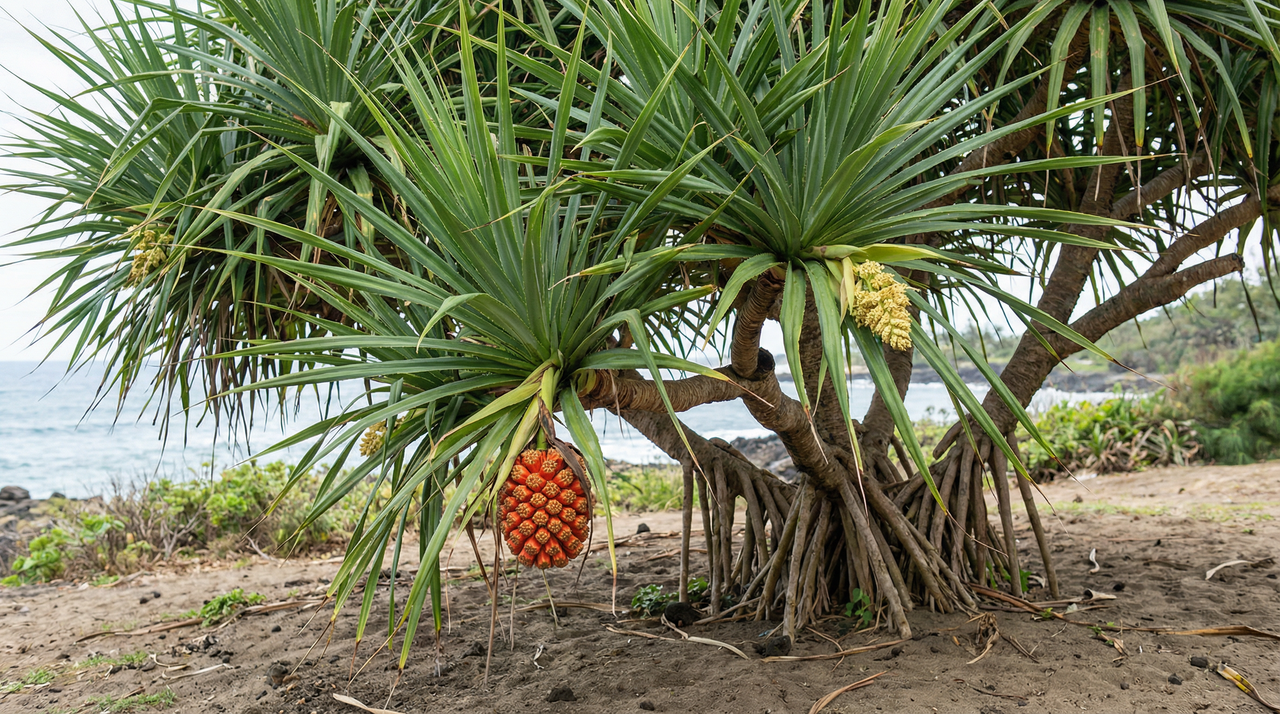
The word "pandan" gets used casually in kitchens and garden centers as though it refers to a single plant, but it's really a shorthand for a genus of over 700 species scattered across the tropical Indo-Pacific. Three of them dominate the conversation. Pandanus tectorius, known as hala in Hawaii and screwpine across the Pacific, is the coastal giant: a dioecious shrub or small tree reaching 6 to 10 meters, propped up by stilt roots in shifting sands. Its leaves spiral outward in a dense crown that gives the whole plant a silhouette you don't forget once you've seen it against a shoreline.[2][3] Then there's Pandanus conoideus, buah merah, towering 10 to 15 meters in the lowland rainforests of New Guinea and producing fruit so massive it looks almost improbable.[4] And finally, Pandanus amaryllifolius, the compact 1 to 2 meter culinary shrub whose leaves have flavored Southeast Asian food and ritual for thousands of years.[5] Three very different plants, one ancient evolutionary playbook.
Botanical Characteristics and Life Cycle of Pandanus Species
Hala's native range stretches from East Africa and the Indian Ocean islands through Southeast Asia all the way to Hawaii, Fiji, and Samoa, always hugging coastlines with sandy, saline soils and full sun.[6] Buah merah stays closer to home in the lowland coastal forests of Papua New Guinea, western Papua, and the Solomon Islands.[4] Pandan leaf is a creature of swamps, riparian zones, and disturbed lowland rainforests in Malaysia, Indonesia, and Thailand, tolerating elevations up to about 500 meters.[7]
All three are dioecious, meaning separate male and female plants, and only the females produce fruit.[8] For growers used to self-fertile trees, that detail matters a lot. Hala grows at a moderate clip of roughly 0.5 to 1 meter per year and won't hit sexual maturity for 5 to 10 years in the wild, though cultivated specimens can sometimes fruit in 3 to 4 years.[9] I've learned to be patient with slow-maturing perennials like this, and I always interplant with faster-producing species so the food forest stays productive while the long-term structure develops. The payoff for waiting is real longevity: hala can live 50 to 100 years or more under good conditions, flowering and fruiting repeatedly without senescing.[10][11] Pandan leaf clumps tend to live 10 to 25 years and benefit from periodic division; buah merah sits somewhere between the two.[12]
Visual Characteristics and Identification of Hala, Buah Merah, and Pandan Leaf
A mature hala is hard to mistake for anything else. The trunk is short and fibrous, the prop roots spread outward like a living tripod to anchor the tree in loose coastal sand,[2] and the crown is packed with up to 100 long, sword-shaped leaves arranged in tight spirals that give the whole canopy a pineapple-like density.[13] Those leaves run 1.5 to 3 meters long, leathery and glaucous, with sharply serrated margins that can draw blood if you're not paying attention.[13] The fruit is a spherical syncarp, 8 to 20 centimeters across, made up of dozens of wedge-shaped drupes that ripen from green through yellowish-orange to vivid red, each one hiding a single hard seed.[14] Buah merah takes that fruit form and scales it dramatically: conical-cylindrical syncarps up to 40 centimeters long and weighing 2 to 7 kilograms, bright red, unmistakable in the rainforest understory.[15]
Pandan leaf (P. amaryllifolius) is a different creature entirely. It tops out at 1 to 3 meters, rarely branches, and almost never flowers in cultivation.[16] The giveaway for identification is the leaves themselves: shorter (30 to 90 centimeters), flexible, with smooth margins instead of the tooth-edged blades of its relatives, and a fragrance when crushed that's immediately distinctive.[17] I've crushed the leaves myself in a nursery and understood on the spot why this plant earned such a central place in Southeast Asian cooking. It doesn't smell like vanilla, despite what some sources claim; it's grassier, nuttier, more popcorn-like, caused by a compound called 2-acetyl-1-pyrroline.[18] Once you know that, the vanilla comparison stops making sense entirely.
Traditional and Cultural Significance Across the Indo-Pacific
In Hawaii, hala isn't just a coastal tree; it's a kinolau, a physical manifestation of the deity Kane.[10] The long leaves, called lau hala, have been stripped, soaked, and woven into mats, baskets, hats, and thatch for generations, with the craft carrying deep social and spiritual meaning alongside its practical utility.[19] Across the Pacific, that relationship between screwpine and human survival goes back a very long time. Learning from Pacific and Southeast Asian knowledge keepers directly, rather than flattening their traditions into bullet points, is how we actually honor this kind of history.
In Papua New Guinea and Indonesian Papua, buah merah sits at the center of ceremony and sustenance simultaneously: a food staple after proper processing, a pigment for body painting, and a symbol of vitality and fertility woven into communal harvesting events.[20] Pandan leaf's story reaches back even further. Archaeological pollen and phytolith evidence links its use to around 2000 BCE, tied to Austronesian migrations across Southeast Asia.[21] For over two millennia, its leaves have appeared in Buddhist and Hindu rituals, wedding ceremonies symbolizing purity and fertility, spirit houses, and food offerings, alongside medicinal applications for digestive complaints, wounds, and rheumatism.[21] All three species are currently assessed as Least Concern on the IUCN Red List,[22] but that status doesn't erase localized pressures from coastal development, overharvesting, and the low genetic diversity common in widely cultivated pandan leaf. When I source these plants, I prioritize nurseries propagating from cultivated stock rather than wild-collected material, and I'd encourage anyone growing them to do the same.
Fun Facts and Ecological Role of Pandanus
The prop roots aren't just striking to look at; they're genuinely functional, anchoring the tree against high winds and tidal surge in the loose, sandy soils where hala thrives.[2] That coastal role extends outward into the broader ecosystem: hala's root mats stabilize dunes and beaches, its syncarps feed birds and bats that disperse the seeds, and the plant forms mycorrhizal associations that improve phosphorus uptake in the nutrient-poor soils it typically colonizes.[23][24] As a windbreak and storm buffer in permaculture designs, it earns its space several times over.
With extreme longevity documented under favorable conditions,[25] which is a good reminder that planting one is a long-term commitment and, in the right climate, a genuine legacy tree. Its strict tropical nature limits outdoor cultivation in the United States,[22] and it's worth noting that escaped populations have become invasive in some Pacific areas outside its native range, so placement and containment matter in marginal zones. The culinary pandan leaf, by contrast, stays compact and manageable, while buah merah stays firmly in its New Guinea rainforest niche, producing those improbable 2 to 7 kilogram red fruit with a flavor often compared to pineapple or guava.[26] Three plants, three distinct niches, and a shared lineage that has shaped coastlines and cultures across half the planet.
Pandan Varieties and How to Source Them
If you're expecting a tidy catalog of named cultivars, Pandan is going to surprise you. Pandanus tectorius has few formally registered horticultural cultivars; most of the diversity you'll encounter lives in botanical varieties and regional landraces rather than anything a breeder has released with a trademark name.[27] That's not a limitation so much as a reality check: choosing a pandan for your garden is really about matching the plant's natural form and traits to what you need it to do.
Notable Varieties and Landraces of Pandanus tectorius
Kew recognizes three subspecies of Pandanus tectorius based on morphological and geographic variation: ssp. justericensis, ssp. androsacemorphus, and ssp. tectorius.[28] Below that level, botanical varieties give growers the most practical handles: var. tectorius is the broad-leaved standard form reaching 10 to 15 meters, var. laevis has notably smoother leaves, var. angustifolius runs narrow-leaved, and var. sampsonii stays compact as a dwarf form.[29][30] For weaving, broader leaves give you more material to work with. For tight urban sites, var. sampsonii is worth hunting down.
Hawaii adds one more distinction worth knowing: a red-fruit landrace that differs visibly from the common yellow-fruited form and reflects centuries of selection by indigenous growers.[31] In my experience, the deeper red color in fruit from certain provenances tends to correlate with richer flavor in traditional preparations, so if you're sourcing for cultural or culinary purposes rather than pure ornament, it's a meaningful distinction to ask your nursery about.
The genus-wide pattern holds for the other two economically important species. Pandanus amaryllifolius has no recognized subspecies or commercial cultivars, but Southeast Asian landraces differ measurably in leaf width, aroma intensity, and growth habit; Malaysian strains are generally considered more aromatic than Thai ones.[32][33] Pandanus conoideus follows a similar logic, with New Guinea landraces selected for fruit color, oil yield, and beta-carotene content; deep red fruits carry higher antioxidant value, and highland forms tend toward elongated cylindrical fruit while coastal forms run rounder.[34] None of this diversity comes through formal breeding programs. It's all farmer selection, climate, and time.
Where to Buy Pandan Plants and Seeds
For US growers, the easiest entry point is Pandanus amaryllifolius. Specialty suppliers like Logee's and Tropica Nursery carry it regularly, and small plants or cuttings typically run $5 to $15, with larger potted specimens around $20 to $50.[35] I always inspect incoming nursery plants carefully before they come anywhere near my other stock. Mealybug colonies hide deep in the leaf bases and are easy to miss if you're just glancing at foliage; I've developed a quick dip-and-inspect routine that has saved me from more than one infestation. Look for vibrant green leaves, sturdy stems, and white fibrous roots, and pass on anything showing leaf spot, scale, or that telltale waxy residue.
Hala (Pandanus tectorius) is available through Hawaiian native-plant nurseries like Hui Ku Maoli Ola and seed suppliers like Sheffield's Seed Company, as well as select Florida and California growers.[36][37][38] Seed packets generally run $5 to $15 for 10 to 20 seeds, young plants $20 to $50, and 3 to 5 gallon specimens $100 to $300. Buah Merah (Pandanus conoideus) is genuinely rare in US commerce; Rare Palm Seeds and Maui Fruit Trees carry it occasionally at $20 to $50 per seed packet or $30 to $200 for plants, with availability limited by tropical-fruit import regulations.[39][40]
Before you order anything across state or national lines, check the regulatory picture. Any Pandanus import into the US requires a USDA APHIS permit and phytosanitary certificate, and fruits may need fumigation or cold treatment.[41][42] A permit delay once cost me an entire growing season, so I now check current APHIS rules before every international order rather than assuming last year's process still applies. Beyond federal rules, Hala carries invasive designations in Hawaii and parts of Florida, which add state-level restrictions; California follows federal rules and does not currently list it as invasive.[43][44] And wherever you source from, all three species are strictly tropical, surviving only in USDA zones 10 to 12, which limits realistic outdoor cultivation to southern Florida, Hawaii, and coastal southern California.[45][46]
Pandan Propagation and Planting Guide (Pandanus tectorius)
Understanding Pandan Seeds: Polyembryony, Morphology, and Recalcitrant Nature
Pandan seeds are genuinely strange, in the best botanical way. Pandanus tectorius produces polyembryonic seeds, meaning each one can carry multiple embryos, some sexually produced and some clonal copies of the mother plant.[47][48] That sounds promising until you factor in that Hala is dioecious, so any zygotic embryos carry mixed parentage from cross-pollination.[49] The result is seedling populations that vary widely in form, vigor, and (for culinary selections) aroma. The seeds themselves are encased in a hard, woody endocarp roughly 1 to 2.5 cm long with a tough fibrous shell that does not give way easily.[50][51] Compound that with recalcitrant seed behavior: Hala seeds lose viability fast once they dry below 20 to 30 percent moisture content, so they can't be stored like most temperate seeds.[52][53] I learned this the hard way with a batch I held too long; viability dropped sharply within just a few months. Now I either use seeds fresh from the fruit or, more often, I skip seeds entirely.
Vegetative Propagation Methods for Reliable Results
For anyone growing pandan for landscape or culinary purposes, offsets and stem cuttings are the practical answer. Sucker division consistently delivers success rates above 80 to 90 percent, and stem cuttings taken at 12 to 18 inches with pre-existing aerial roots perform just as well in warm, humid conditions.[54][55] Temperatures of 21 to 29°C with humidity around 80 to 90 percent are ideal for rooting, which in Florida means summer is your friend. In my experience, offsets from established Hala show aerial roots within just a few weeks of separation in warm, humid conditions; once I see a solid root system developing, usually around four to six weeks, I pot them up with confidence.
Unlike Hala, Pandanus amaryllifolius (the fragrant leaf pandan most people grow for cooking) is essentially sterile in cultivation and depends entirely on suckers for propagation.[56][57] Hala gives you the choice between seeds and vegetative methods, but I still reach for offsets first for the simple reason that they stay true to the parent's form and, where aroma matters, its scent. Air layering is possible but takes four to six months to root, making it a last resort when suckers aren't available.[58]
Seed Germination Timeline and Techniques
If you want to grow Hala from seed for genetic diversity or restoration work, soak seeds for 24 to 48 hours before planting in a well-draining medium under partial shade at 25 to 30°C. Fresh seeds germinate in two to six weeks, though some lots take up to three months, with success rates of 50 to 90 percent when seeds are truly fresh.[59][60] Scarification or a gibberellic acid soak can help break dormancy on harder seeds. Once germinated, the real patience test begins: seed-grown Hala typically takes 5 to 10 years to reach fruiting maturity, compared to 3 to 5 years for vegetatively propagated plants.[8][57] For zone 9B growers, acclimate seedlings gradually from shade to sun over the first two to three years before moving them to a permanent site.
Soil, Site Selection, and Planting Requirements
Hala is a coastal species by evolution, and its soil preferences reflect that. It wants sandy or loamy, well-drained ground with a pH anywhere from 5.5 to 8.0, with an optimal range of 6.0 to 7.5, and it will not tolerate prolonged waterlogging. Sitting in heavy clay or poorly drained soil opens the door to Phytophthora root rot, which I've seen take plants down surprisingly fast.[61][62][63] The prop root system needs loose, aerated soil at least 60 to 90 cm deep to spread properly. On sandy Florida sites I've amended with 5 to 10 percent organic matter to improve nutrient retention and hit that 6.0 to 7.5 sweet spot; a quick soil test before planting saves a lot of troubleshooting later, especially since pH extremes show up as chlorosis or micronutrient lockout. Full sun is ideal (at least six hours daily), though partial shade prevents leaf scorch in intense heat.[2][59] Once established, Hala handles salt spray, wind, and drought with ease, but consistent watering during the first growing season makes a real difference in how quickly the plant anchors itself.
Spacing, Technique, and Timeline to Maturity
Hala gets big, and its prop roots need room to radiate outward without crowding neighboring plants or structures. For landscape plantings, 10 to 20 feet between specimens is the standard, reflecting its mature height of 20 to 30 feet and spread of 13 to 20 feet.[64][65] In windbreak or guild designs I usually go with 15 feet, which gives enough clearance for understory companions to establish without competing with the root architecture. Pandan Leaf, being a clumping shrub that tops out around 1 to 2 meters, can be planted much closer together at 60 to 90 cm for leaf production or 1 to 2 meters for a more open hedge.
Spring or the start of the wet season is the best time to get plants in the ground in frost-free areas, giving them maximum warm weather to root before any dry season stress.[66][67] Dig a generous hole, amend with compost, and water regularly through establishment. Growth is moderate to fast once roots are settled, and vegetatively propagated plants reach useful, harvestable size noticeably faster than seedlings. Going in with realistic expectations about that 3 to 10 year window, depending on species and propagation method, makes the whole experience more rewarding than frustrating.
Pandan Care Guide: Growing Pandanus tectorius Successfully
Every care decision I make for Pandanus tectorius starts with the same mental image: a mature hala tree gripping a windswept Pacific shoreline, roots splayed into coral sand, leaves lacquered against salt spray. That plant asks almost nothing from its environment. Once you internalize that image, the care guide practically writes itself.
Sunlight Requirements for Pandan
Hala wants at least six hours of direct sun daily, mirroring its open coastal habitat.[68][59] In very hot inland sites, some afternoon shade helps, especially for young plants that haven't yet built up their waxy, thick-leaved armor. That cuticle and the elegant spiral leaf arrangement that gives the genus its "screw pine" nickname both evolved specifically to manage intense coastal light, reducing photoinhibition and minimizing self-shading simultaneously.[2] A mature specimen handles bright conditions gracefully because of these built-in adaptations; a seedling moved abruptly from a shaded nursery to full Florida sun will not.
Diagnose light problems early. Too little sun produces elongated, pale stems and washed-out leaf color; too much, without gradual acclimation, scorches the tips and margins brown.[69] If you're growing P. amaryllifolius (the aromatic cooking pandan) indoors, filtered light or a grow light is usually the better fit since it evolved under jungle canopy rather than coastal glare.
Watering Needs and Drought Tolerance
The coastal ecology tells you most of what you need to know about how to water pandan. Mature plants adapted to free-draining coral sands and periodic drought through deep roots, adventitious prop roots, and thick foliage;[68][53] they can handle dry spells that would flatten less-adapted tropicals. In my sandy Central Florida soil, established plants have come through weeks without rain looking unbothered.
Young plants are a different story. For the first year or two, keep the soil evenly moist but never waterlogged, watering every two to three days during the growing season and letting the top few inches dry before you go again.[2][70] Once established, shift to deep, infrequent irrigation every one to two weeks in dry periods. The symptom pairs are worth memorizing: overwatering shows up as yellowing lower leaves, soft roots, and eventual rot (often Phytophthora); underwatering produces tip browning, leaf curl, and brittleness.[71][72] Don't make the mistake of applying the same watering logic to P. amaryllifolius, which prefers consistently moist soil and humidity well above 60%, being a riverbank plant with low salt tolerance.[56]
Soil, Fertilizer, and Feeding for Pandan
Hala evolved in nutrient-poor coastal sands and oligotrophic environments where leaf-litter cycling does most of the work.[73][74] The ideal pandan plant soil is well-drained sandy or loamy with a pH between 5.5 and 7.5, though it tolerates slightly alkaline conditions up to 8.0 and handles salinity that would kill most ornamentals. Heavy clay is the one thing I'd avoid entirely.
Feeding needs are genuinely modest. A balanced slow-release fertilizer (something like a 10-10-10 or palm-specific 8-2-12) applied two to three times during the growing season is usually plenty.[75][73][63] I use slow-release formulas specifically because quick-release fertilizers build up salts in sandy soil, compounding any existing stress. The potassium component matters more than people expect; it's what bolsters drought and salt tolerance, and in my experience plants supplemented with seaweed extract show noticeably sturdier growth and better leaf color than those on nitrogen-heavy programs. Soil testing has become routine for me after frizzle-top in a young hala taught me how fast manganese deficiency develops in the alkaline pockets of my property.[74][76] Iron deficiency (interveinal chlorosis on new leaves) is the other one to watch in high-pH soils. If you're growing fruit-oriented P. conoideus (buah merah), push the potassium; for P. amaryllifolius leaf production, lean toward nitrogen instead.
Heat and Frost Tolerance
Hala is rated for USDA zones 10a through 12 and handles temperatures from an optimal range of 20-35°C up to about 40-49°C (104-120°F) in mature, established specimens.[63][77] The spiral leaf arrangement and stomatal regulation I mentioned earlier under sunlight are the same traits that help the plant manage heat; the extensive prop root system keeps it hydrated even when surface soils bake. Seedlings and plants in the flowering or fruiting stage get hit harder, so extra shade cloth and consistent deep watering during heat waves make a real difference for anything not yet established.[78][79]
Heat stress reads as leaf-margin browning, chlorosis, and wilting. A two-to-three inch layer of organic mulch over the root zone, deep early-morning irrigation, and a temporary windbreak all help during extreme heat events. Buah merah from the cooler New Guinea highlands struggles above 35°C and shows fruit drop;[80][81] if you're in a truly hot-summer climate, hala is the genus representative you want.
Frost Protection and Cold Weather Care
This is where hala's limitations become concrete. Damage begins below 35°F (2°C), and any prolonged exposure under 41°F is seriously harmful.[68][59] Cold damage shows up as browning or blackening leaf tips, yellowing, wilting, and tissue necrosis advancing from the margins inward, with young plants going down first and wet soil during a cold snap making everything worse.[82][83] I move container specimens indoors before temperatures drop below 50°F, treating them essentially the same way I handle tender gingers during winter. The logic is the same: don't wait for visible damage, and never let them sit in waterlogged soil while it's cold.
For in-ground plants in marginally warm spots, a south-facing sheltered wall, frost cloth or burlap with string lights underneath, and a dry but well-mulched root zone give the best odds.[83] If you're outside zone 10, container growing isn't a compromise; it's the practical strategy. P. amaryllifolius is the most cold-sensitive of the three, showing leaf damage below 50-59°F, so it's container-only almost everywhere in the continental US.
Pruning, Maintenance, and Seasonal Rhythm
Less is genuinely more with pandan pruning. The goal is removing dead, damaged, or diseased fronds at the base with clean, sharp, sterilized shears, never taking more than 20-30% of the canopy at once.[84][85][63] Dry season or post-flowering is the right timing. I learned to stake young leaning trunks only lightly and remove lower leaves gradually rather than all at once; doing it slowly reveals the prop roots as an architectural feature rather than an awkward problem. Space plants 10-15 feet apart in landscape settings and mulch the base well to hold moisture and suppress weeds.[84][63]
Hala is a polycarpic perennial (it fruits repeatedly over a long life) and dioecious, so you'll need both male and female plants for fruit production.[86][87] Good cultivation practices (consistent moisture early on, fertility management, protection from stress) can push maturity to three to four years rather than the longer wild timeline.
Seasonal Growth and Flowering Cycle
In stable tropical climates hala is truly evergreen, with essentially continuous flowering and fruiting and no real dormancy period, though growth slows slightly in cooler months.[88][89] Individual fruits take six to twelve months to develop, with Hawaiian populations showing late summer to fall peak ripening. The progression from seedling to reproductive maturity spans five or more years in wild conditions, though sucker-propagated plants in enriched garden settings consistently fruit earlier in my experience; I've seen them flower in three years with good soil prep and consistent feeding.
P. conoideus takes even longer to fruit from seed (up to twelve years), though suckers again close that gap, while P. amaryllifolius rarely flowers in cultivation at all and is managed entirely as a foliage crop.[59][90] In zone 9B the seasonal rhythm is really defined by winter protection needs; once you've moved your containers indoors or covered your in-ground plants against the occasional frost, these are genuinely low-maintenance, long-lived plants that reward patience with years of bold tropical structure.
Harvesting Pandan (Pandanus tectorius)
When to Harvest Pandan Fruit and Leaves
Hala fruits take their time. From flowering to full ripeness, individual drupes need six to twelve months to develop, and the plant fruits year-round in tropical climates with peak production typically running May through September.[38][91] After several seasons watching mine, I've stopped relying on the calendar entirely. The color shift from green to yellow-orange is your first cue, but it's the loosening of the drupes and the sweet, warm aroma that really tell you the moment is right.[92] Traditional practice calls for picking before the fruit fully drops to the ground, and I think that's wise; fruit that falls tends to bruise on those spiny segments and loses flavor fast.[93]
Fresh pandan leaves from P. amaryllifolius are a different read entirely. You're looking for fully expanded, vibrant green leaves in the 30 to 60 cm range with a firm, smooth feel.[94] In the tropics you can harvest year-round once the plant is established, returning every four to six weeks and pulling just two or three leaves per plant.[95] For Buah Merah (P. conoideus), the target is 80 to 90 percent red coverage with a slight give under pressure and easy drupe detachment; unripe red pandanus is bitter and astringent in a way that's genuinely unpleasant, so patience here really does pay off.[96] Leaf timing for both Hala and culinary pandan traces back to the plant's age at maturity, which is covered in the propagation section.
How to Harvest Pandan Without Damaging the Plant
The first time I cut pandan leaves without thinking about which ones I was taking, the plant sulked for months. I'd nipped too many from the interior whorl. Now I only take outer, mature fronds, four to six per plant annually for Hala, using a sharp knife at the base and targeting leaves with good length and suppleness.[92] Gloves are non-negotiable because those leaf margins are genuinely razor-sharp. For culinary pandan leaves, the same logic applies: cut outer leaves at 30 to 50 cm, leave the inner growth alone, and bundle them loosely for storage. Refrigerate wrapped in a damp cloth for up to a week, or freeze for longer use; tying them in loose knots before refrigerating is a traditional trick that actually helps preserve aromatics.[95][54]
Hala fruit demands gentle hands. The infructescence is spiny and segmented, and bruising happens faster than you'd expect.[97] Rinse the fruit carefully with clean water to clear debris, sort for quality, and store in a cool ventilated spot for up to a week.[98] For Buah Merah, handle even more gently; rinse without soaking, then ripen at 25 to 30 degrees C with good humidity for a few days if needed, or hold at 10 to 15 degrees C for up to two to three weeks.[99] Drying sliced fruit at 50 to 60 degrees C for eight to twelve hours is a solid bridge into longer-term storage and leads naturally into processing.[100]
Expected Yields and Flavor at Harvest
A mature Hala at peak production (somewhere around ten to fifteen years old) can yield twenty to fifty of those distinctive four-to-eight-inch infructescences per year.[38] That's a meaningful harvest, and the flavor reward for getting the timing right is real. Properly ripened Hala fruit is soft, juicy, and fibrous with a lingering sweetness that reads somewhere between pineapple and banana, sometimes with a faint nutty or earthy undertone that fades slowly.[10][101] Raw fruit can irritate the mouth, so cooking is standard practice before eating, and it also brings out the flavor more cleanly.[102] Over-ripe fruit gets mealy quickly, which is exactly why those color-and-aroma cues matter so much in practice.
Buah Merah tells a different story. I haven't grown it myself, but I've eaten properly ripened red pandanus from specialty markets and the contrast with unripe fruit is stark: what starts astringent and bitter becomes creamy, nutty, and mildly sweet, with individual drupes reaching 20 to 50 grams at optimal harvest.[103][104] Cooked, the texture can shift toward something starchy and bread-like, which is a surprisingly satisfying result from a fruit that looks nothing like bread.[105] Every bit of that quality comes down to the cues and the care covered above.
Pandan Preparation and Uses
Culinary Uses and Flavor Profiles of Pandan
Pandanus tectorius offers something genuinely rare: a plant where almost every part contributes to the table. The ripe fruit keys can be eaten raw, and the flavor is hard to describe without sounding like you're inventing something -- sweet and juicy with honest comparisons to pineapple, vanilla, coconut, mango, and banana all landing at once.[10][106] Beyond eating fresh, those fruit keys have been dried into Hawaiian crackseed, pressed into puddings and mochi fillings, fermented into the porridge-like pia, and used as food wrappers across the Pacific for generations.[107][108] The seeds and young leaf hearts are edible too, though the latter needs cooking first.[11] If you're drying fruit for storage, 40-60°C in a solar or mechanical dryer targeting 10-15% final moisture content preserves the most nutritional value, while fermentation and smoking offer alternatives for longer-term keeping.[97]
Young Hala leaves bring a pandan-like fragrance to Pacific cuisines -- not for eating directly, but for infusing, knotting into rice, or blending into flavoring pastes.[106] I've found this principle holds across all the related culinary species too: fresh always wins over dried. Pandanus amaryllifolius leaves, which underpin so much of Southeast Asian cooking (pandan latte, pandan cakes, pandan extract for nasi lemak, cendol, even pandan waffle recipes), deliver a sweet grassy-vanilla aroma with coconut, rose, and subtle citrus notes that fresh leaves simply do better than dried ones, which lose a significant portion of their volatile compounds during drying.[109][110] My standard approach is tying a few fresh leaves into a knot and dropping them into coconut milk as it heats; the scent release is immediate and noticeably stronger than any dried pandan flavoring I've tried.
Buah Merah (P. conoideus) rounds out the culinary picture with its enormous red drupes -- some reaching 6 kg -- and a mild, sweet, nutty flavor with pineapple and almond notes.[111] That fruit is impressively dense in beta-carotene (up to 8000 µg per 100 g), vitamin C, vitamin E, and potassium.[112] The non-negotiable rule: cook it thoroughly. Boiling, roasting, or steaming to neutralize calcium oxalate crystals isn't optional -- skipping that step means mouth irritation and a ruined meal.[113] Traditional Papuan preparation methods exist for exactly this reason, and I follow their lead without exception.
Medicinal Preparations from Pandan
Traditional Pacific preparation methods for Pandanus tectorius lean on two basic techniques: crushing fresh leaves into poultices for topical application to wounds and infections, and boiling roots or leaves into decoctions for internal use, typically around 10-30 g of dried material per 500-1000 ml of water, taken one to three times daily.[114][115] These are ethnobotanical practices with centuries of use behind them, not standardized clinical protocols. For P. conoideus, traditional practice uses decoctions of leaves or fruit boiled 15-20 minutes, while P. amaryllifolius is prepared as a simple infusion of one to two leaves per cup of water, or diluted to roughly 1-2% for topical essential oil applications.[116][117] What I appreciate about these preparations from a design perspective is that plants already doing work in a coastal hedge or windbreak are the same ones you'd reach for to make a decoction -- there's no separation between the productive landscape and the medicine cabinet.
Non-Food Uses of Pandan Leaves, Fruit, and Wood
The non-culinary utility of Pandanus tectorius is, frankly, one of the strongest arguments for including it in any tropical permaculture design. Hala leaves produce strong, flexible fibers that Pacific Island communities have woven into mats, baskets, hats, roofing thatch, and even traditional sails for as long as anyone can document.[118][59] The roots yield natural red and yellow dyes for textile work, and the trunks provide timber for construction, tool handles, and poles.[118] I've incorporated Hala into windbreak guilds specifically because of this pipeline: the plant stabilizes the site, the leaves get harvested for small weaving projects, and nothing goes to waste. P. conoideus and P. amaryllifolius follow a similar pattern across Southeast Asia and Papua New Guinea, supplying leaf fibers for mats, bags, baskets, and decorative handicrafts throughout their home regions.[119]
Traditional medicinal uses extend the non-food picture further: leaf poultices for wounds and infections, root and leaf decoctions addressing pain, rheumatism, and digestive complaints, and the P. conoideus fruit used in traditional practice for hypertension and diabetes management.[119][113] The indigenous knowledge embedded in these uses represents centuries of careful observation, and the preliminary research on antioxidant and anti-diabetic activity is beginning to validate what Pacific and Southeast Asian communities already knew. Having seen lau hala weaving in Hawaiian cultural contexts, I can say that this fiber tradition is not a footnote -- it's a living practice, and growing these plants means participating in that continuum whether you intend to or not.
Pandan Health Benefits and Medicinal Uses
People in the Pacific have known for a long time that pandan is more than a beautiful coastal tree. Across Polynesia, Hawaii, and the Philippines, Hala (Pandanus tectorius) has been applied as poultices for wounds and skin infections, brewed into decoctions for fevers and coughs, and used in medicinal baths for rheumatism and headaches.[120][121][114] That's a broad pharmacopoeia from a single plant, and I find it genuinely exciting that modern labs are starting to ask whether the chemistry backs up the tradition.
Traditional and Scientific Uses of Hala
Preclinical research has found real activity in Pandanus tectorius extracts: anti-inflammatory, antioxidant, antimicrobial action against Staphylococcus aureus and E. coli, and accelerated wound healing in animal models, including faster epithelialization and collagen deposition.[113][122][123] In-vitro studies also show cytotoxic effects on certain cancer cell lines and antidiabetic activity that may help regulate blood glucose.[124][125] The genus picture broadens considerably when you look at close relatives: Pandanus conoideus (Buah Merah) is used in Papua for hypertension, diabetes, and wounds, with ACE-inhibitory and anti-obesity effects confirmed in animal models,[116][126] while Pandanus amaryllifolius leaf extracts show hepatoprotective, sedative, and antidiabetic activities alongside COX-2 inhibition.[127][128]
While I love the traditional Pacific stories about hala for fever and wounds, the honest picture is that almost all of this research is still in vitro or from rodent models, with very limited human clinical trials.[129] I'm genuinely excited to see where clinical studies go, but I'm careful not to overstate where the evidence currently sits.
Key Phytochemicals Across Pandanus Species
The bioactivity makes more sense once you look at what's actually in the plant. Pandanus tectorius leaves and fruit are loaded with flavonoids (rutin, quercetin, kaempferol), phenolic acids, terpenoids like β-sitosterol and lupeol, the alkaloid pandanamine, and essential oils dominated by monoterpenes including α-pinene at up to 30%.[130][131] Leaf extracts measure total phenolics between 45 and 200 mg GAE/g and flavonoids around 20 mg QE/g, which puts the antioxidant potential in genuinely meaningful territory.[130][132]
One thing I've noticed growing Hala in different conditions is how much the chemistry shifts with the environment. Drought stress and high sun exposure measurably increase protective phenolics and antioxidants, and provenance matters too.[133][134] Buah Merah is a different story nutritionally, packing 9,000 to 15,000 IU of beta-carotene and 20 to 30 mg of alpha-tocopherol per 100 g,[135] while pandan leaf's claim to phytochemical fame is its signature aromatic compound 2-acetyl-1-pyrroline alongside quercetin and rutin.[136]
Nutritional Profile of Pandan Fruit
Hala fruit was historically a food of necessity across the Pacific during scarcity, and the numbers explain why it sustained people. Ripe drupes deliver around 82 kcal per 100 g, with 20.7 g of carbohydrates, 4.3 g of fiber, 54 mg of vitamin C, 200 to 300 IU of beta-carotene, and useful amounts of potassium and calcium.[137][138] That vitamin C alongside phenolics and flavonoids (20 to 50 mg GAE/g and 10 to 30 mg QE/g respectively) adds antioxidant value on top of the basic calories.[130] Modest by superfood standards, but meaningful as part of a diverse diet.
Preparation matters here. Steaming or baking retains more water-soluble vitamins than boiling,[139] and I process hala seeds by roasting and leaching before grinding them into flour for baked goods, which reduces potential irritants and unlocks a genuinely nutty flavor. Pandan leaf, by comparison, supplies only 20 to 50 kcal per 100 g and functions primarily as an aromatic rather than a nutritional contribution.[140]
Safety Considerations and Precautions
Pandanus tectorius is not highly toxic. Ripe fruit has been safely eaten across the Pacific and Southeast Asia for generations, animal studies show high LD50 values, and there are no cyanogenic glycosides lurking in the chemistry.[141][142] The risks that do exist are mostly physical and preparation-related. Those leaf spines remind me of agave or yucca edges — serious enough to cut skin and puncture fingers, so I always wear gloves when harvesting because they genuinely mean business.[143] Calcium oxalate crystals concentrate in leaves, stems, and unripe fruit, causing mouth and gastrointestinal irritation if consumed raw; after years of growing Hala, I've learned to harvest only fully ripe, orange-red fruit heads because the unripe ones are noticeably more irritating even to handle.[144] Unripe fruit is also bitter and potentially laxative, seeds need roasting or leaching before eating, and excess Buah Merah intake carries a risk of hypervitaminosis A from its exceptional beta-carotene levels.[145][146]
Pandan leaf (P. amaryllifolius) is considered GRAS for culinary use and safe at normal food amounts in pregnancy and for children, but concentrated extracts and medicinal doses are a different matter.[147][148] If you're on blood thinners or pregnant, please talk with your doctor before using pandan extracts; the mild anticoagulant potential is well documented in the literature I've reviewed, and rare allergic reactions, including contact dermatitis in latex-sensitive individuals, have been reported.[149] The plant's distinctive aroma is your best identification tool; no major toxic look-alikes are commonly reported, but wild harvesting still calls for care.[16]
Pandan Pests and Diseases
Pandan earns its reputation as a low-drama landscape plant. Pandanus tectorius evolved along coastlines where salt spray, wind, and periodic flooding are routine, and it carries that toughness into the garden in the form of sharp marginal spines, fibrous silica-reinforced leaves, and a chemical arsenal of flavonoids, alkaloids, and terpenoids that make it genuinely unappetizing to most chewing insects.[150][151] In my zone 9B Florida designs, established plants look almost suspiciously healthy through most of the year. Almost.
Natural Resistance and Common Insect Pests
Young, stressed, or poorly sited plants are a different story. Pest pressure rises sharply in dense plantings with poor airflow, in container and greenhouse settings, and during the long humid months when everything in a subtropical garden is under some level of insect pressure.[152][153] The usual culprits are scale insects, mealybugs, spider mites, and aphids -- the same sucking insects that plague citrus and palms in my yard -- along with leaf beetles, caterpillars, weevils, and the occasional leaf miner or borer on more established specimens.[154][152] Heavy infestations produce the familiar signs: yellowing, distorted leaves, sooty mold from honeydew, and in severe cases real defoliation.[152][155] Related species show similar patterns -- fruit flies can be particularly damaging on ripening Pandanus conoideus fruit -- but for the aromatic culinary pandan most gardeners are growing, mealybugs and scale are what you'll actually encounter.
Fungal and Bacterial Diseases
Fungal problems are where pandan can genuinely struggle, and every time I've seen serious disease in a planting, water management was the root cause. The main threats are fungal leaf spot (Bipolaris, Curvularia, and Phyllosticta species) and root rot (Phytophthora, Fusarium, and Pythium).[156][157] Leaf spots show up as necrotic brown or black lesions; root rot announces itself through wilting and vascular decline that looks like drought stress until you check the roots.[157][158] After our prolonged summer rains, the leaf-spot lesions I see on stressed plants match exactly what the Hawaii extension literature describes. Bacterial leaf blight and viral issues do occur, but they're uncommon enough that I've never encountered either in a well-managed planting. The real triggers are high humidity, poor drainage, and overwatering -- not the plant's genetics.[159] P. amaryllifolius and P. conoideus share similar vulnerabilities to leaf spots, Fusarium, and anthracnose, often compounded by nitrogen or magnesium deficiency that leaves the plant less able to resist infection.[160] There are no widely available disease-resistant cultivars of P. tectorius to lean on.[161] I've trialed several ornamental variegated forms in client gardens and found no meaningful difference in disease pressure compared to the straight species. Culture is everything here.
Prevention and Integrated Management
I lost a young pandan to root rot in my first year growing it -- planted in a low spot with heavy amended soil, watered on the same schedule as everything else around it. Now every client design that includes pandan specifies raised beds or sandy, well-drained soil, and that single change has made the difference between plants that thrive and plants that sulk.[162] Spacing plants 1 to 5 meters apart for airflow, keeping soil pH between 5.5 and 7.0, and using drip rather than overhead irrigation -- about half an inch to an inch per week during dry periods -- keeps foliage dry and dramatically reduces fungal pressure.[163][162] Remove and destroy infected material promptly rather than letting it sit on the soil. For pests, my default response to mealybugs or scale is releasing ladybugs and applying neem oil at the first sign of trouble. I've rarely needed to go further when the site was chosen correctly.[164] Horticultural oils and insecticidal soaps handle most infestations; copper-based fungicides or metalaxyl enter the picture only for severe disease outbreaks, and always following local regulations.[153] Give pandan well-drained, airy conditions with consistent but never waterlogged moisture, and the pest and disease issues largely sort themselves out.
Pandanus tectorius in Permaculture Design
Hala earns its place in a tropical permaculture design before you've even thought about what it produces. The prop roots, the salt tolerance, the sheer biomass of those spiraling crowns: this is a plant that was solving coastal design problems long before we had a word for permaculture. Getting the most out of it starts with understanding where it genuinely thrives and where you're asking it to stretch.
Climate and Hardiness Zones for Hala
Pandanus tectorius is solidly hardy in USDA zones 10a through 12, with most literature placing the practical range at zones 10-11 for reliable outdoor cultivation.[165][166] It wants optimal temperatures between 24-30°C (75-86°F), high humidity in the 60-90% range, and it will tell you loudly when it's cold: anything below 10°C (50°F) for an extended period causes dieback, and frost is simply fatal.[167][168] I'm in zone 9b in Central Florida, which puts me right at the edge of Hala's comfort zone, and I've learned that lesson firsthand. A rare frost event a few years back took out an unprotected Hala I had in a landscape bed. The Pandanus amaryllifolius I keep in 25-gallon containers on a bright, south-facing lanai? Those sailed through just fine. Container growing isn't a workaround in marginal zones; it's the strategy.
Within its preferred range, Hala is remarkably unfussy about site conditions. It handles full sun to partial shade, grows well in sandy loam at pH 5.5-7.5, tolerates annual rainfall anywhere from 1000-2500 mm, and shrugs off sea spray and brackish conditions that would finish off most other food plants.[169][167][2] Pandanus amaryllifolius is a bit more forgiving at the cool end, occasionally surviving zone 9b with protection, while Pandanus conoideus prefers wetter conditions (2000-4000 mm annually) and is more drought-sensitive, so siting that species requires more moisture planning in any design.[170][171]
Ecosystem Functions and Guild Roles
The prop root system is where Hala's permaculture value becomes impossible to argue with. Those aerial roots anchor the plant into shifting coastal dunes and actively prevent erosion, sequester carbon through substantial biomass accumulation, and create a windbreak effect that protects everything downslope.[172][173] Every time I see it used in coastal restoration work, I think of mangroves: both are architectural stabilizers doing structural ecological labor that no amount of human engineering quite replaces. The leaf litter breaks down to build organic matter in soils that often start as nearly pure sand, which is a slow but meaningful contribution to soil development over time.
The wildlife dimension rounds out the picture. Birds nest in the crown structure, invertebrates shelter among the prop roots, and frugivores from birds to bats feed on the syncarps, making Hala a genuine habitat node rather than just a crop plant.[174] The genus also shows potential mycorrhizal associations, which, if you're thinking in terms of soil biology, means it may be doing quiet work beneath the surface as well.[175]
The dioecious pollination reality is something every grower planting Hala for fruit needs to plan for deliberately. It's primarily wind-pollinated, with fragrant male inflorescences that may pull in supplementary bee and fly pollinators under ideal conditions (25-35°C, 70-90% humidity, full sun).[176][177] I always plan my ratios carefully: one reliable male for every ten females has given me consistent fruit set where random planting has not. If you're working with a small space or an isolated specimen, hand pollination is straightforward and worth learning. Some female plants show parthenocarpy, producing fruit without fertilization, which is worth noting as a selection criterion if you're sourcing plants.[178] If you're in Florida or Hawaii, keep tabs on local extension guidance about naturalized Pandanus. The invasive risk is modest but real, and responsible monitoring is part of growing it conscientiously in those states.
Forest Layer Placement and Companion Strategies
In a food forest layout, Hala sits in the sub-canopy to coastal layer. At 4-14 meters tall with a 4-6 meter spread and those signature prop roots, it's not a specimen you tuck into a tight guild; it wants the windward edge, the salt-spray zone, the transitional space between beach and productive garden where nothing else wants to grow.[179][180] Plant it there, let it do its stabilization and windbreak work, and the more sheltered interior of your design becomes viable for plants with less grit.
The other Pandanus species fill completely different layers and that's what makes the genus so useful for multi-stacked designs. Buah Merah grows palm-like to a 5-8 meter spread in the mid-canopy of rainforest systems, fitting into agroforestry understory where Hala would be too exposed.[181] Pandanus amaryllifolius, with its 50-70% shade tolerance and shallow roots, slots into the low understory or shaded edge with almost no competition pressure on neighbors.[182][183] I've used its spiral rosettes as living mulch under taller banana and palm plantings, and the volatiles from the leaves seem to contribute some pest-deterrent effect in the surrounding microclimate. Whether that's chemistry or coincidence, I've found the combination works well enough to keep repeating it. The contrast between Hala's full-sun coastal niche and the aromatic leaf pandan's preference for dappled shade means these two species genuinely complement each other without fighting for the same spot in a design.
The Plant That Made Me Rethink What "Useful" Really Means
I remember the first time I split open a ripe hala fruit on a beach in Hawaii, juice running down my wrist, and thought: this plant has been doing everything right for thousands of years without any help from me. That's the humbling part. Pandan doesn't need a designer. It just needs someone willing to get out of the way and pay attention.
Sources 183
- Plants of the World Online: Pandanus ↩
- Pandanus tectorius - Plant Finder ↩
- Pandanus tectorius - Kew Science ↩
- Pandanus conoideus - Plants of the World Online ↩
- Pandanus amaryllifolius ↩
- Pandanus tectorius - Plants of the World Online ↩
- Distribution and Native Habitats of Pandanus amaryllifolius ↩
- Pandanus tectorius (Hala, Screwpine) ↩
- Pandanus tectorius (Screwpine) - CABI Compendium ↩
- Pandanus tectorius - Wikipedia ↩
- Pandanus tectorius - Useful Tropical Plants Database ↩
- Pandanus conoideus - Useful Tropical Plants Database ↩
- Pandanus tectorius - Missouri Botanical Garden Plant Finder ↩
- Pandanus tectorius - Kew Science ↩
- Pandanus conoideus ↩
- Pandanus amaryllifolius - Wikipedia ↩
- Pandanus amaryllifolius - Kew Gardens ↩
- Characterization of the Key Aroma Compounds in Pandanus amaryllifolius Leaves ↩
- Traditional Weaving with Pandanus Leaves - Pacific Islands Knowledge Base ↩
- Ethnobotany of Pandanus conoideus in Papua New Guinea ↩
- Pandanus amaryllifolius: Ethnobotany and Cultural Significance in Southeast Asia ↩
- IUCN Red List: Pandanus tectorius ↩
- Symbiotic Relationships and Soil Stabilization by Pandanus in Hawaii ↩
- Ecosystem Services of Pandanus tectorius in Atoll Environments ↩
- Pandanus tectorius (Thatch Screwpine) ↩
- Red Fruit (Pandanus conoideus): A Review ↩
- Missouri Botanical Garden Plant Finder - Pandanus tectorius ↩
- Plants of the World Online - Pandanus tectorius ↩
- Pandanus tectorius in Flora of China ↩
- Pacific Island Agroforestry - Pandanus ↩
- Hawaii Naturalization Survey: Pandanus tectorius ↩
- Pandanus amaryllifolius: The Culinary and Medicinal Pandan Plant ↩
- Genetic Diversity in Pandanus amaryllifolius Landraces ↩
- Pandanus conoideus: Ethnobotany and Potential as a New Crop in Papua New Guinea ↩
- Pandanus amaryllifolius - Pandan Plant ↩
- Native Hawaiian Plants for Sale ↩
- Pandanus tectorius Seeds ↩
- Pandanus tectorius - Thatched Screw Pine ↩
- Pandanus conoideus Seeds ↩
- Red Fruit Pandanus for Sale ↩
- Plant Import Information ↩
- Phytosanitary Certificates ↩
- Hawaii's Most Invasive Plants ↩
- Invasive Plant Inventory ↩
- Pandanus tectorius Plant Profile ↩
- Pandanus amaryllifolius (Pandan) Plant Profile ↩
- An investigation of polyembryony and primary endosperm nuclear division in Pandanaceae ↩
- Polyembryony in the Pandanaceae: A Review ↩
- Reproductive Biology of Pandanus tectorius ↩
- Morphology and Anatomy of Pandanus Fruits ↩
- Seed Characteristics of Pacific Island Plants ↩
- Pandanus tectorius Germination and Storage ↩
- Kew Seed Information Database - Pandanus tectorius ↩
- Vegetative Propagation Techniques for Tropical Palms and Pandanus ↩
- Propagation of Pandanus amaryllifolius by Sucker Division and Tissue Culture ↩
- Pandanus amaryllifolius (Pandan) Plant Profile ↩
- Pandanus tectorius (Screw Pine) ↩
- Tissue Culture of Pandanus Species ↩
- Pandanus tectorius Cultivation Guide ↩
- Germination Ecology of Pandanus Species ↩
- Pandanus tectorius - Plants of the World Online | Kew Science ↩
- Pandanus tectorius (Thatch Screwpine) | North Carolina Extension Gardener Plant Toolbox ↩
- Growing Pandanus in Florida ↩
- Pandanus tectorius - Useful Tropical Plants Database ↩
- Pandanus tectorius (Screw Pine) ↩
- Growing Pandanus in Hawaii ↩
- Pandanus tectorius - USDA Forest Service ↩
- Pandanus tectorius - Missouri Botanical Garden ↩
- Pandanus tectorius Care Guide ↩
- University of Hawaii – Hala (Pandanus tectorius) ↩
- Pandanus tectorius Care Guide - RHS ↩
- Overwatering Symptoms in Screw Pines ↩
- Soil and Nutrient Management for Pandanus in Hawaii ↩
- Pandanus tectorius - Fact Sheet ↩
- Fertilization Guidelines for Tropical Palms and Pandanus ↩
- Micronutrient Deficiencies in Coastal Plants ↩
- Physiological Responses of Pandanus tectorius to Environmental Stressors ↩
- Physiological Adaptations of Coastal Plants to Climate Stress ↩
- Pandanus tectorius Species Profile ↩
- Buah Merah (Pandanus conoideus): Cultivation and Uses ↩
- Physiological Responses of Pandanus amaryllifolius to Abiotic Stresses ↩
- Frost Damage in Tropical Plants ↩
- Pandanus tectorius (Screw Pine, Hala, Screwpine) - North Carolina Extension Gardener Plant Toolbox ↩
- Pandanus tectorius Care Guide ↩
- Pruning Tropical Palms and Similar Plants ↩
- Pandanus tectorius ↩
- Human Impact on Pandanus tectorius in Micronesia ↩
- Pandanus tectorius (Thatch Screwpine) - USDA Forest Service ↩
- Pandanus tectorius - Flora of Hawaii ↩
- Pandanus conoideus (Red Fruit): Cultivation and Uses ↩
- Fruiting Phenology of Pandanus tectorius in Micronesia ↩
- Harvesting and Uses of Pandanus in the Pacific - FAO ↩
- Ethnobotany of Pandanus in the Pacific ↩
- Pandanus amaryllifolius Cultivation Guide ↩
- Cultivation and Harvesting of Pandanus amaryllifolius ↩
- Maturity Indices for Red Pandanus Fruit (Pandanus conoideus Lam.) ↩
- Post-Harvest Management of Tropical Fruits ↩
- Pandanus Utilization in the Pacific Islands ↩
- Post-Harvest Management of Pandanus conoideus ↩
- Processing and Storage of Red Pandanus Fruit ↩
- Edible Pandanus Fruits of the Pacific ↩
- Ethnobotany and Nutritional Value of Pandanus Fruit ↩
- FAO Crop Profile: Pandanus conoideus ↩
- Pandanus conoideus Fruit Ripeness and Sensory Attributes ↩
- Cultivation and Harvesting of Pandanus conoideus in Papua New Guinea ↩
- Edible Pandanus: A Review of Its Uses and Nutritional Value ↩
- Hala Fruit in Hawaiian Culture - University of Hawaii ↩
- Traditional Pacific Island Foods - FAO ↩
- Pandan Leaves (Pandanus amaryllifolius Roxb.) in Southeast Asian Cooking ↩
- Comparison of Fresh and Dried Pandan Leaves: Aroma Profile Analysis ↩
- Fruits of the Pandanus Genus: Morphology, Uses, and Composition ↩
- Nutritional Composition of Red Fruit (Pandanus conoideus Lam) ↩
- Pandanus conoideus: A Review of Its Nutritional and Therapeutic Potential ↩
- Ethnobotany of the Hawaiian Pandanus tectorius ↩
- Traditional Uses of Pandanus in Micronesia ↩
- Ethnobotanical Study of Pandanus conoideus in Papua, Indonesia ↩
- Traditional Uses of Pandan in Southeast Asian Folk Medicine ↩
- Pandanus species in Pacific Island Agroforestry - FAO ↩
- Ethnobotany of Pandanus tectorius in Polynesia ↩
- Ethnobotany of Pandanus tectorius in the Pacific Islands ↩
- Medicinal Uses of Pandanus in the Philippines ↩
- Antimicrobial Activity of Pandanus tectorius Fruit Peel Extract ↩
- Phytochemical and Pharmacological Review of Pandanus tectorius ↩
- Cytotoxic Compounds from Pandanus tectorius ↩
- Antidiabetic Effects of Pandanus Extracts ↩
- Inhibitory Effects of Pandanus conoideus on Alpha-Glucosidase and ACE for Diabetes and Hypertension Management ↩
- Medicinal Uses of Pandanus amaryllifolius in Traditional Malay Medicine ↩
- Antioxidant and antimicrobial activity of Pandanus amaryllifolius leaves ↩
- Pharmacological potential of Pandanus amaryllifolius Roxb – A mini review ↩
- Phytochemical Screening and Antioxidant Activity of Pandanus tectorius Leaves ↩
- Chemical Composition of the Essential Oils of Pandanus tectorius ↩
- Bioactive Compounds from Fruits of Pandanus tectorius ↩
- Phytochemical and Biological Evaluation of Pandanus tectorius Dom. Fruits ↩
- Comparison of the Phytochemical and Antioxidant Activities of the Fruits From Three Different Provenances of Pandanus tectorius ↩
- Nutritional Composition and Antioxidant Properties of Red Fruit (Pandanus conoideus) ↩
- Volatile Compounds in Pandanus amaryllifolius Leaves ↩
- Nutritional Composition of Pandanus Fruit ↩
- Traditional Uses of Hala (Pandanus tectorius) in Hawaii ↩
- Effect of Processing on Nutrients in Herbal Leaves ↩
- Nutritional Composition of Pandanus amaryllifolius Leaves ↩
- Phytochemical and Pharmacological Review of Genus Pandanus ↩
- Toxicity Profile of Pandanus Species ↩
- Pandanus tectorius (Screw Pine) - CABI Compendium ↩
- Calcium Oxalate in Plants ↩
- Edible and Poisonous Plants of the Caribbean - Pandanus tectorius ↩
- Pandanus conoideus (Red Fruit): A Review of Its Phytochemicals and Pharmacological Activities ↩
- Traditional Uses and Safety of Pandanus Species in Polynesia ↩
- Safety Assessment of Pandanus amaryllifolius Leaf Extract ↩
- Screw Pine (Pandanus spp.) Toxicity - ASPCA ↩
- Chemical Composition and Bioactivity of Pandanus tectorius ↩
- Plant Defenses Against Herbivory in Pandanus Species ↩
- Pests and Diseases of Pandanus Species ↩
- Pest Management in Pandanus Cultivation ↩
- Insect Pests of Pandanus in Hawaii ↩
- Pests and Diseases of Pandanus Species ↩
- Fungal Pathogens of Pandanus tectorius ↩
- Diseases of Pandanus Species ↩
- Diseases and Pests of Pandanus in Tropical Asia ↩
- Environmental factors influencing disease development in coastal plants ↩
- Pandanus amaryllifolius (Pandan) Plant Profile ↩
- Pandanus tectorius - Screwpine ↩
- Pandanus Production and Utilization ↩
- Pandanus Diseases and Pests - University of Florida IFAS Extension ↩
- Integrated Pest Management for Pandanus tectorius ↩
- Pandanus tectorius - USDA PLANTS Database ↩
- Screw Pine (Pandanus tectorius) - University of Florida IFAS Extension ↩
- Pandanus tectorius - Useful Tropical Plants ↩
- Hala (Pandanus tectorius) - University of Hawaii ↩
- Royal Horticultural Society - Pandanus tectorius ↩
- Pandanus amaryllifolius - CABI Compendium ↩
- Pandanus conoideus - Useful Tropical Plants ↩
- Pandanus tectorius - Missouri Botanical Garden ↩
- Nutrient Cycling in Pandanus tectorius ↩
- Nutritional Ecology of Pacific Island Frugivores ↩
- Ecological Services of Pandanus Species ↩
- Pollination Biology of Pandanus (Pandanaceae) ↩
- Reproductive Ecology of Screwpines ↩
- Geographic distribution and genetic diversity of the Pacific screw pine, Pandanus tectorius ↩
- Missouri Botanical Garden: Pandanus tectorius ↩
- University of Florida IFAS Extension: Pandanus tectorius ↩
- Agroforestry Systems for Tropical Lowlands ↩
- Ecology of Pandanus in Papuan Forests ↩
- Erosion Control Plants in Tropics ↩