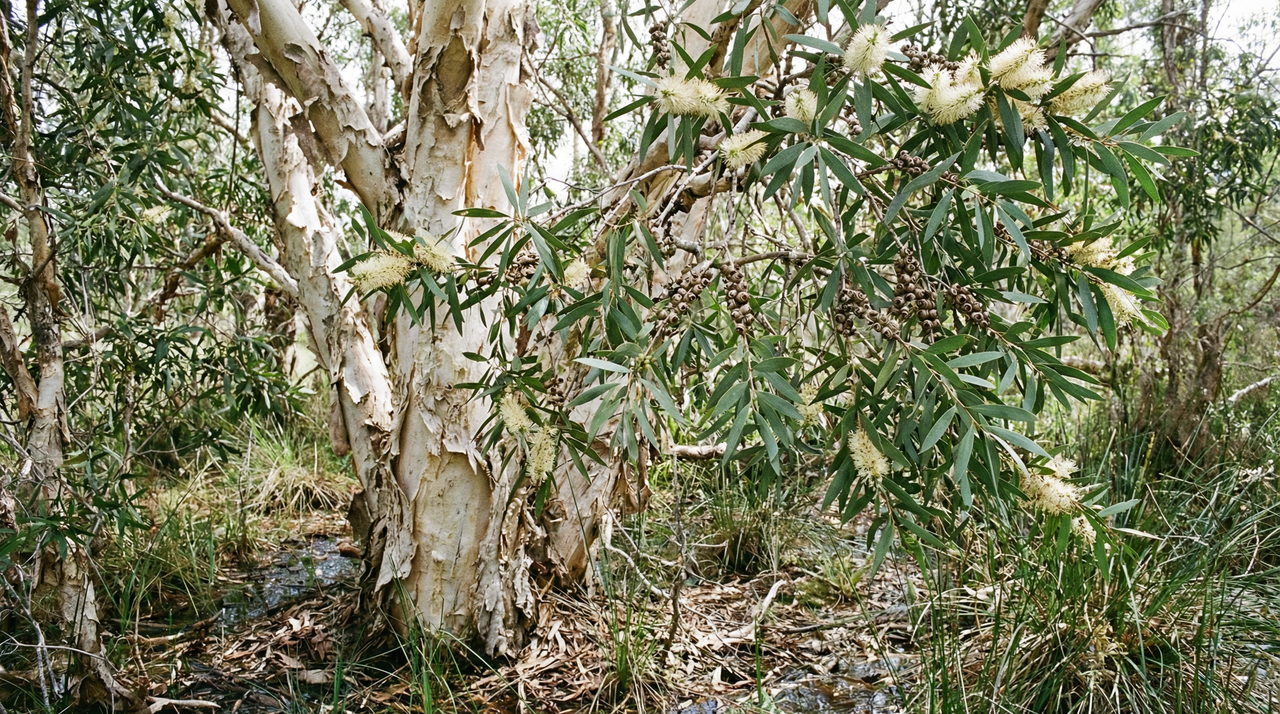
The bark peels off in your hands like layers of old paper, pale and soft and slightly warm from the sun, and the first time it happened to me I genuinely thought I'd damaged the tree. I hadn't. That's just what Melaleuca leucadendra does. The paperbark sheds its outer layers continuously, building up a thick, spongy, cream-colored trunk that's almost unsettling to touch, more insulation than wood. Aboriginal Australians figured out centuries ago that those sheets of bark were essentially nature's packaging material: waterproof enough to wrap food, flexible enough to shape into containers, soft enough to line a baby's cradle.[1] The tree was handing people a resource, and they took it.
Here's the contradiction that keeps pulling me back to this plant: it's one of the most ecologically generous trees I've ever worked with, a pollinator magnet, a wetland stabilizer, a source of genuinely useful medicinal oil, and in the wrong place it's a Category I invasive that has swallowed thousands of acres of Florida Everglades.[2] Same traits. Same fast growth, same fire-adapted seed release, same tolerance for the wet and difficult places other trees abandon. The line between treasure and ecological opportunist turns out to be mostly geography.
Paperbark Origin and History
Botanical Background and Lifecycle of Melaleuca leucadendra
Melaleuca leucadendra, the weeping paperbark, is a fast-growing evergreen that can push 25-30 meters tall in optimal conditions with a lifespan of 50 to 100 years, sometimes stretching past 150 under the right circumstances.[1][3] It's native to coastal northern Australia from Queensland through the Northern Territory, plus Papua New Guinea and parts of Indonesia, where it settles into freshwater swamps, riverbanks, and seasonally flooded coastal plains, typically below 300 meters elevation in tropical monsoon climates receiving 1,000-2,500 mm of rainfall annually.[4][5] Those monsoonal conditions aren't just a preference; they're the engine behind everything the tree can do.
The tree is polycarpic, flowering repeatedly throughout its life, and reaches sexual maturity around 3-5 years after germination, slightly later than close relatives like M. quinquenervia or M. cajuputi, which get there at 2-4 years.[1][6] I've noticed a similar maturity curve when growing other Myrtaceae from seed; that 3-5 year window before meaningful flowering always feels longer in anticipation than it turns out to be in practice. The species also spreads vegetatively through root suckering in wet conditions and carries serotinous woody capsules that hold onto seed until fire triggers release, a survival strategy backed by papery insulating bark that shields the cambium from heat.[7][8]
Melaleuca leucadendra sits within a genus of roughly 230 species ranging from shrubs barely a meter tall to tall wetland canopy trees.[9][10] The broad-leaved paperbark (M. quinquenervia) of eastern Australian coastal lowlands and cajuput (M. cajuputi) of Southeast Asia share many of these adaptations, while shrubby relatives like M. sapida cap out at 1-6 meters.[11][12] Longevity across the genus varies considerably; invasive Florida populations of M. quinquenervia often live only 30-70 years, a reminder that a tree outside its native context isn't quite the same organism.[13][14]
Visual Characteristics of Paperbark
In cultivation, weeping paperbark typically reaches 9-15 meters, though wild specimens in ideal wetland conditions can double that, with drooping branches and a broad spreading canopy that's often multi-trunked at the base.[15][16] The bark is the feature that stops people in their tracks: soft, white to pale cream, fibrous, and peeling away in thin papery sheets, which is exactly how the entire genus earned its common name.[15][17] Having handled it at Australian botanic gardens, I can tell you it feels almost like layered chamois leather, unexpectedly soft and pliable for something growing on a tree trunk. That texture immediately explains centuries of practical use.
The leaves are alternate, lanceolate to elliptic, 3-11 cm long, leathery and green, simpler in appearance than cajuput's narrower oil-gland-dotted foliage or the prominently three- to five-veined leaves of M. quinquenervia.[18] Flowers come in creamy white to pale yellow cylindrical spikes, 5-8 cm long, densely packed with stamens in that classic bottlebrush arrangement bees find irresistible, followed by persistent woody capsules 3-5 mm across holding tiny winged seeds just 1-2 mm long.[1][15] The root system is fibrous and wide-spreading with no dominant taproot, anchored partly by adventitious roots from the trunk base that help stabilize the tree in waterlogged ground.[19][4] It sometimes gets confused with willows or even paper birch at a distance, but the pendulous branches combined with that layered white bark and multi-veined leaves make identification straightforward once you know what you're looking at. Common names include Weeping Paperbark, White Swamp Paperbark, Long-leaved Paperbark, and Cajeput Tree.[1][17]
Traditional and Cultural Uses of Paperbark
Aboriginal peoples including the Kuku Yalanji and Gunggudj have used the bark of M. leucadendra for containers, food bundles, baby carriers, and as a writing surface, while leaf infusions and decoctions addressed respiratory complaints, skin infections, rheumatism, and muscular pain.[20][21] That soft, water-resistant, easily peeled bark is almost too perfectly suited for those purposes, a piece of low-tech engineering that took no modification at all. Seeing traditional paperbark artifacts in Australian botanical collections genuinely changed how I think about multifunctional plants; it's a reminder that Indigenous knowledge and plant morphology have been in conversation for thousands of years.
Across Southeast Asia, Dayak communities in Indonesia and Orang Asli peoples in Malaysia have long distilled cajuput oil from the leaves of the closely related M. cajuputi, using it as an antiseptic and anti-inflammatory treatment for headaches, skin conditions, and infections, with the tree also appearing in protective rituals and folk symbolism.[22][23] Across both continents the tree figures in ceremony and story as a symbol of resilience in difficult wetland environments, a cultural reading that maps fairly directly onto its ecology.[24]
Fun Facts About Paperbark Trees
The bark's insulating layers do double duty: they protect the cambium during wildfires, and when fire finally does its work, serotinous capsules open to drop enormous quantities of tiny winged seed onto nutrient-rich ash beds, enabling rapid post-fire regeneration.[25][26] Learning that changed how I think about disturbance ecology in permaculture systems generally. Fire isn't just destruction; for a tree like this, it's a recruitment strategy.
Then there's the Florida situation. M. leucadendra and especially M. quinquenervia are listed as Category I invasives by the Florida Exotic Pest Plant Council, forming dense monocultures in the Everglades that push out native species.[27][28] And yet, a 72-foot-tall specimen with a 216-inch circumference holds champion-tree status in that same state.[29] Having watched paperbark stands crowd out native vegetation in person, I now approach any Melaleuca outside its native range with real caution. The very traits that make it magnificent at home, its fire-triggered seed release, its tolerance for standing water, its sheer productivity, are exactly what make it ecologically reckless in the wrong place. Right plant, right place isn't a bumper sticker when you're talking about this genus.
Paperbark Varieties and Where to Buy
Recognized Varieties of Melaleuca leucadendra
First, a quick name correction that trips up a lot of gardeners: the accepted botanical spelling is Melaleuca leucadendron, not leucadendra, though you'll see both versions floating around in nursery catalogs and plant databases.[30][1][31] Unlike many popular ornamentals, this species doesn't have a parade of named cultivars with clever marketing. What it does have are three recognized botanical varieties that gardeners and oil producers actually work with: var. leucadendron (the typical form), var. argentea with its distinctly silvery-white foliage, and var. nana, a compact dwarf form for tighter spaces.[30][1][31]
Of these, var. argentea is the one I'd steer most gardeners toward. I've seen both the silver and standard green forms growing in Florida subtropical gardens, and the silver foliage is genuinely striking the way it catches and reflects intense summer light. It also happens to be the highest-yielding variety for essential oil, reaching up to 3% dry weight with notably high 1,8-cineole content, which matters if you're growing this tree with any eye toward cajeput oil production or medicinal harvesting.[32] Ornamental value and practical chemistry don't always align so neatly, so when they do, I pay attention.
For genus-level context, the close relative Melaleuca cajuputi shows just how much range this group has: its three subspecies span Indonesia and Malaysia (subsp. cajuputi, the primary commercial cajuput oil source), the Philippines (subsp. cumingiana, grown more for ornamental foliage), and northern Australian wetlands (subsp. platyphylla, with broader leaves).[33][34] The anchor species stays fairly true to form by comparison, which makes varietal selection simpler even if the options are fewer.
Sourcing Paperbark Plants and Seeds
In the US, weeping paperbark is available primarily through Florida and southern-state nurseries, with 1 to 5 gallon plants typically running $10 to $50 and seed packets of 20 to 100 seeds coming in around $3 to $15 from botanical seed suppliers. Nurseries worth checking include Plant Delights, Moon Valley Nurseries, Treeworld Wholesale, Top Tropicals, Logee's, and Sheffield's Seed Company, though some Florida vendors limit shipping to in-state customers because of agricultural regulations. I've ordered Melaleuca seed from specialty suppliers more than once, and my advice is to always ask about provenance: oil content and growth habit vary noticeably between northern Australian and Indonesian stock, and that difference matters if you have specific goals for the tree.
One thing I always tell clients before they order: double-check your state's current invasive species list, because the difference between weeping paperbark and the prohibited broad-leaved paperbark is only a few letters on a label, and the legal and ecological consequences are enormous. Melaleuca leucadendron is not listed as invasive or a noxious weed on federal lists or in Florida, and it's legally distinct from Melaleuca quinquenervia, the broad-leaved cajeput tree that is a Category I invasive banned from sale, possession, and transport in Florida and listed as a federal noxious weed.[35][36][37][38] Verify before you buy, every time.
How to Propagate and Plant Paperbark (Melaleuca leucadendra)
Paperbark is one of those plants where understanding how it reproduces in the wild tells you almost everything you need to know about propagating it in cultivation. This is a fire-adapted wetland tree that has spent millennia timing its seed release to post-burn mineral soil and seasonal flooding, and that ecology shows up clearly once you start working with its seeds.
Propagation Methods for Paperbark
The seeds themselves are tiny, roughly 0.5 to 1 mm long and ellipsoid to ovoid, with orthodox storage behavior meaning they dry and store reasonably well for one to five years under cool conditions.[39][1][40] Because they need light to germinate, surface-sowing on a moist, well-drained mix at 20 to 25°C is the right move; don't cover them. Under those conditions, germination runs 70 to 90% in controlled settings and sprouts typically appear within two to four weeks.[1][41] If your rates are lower, scarification, a 24 to 48-hour hot-water soak, or smoke treatment can break dormancy by mimicking fire cues and push germination substantially higher.[42][43] I started using smoke water after visiting Australian native plant nurseries a few years back, and I've since applied it to several Myrtaceae with genuinely good results. It sounds fussier than it is.
That said, seed-grown paperbark is genetically variable, which matters if you're after specific oil profiles or ornamental traits. For uniformity, semi-hardwood cuttings (10 to 15 cm, treated with IBA rooting hormone), air layering, grafting, or tissue culture via MS medium with BAP and NAA all produce true-to-type plants and get you to harvest maturity faster.[41][44][45] In humid subtropical summers I find semi-hardwood cuttings more reliable than air layering simply because the ambient moisture helps the wound callus without requiring constant attention to the layering wrap. The main risks across all methods are damping-off, Phytophthora root rot, and fungal issues in poorly ventilated setups, so sterile media and sanitation matter from day one.[46][47] One practical note I give everyone who starts these from seed: label your rows immediately. Young Melaleuca seedlings look remarkably similar to related bottlebrushes and tea trees at the cotyledon stage, and a mixed-up tray costs you months.
Before going any further, I have to say this plainly. In Florida and similar regions, Melaleuca leucadendra is regulated as invasive and permits may be required to propagate or plant it.[48][49] Having watched these trees naturalize in local wetlands, I don't treat that warning as theoretical. If you're in Florida, check your county regulations, and lean hard toward sterile cultivars if you're going to plant at all.
Soil, Site Selection, and Sun Requirements
Paperbark wants full sun, at least six to eight hours of direct light daily, because it comes from open swamp and floodplain habitats where it grows into the canopy rather than under it.[50][16] Juveniles will tolerate some shade, but if you're choosing a site, don't compromise on light; it's the single biggest determinant of establishment speed. On soil, the species is genuinely flexible: sandy, loamy, clay, saline, and periodically waterlogged soils all work, with an optimal pH of 5.5 to 7.0 and a tolerated range from 5.0 to 8.0.[51][16] Push above pH 7.5 and you'll start seeing iron chlorosis; the leaf yellowing that shows up on alkaline sites is one of the first things I look for when assessing a client landscape, and it usually means a sulfur amendment or chelated iron application is warranted before you even think about planting. Below pH 5.0, aluminum toxicity becomes the problem. Stay in the middle of that range and the tree is remarkably forgiving of everything else.
Consistent moisture during establishment reflects the tree's native wetland origins, so don't let young plants dry out, even if the site drains freely.[16][1] A thick mulch layer helps enormously with moisture retention while the root system is getting established, and gradual acclimation to full sun prevents transplant shock in exposed sites.
Spacing, Planting Technique, and Establishment Timeline
Generous spacing isn't optional here. Paperbark matures to 30 to 50 feet with a shallow, spreading root system that limits later pruning options, so the spacing you choose at planting is essentially the spacing you're committing to for the life of the tree.[52][53] For specimen trees, 20 to 30 feet between plants; for windbreaks or landscaping, 10 to 20 feet; for agroforestry rows, 5 to 10 meters between rows; and for hedging purposes, 1 to 2 meters in-row.[54] Crowding these trees creates maintenance problems and, in Florida, amplifies the invasive pressure on adjacent natural areas.
Plant in spring after last frost, roughly March through May in zone 9, with seedlings at four to six inches tall.[55] Deep water every one to two weeks for the first year or two, apply four to six inches of mulch, and protect young plants from frost in marginal zones.[1][56] Once the characteristic papery bark starts developing and the tree pushes vigorous new growth, you'll know the root system has found its footing. Under good subtropical conditions that can happen surprisingly fast: growth runs one to two meters per year once established, and leaf oil harvest can begin from year three onward, with vegetatively propagated plants reaching that window earlier than seed-grown ones.[57][58] That payoff window is worth keeping in mind when you're debating whether the extra effort of taking cuttings from a known-quality parent plant is worth it. Usually, it is.
Paperbark Tree Care Guide
Growing Melaleuca leucadendra well is mostly a matter of thinking like a wetland. This tree evolved in the monsoonal floodplains and coastal swamps of northern Australia and Southeast Asia, and nearly every care decision you make gets easier once you internalize that context. Get the light, water, and nutrient balance right, and the paperbark tree's growth rate is genuinely impressive. Push it into shade, cold snaps, or rich soil, and you'll spend the season troubleshooting problems that were entirely avoidable.
Sunlight Requirements for Melaleuca leucadendra
Paperbark is a full-sun tree, period. It needs 6 to 8 hours of direct light daily,[59][60] and its whole physiology is built around that reality. The papery white bark reflects intense solar radiation, and the leaves orient themselves via phototropism to capture light efficiently while reducing water loss.[61] In the open floodplain canopy where this tree belongs, there's no shade to hide in. Plant it in a dim spot and you'll get etiolated, leggy growth, yellowing foliage, and a tree that's essentially advertising itself to every pest in the garden.[62]
Young plants are the exception that proves the rule. Seedlings and recently transplanted specimens can scorch badly under peak summer intensity, showing brown leaf margins and bleached patches before they've had a chance to harden off.[63] I acclimate mine gradually, giving them some afternoon shade during their first hot season and then pulling back protection as they establish. In that sense they're not unlike young eucalypts, which makes sense given how closely related they are.
Watering Needs and Irrigation for Paperbark Trees
During establishment, generous and consistent moisture is non-negotiable. Deep watering to 12 to 18 inches per session, roughly an inch of water at a time, repeated two to three times a week in spring and three to four times in summer, gives roots the encouragement they need to chase depth.[64][65] Maintain that rhythm for the first two to three years, then shift toward deep, infrequent irrigation that lets the top few inches of soil dry between sessions.[66] In fall, pull back to once or twice a week; in winter, every one to two weeks is usually sufficient if you check soil moisture at two to three inches depth first.[67] Container specimens dry out faster than you'd expect, so check those more frequently regardless of season.
Overwatering is a real risk. Waterlogged roots invite Phytophthora rot, and the early signs, yellowing leaves and a wilted appearance despite wet soil, are easy to misread as drought stress.[66] Actual drought stress looks different: browning leaf edges, scorching, and stunted growth. The tree tolerates moderate salinity up to about 5 ppt, but high-salt or alkaline irrigation water will produce leaf tip burn over time.[68] Because this species has no true dormancy, watering essentially follows your rainfall deficits rather than a fixed seasonal calendar.[69]
Feeding and Soil Fertility for Melaleuca leucadendra
This is where I see the most well-intentioned mistakes. Paperbark evolved in low-nutrient coastal soils, and it's adapted to scavenge efficiently through ectomycorrhizal associations rather than relying on rich ground.[1] Feeding it like a hungry vegetable garden will backfire. Phosphorus is the particular danger: even a single high-phosphorus application into genuinely low-P soil can trigger soft, vigorous growth that looks healthy until the pests arrive the following season. I've watched it happen, and it's a frustrating lesson to learn the hard way.
If you're going to feed, use a balanced, low-phosphorus slow-release formula, something in the range of 10-10-10 or 10-1-5, applied at half the standard rate in spring and summer only.[56][70] Young trees might benefit from applications every six to eight weeks; established ones rarely need more than annual or biennial feeding, if that.[71] Soil testing before you do anything is strongly advised. I prefer compost or well-rotted manure as the primary amendment, which feeds slowly, supports mycorrhizal life, and keeps you well away from toxicity thresholds. Over-fertilization, especially excess nitrogen, produces the same lush, weak growth that invites scale and fungal problems.[72]
Heat Tolerance of Weeping Paperbark
Heat is not the enemy here. Paperbark thrives in AHS Heat Zones 9 through 12, and mature trees have been recorded tolerating temperatures up to 45°C (113°F) without significant damage, provided soil moisture and humidity remain adequate.[73][74] The humidity piece matters more than most people realize. I've noticed that specimens growing near water features or in genuinely humid microclimates come through 100°F summer stretches looking significantly better than those planted in drier, more exposed inland sites. The research backs this up: the species depends on adequate transpiration to regulate internal temperature, and low humidity undercuts that.[75]
Seedlings and young trees are more vulnerable, showing wilting and reduced growth above 35°C.[1] During establishment in hot climates, 30 to 50% shade cloth, 5 to 10 centimeters of organic mulch, and deep infrequent irrigation make a meaningful difference.[76] Heat stress symptoms to watch for include marginal leaf scorch, wilting, and premature leaf drop; if you're seeing those on a young tree in a dry inland bed, shade and water before you diagnose anything else.
Frost Tolerance and Cold Protection for Paperbark
Frost is the hard limit. Paperbark is rated for USDA Zones 9 through 11, with best performance in Zones 10 and 11.[77][78] Mature trees can survive brief exposure down to around 20 to 25°F (-6 to -4°C), but young plants sustain damage at temperatures just below freezing, anywhere from 28 to 32°F.[79] I think of young papaerbark as roughly analogous to young citrus or avocado in my region: a cold snap that merely nips a mature tree can genuinely set back a first-year specimen by a full growing season.
Frost damage shows up as scorched leaves, bud dieback, and in harder freezes, stem cracking and branch dieback.[80] A single event is usually recoverable with judicious pruning of affected tissue, but repeated exposures cause cumulative decline that's hard to reverse. In marginal Zone 9b gardens, heavy mulching around the root zone, frost blankets or horticultural fleece during cold events, and avoiding overhead watering when temperatures drop below freezing all help significantly.[81][82] Young plants in genuinely cold-marginal climates are good candidates for container growing so they can be moved under cover. Always site paperbark in a protected, full-sun microclimate well away from frost pockets, and reduce winter watering in temperate areas where the soil stays cool and damp.[83]
Pruning, Maintenance, and Seasonal Care
Paperbark has a beautiful natural weeping form, and the job of pruning is mostly to stay out of its way. Prune lightly after flowering, in late winter to early spring, removing dead, diseased, or crossing branches and doing any structural shaping of young trees while the wood is still manageable.[84][85] Avoid heavy pruning; it stresses the tree and rarely improves what is already an elegant silhouette. In its native Australian range, primary flowering runs September through December, the Southern Hemisphere spring and early summer,[86] so if you're growing it in the Northern Hemisphere, shift your timing accordingly.
One maintenance note that matters particularly for readers in the southeastern U.S.: paperbark is a Category I invasive in Florida wetlands, and that designation is not theoretical.[87] I always check local ordinances before recommending any Melaleuca species in that region, and I'd encourage you to do the same. Beyond the regulatory question, the invasive range context is also a reminder that lush, over-fertilized growth creates exactly the conditions, scale insects, leaf spot, Phytophthora, that make these trees a management headache rather than an asset.[88] Keep feeding moderate, keep soil testing, and let the tree's natural chemistry do the defensive work it evolved to do.
Harvesting Paperbark (Melaleuca leucadendra)
Paperbark is really two harvests in one tree. There's the slow, patient cycle of timber production, which runs a 20-30 year rotation and won't be a reality for most home growers, and then there's the more accessible leaf harvest for tea and distilled oil, which can begin as early as 2-5 years after planting once the canopy has filled in enough to support regular cuts.[57][58] Given that these trees put on 1-2 meters of growth per year in good conditions, that establishment window passes faster than you'd expect.
Timing and Seasonal Cues for Leaves, Seeds, and Timber
For leaf harvests aimed at essential oil or tea, the dry season is your window. Foliage that's 6-12 months old, cut in late spring to early summer, tends to give the best oil yield, and once the tree is properly established you can take multiple cuts per year without stressing it.[89][90] That calendar shifts with your local rainfall patterns, so treat it as a guide rather than a fixed date. Seeds follow a different clock entirely: woody capsules take 4-6 months to mature after flowering and typically dehisce naturally during the dry season, roughly June through September in Australian conditions.[87][91] One practical note from my own pruning sessions: the new growth that flushes after a hard cut smells noticeably more aromatic than older foliage. If you're harvesting for scent or oil, those fresh flushes are worth prioritizing.
Flavor Profile, Yield, and Safety Notes When Harvesting
Anyone expecting something gentle from a Paperbark leaf tea will be surprised. The flavor is bold, medicinal and camphor-forward, with a eucalyptus backbone and a cool, slightly bitter finish that lingers.[52] That character comes almost entirely from its high 1,8-cineole content, and while it's genuinely milder than true tea tree (Melaleuca alternifolia), it's still potent enough to be irritating in any serious quantity.[92][93] I treat it like a concentrated herbal ally: wonderful in small doses, but never something I overuse. Think of the camphor note as sitting between a eucalyptus leaf and a medicinal chest rub — if you've handled either, you already have the sensory reference.
On the sweeter side of the genus, flowers from many Melaleuca species produce nectar that Indigenous Australians have long used for drinks, and Melaleuca quinquenervia yields a pale, mild-floral honey that bees love.[94][95] The nectar is a gentle, accessible entry point into what the genus offers. M. quinquenervia leaf tea, by contrast, runs bitter, astringent and strongly medicinal, and I'd caution anyone against experimenting without proper identification and guidance.[96] A final practical tip: label your harvested Paperbark leaves clearly in storage. The camphor scent is strong and persistent, and I've opened jars months later that I could no longer reliably distinguish by smell alone.
Paperbark (Melaleuca leucadendra) Preparation and Uses
Paperbark's chemistry makes it one of the more useful trees I've worked with in subtropical design, but almost none of that utility flows through the kitchen. The essential oils concentrated in the leaves are precisely what make them medicinally interesting and gastronomically problematic at the same time. Understanding that tension upfront saves a lot of confusion about what to actually do with this tree.
Culinary Uses and Edible Parts of Paperbark
The flowers are the real culinary gift here. Indigenous Australians have long used the sweet nectar from paperbark blossoms to make traditional drinks,[97] and the blooms are excellent forage for bees producing genuinely flavorful honey.[98][99] I've watched honeybees work paperbark flowers with the same intensity they bring to lemon-scented gum, and the honey carries a floral, slightly medicinal quality that reflects the tree's aromatic character.
The leaves are a different story. They are not a food, and the bark, fruit, and seeds have no meaningful nutritional role either.[100][101] Some Aboriginal and Southeast Asian traditions have prepared spicy, camphor-tinged leaf infusions in very small quantities,[52][102] but water-based extraction is key there, since it keeps essential oil uptake low. I treat those preparations strictly as medicinal infusions, not a daily herbal tea. Even related tea tree leaves can cause gastrointestinal distress when consumed beyond the most minimal amounts.[93] The flowers and their honey are where the edible value actually lives.
Medicinal Preparations from Paperbark Leaves and Oil
The medicinal preparation most worth understanding is cajeput oil, steam-distilled from the leaves, which is rich in 1,8-cineole and carries well-documented antimicrobial, anti-inflammatory, and analgesic properties. Aboriginal Australians and traditional practitioners across Southeast Asia have used it for respiratory complaints, wound care, and infections for a very long time.[103][104][105] Steam inhalation and topical application are the most established routes; bark and leaf decoctions also appear in traditional records.[106][107]
What's thinner is the clinical dosing data. I've used 1-5% dilutions in homemade salves for minor skin irritations with good results, but I never recommend internal use without professional guidance, and that guidance is exactly what modern research still hasn't standardized.[106] Traditional knowledge here is genuinely deep; the modern pharmacological scaffolding is still being built around it. Whether someone is asking about melaleuca oil for acne, general skin care, or respiratory support, the dilution question is never optional.
Non-Food Uses: Bark, Timber, and Traditional Crafts
If you've ever peeled a sheet of paperbark and held it, you immediately understand why Aboriginal peoples made such extensive use of it. Lightweight, flexible, and naturally layered, those sheets have been used for wrapping foods, thatching roofs, making torches, weaving baskets, crafting containers, and even producing red and yellow dyes.[20][108][109] In my experience designing gardens, the bark's natural pliability makes it one of those materials students immediately want to work with; it practically demonstrates its own utility.
The timber earns its own respect. Dense, termite-resistant, and durable, it's been used for construction, furniture, boat-building, and tool handles, with the wood also burning hot and fast as fuel.[104][99] In a permaculture guild, related cajuput pairs well with nitrogen-fixing legumes to support soil health,[110] and the broader pollinator support the genus provides reinforces its ecosystem value far beyond what any single harvest delivers. The bark, the timber, the oil, and the honey together make a picture of a tree whose real utility has almost nothing to do with the dinner table.
Paperbark Health Benefits and Medicinal Uses
Paperbark's medicinal reputation rests almost entirely on a single product: the steam-distilled leaf essential oil known as cajeput oil. The bark, the nectar, the flowers all have their roles, but if you're asking what this tree actually does for human health, you're really asking about that oil and what's inside it.
Phytochemical Profile of Cajeput Oil
The dominant compound in cajeput oil is 1,8-cineole, the same eucalyptol that gives eucalyptus its characteristic sharp bite, and it typically makes up 40-65% of the oil.[111][112] Rounding out the profile are α-pinene, limonene, α-terpineol, β-pinene, and minor sesquiterpenes including viridiflorol and ledene.[113] After years of working with Myrtaceae essential oils, I've learned to batch-label my distillations by chemotype, because a 70% cineole oil feels noticeably hotter against skin than a 45% one. That range is not a technicality; it has real practical consequences.
Geography shapes those percentages significantly. Australian populations tend toward higher cineole, while some Asian variants run richer in nerolidol, and leaf yield from steam distillation generally falls between 0.5 and 2%.[114][113] Flower oil shifts the balance slightly, with linalool climbing toward 10% and cineole dropping to 30-50%.[115] Beyond the oil, the bark carries ellagic acid, gallic acid, hydrolysable tannins, and flavonoids including quercetin and kaempferol derivatives, while the roots concentrate flavonoid glycosides like rutin and isoquercitrin at up to 2% dry weight.[116][117]
Medicinal Research and Traditional Applications
The strongest evidence for cajeput oil centers on three overlapping mechanisms. First, broad-spectrum antimicrobial activity against both gram-positive and gram-negative bacteria, including Staphylococcus aureus, and against various fungi; the mechanism is membrane disruption, where terpenoids like 1,8-cineole and terpinen-4-ol work synergistically to cause cellular leakage.[118][119] If you're familiar with tea tree oil's reputation, cajeput operates through similar logic, just with cineole carrying more of the load than terpinen-4-ol. Second, anti-inflammatory activity via suppression of the NF-κB pathway and NLRP3 inflammasome, with reduced TNF-α, IL-6, COX-2, and iNOS production in macrophage models.[120][121] Third, significant antioxidant activity in DPPH assays, comparable to ascorbic acid in some studies.[118]
The expectorant effect is worth highlighting separately because it's one of the most practically relevant. High cineole content stimulates bronchial secretions and lung surfactant production, which directly supports traditional Aboriginal Australian steam inhalation practices for colds, fevers, and respiratory congestion.[122][123] Southeast Asian traditions extend this into topical applications for sinusitis, bronchitis, wounds, and arthritis.[124] When I use a diffuser with related Myrtaceae oils for a sinus cold, the traditional logic makes immediate sensory sense; the penetrating vapors are doing exactly what centuries of use suggested they would.
Analgesic research is more preliminary. Rodent models show activity in writhing and hot-plate tests, and a small pilot study of 30 participants using topical cajeput oil for knee osteoarthritis found modest pain reduction versus placebo, though long-term data remain thin.[125][126] Related species add breadth: Melaleuca quinquenervia extracts show in-vitro enzyme inhibition suggesting neuroprotective and antidiabetic potential, plus cytotoxicity against breast and colon cancer cell lines via apoptosis.[127] A cajeput oil mixture also showed pilot-trial benefit for acute low back pain.[128] The honest summary is that most of this evidence is in-vitro or from small human studies; robust, large-scale randomized controlled trials simply don't exist yet, so treating these findings as promising rather than proven is the only responsible position.[129]
Nutritional Aspects
Paperbark is not a food plant. No major nutritional database documents a meaningful macronutrient or vitamin profile for any of its parts, and it's not cultivated for consumption anywhere.[130] Leaves do carry moderate mineral content, roughly 500-700 mg potassium, 200-400 mg calcium, and 100-200 mg magnesium per 100 g dry weight, though these figures are extrapolated from related species rather than directly measured.[131] Young leaves have a tradition of being brewed into medicinal tea in Aboriginal and Southeast Asian cultures, but strictly for respiratory support in small amounts, not as a dietary staple, and the cineole content makes internal use in quantity genuinely risky.[117][132]
The one genuinely pleasant exception is the nectar. Aboriginal Australians traditionally collected it as a sweet food, and the flowers support honey production.[1] I've watched bees work paperbark flowers in a permaculture setting and tasted the resulting honey: light, pleasantly aromatic, entirely ordinary in its nutritional value but genuinely lovely. That's the nutritional story here; a medicinal plant that makes decent honey, not a superfood.
Safety Considerations
Casual contact with the foliage is not a concern, but concentrated cajeput oil is a different matter entirely. Undiluted or large doses can cause skin irritation, allergic contact dermatitis, nausea, vomiting, dizziness, seizures, or respiratory depression.[133][134] I learned this firsthand years ago when I applied undiluted cajeput-type oil to a minor cut and ended up with an angry red welt for two days. Now I always dilute to 1-2% for topical use and patch-test first, and I never recommend internal ingestion.[135]
If you're pregnant or on blood thinners, my advice is to skip medicinal doses of this oil entirely. Cajeput oil is contraindicated in pregnancy due to potential uterine stimulation, and the theoretical CYP3A4 and CYP2D6 inhibition raises real interaction risks with drugs like warfarin.[136][137] Children are at elevated risk of CNS depression from cineole-containing oils and should not be given internal preparations. Cross-reactivity with eucalyptus and tea tree is possible for people with Myrtaceae allergies, and pollen can trigger respiratory symptoms in sensitive individuals.[138]
Pet owners should be particularly careful. Cats and dogs are highly sensitive to concentrated Melaleuca oils; even small doses can cause hypersalivation, tremors, ataxia, and respiratory depression.[139] Livestock ingesting large amounts of leaves can also exhibit serious symptoms.[140] One more variable worth keeping in mind: younger leaves and trees grown on warmer, nutrient-rich sites tend to produce higher cineole concentrations, so potency isn't fixed.[141] Consulting a qualified herbalist or healthcare provider before using the oil medicinally, especially alongside any medications, is genuinely good advice rather than boilerplate.
Paperbark Pests and Diseases
There's a reason paperbark holds up so well in difficult, humid sites where other ornamental trees collapse under pest pressure. Melaleuca leucadendra produces a remarkable cocktail of eucalyptol, α-pinene, limonene, and phenolic compounds throughout its bark and foliage that work simultaneously as repellents, antifeedants, and outright insecticides.[142][117] I think of it as the same chemistry that makes tea-tree products useful in the garden, just distributed through an entire tree rather than a bottle. That said, "resistance" is not immunity, and the honest story of paperbark pests and diseases is really a story about what happens when that chemical armor gets stressed.
Natural Resistance and Common Insect Pests of Paperbark
The essential oils that give paperbark its distinctive aromatic quality have documented larvicidal activity against mosquitoes (Aedes aegypti), insecticidal activity against stored-product beetles, and strong repellency against termites.[143][144] The layered papery bark itself physically discourages wood borers, and the tree produces extrafloral nectaries that recruit protective ants, reducing leaf damage by up to 50% in some Melaleuca relatives.[117][145]
Still, problems do show up, and they almost always appear on young or stressed plants first. The main culprits are psyllids (including Boreioglycaspis melaleucae and Trioza adventicia), scale insects, aphids, leaf beetles, gall midges, and wood-boring Agrilus beetles.[146][147] In my own plantings, I've noticed psyllid galls appearing first on the newest flush of seedlings, which taught me to site young trees where morning sun dries foliage quickly. Wet foliage lingering into midday is a consistent invitation for trouble. Symptoms to watch for include leaf curling, galls, sooty mold from honeydew buildup, and stem dieback in severe borer infestations.
My approach is straightforward IPM: good site selection, sanitation, pruning out affected material with sterilized tools, and leaning on parasitic wasps and predatory insects as the first line of response.[148][149] I avoid broad-spectrum sprays precisely because they disrupt the beneficial insects and endophytic fungi that contribute to the tree's natural armor. Horticultural oil is about as heavy as I'll go, and only when a threshold is genuinely crossed. One useful aside for Florida readers: the melaleuca leaf beetle (Oxyops vitiosa) and melaleuca psyllid introduced as biocontrol agents in invasive-range wetlands have reduced plant biomass by 50 to 90% in infested areas, which is a sobering reminder that these trees aren't untouchable when their defenses are overwhelmed at scale.[150] Those agents aren't relevant to a garden planting, but they illustrate the point well.
Major Diseases and Cultural Prevention Strategies for Melaleuca leucadendra
Paperbark evolved in the periodically waterlogged monsoonal wetlands of northern Australia and Southeast Asia, and that origin gives it genuine baseline resilience to many fungal pathogens.[151] The antimicrobial terpenes in its tissues help hold opportunistic pathogens at bay under normal conditions. The operative phrase, though, is "normal conditions." Push the tree outside its comfort zone and that resilience erodes fast.
Phytophthora root rot (primarily Phytophthora cinnamomi) is the single biggest disease threat, capable of causing up to 30% mortality in susceptible populations when soils stay poorly drained and wet.[152][153] In Central Florida's summer rainy season, I always either elevate the planting site slightly or work coarse organic matter into the backfill to keep water moving away from the root crown. It's the single most reliable thing I do to prevent losing a tree. Leaf spot diseases caused by Mycosphaerella, Pestalotiopsis, Phomopsis, Cercospora, and Colletotrichum species show up as brown or black spots followed by premature defoliation, and they spike sharply in high-humidity, low-airflow situations.[154][146] Canker diseases from Botryosphaeria dothidea and related fungi produce girdling lesions and canopy decline, almost exclusively on trees that have already been stressed or wounded.[155]
The threat I watch most carefully now is myrtle rust (Austropuccinia psidii). Current incidence on Melaleuca leucadendra is generally lower than on its relative M. quinquenervia, but every plant in the Myrtaceae family is susceptible, and risk rises with non-native provenance and humid conditions.[156][157] Every humid season I inspect new growth for distorted or rust-dusted shoots and remove anything suspicious immediately. That's not paranoia; that's just what responsible Myrtaceae growing looks like right now.
Environmental stress is the common thread linking every one of these problems. Waterlogging, drought stress, temperatures outside the 60 to 90°F window, pH drifting outside 5.5 to 7.0, and poor airflow each chip away at the tree's defenses and give pathogens a foothold.[117] The prevention framework almost writes itself from that fact: prune in late winter or early spring with sterilized tools to open the canopy, avoid overhead irrigation, maintain balanced soil nutrition without excess phosphorus, and plant in a site where the soil stays consistently moist but never stagnant.[146] If you're in a disease-prone site and want a cultivar with some extra Phytophthora tolerance built in, the compact 'Crown Gem' has been specifically selected for improved resistance and dense foliage that also improves airflow around the crown.[158] When fungicides become necessary, phosphonates are the appropriate tool for Phytophthora; targeted fungicides address leaf spots. But in my experience, growers who get the site right rarely reach for the spray cabinet at all.
Paperbark in Permaculture Design
Paperbark is fundamentally a wetland tree, and the most useful thing I can tell you before anything else is that every design decision you make with it flows from that single fact. Melaleuca leucadendra is not a generalist you slot in where nothing else will grow. It's a specialist with a strong ecological story, and when you align your design with that story, it delivers an extraordinary amount of value. When you don't, or when you plant it somewhere it can escape into natural water systems, you're looking at one of the worst invasive-plant scenarios in North America.
Climate Suitability and Hardiness Zones
Melaleuca leucadendra is rated for USDA zones 9 through 11, with genuinely comfortable performance in zones 10 and 11.[159][160] It can survive brief dips to around 20°F, but prolonged freezes cause real damage, and I've seen even short cold snaps set young trees back significantly.[161] In its native tropical haunts, it's happiest between 60°F and 95°F, with growth continuing up to about 104°F in the wet season.[15] For Central Florida gardeners in zone 9b, that means microclimate selection matters a lot: south-facing placement with a building or dense windbreak to the north, deep mulch over the root zone, and frost cloth ready for young plants in the first couple of winters.
Young seedlings are noticeably more frost-sensitive than mature specimens. I've raised paperbark seedlings alongside broad-leaved paperbark (M. quinquenervia), and even at the same age, the broad-leaved species shrugs off marginal cold events that visibly stress leucadendra. That tracks with the data: M. quinquenervia extends into zone 8b with protection, while cajuput (M. cajuputi) is the most tender of the group, and M. alternifolia (tea tree) is rated all the way to zone 8.[55][162] If you're on the cool edge of the range, verify the hardiness of your specific species before you commit. And before that, verify its invasive status, because in Florida the conversation about which Melaleuca you can grow responsibly is not a minor footnote.
Ecosystem Functions and Services
The first thing most people notice about paperbark in bloom is the flowers: dense, cylindrical spikes packed with 20 to 50 small white blossoms, their prominent stamens giving that unmistakable fluffy bottlebrush silhouette.[59] Anyone who grows Callistemon will immediately recognize the form, but paperbark's spikes tend to be softer in color and the flowering flush can be enormous. The nectar and pollen load is substantial, drawing honeybees, native bees, flies, butterflies, and nectarivorous birds.[1] The primary pollinators are bees, with European honeybees and stingless native bees doing most of the work; birds serve as effective secondary agents for longer-distance pollen transfer.[163]
What I find genuinely elegant about its reproductive biology is the protandrous timing: each flower goes through a male phase before becoming receptive as female, which structurally promotes outcrossing and the genetic diversity that makes a population resilient.[73] After seeing this tree flower in demonstration gardens, I started timing understory herb plantings so something is blooming just before the paperbark spikes open and something else just after, stretching the overall pollinator season rather than relying on one big flush. Flowering peaks in spring to summer, aligning with wet-season conditions that favor pollinator activity, though fragmented landscapes or reduced pollinator populations can significantly cut reproductive success.[164]
Beyond pollination, the ecosystem services stack up quickly. In wetland systems it stabilizes soil, filters water, sequesters carbon, and cycles nutrients; it's also fire-adapted, regenerating from lignotubers and prolific seed banks after burns.[165] In permaculture terms, it functions as a dynamic accumulator of calcium and potassium, a biomass producer for mulch and fuel, a windbreak, and an erosion anchor.[166] It doesn't fix nitrogen (no symbiotic rhizobial relationship in this genus), though some species form mycorrhizal associations that improve phosphorus uptake in nutrient-poor soils.[167] One practical benefit I genuinely appreciate on humid Florida summer evenings: the aromatic compounds in the crushed leaves noticeably dampen mosquito pressure around a sitting area. The research backs that observation up.[168]
Forest Layer and Guild Placement
Size is the first thing to reckon with. Melaleuca leucadendra reaches 20 to 30 meters, occasionally taller, with a single trunk and a broad, weeping canopy that dominates whatever layer it occupies.[169][4] This is a canopy or emergent tree, full stop, and it needs to be placed with that scale in mind from day one. In its native wetland forests it provides structural habitat, deep shade for understory species, and long-term soil stabilization in waterlogged ground.[170] Related species like M. quinquenervia (15 to 25 m) and M. cajuputi (10 to 30 m) occupy similar canopy positions and can form dense, sometimes near-monodominant stands in paperbark swamp communities.[171]
In Australian agroforestry contexts, paperbark integrates well into multi-layered riparian guilds, providing upper canopy shade and nectar habitat while understory legumes handle nitrogen and wetland groundcovers protect bare soil.[1] That's the template I'd work from in a design: tall paperbark canopy, nitrogen-fixing mid-story shrubs (think Sesbania or Canavalia in tropical systems), and low moisture-tolerant groundcovers like creeping plants adapted to seasonal flooding. In my Florida designs, though, I treat any Melaleuca as a high-risk species and only consider it where escape into natural wetlands is physically impossible. The literature on its facilitative value in Australia is genuine and well-documented, but that value does not transfer cleanly to a landscape where it has already proven it can overtake entire ecosystems.[172] Right plant, right place, right context: that's where permaculture design has to start with this one. Where those conditions are truly met, paperbark delivers abundant nectar, useful biomass, and meaningful habitat with minimal inputs once it's established and settled into its site.
The Tree That Taught Me to Read a Wetland
I still think about the first time I peeled back a layer of that papery bark, almost absentmindedly, and found another layer waiting underneath, pale and clean. There's something in that quality, that quiet depth, that I've never quite gotten over. This is a tree that rewards patience and punishes carelessness in equal measure, and honestly, I find that refreshing.
Sources 172
- Australian Native Plant Society: Melaleuca leucadendra ↩
- University of Florida IFAS: Melaleuca in Florida ↩
- MELAL - Melaleuca leucadendra ↩
- Melaleuca leucadendra - Weeping Paperbark ↩
- Flora of Australia: Melaleuca leucadendra ↩
- The Biology of Flowering in Melaleuca leucadendra ↩
- Reproductive Ecology of Paperbark Trees ↩
- Melaleuca leucadendron ↩
- Melaleuca - Wikipedia ↩
- Flora of Australia - Melaleuca ↩
- Melaleuca quinquenervia ↩
- Melaleuca sapida ↩
- Growth and Longevity of Riparian Trees in Northern Australia ↩
- Biology and Ecology of Melaleuca quinquenervia ↩
- Missouri Botanical Garden Plant Finder ↩
- University of Florida IFAS Extension - Melaleuca leucadendra ↩
- Melaleuca leucadendra - Kew Science Plants of the World Online ↩
- Flora of Australia: Melaleuca leucadendra ↩
- Weeping Paperbark (Melaleuca leucadendra) - Florida Invasive Species Council ↩
- Traditional Uses of Paperbark Trees by Australian Aboriginal Peoples ↩
- Ethnobotany of Australian Myrtaceae ↩
- Cajeput Tree in Indonesian Folk Medicine ↩
- Melaleuca Genus in Ethnobotany: A Review ↩
- Traditional Uses of Melaleuca cajuputi in Indonesian Culture ↩
- Fire Ecology of Melaleuca quinquenervia ↩
- Melaleuca cajuputi Powell ↩
- FLEPPC List of Florida Invasive Species ↩
- Invasive Plant Species in the Everglades ↩
- Florida Champion Big Tree Register ↩
- Melaleuca leucadendron - Wikipedia ↩
- Flora of Australia: Melaleuca leucadendron ↩
- Intraspecific variation in Melaleuca leucadendra - Journal of Essential Oil Research ↩
- Flora of Australia: Melaleuca ↩
- Taxonomy of Melaleuca in Australia ↩
- Melaleuca leucadendra (Weeping Paperbark) ↩
- Florida's Most Invasive Plants ↩
- Prohibited Aquatic Plants ↩
- Federal Noxious Weeds List ↩
- Seed Morphology of Melaleuca Species ↩
- Seed Biology of Melaleuca Species ↩
- Propagation of Australian Native Plants ↩
- Propagation Techniques for Melaleuca leucadendra ↩
- Seed Morphology and Ecology of Australian Melaleuca Species ↩
- Vegetative Propagation of Melaleuca quinquenervia by Stem Cuttings and Layering ↩
- In vitro propagation of Melaleuca leucadendron through axillary shoot proliferation ↩
- Diseases in Nursery Propagation of Myrtaceae ↩
- Melaleuca quinquenervia (Cav.) S.T.Blake ↩
- Melaleuca leucadendra in Florida Landscapes ↩
- Invasive Plant Management in Florida: Melaleuca ↩
- Melaleuca leucadendra ↩
- Melaleuca leucadendra (Weeping Paperbark) Plant Profile ↩
- Melaleuca leucadendra - Wikipedia ↩
- Melaleuca leucadendra - UF/IFAS Extension ↩
- Planting and Management of Melaleuca Species ↩
- Cajeput Tree Care Guide - USDA Zones ↩
- Cold Hardiness of Melaleuca quinquenervia ↩
- Growth and Yield of Melaleuca leucadendra Plantations ↩
- Melaleuca leucadendra (Cajeput) - Cultivation and Uses ↩
- Melaleuca leucadendra - Weeping Paperbark ↩
- Caring for Melaleuca Trees in Landscapes ↩
- Leaf Morphology and Photoprotection in Melaleuca Species ↩
- Missouri Botanical Garden Plant Finder: Melaleuca leucadendra ↩
- Cajeput Tree Care Guide ↩
- USDA Plant Profile: Melaleuca leucadendra ↩
- Melaleuca leucadendra - Royal Botanic Gardens Victoria ↩
- Growing Melaleuca Trees: Watering and Care ↩
- Melaleuca leucadendra Care Guide ↩
- Melaleuca leucadendra: Coastal Salinity Response Model ↩
- Melaleuca leucadendra - Missouri Botanical Garden ↩
- Nutrient Management for Australian Native Trees ↩
- Response of Melaleuca to NPK Fertilization ↩
- Fertilizer Toxicity in Tropical Trees ↩
- Ecophysiology of Melaleuca Species in Tropical Australia ↩
- Melaleuca leucadendra - Plant Profile ↩
- Heat Stress Effects on Tropical Trees: Case Study of Melaleuca leucadendra ↩
- Cultivation of Melaleuca Species in Tropical Australia ↩
- Melaleuca leucadendra ↩
- Melaleuca leucadendra ↩
- Melaleuca leucadendra ↩
- Frost Tolerance of Melaleuca quinquenervia in Subtropical Climates ↩
- Frost Protection for Tropical Trees ↩
- Frost Protection for Landscape Plants ↩
- Growing Melaleuca Trees: Care and Cultivation Guide ↩
- Melaleuca leucadendra - Weeping Paperbark ↩
- Pruning Australian Native Plants - Melaleuca Guide ↩
- Flora of Australia: Melaleuca leucadendra ↩
- Melaleuca quinquenervia - University of Florida IFAS Extension ↩
- Fungal Diseases of Melaleuca ↩
- Harvesting and Distillation of Melaleuca Oils ↩
- Cajuput Oil Production and Harvesting Practices ↩
- Reproductive Biology of Melaleuca Species ↩
- Cajeput Oil (Melaleuca leucadendra) Profile - AromaWeb ↩
- Tea Tree (Melaleuca alternifolia) - Uses and Safety ↩
- Edible and Medicinal Plants of Australia - Melaleuca species ↩
- Melaleuca quinquenervia ↩
- Sensory Evaluation of Australian Native Teas ↩
- Ethnobotany of Melaleuca Species in Australia ↩
- Nutritional and Bioactive Potential of Australian Native Plants ↩
- Traditional Uses of Melaleuca Species by Australian Aboriginal People ↩
- Useful Tropical Plants (U.T.P.) Database ↩
- Bush Food: Indigenous Australian Edible Plants ↩
- Traditional Uses of Australian Melaleucas ↩
- Traditional Uses of Melaleuca Species by Australian Aboriginal Peoples ↩
- Melaleuca leucadendra - Useful Tropical Plants ↩
- Traditional Uses of Melaleuca Species in Medicine ↩
- Melaleuca leucadendra - Traditional Uses and Phytochemistry ↩
- Traditional Medicine in Indonesia: Cajuput ↩
- Traditional Uses of Australian Melaleuca Species ↩
- Ethnobotany of the Aboriginal Peoples of Northern Australia ↩
- Permaculture Research Institute - Melaleuca cajuputi ↩
- Chemical Composition and Bioactivities of Essential Oil from Melaleuca leucadendron ↩
- Chemical Composition and Antimicrobial Activity of the Essential Oil of Melaleuca leucadendra L. ↩
- Chemical Composition and Biological Activities of Melaleuca cajuputi Essential Oil ↩
- Geographic variation in the leaf essential oils of Melaleuca leucadendra ↩
- Essential Oil Variability in Flowers of Cajeput Tree (Melaleuca leucadendra) ↩
- Phytochemical Investigation of Melaleuca leucadendra Bark: Isolation of Phenolic Compounds ↩
- Flavonoid Content in Roots of Melaleuca Species: A Comparative Study ↩
- Antioxidant and antimicrobial activities of Melaleuca leucadendra leaf essential oil ↩
- Antimicrobial Activity and Mechanisms of Essential Oils from Melaleuca Species ↩
- Phytochemical analysis and anti-inflammatory potential of Melaleuca leucadendra ↩
- Anti-Inflammatory Properties of Niaouli Oil (Melaleuca quinquenervia) ↩
- Phytochemical Review of Melaleuca Species for Therapeutic Potential ↩
- Traditional Medicinal Uses of Melaleuca Species in Australia ↩
- Ethnobotany of the Aboriginal People of Northern Australia: The Paperbarks ↩
- Analgesic and Anti-Inflammatory Activities of the Essential Oil of Melaleuca leucadendron ↩
- Topical Application of Cajeput Oil for Pain Relief: A Pilot Study ↩
- Cytotoxic and Enzyme Inhibitory Effects of Melaleuca quinquenervia ↩
- Cajeput Oil and Peppermint Oil in the Treatment of Acute Non-Specific Low Back Pain: A Pilot Randomized Clinical Trial ↩
- Essential Oils in Pain Management: Clinical Evidence ↩
- Melaleuca leucadendra - Missouri Botanical Garden ↩
- Phytochemical and Pharmacological Profile of Leaves of Melaleuca leucadendron L. ↩
- Toxicity and Edibility of Invasive Melaleuca Species in Florida ↩
- Eucalyptol (1,8-Cineole): Safety and Toxicity Profile ↩
- Essential Oils of Melaleuca Species: Safety and Toxicity ↩
- Essential Oil Safety: A Guide for Health Care Professionals ↩
- Essential Oils in Pregnancy: Safety Guidelines ↩
- Essential Oils and Drug Interactions: A Review ↩
- Allergic Contact Dermatitis to Essential Oils: A Review ↩
- Concentrated tea tree oil toxicosis in dogs and cats: 443 cases (JAVMA 2014) ↩
- Plant Poisoning in Livestock: Melaleuca Species ↩
- Environmental Influences on Essential Oil Yield in Melaleuca leucadendron ↩
- Chemical Composition and Bioactivity of Leaf Essential Oils from Australian Melaleuca Species ↩
- Larvicidal Potential of Weeping Paperbark (Melaleuca leucadendra) Against Mosquito Vectors ↩
- Insecticidal Activity of Melaleuca leucadendra Essential Oil Against Stored-Product Pests ↩
- Myrmecophily and Ant-Plant Interactions in Melaleuca quinquenervia ↩
- Diseases and Pests of Melaleuca Trees ↩
- Insect Pests of Melaleuca Species ↩
- Integrated Pest Management for Woody Ornamentals in Florida ↩
- Pest Management for Melaleuca Trees ↩
- Biological Control of Melaleuca quinquenervia ↩
- Melaleuca leucadendra (Cajeput Tree) Profile ↩
- Diseases of Melaleuca Species in Australia ↩
- Diseases of Melaleuca quinquenervia in Florida ↩
- Fungal Pathogens of Cajeput Tree ↩
- Botryosphaeriaceae as Potential Pathogens of Melaleuca quinquenervia in Florida ↩
- Myrtle Rust: A New Threat to the Australian Native Plant Nursery Industry ↩
- Susceptibility of Melaleuca quinquenervia to Austropuccinia psidii ↩
- Melaleuca leucadendra 'Crown Gem' Profile ↩
- Melaleuca leucadendra - Plant Finder ↩
- RHS Plant Finder: Melaleuca leucadendra ↩
- USDA Hardiness Zone Map and Plant Tolerances ↩
- Melaleuca alternifolia ↩
- Pollination Ecology of Melaleuca Species in Northern Australia ↩
- Effects of Habitat Fragmentation on Pollinators of Melaleuca quinquenervia in Florida ↩
- Ecological Roles of Melaleuca leucadendra ↩
- Permaculture Plants: Melaleuca Species ↩
- Melaleuca quinquenervia: A Versatile Species for Wetland Restoration ↩
- Insect Repellent Properties of Melaleuca Oils ↩
- Melaleuca leucadendra ↩
- Melaleuca leucadendra ↩
- Melaleuca cajuputi ↩
- Melaleuca quinquenervia: The Invasive Australian Tree in Florida ↩
About the Author
Lucas is a writer and researcher focused on sustainable agriculture and permaculture practices.