Every piece of paper you've ever held exists because of the papyrus plant. That's not a metaphor or a marketing angle; it's a material fact. The ancient Egyptians didn't adapt papyrus to make writing possible, they built an entire administrative civilization around it, from tax records and legal contracts to the Book of the Dead, because nothing else in the ancient world could do what a peeled, pressed, dried strip of this wetland sedge could do.[1] And yet the plant itself gets almost no credit. Ask most gardeners about Cyperus papyrus and they'll picture a pretty pond ornamental, maybe something feathery waving behind a koi pond. They're not wrong, but they're barely scratching the surface.
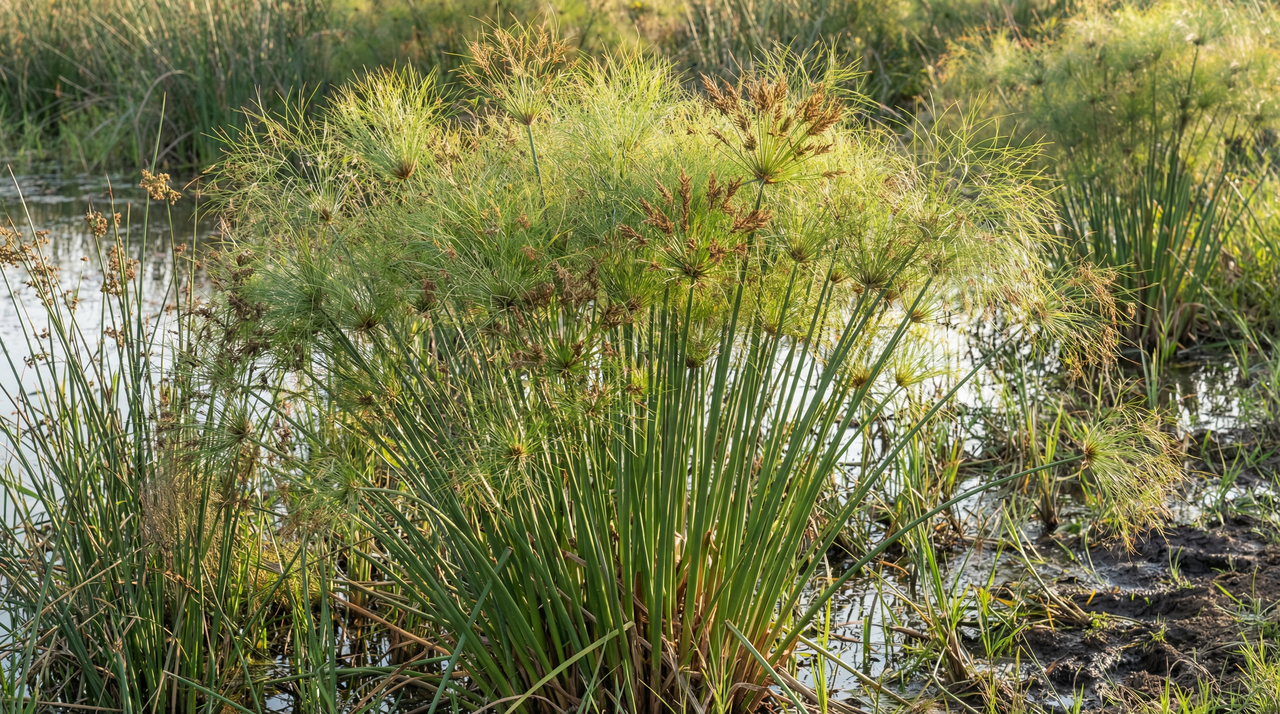
What I find endlessly fascinating about growing papyrus is how physically commanding it is once it gets what it wants: constant water, full sun, and heat. We're talking five meters of triangular green stem topped with an explosion of thread-like rays that looks less like a plant and more like a firework frozen in place. I've grown it in water features from coastal California to humid subtropical gardens, and nothing in the marginal aquatic palette quite prepares visitors for the scale of a mature clump. It fills space the way a small tree does, which means the design decisions around it are completely different from anything else you'd place at a pond edge.
Origin and History of Papyrus (Cyperus papyrus)
Botanical Background and Native Range
Cyperus papyrus is native to the tropical and subtropical wetlands of Africa, with its stronghold in the Nile River basin stretching from Ethiopia through Sudan and Egypt all the way south to South Africa.[2][3][4] It's an obligate wetland species, colonizing floodplains, marshes, riverbanks, and shallow lakes from sea level up to about 1,800 meters.[5] The largest surviving stands on earth sit in the Sudd wetland of South Sudan, covering over 1.5 million hectares, and across the Okavango Delta in Botswana, with additional populations hugging the Nile and the margins of Lake Victoria.[5] Those numbers never fail to recalibrate my sense of scale. I've installed papyrus in Central Florida water features where a single clump commands a whole corner of a pond. Now picture millions of hectares of the same plant, dense enough to support entire ecosystems, and you start to understand what the ancient Nile Delta must have looked like.
The plant is a perennial polycarpic sedge that spreads aggressively by rhizome while also setting seed; individual culms live only one to two years, but the clonal stands they belong to can persist for decades in the right conditions.[6][7] From seed to first flowering typically takes one to three years, with culms reaching their full height of three to five meters by around year two.[8][9] That short-lived culm paired with a long-lived root system is a pattern I find endlessly useful in permaculture design: the individual is temporary, the colony is not. It's part of why papyrus anchored Nile Delta culture for thousands of years without disappearing.
Visually, there's nothing quite like it. The stems are triangular in cross-section, up to five centimeters across at the base, with true leaf blades so reduced they've become fibrous sheaths at the bottom of each culm.[10][11] What catches the eye is the compound umbel at the top: a burst of 20 to 30 centimeter rays carrying small greenish-brown flowers, the whole structure doing most of its photosynthesis through those rays and bracts rather than through conventional leaves.[11][12] I grow Cyperus alternifolius in some of my smaller water features and people confuse the two constantly. The umbrella palm has stiff, leaf-like whorls; true papyrus has a soft, cloud-like explosion at the top, almost weightless-looking in a breeze. Once you've seen the real thing, you don't mix them up again.
Traditional, Cultural, and Historical Uses
By around 3000 BCE, Egyptians had figured out that those thick triangular stems could be sliced into thin strips, layered crosswise, pounded, and pressed into the world's first manufactured writing surface.[13][14] The oldest surviving example is the Diary of Merer, dating to around 2565 BCE, a logistical record from the Giza pyramid project that reads almost like a modern project manager's notes.[15] Before that breakthrough, bureaucracy, literature, and religious codification as we understand them were simply not possible at scale. The Book of the Dead, administrative tax records, love poetry: papyrus made all of it portable and preservable.
The plant meant far more than paper, though. Across Egyptian and Nubian societies, it was woven into boats, ropes, baskets, sandals, and roofing materials, and its symbolic weight matched its practical value.[16][17] It was tied to Thoth, god of writing and wisdom, and to Hapi, the deity of the Nile's annual flood; the papyrus clump became an emblem of fertility and the life-giving river itself.[16] Deeper into tropical Africa, traditional healers used roots, stems, and leaves to treat diarrhea, kidney stones, urinary tract infections, and wounds, a tradition that persisted well beyond the Nile valley.[18][19]
Overharvesting and wetland drainage had effectively eliminated wild papyrus from Egypt by the 10th century CE.[20][21] It's a cautionary story I bring up with clients who want to drain every low spot on their property. When you over-engineer water away from a wetland, you don't just lose a plant; you lose the web of species and ecological services it was holding together. Today, large intact stands in the Okavango Delta, the Sudd, and other protected areas carry UNESCO recognition, while the plant has spread through ancient trade and cultivation into southern Europe, Asia, Australia, and the Americas, supporting modern weaving, craft, and ecotourism economies.[22][23]
Fun Facts About Papyrus
The papermaking craft that Cyperus papyrus launched around 3000 BCE dominated Mediterranean and Middle Eastern record-keeping for nearly four thousand years before parchment and Chinese-derived paper finally displaced it by the 9th and 10th centuries CE.[13] That's an extraordinary run for any technology, let alone one rooted in a single wetland plant. What made it possible was partly the plant's biology: in nutrient-rich tropical wetlands, papyrus generates 10 to 30 tons of dry biomass per hectare per year, a productivity rate that supports carbon sequestration, nutrient cycling, and dense wildlife habitat simultaneously.[24][25] When I'm selecting plants for a permaculture guild, I think about high-leverage species that do multiple jobs at once. Few plants anywhere on earth punch as hard per square meter as this one does in its native wetland context.
One thing that trips up a lot of gardeners: the papyrus scientific name, Cyperus papyrus, belongs to the sedge family Cyperaceae, not to grasses or rushes, and it should not be confused with Cyperus alternifolius, commonly sold as umbrella palm.[26] The look-alike is shorter, with stiff leaf-like bracts arranged in a wheel; true papyrus has those soft, feathery, cloud-like umbels that you see depicted in tomb paintings and hieroglyphs across five millennia of Egyptian art. The same form that once carpeted the Nile Delta still makes this plant one of the most visually arresting marginal aquatics you can grow in a modern pond or rain garden.
Papyrus Varieties and Where to Buy
If you're expecting a menu of cultivars the way you'd find with, say, ornamental grasses or water lilies, papyrus is going to disappoint you. Neither USDA PLANTS nor Plants of the World Online recognizes any widely accepted botanical varieties or subspecies of Cyperus papyrus beyond the straight species itself.[27][28] What breeders and nurseries have given us instead are a handful of horticultural cultivars, and that's where the practical choices actually live.
Notable Cultivars of Cyperus papyrus
The two selections you'll encounter most are 'Nanus' and 'Variegatus'. 'Nanus' is the dwarf form, typically topping out around 1-2 meters compared to the 3-meter-plus height of the straight species.[29][30] That's a meaningful difference when you're designing a container water feature for a patio: the species in full stride reads more like a small tree, while 'Nanus' stays within human scale. I've specified it for clients with smaller ponds and it works beautifully for the first couple of seasons, but I'll warn you now that it still needs annual division. Compact doesn't mean low-maintenance. 'Variegatus' swaps scale drama for visual drama, offering cream or white-striped foliage that earns its place in tropical-themed displays where you want something that genuinely catches the eye.[4] The Royal Horticultural Society specifically recognizes this architectural quality as the primary reason to grow papyrus cultivars in water gardens.[29]
There are no cold-hardy selections. None. The species is a frost-tender tropical and no breeding program has changed that.[31][4] In practice, most gardeners choose between cultivars based on mature height and foliage pattern alone, because that's genuinely all that separates them.
Sourcing and Purchasing Papyrus Plants and Seeds
The good news on the regulatory side is that Cyperus papyrus carries no federal noxious weed designation in the U.S., which means no federal permits are required for seeds, cuttings, or live plants from approved suppliers.[32][33] State and local rules are another matter, particularly in warm-climate states where papyrus can naturalize aggressively in waterways. Always check your local invasive plant lists before you buy. This is one of those situations where I tell clients to consult their regional botanical garden first, because those networks have already vetted their recommended suppliers for local risk.
Don't expect to find papyrus at a big-box garden center. Its specialized wetland requirements and invasive potential in warmer climates keep it firmly in niche territory; your best bets are aquatic plant specialists and water garden suppliers, particularly those based in the southern states where demand is higher.[33][34] For international orders, phytosanitary compliance is non-negotiable.[35]
On price: seed packets typically run $4-9 for 20-100 seeds, and starter plants start around $10-15 for a 1-gallon pot.[36][37][38] My honest advice is to budget $25-40 for a plant large enough to make an immediate visual impact in a pond or container. Smaller starters are cheaper, but they'll take an extra season to fill out into anything close to the architectural statement the umbrella sedge is known for.[39][40]
Papyrus Propagation and Planting Guide
Most of the papyrus in gardens, water features, and wetland restoration projects got there the same way it spreads in the wild: through pieces of rhizome. Seed is possible, and genuinely fascinating from a botanical standpoint, but the overwhelming reality is that division is how this plant moves from one wet site to another. I'll cover everything, but I want to be upfront that if your goal is a thriving clump in a pond margin or bog garden by midsummer, vegetative propagation is the path.
Vegetative Propagation Methods for Papyrus
Rhizome division is the gold standard for propagating Cyperus papyrus, and for good reason.[41][42] It preserves the plant's genetics exactly, it scales fast, and it works with the clump's natural growth habit rather than against it. I've lifted established plants from water gardens and been struck by how the thick, spongy rhizomes practically float when you pull them from saturated soil. The buoyancy makes sense once you understand how adapted this plant is to life in standing water, but it also makes working with them feel oddly satisfying.
The timing matters. Early spring or fall gives divided sections the best chance to establish before heat stress or cold arrives.[43] Use sharp, sterile tools, and select pieces that each carry at least one strong shoot and a fist-sized root mass. I've found that's the minimum threshold for reliable establishment; anything smaller tends to sit and sulk. Plant divisions 5 to 10 cm deep in consistently wet soil or directly in shallow water, keeping temperatures between 20 and 30°C and humidity above 70 percent if you can manage it. Under those conditions, rooting happens in four to six weeks with success rates between 70 and 90 percent.[44] Established clumps benefit from division every two to three years anyway, so propagation and maintenance become the same task.
Stem cuttings of 6 to 12 inches will also root in water or a moist medium within two to four weeks, and while IBA rooting hormone isn't strictly necessary, it can push success rates higher.[45][46] Vegetative layering is possible but less reliable, running around 50 to 70 percent success. Tissue culture using shoot tip or nodal explants achieves 70 to 90 percent with multiple plantlets developing in four to six weeks, though that's obviously a lab-scale method rather than a backyard one.[47] Grafting is not an option. As a monocot, papyrus lacks the vascular cambium that makes graft unions possible, so don't waste time trying.[48]
Growing Papyrus from Seed
The seeds of Cyperus papyrus are tiny brownish achenes, 0.3 to 0.6 mm long, with smooth surfaces, scant endosperm, and no wings or appendages to help them travel.[49][50] Held in the palm, they feel like pepper grains; you lose them immediately in a breeze, so I always work over a tray. What's genuinely interesting about these seeds is that the species reproduces apomictically, meaning seeds are produced clonally without fertilization and are genetically identical to the parent.[51][52] It explains the remarkable uniformity you see across papyrus populations and cultivars, and it means you're not getting any genetic novelty by growing from seed.
If you want to try it anyway, surface sow on a peat-perlite mix and keep temperatures between 21 and 29°C, aiming for around 24°C as the sweet spot.[53][54] Germination takes 7 to 21 days with 40 to 80 percent success depending on seed freshness; that range drops sharply as seed ages. Practically speaking, viability holds for one to two years under normal storage, though seeds stored under proper seed-bank conditions at low moisture and cold temperatures can remain viable for decades.[55][56] Label your trays well. Early seedlings look almost exactly like fine grass, and I've accidentally weeded papyrus more than once before the characteristic umbel starts forming—a humbling experience.
Soil, Site, and Planting Requirements
Papyrus is a wetland obligate. Its entire biology is built around life in saturated, nutrient-rich African freshwater marshes, and it will not thrive in anything that approaches dry conditions.[57][4] The ideal substrate is a silty or clay-loam soil high in organic matter, rich with compost, peat, or coir. Sandy or fast-draining soils are basically useless for this plant. In practice, if the soil stays sopping wet and nutrient-dense, papyrus will forgive quite a lot of other variation.
Optimal soil pH sits between 6.0 and 7.5, with best performance around 6.5 to 7.0.[58][47] The plant tolerates a wider range of 5.5 to 8.0, but push into alkaline territory above 7.5 and you'll likely see interveinal yellowing from iron chlorosis. When that happens in my water gardens, I add chelated iron or adjust with sulfur and usually see recovery within a few weeks. Strongly acidic conditions below 5.5 carry aluminum toxicity risks.[59]
The plant survives flooded, anaerobic root zones because its tissues contain aerenchyma, the same kind of air-channel architecture you see in horsetail and wetland iris species, which transports oxygen down to the roots even when they're submerged.[47] What it cannot handle is stagnant, completely still water with no aeration. That's where root rot sets in: watch for yellowing or wilting leaves, mushy blackened roots, and a foul smell at the base. Some water movement, even gentle, makes a real difference. Optimal planting depth is 10 to 30 cm of standing water, with tolerance up to 50 to 100 cm in saturated soils.[41][60] Plant rhizomes or divisions 5 to 10 cm deep into the medium.
For light, the requirement is full sun, at least 6 to 8 hours daily.[10][61] This is a high-light marsh species, and partial shade reduces vigor noticeably. The one caveat is that intense sun with insufficient water will scorch the leaves, but given that papyrus should always have its feet wet, that combination is mostly a warning about containers that are allowed to dry out accidentally. Container growing is very doable in 18-inch-diameter or larger pots sunk into a water garden or pond margin, which is how I overwinter plants in my Central Florida setup.
Spacing, Technique, and Timeline to Maturity
Before you commit to spacing, keep mature size in mind: a healthy papyrus clump will reach 6 to 15 feet tall with a spread of 3 to 6 feet, and 10 to 12 feet is a realistic average in favorable conditions.[62][63] Those radiating umbels fill their allotted space faster than most people expect, and crowding forces weak, leggy stems that flop over their neighbors.
For ornamental planting, space divisions 2 to 3 feet (60 to 90 cm) apart to give each clump room to develop and allow air circulation through the stand.[10][64] For pond margins and water features where a denser visual effect is the goal, 12 to 18 inches works well. Wetland restoration plantings call for tighter coverage still, around 4 to 6 plants per square meter to encourage the rhizome mat that knits soil together and filters runoff.[65] I've successfully overwintered papyrus in large containers sunk in a water garden and then divided the crowded root mass each spring, consistently turning a single specimen into five or six new plants in a season.
On timeline: vegetative plantings from rhizomes or cuttings root within four to six weeks and will typically reach flowering in 6 to 12 months, often within the first growing season in tropical and subtropical climates.[9][57] Seed-grown plants follow a longer arc: germination in 7 to 21 days, then 2 to 3 months of noticeable seedling growth, with first flowering arriving somewhere between 6 and 12 months and full reproductive maturity at 1 to 2 years.[8] That gap between methods is real and significant. For most gardeners, division is the sensible choice; seed is for the experimentally minded or for restoration scenarios where large numbers of seedlings matter more than speed.
Papyrus Care Guide: Growing and Maintaining Cyperus papyrus
Every time I've placed papyrus in a landscape, the same rule applies before anything else: get the water right, and most of the rest follows. Ignore it, and the plant will tell you within days. This is a semi-aquatic sedge that evolved in the Nile delta and across tropical African wetlands, and it has no interest in pretending otherwise.
Water Requirements and Soil Moisture
Soil must stay constantly saturated. Cyperus papyrus is genuinely intolerant of drying out, and ideal planting depth sits between 15 and 30 cm (6-12 inches) of water, though established plants can handle up to 50-60 cm.[66][10] I learned this the hard way one season when I sited a container planting too close to a dry border. Within a week the leaf tips were browning and the stems were starting to droop. I now use papyrus exclusively in pond margins or large self-watering containers where I can guarantee the roots never dry. High humidity above 60% supports the plant further; positioning near a water feature or misting during dry spells helps, and a layer of organic mulch slows surface evaporation noticeably.[67]
Sunlight and Light Exposure Needs
Papyrus wants full sun, at minimum six hours of direct light daily, to hit its stride with growth and flower development.[68][69] Too little and you'll see the stems etiolate, reaching and thinning, with pale or yellowing foliage and noticeably smaller fronds.[70] It's worth comparing it mentally to its smaller relative, umbrella palm (Cyperus alternifolius), which tolerates considerably more shade; papyrus is a different beast and needs open, bright placement. That said, in intense afternoon heat without adequate water, the tips can scorch and bleach. The plant's elegant vertical stem orientation actually evolved as a photoprotective response, minimizing direct leaf exposure at peak irradiance,[71][41] but that adaptation only works when moisture is abundant. Site it where it catches morning sun freely, with some relief from the harshest western exposure in extremely hot climates.
Fertilizer and Nutrient Management
Papyrus is a moderate-to-heavy feeder. Its explosive seasonal biomass production depends on substantial nitrogen and phosphorus,[72][73] and I've found the timing matters as much as the rate. Applying a balanced aquatic fertilizer (10-10-10 or a nitrogen-forward 20-10-10) right as new culms emerge in spring produces noticeably heavier, deeper green growth than waiting until mid-summer. The best soil for papyrus is fertile and rich in organic matter, ideally above 5%, with a pH of 6.0-7.5.[74][75] Slow-release granular fertilizer every 6-8 weeks or monthly liquid feeding through the active growing season covers most home garden situations well.
Deficiency symptoms are readable if you know what to look for. Nitrogen deficiency starts as chlorosis on older leaves from the tips downward; phosphorus shortage shows as purplish or reddish coloring on older growth with stunted rhizomes; potassium deficiency produces interveinal chlorosis advancing to necrotic leaf margins with weak culms; iron deficiency appears as interveinal chlorosis on the youngest leaves.[76][77] In established pond systems with good nutrient cycling, I rarely need to fertilize at all once the plant is settled. Papyrus is genuinely efficient at pulling nutrients from the water column,[78] which is part of what makes it such a useful phytoremediation plant.
Temperature, Heat, and Frost Tolerance
Papyrus grows happiest between 70°F and 85°F (21-29°C), and established plants can push through temperatures up to 35-38°C when they're sitting in adequate water.[79][80] Above 40°C, even with moisture, oxidative stress reduces biomass and flowering may delay, and seedlings are more vulnerable to heat than mature plants at these extremes.[81] Heat tolerance and water availability are simply inseparable for this plant. When moisture drops and temperature climbs simultaneously, you'll see wilting, tip browning, and leaf curling fast.[82][83] During peak summer heat, shade cloth at 30-50%, early-morning irrigation, and mulching all help buffer thermal stress.[67]
Frost Protection and Overwintering
Cyperus papyrus has no meaningful frost resistance. Foliage browns, wilts, and dies with frost exposure, and temperatures below 20°F (-6°C) can kill the plant outright.[30][84] It's reliably hardy in USDA zones 9-11[85] with an RHS H1c rating that flags the need for frost protection or indoor overwintering in cooler climates.[86]
Gardeners just outside that zone have real options. I've successfully carried large potted papyrus through colder-than-average winters by moving them into a bright, humid sunroom kept above 50°F, cutting water back significantly, and supplementing light when days are very short.[10][87] For in-ground plants in marginal zones, heavy straw mulch over the crown and frost blankets during cold snaps can protect rhizomes even when the above-ground stems are lost. Results vary with plant maturity and local microclimate, so it's worth knowing your site well before committing to a permanent pond planting in zone 8b.[88]
Pruning, Maintenance, and Seasonal Care
Papyrus plant care is genuinely low-effort once the water situation is sorted. The umbrella canopy needs little shaping beyond removing dead or yellowing culms at the base as they appear during the growing season.[89] I've learned to do a full cut-back in late winter rather than just trimming tips; cutting all stems to ground level promotes a flush of fresh, uniform growth by early spring that looks far better than a stand of mixed-age culms.[90][91] The triangular stems are sturdy and rarely need staking except on genuinely exposed windy sites; these plants reach 5-10 feet at maturity[68][92] and the height itself provides some wind buffering when planted in a stand. They pair naturally with marginal aquatics like iris and cattails; avoid planting alongside dryland perennials that will suffer in the wet conditions papyrus requires.
Division every 2-3 years keeps container and small-pond specimens from becoming overcrowded and maintains vigor.[10] Spring is the right time, before new growth really gets moving. Watch for aphids and spider mites during dry periods and root rot if water circulation is poor, but in a well-managed marginal planting, neither is common.[75]
Seasonal Growth Rhythm
In its native tropical African habitat, papyrus surges during the rainy season, roughly April through October, with flowering appearing in late summer to fall.[57][93] In frost-free gardens within USDA zones 9-11, it can hold foliage year-round with only a modest slowdown in dry periods; in areas that see frost, the above-ground stems die back while rhizomes wait dormant through winter.[94] Once you understand that papyrus follows warmth and rain rather than a fixed calendar, timing your pruning, division, and overwintering protection starts to feel intuitive rather than like following instructions. The plant has a clear rhythm; your job is mostly to stay out of the way and keep its feet wet.
Harvesting Papyrus (Cyperus papyrus)
Papyrus harvesting is really two separate conversations happening at once: one about cutting mature culms for fiber, paper, and craft material, and one about the plant's edible yields from rhizomes and young shoots. The techniques overlap, but the timing and the parts you're after are quite different.
When to Harvest Papyrus: Timing, Growth Rate, and Visual Cues
Under warm, shallow-water conditions, papyrus reaches harvestable maturity in 6 to 12 months from planting, with established clumps capable of multiple harvests per year.[41][9][95] The visual cue I watch for in my own wetland plantings is the moment the feathery bracts begin to bronze -- the inflorescences shifting from green toward reddish-brown, which typically falls between late summer and early autumn in the Northern Hemisphere.[96][57] That bronzing signals peak fiber development without yet tipping into over-maturity. Ancient Egyptian harvesters aligned their cuts with low Nile water levels after the flood recession, when fiber quality peaked;[97] useful historical context, but home growers should just follow the plant's own visual cues rather than a Nile calendar.
How to Harvest Papyrus Sustainably Without Damaging the Rhizome
For craft or paper use, cut green culms cleanly at the base when they've reached 1.5 to 3 meters tall, taking care not to disturb the rhizome so the clump can regrow.[96][9][97] The inner pith of those green stems is what gets processed into traditional paper following ancient Egyptian methods,[97] which is why timing matters so much: wait too long and the stems go brittle and brown, losing value for both fiber work and food. I always leave at least a third of the culms standing per cut, rotating around the rhizome cluster. That one habit keeps the clump dense, maintains wildlife cover at the pond edge, and means I can go back for additional harvests within the same growing season from a well-established stand.
Edible Yields and Flavor Profile of Papyrus Rhizomes and Shoots
The rhizomes are starchy and carbohydrate-rich with a mild, slightly sweet flavor -- they can be roasted, boiled, or ground into flour.[98][99][100] Young shoots and tender stem bases are edible too, crisp and mild when harvested before the tissue turns fibrous.[98][99][101] The window is genuinely narrow. Older tissue accumulates higher oxalic acid levels, and wild sources carry realistic contamination risks from pond water quality,[99][101] which is why the edible use today is largely ethnobotanical. Honestly, papyrus earns its keep in my projects as structure and habitat long before it earns it as food.
Papyrus Preparation and Uses
Culinary Uses and Nutrition of Papyrus
Long before papyrus meant paper, it meant food. Ancient Egyptians and African wetland communities ate the rhizomes raw, roasted, boiled, or ground into flour for bread and porridge; the soft pith of young stems was nibbled straight from the plant, and early shoots were harvested and eaten much like asparagus.[11][98][99] It was famine food more than feast food, and that context matters. The nutritional profile is honest rather than impressive: fresh shoots and stems run about 70-80% moisture with 10-15% carbohydrates and only 1-3% protein, while the rhizomes are considerably starchier, hitting up to 30% carbohydrate on a dry-weight basis with trace amounts of iron, calcium, and potassium.[102][103] Sustaining, yes. Superfood, no.
I grow papyrus as a dramatic pond marginal here in Central Florida, and I've watched those rhizomes bulk up into dense, knobby masses over a single season. I have done small survival-cooking trials with young rhizome, and the pith has a mild, slightly sweet crunch that resembles a mild heart of palm. The edible window is narrower than with cattail, though, so if you're growing multiple wetland species, label everything carefully. Mature leaves and older stem tissue are fibrous, higher in oxalates, and not worth eating.[98][99] Accurate identification is also non-negotiable before you forage anything from a wetland; Phragmites australis and Typha latifolia are common look-alikes that share the same habitat.[11][104] Because papyrus grows in water, I only harvest from my own clean system and still cook the rhizomes thoroughly; this is not a plant to forage casually from wild wetlands.
Traditional Medicinal Preparations
Traditional practitioners across Egypt and sub-Saharan Africa have long prepared rhizome decoctions and infusions as diuretics and digestive aids, and applied poultices of various plant parts to wounds, fever, diarrhea, and inflammatory skin conditions.[99][105][106] These are centuries-deep cultural practices and deserve to be understood as such. Clinical validation is thin, so I'd treat any preparation as ethnobotanical history rather than a home remedy protocol, and approach sourcing with the same clean-water caution the culinary uses demand.
Non-Food Uses and Crafts
The craft that made papyrus famous involves pressing layered slices of the inner pith to allow the natural sugars to bind the sheets as they dry into the first true paper.[107][98] I've walked kids through a miniature version of that process as a craft project, and watching them grasp that every ancient Egyptian text rested on a wetland plant is one of those moments that earns permaculture education its keep.
Beyond paper, the stems have been woven into mats, baskets, sandals, hats, and famously the reed boats that Thor Heyerdahl sailed across the Atlantic.[106] Dense stands also yield harvestable fuelwood.[108] The same tall, flexible culms that stabilize the edges of my pond make excellent dried kindling, and the cut stems I pull during seasonal maintenance never go to waste. A plant that cleans water, feeds wildlife, prevents erosion, and still produces material for craft or fire is doing serious permaculture work, even when nobody's eating it.
Papyrus Health Benefits and Traditional Medicinal Uses
If you're looking for a plant with a robust clinical research profile, papyrus is not it. A search of the peer-reviewed literature turns up no human clinical trials and no animal-model studies specifically evaluating Cyperus papyrus for medicinal safety or efficacy.[109] Both Missouri Botanical Garden and Kew Gardens describe it primarily as a wetland ornamental, with no documented medicinal uses in their core botanical profiles.[110][111] After years of growing this plant in water features and reading the ethnobotanical literature, I still treat any medicinal claims with real caution because the human research simply has not been done. That said, the traditional record is genuinely interesting, and the phytochemical story has some substance worth understanding.
Traditional Medicinal History and Ethnobotanical Uses
Ancient Egyptians worked with papyrus medicinally for centuries. Rhizomes were applied to digestive complaints and diabetes-like conditions, stems were used in wound care, and leaves were prepared as topical treatments and fever remedies.[112][113] Traditional African uses extend that record further, with leaf extracts employed for wound healing and fever management. These aren't fringe claims; they reflect consistent cross-cultural patterns that researchers take seriously even in the absence of clinical follow-up.
Where the science does weigh in, it comes from in-vitro and animal-model work rather than human trials. Ethanol and aqueous extracts have shown antimicrobial activity against Staphylococcus aureus and Escherichia coli, antioxidant effects through free-radical scavenging, anti-inflammatory activity in rodent models, and accelerated wound healing in rat tissue studies.[114][115][116] The proposed mechanisms, including free-radical scavenging, suppression of NF-κB signaling, and COX-2 inhibition, are largely inferred from closely related species like C. rotundus rather than from direct papyrus research.[117] That's an important distinction.
Phytochemical Composition and Potential Bioactivities
The chemistry behind those traditional applications is where papyrus starts to get genuinely interesting. The leaves contain flavonoids including quercetin, kaempferol, apigenin, and luteolin derivatives; the stems carry phenolic acids like caffeic acid, ferulic acid, and chlorogenic acid; and the essential oils are dominated by α-cyperone, a sesquiterpene ketone that makes up 50 to 60 percent of the oil fraction.[118][119][120] These profiles shift by plant part and are shaped by environmental conditions including water level, soil nutrients, and sun exposure.[121]
I've noticed that papyrus in full saturated sun pushes growth at a pace that few other marginal aquatics match, and that vigorous production is at least partly explained by the same flavonoid and phenolic chemistry that provides UV protection, herbivore defense, and allelopathic competition at the water's edge.[115] Measured antioxidant activity in DPPH assays shows IC50 values typically below 100 μg/mL, with antimicrobial effects against E. coli and S. aureus at MIC values of 50 to 200 μg/mL.[122] Alkaloids, tannins, coumarins, saponins, and steroids are expected from the Cyperaceae family but remain poorly quantified in papyrus specifically, which tells you exactly where future research needs to go.[123]
Nutritional Profile of Edible Parts
In parts of Africa, papyrus has served as both a seasonal food and a famine-period staple, with young shoots eaten raw or cooked and rhizomes roasted, boiled, or dried and ground into flour for porridges and flatbreads.[124][125] The rhizomes are predominantly starch, running 60 to 70 percent starch on a dry weight basis.[126] Fresh edible shoots come in around 20 to 30 kcal per 100 grams, with modest protein (1 to 2 grams), minimal fat, and 4 to 6 grams of carbohydrate, along with an estimated 10 to 20 mg of vitamin C and trace carotenoids that serve as vitamin A precursors.[127][128] The prepared rhizomes remind me of water chestnut or lotus root in texture and mild flavor, two other wetland edibles I've cooked with; starchy, slightly sweet, and satisfying in a way that makes the famine-food history easy to understand.
Cooking improves starch digestibility and reduces anti-nutritional tannins, so raw isn't always the better option here.[124] None of these figures appear in USDA FoodData Central; everything comes from ethnobotanical fieldwork and limited preliminary studies, so treat the numbers as reasonable estimates rather than standardized values.[129] One thing I'd add from field experience: true papyrus and umbrella plant (C. involucratus) look superficially similar in nurseries and water gardens, and the distinction matters if you're ever considering the edible angle.
Safety Considerations
The clearest thing in the whole papyrus health picture is this: the plant is non-toxic. The ASPCA lists it as safe for cats and dogs, and USDA data confirms no known poisonous compounds; its primary structural chemistry is cellulose, lignin, and non-toxic polysaccharides.[130][131] It has been used safely for millennia in crafts, landscaping, and food preparation without recorded poisoning events, and animal studies indicate low acute toxicity.[132][133]
The silica content in the stems and leaves can cause mild skin irritation in people with sensitive skin.[134] I always wear gloves when dividing large clumps or harvesting from established marginal beds; it's a simple habit that prevents the occasional scratchy rash. Allergenic potential is genuinely low, with no significant reports of contact dermatitis or respiratory reactions in the literature. As with any traditional food or medicinal plant where clinical evidence is sparse, more research is needed before moving beyond the ethnobotanical record.
Papyrus Pests and Diseases
Solid, species-specific pest and disease data for Cyperus papyrus is surprisingly thin. Most of what practitioners rely on is extrapolated from closely related Cyperus species and general wetland horticulture, much the same way I've cross-referenced pest behavior on the more familiar umbrella palm (Cyperus alternifolius) when troubleshooting papyrus in client ponds.[135] That limitation doesn't leave growers without guidance; it just means cultural prevention carries even more weight than usual, because there's no resistant cultivar to fall back on.[136][137]
Common Diseases of Papyrus
Fungal pathogens dominate the disease picture for papyrus, outnumbering bacterial and viral threats by a wide margin.[138] Leaf spot diseases caused by Curvularia spp. and Bipolaris spp. show up as discolored lesions on the stems and foliage, and rust caused by Uromyces cyperacearum produces the orange pustules that, once you know what you're looking for, are pretty unmistakable on a sun-lit stand.[138] The more serious threat, in my experience, is root and stem rot. After installing papyrus around several pond features, I found that any stagnant pocket, where water just sits without moving, almost guarantees a Pythium or Rhizoctonia outbreak within weeks. Phytophthora and Fusarium round out the fungal roster in poorly aerated or waterlogged containers.[138][139] Bacterial wilt potentially linked to Ralstonia solanacearum has been documented, and viral diseases, while rarely reported, may move through insect vectors.[138]
Management starts with the same water you're already managing. Improving circulation, keeping a consistent submersion depth, removing dead rhizome and leaf debris, and avoiding nitrogen overload are the controls that actually move the needle.[138][140] If you're asking why your papyrus plant is turning yellow, stagnant water and root rot are your first suspects before anything else. Copper-based fungicides are an option when cultural steps fail, but they require strict compliance with aquatic pesticide regulations before they go anywhere near a pond.[138][141]
Major Insect Pests and IPM Strategies
Aphids, spider mites, scale, and stem borers are the insects most likely to bother papyrus, and any of them can also vector the viral diseases that are so poorly documented in this species.[142][143] I walk the pond edge every few days during the growing season specifically to check new stems for aphid clusters and the tell-tale orange of rust pustules; catching either early is far easier than managing an established outbreak in a water garden.
The IPM hierarchy here follows the plant's aquatic nature at every step. Full sun, good circulation, water submerged to around 30 cm, and consistent debris removal eliminate most of the habitat that pests and pathogens need.[140][143] A healthy, gently moving pond edge stays remarkably trouble-free on its own. Biological allies like damselfly larvae, which consume aphids and scale, fit naturally into any pond ecosystem without any intervention from you. Because papyrus grows alongside frogs, dragonflies, and aquatic invertebrates, I only reach for neem oil or copper products when cultural steps have clearly failed, and then I follow EPA aquatic-label rates strictly.[141] Regular monitoring is the practice that ties everything together; the sooner you spot a problem, the more options you have that don't involve chemistry.[143]
Papyrus in Permaculture Design
Before you get excited about tucking papyrus into a rain garden or bioswale, you need to answer one question honestly: where do you live? This plant's entire design value rests on a climate that few temperate gardeners can offer. Get the climate wrong and everything else is irrelevant.
Climate and Hardiness Zones for Growing Papyrus
Cyperus papyrus is a USDA zones 9-11 plant, and that hardiness boundary is a hard stop, not a suggestion.[144][10] It hits its stride between 68°F and 86°F and can push through brief periods near 100°F if it's standing in water, but once temperatures drop below 60°F growth slows noticeably, and anything below 50°F triggers rapid yellowing and blackening of the stems.[41][145] I've overwintered container specimens in a heated greenhouse and watched them deteriorate almost overnight when temperatures briefly dipped before I could get them inside. That visual cue, a sudden shift from deep green to sickly yellow, is your warning that you waited too long.
Beyond cold, the plant demands high humidity and consistent saturation. It thrives in annual rainfall of 1000-2000mm or more and will grow happily in standing water up to 50-100cm deep.[11][4] The RHS rates it H1c, meaning even minimal frost protection requires active heating.[146] For gardeners in zone 8b pushing the boundary, you can overwinter rhizomes indoors in damp soil or bring containers into a warm greenhouse, but treat it as a dramatic seasonal accent rather than a permanent backbone element of your system.
Ecosystem Functions and Services Provided by Papyrus
Where climate does allow it, papyrus delivers an impressive suite of ecological services rooted directly in its physical form. The dense stands stabilize wetland soils, control erosion along unstable banks, filter water by absorbing nutrients and pollutants, sequester carbon through genuinely impressive biomass production, buffer flooding, and support habitat for birds, fish, and insects.[147][148] I've used it specifically to shore up eroding pond edges where cattails and even native rushes kept washing out; the rhizomes knit together so quickly and so thoroughly that the bank feels engineered within a single growing season. It's more effective at that job than anything else I've tried in a warm, wet site.
The filtration capacity is the function I keep coming back to in constructed-wetland design. Like a biological pump, the plant draws nutrients from polluted water in a way that rivals common wetland workhorses like elephant ear or bulrush, but at a scale that few emergents can match. Reproductively, papyrus is wind-pollinated, with those tall hollow stems positioning the compound umbel inflorescences above surrounding vegetation to catch air currents, while vegetative rhizome spread does the real work of stand expansion.[149][150] I never worry about papyrus attracting pollinators, so I focus companion planting on species that benefit from the clean, stabilized water environment it creates rather than trying to build a pollinator guild around it. Its use in water gardens and constructed wetlands is well established, and the variegated cultivar 'Variegatus' with its cream-striped foliage adds aesthetic dimension for projects where visual design matters alongside function.[151]
Papyrus in Forest Layers, Guilds, and Wetland Systems
In a permaculture framework, papyrus occupies the emergent upper-herbaceous layer of riparian and constructed-wetland guilds. At 5-15 feet tall with triangular stems and those dramatic umbrella-like inflorescences, it casts meaningful shade and dominates the vertical structure of any wetland edge it colonizes.[152][11] That shading suppresses understory competition by 40-60%, which is genuinely useful for weed management on waterlogged margins but also means you need to choose lower-layer companions carefully or they'll struggle.[153] I pair it with shade-tolerant aquatics lower in the water column rather than competing emergents at the same height.
Below the waterline, the root and rhizome network extends 0.5-1.5 meters, enhancing soil aeration and microbial activity while absorbing an estimated 100-200 kg of nitrogen per hectare per year.[154][155] There's even arbuscular mycorrhizal colonization at 20-50%, a reminder that this "aquatic" plant maintains meaningful soil biology connections.[156] For a designed wetland guild, that nutrient pumping and aeration create conditions that benefit companion plantings downstream or on adjacent banks.
Now the honest caution. In warm humid regions outside its native African range, papyrus can naturalize aggressively and form competitive monocultures that crowd out native vegetation. It's listed as a concern in parts of Florida and California.[157] In warm wet areas of the Southeast especially, I've watched it spread well beyond its intended footprint and now recommend deploying it only in contained systems, like hard-edged pond margins or lined constructed wetlands, where the rhizomes have a physical barrier. Propagation itself is straightforward; rhizome division in spring or early summer into full sun, wet acidic soil, and shallow water is all it takes to establish a new planting fast.[158] That ease of establishment is exactly why containment planning has to happen before the first division goes in the ground.
The Plant That Taught Me to Stop Underestimating Water's Edge
I planted my first papyrus in a half-barrel pond on a client's patio, mostly for drama, and watched it outgrow the container in a single season while quietly cleaning the water the whole time. That's the thing about this plant; it doesn't wait for you to appreciate what it's doing. The Egyptians built their entire written record on it, and somehow it's still out there, growing from the same rhizome, doing the same work. That kind of persistence earns respect.
Sources 158
- British Museum: Papyrus of Ani ↩
- Cyperus papyrus ↩
- Cyperus papyrus L. ↩
- Cyperus papyrus ↩
- Distribution and Ecology of Cyperus papyrus ↩
- The Life Cycle of Cyperus papyrus ↩
- The Biology of Cyperus papyrus L. ↩
- Germination and Growth of Cyperus papyrus ↩
- Papyrus Cultivation Guide ↩
- Cyperus papyrus - Missouri Botanical Garden Plant Finder ↩
- Cyperus papyrus - Wikipedia ↩
- Cyperus papyrus - Missouri Botanical Garden Plant Finder ↩
- Ancient Egyptian Materials and Technology: Papyrus ↩
- Papyrus ↩
- The Diary of Merer: The Oldest Papyrus ↩
- Ethnobotany of Cyperus papyrus in Africa ↩
- Papyrus: The Plant that Changed the World ↩
- Ethnobotanical Uses of Cyperus papyrus in Africa ↩
- Ethnobotanical Notes on Cyperus papyrus and Nymphaea lotus Lem. in Uganda ↩
- Ancient irrigation and papyrus declines ↩
- Conservation status of Cyperus papyrus ↩
- Global Invasive Species Database: Cyperus papyrus ↩
- UNESCO World Heritage and Papyrus Heritage ↩
- Cyperus papyrus L. (Papyrus): A Review ↩
- Wetland Biomass Production of Papyrus (Cyperus papyrus L.) ↩
- Cyperus alternifolius vs. Cyperus papyrus: Distinguishing Features ↩
- USDA PLANTS Database ↩
- Plants of the World Online ↩
- RHS - Cyperus papyrus ↩
- Missouri Botanical Garden - Papyrus Plant Varieties ↩
- Missouri Botanical Garden - Cyperus papyrus ↩
- Federal Noxious Weed List ↩
- USDA PLANTS Database - Cyperus papyrus ↩
- Florida Invasive Plant Council - Pygmy Papyrus Assessment ↩
- Missouri Botanical Garden Plant Finder ↩
- Sheffield's Seed Company - Cyperus Papyrus Seeds ↩
- The Pond Guy - Egyptian Papyrus ↩
- Wilson Bros Gardens - Cyperus papyrus ↩
- Monrovia - Cyperus papyrus 'King Tut' ↩
- Plant Delights Nursery - Papyrus ↩
- Cyperus papyrus (Papyrus) - Propagation ↩
- Cyperus papyrus L. ↩
- Cyperus papyrus Propagation Guide ↩
- Commercial Cultivation of Papyrus ↩
- Propagation of Cyperus papyrus ↩
- Vegetative Propagation of Papyrus (Cyperus papyrus L.) ↩
- Cyperus papyrus: Cultivation and Propagation Guide ↩
- Grafting in Monocotyledons: Challenges and Opportunities ↩
- Seed Structure and Development in the Cyperaceae ↩
- Embryology of the Cyperaceae ↩
- Cyperus papyrus L. ↩
- Plants of the World Online ↩
- Cyperus papyrus ↩
- Propagation of Papyrus (Cyperus papyrus L.) ↩
- Seed Storage of Papyrus (Cyperus papyrus L.) ↩
- Germination Studies on Stored Cyperus papyrus Seeds ↩
- Cyperus papyrus - Missouri Botanical Garden Plant Finder ↩
- Cyperus papyrus Growing Guide ↩
- Wetland Ecology of Cyperus papyrus in Africa ↩
- Growing Papyrus (Cyperus papyrus) in Florida ↩
- Papyrus Plant (Cyperus papyrus) Care Guide ↩
- Cyperus papyrus ↩
- Papyrus (Cyperus papyrus) ↩
- Cyperus papyrus ↩
- Wetland Plant Propagation and Establishment ↩
- Cyperus papyrus - Missouri Botanical Garden Plant Profile ↩
- Heat Stress Management in Tropical Ornamentals ↩
- Papyrus ↩
- Cyperus papyrus ↩
- Cyperus papyrus ↩
- Cyperus papyrus ↩
- Nutrient Dynamics of Cyperus papyrus in Tropical Wetlands ↩
- Cyperus papyrus L. (Papyrus): A Mini-Review ↩
- Cyperus papyrus (Papyrus) Plant Profile ↩
- Soil Requirements for Wetland Plants ↩
- Symptoms of Nutrient Toxicity in Sedge Plants ↩
- Micronutrient Deficiencies in Sedge Species: Implications for Wetland Restoration ↩
- Nutrient Management for Wetland Plants: Cyperus papyrus ↩
- Cyperus papyrus Growing Guide ↩
- Thermal Tolerance and Heat Stress Responses in Wetland Plants: A Case Study on Cyperus papyrus ↩
- Effects of Temperature on Seed Germination and Seedling Growth of Cyperus papyrus ↩
- Physiological Responses of Cyperus papyrus to Heat Stress in Wetland Ecosystems ↩
- Effects of High Temperature on Growth and Morphology of Papyrus Sedge ↩
- Cyperus papyrus ↩
- USDA Plant Hardiness Zone Map ↩
- Growing Papyrus in Temperate Climates: Managing Frost Injury ↩
- Overwintering Tropical Plants ↩
- Growth Responses of Cyperus papyrus to Water and Temperature ↩
- Cyperus papyrus Plant Care ↩
- Pruning and Dividing Ornamental Grasses ↩
- Growing Papyrus ↩
- Cyperus papyrus L. ↩
- Kew Plants of the World Online: Cyperus papyrus ↩
- Royal Horticultural Society: Cyperus papyrus ↩
- FAO: Cyperus papyrus: Growth and Harvest for Traditional Uses ↩
- Phenology of Papyrus (Cyperus papyrus L.) in Wetlands ↩
- Harvesting Papyrus for Traditional Paper Making ↩
- Ethnobotany of Papyrus in Ancient Egypt ↩
- Ethnobotany of Cyperus papyrus in Traditional African Diets ↩
- Culinary and Medicinal Uses of Papyrus ↩
- Plants for a Future - Cyperus papyrus ↩
- Nutritional Composition of Wild Edible Plants in Africa: Focus on Cyperaceae ↩
- Ethnobotanical Uses and Nutritional Potential of Cyperus papyrus ↩
- Wetland Plants: Identification Guide ↩
- Ethnopharmacological Uses of Papyrus Sedge ↩
- Journal of Medicinal Plants Research - Ethnobotanical study of Cyperus papyrus ↩
- Royal Botanic Gardens, Kew - Plants of the World Online - Cyperus papyrus ↩
- Plants for a Future - Cyperus papyrus ↩
- PubMed (search for "Cyperus papyrus" AND medical trial) ↩
- Missouri Botanical Garden Plant Finder - Cyperus papyrus ↩
- Kew Science - Plants of the World Online - Cyperus papyrus ↩
- Papyrus in Ancient Egypt: Its Uses Beyond Writing ↩
- Medicinal Plants of Ancient Egypt: The Ebers Papyrus ↩
- Antimicrobial Activity of Cyperus papyrus Extracts ↩
- Antioxidant and antimicrobial activities of Cyperus papyrus extracts ↩
- Anti-inflammatory and Wound Healing Properties of Papyrus Plant ↩
- Anti-inflammatory mechanisms of Cyperus rotundus (2021) ↩
- Phytochemical Investigation of Cyperus papyrus L. ↩
- Chemical Composition and Biological Activities of Essential Oils from Cyperus papyrus L. ↩
- Antioxidant flavonoids from the leaves of Cyperus papyrus ↩
- Phytochemical screening and biological activity of Cyperus papyrus L. ↩
- Antioxidant and Antimicrobial Properties of Cyperus papyrus Extracts (2021 Study) ↩
- Secondary metabolites of Cyperus species: A review ↩
- Traditional Uses of Papyrus as Food ↩
- Ethnobotany of Cyperus papyrus in Africa ↩
- Nutritional Composition of Papyrus Rhizomes ↩
- Nutritional Evaluation of Some Wild Edible Plants in Sudan ↩
- Nutritional Analysis of Wetland Plants in Sudan ↩
- Plants of the World Online, Kew Science ↩
- Papyrus | ASPCA ↩
- Cyperus papyrus L. ↩
- Cyperus papyrus L. - Useful Tropical Plants Database ↩
- Toxicity Evaluation of Cyperus papyrus in Traditional Medicine ↩
- Cyperus papyrus - Plant Finder - Missouri Botanical Garden ↩
- USDA PLANTS Database: Cyperus papyrus ↩
- Kew Science - Plants of the World Online ↩
- USDA PLANTS Database - Cyperus papyrus ↩
- Diseases of Papyrus (Cyperus papyrus L.) in Uganda ↩
- Fusarium and Rhizoctonia Pathogens in Wetland Plants ↩
- Missouri Botanical Garden Plant Finder: Cyperus papyrus ↩
- EPA Aquatic Pesticide Use Regulations ↩
- Insect Pests of Cyperus Species ↩
- Royal Horticultural Society: Cyperus papyrus ↩
- USDA Hardiness Zone Map for Cyperus papyrus ↩
- Tropical Plant Temperature Requirements ↩
- Cyperus papyrus ↩
- Papyrus Wetlands: Ecosystem Services and Restoration ↩
- Ecological Roles of Papyrus (Cyperus papyrus L.) in Wetland Ecosystems ↩
- The Inflorescence of Papyrus (Cyperus papyrus L.) ↩
- Reproductive Ecology of Papyrus Swamps ↩
- Missouri Botanical Garden Plant Finder - Cyperus papyrus ↩
- Ecology of Cyperus papyrus in African Wetlands ↩
- Cyperus papyrus ↩
- Root System Architecture of Cyperus papyrus in Wetland Ecosystems ↩
- Soil Aeration and Nutrient Dynamics in Papyrus Marshes ↩
- Mycorrhizal Associations in Wetland Plants ↩
- Invasive Species: Cyperus papyrus ↩
- Cyperus papyrus ↩