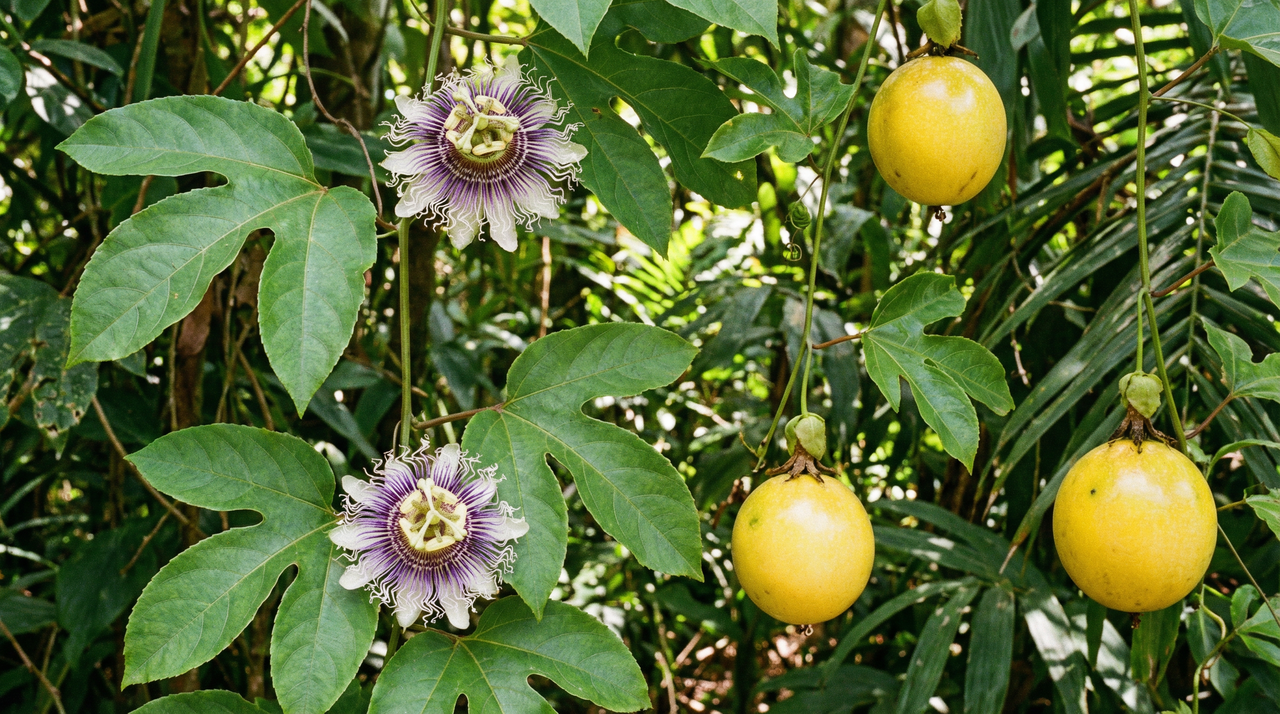
Spanish missionaries arriving in South America in the early 1600s looked at this flower and saw the crucifixion. Not metaphorically, not loosely, but anatomically: the corona as the crown of thorns, the five stamens as the wounds, the three stigmas as the nails, the ovary rising on its stalk as the chalice.[1] They called it flor de las cinco llagas, the flower of the five wounds, and decided a plant this theologically convenient had to be a sign. That act of naming shaped everything. It's how a scrambling jungle vine from the Atlantic Forest of southern Brazil became one of the most globally recognized plants on earth before most Europeans had ever tasted its fruit.
What strikes me every time I'm out in my Central Florida food forest, cutting ripe fruits off the vine with that intoxicating guava-citrus-tropical smell hitting me before I've even made the cut, is that the fruit was almost an afterthought in this plant's global rise. The flower got the press. The Tupi-Guarani people who had been eating the pulp and brewing the leaves into sedative tea for generations barely registered in the colonial botanical record.[2] That gap between what European eyes noticed and what indigenous knowledge already held is, honestly, the most interesting thread running through this plant's entire history, and it doesn't stop at history.
Passion Flower Origin, History, and Cultural Significance
Botanical Background and Native Habitat
Passiflora edulis, the passion flower most home growers are chasing, originated in the Atlantic Forest biome of southeastern Brazil, with its native range extending into Paraguay, Uruguay, and northern Argentina.[3][4] It's a forest-edge plant by nature, thriving in clearings and disturbed patches with dappled light, from sea level up to around 1,200 meters elevation. That ecology tells you something important about how to grow it: not deep shade, not blasting sun, but the kind of bright, shifting light you'd find where a canopy opens up. The passion flower genus, Passiflora, spans a far wider ecological range than any single species suggests. The North American maypop, P. incarnata, grows wild from sea level to about 1,500 meters across the southeastern United States, tolerating conditions the tropical fruiting vine never could.[5] The yellow passion fruit, P. flavicarpa, comes from humid lowland rainforests of tropical South America.[6] Sweet granadilla, P. ligularis, is an Andean cloud forest species at home between 1,500 and 3,000 meters elevation.[7] And the winged passionflower, P. alata, shares P. edulis's Atlantic Forest roots, though it's a much longer-lived vine.[8]
As a grower, one of the first things I tell people about P. edulis is to manage their timeline expectations. It's a fast-moving perennial vine with a typical productive lifespan of 3 to 5 years before yields drop off, and a total lifespan of roughly 5 to 7 years under good conditions, sometimes longer in ideal tropical settings.[9][10] In my subtropical designs, I plan for that 3-to-5-year productive window and build in succession plantings from the start rather than being caught off guard when an older vine slows down.
Visual Characteristics of Passion Flower
The vine itself reaches 15 to 25 feet, climbing by tendrils with woody green stems that furrow with age, carrying palmately lobed leaves that are leathery and dark green.[4] But it's the flower that stops people cold. Each bloom is about 3 inches across, white-petaled, with a radiating corona of purple-fringed filaments surrounding stamens and styles arranged with almost mathematical precision.[11] When you watch one open in morning light, you immediately understand why missionaries saw religious architecture in it. The complexity is genuinely startling. Across the genus, the visual variation is considerable: maypop flowers run white to lavender with a blue-purple corona;[4] P. flavicarpa's flowers are yellow;[12] and P. alata produces large, deeply fragrant crimson blooms with a white-banded purple corona.[12] For identification, the key markers on P. edulis are round stems, three-lobed leaves, white petals with a purple corona, and wrinkled purple fruit around 5 to 8 centimeters wide when ripe. P. flavicarpa produces yellow fruit and reads slightly differently on leaf and flower detail.[13] The ornamental P. caerulea looks similar but produces inedible fruit, so knowing these distinctions matters before you start foraging your own garden.
Traditional and Indigenous Uses Across Cultures
Long before any European botanist put a Latin name to it, Tupi-Guarani peoples of South America were eating the fruit of P. edulis fresh, pressing it into drinks, and brewing leaf and flower teas to ease anxiety, sleeplessness, and digestive complaints.[14] Parallel traditions developed entirely independently in North America, where Cherokee, Creek, and Choctaw peoples used the maypop, P. incarnata, for its sedative and analgesic properties, consuming the leaves, roots, and fruit across a range of preparations.[15][16] Amazonian and Andean groups, including the Asháninka, Kayapó, and Quechua, applied leaf infusions of P. flavicarpa to similar ends, adding wound healing and inflammation to the list.[14] The first European encounter with the genus came in 1569, recorded by Spanish explorers in Peru and Brazil,[17] and the formal botanical description of the genus followed in 1703, with Linnaeus naming P. incarnata in 1753.[18]
That convergence of indigenous knowledge across two continents speaks to how genuinely useful these plants are. It's also a reminder of the ethical weight that comes with growing and commercializing them. Overharvesting of wild passion flower populations has become a real concern in Brazil, Paraguay, and parts of the Amazon, and there are unresolved questions around benefit-sharing when pharmaceutical patents draw on indigenous knowledge without acknowledgment.[19][20] When I source passion fruit plants or products, I look for nurseries that propagate responsibly. The history of this plant makes clear that knowledge has origins, and those origins deserve respect.
The Passion Flower Name and Global Spread
The genus name Passiflora was coined by Linnaeus in 1753, but the symbolism it encodes predates him by over a century. When Spanish missionaries first encountered the flowers in South America in the early 1600s, they saw an entire theological narrative written in the bloom's anatomy: the corona filaments as the crown of thorns, the five stamens as the wounds of Christ, the three styles as the nails, the ovary as the chalice, and the ten petals and sepals as the faithful apostles.[21][22] I find it a fascinating example of how differently cultures can interpret the same flower: where indigenous South Americans saw food and medicine, European missionaries saw the Passion of Christ. Both responses were rooted in genuine wonder at the same extraordinary structure. That religious framing turned out to be extraordinarily effective marketing. The vine was introduced to Europe around 1610 as an ornamental curiosity,[23] and its symbolic power helped propel it through colonial botanical gardens and trade routes until it reached cultivation across more than 100 countries by the 19th and 20th centuries.
The ecological story adds another layer of wonder. P. incarnata is a critical larval host for Gulf Fritillary and Zebra Longwing butterflies, and its extrafloral nectaries draw in protective ants as a kind of bodyguard system.[24] The yellow form is primarily pollinated by carpenter bees through buzz pollination, with birds and bats handling seed dispersal.[25] The genus's climatic range is equally striking: P. flavicarpa is hardy only in USDA zones 9 through 12, while P. incarnata tolerates zones 5 through 9, surviving down to -20°F and growing 20 to 30 feet in a single favorable season.[26][27] For a genus born in the tropics, that kind of cold-hardiness in the North American native species is genuinely remarkable, and it's one reason the passion flower genus has found its way into food forests and ornamental gardens on nearly every inhabited continent.
Passion Flower Varieties and Where to Buy Them
The single most important choice you'll make with this plant isn't about soil or trellis placement. It's variety selection. Get this right for your climate and goals, and everything else gets easier. Get it wrong, and you'll spend years fighting a vine that was never suited to your conditions in the first place.
Purple vs. Yellow Passion Fruit: Key Differences
Passiflora edulis divides into two primary botanical varieties, and they're different enough that you should treat them as separate plants when making your decision.[28][9] The purple form (var. edulis) produces smaller fruits, around 4-5 cm across, with a rich tart flavor and a purple rind that wrinkles beautifully when ripe. It tolerates light frost down to about 25°F and shows meaningfully better resistance to Fusarium wilt and root rot.[9][29] After growing both side-by-side for several seasons, I can tell you the purple vines bounce back from marginal frost events that the yellow types simply don't survive.
The yellow form (var. flavicarpa) is the commercial workhorse. Fruits run 6-8 cm, the flavor is sweeter with a sharper acidity that makes it ideal for juice, and yields are higher overall.[9][29][30] The trade-off is real though: it needs frost-free conditions and is more susceptible to soil-borne pathogens and nematodes. If you're in a reliably warm zone 10-11 garden and you want volume, yellow wins. If you're pushing the tropical limits in zone 9 or somewhere cooler with winter protection, purple is more forgiving.
Notable Cultivars and Related Species
Within those two camps, breeding programs in Brazil and Australia have produced some genuinely useful named selections. Yellow types like 'Gefner', 'Yellow Giant', 'Tropic Gold', and 'Sierra Gold' address specific production problems including fruit fly tolerance, nematode resistance, and Alternaria susceptibility.[31][32] On the purple side, 'Frederick' offers partial aphid resistance. Other regionally adapted selections like 'Kermesina', 'Mays', 'Pink Perfection', and 'Carter' vary in size, yield, and climate fit.[9][33] For most home growers, though, the purple/yellow distinction still matters more than any specific cultivar name.
For gardeners in cooler climates, Passiflora incarnata, the native maypop, changes the entire calculus. It's hardy to USDA zones 5-9, with roots that survive down to 0°F, and it goes deciduous in winter rather than dying back completely.[26][34] The fruit is smaller (2-3 inches) with a sweet-tart, almost pineapple-citrus flavor, and the ornamental cultivars like 'Alba', 'Royal Purple', and 'Harlequin' lean heavily into ecological and aesthetic value rather than fruit production. I grow a patch of maypop at the edge of a meadow planting, and it's a completely different plant in character: wilder, tougher, and genuinely exciting for native pollinators. If P. edulis is your tropical production vine, P. incarnata is your native habitat plant that happens to be edible.
Sourcing Passion Flower Plants and Seeds
Commercial passion fruit production in the US stays concentrated in Florida, Texas, California, and Hawaii, primarily for fresh market and juice, best suited to zones 9-11 for yellow types and slightly hardier zones for purple.[9][35] For home growers, availability is good but scattered. Tropical species (P. edulis and P. flavicarpa) are reliably found through Logee's Plants, Top Tropicals, Plant Delights Nursery, RareSeeds.com, and Logan Berry Farms; the native P. incarnata shows up at Johnny's Selected Seeds, Botanical Interests, High Country Gardens, American Meadows, and Strictly Medicinal Seeds.[36][37] Budget-wise: seed packets typically run $3-15, bulk seed $8-20, starter plants $10-30, and more established vines anywhere from $20-100 depending on size and species.
I learned early on that starting with certified disease-free nursery stock is worth every extra dollar. My first planting from saved seed of unknown provenance brought Fusarium problems I spent two seasons trying to untangle. The USDA Germplasm Resources and Kew's Millennium Seed Bank maintain public collections for conservation purposes, and for P. incarnata specifically, seeking native-sourced stock from extension-endorsed vendors is genuinely good practice.[38][39]
On regulations: I always double-check state rules before ordering, because the difference between a backyard vine and a regulated plant can be significant depending on where you live. P. edulis and P. flavicarpa are classified Category V (naturalized, low threat) in Florida, but Hawaii lists them as noxious weeds requiring a permit for greenhouse-only cultivation. Interstate movement of live plants may require USDA APHIS phytosanitary certificates. The native P. incarnata carries no federal restrictions and is actively encouraged for ecological planting.[40][41][42] Verify current regulations in your state before you order, every time.
How to Propagate and Plant Passion Flower (Passiflora edulis)
Propagating passion flower is a study in trade-offs. Seeds are cheap, accessible, and endlessly fascinating, but they ask for patience you might not have. Cuttings and grafted plants cost more upfront and require a little more skill, but they reward you faster and more predictably. I've done it every way over the years, and my honest recommendation depends entirely on what you're after, so let me walk you through all of it.
Understanding Passion Flower Seeds: Morphology, Dormancy, and Germination
Passion flower seeds are small, hard, and built to survive. Passiflora edulis produces black, oblong seeds roughly 6-8 mm long with a thick woody reticulate testa, each one wrapped in a sweet white jelly-like aril that's perfectly designed to pass through a bird's gut.[43][44] P. incarnata seeds are similar in structure, just slightly smaller.[45] Inside that tough coat sits what I think of as a sleeping giant: a rudimentary embryo with fleshy oily endosperm that genuinely needs the right cue before it'll budge.[46]
The yellow form (P. flavicarpa) has one interesting advantage here. Its seeds are often polyembryonic, containing 4-8 embryos per seed, most of them nucellar clones of the mother plant rather than products of crossing.[47] Purple edulis and P. incarnata, by contrast, are monoembryonic and strongly outcrossing, which means seedlings are rarely true-to-type.[9][48] You might get something wonderful from a seedling batch. You might get something disappointing. That genetic lottery is part of why commercial growers reach for vegetative methods instead.
The hard seed coat creates physical dormancy, so if you're going to start from seed, you need to break it down first. Mechanical scarification works well, as does a brief soak in hot water or dilute acid.[46][49] After losing several seedling batches to slow, uneven germination years ago, I now scarify every seed with fine sandpaper before sowing and start them in sterile mix under lights. The difference in germination consistency is real. Sow at about 1-2 cm depth in a peat-perlite mix, keep temperatures at 25-30°C, and maintain 60-80% humidity; pretreated seeds typically germinate in 10-30 days with success rates of 50-80%.[9][50] Transplant after four to six weeks once you see several true leaves.[9]
Vegetative Propagation: Cuttings, Grafting, and Layering
For most home gardeners growing passion vine for fruit, stem cuttings are the sweet spot between effort and reward. Take semi-hardwood cuttings in late spring or summer, 4-6 inches long with two to three nodes, dip the base in IBA rooting hormone at 1000-5000 ppm, and stick them in a well-draining perlite and peat mix.[9][51] Keep humidity at 70-90% and temperatures between 70-85°F, and you can expect 60-80% of cuttings to root in three to eight weeks. The plants that result will be genetically identical to the parent, which matters if you've found a vine with flavor or yield you love.
Grafting goes a step further, and it's where the real performance gains live. Cleft or whip grafting onto a disease-resistant rootstock like P. caerulea (which adds cold tolerance), P. flavicarpa (which adds vigor), or even P. incarnata combines the traits of both plants in a single vine.[52] Success rates run 70-90%,[9] and the results speak for themselves. I've watched grafted vines on P. caerulea rootstock shrug off light frosts in my zone-9B garden that took out neighboring own-root seedlings entirely. That observation alone converted me. Air layering is also viable for specific situations but rarely worth the extra steps when cuttings perform so reliably.
Seed Storage and Viability for Passion Flower
One thing that surprises many gardeners is how well passion flower seeds store. They're orthodox seeds, meaning they tolerate desiccation, and with proper handling they can remain viable for five to ten years or longer.[53] The key steps are washing away every trace of pulp (fermentation or rot in storage will kill the embryo), drying seeds down to 5-7% moisture, and storing them in airtight containers with desiccant at 5-10°C and around 10-20% relative humidity.[54][55] Fresh seeds may start at 80-90% germination; expect that rate to decline gradually over time but remain usable for years under good storage.[53] Temperature fluctuations are the enemy, because condensation invites fungal growth. Seed bank collections use -18 to -20°C for long-term preservation, achieving viability over decades,[56] but a cold, dry refrigerator shelf works perfectly well for home purposes.
Soil, Site Selection, and Planting Technique
The non-negotiable for growing passion vine successfully is drainage. The vine wants fertile, well-drained loamy or sandy-loam soil rich in organic matter, at a pH of 6.0-7.0.[9][57] Outside that range, problems appear fast: above pH 7.5, iron chlorosis shows up on new growth; below 5.5, aluminum toxicity causes necrotic leaf margins and root damage.[58] I test my beds every spring because I've seen chlorosis develop quickly on passion fruit when my slightly alkaline municipal water creeps the pH up over summer. Lime raises pH, elemental sulfur brings it down, and working in compost helps buffer both directions while improving structure.
Poor drainage kills young vines. The roots need 45-60 cm of depth and they absolutely cannot sit in waterlogged soil; Phytophthora and other root rots set in fast, turning roots dark and mushy before the canopy even shows stress.[59][9] I've lost young vines to this more than once, which is why I now always plant on a slight mound or in a raised bed, especially in Florida's heavy summer rains. Heavy clay or compacted soils need serious amendment before they're suitable, and even then a raised planting position helps.[60]
For light, aim for six to eight hours of direct sun daily. Partial shade reduces both flowering and fruiting and produces leggy, searching growth that's harder to manage.[9] In climates where summer temperatures regularly exceed 90°F, a little afternoon shade or 20-30% shade cloth on young transplants reduces heat stress while they establish.[12] Container growing is viable with a well-draining mix of roughly equal parts coco coir, perlite, and compost, but drainage and consistent moisture monitoring become even more critical in pots.[9]
Spacing, Support, and Initial Training
Passion flower vines are not modest. Mature vines reach 15-25 feet long with a 10-15 foot spread, and a fruiting vine can weigh up to 20 kg when loaded.[9] Whatever support structure you build, overbuild it. I put up what I thought was a sturdy wire trellis early on, watched it slowly bow under the weight of a loaded vine by late summer, and rebuilt everything with cattle panels the following year. Lesson learned.
Standard spacing for P. edulis is 10-12 feet between plants within a row and 12-15 feet between rows, on T-bar or trellis systems with horizontal wires spaced 0.5-1 meter apart vertically.[9][61] That spacing isn't generous, it's functional: good airflow and light penetration through the canopy meaningfully reduces fungal pressure later. P. incarnata can be planted a bit tighter, around 6-8 feet between plants, while yellow forms work anywhere from 6-20 feet depending on your system.[62][63] In the first year, train young vines horizontally along the lowest trellis wire to build a strong lateral framework before letting vertical shoots grow up. That horizontal base is what drives productive side-shoot development later.[9]
From Seed or Cutting to First Fruit: Realistic Timelines
Here's where I try to give people honest expectations rather than optimistic ones. Passiflora edulis grown from seed typically takes two to three years before it fruits.[64] Grafted plants can start fruiting in 12-18 months.[52] That's not a trivial difference when you're looking at a bare trellis wondering whether you've done something wrong. The yellow form is a bit quicker overall, often fruiting within a year or two from seed and six to twelve months from cuttings.[9] P. incarnata from seed can flower in its first or second year but may take until the third for significant fruit; cuttings often come into production by year two.[26]
The wait is genuinely worthwhile. Commercial yields typically peak in years three to five at 10-20 kg per vine,[65][9] and a well-placed vine on a good rootstock that survives its first couple of winters becomes something you'll harvest from for years. Climate, care, and pollination pressure every one of these numbers in either direction, so treat them as averages rather than promises.
Passion Flower Care Guide
Growing passion flower well is really about learning to read the vine. It tells you when it's thirsty, when it's hungry, when the sun is too harsh or not quite enough. Once you tune into those signals, the care routine becomes less about following a schedule and more about responding to what's actually happening in front of you.
Sunlight Requirements for Passion Flower Vines
Passiflora edulis wants at least 6-8 hours of direct sun per day for strong flowering and fruit set.[9] That's the baseline. But I've watched a passion vine planted in too much shade stretch itself thin and pale, putting out yards of leggy stem with almost no flowers, which is a classic case of etiolation.[13] Move that same vine to a morning sun position with some afternoon relief, and the difference is dramatic. The foliage deepens, the tendrils grab purposefully, and the blooms actually show up.
In humid subtropical climates like Central Florida, full blasting afternoon sun above 90°F can flip from productive to damaging fast. Leaf scorch shows up as brown crispy edges or bleached patches, and above 95°F you really need 20-30% shade cloth, especially on younger plants.[66] The vine's native forest-edge origin explains this instinct perfectly: it evolved with filtered light, not open desert exposure. Keeping the soil consistently moist also buffers against heat stress in a way that shade cloth alone can't fully replicate.
Watering Needs and Drought Tolerance
The general rhythm I follow: water deeply when the top inch or two of soil has dried, targeting about 1-2 inches per week depending on rainfall and season, with moisture reaching 12-18 inches into the root zone.[9] Passiflora edulis has real drought tolerance and can push through several weeks of mild stress, but sustained dry spells hit yield hard, so consistency matters during flowering and fruiting.[67]
Overwatering is actually the more common mistake. Yellowing of the lower leaves, wilting despite wet soil, and mushy roots are the red flags; once you've seen root rot take a vine, you learn to let the soil surface breathe.[12] Seedlings need lighter, more frequent water every 2-3 days, while mature plants in winter semi-dormancy can go 2-4 weeks between deep drinks.[9] If you're growing the yellow form (P. flavicarpa), its shallower roots make it especially drainage-sensitive; a 2-3 inch organic mulch layer over the root zone does a lot of heavy lifting for moisture retention.[68] Maypop (P. incarnata) by contrast, once established, handles moderate dry spells well and is more sensitive to salt and chlorine in tap water than edulis.[69]
Feeding and Fertility Management
Passion flower is a genuinely heavy feeder, and the care for passion vine that skimps on fertility shows up immediately in slow growth and sparse flowers. Young plants do well on a balanced 6-6-6 or 10-10-10 formula; once flowering starts, shift to a higher-potassium blend like 5-10-10 or 8-3-9 to support fruit development rather than endless leaf production.[9] For a mature vine, that works out to roughly 1-2 pounds of fertilizer annually, split across 3-4 applications every 4-6 weeks through the active growing season.[70] Ornamental relatives like P. incarnata are genuinely different here: half-rate feeding every 4-6 weeks keeps them flowering without tipping into the excessive foliar growth that sacrifices blooms.[71]
I'd encourage anyone serious about a producing vine to actually test their soil. Target phosphorus at 40-60 ppm, potassium at 120-180 ppm, and a pH of 6.0-7.0.[9] The deficiency symptoms are worth memorizing: uniform yellowing of older leaves points to nitrogen; interveinal chlorosis on young leaves is usually iron, common in alkaline soils; that same pattern on older leaves is magnesium. I've caught magnesium deficiency in my own garden and corrected it with monthly Epsom salt foliar sprays, and the recovery was noticeably quick.[32] Calcium deficiency can cause blossom-end rot, and boron shortfalls quietly tank pollination success without obvious fanfare.[72] Organic amendments like compost, worm castings, bone meal, and greensand work well as part of a passiflora fertilizer program, especially when you're building long-term soil biology. Container plants need more frequent, half-strength applications since nutrients leach with every watering.
Frost Tolerance and Cold Protection
Passiflora edulis is best suited to USDA zones 10-12, requiring at least 200 frost-free days and capable of surviving only brief dips to 28-32°F before real damage sets in.[9] Blackened leaves and stems, wilting, and mushy fruit are the aftermath of a hard freeze. After losing my first passion fruit vine to an unexpected frost in zone 9B, I made a habit of keeping 3-4 inches of shredded hardwood mulch over the root zone year-round and having frost cloth ready to secure at the first frost warning. Protection that traps ground heat overnight, removed again during the day, genuinely makes the difference for marginal plantings.[73]
The contrast with maypop (P. incarnata) is striking. Its roots tolerate down to -15 or -20°F with heavy mulch (4-12 inches of straw or leaves), and while everything above ground dies back below 28°F, the crown comes charging back in spring.[12][26] For temperate gardeners in zones 5-9, that annual dieback-and-regrowth cycle is just part of the passiflora hardiness zone reality, not a cause for alarm. Yellow passion fruit (P. flavicarpa) mirrors edulis in cold sensitivity, and even prolonged temperatures below 50°F can slow it significantly.[74]
Heat Tolerance and Summer Stress Management
The sweet spot for passion fruit vine care in summer is 68-86°F, and P. edulis can handle up to 95°F when soil moisture and humidity are adequate.[9] Above that threshold, flower drop becomes a real problem; pollen viability drops, fruit sets poorly, and you may see leaf scorch and wilting even when the soil isn't dry.[75] In my Central Florida summers, yellow passion fruit selections hold their flowers notably better under 40% shade cloth than purple-fruited types do. The yellow form and certain Brazilian cultivars carry genuine heat resilience that the standard purple form simply doesn't.[76]
The practical toolkit for summer: 30-50% shade cloth when heat exceeds 95°F, 2-4 inches of organic mulch to stabilize soil temperature, and deep irrigation done early in the morning so roots aren't stressed through the hottest part of the day.[74] Maypop handles this differently, relying on deep roots, stomatal closure, and drought adaptation to push through summer heat that would stress edulis without shade.[77] Seedlings across all species are more vulnerable than established plants, so extra protection in the first summer pays dividends.
Pruning, Maintenance, and Seasonal Rhythm
Pruning is where you shift from managing a passion flower vine to actually directing it. The timing I follow for P. edulis is late winter to early spring, removing dead and damaged growth, thinning for airflow, and cutting back to stimulate the new wood that carries fruit.[9] When I moved from an annual cleanup approach to targeted post-fruiting thinning, flower production the following season improved noticeably. Research backs that shift: proper pruning technique can boost yields by up to 30%.[78] Sharp, sterilized tools matter here; these vines are susceptible enough to disease that dirty cuts aren't worth the risk. Train on sturdy support structures with vines spaced 6-10 feet apart, and do light summer tipping to encourage bushiness without cutting into active fruiting wood.
Understanding the vine's seasonal rhythm makes all the care guidance click into place. Passiflora edulis is a polycarpic perennial evergreen in the tropics, productive for 5-7 years with 3-5 peak fruiting years, growing actively above 68°F and slowing below 50°F in temperate conditions.[9] Maypop's above-ground dieback is an annual event by design, with the perennial root system resprouting vigorously each spring; cut those dead vines to the ground after the last frost and wait.[79] Yellow passion fruit grows without true dormancy in zones 9-11, making it the most continuous producer of the three but also the one that most demands consistent year-round water and nutrition management.[80] Plant in spring after the last frost when soil has warmed past 60°F, and the rest of the care guide falls into sequence from there.
Harvesting Passion Fruit (Passiflora edulis)
I mark my calendar from the first open bloom every single time. Not because passion fruit follows a rigid schedule, but because the window between perfect ripeness and overripe is surprisingly short, and I've learned the hard way that showing up unprepared means missing it. In a warm climate like Central Florida, that window from flower to harvest runs roughly 60-90 days for the purple form, though hot, humid summers can push it faster than that average suggests.[9][81] Yellow types tend to move quicker, maturing anywhere from 60-120 days, while the maypop native (P. incarnata) is a sprinter by comparison at just 30-45 days from bloom to fruit.[9]
When to Harvest: Timing, Ripeness Cues, and Seasonal Patterns
I trust my senses over my calendar. A truly ripe passion fruit turns fully purple or bright yellow, develops those characteristic skin wrinkles, and releases a sweet, heady aroma you can catch standing nearby. Gentle pressure should yield just slightly, and a ripe fruit will practically detach with the lightest twist. Green fruit is not a "pick it and ripen on the counter" situation the way tomatoes are: unripe passion fruit is genuinely less flavorful and can cause real stomach upset, so wait for every one of those cues to align before picking.[9][82] In subtropical Florida, the main season runs roughly June through November with year-round potential on well-established vines, though extreme summer heat above 35°C can trigger early fruit drop and shift your timing unexpectedly.[64][9]
How to Harvest and Handle Passion Fruit
Harvest with a gentle twist, or clip the stem with pruning shears if the fruit resists. Thin-skinned and easily bruised, these fruits reward careful handling, and protecting the vine itself matters too if you want it producing for multiple seasons.[82][9] For storage, aim for 10-13°C (50-55°F) with high humidity; at that range, refrigerated fruit holds for up to three weeks.[82][83] Florida humidity accelerates mold fast, so I keep mine at the cooler end of that range rather than splitting the difference. At room temperature, expect 3-5 days before quality drops. Yellow types will continue ripening off the vine over 7-10 days, which gives you some flexibility.
Flavor, Texture, Yield, and Storage
Cut a ripe passion fruit open and you get a small tropical universe: gelatinous, golden-orange pulp packed around crunchy black seeds in a tough leathery shell about 5-8 cm across.[84] The seeds are edible and provide omega-6 fatty acids, though some people find them slightly bitter; I eat them without a second thought.[85] Flavor hits all at once: sweet, tart, tropical, and floral with citrus and pineapple running through it, and a lingering aftertaste that stays with you for minutes.[86] The purple form runs more acidic and intensely flavored; yellow types are juicier and milder with guava and mango undertones that I prefer for fresh eating.[9][87] Well-managed yellow vines can yield 20-50 kg per plant under good conditions, though home yields vary considerably with climate and care.[9] In hot, sunny summers, that intensity spikes noticeably; it's one of those things you only understand once you've actually eaten fruit from your own vine in August heat.
Passion Flower Preparation and Uses
This vine gives in two completely different registers depending on which part you're working with, and keeping that distinction clear makes you a safer, more confident grower. The fruit is food. The leaves and flowers are medicine. The roots are neither, and I'd leave them alone entirely.
Culinary Uses of Passion Fruit
After years of growing these vines, I can tell you the best moment in passion fruit cookery happens about thirty seconds after a ripe fruit drops: you halve it, scoop that glistening, seed-studded pulp straight from the shell, and the aroma alone stops you mid-reach. That signature tropical punch comes from a precise cocktail of volatile esters including ethyl butanoate (fruity, pineapple-forward), hexyl acetate (more apple and banana), and linalool with its soft floral-citrus lift.[88][89] Nothing synthetic comes close.
The ripe pulp and those crunchy black seeds are fully edible and nutritious.[12][90] I use the pulp in smoothies, curds, sauces, and cocktails; strained through a fine mesh, it becomes a gorgeous juice base that pairs well with seafood, chicken, and anything that wants brightness. Latin American and Caribbean cooks have long worked passion fruit into desserts, beverages, and savory dishes, and pasteurizing the strained juice extends shelf life significantly if you're processing a big harvest.[9][91] One gentle note: always use fully ripe fruit. Unripe flesh isn't pleasant and carries cyanogenic compounds that aren't worth the gamble.
The leaves, flowers, and roots are a different story for culinary purposes. Roots should be avoided entirely. Leaves and flowers aren't typically used as food, though P. incarnata flowers do occasionally show up in salads and desserts in traditional contexts.[12][90] I keep those parts firmly in the medicinal category.
Medicinal Preparations from Passion Flower
I make a clear personal distinction here: the leaves I use for herbal tea come from dedicated P. incarnata plantings, never from my fruiting edulis vines. The aerial parts (leaves and flowers) of P. incarnata are the recognized material for nervous-system support, with a long record behind both the anxiolytic and mild sedative effects.[92][93]
For a passion flower tea for sleep or anxiety, the ESCOP and NCCIH guidelines I follow are practical: steep 1-2 g of dried leaves in 250 ml of hot water for 10-15 minutes, up to three times daily.[94][95] The flavor is mild and slightly grassy, somewhere between chamomile and green tea; I often blend them for an evening wind-down cup. Tinctures run 2-4 ml three times daily, while standardized extracts typically fall in the 250-500 mg range.[96][97] Start low, stay within those ranges, and loop in a healthcare provider if you're using it therapeutically for anxiety or sleep. Drowsiness and dizziness are real possibilities, especially with P. flavicarpa preparations, which I'd approach with even more caution and professional guidance.[94][98]
Non-Food Uses of Passion Flower
The vine gives a little more beyond food and medicine. Stems of P. incarnata can be processed into coarse fiber for cordage or small textile projects, and the flowers and leaves yield yellow pigments usable as natural dyes.[99][100] I've twisted a few spent stems into rough cordage during pruning sessions, more as an experiment than a practical harvest. It's a thin yield, but it fits the permaculture ethic of finding use in what you'd otherwise compost. For a vigorous edible passion vine that already feeds pollinators, fruits prolifically, and supports caterpillars, these secondary yields feel like a satisfying bonus rather than a primary reason to grow it.
Passion Flower Health Benefits and Medicinal Uses
There's something deeply satisfying about growing a plant whose medicine has been understood for centuries before anyone put it through a clinical trial. Passion flower is exactly that. Long before researchers started running anxiety studies, indigenous communities across Brazil and South America were already using the leaves, flowers, and fruit of Passiflora edulis to treat insomnia, nervous disorders, hypertension, digestive complaints, and wounds.[101][102] That's a remarkably coherent traditional record, and modern research has largely validated it.
Traditional and Modern Medicinal Research on Passion Flower
The calming effects aren't folklore. Extracts from P. edulis show genuine anxiolytic and sedative properties, primarily by modulating the GABAergic system, which is essentially the same pathway that benzodiazepine drugs target.[103] The strongest human-trial evidence belongs to its close relative P. incarnata, which has shown efficacy comparable to oxazepam for generalized anxiety disorder and measurable improvements in sleep quality.[104][105] Animal and in-vitro studies on P. edulis, P. flavicarpa, and P. alata support similar benzodiazepine-like activity.[106] So while we're waiting on more robust human trials for the edible species specifically, the genus-wide evidence is genuinely compelling. Across these species, researchers have also documented antioxidant and anti-inflammatory activity through free-radical scavenging, cytokine inhibition, and COX suppression, plus antimicrobial effects and early cytotoxic activity in certain cancer cell lines.[107][108][109]
I've been making leaf tea from my own P. edulis vines for years. What I appreciate most is the gentleness of it. Compared to valerian or even lemon balm at higher doses, passion flower tea produces a quiet, unclenching kind of calm without any morning grogginess. I use about 1 gram of dried leaf per cup and always blend it with milder herbs at first to gauge my own tolerance. That's not a clinical dose, just a practical starting point for someone who'd rather feel out a plant slowly than overdo it.
Key Phytochemicals in Passion Flower
The chemistry behind these effects is genuinely diverse. Passiflora edulis contains alkaloids, flavonoids, phenolic acids, terpenoids, glycosides, saponins, tannins, steroids, coumarins, iridoids, and lignans.[110] The specific compounds doing most of the therapeutic heavy lifting include the alkaloids passiflorine, harmine, and harmaline, and the flavonoids vitexin, isovitexin, orientin, quercetin, kaempferol, and chrysin.[111] Phenolic acids like chlorogenic, p-coumaric, and ferulic acid appear throughout the plant, while anthocyanins concentrate mainly in the peel.[112][113]
These compounds aren't evenly distributed. Leaves and flowers are richest in vitexin and isovitexin, reaching 1-5% of dry weight, while fruit pulp runs 150-250 mg GAE of phenolics per 100 g fresh weight and the peel pushes even higher at 200-400 mg GAE.[114][115] Growing conditions matter too. Acidic soils below pH 6 and higher sun exposure tend to push phenolic concentrations up, and purple-fruited cultivars generally outperform yellow types for total phenolics.[116][117] I've noticed this firsthand: vines stressed by heat and humidity in my Central Florida garden seem to produce leaves with a sharper, more pungent character, which lines up with research showing that drought stress can actually enhance certain flavonoids.[116] The plant also contains cyanogenic glycosides (dhurrin and tetraphyllin B) that serve as herbivore defenses and interact with specialist predators like Heliconius butterflies, which is one of those ecological details that makes this vine fascinating to grow.[118]
Nutritional Profile of Passion Fruit
The edible pulp (scooped directly from the rind with the crunchy black seeds included) delivers 97 calories per 100 g, with a standout 10.4 g of dietary fiber and 23 g of carbohydrates.[119] That's an unusually high fiber load for a tropical fruit, which makes sense alongside the traditional use for digestive support. Vitamin C comes in at about 30 mg per 100 g (roughly a third of your daily value), alongside 323-348 mg of potassium, meaningful folate, and beta-carotene running 0.5-1.5 mg per 100 g.[119][120] Yellow passion fruit (P. flavicarpa) can push vitamin C even higher, up to 68 mg per 100 g in some studies.[121]
Beyond the vitamins and minerals, the pulp carries quercetin glycosides, kaempferol derivatives, luteolin, and polyphenolic acids that give it an antioxidant capacity of 100-300 mg GAE per 100 g fresh weight, varying with cultivar and ripeness.[122][123] I pick only fully colored, slightly wrinkled fruit from my vines, and the difference in flavor and perceived richness compared to early-picked fruit is striking. That sensory brightness likely reflects real shifts in the phytochemical composition as the fruit reaches peak ripeness.
Safety Considerations for Passion Flower and Fruit
Ripe pulp is safe and widely eaten without significant toxicity. A typical intake of one or two fruits per day presents negligible risk because ripe pulp contains only trace cyanogenic glycosides, well below 10 mg HCN equivalent per kilogram.[124] Leaves, unripe fruit, and seeds are a different story: leaves can run 100-500 mg per kilogram of cyanogenic compounds, seeds 50-200 mg per kilogram, and unripe fruit is higher than ripe.[124] I label every part of my harvest clearly and never use unripe fruit for anything. Drying and cooking reduce these compounds significantly, which is why properly dried mature leaves for tea carry a much lower risk than fresh or unripe material.[125]
For medicinal leaf preparations, the generally recognized safe range runs 1-2 g of dried leaf as tea, one to three times daily, not exceeding 4 g per day.[94][126] Side effects at higher doses include drowsiness, dizziness, or nausea, and the sedative effects can compound if you're also using benzodiazepines, alcohol, or MAOIs.[127] Medicinal use of leaves or extracts is contraindicated during pregnancy because of potential uterine-stimulant effects, and should be avoided during breastfeeding, in children under 12, and before surgery.[94][126] Allergic reactions are rare but can include oral allergy syndrome or anaphylaxis, with documented cross-reactivity to latex, kiwi, and banana.[128] When I share plants or fruit with friends, I pass along these cautions directly, especially the pregnancy contraindication, because the vine's pleasant reputation can make people assume it's unconditionally gentle. The fruit is. The herb requires a little more respect.
Passion Flower Pests and Diseases
Passion flower is one of those plants that will humble you if you go in overconfident. Passiflora edulis is susceptible to a remarkably broad range of pathogens: fungal diseases including Fusarium wilt, Phytophthora root rot, downy and powdery mildews, brown spot, and anthracnose; bacterial threats like bacterial wilt and leaf spot; and several viruses including Passion fruit woodiness virus, Cucumber mosaic virus, and Passion fruit ringspot virus.[129][9] That's a long list, and it's worth understanding before you plant.
Common Diseases and Environmental Triggers
Most of the worst disease pressure concentrates in exactly the conditions passion flower loves: warm, humid air and moist soil. In tropical regions like Brazil and Australia, estimated yield losses from disease run between 20 and 50 percent in affected plantings.[130] Fusarium wilt accelerates above 25°C, Phytophthora thrives wherever humidity stays above 80 percent and drainage is poor, and soil pH below 6.0 creates conditions that amplify root rot dramatically.[131][132] Good site selection and soil preparation (covered in propagation and care) genuinely function as your first line of disease prevention.
Species differences matter here. Passiflora incarnata has moderate resistance to powdery mildew and strong resistance to both gray mold and root-knot nematodes, though it becomes more susceptible to downy mildew and anthracnose when humidity climbs above 70 percent.[133] Passiflora flavicarpa, on the other hand, is highly vulnerable to Phytophthora in poorly drained soils and is one of the most susceptible species to woodiness virus, with Fusarium resistance varying considerably by cultivar and local conditions.[134][135] For growers in humid climates, choosing resistant cultivars like Frederick, Tropic Beauty, or Kahuna isn't optional -- it's strategic.[136] And in my work with vines, grafting edible passion fruit onto P. caerulea or P. flavicarpa rootstocks is one of the most reliable ways to sidestep Fusarium and Phytophthora in humid climates; it's a technique worth learning early.[137][138]
Major Insect Pests and Natural Defenses
The pest complex on passion flower vine is just as varied as the disease list. Fruit flies (Bactrocera and Anastrepha species) cause larval infestation, premature fruit drop, and rot; aphids transmit woodiness virus while thrips, whiteflies, leafhoppers, scale insects, and root-knot nematodes round out the pressure, with yield losses reaching 30 percent in some situations.[139][140] The first sign of woodiness virus I noticed in my own vines was fruit becoming misshapen and unusually woody instead of filling out properly. I pulled those plants immediately, and I'd recommend the same; infected plants are a reservoir for aphids to carry the virus to healthy ones.
One of the reasons passion flower vines survive significant pest pressure in the wild is their sophisticated defense chemistry. The plants produce cyanogenic glycosides that release hydrogen cyanide when tissue is damaged, along with alkaloids, flavonoids, trichomes, and extrafloral nectaries that recruit predatory ants.[141][142] I've watched ants swarm those nectar glands and actively reduce aphid numbers without any intervention from me, similar to what I see on my citrus and peonies. These same compounds that deter many insects are also why we must be thoughtful about medicinal use of the leaves.
Then there are the passion vine caterpillars, particularly Gulf fritillary larvae, which can strip a vine of up to 50 percent of its foliage in native habitats.[143] I choose to plant extra Passiflora incarnata specifically to support these butterflies, accepting some defoliation as part of a biodiverse system. Passion flower caterpillars on maypop are a tradeoff I'm happy to make.
Integrated Pest and Disease Management Strategies
The IPM hierarchy here is cultural first, biological second, targeted chemical as a genuine last resort. Good spacing for airflow, sharp drainage, regular sanitation, and consistent monitoring catch problems before they cascade.[144][145] Biological controls -- Bacillus thuringiensis for caterpillar pressure, beneficial insects for aphids and mites -- protect pollinators and the vine's ecological role as a butterfly host in ways that broad-spectrum sprays simply can't.[140] When intervention is necessary, neem oil, insecticidal soaps, and sulfur fungicides for powdery mildew are the appropriate tools; mefenoxam targets Phytophthora when cultural controls haven't been enough.[9][146] Prevention through vigilance and plant diversity is the real answer. A well-sited, well-spaced vine growing in genuinely well-drained soil will outperform a coddled one in the wrong spot every single time.
Passion Flower in Permaculture Design
Passion flower is the kind of plant that earns its keep on multiple levels simultaneously, and that's exactly what draws permaculture designers to it. It feeds you, feeds the insects, stabilizes slopes, and turns a bare fence or trellis into a living habitat structure. Getting the most out of it, though, starts with being honest about where it will and won't thrive.
Climate and Hardiness Zones for Passion Flower
Passiflora edulis is a tropical specialist at heart. It performs best in USDA zones 10 and 11, where temperatures stay reliably between 50 and 95°F and annual rainfall hits at least 900 mm with some consistency.[147][91] Growth actually stalls below 59°F, and frost damages the vine at 32°F or below, which is a hard ceiling for anyone gardening without protection.[9] It also demands humidity in the 60-80% range; you can feel this requirement if you've ever tried to push one through a dry continental summer and watched the flowers drop before they set.
In zone 9, and especially the warmer 9b pockets, you can grow P. edulis with significant coddling: south-facing walls, heavy mulch over the root zone, and frost cloth on cold nights.[148][149] I lost my first vine to an unexpected dip into the high 20s before I had a mulching system in place. Now I mound four to six inches of wood chips over the root crown by early November, and that single habit has made the difference between perennial return and starting over from scratch every spring. Yellow passion fruit (P. flavicarpa) is even more tender, requiring protection below 32°F and preferring above 50°F for active growth, so treat it as a zone 10+ plant unless you have a genuinely sheltered microclimate.[150][151]
For gardeners in zones 5 through 9, the genus still has something to offer. Passiflora incarnata, the native maypop, is the cold-hardy cousin of the tropical species, tolerating down to -10°F or lower with mulch protection and thriving across the humid southeastern U.S.[5][12] It dies back to the roots in winter and returns with enthusiasm in spring, which is a completely different management rhythm than the evergreen tropical forms but no less rewarding once you've adjusted your expectations.
Ecosystem Functions and Guild Roles
The pollination story of P. edulis is one of the more dramatic in the food garden. The flowers are self-incompatible, meaning they require cross-pollination to set fruit, and their primary partner is the carpenter bee.[152][153] Carpenter bees perform buzz pollination, vibrating at a frequency that dislodges pollen from the anthers in a way that honeybees simply can't replicate with the same efficiency. I've learned to recognize the low, resonant buzz of a carpenter bee working the flowers from several feet away; it sounds different from everything else in the garden, and when I hear it, I know fruit is coming. In low-bee years, I do a quick pass with a small paintbrush in the morning, transferring pollen between open flowers from different plants. It's a five-minute task that has saved entire crops when the carpenter bee population was running thin.
High humidity, while necessary for the vine itself, creates a real trade-off: above 85%, fungal problems accelerate, and below 50%, pollen viability drops, which cuts fruit set from both ends.[154][9] High humidity is a double-edged sword here, and it's worth building your guild with airflow in mind rather than jamming the vine into a dense, sheltered corner.
Beyond pollination, the vine supports a surprising web of wildlife. Passiflora incarnata specifically serves as a larval host plant for the gulf fritillary, zebra longwing, Julia heliconian, and variegated fritillary butterflies.[155] The first time I found gulf fritillary caterpillars on a maypop in my garden, spiky and orange and completely at home, I realized this plant is as much for the insects as it is for us. If you're designing for biodiversity alongside food production, that butterfly-passion vine relationship alone justifies giving the genus a permanent place in the system.
On the soil side, passion flower acts as a dynamic accumulator of potassium, and its leaf litter feeds that mineral back into the system over time.[156] The vine also forms mycorrhizal associations that help it scavenge phosphorus in less fertile soils, and its dense growth stabilizes slopes when planted along contours.[157][158] It doesn't fix nitrogen, which means it won't build soil protein on its own, but pair it with pigeon pea or a bean at the base and you've covered that gap while the legume also supplies a convenient living trellis anchor.[159] I've had good results planting comfrey nearby as well; the comfrey pulls up additional minerals and its chop-and-drop leaves intercept some of the potassium the passion vine accumulates, turning two dynamic accumulators into a mutually reinforcing soil-building cycle.
Forest Layer Placement and Companion Guilds
In a food forest, P. edulis is a vine layer plant in the most literal sense. It climbs 15 meters or more using tendrils, moving from understory to canopy given time and a willing host structure, and it's been documented reaching 25 feet of growth within a single season under ideal conditions.[160][147] That's a very different energy than the maypop, which tops out at 3-9 meters and resets to the ground each winter, or the more modest P. alata, which fits comfortably into mid-story positions without overwhelming its neighbors.[161][162] Choosing the right species for your system is about matching that vertical reach to what your design can actually manage.
For practical guild placement, give P. edulis a sturdy 10-20 foot trellis, arbor, or fence structure and pair it with nitrogen-fixers at the base.[163][164] Citrus, bananas, and nut trees make reasonable canopy companions because they don't compete aggressively at the root zone the way some tropical heavyweights do. Avoid anything the vine can't be easily disentangled from once it decides to claim territory, because it will. The biomass alone from a productive vine is substantial enough to contribute meaningfully to mulch and green manure, particularly in tropical systems where P. flavicarpa can generate 10-15 tonnes per hectare of leafy material annually.[165]
One thing I take seriously in my own design work: in Hawaii, parts of Australia, and warm coastal zones in the southern U.S., both P. edulis and P. flavicarpa have shown invasive behavior, forming dense thickets that shade out native understory plants.[166][28] I'm not alarmist about this, but I do monitor seedlings closely and prefer contained placements near structures where I can intercept volunteers before they spread. In those regions, the native maypop gives you the butterfly-passion vine relationship, the edible fruit, and the ecological services without the same spread risk, which makes it the responsible default for anyone designing with long-term ecosystem health in mind.
The Vine That Made Me Stop Rushing
I remember the first passion fruit I harvested from my own food forest, still warm from the afternoon sun, wrinkled and heavy in my palm. I cut it open right there in the garden and ate it standing up, seeds and all, juice running down my wrist. There's something about a plant that takes that long to give you something, and then gives you that, that quietly reorders your priorities as a gardener.
Sources 166
- The Passionflower: Botanical and Religious Symbolism in Colonial Latin America ↩
- Ethnopharmacology of Passiflora: A Review ↩
- Passiflora edulis Sims. ↩
- Passiflora edulis ↩
- Passiflora incarnata ↩
- Passiflora flavicarpa - Missouri Botanical Garden ↩
- Kew Science - Passiflora ligularis profile ↩
- Passiflora alata - Useful Tropical Plants ↩
- Passion Fruit Cultivation Guide ↩
- Passiflora edulis: Passionfruit ↩
- Passiflora edulis - CAB International ↩
- Passiflora flavicarpa - Missouri Botanical Garden ↩
- Passion Flowers: Identification and Cultivation ↩
- Passiflora edulis: A Review of Its Traditional Uses and Pharmacology ↩
- Maypop (Passiflora incarnata L.): A Review of Its Traditional Uses, Phytochemistry, Pharmacology, and Safety ↩
- Native American Ethnobotany Database ↩
- Passion Fruit (Passiflora edulis): Origin, Distribution, and Cultivation ↩
- Species Plantarum ↩
- Traditional Uses and Sustainability of Passion Fruit ↩
- Indigenous Knowledge and Bioprospecting: The Case of Passiflora ↩
- The Passion Flower: Its Name and Its Meaning ↩
- The Passion Flower: Symbolism and History ↩
- The Passion of Christ in the Passion Flower ↩
- Extrafloral Nectaries in Passiflora: A Review ↩
- Ecology of Pollination in Passiflora Species ↩
- Passiflora Incarnata - Purple Passionflower ↩
- Maypop (Passiflora incarnata) ↩
- Passiflora edulis ↩
- Purple vs. Yellow Passionfruit: Varietal Differences ↩
- Commercial Passion Fruit Cultivars in Australia ↩
- Breeding for Resistance to Fruit Flies in Passion Fruit ↩
- Passion Fruit Cultivation in Hawaii ↩
- Passion Fruit Varieties ↩
- Passiflora incarnata - Missouri Botanical Garden ↩
- Passionfruit ↩
- Passionflower Seeds (Passiflora incarnata) ↩
- Passiflora flavicarpa - Yellow Passion Fruit ↩
- Passiflora Germplasm ↩
- Millennium Seed Bank: Passiflora edulis ↩
- Noxious Weeds - Hawaii DLNR ↩
- Passiflora edulis ↩
- Importing Plants - USDA APHIS ↩
- Flora of North America: Passiflora edulis ↩
- Kew Science: Seed Morphology of Passiflora edulis ↩
- Flora of North America: Passiflora incarnata ↩
- Embryo Structure and Storage Physiology in Passion Fruit Seeds ↩
- Polyembryony in Passiflora edulis Sims. f. flavicarpa Deg. ↩
- Reproductive Biology of Passiflora incarnata ↩
- Seed Dormancy and Germination of Passiflora incarnata ↩
- Seed Dormancy and Germination in Passiflora incarnata ↩
- Propagation of Passionflower ↩
- Grafting Passionfruit for Disease Resistance ↩
- Viability and Longevity of Passiflora edulis Seeds ↩
- Seed Storage of Horticultural Crops ↩
- Seed Storage Guidelines for Tropical Fruits ↩
- Genebank Standards for Passiflora spp. ↩
- Passion fruit ↩
- Soil pH and Nutrient Management for Tropical Fruits ↩
- Passionfruit Root Rot: Symptoms and Management ↩
- Soil Requirements for Tropical Fruits ↩
- Growing Passionfruit ↩
- Maypop Passionflower Production Guide ↩
- Yellow Passion Fruit Production ↩
- Passion Fruit Growing Guide ↩
- Passion Fruit: Botany, Production and Uses ↩
- Passiflora edulis Care Guide ↩
- Drought Stress Effects on Passiflora edulis ↩
- The Physiology and Ecophysiology of Passion Fruit ↩
- Missouri Botanical Garden - Passiflora incarnata ↩
- Fertilizer Recommendations for Passionfruit ↩
- Passionflower (Passiflora spp.) ↩
- Nutrient Management for Tropical Fruits ↩
- Passiflora edulis ↩
- Passiflora flavicarpa (Yellow Passionfruit) ↩
- Heat Stress Effects on Flowering and Fruit Set in Passiflora edulis ↩
- AHS Heat Zone Map and Plant Ratings ↩
- Drought Tolerance in Native Perennials: Passiflora spp. ↩
- Pruning Passionfruit Vines ↩
- Passiflora incarnata (Purple Passionflower, Maypop, Wild Passion Flower) ↩
- Phenology of Passiflora in Ecuador ↩
- Passiflora edulis: Fruit Development and Maturity ↩
- Postharvest Handling of Passion Fruit ↩
- Postharvest Biology and Handling of Passion Fruit (Passiflora edulis Sims) ↩
- Passion fruit - Passiflora edulis ↩
- Passion Fruit: Nutrition, Benefits, and How to Eat It ↩
- Sensory Characterization of Passion Fruit (Passiflora edulis f. flavicarpa) during Ripeness Stages ↩
- Flavor and Aroma Compounds of Passion Fruit ↩
- Volatile Composition of Passion Fruit (Passiflora edulis): A Review ↩
- Volatile Composition of Yellow Passion Fruit (Passiflora edulis f. flavicarpa) ↩
- Passiflora incarnata ↩
- Passion Fruit Processing ↩
- Passiflora incarnata L. (Passionflower): a review of its traditional and medicinal uses ↩
- ESCOP Monographs: Passiflorae herba ↩
- Passionflower ↩
- ESCOP Monographs: Passiflorae herba ↩
- Passiflora edulis: An Insight Into Potential Pharmacological Activities ↩
- Clinical Trials on Passiflora for Anxiety ↩
- Passiflora flavicarpa: A Review on Its Phytochemistry and Pharmacology ↩
- Edible and Medicinal Plants of the West ↩
- Passiflora flavicarpa - Useful Tropical Plants ↩
- Ethnobotany of Passiflora Species in Brazil ↩
- Ethnobotanical Study of Medicinal Plants Used by Guarani Indigenous Communities in Brazil ↩
- Anxiolytic and sedative effects of extracts from Passiflora edulis ↩
- Passiflora incarnata in Neuropsychiatric Disorders—A Systematic Review ↩
- Efficacy and Safety of Passionflower (Passiflora incarnata) in Anxiety Disorders ↩
- Pharmacological potential of Passiflora alata - a review ↩
- Antimicrobial Properties of Passion Fruit Extracts ↩
- Cytotoxic and Apoptotic Effects of Passiflora edulis in Cancer Cells ↩
- Antioxidant and Anti-inflammatory Properties of Passiflora incarnata ↩
- Secondary Metabolites in Passiflora Species: A Review ↩
- Alkaloids and Flavonoids from Passiflora edulis Leaves ↩
- Phenolic Compounds in Passion Fruit: Chlorogenic Acid and Others ↩
- Anthocyanins and Antioxidants in Passion Fruit Peel ↩
- Phytochemical Composition of Passiflora edulis Leaves ↩
- Phenolic Compounds in Passion Fruit Flowers and Fruits ↩
- Influence of Soil and Climate on Bioactive Compounds in Passion Fruit ↩
- Phenolic and Flavonoid Profiles of Passiflora edulis Cultivars ↩
- Cyanogenesis in passion fruit: the distribution of cyanogenic glucosides in Passiflora edulis ↩
- Passion-fruit (granadilla), purple, raw ↩
- Carotenoid Composition of Passiflora edulis Fruit Pulp ↩
- Nutritional Composition and Bioactive Compounds in Fruits of Passiflora Species ↩
- Phenolic Compounds and Antioxidant Activity of Passion Fruit (Passiflora edulis f. flavicarpa) Pulp ↩
- Flavonoids and Polyphenols in Passiflora edulis: A Review ↩
- Cyanogenic Glycosides in Edible Fruits of Passiflora edulis ↩
- Toxicity of Passiflora Species: Focus on Cyanogenesis ↩
- Passionflower - Mayo Clinic ↩
- Passiflora incarnata: A Review of Pharmacology and Clinical Use ↩
- Passion Fruit Allergy: A Case Report of Anaphylaxis ↩
- Diseases of Passionfruit in Australia ↩
- Passion Fruit Diseases in Brazil: A Review ↩
- Passion Fruit Cultivation Guide ↩
- Environmental Factors Affecting Passion Fruit Diseases ↩
- University of Florida IFAS Assessment of Passiflora incarnata as a Florida Backyard Grower Species ↩
- Diseases of Passionfruit ↩
- Resistance to Fusarium wilt in Passiflora flavicarpa ↩
- Passion Fruit Cultivars for Hawaii ↩
- FAO Guide to Passion Fruit Production ↩
- Grafting Techniques for Disease Resistance in Passiflora ↩
- Insect Pests of Passionflower ↩
- Insect Pests of Passion Fruit ↩
- Chemical and Physical Defenses in Passiflora Species: A Review ↩
- Extrafloral Nectaries and Ant Recruitment in Passiflora Species ↩
- Herbivory on Native Passiflora incarnata ↩
- Passionfruit Pests and Diseases ↩
- Integrated Pest Management for Fruit Crops ↩
- Passion Fruit Diseases and Pests ↩
- Passiflora edulis - Missouri Botanical Garden ↩
- Passiflora edulis (Purple Passion Fruit) ↩
- Growing Passionfruit in California ↩
- Passiflora flavicarpa - North Carolina Extension Gardener Plant Toolbox ↩
- Cold Tolerance of Passion Fruits ↩
- Pollination in Passiflora edulis: Role of Carpenter Bees ↩
- Carpenter Bees as Key Pollinators of Passion Fruit ↩
- Pest Interactions Affecting Pollination in Commercial Passion Fruit ↩
- Xerces Society - Pollinators of Passiflora incarnata ↩
- Native Plant Trust - Ecological Role of Passionflower ↩
- Erosion Control with Vines in Tropical Agriculture ↩
- Mycorrhizal Associations in Passiflora Species ↩
- Agroecological Benefits of Yellow Passion Fruit ↩
- Passiflora edulis - Useful Tropical Plants Database ↩
- Passiflora incarnata - Missouri Botanical Garden ↩
- Passiflora alata - Missouri Botanical Garden ↩
- Permaculture Plants: Passionflower ↩
- Passion Fruit in Permaculture Systems ↩
- Passiflora flavicarpa: Botany and Cultivation ↩
- Invasive Species Compendium: Passiflora flavicarpa ↩
About the Author
Andrew is a writer and traveler, with a strong interest in regenerative and permaculture farming practices. He has lived and worked on farms around the U.S., including Hawai'i, Tennessee, and North Carolina.