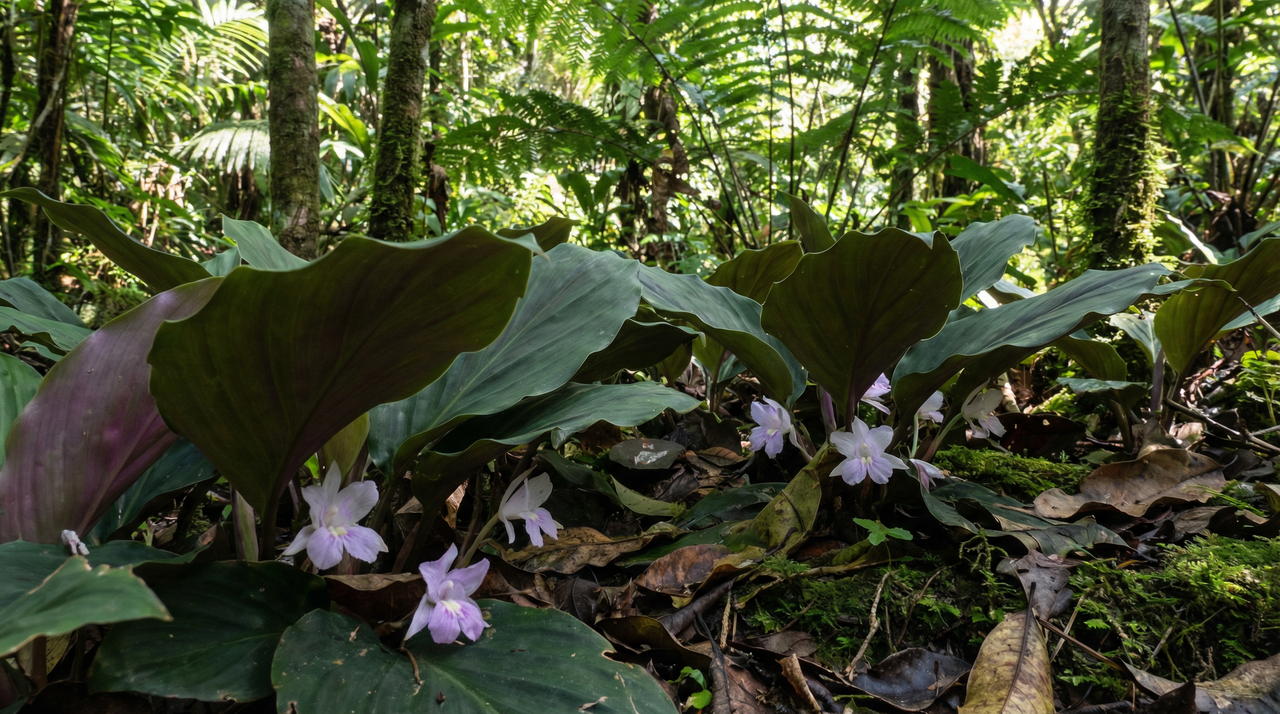
Peacock ginger keeps you guessing, hiding an edible secret beneath striking foliage. Every other ginger relative I've grown leads with a more obvious selling point. Turmeric gives you those flame-colored rhizomes. Galangal announces itself the moment you scratch the skin, but Kaempferia galanga demands a closer look. The leaves lie flat against the ground in a tight, almost meditative rosette, painted with silver and green in patterns that genuinely stop people mid-path in my garden. Then you lift one and catch the scent rising off it: something between camphor, fresh ginger, and a florist's cooler. It's a smell that has no real Western reference point, which is probably why this plant spent centuries feeding kitchens and medicine chests across Southeast Asia while most of the gardening world simply walked past it on the way to something showier.
That obscurity is the strange part. This is a plant with roots, literally and culturally, deep in Indonesian and Malaysian rainforest tradition, used in cooking, in ritual, and in folk medicine long before anyone was writing it up in Western botanical catalogs. And yet I still have to explain what it is at nearly every plant sale I do. Most people who've grown it bought it as an ornamental and had no idea they were sitting on edible, aromatic rhizomes the whole time. If that describes you, keep reading.
The Origins and History of Peacock Ginger
Every plant carries a story in its roots, and the peacock ginger plant is no exception. Kaempferia galanga, a lesser-known member of the Zingiberaceae family, traces its origins to the humid tropical forests of Southeast Asia, with its native range spanning Indonesia, Malaysia, parts of southern India, and into southern China. Picture the forest floor there: dense canopy above, dappled light filtering down, warm and perpetually moist. That's the ecological cradle this plant evolved in, and understanding it tells you almost everything you need to know about growing it successfully.
Native Range and Botanical Background of Kaempferia galanga
As a rhizomatous perennial, the kaempferia galanga plant is built for surviving the dramatic wet-dry cycles of tropical climates. During the dry season, the leaves die back completely, and the rhizomes wait underground until warmth and rain return. The first time I grew it in a Central Florida landscape design, that dormancy genuinely caught me off guard. I thought I'd lost the whole planting. I hadn't, of course, but the experience taught me to pair it with companions that hold visual interest through winter, filling the gap until the peacock unfurls again in spring. That forest-floor niche, low, shade-seeking, seasonally dormant, translates beautifully into food-forest understory design once you understand the rhythm the plant is working with.
Traditional and Cultural Significance
Across its native range, the kaempferia plant has gone by many names. In Indonesia it's known as kencur; in other parts of the region it's called aromatic ginger or sand ginger. Whatever you call it, the rhizome has been quietly earning its place in traditional medicine and cooking for generations. Ayurvedic practitioners, Chinese herbalists, and Southeast Asian cooks have long valued its aromatic roots for digestive support, flavoring rice dishes, and addressing a range of everyday ailments. While it lacks the bold heat of true culinary ginger, I've found its subtler rhizomes add an elegant, citrusy-camphor note in the kitchen garden that surprises people in the best way.
Honestly, documented history on Kaempferia galanga L. is surprisingly sparse compared to its Zingiber relatives. The ethnobotanical record is thin, more oral tradition and regional knowledge than written scholarship. Rather than see that as a deficit, I find it genuinely exciting. There's something wonderful about a plant that has quietly supported human health and flavor for centuries without ever quite getting its due in Western botanical literature.
Fun Facts and Modern Appeal
What is kaempferia galanga to modern gardeners? Increasingly, it's an ornamental obsession. The patterned, silver-and-green leaves that give the plant its "peacock" common name create a living mosaic in shaded beds that's hard to replicate with anything else. I've used it to solve some genuinely tricky design problems: deep shade under a live oak, dry-ish soil beneath a canopy where nothing else wanted to cooperate. When it's happy, it spreads into a lush, jewel-toned groundcover that stops visitors mid-stride.
Its introduction into Western ornamental horticulture is relatively recent, and I suspect most people encounter it first as a novelty nursery find before discovering its culinary and medicinal history. That's a fine entry point. Once it's growing in your garden, the deeper story tends to follow. And there is a deeper story here, one that the coming sections will fill out considerably.
Peacock Ginger Varieties and Sourcing
Popular Kaempferia Species for Ornamental Use
Here's a confusion I run into constantly with clients: they order a "peacock ginger plant," receive Kaempferia galanga, and then wonder why the leaves look nothing like the photos they saved. K. galanga is the species most widely sold under that common name, but its foliage is plain, deep green without much patterning. It's the culinary and medicinal workhorse of the genus, valued for its aromatic rhizomes rather than any visual drama. Beautiful in its own quiet way, but not the showstopper people are usually imagining.
If you want the real peacock experience, you're looking for Kaempferia elegans. The leaves on this one are genuinely striking, silver-and-green with a feathered pattern that holds up beautifully in a shaded understory. Think of it like a Caladium in its light requirements but with a much tighter, ground-hugging growth habit. The lavender-pink flowers that appear at soil level are a lovely bonus, though in my designs I treat the foliage as the whole point. Kaempferia variegated forms generally, and K. elegans specifically, are what most gardeners are picturing when they search for peacock ginger varieties.
Beyond those two, the genus has a few other species worth knowing. Kaempferia rotunda brings rounded leaves with striking purple undersides and white to pink blooms, which I've used to add color depth in shadier guild plantings. Kaempferia pulchra, sometimes called the jungle rose, offers dark-patterned foliage with rich purple flowers and a slightly more compact habit. Neither is as widely available as K. galanga, but when you can find them, they add real texture variation to a layered food forest understory. Kaempferia rotunda in particular pairs well with taller ginger relatives where you want that pop of color underneath.
Where to Source Peacock Ginger Rhizomes
Finding true-to-type variegated Kaempferia species takes some detective work. These plants move through the trade primarily as dormant rhizomes from specialty nurseries, ethnobotanical suppliers, and online tropical plant retailers, and availability tends to be seasonal and limited. I've ordered rhizomes labeled "peacock ginger" and received perfectly nice K. galanga that showed no variegation whatsoever. It happens, and it's not always the seller's fault since common names in this genus are genuinely chaotic.
My practical advice: always look for suppliers who post their own photos rather than stock images, and zoom in on the leaf patterning before you commit. Better yet, if you can find a supplier shipping actively growing plants in small pots during the warm season rather than bare dormant rhizomes, go that route. In my subtropical projects, established plants with active root systems settle in dramatically faster than dormant rhizomes, which can sit in the ground looking like nothing for weeks before you know if they've taken. One more nuance worth flagging: even in a correctly labeled K. elegans, the intensity of that silver variegation shifts with light conditions. Plants grown in deeper shade often show less contrast. So if yours comes in looking a bit washed out, give it slightly brighter indirect light before drawing conclusions about the variety.
Peacock Ginger Propagation and Planting
Soil Preferences and Site Selection
Before you plant a single rhizome, the soil needs to be right. Peacock ginger wants something that feels alive in your hands: rich, loose, and crumbly, the kind of bed that holds moisture without ever sitting wet. Technically that means a slightly acidic to neutral pH somewhere between 5.5 and 7.0, with high organic matter and enough drainage to prevent rhizomes from rotting during Florida's summer deluges.[1][2] In practice, that means working in generous amounts of compost before planting, especially if your native soil runs heavy. I've seen beautiful Kaempferia plantings fail simply because the bed was amended once and then forgotten.
For container growing, I've had reliable results over several seasons using roughly a 50/50 blend of quality potting mix and finished compost, which mirrors the recommended loam, sand, and compost combination without requiring you to source all three separately.[3][4] Containers are genuinely worth considering if your in-ground soil is heavy clay, since you can control drainage precisely and move the pot to shelter if a cold snap threatens.
Planting Rhizomes, Spacing, and Division
Spring is the time to get rhizomes in the ground, once nighttime temperatures are reliably warm and the soil has some heat in it. Space them about 12 inches apart, which gives each clump enough room to spread without immediate competition.[1][2] I think of it similarly to spacing turmeric or culinary ginger: you want enough air circulation above ground and enough soil volume below to let the rhizome network develop without becoming a knotted mess.
Division every two to three years is the most practical way to propagate this plant. This is best done during dormancy when the soil is moist but not saturated.[1][4] Healthy rhizomes feel plump and firm, with visible growth eyes that look like small pale nubs. If a piece feels spongy, shriveled, or hollow, set it aside. I've watched beginners plant dried-out or mushy rhizomes with complete confidence, then wonder why nothing emerged in spring. The tactile check takes ten seconds and saves months of waiting. Gently tease the clump apart by hand or with a clean knife, making sure each division has at least one or two good eyes, then replant at the same depth the original was growing.
Seed propagation is technically possible within the genus, but it's slow and rarely the route home gardeners take for K. galanga. Division is faster, more predictable, and gives you genetically identical plants from a mother clump you already know is healthy. After planting, keep the soil consistently moist and warm; that's what triggers the rhizomes to break dormancy and send up their first leaves.
Peacock Ginger Care Guide
Sunlight, Temperature, and Humidity Needs
Peacock ginger plant care starts with understanding where this plant came from: the shaded floor of tropical forests in Southeast Asia, where light filters down through a dense canopy and the air rarely dips below steamy. Partial shade is non-negotiable. Too much direct sun scorches the beautifully patterned leaves within days, while deep shade reduces the flowering you're working toward all season. I think of it the way I think about calathea or prayer plant: find a spot with bright, indirect light or dappled morning sun, and the foliage will reward you. That's the mental model I use when siting it under taller food forest layers in my Central Florida garden.[2][3]
Humidity is the other half of the environmental equation. Kaempferia care in humid subtropical climates is genuinely easier than most people expect, because summer air outdoors hovers right in that 70-90% range the plant prefers.[2] As a houseplant, though, you'll need to compensate. A pebble tray with water under the pot, or occasional misting, makes a real difference. The leaf tips will tell you when the air is too dry before the situation becomes serious.
Frost Tolerance and Overwintering
Peacock ginger is solidly in USDA zones 9-11, thriving between 70-85°F and starting to struggle any time temperatures drop below 60°F.[2][1] Frost will collapse the foliage fast. I've seen it happen after a single cold night in zone 9B, though the rhizomes usually survive if they're insulated by mulch and soil. Outside zones 9-11, containers are the practical answer; bring them indoors before nights approach freezing.[3]
In my garden, planting under a frost-hardy canopy tree buys a few critical degrees of protection on those occasional near-freezing nights. The foliage naturally yellows and retreats as autumn progresses, and I take that as my signal to dramatically cut back watering and let the plant rest. The rhizomes stay firm underground through the cooler months and push new growth back up when warmth returns in spring. That seasonal rhythm is normal, not a sign of failure.
Watering Requirements and Seasonal Management
In its native habitat, Kaempferia galanga receives over 2,000 mm of rainfall annually, roughly 80 to 100 inches.[3][5] That context helps calibrate expectations: this isn't a drought-tolerant plant. During active growth in spring and summer, aim for 1 to 2 inches of water per week, or watering every two to three days in warm conditions.[1][6] For containers indoors, every five to seven days is often enough depending on pot size and humidity. The goal is consistently moist soil, never soggy; let the top inch dry slightly before watering again.[2]
Deep, infrequent watering encourages the rhizomes to grow strong and reach down rather than staying shallow and vulnerable. Wet the top six inches of soil thoroughly, then wait.[7][8] Young seedlings or freshly planted rhizomes are the exception: they need lighter, more frequent moisture to get established.
I learned the drainage lesson the hard way. My first season with peacock ginger and a few related Zingiberaceae relatives, I lost rhizomes to root rot in a dense garden bed after summer downpours. Yellowing leaves and a faint musty smell from the soil were the warning signs I missed.[7][8] Now I plant in raised beds or containers with extra perlite worked into the mix. On the flip side, underwatered plants show drooping foliage first, then brown, crispy leaf edges and yellowing tips.[7][9] Catch the droop early and a good soak usually fixes it before permanent damage sets in.
A thick layer of organic mulch—shredded leaf litter or coconut coir both work well—reduces how often you need to water while keeping soil temperatures stable.[2][1] For water quality, rainwater is ideal. If you're using tap water, letting it sit overnight before using it has become automatic in my routine; the difference it makes in avoiding crispy leaf tips is genuinely noticeable over a season.[7][10]
Harvesting Peacock Ginger Leaves and Rhizomes
University extension data on harvesting Kaempferia galanga outside its native Southeast Asian range is essentially nonexistent, so what I'm sharing here comes from years of growing Zingiberaceae relatives in subtropical conditions and paying close attention to what the plant itself tells you. Peacock ginger actually offers two harvest targets: the leaves and the rhizomes. Those are separate conversations with different timing, and conflating them is where most gardeners go wrong.
Leaves can be snipped any time the plant is actively growing, which in warm climates means late spring through early fall. Cut at the base of the leaf stem rather than pulling, and keep it moderate. Taking too many leaves too frequently weakens the clump and, more critically, reduces the energy available for rhizome development underground.
When and How to Harvest Kaempferia galanga Rhizomes and Leaves
Rhizomes are a different story entirely. After losing a full clump my first year by digging too eagerly, I now place small stakes around my Peacock Ginger patches in midsummer to remind myself to watch carefully as the season winds down. The signal I wait for is yellowing pseudostems after flowering in late summer to early fall. That's the plant pulling energy back into the rhizomes before dormancy, and that's your window. In my experience, rhizomes harvested just as the last flower fades carry a bright, almost citrusy camphor edge that disappears once the foliage goes completely brown. Flavor peaks before full dormancy. Wait too long and you lose that nuance; dig too early and the roots are small and almost medicinal in their intensity.
From planting to first real harvest, expect to wait at least one full growing season, ideally two. A mature clump in a well-mulched forest garden understory will realistically yield around half a pound to a pound of usable rhizome annually without exhausting itself.
For the actual digging, I use a garden fork and work it into the soil 8 to 10 inches away from the base. Lift the whole mass gently, take only what you need, snap or cut off those sections cleanly, and replant the remaining crown immediately with at least one good growing point still attached. The root system is shallow, so aggressive digging doesn't just reduce this year's yield; it devastates next season's ornamental display. Because I treat these plants as both edible and ground-cover layers in my food forest design, I never clear an entire patch at once. Small, selective harvests preserve the plant's ecological role and give it every chance to fill back in beautifully by spring.
Peacock Ginger Culinary and Medicinal Uses
The rhizome of the peacock ginger plant has two lives: one in the kitchen and one in the medicine cabinet. They're not entirely separate. The same aromatic compounds that make Kaempferia galanga smell so distinctly floral and camphorous are the ones traditional herbalists across Southeast Asia have relied on for generations to ease digestion and soothe inflammation. Understanding both roles helps you get far more from the clumps quietly spreading through your shaded garden bed.
Culinary Applications of Peacock Ginger Rhizomes
Fresh rhizomes dug from your own garden have a noticeably brighter, more floral character than the dried galangal you'll find at an Asian grocery. I've done the comparison side by side, and the home-grown version wins on aroma every time. The flavor sits somewhere between true ginger and lemongrass, less pungent than either, with those soft camphor undertones that make it interesting rather than sharp.
My approach in the kitchen is to scrub rather than peel the thin skin, since a lot of that volatile fragrance lives just beneath the surface and peeling wastes it. Slice the rhizomes thin for stir-fries, simmer them into a simple kaempferia parviflora-style herbal tea with honey and lime, or tuck whole slices into a pickling brine. The young leaves work beautifully as an aromatic wrap for sticky rice or fish, in the same spirit as banana leaf cooking across the region. Plants grown in the dappled shade and consistent moisture that this species prefers produce noticeably more tender rhizomes, so your design choices genuinely affect the flavor you harvest.
Traditional Medicinal Preparations
Kaempferia galanga uses in traditional medicine run deep across South and Southeast Asia, covering everything from digestive complaints to topical applications for muscle pain. The most common home preparations involve drying and powdering the rhizome or making a simple water infusion. I find those preparations easy to replicate from garden harvests, and I'm happy to explore them out of curiosity. That said, I'll be honest: the clinical research backing these uses is sparse. Traditional knowledge is worth respecting, but it's not the same as a randomized trial, and anyone pursuing therapeutic use should talk to a qualified practitioner rather than treating their garden as a pharmacy.
Non-Food Uses and Garden Applications
Beyond the kitchen, peacock ginger earns its keep in ways most gardeners overlook. The dried rhizomes make a genuinely pleasant potpourri base, and aromatic sachets tucked into drawers have a long history as natural insect deterrents in the regions where this plant originates. In the garden itself, the spreading, low foliage functions as living mulch in shaded forest layers, suppressing weeds while keeping soil moisture steady beneath taller companions. Harvesting a handful of rhizomes for kitchen or craft use doesn't set the clump back significantly; the remaining roots push right back, which is exactly the kind of regenerative dynamic that makes a plant worth growing in a thoughtful food forest.
Peacock Ginger Health Benefits and Medicinal Uses
The peacock ginger plant is not turmeric. It doesn't have decades of clinical trials behind it, and I'd be doing you a disservice to pretend otherwise. What Kaempferia galanga does have is centuries of real-world use across Ayurvedic, Chinese, and Southeast Asian traditional medicine, and a growing (if still modest) body of preliminary research that suggests those traditional practitioners were onto something. Think of it as a plant that ancient healers understood intuitively, and that modern science is only just beginning to examine.
Traditional Uses in Ayurveda and Southeast Asian Medicine
Across the tropical regions where this plant grows wild, its rhizomes have long been the go-to remedy for a surprisingly broad range of ailments. Known in Indonesian traditional medicine as "kencur," the rhizomes have been used for centuries to ease indigestion, bloating, and flatulence, and also for respiratory conditions, skin complaints, and as a general restorative tonic.[11][12] Some cultures even used it as an aphrodisiac. When I freshly grate a rhizome and that sharp, camphor-meets-ginger aroma hits me, I find it completely believable that people reached for this plant when something felt off digestively. That pungency is a sensory signal of bioactivity.
Key Phytochemicals and Their Potential Effects
The rhizomes' essential oils are loaded with active compounds, including ethyl p-methoxycinnamate (often comprising 50 to 60% of the oil), cineole, borneol, 3-carene, and an assortment of terpenoids and flavonoids.[13][14][15] Ethyl p-methoxycinnamate in particular is linked to the anti-inflammatory and antioxidant activity seen in lab studies. When I've made simple infusions from fresh rhizomes, they feel more cooling and aromatic than the warming heat you get from true ginger or turmeric. That difference in character actually reflects a meaningfully different phytochemical profile.
Scientific Research on Benefits
Preliminary in vitro and animal studies have demonstrated anti-inflammatory, analgesic, and antimicrobial activity in rhizome extracts.[16][17] Research has also explored accelerated wound healing in animal models and mild anxiolytic effects, though neither finding has been confirmed in rigorous human trials.[18][19] In permaculture design, I value multifunctional species, and the wound-healing research resonates with that principle: a plant that works as a groundcover, a culinary herb, and a traditional first-aid remedy is exactly what a regenerative garden is built around. The science just hasn't caught up to what village healers have known for generations.
Nutrition Profile
As a food source, Kaempferia galanga contributes minor amounts of vitamin C, potassium, and magnesium when eaten.[20] Like ginger and turmeric, it's simply not a meaningful caloric or micronutrient contributor. You're not growing this for macros. You're growing it for its aromatic compounds and the subtle medicinal character they carry.
Safety and Precautions
Used in culinary amounts, Kaempferia galanga is generally considered safe.[21][22] Concentrated essential oil extracts are a different story, and anyone who is pregnant, on blood-thinning medications, or dealing with known plant allergies should seek guidance from a qualified practitioner before using it therapeutically. In my work with clients building medicinal landscapes, my standard advice is always the same: start with culinary doses, get familiar with how your body responds, and bring in a practitioner if you're exploring therapeutic applications. That's not timidity; that's just responsible use of any medicinal plant, whether it's been studied for decades or centuries.
Peacock Ginger Pests and Diseases
If you're looking for a low-drama garden plant, the peacock ginger is a good candidate. In my experience growing Kaempferia and related gingers in humid subtropical conditions, serious pest problems are genuinely uncommon. Healthy plants in a well-sited spot tend to take care of themselves, and I've watched clumps of peacock ginger sail through hot, sticky Florida summers with completely clean foliage and zero intervention on my part. That kind of quiet resilience is exactly what you want in a shade groundcover.
The main issues I've seen with this plant, and with similar shade-lovers like caladiums and hostas, come down to cultural conditions rather than any particular pest or pathogen. Overly wet or poorly drained soil is the real enemy. I learned this the hard way with a patch of Kaempferia I'd planted in a low spot that collected water after heavy rains. The rhizomes rotted before I even realized something was wrong. After that, I started amending beds more aggressively with compost and coarse organic matter to get drainage right from the start, and I haven't lost a planting since. Fungal issues and root rot follow the same pattern: they emerge from soggy conditions, not from the plant being inherently susceptible.
Slugs and snails can occasionally show up in shaded, moist spots, especially during the rainy season. They're opportunists, and a groundcover in dappled shade gives them cover they like. A ring of diatomaceous earth or some iron phosphate bait handles them without disrupting anything else in the garden system.
Prevention really is the whole strategy here. Get the siting right, give the rhizomes excellent drainage, and monitor occasionally after heavy rainfall. Chemical interventions almost never come up as a conversation with this plant.
Peacock Ginger in Permaculture Design
Before you start imagining where this plant fits in your food forest, you need to sit honestly with one number: USDA zone 9. Kaempferia galanga is reliably hardy in zones 10 and 11, and even a brief dip below 60°F can set it back hard.[4][2][1] That's the non-negotiable starting point for any design decision. Get the climate wrong and nothing else matters.
Climate Adaptation and Hardiness Zones
I've grown peacock ginger successfully in zone 9B gardens around Central Florida, but only by treating placement as a microclimate puzzle rather than a general-purpose planting. A dense canopy overhead moderates overnight lows better than open sky ever will. A south-facing wall that radiates stored heat, or a position near a pond that buffers temperature swings, can mean the difference between a plant that sails through a January cold snap and one that turns to mush by morning. In colder margins of zone 9, I'm honest with clients: grow it in a container you can drag to a protected lanai when the forecast dips. I've overwintered plenty of tender perennials that way, and the peacock ginger has been one of the most rewarding to bring back out in spring.
Once you've settled that climate question, the design opportunities open up considerably. What I love about this plant in a subtropical food forest guild is how well its natural habit fits the ground layer niche. It stays under twelve inches tall and spreads in a low, dense mat, which means it slips in beneath taller gingers, bananas, or fruit trees without any meaningful competition for light. I've used it repeatedly in shaded understory beds where bare soil would otherwise invite weeds between waterings. Those broad, beautifully patterned leaves create a living mulch effect that genuinely suppresses weed pressure and holds soil moisture through Florida's dry season in a way that a layer of wood chip mulch alone won't quite replicate.
From a guild design standpoint, the fact that its rhizomes are both edible and medicinal earns it a functional role beyond pure aesthetics. A plant that feeds you, medicines you, covers the soil, and looks stunning doing it is exactly what permaculture design asks for at every layer. I usually tuck it around the drip line of a Meyer lemon or lychee, where filtered afternoon shade keeps it from scorching and the root zones don't overlap aggressively. Give individual clumps eighteen inches or so to spread over a couple of seasons, and you'll have solid coverage without crowding. Just don't plant it somewhere you can't protect it when the weather turns cold. That's the one constraint this plant asks you to respect, and it's a fair ask.
The Plant I Keep Tucking Into Every Shady Corner
I'll be honest: I first grew Peacock Ginger because it was pretty, and I needed something low that wouldn't sulk under the live oaks. The rhizomes were almost an afterthought. But the first time I brewed a tea from the harvested rhizomes, something shifted; now I can't imagine designing a shaded tropical understory without it. It's one of those plants that quietly earns more respect the longer you grow it.
Sources 22
- Kaempferia galanga ↩
- Kaempferia galanga ↩
- Kaempferia galanga ↩
- USDA Plants Database - Kaempferia galanga ↩
- Tropical Herb Gardening: Galangal Care ↩
- Horticultural Guide to Lesser Galangal ↩
- Kaempferia galanga Care Guide ↩
- Preventing Root Rot in Ginger Family Plants ↩
- Signs of Underwatering in Tropical Plants ↩
- Soil and Water Requirements for Ginger Family Plants ↩
- Ethnopharmacological survey of Kaempferia galanga uses ↩
- Traditional medicinal uses of Kaempferia species in Southeast Asia ↩
- Chemical composition and bioactivities of Kaempferia galanga essential oil ↩
- Phytochemical analysis and pharmacological activities of Kaempferia galanga ↩
- GC-MS analysis of Kaempferia galanga rhizome oil ↩
- Review of the traditional uses, phytochemistry, and pharmacological properties of Kaempferia galanga ↩
- Kaempferia galanga: A review on pharmacological activities and phytochemical constituents ↩
- Wound healing properties of Kaempferia galanga extract ↩
- Evaluation of anxiolytic activity of Kaempferia galanga ↩
- Nutritional composition of selected Zingiberaceae species ↩
- Safety assessment of Kaempferia galanga in traditional medicine ↩
- Toxicity and pharmacological profile of Kaempferia galanga ↩