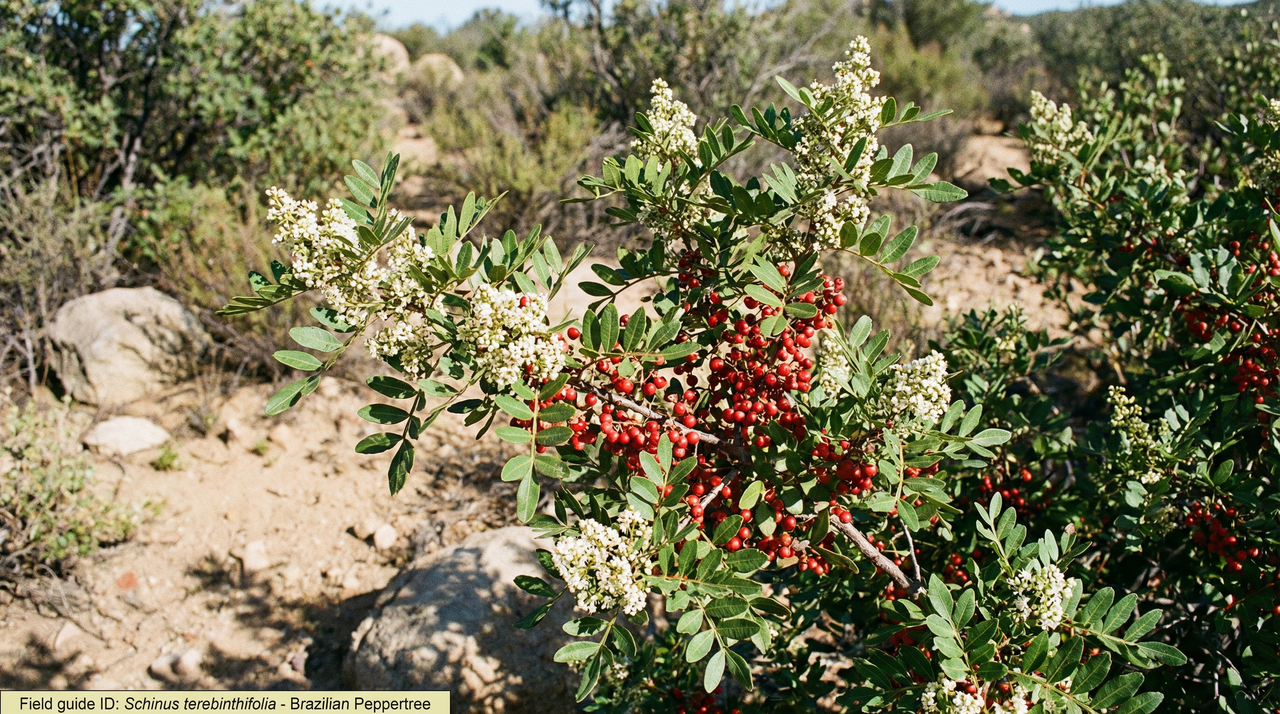
Nobody warns you about the smell. The first time I brushed against a Brazilian peppertree while surveying a restoration site in central Florida, that sharp, resinous hit stopped me mid-step, something between turpentine and Christmas and something I couldn't quite name. It's arresting in the way that only plants with serious chemistry tend to be, and that chemistry is the whole story with Schinus terebinthifolia. Those glossy compound leaves, those clusters of candy-bright pink drupes hanging like nature's most tempting garnish: they've seduced gardeners, landscapers, and botanical gardens across the globe for well over a century. Florida alone is now hosting the consequences on more than 700,000 acres.[1]
Here's the contradiction that keeps this plant interesting despite all of that: the same biological machinery making it an ecological nightmare in invaded regions is exactly what made it a respected medicinal plant among the Guarani and Tupi-Guarani peoples of South America long before any botanist gave it a Latin name. Powerful, persistent, chemically complex, and genuinely beautiful. I've spent years pulling it out of restoration plantings and studying what it actually does, and I'm still not bored by it. What I want to share with you isn't a simple villain story; it's something considerably more complicated.
Origin and History of the Brazilian Peppertree (Schinus terebinthifolia)
Botanical Background and Native Range
Schinus terebinthifolia is native to the subtropical and tropical Atlantic Forest biome of southeastern Brazil, northeastern Argentina, Paraguay, and Uruguay.[2][3] In that home range, it behaves like a capable pioneer: long-lived at 50 to 100 years, hitting reproductive maturity as early as two to four years of age, and capable of producing up to 100,000 seeds per tree every year.[4][5][6][7] Add in drought resilience, moderate salinity tolerance, and the ability to thrive from sea level up to about 1,000 meters, and you have a plant that's genuinely well-adapted to disturbance ecology.[8] In its native forests, that's a feature. Once it escapes, it's a nightmare. Outside its home range, those same traits fuel rapid invasion: the tree forms even-aged monoculture stands, releases allelopathic phenolics and terpenoids that suppress competing vegetation, and has become a serious ecological problem in Florida, California, Hawaii, and Mediterranean regions.[9][10][11] Tellingly, trees in invasive populations tend to live only 20 to 30 years rather than the full century possible in native habitats, suggesting the plant burns fast and spreads hard rather than settling into a stable ecosystem role.[8][12]
Physical Characteristics and Visual Identification
The Brazilian peppertree grows as an evergreen shrub or small tree, typically 15 to 40 feet tall with a dense, spreading canopy reaching 15 to 30 feet wide.[13][14] The leaves are alternate, pinnately compound with 5 to 11 dark green leaflets, and that's usually the first thing I notice when I encounter one on a restoration site, because crush a single leaflet between your fingers and you get an immediate, sharp resinous scent that's completely unmistakable. That aroma is my cue to put on gloves before I do anything else. Small white flowers appear in axillary clusters, and the plant is dioecious, meaning you need both male and female individuals for fruit production.[15][16] The fruits are what give it the name "Christmas berry": tight clusters of bright pink-red drupes, 4 to 6 mm across, that ripen in winter and persist on the tree long enough to look genuinely festive.[8][17] They're also bird candy, which is precisely why this plant spreads so effectively. If you're trying to tell it apart from its relative Peruvian pepper (Schinus molle), look at the canopy and the fruit: Brazilian peppertree has a denser, shrubby branching pattern and smaller fruits, while Peruvian pepper has graceful, pendulous branches and a more open, umbrella-shaped crown.[18][19]
Traditional and Cultural Uses Across South America
The plant's formal botanical name dates to Carl Linnaeus the Younger's 1781 description, though it appears in botanical literature as far back as 1698 under indigenous names, and it arrived in Florida as an ornamental introduction in the mid-19th century.[20][21] Long before European botanists catalogued it, indigenous Brazilian peoples including the Guarani, Kaingang, and Tupi-Guarani were using the leaves, bark, and fruits in infusions, poultices, and teas to address wounds, respiratory infections, digestive complaints, fever, and rheumatism.[22][23][24] That's genuine, deep-rooted ethnobotanical knowledge. What was once a respected medicine plant in its home culture, though, became an ecological liability once the ornamental plant trade carried it to South Africa, Australia, the Mediterranean, and the American subtropics.[25][26] The ornamental appeal was obvious; the ecological consequences took longer to recognize.
Invasive Spread, Toxicity, and Ecological Impact
The scale of Brazilian peppertree's invasion in Florida alone tells you everything you need to know about what happens when a prolific seed producer meets a landscape with no co-evolved competitors: it now occupies over 700,000 acres of the state, spreading via bird-dispersed seeds and releasing allelopathic phenolics and terpenoids that actively suppress the germination of native plants around it.[27][28][29] I've worked on enough Florida restoration projects to know that pulling Brazilian peppertree from a site is less like weeding and more like a multi-year commitment. At this point, I recommend against planting Schinus terebinthifolia anywhere in zones 9 through 11, full stop, and I always arrive ready with a list of native look-alikes for clients who love the visual of those pink berry clusters.
The toxicity piece matters too, and I treat every pink-berried Schinus the same way I treat poison ivy on a job site: gloves on, no casual contact. The plant contains catechols, including 3-n-pentadecylcatechol, that can cause contact dermatitis similar to poison ivy reactions, and ingesting the berries or leaves can produce gastrointestinal upset, nausea, and vomiting in people, pets, and livestock.[30][31] I've seen clients develop blisters after handling the plants without protection, thinking those cheery winter berries were harmless. The leaf essential oil is dominated by monoterpenes like alpha-pinene, which accounts for much of that sharp resinous scent, alongside flavonoids, tannins, and other compounds that contribute to both the plant's bioactivity and its toxic potential.[32] The tree is now listed as a noxious weed in both Florida and California, and its historical use as an ornamental under the names "Florida holly" and "Christmas berry" is heavily restricted across invaded regions.[33][34] Its relative, Peruvian pepper (Schinus molle), is native to arid Andean habitats at 1,000 to 3,000 meters elevation, grows larger, carries a more graceful pendulous form, and has a longer history of culinary and land-stabilization uses in Andean cultures, though its invasive potential in California warrants the same careful scrutiny I apply to any Schinus species.[35][36]
Pepper Tree Varieties and Sourcing
Do Cultivars of Schinus terebinthifolia Exist?
The short answer is no, and that's not a gap in horticultural ambition so much as a reflection of the plant's status. Schinus terebinthifolia has no recognized cultivars or named varieties in any authoritative botanical, horticultural, or invasive species management context.[37][38][39][40] As a Category I invasive species across much of the southern United States, cultivation of any selection is strongly discouraged regardless.[41][18][42]
If you've noticed real differences between individual plants, that's genuine variation. Leaf size, growth density, and berry color do shift from plant to plant, but these are intraspecific differences rather than distinct taxonomic entities.[43] After years of reviewing plant tags and nursery catalogs, I've learned that trade names like 'Compacta,' 'Variegata,' or 'Pink Mist' that occasionally surface in commerce are unreliable marketing rather than stable, formally recognized selections. Similarly, references to two subspecies, Schinus terebinthifolia subsp. terebinthifolia and subsp. acuta, appear in some older literature[44] but this classification lacks consistent current recognition. Neither subspecies distinction nor any trade name changes what you're dealing with ecologically.
For a genuine contrast, look at the closely related Peruvian pepper tree (Schinus molle), which actually has documented ornamental selections: 'Variegata' with cream and green striped leaves, 'Rosea' with pink-tinged new growth, 'Pendula' in a weeping form, and var. aromaticus selected for especially fragrant foliage.[45][46][47] Schinus ferox, another genus relative, has 'Pink Passion,' a compact ornamental selection reaching 10 to 15 feet with vibrant pink berries, though documented cultivar work across the genus remains slim. The takeaway is that the Schinus genus has seen almost no formal breeding investment precisely because the most widely known species can't be responsibly sold.
Legal Restrictions and Responsible Alternatives for Planting Pepper Trees
The regulatory picture around the Brazilian pepper tree is about as clear as it gets. In Florida, the plant is prohibited from sale, transport, or planting under Florida Statutes Chapter 581 and Rule 5B-57.[48][41] California classifies it as a Class C noxious weed with sale and distribution banned statewide.[49][50] Texas lists it as a noxious weed with propagation and sale actively discouraged.[51][52] In Hawaii, both sale and possession are banned outright.[53] Federally, the Plant Protection Act restricts import and interstate movement of the species.[54] I always tell clients to verify current local rules before anything else; these designations can tighten over time.
The responsible path forward starts with native alternatives. In Central Florida landscapes, I consistently specify Florida anise (Illicium floridanum) where clients want that glossy foliage and a sense of dense enclosure. Its star-shaped flowers are genuinely lovely, it thrives in the same humid conditions where schinus would otherwise dominate, and there's no regulatory paperwork attached. In California, Toyon (Heteromeles arbutifolia) delivers similar winter berry color and supports bird forage without the aggressive spread I've witnessed firsthand in unmanaged Florida landscapes.
If you're in a region where a Schinus species is still permitted and you want something in the genus, the Peruvian pepper tree (Schinus molle) is the only realistically available option commercially.[55][35] It's an evergreen tree reaching 25 to 40 feet with graceful drooping branches, aromatic pinnate leaves, and red berries, suited to USDA zones 8 to 11 and genuinely drought-tolerant once established.[45][56] Seeds and plants are available from Sheffield's Seed Company, Monrovia, and Moon Valley Nurseries, among others.[57][58] Know, though, that California IPC lists Schinus molle with moderate invasive risk[36] and Texas carries local sales restrictions on it too. Going with Schinus molle is not a clean answer; it's a lesser-of-concerns decision that still requires site-specific judgment.
Propagating and Planting Pepper Tree (Schinus terebinthifolia)
Before anything else, I want to be direct: growing a pepper tree from seed or cuttings is not simply a gardening decision. It carries real ecological weight. Brazilian peppertree is one of the most aggressively invasive woody plants in the southern United States, and propagating it without understanding the consequences is a mistake I've watched well-meaning gardeners make too many times.
Important Caution: Invasive Status and Regulatory Considerations
Schinus terebinthifolia is regulated or prohibited in Florida, California, Hawaii, and other warm-climate states, and propagating it may be illegal depending on where you live.[8][59] Check your state's invasive species lists and your county extension office before you do anything else. I no longer recommend planting Schinus terebinthifolia in any Florida landscape unless it is fully contained and regularly monitored; the ecological cost simply outweighs the ornamental benefit in our region. That said, if you're in a climate where it's legally permissible and you're prepared to manage it with genuine vigilance, the propagation biology here is genuinely fascinating.
Propagation Methods: From Seed, Cuttings, Grafting, and Tissue Culture
The reproductive biology of this tree is worth understanding before you propagate it, partly because it explains how the plant spreads so effectively in the wild. Each small fleshy drupe, about 4-6 mm across and pink-to-red when ripe, contains one (occasionally two) hard-coated seeds roughly 3-4 mm long.[60][4] The species is dioecious, so you need both male and female plants for seed production, and because of high outcrossing rates, seed-grown plants rarely come true to type.[61][62] What makes it especially interesting is that the seeds exhibit polyembryony, producing 2-5 embryos per seed through nucellar embryony, which means you can occasionally get multiple seedlings from a single seed, some of them clonal.[63]
For seed propagation, freshness matters enormously. In my propagation trials, dried commercial seed has performed erratically, while fresh scarified seed germinated quickly and reliably. Scarify the hard seed coat lightly with sandpaper or soak for 24-48 hours, and germination rates of 70-90% are achievable at 20-30°C in moist, well-aerated media within 2-4 weeks.[64][65] If you want genetic consistency rather than variability, vegetative propagation is the better path. Softwood or semi-hardwood cuttings treated with 1000-3000 ppm IBA under high humidity (80-90%) and temperatures of 21-27°C root at 40-80% success within 4-8 weeks.[66][67] Grafting (cleft, veneer, or T-budding) onto compatible Schinus rootstock achieves 60-90% success and is the preferred method when you need true-to-type plants and earlier fruiting; air layering is also viable at around 80% success in 2-3 months.[64][68] Tissue culture using MS medium with BAP, NAA, and IBA can push success rates up to 90%, but that's primarily territory for researchers and commercial operations rather than home propagators.[69]
After years of designing gardens in Central Florida, I've learned to label every Schinus seedling tray immediately. The first true leaves can look surprisingly similar to several native species, and an unlabeled tray leads to exactly the kind of accidental planting you're trying to avoid.
Seed Biology, Dormancy, Viability, and Germination Timeline
The seeds show intermediate storage physiology, somewhere between orthodox and recalcitrant, and lose viability rapidly if moisture drops below 20-30%; soil seed bank persistence is typically less than five years.[70][71] That's worth knowing if you're storing seed: keep it cool and slightly moist, and use it within a season. Once the hard coat is broken and conditions are right, expect germination in 2-4 weeks. Seed-grown plants typically reach first fruit in 3-5 years, or as quickly as 2-3 years in optimal subtropical conditions; grafted plants can fruit in 2-4 years.[9][72][73] That relatively short juvenile period is part of what makes this species so ecologically tenacious.
Soil, Site Selection, and Sunlight Requirements
If there is one non-negotiable in siting this tree, it's drainage. Schinus terebinthifolia tolerates poor fertility, compacted soil, salinity, and a wide pH range (optimally 5.5-7.5, with a broad tolerance from 4.5 to 8.5), but it will not tolerate waterlogged roots.[4][74][75] Root rot comes on fast in our humid subtropical summers, and I've lost young plants in poorly drained spots within a single rainy season. Sandy loam is the sweet spot, but this tree will grow in almost any well-drained texture. Stay within the pH window because above 7.5 iron chlorosis shows up as yellowing new growth, and below 5.5 aluminum and manganese toxicity become concerns.[75] I've corrected early-stage chlorosis on young trees in alkaline Florida sand with a foliar chelate spray and a surface dressing of sulfur; it responded within a couple of weeks, confirming that these trees genuinely prefer the slightly acid side of neutral.
The tree forms beneficial arbuscular mycorrhizal associations that improve phosphorus and zinc uptake in nutrient-poor soils, which means it needs very little added fertility once established.[76][75] Sun exposure matters too: full sun means a minimum of six direct hours per day, and that's where you'll get the strongest structure and densest canopy.[77][78] Partial shade produces etiolated, sparse growth; the photosynthetic plasticity of this species means sun-grown leaves become smaller and thicker in adaptation to intense light, exactly the kind of efficient, tough physiology that helps it out-compete everything around it. Those same tolerances that make it so adaptable are precisely what make it such a successful invader.
Spacing, Planting Technique, and Establishment Care
Mature Brazilian peppertrees reach 20-40 feet in both height and width, forming a dense umbrella canopy that shades out almost everything beneath it.[79][80] Landscape spacing should be at least 15-20 feet on center, with hedgerow planting at 3-5 feet within rows and windbreak rows spaced 12-15 feet apart. I now use 20 feet as my absolute minimum between any pepper tree and desirable understory plants, after watching a single specimen shade out an entire food-forest guild layer within three years. The shallow, spreading root system is another reason to keep generous distance from structures, paths, and water features.
For establishment, young transplants need consistent moisture, roughly 1-1.5 inches per week, a 2-3 inch mulch layer to retain that moisture, and no fertilizer in the first season.[81][64] Transplant seedlings after 6-8 weeks in the nursery, and resist the urge to overwater at any stage; this tree's root system is already primed to resent sitting in moisture. Even when planted thoughtfully and legally, plan for ongoing monitoring. Where Schinus terebinthifolia is concerned, responsible planting and responsible containment are the same job.
Pepper Tree Care Guide
Before anything else: if you're in Florida, California, Texas, or anywhere else where Brazilian peppertree is listed as invasive or prohibited, please check your local ordinances before you do anything with this plant. After watching it displace native hammock species in South Florida, I no longer recommend planting it in those regions except under very controlled conditions. That context shapes every piece of advice below.
Watering Needs and Drought Tolerance
Young Brazilian peppertrees need consistent moisture during their first year or two, roughly 1 to 2 inches per week, to push roots deep enough to fend for themselves.[82][14] Once established, that taproot (which can reach 1 to 2 meters or more) takes over, and the tree needs almost nothing from you, maybe a deep soak every two to four weeks during extreme heat or prolonged drought.[83][8] The thick, waxy leaves are built to lose as little moisture as possible, and the tree will even shed foliage during severe drought rather than burn through its reserves.[84][85]
Overwatering is the bigger mistake I see with young specimens. Soggy roots lead to rot fast: look for mushy stems at the soil line, yellow leaves dropping prematurely, or a faint sour smell around the base.[80][86] Underwatering shows up as crispy leaf margins and curl. Well-drained sandy or loamy soil with a pH around 6.5 to 7.0 gives you the best protection against both problems.[87][85]
Feeding and Nutrient Management
This is a plant that thrives on neglect. Brazilian peppertree evolved in low-fertility South American soils, and high-nitrogen fertilizer doesn't make it healthier; it makes it faster, weedier, and more attractive to pests.[14][88] I've seen over-fertilized specimens in client landscapes that looked lush but were constantly fighting aphids and scale. The leaner plants on poor soil were frankly more resilient.
Always soil-test before feeding. If the numbers genuinely call for it, a balanced 10-10-10 at 1 to 2 pounds per plant annually, split across two or three growing-season applications, is plenty.[89][90] Mature trees rarely need anything at all. Watch the older leaves for uniform yellowing if you suspect nitrogen deficiency, and check new growth for interveinal chlorosis if your soil runs high in pH, a sign of iron lockout. Leaf-tip burn and dark-then-yellowing foliage usually mean you've given too much, not too little.[91][92]
Frost Tolerance and Cold Protection
Brazilian peppertree is rated for USDA zones 9 to 11, with marginal survival into zone 8b in sheltered spots.[64][93] It can tolerate a brief dip to around 20°F, but anything below 25°F for more than a few hours will cause real damage: blackened leaves, twig dieback, bark splitting.[4][94] Young plants and anything in flower or fruit are most vulnerable. That said, the root system is tough: even a top-killed tree will often resprout from the base, which matters for invasiveness management as much as it does for recovery. I've saved young trees in zone 9b during surprise freezes into the low 20s with heavy mulch plus a frost blanket, similar to how I'd protect a marginal citrus.[95][96] Peruvian pepper (Schinus molle) gives you a bit more buffer, tolerating down to around 10°F, if you're considering the genus in a cooler climate.[77]
Heat Tolerance and Temperature Preferences
Heat is rarely the limiting factor. The tree's sweet spot sits between 60 and 85°F, and it tolerates extremes above 110°F in its native range.[4][97] Above 95°F, especially combined with dry conditions, you'll see leaf scorch, wilting, and flower drop. The plant adjusts stomatal conductance and ramps up antioxidant activity to cope,[98] but seedlings and flowering trees are the most vulnerable. Leaf scorch is one of the first signals I watch for in any heat-wave season, and it's a useful diagnostic: it tells you whether the tree needs water, better mulch, or simply more patience.
Pruning, Maintenance, and Containment
The roots are the thing I always warn people about first. Brazilian peppertree develops a shallow, aggressive root system that can lift pavers within three years and damage foundations and pipes if sited carelessly.[38][99] I've learned from hard experience: keep it at least 15 to 20 feet from any structure. In Florida, it's a Category I invasive, and cultivation is effectively prohibited in many jurisdictions. That has to be your starting point, not an afterthought.
Where cultivation is permitted, prune in late winter during the slowest growth period. Heading cuts of 6 to 12 inches help control size and establish a single leader in young trees; always remove suckers promptly.[89][4] The most important containment step is removing flower panicles before fruit sets, because every berry that drops is a potential new plant. Scale insects are the most common pest, manageable with horticultural oil, and Phytophthora root rot is the disease to watch for in poorly drained sites.[100][101] In many regions, the most responsible maintenance decision is removal rather than cultivation.
Seasonal Care Calendar
In subtropical climates, Brazilian peppertree is effectively evergreen with no true dormancy, though growth does slow in cooler months.[102][83] Flowering peaks from March through June, fruit ripens from late summer through winter with peak color in fall. Peruvian pepper follows a slightly different calendar in temperate zones, flowering late spring to early summer with fruit in summer and early fall, and it goes through a partial growth slowdown in winter.[77][103] For Brazilian peppertree specifically, that near-constant activity means there's rarely a safe moment to ignore it. In Central Florida I've watched these trees barely pause between bloom and fruit cycles, which is exactly why timely flower removal is so important for anyone trying to manage spread rather than contribute to it.
Pepper Tree Harvesting Guide
Before anything else: if you're in Florida, California, Texas, or anywhere else where Schinus terebinthifolia has been classified as invasive, I'm not here to encourage you to plant this tree so you can harvest it. In my Central Florida landscape work, I've managed removal crews cutting back Brazilian peppertree from restoration sites, and I've watched those bright-red drupes appear almost overnight once night temperatures climb above 20°C and stay there. The harvesting information below applies to people already managing these trees on existing properties, or working with Peruvian pepper (Schinus molle) in controlled settings where it's appropriate.
When to Harvest Pink Peppercorns: Ripeness Cues and Seasonal Windows
Brazilian peppertree fruit develops quickly once it sets. From full bloom to mature fruit takes roughly 60 to 90 days,[104][105] with flowering typically running November through January in Florida and ripe fruit appearing from late summer through winter, most abundantly September through December.[97] Warmer temperatures above 20°C and adequate rainfall both push production along, though local climate can shift that window.[106] Schinus molle operates on a much slower clock. From flowering to ripe fruit takes 150 to 180 days,[107] with spring bloom leading to August through November harvest in California and September through December in Florida and Texas, depending on latitude and conditions.[108] These are observational rhythms, not cultivation targets.
How to Harvest and Process the Fruits
When working with schinus terebinthifolius fruit in a managed-removal or restoration context, the simplest approach is hand-stripping ripe clusters directly from branches or laying a tarp beneath female trees and gently shaking branches to drop the berries.[8] I prefer tarps. They're cleaner, faster for volume collection, and reduce the chance of leaving viable fruit on the ground to spread. Aim for 80 to 90 percent color development; ripe fruits detach easily with minimal effort when they're ready.[109][110] One thing you'll notice immediately: the resinous oils transfer to your hands during stripping and linger for hours. Gloves aren't optional, particularly given this family's potential for skin irritation.
Yield, Texture, and Flavor at Different Ripeness Stages
What you're actually after is the outer layer of the dried drupe. Each fruit is a small 4 to 6 mm berry with thin, slightly waxy red skin surrounding a single hard, woody seed that's inedible.[64][111] The shift from green to bright red isn't just visual. Essential oil content rises from around 1 to 3 percent in unripe fruit to 4 to 6 percent at full maturity,[112] which is why harvest timing matters so much for flavor. Fully ripe schinus berries are fruity, citrusy, and piney with a sweet-sour character and that distinctive resinous finish that stays with you.[4][113] Unripe green fruit is milder and slightly bitter. Fresh ripe berries have a juicier, more herbal quality; drying concentrates those volatile oils and gives you the crunchy pink peppercorn texture familiar from gourmet spice blends.[114] Shade drying at low temperatures preserves aromatics best; high heat degrades the volatiles you're trying to keep.[114] Schinus molle berries share that rosy outer layer but lean sweeter, less pungent, and subtly floral,[115] though both species belong to the Anacardiaceae family and carry the same safety considerations. If fruits darken to purple or black, they're overripe and the aromatic intensity drops significantly.[116] For more on safe preparation and culinary use, the preparation and uses section covers drying methods and processing in detail.
Pepper Tree Preparation and Uses
Culinary Uses of Pink Peppercorns
The ripe berries of Schinus terebinthifolia are edible in small culinary quantities and are the source of what you see sold as pink peppercorns in gourmet spice shops.[117][118] The flavor is genuinely distinctive: mildly spicy and peppery, but with a sweet, fruity, citrusy lift that's been described as somewhere between black pepper, juniper berries, and citrus zest.[119][118] That brightness is exactly why they pair so well with fish, strawberries, vanilla, and dark chocolate -- delicate or sweet things that black pepper would simply bulldoze.[120]
Preparation matters here. Drying the berries whole at low heat, somewhere in the 100–120°F range, for several days until moisture drops to around 10–12% preserves those citrusy volatile notes while also reducing the resinous irritant compounds in the fresh fruit.[121][122] Sun-drying works in dry climates, but in my humid subtropical experience, low-heat oven drying is far more reliable for preventing mold and keeping that flavor intact. After drying, a week or two of curing in a shaded, well-ventilated spot before sealing in airtight containers makes a real difference in the finished product.[120]
The related Peruvian pepper (Schinus molle) offers a milder version of the same fruity-peppery character and has its own long culinary tradition across Peru, Bolivia, and Mexico, turning up in ceviche marinades, anticuchos, moles, and spiced beverages.[123] Its berries can substitute for Sichuan peppercorns in numbing spice blends or add a rosy note to mixed peppercorn medleys.[34] And if you ever come across Schinus ferox, its smaller berries carry similar culinary potential, though you'll need both male and female trees for any fruit at all since it's strictly dioecious.[124]
Traditional Medicinal Preparations
Traditional South American medicine has long used nearly every part of this plant: leaf infusions for respiratory complaints, fruit preparations for digestive support, bark decoctions for wound treatment and diarrhea.[125][126] Leaf essential oils have been studied for antimicrobial properties, and tinctures appear in several ethnobotanical records alongside the more familiar teas.[127] Documented traditional dosages for S. terebinthifolia include roughly 5–10g of dried leaf per cup of tea, taken one to three times daily; for S. molle, leaf infusions typically run lighter at 1–2g per cup.[128][125]
I'll be direct about this: those dosage figures come from traditional practice, not clinical trials, and the potential for gastrointestinal upset, allergic reactions, or serious irritation from this Anacardiaceae family member is real. I always recommend consulting a qualified herbalist or physician before pursuing any medicinal use, and that's not a disclaimer I add casually. Anyone who's pruned Brazilian peppertree without gloves and spent the next day with an itchy rash knows this plant demands respect.
Non-Food and Industrial Applications
Beyond the kitchen and apothecary, both species have broader utility rooted in their chemistry and physical properties. The leaf and fruit essential oils of both S. terebinthifolia and S. molle carry documented antimicrobial activity and appear in aromatherapy and natural preservative applications.[129][130] Schinus molle's wood is where the genus really earns its keep in traditional Andean culture: durable, rot-resistant, and faintly fragrant, it's been used for furniture, flooring, tools, construction, religious carvings, and even for flavoring smoked foods over the coals.[131][35] The bark and berries yield natural dyes in yellow and red tones, and the fibrous bark has traditional use in cordage and basketry.[131] When I've hauled pruning debris from Schinus molle in designed landscapes, that woody fragrance lingers in a way that makes the multifunctional potential of this genus genuinely apparent. In its native range and managed settings, that's a tree worth knowing. In Florida or coastal California, those benefits don't change the calculus on invasiveness -- but they do explain why it's been valued across cultures for centuries.
Pepper Tree Health Benefits and Medicinal Uses
The medicinal story of Brazilian peppertree starts long before any laboratory confirmed what indigenous communities already knew. For centuries, Guarani, Kaingang, and Tupi-Guarani peoples used the leaves, bark, and fruits of Schinus terebinthifolia to treat ulcers, skin wounds, respiratory problems, rheumatism, gastrointestinal complaints, pain, and inflammation. Traditional Brazilian folk medicine extended those uses further still, reaching for this plant in cases of diabetes and infection.[132][133][134] What strikes me about this plant, having spent time learning to identify it in Florida landscapes, is how its sheer chemical vigor tracks with its ecological aggression. The same resilience that lets it outcompete native species reflects a staggering investment in secondary chemistry.
Traditional and Modern Medicinal Research on Brazilian Peppertree
Modern preclinical research has done a reasonable job validating the folk record. Pharmacological studies confirm antioxidant, antimicrobial, and anti-inflammatory activities, with anti-inflammatory effects operating through NF-κB inhibition, reduction of TNF-α and IL-6, and paw edema reduction comparable to standard pharmaceutical controls in animal models.[135][136] Essential oils and extracts show broad-spectrum antimicrobial activity against Staphylococcus aureus, Escherichia coli, and Candida albicans, with MIC values as low as 0.25 mg/mL, working via cell membrane disruption and biofilm inhibition.[137][138] Antioxidant capacity appears tied to high phenolic and flavonoid content that activates the Nrf2 pathway, upregulates superoxide dismutase and catalase, and shows free-radical scavenging comparable to ascorbic acid in assays.[139][140]
Preclinical work also points toward analgesic activity in animal writhing tests, anti-diabetic potential through α-glucosidase inhibition with IC50 values comparable to acarbose, anticancer activity via apoptosis induction and cell cycle arrest against breast, colon, and leukemia lines, and hepatoprotective effects through reduced ALT/AST and lipid peroxidation.[141][142][143][144] Those are genuinely impressive preclinical signals. The catch, and it's a significant one, is that almost all of this data comes from in vitro and animal studies. Rigorous human clinical trials are lacking, and without them, safe dosages and confirmed efficacy in people remain undefined.[145] I personally recommend this plant in my designs for culinary spice use only, in tiny amounts, precisely because the research hasn't yet caught up to generations of traditional knowledge on internal therapeutic use. Schinus molle shares comparable anti-inflammatory, antioxidant, and antimicrobial properties with similar traditional applications for wounds and respiratory ailments, and Schinus ferox adds diuretic effects, though it's the least studied of the three.[146][147]
Key Phytochemicals in Pepper Tree
The chemistry behind all these activities is genuinely complex. Brazilian peppertree produces a dense array of secondary metabolites: essential oils dominated by monoterpenes including α-pinene (15–50%), sabinene (up to 40–50%), β-pinene, limonene, and δ-3-carene; flavonoids like quercetin, kaempferol, myricetin, rutin, and catechin; phenolic acids including gallic acid, chlorogenic acid, and catechins; tannins, saponins, coumarins, alkaloids, and sesquiterpenes like germacrene D and δ-cadinene.[130][148][149] When I crush a fresh ripe berry, the immediate burst of citrus-pine fragrance is exactly what you'd predict from that monoterpene profile, a sensory shorthand for the essential oil concentration packed into that small drupe.
What part of the plant you use matters considerably. Leaves run high in monoterpene essential oils and flavonoids; fruits favor sesquiterpenes and monoterpenes; bark concentrates tannins and flavonoids; seeds contain triterpenoids; roots carry coumarins; flowers are particularly rich in flavonoids.[150][151] Potency also shifts with the seasons and environment. Volatile content peaks in warmer months, with α-pinene rising from roughly 20% in winter to around 35% in summer, and drought stress elevates phenolic content as the plant ramps up antioxidant defenses.[152][153][154] I've noticed that berries from trees in the drier, sandier pockets of a landscape do smell noticeably more pungent, which aligns perfectly with that stress-phenolic relationship. These same compounds also serve the plant ecologically through herbivore deterrence, allelopathy, UV protection, and pollinator signaling.[155][156]
Nutritional Profile of Pepper Tree Berries
As a food, the ripe berries function as a spice first and a nutritional source second. Think of them the way you'd think of black pepper: used in small enough quantities that the macronutrient contribution is minimal, around 5–10 kcal per tablespoon, though dried berries come in at roughly 328 kcal per 100g with 60–70% carbohydrates, 5–10% protein, 10–20% mostly unsaturated lipids (oleic and linoleic), and 10–20g of dietary fiber per 100g.[157][158][159] Minerals are more interesting: potassium ranges from 500–1200 mg per 100g dry weight, calcium from 120–1200 mg, with meaningful magnesium, iron, and phosphorus alongside modest vitamin C (2.5–30 mg/100g), trace vitamin A from beta-carotene, and some vitamin E.[160][161] The antioxidant capacity from phenolics (50–100 mg GAE/g) is genuinely comparable to some common berries in DPPH and FRAP assays, which is a meaningful number when you remember that the same phenolics explain the medicinal bioactivity discussed above.
It's worth treating all these figures with some flexibility. The data comes from scientific studies rather than standardized USDA databases, varies by ripeness, geography, and processing method, and is sometimes extrapolated across species.[162][163] Only ripe berries, used in small culinary amounts, belong anywhere near food preparation, a point the safety discussion below makes impossible to ignore.
Safety Considerations and Toxicity
Early in my career I made the rookie mistake of handling Brazilian peppertree without gloves during a removal job. The mild skin irritation I developed that afternoon was enough to teach me, permanently, to treat all Schinus species with the same caution I give poison ivy. That's not an exaggeration. The plant contains urushiol-like catechols (cardol and anacardic acids) alongside monoterpenes and phenolics, and as a member of Anacardiaceae, it shares family chemistry with cashews and mangoes.[164][165][166] Anyone with a tree nut or Anacardiaceae sensitivity faces meaningful cross-reactivity risk.
Ingestion causes vomiting, diarrhea, abdominal pain, and drooling in humans, pets, and livestock. Pollen triggers respiratory allergies including rhinitis and asthma, and smoke from burning the wood irritates eyes and airways.[164][167] Unripe berries are considerably more hazardous than ripe ones. Schinus molle is generally considered mildly toxic by comparison, and its berries are used as pink peppercorns in small culinary amounts (1–2 tsp per serving), though it shares the same dermatitis risk and can cause GI distress in excess.[168][169] Schinus ferox shows potentially higher dermotoxic potential and more pronounced seasonal variation in its irritant compounds.[168]
The contraindication list for internal medicinal use is serious. Pregnant and breastfeeding women should avoid it entirely due to potential uterotonic effects, as should children and anyone with nut or Anacardiaceae allergies.[170][171] Possible interactions with anticoagulants, antidiabetic medications, NSAIDs, and CYP450-metabolized drugs exist due to antiplatelet and enzyme-inhibiting effects, and no established safe medicinal dosages have been defined.[170][171] Correct identification also matters more than most people realize. I've learned to distinguish Brazilian peppertree by its winged leaf rachis from Schinus molle's characteristic drooping branches, and after years working with invasive species, I'm still careful because this plant can be confused with poison ivy, Florida anise, and wax myrtle in the field.[9][172] If you or an animal ingests any part of this plant, wash exposed skin immediately and contact a medical professional or veterinarian. The bioactivity that makes Brazilian peppertree so pharmacologically interesting is exactly what makes it genuinely dangerous outside of careful, informed use.
Pepper Tree Pests and Diseases
Pest Resistance and Vulnerabilities
Brazilian peppertree comes remarkably well-armed. The leaves and fruits are loaded with monoterpenes like sabinene and α-pinene, plus phenolics, flavonoids, and tannins that actively deter feeding insects.[173][174] Beyond chemistry, the plant recruits allies: extrafloral nectaries secrete sugary rewards that bring predatory ants right to the foliage, creating a living pest patrol.[175] I've watched this play out in Florida landscapes where ant activity around the stems consistently tracked with low aphid counts, no sprays required. And when herbivores do push through, the leaves respond by thickening and increasing trichome density, physically reducing insect access.[176]
That layered defense system helps explain why, in Florida, the plant faces fewer than 15 arthropod herbivore species and sustains under 5 percent leaf damage, compared to over 70 species and 20-30 percent damage in its native Brazilian range.[177] It's one of the uncomfortable ecological ironies of invasive plants: leaving their specialist enemies behind is part of what makes them so successful. The pests that do matter are specialists. The rose pepper weevil causes serious damage to fruits and seeds, and the pepper tree stem borer tunnels into branches causing dieback; mealybugs and scales show up occasionally but rarely as more than a nuisance.[178] Biological control programs targeting invasive populations have introduced host-specific agents like the psyllid Calophya terebinthifolii, though these are management tools for invasive stands rather than something a home gardener would deploy.[179]
Peruvian pepper (Schinus molle) shares the chemical defense playbook but faces a different pest roster, particularly in hot, dry climates. I've found it needs more vigilant monitoring for spider mites during dry spells than its Brazilian cousin does, and California red scale, aphids, and the galling pepper tree psyllid (Calophya spp.) can cause real defoliation problems.[180][181] Drought or poor soil stress weakens those aromatic resin defenses for both species, opening the door to pests that a healthy, well-sited tree would typically shrug off.[182] Horticultural oils and insecticidal soaps handle soft-bodied pests when intervention is necessary.[183]
Disease Susceptibility and Management
For all its toughness, the pepper tree does have genuine disease vulnerabilities, and most of them trace back to one thing: water sitting where it shouldn't. Phytophthora root rot (P. cinnamomi) is the most serious threat in poorly drained soils, and I learned that lesson the hard way early in my career when I planted one in a low spot and watched it decline from the roots up over a single wet season. Anthracnose, caused by Colletotrichum gloeosporioides, shows up as dark lesions on leaves and fruits in humid conditions, while Pseudocercospora and Cercospora species cause leaf spots that are common in Florida's subtropical summers.[64] Powdery mildew, Botryosphaeria cankers following wounding or stress, and bacterial leaf spot from Xanthomonas campestris round out the disease profile, though these are generally secondary problems on stressed plants rather than primary threats to healthy ones.[64][184]
The plant's thick bark and allelopathic chemistry give it moderate to high baseline disease resistance, which is part of why it outcompetes native flora so effectively in introduced ranges.[89] If you're growing the 'Compacta' cultivar in containers, there's some evidence it tolerates Phytophthora root rot better than wild-type plants, likely due to its smaller root system.[185] For disease management, the cultural basics are non-negotiable: good drainage, spacing that allows airflow, and no overhead irrigation.[186] I reach for copper-based or strobilurin fungicides only after those cultural steps fail, rotating products to protect the beneficial insects I've built up in surrounding plantings.
Peruvian pepper carries a similar disease profile, adding occasional Verticillium wilt to the list, with no disease-resistant cultivars commercially available.[35][187] Arid conditions reduce fungal risk considerably for S. molle, but drought stress still lowers its defenses enough to invite problems, so consistent cultural care matters even for a tree known for toughness. Across both species, prevention through smart siting is worth far more than any spray program after the fact.
Pepper Tree in Permaculture Design
Brazilian peppertree is one of those plants that forces a permaculture designer to sit with real discomfort. In its native subtropical and tropical forests of Brazil, Paraguay, and Argentina, it makes ecological sense: a fast-growing pioneer that stabilizes bare ground, feeds pollinators, and shelters wildlife. Outside that context, particularly across Florida, coastal California, Texas, and Hawaii, it's a different story entirely. Before any design conversation happens, check your local regulations. In Florida, this plant is a Category I invasive, and planting it is effectively prohibited.[188][189] Any permaculture value it might offer in theory is overridden by the ecological and legal reality on the ground.
Climate and Hardiness Zones for Pepper Tree
Brazilian peppertree is solidly subtropical, thriving in USDA zones 9 through 11 with temperatures holding above roughly 20°F (-7°C); drop below that and young plants take serious damage.[169][4] It prefers full sun, tolerates partial shade, and does fine in sandy or loamy, well-drained soils. Rainfall between 40 and 60 inches annually suits it best, though it handles a remarkably wide range, from around 20 to 80 inches, and once established it's genuinely drought tolerant.[4][190] Salt spray, coastal soils, riparian edges, disturbed areas: it handles them all, which is precisely why it naturalizes so aggressively where conditions favor it.
Peruvian pepper (Schinus molle) offers useful contrast for designers working in drier, slightly cooler climates. It's hardy down to 10-15°F (-12 to -9°C) and pushes into zone 8, surviving on as little as 10 inches of annual rainfall in arid and semi-arid conditions.[191][35] It's the genus representative for low-humidity, high-heat landscapes. That said, it carries its own invasive risks in California, Arizona, and parts of Texas, so the same rule applies: verify local status before any planting decision.
Ecosystem Functions and Guild Roles
In its native South American range, Brazilian peppertree earns its place. It functions as a pioneer species that provides wildlife habitat, stabilizes eroding soil, generates biomass, and attracts a wide range of pollinators including bees, flies, and butterflies through its fragrant flowers.[4][192] The plant is dioecious, meaning male and female flowers occur on separate trees, and insect pollination drives fruit set rates of 80 to 90 percent under good conditions.[193][194] I've seen this play out in ornamental plantings where a lone female tree barely produces berries, but introduce a male nearby and suddenly the fruiting is extraordinary. That's not a feature in invaded ecosystems; it's a warning.
The allelopathy is what really defines this plant's guild behavior, and not in a useful way outside its native forest. Chemicals in the leaves, bark, and fruit actively suppress surrounding vegetation, creating a bare zone beneath mature trees that I'd compare directly to what you see under black walnut: that familiar ring of suppressed, struggling plants that signals chemical warfare happening underground.[195][4] Its fibrous root system does stabilize soil effectively, and its aromatic compounds offer some pest-repellent properties, but it doesn't fix nitrogen, so it's not pulling its weight as a typical pioneer in any nitrogen-cycling sense.[195] In invaded areas like Florida, this allelopathy combines with bird-dispersed seeds, dense monoculture formation, and altered soil chemistry to devastate native plant communities and reduce biodiversity at a landscape scale.[196]
Peruvian pepper shares some of these genus traits, including allelopathy and pollinator attraction, but differs in being somewhat self-compatible and acting as a dynamic accumulator of minerals including potassium, which gives it a modest nutrient-cycling role.[35] Both species carry urushiol-like compounds in their sap, berries, and leaves. I always wear gloves when pruning any Schinus species because the sap can cause the same itchy rash as poison ivy, and that's a risk worth taking seriously before handling either plant.[197] Livestock and pets are vulnerable too.
If Brazilian peppertree is already present on land you're managing, the permaculture move I recommend is repeated cutting combined with sheet mulching to convert the biomass into on-site mulch while you prioritize native replanting. You're not encouraging the plant; you're turning a problem into a resource while systematically replacing it.
Forest Layer Placement and Guild Design
In its native Brazilian Atlantic forests, this pepper tree is genuinely multi-layered in its behavior. It starts as a shrub under three meters in open or disturbed sites, then climbs into the small-tree layer as succession proceeds, eventually reaching five to twelve meters and occasionally fifteen in more established secondary forest.[198][83] That plasticity is classic pioneer behavior. In traditional Brazilian cabruca-style agroforestry, it contributes windbreaks, shade, structural diversity, fodder, and soil stabilization within a managed system where its tendencies are understood and contained.[199] Those benefits exist in a cultural and ecological context that has co-evolved with the plant over generations.
Strip that context away and place it in a Florida food forest, and you get something very different. I've watched Brazilian peppertree form dense thickets that completely shade out understory natives within just a few seasons in zone 9b landscapes. There's no guild to speak of once that happens; it's a monoculture with a permaculture label.
Peruvian pepper, by contrast, functions strictly as a full-sun canopy tree, reaching nine to fifteen meters and occasionally eighteen.[200] Its dense evergreen canopy makes it effective for windbreaks and shelterbelts in arid-region agroforestry, and its height gives it a clearer canopy-layer placement than the more variable Brazilian species.[35] It still carries invasive risks in California and parts of the Southwest and should be managed carefully in any setting where it could escape.[201] The honest permaculture answer for most of the United States is that native alternatives deliver the same structural and ecological services without the cascading consequences. That's not a consolation; it's the design.
The Plant That Taught Me to Sit With Complexity
I'll admit I planted one before I fully understood what I was doing. I was new to Florida, drawn in by the berries, and I thought I knew better. Removing it two years later, roots prying up through caliche I hadn't even known was there, was its own kind of education. I think about that tree whenever a client points to something beautiful and asks if it belongs. The answer isn't always yes, and learning to say that out loud is, honestly, most of the job.
Sources 201
- Brazilian Peppertree - University of Florida IFAS Extension ↩
- Schinus terebinthifolia ↩
- Schinus terebinthifolia ↩
- Biology and Ecology of Brazilian Peppertree ↩
- Flora do Brasil 2020 ↩
- Ecological Impacts of Brazilian Pepper in Florida ↩
- CABI Compendium - Schinus terebinthifolia (Brazilian pepper) ↩
- Brazilian Pepper - Schinus terebinthifolius ↩
- Brazilian Pepper Tree - UF/IFAS Extension ↩
- Schinus terebinthifolia Fact Sheet ↩
- Identification Guide for Schinus Species ↩
- Schinus terebinthifolia (Brazilian pepper) - CABI Compendium ↩
- Schinus terebinthifolia ↩
- Brazilian Peppertree ↩
- Schinus terebinthifolia ↩
- Schinus terebinthifolia - Flora of North America ↩
- Schinus terebinthifolia ↩
- Distinguishing Brazilian Pepper and Peruvian Pepper Trees ↩
- Schinus terebinthifolia - Flora of North America ↩
- Supplementum Plantarum ↩
- Brazilian Pepper - Schinus terebinthifolia ↩
- Schinus terebinthifolia Raddi (Anacardiaceae): Reviewing the ethnopharmacology of a medicinal plant ↩
- Ethnobotany of the Brazilian Pepper Tree (Schinus terebinthifolia) ↩
- Ethnobotany of medicinal plants used by Guarani and Kaingang ethnic groups in southern Brazil ↩
- Schinus terebinthifolia (Brazilian peppertree) ↩
- Schinus terebinthifolia - JEFCA Source Guide ↩
- Brazilian Peppertree: Management in Florida ↩
- Allelopathic Potential of Schinus terebinthifolius Raddi in Laboratory Bioassays ↩
- Florida's Most Invasive Plants ↩
- Brazilian Pepper Tree (Schinus terebinthifolia) as a Source of Contact Dermatitis ↩
- Toxicity of Brazilian Pepper ↩
- Chemical Composition and Antimicrobial Activity of the Essential Oil of Brazilian Pepper Tree (Schinus terebinthifolius Raddi) Leaves ↩
- Schinus terebinthifolia ↩
- Brazilian Pepper vs. Peruvian Pepper ↩
- Schinus molle - Peruvian Peppertree ↩
- Peruvian Pepper Tree (Schinus molle) ↩
- Missouri Botanical Garden - Plant Finder ↩
- USDA PLANTS Database - Schinus terebinthifolia ↩
- Royal Horticultural Society - Plant Selector ↩
- Flora of North America - Schinus terebinthifolia ↩
- Florida Invasive Plant Council - Schinus terebinthifolia ↩
- Texas Invasives - Brazilian Pepper ↩
- Loo, J. et al. (2004). Biology of alien flora: Brazilian pepper. Critical Reviews in Plant Sciences, 23(6), 489-518 ↩
- Schinus terebinthifolia in the Global Invasive Species Database ↩
- Missouri Botanical Garden - Schinus molle ↩
- The Plant List - Schinus molle ↩
- Royal Horticultural Society - Schinus molle cultivars ↩
- Florida Prohibited Aquatic Plants ↩
- Noxious and Invasive Weed List ↩
- Brazilian peppertree ↩
- Invasive Plants of Texas ↩
- Texas Noxious Weed List ↩
- Hawaii's Most Invasive Plants ↩
- Federal Noxious Weeds ↩
- Schinus molle (Peruvian Peppertree) ↩
- Schinus molle ↩
- Schinus molle - Peruvian Pepper Tree Seeds ↩
- Schinus molle - Peruvian Pepper Tree ↩
- Schinus terebinthifolia - Brazilian Pepper ↩
- Schinus terebinthifolia ↩
- Biology and Ecology of Brazilian Peppertree (Schinus terebinthifolia Raddi) ↩
- Genetic diversity and structure in the invasive tree Schinus terebinthifolius Raddi (Brazilian pepper) in Florida: implications for management ↩
- The genus Schinus: Phytochemistry, Biology and Applications ↩
- Propagation of Brazilian Peppertree (Schinus terebinthifolia) ↩
- Seed Germination of the Invasive Brazilian Pepper (Schinus terebinthifolia) ↩
- Propagation of Brazilian Peppertree ↩
- Rooting of Schinus spp. Cuttings Using Auxins ↩
- Graft Compatibility in Schinus Species ↩
- Micropropagation of Schinus terebinthifolia ↩
- Seed Storage of Brazilian Peppertree (Schinus terebinthifolia) ↩
- Biology and Ecology of Brazilian Pepper-tree (Schinus terebinthifolia Raddi) ↩
- Schinus terebinthifolia (Brazilian pepper) ↩
- Propagation of Brazilian Pepper Tree ↩
- Propagation of Brazilian Pepper (Schinus terebinthifolius) ↩
- Soil Preferences and Nutrient Requirements of Brazilian Peppertree ↩
- Mycorrhizal Associations of Brazilian Peppertree ↩
- Schinus terebinthifolia - Missouri Botanical Garden ↩
- Photosynthetic Acclimation of Schinus terebinthifolius to Light Environments ↩
- Schinus terebinthifolia (Brazilian Pepper Tree) ↩
- Brazilian Peppertree: Schinus terebinthifolia ↩
- Schinus terebinthifolia - Missouri Botanical Garden ↩
- Brazilian Pepper Management Plan ↩
- Schinus terebinthifolia Fact Sheet ↩
- Schinus terebinthifolia ↩
- Brazilian Pepper Tree (Schinus terebinthifolia) – Invasive Plant Fact Sheet ↩
- Schinus terebinthifolia - Plant Care & Culture ↩
- Schinus terebinthifolia ↩
- Brazilian Pepper Tree (Schinus terebinthifolia) ↩
- Brazilian Peppertree: Biology, Ecology, and Management ↩
- Fertilization of Trees and Ornamental Plants ↩
- Nutrient Deficiency Symptoms in Woody Ornamentals ↩
- Fertilizer Guidelines for Woody Ornamentals ↩
- Schinus terebinthifolia - Plant Finder ↩
- Brazilian Pepper Tree Care ↩
- Frost Protection for Citrus and Subtropical Trees ↩
- Frost Protection for Trees and Shrubs ↩
- Brazilian Pepper Tree - Schinus terebinthifolia ↩
- Physiological Responses of Schinus terebinthifolia to Abiotic Stresses ↩
- Florida Exotic Pest Plant Council ↩
- Pests and Diseases of Brazilian Peppertree ↩
- Integrated Pest Management for Schinus terebinthifolia ↩
- Schinus terebinthifolia - Brazilian Pepper ↩
- Pepper Tree (Schinus molle) ↩
- Brazilian Peppertree: Schinus terebinthifolia ↩
- Phenology of Brazilian Pepper ↩
- Phenology of Brazilian Pepper Tree in Florida ↩
- Phenology of Schinus molle in Southern California ↩
- Schinus molle Cultivation Guide ↩
- Peruvian Pepper Tree (Schinus molle) Production and Harvesting ↩
- Maturity Indices for Schinus molle Fruits ↩
- Culinary Use of Brazilian Peppertree Fruits ↩
- Chemical Composition of Brazilian Pepper Fruits ↩
- Volatile Compounds in Schinus terebinthifolius Fruits ↩
- Effect of Drying Methods on the Volatile Composition of Pink Peppercorn (Schinus molle L.) ↩
- Peruvian Peppertree (Schinus molle) as a Potential Food Source ↩
- Schinus terebinthifolia - Brazilian Pepper ↩
- Schinus terebinthifolia - Wikipedia ↩
- Pink Peppercorns: Flavor and Uses ↩
- Flavor Chemistry of Schinus Fruits - Journal of Agricultural and Food Chemistry ↩
- Ethnobotany of Schinus terebinthifolia - Journal of Ethnopharmacology ↩
- Post-Harvest Management of Brazilian Pepper ↩
- Drying and Storage of Pink Peppercorns ↩
- Ethnobotany of Schinus molle in the Andes ↩
- Schinus ferox - Plants of the World Online | Kew Science ↩
- Traditional Uses of Brazilian Pepper in South American Medicine ↩
- Schinus terebinthifolia - USDA NRCS Plant Guide ↩
- Ethnobotanical Survey of Medicinal Plants Used by Indigenous Peoples in Brazil ↩
- Ethnopharmacological Review of Schinus molle ↩
- Medicinal Properties of Schinus terebinthifolius Raddi Fruits ↩
- Ethnobotanical Uses of Schinus molle ↩
- An ethnobotanical overview of Peruvian pepper tree ↩
- Pharmacological Properties of Schinus terebinthifolia Raddi (Anacardiaceae) ↩
- Schinus terebinthifolius Raddi (Anacardiaceae): a review of its traditional uses, phytochemistry and pharmacology ↩
- Ethnobotany of Schinus terebinthifolia Raddi (Anacardiaceae): Traditional Uses and Pharmacological Properties ↩
- Pharmacological Properties of Schinus terebinthifolia: A Review ↩
- Anti-inflammatory activity of Schinus terebinthifolius Raddi in animal models ↩
- Antioxidant and antimicrobial activities of Schinus terebinthifolia essential oil ↩
- Antimicrobial Properties of Brazilian Peppertree Essential Oil ↩
- Antioxidant and Nrf2 Activation by Brazilian Peppertree Extracts ↩
- Antioxidant Activity of Schinus terebinthifolia Fruits ↩
- Analgesic effects of the hydroalcoholic extract from the leaves of Schinus terebinthifolia Raddi ↩
- α-Glucosidase Inhibitory Effects of Schinus terebinthifolia ↩
- Anticancer Potential and Molecular Targets of Schinus terebinthifolia ↩
- Hepatoprotective Effects of Schinus terebinthifolia in Animal Models ↩
- Systematic Review of Schinus Genus: Phytochemical and Pharmacological Profile ↩
- Ethnobotanical and Phytochemical Studies of Schinus molle ↩
- Analgesic and Diuretic Effects of Schinus ferox Extracts ↩
- Secondary Metabolites from Schinus terebinthifolius: A Review ↩
- Essential Oil Composition of Schinus terebinthifolius Fruits from Different Regions ↩
- Phytochemical Investigation of Schinus terebinthifolius Raddi Bark ↩
- Secondary Metabolites from Schinus molle L.: A Review ↩
- Seasonal Variation of the Essential Oil of Schinus terebinthifolia from Southern Brazil ↩
- Influence of Geographic Origin and Environmental Factors on Secondary Metabolites of Brazilian Peppertree ↩
- Phenolic Compounds in Schinus terebinthifolia under Environmental Stress ↩
- Phytochemical Composition and Biological Activities of Schinus terebinthifolia Raddi: A Review ↩
- Secondary Metabolites of Schinus molle: A Review of Their Ecological Roles ↩
- Nutritional Composition and Bioactive Compounds of Schinus terebinthifolia Raddi Fruits ↩
- Nutritional and Phytochemical Evaluation of Schinus molle Fruits ↩
- Nutritional Composition of Pink Peppercorn (Schinus terebinthifolia) ↩
- Nutritional Composition and Antioxidant Activity of Schinus terebinthifolia Fruits ↩
- Antioxidant Activity of Schinus terebinthifolia Fruits ↩
- Phytochemical and Nutritional Profile of Brazilian Pepper (Schinus spp.) ↩
- Nutritional and Phytochemical Characterization of Schinus Fruits ↩
- Brazilian Pepper-tree (Schinus terebinthifolia) ↩
- Schinus terebinthifolia Raddi (Anacardiaceae): a review of its traditional uses, phytochemistry and pharmacology ↩
- Allergic Contact Dermatitis Caused by Brazilian Pepper Tree ↩
- Pollen Allergens in Invasive Plants: Schinus terebinthifolia ↩
- Toxic and Non-Toxic Plants - Peruvian Pepper Tree ↩
- Peruvian Pepper Tree (Schinus molle) ↩
- Toxicological Aspects of Schinus terebinthifolius Raddi (Anacardiaceae) ↩
- Toxicity and Beneficial Effects of Schinus molle L. ↩
- Toxicity and Allelopathic Effects of Brazilian Peppertree (Schinus terebinthifolia) ↩
- Insecticidal Activity of Schinus terebinthifolia Essential Oil Against Aedes aegypti ↩
- Leaf extracts of Schinus terebinthifolia as feeding deterrents to insect herbivores ↩
- Extrafloral nectaries and ant protection in invasive Schinus terebinthifolia ↩
- Physical defenses: Leaf traits and trichomes in response to herbivory in Brazilian peppertree ↩
- Arthropod Herbivores of Schinus terebinthifolius in Native and Invaded Ranges ↩
- University of Florida IFAS ↩
- Biological Control of Brazilian Peppertree ↩
- Pests of Landscape Trees and Shrubs: An Integrated Pest Management Guide ↩
- Mite Pests in Ornamental Plants ↩
- Chemical composition and insecticidal activity of essential oils from Schinus molle ↩
- University of Florida IFAS Extension - Brazilian Pepper Management ↩
- Botryosphaeriaceae as Pathogens of Woody Plants ↩
- Brazilian Peppertree: Biology, Ecology, and Management ↩
- Brazilian Peppertree - Schinus terebinthifolia ↩
- Phytophthora Root Rot in Ornamental Trees ↩
- Brazilian Peppertree ↩
- Brazilian Pepper ↩
- Schinus terebinthifolia ↩
- Schinus molle ↩
- Insect Pollinators of Brazilian Peppertree ↩
- Biology and Ecology of Brazilian Peppertree ↩
- Pollination Biology of the Brazilian Pepper Tree (Schinus terebinthifolia): Implications for Invasion Success ↩
- Allelopathy of Brazilian Pepperberry ↩
- Ecological Impacts of Brazilian Pepper in Florida ↩
- Peruvian Pepper Tree Toxicity ↩
- Schinus terebinthifolia in Brazilian Forests ↩
- Traditional Agroforestry Practices in Atlantic Forest Brazil ↩
- Missouri Botanical Garden Plant Finder – Schinus molle ↩
- Schinus molle: A Review of Its Ecology and Invasiveness ↩