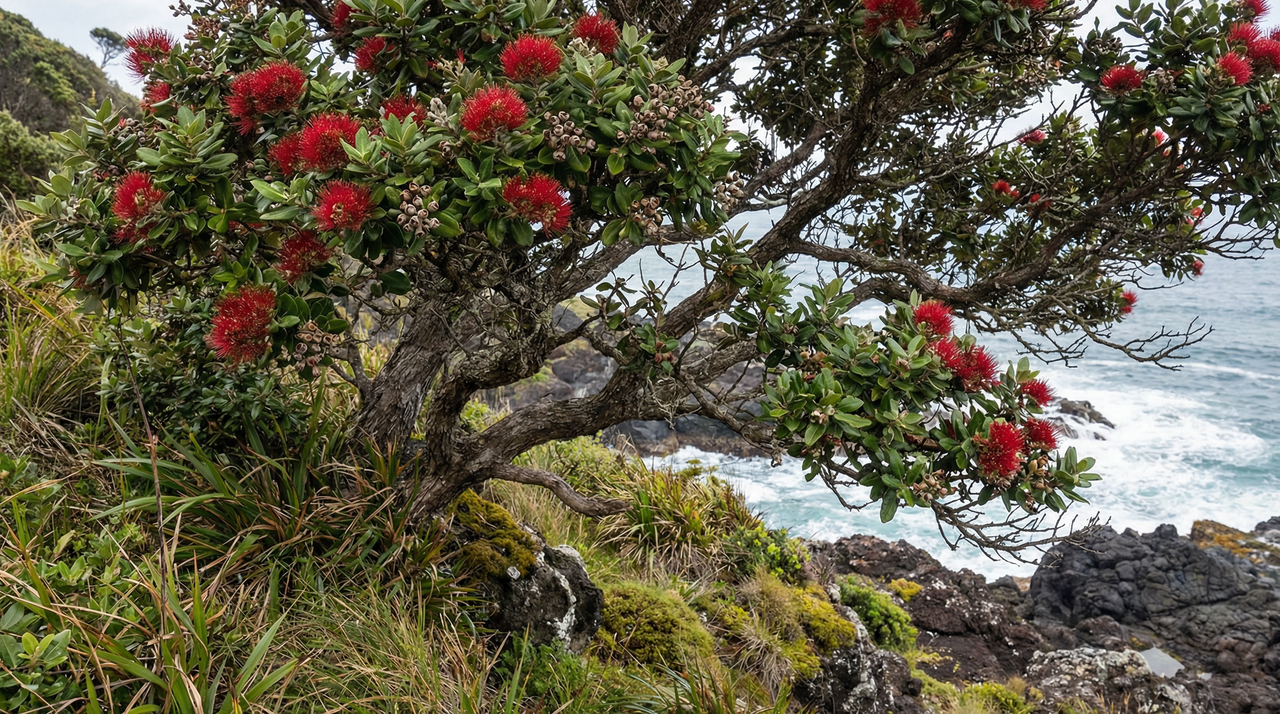
There's a moment every December on the northern coast of New Zealand when something quietly extraordinary happens: a tree blooms in brilliant crimson just as the rest of the Southern Hemisphere tips into high summer, and an entire culture holds its breath a little. The pōhutukawa has been doing this for longer than most other living things in that landscape. Some of these trees are over 800 years old.[1] They were ancient before Europeans had a name for them. And yet the first thing most people outside New Zealand learn about pōhutukawa, if they learn anything at all, is that it's "the New Zealand Christmas tree," which is a bit like describing a cathedral by the color of its front door.
What genuinely stopped me when I started digging into this species wasn't the beauty, though that's real and overwhelming in flower. It was the tree's role at Cape Rēinga, where a single gnarled pōhutukawa grows at the northernmost tip of the North Island, and Māori tradition holds that the spirits of the dead descend its roots to begin their journey to the ancestral homeland of Hawaiki.[2] A plant so bound to the passage between living and dead that it carries tapu status, its wood and bark not freely taken. That's not ornamental. That's a tree woven into the deepest fabric of a people's cosmology, holding coastlines together with its roots and holding something harder to name together with its presence.
Pōhutukawa Origin, History, and Cultural Significance
Few trees carry the weight of an entire coastline the way pōhutukawa does. Where this tree comes from shapes everything about how you grow it and, honestly, how you think about it.
Botanical Background and Distribution of Metrosideros excelsa
Pōhutukawa (Metrosideros excelsa) is native to the coastal margins of New Zealand's North Island, ranging from Northland down to Taranaki and the East Cape, typically from sea level up to about 200-300 meters in sandy, well-drained soils.[3] Isolated populations on the Kermadec Islands, sitting roughly between 29 and 31 degrees south, have developed their own genetic character over time through sheer geographic distance.[4] What strikes me every time I study this species is the longevity. Natural populations commonly live 300 to 500 years, and the oldest documented specimen has been estimated at over 800 years through tree-ring analysis.[5][6] Working with other slow-growing Myrtaceae in landscape projects has taught me to plant these trees with a multigenerational mindset. You're not choosing a garden feature; you're choosing a landmark that may outlive your grandchildren.
Like its close relative northern rātā (Metrosideros robusta), pōhutukawa can begin life as a hemiepiphyte, sending aerial roots downward toward soil from an elevated start, which is a clever strategy for establishing on rocky, inhospitable coastal faces.[3][7] I've seen a similar strategy in strangler figs, and it always reminds me how resourceful a tree can be when its starting conditions are genuinely difficult. Southern rātā (Metrosideros umbellata) extends the genus into South Island montane forests, reaching comparable ages under cooler and wetter conditions.[8] Out in Hawaii, ʻōhiʻa lehua (Metrosideros polymorpha) holds a parallel ecological role, climbing from sea level to over 2,500 meters on volcanic slopes, though the related M. macropus is now critically endangered from habitat loss and disease.[9][10] Rapid ʻŌhiʻa Death and myrtle rust (Austropuccinia psidii) are threading through Metrosideros populations on opposite sides of the Pacific,[11][12] and that parallel vulnerability is something I keep front of mind whenever I source any Metrosideros for a project.
Visual Characteristics of Pōhutukawa
The name "New Zealand Christmas tree" says it best. In its native Southern Hemisphere range, pōhutukawa bursts into bloom from late November through January, painting coastal cliffs and headlands a brilliant crimson right through the summer holidays.[13][14] The flowers are the defining feature: dense terminal clusters up to 10-15 cm across, each individual bloom a mass of bright crimson stamens rather than showy petals, giving the whole canopy that unmistakable fluffy, bottlebrush texture.[3] I've watched analogous red-stamen flowers in subtropical plantings absolutely stop nectar-feeding birds mid-flight, and tūī in New Zealand perform the same role here with obvious enthusiasm.
At maturity the tree is genuinely imposing: 10 to 20 meters tall, occasionally reaching 25 meters, with a broad spreading canopy 6 to 12 meters wide and a gnarled, multi-trunked silhouette that looks like it has been sculpted by the wind (because it has).[5] The trunk can reach over a meter in diameter, clad in rough, tessellated bark ranging from light gray to reddish-brown that peels in thin strips.[3] Leaves are leathery and elliptic, glossy above, often with a reddish-woolly underside when young, built to shrug off salt spray with their thick, waxy cuticle.[5] The root system is shallow and wide-spreading, extending up to twice the canopy width in coastal sandy soils, which is exactly what keeps it anchored on headlands in gale-force winds.[5][3] Northern rātā grows considerably taller at 20-35 meters with more dramatic peeling bark, while southern rātā tends toward corky, fissured texture and a cooler, montane character.[7][8] Hawaiian ʻōhiʻa takes the genus in yet another direction, ranging from full-sized trees to low shrubs with polymorphic flower colors including yellow and orange, even developing adventitious roots for gripping fresh lava flows.[15]
Traditional Māori Uses and Cultural Importance
Here's where the story gets genuinely moving. To Māori, pōhutukawa is a taonga, a treasure, carrying tapu (sacred, restricted) status that governed when and how the tree could be used.[16] Its crimson flowers are understood as the blood of Tawhaki, a hero who fell trying to climb to the heavens, and at Cape Rēinga an ancient pōhutukawa tree marks the point where departing spirits descend to the sea and begin their journey to the afterlife.[17] Trees were planted near marae for protection, and their flowering at Māori New Year anchored the ceremonial calendar.[18] Learning about that tapu status genuinely changed how I think about placing culturally significant trees in designed landscapes. I now approach those siting decisions with considerably more care and always try to understand the cultural protocols associated with any indigenous species before I specify it.
Practical applications ran alongside the spiritual ones. Bark and leaf extracts treated wounds, diarrhea, sore throats, and skin conditions; flowers were brewed as tea or their nectar collected for beverages; the hard, dense wood went into tools, weapons, and carving; and bark and flowers yielded dyes.[19][20] Northern and southern rātā share similar rongoā medicinal and ritual uses, their branches appearing in healing and protective ceremonies in parallel traditions.[21] European awareness of the tree arrived with Captain James Cook in 1769, when his journals noted the red-flowered coastal trees of the North Island, with formal scientific description following in 1814 by James Edward Smith.[22][23] Across the Pacific, ʻōhiʻa lehua carries its own sacred story: tied to the legend of Pele and Hiʻiaka, flowers were traditionally kapu to remove without permission, woven into leis and hula practice.[24][25] Rapid ʻŌhiʻa Death now shadows those traditions with real urgency. When I consider sourcing any Metrosideros for a garden or food forest, those conservation stakes weigh on me, and I'd encourage anyone working with this genus to choose propagated material from responsible nurseries and support in-situ conservation where possible.
Fascinating Facts About New Zealand's Christmas Tree
The "Christmas tree" nickname is delightfully literal: peak bloom in December means New Zealanders celebrating the holidays beneath a canopy of crimson.[5] Outside its native range, though, that same flowering enthusiasm tips into moderate invasiveness in coastal Australia, California, and Hawaii, worth keeping in mind before planting it in a sensitive habitat.[26] The tree's extraordinary salt and wind tolerance comes down to those thick, waxy leaves, which let it colonize clifftops and coastal headlands that most trees simply can't handle.[18] And across the entire genus, from New Zealand's tūī and bellbirds to Hawaii's honeycreepers, bright red stamens are the consistent signal to bird pollinators that a meal is waiting.[27] Put all of that together, the coastal resilience, the 800-year potential lifespan, the deep cultural roots, and the sheer spectacle of it in flower, and you start to understand why this tree is considered a national icon rather than just another ornamental. Plants we grow for beauty often carry older stories, and pōhutukawa carries several centuries of them.
Pōhutukawa Varieties and Where to Buy Them
Notable Varieties and Natural Color Morphs
Most people picture a blaze of scarlet and assume all pōhutukawa trees are the same. They're not. Metrosideros excelsa produces natural color morphs, including pink and white-flowered forms, with the Northland white being a standout: its petals are white but the tepal tips stay red, creating a two-tone effect that reads almost luminous in coastal light.[18][3] These aren't formally named cultivars so much as local ecotypes, shaped by geography rather than breeding programs.
Intentional selection began in the 1950s and gave us a useful range of named forms: 'Compacta' for tight urban spaces, 'Aurea' for golden foliage contrast, and 'Pohutukawa Queen', 'Red Prince', 'Gonzales', and 'Scarlet Pimpernel' for varying flower intensity and habit.[3][28] I regularly specify 'Compacta' for clients with poolside gardens or tight courtyard plantings; it keeps a denser, tidier form while still delivering the red blooms that bring in hummingbirds and native bees. In my experience, seed-grown plants show real variability in flower density and foliage color compared to named cultivars, which is why I always push clients toward verified selections from reputable sources.
The wider genus adds a few more options worth knowing. Northern rātā (Metrosideros robusta) has almost no cultivar development; most plants in trade are grown from wild seed, with 'Aurea' and its golden-yellow foliage being the main exception.[7][29] Southern rātā (Metrosideros umbellata) is more developed, offering 'Rosea' with rose-pink flowers, 'Silver Variegata' and 'Variegata' for foliage interest, and a dwarf 'Compacta' that tops out at two to three meters.[8][30] Hawaiian ʻōhiʻa (Metrosideros polymorpha) rounds out the picture with nursery selections like 'Lehua Mamo' featuring vivid orange-red flowers, though these exist mostly in Hawaiian horticultural circles rather than mainstream trade.[31][32]
Sourcing Pōhutukawa Plants and Seeds in the US
For US gardeners in zones 9 to 11, container-grown domestic stock is your most practical path. Specialty nurseries including San Marcos Growers, Moon Valley Nurseries, Top Tropicals, Logee's, and Monrovia typically carry pōhutukawa with spring and fall being peak availability windows.[33][34][35][36][37] Stock is thinner than, say, sourcing a Callistemon or Banksia, but it's there if you call ahead. Seeds are obtainable through Sheffield's Seed Company and various online marketplaces, though I always ask any nursery whether their plants were grown from cuttings or seed; cutting-grown stock tends to flower earlier and more uniformly in those first few years after planting, which matters when you're designing for bloom impact.[38]
Importing plants or cuttings directly from New Zealand is technically possible but genuinely complicated. USDA APHIS requires import permits, phytosanitary certification, approved origin documentation, and quarantine inspection to guard against threats like the pohutukawa gall midge and associated fungal pathogens.[39][40] Seeds face fewer hurdles but still must be declared under 7 CFR Part 361.[41] California and Florida layer on additional state-level requirements through CDFA and FDACS respectively.[42][43] Buying domestically propagated stock sidesteps all of that.
The related species are harder to find. Metrosideros robusta turns up occasionally in botanical-garden collections and a handful of specialty growers in zones 9 to 10, but it's genuinely rare in US trade.[44][45] Southern rātā appears sporadically through Australasian-plant specialists like One Green World or Rare Plant Research, and seed is available via Sheffield's; confirm current stock directly because availability shifts.[46][8] Hawaiian ʻōhiʻa is essentially off-limits for most gardeners: its endangered status under the US Endangered Species Act and Hawaii state regulations restrict interstate movement and sale to permitted botanical collections and specialized Hawaiian growers, and Rapid ʻŌhiʻa Death makes sterile propagation methods a biosecurity necessity rather than a preference.[47][48] After following the ʻōhiʻa health situation out of Hawaii closely, my advice to every client is simple: buy only from domestic propagators using sterile methods. The rules exist for very good reason.
Pōhutukawa Propagation and Planting
There's something almost improbable about holding pōhutukawa seeds for the first time. I always collect them fresh from coastal trees in late summer, and they feel like dust in my palm: tiny, winged, brown ellipsoids barely 1-2 mm long that scatter on the faintest breeze.[3][49] Understanding the seeds before you sow them matters, because a lot of what makes this tree both exciting and frustrating as a propagator starts right here.
Seed Characteristics, Viability, and Germination Timeline
Unlike the related rātā species, pōhutukawa seeds show no strong dormancy. Fresh seed sown in well-drained sandy media, kept moist and in light at 15-25°C, germinates within 2-4 weeks at rates of 50-80%.[49][3] That speed is welcome. What's less welcome is how quickly viability drops off: use fresh seed whenever possible, and if you must store it, orthodox cold storage at 4°C buys you maybe a year before germination rates fall off a cliff.[50][51] A quick viability check: viable seeds sink, duds float. Or run a tetrazolium assay if you want formal confirmation.[3] Polyembryony is relatively common in this species, with up to two embryos per seed reported in 65-100% of cases, which means seedlings from a single seed may vary from the parent.[49] Compare this with the related northern rātā (M. robusta), whose recalcitrant seeds need hot-water soaking at 80-90°C before they'll germinate, and southern rātā (M. umbellata), which benefits from 1-2 months of cold stratification at 4°C.[7][8] The genus is genuinely diverse in what it asks of the propagator.
Here's the reality check that shapes every propagation decision I make with this tree: seed-grown pōhutukawa typically takes 10-15 years to flower, sometimes 20 in poor conditions, while grafted plants bloom in 3-5 years.[3][52][53] After years of specifying these trees in coastal restoration and garden projects, I now use seed-grown stock almost exclusively for conservation plantings where genetic diversity matters. For anything where a client wants flowers in their lifetime, vegetative propagation wins every time.
Propagation Methods: From Cuttings and Grafting to Tissue Culture
Semi-hardwood cuttings are the method most home propagators will reach for first, and they work well if you give them the right conditions. Take 10-15 cm cuttings from late spring to late summer, treat the base with IBA at 3000-8000 ppm, and root them with bottom heat at 20-25°C under mist.[54][55] Commercial success rates sit around 50-80%, and I've landed consistently in the 60-70% range on my own propagation bench once I added a simple mist tent.[56] My early open-bench attempts were considerably more humbling. Rooting typically takes 4-8 weeks, and timing to active growth in late spring genuinely matters.[57]
For named cultivars and selected flower colors, grafting is the professional route. Cleft, whip-and-tongue, and veneer grafts onto M. excelsa or M. umbellata rootstocks in late winter through early spring yield 50-90% success and lock in the characteristics of the parent plant.[58][59] At nursery scale, tissue culture using shoot-tip or nodal explants on MS medium with cytokinins achieves 80-90% success for mass production of uniform, disease-free plants.[60][61] Most home gardeners won't need that option, but it's worth knowing it exists if you're working with rare cultivars.
Regardless of method, media quality is the thing that separates consistently good results from chronic heartbreak. Use sterile, well-draining peat-perlite or sand-peat mixes at pH 5.5-6.5, and never let propagation trays sit wet.[62][63] I've lost more young pōhutukawa to damping-off and Phytophthora root rot than to any other cause. By the time you see the classic yellowing and wilting, the battle is already uphill. Sterile media, bottom heat, and good airflow prevent more losses than any hormone or fungicide ever will.
Soil, Site Selection, and Planting Technique
After specifying dozens of pōhutukawa in coastal landscapes, I can tell you plainly: if drainage fails, Phytophthora wins. This tree comes from exposed clifftops and coastal headlands in northern New Zealand, and its roots have never learned to tolerate wet feet.[3][16] Sandy, loamy, or volcanic soils with pH 5.5-7.0 are ideal, and it will tolerate up to 7.5-7.8 in alkaline coastal conditions.[13] Full sun is non-negotiable. Its salt-spray and wind tolerance are genuine, not marketing copy, but shade will reduce flowering and weaken growth over time. Soil compaction is more limiting than most people expect: bulk density above 1.4 g/cm³ inhibits the deep taproot this tree develops as it matures.[3]
For anyone growing pohutukawa in containers, the RHS recommends a loam-based mix such as John Innes No. 2 or 3, amended with 20-30% grit or coarse sand to keep things open.[13][64] Avoid peat-heavy media that holds moisture long after watering, and resist the urge to over-fertilize: these trees evolved in nutrient-poor coastal soils and respond to excess feeding with lush, soft growth that's more susceptible to pests and disease.
Spacing, Staking, and Establishment Tips
Mature pōhutukawa reach 9-15 m tall with a canopy spread of equal or greater width, sometimes pushing toward 18-20 m in ideal conditions.[3][13] Specimen trees want 10-15 m between them; for hedging or screens, 6-8 m works, though you'll eventually need to manage competition.[65] I always push clients toward the wider spacing rather than the tighter end. The sculptural, spreading canopy that makes this tree so iconic on coastal cliffs gets crowded out surprisingly fast, and the remedial pruning required to reclaim it years later is far more disruptive than giving the tree room from the start.
Plant in spring or autumn to let roots establish before the extremes of summer heat or winter wet.[13] Staking is only warranted in genuinely exposed, windy locations, and even then use flexible ties and remove them after 1-2 years so the trunk develops its own strength.[3] Good airflow around young plants also reduces the fungal pressure that most affects Metrosideros excelsa in its early years. Get the drainage, the sun, and the spacing right at planting time, and this tree will largely take care of itself from there.
Pōhutukawa Care Guide: Growing Metrosideros excelsa
Most of the care decisions you'll make with a pohutukawa plant come down to one thing: respecting where this tree comes from. It evolved on exposed coastal cliffs in northern New Zealand, bathed in salt wind and roasting in full sun, with its roots threading through volcanic rubble that drains in minutes. Give it conditions that echo that origin and it practically takes care of itself. Push it toward a lush, pampered garden existence and it'll quietly struggle.
Sunlight Requirements and Light Conditions
Full sun is non-negotiable for strong growth and reliable summer flowers.[3][5] Metrosideros excelsa will tolerate some shade, but you'll pay for it in leggy growth and far fewer of those iconic crimson blooms. I've seen similar patterns with other Myrtaceae: new transplants benefit from a brief hardening-off period to avoid leaf scorch if they've been nursery-grown under shade cloth, but once they've settled, the more sun the better. Pick your site before you dig the hole, because pohutukawa growing conditions are easiest to manage when the location is right from day one.
Water Needs and Irrigation
Young trees need consistent, deep watering, roughly one to two inches per week during dry periods, for the first one to three years while they establish a root system deep enough to sustain the drought resilience this species is famous for.[3][66] Once established, mature trees need supplemental irrigation only every two to four weeks during prolonged dry spells. I check soil moisture by pushing a finger two inches into the ground near the drip line rather than watering on a fixed schedule; the goal is to let the top layer dry out between soaks.
Overwatering is the most common way to kill a pohutukawa, and it's a quiet killer. Yellowing leaves, wilting despite moist soil, or soft blackened roots all point to Phytophthora root rot, which thrives in waterlogged conditions.[3][67] Excellent drainage is the single most important site requirement. On the plus side, the metrosideros tree handles salt spray and saline irrigation unusually well, tolerating conductivity up to two to four dS/m, which makes it a sensible choice near coastal roads or driveways where other trees would suffer.[3][68] Northern rātā, by comparison, has notably less tolerance for saline conditions.
Soil, Site, and Feeding Requirements
Metrosideros excelsa leaf drop and a generous layer of organic mulch will do more for a mature pohutukawa than any fertilizer program. This is a tree adapted to nutrient-poor coastal and volcanic soils, happy in a pH range of 5.5 to 7.5 with a slight lean toward the acidic side.[3][69] Young trees respond to a light application of a balanced, low-phosphorus slow-release formula (something in the range of 5-1-5 or 10-10-10) in early spring, at around 50 to 100g per meter of canopy diameter, but always do a soil test first.
I've seen what happens when people "help" native trees with generous doses of high-nitrogen or high-phosphorus fertilizer: you get a flush of soft, sappy growth that practically invites pests, the blooms thin out, and you disrupt the mycorrhizal associations the roots depend on for resilience.[3][69] For mature trees, I don't fertilize at all. A five to ten centimeter layer of organic mulch kept away from the trunk, refreshed annually, is the whole program.[3][66]
Frost Tolerance and Winter Protection
Pohutukawa sits in USDA zones 9b to 11, tolerating brief dips to around -2°C to -5°C once established.[13][3] The critical caveat is "once established." Young plants and new spring growth are much more vulnerable; temperatures below freezing can cause leaf browning, blackened buds, and shoot dieback that wipes out next season's flowers.[70] Think of a young pohutukawa's frost sensitivity as roughly comparable to young citrus or tibouchina: a light frost cloth, thick mulch over the root zone, and a sheltered microclimate with good cold-air drainage can be the difference between a setback and a total loss. Wet winter soils compound cold damage significantly, so drainage matters even more in cooler climates.[67] For comparison, Southern rātā tolerates down to around -12°C, so if you're in a genuinely frosty climate, the genus still has something to offer, just not this species.
Heat Tolerance and Summer Care
The sweet spot for this metrosideros plant is 10 to 25°C. Short-term heat up to 35 to 40°C is survivable, but prolonged temperatures above 30 to 35°C, especially combined with drought, cause leaf scorch, wilting, and chlorosis.[71] Flowering is the most sensitive stage; I've noticed distinctly fewer blooms in specimens pushing through a hot, dry summer compared to the same trees in a cooler, wetter year, and that tracks with what the physiology research shows.[72]
In hotter, humid climates like much of the subtropical Southeast, good air circulation becomes as important as water management; stagnant humid heat around the canopy invites fungal problems. Deep, infrequent irrigation, a maintained mulch layer to moderate soil temperature, and afternoon shade for young plants during heat waves will carry most trees through.[3][73] Cultivars from northern New Zealand provenances, such as 'Gonzii,' may show a modest edge in heat adaptation.
Pruning, Maintenance, and Seasonal Rhythm
Prune lightly after flowering, from late summer into early autumn, removing dead, damaged, or crossing branches.[3][67] For young trees, late-winter structural tidying to encourage a strong central leader makes sense, but keep cuts minimal. I learned early on that heavy pruning on young Metrosideros triggers a long, slow recovery and can cost you an entire flowering season. Less is genuinely more here.
The seasonal rhythm is predictable once you know what to expect. Growth flushes in spring, flowers arrive in December through February in the Southern Hemisphere (or equivalent summer timing where you garden), and seed development follows through autumn.[3][74] First flowering from seed takes anywhere from five to fifteen years, so patience is part of the contract with this tree. Wild specimens can live for centuries; urban trees on constrained sites with compacted soil typically live shorter lives, which is worth keeping in mind when siting one near hardscape.[3] The annual mulch refresh and a once-over for structural pruning after bloom are really the sum total of ongoing maintenance for an established, well-sited tree.
Pōhutukawa Harvesting: Timing, Technique, and Sustainable Yields
Flowering and Seed Capsule Phenology
For New Zealanders, the pohutukawa bloom is Christmas itself: that flood of crimson from October through January, peaking right around the holidays, is one of the most recognizable phenological signals in the Southern Hemisphere.[3][75] Grow one in coastal California and the schedule shifts to May through August, though microclimate can nudge that window noticeably in either direction.[75] The seeds don't follow quickly. Capsules need six to nine months to ripen after flowering,[76][77] which puts the optimal collection window in February through May in New Zealand, when the small woody capsules turn reddish-brown and start to split.[3][52] In my work with similar Myrtaceae, I've found that elevation and aspect can shift that splitting moment by a week or two, so I always check individual trees rather than going by the calendar. And if you're wondering whether to just wait and source a grafted specimen instead of gathering seed: yes, probably. These trees take 40 to 60 years to reach timber maturity,[3] and the cultural and conservation weight they carry means harvesting them for wood is essentially off the table.
Sustainable Harvesting Techniques for Flowers, Seeds, and Honey
The ethical foundation here is clear: collect only naturally dehisced capsules, never take more than 10% of inflorescences from any single tree, and don't return to the same tree every year.[78][3] I mark individual trees in my records and rotate back every second or third season, taking only a modest handful of capsules that are already opening. That habit protects the tree's energy reserves and the local seed bank simultaneously. The parallel protocols from Hawaiian ʻōhiʻa lehua practice tell the same story: hand-pick gently in the morning, take no more than 10 to 20% of blooms per tree, and bring that same mindful restraint to the work.[79] For anyone growing pōhutukawa as a cut-flower crop, harvest stems early in the morning, wipe away the sticky sap that accumulates on fresh cuts (I keep a damp cloth in my harvest kit specifically for this), recut at a 45-degree angle under water, and hold stems at 2 to 5°C with high humidity to push vase life toward 10 to 14 days.[80] A floral preservative solution at pH 3.5 to 4.0 helps significantly. For germination specifics, the propagation section covers those in detail.
Nectar, Honey, and Flower Flavor Profiles
Only the flowers and their nectar are edible. Leaves, bark, wood, and fruit are not considered safe for consumption, and I don't experiment with them in the kitchen regardless of how curious I get.[16][18] The flowers themselves are tender and slightly juicy, with a sweet honey-citrus fragrance that intensifies on warm days.[81] Māori traditionally soaked the flowers in water to make refreshing drinks, and young blooms can find their way into teas or syrups as a modern extension of that tradition, though the culinary applications are limited and understated.[16]
The real reward is the honey. Pōhutukawa honey is dark red with caramel and toffee depth, a thread of cinnamon, and delicate floral undertones, rich and sweet (around 8 to 9 out of 10 on intensity) with low acidity.[82][83] I've tasted both pōhutukawa and rātā honeys at local markets and the contrast is instructive: rātā runs lighter, with fruity, musky, and spicy notes and a cleaner citrus finish,[84] while pōhutukawa's caramel depth is unmistakable. ʻŌhiʻa, by contrast, is largely outside the food realm, valued for cultural and ecological roles rather than culinary ones, with toxicity and disease concerns that make consumption inadvisable.[85] For those keeping bees near flowering pōhutukawa, rainfall during bloom affects nectar concentration noticeably; dry warm summers push the caramel depth higher in my observation, while wet seasons dilute it toward something more broadly floral.
Pōhutukawa Preparation and Uses
Culinary Uses and Edible Parts
The most honest thing I can tell you about eating from a pōhutukawa is this: the tree's generosity is real, but it's narrow. The nectar is where the story starts and, for practical culinary purposes, where it largely ends. Māori children have been tipping flowers to their lips to sip that sweetness for centuries,[16][52] and I completely understand the impulse. Every December when I'm working near a coastal garden in bloom, the bees are so thick on those red flowers that you can hear the tree before you see it. Those same bees are doing something remarkable: turning that nectar into a highly sought-after monofloral honey with a distinctive signature.[86][16] I've tasted several single-origin jars from New Zealand artisan producers, and the profile is surprisingly layered for a floral honey, somewhere between a dark toffee and a ripe stone fruit, with warmth at the finish. Related rātā honeys carry a similar character, and Hawaiian ʻōhiʻa yields its own prized monofloral variety.[87][88]
The petals themselves are technically edible raw, mildly tangy in the way some edible flowers are, and the texture reminds me of a softer hibiscus petal. But they're not a staple, and modern foraging guides that mention them tend to treat them as a curiosity rather than an ingredient.[89] Leaf infusions appear occasionally in experimental tea circles, though the result is earthy and astringent enough that I'd call it acquired territory, and the potential for bitterness and irritants means I wouldn't encourage anyone to steep a cup casually.[90] The woody capsules and seeds are simply not food.[18] If you have dogs nearby, flag this tree too: ingested foliage can cause vomiting and lethargy, so I always advise clients to sweep fallen material regularly.[91] Given the tree's protected status in New Zealand, any harvesting also demands correct identification among pōhutukawa, northern rātā, and southern rātā, and that's not always straightforward in the field without local guidance.[92]
Traditional Medicinal Preparations
The deeper pohutukawa uses sit firmly in the medicinal realm, and they deserve genuine respect rather than casual replication. Bark decoctions and the red sap, called piripiri, have been used by Māori to treat diarrhea, dysentery, and stomach complaints; that same gum applied to wounds acts as a styptic, and chewed to soothe sore throats and coughs.[93][94] Leaf infusions across the genus address respiratory complaints including colds, bronchitis, and asthma, and have been used as eyewashes and anti-inflammatories.[94] In Hawaiian tradition, ʻōhiʻa leaves and bark were prepared as teas or poultices for thrush, fever, wounds, and skin conditions, drawing on the same astringent and antimicrobial tannins that underpin Māori practice.[95]
Simple infusion ratios do exist in the literature, around one to two teaspoons of dried leaf per cup steeped for five to fifteen minutes, but dosages vary significantly by iwi and should only be followed under the guidance of a qualified rongoā practitioner.[96] I've had conversations with Māori herbalists while designing native garden spaces, and every one of them has reinforced the same point: these are living, evolving traditions with layers of knowledge that don't translate cleanly to a steep-time instruction. Modern phytochemistry is beginning to explain why the preparations work, but that validation doesn't make them self-treatment recipes.
Non-Food and Cultural Uses
Beyond food and medicine, the pohutukawa tree's practical cultural legacy is extraordinary. The timber is legendarily durable, resistant to both decay and saltwater, which made it the material of choice for waka paddles, tools, weapons, and ceremonial objects across Aotearoa; rātā and ʻōhiʻa were applied similarly for canoes, house posts, and digging sticks across their respective ranges.[16][97] Red dye was extracted from both the flowers and bark to color flax and muka fiber, while southern rātā bark and ʻōhiʻa bark and flowers served the same purpose for tapa cloth in Hawaii.[98][99] I once tried a small dye experiment using bark from a labeled cutting and was struck by how rich the color ran, though I'll admit I kept meticulous notes on which species I was using precisely because confusing pōhutukawa with rātā is easier than people expect. Bark tannins also served leather preservation, and ʻōhiʻa bark fiber was twisted into ropes and nets while the flowers became lei.[99]
And then, looping back to where we started: pōhutukawa nectar is a significant commercial resource, with apiaries positioned specifically to capture the summer bloom for premium honey production.[16][100] Every summer I watch the red flowers open and think about how many needs this one tree has answered, from a child's sweet treat to a warrior's paddle to a beekeeper's harvest, all from the same blazing coastal canopy.
Pōhutukawa Health Benefits
What I find so compelling about pōhutukawa from a health perspective is how the traditional knowledge and the laboratory data keep arriving at the same destination by different roads. Rongoā Māori, the traditional healing system of Aotearoa New Zealand, has worked with this tree for centuries, and when modern pharmacologists finally started running assays on the extracts, they found exactly what you'd expect if the practitioners had been right all along.
Traditional Māori Medicinal Uses
In rongoā Māori, pōhutukawa bark is prepared as a decoction or tea for gastrointestinal complaints including diarrhea and dysentery, while the leaves and bark are applied topically for wound healing and skin conditions. The gum, called piripiri, gets chewed for sore throats or worked into wound dressings, and the plant features as a general tonic and remedy for coughs and colds.[16][101][102] That pattern, GI complaints addressed internally through bark preparations, wounds addressed externally through leaf and bark poultices, respiratory complaints supported through gum and teas, maps onto a coherent ethnobotanical logic once you know the phytochemistry behind it. The same pattern appears across related Metrosideros species, including northern and southern rātā and Hawaiian ʻōhiʻa, which suggests a genus-wide pharmacological signature rather than coincidental folk use.[101][103]
Scientific Research and Pharmacological Activities
The strongest evidence sits in antioxidant and anti-inflammatory territory. Leaf and flower extracts show significant free-radical scavenging comparable to ascorbic acid across DPPH, FRAP, and ABTS assays, with mature leaves producing higher activity than younger tissue.[104][105][106] On the inflammatory side, M. excelsa extracts inhibit COX-2, reduce nitric oxide production, and suppress pro-inflammatory cytokines including TNF-α and IL-6 through the NF-κB pathway in cell and animal studies.[104][107][108] That's a credible mechanistic explanation for the traditional wound and respiratory applications.
Ethanolic extracts also show antimicrobial activity against Staphylococcus aureus and Candida albicans, with activity against Escherichia coli reported as well.[103][109] More preliminary findings point toward inhibition of α-amylase and α-glucosidase enzymes relevant to blood sugar management[110], and cytotoxic effects on HeLa and MCF-7 cancer cell lines have been reported via apoptosis induction.[110][111] Every one of these findings, though, is in vitro or from animal models. No human clinical trials exist for pōhutukawa or any closely related species, and until those happen, we're working with promising signals rather than confirmed therapeutics.
Key Phytochemicals in Pōhutukawa
The molecules doing the work here fall into three main classes. Flavonoids include quercetin, kaempferol, and myricetin derivatives; phenolics include gallic acid, ellagic acid, tannins, and ellagitannins; and the leaf essential oil contributes monoterpenes and sesquiterpenes including α-pinene, β-pinene, limonene, 1,8-cineole, and β-caryophyllene.[112][113][114] Total phenolic content in leaves ranges from 45 to 65 mg GAE per gram dry weight, notably higher than bark at 20 to 35 mg GAE per gram.[115][116]
The plant produces these compounds for its own ecological purposes, defending against herbivores and pathogens, managing UV stress on exposed coastal cliffs, and attracting pollinators.[117][118] I've noticed something consistent with this: bark tea brewed from trees on windswept coastal headlands always tastes considerably more astringent than material from the same species growing in sheltered city gardens. The chemistry is responding to the environment, and that's worth bearing in mind if you're working with plant material from different sites. Phenolic concentrations peak during summer[116], which aligns with the flowering season and the period when the tree is under maximum ecological pressure.
Nutritional Value and Edible Uses
The one genuinely edible component of pōhutukawa is its nectar. Māori have long consumed it fresh from the flowers, and it's also prepared as a simple tea or infusion.[16][112] I've added fresh flowers to herbal teas and found the result pleasantly mild and subtly sweet, nothing dramatic, no digestive distress. Nutritionally the nectar is primarily simple sugars (sucrose, glucose, fructose) with trace minerals and flavonoids including quercetin and kaempferol, so it's not a nutritional powerhouse on its own terms.[16][112] The more interesting nutritional story belongs to pōhutukawa honey, which is rich in methyl syringate and other phenolics including leptosin, giving it measurable antibacterial and antioxidant activity in its own right.[119][120] There are no entries for pōhutukawa in standard nutritional databases like USDA FoodData Central, which reflects its non-commercial edible status rather than any lack of interest.[121][122] The woody capsules, seeds, bark, and leaves are not considered edible and may contain tannins or other compounds that cause astringency and digestive upset.[121][122]
Safety Profile and Precautions
Pōhutukawa is generally considered non-toxic to humans, pets, and livestock, with no documented cases of severe poisoning from any part of the tree and no listing on ASPCA toxic plant registers for dogs, cats, or horses.[3][123][124] That said, the high tannin load means large quantities of leaves or bark can cause mild GI upset, the sticky sap can trigger contact dermatitis on sensitive skin, and pollen is a real issue for hay fever sufferers during peak December flowering.[125][126][127] I always advise clients who are pregnant or taking anticoagulants to consult their doctor before using any Metrosideros preparation medicinally; specific clinical safety data for pregnancy and breastfeeding is absent, and the research on tannins' interactions with coagulation is clear enough that I won't take chances.[3][128] Pōhutukawa honey is safe to eat with no reported concerns.[3] Anyone drawn to the medicinal potential of this plant should be working alongside qualified Māori practitioners or healthcare professionals, not self-medicating from bark decoctions based on lab studies that have never been tested in humans.
Pōhutukawa Pests and Diseases
For a tree that grows out of cliff faces and endures salt gales that would desiccate most ornamentals, pōhutukawa is surprisingly well-equipped for pest and disease pressure. The real trouble tends to arrive not when the tree is doing what it evolved to do, but when we put it somewhere it wasn't designed to be.
Natural Defenses of Pōhutukawa
Pōhutukawa's leaves and bark carry a formidable biochemical toolkit: tannins, phenolics, flavonoids, terpenoids, and essential oils that act as feeding deterrents and show measurable insecticidal activity against a range of invertebrate pests.[129][130] Physical defenses reinforce the chemistry: tough, leathery leaves covered in dense trichomes, and thick bark that protects against both mechanical damage and fungal entry.[131][129] Beneath the soil, arbuscular mycorrhizal partnerships enhance nutrient uptake and bolster resistance, while extrafloral nectaries recruit ants that provide mutualistic protection against herbivores above ground.[132][133] It reminds me of how tough mānuka is in similar exposed coastal conditions; that phenolic-rich, structurally robust combination just works.
In my experience designing coastal plantings, healthy pōhutukawa in freely draining soil rarely shows more than cosmetic scale pressure. The moment I see serious insect buildup, I start looking for the underlying problem first, because it's almost always compaction, waterlogging, or a site that's too sheltered and humid rather than some aggressive new pest.
Common Insect Pests and Their Management
Scale insects (Eriococcus spp. and various Diaspididae), mealybugs (particularly Pseudococcus calceolariae), pohutukawa looper caterpillars (Cleora scriptaria), aphids, leafhoppers, gall mites, and passion vine hoppers are the insects I watch for most.[134][135] The early signs I look for are white waxy bumps along stems, sticky honeydew deposits followed by sooty mold, and the characteristic notched leaf margins left by loopers in summer. Young or stressed trees can defoliate noticeably; established specimens usually push through with cosmetic damage only. Northern rātā faces an additional threat that pōhutukawa largely avoids in managed landscapes: possum browsing severe enough to kill mature trees.[136]
For scale and mealybugs I reach for horticultural oil or insecticidal soap, applied when crawlers are active. I never use broad-spectrum insecticides near pōhutukawa because they destroy the mycorrhizal network that is the tree's real immune system, and they take out the predatory insects and birds that do most of the pest regulation work for free. Loopers are usually best managed by hand removal on small trees or by simply tolerating the seasonal flush of damage on established specimens.
Major Fungal and Bacterial Diseases
Two diseases deserve particular attention. Myrtle rust (Austropuccinia psidii), first detected in New Zealand in 2017, produces bright yellow-orange powdery pustules on new growth and causes distortion, defoliation, and dieback that can be fatal in young trees and humid conditions.[137][138] There is no cure. The only tools are vigilant monitoring, removal and destruction of infected material, and tight biosecurity when sourcing plants. I now follow MPI and Landcare Research guidance when specifying pōhutukawa for new projects, checking current pest alerts before I sign off on any plant order.
Phytophthora root rot, caused by several species including P. agathidicida and P. cinnamomi, is the disease that has caused the most grief in my landscape work. Wilting, yellowing leaves, stem cankers, and progressive dieback are the symptoms, and by the time they're obvious the root damage is already severe.[139][140] After losing trees early in my career to poorly drained sites, I now insist on a soil percolation test before specifying pōhutukawa in any low-lying or urban pocket. Cultivars like 'Auckland Rooftop' and 'Firecracker' show improved Phytophthora tolerance, though none are fully immune.[141]
Beyond those two headline threats, fungal leaf-spot pathogens (Septoria metrosideri, Mycosphaerella spp., Pestalotiopsis, and others) cause brown-to-black spots and reduced vigor in humid, cool conditions, while canker diseases and bacterial Pseudomonas syringae tend to colonize weakened wood rather than healthy trees.[142][143] Environmental stress, whether drought, waterlogging, urban compaction, or sites above 600 m, significantly amplifies susceptibility across the board.[3][144]
Prevention and Integrated Management Strategies
The most effective disease management I know is choosing the right site from the start: freely draining, slightly acidic to neutral soil (pH 5.0–7.0), full sun, and enough spacing for air to move through the canopy.[3][145] Mulch kept well clear of the trunk, no overhead irrigation, and regular monitoring complete the picture. When intervention is genuinely necessary, horticultural oils handle soft-bodied insects, phosphite or copper fungicides offer preventive (not curative) activity against Phytophthora, and Trichoderma-based biologicals are worth using at planting in suspect soils.[146][147] For myrtle rust, early removal of infected shoots and strict hygiene on tools remain the only realistic responses.[148] A well-sited, vigorous pōhutukawa grown from quality provenance stock remains one of the most resilient coastal trees a permaculture designer can specify; most of its pest and disease vulnerability is something we create for it, not something it invites on its own.
Pōhutukawa in Permaculture Design
If I had to describe pōhutukawa's permaculture personality in a sentence, it would be this: it is a tree that asks very little and gives an enormous amount, provided you put it in the right place. That "right place" is a coastal or near-coastal site with mild winters, plenty of sun, and salt-laden winds that would stress most other canopy trees into submission. Get that siting right, and the ecological returns are remarkable.
Climate and Hardiness Zones
Pōhutukawa is firmly at home in USDA zones 9-11, with the sweetest spot in zones 10-11 where winters stay reliably mild.[3][149] Established trees can tolerate a brief dip to around 20°F (-7°C), but young plants are genuinely frost-sensitive and need protection when temperatures fall below about -5°C.[150] In my experience with tender evergreens in marginal zone 9 sites, heavy mulching over the root zone combined with a temporary windbreak for the first two or three winters makes all the difference. The tree's native climate is predominantly oceanic (Cfb under Köppen-Geiger), with annual rainfall between 800 and 2000 mm and optimal temperatures running 15-25°C, so coastal California, south Florida, South Africa's Cape coast, and the Mediterranean Basin all replicate those conditions reasonably well.[151][152] The tree's high salt tolerance and moderate drought resilience once established make it genuinely useful in landscapes where most broadleaved canopy trees struggle.[18]
If zone 9 feels marginal for pōhutukawa, it helps to know what else the genus offers. Northern rātā pushes into zone 8b-9, tolerating down to about -7°C, while Southern rātā is genuinely cold-hardy to -10°C or lower, extending into zone 8 plantings with some exposure management.[7][8] At the other end, Hawaiian ʻōhiʻa lehua prefers zones 10-12 with minimal frost tolerance, so it represents the strictly tropical branch of the genus.[153] The takeaway for permaculture designers is that the Metrosideros genus covers a wide climatic range; pōhutukawa specifically is the coastal-temperate workhorse.
Ecosystem Functions and Guild Roles
Pōhutukawa is a keystone species in New Zealand's coastal forests, and that status isn't ceremonial.[18] Its extensive root system, including adventitious aerial roots that grip cliff faces and rocky shorelines, physically prevents coastal erosion while its spreading canopy filters wind and salt spray, creating protected microclimates for whatever you plant beneath it.[154] Leaf litter decomposition builds soil organic matter over time, and the tree supports mycorrhizal networks that help understory companions access nutrients in otherwise poor, sandy coastal soils.[155] Pōhutukawa does not fix nitrogen, so it won't enrich the soil in that direct way.[156] I always pair it with leguminous understory companions to fill that gap, and the results have been worth the extra planning.
The pollination story is where permaculture designers really need to pay attention. Pōhutukawa is self-incompatible, meaning it cannot pollinate itself and requires pollen from a genetically distinct individual to set viable seed.[157] The flowers are primarily pollinated by tūī and bellbirds, with bees and flies playing a supporting role.[158] I learned this the hard way on a coastal project where a single specimen produced almost no viable seed year after year. I now specify a minimum of three individuals in any coastal guild planting, spaced to encourage cross-pollination. In non-native ranges, generalist pollinators substitute for the native honeyeaters but with reduced efficiency, so planting multiples matters even more.[159] Beyond pollination, the tree contributes meaningful biomass for carbon sequestration and the Myrtaceae family chemistry provides some pest-deterrent essential oil chemistry as a side benefit to the guild.[160]
Forest Layer and Companion Planting
In its native coastal habitat, the tree occupies the dominant canopy or emergent layer, typically reaching 10-25 metres with a broad crown that starts upright in youth and becomes wide-spreading or slightly weeping with age.[161] That spreading architecture is part of what makes it so effective as a windbreak and salt-spray filter: it presents a dense wall of foliage to the prevailing coastal wind while the textured bark supports epiphyte communities above and shelters understory plants below.[162] I think of it similarly to sea grape in Florida-adjacent designs, where you're essentially using a tough, salt-tolerant canopy species to create a calmer, more sheltered microclimate for everything behind it. The difference is that pōhutukawa brings considerably more ecological depth.
The related rātā species fill different layers when the site calls for it. Northern rātā reaches 20-30 metres and often starts as a hemiepiphyte high in the emergent layer, while Southern rātā can behave as a large shrub in exposed coastal conditions or a 15-20 metre canopy tree in sheltered settings.[7][163] Hawaiian ʻōhiʻa, a true genus pioneer on volcanic substrates, can range from 3 to 30 metres depending on elevation and site, offering mycorrhizal partnerships and erosion control in dramatically different environments.[164]
For guild planting with pōhutukawa, I position it as the canopy anchor or primary windbreak with ferns, Coprosma, and Leptospermum in the understory, and at least one nitrogen-fixing species (a suitable coastal legume) to compensate for what the tree itself can't provide.[156][162] The nectar-rich December bloom draws pollinators into the whole guild, which benefits everything flowering nearby, so timing companion flowering around that summer peak is worth doing deliberately. I also only source from reputable native-plant nurseries and am careful never to plant near sensitive Hawaiian ecosystems given the documented threats to the genus, including Rapid ʻŌhiʻa Death disease and the fragility of remaining native honeyeater populations.[165] Responsible sourcing is part of working with a taonga, whether you're in its native range or not.
The Tree That Made Me Rethink What "Useful" Means
I came to pōhutukawa as a designer looking for a coastal windbreak. What I didn't expect was a tree that would quietly dismantle my habit of measuring plants by yield. It flowers for the birds. It holds the cliff for the community. It carries the dead to the next world, if you ask the right people. I still spec it for its roots and canopy, but I think about it differently now.
Sources 165
- Pōhutukawa and rātā | New Zealand Department of Conservation ↩
- Pōhutukawa and rātā – Te Ara Encyclopedia of New Zealand ↩
- Pōhutukawa (Metrosideros excelsa) ↩
- Kermadec Islands Flora - Department of Conservation ↩
- Metrosideros excelsa ↩
- The age of the oldest pōhutukawa tree (Metrosideros excelsa): a non-invasive method for age estimation ↩
- Metrosideros robusta ↩
- Southern Rata - Metrosideros umbellata | New Zealand Plant Conservation Network ↩
- Metrosideros polymorpha ↩
- Metrosideros macropus - IUCN Red List ↩
- Impact of Myrtle Rust on Pōhutukawa ↩
- Rapid ʻŌhiʻa Death (ROD) - USDA Forest Service ↩
- Pohutukawa Tree Guide ↩
- Metrosideros excelsa (New Zealand Christmas Tree) ↩
- Metrosideros polymorpha - Missouri Botanical Garden ↩
- Pōhutukawa ↩
- Pōhutukawa: Tree of the Gods ↩
- Pōhutukawa - National Icon ↩
- Māori Plant Use Database ↩
- Traditional Māori Medicinal Plants ↩
- Māori Medicinal Plants ↩
- Captain Cook's Journal of the Endeavour Voyage ↩
- A Specimen of the Botany of New Zealand ↩
- ʻŌhiʻa: Our Sacred Tree ↩
- The Legend of ʻŌhiʻa and Lehua ↩
- Metrosideros excelsa ↩
- Metrosideros umbellata - Southern rata ↩
- Royal Botanic Gardens Kew - Plants of the World Online: Metrosideros excelsa ↩
- Metrosideros robusta Cultivars and Selections ↩
- Metrosideros umbellata - Southern Rata ↩
- Metrosideros polymorpha - PLANTS Database Profile ↩
- Hawaiian Native Plant Propagation Database ↩
- Metrosideros excelsa - Pohutukawa ↩
- Pohutukawa Tree (Metrosideros excelsa) ↩
- Metrosideros excelsa - New Zealand Christmas Tree ↩
- Pohutukawa, New Zealand Christmas Tree ↩
- Pohutukawa - Metrosideros excelsa ↩
- Metrosideros excelsa Seeds ↩
- Importation of Plants and Plant Products ↩
- Foreign Quarantine Notices (7 CFR Part 319) ↩
- Noxious Weed Seed and Seedling Importation Regulations (7 CFR Part 361) ↩
- Plant Quarantine Regulations ↩
- Plant Import Restrictions ↩
- Royal Horticultural Society Plant Finder ↩
- USDA Plants Database ↩
- Metrosideros umbellata Seeds ↩
- Endangered and Threatened Wildlife and Plants; Determination of Endangered Status for Metrosideros macropus ↩
- Rapid ʻŌhiʻa Death (ROD) ↩
- Seed Morphology and Germination of Metrosideros excelsa ↩
- Pohutukawa and Rata: Metrosideros species in New Zealand ↩
- Seed Ecology of Metrosideros excelsa in New Zealand ↩
- Growing Pōhutukawa from Seed ↩
- Grafting Techniques for Metrosideros Species ↩
- Propagation Techniques for Metrosideros excelsa ↩
- Pohutukawa Propagation Guide ↩
- Commercial Nursery Guide to Pōhutukawa Production ↩
- Propagation of Native Trees in New Zealand ↩
- Grafting Techniques for Pohutukawa ↩
- Propagation of New Zealand Native Plants ↩
- Micropropagation of Metrosideros excelsa ↩
- Tissue Culture of Native New Zealand Trees ↩
- Pests and Diseases of Pohutukawa and Rata ↩
- Horticulture Production Manual: Metrosideros excelsa ↩
- Metrosideros excelsa Nursery Production ↩
- Pohutukawa Planting Guide ↩
- How to Grow Metrosideros excelsa ↩
- Pohutukawa Care Guide ↩
- Salinity Tolerance of Coastal Plants ↩
- Fertilising Native Plants in New Zealand ↩
- Cold Hardiness of Coastal New Zealand Trees ↩
- Physiological Responses of Metrosideros excelsa to Temperature Stress ↩
- Heat Stress Responses in Metrosideros excelsa: Implications for Climate Resilience ↩
- Growing Pohutukawa in Warm Climates ↩
- Phenology of New Zealand Native Trees ↩
- Metrosideros excelsa ↩
- Reproductive phenology and breeding system of the pohutukawa (Metrosideros excelsa, Myrtaceae) ↩
- Phenological patterns in Metrosideros species ↩
- Seed Collection Guidelines for Native Trees ↩
- ʻŌhiʻa Lehua: A Cultural Resource ↩
- Postharvest Handling of Cut Flowers and Foliage ↩
- Pōhutukawa Honey Description ↩
- Pohutukawa Honey - Flavor Profile and Uses ↩
- Physicochemical and Sensory Characteristics of New Zealand Honeys ↩
- Rātā Honey ↩
- Native Plants of Hawaii: Metrosideros macropus ↩
- Pohutukawa Honey: Benefits and Production ↩
- Rātā Honey - Northern Rātā ↩
- Ōhiʻa Lehua (Metrosideros polymorpha) ↩
- Wild Edibles: Nectar from Native Trees ↩
- New Zealand Native Plants for Tea - Māori Herbal Traditions ↩
- Is Pohutukawa Tree Poisonous? ↩
- Edible and Poisonous Plants in New Zealand ↩
- Medicinal Plants of the Māori ↩
- Rongoā Māori: Healing with Native Plants ↩
- Native Plants Hawaiʻi - ʻŌhiʻa Lehua ↩
- Traditional Hawaiian Medicine and Metrosideros polymorpha ↩
- Rātā ↩
- Māori Plant Use Database ↩
- Ōhiʻa Lehua: Traditional Hawaiian Uses ↩
- New Zealand Honey from Native Trees ↩
- Traditional Uses of Pohutukawa in Maori Medicine ↩
- Māori Medicinal Plants: Rongoā ↩
- Traditional Medicinal Uses and Phytochemical Profile of Pohutukawa (Metrosideros excelsa) ↩
- Antioxidant and Anti-inflammatory Activities of Metrosideros excelsa Leaf Extracts ↩
- Antioxidant and antimicrobial activities of Metrosideros excelsa extracts ↩
- Antioxidant Activity of New Zealand Native Plants Including Metrosideros spp. ↩
- Phytochemical screening and anti-inflammatory activity of pohutukawa (Metrosideros excelsa) ↩
- Bioactive Compounds from Metrosideros Species: COX-2 Inhibition and Antioxidant Properties ↩
- Essential Oil Composition and Bioactivity of Metrosideros excelsa ↩
- Cytotoxic and antidiabetic potential of New Zealand native plants including Metrosideros excelsa ↩
- Cytotoxic and Enzyme Inhibitory Activities of New Zealand Native Plants including Metrosideros excelsa ↩
- Phytochemical Investigation of Metrosideros excelsa Leaf Extract ↩
- Flavonoids and Phenolics in Metrosideros Species ↩
- Essential Oil Composition and Antioxidant Activity of Metrosideros excelsa ↩
- Phytochemical screening and total phenolic content of Metrosideros excelsa leaves and bark ↩
- Seasonal Variation in Phenolic Compounds of Metrosideros excelsa Leaves ↩
- Influence of Environmental Factors on Secondary Metabolites in New Zealand Native Plants ↩
- Chemical Ecology of Metrosideros Species: Role of Flavonoids in Plant Defense ↩
- Phenolic Compounds in New Zealand Native Honeys from Metrosideros excelsa ↩
- Antioxidant Properties of Pōhutukawa Honey ↩
- USDA FoodData Central ↩
- Nutritional Composition of Native New Zealand Plants ↩
- Toxic and Non-Toxic Plants for Dogs ↩
- Toxicity of New Zealand Native Plants ↩
- Secondary Metabolites of Metrosideros Species ↩
- Allergic Contact Dermatitis from Plants ↩
- Pollen Allergies in New Zealand: Common Trees and Grasses ↩
- Toxicity of New Zealand Native Plants ↩
- Chemical Ecology of Metrosideros excelsa ↩
- Essential Oils of Metrosideros robusta: Composition and Bioactivity ↩
- Defense Mechanisms in New Zealand Native Trees ↩
- Mycorrhizal Symbiosis in Pohutukawa ↩
- Mutualisms in New Zealand Forest Trees: Ants and Mycorrhizae ↩
- Pohutukawa - pests and diseases ↩
- Insect pests of native trees in New Zealand ↩
- Impact of possums on northern rata ↩
- Myrtle rust ↩
- Pohutukawa and Myrtle Rust ↩
- Phytophthora Diseases of Metrosideros in New Zealand ↩
- Diseases of Metrosideros species ↩
- Breeding for Disease Resistance in Metrosideros excelsa ↩
- Diseases of Pōhutukawa and Rātā ↩
- Pathology of Metrosideros Species in New Zealand ↩
- Environmental Factors Influencing Dieback in Myrtaceae ↩
- Phytophthora in Native Plants: Management Guidelines ↩
- Phytophthora Root Rot in Woody Ornamentals ↩
- Biological Control of Phytophthora with Trichoderma ↩
- Myrtle Rust Management in Myrtaceae ↩
- USDA Plant Hardiness Zone Map ↩
- Cold Tolerance of Pohutukawa ↩
- Köppen Climate Classification Map of New Zealand ↩
- Metrosideros excelsa (New Zealand Christmas Tree) ↩
- Growing Ohia Lehua - University of Hawaii ↩
- The ecological role of pohutukawa (Metrosideros excelsa) in northern New Zealand ↩
- Nutrient dynamics in podocarp-broadleaved forests dominated by Metrosideros umbellata ↩
- Permaculture Plants: Northern Rātā (Metrosideros robusta) ↩
- Self-incompatibility in New Zealand pohutukawa ↩
- Pollination Biology of Metrosideros excelsa (Myrtaceae) in Northern New Zealand ↩
- Effects of habitat fragmentation on the pollination of Metrosideros excelsa ↩
- Essential Oils of Myrtaceae Species and Their Insect Repellent Properties ↩
- Metrosideros excelsa - Pohutukawa ↩
- Ecology of Metrosideros excelsa in Coastal Forests ↩
- Metrosideros umbellata ↩
- ʻŌhiʻa Lehua: The Ecology of Hawaiʻi's Most Important Tree ↩
- Rapid Ohia Death (ROD) and Impacts on Native Hawaiian Ecosystems ↩