Most people who grow up near pines never think to eat one. I didn't, not for years, until a forager friend handed me a small pinch of bright green spring needles on a cold April morning in Scotland and told me to chew slowly. They tasted like a citrus grove had somehow gotten tangled up inside a forest. Sharp, resinous, alive. I went home and looked it up, and there it was: young Scots pine needles carry more vitamin C per gram than fresh orange juice.[1] The tree I'd been walking past my whole life, treating as scenery, was a larder.
That's the thing about pine that nobody quite prepares you for. We've flattened it into a symbol, a Christmas scent, a timber crop, a windbreak you plant and forget. But Scots pine specifically has been feeding, healing, and sheltering people across an enormous swath of the planet for thousands of years, from the Scottish Highlands to eastern Siberia, and the plants growing across that entire range are all technically the same species. One tree. Dozens of ecotypes. Cultures from ancient Greece to Edo-period Japan finding completely independent reasons to revere it. Once you start pulling on that thread, pine stops being background and starts being one of the most genuinely fascinating organisms in the temperate world.
Origin and History of Scots Pine (Pinus sylvestris)
Botanical Background and Native Range
Few trees can claim a range as staggering as Scots pine. Pinus sylvestris, the botanical name of this pine tree, stretches from the windswept Atlantic coasts of Scotland and Spain all the way east to Siberia, spanning latitudes between 50°N and 70°N and elevations from sea level up to 2000 m.[2][3] It's a monoecious, polycarpic species that typically begins producing seed cones at 10 to 15 years and, under good conditions, can live well past 500 years, with some individuals reportedly exceeding 700.[4] After designing with conifers across varied climates, I've seen firsthand how this species' ecotypic variation isn't just academic. Northern ecotypes carry markedly higher frost resistance while southern ones tolerate summer drought far better, and sourcing plants from a climate-matched provenance makes a real difference at establishment.[5]
The genus reaches deep into East Asia as well. Japanese red pine (Pinus densiflora), native to Japan, Korea, northeastern China, and southeastern Russia up to about 2000 m, can live 200 to 400 years with exceptional individuals exceeding 1000.[6][7] Chinese white pine (Pinus armandi) occupies a narrower montane band in central and southwestern China at elevations between 900 and 3400 m, with a more modest lifespan typically in the 100 to 300 year range, though exceptional specimens can push to 500.[8] Scots pine was introduced to North America in the 18th century for timber and ornamental planting, but it can become invasive in some regions, a point that matters considerably when we talk about siting it in permaculture designs.[2]
Visual Characteristics and Identification
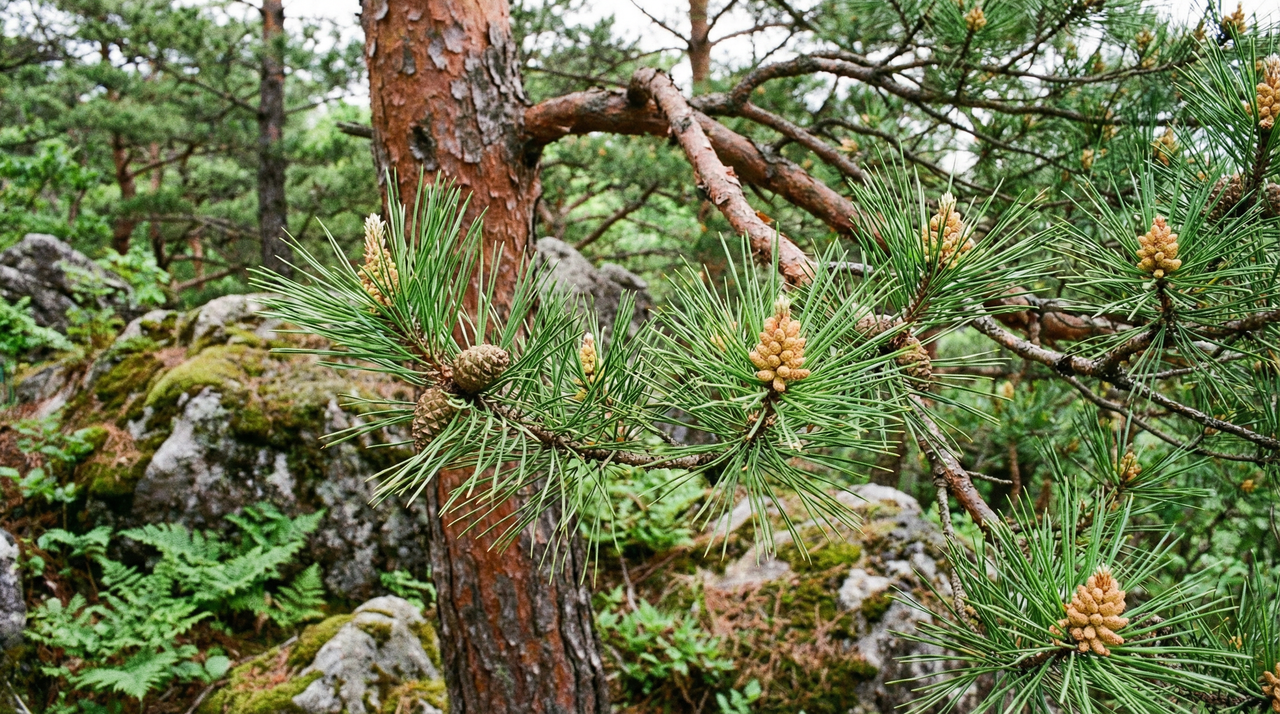
The most reliable way I confirm Scots pine in the field is the needles: paired in fascicles of two, 4 to 7 cm long, slightly twisted, and that particular bluish-green glaucous color that no other common two-needle pine quite matches.[9] Crushing a bundle releases a sharp, resinous scent that's immediately distinctive. The bark does the rest: smooth and reddish-orange on young stems and upper branches, aging to thick, fissured, grayish-brown below while retaining that warm orange-red flush in the crown well into maturity.[10] Cones are ovoid-conical, 3 to 7.5 cm long, ripening to gray-brown over two growing seasons.[9]
Young trees hold a tidy pyramidal shape that becomes rounded, irregular, or dramatically windswept depending on site and regional genetics; Scottish populations often develop more character in their twisting than the straighter central European forms.[2] Below ground, the tree starts with a taproot that transitions to extensive lateral roots stretching 10 to 15 m wide, nearly 100% colonized by ectomycorrhizal fungi.[11] Japanese red pine contrasts visibly, with longer, finer, bright-green needles (up to 21 cm), peeling reddish bark, and an irregularly picturesque crown that makes it a bonsai favorite.[12] Chinese white pine is the odd one out structurally, a five-needle species with long drooping bluish-green foliage and substantially larger cones (9 to 18 cm) containing edible seeds big enough to harvest seriously.[13]
Traditional, Cultural, and Historical Uses
Scots pine has been a working tree for as long as humans have lived alongside it. Dioscorides recommended pine resin for wounds and as an expectorant, Pliny the Elder described turpentine extraction for varnishes and medicine, and medieval writers including Hildegard of Bingen referenced it for respiratory and wound treatments.[14] Vikings relied on it for shipbuilding, waterproofing tar, and medicine, a combination of uses that speaks to how completely integrated this tree was into northern European material culture.[15]
Traditional pine needle tea, brewed from young needles to treat respiratory ailments and scurvy, represents one of those cases where traditional knowledge got there long before nutritional science could explain why it worked.[16] I find it genuinely striking that Korean traditional medicine developed nearly identical respiratory uses for Japanese red pine (sol-ip-cha needle tea, bark decoctions), and that Chinese white pine appears in Li Shizhen's 1578 Bencao Gangmu with comparable anti-inflammatory applications.[17][18] Convergent knowledge across cultures separated by thousands of miles reinforces that these uses were grounded in real, repeatable plant chemistry, though I'll leave the clinical details for the health section.
Sámi, Finnish, Russian, Baltic, and Siberian peoples used Scots pine comprehensively: wood for construction and boats, resin for waterproofing, needles for teas and medicinal baths, inner bark as famine food.[19] In Scotland it carries deep symbolic weight in heraldry and clan identity, standing for resilience and endurance, while Scandinavian traditions connected it to solstice rites and protection.[20] Japanese red pine occupies a parallel cultural space in East Asia, sacred in Shinto and Buddhist contexts as a symbol of longevity and fidelity, and central to bonsai and ukiyo-e traditions.[21] Chinese white pine represents nobility and endurance in classical painting, temple planting, and bonsai.[22] Historically, Scots pine's tall straight form made it prized for ship masts, and its resin supplied turpentine, rosin, varnishes, and even chewing gum.[23] That history of intense extraction also created real sustainability problems: overharvesting for timber and resin drove monoculture concerns in Europe, and Chinese white pine faces ongoing local pressure from overharvesting despite its current IUCN Least Concern status.[24][25] In my own designs, I avoid planting Scots pine in areas where it has shown invasive behavior and instead look for guild-appropriate native alternatives, because respecting that history of overuse is part of what responsible permaculture practice actually means.
Ecological Role, Symbolism, and Fun Facts
Scots pine is a genuine keystone, supporting over 1000 insect species alongside cavity-nesting birds, mammals, and mycorrhizal fungi including the much-loved Boletus edulis.[26] Mature stands sequester an average of 10 to 15 tonnes of CO2 per hectare annually (figures vary considerably by site and stand density), while the slowly decomposing needle litter steadily builds humus beneath.[27] Watching those deep needle layers accumulate in older stands taught me something practical: the mycorrhizal networks operating through that acidic duff are doing long-term soil work that I try to replicate intentionally when incorporating conifers into forest garden systems.
The ecotypic range within Scots pine alone is remarkable enough to surprise people. Central European sources can push close to 1 m of growth per year, while Scottish-origin trees typically achieve 0.5 to 0.7 m, and northern forms carry substantially higher frost resistance than their southern counterparts.[28] Japanese red pine adds another dimension: it's notably fire-adapted, with thick bark and serotinous tendencies that support post-fire regeneration, and the oldest known specimens exceed 1200 years.[12] Chinese white pine closes the picture from the other end of the ecological spectrum, producing large edible pine nuts dispersed by birds and rodents while forming ectomycorrhizal networks that stabilize poor subalpine soils on steep Chinese mountain slopes.[29] Across all three species, the pattern is consistent: these are trees that build systems, not just occupy space in them.
Pine Varieties and Cultivars for Garden and Landscape
Notable Cultivars and Forms of Scots Pine (Pinus sylvestris)
Scots pine has a genuinely impressive cultivar roster, covering everything from full-scale windbreak trees to rockery specimens you could tuck beside a garden path.[30][31] The golden-needled 'Aurea' and 'Gold Coin' are perennial favorites, but here's the thing I always tell clients: those warm yellow hues only materialize in full, open sun.[32][33] I've watched 'Aurea' planted on a north-facing slope stay a muddy, unremarkable green all season. Site these color-dependent forms on south-facing spots with no competition overhead, or don't bother. For structure rather than color, 'Fastigiata' delivers a narrow, upright column, while 'Aurea Fastigiata' (sometimes sold as 'Blue Star') combines that columnar habit with blue-green needles and a flush of golden spring growth, reaching a manageable 3 to 4 meters over many years.[34] 'Watereri', a compact pyramidal dwarf with an RHS Award of Garden Merit, and the bushy 'Nana' round out the smaller end of the palette.[30][31] For rock gardens and tight corners, 'Nana', 'Beuvronensis', and 'Tetrahymenata' stay in the 1 to 5 foot range over many years of slow, deliberate growth.[32][33] Beyond cultivars, three recognized subspecies add further range: var. sylvestris is the typical European form, var. mongolica carries notably longer needles, and var. hamata is the Karelian pine with distinctively twisted cones.[35][36]
Japanese red pine (Pinus densiflora) brings a completely different sensibility. The flat-topped 'Umbraculifera', the Tanyosho pine, is one I've used repeatedly as a focal point in guild designs where vertical space is limited. It functions like a living sculpture, anchoring a mid-layer without overwhelming the surrounding planting. 'Pendula' weeps dramatically, 'Globosa' stays a dense globe, and 'Oculus-draconis' offers variegated needles that earn their keep in ornamental beds.[37][38] Chinese white pine (Pinus armandii) is rarer in cultivation but worth knowing. Its botanical varieties include var. armandii and var. mastersiana, with horticultural selections spanning the columnar 'Columnaris', weeping 'Pendula', and compact 'Horsford'.[39][40] It's a deeper, quieter corner of the genus, better suited to collectors and designers with specific montane aesthetics in mind.
Sourcing Pine Trees and Seedlings in the United States
Scots pine is an introduced species here, naturalized across 22 states primarily in the Northeast and Midwest, and hardy in USDA zones 3 through 7.[41][31] Most US nurseries carry it for ornamental use rather than timber, though it's also historically been a Christmas tree crop.[31][42] If you're planting at scale, USDA Forest Service and state conservation seedling programs are worth looking at: 1- to 2-year-old seedlings often run under a dollar per unit on minimum orders of 100 or more, with production standards requiring 15 to 25 cm height and a 3 to 5 mm root collar diameter with a healthy, robust root system.[43][44] After years of ordering seedlings for restoration projects, I've learned to reject anything that doesn't meet those minimums. Undersized root systems mean a brutal first season and a tree that never quite catches up.
Quality assurance matters regardless of source. Look for straight stems, healthy foliage, and confirmation the stock comes from a licensed grower with documented genetic purity and pest-free status.[44][45] I never skip a quick inspection for early Dothistroma or Diplodia signs at the point of purchase; catching that before a tree goes into the ground has saved me from years of management headaches. If you're importing, USDA APHIS phytosanitary certification is required, though there are no major federal bans on Scots pine itself, so state-level rules are the main variable to check.[46][47]
For Japanese red pine, Conifer Kingdom and Bower and Branch are reliable specialty sources for grafted cultivars like 'Umbraculifera' and 'Globosa'; Sheffield's Seed Company carries seed if you want to grow from scratch. Expect to pay $10 to $25 for seedlings, $20 to $60 for 1 to 3 foot saplings, and $150 to $500 for larger specimen trees.[48][49][50] Chinese white pine is harder to find, with Nature Hills, One Green World, Conifer Kingdom, and Musser Forests among the better bets.[51][52] Its IUCN Vulnerable status, tied to logging pressure in its native range, means I specifically look for nurseries propagating from cultivated stock rather than wild-collected seed.[53] Seed packets run $5 to $15, seedlings $20 to $50, and mature trees can reach $300 or more. Seeds need 30 to 60 days of cold stratification before they'll germinate reliably, so factor that timeline into your planning.[54][55]
Scots Pine Propagation and Planting Guide
Growing pine from seed is one of those things that looks simple on paper and humbles you in practice. I've had batches of Scots pine seedlings hit 80% germination and batches that barely cracked 15%, and the difference almost always came down to one thing: whether I respected the stratification requirement. Once I did, consistently, everything changed.
Scots Pine Propagation Methods: Seeds, Grafting, and More
Seed is the primary method for growing Scots pine, and for most home growers or small-scale foresters it's the most practical and economical route.[56][57] The seeds themselves are small, dark brown, and ellipsoid, roughly 3-6 mm long, each carrying a papery wing that helps them travel hundreds of meters on the wind.[58][59] Because Scots pine outcrosses at rates of 90-99%, seedlings are genetically variable, which is exactly what you want for a naturalized planting or food forest canopy tree, but not ideal if you're trying to reproduce a specific ornamental form.[60]
One thing I wish someone had told me early on: label every seed flat. Scots pine seedlings look remarkably similar to other conifers in their first season, and I lost an entire batch of carefully stratified seed once by accidentally weeding it out. Now every tray gets a tag before anything else happens.
Scots pine exhibits what seed scientists call orthodox storage behavior, meaning the seeds tolerate drying and freezing without damage. Dried to 5-10% moisture content and sealed in airtight, moisture-proof containers with desiccant, they'll stay viable for 10-30 years at -18 to -20°C.[61][62][63] If you're unsure about viability before sowing, ISTA-standard testing combines germination trials at 15-20°C over 28 days, tetrazolium staining on split seeds, and non-destructive X-ray imaging to check for filled versus hollow seeds.[64][65][66] It's a good habit if you're working with stored or purchased seed of unknown age.
Once you're ready to sow, use an acidic, well-draining mix, something like 40% peat or coir, 30% coarse sand, 20% perlite, and 10% pine bark, and sow at about 1-2 cm depth.[67][57] Keep the nursery environment at 15-30°C with 70-80% humidity, indirect light, and consistent moisture without letting things get soggy. Thin seedlings at 4-6 weeks once they're competing for space.[67]
Grafting is the method to reach for when genetic fidelity matters. Ornamental cultivars like 'Nana' or 'Aurea' won't come true from seed, so cleft or side-veneer grafting onto 1-2 year old rootstocks in late winter to early spring is how specialty nurseries produce them reliably. Compatible rootstocks include Scots pine itself, or closely related species like Pinus mugo. With precise cambial alignment, IBA treatment, and clean conditions, success rates of 80-90% are achievable.[68][69] I've refined my technique on bonsai stock over several winters and now consistently see 85%+ take when I match scion and rootstock diameter closely and work right as sap begins to move in late February.
Cuttings are worth mentioning mostly as a caution. Japanese red pine semi-hardwood cuttings treated with 1000-3000 ppm IBA root at 20-50% under mist and bottom heat, while Chinese white pine is more recalcitrant and needs 3000-5000 ppm IBA with still only variable results.[70][57] Tissue culture and somatic embryogenesis exist for elite clonal production but belong firmly in the professional lab, not the home nursery.[71]
Germination Timeline and Cold Stratification for Scots Pine Seeds
Cold stratification is non-negotiable. Without it, germination rates fall below 20%; with a proper 30-90 day period of cold, moist conditions at 3-5°C, rates consistently exceed 70%.[72][73] I use a 24-hour pre-soak in water first, then pack the seeds in moist vermiculite inside a sealed bag in the refrigerator for 60 days. That protocol now gives me 70-85% germination reliably, season after season, turning what used to be a frustrating lottery into a predictable process.
After stratification, seeds germinate in 2-4 weeks at 15-21°C.[72] For indoor sowing, late winter (February-March) works well, letting you time transplanting for after the last frost. Direct outdoor sowing in early spring or fall also works in temperate climates; fall sowing lets nature handle stratification, and in my experience it often produces the most even germination the following spring because the seeds cycle through cold naturally rather than sitting in an artificial environment.
One practical note on timelines: seed-grown Scots pine takes 10-40 years to reach reproductive maturity under natural conditions, often 15-30 years before meaningful cone crops.[74][75] Grafted specimens, by contrast, often begin producing cones within 2-7 years.[76] If you're growing for seed production or breeding work rather than landscape presence, that's a strong argument for grafting your parent trees.
Soil, Site Selection, and Planting Requirements for Scots Pine
Scots pine thrives in sandy or coarse loamy, nutrient-poor soils with a pH of 5.5-6.5, though it tolerates a broad range of 4.5-7.5.[77][78] What it will not forgive is waterlogging or compaction. Heavy clay, peaty low spots, or any site where water pools after rain is a recipe for root rot and slow decline. Rocky or gravelly substrates that drain freely are genuinely fine; this is a pioneer species built for difficult ground.[77]
I now insist on a soil test before planting any pine in a client's landscape. I learned that the hard way on a project where young Scots pines developed interveinal yellowing on new needles within two seasons of planting. The culprit was alkaline soil pushing pH above 7.5, which locked up iron.[78][79] Sulfur amendments brought the pH down to 6.0 over one growing season and the trees recovered, but it was entirely preventable. At the acidic extreme, soils below pH 5.0 can cause aluminum and manganese toxicity, showing up as necrotic spots on needles; fortunately, the ectomycorrhizal associations that Scots pine forms naturally help buffer some of this and improve phosphorus uptake.[80]
Aim for a minimum soil depth of 40-60 cm, with over 60 cm preferred, to accommodate the taproot and lateral root architecture.[77] If you're planting into heavier soil, incorporate coarse sand, pine bark, or grit to open up the drainage, and keep bulk density below 1.2 g/cm³ if you can.[56] Scots pine also demands full sun, a minimum of six hours daily and ideally eight or more. Shade encourages etiolation and reduces vigor over time.[81] This is not a tree to tuck into a partly shaded corner and hope for the best.
Spacing, Transplanting, and Establishment Techniques
Spacing decisions depend entirely on your purpose. For timber or forestry plantings, initial spacing of 2-3 m (roughly 6-10 ft) puts around 400-1,000 trees per acre; plan to thin to 4-6 m after 10-15 years as the canopy fills in.[82][83] For ornamental or garden settings, I use 25-30 ft centers at minimum. Forestry charts often suggest closer spacing, but in a home landscape that kind of density pushes trees into competition that creates the tight columnar habit of a plantation rather than the naturally irregular, picturesque form that makes Scots pine worth growing as a specimen. Give each tree room to express itself.
Adequate airflow between trees also reduces humidity-driven fungal pressure, including needle blight and rust, which the pests and diseases section covers in detail.[82] Chinese white pine plantations use 2-4 m spacing for production work and 20-30 ft for ornamentals, which tracks closely with Scots pine recommendations and reinforces that these spacing principles hold across the genus.[84]
Transplant seedlings outdoors in spring after the last frost, once they're 6-12 inches tall and have been hardened off over 1-2 weeks.[85] Dig the planting hole as wide as the root ball and to the correct depth so the root flare sits at grade, not buried. Alleviate any compaction in the surrounding soil before backfilling. Staking is rarely necessary but worth doing on windy sites for the first year or two, using soft ties that won't girdle the stem.[85] Get the site preparation and planting depth right once, and you largely avoid the establishment problems that cause so many young pines to struggle.
Scots Pine Care Guide: Growing and Maintaining Pinus sylvestris
Scots pine possesses a raw cold tolerance that most other landscape trees simply cannot match. Hardy in USDA zones 3 through 7 and capable of surviving temperatures down to -40°F, this is the pine I reach for in northern landscapes where other conifers hesitate.[86][87] Japanese red pine shares that same zone 3-7 range and -40°F floor, while Chinese white pine is a step milder at zones 5-8, tolerating down to about -20°F, which matters if you're in the Great Lakes region or the mid-Atlantic and want a slightly warmer-natured alternative.[88][89]
Frost Tolerance and Cold Hardiness
That raw zone hardiness number doesn't tell the whole story, though. Established Scots pine handles brutal winters with ease; it's the young trees, new spring growth, and terminal buds that get into trouble when late frosts hit or an early autumn freeze catches soft tissue before it hardens off.[90] Browning or reddish discoloration of needles, shoot dieback, or bud death are your diagnostic signals, and in severe cases you'll see bark cracking or cankers develop over winter.[91] Provenance also matters here: northern seed sources carry better cold adaptation than southern ones, so if you're sourcing for a zone 3 or 4 garden, it's worth asking where those seeds originated.[92]
I never plant a new pine without planning its winter protection for the first two seasons. The research on cambium damage is clear, and I've watched what happens when that step gets skipped: a tree that looked perfectly alive in December turns into a problem by March. A 3-4 inch organic mulch ring kept away from the trunk, a burlap windscreen on the exposed side, and a thorough deep watering before the ground freezes will get most young trees through their first winters without incident.[93][94] Anti-desiccant sprays on seedlings can help too, especially in sites with drying winter winds.[2]
Heat Tolerance and Summer Stress Management
Scots pine comes from continental climates that can get warm summers, but heat stress starts setting in above about 30°C (86°F), and anything sustained above that will push the tree into defensive mode: stomatal closure, reduced chlorophyll, and if drought is also in the picture, needle tip browning, canopy thinning, and dieback.[2][95] Seedlings are the most vulnerable; mature trees with established root systems handle heat spikes to 35-40°C for short periods, especially if nights cool back below 20°C.[96] Southern provenances acclimate better than northern ones in hotter climates, which is worth remembering if you're pushing the southern edge of its range.[97]
In hotter summers I rely on the same toolkit I use for other stressed conifers: deep infrequent watering (roughly 1-2 inches per week for young trees), 2-4 inches of mulch to buffer soil temperature, and afternoon shade for seedlings in their first year or two.[98] Once past year three, that deep taproot makes Scots pine considerably more resilient than most people expect in the heat. Japanese red pine responds similarly, benefiting from deep watering and acidic soil (pH 5.0-6.5) to stay comfortable through summer stress.[99]
Water Needs and Drought Tolerance
Scots pine prefers well-drained sandy or loamy soils with a pH range of 4.5 to 7.0, though it performs best toward the acidic end around 4.5-6.0.[2] During the first one to three years, consistent moisture is essential: aim for 1-2 inches per week or a thorough deep soak every week or two.[32] Once established, the story changes dramatically. A deep taproot reaching 2-3 meters, combined with lateral roots working the upper meter of soil, means a mature Scots pine can go 8-12 weeks without supplemental irrigation in regions receiving 20-40 inches of annual rainfall.[2]
The two watering mistakes I see most often are overwatering young trees and ignoring winter reduction. Overwatering invites Phytophthora root rot, and you'll spot it early as yellowing or base browning of needles before you notice root damage.[100][101] Underwatering shows at the needle tips first: scorching, curling, canopy thinning. Keeping 2-4 inches of organic mulch around the base (away from the trunk) moderates both problems by holding moisture and buffering soil temperature, and pulling back on irrigation through winter dormancy is non-negotiable.[102]
Feeding and Soil Fertility
Scots pine is a moderate feeder that does best in acidic soils at pH 4.5-6.0; if your soil tests above 6.5, a sulfur amendment is worth considering before you reach for fertilizer.[103] A soil test is always my first recommendation before adding anything, because deficiency symptoms can look similar across nutrients. Older needle yellowing suggests nitrogen shortage; purplish needles with poor root development point to phosphorus; tip browning on older needles is often potassium; and chlorosis on younger needles, especially in higher-pH soils, usually means iron or zinc is locked out.[104] In my experience, a targeted organic amendment based on what the test actually shows resolves these symptoms faster than a blanket fertilizer application.
Apply a slow-release acid-loving fertilizer (something like 10-10-10 or 16-8-8) in early spring before new growth breaks, at roughly 0.5-1 lb of actual nitrogen per 1,000 square feet around the drip line.[105] Avoid fertilizing at planting, skip it entirely in winter, and don't over-apply: excess nitrogen invites pest pressure and can cause needle burn.[106] A pine bark or needle mulch layer does double duty here, providing slow organic nutrient release while keeping that soil pH where the tree wants it. Japanese red pine is an even lighter feeder than Scots pine, getting much of its mineral nutrition through its ectomycorrhizal network, so if you're growing one alongside, resist the urge to fertilize both on the same schedule.[107]
Pruning, Maintenance, and Seasonal Rhythm
Late winter through early spring (February to April) is the window for pruning Scots pine, before new growth starts and when sap bleeding and disease risk are lowest.[108] In the first five to ten years, formative pruning to establish a strong central leader is worth the effort; after that, mature trees need very little intervention and naturally shed their lower branches on their own. Never remove more than 25-30% of the live canopy in a single season, and don't cut back into old wood expecting regrowth: Scots pine doesn't resprout from dormant buds the way a broadleaf would.[109] I learned that particular lesson on a mature specimen I was too aggressive with early in my career. If you're growing Japanese red pine and want a denser form, candle pruning in late spring (pinching the new shoots back by a third to two-thirds before the needles extend) is a satisfying and effective technique that doesn't touch old wood at all.[110] Beyond pruning, full sun is non-negotiable for good form and color, and a maintained mulch ring (2-4 inches, kept clear of the trunk) handles moisture, weed competition, and root insulation all at once.[58]
Seasonal Growth Patterns
Understanding Scots pine's seasonal rhythm resolves most of the common care mistakes. It's evergreen, so photosynthesis can happen whenever conditions allow, but growth is far from uniform year-round: bud break and active expansion run from March through May, peak growth hits in late spring to early summer (May to July) with a possible secondary flush in late summer, and by September the tree is already setting buds and preparing to shut down for winter.[111][2] Optimal growth happens between 10-25°C (50-77°F), and full dormancy through winter means water demand drops significantly.[112] The practical payoff of knowing this rhythm: ramp up watering and apply fertilizer during the spring flush, hold back through winter, and time any pruning to avoid disrupting active growth or inviting disease into fresh cuts as dormancy breaks. Cone production typically begins somewhere between 10 and 20 years from planting, so if that's part of your harvest plan, patience is the main requirement.[78]
Harvesting Scots Pine: Timing, Techniques, and Edible Yields
Scots pine rewards patient observers. Before you mark a single date on your calendar, understand that the cones on the tree in front of you began forming roughly two years ago. That 24-30 month maturation cycle from initial bud to fully ripe cone is the first thing I tell anyone new to harvesting pine, because it reframes the whole relationship with the tree.[41][10] Japanese red pine follows the same two-year pattern, with color shifting from yellowish-green to brown through late September into early November depending on your latitude and elevation, which is a useful reminder that genus-level biology is remarkably consistent even when the trees look quite different.[74]
Cone and Seed Maturity Timelines
For Scots pine, the window I watch for is September into October, when the 3-7.5 cm cones have turned fully brown and dry.[41][10] You can gather them from the tree just before they fall or pick up fresh drops from the forest floor, though ground-collected cones need checking for moisture damage and insect activity. Needles are a different story entirely: late spring to early summer, when the new growth is still bright, almost lime-green, and bends easily without snapping, is when I harvest for tea. Those young needles are noticeably more aromatic and higher in vitamin C than the older, duller growth you'd find in August.[41][113] Resin tapping is a spring operation too, and one I approach cautiously. Sustainable tapping is traditionally done on mature trees of 40-80 years with 20-40 cm trunk diameter.[114][115]
Practical Harvesting Methods
I only ever take a few cones or a handful of needles per tree, and I never tap the same tree two years running. That's just basic ethics on any foraging site. For cone collection, shaking branches or gathering naturally fallen cones from the ground is the simplest non-destructive approach.[116] Needles get cut selectively with clean shears rather than stripped by hand, which reduces unnecessary stress on the branch tip. Once you have cones, dry them in a warm, ventilated spot at around 30-40°C for two to four weeks until the scales open on their own, then shake out the seeds and clean them.[74][115] Seeds meant for storage rather than immediate eating should be dried to 5-8% moisture and kept airtight at 0-5°C; viability holds reasonably well for up to two years before it starts dropping off noticeably.[74] Any collected resin should be processed quickly and stored in dark glass at 4-10°C to prevent oxidation.[114]
Flavor, Texture, and Culinary Value of Harvested Parts
Scots pine gives you four edible parts to work with: the seeds, young needles, inner bark, and young cones.[117][118] The pine nuts are the real prize. They're smaller than the Italian stone pine nuts most people buy at the grocery store, but the flavor is genuinely lovely when roasted: mild, sweet, buttery, with just enough resinous edge to remind you where they came from.[118][119] Japanese red pine nuts are smaller still, with a flavor that tips toward resinous and can turn soapy if the seeds are over-mature; mast years occur every three to five years, so when you find a loaded stand, it's worth paying attention.[120][116]
Spring needles steeped as tea have a fresh, piney, slightly citrusy flavor with a clean bitterness that fades as they cool.[121] That brightness comes from the same volatile compounds, particularly alpha-pinene and limonene, that give pine its signature aroma.[122] The needles themselves are too fibrous to eat directly, so infusion is the method. Inner bark is a different category entirely: a traditional famine food, not a casual snack. The first time I processed cambium without enough water changes, the bitterness stayed stubbornly through every bite. Three good rinses and a long simmer make a real difference.[123][118] Properly processed, it has a mildly sweet, woody quality that works in flatbreads or porridge, but it's not something to approach casually.
Whatever you harvest, source only from clean, unsprayed trees well away from roadsides or industrial land.[123][124] The resinous compounds throughout the plant that give pine its medicinal character are also what make bark and immature cones unsuitable as everyday staples without proper leaching.[123][118] Roasted seeds and carefully prepared needle tea sit at the practical, repeatable end of the spectrum. Everything else is traditional knowledge worth preserving, used with care.
Pine Preparation and Uses
Few trees you can actually grow in a temperate food forest offer as many harvestable parts as Scots pine. Needles, inner bark, seeds, pollen, young shoots, and sap are all edible or useful in some form, and resin has served human hands for thousands of years beyond the kitchen.
Culinary Uses of Pine
I brew young Scots pine needle tea every spring, and the moment the steam rises it's immediately recognizable: bright, citrusy, resinous, with something almost green and balsamic underneath. That aroma comes directly from the tree's monoterpene profile, dominated by α-pinene at 40-60%, with β-pinene and limonene rounding out the signature pine-citrus character.[125] The same chemistry runs through East Asian traditions: Japanese red pine needles become sol-song-cha in Korea and matsu-cha in Japan, while Chinese white pine needles yield a similar infusion across the continent.[126][127][128] I learned the hard way that needles more than a year or two old turn the tea astringent and bitter; use the soft, pale new growth and steep it for no more than 10 to 20 minutes.
Pine nuts are where the real culinary depth lives. Scots pine nuts have been staple foods in Scandinavian and Eastern European diets for centuries, while Japanese red pine nuts appear in Korean jeon pancakes and medicinal porridges, and Chinese white pine nuts are prized for a buttery sweetness that many cooks find richer than Mediterranean stone pine.[15][128][129] I've found the roasting window is unforgiving: exactly 12 minutes at 350°F brings out a deep nuttiness, but go a few minutes longer and bitterness takes over entirely.
Spring pollen can go into smoothies or baked goods.[130] Needle syrup, made by simmering needles with sugar, pairs beautifully with venison or duck; that pairing isn't accidental, it's the same α-pinene and bornyl acetate bridging the resinous notes in the meat and the tree.[131] Young Japanese red pine shoots have their own tradition as matsuba, lightly pickled or salted alongside sushi and grilled fish.[132] Inner bark is the most labor-intensive; boiling, roasting, or drying and milling it into flour reduces the bitterness dramatically, and the result has a mild, faintly sweet quality that makes its famine-food history feel less grim once you've actually tasted it.[127] Raw or excessive consumption of resinous parts can cause gastrointestinal irritation, so proper preparation isn't optional.
Medicinal Preparations
Traditional medicinal preparations are straightforward but require precision. Needle tea for therapeutic use calls for 5-10 grams simmered for 10 minutes, a noticeably stronger ratio than the culinary steep.[133] Scots pine essential oil, steam-distilled from needles and twigs, should be diluted to 1-2% for any topical application and stored in amber glass at 4°C away from light; handled that way, it stays potent for up to two years.[134] I never use pine resin internally without proper processing, and I always tell pregnant readers or anyone on blood thinners to talk to their physician first. The plant's potency is real, and the folk tradition is long, but human clinical data is limited. Treat concentrated preparations with appropriate respect. The same resin used in medicinal balsams historically also waterproofed ships and sealed rooftops, which tells you something about just how bioactive these compounds are.
Non-Food Uses of Pine
Scots pine timber has built European civilization in ways we rarely stop to appreciate: construction, shipbuilding, furniture, tool handles, thatching, charcoal, and pitch for waterproofing and torches span millennia of continuous use across the continent.[14][135] From a permaculture perspective, that breadth is the point: one mature Scots pine can supply food, medicine, usable timber, needle mulch, and a full suite of wildlife habitat functions from a single canopy position. That kind of stacking is exactly what a well-designed food forest is supposed to achieve.
Scots Pine Health Benefits and Medicinal Uses
What I find fascinating about Scots pine as a medicinal plant is that the benefits aren't mysterious. They trace directly back to a rich, well-mapped chemistry that the tree produces for entirely self-interested reasons, and we get to borrow the results.
Key Phytochemicals in Scots Pine
Scots pine is loaded with secondary metabolites. These compounds are distributed unevenly across the plant in ways that matter for how you use it. The needles are dominated by monoterpenes, primarily α-pinene at 40-60% and β-pinene at 10-30%, with limonene rounding out the volatile fraction.[136][137] The bark tells a different story: high in condensed tannins, proanthocyanidins (up to 13%), and phenolics like catechin, quercetin, and ferulic acid.[138] Resin is dominated by diterpenes like abietic acid, while the roots hold stilbenes including pinosylvin. If you're working with pine medicinally, these distinctions matter because you're not using the whole plant interchangeably.
After years working with conifers in landscape design, I've noticed that drought-stressed Scots pines become noticeably more resinous and pungent. That's not coincidence. Trees under drought, high UV, or nutrient-poor conditions ramp up phenolic production and push more monoterpenes into their tissues.[139][140] The same pattern holds across related species: Japanese red pine and Chinese white pine show comparable tissue-specific distributions with α- and β-pinene-rich needles and phenolic-dense bark.[141][142] The tree evolved these compounds to defend against pathogens, herbivores, and environmental stress; the antioxidant, antimicrobial, and anti-inflammatory activity that benefits us is a byproduct of that defensive chemistry.[143][144]
Medicinal Research and Traditional Uses
European healers have used Scots pine needles, bark, and resin for respiratory complaints, urinary tract infections, wound care, and skin conditions for centuries.[145] That's a long, consistent record, and it maps closely onto parallel traditions in Korea and Japan for Japanese red pine (respiratory issues, rheumatism, wound healing) and in TCM for Chinese white pine (coughs, asthma, skin tonics).[133][146] When independent traditions across three continents converge on the same plant part for the same conditions, that's worth taking seriously.
The preclinical science has started to explain why. Extracts from Scots pine and close relatives show free-radical scavenging, Nrf2 activation, and enhanced SOD and CAT enzyme activity for antioxidant effects; NF-κB inhibition and reduced TNF-α, IL-6, and COX-2 for inflammation; and membrane disruption plus DNA gyrase inhibition for antimicrobial activity against both bacteria and fungi.[147][148][149] There's also early work on anticancer and neuroprotective pathways, including acetylcholinesterase inhibition.[150][151] Bark extracts standardized to proanthocyanidins (50-200 mg/day) have shown reduced osteoarthritis symptoms in human trials, and phytosterols in pine contribute to cholesterol modulation while flavonoids support vascular health.[152][147] Honest caveat: most of this evidence comes from in-vitro and animal models. Human trials are limited and often small.[153][154] The traditional record is extensive and the laboratory results are genuinely compelling, but we need more robust human studies before making strong therapeutic claims.
Nutritional Profile of Pine Nuts and Needles
Pine nuts are energy-dense in the way that makes sense for a seed designed to fuel a seedling through a harsh establishment phase. Per 100 g, they deliver around 673 kcal, 14 g protein, and 68-69 g fat, mostly unsaturated and including pinolenic acid.[155] The micronutrient profile is genuinely impressive: 251 mg magnesium, 575 mg phosphorus, 6.5 mg zinc, up to 8.8 mg manganese, plus meaningful amounts of vitamin E, vitamin K, and folate.[155][156] A standard serving is around 28 g; roasting at 120-150°C preserves most lipids and proteins but can reduce vitamin E by 10-20%, so I keep my batches at the lower end of that temperature range.[157] The pinolenic acid is worth noting too, with clinical studies in lipid research demonstrating significant appetite-suppressing effects.[158]
Young pine needles are nutritionally modest by calorie count (20-40 kcal per 100 g) but contain 100-250 mg vitamin C per 100 g fresh weight, peaking in winter when few other fresh sources are available.[159][160] I make small batches of fresh needle tea for seasonal immune support and find the flavor noticeably brighter and greener from fresh versus dried needles. Pine pollen adds another dimension: 30-40% protein alongside B-vitamins and minerals, though the pollen's role in pine tree pollen benefits is primarily nutritional rather than medicinal.[161]
Safety and Precautions
Scots pine is generally safe for short-term topical and moderate internal use in healthy adults, considerably less concerning than many medicinal plants and notably safer than relatives like ponderosa pine or yew.[162][163] Ingesting needles, bark, resin, or sap may cause mild GI upset (vomiting, diarrhea), and needle tea is best kept to 1-2 cups daily using roughly 2-3 g dried needles per liter.[164][165]
Pregnancy is a firm contraindication. I do not recommend internal use of pine in any form during pregnancy or lactation due to potential uterotonic effects.[164] Two other common risk factors deserve attention: pine pollen (a well-documented seasonal allergen producing hay fever symptoms each April through June, recognizable as that yellow sulfur-like dusting on cars and garden surfaces)[166] and pine resin, which can cause allergic contact dermatitis in sensitive individuals.[167] For the essential oil (40-70% α-pinene), I dilute to 1% in carrier oil for topical blends after an early experience with skin sensitivity at higher concentrations. The standard advice runs to 1-2% maximum; undiluted ingestion is not appropriate.[168]
Concentrated bark extracts may inhibit platelet aggregation and increase bleeding risk when combined with anticoagulants or antiplatelet medications.[169] People with kidney or liver impairment, asthma, or known pine allergy should use caution across all preparations. One practical foraging note: needles can accumulate heavy metals from polluted soils, so always gather from clean sites well away from roadsides or industrial areas.[170] For any medicinal use, especially if you're pregnant, on medications, or managing a chronic condition, talk to a qualified healthcare provider first.[171]
Pests and Diseases of Scots Pine
Scots pine is not a particularly fragile tree under the right conditions. What I've seen time and again, though, is that "right conditions" is doing a lot of work in that sentence. Drought, overcrowding, waterlogging, storm damage, even a single bad summer, any of these can flip a moderately resistant pine into something that practically advertises itself to bark beetles and fungal pathogens.[172][173] The tree has genuine defenses: a resin rich in terpenes including α-pinene, β-pinene, and sesquiterpenes that both toxifies insects and physically floods their galleries, tough silica-heavy needles, and mycorrhizal partnerships that improve nutrient status and boost defense-gene expression.[174][175] Those defenses hold up beautifully when the tree is vigorous. Stress them enough and the chemistry doesn't keep pace.
Major Insect Pests of Scots Pine
Bark beetles are the threat I worry about most. Ips species, particularly Ips typographus and Ips pini, are the classic culprits: they home in on weakened trees, bore through the bark, and introduce blue-stain fungi that block the vascular system fast enough to kill a tree before you've had a chance to react.[176][177] I've watched the same pattern in loblolly and slash pine in the South: a stressed tree puts out those small pitch tubes on the lower trunk in early summer, and if you're not walking your planting regularly enough to catch them, the tree is often already beyond saving by the time the crown starts to flag. The beetles behave the same way regardless of species. Catch the pitch tubes early, act fast.
Pine sawflies, including Diprion pini and Neodiprion sertifer, cause serious defoliation, especially on young trees.[172][178] A single outbreak rarely kills an established tree, but repeated heavy feeding weakens it enough to invite everything else on this list. The large pine weevil, Hylobius abietis, is a particular menace on seedlings and saplings during reforestation, girdling young bark before the trees can produce enough resin to defend themselves.[179] Japanese red pine and Chinese white pine share this vulnerability with Scots pine, which is worth knowing if you're mixing species in a planting.[180] Non-native plantings of any of these species tend to fare worse than native or co-evolved populations, because they arrive without the accumulated genetic resistance that comes from centuries of local pressure.[181]
Key Diseases Affecting Scots Pine
Needle blights are the most visible diseases in landscape and nursery settings. Dothistroma needle blight causes severe damage in humid conditions, producing red banding on needles that can strip young plantations down to the new flush.[182][183] Lophodermium needle cast follows a similar pattern, causing significant defoliation and real economic loss in European and Asian plantations.[184] I always seek out northern European seed lots when I can because those provenances carry a meaningful head start against the needle fungi that really come on during humid summers.[185] Seed source matters more than most growers realize.
Pine wilt disease deserves its own mention because it moves so fast. The nematode Bursaphelenchus xylophilus, vectored by Monochamus beetles, can take a healthy-looking tree to dead in a single season, particularly when summer temperatures regularly push past 20°C.[186][187] Japanese red pine and Chinese white pine face the same risk in non-native ranges.[188] My own rule is to avoid placing susceptible pines anywhere near known vector beetle habitat when summer heat is a given. Root and butt rots, including Armillaria and Heterobasidion, compound the picture in waterlogged or poorly drained soils,[189][190] and Diplodia tip blight takes out new growth on stressed trees across all three species with no highly resistant cultivars available yet.[191]
Prevention and Integrated Management
The most effective thing you can do for pine health is make good decisions before you plant. Well-drained, acidic soil between pH 4.5 and 6.5, full sun, and genuine spacing so air moves freely through the canopy remove the conditions that most pathogens and insects require.[107][192] I've found that removing the first visibly infected branches at the earliest sign of needle cast, then improving spacing the following season, prevents most outbreaks in landscape plantings without ever reaching for a fungicide. Prune only in dry weather with sterilized tools, remove fallen infected needles, and destroy any heavily infested material rather than composting it.[193][194] Biological controls and targeted insecticides exist as secondary tools for serious pressure, but a healthy, properly sited pine rarely needs them. Reactive spraying almost always signals a site or spacing problem that chemistry alone won't fix.
Pine in Permaculture Design
Of all the conifers I've worked with over the years, Scots pine occupies a particular design niche that's both tremendously useful and genuinely tricky to get right. It's not the flexible, plant-it-anywhere generalist that some permaculture literature makes it out to be. Site it well, though, and it becomes one of the most reliable soil-building canopy trees you can put in the ground for cold, marginal conditions.
Climate and Hardiness Zones for Scots Pine
Scots pine is rated for USDA zones 3-7, with cold tolerance extending to an astonishing -40°C to -50°C in the coldest boreal provenances.[41][195] In practice, it performs best in zones 3-5 and becomes increasingly marginal as you move into warmer parts of zones 6 and 7 where humid summers are the norm.[31] The species is climatically tuned to continental conditions: cold winters, cool to moderate summers, low ambient humidity, and full sun.[58][112] Prolonged heat above 32°C starts causing real problems, and I've seen this play out even in marginal zone-7 plantings where afternoon humidity and poor air circulation invite needle cast almost every wet summer.
On the soil side, Scots pine is remarkably tolerant of poor, sandy, gravelly, or rocky ground, with a workable pH range of 4.5-8.0, though it absolutely requires excellent drainage.[196] Waterlogged roots are a non-starter. If your site has a drainage problem, solve that first or choose a different anchor species. Before I plant Scots pine in any North American project, I always check my state's invasive species list; in the Great Lakes region it has documented escape potential that makes me reach for native alternatives or very carefully contained guild placements.[197]
For designers working in East Asia or in zones 4-7 with warmer, more humid summers, Japanese red pine offers a parallel option with slightly broader heat tolerance up to around 35°C and better adaptation to humid temperate climates like Cfa and Cwa.[198][199] Chinese white pine opens up the picture further for montane sites in zones 5-8, tolerating elevations from 1000 to 3300 meters with moderate urban pollution tolerance that the others lack.[200][201] But for cold, dry, nutrient-poor sites across northern Europe and North America, Scots pine remains the default starting point.
Ecosystem Functions and Ecological Roles
The permaculture case for Scots pine begins with what it does to the soil under its feet. As a pioneer on bare, disturbed, or wind-swept sandy sites, it stabilizes slopes with an extensive root system, initiates succession, and actively builds organic soil layers over time.[2][202] I've watched Scots pine seedlings emerge vigorously on disturbed sandy fill sites in projects I've designed, naturalizing exactly as the ecology predicts, which tells you something useful: if seedlings appear uninvited on sandy, sunny ground, you've identified a spot where the tree is genuinely comfortable rather than just surviving.
Its needle litter is where things get interesting for soil designers. Those slowly decomposing needles register pH 3.5-4.5 as they break down, progressively acidifying the O- and A-horizons while building organic matter over years.[203] At the same time, the tree forms dense ectomycorrhizal networks that pull phosphorus and other nutrients from poor soils without fixing nitrogen.[204] That last point matters for guild design: because Scots pine doesn't fix nitrogen, I routinely position comfrey or alder at the drip line, using chop-and-drop from both to feed the understory while the resinous needle mulch slowly does its acidifying work. Japanese red pine mirrors most of these mycorrhizal functions and adds serotinous post-fire regeneration into the mix, while Chinese white pine delivers comparable carbon storage benefits with the added advantage of those larger, more productive edible nuts.[204][205]
Above ground, Scots pine earns its keep as a windbreak that can cut wind speed by up to 50 percent, and its resinous volatile compounds have measurable deterrent effects on aphids, deer, and some fungal pathogens.[202][206] Wildlife support is substantial, with its cones feeding crossbills, siskins, and voles through winter, and its layered structure hosting hawks, owls, woodpeckers, and a rich community of lichens and bryophytes.[207][208] For human yields, the tree produces timber, resin for turpentine and adhesives, vitamin-C-rich needle tea, and modest edible seeds, all harvestable without compromising the tree's ecosystem functions when managed carefully.[209][210]
Forest Layer, Guilds, and Companion Planting
Scots pine occupies the tall canopy layer, typically 30-60 feet in cultivation with some specimens reaching 100 feet, and it's uncompromisingly shade-intolerant from seedling to maturity.[31][211] That shape shifts from a tight pyramid when young to a broad, irregular, almost sculptural open crown with age, which is relevant for light-gap planning because the canopy eventually creates patchwork shade rather than uniform darkness.
What the tree does to its understory is the most important design consideration. Needle litter can reduce available light by up to 80 percent in closed stands, and that same litter carries allelopathic compounds that suppress many food crops.[212][213] I think of the needle carpet the way I think of loblolly pine litter in Southeastern systems: familiar to anyone who's tried to grow vegetables under a dense conifer and watched them struggle despite reasonable watering. The companions that actually flourish are the acid-tolerant guild: blueberries, lingonberries, rhododendrons, heather, and ferns establish well once the pH shift is underway and the mycorrhizal network is active.[214] In my experience, early establishment of those understory plants requires active weed suppression because the allelopathic mulch doesn't discriminate between weedy competitors and your chosen companions until the system matures.
Japanese red pine reaches 50-70 feet with similar allelopathic and mycorrhizal dynamics, so the same guild logic applies, though its fire-adapted pioneer character makes it particularly useful on disturbed or burned sites in East Asian landscapes.[199][215] Dense monocultures of Japanese red pine can suppress herbaceous diversity significantly, so spacing and intentional light-gap management matter even more there. Chinese white pine offers a compelling alternative for montane food-forest contexts: at 50-80 feet with larger edible nuts yielding 10-20 kg per mature tree after 20-30 years, it pairs well with ferns, mosses, and ericaceous shrubs and delivers substantial carbon storage alongside the edible harvest.[201][216]
Across all three species, the honest summary for food-forest designers is that these pines are only moderately suited to integrated productive understory polycultures because of canopy density, soil acidification, and allelopathy.[217][218] They thrive in the role of pioneer canopy and windbreak with acid-loving companions underneath, paired with nitrogen-fixers at the margins to compensate for what the pine can't provide. Work with what the tree actually does rather than against it, and a pine guild becomes genuinely productive over time.
The Tree I Stop Under Without Planning To
I've designed around pines for years, but the moment that keeps coming back is simpler than any guild plan: standing under an old Scots pine on a cold February afternoon, needles ticking against each other in the wind, that resinous warmth cutting through the cold air, and realizing I wasn't thinking about what it produces or what it fixes. I was just grateful it was there. Some plants earn their place on a spreadsheet. This one earns it differently.
Sources 218
- Phytochemical Composition and Biological Activity of Pinus sylvestris ↩
- Scots Pine - USDA Forest Service ↩
- Pinus sylvestris - Plants of the World Online ↩
- Forest Research - Scots pine (Pinus sylvestris) ↩
- Genetic variation and adaptation in Scots pine ↩
- Pinus densiflora - Plants of the World Online ↩
- Pinus densiflora - USDA Forest Service ↩
- Flora of China - Pinus armandi ↩
- Pinus sylvestris - Missouri Botanical Garden ↩
- Pinus sylvestris - Flora of North America ↩
- Pinus sylvestris - Missouri Botanical Garden Plant Finder ↩
- Pinus densiflora - The Gymnosperm Database ↩
- Pinus armandii - The Gymnosperm Database ↩
- The Traditional Uses of Scots Pine (Pinus sylvestris L.) in Europe ↩
- Ethnobotany of Pinus sylvestris in Europe ↩
- Ethnobotany of Scots Pine in Europe ↩
- Pinus armandi Franch., a Review of Its Traditional Uses, Phytochemistry, and Pharmacology ↩
- Ethnobotanical Surveys of Korean Red Pine (Pinus densiflora) Use in Traditional Medicine ↩
- Ethnobotany of the Sámi: Traditional Uses of Conifers ↩
- Scots Pine: Symbolism and Myth in Scottish Culture ↩
- Sacred Trees in Shinto: The Role of Pine ↩
- The Symbolism of Pines in Chinese Culture ↩
- Pinus sylvestris - USDA PLANTS Database ↩
- Resin Harvesting Sustainability in Pinus sylvestris ↩
- The IUCN Red List of Threatened Species: Pinus armandi ↩
- The Role of Scots Pine in European Forests ↩
- Carbon Sequestration in Pinus sylvestris Forests ↩
- Provenance variation in Pinus sylvestris ↩
- Ecological Roles of Pinus armandi in Subalpine Forests of China ↩
- Pinus sylvestris - RHS Gardening ↩
- Pinus sylvestris - Missouri Botanical Garden ↩
- Royal Horticultural Society (RHS) Plant Finder ↩
- Missouri Botanical Garden Plant Finder ↩
- Pinus sylvestris 'Fastigiata Aurea' ↩
- Pinus sylvestris L. - EPPO Global Database ↩
- Cultivars of Pinus sylvestris - Dendrologie ↩
- Cultivars of Pinus densiflora - American Conifer Society ↩
- Royal Horticultural Society - Japanese Red Pine Varieties ↩
- Pinus armandi Botanical Profile ↩
- Pinus armandii ↩
- Pinus sylvestris L. ↩
- Christmas Trees: Species Selection ↩
- Tree Seedling Price List ↩
- Tree Seedling Quality Standards ↩
- Planting Stock Recommendations for Pinus sylvestris ↩
- USDA APHIS - Plant Protection and Quarantine ↩
- USDA Plants Profile for Pinus sylvestris ↩
- Japanese Red Pine (Pinus densiflora) ↩
- Pinus densiflora 'Umbraculifera' - Tanyosho Pine ↩
- Pinus densiflora - Japanese Red Pine Seeds ↩
- Armand Pine (Pinus armandii) ↩
- Pinus armandii - Chinese White Pine ↩
- IUCN Red List: Vulnerable Status Assessment ↩
- Propagation of Pines from Seed ↩
- Pinus armandii ↩
- Propagation of Pines from Seed ↩
- Propagation of Pinus armandii Franch.: A Review ↩
- Pinus sylvestris ↩
- Conifer Seeds: Structure and Dispersal ↩
- Embryogeny in Pinus sylvestris ↩
- Long-term Storage of Scots Pine Seeds ↩
- FAO Seed Storage Guidelines ↩
- Royal Botanic Gardens Kew - Seed Storage Protocols ↩
- ISTA Rules: Seed viability testing methods ↩
- Tetrazolium Testing for Tree Seeds ↩
- X-ray Analysis of Conifer Seeds ↩
- Nursery Manual for Forest Trees ↩
- Grafting Techniques for Ornamental Pines ↩
- Best Practices for Conifer Grafting Success ↩
- Propagation of Japanese Red Pine (Pinus densiflora) by Cuttings ↩
- Somatic embryogenesis in Pinus species: Advances and challenges ↩
- Seed Propagation of Conifers - University of Minnesota Extension ↩
- Germination Techniques for Conifers ↩
- Silvics of North America: Pinus densiflora ↩
- Growth and Reproduction Characteristics of Grafted Pinus densiflora in Central Japan ↩
- Pinus armandi Franch. ↩
- Silvics of North America: Pinus sylvestris ↩
- Scots Pine (Pinus sylvestris) ↩
- Pinus sylvestris ↩
- Soil Compaction Effects on Pine Trees ↩
- Scots Pine (Pinus sylvestris) ↩
- Silviculture of Scots Pine in Europe ↩
- Scots Pine Planting and Spacing Guidelines ↩
- Silviculture of Pinus armandii Franch. in China ↩
- Growing Scots Pine from Seed - Arbor Day Foundation ↩
- Missouri Botanical Garden - Pinus sylvestris ↩
- USDA PLANTS Database - Pinus sylvestris profile ↩
- USDA Plant Hardiness Zone Map ↩
- Missouri Botanical Garden - Pinus armandii ↩
- Frost Damage in Conifers - University of Minnesota Extension ↩
- Frost Injury to Forest Trees - Canadian Forest Service ↩
- Cold Hardiness of Scots Pine Provenances - Forestry Journal ↩
- University Extension - Winter Care for Conifers ↩
- Kew Gardens - Pinus sylvestris Care ↩
- Physiological Responses of Pinus sylvestris to Heat Stress ↩
- Effects of Heat and Drought Stress on Scots Pine ↩
- AHS Plant Heat Zone Map ↩
- Pinus sylvestris ↩
- Pinus densiflora ↩
- Overwatering Effects on Pine Trees - University of Minnesota Extension ↩
- Phytophthora Root Rot in Ornamental Trees ↩
- Royal Horticultural Society - Pinus sylvestris ↩
- Scots Pine Management and Nutrition ↩
- Nutrient Disorders of Pines ↩
- University of Minnesota Extension - Conifer Fertilization Guidelines ↩
- Fertilizing Evergreens - University of Maryland Extension ↩
- Response of Scots Pine to NPK Fertilization Study ↩
- Pruning Conifers ↩
- Pruning Pine Trees ↩
- Royal Horticultural Society - Pruning Conifers ↩
- Trees and Shrubs Online - Pinus sylvestris ↩
- FAO - Scots Pine Ecology ↩
- Scots Pine (Pinus sylvestris) ↩
- Oleoresin Production from Pinus Species ↩
- FAO - Scots Pine Management ↩
- Pinus densiflora Seed Production and Harvesting ↩
- USDA PLANTS Database ↩
- Scots Pine - Edible Uses ↩
- Edible Wild Plants: Scots Pine (Pinus sylvestris) ↩
- Japanese Red Pine (Pinus densiflora) - Edible Uses ↩
- Edible Wild Plants: Pine Needle Tea ↩
- Chemical Composition of Pinus sylvestris L. Essential Oil - PubMed ↩
- Foraging Scots Pine: Needles, Nuts, and Inner Bark ↩
- Royal Horticultural Society (Plant Cautions - Pinus species) ↩
- Essential Oils of Pinus sylvestris: Chemical Composition ↩
- Pinus densiflora - Wikipedia ↩
- Traditional Uses of Pinus densiflora in Korea ↩
- Edible Uses of Armand Pine (Pinus armandi) ↩
- Flavor Profile and Nutritional Composition of Chinese White Pine Nuts ↩
- Culinary Uses of Pine Pollen ↩
- Traditional Scandinavian Pine Recipes ↩
- Edible Wild Plants: Japanese Red Pine ↩
- Traditional Uses of Pinus densiflora in Korean Medicine ↩
- Essential Oils from Scots Pine Needles ↩
- Historical Uses of Pinus sylvestris in Scotland ↩
- Phytochemical Profile of Pinus sylvestris L. ↩
- Chemical Composition of the Essential Oils of Pinus sylvestris L. from Different Localities ↩
- Phenolic Compounds in Pinus sylvestris Bark ↩
- Drought Stress Effects on Secondary Metabolites in Pinus sylvestris ↩
- Geographic Variation in Phytochemicals of Scots Pine ↩
- Phytochemical Constituents of Pinus densiflora: A Review ↩
- Variation of Essential Oil Composition in Pinus armandi Franch. Needles Affected by Altitudinal Gradient ↩
- Review: Bioactive Compounds from Pinus sylvestris – A Review ↩
- Secondary Metabolites of Pinus sylvestris L. as Potential Plant Protection Compounds ↩
- Ethnobotany of Pinus sylvestris in Europe ↩
- Traditional Uses of Pines in Chinese Medicine ↩
- Anti-inflammatory Effects of Scots Pine Bark Extract ↩
- Antioxidant and Anti-inflammatory Activities of Pinus densiflora Extracts ↩
- Antimicrobial properties of Pinus sylvestris essential oil ↩
- Antioxidant and Anticancer Properties of Pinus sylvestris Extracts ↩
- Neuroprotective effects of Pinus sylvestris extracts ↩
- Phytosterols from Pinus sylvestris: Biological Activity ↩
- Pharmacological Activities of Pinus sylvestris Essential Oil ↩
- Effects of Pinus densiflora extract on allergic rhinitis: A randomized controlled trial ↩
- Nuts, pine nuts, dried - USDA FoodData Central ↩
- Nutritional Composition of Pinus armandii Seeds ↩
- Effect of Roasting on Nutrient Retention in Pine Nuts ↩
- Fatty Acid Composition of Pinus densiflora Seed Oil ↩
- Nutritional Composition of Scots Pine Needles ↩
- Vitamin C Content and Antioxidant Properties of Pine Needle Tea ↩
- Nutritional Value of Pine Pollen ↩
- European Medicines Agency (EMA) - Assessment Report on Pinus sylvestris L., Folium ↩
- ASPCA Toxic and Non-Toxic Plants - Pine ↩
- Toxicity and Safety of Scots Pine Essential Oil ↩
- Contraindications of Pine Species in Herbal Medicine ↩
- Prevalence of Pinus sylvestris Pollen Sensitization in Europe ↩
- Contact Allergy to Pine Resins ↩
- Chemical Composition of Pinus sylvestris L. Essential Oils ↩
- Pine Bark Extract | Memorial Sloan Kettering Cancer Center ↩
- Environmental Contaminants in Scots Pine ↩
- Missouri Botanical Garden Plant Finder - Pinus sylvestris ↩
- Pests and Pathogens of Scots Pine (Pinus sylvestris L.) - IntechOpen ↩
- Missouri Botanical Garden Plant Finder - Pinus sylvestris ↩
- Chemical Composition of Pinus densiflora Resin and Its Role in Defense ↩
- Mycorrhizal Associations and Pest Resistance in Pinus densiflora ↩
- Forest Research - Ips typographus (the spruce bark beetle) ↩
- CABI Compendium - Pinus sylvestris (Scots pine) Pest List ↩
- Penn State Extension - Pine Sawflies ↩
- Resistance mechanisms of Pinus sylvestris to Hylobius abietis ↩
- Insects and Diseases of Japanese Red Pine - University of Minnesota Extension ↩
- Resistant Cultivars of Japanese Red Pine ↩
- Dothistroma Needle Blight of Pines ↩
- Dothistroma Needle Blight of Pines ↩
- Lophodermium Needle Cast ↩
- Provenance Variation in Scots Pine Resistance to Pathogens ↩
- Pine Wilt Disease ↩
- Pine Wilt Disease - Penn State Extension ↩
- Susceptibility of Chinese Pines to Pine Wilt Disease ↩
- Heterobasidion Root Disease ↩
- Phytophthora Root Rot in Forest Trees ↩
- Diplodia Tip Blight of Pines ↩
- Management of Pine Diseases ↩
- Integrated Pest Management for Christmas Trees ↩
- Integrated Pest Management for Pines ↩
- Royal Horticultural Society - Pinus sylvestris ↩
- Missouri Botanical Garden Plant Finder - Pinus sylvestris ↩
- USDA PLANTS Database - Pinus sylvestris ↩
- Kew Science - Plants of the World Online: Pinus densiflora ↩
- USDA PLANTS Database - Pinus densiflora ↩
- Missouri Botanical Garden - Pinus armandii ↩
- Flora of China - Pinus armandii ↩
- Role of Pines in Erosion Control and Windbreaks ↩
- Ecological Roles of Scots Pine in Boreal Forests - USDA Forest Service ↩
- ncbi.nlm.nih.gov ↩
- Pinus densiflora - USDA Forest Service ↩
- Permaculture Plants: Scots Pine ↩
- Biodiversity in Scots Pine Forests - European Forest Institute ↩
- Wildlife Habitat Provision by Conifers ↩
- Timber and Economic Uses of Pinus sylvestris - FAO ↩
- Medicinal Uses of Scots Pine - NCBI ↩
- Royal Horticultural Society - Pinus sylvestris ↩
- Effects of canopy cover on understory vegetation in Scots pine forests ↩
- Allelopathy in coniferous forests: The case of Scots pine ↩
- Pinus sylvestris Forest Associations ↩
- Allelopathy in Pinus densiflora Forests ↩
- Edible Pine Nuts from Pinus armandii - Eat The Weeds ↩
- Allelopathic Effects of Pine Needle Litter on Edible Understory Plants ↩
- FAO - Agroforestry Practices in Japan Involving Pinus densiflora ↩