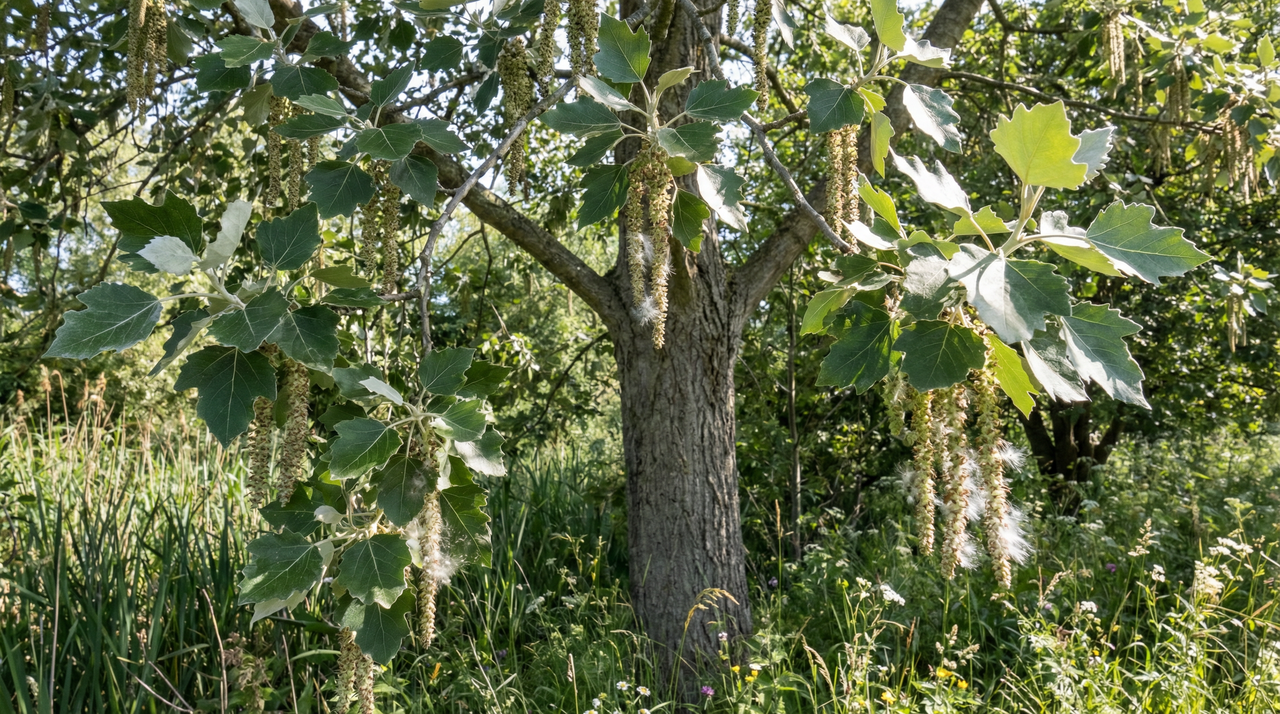
Most people walk past a stand of poplar or quaking aspen and think they're looking at a forest. They're not. What they're actually seeing, in many cases, is a single organism, one root system sending up thousands of trunks across acres of ground, some colonies persisting for tens of thousands of years while every tree above the soil lives and dies on a much shorter clock.[1] I've stood in aspen groves in three different states and that idea still stops me cold every time. We talk so much about perennial polycultures and long-lived root systems in permaculture, and here's a tree that has been running its underground network since before the last ice age.
What makes that even stranger is how overlooked poplars are as a designed element. People plant them for privacy screens or windbreaks, sure, but rarely with any real understanding of what they're working with: a fast-moving pioneer species that rebuilds soil, feeds pollinators in early spring when almost nothing else does, and accelerates succession in ways that would take other species decades longer to accomplish. There's a lot more going on beneath those trembling leaves than most gardeners ever stop to consider.
Origin and History of Poplar (Populus tremuloides)
Botanical Background and Natural History
Quaking Aspen, Populus tremuloides, is about as North American as a tree gets. Native to a staggering sweep of the continent, it ranges from Alaska and Canada through 31 U.S. states all the way down into northern Mexico, thriving in moist, well-drained soils across USDA zones 1 through 7.[2][3][4] No other tree species covers as much ground in North America, and once you understand how it grows, that distribution makes complete sense.
What makes this poplar tree genuinely extraordinary isn't its range, though. It's what's happening underground. Quaking aspen spreads primarily through root suckering, generating new stems from a single shared root system, which means what looks like a grove of individual trees is often one connected organism.[5][6] Individual stems typically live 50 to 150 years, but the root system itself can keep generating new stems indefinitely, and the colony persists across centuries or longer.[7] I've watched this firsthand in restoration projects: when fire or mechanical disturbance knocks a stand back, the root system responds almost immediately, throwing up a flush of new suckers that stabilize soil and restore canopy cover faster than almost any other native species could manage. That clonal resilience isn't incidental to what this tree is; it's the whole story.
The broader Populus genus offers useful context here. European aspen (Populus tremula) follows a similar clonal model, with colonies exceeding 10,000 years old in Scandinavia.[8][9] White poplar (Populus alba), introduced to North America in the 18th century for ornamental and windbreak use, is now naturalized in riparian zones across several regions.[10] Black poplar (Populus nigra) and eastern cottonwood (Populus deltoides) round out the major players in the genus, each occupying distinct ranges and niches.[11][12] But quaking aspen remains the anchor species for North American landscapes and the one most deeply woven into this continent's ecological and cultural fabric.
Visual Characteristics of Quaking Aspen
The first time you stand in an aspen grove on a still afternoon and watch every leaf start trembling from a breeze you can barely feel, you understand why this tree has captured people's attention for so long. Those leaves, broadly ovate to nearly round and typically 2 to 4 inches across, quake because their petioles are flattened and flexible, acting like tiny hinges that respond to even the faintest air movement.[13][3] Whether this adaptation evolved primarily for cooling, herbivore deterrence, or improved light capture, researchers are still debating, but the visual effect is unmistakable.[14] When I'm designing understory guild plantings within aspen stands, that constant dappled, shifting light is something I plan around deliberately -- it creates a unique microclimate that many shade-tolerant natives thrive in.
The bark is equally distinctive: smooth, pale gray to white on young trees with a chalky or papery quality, marked by black horizontal scars, and only becoming slightly fissured with age.[15][16] Mature trees typically reach 20 to 50 feet, occasionally up to 80, with a shallow, fibrous root system occupying the top 12 to 18 inches of soil, spreading far beyond the dripline as the clonal engine that keeps the colony alive.[17] In autumn, those glossy summer leaves shift to vibrant gold, orange, and yellow, making aspen stands visible from miles away across mountain landscapes.
In spring, before any leaves emerge, the tree produces dioecious catkins: male flowers run 2 to 4 inches long and reddish, female catkins shorter and greenish, followed by tiny capsules that split to release seeds equipped with long silky white hairs for wind dispersal.[18][3] Across the broader genus, you see real diversity in leaf shape: European aspen carries orbicular leaves on similar flattened petioles,[19] white poplar has triangular to ovate leaves with densely white-hairy undersides that flash silver in a breeze,[20] and eastern cottonwood features broadly triangular leaves with coarsely serrated margins and can push 50 to 120 feet tall given the right conditions.[12]
Traditional and Cultural Uses
French botanist André Michaux formally described Populus tremuloides in 1803,[21] but Indigenous peoples across North America had understood this tree in intimate, practical terms for thousands of years before that. The inner bark contains salicin, a natural precursor to aspirin with genuine pain-relieving and anti-inflammatory properties, and tribes including the Ojibwe, Lakota, and Blackfoot used it accordingly: as teas and poultices for fevers, rheumatism, headaches, wounds, and respiratory ailments.[22][23] That same inner bark served as emergency food when other sources were scarce, and the flexible bark found use in baskets, shelter components, and tipi frames.[24]
Aspen's relationship with fire in Indigenous land management runs just as deep. Controlled burns promoted and maintained aspen stands, improving hunting habitat and shaping cultural forest landscapes for generations.[23] When I work with clients interested in harvesting aspen bark for its medicinal or practical value today, I always stress the ethical guidelines that came from this same Indigenous knowledge tradition: take no more than 20% of bark from any single tree, harvest from multiple trees, avoid girdling, and use selective cutting of young branches during dormant seasons.[25] These aren't arbitrary rules; they're what keeps the tree and the tradition alive together.
The salicin chemistry that made quaking aspen so valuable to North American peoples turns out to be a genus-wide pattern. European aspen bark appears in the records of Theophrastus, Pliny the Elder, and Hildegard von Bingen, each noting its utility for fevers and rheumatism.[26] Black poplar has a continuous ethnobotanical thread from Neolithic and Bronze Age communities through folk medicine traditions across the Balkans, Anatolia, and the Caucasus, where bark, buds, and leaves treated respiratory ailments, wounds, and inflammation.[27] White poplar bark appeared in ancient Egyptian wound treatment and later in Greek and Roman medicine under Hippocrates and Dioscorides.[28] These parallel discoveries on separate continents, by cultures with no contact, reflect something real about what's in the tree.
Symbolically, poplar trees have accumulated meaning across nearly every culture that encountered them. European folklore linked the white poplar to Hercules and resurrection, with branches planted near graves representing mourning and hope.[29] In Slavic tradition, European aspen was protection against vampires and witches, its trembling leaves explained as guilt or divine judgment.[30] Celtic mythology associated aspen with communication between worlds, and Scandinavian and Sami traditions used it for warding evil and ceremonial crafts, while Latvia and Estonia count it among national symbols of freedom and renewal.[31][32] For quaking aspen specifically, the trembling leaves carried spiritual weight in many Indigenous North American ceremonies and stories, the tree treated not merely as timber but as a living presence with meaning.[22]
Fascinating Facts About Poplars
Pando, a single quaking aspen clone in Utah, is estimated to be approximately 80,000 years old. It spans roughly 43 hectares, contains over 47,000 genetically identical stems, and weighs in at approximately 6,600 tons, placing it among the oldest and heaviest living organisms ever documented on Earth.[33][34] I find this fact clarifying every time I work with long-lived perennial systems: a single stem might not outlive you, but the organism underneath it can outlast entire human civilizations. Patience in landscape planning takes on a different quality once you've internalized that.
That white bark is more than photogenic. It contains photosynthetic cells that allow limited energy production even through winter, a quiet advantage in harsh climates where the growing season is already short.[7] And after fire or severe disturbance, aspen colonies are among the very first to recolonize, the root system untouched below ground and ready to push up new growth almost immediately.[13]
Across the genus, the surprises keep coming. White poplar's silvery leaf undersides, covered in dense hairs, reflect up to 30% more sunlight than a typical leaf surface, reducing heat absorption and water loss in dry Mediterranean conditions.[35] Black poplar carries some of the oldest documented individual trees in Europe, including specimens over 300 years old, testaments to a species that has shaped riverine landscapes and human settlements for millennia.[36] Eastern cottonwood, by contrast, goes the other direction entirely -- reaching over 150 feet and putting on 5 to 10 feet of new growth per year in its early years, one of the fastest-growing native trees on the continent.[12]
What I find genuinely moving about the Populus genus, having worked with these trees across very different landscapes and traditions, is how consistently humans across separate continents arrived at the same conclusions about them: this is a tree worth watching, worth harvesting carefully, worth weaving into story. The trembling leaves, the clonal longevity, the aspirin-like bark -- these aren't coincidences of folklore. They're people paying close attention to what a remarkable tree was actually doing.
Poplar Varieties and Where to Buy Them
Notable Cultivars of Quaking Aspen and Related Poplars
Quaking Aspen doesn't have dozens of named cultivars the way a rose or crabapple might, but the selections that do exist cover a real range of needs. The most widely available include 'Erecta', a columnar form topping out around 40 feet, and 'Pendula', a weeping selection that runs 30-50 feet and stops people in their tracks in autumn.[37][38] 'Aurea' brings golden foliage into the mix, and 'Silver Spire' offers a narrow upright silhouette for tighter spaces. If I'm recommending a selection for a client's windbreak or restoration planting, though, I skip straight past ornamental novelty and look for documented resistance. Clones like Lux, Wisconsin #1, and Kena have been selected for improved pest and disease tolerance, which matters a lot once you understand how fast a stressed aspen stand can decline.[39][40] I also always ask where the nursery stock originated. Northern ecotypes establish better in cold, exposed microclimates; southern ones handle drier conditions more gracefully.[41] Genetic appropriateness isn't just an ecological nicety, it's a practical investment.
The broader genus fills in the gaps where Quaking Aspen isn't quite the right fit. Lombardy poplar (Populus nigra 'Italica') is the one everyone recognizes: pencil-thin, fast, reaching 40-70 feet with a spread of only 10-15 feet, and genuinely useful as a quick screen or windbreak.[42][43] The trade-off is brittle branches that drop without warning in wind or ice, so I'd never site it near structures. White poplar's 'Nivea' selection offers striking silvery leaf undersides with notably high resistance to leaf miners and aphids, which is genuinely useful if you're in a region where white poplar is legal to plant.[44][45] European aspen (Populus tremula) adds columnar and golden-leafed forms through 'Fastigiata' and 'Aurea', though it's a specialty purchase in North America.[46][47]
Eastern cottonwood (Populus deltoides) deserves a mention because it's native, tough, and regionally diverse, with three recognized botanical varieties: var. deltoides across the east, var. monilifera on the Great Plains (more drought-adapted), and var. wislizeni hugging southwestern riparian corridors.[12] The cultivar 'Siouxland' is a particular favorite of mine for biomass or restoration work. It's disease-resistant, fast-growing, and crucially it's a male clone, which means none of the cottony seed fluff that clogs gutters, filters, and clients' goodwill every June.[48] Hybrid poplar breeding across the genus targets exactly these traits: faster growth, better resistance to rust, cankers, and leaf beetles, and improved biomass yields for phytoremediation and fuel, often crossing P. tremuloides with P. alba, P. deltoides, or P. maximowiczii selections.[49][50]
Sourcing Quaking Aspen and Other Populus Species
For most North American permaculture projects, Quaking Aspen is the obvious starting point, and the good news is that it's genuinely easy to source. It's native across most of the western states and much of the east, hardy through USDA zones 1-7, carries no federal invasive designation, and no restrictions exist on planting, moving, or selling it within the U.S. (though state-level pest quarantines are always worth a quick check).[51][52] I source almost exclusively through USDA NRCS Plant Materials partners and native plant nurseries listed through the North American Native Plant Society directory, both because the stock tends to be locally appropriate and because NRCS cost-share programs can bring per-plant prices down to $1-3 for qualifying conservation projects.[53][54] Retail saplings typically run $5-25 each, wholesale drops to $3-10, and seeds from suppliers like Sheffield's run roughly $20-50 per packet; all of these are approximate 2023-2024 figures that shift with region and season.[55]
Eastern cottonwood is comparably accessible through native nurseries and NRCS centers, with saplings often as low as $1-5 and zero federal restrictions on planting.[56][57] White poplar, on the other hand, I simply avoid recommending for projects in the eastern U.S. or Pacific Northwest. It's invasive across parts of all three regions, with several states actively restricting sale or planting, and the ecological cost of its spreading root system in non-native habitat outweighs any ornamental appeal.[58][59] Lombardy and other black poplar forms are available if you're committed to them, but expect possible phytosanitary documentation depending on where you're shipping, and propagation is almost entirely vegetative.[60] European aspen is a non-native specialty-nursery purchase, perfectly fine for zones 2-6 in contained ornamental settings, but it offers no ecological advantage over Quaking Aspen for North American landscapes.[61] The Missouri Botanical Garden Plant Finder and USDA PLANTS Database are the two resources I check first when verifying availability, native status, or regional regulations on any Populus purchase.[62][17]
Quaking Aspen Propagation and Planting (Populus tremuloides)
Seeds, Clones, and Why Aspen Prefers Vegetative Reproduction
Quaking aspen tells two very different propagation stories depending on whether you're watching it work in the wild or trying to replicate it in a nursery bed. In nature, it reproduces both sexually via wind-carried seeds and vegetatively through root suckers, but those two strategies are not equally useful to a grower.[63][64] The seeds themselves are tiny things, just 1 to 2 mm long and barely 0.5 to 1 mg in weight, each wearing a tuft of silky white hairs that carries it tens to hundreds of meters on the wind.[64][4] They're beautiful in a way that makes you think they'd be easy to work with. They're not.
The problem starts with the breeding system. All Populus species are dioecious and wind-pollinated, crossing between individuals at rates of 90 to 100%.[65] Every seedling is genetically unique, which means not one of them will be true-to-type if you're trying to reproduce a specific clone. And then there's viability: aspen seeds have essentially no dormancy and last only one to four weeks after dispersal, with germination rates crashing to near zero after a month or two.[64][66] There's no persistent seed bank to draw from. If you want to use seeds, you sow them fresh on moist bare soil immediately after collection and can expect germination rates of 80 to 95% under those ideal conditions. Miss the window and you have nothing. Seeds are genuinely worth pursuing if you're doing restoration work and want genetic diversity in a planting, but for most growers trying to propagate a known tree, vegetative methods are the only rational path.
Root suckers are where aspen really shines. When a root system is intact and undisturbed, suckering success approaches 100%, which is why ancient clonal colonies like Pando have persisted for thousands of years from a single root network.[17] The first time I dug up a section of aspen root to propagate, I was genuinely stunned. One four-inch root cutting gave me five healthy new trees by the following spring. That near-effortless success reflects the research: root cuttings taken in 2 to 4 inch segments are the recommended nursery method, with success rates of 80 to 95%.[67] I label every row carefully in the first two seasons because aspen seedlings and sucker-grown plants can look deceptively similar to other Salicaceae relatives at the cotyledon stage, and sorting them out later is a headache you don't need.
Stem cuttings are the next tier down. Softwood cuttings root at 60 to 80% and hardwood cuttings at 70 to 85% when treated with IBA rooting hormone.[68] This is where aspen differs meaningfully from its closer relatives: black poplar and eastern cottonwood root much more readily from hardwood stem cuttings, which is part of why hybrid poplars dominate commercial biomass programs. For quaking aspen specifically, if you don't have access to root material, stem cuttings with hormone treatment work reasonably well but require more attention. Layering achieves 50 to 80% success and is particularly intuitive given the tree's natural suckering tendency.[55] Grafting onto compatible rootstocks like Populus deltoides using whip-and-tongue technique in late winter gives 50 to 70% success[69], and tissue culture achieves 80 to 90% rooting on MS medium with BAP, NAA, and IBA[70], though that's a lab method most home growers will never need. For practical purposes: start with suckers or root cuttings unless you have a specific reason to pursue something else.
Soil, Site, and Light Requirements for Successful Establishment
Before you propagate a single cutting, check your drainage. Quaking aspen demands well-drained, moist soil with pH between 6.0 and 7.5 (tolerating a somewhat wider range of 5.5 to 8.0) and is genuinely sensitive to waterlogging, compaction, and poor aeration in ways that will kill a planting fast.[63][4] Like gardenia or blueberry, aspen will show iron chlorosis and stunted growth the moment drainage fails. I've learned to test every site and amend with organic matter before planting rather than troubleshoot a sick tree afterward. Loamy or sandy-loam soils with 2 to 5% organic matter are the sweet spot; the granular, friable structure that allows root and sucker development is as important as the chemistry.[71][4]
pH accuracy matters more than most people realize with this tree. Soils above 7.5 cause iron and manganese deficiencies that show up as interveinal chlorosis; soils below 5.5 can trigger aluminum toxicity and stunted root development.[72][73] If your soil test shows pH above 7.5, apply elemental sulfur in fall and retest the following spring. Waiting until leaves yellow is already too late for a fast-growing tree that puts on 2 to 5 feet per year. In its natural range, aspen occupies slopes with 5 to 40% grade across elevations from 500 to 3,400 meters, and those moderate-to-steep slopes serve a simple function: gravity-assisted drainage.[71] It's classified as LO (usually occurs in non-wetlands) for a reason.[4] In my own designs, planting on slight slopes with good air drainage has consistently mattered more than hitting an exact pH number.
Light is non-negotiable. Quaking aspen is a shade-intolerant pioneer that needs at minimum six hours of direct sun daily; put it in partial shade and you'll get etiolated, chlorotic, leggy plants with visibly reduced vigor.[4][74] Young seedlings show a brief window of slight shade tolerance that quickly disappears as the tree establishes. Site selection should always prioritize full, open sun exposure. If you're considering container culture as a temporary nursery step before field planting, use a well-draining mix of roughly 50% potting soil, 30% perlite, and 20% peat or coir in at least a 5 to 10 gallon container with pH adjusted to the 6.0 to 7.5 range.[75] Just know that poplars outgrow pots quickly and need to get in the ground promptly.
Spacing, Planting Technique, and Long-Term Management
Quaking aspen reaches 20 to 50 feet tall at maturity (occasionally 80 feet) with canopy spread averaging around 25 feet, which already demands respect in a planting plan.[76] Scale that up to black poplar or eastern cottonwood at 65 to 115 feet tall with 30 to 75-foot spreads[77][48] and you start to understand why spacing decisions at planting have consequences that outlast most garden plans. For quaking aspen in a landscape setting, 10 to 20 feet between trees is the general recommendation, but if you're working with a suckering colony (which, in my experience, you always end up with), 15 to 30 feet gives you the room to manage expansion without constant conflict with adjacent plantings.[76][78] Give it room now or you'll be fighting suckers for the next decade.
The spacing logic connects directly to disease management. Aspen growing at 2 to 5 feet per year[79] fills a canopy fast, and when trees are too close together, poor air circulation accelerates canker and rust problems. In my designs I keep aspen at least 20 feet from other susceptible species because improved airflow from proper spacing has dramatically reduced those issues in every planting I've managed. Close spacing also intensifies light competition, reducing vigor over time in these sun-dependent pioneers.[63] Purpose changes the math considerably: for biomass or short-rotation coppice systems, spacings of 5 to 6 feet are standard across the genus to promote vigorous resprouting[80], while black poplar in timber rows can be pulled to 8 to 12 feet, with specimen plantings requiring 30 to 50 feet of clearance.
Whatever the spacing, the planting method itself is fairly consistent. Test and amend soil before anything goes in the ground, improve drainage with organic matter or raised beds where needed, and mulch after planting to retain moisture and suppress competition.[80][81] Avoid compacting the soil around new plantings at all costs; compaction is one of the fastest ways to undo everything aspen needs for its root development and eventual suckering. A well-prepared site, the right spacing for your goal, and a clean, well-drained planting hole are the foundation that everything else in this tree's life builds on.
Quaking Aspen Care Guide
After installing aspens in windbreaks, restoration plantings, and urban food forests across multiple climate zones, I've come to think of this tree's care needs as a simple equation: get the site right and stay out of the way. Get it wrong and you'll spend years fighting a thicket, patching root rot damage, or watching a stressed tree pump out suckers until the whole planting looks feral. The right decisions are front-loaded. Most of the work happens before you plant.
Sunlight Requirements
Quaking Aspen is a shade-intolerant pioneer, full stop. It needs a minimum of six hours of direct sun daily to grow with the vigor that makes it worth planting.[82] In my design work I won't recommend aspen for a site until I've confirmed that sun exposure. In partial shade, the tree gets leggy and pale, and clients end up disappointed. The one twist is that full sun without adequate moisture turns into a liability: leaf scorch, wilting, and bark damage all follow when light and drought combine.[83][84] That scorching is routinely misdiagnosed as disease, so before you pull the tree, check the soil moisture first.
Watering Needs
In the wild, aspen reaches for riparian edges and upland seeps with a shallow, wide-spreading root system concentrated in the top foot or two of soil and extending horizontally up to three times the tree's height.[63][85] That architecture tells you everything: this tree wants consistent surface moisture, and it will find it aggressively. In managed plantings, young trees need one to two inches of water per week during the first couple of growing seasons, applied deeply enough to reach twelve to eighteen inches.[75][86] Sandy soils need more frequent passes; clay holds moisture longer and needs less.[87] Once established, aspen can tolerate a couple of weeks of moderate drought before showing stress, but prolonged dry spells warrant about an inch every week or two.[17]
The mistake I see most often is inconsistent watering through the first two years. The other mistake is overwatering: roots sitting in saturated soil invite Phytophthora and other rot pathogens, and the symptoms (yellowing lower leaves, wilting despite moist soil) look frustratingly similar to drought stress.[88][42] Water deeply and infrequently, never with overhead irrigation, and keep two to four inches of organic mulch around the base (away from the trunk) to moderate soil moisture and temperature year-round.[75][89] Taper irrigation in fall and give a deep pre-freeze soak in colder zones to prevent winter desiccation.[75]
Frost Tolerance and Winter Protection
Few deciduous trees can match quaking aspen's cold hardiness. It's rated for USDA zones 1 through 7 and survives temperatures down to -50 °F.[18][90][17] The paradox, and it's one that trips up new growers, is that the same tree that shrugs off brutal winters is exquisitely vulnerable in spring. New leaves, flower catkins, and tender growth are highly susceptible to late frosts, and I've watched an otherwise healthy aspen come out of April looking like it was torched after a single freeze event.[91][78] The damage appears as brown or blackened leaf margins, wilting, and twig dieback that can easily be mistaken for disease or drought.[55][92]
The most effective protection is site selection: plant on well-drained slopes or uplands where cold air drains away rather than in low-lying frost pockets.[93] I've consistently seen that mulched trees rebound faster from late spring frosts than unmulched neighbors in the same planting, which makes that two-to-four inch mulch layer doubly worth it. For young trees in their first three years, frost blankets or burlap wraps during late-frost windows are reasonable insurance.[94]
Feeding and Soil Fertility
Quaking Aspen is a moderate feeder, growing one to two meters per year with nutrient demands higher than pines but lower than black poplar or eastern cottonwood.[55][95] In restoration and food forest work I almost never fertilize established aspens; the mycorrhizal networks they form do the nutrient-acquisition work more efficiently than any granular application.[96] Where the soil is genuinely poor, a balanced or high-nitrogen fertilizer applied in early spring before bud break can increase biomass by 20 to 50% in young plantations,[97] but I've also seen that lush flush of growth attract borers and reduce cold hardiness, so I keep rates conservative: around 0.25 to 0.5 lb of actual nitrogen per 1,000 square feet, with a soil test to guide any decision.[98][99] The preferred permaculture approach is organic matter: mulch consistently, amend with compost if soils are compacted or depleted, and let biology do the rest.
Optimal soil pH sits between 6.0 and 7.0, though aspen tolerates a range of 5.0 to 8.0.[100] On high-pH soils I watch for interveinal chlorosis, a classic iron deficiency symptom I also see routinely on alkaline Florida soils with other trees. Zinc deficiency shows as rosetting; manganese and boron deficiencies are less common but worth knowing.[101] If you're seeing chlorosis, check pH before reaching for chelated iron; the fix is often an acidifying amendment rather than a micronutrient supplement.
Heat Tolerance
Aspen is fundamentally a cool-climate tree. It's rated for AHS Heat Zones 1 through 7, with photosynthesis beginning to decline sharply above 86 °F and dropping by roughly 50% at 95 °F as stomata close to conserve water.[102][84] What I find genuinely fascinating as a designer is that the leaf-trembling mechanism isn't just aesthetic; the flattened petioles allow leaf flutter that can lower leaf surface temperature by five to ten degrees Celsius.[103] In hotter summers I've noticed aspens on my sites wilting noticeably less than still-leaved companions under the same conditions, which makes that quaking trait feel less like whimsy and more like engineering.
When heat and drought combine, oxidative damage escalates quickly, and seedlings are most vulnerable.[104] For clients at the warmer edge of aspen's range I recommend selecting seed sources from higher elevations or northern provenances, which show better tolerance,[105] and I pair deep weekly irrigation with the mulch layer already in place to keep root zone temperatures manageable.[106]
Pruning and Maintenance
Plant in spring after last frost or in fall using container-grown stock, set at the same depth as the nursery container, spaced ten to twenty feet apart in full sun with good air circulation.[4][78] Any pruning you do should happen in late winter or early spring while the tree is fully dormant and temperatures are still below 50 °F; that window minimizes sap bleed, wound stress, and the risk of Cytospora canker entry.[107][108] Remove no more than 25% of the canopy in a single session, always cutting just outside the branch collar with clean, sharp tools. Focus on dead, diseased, damaged, or crossing branches and a strong central leader on young trees.[78]
Now, about the suckers. What I wish someone had told me early in my career: do not prune aspens hard in summer, and do not over-fertilize them. I made both mistakes on the same tree once and watched it respond by sending up suckers from every lateral root within fifteen feet. What had been a single specimen became a thicket in one season. The rule I've followed ever since is to remove suckers at ground level during the dormant season, before they get any size.[109] On small urban lots I now install eighteen-to-twenty-four-inch deep root barriers from day one; it's a minor upfront cost that prevents an ongoing headache.[78] After installing dozens of aspen plantings, my shorthand is to label every emerging sucker as either "future grove" or "future problem" and decide which one you want before the tree decides for you.
Seasonal Rhythm
Understanding aspen's yearly cycle turns a list of care tasks into a coherent calendar. In early spring, catkins appear before leaves, a brief window when pollinators arrive and the tree is at its most frost-vulnerable. Rapid vegetative growth follows through summer, slowing as day length shortens. Fall brings the golden leaf senescence aspen is famous for, then dormancy through winter.[110][111] With climate warming, spring events have been advancing by ten to twenty days across the genus,[112] which means late-frost risk is no longer predictable on historical schedules alone.
The clonal biology shapes the rhythm too. Individual stems live fifty to one hundred fifty years, but the root system connecting them can persist for millennia; the Pando clone in Utah is the most famous example.[111][113] Fire, in natural systems, triggers explosive suckering and renewal. In managed landscapes, that regenerative impulse is why timing matters so much: dormant pruning, pre-freeze deep watering, and avoiding late-season fertilization all make sense once you see the tree's whole year rather than a static snapshot. Work with the rhythm and aspen rewards you; work against it and you'll stay busy correcting the consequences.
Poplar Harvesting: Timing, Technique, Yield, and Flavor
Most people thinking about harvesting a poplar tree picture timber, and that's fair. But for the home forager or permaculture grower, the more immediate opportunities come from the living tree's seasonal rhythm: sap in late winter, inner bark and cambium through spring, leaves across early summer. Understanding when each window opens, and how to take from the tree without compromising the colony, is what separates sustainable practice from accidental damage.
Seasonal Timing and Harvest Cues for Quaking Aspen
Sap runs earliest, typically March through April, and can be tapped similarly to maple sugaring.[17][114] I've tapped both species on the same property in the same season, and the aspen sap is noticeably thinner and more watery, around 1 to 2% sugar, so don't expect maple-grade syrup without significant reduction.[17][114] The flow window is also shorter. Think of it as a light spring drink rather than a pantry staple.
Inner bark harvest peaks when sap is actively rising and the bark slips cleanly from the cambium without tearing into the wood beneath. That slip is the cue I've learned to trust. Young leaves are best gathered June through August while they're still tender; they toughen up fast as the season advances.[17][114] For timber or biomass, the calculus shifts entirely: Quaking Aspen is typically felled during dormancy, after leaf drop through early spring bud break, at 8 to 16 inches DBH after 30 to 50 years of growth.[37][63] Coppicing in late winter, cutting stems an inch or two above grade, triggers the clonal root system to push vigorous suckers the following spring, supporting rotation cycles of 20 to 40 years for pulpwood.[63][115]
Sustainable Harvesting Techniques
Here's where I get firm with people: when you harvest bark from a clonal aspen, you're not cutting one tree. You're making a decision that affects a connected root system that may span acres. Stripping bark even partway around a stem can girdle it, and a stressed clone responds by suckering aggressively or, in severe cases, declining as a whole. The rule is vertical strips on one side only, leaving the rest of the circumference intact to keep vascular flow uninterrupted.[17][116] Foliage removal should stay under 20% per tree, and on public land, permits matter.[17][114] European and related poplars follow similar dormant-season timing for bark harvesting, with optimal peeling ease from March through May on trees over five years old.[117][118]
Yield, Flavor Profile, and Preparation Considerations
Go in with realistic expectations. Aspen leaves, inner bark, and buds are traditional survival and medicinal resources, not modern ingredients, and the flavor makes that plain: bitter, astringent, and distinctly medicinal from the high phenolic content, tannins, and salicin.[119][120][121] That bitterness intensifies in spring and fall when salicin concentrations peak, and northern stands tend to run hotter in salicylates than southern ones.[122] Resinous buds from related species add balsamic or wintergreen-like notes from volatile compounds like cineole and pinene, which I find more pleasant but still sharp.[123] I always dry or leach inner bark before use, and I wouldn't offer it raw to anyone with aspirin sensitivity or who takes blood thinners. The preparation section covers specific methods in depth, but the short version is: boil, leach, or dry, and keep quantities modest. Taking no more than 20 to 30% of available material isn't just an ethical guideline; it's also how you avoid the stomach irritation that raw phenolics reliably cause.[124]
Poplar Preparation and Uses
Quaking Aspen sits in a category I find genuinely fascinating: a tree with real nutritional and medicinal value that most people will never cook with, not because it's inaccessible, but because it rewards patience and punishes shortcuts. This is a survival food and a medicine chest, not a farmers market novelty.
Edible Parts and Culinary Preparation of Quaking Aspen
The inner bark (cambium) is the star here. It can be eaten raw in a pinch, but dried and ground into flour or used as a thickener is where it actually earns its place in historical diets.[125][13] That nutrition profile is legitimately impressive for a tree bark: roughly 60-70 g of carbohydrates per 100 g dried, modest protein, vitamins C and B, and a solid mineral spread including calcium, potassium, and iron.[126] You understand immediately why Indigenous peoples reached for it during famine rather than letting it sit unused in the forest.[23][127]
The flavor is where reality checks in. The bark runs bitter and astringent from tannins and salicin (sitting around 0.5-1.5% in bark), with a faint wintergreen or licorice note underneath if you catch fresh inner bark.[128] The buds are something else entirely: resinous, balsamic, with aromatic compounds including cineole and pinene that produce a minty, almost honeyed quality.[129] I tasted fresh spring buds for the first time and understood immediately why perfumers have chased that note for centuries.
Processing is non-negotiable. Boiling, leaching, slow drying, or extended soaking all reduce the bitterness and make the bark genuinely digestible.[13][130] I once tried rushing the process with high heat and short soaking time and ended up with something that tasted like chewing a Band-Aid. Slow drying followed by a long cold-water leach is noticeably more effective. The sap can be tapped in early spring and reduced into a syrup, though its sugar content is low (around 1-2%), so don't expect maple results.[13] What I got was a subtle, earthy, faintly sweet liquid that worked nicely as a base for herbal teas but wouldn't satisfy anyone hoping for pancake syrup. Male catkins of related species like eastern cottonwood can be eaten raw or cooked with a pleasantly nutty flavor, which adds some genus-wide variety for the adventurous forager.[131]
Young leaves are technically edible in very small amounts, but I treat them with caution. The phenolic load increases significantly as the season progresses, and eating them in any quantity risks digestive upset.[132][119] Early spring, cooked, in small amounts is the only framework I'd use. None of this is everyday kitchen food; it never was.[23][133]
Medicinal Preparations from Poplar Bark and Buds
The same compounds that make poplar bark bitter in a bowl make it effective as medicine. Native American tribes used bark and bud preparations for fevers, wounds, burns, coughs, respiratory conditions, and rheumatic pain across a remarkably consistent cross-cultural pattern.[23][134] The preparation forms are practical: teas, decoctions, tinctures, salves, and syrups all appear in the historical record.[135] For related species, typical usage runs about 1-2 teaspoons of dried bark per cup of water as a tea (up to three cups daily), or 1-2 ml of tincture three times daily.[136] I've made poplar bud salve twice and found it genuinely useful for muscle soreness, though I always cross-check current safety guidance before preparing or recommending it to anyone, and I keep quantities conservative.
Before making any tea or salve, accurate identification is a prerequisite that I won't understate. Bigtooth aspen, balsam poplar, and paper birch can all look similar in certain contexts, and mistaking a birch for an aspen matters.[137][138] Early in my foraging years I nearly processed the wrong bark because I hadn't yet internalized the flattened petiole that gives quaking aspen its signature leaf tremble. That detail is now the first thing I verify, every time.
Safety, Sustainability, and Look-Alikes
Sustainable bark harvesting has one governing rule that I learned, honestly, by breaking it when I was younger and overenthusiastic: never girdle a tree. The recommended limit is thin strips covering no more than 20% of the circumference, taken from larger, well-established individuals only.[139] Watching a young aspen struggle and eventually die after I'd taken too much bark in one spot was a lesson I didn't need to repeat. These days I preferentially forage from invasive white poplar stands wherever I find them.[10] The bark tends to be thicker and easier to process, the foraging actually benefits the ecosystem by targeting a non-native species, and it keeps pressure off native quaking aspen colonies that don't need a human adding to their stress load. The salicylate content that gives poplar its medicinal value also requires real caution for anyone with aspirin sensitivity, blood-thinning medications, or relevant health conditions. That's covered in the health benefits section; take it seriously before experimenting.
Poplar Health Benefits and Medicinal Uses
If you've spent any time with ethnobotanical records from the Great Plains and Rocky Mountain West, Quaking Aspen's medicinal reputation is hard to ignore. Indigenous healers consistently prepared bark decoctions that addressed a targeted range of complaints from headaches and colds to urinary infections and gout.[140][141][127] That's a remarkably consistent pattern across cultures and geographies, and it turns out the chemistry explains why.
Traditional and Modern Medicinal Applications
The bark of Quaking Aspen contains a suite of phenolic glycosides, principally salicin, salicortin, and tremulacin, alongside flavonoids and phenolic acids.[142][143] Once ingested, salicortin hydrolyzes to salicin and salicyl alcohol, which the body metabolizes into salicylic acid, the same compound that gives aspirin its anti-inflammatory and analgesic punch.[144][145] Preclinical studies demonstrate this pathway inhibits COX-1 and COX-2 enzymes, reducing prostaglandin synthesis, while also modulating cytokines and the NF-κB inflammatory cascade and showing antioxidant activity via radical scavenging.[146][147] These mechanisms map neatly onto the traditional uses for pain, fever, and arthritis that Indigenous healers documented over generations.
This pattern holds across the genus. Black poplar buds (the source of the famous balm of Gilead preparations) have been used in European herbal traditions for coughs, bronchitis, and skin wound healing,[148] and the European Medicines Agency formally recognizes Populus nigra and Populus tremula buds and bark for mild rheumatic ailments and mouth and throat inflammation, with Germany's Commission E recommending roughly 1 to 1.5 grams of bark daily as a decoction.[149] A small randomized trial of sixty participants using aspen bark extract for knee osteoarthritis reported a 40% reduction in pain scores with no serious adverse events, and a similar small trial on black poplar also showed benefit.[150]
I've prepared aspen bark tea alongside willow bark for educational workshops, and I find aspen noticeably milder and less tannic, which some people tolerate better when drinking it regularly for joint inflammation. That said, I always pair that conversation with a clear caveat: large-scale clinical trials establishing optimal dosing and confirmed therapeutic efficacy for any Populus species simply don't exist yet.[151][152] Most evidence remains in vitro or animal-model based, chemical composition shifts significantly by season and plant part, and no regulatory body has approved a Populus-derived drug.[153] Traditional use is meaningful context, not clinical proof.
Key Phytochemicals: Salicinoids, Flavonoids, and Phenolics
Salicortin and tremulacin dominate Quaking Aspen's phytochemical profile, with salicortin reaching up to 8% of leaf dry weight and tremulacin up to 4%, while total phenolic glycosides in leaves can represent 5 to 15% of dry weight and bark phenolics range from 50 to 100 mg per gram dry weight.[154][155] Beyond those salicinoids, the tree produces flavonoids including quercetin-3-O-glucoside, catechin, and rutin, condensed and hydrolyzable tannins, coumarins, terpenoids like tremuloidol, and trace alkaloids, all working together to give the plant its antioxidant, antimicrobial, and anti-inflammatory properties.[156][157]
These compounds evolved as defenses against herbivores and competing plants rather than as gifts to foragers, which explains a lot about their variability.[158] Concentrations peak in summer, rise under drought stress, run higher in western and northern populations, and fall when soil nitrogen is abundant.[159] In my own landscape plantings I've noticed that young spring growth on stressed trees tends to have a sharper, more resinous smell, which aligns with those phytochemical peaks. For anyone making tinctures, methanol and ethanol at 70 to 90% efficiency are the optimal extraction solvents for drawing out phenolic glycosides.[155]
Related species add useful texture here. White poplar bark carries quantified salicortin levels of 1 to 5% dry weight and eastern cottonwood bark can reach 10 to 15% dry weight phenolic glycosides, higher than most leaf tissue in other species.[160][161] European aspen flavonoids also provide UV-B protection for the tree while the water-soluble leaf phenolics exert allelopathic effects on understory plants, a detail that matters when designing guilds.[162] The genus runs on phenolics in ways that make every species medicinally interesting, though quaking aspen and white poplar are the best-studied for human applications.
Nutritional Profile and Traditional Food Uses
Poplar is not a nutritional powerhouse. It's a survival food, historically eaten by Ojibwe and Blackfoot communities when other resources were scarce, primarily as inner bark harvested in spring.[22] Young leaves are technically edible but noticeably bitter, and the tree appears nowhere in USDA FoodData Central as a standard food item; the numbers we have come from foraging guides and ethnobotanical analyses rather than controlled nutritional studies.[163]
With that framing in place: dried inner bark is calorie-dense by wild-food standards, around 350 kcal per 100 grams with 10 to 15 grams of protein and 70 to 80% carbohydrate from sugars and starches.[164] Fresh young leaves run much lighter, roughly 25 kcal per 100 grams with modest protein and carbohydrate, and provide an estimated 10 to 50 mg of vitamin C per 100 grams fresh weight with higher concentrations in spring buds.[165] Minerals include calcium at 100 to 150 mg and potassium at 200 to 300 mg per 100 grams of young leaves, with the inner bark showing meaningful calcium and potassium in dry weight analysis as well.
Nutrient levels peak in spring alongside the vitamin C and then shift toward higher phenolics as the season progresses, which is why traditional preparation always involved boiling or leaching to cut tannins and reduce bitterness.[166] When I've made small batches of inner bark tea for educational demonstrations I always do a first leach, pouring off the initial bitter water, before doing a second gentle simmer. It improves palatability considerably. Even so, tannins comprising up to 10 to 15% of bark dry matter will bind minerals and reduce digestibility, and salicin at 0.5 to 2% dry weight in the bark means every preparation carries an aspirin-like load.[164] This is a plant to use thoughtfully and sparingly, not as a dietary staple.
Safety Considerations and Contraindications
The ASPCA classifies Quaking Aspen as non-toxic to humans and most companion animals, which is a reasonable starting point, but it's the beginning of the safety story rather than the whole of it.[167] The phenolic glycosides (salicortin, tremulacin, salicin) that give the plant its medicinal value are also what create conditional risks, and their concentrations in young spring leaves can reach 10 to 20% of dry weight before dropping as leaves mature.[168] Condensed tannins add another layer, running 5 to 15% of dry weight and reducing protein digestibility in ruminants.[169]
For livestock, particularly horses and cattle, large ingestions can cause rumen acidosis, colic, respiratory distress, and metabolic acidosis; in severe cases the outcome can be fatal.[170][171] In my experience working with native plant guilds I've rarely seen horses or cattle browse aspen heavily when other forage is available; the bitterness is a natural deterrent. But when pasture is scarce in early spring, that deterrent disappears, which is exactly when salicylate concentrations are at their peak. Restricting livestock access to aspen groves during spring flush is sensible management.[171]
In humans, the dose-dependent picture mirrors aspirin toxicity. Small amounts typically cause no more than mild gastrointestinal upset, but larger ingestions can produce dizziness, tinnitus, hyperventilation, metabolic acidosis, and fever, with onset within 30 minutes to 2 hours.[172][173] The contraindications are essentially the same as for aspirin: avoid if you have an aspirin allergy, peptic ulcers, bleeding disorders, or kidney problems.[174] Black poplar specifically is contraindicated in pregnancy (category D), and neither species should be given to children under 16 due to Reye's syndrome risk, the same reason children are kept off aspirin.[142] Anyone taking blood-thinning medications should speak with their doctor before using any Populus bark preparation, as interactions are plausible.[175]
Drought stress, poor soil, and high latitudes can all push phenolic glycoside concentrations higher, so bark from trees under environmental pressure may be more potent than bark from a well-watered, well-fed landscape tree.[176] Pollen is another concern entirely: I have clients with severe spring hay fever who react to poplar before almost anything else in my plant palette, because the pollen is produced in enormous quantities and travels long distances, with cross-reactivity among species being common.[177] Sap contact can cause allergic dermatitis in sensitive individuals, and when working with eastern cottonwood in particular I recommend gloves.[178] There is no antidote for poplar poisoning; treatment is supportive, typically activated charcoal and monitoring, so when in doubt about ingestion, especially in children, contact poison control immediately.[173]
Poplar Pests and Diseases: Identification, Prevention, and Management
Quaking Aspen has moderate to low overall disease resistance, and the two threats you're most likely to encounter in real plantings are leaf rust (Melampsora medusae) and Cytospora canker (Cytospora chrysosperma).[179][180] Rust shows up as yellow-orange blisters on leaves, causes defoliation in persistently wet summers, and drains vigor from stressed trees. Cytospora canker is the one that burned me early on: I first spotted it as resinous, sunken lesions on branches I'd pruned improperly, right where careless cuts left wounds the fungus could exploit. That mistake reinforced something I now consider non-negotiable: clean cuts, proper timing, and no unnecessary wounding.
Common Diseases of Quaking Aspen and Related Poplars
Beyond rust and canker, poplars face secondary threats from Armillaria and Phytophthora root rots (both far worse in poorly drained soils), leaf spots from Septoria, Marssonina, and Phyllosticta, and occasional Verticillium wilt.[181][182] Viral and bacterial diseases are genuinely low risk here, which is a small mercy. What's consistent across the genus is that disease severity tracks tree stress almost perfectly: humidity drives rust and leaf spot, while water stress and poor drainage are the fast lane to canker and root rot.[183] Young trees are universally the most vulnerable.
The picture shifts across related species in instructive ways. European aspen is highly susceptible to Melampsora rust but carries some natural genetic tolerance that offsets it. Black poplar runs moderate-to-low resistance with high rust, canker, and bacterial canker susceptibility. White poplar is highly susceptible to both rust and canker with moderate leaf-spot pressure. Eastern cottonwood has fair overall resistance but compensates for high rust and canker susceptibility through sheer growth speed rather than chemistry.[184][12] Breeding programs have done real work here: resistant cultivars like 'Shadow Aspen' and 'Mountain Sentinel' for Quaking Aspen, 'Berolinensis' for European aspen, 'Serotina' for black poplar, and 'Siouxland' for eastern cottonwood give designers meaningful options at the selection stage.[185]
Insect Pests and Natural Defenses
The insect list is long: aspen leaf beetles (Chrysomela spp.) defoliate whole branches, the aspen borer (Saperda calcarata) and poplar-and-willow borer (Cryptorhynchus lapathi) tunnel into trunks and invite secondary disease, and aphids plus leafminers round out the regular cast.[180] What counterbalances this is the tree's chemical defense system, which I find genuinely impressive. The same phenolic glycosides -- salicortin, tremulacin -- that give aspen its characteristic bitter taste when you crush a leaf or handle fresh prunings hydrolyze into toxic salicylates inside herbivore guts, and the tree also deploys leaf toughness and induced volatiles that recruit predatory insects.[186] Western clones tend to carry higher phenolic loads and show better resistance to leaf beetles than eastern ones.[187] Endophytes and beneficial leaf microbiomes add another layer by producing anti-feedant compounds and modulating defense gene expression.[188]
The clonal growth habit cuts both ways here. In a forest-edge guild I designed, a large clonal aspen patch suffered nearly uniform leaf-beetle defoliation during one dry summer because every stem in that patch was genetically identical. There was nowhere for the pest pressure to break. Eastern cottonwood sidesteps some of this through rapid compensatory regrowth rather than relying on high phenolic concentrations, and it also carries extrafloral nectaries that attract predatory ants as a biological buffer.[189] That diversity of strategy is worth understanding when you're choosing which Populus to place and where.
Integrated Pest Management for Poplars in Permaculture Systems
I rarely reach for fungicides on poplars. Maintaining airflow through good spacing and selective pruning, mulching to hold even soil moisture, avoiding overhead irrigation, and choosing rust-tolerant cultivars at the design stage have collectively eliminated serious rust and canker problems in the landscapes I manage.[190][191] For insects, the same cultural logic applies: stressed trees invite outbreaks, healthy ones rebound. Biological allies -- ladybugs, parasitic wasps, and the ants attracted to cottonwood's nectaries -- do significant work when the system supports them.[192] Planting in diverse guilds rather than clonal monocultures is the single highest-leverage decision: it breaks up uniform susceptibility, supports predator populations, and means one bad season doesn't take down everything at once.[193] Climate change is already shifting pest ranges, which makes that diversity argument stronger every year.[194]
Poplar in Permaculture Design
Quaking Aspen doesn't ease its way into a landscape. It arrives fast, spreads wide, and starts doing ecological work before you've finished mulching the guild around it. That's exactly why I keep reaching for it in cold-climate restoration and food forest designs, and why understanding its personality before you plant it saves a lot of headaches later.
Climate and Hardiness Zones for Poplar
Few canopy trees can claim the cold tolerance of Quaking Aspen. Hardy in USDA Zones 1 through 7, it can survive air temperatures down to -50°F or even -60°F,[15][177] which sounds almost absurd until you realize those numbers come with a caveat that most planting guides skip: it's snow cover, not just cold-hardiness, that keeps roots alive in winter. Without adequate snow insulation, soil temperatures below -5°C can cause root desiccation, frost heaving, and significant injury even when air temperatures read much more moderate.[63] I learned this the hard way early in my design career: a planting on an exposed, wind-scoured knoll looked structurally fine heading into winter, then showed serious root damage by spring. Now I treat windbreaks and deep organic mulch as non-negotiables on any exposed aspen planting. I always site it on north-facing slopes where possible, where cool microclimates and snow accumulation work in its favor.[15] The care guide covers mulching specifics in more detail, but the design takeaway is that optimal performance really lives in Zones 4 through 6, with mountain ecotypes thriving from 5,000 to nearly 10,000 feet in elevation.[195]
The wider genus extends the climatic palette considerably. Black Poplar handles Zones 3 through 9 and tolerates heat up to 100°F with adequate moisture,[196] and Eastern Cottonwood pushes even harder, surviving Zones 2 through 9 with heat tolerance up to 110°F and a surprising ability to handle periodic flooding.[12] European Aspen shares Quaking Aspen's cold resilience but struggles above 85°F,[197] and White Poplar adds drought and salt tolerance once established, though it needs 20 to 50 inches of annual precipitation to perform well.[42] Quaking Aspen itself wants at least 15 inches of annual rainfall, with 20 to 30 inches being the sweet spot for vigorous growth.[177] Climate change is already shifting those precipitation patterns in ways that could shrink suitable aspen range, which is one more reason to prioritize locally sourced stock and design for diversity within any Populus planting rather than betting everything on a single species or provenance.[113]
Ecosystem Functions and Services
There's something about a young aspen grove that makes a food forest feel alive in a way that slower-establishing trees just don't. The leaves tremble constantly in even a slight breeze, creating that shimmering motion that early pollinators seem drawn to, and I've noticed that guilds anchored by aspen tend to hum with insect activity weeks before nearby deciduous plantings fully leaf out. That's not coincidence: Quaking Aspen's catkins open in early spring before the leaves emerge, delivering pollen and nectar at a moment when almost nothing else is blooming.[198] This alone earns it a place in any cold-climate system designed to support native bees and early beneficial insects.
The wildlife value runs much deeper than pollinators. Quaking Aspen supports over 500 associated insect species, plus birds, mammals, and a whole web of species that depend on its structure at various life stages.[198] Its extensive fibrous root system binds soil and reduces erosion on slopes and riparian banks, and across the genus, Black Poplar plantings in riparian zones can reduce bank erosion by up to 50%.[199] The leaf litter breaks down quickly, cycling potassium, calcium, nitrogen, and phosphorus back into the soil and building organic matter at a pace that genuinely accelerates system development.[200]
Aspen functions as a dynamic accumulator rather than a nitrogen fixer; its deep and lateral roots draw up subsoil minerals that return to the system through litter, while mycorrhizal networks (more ectomycorrhizal than arbuscular) enhance phosphorus and water uptake and potentially shuttle resources between connected ramets.[201][202] It doesn't fix nitrogen itself, so pairing it with nitrogen-fixers like alder or clover is the move that closes that gap in the guild. Dense stands also reduce wind speed by up to 50%,[201] making it genuinely useful as a windbreak element on open sites. Even the sap can be tapped in early spring in the way you'd approach maple, and the inner bark and catkins have documented emergency food and medicinal uses.[203]
Eastern Cottonwood extends these services dramatically in warmer and wetter zones, producing 10 to 20 tonnes per hectare per year in biomass and actively phytoremedating heavy metals from contaminated soils.[12] Black Poplar is the riparian restoration workhorse in Europe, with strong flood mitigation capacity.[12] White Poplar, on the other hand, is a cautionary tale: it's invasive in parts of North America and forms dense thickets that push out native species, so it warrants serious scrutiny before anyone introduces it to a design.[204][205] I've seen Quaking Aspen itself turn a bare disturbed slope into a productive edge guild in under a decade, but its suckering taught me early to give it space and plan for containment. I site all Populus at least 50 feet from foundations, septic systems, and any garden beds I want to keep root-free. That's not a number I found in a textbook; it's a lesson from early projects where roots showed up exactly where I didn't want them.
Forest Layer Placement and Guild Design
In a permaculture system, Quaking Aspen sits in the canopy or sub-canopy layer as a fast-growing pioneer that provides temporary shade, wind protection, and biomass mulch while the slower, longer-lived species in the guild get established.[7] At up to two feet of growth per year, it does real structural work fast. Young stands and canopy gaps create bright, nutrient-rich conditions that actively facilitate the understory: quick-decomposing litter, mycorrhizal networks already in place, and root channels that loosen soil for companions.[201]
The mycorrhizal piece is worth dwelling on. Aspen's ectomycorrhizal associations are strong enough that the fungal networks can share resources not just between connected root ramets within a clone but potentially with neighboring trees of other species.[201] Watching an aspen-alder guild function reminds me of how a healthy soil food web operates in a well-established regenerative landscape: the relationships do more work than any single element could alone. I've found that pairing aspen with nitrogen-fixers like speckled alder and understory berries like serviceberry and currants gives you a genuinely productive guild while the aspen is young, using that high-light, high-fertility window before canopy closure changes the equation.
And that's the critical succession point to understand. Once a Quaking Aspen clone matures into a dense closed canopy, the dynamic shifts: shallow lateral roots and heavy shade compete aggressively for light, water, and nutrients, suppressing most light-demanding understory plants.[7] Its leaf and root compounds also carry mild allelopathic properties that can inhibit certain competitors.[206] I planted aspen too close to young fruit trees in one early food forest and watched them struggle for resources within five years. Now I use aspen deliberately as a temporary pioneer on the north or windward edge of a guild, or I manage it on a short coppice rotation to keep it in that productive young-stand phase where it facilitates rather than dominates.
As a keystone pioneer, aspen drives early succession after disturbance, increases landscape heterogeneity, and prepares sites for later-successional species through shade modulation, nutrient cycling, and soil loosening.[207] It hosts over 500 insects, provides browse and cavity habitat for birds and mammals, and builds biodiversity in ways that compound over time.[207] Eastern Cottonwood performs a similar keystone role at much larger scale in riparian canopies, reaching 50 to 190 feet and excelling in phytoremediation and flood management.[12] European Aspen can sustain clonal colonies spanning hundreds of hectares, reinforcing just how persistent this successional strategy is across the genus.[4] The design principle that holds across all of them is the same: place Populus where you want rapid ecosystem acceleration, pair it with nitrogen-fixers to compensate for what it doesn't provide, plan for suckering, and decide early whether it's a temporary pioneer or a permanent canopy element, because those are very different plants in practice.
The Tree That Taught Me to Think in Centuries
I planted a small grove of aspens at the back of a restoration site years ago, half-expecting them to struggle. Instead, by year three, they'd thrown suckers I hadn't anticipated, and I found myself standing in something that felt genuinely alive in a way a single tree never quite does. That's the thing about poplar: it doesn't ask you to think about one tree. It asks you to think about a colony, a timeline, a system that was here long before you and will reorganize itself long after.
Sources 207
- Pando: The Trembling Giant, USDA Forest Service ↩
- U.S. Department of Agriculture PLANTS Database ↩
- Flora of North America: Populus tremuloides ↩
- Quaking Aspen (Populus tremuloides) ↩
- Genetic Variation and Clonal Structure in Quaking Aspen ↩
- Populus tremuloides (Quaking Aspen) Plant Guide ↩
- USDA Forest Service - Quaking Aspen ↩
- Populus tremula L. ↩
- Ancient clonal aspen stands ↩
- White Poplar (Populus alba) ↩
- USDA PLANTS Database: Populus nigra ↩
- Eastern Cottonwood - Populus deltoides ↩
- The Trembling Aspen: Why Do Aspen Trees Shake? ↩
- Missouri Botanical Garden Plant Finder - Populus tremuloides ↩
- Missouri Botanical Garden - Populus tremuloides ↩
- USDA Forest Service - Quaking Aspen (Populus tremuloides) ↩
- USDA PLANTS Database - Populus tremuloides ↩
- USDA Forest Service - Populus tremuloides ↩
- Populus tremula ↩
- Populus alba - White Poplar ↩
- Flora Boreali-Americana ↩
- Ethnobotany of Populus tremuloides ↩
- Native American Ethnobotany Database ↩
- Plants Used by the Great Lakes Tribes ↩
- Sustainable Harvesting of Aspen Bark ↩
- Populus tremula in Traditional European Medicine ↩
- Populus nigra: Ecology, Conservation and Uses ↩
- Populus alba L. (White Poplar) – A Review of Traditional Uses in Human and Animal Health ↩
- Trees in Mythology: Poplars and the Underworld ↩
- Trees in Slavic Mythology ↩
- Celtic Sacred Trees: Aspen in Lore ↩
- Traditional Uses of Aspen in Scandinavian Folklore ↩
- The World's Oldest Living Thing: Prospecting for the Future in a Forest of Ancient Trees - Ecological Restoration (2006) ↩
- Clonal Life and Longevity in Aspen - Western North American Naturalist (2014) ↩
- Urban Tree Tolerance to Pollution and Salinity ↩
- Woodland Tales: European Poplars ↩
- Populus tremuloides (Quaking Aspen) ↩
- Quaking Aspen (Populus tremuloides) ↩
- Disease Resistance in Aspen: Regional Differences ↩
- Quaking Aspen Cultivars and Their Tolerances ↩
- Ecotypic Variation in Populus tremuloides: Implications for Restoration ↩
- Missouri Botanical Garden - Populus nigra 'Italica' ↩
- North Carolina Extension Gardener - Lombardy Poplar ↩
- Populus alba ↩
- Populus alba L. ↩
- Plant Finder - Populus tremula 'Aurea' ↩
- PlantFinder - Populus tremula 'Fastigiata' ↩
- Silvics of North America: Populus deltoides ↩
- Poplar Breeding in the United States ↩
- Hybrid Poplars: Populus × euramericana and P. tremula Crosses ↩
- Quaking Aspen (Populus tremuloides) ↩
- Quaking Aspen ↩
- Native Plant Materials Directory ↩
- Quaking Aspen Plant Materials ↩
- Forest Service Planting Guidelines and Costs ↩
- Plant Materials Program - Eastern Cottonwood ↩
- Populus deltoides ↩
- Populus alba ↩
- Invasive Plants in Connecticut: White Poplar ↩
- USDA PLANTS Database - Populus nigra ↩
- European Aspen (Populus tremula) Seeds ↩
- Populus tremuloides ↩
- Silvics of North America: Populus tremuloides ↩
- Regeneration of quaking aspen ↩
- Reproductive Biology of Populus tremuloides ↩
- Seed Biology of Quaking Aspen (Populus tremuloides) ↩
- Propagation of Populus Species ↩
- Propagating Aspen from Cuttings ↩
- Graft Compatibility in Populus Species ↩
- Micropropagation of Populus tremuloides Michx. via Axillary Shoot Culture ↩
- Populus tremuloides ↩
- Soil pH and Nutrient Availability for Trees ↩
- Iron Chlorosis in Trees and Shrubs ↩
- Missouri Botanical Garden Plants Database ↩
- Growing Quaking Aspen in Containers ↩
- Populus tremuloides ↩
- Silvics of North America: Populus nigra ↩
- Planting Aspen Trees ↩
- Aspen Planting and Care ↩
- Silviculture of Poplars and Willows in Europe ↩
- Soil Preparation for Aspen Reforestation ↩
- Quaking Aspen: Silvics and Ecology ↩
- Leaf Scorch of Trees ↩
- Physiological Responses of Populus tremuloides to Heat Stress ↩
- Water Relations of Quaking Aspen ↩
- Irrigation Needs for Aspen Trees in USDA Zones 2-7 ↩
- Watering Trees: Establishment Phase ↩
- Root Rot in Trees: Symptoms and Management ↩
- Mulching Trees and Shrubs ↩
- Quaking Aspen (Populus tremuloides) ↩
- Aspen Individual Information ↩
- Frost Protection for Trees and Shrubs ↩
- Frost Protection for Deciduous Trees ↩
- Tree Care: Winter Protection for Young Trees ↩
- Fertilizer Recommendations for Aspen Plantations ↩
- Mycorrhizal Associations in Populus ↩
- Macronutrient Requirements in Populus Species ↩
- Fertilizing Trees and Shrubs ↩
- Fertilizer Injury to Trees and Shrubs ↩
- Quaking Aspen (Populus tremuloides) Care Guide ↩
- Micronutrient Deficiencies in Aspen Forests ↩
- Thermal Tolerance and Acclimation in Quaking Aspen ↩
- Leaf Temperature Regulation via Petiole Flutter in Populus tremuloides ↩
- Heat Stress-Induced Responses in Populus tremuloides: Role of Heat Shock Proteins ↩
- High-Elevation Adaptation to Temperature Stress in Trembling Aspen ↩
- Managing Heat Stress in Quaking Aspen ↩
- Pruning Landscape Trees ↩
- Aspen: Biology and Management ↩
- Pruning Aspen Trees ↩
- Flora of North America - Populus tremuloides ↩
- Quaking Aspen: Ecology and Management ↩
- Phenology of Populus nigra in Europe ↩
- Peer-Reviewed Literature on Aspen Demography ↩
- Harvesting Aspen for Food and Medicine ↩
- Aspen Management Guidelines ↩
- Sustainable Bark Harvesting Techniques ↩
- Traditional Uses of Aspen in European Herbalism ↩
- Sustainable Timber Harvesting Guidelines for Poplars ↩
- Seasonal Changes in Aspen Leaf Chemistry ↩
- Phenolic Compounds in Aspen ↩
- Chemical Composition of Populus tremula Leaves ↩
- Secondary Metabolites in Quaking Aspen: Geographic Variation ↩
- Populus nigra Bud Essential Oil: Chemical Composition and Biological Activities ↩
- Wild Edible Plants of Eastern North America ↩
- USDA PLANTS Database Profile for Populus tremuloides ↩
- Nutritional Evaluation of Some Tree Barks ↩
- Ethnobotany of Populus tremuloides ↩
- Chemical Composition of Populus tremuloides Bark ↩
- Volatile Constituents of Populus tremula Buds ↩
- Edible Wild Plants: A North American Field Guide ↩
- Ethnobotany of Populus tremula ↩
- Quaking Aspen (Populus tremuloides) ↩
- Populus Species in Traditional Medicine ↩
- Ethnobotany of Poplars in Turkey ↩
- Populus nigra - Black Poplar ↩
- Medicinal Uses of Poplar Buds and Leaves ↩
- Identifying Trees: Aspen and Poplar ↩
- Aspens: Populus tremula and Populus tremuloides ↩
- Sustainable Harvesting of Bark from Trees ↩
- Ethnobotany of the Ojibwe: Traditional Uses of Aspens ↩
- Native American Ethnobotany Database - Populus tremuloides ↩
- Anti-inflammatory activity of Populus tremuloides bark extract ↩
- Phenolic compounds from Populus tremuloides: Bioactivity and mechanisms ↩
- Phenolic Glycosides in Aspen (Populus tremuloides) ↩
- Journal of Ethnopharmacology: Phytochemical and anti-inflammatory evaluation of Populus tremuloides extracts ↩
- Herbal Medicine: Biomolecular and Clinical Aspects - Aspen Entry ↩
- Pharmacological Properties of Populus Species: A Review ↩
- Phenolic Compounds in Populus nigra Bud Extracts ↩
- European Union Herbal Monograph on Populus tremula L. and Populus nigra L., Gemmae ↩
- Efficacy and Safety of Aspen Bark Extract in Osteoarthritis: A Randomized Trial ↩
- Journal of Ethnopharmacology Review on Populus species, 2019 ↩
- Populus Species: Bioactive Compounds and Pharmacological Activities ↩
- Pharmacological potential of Populus species: a review ↩
- Phenolic Glycosides in Aspen Leaves: Composition and Variation ↩
- Secondary Metabolites of Populus tremuloides Bark and Extraction Methods ↩
- Phytotherapy Research ↩
- Antioxidant Activity of Phenolic Compounds from Populus tremuloides ↩
- Phenolic Glycosides in Trembling Aspen (Populus tremuloides): Defensive Roles Against Herbivores ↩
- Seasonal Variation in Phenolic Glycosides of Quaking Aspen ↩
- Phenolic Glycosides and Flavonoids from Populus alba Bark ↩
- Salicinoids in Populus Species: Distribution and Biosynthesis ↩
- Flavonoids in Populus tremula: UV Protection and Adaptation ↩
- USDA FoodData Central ↩
- Phytochemical Profiling of Populus tremuloides Leaves ↩
- Foraging Aspen: Edible Uses and Nutrition ↩
- Phytochemical and pharmacological review of Populus species ↩
- Toxic and Non-Toxic Plants - Aspen ↩
- Phenolic Glycosides in Aspen: Biosynthesis, Accumulation, and Action Against Herbivores ↩
- Condensed Tannins and Phenolic Glycosides in Quaking Aspen ↩
- Plant Toxicity in Livestock ↩
- Toxicity of Populus Species to Livestock ↩
- Salicylate Poisoning from Plant Sources ↩
- Populus Species ↩
- Herbal Medicine: Biomolecular and Clinical Aspects - Aspen ↩
- Aspen Bark: Uses, Side Effects, Interactions ↩
- Seasonal Variation in Salicylate Content of Populus tremuloides ↩
- Quaking Aspen (Populus tremuloides) ↩
- Allergic Contact Dermatitis from Tree Sap ↩
- Leaf Rust of Aspen ↩
- Diseases of Quaking Aspen ↩
- Diseases of Populus in North America ↩
- Aspen Diseases and Insect Pests ↩
- Diseases of Quaking Aspen ↩
- Poplar Diseases and Management ↩
- Landscape Trees: Disease-Resistant Aspens ↩
- Phenolic glycosides in quaking aspen: Defense against insect herbivores ↩
- Resistance of Quaking Aspen to Chrysomela Leaf Beetles ↩
- Leaf microbiome modulates defense against herbivores in European aspen ↩
- Extrafloral nectaries in Populus: Structure and function ↩
- Integrated Pest Management for Aspen ↩
- Managing Canker Diseases in Poplars ↩
- Integrated Pest Management for Woody Ornamentals ↩
- Management of Aspen Pests in Forestry ↩
- Climate Change Impacts on Forest Pests: Case of Populus tremula ↩
- Quaking Aspen ↩
- Populus nigra - European Black Poplar ↩
- Populus tremula ↩
- Quaking Aspen: Ecology and Management ↩
- Erosion Control Using Populus nigra in Riparian Zones ↩
- Ecological Roles of Aspen in North American Forests ↩
- Aspens in Permaculture and Agroforestry ↩
- Dynamic Accumulators ↩
- Edible and Medicinal Uses of Quaking Aspen ↩
- Populus alba - USDA Plants Profile ↩
- Populus alba ↩
- Allelopathic Potential of Populus tremuloides Leaf Litter ↩
- Flora of North America - Populus tremuloides ↩