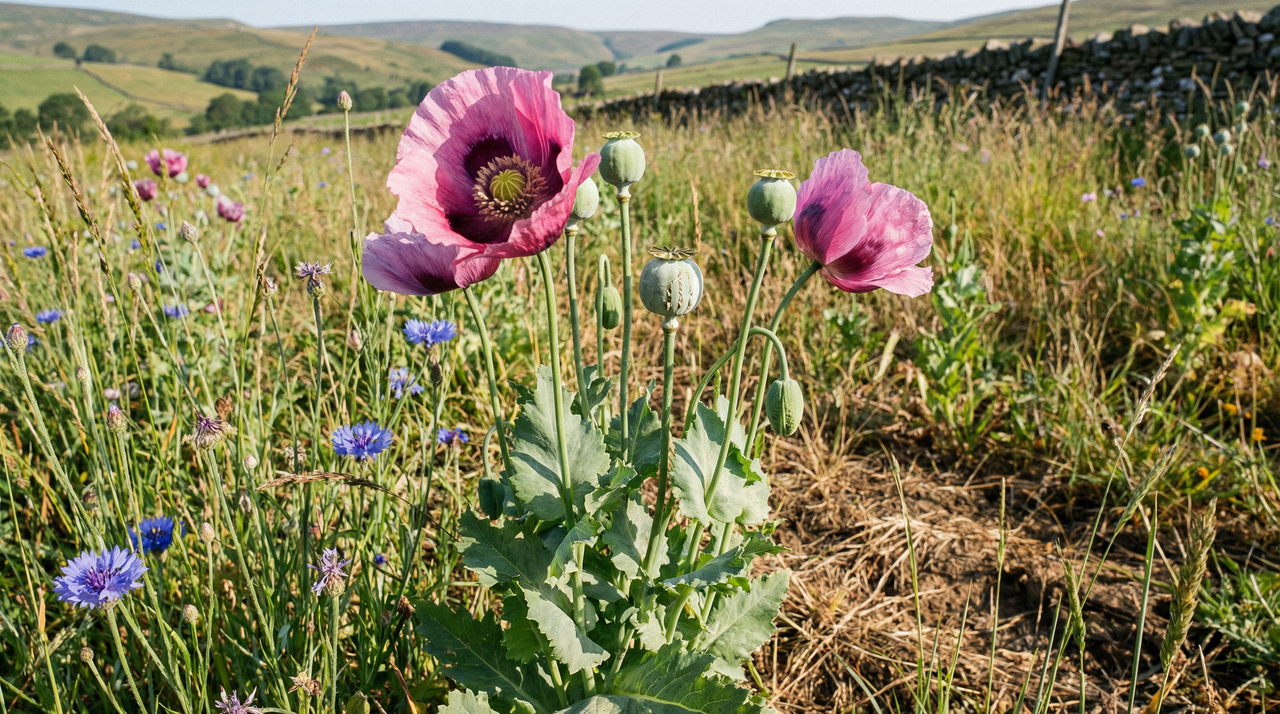
There's a poppy sitting in seed catalogs right now, listed cheerfully between petunias and snapdragons, that gave the world morphine, fueled two wars, and kept entire civilizations sedated, numbed, and dreaming for six thousand years. I grew it in my Florida container garden last winter, tucked between lettuces, and watched honeybees practically lose their minds over it on cool February mornings. That tension, beauty and danger occupying the same glaucous stem, is what makes Papaver somniferum unlike anything else I've worked with in twenty-plus years of growing food and medicine plants.
Most gardeners know it as the poppy with the gorgeous crinkled petals and those sculptural seed pods that look like they were designed by someone who cared deeply about both art and geometry. What surprises people is that the same pods drying on their windowsill are also the reason the DEA keeps a quiet eye on how many you're growing.[1] It's legal, until the question of intent enters the picture. That's the contradiction at the heart of this plant, and once you understand it, everything else about the poppy, its history, its chemistry, its place in your garden, starts to make a different kind of sense.
Origin and History of the Opium Poppy (Papaver somniferum)
Botanical Background and Native Range
Papaver somniferum is an annual that lives on its own terms: germinate, flower, seed, die.[2][3] That monocarpic strategy sounds like a gamble, but the plant hedges brilliantly by producing up to 20,000 seeds per capsule, some documented beyond 48,000 in high-yielding cultivars, seeds that can remain viable in the soil for a decade or two.[4][5] I've found this out firsthand: I'll turn a bed that had poppies five or six years prior, and there they are again, those unmistakable glaucous seedlings pushing through like nothing happened. That persistent seed bank, combined with a preference for disturbed, open, sunny ground, is exactly why the plant has followed human civilization wherever we break soil.[6]
Native to the Mediterranean Basin and extending into Western Asia and North Africa, with its center of domestication somewhere in the eastern Mediterranean, the opium poppy has been a companion to humans since at least 5000 to 6000 BCE, when Neolithic settlements in Europe and the Near East were already cultivating it for food, oil, and medicinal latex.[7][8] Mediterranean trade routes carried it outward by 3000 BCE; Arab traders moved it into South and Southwest Asia during the first millennium CE; European colonizers introduced it to the Americas in the sixteenth century.[9] Today the USDA classifies it as introduced rather than native across more than thirty U.S. states, turning up reliably in the anthropogenic disturbed habitats it has always preferred.[10]
Visual Characteristics and Identification
Once you know this plant, you know it. It typically grows 30 to 150 centimeters tall with an erect habit and leaves that are a distinctive waxy, bluish-green, deeply lobed and serrated along the margins, the upper ones clasping directly around the stem.[11][12] That glaucous foliage stands out beautifully in a mixed border, especially against darker perennials, and it's what tips me off when volunteer seedlings appear in unexpected places years after I've planted them.[13] Nick a stem and milky latex seeps out immediately; that's the plant's alkaloid-laden defense system at work, and it's why I always wear gloves when thinning seedlings.[14]
The flowers are genuinely showy: solitary, 5 to 10 centimeters across, with four to six crinkled petals ranging from white through pink and red to deep purple, often with a dark basal blotch.[15] Each plant blooms for only one to two weeks in late spring to early summer, which makes the timing feel precious. What follows is perhaps the most recognizable feature of all: the swollen, globe-shaped seed capsule crowned with a raised stigmatic disk bearing six to eighteen radiating rays.[8][16] That crown is the visual ID point that separates it cleanly from relatives like Papaver bracteatum, which produces similarly dramatic flowers in orange-red but lacks that coronet entirely and adds large papery bracts around the bud.[17]
Traditional and Cultural Uses Through the Ages
The archaeological and written record for this plant is staggering. Neolithic cultivation goes back to roughly 5000 to 6000 BCE in Europe and the Near East, and by around 3400 BCE the Sumerians had already named it the "joy plant," hul gil in cuneiform, documenting its use for pain relief, sedation, and religious ritual.[18][7] Ancient Egypt's Ebers Papyrus, dating to around 1550 BCE, describes medicinal preparations for pain, insomnia, and diarrhea, and poppy wreaths appear in funerary contexts tied to Osiris and the afterlife.[19][20] Greek literature links it to nepenthe in Homer's Odyssey, to Hypnos the god of sleep, and to Demeter's grief, while Hippocrates and Theophrastus both documented its medicinal properties.[21][22]
That same practical thread, the use of poppy latex for analgesia, sedation, cough suppression, and digestive complaints, runs through Chinese Han Dynasty materia medica, Indian Ayurvedic and Siddha traditions, Persian medical systems, and the writings of Galen and Pliny in Rome.[23][24] Medieval European monks used it in both medicine and alchemy, framing it simultaneously as healing gift and dangerous temptation. No other plant I can think of has been embraced so universally across such different cultures for exactly the same purposes and exactly the same fears.
The modern symbolism is just as layered. The Opium Wars of 1839 to 1860 turned the poppy into a symbol of imperial exploitation and national humiliation, while the fields of Flanders transformed the red-flowered annual Papaver rhoeas into a universal emblem of wartime remembrance.[25][26] When I talk about this plant with clients, I try to hold both of those histories at once, the genuine collective grief the poppy has come to represent and the very real harms its alkaloids have caused. Honoring that complexity feels more honest than either romanticizing it or pretending it's just a pretty garden flower. In the United States it can be grown legally for ornamental purposes under the Controlled Substances Act, but extracting opium latex without a license violates federal law, full stop.[27][28]
Fascinating Facts About the Poppy
The genus Papaver is full of ecological surprises. Papaver somniferum isn't just surviving in disturbed habitats by luck; it actively shapes its immediate environment through allelopathic root exudates that suppress competing plants, and it's drought-tolerant enough via deep taproots and osmotic adjustment to push through dry spells that would knock back softer annuals.[29][30] Bees are its primary pollinators, though self-pollination is possible, and seeds travel via wind, ants attracted to their elaiosomes, and human movement.[31][32] The same alkaloid chemistry that once protected the plant from herbivores in Mediterranean scrub is what eventually made it a scheduled substance in modern law. There's a certain irony in that.
For genus context: Papaver rhoeas, the common red field poppy of Flanders Fields fame, has seeds documented to remain viable in the soil for up to eighty years, dwarfing the twenty-year maximum typical of P. somniferum.[33] On the other end of the life-history spectrum, Papaver bracteatum from the mountains of Iran and the Caucasus is a perennial that can persist for three to seven years, reproducing clonally via rhizomes and thriving at elevations between 1,000 and 3,000 meters on calcareous soils.[34][35] Its significance today is largely pharmaceutical: select genotypes contain up to 3.5% thebaine, the precursor alkaloid used to synthesize opioid medications including oxycodone.[36] Watching the different species in a garden setting, the short-lived annual scattering thousands of seeds versus the clumping perennial building slowly from rhizomes, is one of the clearest illustrations of how differently plants within the same genus can solve the problem of persistence. For those of us growing the ornamental opium poppy responsibly, that seed bank is both its most endearing trait and its most humbling reminder that this plant has been outlasting human intentions for a very long time.
Poppy Varieties and Sourcing
Notable Papaver somniferum Cultivars for Garden and Kitchen
Papaver somniferum grows 24 to 48 inches tall (with dwarf selections staying closer to 18 inches) and carries flowers 3 to 6 inches across in everything from chalky white to deep violet, often with a faint sweet scent.[37][38][39] For a single species, the range of forms is genuinely dizzying. I've grown both 'Pepperbox' and breadseed types in my Central Florida beds, and the contrast couldn't be sharper: the breadseed types (var. nigrum) are workhorses bred for dark gray to black, nutty seeds prized for baking, yielding roughly 1 to 2 pounds of seed per 100 square feet. Meanwhile, ornamental cultivars like 'Danish Flag', 'Mae West', and the Double Beauty series are grown for the sheer theater of those ruffled, peony-like blooms.[40][41][39] Var. album, the white-flowered form, is the go-to for culinary seed production specifically because of its lower alkaloid content; the modern garden cultivars sold at nurseries fall squarely in this low-alkaloid category.[42] One practical note from growing the doubles in Florida humidity: they need real air circulation or powdery mildew will find them before you do.[37] The dried 'Pepperbox' seed heads I harvest each summer, incidentally, are some of the longest-lasting elements in my clients' autumn arrangements.
The genus offers useful foils. Papaver rhoeas, the common field poppy, is a cheerful self-seeding annual running 12 to 30 inches tall whose Shirley series delivers soft pastels and clean single blooms without the wild type's black basal blotch; 'Mother of Pearl' holds the RHS Award of Garden Merit.[43] Its seedlings are noticeably more forgiving of cold than P. somniferum's, which gives you a useful mental benchmark: if your site regularly sees hard late frosts, rhoeas will shrug them off where somniferum seedlings won't. Then there's Papaver bracteatum, the great scarlet poppy, a perennial reaching 3 to 4 feet with brick-red flowers and hairy gray-green basal leaves.[44][45] Garden selections like 'Solar Ray' exist, but its primary use is pharmaceutical: it's grown for thebaine, not ornament, and that distinction matters for the legal conversation below.
Legal Considerations and Where to Buy Poppy Seeds and Plants
Ornamental and culinary P. somniferum seeds are widely available in the U.S., typically $3 to $6 per packet, with live plants from specialty nurseries running $8 to $15 each.[46][47] That everyday availability can obscure the fact that federal law, under the Controlled Substances Act and the 1942 Opium Poppy Control Act, prohibits cultivation for opium or narcotic purposes while explicitly permitting ornamental and seed-production growing in most states.[48][49][50] State law adds another layer: California generally follows federal guidelines with limited non-narcotic cultivation under agricultural oversight, while Texas imposes stricter penalties for unauthorized cultivation.[51][52] After years of designing with poppies, I keep a simple rule: if you're growing for the flower or the seed, you're on safe ornamental ground; if you're thinking about harvesting latex, stop and talk to a lawyer or the DEA.
The regulatory picture extends to commerce and imports. The FDA regulates food-grade poppy seeds for trace morphine residues, and USDA APHIS requires imported seeds to be processed to inhibit germination.[53][54] Licensed pharmaceutical cultivation for codeine or thebaine requires DEA permits; Papaver bracteatum faces similar requirements only when harvested for thebaine and is otherwise unrestricted as a garden plant.[55][27][56] The UK offers a useful comparison: ornamental and culinary cultivation is permitted there, but extracting opium remains illegal under the Misuse of Drugs Act 1971, which is essentially the same distinction American gardeners are navigating.[57][58] Buy from reputable seed companies, grow for beauty or baking, and the legal framework is squarely on your side.
Poppy Propagation and Planting Guide (Papaver somniferum)
Before you order seeds, confirm your local regulations. In most places, growing ornamental and culinary strains of Papaver somniferum is perfectly legal; what's prohibited is cultivating the plant to extract opium.[59] After checking my own county ordinances and talking with a couple of local extension agents, I grow only low-alkaloid ornamental strains and harvest the seeds strictly for baking and replanting. That framing matters because it shapes every decision that follows, from which cultivar you source to how you describe the plants to a curious neighbor.
Understanding Poppy Seeds: Size, Shape, Color, and Storage
These seeds are genuinely tiny. Each one is kidney-shaped, roughly 0.8 to 1.2 mm long and barely 0.5 mm wide, weighing somewhere between 0.1 and 0.15 mg.[3][60] Cultivated forms tend toward that characteristic blue-gray color, though wild types run darker toward brown. I once lost a whole packet's worth on my potting bench because the seeds blended right into the gray concrete. These days I mix them with a small amount of dry sand before sowing, which distributes them far more evenly and makes it obvious where you've actually sown.
The storage potential of poppy seed is remarkable. These are orthodox seeds, meaning they tolerate drying down to 3 to 7 percent moisture content without damage.[61][62] In genebank conditions (airtight containers, desiccants, and storage at around -18°C) viability can hold for 20 to 50 years or more.[63][64] For home gardeners, cool-and-dry in a sealed jar with a desiccant packet will get you five to ten good years; at room temperature, expect viability to tail off after three to five. One practical note on variety purity: Papaver somniferum is predominantly outcrossing despite being self-compatible, so if you're saving seed from a specific cultivar, hand-pollination keeps things true.[65] For most gardeners who simply want beautiful blooms or good culinary seed, that level of precision isn't necessary.
Cuttings and grafting exist as propagation options, but barely. Softwood cuttings with rooting hormone achieve 20 to 50 percent success under controlled humidity and warmth, and grafting onto related rootstocks can reach 60 to 80 percent in research settings.[66][67] Direct sowing from seed is still the overwhelmingly practical path for everyone growing these at home.
Germination Timeline and Requirements
Poppy seeds need light to germinate. Surface sow them or press them just barely into the soil surface with the back of your hand; covering them even lightly with compost can cut germination dramatically. Optimal soil temperature sits between 13 and 18°C (55 to 65°F), and under those conditions you'll typically see emergence in 7 to 21 days with fresh seed germinating at 70 to 90 percent.[68][69] Think of this the way Floridians think about basil in reverse: basil wants warm soil before it moves, poppies want it still cool. Stored seed benefits from 4 to 6 weeks of cold stratification at 4°C before sowing if you're finding germination disappointing.[58]
The related perennial Papaver bracteatum tells a different story: it requires that cold stratification reliably before it will germinate well at 15 to 20°C, and the field poppy Papaver rhoeas similarly benefits from after-ripening or stratification.[70][71] For the annual opium poppy, though, fresh seed in cool soil with light is genuinely all you need.
Soil, Site Selection, and Sun Requirements
Papaver somniferum is native to Mediterranean slopes: disturbed, calcareous ground, lean soil, excellent drainage, full sun.[39] That origin story is your entire site-selection checklist. It thrives in well-drained loamy or sandy loam soil with a pH of 6.5 to 7.5 and organic matter kept modest at 1 to 3 percent.[72][73] Heavy clay, compacted soil, or anything that holds water is a problem; the plant cannot tolerate waterlogging and needs at least six hours of direct sun daily.[8]
My first attempt at container-grown poppies in Central Florida ended with damping-off before the seedlings hit two inches. The culprit was a standard potting mix that retained too much moisture through our cool, damp winter nights. I now use a gritty mix for pots at least 20 cm deep, incorporating a generous amount of horticultural grit or coarse sand.[70] For in-ground beds with heavy native soil, I amend with coarse sand and lime if the pH reads below 6.5; I also resist the urge to enrich the bed with compost, because excess fertility pushes lush foliage at the expense of flowers. Keep organic matter lean on purpose.
If you see wilting despite adequate moisture, stunted seedlings, yellowing leaves, or dark mushy roots, poor drainage or compaction is almost always the culprit rather than underwatering.[74][75] Diagnose the drainage before you diagnose anything else.
Spacing, Planting Technique, and Timing
Direct sowing is non-negotiable in any practical sense. Poppy taproots are sensitive enough that transplant success rates fall to 20 to 40 percent even with careful handling.[76] In my early years I started them indoors like tomatoes. The few survivors were noticeably stunted compared to direct-sown plants in the same bed, and I gave up the practice entirely. Sow in place, thin later, and let the taproot go where it wants from day one.
Timing depends on your zone. In zones 3 to 7, sow in early spring after the last frost; in zones 8 to 9, a fall sowing lets plants overwinter as rosettes and bloom early the following spring.[58] Either way, surface sow or press seeds no deeper than about half a centimeter into prepared, weed-free soil. Once seedlings are a few inches tall, thin to 6 to 12 inches apart in rows spaced 12 to 18 inches.[77]
Spacing shapes the outcome more than most gardeners expect. Mature plants reach 24 to 48 inches tall with a 12 to 24 inch spread, so the numbers matter.[78][79] Closer spacing at 4 to 6 inches maximizes seed yield per square foot; wider spacing at 12 inches or more gives you larger individual blooms and the airflow that keeps fungal pressure down.[80] Decide which you're after before you thin, because you won't want to go back and pull more later. Once you've got well-drained soil, the right timing, and a little patience with thinning, poppies really do take care of themselves.
Poppy Care and Growing Guide
Poppies are one of those plants that punish over-attention. I've watched beginner gardeners fuss over them with fertilizer, extra water, and finely amended beds, only to end up with floppy stems, patchy flowering, and disappointed expectations. What Papaver somniferum actually wants is closer to benign neglect: full sun, lean soil, decent drainage, and a climate that matches its Mediterranean roots. Get those fundamentals right and it practically grows itself.
Sunlight Requirements
Full sun is non-negotiable. Poppies need at least 6 to 8 hours of direct light daily to produce robust stems, abundant flowers, and well-filled seed capsules.[81][58] Shade the plant and you get etiolated, weak-stemmed growth, yellowing foliage, fewer blooms, and increased disease pressure.[82][83] If you're growing in a location where summer afternoons push into scorching territory, a bit of dappled shade after 2 pm can prevent leaf scorch without sacrificing bloom quality.[84] I've found that in my warmest beds, a taller companion plant to the southwest does that job naturally without any intervention on my part. But the morning sun still needs to be unobstructed.
Water Needs
Drainage is the thing I'd worry about before any other water consideration. Waterlogged or heavy clay soil will kill these plants quickly through root rot, showing up as yellowing leaves, wilting, and stunted growth that looks disturbingly like nutrient deficiency.[85][86] During germination and early seedling establishment, keep the top couple of centimeters of soil evenly moist. Once plants are settled in, back off considerably; water once or twice a week only during dry spells, letting the top inch of soil dry between waterings.[45][87] Established plants are genuinely drought-tolerant and well suited to Mediterranean-type rainfall patterns where natural precipitation often carries them through to flowering.[85][88] If you're seeing crispy leaf edges and wilting in an established plant, underwatering is the usual culprit, but check drainage before you reach for the hose. Soil pH should sit between 6.0 and 7.5; the plant has low salinity tolerance and prefers soft to moderately hard water, so if you're in a region with very hard tap water, it's worth knowing.[89]
Soil and Feeding Requirements
Poppies are light feeders, and excess nitrogen is genuinely counterproductive. I made this mistake once early on, pushing a nitrogen-heavy amendment into a bed hoping for bigger, more vigorous plants. What I got instead was leggy, floppy growth, sparse flowering, and a disease problem that wasn't there the season before. Over-fertilization
- reduces alkaloid content
- promotes excessive vegetative growth at the expense of flowers
- lowers seed production
- increases disease susceptibility
If your soil is genuinely poor, a single light application of a balanced low-nitrogen fertilizer (something in the 5-10-10 or 10-10-10 range, applied at 1 to 2 lbs per 100 square feet) at planting in early spring is sufficient. If you're growing primarily for seed, a light top-dressing after flowering can support capsule development.[93][58] Watch for uniform yellowing in older leaves (nitrogen deficiency), purplish discoloration and stunted growth (phosphorus), or marginal leaf scorch (potassium) as signs the soil actually needs correcting.[94][95] In alkaline soils specifically, micronutrient lockout can show up as interveinal chlorosis in young leaves (iron), stunted or rosetted growth (zinc), reduced flower set and small capsules (boron), or distorted new growth (calcium).[94][96] A soil test is the most reliable diagnostic tool before reaching for any amendment.
Frost Tolerance and Protection
Mature Papaver somniferum plants are surprisingly cold-hardy, rated down to -15°C to -20°C (-5°F to -4°F), with some survival reported as low as -29°C (-20°F) in appropriate conditions, spanning USDA zones 3 to 7 and RHS hardiness zone H6.[97][98] The seedling stage is a very different story. Young plants are frost-tender; damage starts at 0°C and becomes significant below -2°C (28°F), showing up as browning or blackening foliage, water-soaked lesions, and aborted buds.[99][100]
I've lost early seedlings to late surprise frosts more than once, partly because young poppy rosettes look deceptively like tiny thistle seedlings and I've occasionally been slow to notice them. I now use row covers or horticultural fleece as a matter of course until plants are established, and I label every row clearly. A 5 to 10 cm layer of organic mulch over the root zone adds meaningful insulation, and siting plants on a south-facing slope helps with frost drainage.[101]
Heat Tolerance and Summer Care
Think of poppies the way you think of lettuce or cilantro: cool-season plants that bolt and decline when temperatures climb. The optimal daytime range is 15 to 25°C (59 to 77°F), with cool nights preferred. Plants can handle short spells up to 27 to 29°C (80 to 85°F), but sustained heat above that triggers wilting, premature blossom drop, bolting, and reduced seed quality.[45][102][103] The most vulnerable stages are seedling establishment (heat sensitivity kicks in above 25°C) and flowering, when temperatures above 28°C compromise pollination and cause flower drop.[104][105]
In hotter microclimates, I reach for culinary cultivars like 'Dutch' or 'Persian White', which tolerate heat better than most ornamental types.[106] A 30 to 50% shade cloth during the hottest weeks, combined with 5 to 10 cm of organic mulch to cool the root zone, makes a real difference.[107][108] Early-morning irrigation keeps roots cool without stressing heat-sensitive foliage at midday. These aren't separate interventions; they work together as a package.
Pruning, Maintenance, and Seasonal Rhythm
A quick note before anything else: Papaver somniferum is legally restricted in many regions because of its alkaloid chemistry, and cultivation to ornamental and culinary seed strains only is the legal standard in most jurisdictions.[28] I grow only permitted ornamental and breadseed varieties in compliance with local law, and I'd encourage anyone unfamiliar with the regulations in their area to check before planting.
Maintenance is genuinely minimal. If you want continuous blooming, deadhead spent flowers before pods develop; if you want seeds for cooking or saving, leave the pods alone and let them mature fully.[109][45] Tall stems in exposed or windy sites may need light staking. A 5 cm mulch layer suppresses weeds and retains moisture without smothering the plant.[58] Once flowering is finished and pods have been harvested or allowed to shatter for self-seeding, cut plants back to ground level and compost the debris.
Seasonal Rhythm
Understanding P. somniferum as a cool-season annual changes how you plan around it. Fall sowing lets seeds germinate in autumn, form a compact basal rosette, and overwinter under light mulch in zones 3 to 7, then resume growth early in spring and flower weeks ahead of spring-direct-sown plants.[2][110] In my own garden, fall-sown rosettes reliably bloom a full three to four weeks earlier than anything I direct-sow in spring, and the plants are visibly stockier. The optimal growing window runs from 15 to 24°C during the day with cool nights; the plant tolerates light frost but benefits from fleece protection until rosettes are established.[58] In zones 8 to 9, treat it as a winter annual, sowing in autumn for a spring display. That timing also matters for seed maturation: stop supplemental irrigation once pods begin to change color and the foliage starts to yellow, so the plant can complete its cycle cleanly.
Harvesting Poppy Seeds and Pods
Papaver somniferum completes its entire life cycle in 80-120 days, with flowering starting around 50-70 days after sowing and pods reaching full maturity just 20-40 days after the petals drop.[2][68][111] In temperate gardens, that usually lands you somewhere between August and October.[93][112] I always remind new growers that while culinary seed saving is permitted in most home gardens, cultivation of Papaver somniferum is regulated in many jurisdictions, so it's worth checking local rules before you plant. That said, the harvest itself is one of my favorite moments in the garden year.
When to Harvest: Reading Pod Maturity Signals
The plant tells you exactly when it's ready; you just have to know what to listen for. A mature pod turns from green to light beige or tan, develops a dry, papery texture, and rattles audibly when you shake it because the seeds have pulled free from the inner walls.[93][113][114] The rattle test is my absolute favorite signal because it's foolproof. One year I held out for a deeper brown color and lost nearly the whole crop to shattering. Now I harvest at the first rattle combined with the faintest split at the crown, and I haven't lost a meaningful harvest since. The pods also take on a distinct papery rustle and release a faint hay-like aroma when you handle them -- small sensory cues that become second nature after a season or two. (If you're growing Papaver bracteatum, note that it typically behaves as a biennial or short-lived perennial, so its timing runs one to two years rather than a single season.)[115]
How to Harvest and Dry Poppy Seeds
Once the pods rattle and show just the beginning of apical splitting, cut the stems below the pods before full dehiscence opens everything up and scatters the seeds across your garden bed.[116] Hang the cut stems upside down in a shaded, well-ventilated spot for 7-14 days.[93][114] I usually hang mine in my carport, away from direct afternoon sun. If you're cutting for a vase rather than seed saving, the timing flips entirely: harvest on the first morning a bloom opens, when petals are at their freshest.[114]
After the hanging period, open the pods and spread seeds in a single layer at 70-80°F in a shaded, ventilated spot for another one to two weeks to finish drying before storage.[93] Skipping this step is how seeds go moldy in the jar. Gentle handling throughout keeps the tiny seeds intact and protects flavor quality.
Expected Yields, Flavor Notes, and Post-Harvest Storage
A single mature pod holds upwards of twenty thousand tiny seeds, so even a modest planting produces a surprisingly generous kitchen harvest.[5][117] The seeds have a nutty, earthy-sweet flavor with a satisfying crunch that roasting intensifies nicely, though I'll leave the full culinary possibilities for later in this guide.[5][117] Store your fully dried seeds in airtight containers somewhere cool (50-70°F), dark, and dry, and they'll stay viable for two to five years.[93][117] Seeds I've stored in a cool pantry have reliably germinated after three years, so if you dry them thoroughly before sealing the container, you can save both culinary stock and next year's sowing seed from the same harvest.
Poppy Preparation and Uses
Culinary Uses of Poppy Seeds
When preparing Papaver somniferum in the kitchen, you're working with the seeds and essentially nothing else. The seeds are the one part of this plant that is genuinely non-narcotic and widely considered safe for everyday culinary use, [2][118][119] and the FDA holds them to a compliance limit of 20 micrograms of morphine per gram to keep it that way. [120] Beyond that regulatory safety net, they maintain a stable presence in modern bakeries and kitchens. [121][122] Simple prep like soaking and rinsing can reduce even those trace alkaloids further if you want extra peace of mind.
Raw poppy seeds have a mild, nutty baseline with faint sweet and earthy undertones. [123] Roasting at 150 to 180°C for five to ten minutes transforms them through Maillard reaction chemistry, producing pyrazines and furans that push the flavor toward something toasty and almost coffee-like. [124][125] I always toast mine fresh right before baking because the aroma shift is dramatic in a way you genuinely have to experience to appreciate. Texture-wise, they stay satisfyingly crunchy in baked goods, and cold-pressed poppy seed oil is beautifully smooth and mildly nutty for dressings. [126][127] They remind me of the role sesame or flax plays in my permaculture kitchen: a quiet, crunchy supporting note that pulls more than its nutritional weight.
Flavor varies noticeably by cultivar and origin, with oil content reaching up to 50% in some types and cooler-climate seeds leaning toward higher sesquiterpenes while Mediterranean, Turkish, and Indian varieties are richer in monoterpenes like myrcene and limonene. [128][125] Globally, they appear in European lemon-poppy muffins and seeded rolls, Indian khas khas halwa, Middle Eastern salads, and North African preparations. [129] The related common poppy, Papaver rhoeas, produces smaller, less oily seeds with a similar nuttiness suited to baking, and its young leaves can be eaten raw or cooked like spinach when harvested early, with petals occasionally used in syrups and teas for a mild sweet-floral note. [130] As for Papaver somniferum's young leaves, I experimented with a few tender ones in salad early in my gardening days and quickly decided the distinctive latex taste and risk of digestive upset weren't worth it. [119][131] The seeds are simply the better story here. And if you grow ornamental poppies, please label your plantings carefully: great scarlet poppy, Papaver bracteatum, is not edible at all; every part contains high levels of thebaine and other toxic alkaloids, with no safe culinary application. [132][133] I've grown several ornamental poppy species over the years and learned that clear labels are non-negotiable.
Medicinal Preparations and Traditional Applications
Traditional use of poppies for medicine is well-documented across cultures, but outside of culinary seeds, this is territory for professionals, not home kitchens. Papaver rhoeas has the gentlest folk-medicine profile, with traditional preparations including infusions, decoctions, and tinctures using 1 to 2 teaspoons of dried herb per cup, up to 6 grams daily, primarily for mild sedative or cough-soothing effects. [134] Papaver bracteatum's historical uses included decoctions and latex extracts, [135] but the alkaloid content is too potent and too variable for any safe household preparation. There are no established home dosages. The pharmacology of Papaver somniferum is covered in depth in the health benefits section; the short version here is that self-preparation of anything beyond culinary seeds from this genus carries real risk and deserves real caution.
Non-Food Uses and Safety Considerations
The practical takeaway on legality is simpler than it sounds. Buying and cooking with poppy seeds from a reputable spice supplier is entirely legal and unambiguous. Growing Papaver somniferum, however, is regulated under the U.S. Controlled Substances Act and similar laws worldwide; cultivation for any purpose beyond permitted ornamental use generally requires checking local regulations carefully, and in many contexts a license. [136][137] I source my culinary seeds from certified reputable spice merchants specifically because of this distinction; it sidesteps regulatory ambiguity entirely and gives me seeds selected for low alkaloid content and consistent flavor. Once that sourcing decision is made responsibly, poppy seeds are simply a delightful, nutrient-rich kitchen staple with a long global history behind them and a satisfying crunch in front of them.
Poppy Health Benefits and Medicinal Uses
No plant in the Western pharmacopeia carries more historical weight than Papaver somniferum. The story of its medicinal use is ancient and genuinely remarkable, but it is also inseparable from a legacy of addiction, overdose, and tight legal control.
Historical and Traditional Medicinal Uses
Physicians across virtually every early civilization documented opium poppy as a remedy for pain, insomnia, anxiety, and cough. Hippocrates prescribed it, Dioscorides catalogued it, and Avicenna described its analgesic applications in exhaustive detail.[138][139][140] Sumerian tablets, Egyptian papyri, Greek and Roman texts, and Ayurvedic manuals all reached for this plant when suffering needed dulling. That remarkable consensus across independent cultures says something real about the plant's efficacy. It also says something about how desperate people have always been for pain relief, and why the compounds in this plant demand such careful handling.
Key Phytochemicals and Alkaloid Profile
The primary medicinal and toxicological story lives in the unripe seed capsule's latex, which contains a family of benzylisoquinoline alkaloids: morphine at 8 to 20 percent of dry latex weight, codeine at 0.5 to 5 percent, thebaine, papaverine, and noscapine in smaller fractions.[141][142][143] Leaves and stems carry far lower concentrations, roots contain moderate thebaine and noscapine, and seeds come in well under 0.1 percent alkaloids. The plant also produces flavonoids (quercetin, kaempferol, rutin), phenolic acids, terpenoids, saponins, and coumarins, all of which function as ecological defenses against herbivores and pathogens and contribute secondary antioxidant activity.[144][145]
Growers should know that these concentrations are not fixed. Alkaloid production responds strongly to environment: well-drained loamy soils at pH 6 to 7.5, moderate nitrogen, temperatures of 20 to 30°C, and drought stress all favor higher yields, while excess nitrogen tends to suppress morphine accumulation.[146][147] This variability matters for safety, not just pharmacology.
Pharmacological Actions and Clinical Evidence
Morphine, isolated in 1805, is a full mu-opioid receptor agonist. It provides potent analgesia by inhibiting the release of substance P and glutamate while modulating ion channels to reduce pain signal transmission.[148][149] Clinical trials consistently show 70 to 90 percent efficacy over placebo for postoperative and chronic pain.[150] Codeine acts as a milder prodrug, converted to morphine primarily by the CYP2D6 enzyme, and it suppresses the medullary cough reflex effectively.[151][152] CYP2D6 enzyme activity varies enormously between individuals due to genetic polymorphisms. As a result, what works as a mild cough suppressant for one person can produce dangerously elevated morphine levels in another. That genetic unpredictability is exactly why I always advise against homemade poppy preparations and defer to physicians who can order appropriate testing. Papaverine operates through a completely different mechanism, inhibiting phosphodiesterase enzymes to relax smooth muscle and dilate blood vessels, and it's used clinically for vasospasm and erectile dysfunction without the opioid pathway involved at all.[153] Extracts also show anti-inflammatory activity through inhibition of NF-κB and COX-2, along with in-vitro antioxidant and antimicrobial effects against organisms like Staphylococcus aureus and Candida albicans.[154][155]
Two relatives round out the picture. Papaver rhoeas (common poppy) contains milder rhoeadine-type alkaloids with weaker analgesic and spasmolytic effects in animal models and no meaningful narcotic or addictive potential.[156][157] I've grown both species side by side for ornamental purposes and can confirm the seedlings look nearly identical in the first few weeks, which is one reason careful labeling matters in any poppy bed. Papaver bracteatum lands in a different category entirely: its latex is dominated by thebaine, which acts more as a stimulant and convulsant than a sedative, carries seizure risk in high doses, and serves primarily as a pharmaceutical precursor for manufacturing oxycodone and naltrexone rather than as a medicine in its own right.[158][159] None of these species are candidates for home medicinal experimentation.
Nutritional Profile of Poppy Seeds
Commercially processed poppy seeds, with most latex residue removed, contain negligible alkaloids (well under 0.1 mg/g) and are GRAS-regulated by the FDA.[160][161][162] Per 100 grams, they deliver roughly 525 calories, 18 grams of protein, 42 grams of fat (with linoleic acid making up 55 to 70 percent of that), nearly 20 grams of fiber, and a highly concentrated mineral profile: 1,438 mg calcium (144% of daily value), 347 mg magnesium, and a staggering 28.7 mg manganese representing over 1,200 percent of daily value.[160][163] For a seed that most people sprinkle absently on a bagel, that's a serious nutritional contribution.
I prefer to soak my seeds for about 12 hours before baking because it lowers phytic acid by 20 to 30 percent, which meaningfully improves mineral absorption without affecting the alkaloid content, fiber, or structure.[164] A light toast after soaking unlocks a nuttier flavor that I find noticeably different from raw seeds, though roasting at high heat can reduce phenolic content by up to 15 percent and degrades some vitamin E.[165] One practical note worth keeping in mind: consuming large quantities of unwashed seeds (more than 10 to 15 grams) can still trigger a positive result on urine drug screening, so that reality exists even at culinary doses.[160][162]
Safety Considerations and Contraindications
Every part of this plant except properly processed culinary seeds is toxic. The unripe capsule latex carries morphine concentrations of 8 to 17 percent by dry weight, enough to cause respiratory depression, pinpoint pupils, sedation, coma, and death in overdose.[166][143] In my years working with plants, this is one I never recommend for home medicinal use, full stop.
If you are pregnant, nursing, or taking any medication that depresses the central nervous system, avoid all parts of this plant except commercially processed culinary seeds. The research on neonatal risks is unambiguous: opium-derived alkaloids cross the placenta and can cause neonatal respiratory depression, sedation, and withdrawal.[167][168] Combined with alcohol or benzodiazepines, opioid alkaloids dramatically increase the risk of profound sedation, respiratory arrest, and death.[169] People with respiratory disease or on anticoagulants face additional compounding risks.
Legally, opium and most of its alkaloids are Schedule II substances under the U.S. Controlled Substances Act.[170] Cultivating Papaver somniferum for opium production requires a DEA permit; culinary seeds are legal and GRAS, but the distinction matters and should be understood clearly.[171] Poppy seed allergy is rare but documented, and the latex sap can cause contact dermatitis, so handling the fresh plant warrants basic precautions.[170] Lookalikes add another layer of risk: Argemone mexicana exudes yellow sap and carries a very different toxicity profile, while Papaver orientale produces no narcotic latex at all.[140][133] Misidentification is a genuine hazard, especially for children and pets, and the only safe response is to keep all poppy plant material out of reach and treat any suspected ingestion as a medical emergency.
Pests and Diseases of Poppy (Papaver somniferum)
Natural Defenses: Latex and Alkaloids in Poppy
The opium poppy comes genuinely armed. Papaver somniferum secretes a sticky latex from leaf trichomes and loads that sap with morphine, codeine, and noscapine, creating both a physical trap and a bitter chemical deterrent that repels many insects before they get established.[172][173][174] I've pinched a leaf and watched that milky exudate well up more times than I can count. It's sticky, it's bitter, and small insects really do get mired in it. This isn't just textbook chemistry; it's something you notice with your hands if you spend time with these plants. These chemical and physical defenses significantly reduce early-season insect pressure. The practical takeaway is that good cultural practices amplify what the plant already does rather than replace it.
That said, the armor has gaps. Papaver bracteatum shows moderate inherent resistance compared with P. somniferum, and breeders have developed cultivars like Borzou and Kashmir with documented tolerance to aphids and powdery mildew.[175][176] Partial tolerance is the realistic goal in any species; no poppy offers complete immunity, and knowing which threats actually breach the defenses is where gardener attention belongs.
Common Insect Pests and Management
Aphids are the pest I watch most closely. Myzus persicae, Macrosiphum euphorbiae, and Aphis fabae all target P. somniferum, curling leaves, secreting honeydew, and, most seriously, vectoring mosaic viruses that can stunt plants and reduce yield significantly.[177][178][179] My habit with any soft-sapped ornamental is to check the tender new growth first thing in spring; catching a small colony before it explodes is far easier than dealing with a full infestation. Ladybugs handle light pressure well, and insecticidal soap or neem oil knocks back heavier buildups without disrupting the rest of the garden ecology.[180][181]
Stem weevils (Lixus piperatus and Lixus iridis) are a different problem, boring into stems and causing structural damage through larval tunneling rather than surface feeding.[182] Beyond these, flea beetles, cutworms, spider mites, slugs, and root-knot nematodes can all stress the plants enough to open the door for secondary disease infection.[180][58] None of them are catastrophic on their own in a healthy, well-spaced planting, but stressed plants are always more vulnerable.
Major Fungal and Other Diseases
Fungal pathogens are honestly the bigger fight. Downy mildew (Peronospora arborescens and related species) thrives in cool, humid conditions between 15 and 20°C with relative humidity above 80%, producing angular yellow spots on the upper leaf surface with a characteristic white downy growth underneath; left unchecked it collapses leaves and tanks yield.[183][184][185] Powdery mildew from Erysiphe species follows a similar humidity trigger, coating leaves and stems in white powder and causing chlorosis and deformation.[177][186] Both mildews are where P. bracteatum's bred cultivars show their advantage; for ornamental P. somniferum, the best defense remains airflow and reasonable spacing rather than fungicide dependence.
Move into warmer, wetter soils and Fusarium oxysporum f. sp. papaveris becomes the threat to watch. This causes vascular discoloration, wilting, and plant death at temperatures of 25 to 30°C with poor drainage.[187] Sclerotinia stem rot adds stem cankers and white mold in cool, wet conditions, while Botrytis cinerea produces the grey fuzzy growth most gardeners recognize from other ornamentals, peaking above 90% humidity.[188][189] Root rots from Fusarium, Pythium, or Rhizoctonia are primarily an overwatering problem, with seedlings especially vulnerable to damping-off.[177][190] Mosaic virus, spread by those same aphids, can produce leaf mottling and stunting but is less frequent than the fungal threats.[191] Bacterial leaf spot from Pseudomonas species appears under high humidity but rarely becomes serious.[192] The repeating pattern across almost all of these is the same: excess moisture plus compromised airflow.
Integrated Management and Cultural Practices
In my experience, staying ahead with airflow and rotation keeps most issues at bay and lets the plant's own defenses do the heavy lifting. Rotating with non-host crops like legumes or cereals every three to four years breaks soilborne pathogen cycles, and spacing plants six to eighteen inches apart rather than crowding them dramatically reduces mildew pressure.[193][58][194] I widened spacing from about six inches to twelve in one trial bed and the powdery mildew pressure dropped noticeably by midsummer. Avoiding overhead irrigation and keeping ambient humidity between 40 and 60 percent removes the conditions most pathogens need to establish. Where some cultivar resistance is an option, Indian 'Sujata' offers moderate downy mildew tolerance, 'Majestic' handles powdery mildew reasonably well, and Iranian lines like 'Kerman' show useful field resilience; just know that none of them are bulletproof.[195]
Biological options (ladybugs for aphids, Trichoderma or Bacillus subtilis drenches for soil fungi), organic sprays (neem, insecticidal soap, sulfur or dilute baking soda for mildews), and targeted fungicides reserved as a genuine last resort round out a sensible IPM toolkit.[180][181] I only grow legally permitted ornamental forms and always check local statutes before planting.
Poppy in Permaculture Design
Papaver somniferum doesn't slot neatly into the classic permaculture forest-garden model, and I think that's part of what makes it so interesting to work with. It's not a canopy tree, not a nitrogen-fixer, not a perennial groundcover. What it is, when you place it thoughtfully, is a short-lived, sun-loving pioneer that earns its keep through pollinator support, modest nutrient cycling, and the kind of cheerful self-perpetuating presence that makes edges and open beds feel alive in early spring.
Climate Preferences and Hardiness Zones
The opium poppy evolved in a Mediterranean rhythm: mild, wet winters followed by hot, dry summers, with 300-800 mm of annual rainfall concentrated in the cooler months.[8][196] That background explains a lot of its behavior in the garden. It wants to germinate cool (15-18°C is ideal), grow through mild temperatures, and finish its cycle before summer heat kicks in; above roughly 25-30°C, growth stalls and the plant tends to bolt or fail outright.[197][198] In most of temperate North America, that translates to zones 3-9 on paper, with the sweet spot being zones 5-8.[2][199]
Humidity is the other half of that Mediterranean equation. The plant prefers moderate humidity in the 40-60% range and is genuinely intolerant of anything higher for extended periods, since stagnant, moist air invites the fungal problems that kill it fastest.[200][201] My design response to that is straightforward: I always place poppies in raised beds or mounded soil where drainage is fast and air movement is good. It mirrors the rocky, well-drained terrain of their native range, and it's the single biggest factor in whether they thrive or rot in heavier or more humid climates.
The genus does offer more climate flexibility than the opium poppy alone. Papaver bracteatum, the great scarlet poppy, comes from mountainous semi-arid regions at elevations up to 2,000 m and is a cold-hardy perennial in zones 5-9, tolerating lows down to -20°F once established.[202][203] Papaver rhoeas, the field poppy, stretches further still, adapting to temperate oceanic, Mediterranean, and cold humid continental climates alike.[204] Across all of them, the unifying requirement is full sun and sharp drainage; the variations are mostly around cold tolerance and seasonality.
Ecosystem Functions and Services
What I find most compelling about poppies as a permaculture plant is their pollination story. Papaver somniferum uses a mixed strategy: it's self-compatible through pollen deposition inside the bud before the flower even opens (a process called pre-anthesis deposition), but protogyny means the female parts mature first, which nudges the plant toward cross-pollination when insects are around.[205][206] In practice, this means reliable seed set even in a low-pollinator year, but genuine cross-pollination and genetic diversity when bees and hoverflies are working the blooms.[207] I've spent spring mornings watching bumblebees methodically dust themselves in those wide, shallow flowers, and the jump in hoverfly numbers around a patch in bloom is genuinely noticeable. That early-season activity, before most perennials have opened, ripples through the whole garden.
Beyond pollinators, the plant does real soil work. As a ruderal pioneer, it cycles nutrients quickly through fast-decomposing leaves and roots, and its taproot pulls minerals up from deeper layers in the classic dynamic-accumulator pattern.[208] The above-ground biomass can be cut and used as a light green mulch or chop-and-drop material.[209] Because of the plant's regulatory status in many regions, though, I treat P. somniferum strictly as an ornamental pollinator plant in my designs and don't lean on the biomass-as-mulch function in any serious way. It's worth keeping the legal context clear, both for yourself and for clients.
Papaver bracteatum brings a complementary set of functions. Unlike the self-compatible opium poppy, it's largely self-incompatible and depends on bees and butterflies for reproduction,[210][211] and its dense perennial root mat offers real soil stabilization on slopes, which gives it a distinct niche in restoration or erosion-prone sites.
Forest Layer Role and Guild Integration
Papaver somniferum is a ground-layer and herbaceous-layer plant in the strictest sense, reaching 0.6-1 m in flower and requiring full, unobstructed sun for the entirety of its short life.[212][10] Put it under even a partially closed canopy and it simply fails: leggy, weak, minimal bloom, no seed set. All the related species share this intolerance; Papaver rhoeas, Papaver orientale, none of them belong in forest understory.[130][213] This genus belongs at the sunny edge, in the gaps, in the open beds.
In my food-forest designs, I use self-seeding poppies to colonize disturbed edges and open patches in early succession, before taller perennials close in. They're genuinely useful in that role: early-season nectar for bees, mild weed suppression while they establish, and cheerful color that signals to clients that something productive is happening.[141][214] The self-seeding persistence is real: once established in well-drained soil with full sun, a patch can maintain itself year over year without replanting.[141]
Papaver bracteatum occupies this same herbaceous slot with more permanence in the right climate, and pairs well with drought-tolerant herbs like lavender or rosemary and neighboring nitrogen-fixers in a pollinator-focused guild.[215] The annual poppies work best paired with companions of similar stature and light requirements, things like Papaver rhoeas, calendula, or phacelia, that reinforce the early-season pollinator draw rather than competing for the same sun. The guild framing here is observational rather than rigorously documented, but the principle holds: plants that share ecological preferences tend to share ecological functions, and in an open, sunny edge bed, poppies pull their weight.
The Plant That Taught Me to Stop Over-Managing
I spent my first season with poppies trying to help them, adjusting the soil, thinning obsessively, watering on a schedule, and they gave me scraggly, short-lived blooms that barely set seed. The year I got distracted and mostly left them alone, they filled an entire disturbed edge with violet and white and that blue-green foliage I never get tired of. Some plants just need you to get out of the way, and poppies were the ones that finally taught me that.
Sources 215
- DEA Opium Poppy Fact Sheet ↩
- USDA PLANTS Database - Papaver somniferum ↩
- Missouri Botanical Garden - Papaver somniferum ↩
- Seed Dormancy and Germination in Papaver somniferum ↩
- Opium Poppy Cultivation Guide - FAO ↩
- Demographic Study of Wild Papaver somniferum Populations ↩
- The Domestication History of Opium Poppy ↩
- Opium Poppy - Kew Royal Botanic Gardens ↩
- Papaver somniferum - Wikipedia ↩
- Papaver somniferum (Opium Poppy) Profile ↩
- USDA Plants Database - Papaver somniferum ↩
- Missouri Botanical Garden - Papaver somniferum ↩
- Royal Horticultural Society - Papaver somniferum ↩
- Alkaloid Production in Papaver somniferum as a Defense Response ↩
- Missouri Botanical Garden - Papaver somniferum ↩
- Royal Horticultural Society - Papaver somniferum ↩
- Papaver bracteatum - Kew Royal Botanic Gardens ↩
- The Earliest Known Uses of Opium in Mesopotamia ↩
- Ancient Egyptian Medicine: The Ebers Papyrus ↩
- Opium in Ancient Egypt and Mesopotamia ↩
- Hippocrates and the Poppy ↩
- Theophrastus: Enquiry into Plants ↩
- Papaver somniferum in Chinese Materia Medica ↩
- Opium in Indian and Persian Traditions ↩
- Symbolism of Poppies in World War I and Funerals ↩
- The Poppy: From Greek Myth to Modern Symbolism ↩
- Controlled Substances Act - Opium Poppy Regulations ↩
- DEA - Poppy Straw and Opium Regulation ↩
- Drought Stress Tolerance in Papaver somniferum ↩
- Allelopathic Potential of Opium Poppy ↩
- Pollination Ecology of Papaver somniferum ↩
- Seed Dispersal Mechanisms in Papaveraceae ↩
- Seed Dormancy and Germination in Papaver rhoeas - NCBI ↩
- Papaver bracteatum Lindl. ↩
- Papaver bracteatum Lindl. (Papaveraceae) as a Source of Thebaine ↩
- Papaver bracteatum Lindl. (Papaveraceae): a review of its botany, ethnobotany, phytochemistry, and pharmacology ↩
- Papaver somniferum - Missouri Botanical Garden ↩
- Papaver somniferum - RHS ↩
- Papaver somniferum Varieties - Royal Horticultural Society ↩
- Opium Poppy Varieties - Seed Savers Exchange ↩
- Breadseed Poppy Cultivars - Johnny's Selected Seeds ↩
- Royal Horticultural Society - Poppy 'Papaver somniferum' Varieties ↩
- Papaver rhoeas 'Mother of Pearl' - RHS Award of Garden Merit ↩
- Papaver bracteatum Lindl. ↩
- Papaver bracteatum - Missouri Botanical Garden ↩
- Breadseed Poppy Seeds ↩
- Opium Poppy Seeds ↩
- History of Opium Poppy in the United States ↩
- Papaver somniferum Cultivation and Regulation ↩
- Controlled Substances Act - 21 U.S.C. § 188 ↩
- California Health and Safety Code - Controlled Substances ↩
- Texas Health and Safety Code - Chapter 481 ↩
- Poppy Seed Regulation and Safety ↩
- USDA APHIS - Importation of Poppy Seeds ↩
- Papaver somniferum Cultivation Restrictions ↩
- Federal Register: Opium Poppy Controls ↩
- Misuse of Drugs Act 1971 ↩
- Growing Papaver somniferum: Varieties and Cultivation ↩
- Papaver somniferum - DEA Controlled Substances ↩
- Seed Morphology of Papaver somniferum ↩
- Seed Information Database (SID) - Royal Botanic Gardens, Kew ↩
- FAO - Genebank Standards for Orthodox Seeds ↩
- Seed Longevity Database - Royal Botanic Gardens, Kew ↩
- USDA ARS National Plant Germplasm System - Seed Storage Guidelines ↩
- The Genetics of Papaver somniferum L. ↩
- Propagation of Ornamental Plants: Papaver somniferum ↩
- Compatibility and Graft Union Formation in Opium Poppy (Papaver somniferum L.) ↩
- Papaver somniferum - Opium Poppy ↩
- Seed Germination of Poppy Plants ↩
- Papaver bracteatum Seed Propagation ↩
- Germination and Dormancy in Papaver rhoeas ↩
- Soil Requirements for Opium Poppy (Papaver somniferum) Cultivation ↩
- Missouri Botanical Garden Plant Finder - Papaver somniferum ↩
- Missouri Botanical Garden Plant Finder ↩
- Soil Aeration Effects on Poppy Growth ↩
- Transplanting Success in Poppy Species ↩
- Opium Poppy Planting Guide - University Extension Resources ↩
- Missouri Botanical Garden - Papaver somniferum ↩
- USDA Plant Guide - Poppy ↩
- Breadseed Poppy Planting Instructions ↩
- Papaver somniferum - Missouri Botanical Garden ↩
- Missouri Botanical Garden Plant Finder ↩
- Growing Poppies: Light Requirements - RHS Gardening ↩
- Papaver somniferum - RHS Gardening ↩
- Papaver rhoeas - RHS Gardening ↩
- Managing Root Rot in Ornamental Poppies ↩
- How to Grow Poppies ↩
- Papaver bracteatum Cultivation Guide ↩
- Soil and Water Requirements for Poppy Species ↩
- Papaver somniferum Cultivation Guide ↩
- Nutrient Management in Opium Poppy (Papaver somniferum L.) ↩
- Fertilizer Recommendations for Flower Crops - Penn State Extension ↩
- Fertilizing Opium Poppies for Seed Production ↩
- Nutrient Deficiencies in Poppy Plants ↩
- Nutrient Management for Opium Poppy (Papaver somniferum) ↩
- Micronutrient Deficiencies in Poppy Cultivation ↩
- USDA Plant Hardiness Zone Map - Papaver somniferum ↩
- Opium Poppy Cold Tolerance ↩
- Frost Damage in Ornamental Plants ↩
- Frost Protection for Poppy Seedlings ↩
- Frost Protection for Perennials ↩
- Temperature Effects on Opium Poppy Growth ↩
- Physiological Responses of Papaver somniferum to Heat Stress ↩
- Papaver somniferum L. (Papaveraceae): Botany, Horticulture, and Uses ↩
- Comparative Heat Tolerance in Ornamental and Culinary Poppy Cultivars ↩
- Cultivar Selection for Opium Poppy in Temperate and Subtropical Areas ↩
- Shade Netting for Crop Protection in Hot Climates ↩
- Mulching Practices for Vegetable and Flower Crops ↩
- Papaver somniferum - RHS Gardening ↩
- Growing Poppies ↩
- Phenological Stages of Opium Poppy ↩
- Opium Poppy Cultivation for Seeds ↩
- Papaver somniferum ↩
- How to Grow and Harvest Poppy Seeds ↩
- Papaver bracteatum Lindl. (Iranian Poppy) ↩
- Harvesting Poppy Seeds: Timing and Techniques ↩
- Growing Poppies for Seed ↩
- Safety of Poppy Seeds - FDA Information ↩
- Papaver somniferum - Missouri Botanical Garden Plant Finder ↩
- FDA Compliance Policy Guide on Poppy Seeds ↩
- USDA FoodData Central - Spices, poppy seed ↩
- Nutritional Composition of Poppy Seeds ↩
- Poppy Seed Flavor Profile - Culinary Uses and Sensory Notes ↩
- Effect of Roasting on the Flavor Profile of Poppy Seeds ↩
- Volatile Compounds in Poppy Seeds (Papaver somniferum L.) and Sensory Evaluation of Seeds from Different Origins ↩
- Poppy Seed - Wikipedia ↩
- Poppy Seed Oil - USDA Agricultural Research Service ↩
- Chemical Composition and Antioxidant Activity of Papaver somniferum L. Seeds from Different Cultivars ↩
- Culinary Uses and Flavor Characteristics of Poppy Seeds ↩
- Wikipedia: Papaver rhoeas ↩
- Papaver somniferum Toxicity - NCBI ↩
- Thebaine and Its Toxicity ↩
- Papaver bracteatum - Wikipedia ↩
- Papaver rhoeas - European Medicines Agency (EMA) Assessment Report ↩
- Traditional uses of Papaver species in Iranian medicine ↩
- Opium Poppy - DEA ↩
- Poppy Production - USDA ↩
- Pharmacological Review of Opium Poppy (Papaver somniferum L.) ↩
- Opium Poppy in Traditional Medicine - NCBI ↩
- Papaver somniferum - Traditional Uses in Medicine ↩
- Phytochemical and Pharmacological Review of Papaver somniferum ↩
- Alkaloid Distribution in Papaver somniferum ↩
- Opium Alkaloids in Papaver somniferum L. ↩
- Flavonoids and Phenolics in Papaver somniferum ↩
- Herbivory-induced changes in the primary and secondary metabolism of opium poppy ↩
- Environmental Influences on Opium Poppy (Papaver somniferum L.) Alkaloid Content ↩
- Influence of Environmental Factors on Alkaloid Content in Papaver bracteatum ↩
- Opioid Receptors and Mechanisms of Analgesia ↩
- Morphine - StatPearls - NCBI Bookshelf ↩
- Clinical Pharmacology of Opium Alkaloids ↩
- CYP2D6 and Codeine Metabolism ↩
- PubMed Review on Codeine and CYP2D6 ↩
- Papaverine as PDE Inhibitor ↩
- Analgesic and Anti-inflammatory Activities of Papaver somniferum Extracts ↩
- Antioxidant and Antimicrobial Properties of Papaver somniferum ↩
- Pharmacological Activities of Papaver rhoeas ↩
- Papaver rhoeas L. (common poppy): A review on medicinal uses, phytochemistry, pharmacology and toxicology ↩
- Chemical Constituents of Papaver bracteatum: Analysis of Different Plant Parts ↩
- Papaver bracteatum Lindl. (Papaveraceae): a perennial source of thebaine and other morphinan alkaloids ↩
- USDA FoodData Central - Seeds, poppy seed, raw ↩
- FDA Guidance on Poppy Seeds ↩
- EFSA Update on opium alkaloids in poppy seeds ↩
- Fatty Acid Composition of Papaver somniferum Seeds ↩
- Phytochemical Changes in Poppy Seeds During Processing - Food Chemistry ↩
- Effect of Roasting on Nutritional Composition of Poppy Seeds - Journal of Food Science and Technology ↩
- Opium Poppy Toxicity - Poison Control ↩
- American College of Obstetricians and Gynecologists (ACOG) Guidelines on Opioids in Pregnancy ↩
- FDA Label for Codeine ↩
- WHO Fact Sheet ↩
- Controlled Substances Act - FindLaw ↩
- FDA - Poppy Seed Regulation ↩
- Role of Latex and Alkaloids in Opium Poppy Insect Resistance ↩
- Latex-Mediated Defense in Poppy Species ↩
- Alkaloids as Insect Deterrents in Opium Poppy ↩
- Diseases of Papaver bracteatum in Commercial Cultivation ↩
- Breeding for Disease Resistance in Papaver bracteatum ↩
- Pests and Diseases of Poppies - RHS ↩
- Insect Pests of Opium Poppy ↩
- Managing Aphids on Ornamental Plants - University of California IPM ↩
- Integrated Pest Management for Poppy Crops ↩
- Plant Disease Management in Opium Poppy - Review ↩
- Weevils on Poppy Plants ↩
- Diseases of Opium Poppy (Papaver somniferum) ↩
- Downy Mildew of Papaver somniferum ↩
- Management of Downy Mildew in Poppy Crops ↩
- Powdery Mildew Management in Papaver somniferum Cultivars ↩
- Fusarium Wilt of Poppy: Management and Resistance ↩
- USDA ARS: Sclerotinia Diseases of Crops ↩
- Botrytis cinerea on Ornamental Poppies: Humidity Effects ↩
- Fusarium Root Rot in Flowers - Penn State Extension ↩
- Diseases of Opium Poppy ↩
- Diseases of Poppy ↩
- UC IPM Online: Poppy Diseases ↩
- Integrated Pest Management for Opium and Iranian Poppy ↩
- Downy Mildew Resistance in Opium Poppy: Current Status and Breeding Strategies ↩
- Opium Poppy Cultivation - FAO Agricultural Guidelines ↩
- Papaver somniferum Growing Guide - RHS ↩
- Papaver somniferum - Kew Royal Botanic Gardens ↩
- Royal Horticultural Society (RHS) - Papaver somniferum ↩
- Papaver somniferum - RHS Gardening ↩
- Papaver somniferum - Missouri Botanical Garden ↩
- Papaver bracteatum - Missouri Botanical Garden Plant Finder ↩
- Papaver bracteatum - RHS Gardening ↩
- Köppen Climate Classification - World Maps ↩
- Pollination Biology of Papaver somniferum ↩
- Reproductive Ecology of Opium Poppy ↩
- Insect Pollinators of Papaver somniferum ↩
- Dynamic Accumulators in Permaculture - Permaculture Research Institute ↩
- Allelopathic Potential of Papaver somniferum on Weed Suppression ↩
- Floral Biology and Breeding System of the Iranian Poppy (Papaver bracteatum) ↩
- Pollination Ecology of Papaver bracteatum in Natural Habitats of Iran ↩
- Missouri Botanical Garden - Papaver somniferum Plant Profile ↩
- Papaver orientale - Missouri Botanical Garden ↩
- Missouri Botanical Garden Plant Finder ↩
- Papaver bracteatum - Missouri Botanical Garden Plant Finder ↩