Nobody believes me when I tell them calendula kept soldiers alive. But there it was, right through the American Civil War and again in World War I, packed into field dressings because surgeons had watched it close wounds that other treatments couldn't touch.[1] And here's the part that still gets me: the same plant those surgeons relied on is sitting in most people's gardens right now, treated as a cheerful little bedding annual, deadheaded into the compost without a second thought. That gap between what this plant is and what most gardeners think it is, that's what I keep running into every time I mention it.
I've grown pot marigold in sandy Florida soil, in heavy Pacific Northwest clay, and in a rooftop container garden where the wind never quit. It thrived in all three, which tells you something. But it wasn't until I started actually using the flowers, harvesting them at the right moment, infusing them in oil, scattering the petals into soups the way medieval cooks did when saffron cost a fortune, that I understood why this plant has never really left human hands in over two thousand years of recorded cultivation. There's a difference between growing a plant and knowing one. Calendula is worth knowing.
Origin and History of Pot Marigold (Calendula officinalis)
Botanical Background and Native Range
Calendula officinalis is native to the Mediterranean basin, where it evolved in the open, sun-drenched disturbed habitats of southern Europe, North Africa, and the Levant, growing from sea level up to about 1,500 meters elevation.[2][3] From those origins it has traveled remarkably far. European colonists introduced it to the Americas in the early 17th century. It is now naturalized across 48 U.S. states, Canada, and much of temperate Europe.[3][4] In most temperate gardens it behaves as an annual, completing its life cycle in a single season and self-sowing freely; in milder climates like USDA zones 9 through 11 it can persist as a short-lived perennial or biennial.[3][5][6] In my zone 9B garden I've watched it blur that line beautifully, behaving less like a classic annual and more like a reliable self-seeder that simply never quite leaves. Commercially it's grown in California, Oregon, and Washington for ornamental and medicinal markets,[3][7] but honestly it's most at home in the kitchen garden and small-scale herb bed, which suits it well.
Visual Characteristics
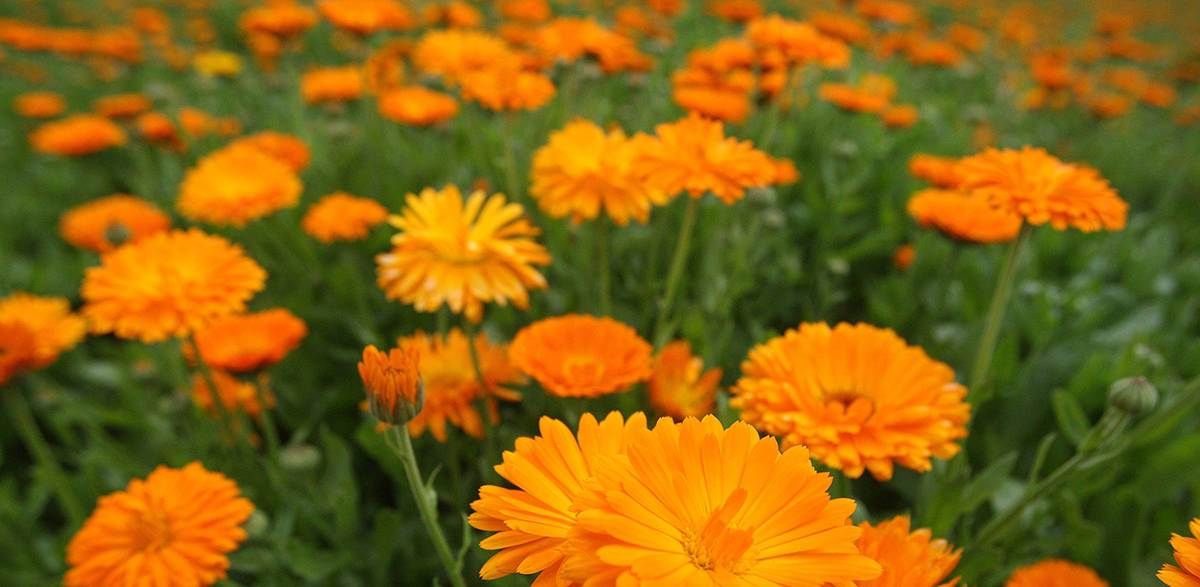
The plant itself is cheerful and compact, typically reaching 12 to 24 inches tall with a branching, bushy habit, though cultivar and growing conditions can push that anywhere from about 8 inches to over 30.[3][8] The leaves are soft and slightly sticky, oblong to lanceolate with gently toothed margins and a faint, resinous aroma when brushed.[8][2] The flowers are what everyone comes for: solitary daisy-like heads in vivid shades of orange, yellow, cream, and bicolor, blooming prolifically from late spring through fall.[8][9] That high genetic variation means the volunteers self-sown from my beds each season often come up in slightly different color intensities than what I originally planted, which I find delightful rather than alarming.
Calendula's curved, boat-shaped achenes and its mild, pleasant scent distinguish it clearly from Senecio vulgaris (groundsel), a toxic look-alike that sometimes shows up in the same garden beds.[3][8] I do a quick sniff-and-look every time I harvest from a new bed. Brighter flowers, stickier leaves, and that characteristic scent are your friends here.
Traditional and Cultural Uses
Calendula has been moving with humans for a long time. Roman trade routes carried it across Europe by 500 to 600 AD, the Silk Road brought it to Asia by the 13th century, and Spanish and Portuguese colonists introduced it to the Americas in the late 16th century.[10][4] At each stop, people found uses for it. Greek and Roman physicians including Hippocrates and Dioscorides applied it topically for wounds and inflammation; medieval herbalists like Hildegard of Bingen documented it for skin conditions; and Avicenna described its wound-healing properties in his 11th-century Canon of Medicine.[11][12] Wound healing is the consistent thread across all of these traditions, and it's one that modern research has since validated, particularly for topical applications.[13] I've made simple calendula-infused salves for minor skin irritations for years, leaning on that long track record while knowing the deeper medicinal evidence lives in the research literature rather than in folklore alone.
Culturally, the flowers carried solar and spiritual weight. Ancient Greeks planted calendula around tombs and temples of Apollo; Christian tradition linked the golden blooms to the Virgin Mary, using them in church decoration and to color butter during Lent.[14] In the kitchen, petals found their way into soups, salads, and butter as a saffron substitute for color and mild flavor, a use Nicholas Culpeper also documented in his 1653 Herbal.[15] Traditional Chinese Medicine and Ayurveda both claimed it for clearing heat and inflammation, giving it a global traditional footprint that few annual herbs can match. I've always sourced my seeds from reputable organic suppliers partly because of this: wild Mediterranean populations face some harvesting pressure, and cultivation is the responsible alternative.[13][16]
Fun Facts and Etymology
The genus name Calendula comes from the Latin "calendae," meaning the first day of the month, a reference to its famously long blooming habit that in warm climates can seem to cycle through month after month without pause. The common name "pot marigold" traces to its history as a kitchen herb thrown into the cooking pot, while "Mary's gold" reflects the Christian association with the Virgin Mary. Both names tell you something true about the plant: it's domestic and useful on one hand, luminous and symbolic on the other. The species has been so widely cultivated across so many centuries that it now carries over 50 named cultivars,[3][4] spanning flower forms from simple singles to fully doubled pompoms in every shade from cream to deep copper-orange. That breadth of cultivated diversity is a direct record of how consistently humans across cultures have wanted this plant close at hand.
Pot Marigold Varieties and Where to Buy
Notable Cultivars and Flower Types
With over 50 named cultivars bred from Calendula officinalis,[17] the choices can feel overwhelming at first, but in practice the differences come down to three things: flower form, color, and what you're growing for. The palette runs from soft pale yellow all the way to deep fiery orange with red-tinged highlights, and forms range from simple single-rayed flowers to lush, fully double pompoms.[18][8] The names I come back to most often when advising clients are 'Pacific Beauty' (a tall, double-flowered mix in rich orange and yellow that's great for cutting), 'Snow Princess' (pale cream-yellow, RHS Award of Garden Merit, notably disease-resistant), compact mixes like 'Bon Bon' and 'Fiesta Gitana' for edging, the historic ruffled 'Shirley' series from the 1930s, and 'Touch of Red' for anyone who wants that blushed-bronze look in a border.[18][4]
The single vs. double question is where it gets practical. Singles can produce 50 to 100 flowers per plant across a season, handle humidity better, and keep pollinators happier with open, accessible centers. Doubles top out closer to 20 to 50 stems but make a showier cut flower.[18][19][20] I've started labeling my seed-starting trays very carefully because double-flowered seedlings look almost indistinguishable from singles in the early weeks, and mixing them up means disappointment later when you wanted a medicinal harvest and ended up with something more ornamental. In humid climates especially, I reach for 'Snow Princess' first; I've watched it shrug off the grey mornings that leave double-flowered types struggling with fungal pressure. Nearly all cultivars are hardy from USDA zones 2 through 11 and tolerate light frost down to around 14°F,[21][4] so the cultivar choice really is about purpose more than climate.
Sourcing Pot Marigold Seeds and Plants
Few plants are this easy to find. Calendula seeds and transplants show up everywhere from big-box garden centers to specialty organic herb suppliers,[8][3] and the prices make experimenting with multiple cultivars genuinely low-stakes. Seed packets run roughly $3 to $6 for 50 to 100 seeds, and 4-inch starts land around $5 to $8. For the widest cultivar selection, though, I always point people toward dedicated seed houses: Johnny's Selected Seeds, High Mowing Organic Seeds, Territorial Seed, and Fedco all carry excellent options.[22][23] If you're growing for medicinal use and those flowers are heading into a salve or infused oil, I'd specifically look for organic-certified seed from suppliers like Mountain Rose Herbs or High Mowing. It's a small extra step that matters when the harvest goes directly onto skin.[24]
The plant is non-invasive and grows as an annual across virtually the entire country,[3] so there's no hesitation needed about introducing it. Buy seeds in early spring for direct sowing or indoor starts, or pick up transplants once your local nurseries get their seasonal stock in. Big-box stores tend to stock two or three cultivars at most; if the 'Pacific Beauty Mix' on the rack works for your purpose, great. If you want 'Snow Princess' specifically, order online.[8] Seed gives you the most control, and with germination rates this reliable, it's almost always the better starting point.
Pot Marigold Propagation and Planting (Calendula officinalis)
If you've ever saved seed from a calendula plant and held those little curved achenes in your palm, you know exactly what I mean when I say they're unforgettable. Each seed is a tiny sickle or crescent shape, about the length of your fingernail, dark brown to nearly black, with a rough, almost spiny surface that catches on everything. Botanists call this shape falcate (sickle-like) and the texture tuberculate (covered in small bumps or projections).[3][25] Once you've seen them, you won't confuse them with anything else in your seed tin. Unlike many plants in the daisy family, these seeds have no feathery pappus to float them on a breeze. They fall nearby and wait.
Understanding Calendula Seeds and Germination
The germination speed on these seeds still impresses me after years of growing them. Under good conditions, a temperature somewhere in the 60-70°F range and consistently moist soil, you'll see sprouts in as little as 7 days, usually no more than 14, with germination rates anywhere from 70 to 95 percent.[26][27] Sow them shallowly, about a quarter to half an inch deep, because they need some light to trigger germination.[17] From that first sprout to your first open flower, expect roughly 45 to 80 days, though some cultivars can stretch toward 120 days depending on conditions.[28]
One thing I wish someone had told me early on: label your rows immediately. Calendula seedlings at the first-true-leaf stage can look surprisingly similar to cilantro or young dill, and I've absolutely mixed them up in a crowded seed tray before. It's a small thing that saves real confusion later. In most of the US, calendula behaves as an annual completing its cycle in a single season, though gardeners in frost-free areas like USDA Zone 10 and above may see it behave more like a short-lived perennial.[29]
Propagation Methods for Calendula
Seed is the method here, full stop, and there's almost no reason to make it more complicated. You can direct sow after the last frost in spring, or in fall in milder climates where winters stay above freezing. For earlier blooms, start seeds indoors six to eight weeks before your last frost date.[30] Seeds don't need stratification or any cold treatment; they have low dormancy and want to germinate.[4]
I save seed from my favorite color strains every season, letting the best heads dry completely on the plant before collecting them, which takes about 30 to 40 days after flowering.[30] I store them in labeled glass jars in my refrigerator at around 5-10°C, and I still get strong germination in year three or four. The science backs this up: these seeds exhibit what researchers call orthodox storage behavior, meaning they dry and store well, retaining 50-80 percent germination viability for several years under proper cool, dry conditions.[31][32]
Stem cuttings are technically possible, with moderate success rates of 50-70 percent using non-flowering shoots taken in summer with rooting hormone and humidity.[33] I've tried it out of curiosity. It's fiddly, slower, and there's simply no advantage over sowing fresh seed. Root cuttings, layering, and grafting are a genuine waste of effort for home gardeners given low success rates and the plant's taproot structure.[34] Tissue culture exists commercially for uniformity but requires laboratory conditions; it's not something you'll do at home.[35]
The one propagation risk worth flagging now is damping-off. I've lost entire seed trays to it during humid Florida springs when I got too generous with the watering can. Good drainage in your starting mix, bottom watering rather than overhead, and adequate airflow make the difference. Watch for aphids and slugs on young seedlings too, especially outdoors.[36]
Soil, Site, and Sun Requirements
Calendula is native to the Mediterranean, where it evolved on dry, sunny, well-drained slopes, often on calcareous (chalky, alkaline) substrates.[2] That origin story tells you exactly what it wants in your garden: sun, drainage, and a soil that doesn't stay wet. Optimal pH sits between 6.0 and 7.0 for best flowering and nutrient uptake, though the plant will survive from about 5.5 up to 8.0.[3][30] In my slightly alkaline Central Florida soil, it performs beautifully as long as drainage is excellent. If I had to choose between perfect pH and perfect drainage, I'd pick drainage every time.
Loamy or sandy soils are ideal. Heavy clay, peaty soils, and anything that holds water around the roots will cause problems because the root system is shallow and fibrous, typically only 6 to 12 inches deep, with limited tolerance for waterlogging.[30][37] For containers, amend your potting mix with 20-30 percent perlite or coarse sand in pots at least 6 to 8 inches deep.[28] Full sun, at least six to eight hours daily, drives the best bloom production. Plants in too much shade stretch and pale and produce far fewer flowers.[38] In climates where summer afternoons push above 85°F, some shade during the hottest hours helps prevent wilting and leaf scorch.[39]
Spacing, Planting Technique, and Establishment
Mature calendula plants reach 12 to 24 inches tall and spread 12 to 18 inches wide,[40] and respecting that spread makes a real difference. I aim for 6 to 12 inches between plants in beds and 18 to 24 inches between rows.[28] Crowded plants trap moisture and reduce airflow, which sets the stage for the fungal issues that will be covered in more detail later. In my experience, well-spaced plants produce more flowers over a longer season than dense plantings that look impressive early but deteriorate fast.
Sow at that quarter to half inch depth, then thin seedlings to final spacing once they have their first true leaves. Don't skip the thinning. When direct sowing calendula alongside tomatoes or beans for companion planting, the same spacing guidelines apply regardless of what its neighbors are doing.[41]
Deadheading spent flowers is the single most effective establishment habit you can build. It prolongs blooming, maintains plant vigor, and keeps self-seeding at a manageable level.[42] I've come to love the volunteers that appear in my beds each spring from seed that fell the previous fall. In informal kitchen garden and food forest settings, I let a few heads go to seed on purpose and treat the resulting plants as a welcome feature. In more formal beds, I deadhead aggressively and decide exactly where I want new plants rather than letting the garden make that choice for me.
Pot Marigold Care Guide: Sunlight, Water, Feeding, and Seasonal Maintenance
Calendula is genuinely forgiving once you understand its Mediterranean instincts: it wants cool, bright, and well-drained. Get those three basics right and you'll have a plant that practically manages itself from spring through fall.
Sunlight Requirements for Calendula officinalis
Calendula needs at least 6 hours of direct sun daily for the blooms you're actually growing it for.[3][43] I've grown it in full-sun beds and along partially shaded guild edges, and the difference is striking: 6-plus hours of direct light reliably doubles flower production compared to shadier spots. Plants in too much shade get leggy, produce fewer flowers, and are the first to show powdery mildew. That said, in climates where summer afternoons push past 85°F, a bit of afternoon shade isn't a compromise; it's a lifeline, and I'll come back to why under heat tolerance.
Watering Needs and Drought Tolerance
Target roughly 1 inch per week during active growth, adjusting for rainfall and heat.[28][8] I water at the base rather than overhead; wet foliage invites the fungal problems covered later in this guide. The practical test is the top inch of soil: when it's dry, water deeply.[30] Established plants have some drought resilience, but young calendula will wilt and drop flower production within a few days of dry soil.[30] I've learned to watch for that slight midday droop as a watering cue rather than waiting for full wilt. Consistent moisture is what keeps the bloom cycle running; inconsistent moisture is what ends it early.
Feeding and Soil Fertility for Optimal Blooms
Calendula is a light feeder, and the biggest mistake I ever made with it was over-fertilizing with nitrogen early in the season. The result was tall, floppy plants with gorgeous foliage and almost no flowers. Now I work compost or well-rotted manure into the bed before planting and largely leave it alone.[26][28] If you want to supplement, a balanced low-dose fertilizer like 10-10-10 at planting or a diluted fish emulsion every few weeks during growth is plenty.[44][45] Excess nitrogen means leggy growth, reduced flowering, and higher disease susceptibility.[28] Maintain pH between 6.0 and 7.5, and if you notice yellowing between leaf veins, a seaweed foliar spray often resolves iron or micronutrient deficiencies quickly.[46]
Frost Tolerance and Cold Protection
Calendula is half-hardy, tolerating light frosts down to around 23-25°F without protection and brief dips to 14°F with it.[47][14] In zones 9-11 it can behave as a short-lived perennial, which I've seen firsthand in mild Central Florida winters when self-seeded plants persist well past the first season.[48] The parts most vulnerable to freeze damage are new shoots and flower buds; the roots are hardiest.[30] A 2-3 inch mulch layer combined with a floating row cover can raise temperatures 4-8°F and has reliably carried my plants through dips into the mid-20s without visible damage.[49][50] Well-drained soil matters here too; saturated roots in a freeze are more likely to rot than roots that stay relatively dry under mulch.
Heat Tolerance and Summer Stress Management
Optimal growing temperatures are 60-70°F during the day and 50-60°F at night.[28] Above 80°F, flowering slows noticeably, and above 85-90°F you'll see bud drop, bolting, and wilting that no amount of watering fully corrects.[41][51] It behaves a lot like basil in that way: once the heat sets in, the plant essentially goes on strike. I've watched buds form and then fall off within 48 hours when temperatures spiked. The practical fixes are morning watering, 2-3 inches of organic mulch over the root zone, and 30-50% shade cloth if afternoon sun is brutal.[52][53] Flowering almost always resumes when cooler autumn temperatures return, so don't pull the plants. If you're in a reliably hot region, heat-tolerant selections like 'Pacific Beauty Mix' or 'Bon Bon Mix' give you a better starting point.[54]
Pruning, Maintenance, and Seasonal Rhythm
Deadheading is the single maintenance task that makes the biggest difference. Removing spent flowers weekly, cutting just above a leaf node, extends the bloom period by 4-6 weeks and keeps the plant focused on producing new buds.[55][56] I do it in the morning while harvesting for tea; it takes a few minutes and the blooms keep coming for months. Pinching growing tips early, after 4-6 leaves develop, encourages bushier plants rather than tall, single-stemmed ones.
Pot marigold stays compact at 10-30 inches and rarely needs staking except in exposed, windy spots.[57] A thin layer of straw mulch handles both weed suppression and root cooling through warm spells. In temperate gardens, bloom runs late spring through fall, often 12-16 weeks or longer, with a predictable pause during peak summer heat before resuming.[58] Let a few late-season flowers go to seed and calendula will self-sow generously, returning the following year without any effort on your part.[8] Once you've given it sun, reasonable water, and restrained fertility, this plant largely takes care of itself.
Harvesting Pot Marigold: Timing, Technique, and Seed Saving
When to Harvest Calendula Flowers and Leaves
What you're harvesting from calendula determines everything about when you pick it. For culinary petals, the window is tight: flowers collected 1 to 3 days after anthesis, roughly 50 to 75 days from sowing, give you the most vibrant color and cleanest flavor.[28][59] For medicinal use, research pins the sweet spot at 50 to 70% floret openness, where carotenoid and triterpenoid lactone concentrations are at their peak before the plant shifts energy toward seed set.[60] Seed heads need considerably more patience: 30 to 45 days of drying on the plant, sometimes 90 to 100 days from sowing, before they brown down and become worth collecting.[61][30]
I've picked hundreds of calendula blooms at this point, and the sensory cues really do matter. A flower at peak turgidity has petals that spring back when you brush them; they feel almost elastic, and the color is saturated all the way to the tips. A bloom that's a day or two past has petals that give a little too easily and may show the faintest curl at the edges. In my experience, that difference between 50% and 70% openness is genuinely noticeable in the final depth of an infused oil. The fuller the flower when you pick it, the richer and more resinous the result.
The good news is that calendula gives you a long run to practice. A single plant can bloom continuously for 60 to 90 days,[26][3] and depending on where you garden, the season stretches from late spring through fall across USDA zones 2 through 11. In warmer southern areas, multiple flushes can keep you harvesting in rounds that approach year-round production with attentive management.
How to Harvest Calendula for Maximum Quality and Plant Health
The protocol I follow every time: harvest in the early morning, after the dew has dried but before the heat builds. Gently remove the entire flower head or just the petals, leaving the reproductive center intact if you want the plant to keep producing.[62][63][28] I never take more than a third of the open flowers at one pass. That one-third rule keeps the plant's energy balanced and its photosynthetic capacity intact, which means more blooms rather than a stressed plant going into decline.
Come back every two to three days. That cadence is really the secret to a months-long harvest; regular picking, combined with deadheading spent flowers, extends your window by four to six weeks compared to sporadic harvesting. The bioactive compounds in calendula decline quickly once flowers move past peak openness toward seed set,[60] so consistency protects both quality and yield. Young leaves can be picked anytime after the plant reaches six to eight inches, though I use them mostly fresh since the petals are what most people are after.
For seed saving, I let a few chosen heads go completely brown and papery on the plant before collecting them.[61][26] I label the stems by harvest date so I know which pods have had the full maturation time and which haven't. Calendula reseeds itself readily when you allow this, which is something I've always appreciated about it compared to fussier annuals that require careful coaxing. Let a handful of heads mature fully, scatter them or leave them to fall, and you'll often find a new generation already establishing before you've finished cleaning up for the season.
Pot Marigold Preparation and Uses
Culinary Uses and Flavor Profile
The petals are where the kitchen action is with calendula. They bring a mild, peppery-citrus flavor and a golden hue so close to saffron that medieval cooks used them as a substitute for coloring rice, butter, and cheese.[64][65] I've been scattering them over summer salads, stirring them into broths, and pressing them onto the tops of custards for years. They're genuinely useful in the kitchen, not just pretty.
Stick to the petals only. The central dark florets turn bitter fast, and I'd tell you the same about the white heel at the base of each petal -- pull it off before the petals go anywhere near food. I learned that the hard way making a salad for guests. The leaves are edible technically, but they're resinous and fibrous enough that I use them only as a very last resort and very sparingly.[66] The seeds can be roasted or sprouted with a pleasant nuttiness if you want to experiment.[66]
Fresh petals have a crisp, slightly chewy texture and bright grassy peppery notes. Dried petals intensify considerably -- more bitter, more complex, with a lingering aftertaste -- so they suit teas and infusions better than salads.[67] Beyond the salad bowl, they infuse beautifully into vinegars, oils, and honey, and can be pickled whole like capers, which is a preparation I keep meaning to try more often.[68] Harvest fully open flowers in the morning after the dew dries for the brightest color and cleanest flavor,[63] and always grow them organically -- these go directly into food, so pesticide residue is a real concern.[69]
If you have ragweed or daisy allergies, skip eating calendula. I've watched friends react and it's genuinely not worth testing. Large amounts can also have a mild laxative effect, so moderation matters.[70][68] Pregnant or nursing individuals should check with a healthcare provider before eating the petals regularly.[70] And if you're growing Tagetes erecta or Tagetes tenuifolia alongside your calendula, those flowers are also edible, but they're distinct plants with different flavor profiles -- don't conflate them.[41]
Medicinal Preparations
Calendula's strongest medicinal role is topical, and the preparation options are simple enough to make at home with confidence. For a skin compress, steep 1-2 teaspoons of dried flowers per cup of boiling water for 10-15 minutes, let it cool slightly, and apply 2-4 times daily.[71][72] Commercial creams typically run 2-5% calendula extract applied 2-4 times daily, which tracks with what I'd expect from the EMA's assessment of this plant.[72] For tincture use on skin, dilute to roughly 1 part tincture to 10 parts water before applying.[73]
Calendula plant tea as an internal preparation is secondary but worth knowing: 1-2 grams of dried flowers steeped in about 240 ml of hot water, taken 2-3 times daily for adults.[73] The mouthfeel is silky and mild, a little like chamomile -- which makes sense, as they're both Asteraceae. Use it judiciously rather than by the potful. For drying and storage, spread flowers in a single layer on a screen in a shaded, ventilated spot at 70-80°F and let them dry for 1-2 weeks until fully crisp.[74] I find the shaded-screen method keeps the petals a rich orange rather than fading them out. Once dry, store in airtight containers below 70°F with humidity under 60%, and they'll hold for up to a year.[47]
Non-Food and Garden Uses
Beyond the kitchen and medicine cabinet, calendula earns its place through sheer ornamental staying power. The blooms last remarkably well as cut flowers and hold color in dried arrangements too. I've used petals from my garden to create a soft, warm yellow dye for wool yarn -- the carotenoid pigments that give the flower its color transfer beautifully to natural fibers with a simple alum mordant.[75] It's a satisfying full-circle use for spent flowers that might otherwise go to compost, which is where the stems and leaves end up anyway as a modest but welcome addition to the pile.
Pot Marigold Health Benefits and Medicinal Uses
Calendula has earned its reputation as a healing plant, and the chemistry behind that reputation is genuinely impressive. What I find fascinating is that every therapeutic benefit people have observed for two thousand years traces back to a surprisingly specific set of compounds concentrated almost entirely in the flowers. The petals aren't just prettier than the rest of the plant; they're pharmacologically richer by a wide margin.
Key Phytochemicals in Pot Marigold
The flowers of Calendula officinalis contain flavonoids ranging from 10 to 50 mg per gram dry weight, carotenoids at roughly 20 to 100 mg per gram, and phenolic compounds in the range of 50 to 150 mg GAE per 100g.[76][77][78] The specific compounds doing most of the heavy lifting are flavonoids like quercetin, rutin, isorhamnetin, and kaempferol derivatives; triterpenoids including faradiol, arnidiol, and the calendulosides; carotenoids including lutein, zeaxanthin, and beta-carotene; and a set of phenolic acids rounding out the profile.[76][79] The seeds also contain calendic acid, a conjugated octadecatrienoic fatty acid unique to this species.[76] Leaves hold moderate levels of flavonoids and phenolic acids, but stems are noticeably weaker; if you're growing calendula for medicinal use, the flower heads are what you're after.
Growing conditions shift these concentrations meaningfully. Flowers harvested at peak summer bloom tend to be richest in flavonoids and essential oils, and Mediterranean-climate plants generally produce more concentrated profiles due to higher light intensity and temperature.[80] I've noticed this in my own garden in Central Florida: flowers harvested in the cool, bright months of late winter and early spring have noticeably deeper color and a sharper, more resinous scent than those struggling through heat stress. That intensity you can smell is a reliable proxy for phytochemical richness. Well-drained, loamy soils with a neutral pH further support higher yields of these compounds.[81] These aren't just academic details; they're directly relevant to the quality of any oil or infusion you make at home.
Evidence-Based Medicinal Research
European folk medicine has relied on topical calendula applications for cuts, burns, ulcers, and skin inflammations for centuries.[82][83] The European Medicines Agency formally recognizes topical calendula use for mild skin irritations and inflammatory skin conditions.[84] That's two millennia of use followed by regulatory validation, which is a reasonably compelling endorsement.
The mechanisms behind this aren't mysterious. The flavonoids and carotenoids activate the Nrf2 pathway, supporting cellular antioxidant defenses, while the triterpenoids and flavonoids together inhibit NF-κB signaling and COX-2 enzymes, reducing pro-inflammatory cytokines like TNF-α and IL-6.[85] The same extracts show broad-spectrum antimicrobial activity against Staphylococcus aureus and Candida albicans in vitro, with minimum inhibitory concentrations of 0.1 to 5 mg/mL.[86] These are the compounds you introduced to your skin when you applied a salve; now you know what they're doing there.
The clinical evidence for topical wound healing is the strongest of any application. A systematic review of 12 randomized controlled trials found calendula superior to placebo for accelerating wound closure in venous leg ulcers, diabetic foot ulcers, and postoperative wounds.[87] In rodent models, a 2% calendula ointment increased collagen deposition by 40% compared to control, through promotion of fibroblast proliferation and modulation of IL-1β and TGF-β.[88] For radiation-induced dermatitis, topical calendula cream showed comparable or superior results to trolamine in breast cancer patients, significantly lowering the incidence of grade 2 or higher dermatitis.[89] After years of making my own calendula-infused oils for salves, I've personally observed faster healing in minor kitchen burns and garden scrapes compared to plain carrier oil alone; it's gratifying when what you've noticed empirically shows up in systematic reviews.
Beyond wound healing, clinical trials have shown calendula cream outperforms zinc oxide for infant diaper dermatitis,[90] and triterpenoid saponins appear to exert immunomodulatory effects through macrophage regulation and cytokine modulation.[91] Hepatoprotective activity and potential antidiabetic and antiproliferative effects have been observed in animal models,[76] but the honest caveat here is that most of this broader research is preclinical or small-scale, and larger randomized controlled trials are still needed.[92] My take: calendula shines brightest when applied to skin. Internal use has a supporting role, but it shouldn't be overstated until the human data catches up.
Nutritional Profile of Pot Marigold
The petals are the primary edible part. Fresh flowers come in at roughly 20 to 30 kcal per 100g with modest macronutrients, while dried flowers concentrate to approximately 250 to 300 kcal per 100g with around 10 to 15g protein and 20 to 25g dietary fiber.[93][76] Vitamins and minerals are more interesting: the carotenoids contribute vitamin A activity at approximately 1660 IU per 100g fresh weight, vitamin C ranges from 3 to 15 mg per 100g fresh, and dried flowers supply meaningful calcium (150 to 200 mg), potassium (500 to 700 mg), and magnesium (50 to 100 mg) per 100g.[94][76]
There is no entry in USDA FoodData Central for calendula, so all these figures come from scientific literature rather than standardized food databases, and they vary noticeably with growing conditions.[95] Compared to nasturtiums or violets, which I've eaten by the bowlful in salads, calendula petals are more of a gentle nutritional accent than a workhorse green. The antioxidant and anti-inflammatory contributions from the flavonoids and carotenoids,[96] overlapping with the phytochemicals covered above, are probably where the real nutritional value lies for most people. A teaspoon of dried petals in your morning tea is a pleasant, low-stakes way to bring those compounds in daily.
Safety Considerations for Pot Marigold
Calendula has a reassuringly clean safety record. Oral toxicity studies in rodents showed no mortality at doses up to 2000 to 5000 mg/kg, and no documented cases of severe poisoning from calendar use in humans exist.[97][76] The ASPCA lists it as non-toxic to dogs, cats, and horses.[98] Flora of North America reports no known toxic principles.[99] For most adults using the flowers in tea or in culinary applications, this is a gentle, well-tolerated herb.
That said, there are real caveats worth taking seriously. If you have a ragweed, chamomile, or daisy allergy, be cautious; calendula's sesquiterpene lactones can cause contact dermatitis in Asteraceae-sensitive individuals.[100] I've had clients confidently slather on a calendula salve and end up with a rash because they didn't make the family connection. Patch-test before committing to topical use if that's your situation. Oral ingestion can cause mild gastrointestinal upset in sensitive people, and internal use is not recommended during pregnancy due to potential emmenagogue effects and insufficient safety data.[101][71] Those with autoimmune conditions and children should get medical guidance before regular internal use. Mild anticoagulant and sedative interactions are noted in the literature, though the evidence there is largely anecdotal.[102]
One sourcing issue that comes up more than people expect: distinguishing Calendula officinalis from certain Tagetes species. Tagetes minuta in particular can cause dermatitis and potential organ damage; T. patula may irritate skin or digestion due to thiophene content.[103] The two genera look superficially similar to newcomers. When I'm educating clients or sourcing plants, the distinguishing clues are scent (calendula has a sticky, faintly resinous aroma, while most Tagetes have a sharper, almost citrus-pungent smell) and the flower structure, though labeling from a reputable supplier is always the safer bet. A reasonable culinary dose is 1 to 2 teaspoons of dried flowers daily.[93] The FDA approves calendula for cosmetic use but has not granted GRAS status for food use,[104] so keep proportions modest and sourcing clean.
Pot Marigold Pests and Diseases
Calendula is one of those rare garden plants that does double duty in the pest arena: it defends itself and its neighbors while still being susceptible to the same pressures it helps other plants avoid. Understanding that dual role makes you a much better grower of it.
Natural Pest Resistance and Companion Planting Benefits
The chemical toolkit calendula carries is genuinely impressive. Flavonoids, saponins, sesquiterpene lactones, and terpenoids including α-thujone, camphene, and limonene all contribute to the plant's natural insect deterrence.[105][106] In companion planting trials, intercropping with pot marigold has shown up to 50-60% reductions in pest populations, with root exudates containing sesquiterpenes specifically inhibiting nematode hatching and movement.[107][108] I've tucked it around tomatoes and beans for years specifically for this reason.
The glandular trichomes on the leaves and stems secrete defensive compounds, and the volatile organic compounds the plant releases, including α-pinene and limonene, actively recruit allies: ladybugs, predatory wasps, and predatory mites all show up to investigate.[109][110] I've noticed that seedlings in my beds often have ladybugs on them within days of the first true leaves appearing. It's not coincidence. The plant is essentially signaling for backup. The flower oils also act as antifeedants against aphids like Myzus persicae, reducing their feeding and egg-laying, with moderate deterrence against spider mites and thrips.[111][112]
None of this makes calendula immune. Aphids, whiteflies, thrips, spider mites, earwigs, slugs, and snails can all still show up, and they're more likely to do so when the plant is stressed by drought, poor drainage, or high humidity.[28][113] Greenhouse-grown plants tend to face more pest pressure than those grown outside.[114] Cultivar selection matters too: 'Nabob' shows good resistance to aphids and spider mites, 'Pacific Beauty' holds up better against slugs, and 'Snow Princess' has demonstrated reduced thrips susceptibility, though no cultivar is completely immune.[115] If you do reach for a pesticide, stay away from neonicotinoids. Calendula is a pollinator magnet, and those compounds will harm the very beneficial insects you're trying to protect.[116] I design every garden I work on with pollinators in mind, and that's a line I won't cross.
Common Diseases and Environmental Influences
Calendula's flavonoids and terpenoids give it moderate disease resistance, but high humidity and poor drainage can overcome that chemistry quickly.[117] Powdery mildew is the most common issue, appearing as white powdery patches on leaves when humidity tops 60% and temperatures sit in the 55-70°F range.[118][119] I've seen it show up first on plants crowded against a wall or fence where air barely moves, which is really the lesson: the disease tells you what the siting already got wrong. Botrytis gray mold follows in cool, wet spells with its telltale brown lesions and fuzzy sporulation, while Alternaria and Septoria leaf spots appear as dark lesions with yellow halos after prolonged wet foliage. Downy mildew brings yellowing and grayish growth on leaf undersides in cool moist conditions, and Puccinia calendulae rust produces orange pustules on stems and leaves. Root rot from Phytophthora or Pythium will take hold fast in waterlogged soil.[117][120]
Fusarium wilt can cause wilting and yellowing in warm, poorly drained soils; bacterial blight from Xanthomonas campestris spreads through splashing water; and viruses like cucumber mosaic and tomato spotted wilt, both transmitted by aphids, can cause mosaic patterns and stunting.[120] Soil pH outside the 6.0-7.0 range or temperature extremes can weaken the plant's defenses and open the door to any of these.[121] For cultivar selection in humid conditions, 'Pacific Beauty' has shown better tolerance to both powdery mildew and Botrytis, 'Art Shades' performs well where rust is a recurring problem, and 'Fiesta Gitana' holds up under downy mildew pressure, though all of them will struggle if the environment is working against them.[122]
Integrated Management and Cultural Practices
The single most effective thing you can do for calendula's health is give it room. Spacing plants 12-18 inches apart, using well-drained soil, keeping water off the foliage, removing infected debris, and rotating your planting location every 2-3 years will prevent the majority of problems before they start.[30][114] In my experience, staying ahead with airflow and garden hygiene keeps calendula looking vibrant with almost no chemical intervention needed.
When problems do appear, work through the progression deliberately. Let the beneficial insects the plant has attracted do their job first. If you need to intervene, reach for insecticidal soap for aphids, neem oil or sulfur for powdery mildew, and copper-based fungicides for rust.[117][123] For slugs in damp springs, copper tape barriers around individual beds work well. Reserve synthetic options for genuine outbreaks after cultural and biological methods have been exhausted, and always consider the pollinators feeding on those flowers. Prevention through good garden practice is genuinely far more effective than trying to treat an established problem, and calendula is resilient enough that you rarely need to get beyond the basics.
Pot Marigold in Permaculture Design
Few plants in my design toolkit earn their space as quietly and consistently as calendula. It doesn't fix nitrogen, it doesn't build deep root channels, and it won't live forever. But what it does do, it does remarkably well: it draws in beneficial insects, keeps certain pests honest, and delivers culinary and medicinal yields, all while staying well-behaved in the herbaceous layer. For a plant that asks so little, the returns are genuinely impressive.
Climate Adaptability and Hardiness Zones
Calendula officinalis is adapted across an unusually wide range, from USDA zone 2 all the way through zone 11, though what that looks like on the ground changes considerably depending on where you garden.[3][7] In zones 2 through 7, treat it as the hardy annual it is, reseed each spring, and don't overthink it. In zones 8 through 11, it may self-seed, overwinter with a little protection, and naturalize in conditions that echo its Mediterranean origins: mild wet winters, dry summers, and decent drainage.[2][124]
Its frost tolerance is real but not unlimited. It handles light frosts down to around 25°F without much drama,[124] and in milder climates an autumn sowing under cloches can carry plants through winter for early spring blooms.[125] The opposite end of the spectrum is where things get trickier. Once temperatures consistently push past 80°F, flowering slows and plant vigor drops.[8] I garden in a humid subtropical climate, and I've learned to think of calendula as a cool-season annual here, timing it for late fall through spring rather than fighting the summer heat. When the humidity climbs and air circulation is poor, foliar problems follow quickly; avoiding overhead watering in rainy periods makes a real difference. It prefers moderate humidity in the 40-60% range with reliably good drainage, and in hotter zones a bit of afternoon shade helps extend the productive window.[28] One practical note for gardeners in zones 2 and 3: label your rows. Self-seeders from the previous year's plants can appear in unexpected spots come spring, and if you're not sure what's a calendula seedling versus a weed, you'll pull the wrong thing.
Ecosystem Functions and Guild Roles
The pollinator draw is where calendula's ecological value becomes immediately visible. Those wide-open yellow and orange composites are nectar and pollen magnets for honeybees, bumblebees, hoverflies, and butterflies, with peak activity at temperatures between 59 and 77°F.[41][126] Because it blooms from spring through autumn,[127] it provides extended support through the seasons when many other plants have come and gone. In my beds I've watched hoverflies arrive in force the moment temperatures hit the low 60s. What could become an aphid situation gets quietly managed before I even notice a problem starting.
That's not accidental. Calendula actively recruits the beneficial insects doing that management work, attracting ladybugs, lacewings, and parasitic wasps while its scent and root exudates push back against aphids, whiteflies, and soil-dwelling nematodes.[128][129] The tomato pairing is one I come back to in nearly every kitchen garden design I do. Intercropping calendula with tomatoes has shown nematode population reductions of up to 50% in some trials,[130] which is a meaningful number if you've ever lost tomato plants to root-knot damage. Add basil to that combination and you've got a classic vegetable guild with complementary pest suppression, pollinator support, and multiple harvest yields from a small footprint.
Dense planting also offers some mild allelopathic and antimicrobial effects that can temporarily slow weeds when used as a seasonal ground cover.[131] I learned the hard way not to count on it as a primary weed management strategy. In an early food forest design I was relying too heavily on it to suppress weeds between shrubs, and it simply didn't hold. Combining it with a low-growing clover beneath it closed the gaps and gave the system the ground coverage it actually needed. Calendula is a supporting player for weed suppression, not the lead.
The yields it offers beyond pest management are what cement its place in my designs. The flowers are edible, traditionally used as a natural dye, and the plant has a long history of medicinal application for anti-inflammatory and wound-healing preparations.[132] I harvest only from plants grown without chemical inputs, particularly for anything going into topical preparations or teas, where purity genuinely matters.
Forest Layer Placement and Companion Planting
At 12 to 24 inches tall, calendula slots into the herbaceous layer of a food forest or permaculture guild without competing for light or creating shade problems for the plants around it.[133][134] Its non-woody structure means it won't push against canopy plants, and its preference for full sun keeps it productive at the forest edge or in the open gaps of a young food forest before the canopy closes in. I find it works similarly to chamomile in layered systems: easy to integrate, contributes to overall ecosystem health, and doesn't require much management to stay useful.
In guild design, it pulls triple duty as a pest repellent, pollinator plant, and self-recruiting companion. In zones 5 and warmer, self-seeding means you often get volunteers appearing right where you need them, which is a satisfying kind of low-input abundance.[3][135] That said, in ideal conditions it can get ahead of you, so a bit of management keeps it from crowding out more intentional plantings. The tradeoff is worth it. Few herbaceous annuals deliver this combination of ecological function, harvest potential, and adaptability across so many climates with so little ongoing input. It's the kind of plant that makes a whole design feel more alive.
The Plant I Never Actually Planned to Keep
I didn't design calendula into my food forest. It just showed up one spring from a handful of seeds a friend pressed into my hand, and it never really left. Every year I tell myself I'll plant it somewhere more intentional, and every year it decides for me, tucking itself between the tomatoes and the borage like it belongs there. Honestly, at this point, it does.
Sources
- Calendula officinalis and Wound Healing: A Systematic Review ↩
- Plants of the World Online (Kew Science) ↩
- USDA PLANTS Database - Calendula officinalis ↩
- Calendula officinalis - Wikipedia ↩
- Royal Horticultural Society - Calendula officinalis ↩
- Missouri Botanical Garden - Calendula officinalis ↩
- Missouri Botanical Garden Plant Finder - Calendula officinalis ↩
- Missouri Botanical Garden - Calendula officinalis ↩
- Royal Horticultural Society - Calendula officinalis ↩
- Calendula officinalis ↩
- The Medicinal Uses of Calendula officinalis in Traditional Medicine ↩
- Herbal Medicine: Biomolecular and Clinical Aspects - Calendula Chapter ↩
- Calendula officinalis L. (Asteraceae): A Review of Its Traditional Uses, Phytochemistry, and Pharmacological Activities ↩
- Calendula officinalis ↩
- Journal of Ethnopharmacology: 'Ethnomedicinal Use of Calendula officinalis' ↩
- Sustainability of Herbal Medicinal Plants ↩
- Calendula officinalis ↩
- Calendula - RHS Gardening ↩
- Calendula Varieties for Garden and Cut Flowers ↩
- Growing Calendula for Cut Flowers ↩
- Calendula officinalis (Pot marigold) ↩
- Calendula Seeds ↩
- Calendula officinalis Seeds ↩
- Organic Calendula Flowers ↩
- Seed Morphology of Calendula officinalis ↩
- Calendula officinalis Growing Guide ↩
- Royal Horticultural Society Plant Finder ↩
- USDA Extension - Calendula Planting Guide ↩
- Missouri Botanical Garden Plant Finder - Calendula officinalis ↩
- Calendula officinalis Growing Guide ↩
- Seed Information Database (SID) - Royal Botanic Gardens, Kew ↩
- Calendula officinalis Seed Germination and Storage ↩
- Calendula officinalis ↩
- Grafting Techniques in the Asteraceae Family: Opportunities and Challenges ↩
- Micropropagation of Calendula officinalis L. through axillary shoot proliferation ↩
- Common Pests and Diseases of Calendula ↩
- Alizadeh et al. (2013). Stress Physiology and Growth Response of Calendula officinalis L. to Organic Matter Content in Soil ↩
- Oregon State University Extension Landscape Plants Program ↩
- Missouri Botanical Garden Plant Finder ↩
- Royal Horticultural Society - Calendula officinalis ↩
- Missouri Botanical Garden Plant Finder - Calendula officinalis ↩
- Royal Horticultural Society Plant Profile ↩
- Missouri Botanical Garden Plant Finder ↩
- Effects of NPK on Calendula Yield and Quality ↩
- Pot Marigold (Calendula) - North Carolina State University Extension ↩
- Fertilizing Flowers - Penn State Extension ↩
- Calendula officinalis ↩
- USDA Plant Hardiness Zone Map ↩
- Royal Horticultural Society (RHS) - Calendula Care Sheet ↩
- University of Minnesota Extension - Overwintering Annuals ↩
- Environmental Stress Effects on Pot Marigold (Calendula officinalis L.) ↩
- Growing Calendula in the Home Garden ↩
- Shade Cloth Use in Horticulture ↩
- Heat Stress Management in Ornamental Plants ↩
- Royal Horticultural Society: Calendula officinalis Cultivation Guide ↩
- UC Cooperative Extension: Calendula Factsheet ↩
- Missouri Botanical Garden: Plant Finder for Calendula officinalis ↩
- Calendula officinalis - RHS Gardening ↩
- Growing Calendula for Flowers, Herbs and Seeds ↩
- Optimal Harvest Stage for Bioactive Compounds in Calendula ↩
- Seed Saving for Calendula ↩
- Missouri Botanical Garden - Calendula officinalis ↩
- Herb Society of America - Calendula Harvesting Guide ↩
- Journal of Ethnopharmacology - Review article on Calendula officinalis ethnobotany ↩
- Pot marigold ↩
- Plants for a Future - Calendula officinalis ↩
- Kew Gardens ↩
- Edible Flowers: Calendula ↩
- USDA PLANTS Database ↩
- Calendula officinalis ↩
- National Center for Complementary and Integrative Health (NCCIH) ↩
- European Medicines Agency (EMA) - Assessment Report on Calendula officinalis L., flos ↩
- European Medicines Agency (EMA) Herbal Monograph ↩
- Harvesting and Storing Herbs ↩
- Missouri Botanical Garden Plant Finder ↩
- Phytochemical and Pharmacological Properties of Calendula officinalis L. ↩
- Phytochemical and Pharmacological Review of Calendula officinalis ↩
- Calendula officinalis - Phytochemical Constituents and Ethnopharmacological Review ↩
- Flavonoids and Terpenoids in Different Parts of Calendula officinalis ↩
- Secondary Metabolites of Calendula officinalis L.: Seasonal and Environmental Variations ↩
- Influence of Soil Type on Chemical Composition of Calendula officinalis ↩
- Ethnobotany of Calendula in European Folk Medicine ↩
- WHO Monographs on Selected Medicinal Plants - Volume 1 ↩
- EMA Community Herbal Monograph on Calendula officinalis ↩
- Anti-inflammatory and Antioxidant Activities of Calendula officinalis: A Review ↩
- Antimicrobial Activity of Calendula officinalis: Review ↩
- Calendula officinalis for Wound Healing: A Systematic Review ↩
- Wound Healing Efficacy in Rats ↩
- Topical Calendula versus trolamine for the prevention of acute dermatitis during radiation for breast cancer ↩
- A Prospective, Randomised Clinical Trial of Topical Treatment with Calendula officinalis in Infants with Diaper Dermatitis ↩
- Calendula officinalis - Antitumor and Immunomodulatory Effects ↩
- Systematic review of Calendula officinalis ↩
- Missouri Botanical Garden Plant Finder ↩
- Nutritional Composition of Edible Flowers ↩
- USDA FoodData Central ↩
- Antioxidant Activity of Calendula officinalis Flower Extract ↩
- Safety and Toxicity of Calendula officinalis ↩
- ASPCA - Calendula officinalis ↩
- Flora of North America - Calendula officinalis ↩
- Allergic contact dermatitis from Calendula officinalis ↩
- EMA Assessment Report on Calendula officinalis ↩
- Calendula officinalis - Drugs.com ↩
- Tagetes minuta - USDA PLANTS Database ↩
- Calendula - Drugs and Lactation Database (LactMed) ↩
- Insecticidal Properties of Calendula officinalis ↩
- Sesquiterpene Lactones as Potential Insecticidal Agents from Asteraceae Species ↩
- Companion Planting with Calendula for Pest Control ↩
- Intercropping Strategies with Marigolds for Sustainable Pest Control ↩
- Glandular Trichomes in Calendula officinalis: Structure and Function in Defense ↩
- Volatile Organic Compounds from Calendula officinalis Attract Beneficial Insects ↩
- Insecticidal Activity of the Essential Oil from Flowers of Calendula officinalis L. ↩
- Antifeedant Effects of Plant Essential Oils on Aphids ↩
- Pest Management for Pot Marigold ↩
- UC IPM - Calendula Pests and Disorders ↩
- University of California Agriculture and Natural Resources - Calendula Pest Management ↩
- Pesticides and Pollinators ↩
- Calendula officinalis Diseases and Pests ↩
- Powdery Mildew on Calendula ↩
- Powdery Mildew on Ornamentals ↩
- Diseases of Calendula - University of California IPM ↩
- Royal Horticultural Society (RHS) - Calendula officinalis cultivation ↩
- Disease Resistance in Calendula Cultivars - University of California Agriculture and Natural Resources ↩
- Integrated Pest Management for Flowers ↩
- Royal Horticultural Society - Calendula officinalis ↩
- RHS Gardening: Calendula officinalis ↩
- Royal Horticultural Society - Calendula officinalis ↩
- Horticultural Guide to Growing Calendula ↩
- UC IPM - Calendula officinalis Cultivation ↩
- Attracting Beneficial Insects with Flowers ↩
- Intercropping Calendula with Tomatoes for Nematode Suppression ↩
- Ecosystem Services Provided by Marigolds ↩
- Plants of the World Online (Kew Science) ↩
- Missouri Botanical Garden - Calendula officinalis ↩
- Royal Horticultural Society - Calendula officinalis ↩
- Missouri Botanical Garden - Calendula officinalis ↩
About the Author
Angela Birrittella is a writer and self-taught nature lover living in Wisconsin. She grew up in a midwestern apple orchard and fell in love with plants at a young age. An instructional designer by trade, she converted her quarter-acre city lot into a mini-food forest she calls "the micro-farm." Angela strives to demystify permaculture and make growing your own food accessible to all.