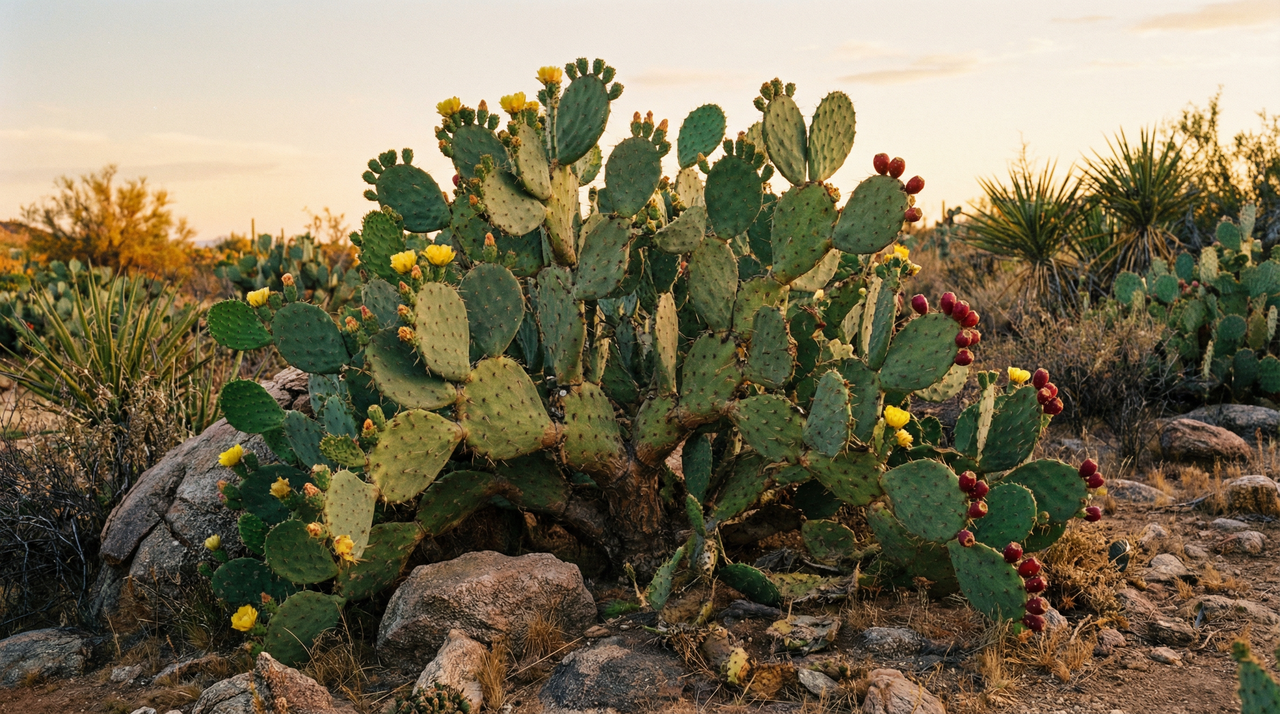
Here's the thing nobody mentions about the Mexican flag: that eagle standing on a cactus isn't decorative. It's the founding myth of Tenochtitlan, the vision that told the Aztecs they'd found their promised land, and the cactus in question is prickly pear. Not corn, not amaranth, not any of the other foods that made Mesoamerica one of the great agricultural cradles of the world. A cactus. One that had already been feeding people in the arid Mexican highlands for roughly 9,000 years by the time the Aztecs built their city on a lake.[1] That context has stayed with me every time I harvest a pad or bite into a ripe tuna, because it reframes the whole plant. This isn't a novelty cactus for a dry garden corner. It's a staple crop with deeper cultural roots than almost anything else most of us are growing.
What gets me, though, is how thoroughly we've managed to misfile it in the Western gardening imagination. People see the spines and think "ornamental, dangerous, hands-off." They don't think "dinner." But the pads are a genuine vegetable, the fruits are genuinely delicious, and the plant will thrive in conditions that would kill most food crops without a second thought. I've grown it in three climates now, and it's the one plant I've never lost to drought.
Prickly Pear Origin, History, and Botanical Background
If you want to understand prickly pear, start in Mexico. Specifically, in the sun-blasted, rocky highlands of central and southern Mexico, where Opuntia ficus-indica evolved in open, sunny habitats with minimal canopy cover and soils that most plants would refuse entirely.[2][3] This is where its entire biology makes sense: a plant that stores water in its pads, opens its stomata only at night to cut evaporative loss, and defends itself with spines and glochids because the environment gave it no other choice. That's not just survival. That's thousands of years of elegant engineering.
Botanical Characteristics and Adaptations
The prickly pear cactus scientific name, Opuntia ficus-indica, places it in family Cactaceae, subfamily Opuntioideae. Its modified stems, called cladodes or pads, do the photosynthetic work that leaves handle in other plants, and the whole system runs on Crassulacean acid metabolism (CAM), a photosynthetic pathway that lets it fix carbon at night and keep its stomata shut during the heat of the day. The result is a plant that can thrive where rainfall is both scarce and unpredictable.
The genus Opuntia is sprawling and taxonomically contested, with somewhere between 150 and 300 recognized species distributed across the Americas. O. ficus-indica is by far the most commercially significant, now naturalized across Mediterranean, African, and Asian regions. Its relatives tell the story of the genus' range: compact O. basilaris forms low mats in the southwestern US, O. cochenillifera reaches tree-like proportions in central Mexico and southern Texas, and O. valida hugs the dry scrublands of the southwest.[4][5][6] What they share is a tolerance for drought and heat that most food plants can't approach.
As a polycarpic perennial, prickly pear flowers and fruits year after year rather than dying after a single reproductive cycle. A well-situated plant typically lives 20 to 50 years, though some specimens push well past that.[7][8] In the wild, drought, herbivory, and resource scarcity can shorten that considerably, but in cultivation, where it gets even modest care, this plant is genuinely long-lived. The species tolerates elevations from sea level up to roughly 2,500 meters, though it performs best below 1,500 meters.[2] Spanish colonizers carried it into the American Southwest and Southeast between the 16th and 18th centuries, and it now grows naturally in California, Arizona, Texas, and New Mexico alongside cultivated populations across the Mediterranean, South Africa, and beyond.[9][10]
Visual Identification Features
A mature O. ficus-indica is a substantial plant. It grows as a large, multi-stemmed shrub or small tree with a characteristic candelabra branching pattern, reaching anywhere from 3 to 16 feet tall with a spread of 6 feet or more.[11][12] First-time visitors to a mature specimen are often surprised by the scale. I've seen established plants in Southern California that read from a distance more like small trees than cacti. Compare that to O. basilaris, which rarely clears 16 inches, and you get a sense of how wide the genus runs in scale.[13]
The pads themselves average 15 to 40 centimeters long and 10 to 20 centimeters wide, though they can push larger under good conditions.[11][14] New growth comes in bright, almost lime green, then matures to that distinctive bluish-green with a waxy, glaucous coating that catches the light differently at different times of day. It's one of those details that only becomes obvious once you've watched the plant through multiple seasons. Each pad is studded with areoles bearing 2 to 6 central spines plus abundant glochids, those tiny barbed hair-like structures that are honestly more troublesome than the larger spines because they embed so easily.[14][15] Spineless cultivars like 'Burbank Spineless' reduce that irritation dramatically, which matters enormously for anyone planning to harvest pads regularly.
Flowers emerge from pad margins between April and June in the US, cup-shaped and typically yellow, though orange and red forms exist.[16] Fruit follows as fleshy, pear-shaped berries 7 to 9 centimeters long, ripening from green to red, purple, or yellow-orange depending on the cultivar, with sweet pulp and up to 300 small hard seeds packed inside.[2][17] The whole plant is plastic in the way that well-adapted survivors are: give it water and the pads thicken noticeably, fruit yields climb, and spine density drops. Stress it with drought and it toughens back up.[18][19]
Traditional and Cultural Uses
Archaeological evidence from the Tehuacan Valley places human use of prickly pear at 9,000 to 11,000 years ago.[20][21] That's not a footnote; that's a relationship older than most of our domesticated food crops. The Aztecs wove it into everything: the pads (nopales) and fruits (tunas) as staple foods, the plant as medicine for wounds and digestive complaints, and its image serving as a central cultural and religious symbol for their empire.[22][23] For me, designing regenerative landscapes, that kind of staying power in a food plant isn't just historical trivia. It's evidence that a plant has genuinely earned its place in human systems.
The Spanish recognized that value quickly. After the conquest of Mexico, they introduced O. ficus-indica to Europe around 1520 to 1530, and it naturalized so thoroughly in Mediterranean climates that many Sicilians and Spaniards would later be surprised to learn it wasn't native.[24] Colonial trade routes carried it further still, to Africa, Australia, and the Caribbean. The closely related O. cochenillifera traveled those same routes for a different reason: it hosts the cochineal insect, source of the carmine dye the Aztecs had been producing since 1200 BCE and that became one of the most valuable colonial exports.[25]
That global spread came with consequences. In Australia and South Africa, where it landed without the natural enemies that kept it in check at home, prickly pear became a declared invasive, overwhelming native vegetation.[26][27] In a well-managed garden in an appropriate climate, I consider it an asset. In regions where it naturalizes aggressively, that assessment changes entirely. The ethical threads around indigenous knowledge and traditional use deserve acknowledgment too: 9,000 years of Mesoamerican stewardship gave the world this plant, and that history warrants more than a passing nod.
Ecological Role and Interesting Facts
A mature prickly pear can reach 5 to 6 meters tall with a trunk diameter up to 50 centimeters.[11][19] Pick up a pad after a good rain and you'll understand immediately why: these things are dense with stored water, heavy in a way that feels almost implausible for a desert plant. That water storage, the CAM photosynthesis, the shallow roots that race to capture sporadic rainfall while deeper anchoring roots hold the plant in place, all of it adds up to a plant that functions as a keystone in arid ecosystems.[28][29]
Its ecological contributions run the full stack: flowers feeding bees, beetles, and nectar bats; fruit fueling birds and mammals that disperse seeds; dense colonies sheltering reptiles and ground-nesting birds; root systems stabilizing erodible soils; and the whole structure acting as a nurse plant for seedlings that couldn't otherwise survive open, exposed conditions.[30][31] In commercial cultivation, well-managed plants yield 10 to 30 tons of fruit per hectare, with high-yield varieties hitting 40 tons, and individual plants producing 5 to 15 kilograms annually once they hit their stride after 3 to 5 years of establishment.[32] One note for new growers: those production numbers improve noticeably with supplemental water in the early years, even though the plant will survive without it. Drought tolerance and drought preference aren't the same thing. Always remove glochids carefully before handling fruit or pads, and check your state regulations before planting, since naturalization potential varies significantly by region.[33][34]
Prickly Pear Varieties and How to Source Them
Notable Varieties and Cultivars of Opuntia ficus-indica
If you're growing prickly pear for food production, Opuntia ficus-indica is where the conversation starts. This is the species behind most commercial orchards worldwide, and for good reason: mature plants can reach 10 to 16 feet tall and nearly as wide, with those distinctive blue-green pads, serious drought tolerance (surviving on under 300mm of annual rainfall), and cold hardiness down to around 10°F in USDA zones 8 through 11.[35][34][36] Globally, over 50 recognized cultivars exist, sorted by fruit color, pad shape, climate adaptation, and whether the plant is being grown primarily for pads or fruit.[37][38]
In US gardens, the names you'll encounter most are 'Burbank Spineless' (sometimes sold as 'Burbank Thornless'), 'Santa Rita', 'Texas Red', and 'Mexican Yellow'.[38][39] I've grown both spiny and spineless forms side by side, and the difference in day-to-day handling is striking. The spineless types are just so much easier to work with at harvest, and they typically deliver 20 to 30% higher edible yields because there's less loss during processing.[40][41] Fruits ripen red to purple with a sweet watermelon or strawberry character, roughly 90 to 120 days after flowering.[40][42] The pads are edible too, as nopales, once spines are properly removed. In optimal conditions, yields can hit 10 to 15 tons per hectare for fruit and 20 to 30 tons per hectare for pads.[39][43] 'Santa Rita' is worth calling out specifically for cold hardiness, tolerating down to around -12°C, which makes it one of the tougher options for gardens on the edge of its range.[39]
A quick taxonomic note: you may occasionally see the name "Opuntia alko-tuna" in informal online sources. That's not a recognized species; it appears to be a colloquial reference rather than valid taxonomy. The correct designation is Opuntia ficus-indica, with two recognized subspecies: subsp. indica and subsp. sabothica.[31][2]
Beyond the anchor species, the genus offers some genuinely useful diversity. Opuntia valida (the santa rita prickly pear cactus, sometimes sold under that common name) stays compact at 3 to 6 feet tall with showstopping blue pads and deep reddish-purple fruits that have a sweet, melon-like tang.[16][44] It handles cold down to -12°C and works beautifully in xeriscapes and rock gardens where you want ornamental impact alongside edibility.[45] Opuntia cochenillifera is a different animal entirely: larger, reaching 6 to 10 feet, spineless or variegated in some cultivars, and historically grown not for its fruit (though those are sweet and citrus-melon flavored) but as the host plant for cochineal dye insects.[46][47][48]
The beavertail prickly pear cactus (Opuntia basilaris) is the one I'd point to for anyone working a smaller space. It tops out at 1 to 3 feet tall and spreads to around 6 feet, with naturally spineless pads, outstanding drought tolerance, and cold hardiness down to 10 to 20°F.[49][50] Ornamental cultivars like 'Benton Beauty' and 'Purple Mystery' lean decorative, but the fruits are legitimately edible with that watermelon-strawberry sweetness.[51] Compared to a vigorous O. ficus-indica specimen pushing 15 feet across, beavertail fits into a courtyard or a modest suburban xeriscape without taking over. Opuntia monacantha rounds out the picture as a South American species with drooping cladodes up to 60 cm and sweet-tangy red-purple fruits; its taxonomy is still somewhat fluid across sources, but it's listed as Least Concern by IUCN with low to moderate invasiveness.[52][53]
Sourcing Prickly Pear Plants Responsibly
Opuntia ficus-indica is genuinely easy to find in the US. Nurseries like Planet Desert, The Cactus King, Mountain Crest Gardens, and Mountain Valley Growers all carry it regularly. Pricing runs roughly $3 to $10 for rooted pads or cuttings, $10 to $25 for small potted plants, and up to $50 to $150 for large established specimens.[16] Propagation from pads is genuinely foolproof once you know the basics, which makes that lower price tier an excellent entry point.
Before you order, though, please check your state's regulations. O. ficus-indica is considered moderately invasive in California, Florida, and parts of Texas, and USDA APHIS rules plus state-level restrictions can complicate interstate shipping of larger plants.[26][54][55] I learned this the inconvenient way when a box I'd ordered got flagged at the California border. Verify before you buy, not after.
Opuntia valida is genuinely rare in the nursery trade and mostly turns up at specialized desert or native plant nurseries.[56] Beavertail and cochineal nopal are more accessible through the same specialty sources, with prices typically landing in the $5 to $50 range depending on size and maturity.[57] O. monacantha is available from Mountain Crest Gardens and similar retailers and doesn't carry the same federal invasive concerns.[58] Across all of these, I only buy from nurseries that propagate their own stock rather than wild-collect, and I'd encourage you to do the same. Wild populations of native Opuntia species deserve that protection, and nursery-propagated plants tend to be healthier and pest-free when they arrive.
Prickly Pear Propagation and Planting
Reproductive Biology and Propagation Methods
Even when you grow a prickly pear from seed, you're almost always getting a clone. Opuntia ficus-indica reproduces primarily through apomixis, meaning it produces seeds without fertilization, and roughly 95-99% of those seeds are apomictic.[59][60] Compound that with polyembryony, where a single seed can carry 2-10 embryos, most arising from diploid nucellar cells that are genetically identical to the mother plant,[61] and you end up with extraordinary genetic stability across seedling populations. Fewer than 5% of seeds are sexually derived.[62] For conservation or breeding work that matters a great deal, but for the home grower it mostly means seed-grown plants are reliably true to type.
That said, pad cuttings remain the workhorse method, and for good reason. A well-rooted pad can have you harvesting fruit in 1-3 years, while seed-grown plants typically take 3-5 years or more to reach reproductive maturity.[63] Spring and early summer are the sweet spot for taking cuttings, ideally when temperatures are consistently above 70°F, and success rates run 80-95% when you do one thing right: let the cut end callus completely before planting.[64] The standard guidance is 3-7 days in a dry, shaded spot,[65] but I've propagated dozens of pads over several seasons here in Central Florida, and humidity changes everything. I routinely go a full two weeks before planting, and it's made a dramatic difference in reducing rot compared to the shorter windows that work fine in drier climates.
Once callused, set the pad upright with the wound end down, buried about 1-2 inches deep in a well-draining cactus mix.[66][67] Keep it in bright indirect light at 70-80°F, water very sparingly and let the soil dry completely between waterings, and expect roots in 4-8 weeks with new pad growth appearing around 2-3 months in.[68]
Seed propagation is slower and more work, but genuinely worth understanding. The seeds are hard, black, reniform, 2-4mm long, with a coat impermeable enough that scarification is essentially mandatory. With it, germination rates climb to 70-80%; without it, expect considerably less.[63][69] Germination happens in 2-8 weeks at 70-85°F under warm, moist conditions. One thing I always tell new growers: seedlings look deceptively like tiny green balloons for the first several weeks before the first recognizable pads form. Label your rows carefully because they're easily mistaken for weeds or other succulents at that stage.
Grafting onto compatible rootstocks like O. robusta or O. humifusa is worth considering in marginal climates or when you want faster establishment. Success rates are 70-90% with proper vascular alignment and careful post-graft humidity management.[70][71] Grafted plants can produce fruit in as little as 1-2 years, and dwarfing rootstocks can reduce overall plant size by 20-30%, which matters when you're working a smaller site.[72] Spineless cultivars are easier to handle during any propagation work, though they need the same exacting drainage and spacing standards as their spiny relatives.[73]
For those interested in conservation or breeding, prickly pear seeds are orthodox, meaning they store beautifully when kept cool and dry. Short-term storage at 5-10°C with 10-20% relative humidity keeps seeds viable for 1-5 years; for long-term banking, freezing at -18 to -20°C in airtight containers with desiccant can preserve viability for 20 years or more, with some seeds documented in soil seed banks for up to 50 years.[74][75] Pads are still the everyday answer for propagating prickly pear, but having a seed stock tucked away is sound backup practice for any serious grower.
Soil, Site Selection, and Spacing Requirements
Every conversation about planting prickly pear cactus should start here: drainage. Not pH, not fertility, not sun exposure. Drainage. Opuntia ficus-indica thrives in sandy, loamy, gravelly, or rocky soils with low organic matter, and tolerates a pH range from 6.0 to 8.5 with an optimal window of 6.0-7.5.[76] It handles salinity up to 8-10 dS/m and does fine on marginal, calcareous, or poor soils that would defeat most crops.[77] But none of that tolerance matters if the soil stays wet. In my experience, even a soil that tests at a perfect pH will kill a prickly pear if water sits around the roots for more than a couple of days. Since I switched every new bed to a mix that's at least 60% inorganic material, I haven't lost a single plant to root rot.
For containers, a 50/50 blend of inorganic grit (perlite, pumice, or coarse sand) to organic material is about the minimum; heavier on the inorganic side is better, and peat-heavy commercial mixes are a recipe for problems.[78][50] In ground beds with heavy clay, amend aggressively with grit or perlite, or better yet raise the bed or choose a slope. The plant's native habitat often features rocky outcrops and hillsides that shed water naturally, and replicating that condition is the whole goal.
Full sun is non-negotiable for healthy growth and fruiting: aim for 6-8 hours of direct light daily across all life stages. The one exception is newly transplanted pads or recently germinated seedlings, which can sunburn before their root system is established and benefit from temporary partial shade.[39][16] The shallow fibrous root system spreads 1-3 meters laterally but typically only 15-60 cm deep, which explains why loose, aerated, non-compacted soil is so important; compacted ground restricts that lateral spread and sets the plant up for stress.[39]
Planting Technique, Timeline, and Germination
Mature O. ficus-indica reaches 10-16 feet tall and equally wide, so spacing matters from day one.[79] The recommended spacing for growing prickly pear at a productive scale is 6-10 feet between plants in-row and 10-20 feet between rows, yielding 400-2,000 plants per hectare depending on whether your goal is fruit production, forage, or a living fence.[80] Closer spacing raises disease pressure; wider spacing opens up airflow, improves light penetration, and makes working around spiny plants considerably less painful. I used to crowd plants thinking I'd get faster coverage. What I got instead was a scale outbreak that took two full seasons to resolve. Eight feet between mature ficus-indica plants is now my minimum, and I won't negotiate on it.
For planting prickly pear cactus from pads, set the callused base stable in the soil, bury 1-2 inches, and then largely leave it alone. Water every 2-4 weeks for the first few months, always allowing complete dry-down between waterings.[64] Roots typically establish in 4-8 weeks, and plants grown from pads reach reproductive maturity in 1-3 years. For seed-grown plants, expect germination in 2-8 weeks at 70-85°F after scarification, first pads forming in year 1-2, and fruiting from year 3-5 at the earliest.[63]
During establishment, keep tools sterile between cuts, maintain that thorough callus before any pad touches soil, and prioritize airflow through your spacing choices. Cochineal scale, mealybugs, cactus moths, bacterial soft rot, and fungal rots all find their easiest entry points through fresh wounds on overcrowded, poorly drained plants.[81][76] Get the drainage and spacing right from the start, and most of those problems simply don't materialize.
Prickly Pear Care Guide
Caring for prickly pear cactus is mostly an exercise in restraint. I've grown a lot of plants that reward constant attention, but this isn't one of them. Get the fundamentals right at planting and then step back; that's genuinely the strategy. What I want to walk through here are the few places where judgment actually matters, because there are some easy mistakes that can take out an otherwise indestructible plant.
Sunlight Requirements for Prickly Pear
Full sun isn't optional. Opuntia ficus-indica needs at least 6 to 8 hours of direct light daily to produce firm, healthy pads and to flower and fruit reliably.[82][83][50] I've watched plants in a partially shaded corner of a food forest develop that classic etiolated look, stretched and pale, with soft, floppy pads that never quite hold their shape. Moving those same plants into full sun stiffened them up within a season and triggered the first bloom within the following year. The whole genus shares this sensitivity to low light; if you're growing in a container indoors over winter, a south-facing window plus a supplemental grow light is the minimum to prevent that same spindly decline.
Watering Needs and Drought Tolerance
Once established, this plant can go 3 to 6 months without irrigation in arid conditions.[84][34] Those pads are water tanks, full stop. In practice, I water established plants every two to four weeks during the growing season and drop to once a month or less in winter dormancy.[68][85] The rule I've learned to trust is the finger test at 8 inches down, not surface dryness. In my first humid-season plantings in central Florida, the top inch dried out fast while the root zone stayed sodden, and I lost two plants to rot before I figured that out.
Overwatering kills far more prickly pear than drought. Yellowing, softening pads, and mushy blackened spots are the warning signs; shriveling and wrinkling mean you've gone the other direction.[68][35] Young seedlings are the exception; they need watering every one to two weeks until they're established. During fruit development, a modest bump in moisture can improve tuna quality, but drainage must stay excellent and humidity should stay below 50% RH to prevent fungal issues.[86][83]
Feeding and Fertilization
Prickly pear evolved in nutrient-poor soils, and its shallow fibrous root system reflects that.[86][68] In my experience, in-ground plants in decent native soil need almost nothing supplemental once they're established. Containers are a different story; one or two dilute applications of a low-nitrogen cactus fertilizer (something in the 5-10-10 or 10-10-10 range, applied at half strength) in early spring and again after fruit set is genuinely enough.[35][87] Potassium deserves a special mention: I've noticed that a potassium-rich feed in early summer produces noticeably better fruit set and sweeter tunas, and the research backs that up.[88] Withhold everything during winter dormancy.
Over-fertilizing does real damage. Soft pads, scorched edges, and salt crust at the soil surface are signs you've pushed too hard.[89][90] On the deficiency side, chlorotic older pads usually signal nitrogen shortage, dark purplish pads point to phosphorus, and interveinal yellowing on new growth in high-pH soils is classic iron deficiency.[80] Use these symptoms as diagnostics before reaching for fertilizer.
Frost Tolerance and Cold Protection
Opuntia ficus-indica is reliably hardy in USDA zones 8 through 11, and it can handle short exposures down to 10 to 20°F.[34][16] The pads are the most vulnerable tissue because of their high water content, so frost damage shows up as yellowing that progresses to blackening and mushy tissue.[91] Roots, protected underground, fare much better. In zones 5 through 7, container plants should come inside above 40°F, and in-ground plants benefit from frost blankets, windbreaks, and 4 to 6 inches of mulch.[49] I've pushed marginal zone 8 plants through 15°F nights by siting them in a raised, south-facing bed with perfect drainage; the dry conditions matter as much as the temperature. That said, surviving a cold winter doesn't guarantee fruiting, so don't expect reliable tuna production in cooler zones even if the plant makes it through. For comparison, Opuntia cochenillifera is noticeably less cold-hardy, topping out around zones 9 to 11, while some Opuntia monacantha plants can dip briefly to 0°F with protection.[44][92]
Heat Tolerance and Summer Stress Management
Few edible plants handle heat the way prickly pear does. It's rated for AHS Heat Zones 1 through 12, can withstand daytime highs of 110 to 120°F, and tolerates brief spikes even beyond that without permanent damage.[41][93] Like established rosemary in my Florida garden, once it's in the ground I genuinely stop fussing. The pads act as water reserves and the plant sails through 100°F days that would crisp basil without blinking. The CAM physiology is the secret: stomata stay closed during the day, opening only at night to take in CO₂, which slashes water loss dramatically.[94]
Seedlings and heavily fruiting plants are the exceptions. Above 104°F, seedlings are vulnerable and flowering is impaired; fruit quality drops above 113°F.[95][96] In my hottest summers I'll give young plants or those carrying a heavy fruit load a bit of afternoon shade cloth, nothing permanent, just enough to knock the edge off during a heat event. Scorched, browning pad edges are the visual cue to act.[11] High humidity without good airflow is a secondary concern; it doesn't stress the plant thermally, but it opens the door to fungal trouble.[97]
Pruning, Maintenance, and Seasonal Rhythm
I always prune and harvest wearing thick leather gloves and eye protection. Glochids are no joke and one careless move can genuinely ruin your gardening day. Pruning should happen in late winter or early spring before new growth begins; remove dead, damaged, or overcrowded pads at the joint using clean, sterilized tools.[98][99] Never take more than 20 to 30% of the plant at once. I make clean angled cuts, let the wounds callus, and often apply a light dusting of sulfur-based fungicide if humidity is high. Healthy removed pads go straight to propagation or the kitchen, nothing wasted.
In marginal zones, winter care means heavy mulch (4 to 6 inches), and for containers, a move to a cool, bright indoor spot above 40 to 50°F with watering reduced to once a month or less.[83][92] If you're in a region where Opuntia monacantha is a concern, keep an eye on wayward pads that root at the edges; it can spread aggressively in parts of Florida and Hawaii.[92]
Seasonal Care Calendar for Prickly Pear
The plant's year has a clear rhythm worth learning. In temperate gardens, active vegetative growth runs April through October. Flowers appear from May through July, but only on pads at least a year old, so new growth you're seeing now will bloom next spring. Fruit follows in July through September, and true dormancy sets in from November through March as temperatures drop below 50°F.[34][100] I've learned to let the plant tell me when to adjust rather than sticking rigidly to calendar dates; if we get an unusually warm March, I see new pad buds emerging early and I start watering again accordingly.
The longevity data on these plants is genuinely reassuring. Well-managed plants commonly live 20 to 70 years in cultivation, with some documented beyond 100.[101] I've watched the same mother plant in my garden cycle through its seasons so reliably that my pruning and harvest schedule is basically automatic now. Get drainage right, hold back on water, give it sun, and the plant will outlast most of what you plant around it.
Prickly Pear Harvesting Guide: Timing, Technique, and Flavor
Prickly pear is one of those plants that rewards patience with real abundance, but only if you know what you're looking for. The harvest windows for pads and fruits are distinct, the protective gear is non-negotiable, and the sensory cues matter far more than any calendar date.
When to Harvest Nopales and Tunas
Flowers typically appear from late spring into early summer, and from there the clock runs 90 to 120 days before tunas are ready to pick, landing most harvests somewhere between July and October depending on your zone and how much rain fell that year.[102][103] Ripe tunas will be fully colored through to red, purple, or yellow depending on cultivar, slightly soft under gentle pressure, carrying a sweet aroma, and clocking 12 to 16 percent Brix if you're measuring.[104][105] I've found these sensory cues far more reliable than any specific date on the calendar. A tuna that looks right but still smells faintly grassy needs another week.
Nopales are more forgiving on timing since pads can come off year-round in warm climates,[106] but the best eating comes from the spring flush. Young pads at 6 to 12 inches long are the target, ideally from the current season's growth.[107] In my experience, those first-year pads are noticeably more tender and less bitter than second-year growth, so it's worth being selective rather than grabbing whatever's within reach. I always harvest early morning before the heat builds; the mucilage is less sticky and the flavor comes through cleaner. If you want larger, sweeter tunas rather than a heavy crop of smaller ones, thinning flowers at bud stage concentrates the plant's energy nicely.[103]
Safe and Sustainable Harvesting Techniques
Glochids are the real danger here, not the large spines. Those tiny barbed hairlike clusters detach on contact and work their way deeper into skin with every touch. Thick leather gloves, long sleeves, eye protection, and either tongs or a specialized fruit picker are the baseline for harvesting prickly pear safely.[104][33] Twist pads or fruits at the base joint, or cut cleanly with a knife. For de-spining post-harvest, I've tried scraping, brushing with a stiff vegetable brush, and peeling. My clear favorite is a butane kitchen torch run quickly over the pad on a concrete slab. It singes every glochid in seconds, leaves no residue, and has become my standard method after a few seasons of trial and error. Fast, clean, and the pads don't mind at all.[108]
On the sustainability side, the formal guidance suggests leaving at least 20 percent of pads for regeneration.[104] I personally leave closer to a third, especially through Florida summers. I've watched plants bounce back faster with that cushion, and a stressed cactus is more vulnerable to the scale and rot issues covered earlier in this article. If birds are a problem for your ripening tunas, netting works well, and a bit of shade cloth during peak summer heat prevents sunburn on exposed fruits.[109]
Flavor, Texture, Yield, and Post-Harvest Storage
The dual harvest here really is something special. Nopales eaten young have a mild, slightly tangy flavor that people often compare to green beans or asparagus, with that okra-like mucilaginous texture that softens and becomes almost silky once cooked.[31] Tunas are a different experience entirely: sweet and juicy, with tangy or sour undertones depending on color and ripeness. Yellow fruits run milder and melon-like; red fruits hit harder with berry intensity; purple varieties often carry a pleasant tartness underneath the sweetness.[110][111] The pulp is juicy with a pleasant mucilage and hard seeds that most people strain out rather than eat.[112] I've noticed that fruits from my own plants in well-drained raised beds develop richer berry notes than anything I've bought at a market, which I attribute to the mild water stress and full sun they get through summer.
Beavertail cactus fruits echo this sweetness with strawberry and watermelon notes, though they're smaller at one to two inches;[113] cochineal nopal fruits add floral complexity from volatile compounds like ethyl butanoate.[114] The genus is consistent in generosity, just varied in expression. For storage, keep freshly harvested nopales at 45 to 50°F with high humidity and they'll hold three to six weeks; tunas do well at 41 to 45°F and last three to five weeks, just don't let them freeze.[115][116]
Prickly Pear Preparation and Uses
Culinary Uses and Flavor Profiles of Nopales and Tunas
Few plants carry as much cultural weight per bite as prickly pear. Mesoamerican peoples built an extensive culinary tradition around its pads and fruits,[117] and the recipes that emerged from that relationship are still the best guide to getting the most from it. Every part of the plant is on the table: young pads (nopales), ripe fruits (tunas), the flowers, and even the seeds, which are pressed into a skin-nourishing oil.[34] The sap is not edible and can irritate skin, so leave that alone.[104]
Before anything else goes near a cutting board, the spines and glochids have to come off. I burn mine quickly over a gas flame, then scrape under running water with tongs. Gloves work too, though I find the flame method faster and more thorough.[118] Skip this step and you'll be picking tiny barbed hairs out of your fingers for days. Also worth knowing: cholla (Cylindropuntia) species look superficially similar but have far more dangerous barbed glochids and are not typically edible, and Euphorbia succulents can be mistaken for cacti but produce a toxic latex that's genuinely harmful.[119][120]
Raw nopales have a grassy, slightly tart flavor with cucumber and green pepper notes, and yes, they're slimy. I tell everyone who's hesitant: it's just like okra. A 10-15 minute boil in well-salted water cuts that mucilage significantly and turns the pads tender and mild.[121] That same process reduces oxalate content by 30-50%, which matters if you're eating nopales regularly.[122] Cooked nopales go beautifully into tacos, salads, and huevos con nopales; the classic Mexican repertoire developed around this vegetable for good reason.[123] At only 16-40 kcal per 100g with solid fiber, calcium, magnesium, and vitamin C, they earn their place at the table nutritionally too.[124]
The fruits are a different experience entirely. Ripe tunas taste like watermelon crossed with honey, with tropical undertones and a gentle tang from citric and malic acids.[125] Eat them fresh, press them for prickly pear juice, simmer them down into prickly pear syrup (which makes an exceptional prickly pear margarita, I'll say that without apology), or cook them into prickly pear jam.[126] The betalain pigments that give red and purple varieties their gorgeous color are genuinely antioxidant-rich, and the fruit provides about 20-30mg of vitamin C per 100g alongside 3.6g of fiber.[127][128]
For safety, the European Food Safety Authority considers extracts safe up to 10g daily, with no genotoxicity concerns.[129] I always source from clean sites and cook the pads, enjoying them as real food while keeping raw portions moderate if you have a history of kidney stones.[130] Wild-harvested plants from roadsides or industrial areas can accumulate heavy metals, so garden-grown or responsibly sourced plants are always the better call.[131] If you're managing blood sugar with medication, the plant's demonstrated hypoglycemic effects mean a conversation with your healthcare provider before making nopales a daily habit is genuinely worthwhile.[132]
A note on sustainable harvesting: I only take young pads in spring and early summer, and I never remove more than half of what's available on a given plant.[65] The plant rebounds vigorously when you leave it room to do so, which is regenerative design in its most direct form.
Medicinal Preparations and Dosages
Traditional healers across Mexico and the American Southwest have used pads, fruits, and flowers to treat wounds, burns, inflammation, and diabetes for generations.[122] The simplest preparation is also the most immediate: mash a fresh, spine-free pad and apply it as a poultice directly to a burn or wound for 20-30 minutes. It feels and functions a lot like fresh aloe vera gel, that same cool, mucilaginous slip that takes the heat out of a minor burn.[133] Beyond first aid, a simple nopal infusion (steep 5-10g of dried material for 10-15 minutes, or simmer 50-100g of fresh pads in a liter of water for about 20 minutes) makes a mild, slightly earthy tea I've used as a base for herbal blends.[134]
For blood sugar support, clinical trials have used 250-600g of cooked pads daily; grilled or boiled nopales before meals, nopal juice, or dried pad capsules at 500-1000mg are the most practical formats.[135][136] Tinctures (macerated in 40-60% alcohol for 2-4 weeks) and decoctions round out the traditional toolkit, and the seed oil gets used topically as an emollient for dry or irritated skin.[137][138] The safety caveats covered under culinary uses apply here too: cook the pads to reduce oxalates, and flag any regular therapeutic use to your doctor if you're on anticoagulants or antidiabetic medications.[129]
Non-Food and Traditional Practical Applications
The plant's utility doesn't stop at the kitchen or medicine chest. Historically it's been a living fence, a fodder crop, a source of fiber for cordage and baskets, and most famously the host for cochineal insects (Dactylopius coccus), whose vivid carmine dye was so valuable to the Aztecs that it carried ritual and economic significance rivaling gold.[139][140] That same dye still colors textiles, cosmetics, and food products today. I find it genuinely moving that a cactus pad in a desert garden carries that much history.
In permaculture terms, the living fence application is one I've used directly. A dense planting of mature pads creates a barrier that discourages anything from deer to determined neighbors, requires no maintenance inputs once established, sequesters carbon through CAM metabolism, and stabilizes eroding slopes while doing it.[141] The mucilage-rich pads also have a history of use in traditional crafts where a natural adhesive was needed.[142] Every one of these applications traces back to Indigenous knowledge systems that understood this plant with a depth that modern growers are still catching up to, and that lineage deserves to be named, not just borrowed from.
Prickly Pear Health Benefits and Medicinal Uses
People knew this plant was doing something long before researchers put it in a centrifuge. Mexican, Native American, and Mediterranean cultures have used prickly pear pads, fruit, and cladode extracts to manage blood sugar, soothe digestion, and treat wounds for centuries.[143][144] That accumulated knowledge is worth taking seriously, and what's remarkable is how well the modern science tracks with it -- though with some honest caveats about what the evidence actually shows.
Traditional Uses and Modern Medicinal Research
The strongest research support sits in two overlapping areas: antioxidant activity and anti-inflammation. Opuntia ficus-indica activates the Nrf2 pathway while betalains and flavonoids directly scavenge free radicals,[145][146] and it suppresses the NF-κB inflammatory pathway, reducing cytokines like TNF-α and IL-6. The flavonol isorhamnetin does a lot of that heavy lifting specifically.[147][148][149]
The antidiabetic research is where I'd tell anyone to pay close attention. The plant inhibits alpha-glucosidase and alpha-amylase, the enzymes that break down carbohydrates, and systematic reviews show modest reductions in blood glucose and cholesterol in humans.[150][151][152] But "modest" and "small sample sizes" matter here. I've seen these plants produce real changes in how I digest a big meal, but I wouldn't swap metformin for nopales on that basis alone. If you're on blood-sugar-lowering medication, talk with your doctor before adding significant amounts -- the additive effect is real enough to require monitoring.
The mucilage in pads is what drives the traditional GI applications. It's the same polysaccharide gel that makes raw nopales feel slightly slippery, and it coats and soothes the digestive tract the way aloe or okra does.[153][154] Traditional use for both diarrhea and constipation makes sense when you understand it's a fiber-and-mucilage system, not a single-direction drug. The plant also promotes wound healing through enhanced collagen synthesis and fibroblast activity, and research points to analgesic, diuretic, and lipid-lowering effects as well.[155][156][157] Most of this evidence, across the genus, is preclinical; the human trials are predominantly small-scale and focused on O. ficus-indica specifically.[154] Related species like O. cochenillifera, O. basilaris, and O. monacanthos share similar traditional uses, but their clinical data is largely extrapolated from the anchor species.[158][159]
Key Phytochemicals Driving Prickly Pear's Benefits
The phytochemical profile here is genuinely broad. Opuntia ficus-indica contains flavonoids (quercetin, kaempferol, isorhamnetin, rutin), phenolic acids (ferulic, caffeic, gallic, p-coumaric), betalains (betanin in red-purple fruit, indicaxanthin), mucilage polysaccharides, sterols, saponins, tannins, and vitamin C. These concentrations shift significantly depending on which part of the plant you're working with.[160][161][162] Cladodes show the widest compound diversity; fruit is particularly rich in betacyanins; seeds concentrate sterols and fatty acids.
These compounds exist because the plant is under pressure. Drought stress, poor or saline soils, and high UV exposure all push the plant to produce more phenolics, flavonoids, and betalains as protective responses.[163][164][165] In my hotter, drier growing seasons I notice the pads and fruit develop noticeably deeper color and a more intense flavor -- that's the plant loading up on antioxidant compounds in response to environmental stress, and it tracks directly with the research. The same mucilage that helps the plant retain water in a drought is the compound that soothes your gut lining. These aren't separate stories; they're the same chemistry serving different masters.[166]
Nutrition Profile of Prickly Pear Pads, Fruit, and Seeds
The two primary edible parts have genuinely different nutritional personalities. Raw nopales are low-calorie (about 16 kcal per 100g) with an impressive mineral profile: 152-157mg calcium, 55mg magnesium, 260mg potassium, and 2.2g fiber per 100g serving.[167] The fruit runs a little sweeter -- around 41 kcal, 3.6g fiber, and 5-6g sugars -- with higher vitamin C (14mg, about 16% DV) and a stronger antioxidant punch from betalains and polyphenols.[127][168] Those betalains -- betanin in red and purple fruit, indicaxanthin in yellow -- are where the antioxidant potency really concentrates, complemented by flavonoids like quercetin and rutin.[162][169]
Preparation changes the nutritional equation in ways worth knowing. Cooking reduces the mucilage's sliminess (grilling pads is my preferred method for this), and it cuts oxalate content by 30-50%, which matters for anyone with kidney stone history. The tradeoff is that boiling can reduce vitamin C by up to 60%.[170][171] Minerals and fiber hold up well through most cooking methods, which is why the pads remain an excellent calcium source even after a good sauté. Seeds are calorie-dense (around 500 kcal/100g from unsaturated fat and protein) but rarely eaten whole; they're more relevant as pressed oil or flour in small servings.[172]
Safety, Side Effects, and Responsible Use
Prickly pear is FDA GRAS for culinary use, and for most people eating properly prepared pads and fruit, it's straightforwardly safe.[173][174] The primary hazard is mechanical, not chemical. Glochids are the real menace -- I learned that the hard way in my first season growing these, thinking a quick rinse was sufficient. They're not. Singeing over an open flame or scrubbing with a stiff brush before any other handling step is non-negotiable.[175]
The oxalate content deserves honest context rather than alarm. Cladodes contain roughly 100-200mg oxalate per 100g raw,[176][177] which is comparable to spinach -- a food most people eat without concern. If you have a history of calcium oxalate kidney stones, cook your pads and keep portions moderate. Cooking drops oxalate levels substantially and improves mineral bioavailability at the same time.[178]
A few specific cautions deserve directness. If you're taking medications for diabetes or blood sugar, the additive hypoglycemic effect is well-documented enough to require monitoring -- don't assume eating nopales regularly is neutral alongside those drugs.[179][180] Medicinal preparations can cause nausea, diarrhea, or headache in some people.[181] Pregnancy is a firm contraindication for medicinal doses due to potential uterine stimulation and insufficient safety data.[180] Rare allergic reactions are possible, with cross-reactivity to latex, kiwi, or papaya in susceptible individuals.[181] For most people eating reasonable amounts of food-grade nopales and tunas -- 50-150g cooked pads a few times a week, a few fresh fruits daily -- the safety profile is excellent.[182] Related Opuntia species follow the same pattern: preparation is the primary risk mitigator, with no significant systemic toxins identified across the genus.[183][184]
Prickly Pear Pests and Diseases
Natural Defenses and Resistance of Opuntia ficus-indica
Prickly pear cactus is genuinely tough. The thick waxy cuticle, the spine and glochid armor, the CAM metabolism that keeps stomata closed during the day, and a whole internal pharmacy of phenolic compounds, flavonoids, alkaloids, and latex sap give Opuntia ficus-indica moderate-to-high resistance compared to most other cacti.[185][39] In my experience, a plant grown lean and dry in excellent drainage is almost insultingly healthy. The problems start when we take it out of that context.
Humidity above 70%, waterlogged soil, or soil pH below 6.0 dramatically increase susceptibility to both pests and diseases.[185][186] Related species follow the same pattern; Opuntia basilaris and O. cochenillifera hold their own in native habitat but become noticeably more vulnerable under cultivation stress or poor drainage. O. basilaris even benefits from mutualistic ant relationships through its extrafloral nectaries, a lovely reminder that in permaculture guilds, fostering the right insect community around your plants can do real protective work.[187]
Choosing the right cultivar from the start is one of the most practical tools available. 'Burbank Spineless' shows tolerance to Phytophthora wilt, 'Indian Princess' resists anthracnose and Fusarium wilt, and the 'Co-1' and 'Co-2' selections offer improved resistance across multiple fungal threats including Phyllosticta pad spot.[188][189] None of them are bulletproof, but starting with the right genetics and giving the plant the conditions it evolved for gets you most of the way there.
Common Insect Pests and Their Management
Cochineal scale is the pest I check for first, every spring. The white cottony masses are unmistakable on pad surfaces; inside each mass is Dactylopius coccus or D. opuntiae feeding away, weakening pads and producing honeydew that invites sooty mold. Cactus moth (Cactoblastis cactorum) is a more serious threat in the southeastern U.S., where its larvae tunnel through pads much the way squash vine borer hollows out zucchini stems. If you garden in the Southeast and find soft, collapsing pads with entry holes, that's the moth to suspect. Cactus pear weevil, mealybugs, red spider mites, and fruit flies round out the usual suspects, and nearly all of them create wounds that give fungal and bacterial pathogens an easy entry point.[190][191][192]
Here's the permaculture nuance I always enjoy sharing: Opuntia cochenillifera is intentionally cultivated for cochineal insects because the brilliant red carmine dye they produce is commercially valuable.[193] The same organism that devastates an edible planting is a crop on the right host species. Context is everything.
For management, I keep cultural methods first: good air circulation, wider spacing than feels necessary, and encouraging natural predators. Rodolia cardinalis lady beetles are effective against cochineal scale and worth fostering.[194][195] Heavily infested pads get removed and destroyed entirely rather than composted. Insecticidal soap or neem oil handles soft-bodied insects when cultural measures aren't enough, but in my guilds, improving air flow has almost always been more effective than reaching for a spray bottle.[196]
Fungal, Bacterial, and Viral Diseases
Most disease problems I've seen in prickly pear cactus trace back to two things: too much moisture or a wound from an insect. Phytophthora root and crown rot, anthracnose (Colletotrichum spp.), Fusarium wilt, Phyllosticta pad spot, canker, and powdery mildew are the primary fungal threats, and they almost always follow wet conditions or prior insect damage.[190][185][197] Bacterial soft rot (Erwinia spp.) and Pseudomonas-driven necrosis are less common but can move fast once established.[198][199] Viral diseases like cactus X virus and Opuntia mosaic virus are rarer still, showing up as mottling, pad distortion, or stunting; they spread through contaminated tools or insect vectors and have no chemical fix.[200]
In my humid subtropical summers, I've lost pads to root rot when I watered on a schedule instead of reading the soil. Once I switched to deep, infrequent irrigation and waited until the soil was completely dry before watering again, the problem disappeared. The defense principles from the resistance section are not theoretical; replicating arid conditions genuinely prevents most of these diseases.
Prevention and Integrated Management Strategies
The foundation is cultural, and it's non-negotiable. Fast-draining soil (I aim for roughly 50% sand, 30% perlite, 20% cactus mix), deep-but-infrequent drip irrigation, no overhead watering, and adequate spacing for airflow eliminate most problems before they start.[201][202] I always sterilize my pruners in isopropyl alcohol between cuts, work only on dry days, and destroy infected material rather than composting it. Sourcing pads from the upper portions of healthy, certified disease-free plants matters too, especially for anything fungal.[203]
When cultural methods aren't enough, targeted interventions exist. Soil drenches of thiophanate-methyl or potassium phosphite address Phytophthora; copper-based fungicides or 1% Bordeaux mixture can help with anthracnose applied at first symptoms, though copper can cause phytotoxicity on cactus tissue and should be used sparingly in cool, dry weather.[201][80] Biological options like Trichoderma spp., Bacillus subtilis (Serenade), and compost teas show promise for suppressing soil-borne pathogens, though these are still experimental rather than guaranteed solutions.[204] My honest advice: choose a resistant cultivar, give the plant dry feet and full sun, and save the spray bottles as a last resort rather than a first response.
Prickly Pear in Permaculture Design
Few plants earn their keep in a dry-climate system quite like prickly pear. It doesn't demand much in the way of inputs, it feeds the land while it feeds you, and it occupies a niche that most other food plants simply can't fill. Getting the design right, though, starts with understanding what this plant actually needs from a site and what it gives back in return.
Climate and Hardiness Zones for Prickly Pear
Opuntia ficus-indica is solidly hardy in USDA zones 8-11, with its best performance in zones 9-11.[34][11] It can shrug off brief cold snaps down to around 10-15°F, but pad damage starts showing up below 28°F and anything under 20°F can be genuinely destructive.[16][50] In zone 8, especially in humid areas, I'd consider winter protection non-negotiable for young plants. After losing my first planting to an unexpected dip below 20°F, I started positioning new specimens against south-facing walls with a layer of gravel mulch at the base, and it's made a real difference.
The species is built for arid to semi-arid climates, performing beautifully on as little as 8-24 inches of annual rainfall and tolerating temperatures well above 100°F when drainage is good.[2][205] Humidity is a different story entirely. High moisture in the air combined with poor drainage is where things go wrong fast, and that's the design constraint I think about most in marginal climates.[206] Coastal zone 8b sites with good airflow and sharp drainage can push viability further than the raw zone number suggests.[207]
Within the genus, the range broadens considerably depending on species. Opuntia cochenillifera is more cold-sensitive, struggling below 20°F and really best suited to zones 9a-11.[49] At the other extreme, certain forms of Opuntia humifusa push all the way into zone 4 or 5, making the genus genuinely useful across a wide swath of North American climates.[208] For coastal plantings, Opuntia valida brings salt tolerance to the table and can work in zones 7-11 with some protection.[209][44] Matching the right species to your microclimate prevents most of the headaches people associate with growing cactus in less-than-ideal conditions.
Forest Layer Placement and Guilds
In a dry-climate food forest, Opuntia ficus-indica sits in the shrub layer, typically reaching 10-15 feet tall, sometimes more.[210][34] I place it on sunny edges and south-facing slopes rather than pushing it into any kind of canopy shade. It needs a solid 6-8 hours of direct light and will sulk in anything less, which makes it a natural fit for pioneer positions, open understories, or the forest margin where it can catch full sun while sheltering lower plantings from wind and browsing animals.[211][3]
For lower-growing groundcover roles, species like Opuntia basilaris and Opuntia valida form dense spreading mats under about 2 feet tall, ideal for slope stabilization and xeriscape groundcover layers.[44][212] The genus spans quite a range of sizes, which means there's usually a species suited to whatever layer or function you're trying to fill in a dry-climate design.
For guild companions, legumes are a natural pairing. Planting beans, clover, or mesquite about 2-3 feet from the base delivers nitrogen enrichment without crowding the prickly pear's shallow root zone.[213] Agave, yucca, and desert grasses complement it well because their root architectures don't compete as directly as shallow-rooted annuals do. In genuinely arid settings, water partitioning matters more than most gardeners realize, and deep-rooted companions like mesquite draw from a completely different part of the soil profile.[214] The plant also benefits from mycorrhizal associations, so avoiding synthetic fertilizers near its root zone preserves those fungal relationships.[215]
One thing I'm direct about with clients: I don't place these near natural areas in regions where they're listed as invasive. I've watched Opuntia ficus-indica form near-impenetrable thickets in disturbed habitats in California,[216] and a living fence in the wrong location isn't a permaculture win. Know your local regulations and site accordingly.
Ecosystem Functions and Pollination Support
The ecological services prickly pear delivers in a well-designed system are substantial. Its shallow, wide-spreading roots stabilize slopes and can reduce erosion by up to 80%, while decomposing pads and fruits cycle organic matter back into the soil.[217][34] I've watched my own sandy beds noticeably improve in texture and water retention over 2-3 years simply from pads breaking down in place. CAM photosynthesis drives all of this with remarkable water efficiency, fixing carbon nocturnally and allowing the plant to function as a meaningful biomass contributor even in near-drought conditions.[59]
As a nurse plant, prickly pear acts almost like infrastructure. Birds, lizards, small mammals, deer, and specialist insects all depend on it for shelter, nectar, and fruit, making it a genuine keystone in dry-climate ecosystems.[218] Its spines deter larger herbivores, which has the useful side effect of protecting other young plants established in its shadow.[215]
Pollination is primarily bee-driven. The large showy flowers, which open in late spring to early summer once temperatures climb reliably above 68°F, attract both specialist cactus bees (Diadasia spp.) and honeybees as primary visitors, with occasional support from hummingbirds and moths.[18] O. ficus-indica is self-compatible but fruit set under natural pollination hovers around 20-30%; cross-pollination can push that above 70%.[219] In a low-bee year, hand-pollinating with a soft brush in early morning has more than doubled my fruit set consistently. You just transfer pollen from flower to flower while they're freshly open, before the heat of the day. It takes ten minutes and it's worth every second. Planting lavender, borage, or native wildflowers nearby supports bee populations through the season and reduces the need to intervene by hand.[220]
Beyond food and habitat, the plant's outputs in a permaculture system are genuinely diverse. Planted in rows it functions as a living fence and windbreak, reducing wind speed by 50-70%.[221] De-spined pads serve as livestock fodder during droughts. Betalain pigments from the fruit are used as natural dyes. The species even shows potential as a biofuel feedstock.[213] For those interested in natural dye work, Opuntia cochenillifera serves as the primary host for cochineal insects and has documented phytoremediation potential for heavy metals like zinc and cadmium, adding another layer of function in degraded-soil restoration contexts.[222] The design principle here is straightforward: put the right species in the right place, manage for drainage and sun, and this genus repays you with ecosystem services that accumulate quietly for decades.
Stop Apologizing for Useful Plants
I used to hesitate before recommending prickly pear to clients, worried they'd see spines and walk away. Then one August afternoon I stood in my food forest eating a cold tuna straight from the fridge, fingers still faintly pink from the juice, and realized I'd been underselling something extraordinary out of someone else's imagined reluctance. Nobody who's tasted one ever needs convincing twice.
Sources 222
- Ecophysiology, productivity and uses of the prickly pear - FAO ↩
- Opuntia ficus-indica - Wikipedia ↩
- Prickly Pear Cactus Native Range - Kew Gardens ↩
- Flora of North America: Opuntia basilaris ↩
- Flora of North America: Opuntia cochenillifera ↩
- Flora of North America - Opuntia valida ↩
- Opuntia ficus-indica - Plant Finder ↩
- The Biology of Opuntia Cacti ↩
- History of Opuntia ficus-indica Introduction to the United States ↩
- Prickly Pear Cactus (Opuntia ficus-indica) - UC Agriculture and Natural Resources ↩
- Opuntia ficus-indica - Missouri Botanical Garden ↩
- Opuntia ficus-indica ↩
- Opuntia basilaris ↩
- Kew Gardens Plants of the World Online ↩
- Royal Horticultural Society (RHS) Opuntia ficus-indica Fact Sheet ↩
- Opuntia ficus-indica - Missouri Botanical Garden ↩
- Prickly Pear - USDA Plant Guide ↩
- Morphological Variations in Opuntia ficus-indica Cultivars ↩
- Opuntia ficus-indica - Kew Gardens Fact Sheet ↩
- Opuntia ficus-indica (L.) Mill. ↩
- The Prehistory of the Tehuacan Valley ↩
- The Nopal: A Symbol of Mexican Identity ↩
- The Florentine Codex: General History of the Things of New Spain ↩
- Introduction of the Prickly Pear to Europe ↩
- The Cochineal Insect and Its Role in History ↩
- Opuntia ficus-indica ↩
- Invasive Species in Australia - Prickly Pear ↩
- Physiological Ecology of North American Desert Plants ↩
- Opuntia ficus-indica: A Multipurpose Drought-Resilient Plant for Arid Environments ↩
- Opuntia ficus-indica - Plant Finder ↩
- Opuntia ficus-indica ↩
- Prickly Pear Cactus (Opuntia ficus-indica) Production and Uses ↩
- Harvesting and Handling Prickly Pear Cactus ↩
- Prickly Pear Cactus - USDA Plants Database ↩
- Missouri Botanical Garden - Opuntia ficus-indica ↩
- FAO - Prickly Pear Cactus Crop Production ↩
- USDA ARS - Prickly Pear Breeding ↩
- University of Arizona - Cactus Research ↩
- Cultivar Evaluation of Opuntia ficus-indica in Mediterranean Climates ↩
- University of Florida IFAS Extension - Opuntia ficus-indica ↩
- Peer-Reviewed Study on Fruit Yield - Journal of Arid Environments ↩
- FAO - Prickly Pear Cactus Uses ↩
- Growth Rates and Yields of Nopal and Moblanc Cultivars ↩
- USDA PLANTS Database - Opuntia valida ↩
- Jepson eFlora - Opuntia valida ↩
- Cochineal Prickly Pear - Missouri Botanical Garden ↩
- Opuntia cochenillifera - Useful Tropical Plants ↩
- Kew Science Plants of the World Online - Opuntia cochenillifera ↩
- Opuntia basilaris (Beavertail Cactus) ↩
- Beavertail Cactus (Opuntia basilaris) ↩
- Opuntia basilaris ↩
- Opuntia monacantha - Wikipedia ↩
- IUCN Red List - Opuntia monacanthos ↩
- Federal Noxious Weeds ↩
- Noxious and Invasive Weed List ↩
- USDA PLANTS Database: Opuntia valida ↩
- Opuntia basilaris (Beavertail Cactus) ↩
- Opuntia monacantha - Prickly Pear Cactus ↩
- Apomixis and Polyembryony in Opuntia ficus-indica ↩
- Reproductive Biology of Prickly Pear Cactus ↩
- Polyembryony in Opuntia ficus-indica ↩
- Apomixis and Polyembryony in Opuntia Species ↩
- Growing Prickly Pear Cactus from Seed ↩
- Propagation of Opuntia - University of Arizona Extension ↩
- Prickly Pear Cactus Propagation ↩
- Propagating Cacti from Cuttings ↩
- Growing Opuntia from Cuttings ↩
- Propagating Cacti from Cuttings ↩
- Propagation of Opuntia Species ↩
- Grafting Cacti and Succulents ↩
- Propagation and Grafting of Opuntia ficus-indica ↩
- Opuntia Rootstocks for Grafting ↩
- Prickly Pear Propagation by Grafting ↩
- Seed Storage Behaviour of Opuntia ficus-indica ↩
- Seed Storage of Succulents and Cacti ↩
- Prickly Pear Cactus Care and Propagation ↩
- Salinity Tolerance of Opuntia ficus-indica ↩
- Growing Cacti and Succulents ↩
- Cactus Pear Cultivation Guidelines ↩
- Prickly Pear Cactus Production and Marketing ↩
- Pests and Diseases of Prickly Pear Cactus ↩
- Missouri Botanical Garden - Opuntia ficus-indica ↩
- Royal Horticultural Society - Growing Opuntia ↩
- Opuntia ficus-indica: A Multi-Use Crop for Arid Regions ↩
- Royal Horticultural Society - Opuntia ficus-indica ↩
- FAO - Opuntia ficus-indica Cultivation Guide ↩
- FAO - Nutrient Requirements and Management of Opuntia ficus-indica ↩
- University of California ANR - Fertilizer Recommendations for Cactus Pear ↩
- University of Arizona - Nutrient Disorders in Succulents ↩
- Taylor & Francis - Prickly Pear Cactus Nutrition and Disorders ↩
- University of Arizona Extension - Frost Damage on Cacti ↩
- Missouri Botanical Garden - Opuntia monacantha ↩
- AHS Heat Zone Map ↩
- CAM Photosynthesis and Heat Tolerance in Cacti ↩
- University of Florida IFAS - Prickly Pear Cactus ↩
- University of Arizona Extension - Heat Stress in Cacti ↩
- The Spruce - Cactus Sunburn ↩
- University of Arizona Extension - Pruning Cacti ↩
- Missouri Botanical Garden - Pruning Cacti and Succulents ↩
- Texas A&M AgriLife - Prickly Pear Cactus ↩
- Missouri Botanical Garden Plant Profile ↩
- Phenology and Fruit Development in Opuntia ficus-indica ↩
- Prickly Pear Cactus Production and Marketing ↩
- Prickly Pear Cactus (Opuntia ficus-indica) ↩
- Harvesting Prickly Pear Cactus Fruit ↩
- Prickly Pear Cactus (Opuntia ficus-indica) ↩
- Prickly Pear Cactus Production and Marketing ↩
- Nopal Cactus Production and Processing ↩
- Harvesting Prickly Pear in California ↩
- Journal of Agricultural and Food Chemistry - Chemical Composition of Prickly Pear ↩
- Prickly Pear Fruit: Composition and Bioactive Compounds ↩
- Sensory Profile of Prickly Pear Fruit ↩
- Opuntia basilaris ↩
- Volatile Compounds in Prickly Pear Fruits (Opuntia spp.) ↩
- Postharvest Biology and Technology of Prickly Pear Fruit ↩
- Postharvest Handling of Prickly Pear Fruit ↩
- Opuntia spp.: Characteristics, Cultivation and Uses - FAO ↩
- How to Prepare Nopales (Cactus Pads) ↩
- Cylindropuntia and Opuntia Differences ↩
- Euphorbia vs. Cactus: Toxic Look-Alikes ↩
- Prickly Pear Cactus (Opuntia) - Preparation and Use ↩
- Opuntia ficus-indica (L.) Mill. (Cactaceae): A Versatile Plant in Traditional and Modern Uses ↩
- Nopales in Mexican Cuisine - Traditional Uses ↩
- USDA FoodData Central - Nopales (prickly pear cactus pads) ↩
- Prickly Pear Cactus (Opuntia ficus-indica) Fruit Sensory Evaluation ↩
- Prickly Pear Fruit Processing ↩
- USDA FoodData Central - Prickly Pear ↩
- Nutritional and phytochemical characterization of Opuntia spp. - Journal of Food Composition and Analysis ↩
- Safety of Opuntia ficus-indica for human consumption - EFSA Opinion ↩
- Oxalate Content in Cactus Cladodes and Pears: Implications for Dietary Use ↩
- Heavy Metal Accumulation in Wild Opuntia ficus-indica: A Risk Assessment ↩
- Prickly Pear Cactus (Opuntia spp.) as a Functional Food: Current Insights on Hypoglycemic Effects ↩
- Opuntia ficus-indica in Traditional and Modern Medicine ↩
- Prickly Pear Cactus (Opuntia spp.) Herbal Monograph ↩
- Ingestion of Prickly Pear Paddle (Opuntia) in Type 2 Diabetes: Clinical Trial on Dosage and Side Effects ↩
- Hypoglycemic effect of Opuntia ficus indica in non-insulin-dependent diabetes mellitus patients - Phytotherapy Research ↩
- Phytotherapy Guidelines for Opuntia Species ↩
- Traditional and Medicinal Uses of Opuntia Species: A Review ↩
- Traditional Uses of Opuntia ficus-indica in Mexico ↩
- Cochineal: History and Uses ↩
- Living Fences with Opuntia in Traditional Agriculture ↩
- Crafts and Dyes from Opuntia Species ↩
- Traditional Uses of Opuntia ficus-indica in Diabetes Management ↩
- Medicinal Uses of Opuntia ficus-indica in Traditional Mexican Phytotherapy for Diabetes ↩
- Nrf2 activation by cactus pear (Opuntia ficus-indica) antioxidants ↩
- Betalains as antioxidants in Opuntia ficus-indica: Mechanisms of action ↩
- Anti-inflammatory effects of Opuntia ficus-indica through NF-κB inhibition ↩
- Isorhamnetin anti-inflammatory effects from Opuntia ficus-indica ↩
- Anti-Inflammatory Activity of Opuntia Mucilage via NF-κB Inhibition ↩
- Antidiabetic Effect of Opuntia ficus indica Cladode and Fruit Skin Extract ↩
- Antidiabetic Effects of Prickly Pear Cactus (Opuntia spp.) ↩
- Effects of nopal (Opuntia ficus-indica) on cardiometabolic health: a systematic review and meta-analysis of randomized clinical trials ↩
- Opuntia ficus-indica (Prickly Pear) - Medicinal Uses ↩
- Pharmacological Activities of Opuntia ficus-indica: A Review ↩
- Wound Healing Potential of Opuntia Species ↩
- Analgesic and Diuretic Activities of Opuntia ficus-indica ↩
- Hypolipidemic effect of dietary fiber from Opuntia ficus indica ↩
- Bioactive Polysaccharides from Opuntia Cladodes ↩
- Phytochemical and Pharmacological Evaluation of Opuntia Species ↩
- Phytochemicals and Bioactivities of Opuntia ficus-indica: A Review ↩
- Secondary Metabolites from Opuntia ficus-indica: Extraction, Identification and Bioactivity ↩
- Betalains and Polyphenols in Opuntia ficus-indica ↩
- Phytochemical Responses of Opuntia ficus-indica to Drought Stress ↩
- Influence of Soil Composition on Phenolic Compounds in Prickly Pear ↩
- Seasonal and Geographical Variation in Bioactive Compounds of Opuntia ficus-indica ↩
- Phenolics and Flavonoids in Opuntia Defense ↩
- USDA FoodData Central - Nopales, raw ↩
- Nutritional Composition of Opuntia ficus-indica and Other Opuntia Species ↩
- Nutritional and Bioactive Compounds in Nopal (Opuntia spp.) Pads and Fruits ↩
- Bioavailability of Nutrients in Nopal ↩
- Nutritional Composition of Opuntia ficus-indica and Other Opuntia Species ↩
- USDA FoodData Central - Seeds, cactus (general profile) ↩
- ASPCA Toxic and Non-Toxic Plants - Prickly Pear ↩
- USDA Plant Guide - Opuntia ficus-indica ↩
- Dermatological manifestations of cactus exposure ↩
- Oxalate Content in Edible Cacti ↩
- Oxalate Content in Cactaceae Species ↩
- Oxalate Content and Renal Safety of Prickly Pear ↩
- Opuntia ficus-indica (prickly pear) in the regulation of body weight and diabetes mellitus ↩
- Prickly Pear - LiverTox - NCBI Bookshelf ↩
- Allergens in Prickly Pear ↩
- Prickly Pear Cactus: Preparation and Food Safety ↩
- Toxicity of Opuntia Species: A Review ↩
- Safety and Toxicity of Opuntia Consumption ↩
- Diseases of Cactus Pear (Opuntia ficus-indica) in Mediterranean Countries ↩
- Phytophthora Root Rot of Cacti ↩
- Ant-Plant Mutualism in Desert Cacti: Opuntia basilaris Case Study ↩
- Breeding for Disease Resistance in Opuntia ficus-indica ↩
- Comparative Susceptibility of Cacti to Pathogens ↩
- Diseases and Pests of Prickly Pear Cactus (Opuntia spp.) ↩
- Cactoblastis cactorum (Cactus Moth) ↩
- Cochineal Insect on Prickly Pear ↩
- The Cochineal Insect: Identification and Ecology ↩
- Integrated Pest Management for Cactus Pear ↩
- Cochineal Scale on Succulents ↩
- Integrated Pest Management for Opuntia ↩
- Fusarium Wilt Epidemiology in Southwestern Opuntia Species ↩
- Bacterial Diseases of Prickly Pear ↩
- Diseases of Cacti and Succulents ↩
- Viral Pathogens in Cacti ↩
- University of Florida IFAS Extension: Prickly Pear Cactus (HS1292) ↩
- University of California Integrated Pest Management – Cactus Diseases ↩
- Prickly Pear Cactus: Diseases and Pests ↩
- Integrated Pest Management for Opuntia ↩
- University of Arizona Extension - Growing Prickly Pear Cactus ↩
- University of Maryland Extension - Prickly Pear Care ↩
- Texas A&M AgriLife Extension - Growing Prickly Pears in USDA Zones ↩
- USDA PLANTS Database - Opuntia humifusa ↩
- Missouri Botanical Garden - Opuntia valida ↩
- FAO - Opuntia ficus-indica in Agroforestry Systems ↩
- Journal of Experimental Botany - Shade Tolerance of Opuntia ficus-indica ↩
- Missouri Botanical Garden - Opuntia basilaris ↩
- Permaculture Research Institute - Prickly Pear in Permaculture ↩
- Journal of Arid Environments - Ecological Role of Opuntia Species ↩
- Missouri Botanical Garden - Opuntia Ecology ↩
- Invasive Plant Atlas - Opuntia ficus-indica ↩
- FAO - Cacti for Erosion Control in Arid Lands ↩
- Arizona Game & Fish Department - Cacti as Keystone Species ↩
- FAO - Prickly Pear Cactus Production ↩
- NPS - Pollinator-Friendly Plants ↩
- FAO - Agroforestry Uses of Opuntia ficus-indica ↩
- Science of the Total Environment - Phytoremediation Potential of Opuntia ↩