Few staple crops offer the self-reliance of quinoa, a fast-growing annual that produces complete-protein grain even in marginal soils. When colonizers arrived in the Andes, they suppressed it deliberately, banning a crop that had sustained the Inca empire for millennia because of its central role in "pagan" rituals.[1] For centuries it retreated into remote highland communities above 3,800 meters, where thin air, saline soils, and nights that drop below freezing kept most other crops from even germinating. The plant just kept going. That kind of stubbornness is something I find genuinely hard not to respect.
What gets me, though, is the contradiction at the center of this plant's story. Quinoa is coated in saponins, a bitter, soap-like chemical defense that will make you gag if you skip the rinse step, and yet that same bitterness is part of why it survived at all, protecting seeds from birds, insects, and the full weight of colonial agricultural disruption. The thing that makes it difficult to eat is part of what kept it alive long enough for us to eat it. I think about that whenever I'm standing at the sink, running water over a batch before cooking.
Quinoa Origin and History
Botanical Background and Life Cycle
The scientific name Chenopodium quinoa places this plant squarely in the Amaranthaceae family, alongside amaranth and weedy lamb's quarters.[2] But quinoa's story begins somewhere far more dramatic than a garden path: the Andean highlands of Peru, Bolivia, Ecuador, Chile, Colombia, and Argentina, at elevations between 2,300 and 4,000 meters, with the Lake Titicaca basin as the confirmed center of domestication.[2][3][4] Archaeological evidence puts cultivation there at 5,000 to 7,000 years ago, which means people were selecting, saving, and stewarding this grain long before the Roman Empire existed.
What makes quinoa worth growing at that altitude, in that landscape, is a remarkable suite of physiological adaptations. The plant handles frost down to -8°C, shrugs off saline-alkaline soils with pH as high as 9.0, and manages intense high-altitude UV through thick leaf cuticles, anthocyanins, flavonoids, and pubescent leaf surfaces that scatter radiation before it can cause damage.[5][6][7] I think about this every time I'm considering a difficult corner of a client's property: quinoa succeeds where other crops fail, and that's not an accident of breeding, it's five millennia of human selection in some of the harshest farmable land on earth. As an annual, it completes its life cycle in 90 to 150 days depending on the cultivar, and it can grow anywhere from half a meter to three meters tall.[2][8] The diversity behind that range is staggering: somewhere between 200 and 3,000 landraces exist, each shaped by the microclimate and cultural preferences of the community that kept it alive.[9][10] When I design for marginal or saline sites, I reach for landrace-type seed over commercial lines for exactly that reason: the genetic breadth is the resilience.
It took a 20th-century agricultural revival to finally bring the crop back after centuries of suppression. Today it grows in more than 120 countries.[4][2]
Visual Characteristics of Quinoa
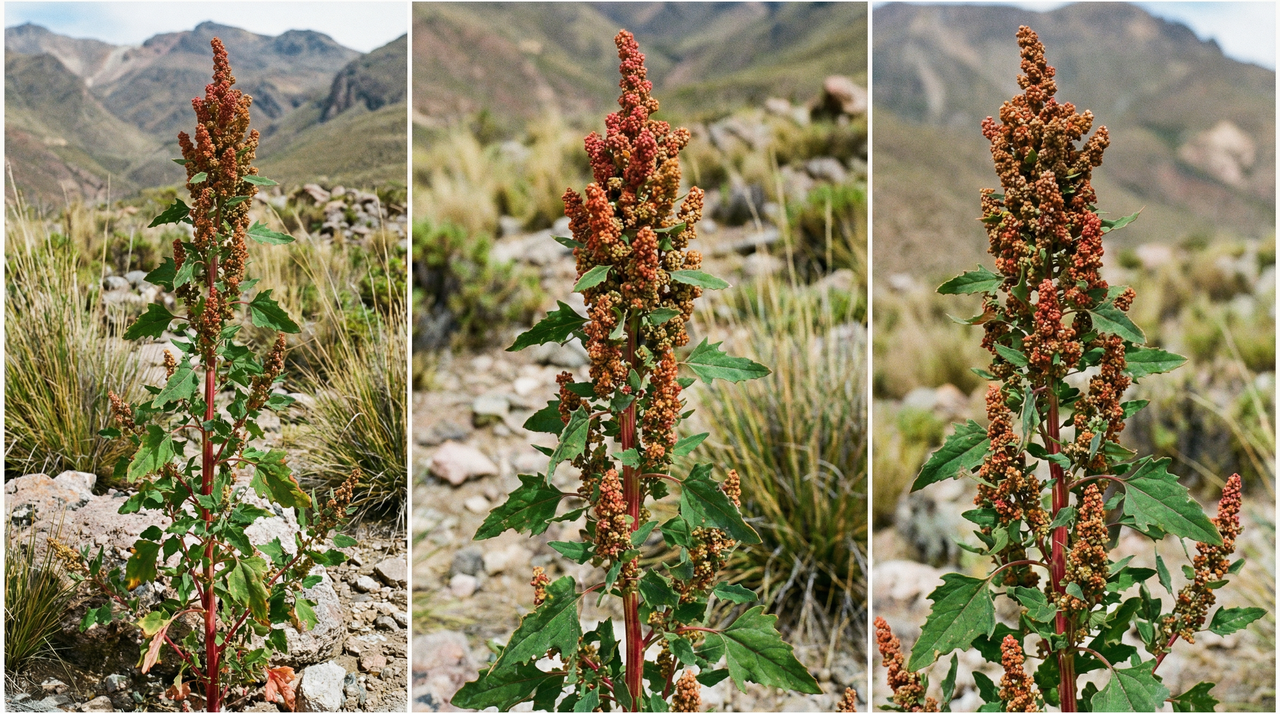
In the garden, quinoa is hard to miss once it matures, but the early weeks can fool you. The seedlings are small, slightly powdery-looking, and easy to confuse with the weedy relatives that germinate at the same time. The giveaway for me is that farinose bloom: a fine, mealy coating on the undersides of young leaves that catches morning light differently than anything else coming up in the bed. Once you've spotted it once, you won't misidentify a quinoa seedling again.
As it grows, the plant becomes an upright, freely branching annual with stems that shift from green to red-purple at the base.[11] The leaves are rhombic to triangular, five to fifteen centimeters long, with a powdery coating beneath and margins that range from smooth to lightly serrated.[2] Below ground, a taproot can reach one to two meters, with extensive fibrous laterals branching out from it, which is a big part of why quinoa handles drought the way a sunflower does: it goes looking for water rather than waiting for rain.[12]
The flowers are small, greenish-yellow, wind-pollinated, and packed into dense terminal panicles.[13] The first time I saw a mature quinoa panicle glowing deep red against a September sky, I understood immediately why Andean farmers still call this plant the mother grain. Those panicles, with their conspicuous colored bracts, are the plant's most diagnostic field feature and they're genuinely beautiful.[14] Each tiny fruit holds a single seed, just 1.5 to 2.5 mm across, coated in bitter saponins that protect it from birds and insects but require a rinse before eating.[13] Seed color runs from ivory to red, black, and purple depending on the cultivar, and the range of morphological forms across landraces reflects adaptation from sea level all the way up to 4,000 meters.[15]
Traditional and Cultural Uses in the Andes
Quechua and Aymara communities have cultivated quinoa for over 5,000 years, and they named it well: chisiya mama, mother of all grains.[16][10] It was offered to Pachamama, used as currency, and seeded ceremonially with gold tools. The seeds, rinsed to remove saponins, became soups, porridges, and fermented drinks; leaves and seeds both served as medicine for inflammation, digestive complaints, anemia, and altitude sickness.[17] Traditional farming systems intercropped quinoa with potatoes and developed specialized management for the saline soils that most other crops couldn't survive.[18] That knowledge system was sophisticated, place-specific, and deeply encoded in community identity.
Spanish colonizers understood that, and targeted quinoa accordingly. Suppressing the grain was a way of suppressing the culture. The revival that came in the twentieth century eventually drew global attention: the FAO declared 2013 the International Year of Quinoa, and UNESCO now recognizes the associated traditional knowledge as intangible cultural heritage.[16][19] What the global superfood boom has complicated, though, is whether that recognition translates into genuine benefit for the communities who kept quinoa alive. The concerns are real: genetic erosion from commercial monocultures, landraces displaced by a handful of exportable varieties, and profits that rarely flow back to Andean grower cooperatives.[20][21] I source seed from projects that return a share of profits to those cooperatives because I've seen how quickly industrial monoculture can erode the genetic diversity that makes a crop resilient in the first place. It matters where your seed comes from.
Fun Facts About Quinoa
Quinoa is technically a pseudocereal, not a true grain, and its nutritional profile reflects that distinction. The seeds contain 12 to 18 percent protein, averaging around 14 percent, with all nine essential amino acids including lysine, which is notably scarce in most plant foods.[22] A single plant can produce up to 2,000 seeds, and yields under good conditions reach 800 to 1,500 pounds per acre, scaling higher with optimal inputs.[23][24]
The saponin coating on the seeds is worth understanding as chemistry rather than just a cooking inconvenience. It's a chemical defense against herbivores and pathogens, and it's effective: the bitterness genuinely deters most seed predators.[25] I've trialed both mechanical polishing and simple home rinsing, and thorough washing under running water is enough to drop bitterness to a perfectly palatable level without losing nutritional value. I usually tell clients it's nature's way of asking for one extra step before dinner. Breeders have also developed "sweet" low-saponin cultivars that skip the washing, which I'll get into more in the varieties section. Beyond the kitchen, the plant's deep taproot helps stabilize soil and resist erosion, its flowers attract pollinators, and its seeds feed birds and small mammals through the fall.[26][27] Modern challenges include photoperiod sensitivity that can delay flowering outside Andean latitudes and ongoing pressure from commercial monocultures on what remains of the crop's extraordinary genetic diversity.[20]
Quinoa Varieties for Home Gardeners and US Growers
Classification Systems: Seed Color, Saponin Content, and Ecotypes
Before you choose a quinoa variety, you need to understand the three-way classification system that determines how your harvest will behave in the garden and in your kitchen. Cultivars are grouped by seed color (white, red, or black), saponin content (high-bitter traditional types versus low-saponin modern breeds), and ecotype origin: the Valenzuela group covering most white types, Sajama covering reds, and the Yungas group for blacks.[28][29] These categories aren't just taxonomy; they're the reason two seed packets from the same garden supplier can require completely different post-harvest work, produce measurably different protein levels, and succeed or fail under the same growing conditions. That contrast couldn't be sharper when you compare quinoa to its weedy cousin Lamb's Quarters (Chenopodium album), which has no cultivated varieties at all, just wild ecotypes shaped by wind and chance rather than five thousand years of deliberate human selection.[30][31]
Notable US-Adapted Quinoa Cultivars
The varieties most worth growing in North America today are largely products of USDA-supported breeding at University of Arizona, Oregon State University, and Cornell, which have developed cultivars with reduced saponin, improved yields, heat and drought tolerance, and resistance to downy mildew.[32][33] That downy mildew resistance has personally made the difference between a complete washout and a decent harvest in my more humid growing seasons, so I don't treat it as a nice-to-have trait.
Among white types, 'Titicaca', 'Brightest Brilliant', 'Chadstone', and 'Dolores' are the most commonly available for US home growers.[34][35] Red varieties like 'Cherry Vanilla', 'Red Faro', and 'Red Head' can push yields to 1,500 lbs per acre, and red and black types average 15-18% protein compared to 12-14% in white seed.[36][37] For home use, I find that richer, nuttier flavor worth the tradeoff in yield. Black cultivars like 'Midnight Sun' and 'Black Seeded' have saponin levels as low as 0.1-0.5%, which in practice means far less rinsing time and water in the kitchen, a practical difference I didn't fully appreciate until I grew them side by side with traditional high-saponin types.[38]
Sourcing Quinoa Seeds in the United States
The US consumes roughly 30,000 metric tons of quinoa annually but grows only 450-500 metric tons domestically, mostly across Colorado, California, Idaho, and Montana, importing about 25,300 metric tons in 2022 from Peru and Bolivia.[39][40] Finding locally grown seed is still genuinely difficult, which makes choosing US-adapted cultivars from the named university breeding programs one of the most concrete ways a home grower can support domestic development of the crop. The good news: quinoa isn't listed as invasive federally or in California, seed is legally importable with phytosanitary certification, and over 80% of US production carries organic certification.[41][42] Seed packets typically run $3-6, with bulk organic seed at $10-20 per pound.[43] I order almost exclusively from Johnny's Selected Seeds, Seed Savers Exchange, High Mowing Organic Seeds, and Baker Creek, all of which carry low-saponin varieties that perform reliably without hunting down specialty sources.[44][45][46]
Quinoa Propagation and Planting
Quinoa is an annual, and that single fact shapes everything about how you grow it. You're starting fresh from seed every season, which is honestly fine because the seed germinates reliably and the whole process is straightforward once you know a few quirks specific to this crop.
Propagation Methods for Quinoa
Direct seeding is the standard approach for growing quinoa at home or at scale, and for good reason.[47] Vegetative methods like stem cuttings, layering, and grafting exist in the literature but they're more curiosity than practice; even with auxin treatment, cuttings succeed only 20-60% of the time, and grafting trails behind that at 30-50%.[48][49] I've never bothered trying. Seed is cheap, germination is excellent, and this is simply not a plant that begs to be cloned.
Before you sow, wash the seeds. The thin papery testa coating each grain contains bitter saponins that can inhibit germination and will certainly make your seedlings a rougher start.[50] I rinse mine in a fine mesh strainer under cold running water for a couple of minutes, then taste a few seeds to confirm the soapy bitterness is gone before they go in the ground. That quick sensory check has saved me from sowing insufficiently washed seed more than once.
Tissue culture does exist for quinoa, achieving 70-90% success in research labs using MS medium with BAP for shoot induction and IAA or NAA for rooting, but that work is aimed at breeders, not gardeners.[49][51] If you're saving seed from open-pollinated varieties, know that outcrossing rates of 1-10% mean seedlings can show some variability; source a named cultivar if consistent grain color or saponin levels matter to you.[50][52]
Soil and Site Requirements
Quinoa evolved in thin-aired Andean valleys where soils drain fast, light is intense, and salinity is often higher than most crops tolerate. Recreating that drainage profile in your garden bed matters more than almost anything else. The plant wants well-drained loamy or sandy loam soils, full sun (six to eight hours minimum), and a pH somewhere between 6.0 and 8.5, with the sweet spot around 6.5-7.5.[53][54] I once ran a soil test on a raised bed I'd amended heavily with wood ash; the pH came back at 8.2 and I half-expected failure. The quinoa didn't flinch. Meanwhile the tomatoes in the adjacent bed were chlorotic. That salinity tolerance, up to 8-12 dS/m once established, is real.[53][54]
Waterlogging, though, is the hard limit. Quinoa is highly sensitive to standing water, especially during germination, so if your site holds water after rain, build up your beds or choose a different spot entirely.[53] Dark mushy roots, wilting despite moist soil, and yellow leaves low on the plant are the classic early signs of root rot from poor drainage.[55] Soil depth of at least 60-80 cm gives the taproot room to establish; compaction above a bulk density of 1.5 g/cm³ will produce stunted, shallow roots and visibly reduced growth.[56][57] Organic matter in the 2-4% range is ideal; work in compost before planting, and if your soil is acidic, a lime amendment will serve better than fighting the plant's preference.[56][57] Unlike lamb's quarters, which thrives in disturbed nitrogen-rich ground, quinoa actually prefers leaner, well-drained conditions.[58]
Spacing, Sowing Technique, and Germination Timeline
Sow directly after your last frost date, once soil temperatures have reached at least 50°F (10°C) and ideally closer to 68°F (20°C).[53] Press seeds about half an inch to one inch deep (1-2.5 cm), with rows spaced 1-3 feet apart depending on how much room you have and what size plants you're targeting.[53][59] Thin to 6-18 inches within the row once seedlings are a few inches tall; commercial plantings target 200,000-500,000 plants per hectare, which gives you a useful reference point for scaling.[53][60] That airflow from proper spacing also reduces disease pressure later in the season, which matters more than you'd think in humid climates.
If your season is genuinely short, you can start seed indoors 4-6 weeks before last frost using peat pots, transplanting carefully when seedlings reach 4-6 inches.[61] I tried this approach a few seasons back and lost about a third of the transplants to root shock. The taproot does not appreciate disturbance. Now I only start indoors if I need the head start, and I go straight to peat pots that go in the ground whole. For most gardens with a reasonable last-frost date, direct seeding after the soil warms is simply the more reliable path to a good stand.
Under good conditions, germination happens in 7-10 days at optimal temperatures of 68-77°F (20-25°C), and germination rates can reach 80-95% when seed viability is above 85%.[54][62] Label your rows. Young quinoa seedlings look remarkably like lamb's quarters, and I speak from the embarrassing experience of weeding out an entire row because I forgot where I'd planted.
Seed Characteristics and Storage
Each quinoa seed is small, 1.5-3.0 mm across, with a thin papery testa and an unusual annular embryo that wraps around a starch-rich perisperm at the center.[50][63] The color variation (white, red, black, and others) is a real trait, not just marketing, and reflects genuine genetic diversity across Andean landraces.[52] The saponins sit in that testa, which is why washing before planting and before eating addresses the same underlying chemistry.
The good news for seed savers is that quinoa is orthodox, meaning it tolerates drying down well and stores reliably.[64] Professional gene banks maintain viability for 20-50 years or more at -18 to -20°C with moisture content around 5-8%.[64][65] At home, storing seed in a sealed container in the refrigerator at below 50% relative humidity will keep germination rates high for 3-5 years.[64][65] I've been pulling seed from the same refrigerator batch for four years now with no noticeable drop in germination. A quick float test or a damp-paper-towel germination check before committing a full bed is always worth the few days it takes.
Quinoa Care Guide: Growing and Maintenance
Quinoa rewards growers who understand where it comes from. Its Andean homeland sits at 3,000 to 4,000 meters, where the sun is intense, the air is thin, nights are cold, and soils are often marginal. Every care decision you make in the garden is easier when you keep that image in mind: a tough, efficient annual built for extremes, not coddling.
Sunlight Requirements for Quinoa
Quinoa wants full sun, at least six to eight hours of direct light per day, with an ideal daily light integral of 20 to 30 mol/m²/day and peak PPFD around 800 to 1,200 µmol/m²/s during active growth.[66][67] In shadier spots, it'll tell you fairly quickly: leaves yellow and elongate, internodes stretch, and the whole plant goes pale and spindly, classic etiolation that signals it's reaching for light it isn't getting.[68][69] Reduced yield and smaller leaves follow close behind. I always label my quinoa rows carefully because the seedlings look so much like lamb's quarters, and that habit has also saved me from missing early etiolation in a slightly shaded corner of the bed.
The other edge of the spectrum matters too. Under extreme heat combined with very high light intensity, quinoa can show leaf scorch, wilting, and photoinhibition where photosystem II takes damage and the plant essentially stops photosynthesizing efficiently.[70][60] In most temperate gardens this isn't a problem, but in the low desert or during a prolonged heat dome, a 30% shade cloth in the afternoon can prevent damage without sacrificing yield. Full sun, but read the plant.
Watering Needs and Drought Tolerance
Over its 90 to 120 day season, quinoa needs roughly 300 to 600 mm (12 to 24 inches) of total water, with best yields often coming when rainfall stays under about 400 mm and you fill the gaps with supplemental irrigation.[71] The key rhythm: moderate water during vegetative growth (around 0.5 to 1 inch per week), ramping up to 1 to 1.5 inches weekly at flowering and grain fill, then tapering off as seeds mature and stopping entirely one to two weeks before harvest.[72][73] Deep, infrequent applications beat frequent shallow sprinkles; drip irrigation hits this target well and keeps foliage dry, which matters for disease prevention.
Quinoa is remarkably drought-hardy, particularly Andean highland cultivars during the vegetative stage. It can survive 10 to 20 days without water under reasonable conditions without catastrophic yield loss.[2][74] I've found it holds up better than many herbs I grow when I'm away from the garden for a stretch. That said, prolonged stress shows up as wilting, browning leaf edges, and reduced seed set.[75] Overwatering is actually the bigger risk for most home growers: soggy roots invite Pythium and Fusarium, and you'll see leaves yellowing and wilting even in wet soil, which is a confusing sign until you've seen it once.[76] Well-drained sandy loam and a 3-inch layer of mulch solve both problems at once.
Quinoa tolerates irrigation water anywhere from pH 6.0 to 8.0 and handles moderate salinity up to 4 to 6 dS/m without significant yield loss, though keeping EC below 2 dS/m is preferable when you have the choice.[77] In water-scarce situations, deficit irrigation at 50 to 75% of crop evapotranspiration through the vegetative stage can preserve yield while conserving resources, a strategy worth knowing if you're gardening through a dry summer.[78]
Frost Tolerance and Cold Protection
Quinoa's Andean heritage gives it cold hardiness that genuinely surprises people. Mature plants can survive brief dips to -8°C (17°F),[79][74] far below what most annuals tolerate, and Andean varieties deploy antioxidant enzymes, osmoprotectants, and saponins as part of their cold-acclimation toolkit.[80] Compare that to its weedy relative lamb's quarters, which is killed near -4°C and you get a sense of how meaningfully quinoa has been selected for altitude.[30]
Here's what I've learned the hard way: the mature-plant hardiness number is real, but it doesn't apply equally across the lifecycle. Seedlings are highly sensitive below 0°C, and the flowering stage is where a single frost can cause 50 to 100% yield loss through sterility.[81][82] That asymmetry changes how you plan. Now I always use row covers during germination in variable springs and keep them handy through the flowering window, especially in zones 7 and 8 where late frosts sneak in. For site selection, a windbreak on the north or northwest side isn't just about comfort; it genuinely moderates the microclimate during those critical vulnerable periods.[83] Frost damage to watch for includes water-soaked leaf appearance, browning from the edges inward, and in severe cases, blackened stems.[84]
Fertilizing Quinoa: Nutrient Needs and Deficiencies
Quinoa evolved on poor Andean soils but that doesn't mean it can't use fertility when you offer it. It's a moderate to heavy feeder that responds well to balanced NPK, with nitrogen and phosphorus being most critical.[85] General targets are 80 to 150 kg/ha nitrogen, 40 to 80 kg/ha P₂O₅, and 40 to 100 kg/ha K₂O, applied in splits rather than all at once: roughly 30% at planting, 40% during vegetative growth, 30% at flowering.[86] I never skip a soil test before I fertilize. The key thresholds are below 20 ppm NO₃-N for nitrogen, below 15 ppm Bray P1 for phosphorus, and below 100 ppm exchangeable K for potassium; staying above those baselines before adding inputs has saved me from both under- and over-fertilizing.[87]
Excess nitrogen is the most common mistake. It pushes lush vegetative growth, but the plant gets top-heavy and prone to lodging, and seed yield actually drops.[88] Quinoa prefers a soil pH of 6.5 to 8.0, tolerating as wide as 6.0 to 8.5, and potassium becomes especially valuable under drought or saline stress.[89] Deficiency symptoms are worth memorizing for diagnostics: uniform yellowing on older leaves usually means nitrogen; purplish-red coloring on older leaves points to phosphorus; interveinal chlorosis on older leaves is typically magnesium or potassium; and interveinal chlorosis on young leaves suggests iron or manganese.[90] I've caught phosphorus deficiency early in my own beds by watching for that reddish cast, long before it starts dragging down yield.
Seasonal Growth Rhythm and Lifecycle
Quinoa is a strict annual with a predictable 90 to 120 day arc: germination in 5 to 10 days once soil clears 5 to 10°C, four to six weeks of vegetative growth, six to eight weeks of flowering, then four to six weeks of seed fill before harvest.[88][91] It needs 120 to 150 frost-free days, which means timing is everything in shorter-season climates. For most of zones 5 to 9, that means direct seeding two to four weeks before the last average frost date, using row covers to protect emerging seedlings, then pulling those covers well before temperatures spike and flowers form.
Through the season, I calibrate my watering to phenology rather than a fixed schedule: lighter through vegetative growth, increasing at the panicle stage, then backing off deliberately as the seeds harden. Mulch does the heavy lifting between waterings, keeping the root zone consistently moist without waterlogging.[88] Lamb's quarters, the weedy Chenopodium cousin, can overwinter as a winter annual in mild climates; quinoa has no such flexibility. It completes its cycle and it's done, which makes succession planning straightforward.
Pruning, Maintenance, and Heat Considerations
Quinoa is genuinely low-maintenance in the structural sense. Plants reach 1 to 3 meters tall with an upright habit that rarely needs intervention,[56] and traditional cultivation doesn't involve pruning at all. What I do routinely is remove any damaged or diseased leaves to improve airflow through the canopy, and occasionally thin dense plantings so light reaches inner stems. That canopy management also reduces the humid microclimate that fungal diseases love.[92] In windy sites or with particularly heavy seed loads, taller varieties may need simple staking to prevent lodging, especially if you've been generous with nitrogen.[93]
Heat tolerance data for quinoa is thinner than cold tolerance research, but the plant's optimal temperature window sits at 15 to 20°C.[94] Think of it like growing lettuce in terms of preferred temperatures, though quinoa has more flexibility. Where summers run hot, timing your planting so grain fill happens before peak heat pays off more than any pruning technique. In a permaculture context, quinoa's vertical habit and minimal care requirements make it a satisfying annual to slot into a rotation or guild; a little attention at seeding and harvest and it mostly takes care of itself in between.
Quinoa Harvesting and Storage Guidelines
Most quinoa varieties reach maturity somewhere between 90 and 120 days after seeding, though the full cycle can stretch to 150 days depending on the cultivar and your climate.[53][59] Once flowering begins, you're typically 25 to 40 days from physiological maturity.[74][95] That said, I've found with Chenopodium relatives that counting days only gets you so far. Reading the plant is more reliable.
When to Harvest Quinoa: Timing, Maturity Signs, and Saponin Reduction
The clearest signal is a color shift in the panicles from green to yellow, tan, or beige, with the seeds themselves turning from green to brown, black, ivory, or translucent depending on variety. The leaves should be yellowing and drying back. I press a few seeds between my fingernails: if they dent, I wait; if they're hard and firm, the crop is ready. Aim for 80 to 90 percent of panicles dry before cutting.[96][97][98]
Ideal harvest moisture is 12 to 15 percent. Above 18 percent and you're courting mold in storage.[96][99] Full maturity also means lower saponin content, which directly reduces the bitterness you'll battle at the sink. I harvested a batch slightly early one season and spent twice as long rinsing it. Now I hold off until I see genuine leaf senescence all the way down the stem, not just at the top.
How to Harvest Quinoa: Technique and Post-Harvest Handling
Cut the panicles at the base on a cool, dry morning.[100][101] Morning conditions minimize shattering and reduce the mold risk that comes from harvesting wet. Quinoa shatters readily once fully dry, so I cut while the field is still at that 80 to 90 percent mark rather than waiting for every panicle to be perfectly done. Losing seed to the ground is a frustrating way to shrink your yield.
After cutting, spread the panicles to field-dry for 7 to 10 days if needed, then thresh and winnow to separate seed from chaff.[102][103] For long-term storage, get seed moisture below 12 percent. A warm, well-ventilated barn works well; a damp garage does not.
Quinoa Yield and Flavor at Harvest
In my garden trials, individual plants reliably give 100 to 200 grams of seed once timing is dialed in, which matches the published range of 90 to 225 grams per plant under good conditions.[104][105] Commercially, yields run 1,000 to 3,000 kg per hectare, with well-managed plots hitting 4,000 kg/ha. For backyard growers, a good season with a dozen plants makes a meaningful dent in your pantry needs.
Properly timed harvest and thorough rinsing together unlock what quinoa is actually supposed to taste like: a dominant umami note from glutamic acid, with a nutty, toasty aroma that develops through Maillard reactions during cooking.[106][107] It's a similar transformation to what happens with amaranth or millet when you get the harvest window right. White varieties stay mild and neutral; red and black types develop more robust, earthy character. The bitterness people associate with quinoa is almost always a processing or harvest-timing problem, not an inherent trait of the grain.
Quinoa Preparation and Uses
Culinary Uses and Preparation of Quinoa Seeds and Leaves
Most people know quinoa as those tiny seeds in a grain bowl, but the leaves are quietly edible too. Andean cooks have long used them raw in salads or cooked as pasallallas, a wilted green with mild bitterness similar to beet greens or Swiss chard.[108][109] Cooking softens that bitterness considerably, so I'd start there if you're new to them.
The seeds require one non-negotiable step before cooking: saponin removal. Rinsing under running water until the foam disappears works well, usually three to five passes, and I always taste a few grains at the end to confirm there's no soapy residue left. Soaking for four to six hours can leach out up to 90 percent of saponins, and boiling or pressure cooking for fifteen to twenty minutes reduces what remains.[110][111] Traditional Andean methods used sand rubbing, wood ash lye soaks, and hand-winnowing long before modern kitchen faucets existed.[112] Combining rinsing with cooking is the safest approach regardless of which technique you start with.[113]
Once properly processed, quinoa cooks up fluffy and chewy with a nutty, earthy flavor. Toasting the dry seeds in a skillet before adding water deepens that nuttiness and cuts any residual bitterness noticeably.[22] A 100g cooked serving delivers around 4.4g of complete protein containing all nine essential amino acids, making it genuinely useful for vegan households.[114][22] I regularly recommend it to clients designing edible landscapes for plant-based families because the mineral profile backs the protein story: 27% DV manganese, 15% DV magnesium, and meaningful iron and zinc per serving.[22] Research supports cardiovascular, glycemic, and anti-inflammatory benefits too, though those are covered in depth in the health benefits section.[114][115]
Traditionally, quinoa seeds were paired with potatoes, beans, corn, and aji peppers, eaten as whole grain, ground into flour, or popped like miniature popcorn.[116][117] Modern quinoa bowl recipes, Mediterranean quinoa salads, and whole grain quinoa recipes follow the same logic: a sturdy base grain that absorbs flavors and holds texture. Its Chenopodium relatives offer interesting kitchen parallels. Lamb's quarters volunteer freely in my garden beds, and young leaves under 30cm taste genuinely like spinach, rich in vitamins A and C.[118] Boiling and discarding the water reduces their oxalates by 50 to 80 percent, which I do as a habit.[119] Epazote is another story entirely: I use one or two leaves per pot of beans because the ascaridole content is real and cooking only partially reduces it. Seeds, essential oil, and raw preparations are off the table.[120]
After harvest, dried quinoa stores best in airtight containers below 50°F at 12 to 13 percent moisture or lower.[121][122] Get those conditions right and it'll keep beautifully until you're ready to cook with it.
Traditional and Modern Medicinal Preparations
Andean communities have used quinoa medicinally for millennia, primarily as a leaf tea (5 to 10g dried leaves per liter of water, one to two cups daily) and whole seeds at roughly 10 to 20g per day for anti-inflammatory support.[123] These remain traditional practices rather than clinically validated protocols; rat studies show ethanol extracts reduce inflammation at 100 to 200 mg/kg, but large human trials haven't followed.[123] If you're preparing leaf teas from homegrown plants, the same saponin-removal logic that applies in the kitchen applies here. Growing your own also means genuinely fresh material rather than dried leaf of uncertain age, which matters for any preparation you're relying on for more than flavor.
Non-Food Uses of Quinoa
The saponins that make raw quinoa bitter also make excellent natural soap, which Andean communities have used for washing textiles and hair for centuries.[17] Leaves and stems yield natural dyes in reds and yellows, and fiber extracted from the stems has traditional textile applications.[17][2] I've run stem-bundle dye experiments with clients looking to close the loop on their garden waste, and the color results from quinoa are worth the effort. The biomass also holds genuine potential for biofuel given the plant's high seed-oil content and substantial annual yield.[17] For a grain most people think of purely as a bowl ingredient, the range of uses from soap to dye to fuel is quietly remarkable.
Quinoa Health Benefits and Nutrition
Few plants pack this much nutritional complexity into a seed the size of a sesame. Quinoa's reputation as a superfood isn't hype built on marketing; it's grounded in a genuinely unusual nutrient profile that separates it from most other grains and pseudocereals.
Nutritional Profile of Quinoa
Quinoa provides all nine essential amino acids, with protein making up 14-18% of dry seed weight.[124] For a plant food, that's genuinely rare. As cooked grain (boiled, unsalted), a 100 g serving delivers 120 kcal, 4.4 g protein, 1.9 g fat, 21.3 g carbohydrates, and 2.8 g fiber.[22] Dry seeds carry considerably more fiber, typically 7-9 g per 100 g, with some varieties exceeding that range.[124] It's also naturally gluten-free with a low glycemic index of around 53, which puts it well below white rice and most wheat-based products.[125]
The micronutrient list is long: B-complex vitamins, vitamin E, magnesium, iron, zinc, phosphorus, potassium, and manganese all show up in meaningful amounts.[124][126] Phytates in the seed coat can reduce mineral bioavailability, but soaking or fermentation before cooking improves uptake noticeably.[124][126] How you cook it also matters: boiling causes a 20-50% loss of antioxidants and some water-soluble vitamins through leaching, while steaming or roasting preserves the phytonutrient profile much better.[127][128] I've started steaming mine more often for exactly this reason. Always rinse the seeds for one to two minutes until the water runs clear before cooking; that removes the bitter saponins that would otherwise cause digestive irritation and ensures you're getting the full nutritional benefit without interference.[129]
A quick genus note: lamb's quarters (Chenopodium album), a close relative I grow alongside quinoa in rotation, has denser vitamins A, C, and K in its leaves, but also higher oxalate levels (200-500 mg per 100 g fresh weight) than quinoa seeds.[130][131] I treat them very differently in the kitchen, and the oxalate difference is a big part of why.
Key Phytochemicals in Quinoa
Beyond macronutrients, quinoa produces a broad array of secondary metabolites: phenolic acids, flavonoids like quercetin, kaempferol, and rutin, betacyanins, and saponins that range from 0.1% to 5% of dry seed weight depending on cultivar and growing conditions.[132][133] These compounds aren't evenly distributed across the plant. Leaves carry the highest phenolic and flavonoid density (10-20 mg GAE/g), while seeds are concentrated in saponins; antioxidant capacity follows that gradient from leaves down to roots.[134]
Genotype drives saponin content more than any other factor. Traditional Andean types tend to run high; Chilean ecotypes and modern "sweet" cultivars bred for low saponin content typically fall below 0.1%.[135] Environment adds another layer: seeds grown at higher altitude tend to be richer in phenolics and flavonoids, while salt stress pushes saponin levels up.[136] Washing or pearling can strip 70-99% of saponins, with traditional Andean rinsing methods achieving 90-95% reduction.[137] I started growing a low-saponin sweet variety a few seasons ago specifically to reduce post-harvest processing time, and the difference is real. That said, I still rinse everything; the bitterness on your tongue is the most reliable test you have that saponins remain.
These compounds do real ecological work for the plant: herbivore defense, UV protection at altitude, stress tolerance. Their health implications are where things get interesting.[138][139]
Evidence-Based Medicinal Benefits
The best-supported benefits center on antioxidant activity and cardiometabolic health. Quinoa's flavonoids and betacyanins (most concentrated in colored varieties) demonstrate strong antioxidant activity in DPPH and FRAP assays.[140][141] Anti-inflammatory effects via inhibition of TNF-α, IL-6, COX-2, and NF-κB pathways have been demonstrated, attributed to saponins, phenolics, and ecdysteroids, though most of this work is in vitro and in animal models.[140][142]
The glycemic and lipid data is where I'd feel most confident making specific recommendations to clients managing metabolic health. Human trials show quinoa consumption reduces both glycemic response and LDL cholesterol in patients with type 2 diabetes, with the low GI, fiber content, and phytosterols all contributing to the effect.[143][144] Phytosterols and fiber binding bile acids contribute to the LDL reduction specifically.[145] In my own experience, swapping quinoa for white rice at dinner gives noticeably more stable afternoon energy, which tracks with the GI research.
Traditional Andean use as a diuretic, digestive aid, wound healer, and remedy for altitude sickness stretches back thousands of years, and while there's genuine ethnobotanical depth here, robust human clinical validation for those applications is still lacking.[146][123] Antimicrobial activity against E. coli and S. aureus has been shown in vitro, and animal studies suggest anti-fatigue and antihypertensive peptide effects, but these sit firmly in the "promising, needs more human data" category.[147][148][149] In-vitro anticancer work showing apoptosis induction in breast and colon cell lines is intriguing, but nowhere near ready to be used as a health claim.[150] The honest summary: human clinical evidence is strongest for nutrition, antioxidant status, and cardiometabolic markers; most pharmacological claims need larger, well-designed trials before they move beyond "watch this space."[151][152]
Safety and Side Effects
Saponins are the main practical concern. These bitter triterpenoid glycosides coat the seed hull at concentrations between 0.01% and 5% dry weight, and if you skip rinsing, they cause nausea, cramping, and diarrhea.[153][154] Rinse for two to three minutes until the water runs completely clear, and you remove 80-95% of them. I've never had a digestive issue with quinoa when I've done this properly. If the cooked grain still tastes soapy, the rinsing wasn't thorough enough; that bitterness is your signal. Leaves and stems also carry higher saponin and oxalate levels (0.1-0.3 g per 100 g fresh weight), and phytates across the plant are reduced by soaking or fermentation.[155][156]
Allergic reactions are uncommon but real. Quinoa has low to moderate allergenic potential, with rare cases of oral allergy syndrome, contact dermatitis, and anaphylaxis on record.[157][158] Cross-reactivity with other Amaranthaceae family members (spinach, amaranth) is possible. In my consulting work I've seen this a handful of times: if a client already reacts to spinach or amaranth, I suggest they try a small amount of well-rinsed quinoa before incorporating it regularly. Livestock, especially sheep and cattle, are considerably more sensitive than humans; unprocessed seed can cause digestive upset or hemolytic anemia in animals, so keep harvested grain out of reach.[159]
The broader safety picture is reassuring. Quinoa has been eaten safely for over 5,000 years with traditional processing, the FDA has granted GRAS status to certain quinoa extracts, and it's considered safe during pregnancy when consumed in normal food amounts as part of a balanced diet.[160][161] The processing step that unlocks all of those nutritional and phytochemical benefits is the same one that removes the main safety concern. Rinse it well, and quinoa is about as forgiving a food as you'll find.
Quinoa Pests and Diseases
The list of potential insect visitors is genuinely long, including aphids, leafhoppers, flea beetles, thrips, cutworms, armyworms, stem borers, leafminers, spider mites, and seed bugs.[162][163] But here's what that list doesn't tell you: most of those insects won't actually cause serious problems in a well-managed garden planting.
Natural Resistance to Common Insect Pests
Quinoa's saponin-coated leaves do real work as a pest deterrent. The bitterness and mild toxicity of those saponins push aphids and leafhoppers toward easier targets, and the plant's pubescent, trichome-covered foliage physically traps or impales small insects before they can settle in.[70][164][165] Resistance to flea beetles and thrips falls somewhere in the moderate range, while armyworms, cutworms, and stem borers are a different story entirely -- they don't care about bitterness once they've gotten a foothold, and those are the pests that actually warrant intervention.[70][68]
Variety choice matters here more than many growers realize. 'Saxa' and 'Cherry Vanilla' carry meaningful aphid resistance, and 'Brightest Brilliant' shows tolerance to leafminers; Andean landraces generally outperform commercial cultivars across the board.[166][167][168] I've trialed 'Cherry Vanilla' in my own projects specifically because of its layered resistance, and it does hold up noticeably better than some of the generic commercial seed. When armyworms do show up in numbers, I skip the broad-spectrum sprays and go straight to Bacillus thuringiensis targeted at young larvae -- that's where Bt actually earns its keep.[169]
Major Diseases and Environmental Triggers
On the disease side, downy mildew caused by Peronospora variabilis is the threat that deserves most of your attention. In humid conditions it can reach 100% incidence in the field, and once it takes hold in a warm, wet summer it's genuinely hard to reverse.[170][171] It thrives at 50-68°F with humidity above 80%, which in my part of Central Florida describes nearly every spring morning from March through May.[172] I've watched seedlings develop that telltale underleaf yellowing alarmingly fast when airflow is restricted. The seed packet spacing is almost never enough in humid climates.
Beyond downy mildew, quinoa can also develop bacterial leaf spot, powdery mildew, Cercospora and Alternaria leaf spots, Fusarium wilt, Sclerotinia stem rot, and root rots in waterlogged or acidic soils.[173][174] Aphid-transmitted viruses including Cucumber Mosaic Virus can also show up at 5-50% field incidence depending on aphid pressure.[175] Controlling aphids, then, does double duty. Cultivars like 'Sajama,' 'Titicaca,' and 'Cherry Vanilla' carry partial resistance to downy mildew, and roughly 10-20% of global germplasm accessions show moderate to high resistance overall.[176][177]
Integrated Pest and Disease Management for Quinoa
The most useful thing I can pass along from managing test plots is this: weekly scouting and pulling the first infected leaves consistently outperforms waiting to spray. Prevention is simply more effective than remediation. That means starting with resistant varieties, rotating into a bed that hasn't grown quinoa or related Chenopodium species for three to four years, and spacing plants generously enough that air moves freely through the canopy.[178][179] For insects, monitor against economic thresholds rather than spraying on a calendar; neem works well for leafhoppers, Bt for armyworms, and spinosad for thrips when populations actually warrant it.[169][180] When disease pressure builds despite good cultural practices, copper-based fungicides and phosphorous acid products are the most compatible options for organic or low-input systems.[181] Think of chemical inputs as a backstop, not a strategy.
Quinoa in Permaculture Design
Quinoa earns its place in a permaculture system well before you harvest a single seed. The leaves are edible and cooked much like spinach,[2][15] and the plant carries a long history as a traditional remedy for anemia, blood sugar, and digestive complaints in Andean communities.[182] That's a lot of function packed into a fast-growing annual that most people only think about at the grain stage.
Ecosystem Functions and Uses
The ecological contributions start with physical structure. Quinoa's dense canopy suppresses weeds reliably, and its deep taproot stabilizes soil and reduces erosion; once established, it needs very little water to keep doing both.[183] I've sown it thickly along the edges of annual beds in my zone 9b designs specifically because it outcompetes summer weeds with minimal fuss. The ornamental value is a genuine bonus: cultivars like 'Cherry Vanilla' produce purple and reddish-purple panicles of small flowers that add real textural contrast against green companions,[184][185] and in my trials I've noticed those flowering panicles seem to pull in more predatory wasps than I'd expect from a grain crop.
If you're thinking about extending the Chenopodium theme into your guild, epazote (C. ambrosioides) is worth knowing about. It accumulates potassium, calcium, and phosphorus that you can cycle back as chop-and-drop mulch, supports pollinators, and releases volatile compounds that actively deter aphids and certain beetles.[186][187] I'd call it a useful companion with an asterisk: epazote has allelopathic tendencies that can suppress native plants, it has documented invasive potential in several U.S. regions, and it's toxic in large doses.[188][189] Use it intentionally and keep it contained.
Forest Layer and Guild Roles
Quinoa is an erect, branching annual that can reach 1 to 3 meters tall with a spread of 45 to 120 cm.[2][184] That puts it squarely in the ground and herbaceous layers as a pioneer annual, not a candidate for the understory of a mature food forest. Its taproot can push down to 1.5 meters, the farinose leaf coating manages salt and moisture regulation, and it tolerates up to 30 to 50 percent light reduction without falling apart[190][191] — but it produces far more seed in open sun.
In guild design, I routinely interplant quinoa with bush beans and peas. It fits well with legumes,[183] and the nitrogen those plants fix benefits the whole bed. Quinoa does have mild allelopathic tendencies, so if you crowd the planting, neighboring seedlings can stall out.[191] Thin aggressively and give companions room. Lamb's quarters (C. album) fills a similar ground-layer niche in disturbed sites and functions as a dynamic accumulator of potassium, calcium, and phosphorus,[192][193][194] which shows how broadly the genus covers the opportunistic annual layer. A practical note: label your quinoa rows clearly that first season. Young quinoa, lamb's quarters, and epazote seedlings look remarkably alike, and I've watched plenty of gardeners weed out exactly what they were trying to grow.
Climate Adaptability and Hardiness Zones
Quinoa originated in high-altitude Andean regions between 2,300 and 4,000 meters, from Colombia down through Chile, where it evolved to handle saline soils, intense UV, and wide daily temperature swings.[195][196][197] On paper it's viable in USDA zones 4 through 11, but "viable" and "productive" are two different things.
The core temperature story matters a lot for design decisions. Optimal growing conditions sit between 15 and 25°C during the day with cooler nights around 10°C. Mature plants can briefly tolerate frost down to -8°C, though seedlings need protection below freezing.[198][199] The harder limit is heat at flowering: once temperatures climb above 30°C, pollen becomes sterile and you can lose up to half your seed set.[200] I learned this the hard way trying to push quinoa through a humid subtropical summer. The plants looked fine; the panicles just never filled. Earlier sowing and quicker-maturing varieties fixed most of that problem.
Annual rainfall between 200 and 800 mm suits it well, with 300 to 500 mm being the sweet spot. It's drought tolerant once established, but needs consistent moisture at flowering and grain fill, and it won't tolerate waterlogged roots at any stage.[201][202] Its salinity tolerance is genuinely impressive; the deep taproot and leaf coating let it handle brackish irrigation water that would kill lettuce outright,[203] which matters if you're working with marginal water quality. Modern cultivars like 'Titicaca,' 'Inti,' and 'Blanco' have extended that range considerably, with successful production in Colorado at elevation and across the Pacific Northwest,[204][205][206] proving that temperate growers outside traditional highland zones can produce real harvests when they respect that cool-temperature flowering window.
The Crop That Made Me Rethink What "Difficult" Means
I'll be honest: I grew quinoa mostly out of stubbornness the first time, convinced it wouldn't perform in my mid-Atlantic summers. It struggled, yes, but it also gave me seed. Imperfect, hard-won, beautiful seed. There's something humbling about growing a plant that survived colonial suppression and thin Andean air and still found its way into my small raised beds, asking very little, offering everything.
Sources 206
- FAO: International Year of Quinoa 2013 ↩
- USDA PLANTS Database - Chenopodium quinoa ↩
- The History and Domestication of Quinoa ↩
- Quinoa's Ancient Roots and Global Spread ↩
- Quinoa Adaptation to High Light and UV Radiation in the Andes ↩
- Andean Crops: Quinoa Soil Preferences ↩
- Leaf Anatomical Adaptations in Quinoa to Abiotic Stresses ↩
- Quinoa Production - Penn State Extension ↩
- Plants of the World Online - Chenopodium quinoa ↩
- Ethnobotany of Quinoa in the Central Andes ↩
- Missouri Botanical Garden Plant Finder - Chenopodium quinoa ↩
- FAO - Quinoa: An Ancient Crop to Contribute to World Food Security ↩
- Plants of the World Online - Chenopodium quinoa ↩
- Missouri Botanical Garden Plant Finder - Chenopodium quinoa ↩
- Flora of North America - Chenopodium quinoa ↩
- Quinoa in the Andes: From Sacred Crop to Global Superfood ↩
- Ethnobotany of Quinoa in the Andes ↩
- Traditional Knowledge and Quinoa Cultivation among Aymara Communities ↩
- The Cultural Heritage of Quinoa in the Andes ↩
- Quinoa: An Andean crop at risk? ↩
- Chenopodium quinoa - Kew Science ↩
- Quinoa Nutritional Profile ↩
- Colorado State University Extension - Quinoa Production in Colorado ↩
- FAO: Quinoa - An Ancient Crop to Contribute to World Food Security ↩
- Saponins in Quinoa: Biosynthesis, Regulation, and Health Benefits ↩
- Quinoa: An Ancient Crop to Face Global Changes in Climate and Markets ↩
- Biodiversity and Sustainable Use of Quinoa in the Andes ↩
- FAO Quinoa Factsheet ↩
- USDA Quinoa Production Overview ↩
- USDA PLANTS Database ↩
- Plants of the World Online (Kew) ↩
- Breeding Quinoa for the U.S. Market ↩
- Cornell University Quinoa Breeding Program ↩
- University of Arizona Quinoa Varieties ↩
- USDA National Plant Germplasm System - Quinoa Varieties ↩
- Quinoa Protein Content and Nutritional Profiles ↩
- Oregon State University Quinoa Breeding Program ↩
- Quinoa Production in the United States ↩
- Quinoa: 2023 Crop Production Summary ↩
- U.S. Quinoa Imports and Exports 2022 ↩
- Organic Quinoa Standards ↩
- Federal Noxious Weed List ↩
- Quinoa Seeds - Brightest Brilliant Rainbow ↩
- Quinoa Seeds ↩
- Quinoa ↩
- Bulk Quinoa Seeds - Organic ↩
- Quinoa - Production and Cultivation ↩
- Vegetative Propagation of Quinoa (Chenopodium quinoa Willd.): A Review ↩
- Micropropagation of Quinoa (Chenopodium quinoa Willd.) ↩
- Chenopodium quinoa - Quinoa ↩
- In Vitro Propagation of Chenopodium quinoa ↩
- Genetic Diversity and Population Structure in Quinoa (Chenopodium quinoa Willd.) Landraces across the Andes ↩
- Quinoa Production ↩
- Quinoa: Production and Perspectives ↩
- Quinoa Production Guide ↩
- Quinoa: An Ancient Crop to Contribute to World Food Security ↩
- Soil Management for Quinoa Production ↩
- Chenopodium album - Wikipedia ↩
- Growing Quinoa ↩
- How to grow quinoa ↩
- Quinoa Production in North America ↩
- Seed Germination of Quinoa ↩
- Embryology and Seed Structure in Chenopodium quinoa ↩
- Seed Storage of Quinoa (Chenopodium quinoa Willd.) ↩
- Quinoa Seed Storage and Viability ↩
- Light Requirements for Quinoa Cultivation ↩
- Photosynthetic Characteristics of Chenopodium quinoa ↩
- Effects of Shade on Chenopodium quinoa ↩
- Quinoa Production Guidelines ↩
- Photoinhibition in Quinoa under High Light Stress ↩
- FAO: Quinoa - An Ancient Crop to Contribute to World Food Security ↩
- Irrigation Scheduling for Quinoa ↩
- Growing Quinoa in Home Gardens - Colorado State University Extension ↩
- Quinoa: Botany, Production and Uses ↩
- Missouri Botanical Garden Plant Finder - Chenopodium quinoa ↩
- Diseases of Quinoa and Their Management ↩
- FAO Quinoa Cultivation Guidelines ↩
- FAO Quinoa Irrigation and Water Management ↩
- Quinoa Adaptation to High-Altitude Environments in the Andes ↩
- Cold Stress Responses in Andean Quinoa Varieties ↩
- Frost Tolerance in Quinoa (Chenopodium quinoa Willd.) ↩
- Frost Tolerance in Quinoa: A Review ↩
- Andean Quinoa Frost Management Techniques ↩
- Frost Tolerance and Sensitivity of Quinoa (Chenopodium quinoa Willd.) ↩
- Quinoa Nutrient Management - University of Minnesota Extension ↩
- Quinoa: An Ancient Crop to Contribute to World Food Security ↩
- University of Nebraska-Lincoln Extension: Quinoa Production Guide ↩
- Quinoa Production Guide ↩
- FAO Quinoa: An Ancient Crop to Contribute to World Food Security ↩
- Physiological and Morphological Responses of Quinoa to Fe, Mn, Mg, N, and Ca Deficiencies ↩
- Quinoa Production in North America ↩
- Quinoa Water Requirements and Irrigation Management ↩
- Horticultural Management of Quinoa ↩
- Agronomic Management of Quinoa ↩
- Phenological Development in Quinoa ↩
- Quinoa Production Guidelines ↩
- Quinoa: An Ancient Crop for Modern Times ↩
- Growing Quinoa in the Pacific Northwest ↩
- Quinoa Harvesting and Storage ↩
- Quinoa Production Guidelines ↩
- Quinoa Harvest Management ↩
- Quinoa Production Guide - University of California Agriculture and Natural Resources ↩
- Quinoa Harvesting and Post-Harvest Handling - FAO ↩
- Quinoa Production Statistics ↩
- Agronomic Characteristics of Quinoa ↩
- USDA FoodData Central: Quinoa, cooked ↩
- Volatile Composition and Sensory Properties of Quinoa ↩
- Saponins in Quinoa: Safety and Processing - Food Chemistry ↩
- Traditional Use of Quinoa Leaves in Andean Cuisine - Journal of Ethnobiology ↩
- Quinoa Processing and Saponin Removal - USDA Agricultural Research Service ↩
- Quinoa: An Ancient Crop for Modern Times - FAO ↩
- Traditional Saponin Removal Methods in Quinoa Processing (Journal of Ethnopharmacology) ↩
- Preparing Quinoa: Removing Saponins and Antinutrients - University of California Agriculture and Natural Resources ↩
- Navruz-Varlı and Mortaş - Quinoa: Nutritional Value and Health Benefits ↩
- Vega-Gálvez et al. - Quinoa (Chenopodium quinoa Willd.): An ancient nutraceutical grain ↩
- Quinoa: An Ancient Crop to Improve Food Security ↩
- Traditional Andean Foods and Culinary Practices ↩
- USDA FoodData Central - Lamb's Quarters ↩
- Lambsquarters (Chenopodium album) ↩
- FDA Poisonous Plant Database - Chenopodium ambrosioides ↩
- Quinoa Post-Harvest Handling and Storage ↩
- Grain Harvesting and Storage - USDA National Agricultural Library ↩
- Ethnobotanical Uses of Quinoa in the Andes ↩
- Nutritional Composition of Quinoa: A Review ↩
- Health Benefits of Quinoa: Clinical Evidence ↩
- Nutritional and Health Benefits of Quinoa ↩
- Effects of cooking on antioxidant activity of quinoa ↩
- Bioactive compounds in quinoa: Impact of processing ↩
- USDA FoodData Central ↩
- USDA FoodData Central - Lamb's quarters, raw ↩
- Oxalate content in Chenopodium album ↩
- Phytochemical Profile of Quinoa ↩
- Phenolic Compounds and Antioxidant Activity in Quinoa ↩
- Phytochemicals and Antioxidant Properties of Different Parts of Quinoa ↩
- Genetic and Environmental Effects on Saponin Content in Quinoa ↩
- Phenolic Compounds in Quinoa: Influence of Altitude and Genotype ↩
- Processing Methods for Saponin Reduction in Quinoa Grains ↩
- Phytochemical Composition and Health-Promoting Effects of Quinoa: A Review ↩
- Secondary Metabolites in Quinoa: Saponins and Their Role in Defense ↩
- Antioxidant and Anti-inflammatory Properties of Quinoa ↩
- Phenolic Compounds and Antioxidant Properties of Quinoa ↩
- Anti-Inflammatory Effects of Quinoa Saponins in Vitro ↩
- Quinoa as a Functional Food for Diabetes Management ↩
- Consumption of Quinoa Reduces Glycemic and Lipid Profile in Patients with Type 2 Diabetes ↩
- Hypolipidemic Effects of Quinoa in Hypercholesterolemic Models ↩
- Traditional Medicinal Uses of Quinoa in Andean Regions ↩
- Antimicrobial Activity of Chenopodium quinoa Phenolic Extracts ↩
- Anti-fatigue effects of quinoa peptides in rats ↩
- Antihypertensive Peptides from Quinoa Proteins ↩
- Anticancer Potential of Quinoa Polyphenols ↩
- Quinoa (Chenopodium quinoa Willd.): An Overview of Genetics, Phytochemistry, and Oral Health ↩
- Meta-Analysis of Quinoa Supplementation on Cardiometabolic Risk Factors ↩
- Saponins in Quinoa (Chenopodium quinoa): Composition and Functional Properties ↩
- FAO - Quinoa: An Ancient Crop to Contribute to World Food Security ↩
- Oxalate Content of Quinoa and Other Pseudocereals ↩
- Nutritional and Anti-Nutritional Factors in Quinoa Seeds ↩
- Food anaphylaxis to quinoa ↩
- Quinoa Allergy: A Case Report ↩
- Toxicity of Quinoa to Livestock ↩
- FDA GRAS Notice 000692 - Quinoa Sprout Extract ↩
- Historical Uses of Quinoa by Andean Indigenous Peoples ↩
- Insect Pests and Diseases of Quinoa ↩
- Pest Management in Quinoa: A Review ↩
- Saponins in Quinoa: Role in Pest Resistance ↩
- Trichomes and Insect Resistance in Chenopodium quinoa ↩
- Quinoa Insect Pest Resistance: A Review ↩
- Cultivar Evaluation for Aphid Resistance in Quinoa ↩
- Insect Pests of Quinoa in the Andean Region ↩
- Integrated Pest Management for Quinoa ↩
- Quinoa Diseases and Resistance ↩
- Downy Mildew in Quinoa ↩
- Downy Mildew of Quinoa: Environmental Factors ↩
- Bacterial Diseases of Quinoa ↩
- Diseases of Quinoa in the Andes ↩
- Viral Pathogens in Chenopodium quinoa ↩
- Screening of Quinoa Germplasm for Resistance to Downy Mildew ↩
- Quinoa Improvement and Future Challenges ↩
- Quinoa Production Guide - USDA ARS ↩
- Downy Mildew of Quinoa - Oregon State University ↩
- Quinoa Insect Pests and Management ↩
- Quinoa Disease Management - University of Idaho Extension ↩
- Traditional Uses of Quinoa in Medicine ↩
- Quinoa in Permaculture Systems ↩
- Chenopodium quinoa - Missouri Botanical Garden Plant Finder ↩
- Chenopodium quinoa - RHS Gardening ↩
- Ecological Roles of Chenopodium ambrosioides ↩
- Insecticidal Properties of Chenopodium ambrosioides ↩
- Allelopathic Effects of Epazote (Chenopodium ambrosioides) ↩
- Invasive Potential of Epazote in US Landscapes ↩
- Quinoa (Chenopodium quinoa Willd.): An Overview of a Super Grain ↩
- Adaptations of Quinoa to Abiotic Stresses ↩
- USDA Plants Profile for Chenopodium album ↩
- Dynamic Accumulators: Chenopodium album and Soil Health ↩
- CABI Compendium - Chenopodium ambrosioides ↩
- Quinoa - Wikipedia ↩
- Quinoa in the U.S. - Utah State University Extension ↩
- Quinoa: Botany, Production and Uses - CABI ↩
- Quinoa Production - USDA National Agricultural Library ↩
- Growing Quinoa - University of Minnesota Extension ↩
- Heat Stress Effects on Quinoa ↩
- Quinoa: Production and Cultivation ↩
- Water Requirements for Quinoa ↩
- USDA ARS - Quinoa Adaptation and Breeding ↩
- Quinoa Production in Colorado - Extension Guide ↩
- Quinoa Trials in the Pacific Northwest - Washington State University ↩
- FAO - Quinoa: An Ancient Crop to Contribute to World Food Security ↩