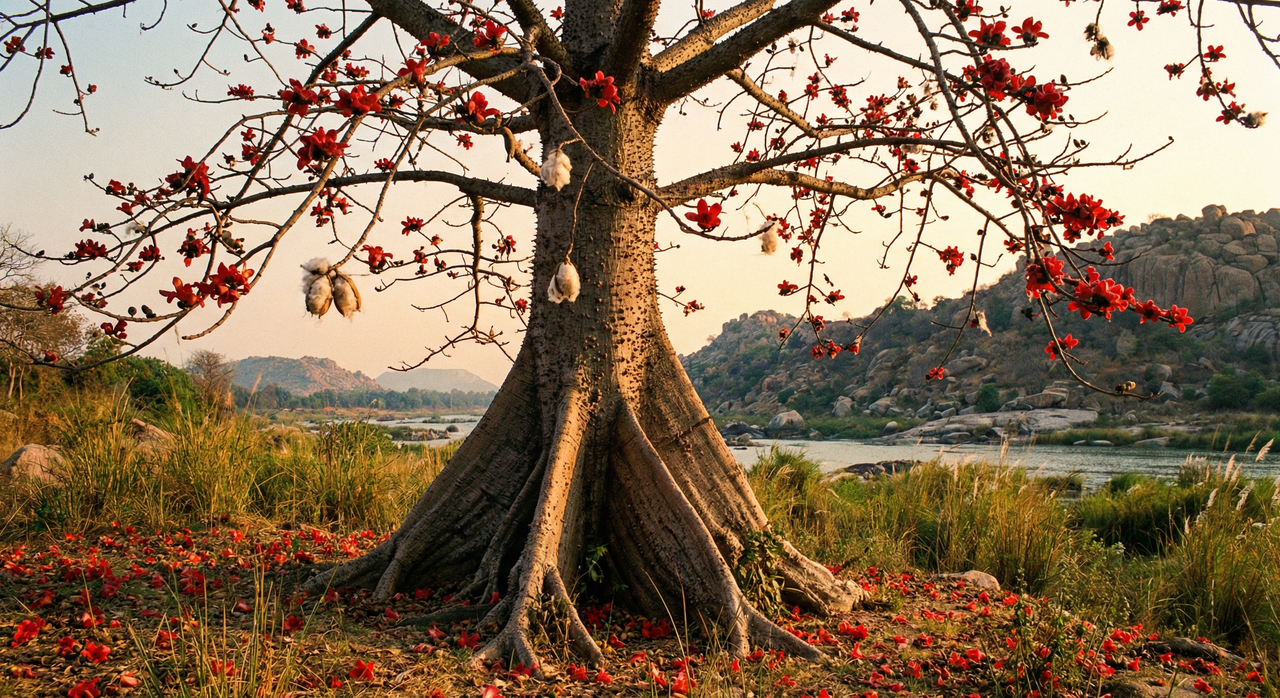
Every winter in my Central Florida food forest, I watch visitors stop dead in their tracks when they first see it: a completely bare tree, not a leaf in sight, absolutely covered in fist-sized scarlet flowers. No foliage to compete with them, no green context, just this skeletal giant holding what looks like a hundred lit candles against a January sky. The Red Silk-Cotton Tree blooms before it leafs out, which sounds like a minor botanical footnote until you're actually standing underneath one and your brain genuinely cannot reconcile what it's seeing. I've grown this tree in three climates now, and that moment of confusion on a visitor's face never gets old.
What catches most people off guard isn't just the spectacle, though. It's that a tree this dramatic, this deeply woven into Hindu mythology and Ayurvedic medicine and the material traditions of cultures across two continents, is almost completely absent from Western permaculture conversations. Bombax ceiba has fed and healed people for centuries: flowers cooked into curries, fiber stuffed into mattresses, bark boiled into wound washes.[1] And yet most temperate gardeners have never heard of it. That gap between cultural depth and horticultural obscurity is exactly what I want to close.
Origin and History of the Red Silk-Cotton Tree (Bombax ceiba)
Botanical Background and Native Range
Bombax ceiba is a fast-growing, deciduous pioneer tree native to the tropical and subtropical zones of South and Southeast Asia, ranging from India and southern China through Myanmar, Thailand, Vietnam, Malaysia, Indonesia, the Philippines, and into northern Australia.[2][3][4] It matures and begins flowering in as little as 5 to 10 years, then keeps going for 50 to 100 years or more, colonizing riverbanks, alluvial soils, and disturbed dry forests in regions receiving roughly 1000 to 2500 mm of annual rainfall.[5][6] Think of it the way we think of fast-growing disturbance species here in the American South, except this one grows with buttressed trunks and lives a century.
The genus extends well beyond Asia. Bombax costatum occupies West and Central African savannas from Senegal to Tanzania, while Bombax buonopozense inhabits lowland forest and gallery forest across West Africa. Bombax insigne grows from southern China through Southeast Asia up to around 1500 meters elevation, and Bombax anceps spans the subtropical forests of southern China, northern Vietnam, Laos, and Thailand.[7][8] Across this broad geography, the genus shares a recognizable suite of traits: deciduous habit, polycarpic reproduction, rapid early growth of 1 to 2 meters per year, and the same elegant adaptation to pronounced wet-dry cycles.[9] Taxonomy gets a little murky here; some authorities treat B. insigne or B. costatum as synonyms of B. ceiba, though most current sources including Kew's Plants of the World Online accept them as distinct species.[10][11]
Visual Characteristics
Mature Bombax ceiba trees reach 15 to 40 meters tall, occasionally stretching to 60 meters, with a straight trunk anchored by prominent buttress roots and a spreading, tiered crown that can look almost pagoda-like from a distance.[12][13] Young trees are armed with stout conical spines on the trunk; those gradually become less pronounced as the bark shifts from smooth light gray to rough, furrowed grayish-brown over time. The leaves are alternately arranged, palmately compound with five to seven lanceolate leaflets each 8 to 20 cm long, and the whole canopy drops in the dry season before flowering begins.[14][15]
That leafless flowering is what people remember. From late winter through early spring, clusters of large, bell-shaped, brilliant scarlet flowers appear directly on the bare branches, each bloom 5 to 15 cm across.[16][17] If you've seen redbud or serviceberry bloom on bare branches in a northern spring, you have a rough mental image, but scale it up dramatically and replace the delicate pink with fire-engine red. After flowering, woody oblong capsules 10 to 20 cm long develop and eventually split into five valves, releasing small dark seeds packed in white silky kapok fiber.[18] Related species vary: B. costatum typically reaches 6 to 25 meters with orange-red flowers, B. insigne ranges from scarlet to white or pink, and B. buonopozense carries vivid red flowers with a yellow base.[19][20]
Traditional and Cultural Significance
Across Hindu tradition, the bombax tree is associated with the deity Shiva, planted near temples, and woven into festivals, weddings, and protective rituals as a symbol of vitality and prosperity.[10][21] In Marathi, the tree is commonly called "Shalmali" or "Saur," names embedded in Ayurvedic texts that document uses of bark, flowers, roots, leaves, and seeds to treat diarrhea, dysentery, fever, inflammation, and wounds.[22][23] Traditional Chinese Medicine and African ethnomedicine draw on the same plant parts for overlapping conditions, a continuity across continents that ethnobotanists find striking.[24]
In West Africa, B. costatum and B. buonopozense serve as sacred trees representing fertility and protection from evil spirits, used in ancestor veneration and rainmaking rituals among Yoruba, Akan, and other groups.[25][26] Southeast Asian species like B. insigne and B. anceps carry different symbolism, representing renewal, duality, and abundance in Vietnamese, Laotian, Cambodian, and Hmong traditions, with flowers incorporated into festivals and weddings.[27]
That reverence has a shadow side. Overharvesting of B. insigne flowers for herbal tea, combined with habitat loss, has pushed that species to Endangered or Critically Endangered status in parts of its range, with population declines exceeding 50 to 80 percent.[28] B. buonopozense is listed as Vulnerable.[29] When I see a plant listed as Endangered because its flowers are being harvested for tea, it's a reminder that every sourcing decision has consequences. I always ask whether the nursery is propagating from cultivated stock, not wild-collected material.
Fun Facts and Ecological Role
The red silk-cotton tree's bare-branch flowering isn't just spectacular to look at; those scarlet blooms are primarily bat-pollinated, timed to coincide with the nocturnal foraging patterns of fruit bats rather than bees.[5] The tree also tolerates moderate fire events thanks to its thick fibrous bark, which lets it function as a genuine ecological pioneer: stabilizing riverbanks, providing nesting sites for birds, and supporting bat roosting.[30] Related species like B. anceps and B. costatum extend those contributions into savanna canopy dynamics and biodiversity support across two continents.[31]
Once the woody capsules split open and release their seeds, the tree earns another common name entirely. The white kapok surrounding each seed is buoyant, water-repellent, and hypoallergenic; historically it filled pillows, mattresses, and life jackets, though commercial kapok production more often came from the related Ceiba pentandra.[32][33] Anyone who has grown this tree quickly learns why the common name fits so well; once those pods open, silky floss fills the air and drifts across the entire garden. The Royal Horticultural Society has recognized the tree's ornamental value with an Award of Garden Merit, though it can naturalize and become weedy in frost-free areas like Florida, Hawaii, and parts of Australia through prolific seeding.[34][35] It's a tree that demands respect for its scale and its seed bank.
Red Silk-Cotton Tree Varieties and Sourcing
Notable Varieties and Selections of Bombax ceiba
If you're hunting for a tidy catalog of named cultivars, I'll save you some time: there isn't one. Bombax ceiba has no widely recognized stable cultivars, and most of what gets described as a "selection" is really a localized phenotype that someone observed and informally named.[36][37] A few horticultural names do float around in trade: 'Flame' for especially vivid red flowers, 'Variegata' for variegated foliage, and looser references to pink, white ('Alba'), 'Golden,' and 'Silver' forms.[38][39] Whether any of these breed true from seed is another question entirely. My honest advice is to treat them as descriptions of what you might be lucky enough to encounter rather than reliable breeding lines. The straight species, with its bare-branched spring fireworks and massive stature, is already spectacular enough that the lack of cultivar refinement has never bothered me in a planting design.
Sourcing Red Silk-Cotton Trees: Nurseries, Regulations, and Propagation
In North America, your best bet is a specialist tropical nursery, primarily in Florida, where growers like Select Trees and Top Tropicals occasionally carry Bombax ceiba.[40][41] Stock peaks after spring and summer flowering, so calling ahead in late summer is smarter than assuming availability. Expect to pay roughly $5 to $15 for a seed packet, $10 to $30 for a small sapling, and considerably more for any larger specimen.[42] I've learned to request photos of trifoliate leaves and flower buds before finalizing orders because I've received misidentified material more than once. The common name "Red Silk-Cotton Tree" gets applied loosely across the genus, so confirming the botanical name on every order matters.[43]
Importing live plants from overseas is genuinely complicated. Bombax ceiba carries no CITES restrictions and sits off the USDA Federal Noxious Weed List,[44][45] but live plant imports still require USDA APHIS permits, phytosanitary certificates, and PPQ Form 525.[46] I always budget extra time for that paperwork. Beyond the regulatory layer, large specimens simply don't ship well; transplant shock is real, and I've lost a six-foot sapling to root disturbance after a rough transit. When new arrivals do come in, I shade them heavily and mist twice daily for the first two weeks.
Growing from fresh seed is the most reliable route: germination runs 70 to 80 percent at 25 to 30°C, but viability drops sharply after six to twelve months, so fresh seed matters.[47] Cuttings have notoriously poor success rates. Then comes the patience part: juvenile trees typically take five to seven years to first flower. I've started interplanting mine with faster-blooming shrubs so the guild doesn't feel static during that long quiet phase. The related species Bombax insigne (Endangered) and Bombax anceps (Vulnerable) are even harder to source, appearing mainly through seed banks and botanical garden exchanges rather than any standard nursery trade.[48][49] Their conservation status alone should tell you to verify what you're actually buying before any money changes hands.
Propagation and Planting of Red Silk-Cotton Tree
Before you decide how to propagate Bombax ceiba, there's one number worth holding in your head: seed-grown trees take 5–8 years to first fruit, while grafted plants can flower and fruit in 2–4 years.[50][37] That gap matters enormously in a food forest or ornamental planting where patience has real costs. For most home gardeners, fresh seed is the accessible and affordable starting point. For anyone wanting confirmed flower color, faster fruiting, or consistent vigor, vegetative propagation is the logical choice. Knowing which camp you're in shapes every decision that follows.
Seed Morphology, Storage, and Germination for Bombax ceiba
The seeds you'll actually handle are small, dark, kidney-shaped things, roughly 6–8 mm long, attached to long silky kapok hairs inside fibrous capsules that can hold 100–200 seeds each.[51][52] I've found that freshly collected seeds still heavy with moisture and surrounded by that fluffy floss germinate noticeably faster than seeds that have sat out even a week. That's not just an impression; it reflects the biology. Bombax ceiba seeds are recalcitrant, with moisture content around 40–50% at maturity, and they lose viability rapidly if they dry below 10–15%.[53][54] At room temperature, viability drops off in as little as 2–4 weeks. If you can't sow immediately, moist cool storage at 4–15°C and 85–90% relative humidity extends viability to 6–12 months; beyond a year, cryopreservation is the only reliable option.[55]
My standard practice is to strip the kapok floss off immediately after harvest and sow the same day. Label everything. Seedlings at the cotyledon stage look deceptively uniform, and once the first true palmate leaves emerge — the ones that remind you this is firmly in the hibiscus family — you'll want to know which batch each came from. Fresh seeds sown in warm, moist, well-drained sandy loam at 25–30°C germinate in 7–14 days at rates of 70–90%.[56][57] A 24–48 hour warm-water soak before sowing can improve germination further, and some growers use light mechanical scarification or GA3; the research on whether scarification is necessary for this species specifically is genuinely conflicting, though related species like B. costatum and B. insigne clearly benefit from it.[57] I usually do a warm soak and skip scarification unless germination rates disappoint me in the first batch. One thing to keep in mind: each seed carries a single zygotic embryo with no polyembryony, unlike some of its African relatives.[58] Every seedling is genetically unique, and because the species outcrosses freely, seed-grown trees won't come true to any particular parent's flower color or habit.[59] That's fine for restoration or food forest canopy work; it's less ideal if you're selecting for a specific phenotype.
Vegetative Propagation Techniques: Cuttings, Grafting, Air Layering, and Tissue Culture
For clonal propagation, air layering during the monsoon or rainy season is one of the more accessible methods for home growers, giving 50–80% success and preserving the genetics of whatever superior genotype you're working with.[60] Grafting — cleft, veneer, or bud grafting onto Bombax ceiba rootstock — achieves similar 50–80% take rates when done in late winter to early spring with active sap flow, precise cambium alignment, and post-graft humidity management.[61][62] In my experience with grafting this genus, matching cambium layers carefully and working quickly to minimize drying are the two factors that separate an 80% take rate from a 40% one. Semi-hardwood cuttings taken in late spring or the monsoon season with IBA at 1000–5000 ppm in a perlite:vermiculite mix under high humidity and bottom heat at 24–30°C root at more modest 20–40% rates over 4–12 weeks, which makes them a viable but less efficient option.[63] Tissue culture using Murashige and Skoog medium with BAP and NAA achieves 70–90% success but is technically demanding and expensive enough that it belongs in commercial nursery or research settings rather than a home propagation bench.[64]
Optimal Soil, Site Selection, and Sun Requirements
Full sun is non-negotiable. Bombax ceiba needs a minimum of 6–8 hours of direct light daily, and partial shade produces etiolated, chlorotic growth with poor flowering.[14][37] Site selection should start there and layer in drainage second. The preferred soil is well-drained sandy loam, loam, or clay loam at pH 5.5–7.5, with optimal performance at 6.0–7.5 and organic matter around 2–5%.[5][65] The taproot needs at least 1–1.5 m of good soil depth, and waterlogging causes root rot quickly.[37] My standard drainage test is filling a planting hole with water and checking back after 24 hours; if water is still sitting there, I move on to a different spot. In my subtropical garden I amend with composted bark rather than peat to bump organic matter without pushing pH too low, since peat can tip a marginal 5.5 reading into problem territory. Once the tree is established it handles drought well and is adapted to seasonal dry periods, but young transplants need consistent moisture without saturation.[15] A 5–7 cm mulch layer kept well clear of the trunk conserves moisture and moderates soil temperature during that critical establishment window.[18]
Spacing, Planting Technique, and Establishment Timeline
Plan for the tree this will become, not the tree you're planting. Mature red silk-cotton trees reach 20–30 m tall with a broad umbrella canopy spreading 9–15 m across, and early growth runs 1–2 m per year for the first decade or more.[10][66] I once planted two seedlings 6 m apart in a food forest, thinking that felt generous, and spent years pruning to keep them from crowding each other and everything around them. The standard for ornamental and landscape use is 8–10 m between specimens.[65][67] In agroforestry or intercropping systems, 5–10 m works; timber plantations use 3–5 m square; windbreaks can go 2–3 m within rows with 4–6 m between rows. Keep any specimen at least 10–12 m from structures because the deep taproot and lateral root spread will eventually find foundation edges and utilities.[67]
At planting, dig the hole at least twice the width of the root ball, disturb the taproot as little as possible, and water in thoroughly. I stake young transplants through the first year in any site with seasonal wind, and I plan for aggressive thinning of nearby plantings after year five when that fast early growth starts producing competing crowns. The establishment timeline is worth stating plainly: seed-grown trees take 5–8 years to first fruit under good conditions, while grafted plants can fruit in 2–4 years.[50][62] If you're willing to invest in grafted material at the outset, that patience gap closes considerably.
Red Silk-Cotton Tree Care Guide
Growing Bombax ceiba well means thinking like the tree thinks: in seasons, not schedules. Every care decision, from when to water to when to reach for the pruning saw, flows from understanding that this is a deciduous tropical giant built for pronounced wet and dry cycles. Get that rhythm right and the tree practically tends itself. Fight it with constant irrigation or aggressive fertilizing, and you'll get soft, weak growth that misses the whole point.
Sunlight Requirements for Bombax ceiba
The red silk cotton tree is a pioneer emergent, meaning it evolved to claim the most exposed, unshaded positions in disturbed tropical forests. Mature trees need six to eight hours of direct sun daily with no negotiation.[18][68] Seedlings will tolerate partial shade or bright indirect light during their first season, which is genuinely useful in nursery conditions, but I've found that the moment I move young trees into full sun and temperatures hold above 25°C, they practically lunge out of the ground. I label every seedling row carefully now because young plants look deceptively like okra or cotton starts before that growth surge hits. Any site with significant canopy shade above will produce the same result as over-fertilizing with nitrogen: tall, leggy, weak-wooded growth with poor flowering.
Watering Needs and Drought Tolerance
Once established, Bombax ceiba is genuinely drought-tolerant, relying on a deep taproot and its deciduous habit to coast through dry seasons.[69] It wants well-drained loamy or sandy loam soil with a pH between 6.0 and 7.5; sitting in wet feet will kill it faster than any drought.[70] Young trees need consistent moisture, roughly one to two inches per week, with soil kept evenly moist but never waterlogged.[71] Established specimens want deep, infrequent watering every five to fourteen days during active growth, scaling back to every two to four weeks during dormancy.[72] The moment my trees start yellowing and shedding leaves in late autumn, I cut watering in half immediately. That bare silhouette and thickening corky bark are unmistakable signals that the tree has entered survival mode and absolutely does not want wet soil. Overwatering shows up as yellowing drooping leaves, soft mushy roots, and a sour soil smell; underwatering as wilting, crispy leaf margins, and premature drop.[73] Read the tree rather than the calendar.
Feeding and Soil Management
Bombax ceiba is a moderate feeder that tolerates genuinely poor soils but responds well to organic amendments like compost or well-rotted manure.[74][75] Always soil test before adding anything; the deficiency symptoms you're trying to fix (interveinal chlorosis, marginal scorch, small mottled leaves) can look nearly identical to over-fertilization toxicity, and guessing wrong costs you a season of growth.[76] When supplemental fertilizer is warranted, a balanced 10-10-10 applied in two or three splits from spring through early summer, timed to coincide with the new leaf flush, is the standard approach.[18] Shift toward phosphorus-rich formulas on mature trees approaching flowering age, and cut nitrogen out entirely in autumn to let the tree harden off properly.[77] I pushed a young tree with high-nitrogen fertilizer once, thinking faster growth meant faster flowers. Instead I got soft, floppy shoots that snapped in the first tropical storm and no flowers the following spring. Compost and patience have served me far better ever since.
Heat and Drought Management
This tree is genuinely built for heat, tolerating temperatures from 10°C up to around 45°C with optimal growth between 20 and 35°C.[78] Deep taproots, efficient stomatal control, thick bark, and the option to simply drop its leaves during extreme dry heat are all adaptations that let it survive conditions that would stress most trees.[79] Seedlings and trees in active flower are the most vulnerable stages; above 40°C, a 30 to 50 percent shade cloth buys important protection until temperatures drop.[80] Watch for wilting, scorched leaf margins, and curling as early signals, especially during drought. A five to ten centimeter layer of organic mulch over the root zone, kept clear of the trunk, is the single most effective intervention: it retains soil moisture, moderates root temperature, and reduces the compounding stress of heat plus drought together.[71] Water deeply and early in the morning during peak summer heat rather than on a fixed schedule.
Frost Tolerance and Cold Protection
The red silk cotton tree is not frost-hardy. It belongs in USDA Zones 10 through 12, and even a brief dip to 28°F (-2°C) can cause branch tip dieback on mature specimens; sustained temperatures below 32°F or any hard frost below 20°F risks bark splitting or outright death.[81][82] Young plants are more vulnerable than established specimens, which is something I learned the hard way when I lost the top eighteen inches of a five-year-old tree to an unexpected cold snap in zone 10b. Four to six inches of organic mulch around the base, breathable frost cloth during cold snaps, and a sheltered southern exposure with wind protection have prevented any repeat damage since.[12][83] In marginal zones, container culture with indoor overwintering is the only reliable option. Microclimate selection at planting time is not optional with this species; a single bad night in an exposed position can undo years of growth.
Pruning, Maintenance, and Pest Management
The ideal pruning window falls in late winter to early spring, during the leafless dormant phase after leaf drop but before new buds break.[84] Use this window to establish a strong central leader on young trees, remove dead or damaged wood, and open the canopy for airflow, but take no more than 25 percent of the canopy in a single session.[85] The milky sap irritates skin, so gloves and sterilized tools are non-negotiable; I learned the tool sterilization lesson after an early anthracnose outbreak spread between cuts. Light shaping can follow flowering if needed. On the pest front, the usual suspects are aphids, scale, mealybugs, borers, caterpillars, and spider mites; neem oil, insecticidal soaps, and Bt for caterpillars handle most issues if caught early, and encouraging ladybugs and other predators does more long-term good than any spray program.[86] Fungal problems including anthracnose, leaf rust, and powdery mildew are almost always traceable back to poor drainage, overhead watering, or overcrowding; the cultural practices already covered here are genuinely the best disease prevention available.[87]
Seasonal Rhythm and Phenology
Everything in a Bombax ceiba care calendar orbits one biological fact: this tree runs on a wet-dry cycle, not a temperate four-season rhythm. Leaves drop from November through February as the dry season sets in, the tree conserving water through deciduous dormancy. Then, on completely bare branches, the large red flowers open from February through April, followed by fruit maturation in May and June, and finally a flush of new semal leaves in April and May as rains return.[10][88] Watching those crimson blooms open on naked branches each spring is genuinely one of the more dramatic sights in my garden, and it's also my clearest signal that it's time to resume regular watering and begin the spring fertilizer cycle. Reduce watering and stop fertilizing as leaf drop begins in autumn. Prune during the leafless window before buds break. Resume feeding with the leaf flush. Every task anchors to this phenological sequence rather than a fixed month on the calendar, and once you internalize that rhythm, caring for this tree becomes much more intuitive than any written schedule could make it.[68][15]
Red Silk-Cotton Tree Harvesting Guide
There are really two separate harvests on this tree, and they run on completely different clocks. Get familiar with both before the first flower opens, because the windows move faster than you'd expect on a species this dramatic.
When to Harvest Bombax ceiba: Timing, Color Cues, and Phenology
Bombax ceiba flowers in spring, typically March through April in tropical regions, and the woody oval capsules that follow take 60 to 90 days to reach maturity, putting the main harvest window somewhere between May and July depending on your location.[89][90] The signal to watch for is color: capsules that started out green will shift to yellowish-brown or reddish-brown just before they split longitudinally along their length, which can be anywhere from 10 to 20 centimeters.[91][92] Once you see that color shift, you have a short window. The pods dehisce quickly once they start, and the kapok fiber disperses in the wind almost immediately.
I should be honest about the timeline upfront: after growing several Bombax ceiba from seed, I've learned that the first reliable flower harvest rarely comes before year six or seven. Seed-grown trees generally take 5 to 8 years to flower, so if you're planning for edible flowers or fiber in a kitchen garden context, factor that patience into your design from the start. Grafted specimens can get you there in 2 to 4 years, which is worth the sourcing effort if your goal is harvesting rather than canopy building.
How to Harvest and Process Edible Flowers, Young Pods, and Kapok Fiber
For the edible harvest, flowers are picked when young and tender in spring, and young pods are gathered before full maturation for use in the kitchen.[15] Timing the flower harvest is fairly forgiving, but you do need to beat the bees and the midday heat. I pick early in the morning when the blooms are still fresh, and I've found that cool storage within a few hours makes a real difference in texture. For the pods, watch for the color shift described above; pods that have already started to show the yellowish-brown transition will have woody fiber that's less pleasant to eat, so err on the early side.
Kapok processing is a different matter entirely. Once the pods dehisce, you collect them, sun-dry the opened capsules to loosen the fiber further, remove the seeds, then clean the fiber before drying it down to below 10% moisture content. Storage requires cool, dry conditions, around 20 to 25°C at 50 to 60% relative humidity, in breathable containers so the fiber doesn't mat or mold.[93][94] It's honestly a lot more labor than processing home-grown cotton or milkweed fluff, both of which I've done. The kapok clumps and the seeds cling stubbornly. And because the mature capsules carry fine irritating hairs, I always wear gloves when handling them, a practice I adopted after some early mistakes that left my hands itching for days.
Flavor Profiles, Yields, and Culinary Value of Harvested Parts
The flowers are the real culinary prize. They offer a mild, slightly sweet and tangy flavor with subtle floral notes and a honey-like aroma, and they become mucilaginous when cooked, a texture that thickens soups beautifully but turns unpalatably slimy if you push past the right point.[95][96] The young pods share that okra-like slip, with juicy pulp and a mildly sweet taste when cooked.[97] Related species like Bombax costatum and Bombax buonopozense show the same signature mucilaginous quality in flowers and pods, and while data on some of the rarer relatives is thinner, the flowers I've tasted from across the genus all share that characteristic thickening slip.[98]
The autumn kapok harvest, by contrast, isn't a food harvest at all. The fiber from dehisced pods goes into stuffing, insulation, and traditional bedding rather than the kitchen.[93] In a smaller home landscape, I prioritize the spring flowers and young pods over waiting for the fiber windfall. The edible parts reward attentive, timely picking; the kapok rewards patience and a good drying setup.
Red Silk-Cotton Tree Preparation and Uses
Culinary Uses and Preparation of Red Silk-Cotton Tree
The flowers are where most cooks start with this tree, and honestly, they're the easiest entry point. Fresh blooms can go straight into a salad or get tossed into a quick stir-fry, where their mild, slightly sweet flavor and tender texture shine without much fuss.[99][15] One thing I've learned the hard way: harvest only what you'll use that day. The color fades within hours of picking, and once they go dull they lose their appeal on the plate entirely.
Those mucilaginous qualities aren't a bug, they're a feature. Think okra in a soup pot. Across the genus, Bombax costatum flowers are deliberately used as a thickener in West African soups for exactly this reason, while B. insigne and B. anceps flowers and leaves turn up in Vietnamese broths and Southeast Asian curries where that slippery body is prized.[100][101] Learning the kitchen logic of one Bombax teaches you the rest of the genus.
Young leaves and shoots are worth knowing too. Raw, they have a mild bitterness that's pleasant in small amounts; a quick boil or stir-fry mellows them to something closer to spinach.[102][103] Immature pods follow a similar pattern, crisp and mildly acidic when young, reminiscent of green okra, good raw or cooked.[15] Cooking does double duty across all these parts: it improves texture and reduces any latex or saponin residue that can cause mild irritation when consumed raw in quantity.[104] The seeds press into a neutral to nutty cooking oil that's used throughout South Asia, though the hard seed coat means pressing isn't a home-kitchen project.[105]
Medicinal Preparations from Bombax ceiba
Traditional systems on two continents have pulled medicine from nearly every part of this tree. Bark decoctions appear in Ayurvedic and Chinese preparations for diarrhea, dysentery, inflammation, and respiratory complaints; flower infusions address coughs and skin conditions; root preparations and gums show up as tonics and aphrodisiacs across South Asian traditions.[102][106] In Nigerian systems, B. buonopozense bark treats malaria, chest pain, and gonorrhea, a range of applications that illustrates just how deeply embedded the genus is in African healing traditions.[107]
Traditional dosages, where documented, tend toward 50-100 g of dried bark per liter of water, taken as one or two cups daily, or 5-10 g dried bark twice daily.[108] I want to be clear that these are traditional guidelines, not clinically standardized protocols, and I personally wouldn't use Bombax preparations medicinally without guidance from a qualified practitioner. The ethnobotanical record is rich but the human clinical data is thin, and that gap matters.
Non-Food Uses: Fiber, Wood, and Traditional Materials
The common name gives it away: this tree built its reputation on fiber. The dense silky floss packed around each seed inside the mature capsules is buoyant, water-repellent, and naturally antimicrobial, properties that made it indispensable for stuffing pillows, mattresses, and life jackets long before synthetic fill existed.[10][21] Relatives follow the same pattern: B. costatum and B. buonopozense floss stuffs bedding and serves as tinder or ritual costume material, while B. insigne and B. anceps fibers get twisted into ropes, nets, and paper across Indochina.[109][110]
The wood is soft and lightweight, suited for canoes, plywood, matchsticks, and carving, though not for anything load-bearing.[111] Inner bark fibers strip out into serviceable cordage and traditional textiles across the tree's range. A single mature specimen, harvested respectfully and never girdled, can supply a household with food, medicine, stuffing, rope, and light timber across its lifespan. That's the kind of stacking function that makes a large tree worth its footprint in any serious food forest.
Red Silk-Cotton Tree Health Benefits and Medicinal Uses
What strikes me every time I read through the research on this tree is how well the traditional uses map onto the chemistry. Ayurvedic and African herbalists weren't guessing when they reached for the bark or flowers; they were working with a plant whose phytochemical profile gives it genuine pharmacological range. Understanding that profile is the cleanest way into the medicinal story.
Key Phytochemicals in Bombax ceiba
The compound lineup in red silk cotton tree is genuinely impressive in breadth. Flavonoids anchor the profile: quercetin, rutin, kaempferol, gossypetin, and their glycosides are well-documented across leaves and flowers,[112][113] and in my experience, flowers harvested just as they begin to open have the most vivid color and the most intense fragrance, which aligns with research showing leaf flavonoid levels run 20-30% higher during flowering than during monsoon season.[114] Timing your harvest matters.
Phenolic acids, particularly gallic and ellagic acid, reinforce the antioxidant capacity, with total phenolics reaching around 45-50 mg/g in B. ceiba leaves and considerably higher in some related species.[112][115] The bark adds lupeol and β-sitosterol, two terpenoids where lupeol in particular has been linked to anti-inflammatory activity,[113] while tannins (including condensed and ellagitannin forms), saponins, and scopoletin round out a chemistry set that explains the tree's reputation across such a wide range of traditional indications.[116]
Documented Medicinal Research and Pharmacological Actions
The strongest preclinical evidence clusters around two actions: anti-inflammatory and antioxidant. Bombax ceiba extracts suppress COX-2 expression, inhibit NF-κB signaling, and reduce pro-inflammatory cytokines including TNF-α and IL-6,[117][118] while the gallic acid, ellagic acid, and flavonoid content drives potent free-radical scavenging activity.[119] Multiple independent studies converge on these two pathways, which gives them more weight than the more isolated findings elsewhere in the literature.
From there, the pharmacological picture broadens. Antidiabetic activity has been demonstrated through α-glucosidase inhibition, improved insulin sensitivity, and PPARγ agonism.[120] Antimicrobial effects against both gram-positive and gram-negative bacteria, including S. aureus and E. coli, are documented.[121] Researchers have also identified analgesic, hepatoprotective, wound-healing, expectorant, and adaptogenic activity, and early anticancer work points to mitochondrial-mediated apoptosis involving caspase activation and cell cycle arrest.[122][123][102] All of this is compelling, and all of it is primarily in-vitro and animal-model data, with very limited human clinical trials.[124] The traditional use in Ayurveda, Unani, and African folk medicine for diarrhea, respiratory ailments, fever, and wound care[116][98] tells us the plant works in practice; the science is still catching up on exactly how and at what doses.
Nutritional Profile of Edible Parts
The edible parts of this tree have real nutritional value, though preparation determines how much of it reaches you. Young flowers and leaves need to be cooked; seeds require drying, roasting, or fermenting to reduce tannins (0.5-2%) and phytates (1-3%) that would otherwise limit mineral absorption and cause digestive irritation.[125][126] I've found that roasting seeds until they're lightly golden eliminates the slight bitterness I noticed with under-processed batches entirely.
Young leaves contribute 3-5g protein and 50-60 mg vitamin C per 100g fresh weight, with calcium hitting 200-300 mg per 100g.[127] Flowers offer meaningful B vitamins and around 20-25 mg vitamin C fresh, while dried flowers and seeds are proportionally much denser in potassium (up to 1500 mg per 100g dried) and iron (5-10 mg).[128] Seeds contain 15-20g protein and 20-25g fat per 100g dry weight, the fat being primarily oleic and linoleic acids.[129] Think of these as occasional, seasonal supplements to a varied diet rather than staple foods, which is exactly how they've functioned across Asian and African cuisines for generations.
Safety Considerations and Contraindications
Bombax ceiba has a long and largely clean safety record. Acute toxicity studies show LD50 values above 2000 mg/kg for extracts,[130] and there are no well-documented poisoning cases associated with proper culinary or traditional use.[99] I'd compare that reassuring baseline to hibiscus or roselle: generally fine for culinary use, but still something you introduce thoughtfully, especially if you've never eaten it before.
The caveats are real, though, and I want to be specific rather than vague. Seeds contain cyclopropenoid fatty acids, including malvalic and sterculic acids, which have shown hepatotoxic and metabolic effects in animal studies.[131] Seed pod hairs can irritate skin on contact, and the sap or plant parts may cause dermatitis in sensitive individuals.[35] Proper roasting or boiling addresses most of these concerns; don't skip that step. The pregnancy contraindication is non-negotiable: alkaloids and saponins in this plant have documented uterine stimulant activity, and I don't recommend medicinal use of any Bombax part during pregnancy or lactation, full stop.[99] Its hypoglycemic and vasodilatory properties also create real potential for interaction with antidiabetic, antihypertensive, and anticoagulant medications.[124] If you're on any of those, consult your doctor before moving beyond occasional culinary use.
Red Silk-Cotton Tree Pests and Diseases
The red silk-cotton tree is a genuinely tough species when you put it in the right spot. In its native tropical and subtropical range, Bombax ceiba grows vigorously with few serious problems, and that resilience holds up well in well-sited permaculture plantings.[132][133] The caveat, and it's an important one, is that susceptibility climbs sharply when drainage is poor or monsoon humidity lingers around the root zone. In my experience designing with large-flowering tropicals, getting air movement and drainage right at the start prevents the majority of issues before they ever appear.
Common Diseases and Environmental Triggers
The fungal threats are real but predictable. Cercospora leaf spot shows up as circular gray-centered lesions with dark margins, quietly reducing photosynthesis through humid seasons. Anthracnose (Colletotrichum spp.) is more aggressive, defoliating young leaves and twigs when wet conditions persist. Powdery mildew from Oidium spp. appears during monsoons, while Fusarium wilt targets seedlings under stress. The most serious threats are the root rots, particularly Phytophthora and Ganoderma lucidum, both tied directly to waterlogged soils that cause progressive yellowing and decline.[134][135] Bacterial leaf blight from Xanthomonas campestris is less common but worth knowing: water-soaked lesions on leaves during persistently wet stretches.[136]
Genus-wide comparisons are instructive here. Bombax insigne's thick bark and latex give it a measurable edge against leaf rust and powdery mildew, while B. buonopozense's deep roots and drought-adapted phenolic profile translate to stronger fungal resistance under drier conditions. B. costatum leans the other way, showing notable vulnerability to white rot (Ganoderma) and sooty mold secondary to insect pressure.[137][138] No resistant cultivars of B. ceiba have been bred for any of these issues, so there's no variety to save you here; cultural practice and site selection are the entire game.[139]
Major Insect Pests and Natural Defenses
The insect pressure list is fairly extensive: semilooper caterpillars (Anomis flava, Lymantria spp.), leaf beetles, aphids, scale insects, mealybugs, wood borers, bark beetles, and termites.[140][141] Defoliation is the obvious damage, but the more insidious problem is what follows: sap-sucking insects deposit honeydew that feeds sooty mold, and borers create entry wounds that invite pathogens. It's the same pattern I see on stressed citrus or hibiscus in the broader Malvaceae world, where the secondary infections end up doing more lasting damage than the original pest.
The tree isn't defenseless, though. The sharp trunk spines that have surprised me more than once during pruning actually do deter certain bark-foraging insects, and the glandular trichomes on the leaves trap and repel smaller pests.[142] More importantly, the same phenolics and flavonoids (quercetin, kaempferol glycosides) discussed in the health benefits section function as antifeedant and insecticidal compounds in the garden, backed up by alkaloids and terpenoids in the bark and leaves.[143] A healthy, well-sited tree leans on these defenses naturally. A stressed one can't.
Integrated Management Strategies
Since no resistant cultivars exist, IPM here is really just good permaculture design applied consistently.[139] Prioritize excellent drainage, full sun exposure, and spacing of at least 10 to 15 feet for airflow. Prune infected material during dry weather using sterilized tools, avoid overhead irrigation, and keep mulch well away from the trunk base. Balanced fertility matters too; pushing excess nitrogen produces soft, susceptible growth.[144][145] When intervention is genuinely necessary, neem oil handles scale and aphid pressure reasonably well, Bacillus thuringiensis addresses caterpillars, and copper fungicides applied preventively before humid seasons can hold back anthracnose and leaf spot. Chemical options come last, not first. Every time I've seen serious pest or disease pressure on a silk-cotton tree, the real problem was compacted soil, poor drainage, or overcrowding, not a lack of pesticide.
Red Silk-Cotton Tree in Permaculture Design
If you've ever seen a red silk-cotton tree in full flower on a warm February morning, bare branches lit up with scarlet blooms like something between a chandelier and a campfire, you already understand why permaculture designers in tropical climates are willing to plan entire food forests around a single specimen. The design calculus is real, though. This is a tree that rewards patience, demands honest site assessment, and will absolutely outgrow a poorly considered placement. Getting those three things right is the work.
Climate Preferences and Hardiness Zones
Bombax ceiba belongs in USDA zones 9b through 11, with most reliable long-term success in zones 10 and above.[146][70] South Florida, coastal Southern California, Hawaii, and the warmest pockets of South Texas and southern Arizona are the realistic cultivation window for most readers. Zone 9b is where things get conditional fast. The tree can take brief dips to around 20-28°F, but the damage is ugly and it comes on quickly: wilting, leaf drop, bark splitting, and in young trees sometimes death.[147][148] I learned this the hard way after losing a two-year-old tree to a surprise 26°F dip before I'd figured out my microclimate properly. Eight inches of mulch over the root zone and frost cloth when temperatures threaten to drop below 28°F make the difference between a setback and a casualty.[149] Microclimate selection isn't optional in zone 9b; it's the whole strategy.
In its native range across South and Southeast Asia, this species thrives in warm, humid monsoon climates with annual rainfall between 1,000 and 2,500 mm and humidity that routinely exceeds 70-80%.[150][15] Replicating those conditions in a designed system means choosing a full-sun, well-drained inland site on sandy loam to loamy soil at pH 5.5-7.5, with supplemental irrigation during dry seasons until the tree is established.[151][15] Salt tolerance is limited, so coastal sites with salt spray are a poor fit. If you're working with related species like Bombax costatum or Bombax buonopozense, expect even less cold tolerance; both are firmly zones 10-12 with no meaningful margin.[19][152] The non-negotiables for long-term success remain the same across the genus: full sun, excellent drainage, and protection from cold wind.
Ecosystem Functions and Wildlife Support
The ecological story of this tree centers on one spectacular event: dry-season flowering on bare branches. The large, crimson, cup-shaped blooms open at dusk, releasing a musky scent and filling with sucrose-rich nectar that is primarily designed for fruit bats.[153] Sunbirds, bulbuls, and mynas move in during the day as secondary visitors, and I've watched hummingbirds work through a flowering specimen in Central Florida with an intensity I hadn't seen on anything else in the system. The tree was bare, the blooms were glowing orange-red in the morning light, and the noise from the birds was genuinely startling. That kind of dry-season nectar resource is rare in subtropical food forests, and it matters for pollinator habitat even when the plant community isn't actively fruiting.
The catch in non-native settings is that the tree is self-incompatible and depends heavily on bat and bird vectors for cross-pollination.[149][154] Where bat populations are low or absent, hand-pollination at dusk becomes necessary if you want capsule set. I've done this by transferring pollen between flowers on separate trees just as they open, and it works, but it's a commitment. Planting at least two specimens within range of each other and providing habitat connectivity for nectar-feeding wildlife improves your odds considerably.
Beyond the flowers, the ecosystem functions run deep. Buttress roots stabilize slopes and stream banks.[151] Leaf litter decomposes rapidly, cycling nutrients back into the soil web, and the bark supports mycorrhizal associations and epiphytes that contribute to guild-wide soil health.[155] One thing worth stating clearly: this tree is not a nitrogen fixer. Its contribution to fertility comes through dynamic accumulation and litter cycling, not atmospheric nitrogen capture.[156] Plan your guild accordingly and pair it with leguminous understory companions where nitrogen inputs matter.
Forest Layer Placement and Guild Design
At 20-30 meters at maturity with a spreading crown 10-15 meters wide, the red silk-cotton tree occupies the emergent or upper canopy layer in a tropical food forest.[157][158] What makes it genuinely useful rather than just dramatic is the combination of its open crown architecture and deciduous habit. Light filters through in ways you simply don't get from a dense evergreen canopy. I used to compare it to the jacaranda I grew alongside pineapple and ginger in a Central Florida test bed; both allowed enough light penetration for understory productivity without the cramped, shaded-out feeling you get from species like strangler fig or avocado left unpruned. With the silk-cotton, you get the added benefit of full light during the dry season when the tree is leafless, which matters for understory crops that want a sunny winter period.
As a pioneer species, it earns its place early in succession.[159] Fast growth of 1-2 meters per year in good conditions means it establishes structure quickly, and its leaf litter creates the kind of organic matter that benefits shade-tolerant ground covers and rhizomatous crops planted beneath it.[159] Ginger, turmeric, taro, and low-growing nitrogen-fixers like peanut or arachis are all reasonable understory companions. If you're working at a smaller scale or want something more manageable, Bombax costatum tops out at 10-15 meters in savanna conditions and shares the same open-crown light-permeability without requiring quite as much horizontal space.[19] The patience required for a tree of this stature is real, but the payoff, habitat value, seasonal drama, fiber, and food, accumulates over decades once you get the placement right.
The Tree That Taught Me to Pay Attention to Bare Branches
I almost passed on planting mine because I couldn't imagine waiting five years for flowers. Then one February morning I walked out to find every leafless branch lit up in red against a gray sky, and I stood there longer than I'd like to admit. It blooms when nothing else does, for pollinators that have nothing else. That's not a coincidence; that's a relationship the tree has been keeping for thousands of years, and I'm just glad I didn't miss it.
Sources 159
- Ethnobotanical and pharmacological properties of Bombax ceiba ↩
- USDA Plants Database - Bombax ceiba ↩
- Kew Science - Plants of the World Online: Bombax ceiba ↩
- Global Biodiversity Information Facility - Bombax ceiba ↩
- USDA Forest Service - Bombax ceiba Ecology and Silviculture ↩
- USDA Forest Service Silvics Manual - Bombax ceiba ↩
- Kew Science - Plants of the World Online ↩
- PROTA - Bombax costatum ↩
- Useful Tropical Plants Database ↩
- Wikipedia - Bombax ceiba ↩
- Kew Science - Plants of the World Online ↩
- Missouri Botanical Garden - Bombax ceiba ↩
- Flora of China - Bombax ceiba ↩
- Missouri Botanical Garden Plant Finder ↩
- Useful Tropical Plants - Bombax ceiba ↩
- Kew Science - Bombax ceiba ↩
- Flora of China - Bombax ceiba ↩
- Missouri Botanical Garden ↩
- Useful Tropical Plants - Bombax costatum ↩
- Kew Science - Bombax buonopozense ↩
- Kew Science - Bombax ceiba Cultural Significance ↩
- Journal of Ethnopharmacology - Traditional uses and pharmacological profile of Bombax ceiba ↩
- PMC - Bombax ceiba: A review on its phytochemistry and pharmacological activities ↩
- Ethnobotanical Survey - Bombax costatum ↩
- Cultural Significance of Bombax costatum in West African Folklore ↩
- Sacred Trees of West Africa ↩
- Ethnobotany of Bombax anceps in Northern Vietnam ↩
- IUCN Red List - Bombax insigne ↩
- IUCN Red List - Bombax buonopozense ↩
- Fire Tolerance in Tropical Trees ↩
- Ecological Role of Bombax Species ↩
- FAO - Kapok and Related Bombax Species ↩
- The Genus Bombax: A Review ↩
- RHS - Bombax ceiba ↩
- CABI Compendium - Bombax ceiba ↩
- Plant Finder: Bombax ceiba ↩
- Kew Plants Profile for Bombax ceiba ↩
- PlantFile ↩
- Gardenia ↩
- Bombax ceiba - Red Silk Tree ↩
- Bombax ceiba ↩
- Bombax ceiba Seeds for Sale ↩
- Flora of Tropical East Africa ↩
- CITES Appendices ↩
- Federal Noxious Weed List ↩
- Importation of Plants and Plant Products ↩
- Bombax ceiba: Propagation and Cultivation ↩
- Bombax insigne ↩
- IUCN Red List: Bombax anceps ↩
- Bombax ceiba - The Red Silk-Cotton Tree ↩
- Plant Finder: Bombax ceiba ↩
- Flora of China: Bombax ceiba ↩
- Recalcitrant Seeds of Bombax ceiba: Storage Behavior and Viability ↩
- Recalcitrant Seeds: Biology and Storage ↩
- Seed Storage Behaviour of Bombax ceiba ↩
- Seed Biology and Germination of Bombax ceiba L. ↩
- Seed Propagation of Bombax ceiba: Scarification and Germination Studies ↩
- Embryology and Seed Structure in Malvales: Bombax ceiba ↩
- Genetic Variation in Bombax ceiba Seedlings from Seed Propagation ↩
- Vegetative Propagation of Bombax ceiba through Air-layering and Cuttings ↩
- Propagation of Bombax ceiba by Grafting Techniques ↩
- Grafting Manual for Tropical Trees: Bombax Species ↩
- Tropical Woody Plant Propagation Guide ↩
- Micropropagation of Bombax ceiba L.: A Multipurpose Tree Species ↩
- Soil Requirements for Tropical Trees: Bombax Species ↩
- University of Florida IFAS Extension - Bombax ceiba ↩
- World Agroforestry Centre - Bombax ceiba Profile ↩
- Growing Tropical Trees: Bombax ceiba Care Guide ↩
- Bombax ceiba - Missouri Botanical Garden ↩
- Bombax ceiba - University of Florida IFAS Extension ↩
- Bombax ceiba Care Guide - University of Florida IFAS Extension ↩
- Water Management for Tropical Trees: Bombax Genus ↩
- Bombax ceiba - Royal Horticultural Society ↩
- Bombax ceiba - Royal Horticultural Society ↩
- Soil Requirements for Tropical Ornamental Trees - University of Florida IFAS Extension ↩
- Nutrient Deficiencies in Trees - University of Florida IFAS Extension ↩
- Nutrient Management for Tropical Trees ↩
- Physiological Adaptations of Bombax ceiba to Drought and Heat Stress ↩
- AHS Heat Zone Map ↩
- Heat Stress in Tropical Trees: Symptoms and Management ↩
- Bombax ceiba - North Carolina Extension Gardener Plant Toolbox ↩
- Royal Horticultural Society - Bombax ceiba ↩
- Frost Protection for Tropical Trees ↩
- Bombax ceiba Care Guidelines ↩
- Tropical Tree Pruning Techniques ↩
- Pests and Diseases of Bombax Trees ↩
- Pests and Diseases of Deciduous Trees - Royal Horticultural Society ↩
- Bombax ceiba - Missouri Botanical Garden Plant Finder ↩
- Silk Cotton Tree (Bombax ceiba): Cultivation and Uses ↩
- Phenology and Reproductive Biology of Bombax ceiba ↩
- Silk Cotton Tree (Bombax ceiba): Cultivation and Uses ↩
- Bombax ceiba - Missouri Botanical Garden ↩
- Post-Harvest Processing of Kapok Fiber ↩
- Storage Conditions for Natural Fibers ↩
- Volatile compounds in flowers of Bombax species ↩
- Ethnobotany of Bombax ceiba ↩
- Edible Flowers of India ↩
- Ethnobotanical Survey of Bombax costatum in West Africa ↩
- Traditional Uses of Bombax ceiba in Indian Cuisine ↩
- Ethnobotany of Bombax costatum in West Africa ↩
- Ethnobotany of Bombax insigne in Northeast India ↩
- Ethnobotany of Bombax ceiba ↩
- Traditional Uses of Bombax ceiba in India ↩
- Bombax insigne - Useful Tropical Plants ↩
- Fatty Acid Analysis of Bombax ceiba Seed Oil ↩
- Pharmacognostic and pharmacological overview on Bombax ceiba ↩
- Ethnobotanical Survey of Medicinal Plants Used in the Management of Malaria in Southern Nigeria ↩
- Ethnobotanical Survey of Medicinal Plants in Nigeria ↩
- Ethnobotany of Bombax insigne in Northern Vietnam ↩
- Bombax buonopozense - Useful Tropical Plants ↩
- Bombax ceiba - Useful Tropical Plants ↩
- Phytochemical Screening of Leaf Extract of Bombax ceiba ↩
- A Review on Phytochemistry and Pharmacology of Bombax ceiba ↩
- Seasonal Variation of Secondary Metabolites in Bombax ceiba Leaves ↩
- Secondary Metabolites from Bombax ceiba: Coumarins and Phenolics ↩
- Phytochemical and Pharmacological Profile of Bombax ceiba: A Review ↩
- Anti-inflammatory and COX-2 Inhibitory Activities of Bombax ceiba ↩
- Anti-inflammatory and antioxidant activities of Bombax ceiba ↩
- Antioxidant Phenolics from Bombax ceiba ↩
- Antidiabetic potential and mechanisms of Bombax ceiba ↩
- Antimicrobial Mechanisms of Bombax ceiba Extracts ↩
- Apoptosis Induction by Bombax ceiba in Cancer Cells ↩
- Wound Healing and Astringent Effects of Bombax ceiba ↩
- Pharmacological Review of Bombax ceiba: A Comprehensive Update ↩
- Useful Tropical Plants ↩
- Anti-nutritional factors in underutilized plant seeds including Bombax ceiba ↩
- Phytochemical and Nutritional Analysis of Bombax ceiba Leaves and Seeds ↩
- Nutritional Composition of Edible Flowers from Bombax ceiba ↩
- Physicochemical properties of seed oil from Bombax ceiba ↩
- Toxicity Studies of Bombax ceiba ↩
- Toxicity Studies on Bombax ceiba Seed Oil ↩
- Pests and Diseases of Tropical Trees: Bombax Species ↩
- Royal Horticultural Society Garden Plants Database ↩
- Diseases of Bombax ceiba ↩
- Anthracnose and Leaf Spot in Bombax ceiba ↩
- Diseases of Bombax ceiba ↩
- Diseases of Tropical Trees: Bombax Species ↩
- Bombax buonopozense: Ecology and Conservation ↩
- Diseases of Bombax ceiba ↩
- Pests and Diseases of Silk Cotton Tree ↩
- Pests and Diseases of Tropical Trees: Bombax ceiba ↩
- Morphological Adaptations in Bombax ceiba for Herbivore Defense ↩
- Phytochemical and Pharmacological Profile of Bombax ceiba: A Review ↩
- Cultivation and Pest Management of Silk Cotton Tree ↩
- Integrated Pest Management for Ornamental Trees ↩
- USDA PLANTS Database ↩
- Tropical Trees: Cold Tolerance and Damage - University of Florida IFAS Extension ↩
- Bombax ceiba - Missouri Botanical Garden Plant Finder ↩
- University of Florida IFAS Extension - Silk-Cotton Tree ↩
- FAO - Bombax ceiba Description ↩
- Bombax ceiba - Missouri Botanical Garden Plant Finder ↩
- USDA Plant Hardiness Zone Map ↩
- Pollination ecology of Bombax ceiba L. (Bombacaceae) in Central India ↩
- Floral Morphology and Pollination Syndromes in Bombacaceae ↩
- Mycorrhizal Associations in Bombax ceiba ↩
- Ecological Roles of Bombax Trees in Tropical Ecosystems ↩
- Plants of the World Online | Kew Science ↩
- Ecological and Silvicultural Characteristics of Bombax ceiba L in India ↩
- Ecological Role of Bombax ceiba in Tropical Forests ↩