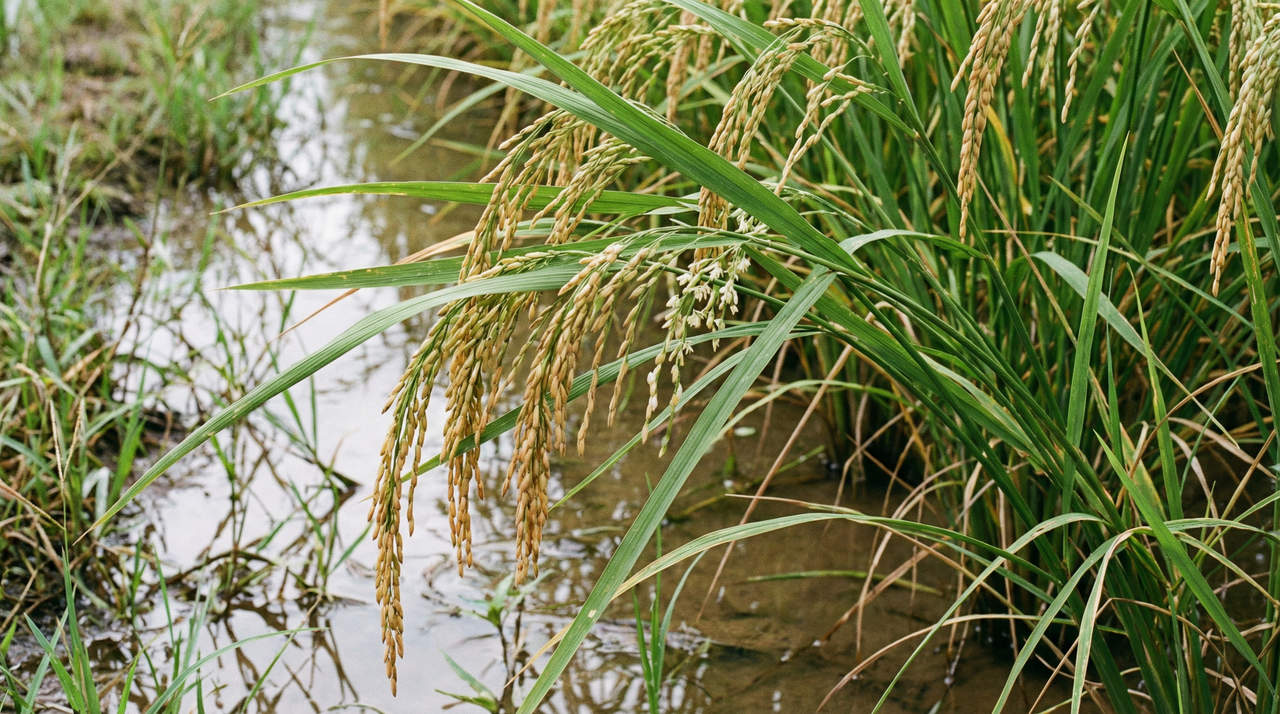
Half the world eats rice every single day, and most of those people have never seen it grow. I hadn't either, not really, until I stood knee-deep in a flooded paddy in Northern California and finally understood something that no book had prepared me for: rice isn't just a crop that tolerates water. It engineers its own relationship with it. The plant builds internal air channels, called aerenchyma, that pipe oxygen down from leaf to root so it can breathe in conditions that would suffocate almost any other grass.[1] That's not an adaptation in the casual sense. That's a fundamentally different way of being a plant.
What gets me is how thoroughly we've flattened that strangeness into a box on a supermarket shelf. White rice. Brown rice. Maybe jasmine or basmati if you're feeling adventurous. But the plant behind all of it carries ten thousand years of human ingenuity, at least two completely independent domestication events on two different continents, and a bran layer packed with compounds that the milling process just throws away.[2] Growing rice, even a single container of it on a warm patio, pulls you back into contact with all of that. And once you see those arching panicles go gold in late summer, you'll understand why entire civilizations built themselves around this plant.
Rice Origin, History, and Cultural Significance
Botanical Background and Life Cycle of Rice
Rice (Oryza sativa) is an annual monocarpic grass, meaning it germinates, flowers, sets seed, and dies within a single season, completing that entire arc in 90 to 180 days depending on variety.[3][4] That window matters enormously for growers because variety selection is really duration selection: short-duration types finish in 90 to 120 days, medium-duration types in 120 to 150, and long-duration varieties push past 150 days.[5] I think of it the way I think about choosing between a day-neutral tomato and a short-day onion: the plant's internal clock is as important as your soil.
That clock was set roughly 10,000 to 13,500 years ago in the Yangtze River basin, where farmers selecting from the wild progenitor Oryza rufipogon gradually bred out two traits that would have frustrated any harvest: seed shattering and dormancy.[6][7] The result was synchronized maturation, a field of grain that ripens together and stays on the plant long enough to harvest. The two major subspecies that emerged from this process differ in more than texture: indica types, typically 120 to 150 days, are often photoperiod-sensitive, meaning day length triggers flowering, while japonica types mature faster at 90 to 120 days and are usually not photoperiod-dependent, which is part of why japonicas have traveled so much further into temperate latitudes.[8][9]
About 3,000 years ago, a parallel story unfolded in the inland Niger River Delta of West Africa, where Oryza glaberrima was domesticated independently from its own wild ancestor.[10] African rice runs a similar 90 to 150 day lifecycle but brings notably greater resilience to drought, weed pressure, and poor soils.[11] I've grown both in trial beds, and the difference on a marginal, low-input site is striking. O. glaberrima just keeps moving where O. sativa stalls.
Visual Characteristics of Rice Plants
Stand next to a rice plant mid-season and you're looking at a grass that reaches 0.5 to 1.5 meters tall, with hollow jointed culms, long narrow leaves 20 to 50 centimeters in length, and a root system that does something most vegetables can't: it possesses aerenchyma tissue that enables it to survive flooded, anaerobic conditions.[12][13] That adaptation is why rice can thrive in standing water that would rot the roots of almost anything else in your garden. The small membranous ligule and stubby auricles where the leaf blade meets the sheath are details I've come to appreciate because they help identify rice seedlings quickly in a mixed planting.
Flowers are small and pale yellow to white, arranged in drooping panicles, and the resulting grain is a caryopsis, technically a fruit where the seed coat is fused to the ovary wall, 5 to 10 millimeters long and straw-colored before milling.[14][15] African rice diverges visibly here: O. glaberrima leaves and sheaths are pubescent (noticeably hairy), the spikelets often carry awns up to 10 centimeters long, and the grains are considerably more prone to shattering than their Asian counterpart.[16][17] That shattering tendency is one reason I learned to harvest African rice a few days earlier than I'd normally wait, before the lower panicle branches start dropping grain in the field.
Traditional and Cultural Uses of Rice
Rice reached its global footprint through a mix of migration, the Silk Road, maritime trade routes, and the transatlantic slave trade, arriving in Europe between the 8th and 10th centuries via Islamic expansion and landing in the Americas in the 16th century.[18][19] Everywhere it went, it arrived carrying meaning. In Asian traditions spanning Hindu, Buddhist, Shinto, and Chinese practice, rice has long stood for fertility, prosperity, and purity; the same depth of symbolic significance runs through West African cultures including the Wolof, Mandinka, and Jola, for whom rice is woven into cosmology and ceremony, not just cuisine.[20][21] These weren't separate traditions that happened to converge on the same crop; they were independent cultures discovering, over millennia, that this one grass could anchor a civilization.
Traditional medicine followed naturally from that centrality. Rice water and congee appear in both Ayurveda and Traditional Chinese Medicine as remedies for digestive complaints and spleen tonification; husks and leaves served as poultices; and African rice decoctions were used to treat fevers, dysentery, and inflammation.[22][23] In my own kitchen I've used the starchy water left from rinsing rice both as a mild plant tonic on seedlings and as a soothing skin rinse, continuing a practice that, it turns out, spans centuries of documented use.
Modern Challenges and Conservation of Rice Diversity
The history of rice cultivation doesn't end with ancient ingenuity; it runs directly into some uncomfortable contemporary realities. Rice paddies account for 30 to 40 percent of global irrigation water and roughly 10 percent of agricultural methane emissions.[24] Meanwhile, the traditional landraces that represent thousands of years of farmer selection are disappearing fast, with some African regions losing over 90 percent of their heritage varieties to modern hybrid replacement.[25] The wild progenitor O. rufipogon itself is now considered vulnerable. And the biopiracy dimension is impossible to ignore: the 1990s RiceTec Basmati patent dispute between India and a Texas company, and similar attempts to claim intellectual property over African rice traits without community benefit. These cases show how the same cultural heritage that was built over millennia can be extracted and enclosed in a legal filing.[26][27]
Having worked with heirloom seed networks, I believe gardeners have a genuine role here: growing traditional varieties, saving seed, and supporting community-based conservation rather than purchasing patented hybrids. Even a small container of 'Duborskian' or a backyard paddy of African red rice is an act of participation in that longer story. Growing rice connects you to 10,000 years of human-plant co-evolution. It also asks something of you in return.
Rice Varieties and Where to Source Them
The rice aisle at a grocery store suggests uniformity. Your seed catalog tells a different story. Oryza sativa has been cultivated across such wildly different climates and cultures for so long that home gardeners now have access to cold-hardy heirlooms, ornamental statement plants, and historic varieties that predate industrial agriculture by centuries. The sheer range is one of the things I find most exciting about growing this crop on a small scale.
Popular Ornamental and Heirloom Varieties of Oryza sativa
For gardeners in cooler climates, 'Duborskian' is the name to know first. It tolerates cold better than most varieties, which opens up rice growing to people who thought their summers weren't long enough. 'Carolina Gold' is the one I keep coming back to for its history alone; it was the commercial backbone of the American South before the Civil War disrupted those plantations, and growing it feels like holding something back from the edge of oblivion. Ornamental types like 'Gulielma' lean more decorative than productive, with foliage that stops visitors in their tracks, and online nurseries and heirloom seed companies carry these widely enough that sourcing is rarely the problem.
African rice, Oryza glaberrima, deserves its own paragraph rather than a footnote. It's a genuinely different species with red bran, shorter stature, and a nutrient efficiency that Oryza sativa can't quite match on poor soils.[28] I've trialed it in Central Florida test beds and the vigor in depleted spots was noticeable. That said, its high shattering tendency means seed drops before you're ready, and volunteer seedlings the following season can become a real management task. Beautiful, resilient, and demanding of your attention in equal measure.
Sourcing Rice Seeds for Home Gardens
Finding seed is straightforward. Baker Creek Heirloom Seeds, Johnny's Selected Seeds, Seed Savers Exchange, High Mowing Seeds, and Plant Delights Nursery all carry Oryza sativa varieties, with small packets of 10 to 50 seeds running roughly $3 to $10. What you almost certainly won't find is a starter plant. Rice is an annual grown from seed, and I learned this the hard way after spending an afternoon calling specialty nurseries looking for plugs, only to confirm that they essentially don't exist commercially. Budget for seed and plan accordingly.
African rice seed is obtainable in small research quantities from Seed Savers Exchange and Baker Creek, typically 50 to 100 seeds for $5 to $15, or in bulk from germplasm repositories like IRRI and the USDA ARS.[29][30][31] If you're importing from abroad, know that a USDA APHIS import permit and a phytosanitary certificate are required before anything crosses the border.[32][33] It's a manageable process, just not an impulse purchase.
For context on what commercial rice actually involves: the trade classifies varieties primarily as indica long-grain types or short-grain japonica, with strict quality thresholds around moisture content, milling yield, and foreign material.[34][35] Aromatic rices like basmati and jasmine require certified origin documentation for international trade.[36] That regulatory machinery exists at a scale completely removed from growing a container of glutinous rice or a small paddy plot of red rice in your backyard. As a home grower, you get to skip all of it and just choose the variety that sounds most interesting.
Rice Propagation and Planting Guide
Rice is fundamentally a seed crop, and almost everything about how you grow it follows from that single fact. Whether you're setting up a small paddy in a backyard pond liner or planting out a half-acre plot in the subtropics, the path forward starts with understanding what that seed actually is and what it needs to become a plant.
Understanding the Rice Seed: Structure, Morphology, and Domestication
The rice seed is a caryopsis, a grain type where the pericarp is fused directly to the seed coat, all of it enclosed in a protective hull made up of the lemma and palea.[37][38] Inside, the embryo takes up only about 5-10% of the total seed volume, a relatively compact structure that includes the scutellum, coleoptile, plumule, radicle, and coleorhiza.[37] The bulk of what's left is starchy endosperm surrounded by an aleurone layer. Once you understand this anatomy, the rest of the germination story becomes intuitive: keep things moist so the hull softens, let the radicle push down first, and only introduce standing water after the shoot is reaching upward.
Ten thousand years of domestication shaped the seed you're planting today. Selection pressure from Oryza rufipogon pushed grain size up by 20-50%, shrank the relative embryo, eliminated seed shattering, and dialed back dormancy so that a field ripens together rather than staggering its release over weeks.[39] Grain shape diverged noticeably between subspecies: indica types run long and slender (6.0-7.5 mm length), while japonicas tend toward shorter, rounder grains.[40][41] Thousand-grain weight generally falls around 20-30 g.[42]
African rice (Oryza glaberrima) followed a parallel domestication path in West Africa roughly 3,000 years ago, starting from Oryza barthii and arriving at similar non-shattering, synchronized traits through independent selection.[43] Both species are overwhelmingly self-pollinating, which is genuinely good news for seed savers.[44][45] Open-pollinated varieties come true from seed across multiple generations without any isolation tricks. Hybrid varieties are a different story; they segregate in the second generation, which means annual seed purchases rather than on-farm saving. For 99% of gardeners and small-scale growers, saving and replanting true-to-type seed from non-hybrid rice is the reliable, low-tech path that has sustained rice cultures across millennia.
During germination, water imbibition wakes the embryo and the radicle emerges first, anchoring into the soil before the shoot follows. Optimal germination happens in moist (not submerged) conditions at 25-35°C; shallow water of 2-5 cm can be introduced after initial sprouting rather than at seeding.[37][46] I learned this the hard way in my first raised-bed paddy trial: flooding immediately on seeding day crushed germination rates, while keeping the soil moist but surface-visible for the first five to seven days produced far more uniform emergence.
Seed Viability, Storage, and Quality Testing
Rice behaves as an orthodox seed, meaning it tolerates drying down and cold storage without dying. Under genebank conditions (0-10°C, less than 20% relative humidity, 5-7% seed moisture), viability can extend 20-50 years or more.[47][48] At ambient conditions without any special handling, you're typically looking at 3-5 years before germination rates start sliding; proper hermetic storage at home can stretch that to 10-15 years.[49] The critical number to avoid is 13-14% seed moisture, above which fungal problems like Aspergillus become a real threat.[47]
For home growers, vacuum-sealed bags in a household refrigerator get you surprisingly close to those hermetic conditions. I've carried heirloom rice seed this way for three or four seasons with minimal germination loss, and it's one of the simplest practices you can adopt to protect varietal purity year after year. For long-term conservation of Oryza glaberrima specifically, seeds are dried to 3-7% moisture and stored at -18°C or lower in hermetic containers, with viability checks recommended every 5-10 years.[50]
Before planting saved seed, a standard germination test (7-14 days at 25-35°C on moist media, per ISTA guidelines) gives you a clear percentage to work with.[51] The tetrazolium assay is faster: imbibed seeds stained with 2,3,5-triphenyltetrazolium chloride show red or pink in viable tissue within 2-4 hours.[52] X-ray radiography is the non-destructive option used in research settings to flag internal damage or insect infestation without sacrificing the seed.[53] For most home growers, a simple germination test on ten or twenty seeds tells you everything you need before committing a whole flat or bed.
Soil and Site Selection for Rice
Rice has a split personality when it comes to soil. Traditional flooded paddy production thrives in heavy clays and clay-loams that hold water without draining away beneath the plants, while upland systems adapt to lighter, well-drained soils with supplemental irrigation.[54] The plant handles anaerobic root conditions through aerenchyma tissue, which channels oxygen from the shoots down to the roots, a trait the origin-and-history section touched on. In practice, this means the soil texture you choose directly determines your water management strategy. For paddy-style growing, you want something that forms a good clay pan; for upland or container growing, shoot for 2-4% organic matter with a granular or blocky structure that supports root development down to at least 40-50 cm.[55] Bulk density above 1.5-1.6 g/cm³ starts restricting roots and can cut yields by 20-30%.[56]
Soil pH ideally sits between 5.5 and 6.5, though rice tolerates a broader range of 4.5-7.5 with varying consequences at the extremes.[57] Below pH 5.5, aluminum toxicity becomes a serious problem, causing root stunting, poor tillering, and chlorosis. This is where Oryza glaberrima earns real respect: I grew both Asian and African accessions side-by-side on slightly acidic Florida soil, and the difference in root development and tillering was visible without any measuring tools. The African types have root exudates that improve phosphorus uptake under acid conditions, giving them genuine advantages on marginal ground.[58][59] On the alkaline end, above pH 7.5, iron and manganese deficiency triggers interveinal chlorosis and stunting. Lime corrects acidity, gypsum addresses sodic soils, and compost builds organic matter regardless of starting conditions.
Site selection comes down to sun first. Rice needs 6-8 or more hours of direct sunlight daily; insufficient light produces leggy, under-tillering plants with thin, low-yield panicles.[60] Oryza glaberrima shows moderate shade tolerance and can manage with 4-6 hours in intercropping situations.[61] Annual rainfall of 1,000-2,500 mm suits paddy rice, and African rice is specifically adapted to West African wetland and deep-water systems where water levels can reach 50-100 cm.[62] For container growing, a mix of 40-50% loamy clay, 20-30% compost, 20% peat or coco coir, and 10-20% perlite or sand maintained with 2-5 cm of standing water approximates paddy conditions reasonably well.[63]
Primary Propagation Methods: Direct Seeding vs. Transplanting
The two practical methods for growing rice from seed are direct seeding and nursery transplanting. Everything else, stem cuttings with IBA rooting hormone, tissue culture on Murashige and Skoog medium, grafting at the 3-4 leaf or tillering stage, is genuinely fascinating from a research standpoint but belongs in a laboratory or germplasm conservation program rather than a home garden.[64][65] For the purposes of actually growing rice, seed is the method.
Direct seeding goes in at 1-2 inches (2.5-5 cm) deep, using approximately 80-100 kg of seed per hectare at the field scale.[66] Transplanting starts seeds in a nursery bed, then moves seedlings at 20-30 days old into their permanent position, usually planting 2-3 per hill.[67] Both approaches need soil temperatures above 21°C and initial moist (not flooded) conditions for germination to proceed reliably. The transplant method gives you more control over seedling establishment and allows better weed management in the bed while seedlings are getting established elsewhere; direct seeding is faster and skips the transplant shock but demands cleaner, well-prepared soil from the start.
Spacing, Density, and Planting Technique
Planting density for rice typically targets 250,000-300,000 plants per hectare, within a broader range of 150,000-400,000 depending on variety and system.[68] Transplanted modern inbreds generally go in at 20-25 cm between rows and plants; hybrids tighten to around 20×15 cm; direct-seeded rows run 10-15 cm within rows spaced 20-25 cm apart; mechanized or upland systems often open rows to 25-30 cm.[69][70]
Height matters here because it interacts directly with density. Indica types can reach 100-180 cm; japonicas run 80-120 cm; semi-dwarf types like IR8 settle around 90-110 cm.[71] Taller plants at close spacing in high-nitrogen conditions are a lodging waiting to happen. I tend to open up my spacing when I know I'm growing a taller heirloom type, not just for harvest access but because the airflow genuinely reduces disease pressure in humid summers. When growing for maximum yield, I'll go to the tighter end; when hand harvesting and disease management matter more, I give the plants room to breathe.
Oryza glaberrima reaches 100-150 cm and produces strong tillering of 10-20 tillers per plant, which gives it natural weed-competitive ability that can compensate for slightly wider spacing in low-input systems.[72] One practical note: young rice seedlings look remarkably like common grass weeds in the first couple of weeks after emergence. Labeling your rows carefully at planting will save you from accidentally weeding out your crop.
Germination Timeline and Growth Duration
Once seed is in the ground or seedlings are transplanted, the calendar unfolds in fairly predictable categories. Short-duration varieties run 90-120 days from sowing to harvest; medium-duration types take 120-150 days; long-duration varieties stretch to 150-180 days or more.[46] After flowering, anthesis to physiological maturity typically takes 25-40 days, with grain filling occupying most of that window at 20-35 days.[67] African rice runs slightly longer at 30-45 days from anthesis to maturity, a small but real difference to account for when planning your season.[73]
The timing anchor for planting is soil temperature above 21°C, after the last frost has passed.[74] In warm climates, this lines up naturally with the wet season onset. In temperate gardens, it usually means late spring or early summer planting with a variety choice driven by how many frost-free growing days you actually have. Short-duration varieties exist precisely for growers at the cooler end of rice's range, and they're often the most realistic option for how to grow rice in climates that would otherwise feel marginal for this crop.
Rice Care Guide: Water, Nutrients, Temperature, and Seasonal Management
Growing rice well means accepting that it doesn't forgive improvisation. Every major decision, from how deep to flood a bed to when to split your nitrogen, needs to line up with where the plant is in its growth cycle. I've come to think of rice care less like tending a vegetable garden and more like conducting a slow, three-act performance where the stage changes completely between acts.
Sunlight Requirements for Rice
Rice wants full, unobstructed sun, at least 6 to 8 hours daily, and it's one of the least shade-tolerant crops I grow.[75][76] Shade that would barely slow down a tomato will cause etiolation in rice: stems stretch upward chasing light, leaves pale to a washed-out yellow, and tillering drops sharply.[77][78] Fewer tillers means fewer panicles, which means a fraction of the grain you were expecting. I site my rice beds on open pond margins or south-facing raised paddies where nothing overhead can creep in as the season progresses. The flip side, though, is that intense midday sun during heat waves can push photoinhibition, where the photosynthetic machinery actually throttles back under excess light, causing leaf scorch and chlorosis.[79][80] Consistent soil moisture and good airflow help buffer that, but it's worth keeping in mind if you're growing in an intensely reflective space like a whitewashed courtyard or a metal-sided greenhouse.
Water Needs and Irrigation Management
Rice is thirsty in a way that genuinely surprises first-time growers. Over a full season, a flooded paddy typically needs 1,200 to 1,500 mm of water, translating to roughly 1 to 2 inches per week during the active growing phases.[12][81] Traditional management holds 5 to 10 cm of standing water through most of the season, starting shallower (3 to 5 cm) right after transplanting, then deepening to 10 to 15 cm during flowering and grain fill to protect the developing panicle.[82][83]
For home growers who don't have unlimited irrigation, alternate wetting and drying (AWD) is probably the single most practical technique I've adopted. You let the soil surface dry slightly between flood cycles rather than maintaining continuous inundation. In my Central Florida beds, this approach cuts water use by around 25 percent with no measurable drop in panicle quality, right in line with IRRI's documented 15 to 30 percent savings.[81][84] If you ever work with African rice (Oryza glaberrima), you'll notice it gets by on 800 to 1,200 mm per season, a meaningful difference on a rainfed or low-input site.[85]
Soil Fertility and Feeding Schedule
Rice is a heavy feeder, especially for nitrogen. Under flooded conditions, typical nitrogen requirements run 100 to 200 kg per hectare depending on yield targets.[86][87] In US terms, extension services in the southern rice belt recommend 120 to 150 lbs/acre of nitrogen alongside 40 to 60 lbs/acre of phosphorus and 30 to 60 lbs/acre of potassium, calibrated to soil tests and your specific yield goals.[88][89] Split application is where most small-scale growers go wrong. Putting 30 to 50 percent down at preflood and the remainder at early boot stage reduces losses and keeps uptake efficiency high.[88] I've watched nitrogen deficiency appear in my own beds within days of a missed first split: older leaves fade from pale green to yellow starting at the tips, and the whole stand loses that deep-green flush that signals a well-fed crop.[90][91]
Target soil pH between 5.5 and 6.5, with 6.0 to 6.5 being the sweet spot for nutrient availability.[92] Below pH 5.5, molybdenum deficiency becomes a real issue, and zinc deficiency is widespread globally, affecting roughly half of all rice soils, particularly after flooding or on high-pH calcareous ground.[93] African rice handles lower fertility and more acidic conditions (pH 5.0 to 7.0) with notably less complaint, which makes it a useful teaching plant for understanding nutrient cycling in low-input systems.[85][94]
Frost Tolerance and Cold Sensitivity
There is no negotiating with frost and rice. A single night below freezing kills plants outright, and even one night at 28 °F has wiped out my seedlings before I could do anything about it.[95][96] Germination won't even start reliably below 10 to 12 °C (50 to 54 °F), and cold stress at the flowering stage, anything under 20 °C, spikes spikelet sterility even without a visible freeze.[95][97] Rice sits squarely in USDA zones 8 through 11, classified by the RHS as H1c, meaning it cannot handle any frost and should be treated as a warm-season annual anywhere outside the tropics.[3][98] Cold injury shows up as stunted growth, reduced tillering, leaf chlorosis and necrosis, and poor panicle development if the plant survives at all.[99] African rice requires even warmer baselines, 15 to 18 °C minimum, and is best reserved for USDA zones 9 through 11.[100][101]
Heat Tolerance and High-Temperature Management
Rice thrives in heat, rated for AHS Heat Zones 9 through 11, but there's a threshold where hot becomes damaging.[102] Sustained daytime temperatures above 33 to 35 °C during flowering and grain fill are where yield losses start accumulating through spikelet sterility, which means grains that never form properly.[103] Heat stress damages photosystem II, impairs photosynthesis, and drives up photorespiration.[104] In practice, consistent irrigation and mulching can reduce canopy temperatures by 2 to 5 °C, which is often enough to keep indica-type plants setting grain through a Central Florida summer.[105] I've noticed my indica varieties keep producing normally at 95 °F daytime highs as long as nights drop back into the low 70s; japonica types stall under the same conditions, which matches the documented indica advantage in heat tolerance. African rice (Oryza glaberrima) pushes this further: some landraces maintain pollen viability at 38 °C, thanks to enhanced antioxidant activity and more stable cell membranes, a trait that makes certain lines genuinely exciting for hot, marginal sites.[106][107]
Seasonal Rhythm and Stage-Specific Care
Rice moves through three distinct phases: vegetative (45 to 90 days), reproductive (30 to 60 days), and ripening (30 to 40 days), and each one calls for a different set of inputs.[4][108] At optimal temperatures of 20 to 35 °C, the full cycle runs 3 to 6 months; cooler temperate climates stretch that timeline considerably.[109]
During the seedling and early tillering stage, I keep water shallow at 2 to 5 cm and apply basal fertilizers, then increase flood depth to 5 to 10 cm as tillering picks up, using AWD cycles and the first split of nitrogen (30 to 40 kg N/ha) to drive leaf area and tiller production. At panicle initiation, I hold a steady 5 to 10 cm, apply the second nitrogen dose (20 to 30 kg N/ha), and watch closely because this is the stage most sensitive to both cold and heat stress. During grain fill, I reduce depth to 3 to 5 cm and shift focus to a potassium top-dress while backing off nitrogen to avoid late-season disease pressure. Then I draw the water down entirely as the grains mature, letting the field dry for harvest.[110][111] African rice follows a similar 90 to 150 day arc with slightly more forgiving transitions, tolerating drought and waterlogging interruptions that would set sativa varieties back significantly.[112][113] The single biggest lesson I've learned from managing multiple beds is to label each patch with its planting date. Losing track of when a particular section reached panicle initiation has cost me a nitrogen application at exactly the wrong moment, and that kind of timing gap shows up directly in final grain weight.
Rice Harvesting: Timing, Techniques, Yield, and Flavor
There's a moment in late summer when I stop counting days and start paying attention to the plants themselves. The panicles have been filling for weeks, and suddenly they're heavy, bent toward the water, and the green has given way to that unmistakable golden brown. That's when I know the rice is talking to me.
When to Harvest Rice: Maturity Indicators and Timing
The clearest signal a rice plant sends is color change: panicles shift from green to golden brown or yellow as the grain matures, and 80-85% of those grains should be ripe before you reach for the sickle.[114][115] I also do a thumbnail test: squeeze a grain firmly, and if it gives, wait. A properly mature grain pops back hard and unyielding.[116][117] Physiologically, that hardness corresponds to a grain moisture content around 20-25%, which is the ideal window to cut.[118][119] In calendar terms, that's typically 30-35 days after flowering, or 100-150 days from planting depending on variety and climate.[120][121]
For U.S. growers, that translates to August through October in Arkansas, September and October in California, and July through September in Texas.[111][122] West African growers harvesting African rice (Oryza glaberrima) traditionally cut in October through December, peaking in November after the rains.[123] Whatever your region, pick a dry, sunny stretch and don't gamble on incoming rain. I learned this the expensive way during an early trial: I pushed harvest back a few days waiting for a window that never came, the panicles got wet, and mold moved in fast.[116][117] Now I watch the forecast as closely as I watch the plants.
Rice Harvesting Techniques and Post-Harvest Handling
You're harvesting two things from rice: the grain (the caryopsis, destined for the table after milling) and the straw, which is genuinely useful as fodder, mulch, or biomass fuel.[124][125] For small permaculture beds, a sharp sickle is the right tool. The intimacy of cutting panicle by panicle lets you be selective and precise in a way no machine can match.[116][126] It's also essentially the same method traditional West African farmers have used with African rice for centuries.[127] Larger plots are a different calculation; I've borrowed a combine for trials over a quarter-acre and the time savings are real, though you lose some nuance in crop assessment.
The post-harvest sequence is where yields are made or lost. Drain fields 2-3 weeks before cutting so the soil firms up for equipment or foot traffic, then thresh, clean, and dry the grain down to 13-14% moisture before storage.[128][120] Store at around 59°F (15°C) in airtight containers with relative humidity below 60%.[129] Skipping that final drying step can cost you up to 20-30% of the harvest to mold, insects, and spoilage; I keep airtight jars, a hygrometer, and dried neem leaves on hand every season.[130][131] Straw goes straight to the mulch pile or the compost heap, closing the loop that permaculture systems are built on.[132]
Yield, Flavor Profile, and Quality Factors
Harvest decisions shape what ends up on the plate more directly than most growers realize. The edible caryopsis has a subtle sweetness and umami character in its base form, but fragrant varieties like Basmati and Jasmine develop their distinctive popcorn-like aroma from a compound called 2-acetyl-1-pyrroline (2-AP), and that intensity actually increases when plants experience cool temperatures or mild drought stress in the days before harvest.[133][134] Texture is driven by amylose content: long-grain high-amylose varieties (20-25%) cook up fluffy and separate, while short-grain low-amylose types (10-15%) turn soft and sticky.[135][136] I grow both side by side and can confirm that the same water-to-rice ratio that produces perfect fluffy basmati turns sushi rice into a gummy disaster.
White rice delivers a mild, neutral flavor with a clean short finish; brown rice is chewier and carries a pronounced nutty, earthy character that lingers.[137][138] African rice (Oryza glaberrima) is a different experience altogether: more robust, nuttier, with a slightly astringent or bitter finish and a firmer chew from its higher amylose content.[139][140] When I've tasted landraces like Kajouj against a mild jasmine rice, the contrast is striking; Kajouj demands a dish built to match its assertiveness. Properly harvested and dried grain also seems to develop deeper, nuttier complexity with a little aging, though I'd call that an observation more than a rule. What I do know is that careful handling from the moment of cutting protects everything downstream, from nutrition to flavor to texture.
Rice Preparation and Culinary Uses
Culinary Uses, Flavors, and Nutrition
The grain itself is the heart of the plant on your plate. Rice bran is genuinely edible and worth seeking out for its fiber, vitamins, and antioxidants, and young shoots appear in teas or salads in some culinary traditions, but hulls, flowers, and roots are another story entirely.[141][142][143] Once you've grown both white and brown rice in trial beds, as I have, you notice immediately how the retained bran layer changes everything: longer cook time, a nuttier, earthier chew, and that slightly oily richness from natural bran fats.[144][145] Brown rice also carries more inorganic arsenic (0.2–0.3 mg/kg versus 0.1–0.2 mg/kg for white) because arsenic concentrates in that bran layer,[146][147] which is exactly why I now use the excess-water method for family meals: a 6:1 water-to-rice ratio, boil and drain, removes up to 60% of arsenic without sacrificing much flavor.[148][149]
Nutritionally, brown rice holds the edge: more fiber, more B vitamins, and the anti-inflammatory gamma-oryzanol and ferulic acid that polishing strips away.[150][151] White rice's neutral, slightly sweet starch makes it the canvas behind fried rice recipes, chicken rice dishes, and Mexican rice preparations the world over.[152] From East Asian chicken and rice dishes built on soy sauce and ginger to Latin American rice recipes for chicken layered with tomatoes and cumin, the regional pairings are really just variations on the same theme: rice absorbs and amplifies whatever surrounds it.[153][154] A Mexican Spanish rice recipe, for example, is really an object lesson in how toasting and then simmering in broth transforms bland starch into something fragrant and complex.
African rice (Oryza glaberrima) deserves a spot in any serious kitchen conversation. It carries 8–12% protein by dry weight, higher iron and zinc, a chewier bite that reminds me of farro, and a lower glycemic index than most Oryza sativa varieties.[130][155] The catch: phytic acid and lectins require soaking 12–24 hours, fermenting, or pressure cooking for at least 20–30 minutes before eating.[156] Worth the step. Store raw rice in cool, dry conditions below 14% moisture to prevent mycotoxin formation, and always cool cooked rice quickly before refrigerating to keep Bacillus cereus in check.[157][158] Rice is naturally gluten-free, though certified gluten-free labeling matters for anyone with celiac disease.[159]
Medicinal and Traditional Preparations
I've been rinsing rice and saving that milky starch water for years, splitting it between a hair conditioning rinse and a foliar spray for seedlings in my garden. It's one of those kitchen-to-garden loops that feels almost too simple to work, but rice water has genuine traditional backing as both a topical skin soother and an internal digestive remedy across Asian cultures.[160][161] Rice bran extract standardized for gamma-oryzanol is the preparation with the strongest clinical support, used for cholesterol management at 1–3 g per day.[162][163] Beyond that, leaf teas appear in traditional practice for digestive complaints and fever, husks have served as diuretic poultices in Chinese medicine, and young seedlings turn up in some regional detoxification soups, though these uses are ethnobotanical practice rather than standardized medicine. African rice preparations follow similar regional logic, using roughly 20–50 g of plant material per liter of water taken once or twice daily, but dosages aren't standardized and clinical evidence is still thin.[164]
Non-Food Uses of Rice By-Products
Nothing about a rice plant needs to go to waste, and that's what I love about growing it in a permaculture context. Rice straw has become one of my favorite mulching materials: I layer it around raised beds, use it to suppress weeds between rows, and occasionally weave simple borders the same way rural communities across Asia have traditionally woven it into mats, hats, and rope for centuries.[165] Rice bran oil, rich in antioxidants, cycles back into kitchen use for high-heat cooking and into skin care in the same closed loop.[166] Hulls, which are genuinely inedible, find industrial purpose as biofuel, abrasives, and fillers in concrete and plastics; rice-husk ash specifically improves the strength and durability of cement composites in green building applications.[143] For a grower thinking in systems, this is the point: every part of the plant, from grain to hull, feeds back into some useful cycle rather than becoming a disposal problem.
Rice Health Benefits and Medicinal Uses
Most people picture a bowl of white rice when they think about this crop's nutrition, but that image is missing the most interesting part. The bran and hull are where rice keeps its phytochemical wealth, and polishing strips most of it away before the grain ever reaches a supermarket shelf.
Key Phytochemicals and Bioactive Compounds in Rice
Rice bran oil can contain up to 1.5% gamma-oryzanol, and the bran fraction itself holds 200–300 mg per 100g of phenolic acids, including ferulic acid bound into the cell walls alongside phytosterols and a full tocopherol and tocotrienol suite.[167][168][169] Pigmented black and red varieties go further still, with anthocyanin levels running 10 to 100 times higher than non-pigmented types.[170] Those compounds translate into real biological action: gamma-oryzanol and tocotrienols reduce lipid peroxidation, flavonoids like quercetin and luteolin support cellular antioxidant defenses, and in laboratory settings they've been shown to induce apoptosis in cancer cell lines.[171][172][173]
After years of growing both standard and pigmented rice, I've noticed the bran from grains grown in hot, humid conditions comes out visibly darker and more aromatic, with an antioxidant bite you can actually taste in a simple rice porridge. That tracks with the data showing indica cultivars generally run 20–50% higher in phenolics than japonica types, and that high temperatures above 35°C shift the compound balance toward flavonoids while drought stress enhances other secondary metabolites.[174][175][176] Choosing pigmented or indica varieties, or growing in conditions that stress the plant a little, genuinely changes what you're harvesting.
African rice, Oryza glaberrima, adds another dimension here. It shows 20–50% higher flavonoid content, roughly 1.5 to 2 times the antioxidant activity of O. sativa, and a unique complement of alkaloids, tannins, saponins, and alkylresorcinols concentrated further by upland and dry-season cultivation.[177][178] While I primarily grow Asian rice, those numbers remind me that method and variety selection can meaningfully shift the health compounds in what I actually bring to the table. The plant builds these compounds for its own defense, mobilizing phytoalexins like momilactones against pathogens, deploying phenolics to deter herbivores, and scavenging ROS under stress.[179][180] A plant protecting itself is, in many cases, a plant protecting us too.
Medicinal Research and Traditional Uses
The strongest clinical evidence clusters around gamma-oryzanol and rice bran polyphenols. Gamma-oryzanol has demonstrated cholesterol-lowering effects in clinical trials, reduces cytokine-driven inflammation, and cuts oxidative stress markers; bran polyphenols, running 40–100 mg per 100g in brown rice, add antidiabetic and gastrointestinal benefits including constipation relief and potential prebiotic support for ulcerative colitis.[181][182][183][184] Anthocyanins in red and black rice varieties extend that cardiovascular and anti-inflammatory picture by modulating TNF-α and IL-6, with in-vitro evidence for apoptosis induction in breast and colon cancer cell lines.[170][185]
Beyond the bran, rice extracts show anti-diabetic activity through alpha-glucosidase inhibition and improved insulin sensitivity, and germinated rice offers GABA with documented neuroprotective potential.[186][187] Rice water as a traditional oral rehydration solution for diarrhea and dehydration across Asia is one of those uses that has survived millennia for good reason.[162] I keep a small jar of it in the fridge every summer and have used it for stomach bugs in the family with real results; it's simple, free, and grounded in a long tradition of practical use.
African rice brings complementary animal-model evidence for anti-diabetic effects via alpha-amylase inhibition, analgesic activity comparable to aspirin in rat models, and antimicrobial and wound-healing properties.[188][189][190] No published human trials exist for O. glaberrima yet, and much of the broader Oryza sativa pharmacological research still rests on in-vitro and animal data rather than large-scale clinical confirmation.[191][192] Traditional knowledge and preclinical research together make a compelling case; just don't mistake a promising cell study for a proven therapy.
Nutritional Profile of Rice
A 100g serving of cooked white long-grain rice delivers 123 kcal, 26g carbohydrates, 2.7g protein, and under 1g each of fat and fiber.[144] Brown rice comes in slightly lower at 111 kcal, with 23g carbohydrates, 0.9g fat, and 1.8g fiber.[193] The macro numbers look similar, but the micronutrient gap is wide: brown rice retains 43 mg magnesium versus 7 mg in white, substantially more phosphorus, potassium, zinc, and B vitamins, and polishing removes 70–90% of the phenolics and antioxidants the bran layer holds.[194][195]
African rice adds scope to this picture: raw O. glaberrima grain approximates 345–365 kcal per 100g, with 7.5–9g protein (often higher than O. sativa), more iron, magnesium, polyphenols, and higher antioxidant capacity overall, though those values are less standardized and vary considerably by cultivar, soil, and processing.[196][178] In my own kitchen I reach for white rice when I want something neutral and easy to digest, and brown when I want the full nutritional picture; parboiling before milling drives B vitamins and minerals deeper into the endosperm, preserving more than standard milling does.[197] One nutritional reality that shapes those choices: brown rice accumulates more arsenic in its bran layer, which is worth factoring in, especially for the most regular eaters in your household.[198]
Safety Considerations and Practical Guidance
Rice is one of the safest staple foods we know. Rice allergies affect fewer than 1% of children, typically cause only mild reactions, and the grain is naturally gluten-free, though cross-contamination during processing is a real concern for people with celiac disease.[199][200] It's safe for pets and livestock too.[201]
The arsenic question is the one area where I don't hedge. Rice efficiently accumulates inorganic arsenic, especially in the bran, and brown rice simply contains more of it than white.[202][203] The CDC advises against rice-based first foods for infants; FDA and FAO recommend limiting intake to 2–3 servings weekly for pregnant women and young children, and varying grains.[203] Upland cultivation, including the traditional West African systems used for O. glaberrima, tends to result in lower arsenic accumulation than flooded paddies.[204] Phytic acid in the bran is a separate, more manageable concern: it binds iron, zinc, and other minerals, reducing their absorption.[205] I soak or lightly ferment my brown rice before cooking; it's a small habit that meaningfully improves the mineral math.
Practical mitigation for arsenic is straightforward. Cooking in a 1:6 water ratio and draining removes 40–60% of the arsenic load; rinsing and parboiling help further.[206] Storing grain dry prevents mycotoxin buildup, and rotating across different grains handles the rest.[207] Humans have relied on rice as a dietary anchor for ten thousand years; a little informed attention to preparation keeps it exactly that.
Rice Pests and Diseases: Management for Resilient Growth
Rice is locked in a genuine evolutionary arms race with the organisms that want to eat it, and the stakes are real. Global yield losses from pests average around 14%, with FAO estimates ranging from 10 to 20% in bad years.[208][209] That's not an abstraction. That's food security, and it's why understanding resistance profiles matters even for a backyard paddy.
Major Diseases of Rice and Resistance Profiles
IRRI uses standardized evaluation scales to rate disease reactions from immune through highly resistant, moderately resistant, and susceptible. For rice blast (Magnaporthe oryzae), the most feared rice paddy disease globally, the cutoffs are blunt and useful: lesions under 1 mm signal high resistance, 1 to 3 mm is moderate, and anything larger tips into susceptible territory.[210][211] Knowing where your variety falls on that scale before you plant is the difference between a manageable season and a heartbreak.
Bacterial leaf blight (Xanthomonas oryzae pv. oryzae) follows the same rating framework, and here's where Oryza glaberrima starts earning its reputation: many African rice accessions and landraces show moderate to strong resistance where most commercial sativa lines struggle.[212][213] Sheath blight (Rhizoctonia solani) is a harder nut to crack. No major resistance gene has been identified in O. sativa, the inheritance is polygenic, and even O. glaberrima, which holds up reasonably in humid West African environments, is broadly susceptible.[214]
African rice also carries the Rymv2 gene for resistance to rice yellow mottle virus, along with partial blast resistance in accessions like IRAT 210 and TOG 12308, making it a strategic breeding parent rather than just a curiosity.[215] Concrete IRRI cultivars do the heavy lifting on the sativa side: IRBB2 and IRBB5 carry Pi2 and Pi5 for blast resistance, while IR50 and IR72 offer moderate sheath blight tolerance. Modern breeding programs increasingly pyramid multiple Pi and Xa genes rather than relying on a single resistance source, because single-gene lines have a frustrating habit of breaking down as pathogen populations shift.[216][217] Rice blast thrives at 25 to 28°C with humidity above 90%, and bacterial blight prefers similar warm, wet conditions, so managing canopy airflow and fertilizer rates isn't just good practice; it directly reduces the environmental window these pathogens need.[218]
Key Insect Pests and Natural Defenses
Stem borers (Scirpophaga incertulas and Chilo suppressalis) and brown planthopper (Nilaparvata lugens) are the top economic threats, with gall midge and leaf folders causing significant but generally lower losses.[208] Brown planthopper resistance in standard O. sativa cultivars tends to erode quickly because new virulent biotypes keep evolving; some O. glaberrima accessions like TOG 5681 show partial resistance, though it's far from bulletproof.[219] I grew IR64 side-by-side with a few other IRRI lines for several seasons, and I noticed the planthopper tolerance held noticeably longer when I wasn't keeping the field constantly flooded, which connects water management directly to pest pressure in ways the textbooks sometimes understate.
Gall midge is where O. glaberrima genuinely shines, with multiple accessions providing near-complete deterrence. The catch is that cultivar-based resistance typically breaks down within five years as local biotypes adapt.[220] I learned this the hard way when I lost a promising gall-midge-resistant planting because I'd relied on a single-gene line. That season converted me to gene pyramiding and variety diversity as non-negotiables. O. glaberrima also shows moderate stem borer resistance through thicker leaf sheaths and lower palatability, traits that complement the stem toughness and early maturity strategies found in some sativa lines.[221]
Rice isn't entirely passive in these battles. Silica-reinforced cell walls, trichomes, and thicker cuticles (especially pronounced in O. glaberrima, where running your fingers along young leaf margins feels noticeably rougher than on most sativa seedlings) create physical barriers that slow feeding. Chemical defenses including phytoalexins like sakuranetin and momilactones, triggered through jasmonic acid signaling, add another layer that underpins the partial resistance we observe in the field.[222][223] IRRI has stacked these advantages into specific lines: IR36, IR64, and IR72 for brown planthopper; IR26 and IR56 for stem borers; IR36 and IR40 for leaf folder management.[224]
Integrated Pest and Disease Management Strategies
My approach in a regenerative system runs through five priorities in order: host-plant resistance first, then cultural practices, biological controls, monitoring with economic thresholds, and chemical intervention only when thresholds are actually exceeded. Alternate wetting and drying disrupts conditions that favor both blast and bacterial blight while reducing planthopper habitat.[225] Field sanitation, timely planting, and balanced fertilization (avoiding nitrogen excess that creates the lush, tender growth pathogens and insects love) are unglamorous but genuinely effective. On the biological side, Trichoderma spp. and Pseudomonas fluorescens have solid track records, and maintaining habitat for predatory insects pays dividends season after season.[226] For rice water weevil, the 25% feeding scar threshold is a concrete scouting benchmark worth adopting rather than spraying on a calendar schedule.[227]
NERICA hybrids, which introgress O. glaberrima traits including gall midge resistance, rice yellow mottle virus tolerance, and even allelopathic Striga suppression into O. sativa yield potential, represent this systems thinking at the breeding level.[228] In fields where witchweed pressure is high, I now deliberately choose seed from African rice parentage lines for exactly that reason. Resistance is never permanent and never complete; biotypes evolve, climates shift, and no single variety carries every answer. The goal is layering enough diversity, whether genetic, cultural, or biological, that no single failure cascades into a lost crop.
Rice in Permaculture Design
Rice doesn't slot neatly into the classic permaculture design vocabulary of stacked canopies and food forest guilds. It tells a different kind of story: one of managed wetlands, productive floodplains, and the surprising amount of ecological work a flooded grass can do when you set it up thoughtfully. Getting that story right starts with being honest about where rice can actually grow.
Climate and Hardiness Zones for Growing Rice
Oryza sativa is a tropical and subtropical species, most at home in humid regions that map to Koppen-Geiger zones Af, Am, Aw, and Cfa.[229][230] In USDA terms, that translates to zones 9 through 11 for any hope of it behaving like a perennial; in zones 7 and 8 you're looking at a short-season annual that needs a long, hot summer and can't tolerate frost.[74] Cold is simply a dealbreaker. Temperatures below 50°F (10°C) will damage the plant, and anything at or below 32°F is fatal.[231][232] Germination won't even begin until soil temperatures hit 59°F (15°C), with the real sweet spot between 86 and 95°F.[233]
Heat is trickier than most growers expect. Rice wants warmth, ideally 20 to 37°C during vegetative growth, but push past 35°C during flowering and you're in trouble.[233] I'll come back to why that matters for pollination in a moment. On the water side, optimal rainfed production requires 40 to 60 inches of annual precipitation and relative humidity in the 60 to 90% range.[110] Most of the world's rice comes out of China, India, Indonesia, Bangladesh, and Vietnam for good reason; in the US, commercial production stays in Arkansas, California, Louisiana, Mississippi, Missouri, and Texas.[234]
African rice (Oryza glaberrima) grows in USDA zones 8 through 11 and handles drought, flooding, and heat with noticeably more grace than its Asian counterpart.[235][236] I've grown both in warm-season wetland beds, and there were dry spells where my O. glaberrima kept going while the O. sativa rows were begging for more water. If you're on the edge of reliable irrigation or dealing with irregular rainfall, that difference matters.
Ecosystem Functions and Services of Rice Paddies
Rice is overwhelmingly self-pollinating, with over 95% autogamy in both O. sativa and O. glaberrima.[237][238] The flowers are cleistogamous, meaning the anthers dehisce inside the closed floret, and pollen viability drops fast, especially above 35°C.[239] I label my rows carefully during flowering because even a few days of midday heat spikes in a Central Florida summer can visibly reduce seed set. Bees and other insects visit occasionally but contribute essentially nothing to fertilization.[240] This is a plant that handles its own reproduction, which keeps the design focus squarely on water, temperature, and plant health rather than pollinator corridors.
What rice does offer the broader system is substantial, though. A well-managed paddy functions as an anthropogenic wetland, filtering nutrients, reducing soil erosion through ground cover and water retention, and suppressing weeds through flooding and the sheer competitive density of the planting.[241][242] Paddies also create habitat for amphibians, waterfowl, fish, and a rich community of aquatic invertebrates.[243] In properly designed home paddies I've measured meaningfully less runoff compared to bare or row-cropped soil nearby, which matters on sloped sites or near waterways.
The honest caveat is that flooded anaerobic conditions drive methane emissions and can create water quality problems if agrochemicals are in the mix.[75][241] Rice monocultures also support lower ecological diversity than natural wetlands.[241] Permaculture integration addresses both problems directly. Rice-duck systems are genuinely impressive: the ducks suppress weeds, consume pests, and fertilize continuously with their manure.[244] By season's end, the soil tilth in a duck-integrated paddy is noticeably improved over a conventionally flooded plot. Pairing rice with Azolla, a nitrogen-fixing aquatic fern, reduces evaporation, shades out competing algae, and adds fertility without any external inputs.[245] African rice contributes its own version of these services, with root exudates that support nitrogen-fixing microbes and biomass useful for green manure.[246]
Rice in Forest Layers and Permaculture Guilds
I'll be direct: rice does not belong in a shaded food forest stack. It's photophilic and aquaphilic, and early in my design work I tried underplanting a rice bed with shade-tolerant herbs. They either drowned in the standing water or starved for light within a few weeks. Rice functions as a ground-layer aquatic species in open wetland designs, full stop.[247] Trying to force it into the understory of a canopy tree, even a light-filtering one, will cost you yield and probably the crop.
Where rice truly earns its place is in open, flooded polycultures. It competes aggressively against weeds for light, water, and nutrients, forms dense productive stands, and pairs naturally with nitrogen-fixing companions like Azolla and cowpeas grown on paddy edges. Integrate fish or ducks and you've built a largely self-regulating system where each element does work for the others. African rice brings additional weed suppression through allelopathic root exudates (though the evidence there is still emerging) and enhanced resilience on sites where O. sativa would struggle. The design principle is simple: give rice full sun, standing water, and good companions, and it will do the ecosystem work you're asking of it. Put it anywhere else and you're fighting the plant's nature rather than working with it.
The Year I Finally Grew My Own Rice
I grew a small container patch of 'Duborskian' one summer mostly to prove I could, and when I finally cut those panicles and spread them to dry on an old window screen, I just stood there for a minute. Ten thousand years of human ingenuity, and here it was in my backyard, in a plastic tub. No other plant I've grown has made me feel that small and that connected at the same time.
Sources 247
- Aerenchyma formation in plants: A review ↩
- Phytochemicals in rice and their role in human health ↩
- USDA PLANTS Database - Oryza sativa ↩
- Rice Growth Stages - International Rice Research Institute (IRRI) ↩
- Duration of Rice Cultivars - IRRI Knowledge Bank ↩
- Origin and Domestication of Rice ↩
- The Domestication of Oryza sativa ↩
- Origin and Domestication of Cultivated Rice ↩
- Life History Evolution in Rice ↩
- The Origins of African Rice Domestication ↩
- African Rice (Oryza glaberrima Steud.): Production and Research Guidelines ↩
- Rice Plant Morphology - FAO ↩
- Morphological Characteristics of Rice - IRRI Knowledge Bank ↩
- Rice Grain Morphology and Anatomy ↩
- Botanical Description of Rice ↩
- African Rice (Oryza glaberrima Steud.): A Potential Species for Rice Improvement ↩
- Kew Plants of the World Online ↩
- History of Rice Cultivation ↩
- Rice: Global Networks and New Histories ↩
- Cultural Heritage of Rice in Asia ↩
- African Rice: Between Myth and Reality ↩
- Medicinal Uses of Rice (Oryza sativa L.) in Ayurveda ↩
- Ethnobotany and Pharmacology of African Rice (Oryza glaberrima Steud.) ↩
- Rice and Water Sustainability ↩
- Loss of Agrobiodiversity in Rice Landraces ↩
- Biopiracy of Basmati Rice: The Legal Battle ↩
- Biopiracy and Seed Sovereignty in Africa ↩
- African Rice (Oryza glaberrima Steud.): Domestication, Breeding and Utilization ↩
- Oryza glaberrima (African Rice) ↩
- Heirloom Rice Varieties ↩
- USDA ARS Germplasm Resources Information Network (GRIN) ↩
- Seeds for Planting ↩
- Foreign Quarantine Regulations (7 CFR Part 319) ↩
- Rice: World Markets and Trade ↩
- FAO Rice Standards ↩
- IR-4 Act for Basmati Rice ↩
- Rice Caryopsis Structure and Development ↩
- Anatomy of the Rice Seed ↩
- The Domestication of Rice: From Wild to Cultivated ↩
- Rice Grain Quality and Characteristics ↩
- QTLs for Grain Shape in Rice ↩
- Morphological Diversity in Rice Grain and Its Implications ↩
- The Genetic Origin of Cultivated Rice in West Africa ↩
- Rice Pollination and Fertilization ↩
- Reproductive Biology of Oryza glaberrima Steud. ↩
- Rice Growth and Development ↩
- IRRI Seed Storage Guidelines ↩
- FAO Seed Storage Manual ↩
- Seed Longevity and Storage Physiology in Rice ↩
- Genebank Standards for Acquisition, Storage and Plant Genetic Resources for Food and Agriculture ↩
- International Rules for Seed Testing (ISTA) ↩
- Tetrazolium Testing for Seed Viability - ISTA Handbook ↩
- X-ray Analysis in Seed Quality Assessment - Review ↩
- FAO - Rice Cultivation ↩
- Rice Root Growth and Soil Depth Requirements - IRRI ↩
- Effects of Soil Compaction on Root Growth and Yield of Rice ↩
- USDA PLANTS Database - Oryza sativa ↩
- Adaptation of African Rice (Oryza glaberrima Steud.) to Acidic Soils ↩
- Responses of African Rice Genotypes to Soil Acidity ↩
- Rice Cultivation Guide - Light Requirements ↩
- Response of African Rice (Oryza glaberrima Steud.) to Shading Stress ↩
- Oryza glaberrima: The Forgotten Rice of Africa ↩
- Growing Rice in Containers - University of Florida IFAS Extension ↩
- A Simple and Efficient Grafting Method for Rice ↩
- Tissue Culture Techniques for Rice Propagation ↩
- Rice Knowledge Bank: Planting Rice ↩
- FAO Rice Cultivation Guidelines ↩
- IRRI Rice Knowledge Bank: Plant Density and Spacing ↩
- FAO: Rice Planting Practices and Density Recommendations ↩
- Agronomy Journal: Row Spacing Effects on Rice ↩
- IRRI Rice Knowledge Bank - Plant Height and Varieties ↩
- African Rice (Oryza glaberrima Steud.): A Potential Species for Future Rice Breeding Programs ↩
- Phenological Development in African Rice (Oryza glaberrima Steud.) ↩
- Oryza sativa Phenology ↩
- Oryza sativa Description and Habitat ↩
- Rice Production Guidelines: Soil Management ↩
- Light Stress in Rice: Etiolation and Shade Avoidance ↩
- Effects of Low Light Intensity on Growth and Development of Rice Seedlings ↩
- Photoinhibition of Photosynthesis in Rice ↩
- High Light Stress in Rice: Symptoms and Mechanisms ↩
- Water Management in Rice ↩
- International Rice Research Institute: Water Management ↩
- USDA PLANTS Database: Oryza sativa ↩
- FAO Rice Water Management Guide ↩
- African Rice (Oryza glaberrima): Breeding and Agronomy ↩
- Rice Nutrient Management ↩
- Nitrogen Use in Rice Production ↩
- Louisiana Rice Production Handbook ↩
- University of Arkansas Rice Fertilization ↩
- Nutrient Management: Nutrient Deficiencies ↩
- Rice Nutrient Deficiency Symptoms ↩
- Rice Soil Fertility Management - LSU AgCenter ↩
- Micronutrients in Rice Production ↩
- Soil Management for African Rice (Oryza glaberrima) ↩
- Temperature Effects on Rice - IRRI Knowledge Bank ↩
- Low Temperature Stress in Rice - IRRI ↩
- Cold Tolerance in Rice ↩
- RHS Plant Hardiness Ratings ↩
- Frost Damage in Rice - University of California Agriculture and Natural Resources ↩
- Oryza glaberrima ↩
- USDA Plant Hardiness Zone Map and Crop Suitability for Rice ↩
- AHS Heat Zone Map ↩
- Heat Stress Effects on Rice Yield ↩
- Heat Stress in Rice: Physiological Responses and Adaptation Mechanisms ↩
- Heat Stress in Rice: Mitigation Strategies ↩
- Heat stress tolerance in African rice (Oryza glaberrima Steud.) ↩
- Genetic Diversity and Heat Tolerance in African Rice Landraces ↩
- Agronomy of Rice ↩
- Influence of Temperature on Rice Development - ScienceDirect ↩
- Rice Water Management Guidelines ↩
- Rice Growth Stages and Management ↩
- The Life Cycle of Rice ↩
- Oryza glaberrima Steud.: A Source for Adaptation to Climate Change in Africa ↩
- Missouri Botanical Garden - Rice Crop Science ↩
- Harvesting Rice: Timing and Indicators ↩
- Harvesting Oryza sativa: Best Practices ↩
- Rice Production Handbook ↩
- FAO Rice Technology - Harvest and Postharvest Operations ↩
- University of Arkansas Extension - Rice Production Guide ↩
- Rice Harvesting and Post-Harvest Handling ↩
- Rice Production Handbook ↩
- California Rice Production ↩
- Rice Production in West Africa ↩
- Oryza sativa ↩
- Oryza sativa - USDA Plants Profile ↩
- Rice Farming and Production Guide ↩
- Traditional Harvesting and Processing Techniques for African Rice ↩
- Post-harvest Handling of Rice ↩
- Rice Storage Guidelines ↩
- Post-Harvest Management in Rice ↩
- Post-Harvest Management of Rice in Sub-Saharan Africa ↩
- Utilization and Storage of Rice Straw ↩
- Aroma of a thrilling journey of rice: A review ↩
- 2-Acetyl-1-pyrroline augmentation in aromatic rice through drought and salinity ↩
- Rice Grain Quality and Texture: A Review ↩
- Amylose Content and Cooking Quality of Rice ↩
- Flavor and Aftertaste in Rice Consumption Studies ↩
- Sensory and Nutritional Properties of Brown and White Rice ↩
- Sensory Analysis of African Rice (Oryza glaberrima) Grains ↩
- Chemical composition of African rice (Oryza glaberrima) compared with Asian rice ↩
- Edible Parts of Rice Plant - FAO Rice Knowledge Bank ↩
- Rice Bran - Wikipedia ↩
- Rice Hulls: Uses and Safety - ScienceDirect ↩
- USDA FoodData Central - Rice, white and brown ↩
- Factors Affecting Rice Texture During Cooking ↩
- FDA - Arsenic in Rice and Rice Products ↩
- Arsenic in Rice ↩
- FAO Guidelines on Arsenic in Rice ↩
- University of California Rice Arsenic Reduction ↩
- Harvard T.H. Chan School of Public Health - Brown Rice vs. White Rice ↩
- PubMed - Phytochemicals in Rice ↩
- USDA FoodData Central - White Rice, cooked ↩
- Traditional Uses of Rice ↩
- FAO - Rice in Global Diets ↩
- Nutritional Composition of African Rice (Oryza glaberrima) ↩
- Processing Methods to Reduce Phytic Acid in Cereals ↩
- WHO Food Safety and Mycotoxins ↩
- CDC Food Safety - Bacterial Contamination ↩
- Celiac Disease Foundation - Gluten-Free Foods ↩
- Rice Water in Traditional Medicine ↩
- Rice Water for Hair and Skin ↩
- Medicinal Uses of Rice (Oryza sativa) in Traditional Medicine ↩
- Health Benefits of Rice Bran Oil ↩
- Oryza glaberrima: The African Rice and its Traditional Uses ↩
- Uses of Rice Straw ↩
- Traditional Uses of Rice By-Products in Asia ↩
- Gamma-Oryzanol from Rice Bran Oil—A Review ↩
- Ferulic Acid in Rice: Occurrence and Bioactivity ↩
- Bioactive Compounds in Rice Bran: Gamma-Oryzanol and Health Benefits ↩
- Anthocyanins in Colored Rice Varieties ↩
- Biological Activities of Gamma-Oryzanol from Rice Bran ↩
- Tocotrienols from Rice Bran: Antioxidant and Health Benefits ↩
- Flavonoids in Rice: Quercetin and Biological Activities ↩
- Phenolic Acids in Rice Husk and Bran ↩
- Phenolic Content and Antioxidant Activity in Indica and Japonica Rice Cultivars ↩
- Metabolomics Analysis of Rice under Abiotic Stresses Including Temperature and Water Deficit ↩
- Nutritional and Phytochemical Composition of African Rice (Oryza glaberrima Steud.) ↩
- Phytochemical Profiling of African Rice Genotypes for Antioxidant Potential ↩
- Phytoalexins from the Rice Blast Fungus-Resistant Plant, Oryza sativa ↩
- Evolution of Flavonoid Biosynthesis in Rice: Defense and Ecological Roles ↩
- Clinical Trials on Gamma-Oryzanol for Lipid Lowering ↩
- Gamma-Oryzanol: A Multi-Functional Nutraceutical ↩
- Phytochemicals in Rice Bran: A Review ↩
- Systematic review of rice bran fiber for gastrointestinal disorders ↩
- Anthocyanins in Purple Rice: Anti-Inflammatory Properties ↩
- Systematic Review of Rice Bran in Diabetes Management ↩
- GABA and Its Receptor Interactions in Rice Extracts ↩
- Anti-Diabetic Potential of Oryza glaberrima Extracts ↩
- Analgesic and anti-inflammatory activities of the methanol leaf extract of Oryza glaberrima Steud (Poaceae) in rats ↩
- Traditional Uses and Pharmacological Activities of Oryza glaberrima in West Africa ↩
- Pharmacological Activities of Oryza sativa: A Review ↩
- Meta-analysis of rice bran supplementation and oxidative stress ↩
- Rice, brown, long-grain, cooked ↩
- USDA FoodData Central ↩
- Journal of Agricultural and Food Chemistry: Phenolic Compounds in Rice Bran ↩
- Nutritional composition of African rice (Oryza glaberrima Steud.) ↩
- USDA Federal Register - Enrichment Standards for Rice (1986) ↩
- World Health Organization (WHO) - Arsenic in Rice ↩
- Rice Allergy in Children - AAAAI ↩
- Food Safety and Cross-Contamination of Gluten-Free Products - PMC ↩
- ASPCA Toxic and Non-Toxic Plants List ↩
- CDC - Arsenic in Rice and Rice Products ↩
- FDA: Arsenic in Rice and Rice Products ↩
- Arsenic Accumulation in African vs. Asian Rice Varieties ↩
- Phytic Acid and Mineral Interactions in Rice ↩
- Rice and Arsenic: Guidelines for Consumers ↩
- Rice and Functional Gastrointestinal Disorders - PMC ↩
- IRRI - Rice Pest Management ↩
- FAO - Crop Prospects and Food Situation ↩
- IRRI Rice Knowledge Bank - Disease Resistance ↩
- Rice Blast Disease Management - APS Journals ↩
- Bacterial Blight Resistance in Rice - Frontiers in Plant Science ↩
- Bacterial Blight Resistance in Oryza glaberrima Accessions ↩
- Management of Sheath Blight in Rice: Focus on African Varieties ↩
- Disease Resistance in African Rice (Oryza glaberrima) ↩
- Rice Blast Resistance Genes: Pi Genes Overview ↩
- Sheath Blight of Rice: Management and Resistant Cultivars ↩
- Rice Blast Disease: Symptoms, Cycle, and Management ↩
- IRRI Plant Protection Note 9b: Brown Planthopper ↩
- Field Observations of Gall Midge Resistance in Oryza glaberrima ↩
- Insect Pests of Rice: A Guide for Integrated Pest Management ↩
- Silicon-mediated plant defense mechanisms against insects ↩
- Phytoalexins and rice resistance to pests ↩
- IRRI Rice Knowledge Bank - Insect Pests ↩
- Rice Disease Management - IRRI Rice Knowledge Bank ↩
- Integrated Pest Management for Rice - FAO ↩
- Rice Water Weevil Management in Rice ↩
- NERICA Varieties and Pest Management ↩
- Global Rice Production and Climate Zones - FAO ↩
- Rice - Wikipedia ↩
- Growing Rice in the Home Garden ↩
- Cold Tolerance in Rice ↩
- IRRI Rice Knowledge Bank: Temperature Effects on Rice ↩
- FAO - Rice Production Guidelines ↩
- African Rice (Oryza glaberrima Steud.): The Agroecology of a Crop and Its Future ↩
- Oryza glaberrima Steud. (African Rice) ↩
- Rice Pollination - USDA Agricultural Research Service ↩
- Pollination in Rice - Kew Royal Botanic Gardens ↩
- Pollination Biology of Cultivated Rice ↩
- Insect Pollinators in Rice Fields ↩
- Ecosystem Services Provided by Rice Paddies ↩
- Soil Erosion Control in Rice Farming ↩
- Biodiversity in Rice Ecosystems ↩
- Permaculture Research Institute: Integrated Rice Systems ↩
- FAO: Rice-Fish Culture ↩
- Ecosystem Services Provided by African Rice (Oryza glaberrima Steud.) ↩
- Oryza glaberrima ↩