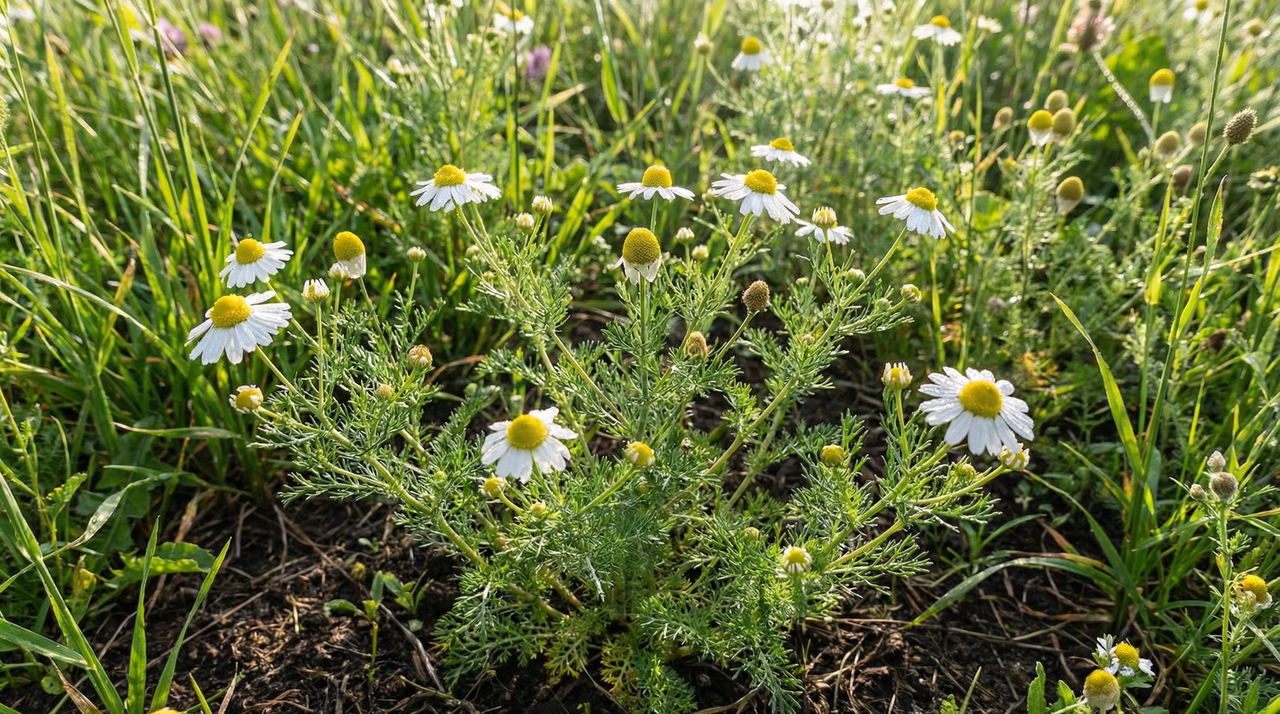
Roman chamomile is one of the few low-growing herbs that performs equally well as a resilient living pathway and a potent medicinal crop. You crush a stem, catch that sudden wave of warm, apple-sweet fragrance rising up from the ground, and you stop walking. You crouch down. You wonder why you don't have more of it. That scent is the plant's whole argument for itself, and it makes the argument better than I ever could in print. But here's what I didn't understand for years: the plant you're smelling isn't producing that fragrance to charm you. Those volatile oils are defense chemistry, the same compounds that make it genuinely medicinally active and, for reasons I'll get into, deeply confusing to buy at the nursery.
Roman chamomile and German chamomile share a flower, a flavor profile, and a reputation for calm, and they've been getting mixed up in herbalism texts since at least the first century AD. Most of what you've read about "chamomile tea" probably blends research on both species together without telling you so. That matters if you're growing it for medicine, designing a living groundcover lawn, or trying to understand why your seed packet produced plants nothing like the low mat you were expecting. Getting clear on which plant you actually have, what it actually does, and how it actually grows turns out to be more interesting than the generic herb-garden advice suggests.
Roman Chamomile Origin and History
Botanical Background and Native Range
Roman chamomile, known botanically as Chamaemelum nobile, is a low-growing perennial herb native to Western and Southern Europe, including the UK, Portugal, Spain, France, and Italy, as well as parts of the Mediterranean and North Africa; it has since naturalized in portions of North America too.[1][2][3] In its native range, it colonizes sunny grasslands, coastal dunes, and disturbed ground up to about 1,500 meters elevation, always gravitating toward well-drained soil and open light.[4][5] What makes it such a successful groundcover is a dual reproductive strategy: creeping rhizomes spread 10 to 30 cm per year to knit together dense colonies, while small insect-pollinated seeds can persist in the soil for two to five years waiting for the right moment to germinate.[6][7]
I've used it as a groundcover in several garden designs and one thing I wish someone had told me early on is that its lifespan is shorter than most people expect. As a polycarpic short-lived perennial, it typically persists around three to five years before it starts getting woody and patchy.[8][9] I plan for that now: divide and replant every few years, and the mat stays lush. Seed-grown plants typically flower in their second year, while divisions can bloom in their first season, which is part of why I almost always propagate vegetatively when I want reliable coverage fast.
Visual Characteristics of Roman Chamomile
The plant itself is instantly recognizable once you've grown it, though I'll admit that as seedlings, the finely divided feathery foliage can look suspiciously like tiny carrot tops or dill sprouts. I learned to label my seed trays after one too many mix-ups with German chamomile. Mature plants stay low, reaching about 15 to 30 cm tall and spreading 20 to 45 cm wide via procumbent stems that root at the nodes as they creep along the ground.[10] The leaves are bipinnate to tripinnate, soft with fine hairs, and only 1 to 3 cm long; the flowers are the classic daisy configuration, white ray petals surrounding a yellow disc, typically 1.5 to 3 cm across, blooming from June through September.[6][11]
Distinguishing it from German chamomile (Matricaria chamomilla) matters, especially if you're growing for specific uses. Roman chamomile is perennial where German is annual; it has a chaffy receptacle, noticeably pubescent foliage, and a stronger, sweeter apple-like scent.[5][12] Soil conditions also influence how the mat grows: sandy, well-drained ground produces compact, dense coverage, while heavier soils lead to looser, sprawlier growth.[13] Among named cultivars, 'Treneague' forms a compact, non-flowering mat, while 'Flore Pleno' produces double flowers in dense mounds that are frankly gorgeous in a cottage border.[14]
Traditional and Cultural Uses
The earliest solid documentation of roman chamomile as a medicinal plant comes from 1st-century AD classical sources. Both Dioscorides in De Materia Medica and Pliny the Elder in Naturalis Historia recorded its use for inflammation, digestive complaints, wound healing, fevers, and as a calming agent.[15][16] Claims of earlier Egyptian or Hippocratic use are speculative: ancient texts used the generic term "chamomilla" without reliably distinguishing between Roman and German chamomile, so we can't confidently assign those references to Chamaemelum nobile specifically.[17] The record becomes clearer again in the 12th century with Hildegard of Bingen's writings and solidifies through the 16th and 17th century European pharmacopeias.
Beyond medicine, Roman chamomile carried genuine cultural weight across European folk traditions. It was used to treat anxiety, insomnia, menstrual cramps, and skin irritations, but also worn in amulets as a protective charm against evil spirits and incorporated into purification ceremonies as a symbol of peace.[18][19] I find that history genuinely useful when I'm designing calming garden spaces today. There's something to be said for a plant that has represented tranquility across cultures for two millennia.
Fun Facts About Roman Chamomile
The apple-like scent that makes this plant so distinctive comes from volatile compounds including chamazulene, and on a warm summer afternoon when you brush against a patch of it, the fragrance is surprisingly intense.[6] I've noticed fewer mosquitoes lingering around my chamomile plantings during evening hours, which aligns with research showing its essential oil has potential insect-repellent properties against mosquitoes.[20] Beyond that, the mat-forming habit earns its keep ecologically: bees and flies work the flowers reliably, the dense ground layer stabilizes soil, suppresses weeds, and reduces erosion.[21][22]
Hardy from USDA zones 4 through 9, it prefers full sun and well-drained soil with a pH of roughly 6.0 to 7.5, though it can tolerate slightly more alkaline conditions.[23][10] Its tolerance for light foot traffic is what made it the foundation of those famous European chamomile lawns, a tradition that still works beautifully with 'Treneague' today.[24] Modern applications have largely followed the traditional ones: calming teas, aromatherapy, perfumery, and topical preparations, all drawing on the same chemistry that Dioscorides was writing about two thousand years ago.[25][4]
Roman Chamomile Varieties and Where to Buy
Roman chamomile is genuinely one of the more fun plants to shop for, because the cultivar options aren't just cosmetic differences. The species, Chamaemelum nobile (you'll still find it sold as Anthemis nobilis at some older nurseries, so don't be confused by that), spreads low and willingly across zones 4-9, making it useful in everything from a medicinal border to a fragrant path edge. But once you start looking at named selections, you realize how much the breeders have done to make this plant fit specific garden problems.
Notable Cultivars of Roman Chamomile
The cultivar range spans roughly 3 to 12 inches in height and diverges significantly in flower form, foliage character, and fragrance intensity.[26][12][27] 'Flore Pleno' is the double-flowered form most people are thinking of when they picture a showy chamomile planting, and 'Sweet Inglefield' offers a similar pompom bloom with an aroma that, in my experience, is noticeably richer than the straight species when you brush past it in the morning. 'Helen' spreads vigorously and is worth choosing where you need coverage fast. 'Bridgewater' produces larger flowers, while 'Gold Ribbon' brings variegated foliage that earns its place brightening shadier corners where other herbs would just look drab.
Then there's 'Treneague,' which deserves its own moment. It doesn't flower at all, forming a tight, feathery mat that stays low and handles mowing and light foot traffic better than you'd expect from something so fine-textured.[26][27][23] I've used it between stepping stones in several landscape projects and clients are always surprised by how well it holds up. One important note: because 'Treneague' is sterile, you won't find it as seed. If you see Chamaemelum nobile 'Treneague' seeds for sale, that's a red flag; it can only be propagated vegetatively.
Sourcing Roman Chamomile Plants and Seeds
Roman chamomile is easy to source in the US. Seeds run $3-5 a packet, and live plugs or plants typically land between $6-20 depending on size and supplier. Richters Herbs, Mountain Valley Growers, Plant Delights Nursery, Johnny's Selected Seeds, Baker Creek Heirloom Seeds, Seed Savers Exchange, Fedco, and Burpee all carry it in some form. When I'm growing roman chamomile specifically for tea, I reach for certified-organic stock from Johnny's or Mountain Rose Herbs; the flavor difference in the cup is real, and it's worth the small premium.
Fresh plants show up most reliably in spring and fall at nurseries, in step with propagation cycles,[28][29] while dried herb and extracts are available year-round. If you're sourcing specialty cultivars not yet common in the US trade and need to import, the process is manageable: a phytosanitary certificate from the exporting country is required, and an import permit may be needed depending on whether you're bringing in seeds, cuttings, or live plants, all per USDA APHIS rules.[30][31][32] I've helped a few clients navigate this for cultivars not yet widely distributed stateside, and planning ahead for the paperwork makes it straightforward. Start with the right variety for your purpose and the rest of the growing journey gets considerably easier.
Roman Chamomile Propagation and Planting
Roman chamomile is one of those plants where the method you choose at the start shapes your entire first season. Get it right and you'll have a fragrant, mat-forming groundcover flowering by midsummer. Get it wrong and you'll be staring at a flat of tiny seedlings wondering why nothing happened.
Propagation Methods: Division, Cuttings, and Seed
Division is the method I reach for first, and it's the one most nurseries and professional growers rely on for exactly the same reason: consistency.[33][4] When a client wants a seamless chamomile lawn, I'm not gambling on seed. I'm splitting established clumps in early spring, when soil is just starting to warm, and those divisions root quickly and flower that same season. There's a real satisfaction in watching a plant you split in March blooming by June while the seed-sown patch next to it is still doing its feathery carrot-top impression.
Stem cuttings are a solid second option, particularly if you have one good mother plant and want to multiply it without dividing the whole clump. Take 2 to 4 inch cuttings from healthy, non-flowering stems of shoots that are about four to six weeks old, dip them in rooting hormone, and set them in a 1:1 mix of coarse sand and perlite.[34][10] Keep them at 65 to 70°F under bright indirect light and expect roots in four to six weeks. It's a good winter project if you're overwintering a plant indoors.
Seeds are where things get interesting, and by interesting I mean humbling. The seeds themselves are tiny achenes, barely 1 to 2 mm long, with physiological dormancy that requires cold stratification at around 4 to 5°C for several weeks before germination becomes reliable.[33][35] They also need light to germinate, so surface sowing is essential. Fresh seed can hit 70 to 90% germination under ideal conditions, but viability declines steadily with age, and most home-saved seed doesn't stay in ideal conditions.[36] If you're storing seed, keep it cool, dry, and sealed with a desiccant; properly stored orthodox seed like this can hold viability for two to five years at home and far longer under true seed-bank conditions.[37]
Here's the quirk that catches people: Roman chamomile is primarily apomictic, which means seed-grown plants should technically be genetic clones of the parent.[38] In theory, seeds should be reliable. In practice, germination is erratic enough that I treat seed propagation as an experiment rather than a production method. I still start a flat or two each year just to watch the process, but for anything where I need predictable results, I go straight to divisions. Label your seed flats carefully too. I learned early on that chamomile seedlings look nearly identical to young carrot or parsley, and an unlabeled flat is a mystery you won't solve for weeks. Grafting is not used for this species, so you can set that idea aside entirely.[39]
Soil, Site Selection, and pH Requirements
Understanding where Roman chamomile comes from tells you almost everything you need to know about its soil preferences. It's native to calcareous grasslands in western and southern Europe, the kind of dry, lean ground where deeper-rooted competitors can't easily crowd it out.[4] That heritage is why it performs best in well-drained sandy or loamy soil with modest organic matter, low to moderate fertility, and a pH somewhere in the 6.0 to 7.5 range, though it will tolerate a wider band if drainage is excellent.[40][41] Rich, amended garden soil is not a gift to this plant. It tends to produce floppy, soft growth that flowers poorly and sits more susceptible to rot.
Sun exposure matters both for productivity and for that characteristic apple scent. Six to eight hours of direct light produces denser growth and higher essential oil content; shade pushes the plant toward legginess and reduced flowering.[10][33] In hotter climates, afternoon shade can prevent wilting and stress without sacrificing much of the fragrance. The roots are shallow and fibrous, so you don't need deep soil; six to eight inches will do, though eight to twelve is more comfortable for the plant long-term.[42]
I test pH each spring with a basic soil test kit, and it's a habit I'd encourage any grower to pick up. Soil that drifts too acidic triggers iron chlorosis; you'll see yellowing leaves that tell you the plant can't access what it needs. Swing too alkaline and you get manganese toxicity and reduced phosphorus uptake.[43][44] Elemental sulfur brings pH down; agricultural lime brings it up; rates depend on your soil texture. For containers, a 1:1:1 blend of peat moss, coarse sand, and perlite gives the drainage profile it needs.[45] Heavy clay is the real enemy here. If you're working with it, raised beds or generous grit amendment are worth the effort, because the first signs of poor drainage are subtle at first (some wilting, slightly yellow leaves) until they aren't: mushy blackened roots and a plant you can't save.[46][47]
Spacing, Planting Technique, and Germination Timeline
Mature plants reach six to twelve inches tall and spread twelve to twenty-four inches wide, and that spread is really your guide to spacing decisions.[23][48] For a lawn-like groundcover effect, I plant six inches apart and let the plants knit together into a solid mat within a season or two. For a harvest bed or ornamental border planting where I want to get in and pick flowers without trampling neighbors, I space them closer to twelve inches with eighteen to twenty-four inches between rows.[10] Tighter spacing also helps suppress weeds faster, though I've noticed that wider spacing with good airflow between plants reduces the powdery mildew I sometimes see in humid summers.
For seed, surface sow directly after the last frost date in spring, pressing seed lightly into prepared soil without covering it; light is required for germination and even a thin layer of soil can cut your already-variable rates further.[33][23] Germination takes seven to twenty-one days at 15 to 21°C, and under good indoor conditions first flowering can follow in ninety to one hundred twenty days.[49] Outdoor-direct-sown plants, though, will often spend their first year establishing rather than flowering, with real bloom production coming in year two. Divisions and spring transplants skip all of that waiting; they can flower and be lightly harvested in their first season.[33][50] When clients want instant results, divisions are what I plant. When I want to watch the whole process unfold, I start a few seeds. Both approaches have their place, but knowing which one suits your timeline makes the difference between a satisfying first season and a frustrating one.
Roman Chamomile Care Guide
Roman chamomile is one of those plants that rewards a light touch more than attentive fussing. Get the sun, water, and soil roughly right and it will reward you with fragrant, floriferous mats year after year. Overdo any one of those three and you'll end up with a leggy, nearly scentless plant that makes you wonder why you bothered.
Sunlight Requirements
Roman chamomile wants full sun, ideally six to eight hours of direct light daily.[10] In my zone 9B garden, though, I rely on the afternoon-shade recommendation far more than a gardener in, say, coastal Oregon ever would. Without it, I've watched leaf edges brown and curl by midsummer, and the plants droop dramatically before recovering each evening. That's scorch, and once you've seen it you recognize it immediately.[51][10] On the flip side, too little light produces the opposite problem: elongated, pale stems reaching toward whatever brightness they can find, with almost no flowers to show for it. If your plants look floppy and yellowish rather than compact and green, move them before assuming they're diseased.
Water Needs
The practical rule is about an inch of water per week during the growing season, applied when the top inch or two of soil feels dry to the touch.[52][53] I don't trust a watering calendar for this plant. I trust my finger. Seedlings and newly divided plants need consistently moist soil until their roots settle in; once they're established, let the top inch dry between waterings; and in winter dormancy, you can pull back to once every few weeks, just enough to prevent the roots from desiccating completely.[54][55]
Roman chamomile will handle a dry spell or two once established, but extended drought shows up fast as scorched leaves and stalled flowering.[56] Overwatering is actually the more common mistake I see: yellowing leaves, wilting despite damp soil, and a general soggy sadness that often tips into root rot.[57][53] Think of it like lavender in this respect: both hate wet feet, though chamomile is less drought-hardy once temperatures climb. Good drainage matters more than irrigation frequency.
Feeding and Fertility
This is where restraint really pays off. Roman chamomile grows best in lean to moderately fertile, well-drained soil, and heavy feeding actively works against you.[58][10] I learned this the hard way when I amended a new bed generously before planting. The plants looked magnificent: lush, full, deeply green. They also produced almost no scent and fewer flowers than I expected. Excessive nutrients push vegetative growth at the expense of essential-oil concentration, which is precisely what you're growing roman chamomile for.[59] Now I plant into unamended native soil whenever possible and skip the fertilizer entirely. If a planting looks genuinely pale and struggling in spring, a light balanced feed is fine, but treat it as an exception rather than a routine.
Frost Tolerance and Winter Care
Roman chamomile is hardy in USDA zones 4 through 9, with established plants capable of handling temperatures down to roughly 5°F to 14°F before significant damage occurs.[60][61] Young plants and new spring growth are more vulnerable than a well-rooted mat; I've watched first-year seedlings look completely hopeless after a surprise frost, only to push fresh growth from the base within two weeks, particularly when the soil drains freely. Drainage, I've found, matters as much as temperature in determining survival. For gardeners in colder zones, two to four inches of organic mulch applied after the ground freezes, combined with good drainage, makes a meaningful difference in how much of the plant survives to spring.[62][63]
Heat Tolerance
Roman chamomile is a cool-temperate plant at heart, with optimal growth between 60°F and 70°F.[64][65] Push it consistently above 77°F and you'll start to see wilting, leaf scorch, chlorosis, and reduced flowering, with seedlings and plants in active bloom being the most sensitive stages.[66] In my humid Florida summers, the combination of afternoon shade and consistent soil moisture through mulching has prevented most of the scorch I used to see in full-exposure beds. The cultivar 'Treneague' is sometimes cited as a heat-tolerant option,[67] though in my experience any chamomile's heat performance depends as much on your specific microclimate as on variety. Treat these mitigations as a system: shade, mulch, and drainage working together rather than any single fix.
Pruning, Maintenance, and Seasonal Rhythm
After the main flush of bloom, shear the plants back by about one-third. It feels aggressive the first time you do it, but this is what keeps mats compact and prevents the open, floppy habit that develops when clients skip this step.[23][68] For larger plantings used as a groundcover, a light pass with the mower does the same job. One thing I never do is prune hard in late fall. Waiting until I see the first flush of spring growth has consistently produced faster, healthier recovery, since the plant enters winter with enough top growth to buffer against temperature swings.
Flowering runs from June through September in temperate climates, and in mild winters the plant stays evergreen; in colder zones it dies back and regrows from the roots.[10][69] Every two to three years, divide established clumps to keep them vigorous and flowering well.[70] The divisions I've taken in early spring have flowered that same season, which makes division one of the most satisfying maintenance tasks in the garden: minimal effort, immediate reward.
Roman Chamomile Harvesting Guide
First-year plants will flower, but I'd encourage some patience. Roman chamomile reaches full maturity and peak yield in its second season,[71][44] and after several seasons growing this plant, I can tell you the difference in aroma between a young plant and a well-established second-year mat is noticeable the moment you brush past it. The flowering window runs June through August, with July as the sweet spot.[72]
When to Harvest Roman Chamomile: Timing, Visual Cues, and Peak Aroma
The harvest window is narrow and worth understanding. Peak essential oil content arrives roughly 3 to 7 days after a flower opens, with the highest volatile concentration around day five post-anthesis.[73][74] Harvest too early and you get lower phenolic and flavonoid levels; wait too long and the flavor volatiles begin to degrade even as some compounds climb.[75][76] What you're watching for visually is a fully open flower whose white petals are just beginning to droop slightly downward around that bright yellow center.[77][72] The scent test never lies: rub a flower head gently between your fingers. If you get that clear, sweet apple hit, the oils are there.[77]
Always harvest in the morning after the dew has dried but before midday heat sets in.[73][78] I've found that flowers picked on a hot afternoon lose that brightness in the dried product faster, sliding toward the hay-like notes before you're ready for them.
How to Harvest Roman Chamomile Flowers Without Harming the Plant
Pick individual flower heads by hand on a dry day, using your fingers or small snips right at the stem base.[77] The one rule I'd carve in stone: take no more than one-third of the foliage at any single pass.[44][66] My first season I was more aggressive than that, and the plants sulked visibly; I watched new bud formation stall for weeks. Leaving two-thirds of the mat intact keeps it healthy, encourages continuous bloom through August, and protects the low-growing groundcover structure you've worked to establish.
Roman Chamomile Yield, Flavor Profile, and Edible Parts
The flowers are the prize here. Leaves are edible but tend toward bitterness, and stems are too fibrous to bother with.[79][80] The flavor is mild, sweet, and distinctly apple-like with a delicate floral undertone and just a whisper of bitterness at the finish.[81] Having grown German chamomile alongside it for comparison, I'd describe Roman as the gentler, sweeter sibling; it lacks the slightly more assertive character that makes German better suited to medicinal concentrations but gives Roman a clear edge in the kitchen.
Fresh flowers carry that vivid apple-sweet scent. Once dried, the aroma mellows into something softer and earthier, with hay-like notes underneath.[82] That shift is natural, but harvesting at peak in the morning window slows it considerably. Dried roman chamomile flowers steeped in tea produce a light, almost fluffy infusion with minimal grittiness,[83] a quality that rewards the grower who times the harvest well.
Roman Chamomile Preparation and Uses
Edible Parts and Flavor Profile
Every part of Roman chamomile has a role, but the flower heads are the only part worth gathering seriously. Both the yellow disc center and the white ray florets are edible and useful, whether fresh off the stem or dried for later.[84][85] The leaves are technically edible, but I'd call them a seasoning at best: a leaf or two scattered into a salad adds something faintly herbal, though they can turn bitter quickly, so a sparing hand is wise. The roots should stay in the ground entirely. What makes Roman chamomile worth growing for kitchen use is that sweet, apple-like flavor with fruity, herbal undertones that German chamomile simply doesn't have. I always describe the difference to new clients this way: German chamomile is the stronger medicine; Roman is the one your kids will actually drink at bedtime without negotiating.
Culinary Applications and Traditional Uses
Roman chamomile's phytochemical richness, including flavonoids like apigenin and luteolin and sesquiterpenes like chamazulene, comes through most practically in a well-made tea.[86][87] Steep dried flower heads in water just below 90°C rather than a full boil, because that extra few degrees of heat strips out the volatile aromatics that carry most of the flavor and medicinal value. A squeeze of honey and lemon makes the naturally mild brew something genuinely lovely.[88] The flowers fold just as gracefully into baked goods: shortbread, honey cake, and simple breads all take on a quiet floral note without becoming perfumed or soapy. I've made chamomile-infused butter for scones and had people ask what the secret ingredient was.
How you dry the flowers matters more than most people realize. I've shade-dried mine at low temperatures for years specifically because I once tried quick-oven drying during a busy season and lost almost all of that apple fragrance. Research backs up what my nose was telling me: drying above 40°C can destroy up to 30 percent of volatile compounds.[89] A mesh rack in a shaded, airy spot takes a little longer, but the finished product is worth it.
Medicinal Preparations and Dosages
Roman chamomile has a long history as a calming, anti-inflammatory remedy across European folk traditions, used for anxiety, poor sleep, skin inflammation, and digestive complaints.[90][91] The main preparation routes are infusion for everyday use, tincture for longer-term support, decoction for topical washes, and steam-distilled essential oil for aromatherapy and diluted skin applications.[92][93] For tea, the standard adult dose is 1 to 2 grams of dried flowers per cup, up to three times daily. I usually start people I know at the lower end of that range and they consistently report good results for mild anxiety. Tinctures run at 1 to 4 ml (1:5 in 45% alcohol) up to three times daily, and clinical studies using dried flower extracts have worked in a range of 220 to 1,100 mg per day, with around 1 to 3 grams daily supporting IBS symptoms in meta-analyses.[94][95][96][97] Essential oil should be diluted to 1 to 2 percent in a carrier before any topical use.
Safety Considerations
One thing I make a point of asking new clients before recommending chamomile skin soaks or teas: do you react to ragweed? Roman chamomile belongs to the Asteraceae family, and anyone with sensitivities to ragweed, chrysanthemums, or related plants carries a real risk of cross-reaction, ranging from mild allergic responses to, in rare cases, anaphylaxis. Pregnancy is a firm contraindication; the plant's uterine-stimulating properties make it one I do not recommend for pregnant clients under any circumstances, and breastfeeding mothers should also check with their provider before using it medicinally. Coumarin content means there's a potential interaction with blood thinners that shouldn't be dismissed, and because chamomile has sedative properties, combining it with prescription sedatives or anti-anxiety medications warrants a conversation with a healthcare provider first. For most adults using it as an occasional tea or a diluted topical preparation, the risk profile is genuinely low. But this plant earns its place in the apothecary garden precisely because it's potent, and potency deserves a little respect.
Roman Chamomile Health Benefits and Medicinal Uses
Roman chamomile has earned its reputation as a gentle healer not through mystery, but through chemistry. Understanding what's actually in the plant helps explain why it's been in European medicine chests for centuries and why it still holds up under modern scrutiny.
Key Phytochemicals and Their Therapeutic Roles
The flowers of Chamaemelum nobile pack a diverse secondary metabolite profile: flavonoids including apigenin, luteolin, and quercetin; coumarins like umbelliferone and herniarin; phenolic acids; and smaller amounts of saponins and tannins.[98][99][100] The essential oil fraction is where things get particularly interesting for medicinal applications: dried flowers yield 0.5-1.5% essential oil, rich in sesquiterpenes like chamazulene and α-bisabolol (which can reach 25-60% of oil content), along with monoterpenes such as α-pinene.[101][102] That signature apple scent comes from the interplay of α-bisabolol, chamazulene, and farnesene -- no alkaloids in the picture, which partly explains the plant's gentle safety profile.[103][98]
The potency of these compounds isn't fixed. Apigenin content ranges from 0.5-2% dry weight, while chamazulene can swing anywhere from 1-20% depending on harvest season, soil type, altitude, and chemotype.[104][105][106] Summer harvests from well-drained, calcareous soils consistently produce stronger aroma and, in my experience, noticeably more sedating teas. Think of it like lavender: the same species grown in heavy clay versus gritty limestone produces a completely different sensory and medicinal experience. Selecting your site with this in mind isn't just about aesthetics; it directly shapes the therapeutic quality of what you harvest.
Evidence from Medicinal Research and Traditional Applications
European herbalists have turned to Roman chamomile for indigestion, bloating, nervous tension, insomnia, and inflamed or irritated skin for well over a thousand years, with flowers always recognized as the primary medicinal part.[107][4] Modern research has started to explain why that folk wisdom held together so well. The anti-inflammatory effects trace primarily to chamazulene and bisabolol inhibiting the NF-κB signaling pathway and suppressing COX-2 expression, at least in vitro and in animal models.[108][109] The calming reputation has a clear mechanism too: apigenin binds to GABA-A receptors in a way that produces anxiolytic effects comparable to benzodiazepines in animal studies, backed by small-scale human trials.[110][111]
Beyond those headliners, the research also supports antispasmodic action via calcium channel antagonism (which explains the traditional use for gut cramping and bloating), antioxidant activity through Nrf2 pathway activation, antimicrobial effects against Staphylococcus aureus and Candida albicans, and measurable wound-healing potential.[112][113][114][115] Clinical evidence also supports benefits for functional dyspepsia and general gastrointestinal symptoms.[116] Much of the robust clinical trial data comes from German chamomile (Matricaria recutita), not Roman. While the phytochemical overlap is substantial and the traditional profile aligns closely, Roman-specific large trials are limited.[117][118] The roman chamomile benefits for skin and digestion that herbalists have relied on for generations are biologically plausible and increasingly supported, but anyone reading the research should check which species is actually being studied.
Safety Profile, Contraindications, and Usage Guidelines
For most people using Roman chamomile as a tea or diluted topical, the safety record is genuinely reassuring. The FDA classifies it as GRAS for food use, and animal toxicity studies put the essential oil LD50 above 5 g/kg, which puts it firmly in the low-toxicity category at culinary and traditional medicinal doses.[119][120][96] A sensible daily tea dose is 1-2 teaspoons (around 1.5 g) of dried flowers steeped in 150-250 ml of water for 5-10 minutes, taken 1-3 times per day without exceeding 4-6 g of dried herb daily; the EMA specifically recommends 1.5 g per day for dyspepsia.[121][122]
Where I urge real caution is with Asteraceae allergies. Sesquiterpene lactones are the primary culprits in sensitization, and contact dermatitis shows up in 0.5-2% of patch tests; rare anaphylaxis has been documented, particularly in people who already react to ragweed.[96][123][124] I've worked with clients who had no idea their ragweed sensitivity would extend to undiluted chamomile extracts until they developed a reaction. A patch test before using any concentrated preparation on skin is not optional; it's just good practice.
If you're on blood thinners or sedatives, treat medicinal doses seriously. The coumarin content and mild anticoagulant effects can increase bleeding risk with warfarin. The sedative potentiation is also real enough to matter, and high-dose essential oil use carries risks of neurotoxicity and hepatotoxicity.[90][125] During pregnancy, skip medicinal doses entirely, particularly in the first trimester: potential uterine stimulation and emmenagogue effects make the risk not worth taking without direct medical guidance.[126][122] For children over six, a half adult dose under adult supervision is the guideline; avoid it entirely for children under six.[122] Finally, source from organic, clean-soil cultivation: Roman chamomile can accumulate heavy metals from contaminated ground, and the identification risk from look-alikes (including dyers groundsel, which carries hepatotoxic alkaloids) is real enough that knowing the plant by its hollow, apple-scented flower heads and feathery foliage is genuinely worth your time.[127][10]
Roman Chamomile Pests and Diseases
There's a reason I plant roman chamomile near my brassicas. The essential oils in its foliage, particularly chamazulene and alpha-bisabolol, repel a surprising range of insects including aphids, flies, and mosquitoes, and deer tend to walk right past it.[128][129][130] That phytochemical armor makes it genuinely low-maintenance compared to most herbs I grow. But "resistant to most" is not the same as bulletproof, and knowing where the gaps are saves a lot of frustration.
Common Pests of Roman Chamomile
The biggest vulnerability I've seen firsthand is slugs. After heavy rain, they'll demolish new foliage fast, especially in beds that stay moist.[131] Copper tape barriers around beds are my most reliable defense without disrupting the beneficial insects the plant attracts. Not glamorous, but consistently effective. Aphids occasionally appear on new growth, but roman chamomile usually shrugs off light infestations on its own.[132] Spider mites are more of a concern in dry, crowded conditions, and leaf beetles or froghoppers can cause occasional physical damage, though I've found these secondary pests rarely threaten an otherwise healthy plant.[133] There are no named cultivars bred specifically for pest resistance,[134] so management practices carry the whole load here.
Diseases Affecting Roman Chamomile
Fungal problems are the real Achilles' heel. Powdery mildew is the most common culprit, caused by Golovinomyces or Erysiphe species, and it thrives above 75°F in humid conditions[135] while the plant itself prefers 50-75°F.[136] I've learned to catch it early as a faint white dusting on lower leaves during humid spells. Root and crown rots from Phytophthora or Fusarium become serious in poorly drained soil,[137] and Botrytis gray mold develops in dense plantings with poor airflow.[138] Rust and viral infections like Cucumber mosaic virus occur occasionally but at lower frequency.[139] If you want a cultivar with a shorter disease to-do list, 'Treneague' has documented resistance to both powdery mildew and root rot,[140] which is part of why I recommend it as a lawn substitute where you want persistence over blooms.
Integrated Pest and Disease Management
I've stopped reaching for neem at the first sign of aphids because roman chamomile usually handles minor infestations without help. What's cut my intervention needs in half is getting the fundamentals right from the start: well-drained soil to prevent root rots, adequate spacing to keep air moving through the canopy, no overhead watering, prompt removal of infected debris, and rotating away from the same spot every two to three years.[141][142] Simply thinning neighboring plants to improve airflow has prevented mildew spread more reliably than any spray in my experience. From there, biological controls fit naturally into a regenerative system: lacewings and ladybugs for aphids, predatory mites where spider mites appear, and Bacillus subtilis as a biofungicide for early fungal suppression.[143] Targeted mechanical fixes like copper tape and hand-picking slugs stay in the toolkit for specific problems. If you do reach for a spray, neem oil and sulfur-based fungicides are the organic first options; follow label instructions and check with your local extension service before using anything stronger.[143] The goal is always to amplify what the plant already does well, not fight against its nature.
Roman Chamomile in Permaculture Design
What I keep coming back to with roman chamomile is how much quiet work it does in a guild. It's not flashy in the way a productive fruit tree or towering comfrey is, but in the herbaceous layer it pulls real weight: building soil, supporting predatory insects, suppressing weeds, and filling horizontal space that would otherwise invite trouble.
Ecosystem Functions and Guild Roles
The soil work starts underground. Roman chamomile functions as a dynamic accumulator, drawing calcium and potassium up from deeper layers and releasing them into the topsoil as the mat naturally sheds and decomposes.[144] I've watched this play out under young apple trees where I've used it as a living mulch: the leaf color on those trees improved noticeably in the second season, suggesting the mineral cycling was doing something real. Above ground, the dense mat stabilizes soil, reduces erosion, and suppresses weed germination through sheer coverage and its allelopathic chemistry.[145]
The bloom period is where the biodiversity benefits really land. Those daisy-like flower heads attract bees, butterflies, hoverflies, and other beneficial insects from May through September, offering nectar and pollen across a long summer window.[146][147] In midsummer I'll often find hoverflies and ladybugs congregating on these flowers in numbers that feel disproportionate to such a small plant. The payoff shows up on nearby brassicas: aphid pressure drops, and I'm convinced the beneficial predator population the chamomile draws is a significant part of why. As a companion plant, it works by masking host scents and luring in pest predators simultaneously, with documented benefits to cabbage, onions, and beans while repelling aphids, flies, carrot flies, and nematodes.[148][149]
The flowers are self-compatible but insect cross-pollination drives better results, which means the plant needs open, accessible conditions to deliver its full ecological contribution.[150] In North American gardens, roman chamomile offers moderate pollinator value but isn't a substitute for native flora in supporting specialist native bees.[150][151] Pair it with native flowering plants for a complete pollinator strategy. And if you or anyone in your household reacts to ragweed or daisies, test a small patch before planting broadly. I've seen mild contact dermatitis in sensitive clients, and I always flag the Asteraceae allergy risk explicitly in my design notes.[152]
Forest Layer and Companion Planting
Roman chamomile belongs strictly in the groundcover and herbaceous layer. At 6 to 12 inches tall, spreading 12 to 24 inches wide through surface stolons with shallow roots reaching only 6 to 12 inches down, it has no business in a shaded forest understory.[153][154] What it does beautifully is fill open, sunny horizontal space without competing meaningfully with the deeper-rooted trees and shrubs above it. I've intercropped it in orchard alleys and around the drip line of young fruit trees in well-drained spots, and it doesn't fight for resources the way a more vigorous groundcover might.
Its allelopathic properties help it hold territory against weeds by suppressing their germination, which is a genuine benefit in those orchard alleys where cultivating the soil would damage tree roots.[4][155] As a roman chamomile ground cover, it's also one of the more sensory-rewarding choices I've used: the feathery, silver-green foliage releases that distinctive apple fragrance when brushed or lightly walked on. That quality makes it genuinely useful as a fragrant lawn substitute between flagstones or stepping stones, in path edging, or tucked into rock gardens where each footfall triggers the scent.[156][154]
The stolons do spread enthusiastically after wet periods. I learned to install edging or physical barriers around this plant when it shares space with smaller companions, because it will quietly overwhelm low-growing herbs if you give it a wet spring and walk away. Managed well, the spreading habit is the feature; unmanaged, it's the problem.[151]
Climate Adaptation and Hardiness Zones
Roman chamomile's Mediterranean and oceanic European origins explain nearly every preference it has. It evolved in mild winters, warm summers, and well-drained soil with rainfall concentrated in the cooler months.[157][3] In North America, those conditions map best to USDA zones 4 through 9, with the plant hitting its functional and aromatic peak in the 60 to 75°F range where flowering and compound production both maximize.[10][61] In zones 4 and 5, a 2 to 3 inch layer of organic mulch applied after the ground freezes prevents frost heaving and protects the shallow root system through winter dormancy.[66]
For guild placement, drainage is the non-negotiable variable. The plant tolerates 20 to 40 inches of annual rainfall well and is moderately drought-tolerant once established, but waterlogged soil will kill it faster than cold will.[3] It prefers full sun to partial shade, handles coastal salt spray reasonably well, and thrives in sandy or loamy well-drained soil across a wide pH range.[158] Humidity above 70 percent invites powdery mildew, which makes it a tricky fit in hot, muggy climates regardless of zone number.[159]
In the US, the California coast, Pacific Northwest, and Great Lakes region with good drainage are the sweet spots where the mat thrives and delivers its full suite of ecosystem services reliably.[160][119] The pollinator-attracting function also depends on temperature: beneficial insect activity peaks in that same 60 to 75°F window at moderate humidity, so in regions where those conditions are fleeting, the ecological contribution is more seasonal than sustained.[160] Knowing your climate sets the ceiling for what this small plant can realistically contribute to the guild around it.
The Plant That Taught Me to Slow Down
I remember kneeling in a chamomile lawn at a historic garden in England years before I ever planted my own, pressing my palm flat against those feathery mats just to release the scent. It smelled like something I couldn't name yet. Now I grow it along the edges of my food forest paths, and every time I brush past it on a hot morning, I'm back there on my knees in the grass, understanding for the first time that a garden could be both useful and genuinely kind.
Sources 160
- Chamaemelum nobile - Missouri Botanical Garden Plant Finder ↩
- Chamaemelum nobile - Kew Science Plants of the World Online ↩
- Chamaemelum nobile - Royal Horticultural Society ↩
- Kew Gardens: Roman Chamomile ↩
- Flora of North America - Chamaemelum nobile ↩
- Chamaemelum nobile ↩
- Germination and Seed Bank Dynamics of Chamaemelum nobile ↩
- Chamaemelum nobile ↩
- Missouri Botanical Garden - Plant Finder: Chamaemelum nobile ↩
- Roman Chamomile - Missouri Botanical Garden ↩
- Chamaemelum nobile - Missouri Botanical Garden ↩
- Roman Chamomile: Morphology and Cultivation ↩
- Chamaemelum nobile - Roman Chamomile ↩
- Cultivars of Chamaemelum nobile ↩
- De Materia Medica ↩
- Naturalis Historia ↩
- Roman Chamomile: Ethnobotany and Uses ↩
- Roman Chamomile: A Historical and Medicinal Review ↩
- Traditional Uses of Chamomile in European Folk Medicine ↩
- Insect Repellent Activity of Essential Oils ↩
- Chamaemelum nobile L. ↩
- Ground Cover Plants: Roman Chamomile ↩
- Roman Chamomile: Planting, Growing, and Harvesting Roman Chamomile ↩
- Roman Chamomile ↩
- Roman Chamomile Essential Oil ↩
- Chamaemelum nobile - Roman Chamomile ↩
- Missouri Botanical Garden: Chamaemelum nobile ↩
- Chamaemelum nobile ↩
- Chamaemelum nobile - Roman Chamomile ↩
- International Movement of Plants and Plant Products ↩
- Phytosanitary Certificates ↩
- Organic Import Regulations ↩
- Chamaemelum nobile (Roman Chamomile) Growing Guide ↩
- Herb Propagation Guide: Chamomile ↩
- Seed Storage of Medicinal and Aromatic Plants ↩
- Seed Storage Behaviour: Describing Orthodoxy, Intermediacy and Recalcitrance ↩
- Millennium Seed Bank: Storage Protocols ↩
- Missouri Botanical Garden PlantFinder - Chamaemelum nobile ↩
- Propagation of Roman Chamomile ↩
- Chamaemelum nobile (Roman Chamomile) ↩
- Chamaemelum nobile - Royal Horticultural Society ↩
- Missouri Botanical Garden Plant Finder ↩
- Adjusting Soil pH (acid to alkali) ↩
- Growing Roman Chamomile ↩
- Chamaemelum nobile ↩
- Preventing Root Rot in Herbs ↩
- Roman Chamomile Plant Care Guide ↩
- Chamaemelum nobile (Roman Chamomile) ↩
- Roman Chamomile Cultivation ↩
- Propagation and Cultivation of Chamaemelum nobile ↩
- Chamaemelum nobile - Roman Chamomile ↩
- Chamaemelum nobile (Roman Chamomile) ↩
- RHS Gardening: Chamaemelum nobile ↩
- Missouri Botanical Garden, Plant Finder: Chamaemelum nobile ↩
- RHS Plant Profile: Chamaemelum nobile ↩
- University of Maryland Extension - Gardening Solutions ↩
- Missouri Botanical Garden Plant Finder ↩
- Royal Horticultural Society - Chamaemelum nobile ↩
- Missouri Botanical Garden - Chamaemelum nobile ↩
- Chamaemelum nobile - Roman Chamomile ↩
- USDA Plant Hardiness Zone Map ↩
- Roman Chamomile: Frost Tolerance and Care ↩
- Frost Protection Techniques - Missouri Botanical Garden ↩
- Chamaemelum nobile - Roman Chamomile ↩
- Chamomile: A Herbal Medicine of the Past, Present and Future ↩
- Growing Roman Chamomile ↩
- Chamaemelum nobile Cultivation Guide ↩
- Chamaemelum nobile (Roman Chamomile) ↩
- Chamaemelum nobile ↩
- Horticulture: Roman Chamomile ↩
- Chamaemelum nobile ↩
- Roman Chamomile Cultivation and Harvesting Guide ↩
- Chamomile Production and Processing ↩
- Essential Oil Yield in Chamaemelum nobile ↩
- Harvest Timing Effects on Volatile Compounds in Chamaemelum nobile ↩
- Phenolic and Flavonoid Content Variation in Chamomile at Different Maturity Stages ↩
- Harvesting Chamomile Flowers ↩
- Essential Oil Production in Chamaemelum nobile: Harvest Timing Effects ↩
- Chamaemelum nobile (Roman Chamomile) ↩
- Plant Finder: Chamaemelum nobile ↩
- Chamomile - an overview ↩
- Chamaemelum nobile (Roman Chamomile) ↩
- Chamaemelum nobile ↩
- Missouri Botanical Garden Plant Finder: Chamaemelum nobile ↩
- Royal Horticultural Society Plants for Problems: Chamaemelum nobile ↩
- Phytochemical and Pharmacological Profile of Chamaemelum nobile ↩
- Flavonoids in Roman Chamomile: Apigenin and Health Benefits ↩
- Chamaemelum nobile ↩
- Drying Methods and Their Impact on Roman Chamomile Essential Oil Composition ↩
- Chamomile: A herbal medicine of the past with a bright future ↩
- Historical Uses of Chamomile in Ancient Civilizations ↩
- German Commission E Monographs - Chamomile ↩
- USDA Plants Database - Chamaemelum nobile ↩
- Chamomile: A Herbal Monograph ↩
- Chamaemelum nobile (Roman Chamomile) ↩
- Chamomile ↩
- Clinical Guidelines for Roman Chamomile Dosage in Anxiety and GI Disorders ↩
- Phytochemical Profile of Chamaemelum nobile ↩
- Flavonoids and Phenolics in Chamomile Species ↩
- Chamaemelum nobile L. - A Review of Its Botany, Phytochemistry and Pharmacology ↩
- Chemical Composition of the Essential Oils of Chamaemelum nobile L. from Morocco ↩
- GC-MS Analysis of Essential Oils from Various Parts of Roman Chamomile ↩
- Roman Chamomile Essential Oil Composition ↩
- Essential Oils of Roman Chamomile: Variability and Biological Activities ↩
- Flavonoid Content and Variation in Chamaemelum nobile Cultivars ↩
- Influence of Environmental Factors on the Essential Oil Composition of Chamaemelum nobile ↩
- Chamaemelum nobile ↩
- Anti-inflammatory effects of Chamaemelum nobile in vitro ↩
- Anti-Inflammatory Effects of Chamazulene from Roman Chamomile on NF-κB Pathway ↩
- Anxiolytic Effects of Apigenin from Chamomile ↩
- Anxiolytic activity of Chamaemelum nobile in healthy volunteers ↩
- Antimicrobial activity of Roman chamomile essential oil ↩
- Antioxidant properties of Chamaemelum nobile extracts ↩
- Antispasmodic and analgesic effects in animal models ↩
- Wound Healing Potential of Roman Chamomile in Rats ↩
- Clinical trial of chamomile for functional dyspepsia ↩
- Chamomile: A herbal medicine of the past, present and future ↩
- Anticancer Potential of Chamomile Extracts ↩
- Chamaemelum nobile (Roman Chamomile) ↩
- Roman Chamomile Essential Oil: A Review of Its Chemical Composition and Biological Activities ↩
- Chamomile Monograph ↩
- Assessment Report on Chamaemelum nobile ↩
- Allergic Contact Dermatitis from Chamomile ↩
- Contact Allergy to Chamomile ↩
- Herbal Medicine: Biomolecular and Clinical Aspects - Chamomile ↩
- Chamomile Use During Pregnancy ↩
- Heavy Metal Accumulation in Medicinal Plants: A Case Study on Roman Chamomile ↩
- Pest Repellent Properties of Chamomile ↩
- Chemical Composition and Bioactivities of Essential Oils from Roman Chamomile ↩
- Terpenoids from Roman Chamomile as Insect Repellents ↩
- Plant Finder - Roman Chamomile (Chamaemelum nobile) ↩
- Insect Pests of Herbs in Greenhouses ↩
- Roman Chamomile: Chamaemelum nobile ↩
- Plant Finder - Chamaemelum nobile ↩
- Formation of powdery mildew disease on roman chamomile in Europe ↩
- Roman Chamomile (Chamaemelum nobile) ↩
- Phytophthora Root Rot in Herb Crops ↩
- Chamaemelum nobile: Cultivation and Care Guide ↩
- Diseases of Ornamental and Herb Plants ↩
- Chamaemelum nobile 'Treneague' Profile ↩
- Diseases and Pests of Chamomile ↩
- Powdery Mildew on Ornamentals ↩
- Integrated Pest Management Guidelines for Ornamental and Medicinal Plants ↩
- Roman Chamomile in Permaculture Systems ↩
- Chamaemelum nobile Plant Profile ↩
- Chamaemelum nobile ↩
- Ecological Benefits of Chamomile in Gardens ↩
- Chamaemelum nobile - Roman Chamomile ↩
- Companion Planting Guide for Chamomile ↩
- Pollination Biology of Roman Chamomile (Chamaemelum nobile) - Botanical Journal ↩
- Roman Chamomile ↩
- Chamaemelum Nobile Profile ↩
- Missouri Botanical Garden - Chamaemelum nobile ↩
- Royal Horticultural Society - Roman Chamomile ↩
- Allelopathic Effects of Roman Chamomile (Chamaemelum nobile) - A Study in Daisy Family Weeds ↩
- Roman Chamomile for Soil Health ↩
- Bioclimatic Distribution of Chamaemelum nobile ↩
- Roman Chamomile: A Guide to Cultivation ↩
- Growing Roman Chamomile in the Pacific Northwest ↩
- Herbs for California Gardens: Chamomile ↩