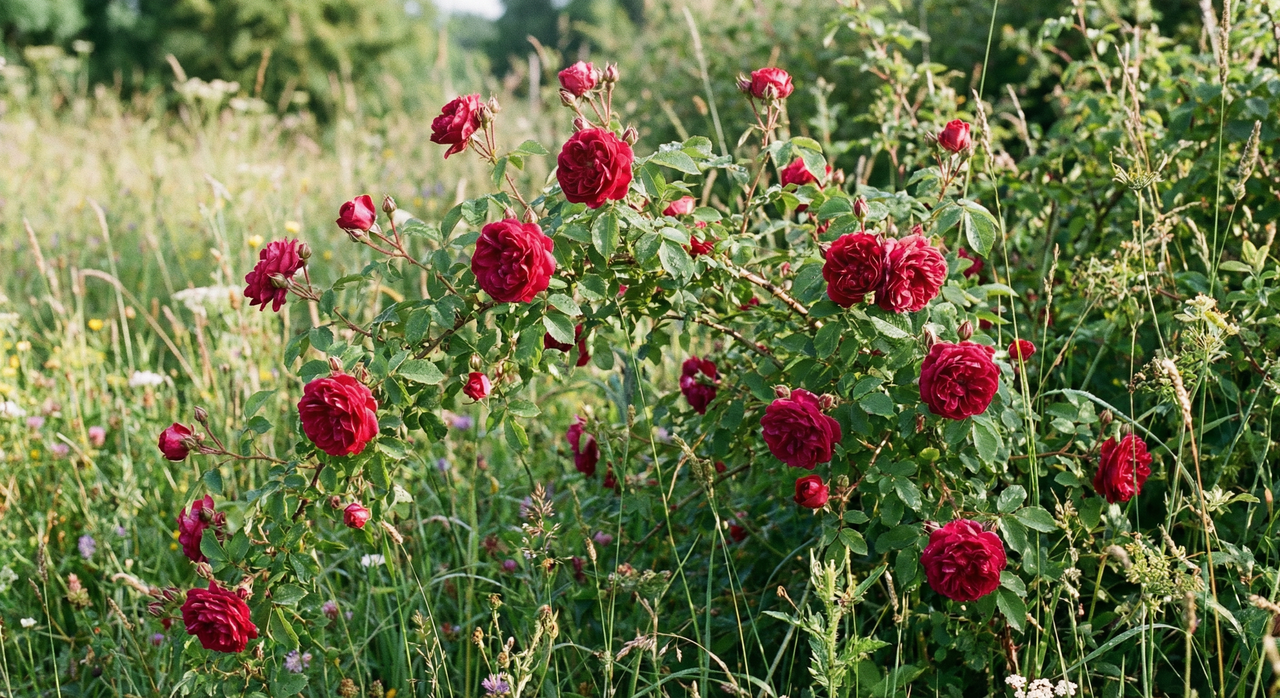
Most people who grow roses have never eaten one. That stopped making sense to me a long time ago. The Apothecary's Rose, Rosa gallica var. officinalis, was cultivated for centuries primarily as a medicinal and culinary plant, stocked in monastery gardens not for its looks but because it worked. Medieval apothecaries sold the dried petals by weight. French confectioners folded them into preserves. And yet somewhere along the way, the entire genus got rebranded as an ornamental, something you plant along a fence and then spray every two weeks just to keep it alive. The old roses, the ones people actually used, got quietly shelved in favor of showier hybrids that need constant coddling and produce almost nothing you can eat.
I've grown Rosa gallica alongside rugosa, dog rose, and sweet briar in a half-dozen different gardens, and the thing that keeps pulling me back isn't the flowers, gorgeous as they are. It's the hips. Swollen, brick-red, packed with more vitamin C by weight than most citrus,[1] they're the part of the plant that kept sailors and soldiers from getting scurvy before anyone had named the vitamin responsible. That history is sitting right there in your garden, and most people walk past it every autumn without a second glance.
Origin and History of Rosa gallica
Botanical Background and Native Range
Before there were hybrid teas, floribundas, or any of the thousands of cultivars crowding modern nursery catalogues, there was Rosa gallica. Native to southern and central Europe, its wild range stretches from the Iberian Peninsula east through the Mediterranean basin all the way to the Caucasus Mountains and southern Russia.[2][3] In its native habitat it favors open meadows, forest edges, scrublands, and calcareous soils, growing from sea level up to about 1,500 meters in temperate and Mediterranean climates.[4] It's a compact deciduous shrub, typically 3 to 5 feet tall, and a genuinely long-lived one: most established plants persist 20 to 50 years in gardens, with well-tended specimens known to exceed a century.[5][6] In my experience, these shrubs genuinely outlast most of the herbaceous perennials planted alongside them when given decent drainage and a sunny spot.
Carl Linnaeus formally described Rosa gallica in Species Plantarum in 1753,[7] but the plant had been under cultivation for well over two millennia before anyone assigned it a Latin binomial. As a diploid species (2n=14), it became a foundational parent in rose breeding history, its genetics woven into countless cultivars we now consider classics.[8] The broader genus stretches across an impressive range of habitats and climates, from Rosa acicularis, a circumboreal species hardy to -46°C found across northern North America and Eurasia,[9] to Rosa rugosa, a salt-tolerant coastal species of eastern Asia that has naturalized (and in places become invasive) across parts of North America,[10] to Rosa chinensis, cultivated in Chinese gardens for over 2,000 years.[11]
Traditional and Cultural Uses Across Centuries
Rosa gallica earns its common name, the Apothecary's Rose, honestly. Cultivation dates to at least 500 BC in Persia, and Pliny the Elder was already writing about it in his Natural History around 77 AD.[12][13] By the medieval period, it was a fixture in monastery gardens across Europe, valued for treating wounds, inflammation, sore throats, digestive complaints, and menstrual irregularities, among other ailments.[14] Charlemagne thought highly enough of it to mandate its planting on royal estates in his 9th-century Capitularies.[15] I find something quietly satisfying about harvesting and drying the petals each June for rosewater, knowing I'm participating in a practice that stretches back through Hildegard von Bingen, medieval pharmacopoeias, and eventually into the French Codex of 1818.[16][17]
The symbolism runs just as deep as the medicine. In Christian iconography, the red rose became associated with the Virgin Mary, with the five petals referencing the five wounds of Christ.[18] What do roses symbolize beyond religion? Love, beauty, purity, and secrecy, a layered vocabulary that made the rose indispensable to French royalty; it was cultivated in the gardens at Versailles under Louis XIV and appeared in the heraldry of noble families across Provence.[19][20] White roses carry connotations of purity and innocence in this same tradition; yellow rose meaning shifted over centuries toward friendship and, in some contexts, jealousy. The full architecture of rose symbolism as we know it today has its roots in this species and its relatives.
Across the genus, patterns of traditional use repeat with regional variation. Rosa canina hips were harvested across Britain during World War II to produce vitamin C syrup for children.[21] Rosa rugosa has been used for centuries in East Asian medicine and teas.[22] Indigenous peoples across North America relied on Rosa acicularis for food, wound healing, and tools.[23] Rosa chinensis carried deep symbolism in Chinese poetry and art alongside 2,000 years of medicinal use.[11] One practical note for North American gardeners: while Rosa gallica itself is well-behaved in my gardens, I always check local extension lists before planting Rosa rugosa or Rosa rubiginosa because both can form aggressive thickets in certain regions.[24][25]
Visual Characteristics and Identification Features
Rosa gallica grows as a compact, upright deciduous shrub, typically 3 to 5 feet in both height and spread, with erect stems clothed in reddish-brown bark and dense straight prickles.[26][27] The pinnately compound leaves carry 5 to 7 ovate leaflets with serrated margins, dark green and smooth above, often slightly hairy beneath.[28] It's a once-blooming rose, peaking in June for roughly 3 to 5 weeks, which means placement near a frequently traveled path rewards that brief but glorious moment beautifully.[29]
The flowers are unmistakable: deep crimson-pink, double and pompon-shaped, 5 to 8 centimeters across, and intensely fragrant with a sweet, spicy character that stops visitors mid-stride.[5][30] After flowering, small spherical hips develop, bright red to orange-red at maturity, about 8 to 15 millimeters in diameter.[31] They're smaller and more intensely flavored than the plump hips of Rosa rugosa, which I've foraged and cultivated as well; both make excellent syrups, but gallica hips have a concentrated tartness that rugosa's larger fruits lack.
Knowing how to distinguish Rosa gallica from its relatives comes in handy during site assessments. Rosa rugosa's rugose, heavily wrinkled leaflets and very large hips are instantly different in hand.[32] Rosa rubiginosa has glandular leaflets that release an apple-like scent when you crush them between your fingers, a sensory cue I've used many times in the field to sort it quickly from other wild roses.[33] Rosa acicularis tends toward bristly stems and grayish, pubescent leaflets.[9] Rosa chinensis, by contrast, has glossy leaflets and a repeat-blooming habit that sets it apart from gallica's single annual flush.[34]
Fun Facts and Enduring Legacy
The cultivar 'Versicolor', known as Rosa Mundi, is one of the oldest striped cultivars in existence, traced back to at least the 13th to 15th centuries.[35] That a named garden selection has persisted for 700-plus years says something genuine about what gardeners have valued here. The fragrance driving that longevity comes largely from linalool and geranyl acetate, compounds that made Rosa gallica central to European perfumery from the 16th century onward.[36] Early June in my garden, when the gallica blooms open, is one of my favorite weeks of the whole growing year.
Ecologically, the rose more than earns its place. Rosa gallica is listed as Least Concern on the IUCN Red List,[37] and in the garden it reliably attracts pollinators and feeds birds once the hips ripen, which I've watched happen fast in autumn.[38] Hip vitamin C content across the genus is remarkable, ranging from roughly 426 mg per 100g in dog rose to potentially several times that in rugosa,[39][40] which explains why rose hips prevented scurvy long before anyone knew what vitamin C was. Across cultures, the resonance continues: Rosa rugosa symbolizes resilience in Japanese coastal folklore, Rosa chinensis graces 2,000 years of Chinese poetry, and Rosa canina appears in British folklore as a ward against witchcraft.[41][42] The Apothecary's Rose sits at the center of all of it, the original, the anchor, the rose that started everything.
Rosa gallica Varieties and Sourcing
Notable Varieties and Attributes of the French Rose
Rosa gallica doesn't sprawl into a tangle of formally recognized subspecies the way some species do. What it has instead is a handful of historically significant selections that horticulturists have carried forward for centuries.[43][44] The plant itself is a compact, upright shrub reaching 3 to 5 feet with arching prickly canes, well suited to border edges or informal hedges.[45] Flowers run 2 to 3 inches across, deep pink to red, intensely fragrant, and they arrive once per season in early summer for roughly four to six weeks before the plant goes quiet until next year.[45][46] That once-blooming character is genuinely the thing to calibrate expectations around before buying.
Cold hardiness is one of this rose's reliable strengths: plants are typically rated for USDA zones 4 through 9, with tolerance down to around -30°F, and 'Officinalis' specifically holds to zone 4a.[45][47] Disease resistance is moderate but not uniform across selections; blackspot, powdery mildew, and rust can all appear depending on cultivar and local conditions.[45] I've found that siting these roses where air circulates freely does more for disease management than any spray program, which matters in mixed guild plantings where you'd rather not reach for treatments at all.
The cultivars worth knowing are 'Officinalis' (the Apothecary's Rose), 'Versicolor' (also called York and Lancaster, with its famously striped petals), and 'Tuscany Superb', a deep velvety crimson that photographs like something out of a Dutch still life.[45][44] These are heritage selections valued for fragrance, form, and history rather than modern traits like repeat bloom or disease immunity. In my experience, 'Officinalis' establishes faster from bare-root stock than some of the showier cultivars, which matters when you're planting on a budget and want a strong first season.
While the French rose anchors my heritage plantings, the broader genus gives you tools for almost any situation. Rosa rugosa handles extreme cold and coastal salt with cultivars like 'Hansa' and 'Fru Dagmar Hastrup', and its hips are notably large and vitamin C-rich[5] -- I actively use rugosa and prickly rose together in edible guild designs where I want both beauty and a genuine food yield from the shrub layer. That said, I no longer recommend Rosa rugosa in the Northeast or Pacific Northwest after seeing how it spreads into coastal habitat; it's restricted or prohibited in Massachusetts, Rhode Island, New York, and Maine for good reason.[48] Rosa gallica, by contrast, remains a responsible heritage choice everywhere I've used it.
For brutal northern winters, Rosa acicularis (prickly rose) is a native North American option tolerating down to -50°F in zones 2 through 7, with good natural disease resistance and hips worth harvesting.[9][49] If you're gardening in zones 7 and warmer and want flowers across multiple seasons, Rosa chinensis cultivars like 'Old Blush' repeat from late spring through fall and contributed that trait to most of the modern roses we take for granted.[50] Rosa canina runs larger at 6 to 20 feet with dense thicket-forming growth and abundant hips[51], while sweet briar (Rosa rubiginosa) offers apple-scented foliage that's genuinely distinctive but carries invasive caveats in California, Oregon, the Northeast, and Washington.[52] Always check your state's noxious weed list before ordering anything outside the gallica species.
Sourcing Rosa gallica Plants and Seeds
For Rosa gallica specifically, High Country Roses and Heirloom Roses are my first stops, with Plant Delights Nursery worth checking for less common selections.[53][54] For other Rosa species, One Green World, Nature Hills Nursery, Prairie Moon Nursery, and Sheffield's Seed Company all carry genus-wide selections.[55] Plants come in three forms: bare-root during dormancy (roughly November through March), potted one-gallon containers available year-round with spring and fall peaks, and seeds (less common, requiring cold stratification before they'll germinate).[56] Budget-wise, expect $5 to $15 for seed packets, $20 to $40 for bare-root plants, and $25 to $60 for potted stock; mature specimens from specialty growers can reach $100.[57][58]
Always request own-root stock rather than grafted when ordering from a specialty nursery. Grafted roses can throw rootstock suckers that compete with and eventually crowd out the named variety you actually wanted, and in a perennial bed or food forest that's an ongoing nuisance. Bare-root own-root plants purchased in late winter have consistently given me the best establishment rates. Inventory shifts seasonally and spring brings both better selection and higher prices, so checking current catalog listings before you commit saves frustration.[59] Serious collectors can access germplasm through the USDA's GRIN network and the Millennium Seed Bank at Kew.[60]
If you're sourcing from outside the US, imports require USDA APHIS compliance, including a phytosanitary certificate confirming the material is free of soil, pests, and disease.[61] Rosa gallica itself is not classified as invasive in the US and is cultivated widely without restriction, which puts it in a different regulatory category than rugosa (restricted in several northeastern states) or dog rose (on some state noxious weed lists).[47][62] Whatever the source, prioritize certified disease-free stock; a clean start matters more with roses than most plants.
Propagating and Planting Rosa gallica
If you want the real Rosa gallica -- the Apothecary's Rose, 'Tuscany Superb', 'Versicolor' -- you need to propagate vegetatively. Seed simply won't give you a true-to-type plant. Because Rosa gallica outcrosses freely and exhibits polyembryony (multiple embryos per seed), the seedlings you raise will be genetically variable offspring with no guarantee of matching the parent in flower color, fragrance, or form.[63][64] I learned this the hard way early on, when I carefully grew out a batch of gallica seedlings I'd collected myself and ended up with a motley assortment of single-flowered pale things that looked nothing like the mother. Now I use seed only when I'm in experimental-breeder mode, and I tag everything with permanent metal stakes because young Rosaceae seedlings look nearly identical at the cotyledon stage.
Propagation Methods for Rosa gallica and Related Roses
For vegetative propagation, you have three solid options: cuttings, layering, and grafting. Softwood cuttings taken in late spring or early summer root at 50-80% success rates; hardwood cuttings taken in late autumn or winter drop to 30-50% but require less babying.[63][65] Simple layering, where you peg a low stem to the soil and wait, hits 60-80% success and is honestly the easiest no-fuss method for home gardeners who just want a few extra plants without sourcing rootstock. For the most reliable true-to-type results at scale, bud grafting (T-budding) in late summer onto Rosa canina or Rosa multiflora rootstock is the commercial standard.[66][67]
Seeds are worth understanding even if they're not your primary route. Rosa gallica exhibits double dormancy: a hard seed coat (physical) paired with physiological immaturity that together require 60-90 days of cold moist stratification at around 4°C before germination begins at 15-20°C.[68][69] Properly treated seeds from a good lot can germinate at 50-90%, but variability between lots is real, and the offspring still won't be true to type.[63][70] Seeds store reasonably well dried to 5-10% moisture at cool temperatures, though some literature notes intermediate desiccation sensitivity across the genus, so the practical advice is to store cool, dry, and not too long before stratifying.[71][72]
Soil, Site Selection, and Sun Requirements
Good drainage is the single most important factor when siting a gallica rose. I've seen beautiful specimens collapse to Phytophthora root rot in poorly drained beds regardless of how perfect everything else was. Rosa gallica prefers a fertile, well-structured loam with pH 6.0-7.0, though it tolerates 5.5-7.5 in practice.[73][74] Push above 7.5 and you'll start seeing the classic iron chlorosis -- yellowing leaves with green veins -- that I encounter regularly on gallicas planted into Central Florida's alkaline pockets. A yearly sulfur application and chelated iron foliar spray keeps them vibrant, but the smarter solution is testing your soil before you plant and amending with dolomitic lime or elemental sulfur to hit your target pH from the start.[74][75]
Prepare the bed to at least 18-24 inches deep, and if you're working with heavy clay or coarse sand, work in 5-10% compost or well-rotted manure to improve both drainage and water retention.[32][76] The species is native to European calcareous soils and has the genus's broad ecological plasticity, tolerating sandy, loamy, and rocky substrates as long as water doesn't sit at the roots.[6] For sun, the minimum is six to eight hours of direct light daily. Anything less and you get leggy, chlorotic growth with disappointing bloom.[73][77] In zones 8-10, afternoon shade helps prevent leaf scorch -- I've watched Rosa rugosa growing nearby handle full blazing afternoon sun better than gallica does, which is a useful reminder that species selection and siting work together.
Spacing, Timing, and Planting Technique
Mature Rosa gallica reaches 3-5 feet tall with a spread of 3-6 feet, so plan spacing accordingly.[78][79] In mixed borders I space plants 3-4 feet apart to allow airflow between shrubs. In my experience, anything tighter in a humid summer climate almost guarantees black spot pressure on older gallica varieties, and you'll spend more time managing disease than enjoying the flowers. For hedge or screen plantings, you can tighten that to 18-24 inches.[80] No staking is typically needed. Plant in spring or autumn when the soil is workable and temperatures are mild; no special support structures required.
Timeline from Propagation to First Harvest
Patience is part of the deal with Rosa gallica. From stratified seed, germination takes 4-8 weeks after the cold treatment period, and you're looking at 2-3 years before the plant reaches flowering size and sets its first hips.[81][82] Grafted plants close that gap considerably, typically producing hips within 1-3 years. For client gardens where structure and function are expected sooner, I always reach for grafted stock. My own seedling batches are purely for selection work and curiosity -- a slower, messier process that occasionally throws up something worth keeping.
Rosa gallica Care Guide: Growing French Rose Successfully
What I appreciate most about growing Rosa gallica is how little drama it asks for compared to modern hybrid roses. Hardy in USDA zones 4-8 and capable of surviving temperatures down to -30°F,[47][5] this is a plant that rewards minimal intervention far more generously than anything you'll find at a big-box garden center. That said, "low-maintenance" doesn't mean "no maintenance." Knowing when to water, when to feed, and when to simply get out of the way makes all the difference.
Watering Needs for French Rose and Related Species
The practical rule I follow: about 1 inch of water per week during the growing season, delivered as a deep soak rather than a light sprinkle, and then letting the top 1-2 inches of soil dry before watering again.[83][84] Deep, infrequent watering encourages roots to go down looking for moisture, which builds a more resilient plant over time. In hot spells I'll increase that to every four or five days; during cooler stretches or dormancy, I back off considerably.[85]
Overwatering is something I see misdiagnosed constantly. If your plant is wilting despite wet soil, with yellowing leaves and stunted growth, that's usually root rot, not drought stress.[86][87] Underwatered plants, by contrast, wilt and show browning leaf edges with reduced flowering. Both are avoidable with attentive soil checks rather than a rigid watering schedule. Once established, gallica handles short dry spells reasonably well,[83] though consistent moisture improves both flower quality and hip production.[88] For context on genus range: Rosa rugosa can go four to six weeks without irrigation once established,[89] which makes it the go-to for truly neglect-proof planting schemes. Gallica sits a step below that threshold, but well above what hybrid teas demand.
Fertilizing and Feeding French Rose
On lean garden soils, gallica actually does better with less food, not more. I've seen it produce its best flower quality on two light compost applications per year, whereas the years I over-fertilized it gave me lush, soft growth that underperformed on blooms and seemed to invite trouble. The guidance lines up with my experience: moderate fertilization, starting in early spring as new growth emerges, with a follow-up after the first bloom cycle, and nothing after August to avoid pushing tender growth that won't harden before winter.[90][91]
Organics are the right fit here. Well-rotted compost, composted manure, or fish emulsion applied at the surface with a light watering works well with gallica's fibrous, shallow root system.[92][6] If you're using a granular product, a balanced 10-10-10 or slightly phosphorus-heavy 5-10-10 is preferable to high-nitrogen formulas, which push the kind of growth that disease loves.[93] Keep soil pH in the 6.0-7.0 range; above that, iron chlorosis shows up as yellowing young leaves with green veins still visible, which is the deficiency symptom I encounter most often.[94]
Frost Tolerance and Winter Protection
Early in my design career I lost several young gallica plants to late spring frosts on an exposed, low-lying site. The new growth had pushed, a frost hit, and the tender shoots blackened almost overnight.[95] Now I prioritize south-facing slopes with good air drainage when siting these roses, and I never skip a post-freeze check in April. Those early lessons made me a much more attentive planter.
For winter protection in zones 4-5 or exposed sites, mound soil or organic mulch 6-8 inches high around the base after the ground freezes, using straw, pine needles, or shredded bark.[96][97] Snow cover, when you have it, actually does a beautiful job as natural insulation.[98] Any frost-damaged growth gets cut out cleanly in spring once you can see where live wood begins.[99] If you're gardening in zones 2-3 and want something harder still, Rosa rugosa and Rosa acicularis both handle temperatures down to -40°F or lower with quick recovery.[100][101] At the other end, China rose struggles below 28°F and needs meaningful protection in colder regions.[32]
Heat Tolerance and Summer Stress Management
Gallica prefers days in the 60-75°F sweet spot and handles short spikes up to 95°F, but prolonged heat above 85°F causes real stress: reduced blooming, petal scorch, and smaller hips.[102][103] I've watched it look genuinely miserable during heat stretches that Rosa rugosa handles with its leathery coastal leaves without missing a beat. The 'Officinalis' cultivar shows better heat resilience than most gallica selections if you're gardening in warmer zones.[104]
Practical mitigation is straightforward: 2-3 inches of organic mulch to cool the root zone and retain moisture,[80] early morning deep watering, and afternoon shade from a taller companion if your site bakes. A 30-50% shade cloth during extreme heat waves can prevent leaf scorch.[105] For readers in subtropical gardens, Rosa chinensis with its thicker cuticles is the better pick for sustained high heat; gallica belongs in the temperate range where it genuinely thrives.[106]
Pruning, Maintenance, and Seasonal Rhythm
Because Rosa gallica blooms on old wood, the cardinal rule is: don't hard prune it. Late winter or early spring, go in with clean, sharp secateurs and remove dead, diseased, damaged, or crossing stems to open up the structure.[107][108] That's mostly it. Pair that with a fresh layer of organic mulch kept a few inches back from the stems,[32] and you've done the bulk of annual maintenance. On deadheading: skip it if you want hips for wildlife or kitchen use; do it on repeat-blooming relatives like chinensis to encourage more flowers.[73] One thing I've learned the hard way is that suckers from the rootstock need to come out at soil level the moment you spot them; left unchecked, they can dominate a gallica shrub within a single season.[109]
The seasonal rhythm this all fits into: active growth in spring, flowering in late spring through summer, hips forming and ripening into autumn, then full dormancy in winter.[5] I watch for bud break in my own garden as the cue to begin spring care; that flush of red-tipped new growth means it's time to finish any pruning and start feeding. Good air circulation during the humid stretch matters for fungal prevention,[95] which is another reason the open-structure pruning approach serves this plant so well. The whole system, from site selection to seasonal timing, is designed to work with the plant's natural habit rather than override it. That's exactly what makes old roses like gallica so compatible with a permaculture approach.
Harvesting Rosa gallica: When and How to Gather Petals and Hips
Rosa gallica gives you two distinct harvests, separated by months, and learning to read the plant rather than a calendar is what makes the difference between catching them at their peak and missing the window entirely.
Timing Your Harvest: From Early Summer Flowers to Autumn Hips
Petals come first. Rosa gallica blooms in June, and once those flowers open fully, you have a narrow window before they start to decline. After flowering, the hips need roughly 90 to 120 days to develop fully, which puts the harvest squarely in September to October for most temperate gardens.[110][111] Warmer conditions can compress that timeline to 80 days; a cool northern climate can stretch it past 120.[110] I've learned to stop trusting dates and start trusting color. On my own plants, I wait until the hips shift to that deep, saturated red-orange and feel plump and just slightly yielding under gentle pressure, detaching easily from the stem with a light tug.[112][113] A light frost before harvest is a genuine bonus, not just folklore; it softens the flesh slightly and concentrates the flavor.[114] If you grow relatives alongside your gallica, expect the timeline to shift: Rosa rugosa hips peak September to early October, Rosa acicularis can be ready as early as late August in colder zones.[115][116]
Harvest Techniques and Tools for Healthy Plants
For petals, I always harvest in the cool of the morning. The fragrance is noticeably stronger before the sun heats things up, and the flowers are better hydrated. Pick them when fully open but before any browning at the edges begins.[117][118] Leaves can also be gathered throughout spring and early summer for drying into tea, though this is far less common than harvesting flowers or hips.[117]
Gloves are non-negotiable. I learned that the hard way early on, and beyond the obvious thorn issue, a puncture wound in the garden is also a disease entry point. Use sharp, clean pruning shears for both petals and hips; dull or dirty tools tear tissue and spread fungal issues faster than almost anything else.[119][120] It sounds basic, but clean tools and morning harvests become a rhythm once they're habit.
Expected Yields, Flavor Cues, and Practical Tips
A mature Rosa gallica bush will realistically yield somewhere in the range of 0.5 to 1 kg of hips in a good season.[47] That's modest compared to Rosa rubiginosa, which can push 1 to 2 kg under ideal conditions,[121] though sweet briar carries invasive cautions across parts of the U.S. that are worth checking before you plant it. I've weighed my gallica harvests over several seasons now, and half a kilogram of beautiful, fragrant hips from a single compact shrub feels like a genuine reward for patience. The key is watching those plump, vivid hips and not rushing them; the ones that have had time to fully develop always taste better than the ones pulled too early.
Rose (Rosa gallica) Preparation and Uses
Edible Parts, Flavor Profiles, and Culinary Applications
The petals and hips are your working ingredients from Rosa gallica, with leaves occasionally dried into herbal teas; stems, roots, and seeds stay out of the kitchen entirely.[122][123] After years of harvesting both, I think of them as opposite ends of the flavor spectrum. Petals are mild, sweet, and faintly spicy with a citrus lift, and when fresh they have a texture that surprises people -- tender but with just enough substance to hold up in a salad or float beautifully on a cocktail.[124][125] That aroma comes from a volatile profile built around geraniol, nerol, citronellol, and 2-phenylethanol, giving them their rosy sweetness with green, honey, and faint clove-like undertones.[126][127] Harvest at peak bloom and use them the same day if you want the best of that fragrance. Dried petals shift toward caramel and musk, which is lovely in its own right but very different from fresh.[128]
Hips are tart, tangy, and brightened by citrus-like acidity that mellows after the first frost.[124] I always wait for that first frost before picking seriously -- the sugars shift and the hips become genuinely pleasant rather than just mouth-puckering. I also leave at least half on the shrub for the birds and to keep the plant producing well next year.[129] Those irritating interior hairs and seeds are not optional to deal with -- they'll cause real throat and digestive discomfort if you skip cleaning.[130][123] My preferred approach for fresh hips is to halve them and scoop out the seeds and hairs with a small spoon before cooking. For dried hips, I simmer them soft and then sieve the pulp through a fine mesh. Either way, thorough removal is non-negotiable.[131] Once cleaned, petals go into syrups, jams, candied garnishes, teas, and rose water; hips become teas, preserves, syrups, and vinegars with an impressive vitamin C content -- up to 2000 mg per 100g dried, though values vary considerably by ripeness, cultivar, and processing method.[132][133] These uses trace back to medieval European and Middle Eastern kitchens where petal jams, scented waters, and hip teas were staples for flavoring and for staving off winter colds.[134] Rosa rugosa hips feature in Scandinavian nyponsoppa soup, Rosa canina supplied Britain's vitamin C during World War II, Rosa chinensis petals appear in Chinese petal jam and rice wine, and Rosa rubiginosa leaves bring an apple scent to tea blends.[22][135]
I only use organic rose petals and hips from my own unsprayed plants. If you're buying or foraging, confirm they're pesticide-free before anything goes in your mouth. Those with allergies to the rose family should skip them entirely, and excessive amounts can cause digestive upset from the high fiber and vitamin C load.[131][136]
Medicinal Preparations and Dosages from Rosa Petals and Hips
Rosa gallica earned its "Apothecary's Rose" name through centuries of practical use -- petals and hips showing up in medieval tonics for digestion, wounds, headaches, and menstrual complaints, with antiseptic and anti-inflammatory applications that have carried forward into modern herbalism.[137] The preparations themselves are straightforward. A basic tea uses one to two teaspoons of dried hips or petals per cup, steeped for ten minutes, taken up to three times daily. Tinctures run two to five milliliters two to three times daily, and powdered hips are typically used at two and a half to five grams per day for up to three months -- a dosage level supported by EMA and WHO monographs for osteoarthritis management.[138][139][140] Rose water, produced by steam distillation of petals, soothes irritated eyes and skin and acts as a mild sedative -- a process barely changed since medieval times.[141][137] Making a small batch at home from homegrown edible rose petals with a simple distillation setup connects you directly to that long tradition -- and it smells extraordinary.
Non-Food Uses: Perfumery, Dyes, Crafts, and Biomass
The same petals that flavor your jam have been feeding the perfume industry for centuries. Rosa gallica's complex aroma profile made it central to French and Middle Eastern perfumery traditions, with petals distilled into essential oils and hydrosols that remain relevant in both aromatherapy and cosmetics today.[142][143] Beyond fragrance, the petals yield pink to red dyes for fabric and yarn when used with an alum mordant, and related species like Rosa rubiginosa offer green dyes from their leaves and stems.[144] Dried petals find their way into potpourri, sachets, soaps, and herbal wreaths, and hips can be strung into simple beads or seasonal decorations.[137] In a permaculture garden, nothing from annual pruning needs to go to waste -- the canes become mulch or fuel, and the dense wood is suitable for small handles or tool repairs.[145][146] It's one of those plants where the more you pay attention, the more it offers.
Rosa gallica Health Benefits and Medicinal Uses
Traditional and Historical Medicinal Uses
Rosa gallica has been a fixture in European herbal medicine since ancient times, cultivated deliberately in medieval monastic gardens precisely because monks needed it on hand.[122][137] The traditional applications span an impressive range: digestive complaints like diarrhea and dysentery, skin conditions from acne to infected wounds, respiratory issues including coughs and sore throats, and general use as a mild diuretic and sedative.[122][137] The European Medicines Agency still recognizes it as a traditional herbal medicinal product for symptomatic digestive relief, though that recognition is grounded in long-standing use rather than clinical trials.[147]
Modern research has started to explain why those traditional uses stuck around. Lab studies confirm anti-inflammatory activity through inhibition of NF-κB, suppression of pro-inflammatory cytokines like TNF-α and IL-6, and COX pathway interference.[148] That COX inhibition also likely underlies the analgesic reputation. If a client asks me for the best-researched rose hip option for joint comfort, I point them toward Rosa canina products, which have randomized controlled trials showing 40-50% symptom reduction in osteoarthritis over three to four months.[149][150] Rosa gallica simply doesn't have that clinical depth yet; the evidence remains mostly preclinical and traditional.[151] Supporting bioactivities include antimicrobial action against pathogens like Staphylococcus aureus and E. coli,[152] astringency from tannins that explains both its gut-calming and wound-healing uses,[147] enzyme inhibition suggesting antidiabetic potential,[153] and mild sedative and nervine properties that give some scientific credibility to its traditional use for stress relief.[148] Its diuretic and expectorant actions round out the historical picture for respiratory and urinary applications.[151]
Key Phytochemicals and Their Bioactivities
The petals are loaded with hydrolyzable tannins, flavonoids including quercetin and kaempferol glycosides, phenolic acids like gallic and ellagic acid, anthocyanins, and vitamin C.[154][155] Total phenolic content in extracts can reach 20-30 mg/g,[156] and in DPPH assays the antioxidant activity is comparable to ascorbic acid standards, primarily driven by those polyphenols scavenging free radicals and chelating metal ions.[157] The essential oil is dominated by monoterpenoids above 80%, led by citronellol, geraniol, nerol, and phenylethyl alcohol.[158] These rose oil skin care benefits are well established; the seed oil adds another dimension with linoleic acid up to 50%, alpha-linolenic acid at 20-30%, and oleic acid around 15-20%, a fatty acid profile that supports skin barrier repair and anti-inflammatory activity.[159]
Different plant parts carry distinct chemical personalities: leaves concentrate phenolics, flowers house the essential oil, seeds run high in unsaturated fats, and hips pack the densest phenolic and vitamin C loads of all.[160] Concentrations aren't fixed either. Secondary metabolite levels peak during summer and autumn,[161] and my experience growing Rosa gallica in hot, humid conditions matches that pattern: plants pushed by summer heat produce noticeably more pungent, phenolic-rich petals than the same cultivar in a cooler spot. Those tannins that make the petals astringent aren't just medicinally useful; they're also the plant's defense chemistry against herbivores and pathogens, which is a nice reminder that what benefits the plant often ends up benefiting us too.
Nutritional Profile of Petals and Hips
Both petals and hips are edible, and I use both, but they're nutritionally in completely different leagues.[162][4] Fresh petals run 80-95% water, are low in calories, and carry modest amounts of vitamin C, beta-carotene, B vitamins, and minerals like calcium and potassium alongside their polyphenol content.[163] The petals add delicate flavor and some antioxidants to salads or teas, but honestly the specific nutritional data for Rosa gallica petals is thin; most research focuses on Rosa damascena or the hips.[164]
The hips are where the real nutritional punch lands. Rosa species hips contain between 426 and 2000 mg of vitamin C per 100g fresh weight, content that peaks after the first frost,[165][166] which is why I always wait for that first light chill before harvesting mine. Processing method matters significantly though: vitamin C is heat- and oxidation-sensitive, with losses of 30-50% possible during drying or boiling, so freeze-drying preserves more than oven-drying, and a gentle simmer beats a rolling boil every time.[167]
Safety Considerations and Proper Use
The overall safety profile here is reassuring. Rosa species are classified as non-toxic to cats, dogs, and horses by the ASPCA,[168] and in fifteen years of garden design work, the thorns are genuinely the hazard I warn clients about most, not any chemical concern. I've seen far more scratched hands and punctured fingers than any case of chemical toxicity, so site these away from high-traffic paths.[169]
That said, the seeds do contain cyanogenic glycosides, primarily prunasin, with HCN potential of roughly 0.5-2 mg/g in seeds at less than 0.1% dry weight.[170] Proper preparation by removing the seeds and the bristly inner hairs keeps risks minimal, and severe poisoning is extremely rare.[171] Early on I once forgot to strain a hip tea thoroughly and ended up with a gritty, faintly bitter brew that made me take the seed-removal step a lot more seriously. High tannin or vitamin C intake from excessive consumption can cause GI upset regardless.[169] For topical use, undiluted essential oils can cause skin irritation, and people with Rosaceae family or birch pollen allergies may experience contact dermatitis.[172]
Pregnancy and breastfeeding safety at medicinal doses isn't well established, so consultation with a healthcare provider is the sensible route.[147] The vitamin C load in concentrated hip preparations can interact with anticoagulants, and antidiabetic medication users should flag it with their doctor given the enzyme-inhibiting activity noted above.[173] Practical daily dosing for dried hips sits around 2-5 grams or one to two teaspoons per cup steeped as tea, up to three cups a day.[174] Always source from pesticide-free plants, and confirm your identification: Rosa gallica's thorny stems, pinnate leaves typically with five leaflets, and large solitary fragrant flowers distinguish it clearly from potential look-alikes.[175]
Pests and Diseases of Rosa gallica
Strong Fungal Disease Resistance in French Rose
After growing Rosa gallica 'Officinalis' alongside hybrid teas for several seasons, the difference in fungal pressure is almost embarrassing. Where my hybrid teas were developing black spot lesions by July even with careful management, the gallica beside them sailed through Central Florida's humid summers with barely a spot. That resilience isn't luck; it's chemistry. Rosa gallica carries high concentrations of tannins, flavonoids, and essential oils with demonstrated antifungal activity,[176] and those compounds give it a meaningful edge against both black spot (Diplocarpon rosae) and powdery mildew (Podosphaera pannosa).[117][160] Rust resistance is moderate but still outperforms the hybrid teas I've tried in the same bed;[177] I'd call rugosa nearly bulletproof by comparison, but gallica holds its own. Not all cultivars perform equally here. 'Officinalis' earns its apothecary reputation with good black spot resistance, while 'Versicolor' (Rosa Mundi) tends to be more prone to it in damp conditions.[178]
Humidity and temperature still shape outcomes, regardless of genetics.[179][180] Spacing plants 3-4 feet apart, watering at the base rather than overhead, removing fallen leaves, and siting in full sun all but eliminate fungal issues on gallica types in my experience.[44][181] These are the same cultural steps covered in the care guide, but here they're doing active disease prevention. When treatment becomes necessary, neem oil, Bacillus subtilis products, and Bordeaux mixture have good track records against these fungal pathogens.[181]
Moderate Susceptibility to Bacterial and Viral Pathogens
The fungal story is genuinely good news. Bacterial and viral susceptibility is a bit more nuanced. Rosa gallica shows moderate vulnerability to bacterial crown gall and rose mosaic virus,[182] so sourcing clean, certified disease-free stock matters (the varieties section covers this in detail). Rose rosette virus is a legitimate concern across the genus right now, but gallica shows lower susceptibility than modern hybrids,[183] which tracks with the broader pattern seen in wild-origin species. Dog rose, for instance, often escapes black spot entirely in field trials and is considered resistant or tolerant to rose rosette,[160] and prickly rose holds near immunity to the virus as well.[184] These wild relatives aren't just garden curiosities; they're the genetic reservoir that old garden roses like gallica draw on.
Common Insect Pests and Natural Defenses
Rosa gallica can host the usual rose pests: aphids on new growth, spider mites in hot dry spells, Japanese beetles on flowers and foliage, and thrips leaving silvery scarring on petals.[185][186][187][188] What I've noticed growing these alongside modern roses is that aphid colonies on the gallica are slower to establish and smaller when they do. I credit the aromatic oils; the scent on new spring growth is noticeably stronger than on hybrid teas, and something about it seems to slow colonization. The plant backs this up biochemically with citronellol, geraniol, phenolics, and flavonoids that act as genuine antifeedants, combined with physical prickles that deter larger browsers.[160][189] Rugosa's leathery leaves and glandular secretions push that defense further into near-general pest resistance;[190] prickly rose's northern-adapted biochemistry makes it similarly tough.[184] Gallica sits between those wild extremes and the more vulnerable China rose types,[191] which is honestly a comfortable place to be.
Integrated Pest Management for Rosa gallica
My threshold for intervention is deliberately high. I don't reach for neem until I see more than a few aphid clusters or Japanese beetle damage on three or more stems. Most seasons with gallica, I never get there. The IPM framework that works best starts with the cultural foundation: good spacing for airflow, clean pruning cuts, mulch to suppress splash-back, and site selection that avoids pockets of stagnant air.[192][181] From there, biological allies do real work: ladybugs and parasitic wasps move in when you stop spraying broad-spectrum products, and the permaculture guild plantings around the rose create habitat that keeps those predators around. Targeted organics like insecticidal soap or neem come last, applied after scouting confirms the pressure justifies it. For most gardeners following these steps with a disease resistant rose like Rosa gallica, occasional spot treatments are the realistic worst case, not a weekly routine.
Permaculture Design with Rosa gallica
Old garden roses don't get enough credit in permaculture circles. Most of the conversation goes to nitrogen-fixers and dynamic accumulators, and the rose gets filed under "ornamental" and quietly forgotten. That's a mistake. Rosa gallica, the French Rose, earns its place in a food forest or hedgerow guild on sheer ecological merit, and it does it without demanding much in return. I've been placing these roses at the sunny edges of food-forest designs for years, and they consistently outperform the flashier plants in terms of long-term resilience and wildlife support.
Climate Adaptability and Hardiness Zones
Rosa gallica is hardy in USDA zones 4 through 8, tolerating winter lows down to around -30°F.[193][117] It hits its stride in zones 5 through 7, where active-season temperatures between 60°F and 75°F let it put on steady, healthy growth.[86] Once established, it's also surprisingly drought-tolerant, managing on as little as 20 inches of annual rainfall, though it clearly prefers the 30-40 inch range.[32][194] Southeastern gardeners in zones 7 and 8 can grow it too, but humidity management matters: this rose prefers moderate humidity between 40% and 60% with good air circulation.[32][195] I've watched gallica handle southeastern humidity much more gracefully than modern hybrid teas, but good air flow through the planting is non-negotiable. Crowd it in, and fungal problems follow.
For gardeners outside gallica's range, the genus has options. Rugosa rose and prickly rose both push into zones 2 through 7, handling -40°F cold with ease.[196][49] On the warmer end, China rose covers zones 6 through 9 but benefits from afternoon shade once temperatures push past 90°F.[197] One responsible caveat before you reach for rugosa or sweet briar: both are considered invasive in parts of the United States, and sweet briar has similar concerns.[198] Know your region's status before planting either near natural areas.
Ecosystem Functions and Guild Roles
The fragrant flowers of Rosa gallica, typically 2 to 3 inches across with exposed stamens and abundant sticky yellow pollen, are built for insect visitation.[199][200] The plant relies on cross-pollination, drawing bees, hoverflies, butterflies, and other pollinators to get the job done.[160][201] Those pollinators don't stay put on the rose. I plant lavender and catmint alongside my gallica roses specifically because the combination generates a noticeable hive of activity that spills over to neighboring food crops. Hoverflies especially seem to work the whole guild once they arrive. The hips that follow the flowers are equally valuable: they persist into winter and feed birds and small mammals through the lean months, while the dense thorny structure underneath provides shelter for insects and nesting cover for small birds.[145][202]
Below the surface, Rosa gallica's deep roots help stabilize slopes and prevent erosion, and its decomposing leaf litter adds organic matter that gradually improves soil structure.[145] The aromatic compounds in its foliage may also deter aphids, an effect that has been documented more specifically in sweet briar relatives through eugenol content.[203] Add the plant's spreading habit, which naturally forms a dense thicket useful as a low windbreak, living fence, or weed-suppressing ground cover,[145][26] and you have a shrub quietly performing four or five ecological functions at once while most people just notice the flowers.
Forest Layer Placement and Companion Planting
In food-forest design, Rosa gallica belongs in the shrub layer, ideally at the sunny edge where it can catch enough light while remaining sheltered by taller canopy trees. Its tolerance for significant partial shade makes it one of the more flexible shrub-layer candidates for sub-canopy planting.[204] In my own designs, I position it where the food forest thins toward an open garden or path, which gives it the air circulation it needs and makes the bloom flush accessible to pollinators moving between the woody and herbaceous zones.
For rose companion plants, the guild combinations that work well around Rosa gallica include:
- lavender
- oregano
- salvias
- alliums
- yarrow
- nitrogen-fixing shrubs like broom
Rugosa's calcium accumulation through leaf litter decomposition makes it a genuine dynamic accumulator in coastal food forest guilds,[88] and I've seen it do impressive work stabilizing sandy dune edges. That said, I now use root barriers when incorporating it, because I've watched rugosa overtake neighboring plants in poorly managed edges and it's genuinely difficult to pull back once established. The gallica is far more biddable. Once it's settled in, it needs almost no management, delivers flowers for the bees in June, hips for the birds by autumn, and structure year-round. That kind of quiet reliability is exactly what a well-designed guild needs in its bones.
The Rose That Made Me Stop Apologizing for Sentiment
I spent years downplaying roses in permaculture circles, quietly embarrassed by how much I loved them, always leading with the hip nutrition or the pollinator data before I'd let myself just say they're beautiful. A Rosa gallica in full June bloom, petals the color of old silk, fixed that for me. Good design doesn't have to justify beauty. Sometimes the plant that feeds the bees, heals the gut, and stops you cold in the garden path is the same plant. That's enough.
Sources 205
- Vitamin C content of rose hips and other fruits ↩
- Kew Science - Plants of the World Online ↩
- Rosa gallica - Plants of the World Online ↩
- Rosa gallica | Plants for a Future ↩
- Rosa gallica - Missouri Botanical Garden ↩
- Rosa gallica - Kew Gardens ↩
- Species Plantarum ↩
- Genome Sequencing of Rosa gallica ↩
- Rosa acicularis ↩
- Rosa rugosa Thunb. ↩
- Rosa chinensis ↩
- Rosa Gallica: The Apothecary's Rose ↩
- Natural History ↩
- Rosa Gallica: The Apothecary's Rose ↩
- Capitularies of Charlemagne ↩
- The Medieval Garden ↩
- Essential Oil Composition of Rosa gallica ↩
- The Symbolism of Roses in Medieval Europe ↩
- Roses in Heraldry and Monarchy ↩
- Historical Cultivation of Rosa gallica in French Gardens ↩
- Rosa canina L. (Rosehip): A Comprehensive Review ↩
- Comprehensive review on Rosa rugosa Thunb. ↩
- Rosa acicularis in Indigenous Medicine: A Review ↩
- Invasive Plant Atlas: Rosa rugosa ↩
- Invasive Plants in Pennsylvania: Rosa rubiginosa ↩
- Rosa gallica - Missouri Botanical Garden ↩
- Rosa gallica - RHS Gardening ↩
- Rosa gallica - Missouri Botanical Garden ↩
- Rosa gallica - RHS Gardening ↩
- Rosa gallica - RHS Gardening ↩
- Rosa gallica - Missouri Botanical Garden ↩
- Rosa rugosa ↩
- Rosa rubiginosa - Flora of North America ↩
- Rosa chinensis ↩
- The Old Roses: Rosa x gallica 'Versicolor' ↩
- Chemical Composition of the Essential Oil from Rosa gallica L. Petals ↩
- Rosa gallica ↩
- Ecological Role of Wild Roses in Europe ↩
- USDA FoodData Central - Rose Hips, Wild ↩
- Phenolic Compounds in Rosa gallica L. Fruits ↩
- Symbolism of Flowers in Chinese Art ↩
- Wild Rose in English Folklore ↩
- Rosa gallica - Kew Science ↩
- Rosa gallica | Royal Horticultural Society ↩
- Rosa gallica - Missouri Botanical Garden ↩
- Rosa gallica | Royal Horticultural Society ↩
- Rosa gallica - USDA PLANTS Database ↩
- Invasive Plant Atlas of the United States - Rosa rugosa ↩
- USDA PLANTS Database - Rosa acicularis ↩
- Rosa chinensis 'Old Blush' - Missouri Botanical Garden ↩
- Dog Rose (Rosa canina) - RHS Gardening ↩
- Invasive Plant Atlas: Sweetbrier Rose ↩
- Rosa Gallica Officinalis - High Country Roses ↩
- Rosa Gallica - High Country Roses ↩
- Rosa acicularis - Prickly Rose ↩
- Rosa Gallica - Bare Root Rose ↩
- Rosa Gallica Seeds ↩
- Rosa Rugosa Bare Root Roses ↩
- Rosa gallica L. ↩
- Millennium Seed Bank: Rosa species conservation ↩
- Importation of Plants for Planting ↩
- Massachusetts Prohibited Plant List ↩
- Propagation of Roses ↩
- Rosa gallica: Cultivation and Propagation ↩
- Propagating Roses ↩
- Rose Propagation: Grafting and Budding ↩
- Rootstocks for Roses ↩
- Royal Horticultural Society - Growing Roses from Seed ↩
- Seed Dormancy and Germination of Rosa canina ↩
- Embryology and Polyembryony in Rosa Species ↩
- Millennium Seed Bank: Rosa gallica ↩
- Desiccation Tolerance in Intermediate Seeds: Rosa spp. ↩
- Rosa gallica Cultivation Guide ↩
- Soil pH for Roses ↩
- Lime and Sulfur for Soil pH Adjustment ↩
- Soil Requirements for Roses ↩
- Rosa gallica - Missouri Botanical Garden ↩
- Royal Horticultural Society Plant Finder ↩
- Rosa gallica - Missouri Botanical Garden ↩
- Royal Horticultural Society: Roses - Planting and Care ↩
- Growing Roses from Seed ↩
- Rose Hip Production Timeline ↩
- Missouri Botanical Garden Plant Finder - Rosa gallica ↩
- Roses: Watering in Temperate Climates ↩
- Rosa gallica - RHS Gardening ↩
- Rose Care: Watering and Common Diseases ↩
- Managing Root Rot in Roses ↩
- Rosa rugosa (USDA PLANTS Database) ↩
- Drought-Tolerant Plants for the Home Landscape ↩
- Rose Care: Soil pH and Nutrition - University of Minnesota Extension ↩
- Royal Horticultural Society: Feeding Roses ↩
- Royal Horticultural Society - Fertilising roses organically ↩
- Rose Fertilization Guidelines ↩
- Nutrient Disorders in Roses ↩
- Frost Damage in Roses ↩
- Winter Care for Roses - University of Minnesota Extension ↩
- Winter Protection for Roses ↩
- Prepare Your Roses for Winter ↩
- Frost Damage on Roses ↩
- Rosa rugosa - Missouri Botanical Garden ↩
- Frost Tolerance in Wild Roses ↩
- Heat Stress Responses in Rose Species ↩
- AHS Heat Zones for Roses ↩
- Heat Stress in Roses: Symptoms and Management ↩
- Rosa gallica - Missouri Botanical Garden ↩
- Heat Stress Responses in Wild Roses: Focus on Rosa rubiginosa ↩
- How to Prune Roses ↩
- Pruning and Training Roses ↩
- Rosa rugosa - Missouri Botanical Garden ↩
- Phenological Development of Rose Hips in Selected Rosa Species ↩
- Rosa gallica L.: Botanical and Horticultural Aspects ↩
- Harvesting Rose Hips: A Guide to Rosa Species ↩
- Rose Hips — Cultivation and Uses ↩
- Rose Hips: Harvesting and Uses ↩
- Rosa rugosa ↩
- Phenology of Rosa acicularis in Alaska ↩
- Harvesting Roses: Flowers and Hips ↩
- Rose Harvesting Guide ↩
- Pruning roses ↩
- Rugosa Rose: Harvesting Flowers and Hips ↩
- Rosa rubiginosa (Sweetbriar Rose) ↩
- Rosa gallica - Wikipedia ↩
- University of Minnesota Extension - What parts of rose are edible? ↩
- UC Master Gardener Program - Edible Roses ↩
- Edible Roses: Identification and Uses ↩
- Aroma Profile of French Rose (Rosa gallica) ↩
- Volatile Compounds in the Flowers of Rosa chinensis ↩
- Aroma Analysis of Fresh and Dried Rose Petals ↩
- Harvesting Rose Hips - Sustainable Guidelines ↩
- Eat The Planet: Rose Hips Identification, and Rose Hip Recipes ↩
- Rose Hips: Benefits, Uses and Side Effects ↩
- Nutritional Composition of Rosa rugosa Fruits ↩
- Vitamin C Content of Rose Hips from Different Rosa Species ↩
- Historical Uses of Roses in French Cuisine ↩
- The Chinese Kitchen Garden ↩
- Edible Flowers: A Kitchen Companion ↩
- Traditional Uses of Rosa gallica in Herbal Medicine ↩
- European Medicines Agency (EMA) - Rosa canina Monograph ↩
- World Health Organization (WHO) - Rosa canina ↩
- German Commission E Monographs - Rose Preparations ↩
- Rose Water: History and Uses in Culinary and Cosmetics ↩
- History of Perfumery in France ↩
- Historical Accounts of Rose Oil Production from Rosa gallica ↩
- Dyeing with Rose Petals: Traditional Methods ↩
- Rosa gallica in Permaculture ↩
- Rosa rubiginosa - Sweetbriar ↩
- European Medicines Agency (EMA) Assessment Report on Rosa gallica ↩
- Anti-inflammatory and antioxidant activities of Rosa gallica L. extracts ↩
- Efficacy and safety of rose hip powder in osteoarthritis: A randomized controlled trial ↩
- Analgesic Effects of Rose Hip in Clinical Trials ↩
- Rosa gallica L. (Rosaceae): An Ethnopharmacological Review ↩
- Antimicrobial Properties of Rosa gallica Essential Oil ↩
- Antidiabetic Potential of Rosa gallica Extracts ↩
- EMA Assessment Report on Rosa gallica ↩
- Phytochemical composition and antioxidant activities of Rosa gallica petals ↩
- Flavonoid and Phenolic Content in Different Rosa Species Including R. gallica ↩
- Antioxidant Mechanisms of Rosa gallica Polyphenols ↩
- Essential Oil Composition and Terpenoids in Rosa gallica ↩
- Fatty Acid Profile of Rosa gallica Seed Oil ↩
- Phenolic Compounds in Leaves of Rosa gallica L. ↩
- Environmental Influences on Secondary Metabolites in Rosa gallica ↩
- The Royal Horticultural Society - Edible Flowers ↩
- Nutritional Composition of Edible Flowers ↩
- Nutritional Composition and Bioactive Compounds in Roses - Springer Link ↩
- Rosehips in Traditional Medicine ↩
- Vitamin C Content in Wild Rosa Species ↩
- Effect of Different Drying Methods on the Quality of Rose Flowers - ScienceDirect ↩
- ASPCA: Toxic and Non-Toxic Plant List for Cats Dogs and Horses ↩
- Missouri Botanical Garden Plant Finder: Rosa gallica ↩
- Cyanogenic Glycosides in Rosaceae ↩
- Cyanogenesis in Roses ↩
- Allergic Contact Dermatitis from Plants in the Rose Family ↩
- Rosa gallica - Drugs and Lactation Database (LactMed) ↩
- WHO Monographs on Selected Medicinal Plants - Volume 4 ↩
- Identification of Wild Roses ↩
- Antifungal Activity of Rosa gallica Extracts ↩
- Rose Diseases and Their Control ↩
- Rose Disease Resistance Evaluations - USDA National Plant Germplasm System ↩
- Powdery Mildew on Roses: Environmental Factors ↩
- Environmental Influences on Rose Diseases ↩
- University of California IPM: Roses ↩
- Bacterial Diseases of Roses - USDA ↩
- Rose Rosette Disease Overview ↩
- Rosa acicularis in Rose Breeding for Disease Resistance ↩
- Rose Pests and Diseases ↩
- Insect Pests of Roses ↩
- Insect Pests of Roses ↩
- Rosa gallica in Cultivation ↩
- Antifeedant Effects of Rosa gallica Leaf Extracts on Lepidopteran Larvae ↩
- Rugosa Roses: Tough and Disease-Resistant ↩
- Pest Resistance in Roses: A Review ↩
- Integrated Pest Management for Roses ↩
- USDA Plants Database - Rosa gallica ↩
- Roses: Planting, Care, Pruning, and Watering - University of Minnesota Extension ↩
- Growing Old Garden Roses - Royal Horticultural Society ↩
- RUGOSA ROSE - USDA PLANTS Database ↩
- Rosa chinensis Jacq. ↩
- Rugosa Rose (Rosa rugosa) - Invasive Species in the Northeast ↩
- Rosa gallica L. | Flora of North America ↩
- Rosa gallica | French Rose | Species Roses | Rose Gardening ↩
- Pollination Biology of Rosa gallica ↩
- Dog rose | Kew ↩
- Eugenol Content and Pest Repellence in Rosaceae ↩
- Rosa gallica in Permaculture Systems ↩
- Ecological Characteristics of Rosa canina ↩
About the Author
I can't put words to the feelings when I try to articulate the vast, silent, richness nature offers us, and it humbles me every time I interact with her. This is why I have devoted myself to trying to understand, protect, and share her story with all eager to listen.