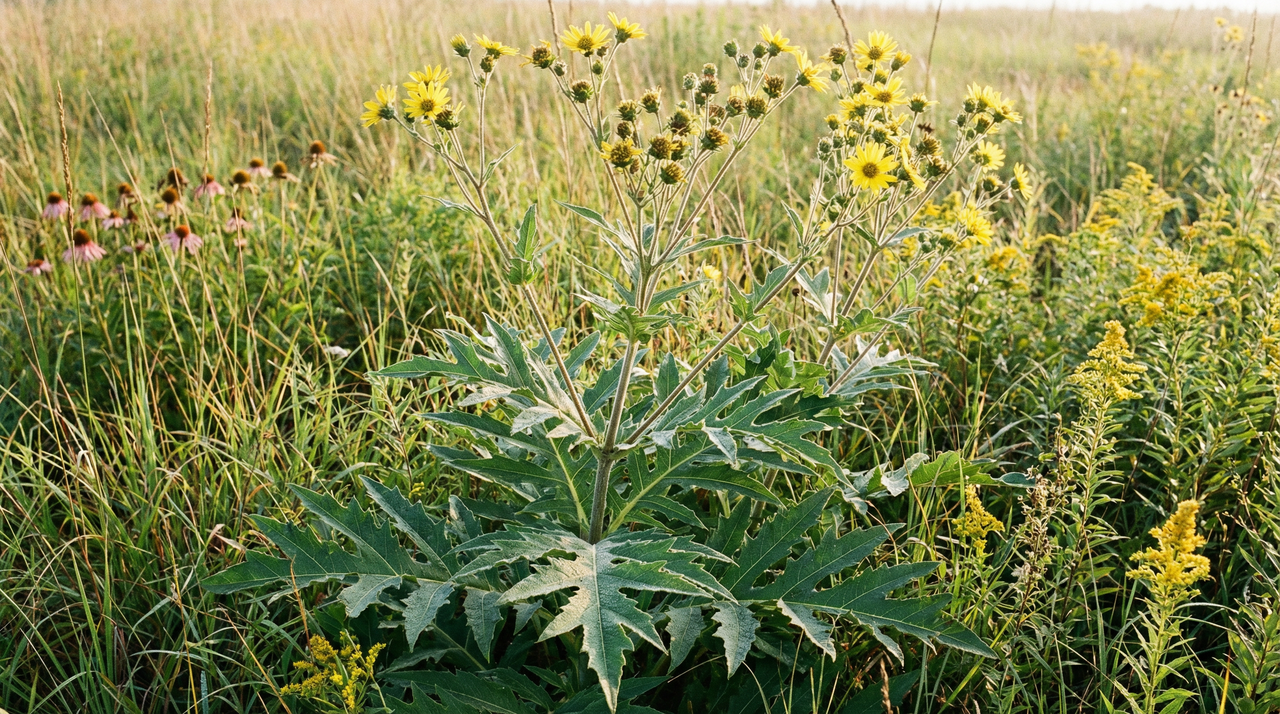
The first time I chewed a piece of rosinweed resin straight from the stem, my instinct was to spit it out. It tasted like turpentine cut with something almost medicinal, sharp and strange, nothing like what you'd expect from a plant with cheerful yellow flowers nodding over a prairie in full August light. But I didn't spit it out, because I'd read enough to know that the Lakota chewed this same resin the way you'd chew gum, and I wanted to understand why. That contradiction, a plant this pungent being genuinely valued as food and medicine across generations, is exactly what makes rosinweed worth knowing.
Most gardeners who've even heard of Silphium laciniatum know it as "the compass plant," the prairie giant whose deeply lobed basal leaves orient themselves on a north-south axis to minimize midday sun exposure.[1] That single adaptation tells you almost everything about how this plant thinks, if a plant can be said to think. It's not here to be convenient. It's here to survive on its own terms, in its own time, on its own schedule. Give it what it needs and it will outlive you in your garden.
Origin and History of Rosinweed (Silphium laciniatum)
Botanical Background and Native Range
Rosinweed, known botanically as Silphium laciniatum and commonly called compass plant, is a tall perennial wildflower in the Asteraceae family native to the tallgrass prairies of central North America.[2][3] Its core range sweeps through the Great Plains states, Kansas, Missouri, Illinois, Nebraska, Iowa, Oklahoma, Texas, and into Minnesota, Ohio, and Kentucky, covering USDA zones 3 through 9.[4][5][6] Think of it as a true child of the prairie, shaped over millennia by wind, fire, drought, and the relentless competition of a grassland ecosystem.
What I find remarkable about this plant's lifecycle is just how unhurried it is. Established specimens live 20 to 30 years or more, spending their first 2 to 3 years investing almost entirely in root development before sending up a flowering stalk.[7][8] After that, it maintains a basal rosette and bolts a new flowering stalk each season without dying back, more like a slow-burning perennial anchor than an annual performer. I'd describe it as a plant that asks for patience upfront and then rewards you for decades.
This plant has no relation to the famous ancient Silphium of Greek and Roman antiquity, a completely different Mediterranean species now considered extinct. Silphium laciniatum is globally secure, rated G5 by NatureServe, though some state-level protections exist and prairie habitat loss means local populations can be vulnerable.[9][2]
Visual Characteristics and Prairie Adaptations
The first thing you notice about a mature rosinweed is its sheer presence. Plants routinely reach 6 to 10 feet tall on stout, rough-hairy stems, with exceptional specimens pushing to 13 feet.[5] The large basal leaves are deeply pinnately lobed and covered in coarse, stiff hairs that give them an unmistakable sandpapery feel. Once you've touched those leaves, there's no forgetting the texture. What's even better is that many of those basal leaves orient themselves on a north-south axis, a phototropic response that minimizes exposure to scorching midday sun and reduces water loss.[10][11] In my experience, this compass orientation becomes most obvious by the plant's third year, when the rosette is large enough to really read the direction clearly. It's a genuinely useful identification clue.
The stems and leaves exude a sticky, aromatic resin that gives the plant its "rosinweed" name, and flowering stalks carry large 2 to 3 inch daisy-like heads with bright yellow ray florets blooming from June through September.[12][13] Below ground, a taproot can descend 6 to 15 feet into the soil, anchoring the plant against prairie winds and accessing moisture that shorter-rooted neighbors can't reach.[2] Within the broader Silphium genus, look-alikes include cup plant (S. perfoliatum), prairie dock (S. terebinthinaceum), and starry rosinweed (S. asteriscus), the latter being a shorter species with less-divided, smoother leaves and a distinctive starry involucre behind its flower heads.[14][15] Young rosettes of all these can fool you, and I've learned to label seedlings carefully and wait for the characteristic deep lobing before feeling confident in an ID.
Traditional and Cultural Uses by Native Peoples
The earliest scientific record of Silphium laciniatum comes from André Michaux's 1803 Flora Boreali-Americana, but Indigenous peoples of the Great Plains had centuries of relationship with this plant long before that.[16] The Lakota, Dakota Sioux, Omaha, Winnebago, Pawnee, and Ponca all used it medicinally. They prepared root decoctions and teas for respiratory ailments like coughs, colds, and sore throats, utilized it as a diuretic, and applied it as poultices for wounds and skin irritations.[17][18][19] The aromatic resin was chewed as gum and applied topically to wounds and insect bites, a use I've seen referenced consistently across multiple ethnobotanical databases. I've collected small amounts of that resin from garden plants myself, and the sticky, turpentine-like quality matches the historical descriptions exactly.
Food uses were more minor: seeds were occasionally roasted or ground into flour, and young leaves were sometimes prepared as pot herbs to reduce their bitterness.[20][21] Harvesting practices emphasized taking only partial roots to allow regeneration, reflecting a relationship with the plant rooted in long-term ecological thinking rather than extraction.[22] When I incorporate compass plant into restoration plantings today, those sustainable harvesting traditions inform how I approach the plant. Propagating from seed rather than digging wild roots isn't just practical; it's how that knowledge deserves to be honored.
Fun Facts and Ecological Significance
The same sticky resin that made this plant medicinally useful also likely deters herbivores and carries antimicrobial properties.[13] As a fire-adapted species, it resprouts vigorously from its root crown after burns, which is exactly the kind of resilience that makes it an anchor species in any prairie restoration planting.[23][24] That taproot also does serious ecological work, continually building and stabilizing the subsurface structure of the ecosystem at scale.[2]
Above ground, the flowers support native bees, bumblebees, butterflies, and beetles through a long summer bloom, and the seed heads feed cardinals, finches, and sparrows well into fall.[25][26] All of this matters urgently because over 90% of original tallgrass prairie has been lost to agriculture, fragmentation, and fire suppression, leaving compass plant populations stable only in protected remnants and declining nearly everywhere else.[9][5] In my restoration-style plantings, it's one of the first species I reach for precisely because its deep history, physical toughness, and ecological generosity are all the same thing.
Rosinweed Varieties and Sourcing
Natural Botanical Varieties and Lack of Commercial Cultivars
The common name "rosinweed" gets applied loosely across several Silphium species, but it more specifically refers to Silphium integrifolium, while the plant we're profiling here, Silphium laciniatum, is more precisely the Compass Plant, sometimes called Kansas Rosinweed in certain regional contexts.[5] I've seen this blur in seed catalogs and even on nursery tags, so it's worth knowing before you order. The species does have two natural botanical varieties, Silphium laciniatum var. laciniatum and var. heterophyllum, but these aren't horticultural selections in any commercial sense.[27][28]
There are no named cultivars available to home gardeners, and honestly, I've come to see that as a feature rather than a gap. Every pollinator garden and prairie restoration I've specified this plant for has relied entirely on wild-type material, and in my experience those genetics outperform selections the same way wild-strain Echinacea tends to outlast the cultivated color forms over the long haul.[27] Breeding research for pest resistance, including lines showing reduced aphid and leaf beetle pressure, is happening in bioenergy crop trials,[29][30] but none of that has reached the nursery trade yet. For now, the rugged prairie genetics are what you want.
Where to Buy Authentic Rosinweed Plants and Seeds
Skip the big-box garden center for this one. I once received a plant labeled "rosinweed" that turned out to be a different Silphium species entirely, which taught me to always confirm the scientific name before paying. Reputable native plant specialists like Prairie Moon Nursery, Roundstone Native Seed Company, Ion Exchange, and Native American Seed carry verified material, and their sourcing matters enormously if you're contributing to a restoration planting rather than just filling a border. Seed packets typically run $3 to $8 for 50 to 100 seeds (Prairie Moon is around $4 per 100-seed packet), and live plants generally fall between $10 and $25 depending on container size (Ion Exchange lists 1-gallon pots around $12). Shipping is generally unrestricted within the US since this species isn't invasive, though it's always worth a quick check on your state's rules. Choosing a specialist nursery isn't just about quality; it's how you participate in prairie restoration rather than undermine it.
Rosinweed Propagation and Planting Guide (Silphium laciniatum)
Rosinweed is a plant that will humble you if you treat it like a typical garden perennial. It evolved on the tallgrass prairie, where hard winters, fire, and deep drought shaped every aspect of its biology. Work with that evolutionary history and you'll establish a plant that outlives your garden plans. Ignore it and you'll wonder why your germination rate was 10% and your transplants keep dying.
Understanding Rosinweed Seeds: Morphology, Dormancy, and Germination
Silphium laciniatum seeds are orthodox achenes, the same basic structure you'd find across the daisy family: a single embryo, plenty of endosperm, a thin seed coat, and those characteristic pale bristles that catch the wind.[31][2] The achenes themselves are small, 5 to 8 mm long, dark brown to nearly black with faint ridges. They look inconspicuous, but what's happening inside is the real story: physiological dormancy that absolutely requires cold moist stratification, typically 30 to 90 days at 34 to 41°F, to break.[32][33] Skip that step and you're looking at 10 to 20% germination on a good day. Add a light scarification before stratifying and you can push germination rates to 70 to 80%, sometimes higher with fresh seed under ideal conditions.[34]
Seed is the most ecologically sound propagation method and the one I rely on most. Fall sowing is the low-effort approach: put silphium laciniatum seeds in the ground after the first hard frost and let winter do the stratification work for you.[35] For spring sowing, pre-stratify in damp sand or vermiculite in your refrigerator for at least 60 days, then sow at 65 to 75°F once the ground can be worked.[33] I label my flats meticulously because first-year rosettes are remarkably easy to mistake for other prairie seedlings during weeding. I've flagged whole rows before just to save myself that headache.
If you need vegetative options, root division of dormant established clumps in spring or fall succeeds 70 to 90% of the time, and root cuttings taken in late fall or early spring can work with IBA rooting hormone at 1,000 to 3,000 ppm.[36][37] Stem cuttings and layering have essentially no track record with this species. For restoration projects, I'd also note that the open-pollinated seedlings you raise will show 10 to 20% variation in height, bloom time, and vigor, which I actually welcome.[38] That spread extends the flowering window for pollinators in a guild rather than compressing everything into one week.
Soil, Site Selection, and Planting Techniques for Success
Full sun is non-negotiable. Rosinweed wants 6 to 8 or more hours of direct light daily, and seedlings are especially unforgiving about this.[39] I've had clients try to tuck it into a bed that gets partial afternoon shade, and the difference compared to a fully open planting is immediate and dramatic: leggy stems, sparse flowers, lackluster growth overall.[40] Think of the open prairie and give it that kind of exposure.
The taproot tells you everything you need to know about drainage and soil depth. That root can reach 5 to 15 feet down, so it needs soil that will let it go: deep, well-drained loam, sandy loam, or clay loam, ideally at least 24 to 36 inches of uncompacted growing medium.[2][41] A pH between 6.0 and 7.5 is ideal; soggy or waterlogged conditions will cause root rot, full stop.[5] I've amended heavy clay beds with coarse sand and perlite before planting and never regretted it. If you see bronze or purple foliage, stunting, or blackened roots early on, suspect waterlogging or compaction before you blame anything else.[42] Consistent moisture matters during the first year or two while the taproot establishes, after which the plant's drought tolerance kicks in substantially.[43]
Spacing, Timelines, and Long-Term Establishment
Sow rosinweed seeds at 1/4 inch deep, no deeper, into soil prepared to at least 12 to 18 inches.[12] For garden or pollinator plantings, space 24 to 36 inches apart to accommodate the mature spread of 3 to 6 feet and keep air circulating. Prairie restoration projects typically use 1 to 2 feet within rows and 2 to 3 feet between rows, which works out to roughly 2,000 to 4,000 plants per acre.[44] Don't shortchange the spacing thinking you'll thin later; these plants resent root disturbance even as young seedlings, and moving established specimens is a genuine risk to survival given that taproot depth.[7] I made that mistake with nursery plugs in my second year of working with this species, trying to reposition a few plants after their first growing season. I lost most of them. Now I direct-sow into final position or use very deep pots that go straight into the ground without disturbing the root.
Seed Storage, Viability, and Sourcing Considerations
Set honest expectations before the seed even goes in the ground. First-year seedlings typically spend 1 to 2 years as a basal rosette before bolting, and meaningful seed production usually doesn't happen until year 2 to 4 from sowing.[45][32] That slow start tests patience, but the long-term payoff is a resilient, multigenerational anchor once its taproot is fully established.[33] The first two years are the commitment test; after that, you have something nearly indestructible.
For anyone saving their own seed, the storage protocol is straightforward and very rewarding over time. Dry harvested achenes down to 3 to 10% moisture, clean them by winnowing, and store in airtight containers with desiccant packets.[46] Refrigerator temperatures (4 to 10°C) will keep them viable for 1 to 5 years; a freezer at -18 to -20°C extends that to 5 to 10 or more years.[34][47] Fresh seed viability runs 80 to 90%; well-stored seed holds above 70%. I dry my harvested achenes until they snap rather than bend, then tuck them in the fridge with silica packets. Five-year-old stock still germinates at 70-plus percent when I stratify correctly, which has let me build up enough supply for larger restoration installs without sourcing new seed every season.
Rosinweed Plant Care and Growing Guide
If you understand one thing about caring for rosinweed, it's this: most of what it needs, the tallgrass prairie already figured out. Your job is mostly to stay out of the way.
Sunlight Requirements
Full sun is non-negotiable. At least 6-8 hours of direct sun daily is what this plant evolved under, and shortchanging it on light leads to reduced vigor and noticeably fewer flowers.[12][48] I've grown a lot of prairie forbs, and the pattern is consistent: shade doesn't just slow them down, it changes their whole character. A compass plant in too much shade gets that stretched, pale look, and you lose the tight basal rosette that makes it so architecturally interesting. One useful thing about Silphium laciniatum specifically is that you can use the leaves as a diagnostic: those famously vertical, north-south oriented leaves stay upright and turgid in full sun. When they start flopping or losing that orientation, the plant is telling you something. It prefers drier continental conditions rather than humid coastal climates, though it handles moderate humidity tolerably well.[49]
Water Needs and Drought Tolerance
Rosinweed's relationship with water comes in two distinct phases, and getting through the first one is everything. The plant needs well-drained, loamy or sandy soil and won't tolerate waterlogged conditions; aim for a pH in the 6.0-7.5 range.[39][50][51] During the first year or two, water to about an inch per week with deep, infrequent sessions every one to two weeks rather than frequent shallow sprinkles.[39][50][52] You're not watering the plant so much as you're coaxing that taproot downward. I've watched that process over multiple grow-outs: the first season, top growth is almost disappointingly slow, and that's because the plant is investing almost entirely underground. By the second or third year, when the basal rosette starts spreading in earnest, you know the taproot has committed.
Once that taproot reaches depth (it can extend 10-15 feet or more), the plant can go 4-6 weeks without supplemental irrigation in most climates.[53][54] The main threat in the meantime is overwatering; root rot is the most reliable way to lose a young plant, and soggy soil during establishment is far more dangerous than dry spells.[39]
Soil and Feeding
Here's where I see the most well-intentioned mistakes. Rosinweed is native to low-fertility prairie soils, and it's genuinely adapted to them -- it mines phosphorus and nitrogen efficiently enough to thrive where most garden perennials would struggle.[2][55] Excess nitrogen causes weak, floppy stems, reduced flowering, and increased pest pressure, and it gives weedy competitors a leg up over the native species you're trying to establish.[56][57] I made exactly this mistake early on: applied a generous compost top-dressing to a young planting, thinking I was being helpful, and the following season I had tall, soft stems that needed staking. The plants looked lush and produced almost nothing worth staking them for.
Get a soil test before you do anything.[56] In my experience with native-soil restoration plantings, the soil rarely needs amendment at all. If yours tests genuinely poor, a small amount of compost worked in at planting can improve structure, and a half-rate balanced slow-release fertilizer in year one is acceptable for very depleted soils only.[58][59] After establishment, skip it. If you notice uniform yellowing on older leaves, that's nitrogen deficiency; dark green or purplish foliage suggests phosphorus; interveinal chlorosis on young leaves points to iron.[60] Those signals are rare in well-sited plants, but useful to know.
Heat Tolerance
Silphium laciniatum handles summer heat remarkably well, thriving in USDA Zones 3-9 and tolerating summer highs above 100°F.[58][2] The mechanisms are elegant: that deep taproot accesses groundwater far below the roasting surface layer, the vertically oriented leaves minimize direct sun exposure during peak hours, and thick cuticles with sunken stomata reduce water loss.[2][61] I find the leaf behavior genuinely useful in the garden: when the leaves are tracking properly vertical and oriented north-south, the plant is content. During extreme heat waves, some midday wilt and temporary growth pause are normal stress responses rather than emergencies.[62] A 2-3 inch organic mulch layer around the base helps moderate soil temperature during the worst of summer.[12][63]
Frost Tolerance and Hardiness
Cold hardiness is one of rosinweed's genuine strengths. Established plants survive temperatures down to -40°F and carry an RHS H7 rating for full winter hardiness.[49][58][64] The nuance is that young plants and newly emerging spring growth are more vulnerable: late frost can cause wilting, discoloration, or tip necrosis on buds.[65][66] I still mulch first-year transplants through their first winter and have seen reliable recovery even after a late-spring frost nips emerging growth. The key is patience: wait until new growth appears before cutting back any frost-damaged material, and avoid working on cold, saturated soil where frost heave is a risk.[67] Flowering happens June through September, well clear of typical frost windows.[67]
Pruning, Maintenance, and Seasonal Rhythm
Once established, rosinweed demands very little. Cut back dead foliage and stems to the ground either in late fall after the first frost or in early spring before new growth emerges -- both work.[53] I lean toward leaving the stems through winter: the seed heads feed birds, the structure adds presence to the dormant garden, and it aligns with the plant's natural prairie cycle. Deadheading generally isn't recommended for the same reason.[53] Staking is rarely needed given the plant's sturdy architecture, though very exposed or windy sites might warrant it for particularly tall stems.[7][68]
The one place intervention really matters is weed control during the first one to two years, before the expanding basal rosette starts shading out competitors.[7] After that, apply 2-4 inches of shredded leaves or straw around the base once the ground freezes in fall, then pull it back gradually in spring.[69][70] That two-year patience window, from small rosette to flowering stalk, is the whole game with this plant. Once you're past it, rosinweed largely runs its own seasonal rhythm without asking much of you at all.
Harvesting Rosinweed (Silphium laciniatum)
Patience is the first tool you need. Rosinweed takes 2-4 years from seed to produce its first meaningful harvest,[43][71] and I learned that the hard way. After waiting three full growing seasons for a substantial seed set, I now mark every planting with a permanent label, because by late summer the tall stalks blend in with other Silphium until you crush a leaf and get that unmistakable resinous hit.
Timing and Visual Cues for Seed and Leaf Harvest
The harvest calendar actually runs twice. Spring is for young leaves, shoots, and flower buds while they're still tender and before the resinous bite fully develops.[2][8] Seed harvest is a different season entirely. Flowering runs July through September, and seeds need roughly 45-60 days from bloom to maturity, putting the seed harvest window firmly in August through October.[2][72][71] You want heads that have drooped, browned fully, and carry seeds that are hard, dark, and dry to the touch.[2][8]
Don't wait too long, though. Goldfinches have beaten me to ripe heads within days of the first brown color appearing, which has trained me to check my patches every single day once mid-August arrives. Sustainable practice means leaving 20-30% of seeds for wildlife and natural regeneration anyway,[73] so consider the birds your co-harvesters rather than competition.
Harvest Techniques and Post-Harvest Handling
Collect seed heads on dry mornings when both the plant and the heads are fully dry, which keeps mold risk low and viability high.[2][73] The resinous smell intensifies noticeably when you're handling mature heads, which I take as confirmation I've got the right plant. For taproots, careful digging in fall or spring is possible for propagation purposes, but minimize soil disturbance and only lift roots from established plants that have already set seed.[2][73] Honestly, I only ever touch roots when dividing an overcrowded clump for propagation; that feels like the only justification for disturbing a root system this impressive.
Post-harvest handling is simple prairie-seed practice: spread heads to dry further at room temperature, clean out the chaff, and store in cool, dry conditions.[43][74] No fuss required.
Expected Yields and Flavor Profile
On a production scale, seed yields land around 200-500 kg/ha and vegetative biomass can reach 10-15 tons/ha under favorable conditions,[43][71] which is exactly why sustainable agriculture researchers keep circling back to it. Those numbers come from the same deep-root chemistry responsible for the flavor.
Young spring leaves carry a bitter, resinous taste with pine-sap or turpentine-like notes that match the plant's pungent aroma perfectly.[75][76][77] It reminds me of a milder version of the camphor note you get when bruising a eucalyptus leaf, but it softens dramatically after a quick blanch. Some palates find it off-putting; others find it compelling in small amounts. Either way, harvest young spring material sparingly, and check the plant's protected status in your region before foraging in the wild. The preparation details are worth treating as their own conversation.
Rosinweed Preparation and Uses
The first thing you notice when you crush a young rosinweed leaf between your fingers is the smell. It's resinous, sharp, almost turpentine-adjacent, and it immediately tells you this isn't a neutral green you can toss into a salad without thinking. That scent is also the plant's defining culinary character, and learning to work with it rather than against it is the whole game.
Culinary Uses of Rosinweed: From Prairie Foraging to Modern Kitchens
The most approachable entry point is the young spring growth. Tender stalks and pith harvested before the plant hits full height have a mild, celery-like quality that's genuinely pleasant raw,[2][78] and early leaves can go into salads or be cooked down like spinach before the resin concentration climbs with age.[2][78][79] Shoots pulled in early spring before flowering can be prepared like asparagus, and flower buds collected just before they open cook up similarly to artichokes.[1] Native American tribes used all of these parts as food,[78] and boiling or steaming was the primary method for pulling the bitterness back to something manageable.[80] I've found that a quick blanch in well-salted water followed by a sauté in butter does the same work more efficiently, transforming the turpentine edge into something pleasantly artichoke-like.
Young roots are starchy with a parsnip-like texture, and they've been roasted, boiled, dried and ground into flour, or even roasted as a coffee substitute.[2][78][79] The resin itself was chewed as a kind of gum.[2] Seeds can be roasted, ground into meal after hulling, or pressed for oil, though yields are low enough to make them impractical for anything beyond occasional use.[79] Honestly, rosinweed is not finding its way onto restaurant menus anytime soon.[80] Its culinary story lives primarily in the ethnobotanical record, and I think that's the right frame. Small, sustainable, respectful harvesting from established plants in restored prairies is how to approach this, not as a kitchen staple. Consult the dedicated safety section before experimenting.
Non-Food Uses: Fiber, Dye, and Industrial Potential
Beyond the table, rosinweed has a material culture that's easy to overlook. The stems yield strong fiber suitable for cordage and weaving, while roots produce natural dyes in warm yellow and brown shades, both documented traditional uses by indigenous peoples with genuine potential for modern sustainable craft work.[81] I've experimented with comparable prairie plant fibers for garden ties and small weaving projects, and the strength-to-weight ratio is consistently better than you'd expect from a herbaceous stem. The root dyes pair beautifully with goldenrod yellows and coneflower browns in natural dyeing work. The seed oil is rich in unsaturated fats and has been identified as a candidate for biofuel production and cosmetic applications, though commercial development hasn't materialized at scale yet.[81] When I design with rosinweed in prairie guilds, that full picture of yields, food, fiber, dye, and potential fuel feedstock, is exactly the kind of multi-function stacking that makes a single species earn its square footage twenty times over.
Rosinweed Health Benefits and Medicinal Uses
Rosinweed doesn't have a flashy clinical dossier the way some medicinal herbs do. What it has is something I find more compelling: a long, specific record of human use across multiple cultures who knew this prairie giant intimately. That history deserves honest engagement rather than either uncritical enthusiasm or dismissal.
Traditional Native American Uses of Rosinweed
Several tribal nations of the Great Plains developed distinct medicinal traditions around Silphium laciniatum, including the Cherokee, Osage, Lakota, Dakota, and Omaha.[82][83] Root teas and decoctions were the go-to preparation for respiratory complaints: colds, coughs, sore throats.[84][85] Healers also used the plant as a diuretic and for digestive complaints, while topical poultices were applied to wounds, sores, and insect bites.[82][86] Fever and skin ailments rounded out the traditional applications, with the plant regarded as both anti-inflammatory and diaphoretic.[58][87]
What strikes me about this record is its consistency across geographically distinct groups. Respiratory uses keep appearing, which suggests people were observing something real. Modern pharmacological studies remain limited to in-vitro and animal models, and no clinical trials exist; the FDA has not approved this plant for any medicinal use.[88][89] I treat this the way I treat most under-studied native plants: respectful acknowledgment of traditional knowledge, genuine curiosity about the chemistry, and a preference for keeping rosinweed in my landscape design rather than in my medicine cabinet until the research catches up.
Phytochemical Profile and Preliminary Research
The chemistry is where things get genuinely interesting. Phytochemical analysis has identified a rich array of bioactive compounds: flavonoids including quercetin and kaempferol glycosides, phenolic acids such as chlorogenic and caffeic acid, sesquiterpene lactones (costunolide, dehydrocostus lactone, silphilenolides), and an essential oil dominated by germacrene D (20-30%) and β-caryophyllene (15-25%).[90][91][92] Total phenolics in leaves run around 50-70 mg GAE/g, with chlorogenic acid reaching up to 20 mg/g and flavonoids at 15-25 mg/g.[90][92] Those are respectable numbers.
In-vitro antioxidant activity comes in at IC50 values of 20-50 µg/mL in DPPH assays, driven by those phenolic concentrations.[93][88] The sesquiterpene lactones appear to be the primary anti-inflammatory agents, inhibiting pro-inflammatory cytokines, COX-2, and nitric oxide production in lab models.[94][95] Essential oils and methanolic extracts also show antimicrobial activity against Staphylococcus aureus (MIC 0.5-2 mg/mL) and some effect against E. coli and Candida albicans.[88][96] Preliminary cytotoxic activity against some cancer cell lines has been noted as well, again attributed to sesquiterpene lactones.[97] None of this is clinical evidence; all of it is promising.
One nuance worth knowing: these compound levels shift significantly with environment. Sesquiterpene lactone content tends to run higher in nutrient-poor soils, while acidic conditions promote phenolic accumulation, and phenolics peak during flowering.[98][99] I've noticed that the resinous aroma on my mid-summer plants is noticeably stronger than on spring growth, which tracks with this. A garden-grown plant in amended soil may have a meaningfully different profile than a wild Kansas prairie individual.
Nutritional Value of Rosinweed
Nutrition is a minor chapter in the rosinweed story, not the main one. Young leaves and shoots are edible, offering a bitter, spinach-adjacent flavor alongside modest calories (roughly 20-30 kcal per 100 g fresh weight), 1-2 g protein, 3-5 g fiber, and vitamins A and C with calcium and iron typical of wild prairie greens.[79][100][101] Roots contain substantial inulin (a prebiotic fiber), though they're rarely eaten in any quantity. Some tribes historically turned to rosinweed as a famine food,[78][102] which contextualizes its value accurately: nutritious enough to matter in a lean season, but intensely bitter enough that it was never a preferred staple. I've tried blanching young leaves briefly and pairing them with strong flavors like garlic and vinegar, which helps considerably.
Safety Considerations for Rosinweed
Rosinweed is generally considered non-toxic for casual handling, with no widespread reports of serious human poisoning.[58][2] Excessive ingestion may bring on mild gastrointestinal upset from the sesquiterpene lactones and saponins, but that's a far cry from acute toxicity. The more practical concern is skin irritation: the sesquiterpene lactones and resinous sap can cause allergic contact dermatitis in sensitive individuals, and Asteraceae pollen is a known allergen for some people.[103][104][105] I learned this personally: a pruning session without gloves left my forearms itchy and red for two days. Now I treat it like I'd treat echinacea or any other sesquiterpene-rich Asteraceae, gloves on, patch test before any topical use.
Livestock seem unbothered under normal grazing conditions, and the plant was historically used as a horse tonic.[106][2] Anyone foraging should be confident in their identification, practice sustainable harvest, and seek expert guidance before consuming significant quantities; cooking reduces bitterness but modern safety data remains thin, and this is simply not a cultivated food crop with an established safety record.[107][108] My honest approach with rosinweed is to grow it for ecology and observe it with curiosity, letting the researchers do the clinical work before I start recommending it as anything more than a remarkable prairie native with a fascinating history.
Rosinweed Pests and Diseases
One of the things I appreciate most about designing with rosinweed is how rarely I have to think about problems after it's established. This is a plant shaped by millions of years of prairie pressure, and that history shows. Its defenses aren't subtle.
Natural Resistance and Common Pests of Rosinweed
In native prairie habitats, rosinweed shows genuinely high pest resistance, and even in managed garden settings with good care, insect damage typically stays below 5% yield loss.[109][110] That's not an accident. The leaves are covered in dense, sticky trichomes that make navigation genuinely difficult for soft-bodied insects, and the latex running through the plant contains sesquiterpene lactones and polyacetylenes that repel or toxify many would-be herbivores. When chewing begins, the plant ramps up phenolic and flavonoid production as a secondary response.[111][112] In my experience designing native plantings, those resinous leaves also deter deer more reliably than almost anything else I've used at a similar scale. The scent when you brush against it is distinctive, and deer seem to agree that it's unpleasant.
Occasional visitors include aphids (particularly Myzus persicae and Macrosiphum spp.), leaf beetles in the family Chrysomelidae, grasshoppers, and caterpillars.[113] The silphium borer moth is another to keep an eye on in some regions. None of these are reliably damaging on a well-sited plant. I've watched aphid populations flare and collapse within a single season without any intervention, partly because I build companion guilds that attract ladybugs and other beneficials alongside my rosinweed plantings. When something does take hold, insecticidal soap, neem oil, or hand-picking covers most situations. Routine chemical use isn't warranted, as healthy native prairie guilds heavily self-regulate and organically stabilize secondary pest populations.[114] If herbivory does occur, rosinweed tolerates it well, compensating through rapid regrowth rather than declining.[115]
Fungal Diseases Affecting Rosinweed and Prevention Strategies
USDA PLANTS data rates rosinweed with low overall disease susceptibility in dry prairie conditions, though that picture changes when you move it into humid environments with crowded plantings and poor air movement.[2][114] The primary fungal threats are leaf spots from Septoria silphii, Cercospora, and Alternaria (brown or black spots with yellow halos), rust from Puccinia silphii appearing as orange pustules in cool moist conditions, and powdery mildew from Erysiphe cichoracearum showing as white patches starting on older leaves.[116][117] Root rot and crown gall can appear too, but almost exclusively where drainage is poor and soils stay waterlogged.[118] Bacterial and viral problems are largely a non-issue for this species.[119]
Prevention is the entire story here. I've found that going wider than the standard spacing recommendation dramatically cuts mildew pressure, especially during humid summers. Good preventive garden hygiene, removing infected debris, avoiding overhead irrigation, and skipping high-nitrogen fertilizers all reduce pressure significantly.[58][120] In my own designs I avoid routine fungicides entirely with this species; cultural prevention and healthy soil biology keep disease at bay far more sustainably. Chlorothalonil or sulfur-based products exist as a last resort for truly severe cases, but I've never reached for them. There are currently no named cultivars bred for enhanced disease resistance, though breeding programs at The Land Institute are actively selecting disease-tolerant genotypes for perennial agriculture and restoration applications.[121] That work genuinely excites me as someone who'd love to see even more resilient material available for regenerative systems in the coming years.
Rosinweed in Permaculture Design
If there's one plant I reach for when someone asks me to rebuild an open, sunny landscape from the ground up, rosinweed is near the top of the list. Not because it's flashy in a catalog way, but because it does the slow, structural work that prairie ecosystems depend on. This is a plant that earns its place over years, not weeks, and understanding where it belongs in a designed system starts with knowing what it evolved to do.
Climate Adaptability and Hardiness Zones
Rosinweed is genuinely cold-hardy, rated reliably across USDA zones 4-9, with some sources extending that to zone 3 where minimum temperatures can plunge to around -40°F.[65][33] Its native range spans the tallgrass prairie belt from North Dakota and Illinois down to Texas and Kansas, where annual precipitation runs between 25 and 40 inches and conditions range from humid continental summers to the fringes of humid subtropical.[69][122] It thrives in mesic to dry conditions and, once that deep taproot is established, handles drought impressively well.
That said, placement matters at the warm end of its range. In zone 9 conditions, I've seen the large, deeply lobed leaves develop scorch during heat events above 95°F, especially when soil moisture is inconsistent.[5] For subtropical-edge plantings, extra mulch through summer establishment goes a long way. What it will not tolerate under any conditions is shade or waterlogged soil; full sun and good drainage are non-negotiable for this plant to perform.[27]
Ecosystem Functions and Guild Roles
Rosinweed's ecological resume in a permaculture system is long. Start with that taproot, which on a mature specimen can reach 10 to 15 feet into the soil profile.[2] I've dug around the base of established plants and the root system is genuinely humbling compared to something like echinacea or rudbeckia, which stay relatively shallow. That depth means it's pulling calcium, magnesium, and potassium up from subsoil layers that neighboring plants can't reach, then cycling those minerals back into the system through leaf litter.[123] It's a dynamic accumulator, not a nitrogen fixer, so pairing it with legumes like baptisia makes a good complementary combination. The root mass also breaks up compaction, improves water infiltration, stabilizes slopes, and sequesters meaningful carbon over its long lifespan. Prairie restoration sites use it specifically for these soil-rebuilding qualities.[124]
Then there's the pollinator story, which is where rosinweed really distinguishes itself in a summer guild. The bloom runs six weeks from roughly late June through August, peaking in July, with three-inch flower heads loaded with nectar and pollen.[125][126] More than 70% of visits come from native bees, including bumblebees and solitary species like Megachile and Andrena; monarchs, skippers, and butterflies work it steadily too.[127] One drought year I watched bee activity on my rosinweed planting drop off sharply mid-season, and the seed set was noticeably thin. That's because the plant is self-incompatible and depends entirely on cross-pollination to reproduce; drought alone can suppress flowering by up to 50%.[128][129] Since then, I've shifted toward mass plantings rather than isolated specimens, which buffers against those pollination mismatches and makes the colony much more resilient. Goldfinches and small mammals work the seed heads through fall, so the wildlife value extends well past bloom.[2]
Placement in Forest Gardens and Companion Guilds
Rosinweed is strictly a full-sun species and not a forest garden plant. It occupies the tall herbaceous layer in open systems, reaching anywhere from 3 feet to a towering 8 or 10 feet in a good season, and it will decline in a closed canopy.[130][2] In agroforestry contexts, it can work along well-lit south-facing edges or wide alleys between tree rows, but put it under a canopy and you'll watch it slowly give up. Its design home is sunny prairie-style polycultures and grassland restoration beds.
In those settings, it's an excellent pioneer. The deep roots and drought tolerance help it establish on degraded ground where other plants struggle, and it improves conditions for whatever comes after it.[123] In my prairie-style beds, I pair it with little bluestem, big bluestem, and Indiangrass for structural layering, then weave in coneflowers and baptisia for bloom succession and nitrogen contribution.[27][131] Rosinweed adds real height and can be assertive in its competition for light and water once it's well established,[132] but it's clump-forming and non-invasive, so it won't steamroll its companions.[27] Give it room, give it sun, and it will reward you with decades of soil building, pollinator support, and the kind of low-maintenance reliability that only comes from planting something exactly where it belongs.
The Plant That Taught Me to Stop Rushing the Prairie
I almost pulled my first compass plant in year two, convinced I'd gotten bad seed. Nothing but a flat rosette, no drama, no flowers, just those deeply cut leaves orienting themselves north like they'd been doing it for centuries before I showed up. I'm glad I left it alone. Four years later it bloomed taller than my head, and I understood, finally, that some plants aren't slow; they're just on a different schedule than impatience allows for.
Sources 132
- USDA Forest Service: Silphium laciniatum ↩
- USDA PLANTS Database - Silphium laciniatum ↩
- Silphium laciniatum - Wikipedia ↩
- Silphium laciniatum ↩
- Silphium laciniatum ↩
- Silphium laciniatum L. ↩
- Silphium laciniatum (Compass Plant) | North Carolina Extension Gardener Plant Toolbox ↩
- Silphium laciniatum (Compass Plant) ↩
- Silphium laciniatum ↩
- The Compass Plant: Nature's Prairie Compass ↩
- Phototropism in Silphium laciniatum ↩
- Silphium laciniatum ↩
- Compass Plant (Silphium laciniatum) ↩
- Flora of North America: Silphium ↩
- Silphium asteriscus - Missouri Botanical Garden ↩
- Native American Ethnobotany ↩
- Ethnobotany of the Lakota ↩
- Ethnobotany of the Omaha and Ponca Tribes ↩
- Silphium laciniatum - Native American Ethnobotany Database ↩
- Ethnobotany of the Omaha Indians ↩
- Medicinal Plants of the Prairie ↩
- Ethnobotany of the Prairie: Native American Uses of Plants in the Great Plains ↩
- Fire Ecology of Tallgrass Prairie Plants ↩
- Fire Ecology of Tallgrass Prairie Species ↩
- Silphium laciniatum ↩
- Silphium laciniatum ↩
- Lady Bird Johnson Wildflower Center - Silphium laciniatum ↩
- Kansas Native Plant Society - Rosinweed Information ↩
- Silphium laciniatum as a Model Perennial Bioenergy Crop ↩
- Breeding for Insect Resistance in Silphium laciniatum ↩
- Flora of North America: Silphium laciniatum ↩
- Propagation Protocol for Silphium laciniatum ↩
- Plant Guide: Compassplant ↩
- Germination and Viability of Prairie Forbs ↩
- Propagation of Prairie Plants ↩
- Vegetative Propagation Techniques for Prairie Plants ↩
- Propagation of Native Perennials: Silphium Species ↩
- Genetic Diversity and Population Structure of Silphium laciniatum ↩
- Silphium laciniatum (Compass Plant) Profile ↩
- Growing Prairie Plants: Silphium Species ↩
- Root Systems of Tallgrass Prairie Plants ↩
- Missouri Botanical Garden - Silphium laciniatum ↩
- Silphium laciniatum: A Prairie Plant for Sustainable Agriculture ↩
- Native Plant Spacing for Prairie Restoration ↩
- Missouri Botanical Garden Plant Finder - Silphium laciniatum Overview ↩
- Seed Storage of Native Prairie Plants ↩
- Manual of Seed Handling and Storage ↩
- Compass Plant (Silphium laciniatum) ↩
- University of Wisconsin Extension - Prairie Plants ↩
- Compassplant (Silphium laciniatum) - USDA PLANTS Database ↩
- Silphium laciniatum - Royal Horticultural Society ↩
- Silphium laciniatum Care Guide - Kew Gardens ↩
- Silphium laciniatum - Missouri Botanical Garden ↩
- Compassplant (Silphium laciniatum) - USDA PLANTS Database ↩
- Silphium laciniatum L. ↩
- Fertilization of Native Prairie Plants ↩
- Fertilization Strategies for Silphium in Bioenergy and Restoration ↩
- Silphium laciniatum (Compass Plant) ↩
- Nutrient Requirements of Prairie Perennials ↩
- Identifying Nutrient Deficiencies in Ornamental Plants ↩
- Ecological Adaptations of Prairie Perennials to Drought and Heat ↩
- Plant Finder - Silphium laciniatum ↩
- Native Plants for Kansas Landscapes ↩
- Royal Horticultural Society - Plant Finder ↩
- Missouri Botanical Garden Plant Finder: Silphium laciniatum ↩
- Frost Damage in Native Prairie Plants - Kansas State University Extension ↩
- Lady Bird Johnson Wildflower Center - Silphium laciniatum ↩
- Plant Finder: Silphium laciniatum ↩
- Silphium laciniatum (Compass Plant) ↩
- Overwintering Native Perennials in the Midwest ↩
- Cultivation Guide for Native Perennials: Compass Plant ↩
- Compass Plant (Silphium laciniatum) ↩
- Silphium laciniatum (Compass Plant) Care and Harvesting ↩
- Harvest and Post-Harvest Techniques for Prairie Seeds ↩
- Aroma and Culinary Potential of North American Silphium Species ↩
- Edible Native Plants of the Midwest ↩
- Silphium laciniatum: Edible Wild Plants of the Prairie ↩
- Native American Ethnobotany: A Database of Foods, Drugs, Dyes and Fibers of North American Peoples ↩
- Edible Wild Plants of the Prairie ↩
- Silphium laciniatum ↩
- Ethnobotany of the Prairie Sunflowers (Helianthus spp.) and Relatives ↩
- Native American Ethnobotany: A Database of Plants Used as Drugs, Foods, Dyes, and Fibers by Native Peoples of North America ↩
- Ethnobotany of the Great Plains ↩
- Medicinal Plants of the Prairie: Silphium laciniatum Uses ↩
- Cherokee Medicinal Plants and Their Uses ↩
- Medicinal Plants of North America ↩
- Essential Oils and Allergens from Asteraceae Family ↩
- Phytochemical Screening and Antimicrobial Activity of Silphium laciniatum ↩
- Pharmacological Potential of Silphium Species ↩
- Phytochemical Profile and Antioxidant Activity of Silphium laciniatum L. ↩
- Secondary Metabolites of Silphium Species: Sesquiterpene Lactones and Phenolics ↩
- Flavonoids and Phenolic Compounds in Prairie Plants: Silphium laciniatum ↩
- Antioxidant and Anti-inflammatory Activities of Silphium laciniatum L. ↩
- Anti-Inflammatory Sesquiterpene Lactones from Silphium laciniatum ↩
- Anti-inflammatory Properties of Asteraceae Species: Focus on Silphium laciniatum ↩
- Antimicrobial Properties of Essential Oils from Silphium Species ↩
- Bioactive Compounds in North American Asteraceae ↩
- Chemical Variation in Silphium laciniatum: Influence of Environment and Genetics ↩
- Effects of Soil and Cultivation on Bioactive Compounds in Silphium laciniatum ↩
- Ethnobotany of Silphium Species - Native American Uses ↩
- Nutritional Potential of Silphium Species ↩
- Missouri Botanical Garden Plant Finder ↩
- Toxicity of Sesquiterpene Lactones in Silphium Species ↩
- Allergic Contact Dermatitis to Compositae ↩
- Missouri Botanical Garden Plant Finder - Silphium laciniatum ↩
- Toxicity of Native Prairie Plants ↩
- PFAF - Silphium laciniatum (Known Hazards) ↩
- Sesquiterpene lactones: adverse health effects and toxicity mechanisms ↩
- Missouri Botanical Garden Plant Finder - Silphium laciniatum ↩
- USDA NRCS Plant Guide: Silphium laciniatum ↩
- Chemical and Physical Plant Defenses in the Prairie Plant Silphium laciniatum ↩
- Latex as a Plant Defense Mechanism ↩
- Insect Pests of Prairie Plants - University of Wisconsin Extension ↩
- Integrated Pest Management for Prairie Plants - Kansas State University Extension ↩
- Herbivory and Plant Defenses in Tallgrass Prairie ↩
- Diseases of Silphium Species ↩
- Rust Diseases on Ornamental Plants ↩
- Agrobacterium-Induced Crown Gall in Perennial Sunflowers ↩
- Diseases of Prairie Plants: Silphium Species ↩
- Integrated Management of Foliar Diseases in Native Prairie Plants ↩
- Silphium: A Native Prairie Plant for Perennial Crops ↩
- Tallgrass Prairie Ecoregion ↩
- Ecological Benefits of Native Plants in Permaculture ↩
- Compass Plant (Silphium laciniatum) in Tallgrass Prairie Restoration ↩
- Pollinators of Silphium terebinthinaceum and Silphium laciniatum ↩
- Compass Plant (Silphium laciniatum) ↩
- Pollinator Fidelity in the Asteraceae ↩
- Effects of Drought on Flowering and Pollination in Tallgrass Prairie Plants ↩
- Climate Change Impacts on Pollinator Networks in North American Prairies ↩
- Missouri Botanical Garden Plant Finder ↩
- Pollination Biology of the Prairie Flora ↩
- Ecological Interactions of Prairie Plants - Review ↩