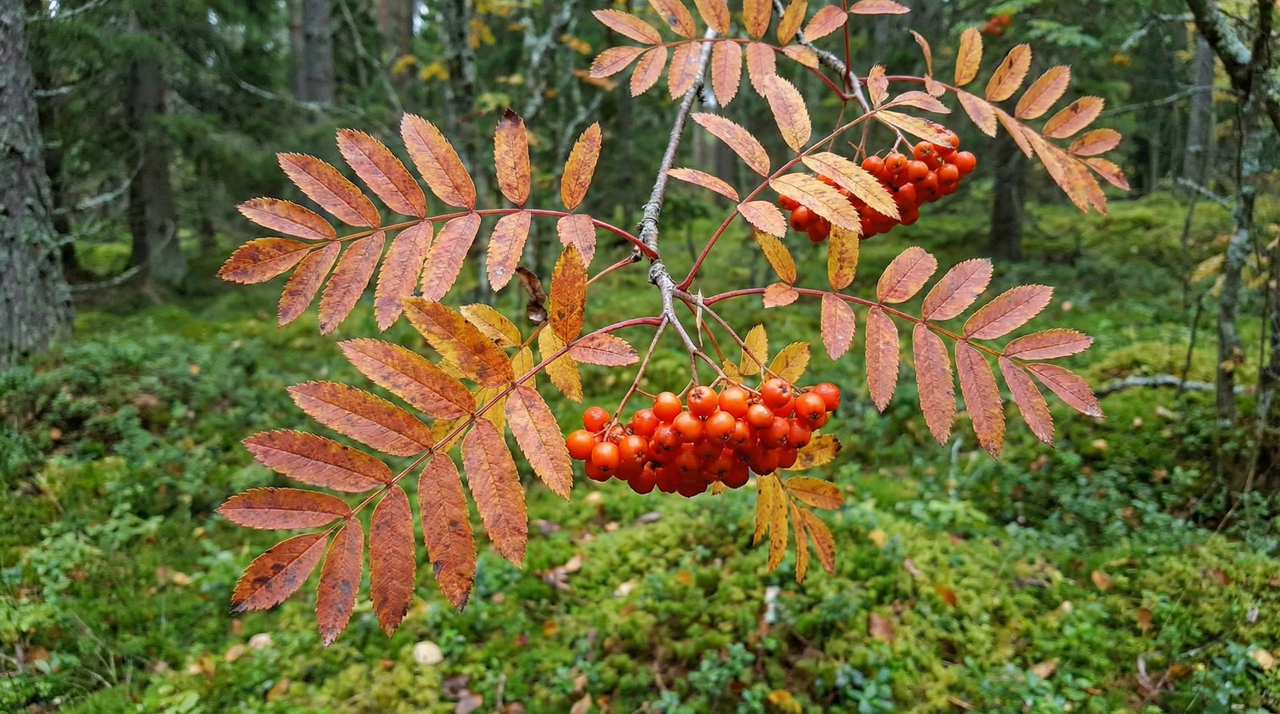
Few cold-hardy trees deliver as much functional value as rowan, yet historical cultures prized it for a different reason: this tree wards off witches. Celtic households tied sprigs above doorways. Norse farmers planted it at field edges. Sami herders carried the wood on journeys. You can write that off as quaint folklore, and most plant guides do, but I find myself more curious than dismissive. Because when a tree inspires that kind of consistent, cross-cultural reverence across thousands of years and hundreds of miles, something is usually going on. The people living closest to these plants weren't superstitious fools; they were careful observers. And rowan, I've come to think, earned its reputation the hard way, by showing up reliably in hard places and hard seasons when almost nothing else did.
What nobody mentions in the breathless "plant this for wildlife" writeups is that those gorgeous orange-red berries will absolutely ruin your afternoon if you eat them raw. Parasorbic acid. It converts to a safer compound once cooked or frozen, but fresh off the cluster it causes real gastrointestinal distress, and the seeds carry cyanogenic glycosides on top of that. This is a tree that asks for a little respect before it gives anything back, which, honestly, makes the payoff feel more earned. The jellies are extraordinary. The game sauces are something else entirely. I just wish more growers went in knowing that the transformation from "bitter, mildly toxic fruit" to "kitchen treasure" is the whole point of this plant.
Rowan Origin and History (Sorbus aucuparia)
Botanical Background and Native Range
Few tree species have the geographic sweep of rowan. Sorbus aucuparia grows natively across most of Europe, from Scandinavia and the British Isles east through western Asia to the Caucasus, and even touches parts of North Africa, spanning temperate to boreal forests from sea level all the way to 2,000 meters elevation.[1][2][3] That range explains so much about why it performs reliably in temperate permaculture systems: it's been shaped by cold, poor soils, and variable conditions for millennia. When I see a rowan thriving on a windswept hillside planting or the edge of a regenerating woodland, I'm not surprised. This tree comes from a long line of survivors.
As a deciduous perennial, rowan typically lives 100 to 200 years, with exceptional specimens documented at 300.[1][4] It reaches reproductive maturity somewhere between 3 and 15 years (most commonly 5 to 10), then flowers and fruits for decades under a polycarpic strategy.[2] Flowers appear in May and June; berries ripen August through October.[1][5] It's been introduced widely across North America as an ornamental and has naturalized in cooler regions, which means North American growers are working with a tree that's genuinely adapted, not just transplanted and hopeful.[6] In my experience, a well-sited rowan will outlive most of what else you plant in the same season, becoming a genuine multi-generational feature of a landscape.
Visual Characteristics of Rowan Trees
Rowan is a small to medium tree, typically reaching 6 to 15 meters tall with a spread of 4.5 to 9 meters, forming an upright to rounded crown that can be single-trunked or multi-stemmed through suckering.[7][8] The bark starts smooth and grey-brown before becoming rough and fissured with age, marked by prominent lenticels.[7] One trait I always look for in the field: young branches grow in a slightly zigzag pattern, which I've used more than once to spot rowan volunteers in restoration projects before the leaves are fully out.
The leaves are pinnately compound with 9 to 15 serrated leaflets, darker green above and paler below, emerging with a reddish, slightly fuzzy flush in spring before settling into their summer green and then turning brilliant yellow, orange, or red in autumn.[8][9] That compound leaf structure is your clearest identification tool: it separates rowan immediately from whitebeam, whose leaves are simple with that distinctive white-felty underside. Flowers arrive in late spring as large, flat-topped clusters up to 15 cm across, creamy-white and mildly fragrant.[2][10] The berries that follow are bright red to orange, spherical, 6 to 9 mm across, hanging in dense pendant clusters of 100 to 300 that persist well into winter.[8]
Underground, rowan relies on a shallow, fibrous, horizontally spreading root system rather than any deep taproot, which explains its remarkable adaptability to rocky and nutrient-poor soils and its role as a pioneer species.[5] It also shows real phenotypic plasticity, with leaves trending narrower on drier or cooler sites, and it hybridizes readily with related Sorbus species.[11]
Traditional and Cultural Uses
Rowan's relationship with people stretches back at least to medieval Europe, where 12th-century texts document it, and its berries served as a genuinely important famine food and medicine across northern Europe, used for digestive issues, colds, diarrhea, and scurvy prevention thanks to their vitamin C content.[2] This medicinal tradition was historically bound up with practical knowledge of preparation.[12] When I run foraging workshops, I'm very direct about this: I've always cooked rowan berries before they go anywhere near a recipe, and that's non-negotiable.
The tree's cultural weight runs far deeper than its stomach-settling properties. In Celtic and Norse tradition, rowan is revered for protection against evil spirits, witchcraft, and lightning, its red berries understood to symbolize blood and life force.[13][14] It appeared in May Day and Midsummer rituals, was shaped into amulets and walking sticks, and among Sami communities it wove through food, medicine, and ceremony alike.[15] I'll admit that when a client asks me for a "guardian" planting near an entrance, rowan is almost always in my first sketch, and I don't think that's entirely rational. But meaning in the garden matters. Today, rowan is seeing a genuine revival in the kitchen and in herbal practice, alongside its long-established role as an ornamental, with the wood still valued for tools and crafts.[16]
Interesting Facts About Rowan
Once properly cooked, rowan berries are genuinely nutritious, high in vitamin C and antioxidants, and they provide critical winter food for thrushes, blackbirds, and other birds whose seed dispersal in turn drives the tree's spread across landscapes.[2][17] In my designs, this berry persistence into deep winter makes rowan more reliable for wildlife value than many ornamentals that drop everything by November. As a pioneer species, it also stabilizes soils and boosts biodiversity in disturbed ground, making it an ecological workhorse before any other canopy tree gets established.
Rowan is hardy to USDA zones 3 through 7, tolerating temperatures down to -40°F, and it adapts to a wide range of soils as long as drainage is good, preferring a slightly acidic to neutral pH of 5.5 to 7.5.[2][18] Gardeners sometimes confuse it with whitebeam, which prefers calcareous soils, grows considerably taller (up to 25 meters), and has those simple, felty-backed leaves; comparing leaf undersides at the nursery is the fastest way to avoid a mix-up.[19]
Rowan hybridizes readily with related species, including whitebeam, producing fertile hybrids like Sorbus × hybrida.[20] And for all its reputation as a modest, misty-mountainside tree, champion specimens tell a different story: a 57-foot record in Cincinnati and a 30.1-meter UK champion show what a well-sited rowan tree can become over a long life.[21]
Rowan Varieties and Where to Buy Them
The wild European mountain ash, Sorbus aucuparia, is already a striking tree, but the named cultivars take that raw material and refine it considerably. I've grown seedling rowans and grafted selections side by side, and the difference in fruit set, cluster size, and autumn color saturation on the named forms is genuinely noticeable. If you're putting this tree in a designed landscape or small garden, that consistency matters.
Notable Rowan Cultivars
The cultivar palette runs wider than most people expect. On the ornamental side, 'Aurea' opens spring with golden-yellow foliage before settling into orange-red berries, while 'Glauca' brings a cool blue-green tone that reads beautifully against evergreen companions. For tight urban plots, 'Fastigiata' grows in a narrow column and 'Compacta' tops out around 4 to 6 meters, making it the most practical choice for a rowan bush-scale planting in a small garden.[22][23]
For pure berry drama, 'Cardinal Royal' loads up with vivid red clusters,[22] and 'Sheerwater Seedling' pairs a tidy pyramidal shape with improved resistance to leaf scorch and scab, which I'd specifically recommend to anyone gardening in a humid region where those problems tend to show up by midsummer.[24] Compared to seedling-grown trees, these selections consistently offer more compact habits, larger and more persistent fruit clusters, and better tolerance to urban conditions.[25] Berry color alone gives you a lot to work with: the range runs from classic red through orange, pink, yellow, and even white depending on the selection.[26]
If culinary use is part of your goal, 'Edulis' is the one to track down. Its berries are larger and noticeably sweeter than the species,[22] which matters when you're making jelly or wine and want to minimize added sugar. Rowan has relatively little breeding work focused on flavor compared to, say, apples or currants, so 'Edulis' stands out as the main option for home processors. That's actually fine by me; the wild-type berries make outstanding jelly and liqueur once properly cooked (more on that in the preparation section), and the ornamental selections are doing so much ecological work in the meantime.
Sourcing Rowan Trees in the US
Sorbus aucuparia is a European native that's now a familiar ornamental in North American horticulture, widely available from US nurseries and not considered invasive by USDA or national invasive species databases.[9][27] For a designed permaculture planting, that's reassuring; rowan's moderate growth rate and bird-dispersed seeds are nothing like the aggressive spreaders I've spent years trying to remove from clients' properties.
Good sources include Nature Hills Nursery, FastGrowingTrees.com, Burnt Ridge Nursery, One Green World, and Monrovia for container stock; Sheffield's Seed Company if you want to start from seed.[7] The tree is reliably hardy in USDA zones 3 through 7,[9] so most of the continental US outside the Gulf Coast and Southwest can grow it successfully. My buying advice: prioritize named, disease-resistant cultivars over anonymous seedlings, and check the root system before you commit. I learned that lesson with a couple of leggy, root-bound trees early on that sulked through their entire first growing season. Bare-root stock planted in spring or fall establishes most readily; container-grown trees give you more flexibility year-round. Expect to pay roughly $25 to $50 for a small starter tree and $150 to $300 for a larger specimen.
Rowan Propagation and Planting Guide
Rowan is one of those plants that rewards you for understanding its biology before you start collecting seeds or reaching for a knife to take cuttings. The more I've worked with it, the more I appreciate how much its reproductive quirks shape what you'll actually get in the ground.
Understanding Rowan Seed Biology and Reproduction
Here's something most gardening books gloss over: rowan doesn't reproduce quite the way you'd expect. Many populations exhibit facultative apomixis, producing seeds that develop from diploid nucellar cells without fertilization, meaning those seeds are essentially clones of the mother plant.[28][29][30] Diploid populations, on the other hand, reproduce sexually and generate genuine genetic variation.[30] That diversity matters ecologically: seeds dispersed primarily by thrushes carry a broad genetic pool across the landscape, which is part of why rowan colonizes so effectively from hedgerow to subalpine gully.[31]
What this means practically is that seed-grown plants from wild-collected berries are perfectly fine for wild-type rowans in a food forest or windbreak, where some variation is welcome. They're not appropriate for named cultivars, which need vegetative propagation to come true.[32][33] I label every seedling tray obsessively when raising Rosaceae from seed, because early compound leaves on rowan look maddeningly generic, and by the time plants reach transplant size it's easy to forget which batch came from which mother tree. Wherever your seed comes from, be scrupulous about starting with healthy, disease-free material.[34] Seedlings are vulnerable to damping-off caused by Pythium and Rhizoctonia, so sterilized seed mix, restrained watering, and good airflow are non-negotiable at the germination stage.[35] After one early season of losses, I added a small oscillating fan to my propagation corner and the problem essentially vanished.
Seed Storage, Viability, and Germination
The single fact that shapes how most growers approach rowan is this: seed-grown trees typically take 10 to 15 years to produce a meaningful fruit harvest, while grafted trees begin fruiting in just 2 to 4 years.[36][33] If you're designing a productive food forest, that gap matters enormously. Seed is the patient route, and it has its own rewards, particularly the ecological elegance of growing genetically adapted local stock.
To germinate rowan from berries, you need to break physiological dormancy with cold stratification: three to four months at 1 to 5°C (34 to 41°F), followed by warm germination at 15 to 21°C (60 to 70°F).[37][38] Light scarification can improve germination rates, and direct autumn sowing is possible, though success tends to be lower without pre-treatment.[39] I use the crisper drawer of my refrigerator in damp vermiculite, and 90 to 120 days has been consistently reliable. I always run a small test batch first rather than committing the entire seed lot, because fresh, high-quality seed from northern or higher-altitude origins can hit 70% germination,[40] while older or southern-provenance seed with thicker coats may only manage 40 to 50%.[41]
Rowan seed stores well if handled correctly. It's orthodox in its behavior, tolerating desiccation, so dried seed at 5 to 10% moisture content in an airtight container stays viable for up to a year in the refrigerator at 3 to 5°C, and for 5 to 15 years or more in a chest freezer at -18°C.[42][43] For most home growers, fridge storage covers everything you'll need. The ultra-low temperature protocols are really seed-bank territory. If you want a quick viability check before stratifying a stored batch, tetrazolium staining or a simple float test (though TZ is more reliable) can give you a reasonable read before you invest fridge space.[44][45]
Vegetative Propagation Methods
For anyone wanting a named cultivar or a faster path to fruit, grafting is the standard approach. Whip-and-tongue or cleft grafts onto Sorbus aucuparia seedling rootstock in late winter or early spring give the best compatibility and long-term vigor.[33][46] Hawthorn rootstock is sometimes used and can offer a degree of dwarfing, but compatibility is variable.[47] From my experience with other Rosaceae, I prefer own-species stock wherever possible; the hawthorn dwarfing effect can be appealing in a tight space, but I've seen heat-stressed incompatibility show up years later in difficult summers, and I'd rather not troubleshoot a graft union when a tree is ten years old. Pyrus rootstock is generally not recommended.[33]
Semi-hardwood cuttings are an option for home propagators willing to accept more variable results. Take 10 to 15 cm cuttings in late summer, treat with IBA hormone, and root under mist or a humidity tent; success ranges from 20 to 70% depending on conditions and timing.[32][48] I've struck a handful of semi-ripe cuttings successfully in a shaded greenhouse, though I wouldn't rely on it at scale. Layering (mound or air) works too but takes one to two years to produce a rooted plant,[33] which puts it in the same patience category as seed. For suckering forms, dividing clumps in autumn or early spring every five to seven years is perfectly straightforward.[49] Tissue culture exists for specialized disease-free multiplication but isn't a home-garden consideration.
Site Selection, Soil, and Sunlight Requirements for Rowan
Drainage is the non-negotiable. Rowan will not tolerate waterlogged soil; standing water around the roots invites rot and sets a young tree back hard.[24][50] Given that, the tree is genuinely flexible. It prefers well-drained, moderately fertile, humus-rich loam with a pH of 5.5 to 7.0, but it will grow in sandy or clay soils as long as drainage is adequate and organic matter is reasonable (around 3 to 6% is ideal).[51][9] I've watched rowan do surprisingly well in moderately compacted urban soils when the planting hole was generously amended with grit and compost. If your soil test comes back at pH 7.8 or above and you'd rather not amend extensively, this is a moment to consider whether a more alkaline-tolerant pioneer would serve your system better.
For fruiting, aim for full sun: a minimum of four to eight hours of direct light daily.[52] Rowan tolerates partial shade, up to about 50% canopy cover, which reflects its native range from forest edges and open glades up into the subalpine zone.[53] Full shade, though, reduces both vigor and berry production noticeably. Its root system is relatively shallow, with most activity in the top 30 to 50 cm, so container growing in a pot at least 45 to 60 cm wide and deep with a gritty, free-draining mix is feasible for smaller cultivars,[54] though full-size specimens clearly prefer open ground.
Spacing, Planting Technique, and Establishment
How you space a rowan depends entirely on what you're asking it to do. A specimen tree in a permaculture guild wants 15 to 30 feet (roughly 4.5 to 9 meters) from its neighbors, giving full access to light and room for the 15 to 25-foot spread a mature tree can develop.[24][55] In a guild, I typically position rowan as an upper canopy tree about 20 to 25 feet from a central fruit tree, using the intermediate space for nitrogen-fixers and low-growing herbs. Orchard planting tightens to 15 to 20 feet; hedges or screens can go down to 10 to 15 feet, though that spacing means accepting more pruning work over time to maintain airflow.[56] I learned the airflow lesson the hard way after crowding a row of young rowans in an early planting; mildew pressure that first summer was noticeably higher than in a more open planting nearby, and it took two seasons to fully recover once I thinned them.
Transplant seedlings once they've reached 6 to 12 inches tall, into their final positions in spring or autumn, disturbing roots as little as possible.[34] Rowan grows at a moderate pace of 30 to 60 cm per year,[2] so new transplants aren't small for long, but they do benefit from staking for two to three years on any exposed or windy site.[57] Water in well at planting, keep the establishment area weed-free, and watch young trees closely for the early signs of anthracnose, powdery mildew, and aphids during their first vulnerable growing seasons. Full pruning and ongoing maintenance guidance is covered separately in the care section, but a light formative prune at planting to set a clear structure will save you significant work later.
Comprehensive Rowan Tree Care Guide
Rowan is one of those trees that rewards you for getting the basics right early and then mostly leaves you alone. The first three to five years demand genuine attention; after that, you're working with a tree that has been thriving in the rocky uplands of Europe and western Asia since long before anyone had a care guide. Respect its cool-climate nature, give it decent light and drainage, and it will repay you for a very long time.
Sunlight Requirements
Rowan does best in full sun, meaning at least six hours of direct light daily, which is where you'll see the strongest growth, the heaviest flowering, and the most abundant berry clusters.[7][58] It tolerates partial shade, but I always site it in the sunniest available spot when I'm designing a food forest or mixed planting; shaded trees tend toward etiolated, leggy growth and yellowing foliage, and fruit yields drop noticeably.[59][58] The flip side is that intense sun combined with heat and dry air can cause leaf scorch, so in warmer parts of zone 7 where summer afternoons get brutal, a spot with afternoon filtering isn't a bad compromise.
Water Needs
Young rowans need consistent moisture to establish well. For the first year or two, aim for about an inch of water per week when rainfall doesn't cover it, always in deep, infrequent sessions rather than shallow daily sprinkles.[58][7] Watch the drainage; soggy roots are a real problem, and overwatering presents as yellowing lower leaves, wilting, and premature leaf drop that's easy to misread as drought stress.[60][61] Once established past the two-year mark, rowan becomes genuinely drought-tolerant and usually needs supplemental water only during extended dry spells, roughly an inch every week or two if conditions are particularly dry.[58][10]
Feeding and Soil Fertility
Rowan is a light feeder by nature, having evolved on thin, rocky, nutrient-poor soils across northern Europe.[58][62] I've seen over-fertilized rowans in client landscapes produce lush, weak growth that looked suspiciously like drought stress until a soil test revealed salt buildup from excess synthetic inputs. My default is a 2-3 inch layer of organic compost mulch kept away from the trunk, refreshed annually; for young trees on genuinely poor soils, a light application of balanced slow-release fertilizer in early spring is the most I'd do.[63][64] I always soil-test before planting, because the visual deficiency symptoms overlap so much with other stresses. Iron deficiency (interveinal chlorosis on young leaves) can appear above pH 7.0, while magnesium deficiency shows up below 5.5; the sweet spot is pH 5.5 to 7.5.[65][53]
Frost Tolerance
This is where rowan genuinely shines as a cool-climate tree. It's rated USDA zones 3 through 7 and RHS H7, handling temperatures down to -40°F in the coldest zones.[9][66][67] The catch is that young trees and newly emerging tissue are genuinely vulnerable to late spring frosts in April and May; I've seen late-frost events blacken emerging buds and set back fruit set for an entire season in exposed marginal sites, but moving trees out of frost pockets has prevented it ever since.[58][68] Site selection is your strongest tool: sheltered, well-drained spots away from low-lying frost pockets, with a deep fall watering before dormancy and 2-4 inches of organic mulch to buffer roots against freeze-thaw cycles.[7][69]
Heat Tolerance
Rowan is rated AHS Heat Zones 4-1, tolerating short periods above 86°F but showing real stress when prolonged heat and dry air combine.[24][70] The signs are similar to what I see on serviceberry during hot, dry stretches: brown leaf margins, wilting, and a general loss of vigor; sustained temperatures above 80°F can also disrupt flowering and reduce yields noticeably.[71][72] If you're in the hotter end of zone 7, position your rowan where it gets some afternoon shade, keep the mulch thick, and irrigate consistently through dry spells; in USDA zones 8 and above, this isn't really the right tree.[73][74]
Pruning and Maintenance
Timing matters here. Prune in late winter to early spring, February through March before bud swell, to avoid sap bleeding and to keep cuts clean during dormancy.[58][7] Early in my career I made the mistake of heavy corrective cuts on a young rowan and watched it skip berrying for two full seasons afterward; now I follow a strict light-pruning rule, removing only dead, damaged, diseased, crossing, or overcrowded wood to improve airflow and light penetration without touching productive flowering branches.[58][7] On young trees, formative pruning to establish 3-5 strong leaders keeps the structure balanced; on mature trees, the main annual job is removing basal suckers at ground level.[58][34] In practice, a late-winter inspection and a few targeted cuts is usually all a well-sited mature rowan ever needs, beyond refreshing the mulch ring and hand-weeding near the trunk to avoid root damage.[7][53]
Seasonal Rhythm and Longevity
Rowan follows the cool temperate calendar faithfully: longer spring and summer days drive vegetative growth and flowering through May and June, shortening autumn days trigger fruit ripening from September into October, and a light frost at the end of the season actually improves berry flavor before the tree drops into dormancy.[75][76] Going into winter, a deep watering before the ground freezes and a fresh mulch layer of 2-4 inches helps young trees through freeze-thaw cycles; exposed sites benefit from a windbreak or temporary deer fencing while the tree is small.[77][78] A well-sited rowan typically lives 100 to 200 years, with exceptional specimens reaching 300 in ideal conditions, and in permaculture plantings I've designed, trees that were cared for well through establishment are still productive and beautiful for generations. It's a multi-generational investment, but one that asks remarkably little once it finds its footing.
Rowan Harvesting: Timing, Technique, and Flavor Transformation
Rowan rewards patience. Flowers open in May and June, and from there the berries take four to six months to reach full maturity, arriving in September and October after a long, slow development through summer.[79][80] That timeline assumes the tree has had adequate winter chill, somewhere in the range of 800 to 1,200 hours below 7°C, which is part of why rowan thrives in USDA zones 3 through 7 and tends to sulk in mild winters.[81] It's a rhythm you start to feel after a few seasons with the tree.
When to Harvest Rowan Berries
The visual cues are reliable once you know what to look for: bright red to orange-red clusters, a slight give when squeezed, and fully developed hard brown seeds inside.[58][82] Sugar content climbs to roughly 12 to 18 degrees Brix at peak ripeness, but honestly, the biggest game-changer I've found is waiting for the first light frost.[7] Every autumn I've harvested rowan after that first frost, the subsequent cooking step is just noticeably more pleasant; the bitterness backs off enough that the fruit's character can actually come through in the pot.
How to Harvest Rowan Sustainably
Cut entire clusters with sharp, sterilized pruning shears rather than pulling or stripping individual berries, and do it in the morning when conditions are dry to reduce the risk of mold taking hold in your harvest basket.[58] Wear gloves. The sap is stickier than you'd expect and bonds to shear blades with impressive determination if you don't clean them immediately after use. I leave at least 20 percent of the clusters on each tree for wildlife,[83][84] and I tend to leave the highest clusters entirely. The cedar waxwings that move through my area each October will strip whatever I've left behind, and watching that happen feels like part of the harvest too.
Understanding Raw Rowan Flavor and Post-Harvest Transformation
Raw rowan berries are not a snack. I don't let children or pets nibble them; the research is clear enough that I always wait until after cooking or freezing before tasting.[85] Beyond the safety concern, the raw fruit is intensely sour and astringent due to high malic acid content, tannins, phenolic compounds, and stone cells that give the flesh a gritty texture.[86] Cooking, freezing, or fermentation changes all of that: parasorbic acid breaks down, tannins denature, and the berries' naturally high pectin content becomes the asset it should be, setting jellies beautifully without much help.[87][88] Drying concentrates the sugars into something almost nutty. Berries from colder or higher-altitude sites often carry more anthocyanins and acid, which I've found translates to deeper color and a firmer set in the jam pot.[89] A mature tree yields roughly 10 to 30 pounds per season;[90] fresh berries hold one to two weeks refrigerated, freeze well for up to a year, or can be dried at low heat over 24 to 48 hours.[91]
Rowan Berry Preparation, Culinary Uses, and Traditional Applications
Making Rowan Berries Safe and Palatable
I tell every client who plants a rowan the same thing: do not eat these berries off the tree. Raw berries are deeply astringent and unsafe, while the seeds carry cyanogenic glycosides that release hydrogen cyanide if crushed or eaten in quantity.[24][92] The good news is that cooking, freezing, or fermenting converts parasorbic acid into harmless sorbic acid, making the berries both safe and genuinely delicious.[93][94] My practical tip: harvest after the first hard frost, or stick the clusters in the freezer overnight before processing. That cold exposure breaks down a significant portion of the astringency and makes the whole experience far more pleasant in the kitchen.
Traditional Culinary Recipes and Flavor Transformations
Once properly processed, rowan berries have a lot to offer. Their naturally high pectin content means jelly sets beautifully without added thickener, which I appreciate after years of wrestling with low-pectin fruits.[94][1] Think of it like a tart crabapple, but with more depth. Cooked with sugar, the berries develop a sweet-tart, faintly apple-like flavor that earns its place alongside venison and lamb, in pies and crumbles, or poured over cheese.[95] A classic rowan berry jelly recipe often pairs them with apples, which supplements the pectin and mellows the bite. For infused gin or country wine, fermentation does the heavy lifting, reducing bitter phenolics and tannins while preserving the berries' vitamin character.[95] These aren't novelty recipes; they're rooted in centuries of European foraging tradition.
Medicinal, Wood, and Non-Food Uses of Rowan
Rowan's folk-medicinal history runs deep. Bark and berry infusions have long been used across Europe to ease coughs, sore throats, and diarrhea, and the berries' vitamin C content made them a genuine scurvy remedy long before anyone knew what vitamin C was.[1][96] I respect that tradition while always reminding people to cook the berries, remove the seeds, and keep quantities moderate.
The tree itself is worth considering beyond the fruit. Rowan wood is tough and fine-grained, historically prized for tool handles, walking sticks, and carved objects.[1][97] I've specified rowan for carved walking sticks in garden designs specifically because the grain holds fine detail without splitting under a tool. Crushed berries also yield a reddish natural dye for wool, a use that fits beautifully into low-waste permaculture systems where every part of the harvest finds a purpose.[98] Rowan rewards patience and respect at every stage, from harvest through preparation.
Rowan Health Benefits and Medicinal Uses
European mountain ash has a long reputation in traditional medicine, and the more I dig into the research, the more I understand why communities across northern and central Europe kept coming back to it. The science is still catching up to centuries of use, but what's there is genuinely interesting. My honest take, after growing and processing these berries for several seasons now, is that rowan deserves serious respect as a supportive plant food and cautious herbal ally, not a miracle cure.
Phytochemical Profile of Rowan Berries
The 2020 phytochemistry review on Sorbus aucuparia is probably the most comprehensive single resource on what's actually in this plant, and the picture it paints is striking.[99] Flavonoids are the dominant class of secondary metabolites, including quercetin and kaempferol glycosides, flavones like vitexin and isovitexin, and anthocyanins such as cyanidin-3-rutinoside that give ripe berries their red-orange pigment.[99][100] Layered beneath those are phenolic acids, particularly chlorogenic and neochlorogenic acids, found consistently across fruits, leaves, and bark.[99][101] The fruits also contain triterpenoid acids including ursolic acid and oleanolic acid, compounds that show up in research on inflammation and metabolic health.[99] Tannins, both hydrolyzable and condensed, are present especially in leaves, bark, and fruit, which explains the puckering astringency of a raw berry.[99]
These compounds peak during autumn ripening and that northern European populations tend toward higher flavonoid concentrations.[87][102] I've noticed that berries harvested after the first hard frost taste less bitter, and the phytochemistry backs that up; compounds shift as temperatures drop. The whole profile translates into measurable antioxidant activity, with rowan extracts scavenging free radicals and inhibiting lipid peroxidation at levels comparable to vitamin C in DPPH and FRAP assays. They also demonstrate antimicrobial action and anti-inflammatory effects via NF-κB pathway modulation.[100][103][87]
Evidence from Medicinal Research
Traditional European herbalism leaned on rowan as an astringent for diarrhea and dysentery, a gargle for sore throats and respiratory infections, and a reliable source of vitamin C against scurvy.[104][105][106] Modern research is beginning to explain why those uses persisted. Rowan extracts show significant antioxidant activity tied directly to their phenolic and flavonoid load,[107][108] and preclinical studies have demonstrated antimicrobial activity against Staphylococcus aureus, E. coli, and Candida albicans.[109][110]
The more striking findings come from animal models. In vivo studies show antidiabetic effects through inhibition of α-glucosidase and α-amylase, hepatoprotective activity in liver injury models, cardiovascular benefits including reduced blood pressure and improved lipid profiles, and wound healing potential in diabetic rats.[111][112][113][114] Some cell-line research also points toward anticancer potential through apoptosis induction.[115][116] Compelling, yes, but the honest reality is that almost none of this has been tested in humans; clinical trials for Sorbus aucuparia are essentially nonexistent.[117] I think of rowan the way I think of elderberry, a plant I've grown and used for years with considerably more human trial data behind it: the preclinical profile is compelling enough to justify respectful culinary use, but it's not a substitute for proven treatments.
Nutritional Value of Processed Rowan Berries
Raw nutritional numbers and processed nutritional reality are two different conversations for rowan. The processing requirement isn't optional; cooking, fermenting, or proper drying is non-negotiable before you eat them.[118][119]
That said, the base nutrition is solid. Per 100 grams raw, rowan berries offer around 73 kcal, 1.3 g protein, 3.4 g fiber, and approximately 50-60 mg vitamin C, though cooking and drying can reduce that vitamin C by 20-50% or more.[118][120] The phenolic profile, loaded with chlorogenic acids, quercetin and kaempferol glycosides, and cyanidin-based anthocyanins, gives rowan an antioxidant capacity that can rival or exceed blueberries in lab assays.[121][122] Those polyphenols are far more heat-stable than vitamin C, so jams and jellies retain more of the antioxidant benefit than you might expect. I've started making small batches of lightly simmered rowan syrup when my goal is immune support rather than a set jelly, keeping the temperature lower and the cooking time shorter to hold onto more of that vitamin C. A typical serving of prepared berries runs 20-50 grams in most culinary applications.
Safety Considerations and Contraindications
I never use raw rowan in any form, and I'd say the same to any forager or gardener asking my advice. Raw berries contain parasorbic acid, which can cause nausea, vomiting, diarrhea, and abdominal pain; the seeds additionally contain cyanogenic glycosides including prunasin and amygdalin that can release hydrogen cyanide if crushed and ingested in quantity.[1][123][124] The good news is that cooking or fermenting hydrolyzes parasorbic acid to sorbic acid and addresses the cyanogenic risk, and no fatalities from rowan berry consumption have been reported.[58][125] Properly prepared berries have a long tradition of medicinal use, typically as an astringent at around 2-3 g dried fruit per day or 1-2 teaspoons in tea, but that doesn't make them universally appropriate.[126] Pregnant and breastfeeding individuals, children under 12, and anyone on anticoagulant therapy or with Rosaceae allergies should avoid medicinal use entirely given the limited safety data.[126][127] Rowan berries can also cause mild gastrointestinal upset in dogs, cats, horses, and livestock, so keep fallen fruit cleared if animals have access to the area.[128] Small culinary amounts of properly cooked fruit are generally considered safe for healthy adults; concentrated extracts are a different matter and warrant medical guidance before use.
Rowan Pests and Diseases
One reason I keep recommending rowan in mixed guild plantings is that it does a lot of its own pest management before I ever have to step in. Sorbus aucuparia carries an impressive suite of natural defenses: parasorbic acid, condensed tannins, and flavonoids at the chemical level, plus tough waxy leaves and fine pubescence as physical barriers, and endophytic fungi and bacteria that contribute additional secondary metabolite production.[58][129][130] Compared to the apples and pears I manage in other food forest designs, rowan is notably cleaner most years.
Natural Defenses and Pest Resistance in Rowan
Aphids are the most consistent rowan tree pest to watch for. Dysaphis aucupariae and the green apple aphid both target the species, causing leaf curling, honeydew buildup, and eventually sooty mold.[58][18] In my monitoring I've found the honeydew and curling show up first on new growth in late spring; catching it early with a strong blast from the hose or encouraging hoverflies and parasitic wasps through companion planting has kept trees clean without any spray. If you're selecting a cultivar where aphid pressure is anticipated, 'Elegantissima' offers better tolerance than straight species, while 'Aurea' handles aphids reasonably well but is more susceptible to leaf miners.[131]
Beyond aphids, leaf miners (Phyllonorycter hyrcinella and Stigmella spp.) cause cosmetic foliar damage, and sawfly larvae can defoliate branches if populations build unchecked.[18][132] Scale insects and flatheaded borers are lower on my concern list since rowan's bark chemistry provides partial resistance, though borers become a real problem on stressed or newly planted trees.[132][133] American mountain ash (Sorbus americana) has notably lower resistance to leaf beetles and shows more defoliation pressure generally, with far fewer named cultivars bred for pest tolerance.[134][135] The pattern holds consistently: stress amplifies all of these problems. Drought, compaction, or a humid monoculture setting will invite pressure that a well-sited tree in a diverse planting mostly shrugs off.[136][137]
Common Diseases of Rowan and How to Manage Them
Rowan's general disease resistance is strong, particularly when grown in conditions that reflect its native European range: good drainage, adequate sun, and consistent but not excessive moisture.[138][58] The two threats I take seriously are honey fungus (Armillaria mellea) and Phytophthora root rot, both of which target trees in waterlogged or poorly drained soils.[139][140] Neither has a reliable chemical cure once established, which is why siting decisions matter more than any treatment protocol.
If you garden in the humid Midwest or Northeast, fire blight is the rowan tree disease I watch most closely. The research is clear that prompt removal of infected branches at the first sign of shepherd's crook symptoms is non-negotiable.[141][142] Rust diseases caused by Gymnosporangium species require a juniper alternate host nearby, so if you're seeing orange pustules on rowan leaves and have junipers in the landscape, that's your diagnosis.[58] Cankers, Verticillium wilt, powdery mildew, leaf spot, and apple scab round out the list as minor concerns; rowan shows good resistance to powdery mildew in particular, and scab mostly affects fruit rather than causing serious tree decline.[139][58]
Rather than reaching for fungicides at the first hint of rust or mildew, I focus on the cultural foundations: well-drained slightly acidic soil, good air circulation through appropriate spacing, and plant diversity around the tree that mirrors the forest systems where rowan evolved.[22][143] When intervention is warranted, I prune during dry late-winter or early spring weather with sterilized tools, remove all infected material from the site, and consider copper-based bactericides or sulfur fungicides only when monitoring confirms a genuine threshold has been crossed.[58][144] For cultivar selection, I've been recommending 'Fastigiata' for clients in wetter sites where vigor and disease tolerance matter; your local extension service will have the most relevant regional guidance, especially for mountain ash fire blight pressure in your specific climate.[56]
Rowan in Permaculture Design
Rowan earns its place in a thoughtful food forest not just for what it produces, but for what it sets in motion around it. I've worked with several Sorbus species across very different sites, and what strikes me every time is how much ecological work this tree quietly does while most visitors are focused on those brilliant autumn berry clusters. Before you plant one, though, you need to be honest about whether your site actually suits it, because rowan has a very clear idea of where it wants to live.
Climate Adaptability and Hardiness Zones
Rowan is genuinely one of the hardiest deciduous fruiting trees you can establish in a temperate food forest, rated for USDA zones 3 through 7 with cold tolerance reaching all the way down to -40°F.[145][67] That puts it comfortably in the same territory as hardy apples and elderberries, but with cold resilience that few Rosaceae members match. Its sweet spot is the cool, moist temperate climate it evolved in, ideally somewhere pulling 20 to 60 inches of annual rainfall with moderate humidity.[9] The Northeast, Great Lakes, Appalachians, and Pacific Northwest all fall within that profile, and rowan has naturalized comfortably across those regions.[9]
The upper limit is where I'd steer people to pay attention. Prolonged temperatures above 30°C (86°F), particularly paired with summer drought, will stress this tree visibly.[9] I learned that the hard way with an early planting on a south-facing slope that got more afternoon heat than I'd anticipated. The leaves scorched by late July. Now I position rowan where it catches good morning sun but gets some afternoon relief at the warmer edges of its range, which makes a real difference. If you're in zone 8 or warmer, this isn't your tree. There are better heat-adapted options for those climates, and rowan won't thank you for trying. Where it does thrive, even high elevations up to around 6,500 feet, its moderate salt and wind tolerance extends its usefulness to exposed or coastal sites.[138]
Ecosystem Functions and Wildlife Support
The ecological return from a single rowan is remarkable for a tree of its size. Those berry clusters that ripen in September and October become a feeding frenzy, drawing over 50 bird species including thrushes, waxwings, robins, and blackbirds, plus mammals like red squirrels and bears.[22][10] I've stood at the edge of a design site in late October watching a pair of fieldfares strip an entire branch in under ten minutes. That kind of energy is exactly what a food forest wildlife guild is supposed to generate.
The pollinator contribution starts months earlier. Rowan's spring corymbs, those flat-topped clusters of small white flowers, are magnets for hoverflies, particularly Eristalis and Syrphus species, alongside honeybees and bumblebees.[146] The hoverfly activity I've observed on established trees in late May is genuinely impressive. The tree supports over 40 insect species overall,[2] which has real ripple effects for the broader polyculture around it. Rowan is self-fertile, so a single specimen will fruit, but cross-pollination improves fruit set, which is worth factoring into planting density decisions.[147]
Below ground and at the leaf litter level, rowan contributes meaningfully to soil health. Its decomposing leaves build organic matter and release nutrients that feed understory plantings,[2] and its fibrous root system makes it genuinely useful on slopes and riparian edges where erosion is a concern.[2] Dense canopy makes it effective as a windbreak component,[135] and there's evidence it can accumulate heavy metals for basic phytoremediation on degraded sites.[148] It doesn't fix nitrogen, which is worth flagging plainly since some designers assume it does because of its pioneer role. That's a gap you'll want to fill deliberately with companions.
Two caveats deserve honest mention. Because rowan sits in the same family as apples and pears, it shares their vulnerability to fire blight, and I manage it exactly the way I manage my orchard: good airflow, no overhead irrigation, and prompt removal of any blighted wood.[149] In the Pacific Northwest specifically, bird-dispersed seeds have raised enough concern that it's monitored for potential invasiveness in parts of Washington state.[150] It's not banned, but it's worth knowing your local context before planting near natural areas.
Forest Layer and Guild Placement
Rowan is a canopy tree, not an understory shrub, and treating it as one is the most common design mistake I see. It reaches 50 to 65 feet at maturity with a moderate growth rate of 12 to 24 inches per year once established,[151] and it wants light. Seedlings need canopy density below 50% to establish well; mature trees perform best in full sun to partial shade.[152] In its native ecology it's a pioneer of disturbed edges, open glades, and post-disturbance sites, which tells you a lot about where to place it: at the sunny margins of a food forest, not tucked in behind taller canopy.
I often reach for rowan in exactly the spots where I'd consider a serviceberry but need more vertical presence. It delivers a similar combination of spring pollinator draw and late-season fruit for wildlife, just at a larger scale. In natural associations it partners with silver birch and Norway spruce,[153] and in North American contexts the related American mountain ash pairs well with red maple and yellow birch in restoration guild plantings.[154] Those associations translate directly into design: rowan as the upper-layer focal tree, with birch or spruce as companions that reinforce its natural community without competing aggressively for the same light.
Since rowan doesn't fix nitrogen, the guild needs that function built in elsewhere. My go-to combination layers comfrey and alder beneath and around the rowan: the alder handles nitrogen input, the comfrey acts as a dynamic accumulator and living mulch, and the tree does the canopy, wildlife, and soil-cycling work.[155] I've refined that combination across several sites and it consistently produces a system that feels more alive than the sum of its parts. Ground covers tucked into the gaps complete the vertical stacking and suppress weeds while the rowan establishes, which takes patience but pays off compoundly once the tree hits its stride.
A Tree for a Garden to Remember Itself
I put my first rowan in a cold, exposed corner that had defeated three other trees, half expecting it to sulk. It didn't. By the third autumn, the birds found it before I did, and I stood there watching a fieldfare work through the clusters like it had been doing this forever, because honestly, it had. That's the thing about rowan: you're not really planting something new. You're just rejoining something old.
Sources 155
- Sorbus aucuparia - Wikipedia ↩
- Rowan Tree (Sorbus aucuparia) - Woodland Trust ↩
- Sorbus aucuparia L. ↩
- Rowan (Sorbus aucuparia) - Trees for Life ↩
- Sorbus aucuparia - European Rowan ↩
- Invasive Plant Atlas: Rowan ↩
- Sorbus aucuparia ↩
- Sorbus aucuparia - RHS ↩
- Sorbus aucuparia - USDA PLANTS Database ↩
- Sorbus aucuparia - Kew Gardens ↩
- Flora of North America - Sorbus aucuparia ↩
- Ethnobotany of the Mountain Ash (Sorbus aucuparia) ↩
- The Rowan Tree: Protection in Folklore ↩
- Plants in Norse Mythology and Ritual ↩
- Sami Traditional Knowledge of Plants ↩
- Sorbus aucuparia Profile - Missouri Botanical Garden ↩
- Sorbus aucuparia L. - USDA Forest Service ↩
- Mountain Ash (Sorbus spp.) ↩
- Sorbus aucuparia ↩
- Sorbus aucuparia ↩
- Champion Tree Database: Sorbus aucuparia ↩
- Royal Horticultural Society - Sorbus aucuparia ↩
- Sorbus aucuparia 'Compacta' - Royal Horticultural Society ↩
- Missouri Botanical Garden - Sorbus aucuparia Cultivars ↩
- Sorbus aucuparia - RHS Gardening ↩
- Sorbus aucuparia ↩
- Invasive Plant Species ↩
- Apomixis and Hybridization Drive Reticulate Evolution and Range Expansion in an Eurasian Woodland Genus (Sorbus L.) ↩
- Apomixis and Hybridization Drive Reticulate Evolution and Range Expansion in a Polyploid Lineage ↩
- Reproductive Biology of Sorbus aucuparia ↩
- Genetic Variation in Rowan (Sorbus aucuparia L.) Populations ↩
- Propagation of Trees and Shrubs ↩
- Propagation of Rowan (Sorbus aucuparia) ↩
- Sorbus aucuparia ↩
- Damping Off and Seedling Diseases in Ornamental Trees ↩
- Growing Rowan Trees - Missouri Botanical Garden ↩
- RHS Gardening - Sorbus aucuparia ↩
- Seed Germination of Sorbus aucuparia: Stratification Techniques ↩
- University of Minnesota Extension - Tree Seed Germination ↩
- Geographic Variation in Seed Traits of Sorbus aucuparia Across Europe ↩
- Seed Morphology and Germination in European Rowan (Sorbus aucuparia L.) ↩
- Seed Storage of Temperate Tree Species ↩
- International Seed Storage Guidelines ↩
- Tetrazolium Testing of Tree Seeds ↩
- Germination and Storage of Rowan Seeds ↩
- Grafting and Budding Nursery Crop Plants ↩
- Sorbus Grafting Compatibility in Ornamental Trees ↩
- Mountain Ash Propagation Techniques ↩
- Woody Plant Propagation: Sorbus Species ↩
- Sorbus aucuparia Habitat Requirements - European Forest Institute ↩
- Royal Horticultural Society - Sorbus aucuparia ↩
- Royal Horticultural Society (Plant Web Page) ↩
- Rowan - Sorbus aucuparia L. - USDA Forest Service ↩
- RHS - Sorbus aucuparia ↩
- Royal Horticultural Society - Rowan (Sorbus aucuparia) ↩
- University of Minnesota Extension - Rowan Trees ↩
- Ornamental Tree Planting Distances ↩
- Sorbus aucuparia - RHS Growing Guide ↩
- Leaf Scorch in Trees: Causes and Prevention - University of Minnesota Extension ↩
- RHS Gardening - Sorbus aucuparia ↩
- University of Minnesota Extension - Tree Care: Watering and Root Rot ↩
- Fertilizing Ornamental Trees and Shrubs - University of Minnesota Extension ↩
- Nutrient Deficiencies in Trees - Royal Horticultural Society ↩
- Fertilizer Burn in Trees: Symptoms and Prevention - University of Minnesota Extension ↩
- Sorbus aucuparia Soil Preferences - European Ecological Studies ↩
- RHS Plant Finder: Sorbus aucuparia ↩
- USDA Plant Hardiness Zone Map ↩
- Frost Injury to Trees - University of Minnesota Extension ↩
- Cold Damage in Ornamental Trees - Missouri Botanical Garden ↩
- Heat Zone Map - American Horticultural Society ↩
- Sorbus aucuparia Plant Profile - Missouri Botanical Garden ↩
- Physiological Responses of Sorbus aucuparia to Heat Stress ↩
- Growing Guide: Sorbus aucuparia - RHS ↩
- Managing Heat Stress in Trees - UC IPM ↩
- Rowan Tree (Sorbus aucuparia) - Lifespan and Care - RHS ↩
- Royal Horticultural Society Plant Finder - Sorbus aucuparia ↩
- RHS - Sorbus aucuparia ↩
- The Morton Arboretum - Rowan Tree Care ↩
- Sorbus aucuparia - RHS Plants ↩
- POWO: Sorbus aucuparia ↩
- Fruit Trees: Rowan ↩
- Rowan (Sorbus aucuparia) - Fruit Production and Harvest ↩
- Foraging for Rowan Berries ↩
- Sustainable Harvesting Techniques for Mountain Ash ↩
- Rowan - Sorbus aucuparia ↩
- Journal of Agricultural and Food Chemistry - Phenolic and Flavonoid Compounds in Sorbus aucuparia ↩
- Volatile Compounds in the Fruit of Sorbus aucuparia L. ↩
- GC-MS Analysis of Aroma Compounds in Rowan Berries ↩
- Peer-reviewed Research on Climate Impact on Phenolics in Sorbus aucuparia ↩
- Mountain Ash (Rowan) Production - USDA Natural Resources Conservation Service ↩
- Preserving Wild Berries: Rowan Storage Methods - Cornell Cooperative Extension ↩
- Toxicity of Rowan Berries - Poison Control ↩
- Rowan ↩
- Rowan - Kew Royal Botanic Gardens ↩
- Ethnobotany of Rowan (Sorbus aucuparia) in Europe ↩
- Sorbus americana Uses - Plants for a Future ↩
- Rowan Tree Uses - The Morton Arboretum ↩
- Traditional Dyes from Berries - Royal Botanic Gardens Kew ↩
- Phytochemistry and Medicinal Properties of European Rowan (Sorbus aucuparia): A Review (2020) ↩
- Phenolic Compounds and Antioxidant Activity of Rowanberry (Sorbus aucuparia L.) Fruits ↩
- Phenolic Compounds in Leaves of Sorbus aucuparia ↩
- Geographic Variation in Flavonoids of Rowan Leaves ↩
- Antimicrobial and Antioxidant Activities of Sorbus aucuparia Extracts ↩
- Traditional uses and pharmacological properties of Rowan (Sorbus aucuparia) ↩
- Ethnobotany of Sorbus aucuparia in Europe - Review ↩
- Rowan - Traditional Uses and Folklore ↩
- Antioxidant activity of rowanberry (Sorbus aucuparia L.) fruits ↩
- Antioxidant activity of Sorbus aucuparia L. fruits on DPPH and ABTS radicals scavenging ↩
- Antimicrobial activity of European rowan extracts ↩
- Antimicrobial properties of rowanberry extracts against foodborne pathogens ↩
- Antidiabetic Effects of Sorbus aucuparia Fruit Extracts ↩
- Hepatoprotective in vivo study ↩
- Cardiovascular in vivo study ↩
- Wound healing potential of Sorbus aucuparia fruit extract in diabetic rats ↩
- Phenolic Compounds from Rowanberry: Anticancer Potential ↩
- Cytotoxic Mechanisms of Berry Extracts on Cancer Cells ↩
- ClinicalTrials.gov search for Sorbus aucuparia ↩
- USDA FoodData Central - Rowanberries, raw ↩
- Journal of Food Science - Processing Effects on Cyanogenic Glycosides ↩
- PMC - Nutritional Composition of Rowan Berries ↩
- Phenolic Compounds and Antioxidant Properties of Fruits from Different Rowan Species (Sorbus L.) ↩
- Rowanberry Polyphenols: Composition and Health Benefits ↩
- Mountain Ash Berries Poisoning ↩
- Cyanogenic Glycosides in Rosaceae - Phytochemistry Review ↩
- Rowan (Sorbus aucuparia) - Toxicity and Uses ↩
- EMA - Community Herbal Monograph on Sorbus aucuparia L., Fructus ↩
- Plants For A Future - Sorbus aucuparia ↩
- ASPCA Toxic and Non-Toxic Plants - Mountain Ash ↩
- Secondary Metabolites of Sorbus Species: A Review ↩
- BioWeb@UCLA - Rosaceae - Structure and Defense Mechanisms ↩
- Royal Horticultural Society - Sorbus aucuparia ↩
- Pests and Diseases of Sorbus aucuparia ↩
- Insect Pests of Woody Plants ↩
- American Mountain Ash - Pest and Disease Information ↩
- American Mountain-Ash (Sorbus americana) - USDA Forest Service ↩
- Integrated Pest Management for Mountain Ash - Oregon State University Extension ↩
- European Rowan in Temperate Forests: Pest Interactions ↩
- Sorbus aucuparia ↩
- RHS Plant Finder: Sorbus aucuparia ↩
- Phytophthora on Ornamental Trees - RHS ↩
- Mountain Ash (Sorbus) Diseases ↩
- The American Phytopathological Society: Rowan Tree Pathogens ↩
- Missouri Botanical Garden: Sorbus aucuparia ↩
- University of California Agriculture and Natural Resources - Plant Health: Pruning and Sanitation ↩
- Sorbus aucuparia - Missouri Botanical Garden ↩
- PLOS ONE: 'Pollinator effectiveness on sympatric Sorbus species (Rosaceae) reveals a role for hoverflies' ↩
- Pollination Ecology of Sorbus aucuparia in Northern Europe - Journal of Pollination Ecology ↩
- Phytoremediation Potential of Sorbus aucuparia ↩
- Fire Blight Susceptibility in Rosaceae - Extension Services ↩
- Invasive Species in Washington - Washington State Noxious Weed Control Board ↩
- Sorbus aucuparia - Missouri Botanical Garden Plant Finder ↩
- Peer-reviewed study on temperate forest community structure with Sorbus aucuparia ↩
- Temperate Forest Succession and Sorbus aucuparia ↩
- USDA PLANTS Database - Sorbus americana ↩
- Missouri Botanical Garden Plant Finder ↩