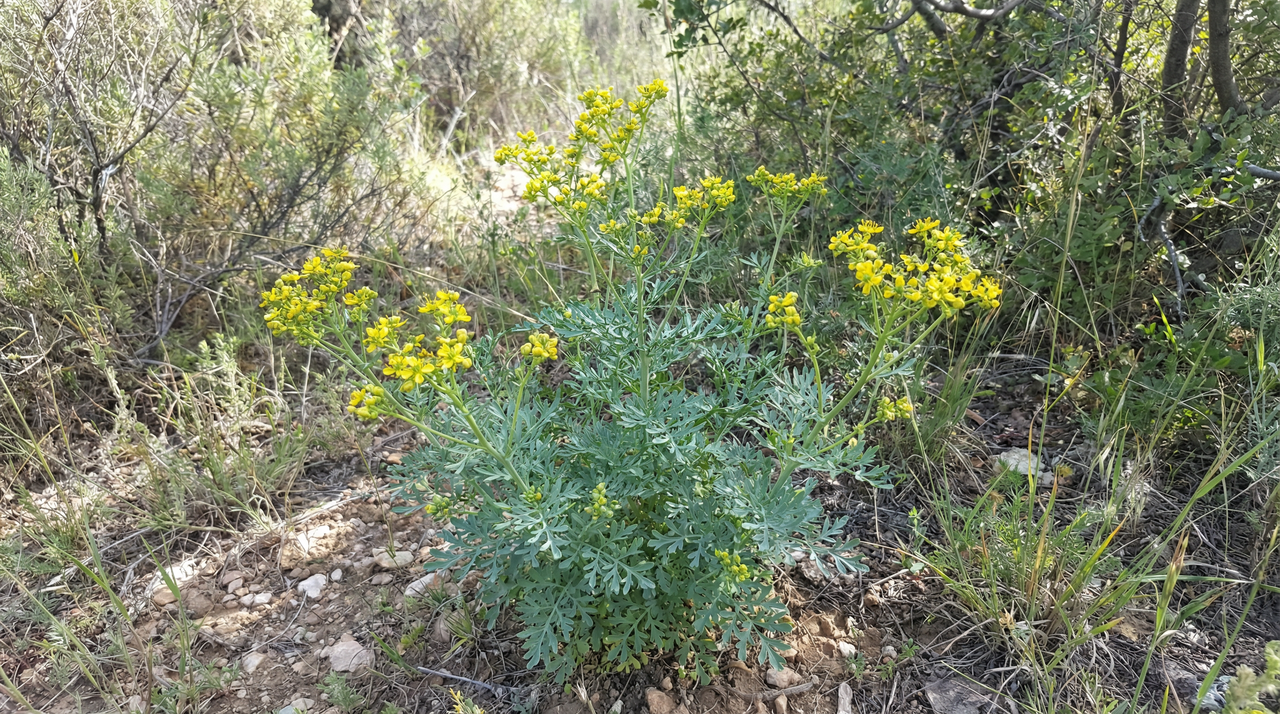
Rue is one of the few plants I've grown that I'd describe as genuinely intimidating. Not because it's difficult—it's actually almost insultingly easy to keep alive—but because it demands a kind of respect that most herbs never ask for. Touch it bare-handed on a sunny afternoon and the furanocoumarins in its oil will have a conversation with your skin over the next 24 hours that you won't enjoy. I learned this secondhand from a gardener in Crete who rolled up her sleeve to show me the ghost of a burn she'd gotten decades earlier, weeding a rue hedge without gloves. The plant had been there longer than she could remember. Her grandmother planted it by the door to keep away the evil eye.
That detail still stops me: a plant so toxic it can blister skin, grown deliberately at the threshold of the home as protection. Rue has always lived in that strange overlap between danger and care, between poison and remedy, between something you'd never eat and something your great-grandmother made tea from. It's one of the oldest cultivated herbs in the Western world, woven through Roman medicine, Shakespearean symbolism, and Latin American folk cleansing rituals all at once. Before you plant it, it's worth understanding exactly what you're inviting in.
Rue Origin, History, and Botanical Background
There's a moment every time I brush past a mature rue plant when I'm reminded that this is not a soft, accommodating herb. The smell hits first, sharp and citrusy with a bitter medicinal undertone that either fascinates or repels depending on who's experiencing it. That intensity is no accident. It goes all the way back to the plant's origins in the rocky scrublands of the Mediterranean Basin, where Ruta graveolens evolved its chemical armor long before anyone had a name for it.
Botanical Background and Native Range of Ruta graveolens
Rue is native to southern Europe (the Balkan Peninsula, Italy, Greece, the Iberian Peninsula), northern Africa (Morocco and Algeria), and parts of the Middle East.[1][2][3] In its home range it grows in the dry, rocky, calcareous soils of garrigue and maquis ecosystems, tolerating elevations up to about 1,400 meters natively and even higher in cultivation.[4][5] These are lean, punishing conditions, and rue adapted accordingly. It's a polycarpic perennial subshrub in the Rutaceae family, meaning it flowers repeatedly over many years rather than dying after a single seed set.[6][7] Typical lifespan in cultivation runs somewhere between 5 and 10 years, though favorable conditions can stretch that to 15 or 20, and in very cold regions it may behave more like a short-lived perennial or even an annual.[8][9][10] I usually plan on 6 to 8 years in warm climates before a plant gets leggy enough to warrant hard rejuvenation or replacement, but that's a rough rule of thumb, not a guarantee.
What really defines rue's persistence is its structure below ground. The plant develops a deep taproot with fibrous lateral roots, and it can resprout from the root crown if the top growth is damaged.[10][11] After placing established rue in several dry-summer Mediterranean-climate designs, I've watched it shrug off months without irrigation that reduced neighboring herbs to straw. That taproot is also why mature plants don't move gracefully; trying to transplant a three-year-old specimen is an exercise in humility. Above that root system, stems are woody at the base and become slightly less so toward the tips, topping out at 60 to 120 centimeters tall and perhaps half that in width.[12] The whole plant is loaded with alkaloids, essential oils, furanocoumarins, and psoralens that deter herbivores and pathogens alike.[10] These compounds explain both rue's long medicinal reputation and the safety concerns that will come up repeatedly as you learn this plant. Rue has naturalized across more than 20 U.S. states, appearing in disturbed areas throughout the South, Midwest, California, and Texas, but it's not federally listed as invasive, and in my own garden I've seen it self-seed without ever becoming genuinely weedy.[9][13]
Visual Characteristics: Identifying Rue in the Garden
Rue is one of those plants you can identify from across a garden before you ever get close enough to smell it. The foliage is a cool, distinctive glaucous blue-green, alternate, 2 to 3 times pinnately compound, with oblong leaflets that give the whole leaf a delicate, fern-like silhouette.[6][14] Hold a leaf up to the light and you'll see the translucent glandular dots that release that sharp, citrus-bitter oil when the tissue is broken. Some clients I've worked with find the scent almost intoxicating; others take one deep breath and immediately back up a step. It's genuinely divisive in a way that only comes from repeated, close-up handling. The plant matures into a compact, bushy, upright form, typically reaching 2 to 3 feet in most gardens, though cultivars like 'Blue Spire' can push toward 3 to 4 feet with good soil and light.[15][16]
From June through August or September, rue covers itself in flat-topped clusters of small, bright yellow four-petaled flowers about a centimeter across.[4][17] After flowering, the plant sets small lobed seed capsules that turn from green to brown as they ripen, eventually splitting to release tiny black seeds.[18][19] Growth habit shifts noticeably with conditions: plants in dry, stressful situations stay compact with smaller foliage, while those in richer, moister soil produce larger leaves and taller flowering stems.[4] If you're trying to identify rue in someone else's garden, the blue-green color plus that unmistakable smell when you brush a leaf is essentially a two-point confirmation.
Traditional, Cultural, and Historical Uses of Rue
Rue's chemistry made it impossible to ignore. By the first century CE, Dioscorides had documented it in De Materia Medica and Pliny the Elder was writing about its medicinal uses and its power to ward off witchcraft.[20][21] It traveled along Roman trade routes, took root in European monastery physic gardens, and was catalogued in John Gerard's Herball in 1597.[22][23] Every community that grew it seemed to arrive at the same conclusion: a plant this pungent, this bitter, this chemically assertive must have power over both body and spirit.
That intuition crystallized into a rich symbolic life. The English name "herb of grace" and the phrase "rue the day" both trace back to rue's deep association with repentance, sorrow, and cleansing. Luke 11:42 references the plant, and in Hamlet, Ophelia's famous line names rue the herb of grace directly.[24][25] Protection against the evil eye runs like a thread through Mediterranean, European, and Latin American traditions; rue was planted near doorways, carried as an amulet, burned as incense, and woven into Catholic purification rituals.[26] In Mexican folk practice it remains central to limpias, spiritual cleansings meant to dispel negative energy. Rue's protective reputation didn't arise from superstition alone. A plant with alkaloids strong enough to deter herbivores, psoralens that can blister skin in sunlight, and a scent that fills a room when you walk past it is going to make an impression on every culture that encounters it. The folklore followed the chemistry.
Across Greek, Roman, Turkish, and European ethnobotanical traditions, rue was applied historically to digestive complaints, menstrual disorders, eye inflammations, gout, and infected wounds.[27][26] These uses are historical, not prescriptive. Rue is genuinely toxic, with a documented history as an emmenagogue and abortifacient, and self-medication with this plant is not something I would ever recommend.[28] The folklore is worth knowing. The chemistry demands respect.
Rue Varieties and Where to Buy Them
Notable Cultivars of Ruta graveolens
The common rue plant most people picture, the straight species with its glaucous blue-green leaves and sharp medicinal scent, has been refined over centuries of cultivation into a surprisingly diverse range of garden forms. Breeders have selected for foliage color, habit, and a somewhat milder fragrance while keeping the ornamental character that made rue a fixture in knot gardens and physic borders for centuries. The lineup today includes 'Aurea' with golden-yellow variegated leaves, 'Variegata' in cream and green, 'Compacta' (a tidy dwarf topping out around 18 inches), the silvery 'Silver' or 'Moonlight' types, 'Blue Spire' with its columnar upright habit, the popular 'Jackman's Blue', and 'Fenland Glory', among others.[4][29] Cultivated selections like these tend to be larger and carry a milder scent compared to their wild Mediterranean ancestors, which are compact, intensely pungent plants adapted to rocky, dry soils.
In my design work, 'Jackman's Blue' is the one I reach for most often in formal borders. That intense steel-blue foliage reads like a visual anchor next to silver companions like lamb's ear or artemisia, and the compact mounding habit stays tidy without much intervention. For smaller urban plots or containers, I'll lean toward 'Compacta' or 'Blue Spire' because you get the same ornamental value without the plant eventually muscling into neighboring beds. Whatever cultivar you choose, the bitter oils and phototoxic furanocoumarins are still present, so respect the plant accordingly.
Sourcing and Purchasing Rue Plants and Seeds
Ruta graveolens is genuinely easy to find. Rooted plants and seeds are available through online retailers, nurseries, and specialty horticultural suppliers including Missouri Botanical Garden plant sales, High Mowing Organic Seeds, and Plant Delights Nursery, along with the usual platforms like Etsy and Amazon.[30][31][6] Expect to pay roughly $6.99 to $9.99 for a 4-inch potted plant, $3.49 to $5.99 for a packet of 50 to 100 seeds, or $2.50 to $4.00 per starter plug. I personally skip the Amazon route when I can and order either rooted plants from Missouri Botanical Garden or certified organic seed from High Mowing, because the quality and sourcing ethics align with what I teach clients about building resilient gardens. Seed viability averages 70 to 80% when stored properly, and in my own trials that range has held up reliably, though fresh seed from reputable suppliers consistently outperforms packets that have been sitting on a warehouse shelf.
The rue plant is a hardy perennial suited to USDA zones 4 through 9,[6] so most North American gardeners are in range. Before you click add to cart, though, check your state's noxious weed list. Ruta graveolens is not federally regulated, but individual states maintain their own restrictions based on local ecological concerns.[32][33][34] I check the USDA and state lists before recommending any new herb to a client, and rue is one where a quick five-minute search is genuinely worth your time.
Rue Propagation and Planting Guide
Rue gives you options, but not all of them are equally worth your time. I've started plants from seed, from cuttings, and by dividing established clumps, and each method taught me something different about what this plant actually wants. Before anything else, though: gloves. Every single time you handle rue, wear them. The furanocoumarins in the sap cause phytophotodermatitis, a blistering, weeping rash that shows up days after skin contact with sunlight.[6][35] Since the risk of phytophotodermatitis is high when handling stems, always maintain a strict glove policy.
Rue Seed Morphology, Viability, and Germination
Rue seeds are tiny, angular to ovoid, dark brown to nearly black, with a hard endosperm and a ridged, tuberculate surface.[5][36] They're monoembryonic, meaning each seed produces one seedling, and they store reasonably well: 2-5 years under cool, dry home conditions and considerably longer in proper seed-bank storage.[37][38] Use fresh seed if you can; germination rates drop noticeably with age.
Dormancy from seed coat impermeability is the main hurdle. Cold moist stratification for 1-3 months at 4-10°C, scarification, or alternating temperature cycles all help break it.[39] Light exposure matters too; don't bury these deeply. With fresh seed, good pre-treatment, and consistent moisture in sterile media, you can push germination rates to 60-90% at 15-21°C, usually within two to three weeks, though the window stretches to eight weeks with older or untreated seed.[40]
Here's the bigger issue with seeds: rue is outcrossing, which means seedlings are genetically variable and rarely true-to-type.[41][42] After a few seasons of nurturing rue seedlings for months, only to get plants with wildly varying foliage color and bitterness, I stopped expecting consistency from seed. Label every flat carefully too; young rue seedlings look nearly identical to carrot or parsley in the first few weeks, a detail I wish someone had warned me about before I mixed up an entire propagation bench.
Vegetative Propagation Methods for Rue
For anything resembling predictability, semi-hardwood cuttings are the method I rely on. Take 5-10 cm tips from non-flowering new growth in late spring to early summer, treat the cut end with IBA rooting hormone at 1000-3000 ppm, and stick them into a perlite-vermiculite mix kept at 18-24°C under high humidity. Done right, you're looking at 70-95% rooting in 3-6 weeks.[43][44] Hardwood cuttings drop to 20-50% and aren't worth the effort when softwood timing is so reliable.
Ground layering in spring or early summer works, as does dividing established clumps every 3-4 years, with success rates of 50-90% when divisions carry healthy roots into well-drained media.[43][45] Both preserve the genetics of the parent plant, which matters if you've found a compact form with good blue-green color. Tissue culture achieves excellent results but requires sterile lab conditions, and grafting is impractical given the plant's semi-woody habit and low compatibility rates.[46][47] Wear gloves and cover your arms for every one of these operations, every time.[6]
Soil, Site Selection, and Planting Technique for Rue
Think about where rue comes from: rocky Mediterranean slopes, thin calcareous soil, full sun, very little water. That's the template. Rue wants lean, well-drained soil with low organic matter (roughly 2-5%), a pH of 6.5-7.5, and at least 6-8 hours of direct sun daily.[6][48] In heavier clay or waterlogged ground, it fails quickly to root and crown rot, no exceptions.
I grow rue in the same dry sunny bed as my lavender and rosemary, and that's not an accident. All three share the same Mediterranean preference for gritty, low-nutrient soil, and they look good together doing it. The plants in my leanest, sandiest spots consistently produce denser, more aromatic foliage than anything I've grown in amended beds. Excessive fertility produces leggy, weak growth and, based on what I've seen, dilutes the essential oils that make rue worth growing in the first place.[49]
If your soil runs acidic, amend with lime before planting; I test my beds each spring and correct as needed since rue in overly acidic soil just sulks.[50] For containers, a mix of 40-50% potting soil, 30-40% coarse sand or perlite, and 20% organic matter at pH 6.5-7.5 works well, and the pot needs to be at least 30 cm deep to accommodate the taproot without constricting it.[49][51] Drainage holes are non-negotiable.
Spacing, Timing, and Transplanting Rue
Mature rue reaches 60-90 cm tall and wide with a full, bushy habit.[52] Space plants 30-45 cm apart with rows 60-90 cm between them, or plant 3-4 per square meter in a border setting.[53][54] In humid climates I always go toward the wider end of that range; the extra airflow reduces the powdery mildew pressure I've dealt with in wetter summers. Keep rue away from paths where children or pets might brush against it.
Start seeds indoors 6-8 weeks before the last frost, or direct sow after soil warms to 15°C. Transplant seedlings at 8-10 cm tall once frost risk has passed, or in fall in milder zones.[49][48] Rue is hardy in USDA zones 4-9, and plants started indoors can reach flowering size in their first year, while direct-sown plants often take until year two.[5] That timeline difference is another reason I default to cuttings: a rooted cutting from a plant I already trust gets me to a productive, established specimen faster than almost any seed-grown alternative.
Rue Care Guide: Growing and Maintaining Ruta graveolens
If you want a plant that punishes neglect, rue is not it. What this tough Mediterranean subshrub actually punishes is excessive attention: too much water, too much fertilizer, too much shade. I grow it in zone 9B Central Florida, which is about as far from its rocky Adriatic homeland as you can get without leaving the continent, and I've found that once established, it asks for almost nothing. Getting it to that point is the real skill.
Water Needs for Rue
Young plants need regular watering until their root system goes deep, but the transition from "keep moist" to "mostly ignore" happens faster than you'd expect, often within the first growing season. Established rue can go two to four weeks without water under moderate conditions.[4][5] Once mine settled in, I shifted to watering only when the top inch or two of soil was completely dry, and that simple rule has kept them healthy through brutal Florida summers.[4][55] It was overwatering that killed my first specimen, not drought. Yellowing leaves working upward from the base are the early warning sign of too much moisture; leaf curling and browning tips point the other direction toward too little.[4][56] Winter watering should taper off considerably regardless of your zone.
Sunlight Requirements
Rue wants full sun, at least six to eight hours daily, and it repays that light with compact growth, heavy flowering, and the highest concentration of its aromatic essential oils and rutin.[4][55] Think of it the same way you'd think about rosemary or lavender: shade produces leggy, less aromatic plants that are more susceptible to rot. That said, in July and August here in Florida, I watch my plants closely for bleaching and leaf scorch. If the sun is relentless and afternoon temperatures are regularly above 95°F, a bit of afternoon shade does more good than harm.
Feeding and Soil Preferences
Rue genuinely prefers poor soil. Sandy or loamy, well-drained, and leaning neutral to slightly alkaline (pH 6.0 to 7.5) describes its ideal home.[4][55][8] I never fertilize my established plants. Rich soil makes them floppy and dilutes the essential oils that make the plant worth growing in the first place. If you feel compelled to feed at all, a single light application of a low-nitrogen formula like 5-10-10 in early spring is the limit, and skip it entirely in summer.[4][57] Rue is genuinely well-suited to the dry, lean guilds I talked about in the permaculture design section, partly because most plants grown alongside it don't want heavy feeding either.
Heat and Frost Tolerance
Rue's Mediterranean heritage gives it a wide thermal range. It's hardy from USDA zones 4 through 9, with an RHS H6 rating that puts its cold tolerance down to -20°C (-4°F).[4][48][5] In zones 4 and 5, a few inches of organic mulch applied after the ground freezes will help the roots survive. Even after frost damage, browning leaf edges and blackened stem tips, the plant typically resprouts vigorously from the crown once temperatures climb again, as long as drainage is good.[4][58] I've watched it happen in my own garden after unexpected cold snaps: the foliage looks rough for a few weeks, then new growth appears from the woody base as if nothing happened.
On the heat end, rue tolerates temperatures up to 100°F and higher in well-drained conditions, though vegetative growth is happiest between 59 and 82°F.[4][59] When temperatures push past 95°F, watch for leaf scorch and wilting, and if you're regularly above 104°F, seedlings especially will struggle.[4][59] I run a 30% shade cloth over mine in peak July heat and see noticeably less scorch on covered plants compared to exposed ones. Mulch, deep infrequent irrigation every seven to ten days, and cooler nights all help the plant recover.[44][60]
Pruning and Maintenance
I used to prune rue like lavender, cutting it back hard in spring, and I lost a full season of flowers because of it. Now I trim spent flower stems by about one-third after bloom and leave the rest alone.[4][61] That lighter touch encourages stronger regrowth and keeps the plant from going fully woody. Every three or four years, older plants do benefit from a more deliberate renewal prune in late winter, cutting back to encourage fresh growth from the base and extend the plant's productive life. But heavy pruning mid-season is a reliable way to sacrifice flowering, so resist the urge.
Protect your hands and arms during pruning, as the sap is severely phototoxic when triggered by sun exposure after skin contact with the plant's oils.[4][62] I've seen blistering on my own forearms from careless summer pruning, and that was enough to make long sleeves a non-negotiable habit. All parts of the plant are also toxic if ingested, so keep children and pets well clear of it.[4][62] This is genuinely the one area where rue demands real vigilance rather than benign neglect.
Seasonal Rhythm and Lifespan
Rue is a polycarpic perennial that flowers from June through September and follows a predictable rhythm of vigorous spring growth, summer bloom, and winter slowdown.[5][63] In warmer zones like mine, it stays evergreen and flowers reliably through summer without much fuss. Gardeners in zones 4 through 6 will see it behave more like a deciduous herb, dying back to the crown and resprouting in spring. Either way, it's the same tough plant underneath. With good drainage and reasonable care, rue lives three to ten years, though specimens under genuinely ideal conditions have been documented lasting much longer.[5][63] Compared with more demanding Mediterranean herbs I've grown, rue is refreshingly forgiving as long as you respect its need for lean soil, good sun, and restrained watering.
Harvesting Rue (Ruta graveolens)
Before anything else: put on gloves. I don't say that as a formality. I learned this lesson the hard way early in my growing career, when I harvested rue on a warm July morning without them and spent three days dealing with a painful phytophotodermatitis reaction on my forearms. The blistering, the burning, the lingering hyperpigmentation. Never again. Rue's oils are phototoxic, and sun exposure after skin contact turns what seemed like a minor inconvenience into a genuinely miserable experience.[64][65] I've also noticed the reaction seems noticeably worse on hot, sunny days versus overcast ones, so if I'm harvesting in summer, I try to work in the morning before full sun hits the bed.
When and How to Harvest Rue Leaves, Flowers, and Seeds
For leaves, the window is late spring through early summer, roughly May through July in zones 5-9, and morning harvests on dry days are best because essential oil content peaks then and the foliage is less bitter.[6][64][65] What you're looking for is lush, blue-green foliage before the flower stalks fully emerge. Once rue puts its energy into blooming, leaf quality declines. If you've grown your plant from seed, hold off until the second year.[64][6] I made the mistake of harvesting my first seed-grown rue at about four months old, and the plant sulked for the rest of the season. Cuttings-grown plants are more forgiving and can typically yield leaves within 3 to 6 months of establishment.[64]
Flowers come at full bloom in early summer, around 70 to 90 days after planting.[66] For seeds, wait until the pods go papery and brown, typically 90 to 120 days after flowering in late summer or fall. Reliable seed production tends not to happen until the third year from sowing, so don't be discouraged by a sparse first crop.[66][64]
Safe Harvesting Techniques and Post-Harvest Handling
Cut leaf stems 2 to 3 inches above the base, always leaving enough growth that the plant can recover and bush back out.[6][67] A light prune after harvesting encourages that bushy regrowth and keeps the plant from going leggy. For seeds, bring the brown pods indoors and let them finish drying before extracting, since field-dried pods can split and scatter before you've collected anything useful.
Expected Yields and Flavor Considerations
A mature rue plant yields roughly 0.5 to 1 kg of fresh leaves annually, or around 100 to 200 grams dried, with soil fertility and irrigation pushing results toward the higher end of that range.[6] Younger leaves are always preferable; the flavor intensifies into a sharp, acrid bitterness as the foliage matures.[6] That said, most gardeners I know grow rue for its ornamental value and pest-deterrent role rather than for any culinary purpose. Its toxicity profile makes internal use something to approach with serious caution, and the preparation and uses section covers that terrain in full.
Rue (Ruta graveolens) Preparation and Uses
Rue sits in an unusual category among garden herbs: beautiful, historically significant, phytochemically rich, and genuinely hazardous. Before we get into what it has been used for, that last point needs to be front and center.
Important Safety Considerations Before Using Rue
All parts of Ruta graveolens are considered toxic if consumed improperly, with documented risks including severe gastrointestinal distress, phytophotodermatitis, neurological effects, and organ damage.[68][69][70] Pregnant individuals should avoid it entirely; the evidence on its abortifacient activity is consistent enough that I flag rue as off-limits in my herb garden consultations for anyone who is pregnant or trying to conceive, no exceptions.[71][68] There is no standardized safe internal dose. The furanocoumarins and alkaloids responsible for its medicinal reputation are the same compounds that make it dangerous, and the health benefits section covers that chemistry in detail. Keep that in mind as context for everything below.
Culinary Applications and Historical Flavoring Uses
Today, rue is best understood as an ornamental and medicinal plant rather than a kitchen herb, and most contemporary sources simply don't recommend eating it.[5][72][73] Historically, though, cooks in Mediterranean, Ethiopian, and Italian traditions used young leaves and seeds in quantities under one gram, fresh, as a bitter flavoring in soups, breads, cheeses, and cured meats, or infused into liqueurs like grappa alla ruta.[28][74] The flavor is intensely bitter and pungent, with citrus, camphor, and eucalyptus undertones dominated by monoterpenes and 2-undecanone, and that medicinal sharpness only intensifies as the plant matures.[75][76] I've tasted it carefully, just a small bruised leaf. Think wormwood or gentian, that same lingering, almost aggressive bitterness. It's not subtle.
The leaves shift from soft and velvety when young to leathery and fibrous at maturity, and that physical change tracks the escalating chemical intensity.[4][77] Rue is rich in rutin and quercetin,[78] but detailed nutritional data barely exists because rue simply isn't tracked as a food crop.[79] The phytochemical richness is real; the culinary application is history.
Traditional Medicinal Preparations
Across European and Turkish folk traditions, leaves have been prepared as infusions, tinctures, and poultices for digestive complaints, menstrual irregularities, rheumatism, eye inflammations, and wound healing.[80][27][81] A rue plant tea sounds approachable, but those same toxicity warnings apply fully here. I'd leave any therapeutic preparation to a trained clinical herbalist who can account for individual sensitivity, dosage, and drug interactions.
Non-Food and Ornamental Uses
Rue's essential oil has legitimate non-culinary applications: aromatherapy, topical preparations for joint pain and rheumatism, and insect repellency; poultices from leaves have traditionally been applied for bruises and localized inflammation, though skin sensitivity remains a real concern with direct contact.[27] In my own xeriscape and dry-garden designs, rue earns its place purely on the strength of that blue-green foliage, which holds structure and color through heat and drought in ways most herbs simply can't manage.[4] Grown as a border specimen or structural element in an herb garden, respected rather than snacked on, rue rewards the gardener with something genuinely beautiful and ecologically interesting.
Rue Health Benefits and Medicinal Uses
Rue has one of the most chemically complex profiles of any herb growing in my garden, and I want to be direct before going any further: that complexity is exactly why it demands so much respect. The same compounds that gave rue its centuries-long medicinal reputation are responsible for some genuinely serious toxicity. Understanding one requires understanding the other.
Key Phytochemicals in Rue
Ruta graveolens synthesizes a remarkable range of secondary metabolites. The alkaloid fraction includes graveoline, skimmianine, and arborinine; the flavonoid fraction centers on rutin, which can reach 2-3% of leaf dry weight, alongside quercetin and kaempferol.[82][83] The furanocoumarin family, including psoralen and bergapten, sits alongside coumarins like umbelliferone and scopoletin. Then there's the essential oil, dominated by 2-undecanone at concentrations up to 50-70%, with limonene and pinene rounding out the volatile profile.[84] The distribution of these compounds shifts depending on which part of the plant you're examining. Leaves carry the highest concentrations of flavonoids and coumarins, roots are richest in coumarins and furoquinolines, and volatile compounds peak in flowers and seeds.[85] Season matters too, with alkaloid levels climbing in summer,[86] and geography plays a role: Mediterranean populations tend to run higher in 2-undecanone, while temperate-grown plants often show elevated flavonoids.[87]
All of this chemistry exists because the plant evolved it for its own protection. The glandular trichomes visible on rue's leaves and stems actively secrete essential oils and furanocoumarins as defenses against herbivores, pathogens, and competing plants.[82] In my hot, humid subtropical conditions, freshly pruned rue smells noticeably more intense than the same plant would in a cooler climate, and I'm convinced my plants are more phototoxic for it. The research on geographic and seasonal variation supports that observation.
Medicinal Research and Traditional Uses
Folk medicine traditions across the Mediterranean and Middle East have used rue for rheumatic pain, digestive complaints, menstrual irregularities, skin conditions, and as both an emmenagogue and antispasmodic for centuries.[88] The preclinical science gives you some sense of why those traditions took hold. In vitro and animal studies document COX-2 inhibition, NF-κB suppression, and reduced inflammatory cytokines like TNF-α and IL-6; antioxidant activity with DPPH IC50 values in the 20-50 μg/mL range; antimicrobial action against Staphylococcus aureus and Candida albicans; and analgesic effects comparable to aspirin in writhing-test models.[89][90][91] Additional preclinical findings point toward apoptosis induction in breast and colon cancer cell lines, improved glucose tolerance in diabetic rat models, and GABAergic sedative and spasmolytic activity.[92]
Interesting lab results and clinical usefulness are very different things. Almost all of this evidence comes from cell cultures and rodent models; robust, well-controlled human clinical trials essentially don't exist.[93] When I want anti-inflammatory support in my own herbal practice, I reach for turmeric or ginger without hesitation. The preclinical story for rue is compelling enough to follow in the literature, but nowhere near compelling enough to justify internal use given what's coming in the safety section.
Nutritional Profile of Rue
Some nutritional figures exist in the literature: rough estimates put fresh rue leaves at around 45 kcal per 100g, with approximately 3g protein, 9g carbohydrates, 3.5g fiber, and 50-100mg vitamin C, plus notable dried-weight calcium and potassium figures.[94][95][96] These numbers aren't standardized across any major database, and I'd treat them as rough estimates at best. More to the point, they're largely academic, because all parts of the plant are considered toxic and authorities do not regard rue as a safe food.[70][97] The antioxidant content from its flavonoids is real, but the compounds sitting right alongside those flavonoids make consumption inadvisable.
Safety and Toxicity Concerns
Every part of Ruta graveolens is toxic—that's not a caveat, it's the baseline. The alkaloids graveoline and skimmianine, along with furanocoumarins including psoralen, bergapten, and xanthotoxin, are responsible for both systemic toxicity and severe phototoxicity.[98][99] Ingestion causes gastrointestinal irritation, nausea, vomiting, and diarrhea at lower doses; at higher doses, documented outcomes include neurological symptoms, liver and kidney damage, convulsions, and death.[100][101] Rue is also a confirmed abortifacient.[100]
Skin contact is its own category of hazard. The furanocoumarins in rue's sap cause phytophotodermatitis, meaning contact followed by sun exposure produces blistering, burns, and lasting hyperpigmentation.[102][103] This happens with dried material as well as fresh. I always prune rue in long sleeves and thick gloves, and I've still found faint phototoxic spotting on my wrists after a sunny pruning session. If you've seen giant hogweed or wild parsnip burns, you have a frame of reference; rue is milder but operates by the same furanocoumarin photoactivation mechanism.
Rue is categorically contraindicated during pregnancy and breastfeeding.[104] The drug interaction list is serious: rue potentiates anticoagulants like warfarin and inhibits both MAO-A and MAO-B, creating the potential for dangerous interactions with antidepressants, stimulants, and certain foods.[105][106] Toxin levels run highest in young leaves, in sun-exposed plants, and during warmer months, which means the plant you're harvesting in peak summer is more dangerous than the one you deadheaded in April.[8] No safe internal dose has been established. After reviewing documented cases of miscarriage and liver stress associated with rue preparations, I no longer experiment with even small amounts internally and give my clients the same guidance.
The FDA recognizes rue oil as a flavoring agent only in minute quantities as part of processed food formulations, and the plant itself is not approved for therapeutic use.[107] It is toxic to dogs, cats, and horses, so placement in a garden shared with pets requires real planning.[35] The ruta graveolens benefits discussed in traditional and preclinical literature are real enough to study, but not sufficient to overcome a toxicology profile this serious. Grow it, admire it, let it do its work as a companion plant, and leave the internal uses to professional clinical supervision.
Rue Pests and Diseases
Natural Pest Resistance of Rue
Pick a sprig of rue on a hot afternoon and you'll notice your fingers come away sticky, with a scent that's equal parts citrus and something almost medicinal. That's the glandular trichomes doing their job, releasing a cocktail of alkaloids, quinones, rutin, and volatile oils that function as repellents, antifeedants, and outright toxins to insects.[108][109] I've noticed that mine smell stronger and feel tackier in dry summer heat, which tracks with what I see in the garden: fewer pests on neighboring plants when rue is at its most aromatic.
The numbers back up what gardeners observe. Aphid colonization drops by 70 to 90% around rue, and stored-product pests like granary weevils see 80 to 100% mortality within 24 to 48 hours of exposure to rue extracts.[110][111] Whiteflies show 30 to 50% repellency, mosquitoes land significantly less often, and root-knot nematode egg hatching is inhibited by up to 60%.[112][113] Much of this research is lab-based or uses concentrated extracts, but when I moved rue to the edge of a rose bed that had been struggling with aphids, the difference in the following season was hard to ignore. Standard cultivars like 'Jackman's Blue' and 'Variegata' carry these same properties, so cultivar choice doesn't change the calculus much here.[114]
Rue also deters deer, rabbits, Japanese beetles, and flies, making it a genuinely useful guild member at sunny edges and borders.[115] That said, aphids and spider mites can still appear, especially on plants that are stressed or crowded. Insecticidal soap, neem oil, or a release of ladybugs handles both quickly.[116][117] A healthy plant in full sun rarely needs anything beyond occasional intervention. One caveat worth mentioning: rue self-seeds readily and can take over neglected corners. I pull volunteers as soon as I spot them, which keeps the plant where I actually want it.[118]
Disease Resistance and Vulnerabilities
Rue's phytochemical defense extends to pathogens. The same alkaloids, coumarins, flavonoids, and essential oils that deter insects also inhibit microbial growth, giving rue a broadly resistant disease profile that outperforms many of its Rutaceae relatives, including citrus.[119][120] I've rarely lost a rue plant to disease when I give it the gritty, well-drained soil it prefers, and that's not an accident.
The two real vulnerabilities are root rot and powdery mildew, and both are almost entirely cultural in origin. Root rot from Phytophthora, Fusarium, or Pythium is the more serious of the two; it follows overwatering or heavy, poorly drained soil almost every time.[44] I learned this early on when I planted into unamended clay and watched a first-year plant collapse before I understood what rue actually needs underfoot. Since switching to a gravelly, amended mix with sharp drainage, I haven't had a repeat. Powdery mildew appears in humid, stagnant conditions, particularly when plants are crowded. Spacing rue 18 to 24 inches apart and keeping it in at least six hours of direct sun is the primary prevention.[117][121] If mildew does appear, I've had better results with a baking soda and dish soap spray than with neem at that stage; neem feels more useful as a preventive than a cure once you're already seeing white fuzz.
Leaf spot (Alternaria or Septoria), occasional rust, and low-level susceptibility to Botrytis or bacterial leaf spot exist on the books but rarely show up in practice when drainage and airflow are correct.[122][123] Rue also shows high resistance to Verticillium wilt. No cultivar offers meaningful extra disease protection over the species; 'Variegata' and 'Blue Spire' may show better general vigor in good conditions, but site and stewardship matter far more than variety selection.[124][4]
Rue in Permaculture Design
Rue is one of those plants that rewards designers who think like ecologists first. Everything about how it grows, where it thrives, and what it does to its neighbors traces back to that rugged Mediterranean hillside origin: thin, rocky, calcareous soil; intense sun; long dry summers; and a biological imperative to defend itself chemically from anything that might want to eat it. Understanding that context makes the design decisions much clearer.
Climate Adaptability and Hardiness Zones
Rue is genuinely adaptable across a wide swath of North American climates, hardy from USDA zones 4 through 9, with best performance in zones 5 through 8.[6][70] In zone 4, where temperatures can plunge to -30°F, a two-to-four inch mulch layer applied after the ground freezes gives the woody rootstock enough insulation to bounce back in spring.[125] At the hot end of that range, leaf scorch becomes a real concern above 95°F in full sun, and I've found that even a bit of afternoon shade during peak summer heat makes a visible difference in how the foliage holds up.[126]
Once established, rue is genuinely drought-tolerant, preferring modest annual rainfall of around 400 to 800 mm concentrated in the cooler months, which mirrors the Mediterranean wet-winter, dry-summer pattern it evolved under.[127] What it cannot tolerate is consistently wet roots in winter; research on water stress responses confirms that waterlogged conditions trigger root rot quickly in this species.[128] I actually use rue in some of my coastal and sandy-site designs precisely because of its moderate salt tolerance and its ease in poor, well-drained soil where more finicky herbs struggle.[70][129] In my zone 9B garden, the two threats are compacted, water-retentive clay and excessive summer humidity; raised beds and a gravel mulch solve both.
Ecosystem Functions and Pollination Services
Rue's small yellow flowers, each a neat open bowl about half an inch across, bloom in terminal clusters from June through September.[10] That open corolla shape is the key design detail: it makes nectar and pollen accessible to a genuinely broad range of insects. Honeybees and bumblebees are the primary visitors, but hoverflies, butterflies, and beetles all work the blooms reliably.[130][131] In my own borders, the midsummer flush of yellow flowers draws clouds of hoverflies that I don't see on neighboring plants in anything like the same numbers. For a plant this compact and unfussy, that insectary value is significant.
Beyond pollinator support, rue functions as a pioneer on disturbed or degraded ground. Its fibrous root system stabilizes thin, rocky, or sandy soils, which makes it a sensible choice for erosion-prone edges or dry terraces where you want ground cover that doesn't need babying.[132][133]
Forest Layer Placement and Guild Considerations
Rue is a low-growing subshrub, typically one to two feet tall, with a taproot and woody base.[10] That puts it squarely in the herbaceous to low-shrub layer of a food forest design, and it belongs on sun-drenched edges, not under canopy. Shaded understory positions are simply wrong for this plant; it needs full sun to thrive and to express its volatile oil chemistry.[134]
The guild story gets complicated here, and I want to be direct about it. Rue releases coumarins, flavonoids, and essential oils from both its roots and foliage that actively inhibit seed germination and suppress the growth of neighboring plants.[135][136] I learned this the uncomfortable way early in my design career, when a rue I'd tucked near a vegetable bed left me with stunted lettuce seedlings and no obvious explanation until I started pulling the research. Keep rue well away from food crops and sensitive perennials. The same chemistry that makes it effective at suppressing weeds and deterring aphids, flea beetles, and Japanese beetles makes it genuinely antagonistic to a lot of what we're trying to grow nearby.[137]
Where rue does belong is in dedicated insectary strips, dry Mediterranean herb guilds, or isolated sunny borders. Paired with lavender, rosemary, or other drought-tolerant Mediterranean subshrubs, it forms a low-maintenance pollinator planting that suits both its chemistry and its aesthetic.[138] It does not fix nitrogen, so it's contributing pollinator habitat and pest deterrence rather than soil fertility.[139] Finally, the phototoxic furanocoumarins in rue's sap pose a real hazard to anyone handling it in sunlight. I always wear gloves and long sleeves when pruning rue on sunny days; the combination of its sap and UV exposure can produce a painful burn I've seen more than once.[140] Design it somewhere you can appreciate it visually and harvest from it carefully, not somewhere it's constantly underfoot or adjacent to children and pets.
The Plant I Always Warn People About, Yet Still Grow
I've handed out more rue cuttings than I can count, and every single time I say the same thing: gloves, always gloves. There's something almost medieval about it, this blue-green subshrub that smells like nothing else in the garden and asks so little while giving back so much to the ecosystem around it. I keep it at the sunny edge of my food forest where I can see it every day, which I think is exactly where rue has always wanted to be: close enough to matter, not so close you forget what it is.
Sources 140
- Ruta graveolens L. ↩
- Ruta graveolens ↩
- Ruta graveolens L. ↩
- Ruta graveolens ↩
- Ruta graveolens L. ↩
- Ruta graveolens ↩
- Ruta graveolens ↩
- Ruta graveolens ↩
- Ruta graveolens L. ↩
- Biology and Ecology of Ruta graveolens ↩
- Rue (Ruta graveolens) Plant Profile ↩
- Ruta graveolens ↩
- Rue - Ruta graveolens ↩
- Ruta graveolens L. ↩
- Plant Finder - Ruta graveolens ↩
- Rue (Ruta graveolens) ↩
- Rue (Ruta graveolens) ↩
- The Plant List: Ruta graveolens ↩
- Ruta graveolens ↩
- Ruta graveolens - Missouri Botanical Garden Plant Finder ↩
- De Materia Medica - Dioscorides ↩
- Plants and Gardens in the Monasteries ↩
- Rue in Herbal History ↩
- Luke 11:42 ↩
- Rue: Symbolism in Chaucer and Shakespeare ↩
- Rue: The Herb of Grace in Folklore and Medicine ↩
- Ethnobotanical Review of Ruta graveolens in the Mediterranean Basin ↩
- Historical Uses of Rue in Ancient Medicine ↩
- Royal Horticultural Society - Rue Cultivars ↩
- Plant Finder: Ruta graveolens ↩
- Certified Organic Seeds ↩
- USDA APHIS State Noxious Weeds List ↩
- California Noxious Weed Regulations ↩
- Arizona Noxious Weeds List ↩
- Rue (Ruta graveolens) Toxicity and Handling ↩
- Seed Morphology of Ruta graveolens ↩
- Seed Information Database - Ruta graveolens ↩
- Germplasm Resources Information Network (GRIN) - Ruta graveolens ↩
- Germination of Rue (Ruta graveolens) Seeds ↩
- Seed Germination of Rue (Ruta graveolens L.) ↩
- Ruta graveolens ↩
- Hybridization in the Genus Ruta ↩
- Propagation of Rue (Ruta graveolens) ↩
- Vegetative Propagation of Rue (Ruta graveolens) ↩
- Vegetative Propagation Techniques for Rue ↩
- Micropropagation Protocol for Ruta graveolens L. ↩
- Grafting Techniques in the Rutaceae Family ↩
- Ruta graveolens ↩
- Rue (Ruta graveolens) Plant Profile ↩
- Soil Requirements for Mediterranean Herbs ↩
- Ruta graveolens ↩
- Ruta graveolens ↩
- How to Grow Rue (Ruta graveolens) ↩
- Ruta graveolens Plant Care Guide ↩
- Royal Horticultural Society - Rue ↩
- Drought Stress in Herbaceous Perennials ↩
- Rue (Ruta graveolens) Growing Guide ↩
- Frost Damage in Herbaceous Perennials ↩
- Heat Stress Effects on Seedling Growth and Physiology of Ruta graveolens ↩
- Heat Stress Responses in Medicinal Plants: A Focus on Antioxidant Systems ↩
- Royal Horticultural Society - Rue ↩
- Royal Horticultural Society - Rue ↩
- Missouri Botanical Garden - Ruta graveolens ↩
- Growing Rue (Ruta graveolens) ↩
- Growing Rue in the Home Garden ↩
- Missouri Botanical Garden - Ruta graveolens ↩
- Ruta graveolens (Common Rue) - Harvesting and Propagation ↩
- Plants of the World Online - Ruta graveolens ↩
- Ruta graveolens Toxicity ↩
- Ruta graveolens ↩
- Rue (Ruta graveolens) - Drugs and Lactation Database ↩
- Ruta graveolens ↩
- Toxicity of Rue (Ruta graveolens L.) ↩
- Rue: A Forgotten Herb in Italian Cuisine ↩
- Essential Oil Composition of Ruta graveolens L. at Different Harvest Times ↩
- Flavor Chemistry of Rue Leaves: Age and Processing Effects ↩
- Essential Oil Composition of Ruta graveolens L. from Different Plant Organs ↩
- Phytochemical and Pharmacological Profile of Ruta graveolens L. ↩
- USDA FoodData Central Search (No direct entry for rue; similar to herbs like parsley) ↩
- Missouri Botanical Garden Plant Finder ↩
- Traditional Uses of Medicinal Plants in Turkey ↩
- Phytochemical and Pharmacological Profile of Ruta graveolens L. ↩
- Phytochemistry and Pharmacological Activities of Ruta graveolens: A Review ↩
- Chemical Composition of Ruta graveolens Essential Oil ↩
- Chemical Constituents of Ruta graveolens Organs ↩
- Seasonal Variation in Secondary Metabolites of Ruta graveolens ↩
- Geographic Variation in Chemical Constituents of Ruta graveolens ↩
- Ruta graveolens: A Comprehensive Review on Phytochemistry, Pharmacology and Ethnomedicinal Uses ↩
- Antioxidant and Anti-inflammatory Activities of Ruta graveolens ↩
- Antimicrobial Properties of Ruta graveolens Against Bacterial Pathogens ↩
- Analgesic and Antispasmodic Effects of Rue in Animal Models ↩
- Pharmacological Review of Ruta graveolens: An Update ↩
- Ruta graveolens: A Systematic Review of Its Pharmacological Properties ↩
- USDA PLANTS Database ↩
- Phytochemical and Pharmacological Profile of Ruta graveolens ↩
- Mineral Composition of Some Medicinal Plants ↩
- Ruta graveolens - Wikipedia ↩
- Toxicology of Ruta graveolens: Alkaloid and Furanocoumarin Profiles ↩
- Ruta graveolens - Plant Detail Sheet ↩
- Toxicity of Ruta graveolens in humans and animals ↩
- Herbal Medicine: Biomolecular and Clinical Aspects - Rue ↩
- Rue (Ruta graveolens) - Royal Horticultural Society Poisons ↩
- Phototoxicity of Ruta graveolens: Environmental Influences ↩
- Rue - Ruta graveolens ↩
- Ruta graveolens as a potential source of neuroactive compounds ↩
- Rue: Overview, Uses, Side Effects, Precautions, Interactions ↩
- FDA Substances Added to Food: Rue Oil (Ruta graveolens L.) ↩
- Ruta graveolens: A Review of Its Traditional Uses, Phytochemistry and Pharmacological Activities ↩
- Glandular Trichomes and the Defense of Ruta graveolens against Herbivores ↩
- Toxicity of Rue Extracts to Aphids and Whiteflies in Laboratory Conditions ↩
- Insecticidal Activity of Ruta graveolens Essential Oil Against Stored-Product Pests ↩
- Repellent Properties of Ruta graveolens Against Aedes aegypti ↩
- Field Evaluation of Rue for Nematode Resistance in Horticultural Crops ↩
- Cultivars of Ruta graveolens ↩
- Companion Planting with Rue for Pest Control ↩
- Managing Pests in Rue Plants ↩
- Integrated Pest Management for Rue (Ruta graveolens) ↩
- Invasive Plants in North America: Rue ↩
- Ruta graveolens Resistance to Plant Pathogens ↩
- Antifungal Activity of Ruta graveolens Extracts ↩
- Ruta graveolens Fact Sheet ↩
- Common Diseases of Herbaceous Perennials ↩
- Rue (Ruta graveolens) Plant Care & Growing Guide ↩
- Cultivars and Hybrids of Rue ↩
- Winter Care for Perennials ↩
- Ruta graveolens Plant Profile ↩
- Ruta graveolens Plant Profile ↩
- Julier et al. (2020) - Water Stress and Disease Responses in Ruta graveolens (Horticultural Research Journal) ↩
- Growing Rue in Coastal Gardens - University of California Agriculture ↩
- Pollination Ecology of Ruta graveolens ↩
- Insect Pollinators in Mediterranean Flora ↩
- Plant Fact Sheet for Ruta graveolens ↩
- USDA PLANTS Database Profile for Ruta graveolens ↩
- Ecological Requirements of Rue (Ruta graveolens L.) ↩
- Allelopathic Potential of Ruta graveolens on Lettuce Germination ↩
- Allelopathic Effects of Ruta graveolens in Mediterranean Ecosystems ↩
- Companion Planting with Rue ↩
- Rue in Permaculture and Food Forests ↩
- Toxicity of Ruta graveolens ↩
- Ruta graveolens ↩