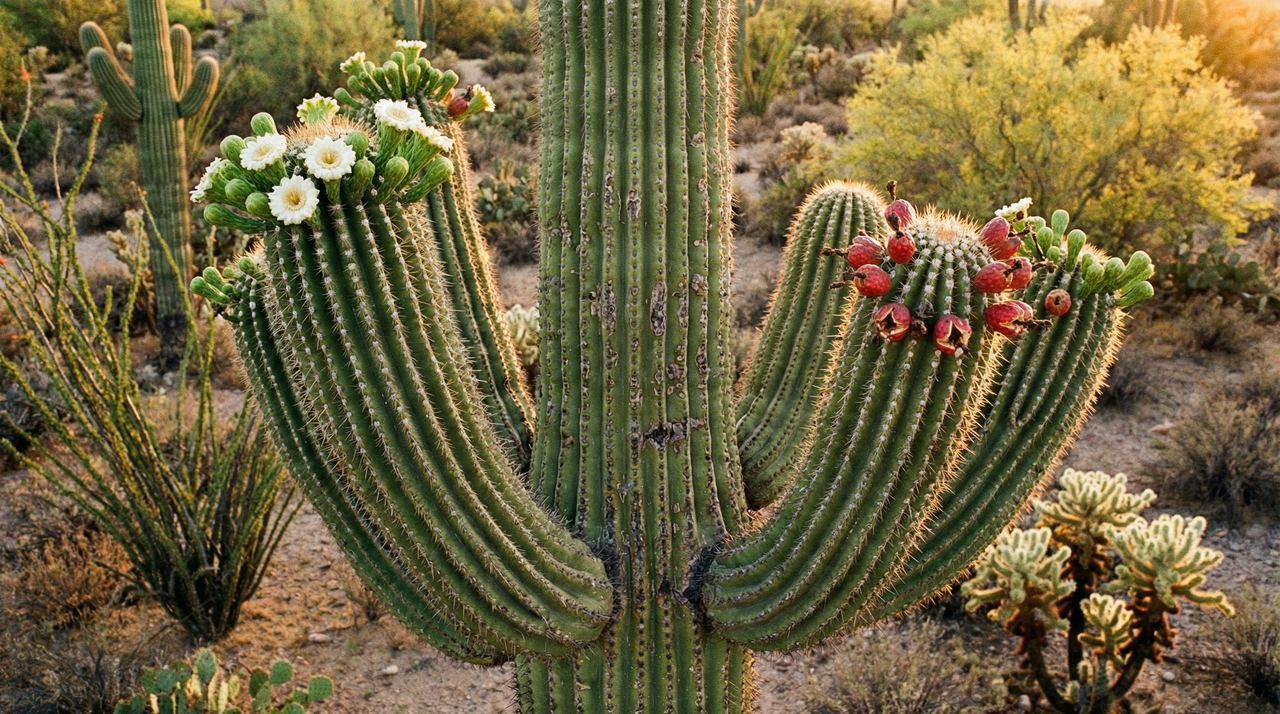
A mature saguaro standing taller than your house is likely older than your grandmother. That's the fact that stopped me cold the first time I really sat with it, standing in the Sonoran Desert with a mature cactus towering over me, its accordion-pleated trunk swollen with stored water, its arms branching out with the unhurried authority of something that has genuinely seen some things. That specimen was likely over a hundred years old. And here's what gets me: when it was the height of my knee, the Civil War hadn't ended yet.[1] We talk a lot in permaculture about thinking in decades. The saguaro demands you think in centuries.
Most people who want to grow one have no idea what they're actually signing up for, and I don't mean that as a discouragement. I mean it as an invitation to completely reframe your relationship with a plant. This isn't something you'll harvest next summer, or even next decade. What you're really doing, if you grow a saguaro from seed, is making a gift to whoever lives on your land long after you're gone. That's a design decision. And it's one of the most ecologically consequential ones a desert gardener can make.
Origin and History of the Saguaro Cactus
Botanical Background and Life Cycle
Few plants on earth ask you to think in centuries the way the saguaro does. Carnegiea gigantea typically lives 150 to 200 years in the wild, with some individuals confirmed beyond 250 to 300 years through radiocarbon dating of spines and growth ring analysis.[2][3][4] That framing matters before anything else, because every other fact about this plant flows from it. A seedling growing half an inch per year during summer monsoons can take six to twenty years just to reach one foot tall.[2][5] First flowers don't appear until somewhere between age thirty and seventy, once the plant reaches five or six feet.[2][6] Those iconic arms most people picture? They typically don't emerge until the plant is fifty to one hundred years old and fifteen to twenty-five feet tall.[2][4] I've worked with plenty of slow-maturing desert species, but I always tell clients that a saguaro is genuinely a multi-generational commitment; if you plant one today, your grandchildren may be the first to see it branch.
That glacial pace comes with punishing early mortality. Most seedlings don't survive their first five to ten years, taken out by drought, predation, frost, or the absence of a nurse plant for shade.[2][7] Compare that to a barrel cactus or even a prickly pear, which can establish in a garden season or two; juvenile saguaros are fragile in a way that surprises people who assume "cactus" means indestructible. Survival rates improve substantially once plants reach six to twelve feet and have enough water storage mass to buffer a dry spell.[2][7] Even mature plants face threats from extended drought, hard freezes, woodpecker damage that invites fungal infection, and the slow structural weakening that comes after a century of growth.[8][9]
The saguaro's scientific name is Carnegiea gigantea, and it grows nowhere on earth except the Sonoran Desert: southern Arizona, a sliver of southeastern California, and northwestern Mexico.[3][10] That endemism is not incidental; the species is tightly calibrated to USDA zones 9 through 11, the region's bimodal rainfall pattern of three to fifteen inches annually, and the rocky, well-drained soils in the pH 6.5 to 7.5 range that characterize its native saguaro cactus habitat.[3][6] Populations are stable in core habitats but declining at the margins, with successful recruitment requiring wet years and the right soil temperature windows.[7][9]
Visual Characteristics
A mature saguaro typically reaches forty to fifty feet tall and two to three feet in diameter at the base, with a fully hydrated plant weighing up to six tons.[2][11] The record stands at seventy-eight feet.[2] Juveniles are honestly a little unremarkable; they look like unbranched green columns with ten to fifteen ribs, what I'd describe to clients as "stubby green pickles" until they hit fifteen or twenty feet.[12][3] Arms eventually emerge and curve upward into the classic candelabra silhouette, with rib count increasing to eighteen to twenty-five as the plant matures.[12] Those ribs aren't just structural; they expand accordion-like after monsoon rains, allowing the plant to store massive internal water reserves.[2][11] I've watched the pleating on young plants shift after a good summer rain; it's subtle on a one-foot specimen but dramatically obvious on a mature ribbed trunk that can visibly swell between observations.
Flowers are creamy white, sometimes with a faint pink blush at the base, funnel-shaped and about three inches across, opening nocturnally from April through June and closing by midday.[10][3] The fruit that follows in June and July is a deep red, elongated pod splitting open to reveal sweet pulp packed with small black seeds.[10] Outside its native Sonoran Desert range, saguaros grown in cultivation typically reach only eight to fifteen feet tall and one to two feet across, a useful reality check for anyone imagining the full silhouette in a backyard planting.[13][14]
Traditional and Cultural Uses
The saguaro's scientific name was formalized in 1900 when botanists Nathaniel Britton and Joseph N. Rose described and named it in their landmark work "The Cactaceae," honoring Andrew Carnegie.[15] Earlier encounters were documented by Edward Palmer's 1893 collections and John Wesley Powell's accounts of the Southwest from the 1860s and 1870s.[15] But the word "saguaro" itself comes from the Tohono O'odham language, and their relationship with this plant predates any Western botanical record by centuries. The Tohono O'odham, along with related Pima and Seri peoples, harvest the red fruit (called bahidaj) each early summer using long poles fashioned from dried saguaro ribs.[16][2] The fruit feeds families fresh, gets cooked into syrup and jam, fermented into ceremonial wine, and the seeds eaten as food; the dried ribs have historically served as construction material, tools, basketry frames, and household implements.[16][17]
What strikes me every time I read about those harvesting traditions is how the saguaro's growth timeline made cultivation essentially impossible; no indigenous group domesticated this plant precisely because it takes fifty to two hundred years to develop arms and reach full maturity, meaning all historical use depended on wild, established stands. The saguaro blossom is now the official state flower of Arizona, and the plant is strictly protected by law: in Arizona, removing or disturbing a saguaro requires permits, and the species is safeguarded under federal protections from illegal collection and habitat loss.[18][19] In my work, I always make this explicit: in Arizona you need a permit even to move a fallen saguaro rib. These protections exist because a plant that takes a century to reach its iconic form cannot be replaced on any human-scaled timeline. If you're researching the Tohono O'odham harvesting protocols with any intention of ever accessing fruit yourself, approach that process with the same respect you'd give any protected cultural and ecological resource.
Fun Facts About the Saguaro
Determining how old a saguaro actually is requires radiocarbon dating of spines or growth ring analysis rather than a quick count of anything visible.[20] A plant that's lived past 250 years has outlasted European settlement of the Americas, multiple generations of any family, and yet in its first decade it might still be shorter than a house cat. That paradox is part of what makes walking through Saguaro National Park feel genuinely humbling; those multi-armed giants were already old when your great-great-grandparents were born.
The accordion pleating that stores all that water also gives the plant remarkable resilience. A fully hydrated saguaro can carry water comprising up to ninety percent of its weight, drawn in rapidly during monsoon events and rationed out over months of drought.[11][21] The plant can even recover from significant physical injuries by forming callus tissue, though deep stem wounds remain potentially fatal.[11] Seed dispersal happens through birds like curve-billed thrashers and mammals including coyotes and packrats, all drawn to that sweet red fruit; the plant also forms mycorrhizal associations that support nutrient uptake in its rocky, nutrient-poor soils.[4] And the relationship runs deep: mature saguaros themselves become nurse plants, sheltering the seedlings of dozens of other desert species in their shadow. A single ancient saguaro is less a plant and more a neighborhood.
Saguaro Varieties and Sourcing
Why Saguaro Has No Recognized Cultivars or Varieties
If you're searching for named cultivars or botanical varieties of Carnegiea gigantea, I'll save you the trouble: there aren't any. Saguaro is the sole species in its monotypic genus, with no recognized horticultural selections, no subspecies, and no breeding programs producing named forms.[3][22] That might sound like a limitation, but in practice, I've never met two saguaros that looked quite alike. Branching patterns, lean angles, arm count, and growth rate all shift noticeably based on microsite conditions -- a specimen growing in a rocky north-facing bajada versus a flat sandy wash develops its own distinct personality over time. That individuality is something no nursery tag can manufacture.
The practical implication for permaculture designers is that you're choosing a species, not a variety, and then trusting time to do the rest. Each plant is a multi-generational commitment that wants well-drained, coarse or gravelly soil with a pH between 6.0 and 7.5, ideally replicating the rocky hillsides and bajadas of its native Sonoran Desert range.[3][23] I've planned saguaro placements knowing the client -- or their grandchildren -- will enjoy the full majesty decades later. That's the nature of this plant, and honestly, it's what makes it worth growing.
How to Source Saguaro Legally and Responsibly
Wild collection is off the table, full stop. Arizona state law (A.R.S. § 3-901 et seq.) prohibits removing, damaging, or transporting saguaros without a permit from the Arizona Department of Agriculture, and the penalties are serious.[24][25] In my work with desert restoration and client landscapes, I've helped navigate these permits, and they exist for good reason. A plant that takes 50-100 years to grow its first arm doesn't recover from casual extraction.
Every saguaro in cultivation should come from licensed nursery stock propagated from seed. Reputable sources include Strictly Cacti in Tucson, Mountain Crest Gardens, and Planet Desert Nursery, all of which offer seeds, young plants, and mature specimens that comply with regulations and often ship nationwide.[26][27][28] When inspecting nursery stock, look for firm, unblemished stems and a well-developed root system with no soft spots or discoloration at the base.[29] I've picked up enough nursery plants over the years to know that a poorly rooted seedling feels almost hollow when you handle it -- the root ball shifts loosely in the pot rather than holding together as a cohesive unit. That's the one you put back.
Spring is the best window for purchasing, when nursery stock is freshest and temperatures favor establishment. Larger specimens require specialized handling because of their size and the sheer care needed to transport them without damage. Interstate buyers should also know that while saguaro is not listed under CITES and carries no federal endangered status, USDA phytosanitary regulations still govern how plants cross state lines, and reputable suppliers will have the paperwork sorted.[30][31] Because these plants can live 150-200 years and anchor entire desert ecosystems, sourcing ethically isn't a technicality -- it's core to the permaculture ethic of working with, not against, the natural world.
How to Propagate and Plant Saguaro Cactus
If you want a saguaro in your garden, you need to make peace with time first. Everything about this plant, from its reproductive biology to its bone-slow seedling growth, reflects a life strategy built for centuries, not seasons. Understanding that biology is the only way to make sense of the cultivation choices that follow.
Saguaro Reproductive Biology and Seed Characteristics
Saguaro reproduces sexually, with no shortcut through apomixis.[32][3] Its flowers are hermaphroditic but self-incompatible, so every viable seed requires a different parent's pollen, delivered by lesser long-nosed bats at night and birds or bees by day.[33] That genetic diversity matters to the species, but it also means you can't reliably self-pollinate a single specimen in a pot and expect results. The resulting fruit holds large numbers of tiny seeds dispersed by birds and small mammals across the desert.[34]
Each seed is a small, dark kidney-shaped structure, roughly 1.5-2 mm long and 1 mm wide, with a slightly textured surface and a paler hilum at the narrow end.[35] Most contain a single embryo,[34][32] though occasional polyembryony does occur, a small redundancy that may improve odds in the Sonoran's boom-and-bust environment.[36] The seed coat is hard and impermeable, and seeds generally need scarification, either light mechanical abrasion or a brief acid treatment, before moisture can reach the embryo.[35][4]
Seed is the primary propagation method for home growers, with fresh seed achieving germination rates of 20-50% under optimal conditions.[4][37] The alternative most serious enthusiasts consider is grafting onto compatible columnar rootstocks like Trichocereus pachanoi or Stenocereus thurberi, which can push success rates above 80% and bring the plant to fruiting in 5-15 years rather than the 35-40 years a wild-grown specimen typically requires.[38][39] I've seen grafted saguaros in botanical collections beginning to flower in under a decade while my own seed-grown plants are still barely a foot tall after twelve years. Both paths are valid; you just have to be honest with yourself about your timeline. Cuttings are rarely successful given the plant's columnar form, offset propagation is uncommon, and tissue culture remains a conservation-lab technique rather than anything practical for home growers.[40][41]
One thing I feel strongly about: I never collect saguaro seed or plant material from the wild. Every saguaro I grow comes from reputable nurseries that propagate legally, and I encourage you to do the same, both for the sake of the Sonoran Desert and to stay on the right side of Arizona law. Carnegiea gigantea is a protected species, seed collection is regulated in protected areas like Saguaro National Park, and collecting plant parts from the wild can carry serious penalties.[3][10]
Germination Requirements and Timeline
Replicating the Sonoran monsoon is the goal. Sow seeds shallowly, about 1/8 inch deep, onto a sterile cactus mix heavily amended with perlite or coarse sand, and keep temperatures between 75-85°F (24-29°C).[4][42] Maintain consistent moisture without ever letting the medium get soggy, and expect germination in 7-14 days under those conditions.[40][43] Once seedlings emerge, reduce watering and shift to bright indirect light or grow lights; full sun will scorch them at this stage.[4][6]
The germination itself is the easy part. Seedlings grow around 0.5-1 inch per year initially and won't reach 1-2 feet for a decade or more.[44] I've started saguaro from seed several times, and I always label every pot obsessively because those first-year seedlings look like tiny inverted green cones and are almost impossible to distinguish from each other. If you have legally sourced fresh seed, use it promptly; germination rates are highest early on. Seeds can remain viable for up to ten years when stored cool and dry below 10°C,[4] and with optimal cold-storage conditions viability can extend considerably longer,[45][46] but fresh seed gives you the best odds when you're starting out.
Soil, Site Selection, and Planting Technique
In its native habitat, saguaro grows on gently sloping bajadas in coarse, gravelly, low-organic soils with excellent drainage and almost no clay or silt.[47][3] Replicate that and you're most of the way there. The plant tolerates a wide pH range of roughly 5.5-8.5 and performs well in the naturally alkaline Sonoran soils it evolved in, though pH above 7.5-8.0 can start limiting iron and magnesium uptake and cause chlorosis.[48][10] In my experience with desert cacti, if you get drainage and aeration right, the plant is remarkably forgiving on pH. Get it wrong, and perfect pH won't save it.
My squeeze test: grab a handful of your mix. If it holds any shape at all, add more perlite or pumice. I've lost young saguaros to mixes that seemed fine but retained just enough moisture to invite root rot. The root system is shallow and wide, spreading horizontally up to twice the plant's height in the top 6-12 inches of soil,[49][50] so the soil needs to be loose, uncompacted, and well-aerated to at least 18-24 inches depth.[51] Compaction and poor aeration restrict root development just as surely as overwatering does. Outside the Southwest, raised beds or amended containers with a nearly inorganic mix are often the only way to achieve what this plant actually needs. Young plants also need protection from intense afternoon sun; shading juveniles until they're at least several inches tall prevents the photoinhibition and sunscald that can set them back significantly.[52]
Spacing, Scale, and Transplanting Mature Specimens
Before you plant, really consider what you're committing to. A saguaro grows less than an inch per year in its first decade, requiring eventual accommodation for a massive canopy spread of 15-20 feet and a robust trunk.[53][54] Those shallow roots extend horizontally roughly twice the plant's height, which means spacing individuals 15-25 feet apart isn't optional, it's structural.[55] Crowding leads to competition, poor air circulation, and weak arm development over time.
In the wild, saguaro seedlings almost always establish under nurse plants like mesquite, which provide shade, reduce desiccation, and deter herbivores.[56] I use a similar strategy in the nursery, starting seedlings under a taller companion plant or shade cloth until they're at least six inches tall, the same approach I take with young barrel cacti. Transplant seedlings when they reach 1-2 inches, usually 1-3 months after germination, and time any transplanting of established plants for spring or fall when temperatures sit in the 70-90°F range.[4][57] Handle roots gently, minimize disturbance, and plant into well-draining soil. Most gardeners will never see their saguaro reach 40 feet, but a legally sourced, well-sited specimen planted today can be a landmark for generations.
Saguaro Cactus Care Guide
Every care decision you make for a saguaro should start from the same question: does this mimic the Sonoran Desert? If the answer is no, reconsider. These cacti have survived for 150 to 200 years by being perfectly matched to a specific, punishing environment, and the fastest way to kill one in cultivation is to treat it like a houseplant that needs regular attention.
Sunlight Requirements for Saguaro Cacti
Saguaros need at least 6 to 8 hours of direct sun daily, and they are genuinely adapted to the kind of relentless, high-altitude desert intensity that most plants can't survive.[3] In my experience growing them from seed, the only exception I make is giving tiny seedlings a touch of afternoon shade in their first summer, because that intense heat combined with the vulnerability of a brand-new root system can overwhelm them before they've had a chance to establish. Once they're a few inches tall and clearly growing, I pull the shade cloth and let them have full sun. That's it. They don't want dappled light or a partially shaded patio corner.
Watering Needs and Drought Tolerance
Mature saguaros are extraordinary water misers. They can survive 6 to 12 months without a drop, sometimes longer, by storing water in their pleated stems and getting by on less than 12 inches of annual rainfall.[2][3] I think of them as a biological cistern: during the monsoon, the pleats expand noticeably as the plant drinks in reserves, then contract slowly through the dry months. I've watched mature specimens in my landscape swell visibly from one week to the next in July. It's one of the more satisfying things to observe in a garden.
In cultivation, water deeply but infrequently during the active growing season, roughly every 2 to 4 weeks in spring and summer, only when the top 2 to 3 inches of soil are bone dry. Cut back to every 4 to 6 weeks in fall, and stop watering almost entirely through winter dormancy.[58] Young container plants may need water every 10 to 14 days during peak summer heat, but the rule stays the same: wait for complete dryness between sessions. I label every pot I have with the date I last watered. It sounds fussy, but when you're working with a plant this slow, impatience is genuinely dangerous.
Overwatering is far and away the most common way gardeners lose a saguaro. Watch for soft or mushy spots on the stem, yellowing, blackened foul-smelling roots, or any fungal growth at the base.[59] Underwatering shows up differently: pronounced wrinkling, shriveling, and browning at the tips. If you're in the right climate zone and your plant is established in the ground, rainfall alone will likely handle the job. Rainwater is ideal, but any low-salinity water under 500 ppm with a pH between 6.0 and 8.0 works well.[53]
Fertilizing a Light-Feeding Desert Giant
The saguaro is naturally adapted to nutrient-poor, alkaline, sandy desert soils with minimal organic matter, and mature plants in native habitat need no supplemental fertilizer whatsoever.[60] I've never fertilized an established saguaro growing in the ground, and they continue to grow. Slowly, yes, but that is exactly how they are supposed to behave. The slower the growth, the denser the tissue, and the healthier the plant.
If you're growing a young saguaro in a container and feel compelled to feed it, a balanced low-nitrogen cactus fertilizer around 5-10-10, diluted to half strength, applied once or twice during the spring and summer growing season is the ceiling.[61] Never fertilize in fall or winter. Pushing soft, rapid growth through over-feeding stresses the plant and invites pest problems. True nutrient deficiencies are rare, but in poorly drained containers you might see chlorosis or a purplish tint, which usually points to drainage as the real culprit rather than a missing nutrient.[62]
Frost Tolerance and Cold Protection
Saguaros are rated for USDA zones 9a through 11, with their best performance in zones 10 and 11.[63] A well-established mature specimen can tolerate a brief dip to 20°F, but prolonged exposure below 28°F starts causing real stem damage. Young plants are significantly more sensitive and can be damaged at 28 to 30°F.[4] That gap between juvenile and adult cold tolerance is the most important thing to understand here, because it completely changes your protection strategy.
Frost damage shows as softening, browning or yellowing of the skin, splitting ribs, or blackened tissue, with the growing tip, flower buds, and waterlogged roots being the most vulnerable points.[64] Protecting that growing tip is non-negotiable. I once lost a promising juvenile to an unexpected overnight freeze that barely touched the rest of the plant but damaged the meristem, and it never recovered properly. Now I cover young plants any time temperatures below 28°F are in the forecast, no exceptions. In marginal zone 9a, a south-facing wall makes a real difference for siting.
Heat Tolerance and Summer Stress Management
Adult saguaros are genuinely built for brutal heat. Native to the Sonoran Desert, they're rated for AHS Heat Zones 10 through 12 and can handle short spikes to 120°F, thanks to a combination of thick waxy skin, CAM photosynthesis (which keeps stomata closed during peak midday heat), expandable pleated stems, and insulating spines.[65] Those adaptations work together as a system, not as individual tricks, which is part of why the plant is so resilient once it's properly established.
Seedlings are a different story. On young plants, the ribs can flatten like a deflated accordion during a heat wave, which is one of the clearest stress signals I know. Other symptoms include yellowing, bleaching, or white-gray sunscald patches, and they overlap enough with drought stress that you have to look at the whole picture.[66] For seedlings and juveniles, 30 to 50% shade during the hottest part of the day, good airflow, and impeccable drainage are your main tools. Sustained heat above 110°F combined with dry conditions is particularly hard on them.[67] Once a saguaro reaches maturity, it handles summer largely on its own.
Pruning, Maintenance, and Seasonal Rhythm
Pruning a saguaro is almost never the right call. Any cut risks rot and infection, and the plant has no reason to need shaping.[18] The only time I would ever consider cutting is if an arm has become a genuine structural hazard to a roof or a person, and even then I call a specialist with sterile tools and proper sealant. The slow growth rate of this plant, which averages 0.5 to 2 inches per year in youth and roughly an inch per decade at maturity, means any mistake has consequences that will outlast most of us.[60]
Think of the plant's care calendar in terms of the Sonoran monsoon. Saguaros can expand up to 10% in volume during summer rains in July through September, then contract gradually through the dry season.[12] Your watering schedule should mirror that pulse: active support in spring and summer, pulling back in fall, near-dormancy in winter. Everything else follows that rhythm. A properly sited saguaro in the right climate zone really does take care of itself, and one of the best things you can do as a grower is resist the urge to intervene and simply observe.
Saguaro Harvesting: Timing, Technique, Yield, and Flavor
When to Harvest Saguaro Fruit
If you're growing saguaro from seed, the first harvest is a long-horizon goal. Even in ideal conditions, seed-grown plants typically won't produce fruit for 6 to 15 years.[68][2] I always tell new desert gardeners that saguaro rewards a long-view mindset or a willingness to buy larger nursery stock if they actually want to see fruit in their lifetime. When first fruit does arrive, the window moves fast: each bloom takes 6 to 8 weeks to become a ripe, harvestable fruit.[68][69]
That window falls between late May and early July across most of the Sonoran Desert, with flowering running April through June.[70][47][71] Spring rains drive the whole cycle; a dry spring can delay or diminish the crop, and the fruit's arrival has historically aligned with the Tohono O'odham ceremonial calendar precisely because it tracked the monsoon's approach.[47][4] You read the desert's calendar rather than imposing your own.
Ripeness cues are unmistakable once you know them. The fruit shifts from firm and green to deep bright red or purplish-red, softens slightly under gentle pressure, and detaches easily from the stem.[72][4] I learned to trust that specific shade of deep red from watching Tohono O'odham harvesting demonstrations years ago, and it stuck with me. The aroma also changes as the fruit softens, turning almost floral in a way that no photograph or field guide quite captures. When you catch that scent on the desert air, you know the fruit is ready.
How to Harvest and What to Expect from Saguaro Fruit
Harvesting saguaro fruit is nothing like harvesting prickly pear, where gloves and long tongs get the job done. Saguaro fruit clusters at the tops of arms that can be 15, 20, or 40 feet up. The traditional and still-practical method uses long poles, typically 10 to 15 feet, to reach and twist the ripe fruits free without climbing or damaging the cactus.[4][35] It's elegant in practice: a gentle twist, and the fruit drops.
What you're catching is a fleshy, club-shaped berry about 1.2 to 2 inches long, vivid red inside and out, with juicy red pulp packed around numerous small black seeds roughly 1.5 millimeters across.[4][73][47] Those seeds are hard and gritty enough that eating the fruit fresh means crunching through them, which is exactly why traditional preparation has long favored pressing the pulp into syrup or grinding the dried seeds into flour. The flavor is subtly sweet with notes that have been compared to strawberry, raspberry, and watermelon, with a slightly tangy finish.[4][42] In my experience tasting desert fruits, that melon-like quality is the most distinctive note, and the sweetness concentrates beautifully when processed, which is where traditional recipes really let the saguaro cactus fruit shine.
Saguaro Preparation and Uses
Culinary Uses of Saguaro Fruit
Few foods carry the cultural weight of saguaro fruit. For the Tohono O'odham, the annual harvest isn't simply foraging; it marks the beginning of the new year and has done so for centuries.[68][4][74] That context matters before anything else. You can eat saguaro cactus fruit fresh, dried, cooked down into syrup, set into jam, pressed into juice, or fermented into tiswin, a ceremonial wine with deep ceremonial significance.[75][76][77] The seeds, once dried or roasted, can be ground into a flour that works into flatbreads, adding a mild nuttiness that surprises most people who've never tried it.[78]
The ripe pulp itself is genuinely delicious. Think somewhere between strawberry and raspberry with a hint of kiwi, juicy and seedy in a way that makes fresh eating a little messy and entirely worthwhile.[79][4] After years working with desert plants, I've learned to identify truly ripe fruit by its deep crimson color and the way it practically releases itself from the cactus with a gentle twist. Under-ripe fruit is worth skipping; the flavor isn't there yet.
Before any of that, you've got to deal with spines. Traditional methods include burning them off over a fire, rubbing the fruit between thick cloths, or scraping carefully with a knife.[75][76] Burning is effective, but do it outdoors and away from your face. The airborne irritants from scorched spines are no joke, and that's a lesson worth learning before, not after.
Storage is straightforward: fresh fruit keeps for about a week refrigerated at 35 to 40°F, the pulp freezes well for longer storage, and seeds can be sun-dried in the traditional way.[53] The flowers are technically edible too, appearing in some spring renewal ceremonies, though they're rarely eaten outside that context.[68] One thing to be clear about: saguaro pads are not edible. They're not nopales. Unlike prickly pear, whose pads are a kitchen staple across the Southwest, saguaro pads can cause gastrointestinal irritation if ingested.[75] It's an easy assumption to make and a good one to correct early.
Before harvesting any saguaro fruit, check the regulations. Arizona Native Plant Law and BLM guidelines limit collection to 25% of accessible fruit per plant, prohibit any damage to the cactus itself, and require permits for commercial harvest.[80][81] In my experience, respecting that 25% limit isn't just legal compliance; it's what keeps the fruit available for the birds, bats, and wildlife that depend on it. A keystone species doesn't stay a keystone if we treat it carelessly.
Non-Food Uses in Landscape Design
Beyond the kitchen, saguaro earns its place in southwestern landscapes simply by existing. Its sculptural vertical form, extreme drought tolerance, and near-zero maintenance once established make it a standout element in xeriscaping and desert garden design.[53][82] I've watched saguaros anchor garden designs in a way no other plant quite replicates. They grow slowly, yes, but each decade they become more themselves, and there's a quiet gravitas to a mature specimen that makes a landscape feel genuinely rooted in place.
Saguaro Health Benefits and Medicinal Uses
Traditional Medicinal Uses by Indigenous Peoples
Centuries before modern laboratories analyzed a saguaro extract, Sonoran Desert peoples had assembled a remarkably thorough pharmacopoeia from a single plant. The ripe fruit was used to cool fevers, ease digestion, and act as a gentle laxative, with its high water content making it a literal lifesaver for thirst in brutal summer heat.[83][84] The pulp was applied topically for skin conditions and wound healing, while syrup made from the fruit addressed coughs and respiratory complaints.[85] Even the woody ribs had roles: teas from boiled ribs served as diuretics and respiratory remedies, and the ribs themselves were fashioned into splints for broken bones.[83][86] Flower extracts were applied to soothe burns and reduce swelling.[83] I've had the privilege of observing traditional-style harvests during restoration projects in the Sonoran region, and what strikes me every time is how whole-plant this knowledge is -- nothing wasted, everything purposeful.
Modern pharmacological research on saguaro is still catching up. Most of what we have comes from ethnobotanical records, preliminary in vitro studies, and animal models rather than clinical trials, and the evidence base is thinner than it is for better-studied cacti like prickly pear.[87][88] The ethnobotanical record combined with emerging phytochemical data gives me genuine confidence in moderate use of ripe saguaro fruit, even while I'd caution anyone against overstating the clinical proof.
Key Phytochemicals and Their Activities
Part of why those traditional applications hold up to scrutiny is the plant's impressive secondary metabolite profile. Saguaro contains distinct bioactive groups—including phenolic acids, flavonoids, and alkaloids—alongside betacyanins and trigonelline; betacyanins; polysaccharides; saponins; and triterpenoids like lupeol.[89][90] That's a chemically complex plant, and it makes sense -- surviving in the Sonoran Desert requires serious biochemical investment. In vitro and animal studies show antioxidant capacity comparable to synthetic antioxidants, driven largely by the phenolics and flavonoids, alongside anti-inflammatory, antimicrobial, and potential anti-diabetic activity via alpha-glucosidase inhibition.[91][92][88] Polysaccharides may contribute immunomodulatory effects as well.[93] One detail I find genuinely fascinating: metabolite concentrations shift with plant age, drought stress, and pollination events, with stressed plants generally producing higher levels of protective compounds.[94][95] I've noticed something similar working with desert-adapted species more broadly -- plants pushed hard by heat and dry spells often have more pungent, bioactive tissues than pampered specimens.
Nutritional Profile of Saguaro Fruit
The fruit is where most people will interact with saguaro's health value. Each fruit weighs around 100 grams, with about 50 grams of edible pulp and seeds, and water content runs 78 to 85 percent.[96] That hydration alone is significant in a desert context. Caloric density is modest at roughly 63 to 69 kcal per 100 grams, primarily from carbohydrates with 3 to 5 grams of fiber and 10 to 14 grams of natural sugars, plus negligible fat and less than a gram of protein.[96][97] Where it really stands out is vitamin C, which ranges from 20 to over 100 mg per 100 grams fresh -- a range I find impressive even compared to the prickly pear fruits I grow routinely.[96][98] Potassium at 250 to 300 mg per 100 grams is worth highlighting for electrolyte balance, with calcium, magnesium, and iron rounding out the mineral profile.[99] Overlaying all of this is a solid polyphenol and pectin contribution that adds digestive and antioxidant value on top of the straight vitamin-mineral numbers. One processing note worth keeping in mind: drying concentrates sugars dramatically to 60 to 70 grams per 100 grams, while heat above 70°C degrades the vitamin C significantly.[100][98]
Safety Considerations for Saguaro Consumption and Use
Ripe saguaro fruit is non-toxic and has sustained entire communities for centuries -- there's no meaningful chemical hazard from eating it in reasonable amounts.[101][4] The ASPCA also lists saguaro as non-toxic to common pets, with the spine being the primary hazard for animals and humans alike.[101] In practice, the spines are the real danger. I've watched far too many eager foragers reach toward a cactus without proper gloves, and saguaro spines embed more deeply and stubbornly than most barrel cactus spines I've worked with -- puncture wounds, inflammation, and localized infection are the genuine risks.[102] Heavy gloves and a long harvesting pole are non-negotiable. Eating large amounts of raw or unripe cactus flesh is a separate, milder concern -- the fiber, oxalates, saponins, and tannins can cause nausea or diarrhea, though the ripe fruit at normal consumption levels doesn't approach that threshold.[103][104] Those sensitive to oxalates should moderate intake. Allergenic potential is low -- the plant is bat- and bird-pollinated, so its pollen isn't floating around triggering respiratory reactions.[101][105] I advise the workshop participants I work with to treat the spines with the same respect you'd give a scalpel, source fruit only from permitted locations, and enjoy the rest with confidence.
Saguaro Pests and Diseases
In its native Sonoran Desert, a saguaro growing in the right spot with the right soils is a surprisingly tough plant. The thick spines deter crawling insects, a waxy cuticle limits soft-bodied pest attachment, and the plant produces alkaloids, phenolics, and terpenoids that act as repellents and antifeedants against herbivores.[106][107] Put it in a garden with clay soil and an enthusiastic irrigation schedule, though, and those defenses erode fast. Most of the disease and pest problems I've seen in cultivated saguaros trace directly back to human decisions, not to any inherent weakness in the plant itself.[72]
Common Diseases of Saguaro Cactus
The biggest disease threats are fungal rots and bacterial necrosis. Phytophthora species, Fusarium, Aspergillus, and Armillaria all cause root and arm rot, and every single one of them thrives when drainage is poor or supplemental water sits too long around the base.[72][108] I learned this firsthand with an early seedling I babied through a hot summer by watering far too generously. The base went soft, and Phytophthora had established itself before I noticed. Switching to extremely sharp drainage and pulling back on summer irrigation completely eliminated the recurrence. The lesson was uncomfortable but clear.
Bacterial soft rot, caused by Erwinia carotovora and Pseudomonas species, operates on a different mechanism. These pathogens enter through wounds and produce discolored, mushy tissue that can spread quickly enough to threaten the whole column.[109][110] This is exactly why insect borers are a secondary disease problem, not just a physical one. Any break in the skin is an invitation. Sunburn on recently transplanted or weakened plants can cause similar-looking necrosis, so it's worth ruling out abiotic stress before assuming infection.[111] Viral diseases, by contrast, are rarely documented in this species and aren't a practical concern for most growers.[112]
No disease-resistant cultivars exist. Because saguaro is propagated almost entirely from wild-type seed, you're working with the genetic variability of wild populations, some of which show greater tolerance to soil-borne pathogens than others.[113] I select the healthiest-looking seedlings I can find from reputable desert nurseries and treat that careful sourcing as my first line of defense. Prevention through well-drained soil, minimal irrigation, wound avoidance, and prompt removal of infected tissue is far more effective than reaching for copper bactericides or fungicides, which are reserved for serious situations and applied sparingly to protect the broader desert ecosystem.[111][62]
Insect Pests and Integrated Management
Insects become serious problems when a saguaro is already stressed. The most structurally damaging are the borers. Buprestid flatheaded borers, longhorn beetles, and carpenter bees tunnel into the ribs, causing sap leakage and opening the wounds that invite the bacterial rot described above.[114] Cactus weevils work similarly, targeting fruits, stems, and sometimes roots while spreading decay organisms.[114] The invasive cactus moth, Cactoblastis cactorum, is the pest I monitor most carefully. Females lay eggs directly on the surface, larvae bore deep into stems, and the damage can kill plants outright.[115][116] Every spring I check my landscape plants for egg sticks and fresh bore holes, which aligns with what Arizona Extension recommends as peak monitoring season.
Sap-feeders, including cactus scale, mealybugs, and cochineal insects, are a lower level of threat but still worth catching early. They produce white cottony or waxy coverings, cause yellowing and stunting, and excrete honeydew that leads to sooty mold; some can also vector viruses.[72][117] Diagnostic symptoms to watch for across all pest categories include bore holes, white exudates, pitting, wilting arms, sap leakage, black sooty mold, and progressive tissue collapse that can eventually leave only the woody skeleton.[72]
After seeing broad-spectrum insecticides knock out beneficial insects in desert gardens, I now rely almost entirely on horticultural soaps, oils, and encouraging natural predators like ladybugs and parasitic wasps. The formal IPM framework from University of Arizona Extension agrees: cultural practices and sanitation first, targeted biological controls second, and systemic insecticides only as a last resort and never in ways that could harm the pollinators this plant depends on.[72][118][119] Long-term monitoring programs at Saguaro National Park and through Arizona institutions continue to track cactus moth, borer, and scale populations across wild and cultivated plants, which means the science around managing a dead or declining saguaro cactus is actively improving.[120] That ongoing stewardship gives me some confidence that growers paying attention are part of a much larger conservation picture.
Saguaro in Permaculture Design
Most keystone species work quietly in the background. The saguaro does not. It stands as the emergent canopy element in the Sonoran Desert, announcing itself as the structural anchor of an entire ecosystem, supporting over 50 associated animal species from insects to large mammals.[121][122] That's not hyperbole; that's the ecological accounting of a plant that functions, practically speaking, as a living apartment complex. Gila woodpeckers excavate nest cavities in the trunk that persist for decades, and once vacated those hollows become home to elf owls, screech owls, and Harris's hawks.[2][122] Meanwhile, below ground, the root system spreads up to 100 feet radially while staying less than a foot deep, capturing rainfall the moment it hits the soil and anchoring the surrounding substrate against erosion.[2]
Ecosystem Functions and Keystone Role
The pollination guild alone rewired how I think about nocturnal design. I watched lesser long-nosed bats work saguaro flowers at dusk in the Sonoran Desert a few years back, and it stuck with me in a way a field guide never could. Those large white blooms open at night specifically for the bats, but by morning they're still accessible to white-winged doves, orioles, carpenter bees, native bees, hummingbirds, and Gila woodpeckers.[123][124] That's a 24-hour pollinator relay with specialists at every shift. Now, whenever I design desert guilds, I think deliberately about what the system is doing after dark -- and the saguaro is the reason why.
The fruit that results from all that pollination becomes a vital summer food source for white-winged doves, coyotes, pack rats, javelinas, and other desert fauna, with seed dispersal built right into the transaction.[2][122] Below ground, symbiotic mycorrhizal fungi help the plant scavenge phosphorus from soils that offer almost nothing in the way of fertility.[125] The whole system is interlocked. Which is exactly why, when lesser long-nosed bat populations decline or climate shifts compress the bloom window, the ripple effects run through dozens of dependent species. Protecting a mature saguaro in place is frequently the higher-leverage permaculture act compared to planting a new one somewhere marginal.
Forest Layer and Guild Associations
The USDA officially classifies the saguaro as a shrub, owing to its lack of secondary woody tissue.[126] I find this taxonomically defensible and practically useless. A plant that reaches 40 to 78 feet at maturity[3][127] functions as the emergent overstory of the Sonoran Desert, period. In permaculture zone mapping, it belongs at the top of the canopy layer, full stop.
The design challenge is that you are planting for someone else's food forest. These milestone structural changes take over half a century to emerge.[127][65] I think about it the way I think about planting a white oak in a temperate food forest: same generational patience, very different ecology. The right response isn't to avoid it. The right response is to design the system accordingly and appreciate what it does for you in the meantime.
One thing I've watched play out clearly in the field is the difference between saguaro seedlings that germinate under a nurse plant versus those left in open ground. Under a palo verde or mesquite, the shade reduces desiccation stress and the canopy filters predation, and that protection can increase seedling survival by up to 50 times compared to open-sun establishment.[4] Plant your nurse species first. Let them do two decades of work, then introduce the saguaro beneath them. The CAM physiology handles the water math from there, fixing CO2 at night to minimize daytime loss while those shallow, wide-spreading roots intercept any precipitation that reaches the soil.[65] Once the saguaro overtops its nurses, the understory guild shifts rather than disappears -- the trunk itself becomes the habitat infrastructure.
Climate and Hardiness Zones
The saguaro is a climate specialist, not a generalist, and the climate envelope is genuinely narrow. Optimal cultivation sits in USDA zones 9b to 10a. Mature plants can take brief dips near 20°F, but young plants need protection below 30°F, and prolonged exposure below 25 to 28°F causes real tissue damage.[59][3] If your winter lows regularly drop below 28°F, I'd recommend growing saguaro only in a well-protected microclimate or a large container you can move -- the research on tissue damage at those temperatures is unambiguous.
The heat ceiling is essentially not a concern; the plant handles temperatures above 115°F without complaint, with optimal growth between 70 and 100°F.[59] What actually limits distribution isn't heat -- it's moisture pattern and humidity. Saguaro thrives on 5 to 12 inches of bimodal annual rainfall, with summer monsoons doing the heavy lifting, at elevations between 650 and 4,900 feet.[3][65] High ambient humidity is the quiet killer. The plant expects 10 to 40 percent relative humidity and does not negotiate on that; elevated humidity promotes rot and fungal problems that a well-draining rocky or sandy soil can only partially offset.[3][65]
For growers in marginal zones, raised beds, coarse gritty soil mixes, windbreaks, and disciplined dry-winter irrigation schedules can extend the range slightly.[128][129] But none of that replicates the Sonoran Desert's particular combination of dry heat, alkaline soils, and bimodal precipitation. Where the climate does align, though, a saguaro becomes one of the most valuable long-term structural investments you can make in a desert permaculture system -- stabilizing soil, generating wildlife habitat, and anchoring a guild that deepens in complexity across decades.
What a 200-Year-Old Cactus Taught Me About Time
I once stood next to a saguaro that germinated before my great-grandmother was born, and I felt something I don't often feel in a garden: genuinely humbled. Most of the plants I work with reward patience in seasons. This one rewards it in lifetimes. I don't grow saguaro because it's practical. I grow it because every time I check on that seedling, barely two inches tall after three years, I'm reminded that some things worth tending aren't meant for us to finish.
Sources 129
- Saguaro Fun Facts – National Park Service ↩
- Saguaro Cactus ↩
- Carnegiea gigantea ↩
- The Saguaro Cactus ↩
- Saguaro Cactus Fact Sheet ↩
- Royal Botanic Gardens Kew - Carnegiea gigantea ↩
- Population Dynamics of the Saguaro Cactus (Carnegiea gigantea) ↩
- Environmental Factors Affecting Saguaro Longevity ↩
- Saguaro Cactus (Carnegiea gigantea) ↩
- Saguaro Cactus (Carnegiea gigantea) ↩
- The Saguaro Cactus: A Natural History ↩
- Morphological Variation in Carnegiea gigantea Across the Sonoran Desert ↩
- Missouri Botanical Garden ↩
- Old World Saguaro? Growth and Longevity in a Non-native Setting ↩
- The Cactaceae: Descriptions and Illustrations of Plants of the Cactus Family ↩
- Traditional Uses of the Saguaro by the Tohono O'odham ↩
- Cultural Uses of Saguaro by Native Americans - University of Arizona ↩
- Saguaro Cactus Care and Maintenance ↩
- Saguaro in Popular Culture ↩
- Age Structure and Growth Rates of Saguaro Populations ↩
- Saguaro Biology and Ecology ↩
- Flora of North America: Carnegiea gigantea ↩
- Missouri Botanical Garden - Saguaro ↩
- Saguaro Cactus Regulations in Arizona ↩
- Arizona Native Plant Law ↩
- Saguaro Cactus for Sale ↩
- Carnegiea Gigantea Seeds ↩
- Buy Saguaro Cactus Online ↩
- Saguaro Cactus Propagation ↩
- Interstate Movement of Plants ↩
- CITES Appendices ↩
- Reproductive Biology of the Saguaro Cactus (Carnegiea gigantea) ↩
- Pollination and Seed Dispersal in Carnegiea gigantea ↩
- Seed Development and Germination in the Saguaro Cactus (Carnegiea gigantea) ↩
- Seed Morphology of Cactaceae ↩
- Polyembryony in Cactaceae: A Review ↩
- Growing Saguaro from Seed ↩
- Grafting Succulents: Techniques and Rootstocks for Cacti ↩
- Propagation of Carnegiea gigantea: Grafting Methods ↩
- Propagation of Cacti and Succulents ↩
- Carnegiea gigantea Propagation ↩
- Carnegiea gigantea: Saguaro Germination Tips ↩
- Growing Cacti from Seed ↩
- Saguaro Cactus Propagation Guide ↩
- Seed Storage Behaviour: A Compendium ↩
- Seed Storage Behaviour of Cacti ↩
- Carnegiea gigantea - Desert Botanical Garden ↩
- Soil pH for Desert Plants ↩
- The Saguaro Cactus: Carnegiea gigantea ↩
- Effects of Soil Compaction on Root Development in Desert Plants ↩
- Desert Museum - Saguaro Care ↩
- Photoinhibition and Sunburn in Desert Cacti ↩
- Saguaro Cactus Fact Sheet ↩
- Saguaro Cactus: Carnegiea gigantea ↩
- Saguaro Cactus Care and Planting Guide ↩
- Nurse Plants and Saguaro Establishment - Desert Botanical Garden ↩
- Saguaro Cactus Care Guide ↩
- Saguaro Cactus Care Guide - Desert Botanical Garden ↩
- Saguaro Cactus Care Guide ↩
- Missouri Botanical Garden Plant Finder - Carnegiea gigantea ↩
- Missouri Botanical Garden Plant Finder ↩
- Cactus and Succulent Nutrient Deficiencies ↩
- Missouri Botanical Garden - Carnegiea gigantea ↩
- Frost Damage to Desert Plants ↩
- Saguaro Cactus (Carnegiea gigantea) ↩
- Saguaro Cactus: Signs of Stress and Care ↩
- Drought and Heat Stress in Desert Cacti ↩
- Saguaro ↩
- Fruit Production in Saguaro Cactus ↩
- Carnegiea gigantea ↩
- Saguaro Cactus Flower Description ↩
- Saguaro Fruit: Ripening and Harvest ↩
- Carnegiea gigantea ↩
- Traditional Uses of Saguaro by the Tohono O'odham ↩
- Saguaro Cactus: Edible Uses and Preparation ↩
- Traditional Tohono O'odham Uses of Saguaro Fruit ↩
- Ethnobotany of the Saguaro ↩
- Preparation Methods for Saguaro Fruit Flour ↩
- Saguaro - Carnegiea gigantea ↩
- Saguaro Harvest Regulations ↩
- Plant Guide: Saguaro (Carnegiea gigantea) ↩
- Saguaro Cactus: Icon of the American Southwest ↩
- Saguaro Cactus: Icon of the American Southwest ↩
- Traditional Medicinal Uses of Sonoran Desert Plants ↩
- Ethnobotany of the Tohono O'odham ↩
- Ethnobotany of the Saguaro Cactus ↩
- Carnegiea gigantea: The Saguaro and its Uses ↩
- Phytochemical Screening and Antimicrobial Activity of Carnegiea gigantea Extracts ↩
- Phytochemical Profile and Antioxidant Activity of Saguaro (Carnegiea gigantea) ↩
- Phytochemical Investigation of Carnegiea gigantea Fruits: Antioxidant and Enzyme Inhibitory Properties ↩
- Antioxidant Activity of Fruits from Saguaro Cactus (Carnegiea gigantea) ↩
- Bioactive Compounds from Saguaro Cactus: Anti-Inflammatory Potential ↩
- Phytochemical and Pharmacological Profile of Carnegiea gigantea ↩
- Age-Related Changes in Metabolite Composition of Saguaro Cacti ↩
- Environmental Influences on Secondary Metabolites in Desert Cacti ↩
- Nutritional Composition of Saguaro Fruit (Carnegiea gigantea) ↩
- Many Facts about the Saguaro Cactus ↩
- Saguaro Fruit: Nutritional Composition and Traditional Uses ↩
- Nutritional Composition of Saguaro Fruit (Carnegiea gigantea) ↩
- Vitamin C Content in Cactus Fruits: Stability During Processing ↩
- Carnegiea gigantea ↩
- Saguaro Cactus Fruit: Harvesting and Uses ↩
- Toxicity of Cacti: Focus on Oxalates and Saponins ↩
- Cacti as Food: Safety and Health Benefits ↩
- Toxicity of Cactaceae Family Plants ↩
- Defense Mechanisms in Saguaro Cactus Against Herbivores ↩
- Chemical Ecology of Cactaceae: Insect Resistance ↩
- Phytophthora Root Rot in Cacti and Succulents ↩
- Bacterial Necrosis of Cacti ↩
- Bacterial Necrosis of Saguaro ↩
- Managing Cactus Diseases in Arid Environments ↩
- Viral Diseases in Cactaceae ↩
- Pathogens Affecting Saguaro Cacti ↩
- Insects and Pests of the Saguaro Cactus ↩
- Cactus Moth: A New Threat to the Sonoran Desert ↩
- Cactoblastis cactorum: Potential Threat to Native Cacti ↩
- Pests and Diseases of the Saguaro Cactus ↩
- Integrated Pest Management for Desert Landscapes ↩
- Biological Control of Cactus Pests ↩
- Long-term Monitoring of Saguaro Populations in Saguaro National Park ↩
- Saguaro as Keystone Species ↩
- The Role of the Saguaro in Desert Ecosystems ↩
- Saguaro Cactus Pollination and Seed Dispersal ↩
- Bat Pollination in the Sonoran Desert ↩
- Nurse Plant Syndrome in the Sonoran Desert ↩
- USDA PLANTS Database - Carnegiea gigantea ↩
- Growth and Development of the Saguaro ↩
- Growing Desert Plants in Southern California ↩
- Desert Gardening: A USDA Zone Guide (Master Gardener Handbook) ↩