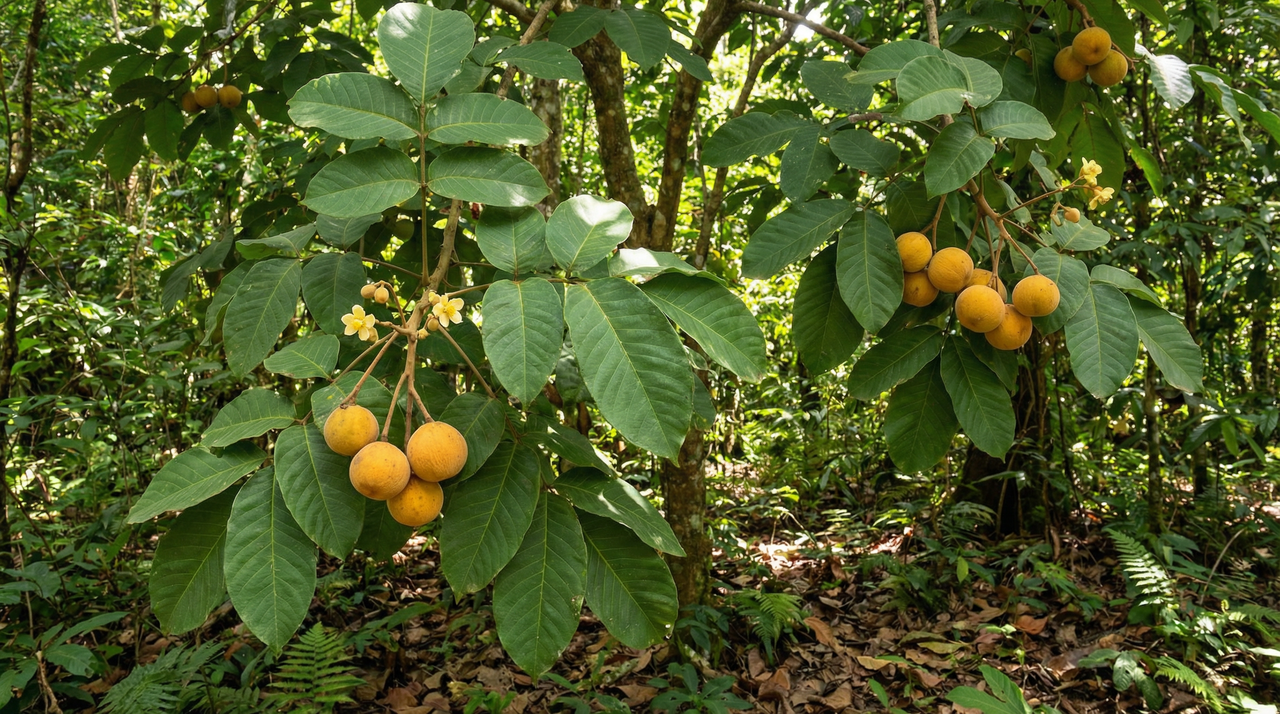
The first time I ate a santol, someone handed it to me on a humid afternoon in a Philippine market and watched my face with the particular patience of a person who already knows what's about to happen. The pulp is cottony, juicy, sweet, and sour all at once, somewhere between a ripe apple and a lychee with a citrus edge that catches you off guard. I loved it immediately. Then I nearly swallowed one of the seeds, and the vendor grabbed my wrist and shook her head like I'd just reached for a live wire. That moment is, I think, the most honest introduction to this tree: gorgeous, generous, and carrying a quiet danger that most English-language gardening resources bury in a footnote if they mention it at all.
Santol (Sandoricum koetjape) is a legitimate canopy giant, capable of reaching 45 meters with a buttressed trunk that looks like it belongs in a cathedral. It can live 200 years. It feeds hornbills. In parts of the Philippines, it's woven into folklore about forest spirits and abundance. And outside Southeast Asia, almost nobody has heard of it. That obscurity is strange when you consider what it offers a tropical food forest, and I've spent the better part of two growing seasons trying to understand exactly why it hasn't crossed over the way breadfruit or jackfruit have. The answer, I suspect, starts with those seeds.
Santol Origin, History, and Cultural Significance
If you've never heard of santol before, you're not alone -- it rarely shows up outside Southeast Asian markets and specialty tropical nurseries, even though it's been feeding people and shading forest floors for centuries. Once you encounter it, though, you don't forget it. The tree alone is a presence.
Botanical Background and Native Range
Santol, known scientifically as Sandoricum koetjape, belongs to the Meliaceae family, the same lineage as neem and mahogany, and it shares that family's tendency toward impressive stature and chemical complexity.[1][2] It's native to the humid tropical rainforests of the Philippines, Malaysia, Thailand, Indonesia, and parts of India, growing naturally from lowland forest up to around 1000 m elevation.[1][3] In that native context, it's a canopy dominant, reaching 20 to 45 meters tall with a buttressed trunk up to a meter in diameter and a broad, dense crown that casts serious shade.[4][5] When I'm designing upper-story anchors for food forest guilds, that buttressed base and spreading crown remind me strongly of mature mahogany -- the kind of tree that announces its presence before you see the fruit.
The santol tree is polycarpic and extraordinarily long-lived, potentially exceeding 200 years in undisturbed forest settings, with cultivated trees remaining productive for 40 to 60 years.[1] From seed, expect to wait 5 to 7 years before the first fruit appears, which is exactly the kind of fact that makes propagation strategy critical from day one. Flowers are small, greenish-white to yellowish, bisexual, and arranged in axillary panicles; they're primarily insect-pollinated, with bees doing most of the work, and the tree benefits strongly from cross-pollination.[6][4] Birds and mammals disperse the seeds naturally via the sweet sarcotesta, and under warm, moist conditions germination happens in as little as two to four weeks with high success and no significant dormancy period.[1][7] From seed to fruit in under a decade, it's a long game -- which is why grafting became standard practice in cultivation long before most growers realized it was an option. The santol tree thrives in full sun with well-drained fertile loam, temperatures of 20 to 35°C, and 1000 to 2500 mm of annual rainfall, and it has been successfully introduced to Hawaii, Fiji, the Caribbean, and parts of Central and South America, naturalizing around cultivation sites without establishing problematic wild populations outside its native range.[1][8]
Visual Characteristics of the Santol Tree
The santol tree's silhouette is unmistakable once you know it. That straight trunk, reaching a meter across with rough, grayish-brown, fissured bark, supports a crown stretching 10 to 20 meters wide, and the root system below matches the ambition above, with a primary taproot descending 2 to 3 meters and extensive lateral fibrous roots spreading outward.[9][10] Leaves are alternate and typically trifoliolate (sometimes 5 leaflets, rarely 7), with elliptic to ovate leaflets running 5 to 20 cm long, glossy green above and pale beneath with clear pinnate venation and pointed tips.[4][1] Those trifoliolate leaves are a reliable family tell, similar enough to other Meliaceae relatives that experienced growers often do a double-take. In my observation of tropical specimens on richer soils, the leaflets tend to come out noticeably broader and glossier, while trees on leaner ground produce smaller, slightly leathery foliage.[4]
The fruit itself is a globe, 4 to 7.5 cm in diameter (occasionally reaching 15 cm in selected cultivars), weighing 45 to 150 g, with either yellow or red skin depending on the type, white juicy pulp, and 5 to 12 large brown seeds.[4][11] Yellow-skinned fruit tends toward sweeter and larger; red-skinned types run more tart and compact.[12] Those seeds are important to know about from the start, and I'll say more about them below.
Traditional and Cultural Uses in Southeast Asia
Santol's relationship with people runs deep. In the Philippines, the fruit symbolizes abundance and resilience, appears in festivals and everyday cooking like sinigang, and the tree itself carries folklore associations with forest spirits and protective powers.[13][14] Among the Ifugao, branches and fruit appear in harvest rituals and offerings, and Tagalog communities have traditionally used the rinds in vinegar preparations for digestive health.[15]
Indigenous knowledge systems across Southeast Asia have long recognized this tree's medicinal properties in ways that modern phytochemistry is still catching up with. The fruit pulp and rind address digestive complaints including diarrhea and dysentery; bark decoctions have been applied as anti-inflammatory treatments, vermifuges, and wound care; leaf poultices treat rheumatism, fever, and skin conditions; and seed oil finds use in hair and skin preparations.[16][17] Tannins, saponins, and flavonoids distributed across the plant's tissues underpin these applications, and that phytochemical story belongs to the health benefits section. What matters here is that every part of this tree has been understood as useful, not just the fruit. The health benefits and phytochemical research sections ahead cover the science in detail. For now, it's worth sitting with the fact that this knowledge was developed over generations of careful observation, and crediting that origin matters.
Globally, santol is currently assessed as Least Concern, but deforestation and agricultural expansion are putting pressure on local populations in parts of its native range, affecting both wild biodiversity and traditional community access to these trees.[18]
Fun Facts About Santol
A tree that can live 200 years and feed hornbills, monkeys, and people across multiple generations deserves a moment of appreciation.[19] The santol tree supports wildlife through zoochorous fruit dispersal while also contributing to local economies through fruit sales and timber prized for furniture and construction.[20] Its deep root system gives established trees moderate drought tolerance, and natural compounds in leaves and fruit provide some built-in pest resistance.[21][22] For growers in Florida worrying about adding another invasive to the landscape, santol is currently monitored at low risk and does not appear on the state's exotic pest plant list.[23]
Wild santol fruits run small, 2 to 4 cm across, with tougher skin, more seeds, and a sharper astringency compared to the larger, sweeter cultivated forms shaped by generations of selective breeding.[24] The first time I handled fresh santol fruit, I made the mistake of not knowing about those woolly seed hairs. The cottony irritant fibers on wild-type seeds are no joke -- a good reminder that even familiar-looking tropical fruits have their own rules, and the cultivated forms humans have patiently refined over centuries exist for good reason.
Santol Varieties and Where to Source Them
Red and Yellow Santol Types
The clearest way to think about santol variety selection is through color. Red-fruited types tend to be more acidic with a sharper, tangier pulp, while yellow-fruited types generally lean sweeter and milder.[25][26] I've grown both unnamed types side by side in Central Florida, and the reds do tend to color up earlier and carry noticeably more acid in the pulp, which makes them genuinely useful for cooking applications even before they're fully ripe.
If you dig into the named selections, the Philippines has produced some of the most cited cultivars: 'Roxas' is known for high yields and sweetness, while 'Banar' and 'Batangas' fall into the red camp.[27][28] Indonesia has its own regional selections: 'Sentul Merah' (red) and 'Sentul Kuning' (yellow), and Thailand contributes 'Sentul Red' to the roster. The list isn't long because formal breeding programs for Sandoricum koetjape are limited; most improvement has come through farmers selecting superior trees from local populations over generations rather than through any systematic hybrid development.[25][27] Institutions like the University of the Philippines Los Baños have worked on selections for yield, fruit size, and fruit fly resistance, but standardized cultivars remain largely unavailable outside their home countries.[29][25] The practical takeaway: if you're in zones 10–12 and you find a tree producing 50–100 kg of fruit per season,[3] you're already ahead of most U.S. growers, named variety or not.
Sourcing Santol Trees, Seeds, and Fruit
Santol is commercially widespread across Indonesia, the Philippines, Thailand, Malaysia, and Vietnam, with small regional trade flowing between ASEAN markets.[30] In the United States, it's a different story. Fresh fruit imports require phytosanitary certificates and often irradiation treatment to satisfy APHIS pest exclusion requirements,[31] and even when fruit does arrive it only lasts 5–7 days before deteriorating.[32] That combination of regulatory friction and perishability keeps santol firmly out of mainstream retail. Specialty Asian markets occasionally carry it between June and August,[3] but reliably finding fresh fruit is more luck than strategy.
For anyone in southern Florida or Hawaii who wants to grow their own, seeds run $5–15 per packet and air-layered saplings typically land between $20–50 depending on size.[33][34] Personally, I skip seeds and go straight for 12–18 inch saplings. The germination and juvenility window is long enough that buying a head start just makes sense. When you're ordering, ask the nursery directly which color fruit the parent tree produces. Most U.S. vendors sell unnamed seedlings or lightly selected clones, and knowing whether you're getting a red or yellow type shapes your culinary expectations from the start.
Santol Propagation and Planting Guide
Getting a santol tree established starts with understanding two things that will shape every decision you make: how its seeds behave, and how patient you're willing to be. Get those two factors sorted and the rest follows logically.
Seed Characteristics and Recalcitrant Nature
Each santol fruit contains 5 to 10 seeds, brown and somewhat flattened, roughly 1 to 2 cm long with an ellipsoidal to heart-shaped profile.[35] They look sturdy enough, but appearances are deceiving. Santol seeds are recalcitrant, meaning they evolved to germinate quickly in humid tropical forest conditions and never developed the ability to tolerate drying out. Drop moisture content below roughly 20 to 30% and viability collapses fast; under typical ambient tropical conditions, seeds remain viable for only 2 to 4 weeks.[36][37][38]
I learned this the hard way with breadfruit relatives years ago. I waited about ten days after extraction thinking I had a comfortable window, and germination dropped below 40%. With santol specifically, sow immediately after removing seeds from ripe fruit and you can expect 80 to 90% germination in 2 to 4 weeks at 25 to 30°C in well-drained sandy loam under high humidity.[39][40] If you must store them, keep moisture content at 40 to 50%, temperature between 15 and 20°C, and relative humidity at 80 to 90% in breathable containers like perforated bags or cloth sacks; under those conditions viability can stretch to 6 to 12 months, though germination rates decline after the first few months.[41][42] If you're unsure whether stored seeds are still viable, the tetrazolium chloride (TZ) test gives you a quick answer before committing to a flat of planting medium.
Propagation Methods: From Fresh Seed to Grafting
Seed is the simplest entry point for growing santol, but it comes with a serious time cost. Trees grown from seed typically take 5 to 8 years to bear first fruit.[43][44] Grafting changes that math entirely. Cleft, whip-and-tongue, chip budding, or T-budding onto 1 to 2 year old santol seedling rootstock achieves 70 to 90% success when done during the rainy season,[43][45][46] and the resulting tree typically starts fruiting in 2 to 4 years.[43][44] My preference is cleft grafting on one-year-old rootstocks at the onset of rains; the union calluses reliably, not unlike what I see with citrus grafts in my zone 9B work.
For gardeners or nursery professionals who want additional vegetative options, semi-hardwood cuttings (15 to 20 cm, 3 to 4 nodes) treated with IBA at 3000 ppm under mist propagation can work, and marcotting (air-layering) is a lower-tech approach with a reasonable success rate. Emerging tissue-culture protocols using shoot-tip explants are producing disease-free clonal material for commercial nurseries, though that's outside the scope of most home growers.[47][43][48]
Soil, Site Selection, and Planting Technique
Santol wants fertile, well-drained loamy or sandy-loam soil with 2 to 5% organic matter and a pH of 5.5 to 7.5, with the sweet spot sitting around 5.5 to 6.5.[43][49][1] What it absolutely will not tolerate is waterlogging. Saturated roots lead fast to chlorosis, wilting, premature leaf drop, and eventually Phytophthora-driven root rot.[50][51] I test soil annually in my own food forest, and I've corrected mild iron-deficiency chlorosis on young tropical trees with a targeted sulfur application followed by a thick compost mulch; it's a simple fix, but only if you catch it early and understand what pH drift looks like on a leaf. Below 5.0, nutrient availability tanks. Above 7.0, iron and manganese become locked out.[50][52]
The tree develops a taproot that drives 2 to 5 meters down or more, with lateral roots spreading 10 to 15 meters, so soil structure matters far beyond the planting hole.[53][54] Dig your planting hole at least 60 to 100 cm deep and backfill with a sand-compost-native soil mix; in clay-heavy or high-rainfall sites, elevated beds or ridges make a real difference.[53][55] I've used raised beds with other Meliaceae relatives that hate wet feet and it's consistently one of the highest-return investments you can make at planting. Site in full sun with at least 6 to 8 hours of direct light daily; USDA zones 10b to 11 are the realistic target.[56][57] Get drainage right from the beginning and you'll have a future overstory anchor that rewards every guild plant growing beneath it for decades.
Spacing, Timeline, and Establishment
That 20 to 45 meter mature height with a 10 to 20 meter canopy spread isn't a small commitment.[58][59] Standard orchard spacing of 10 to 12 meters between trees allows around 70 to 100 trees per hectare and gives roots, light, and airflow room to develop properly.[58][1] I think of this the way I think about placing a mature mango or a large avocado in a guild: every companion that eventually lives under the canopy depends on the placement decision you make today. Crowd santol and you'll sacrifice both the tree and everything you hoped to grow with it.
Young trees need staking in windy sites and consistent moisture every 2 to 3 days during establishment, along with formative pruning in the first 2 to 3 years to develop a strong structure.[43][60] In marginal zone 9B or 10a situations, apply 6 to 12 inches of organic mulch around the base and protect the trunk with frost cloth during cold snaps.[50][61] A grafted tree given proper drainage, spacing, and those early establishment years can begin light cropping around year three. That's not instant gratification, but for a tree that may outlive you by a century, it's a remarkably short wait.
Santol Care Guide: Growing Sandoricum koetjape Successfully
Santol is the kind of tree that asks for patience upfront and then repays you for decades. The trade-off is real: these trees can take five to eight years to fruit from seed, but a well-sited, well-tended specimen will eventually deliver 100 to 300 kilograms of fruit per season and keep doing it for generations. Getting the fundamentals right early is what makes that payoff possible.
Soil and Fertility Needs for Santol Trees
Santol is adaptable in terms of soil texture, tolerating sandy or clay ground as long as drainage is adequate, but it genuinely performs best in fertile loamy soil with a pH between 5.5 and 7.5.[62][63] I always run a soil test before fertilizing because micronutrient issues in tropical Meliaceae relatives show up faster than most growers expect, especially in soils that drift toward neutral or slightly alkaline.
Young trees in their first three years need nitrogen to push vegetative growth, typically 100 to 500 grams of a higher-nitrogen formulation like 16-20-0 or 10-20-10 annually.[64][65] Once trees hit four-plus years and start fruiting, the emphasis shifts toward potassium to support fruit quality, with 500 grams to 2 kilograms of a balanced 15-15-15 or higher-potassium 10-20-20 applied annually.[66][67] Split those applications into two to four doses during the rainy and growing season, always applied at the drip line rather than against the trunk, and water in thoroughly. Adding 5 to 10 kilograms of organic matter per tree each year improves soil structure and helps buffer against both nutrient lockout and leaching.[65][68]
After growing several tropical Meliaceae relatives, I've learned to watch new leaves closely for interveinal yellowing, the hallmark of iron deficiency, which can appear within weeks in neutral-to-alkaline soil pockets even when overall pH looks fine on paper.[69][70] Nitrogen shortage shows up as general yellowing and pale new growth; potassium deficiency produces brown leaf margins and smaller fruit; zinc problems give you small, distorted foliage and a rosette-like growth habit. On the other side of things, over-fertilization causes leaf-tip burn, marginal necrosis, and wilting, and pushing too much nitrogen redirects energy away from fruiting into excessive vegetative growth.[65][68] If you see those symptoms, cut rates by 50 percent and flush the root zone with water before doing anything else.
Water Requirements and Irrigation for Santol
In its native Southeast Asian rainforest habitat, santol grows where annual rainfall runs between 1,500 and 2,500 millimeters, and it clearly prefers that well-watered baseline.[71] A 5 to 10 centimeter organic mulch layer helps enormously at any stage, conserving moisture, suppressing weeds, and protecting roots from temperature swings.[6]
Young trees need water twice weekly or even daily to keep the top two to three inches of soil consistently moist.[72][73] I use the top-two-inches-dry test religiously at this stage because it prevented the root rot I saw in my first planting where I guessed at frequency instead of checking. Established trees shift to deep, infrequent irrigation every seven to ten days, roughly 20 to 30 liters per tree weekly in dry periods, scaling up to 20 to 50 liters during severe drought.[74][56] Use water with low salinity (EC below 1 dS/m) and minimal chlorine; rainwater is ideal where you can collect it.[72]
Once established, santol shows moderate drought tolerance through stomatal closure and osmotic adjustment, with survival rates above 80 percent under moderate water deficit.[75][71] That said, prolonged drought causes leaf browning, premature drop, and meaningfully reduced yields. Underwatering shows up as dry topsoil and midday wilting; overwatering produces yellowing older leaves, sudden wilting, and the kind of mushy roots that signal Phytophthora root rot is already underway.[76] Learning to read those symptoms early saves trees.
Frost Tolerance and Cold Protection
Santol is strictly a tropical tree, hardy only in USDA zones 10b to 11.[77][78] Mature specimens can survive a brief dip to 28 to 32°F, but sustained exposure below freezing causes real damage, and young plants are far more vulnerable.[50] Cold stress below 50°F brings on leaf scorch, wilting, defoliation, dark lesions on stems, and branch dieback, with lingering disease susceptibility in the damaged tissue.[79]
I'll be direct: if your lowest winter temperatures regularly drop below 32°F, santol is not a landscape tree without serious intervention. In that situation I recommend large containers that can be moved under cover, or heavy frost blankets combined with a wind-protected microclimate that has good air drainage. Even a brief hard freeze can set a young tree back a full growing season.[80] Growers in marginal southern Florida or Hawaii's cooler elevations should site these trees on south-facing slopes with good thermal mass nearby.
Heat Tolerance and High-Temperature Management
Where santol struggles with cold, it genuinely thrives in heat. Optimal growth happens between 25 and 35°C (77 to 95°F), and the tree can tolerate up to 40°C when humidity and irrigation are adequate, classifying it as AHS Heat Zone 12.[81][82] Deep roots and active stomatal regulation give established trees resilience that younger ones simply don't have yet.[6]
Heat stress above 35°C without adequate moisture causes leaf scorch, wilting, sunscald on developing fruit, and flower drop that translates directly to lower yields.[83][84] In my experience, 40 percent shade cloth over young trees during the hottest weeks makes the difference between scorched leaves and steady growth, a lesson I learned from managing other heat-sensitive tropicals before my first santol planting. For established trees the practical toolkit includes drip irrigation every three to four days, a 10 to 15 centimeter organic mulch layer, windbreaks, and proper spacing of 20 to 25 feet to allow air circulation.[85] Maintain full sun for mature trees but give young ones a bit of afternoon relief during peak santol season heat.
Pruning, Maintenance, and Seasonal Rhythm
Left unpruned, santol trees can reach 50 to 100 feet, which makes harvest a logistical problem rather than a pleasure. In production settings they're typically maintained at 25 to 33 feet through annual post-harvest pruning that removes dead or diseased wood and thins the canopy by 10 to 20 percent for better light penetration and air circulation.[57][43] As someone with a landscape design background, I time that post-harvest thinning deliberately to coincide with the onset of the dry season, because in the Philippines, flowering is triggered by the dry months of January through March, with fruit ripening roughly five months later.[86][6] Pruning just before that dry-season trigger opens the canopy right when the tree needs maximum light exposure to set a good flowering response. What feels like routine maintenance becomes a purposeful act that directly shapes the following year's harvest.
During the wet season, vegetative growth accelerates and the evergreen canopy fills back in quickly. Santol never goes fully dormant, so that wet-season flush is when fertilizer applications and mulch replenishment do the most good.[43] Mature trees also benefit from a top-up fertility application split across post-harvest, pre-flowering, and fruit development stages, typically 2 to 3 kilograms of a balanced or high-potassium formulation applied at the drip line.[65] Keep an eye out for fruit flies, stem borers, aphids, and anthracnose during those monitoring passes, though the full pest management story gets its own treatment separately. Once a santol hits maturity at ten-plus years, expect 150 to 250 kilograms per tree in peak years, with the tree capable of sustaining that output for decades.[6] That's the payoff for doing the early work right.
Harvesting Santol: Timing, Techniques, and Flavor
When to Harvest Santol Fruit
Santol flowers through the dry season, roughly December to February, and from there it's a patient wait of 120 to 150 days before the fruit is ready to pick.[87][88] That math puts the harvest window broadly from April through August, with the real peak across the Philippines and Thailand landing squarely in May through July.[1][89] The santol season in the Philippines is predictable enough that once you've seen a tree through one full cycle, you'll know exactly when to start watching. I appreciate that reliability in a food forest planting.
Santol Flavor, Texture, and Yield at Harvest
The visual cue that tells you a santol is ready is a color shift from green to yellowish-brown or light tan, with the round to slightly oval fruit ranging from 4 to 7 centimeters across (some selections push closer to 10).[4][57] After growing santol from both seed and grafted stock, I've learned to combine that color check with a gentle tug: ripe fruit releases from the stem without forcing. Pick too early and you're fighting a level of astringency that makes the fruit nearly inedible fresh.
That distinction between ripe and unripe is worth understanding because both have their place. Unripe santol is sour, tannic, and high in acidity, which is exactly what you want for savory salads, pickles, and sinigang-style dishes.[90][1] Ripe fruit is a completely different experience: the white aril surrounding the seeds turns juicy, crisp, and sweet with a citrusy aroma driven by linalool and related terpenes.[1][91] Snacking straight from a tree at peak ripeness, I'd describe it as somewhere between a crisp apple and a lychee with a squeeze of citrus behind it. It's genuinely lovely.
The edible portion is only that white aril, and here I'll be direct: do not swallow the large seeds.[1][56] I always remind first-time harvesters of this before they take a bite. The skin itself is leathery and holds up well to handling, so harvest by hand or with a picking pole without much worry about bruising.[4] Young grafted trees tend to produce lightly in their first few fruiting seasons, but a well-established santol in a food forest setting will load up with fruit heavily enough that the limiting factor becomes who's doing the picking, not how many fruits set.
Santol Preparation, Culinary Uses, and Safety
Flavor, Nutrition, and Culinary Applications of Santol Fruit
The edible part of santol is the aril, that cottony white pulp clinging to the seeds, and it's one of the more complex flavor experiences in the tropical fruit world. Think somewhere between tamarind and a ripe apple: sweet-tart, slightly astringent, juicy but with a fibrous pull that changes completely depending on ripeness.[92] Ripe fruit leans sweet and is eaten fresh across Philippine and Thai street markets, often with just a pinch of salt or sugar.[93][94] Unripe santol shifts sharply sour and works beautifully in savory applications: sinigang, rujak, Thai salads, pickles, and curries all use that acidity intentionally.[92][4] I've cooked the ripe aril into jam and added it to ginataang dishes, and the texture softens into something almost lush once the heat breaks it down.
Nutritionally, a 100g serving delivers 77 calories, 19.7g carbohydrates, 36mg of vitamin C (around 40% of the daily value), 200mg potassium, and 3.6g of dietary fiber.[95][96] That fiber number is part of why the fruit feels so satisfying -- I notice it every time I eat a few arils and find myself not hungry again for hours. It's not a nutritional powerhouse by superfood standards, but it's a genuinely wholesome fruit with real mineral density and antioxidant value.
Safety Considerations and Non-Food Uses of the Santol Tree
Here's where I have to be direct, because the seeds are genuinely dangerous. They contain cyclopropenoid fatty acids and saponins that can cause severe gastrointestinal inflammation, abdominal pain, vomiting, and in documented cases, intestinal obstruction or perforation requiring surgery if swallowed whole.[97][98] I've read those case reports. Never let children eat santol unsupervised. Traditional processing -- prolonged boiling with water changes, sometimes followed by frying or toasting -- reduces bitterness and lowers toxicity, but the result is bland and seeds should still be eaten only in moderation even after that treatment.[97][99] Toxin concentrations are higher in unripe fruit and seeds, so stick to fully ripe fruit and remove every trace of seed coat before eating.[100][97] The leaves and bark are not edible and belong in the realm of traditional medicine, not the kitchen.
Beyond the fruit, santol earns its space in a food forest through what the whole tree gives back. Its rapid growth produces abundant biomass for mulch, compost, or fuel, and its canopy works well as a windbreak protecting understory crops.[101][56] The timber is the real long-game reward: a reddish-brown, lightweight, termite-resistant hardwood used across Southeast Asia for construction, furniture, boat building, and tool handles.[6][57] I've used shorter sections of santol wood as garden stakes and they hold up remarkably well. Careful seed handling is the entry fee, but the yield from a mature, well-placed tree extends far past the kitchen table.
Santol Health Benefits and Medicinal Uses
Long before any laboratory analyzed its chemistry, santol was doing quiet work in Southeast Asian communities as a go-to remedy for the kinds of ailments that define daily life in tropical climates: upset stomachs, infected wounds, persistent fevers. That folk knowledge is the foundation the modern research builds on, and I think it's worth honoring before we get to the science.
Traditional Medicinal Uses Across Southeast Asia
Across the Philippines, Indonesia, Malaysia, Thailand, and Vietnam, Sandoricum koetjape has served as a medicinal resource for generations.[102][103] In the Philippines, leaf decoctions address fever and diarrhea; bark is applied topically as an astringent and wound treatment. Indonesian and Malaysian traditions use bark and leaf preparations for stomach ailments, dysentery, and inflammation. Thai practitioners apply leaf extracts to snakebites and diarrhea. Vietnamese communities use both fruit and bark for digestive complaints and as anthelmintics.[104][105][106][107] What strikes me every time I go through ethnobotanical literature on underutilized tropical trees is how consistent these patterns are across independent cultures. When multiple communities separated by ocean and language converge on the same plant parts for the same conditions, that's signal, not coincidence.
Key Phytochemicals in Santol
The chemistry behind those traditional uses is genuinely interesting. Santol contains flavonoids including quercetin, kaempferol, and rutin; phenolic acids like gallic acid and ellagic acid; terpenoids including β-sitosterol and lupeol; signature limonoids like sandoricin and koetjapic acid; plus tannins, saponins, alkaloids, ascorbic acid, carotenoids, and fixed oils.[108][109][110] Specific bioactive compounds researchers have pulled out include quercetin, rutin, α-amyrin, β-sitosterol, sandoricosides, and bryanogenin.[111][112] Critically, concentrations shift significantly depending on which part of the tree you're analyzing and how it was extracted, so a study on leaf extract doesn't tell you much about what's happening in the fruit pulp you're actually eating.[113] This is why I always push back when someone tries to collapse "santol benefits" into a single tidy list; the bark, the leaves, the fruit, and the seeds are chemically distinct things.
Pharmacological Research and Potential Benefits
The lab research is promising, with the strongest evidence behind antioxidant and anti-inflammatory activity. DPPH, ABTS, and FRAP assays consistently demonstrate meaningful free-radical scavenging, traced largely to those phenolic and flavonoid fractions.[111][114][115] Anti-inflammatory effects have been validated in carrageenan-induced paw edema animal models, where extracts inhibited TNF-α, IL-6, and COX enzymes and performed comparably to indomethacin in some trials.[116][117][118] I find that result genuinely interesting, especially when I think about how turmeric or ginger generated similar animal-model excitement before large human trials complicated the picture. Santol antimicrobial research shows activity against Staphylococcus aureus and Candida albicans, attributed to tannins, saponins, and alkaloids disrupting microbial membranes.[119][120] Rodent models also show analgesic effects via COX inhibition and antidiabetic potential through α-glucosidase and α-amylase inhibition alongside enhanced insulin secretion.[116][121][122] In vitro, certain extracts trigger apoptosis and cell cycle arrest in breast and colon cancer cell lines.[123][124] Every single one of these findings is preclinical; human clinical trials are essentially nonexistent at this point.[125][126][127] I always remind people in my workshops that santol is primarily a food crop, and a delicious one. The research is a reason to stay curious, not a reason to dose yourself with bark extract.
Nutritional Profile and Limitations
Here's where I have to be honest: reliable nutritional data for santol is thin. It's absent from USDA FoodData Central,[128] and peer-reviewed sources offering quantified macronutrient or mineral breakdowns are scarce. General descriptions associate the ripe fruit with vitamin C, potassium, dietary fiber, and carbohydrates,[129] but I'd treat any specific figures floating around online with real skepticism. When I've worked with other under-documented tropical fruits through local agricultural extension services, the actual numbers often diverge substantially from generic tropical-fruit averages. If precise nutrition data matters to you, your best resource is a local food science laboratory or agricultural university in a country where this tree is actively cultivated.
Safety Considerations and Precautions
The ripe pulp itself is safe and widely eaten across Southeast Asia. Once you've removed the skin and seeds, that translucent sweet-tart aril is the part people have been enjoying for centuries with no issue.[1][127] I've never had an issue eating the pulp. The seeds, though, are a different matter entirely, and I say this clearly in every workshop: always scoop them out and discard them. The seeds contain limonoids including sandoricin and koetjapins, plus saponins, that can cause severe abdominal pain, vomiting, diarrhea, and in serious cases intestinal obstruction or perforation requiring surgery.[130][131][132] Children are at particular risk because they tend to swallow fruit whole, and there's no specific antidote; treatment is purely supportive. Acute toxicity testing on bark and leaf extracts shows low toxicity at normal doses (LD50 above 2000 mg/kg in rats),[133][134] but contact with the rind or sap can trigger contact dermatitis in sensitive individuals, so wear gloves if you're processing a lot of fruit. For most people, moderate consumption of ripe pulp appears safe, including for pregnant and lactating women, and there are no documented interactions with pharmaceuticals, though the fiber content could theoretically affect absorption timing of some medications.[1] The pulp is the prize; the seeds are not worth the risk.
Santol Pests and Diseases
Natural Defenses and Disease Susceptibility in Santol
Santol sits in an interesting middle position within the Meliaceae family. Its limonoid compounds and leaf trichomes give it a measurable edge over some relatives, but it's no neem. Neem largely protects itself through azadirachtin and a dense arsenal of antifungal chemistry; santol rewards attentive management rather than benign neglect.[135][136] I've noticed that young foliage with dense trichomes does seem to deter early-season aphids, which is satisfying to observe, but that protection doesn't extend to the real threats once the wet season arrives.
Anthracnose, caused by Colletotrichum spp., is the disease you'll lose sleep over. Humidity above 80% and temperatures around 25-30°C create ideal conditions for it to tear through a crop, and yield losses of 30-50% during monsoon periods are well documented in Southeast Asian orchards.[135][137][138] I time my first neem or copper spray to coincide with the onset of consistent rain rather than waiting to see symptoms, because by then you're already behind. Cercospora santoli leaf spot is the other one to watch; dark spots on foliage can trigger defoliation and drag down yield, with incidence reaching 30% in neglected trees.[135][139] Santol leaf disease pressure in general escalates fast when trees are crowded or drainage is poor, which is where site selection and spacing decisions made at planting come back to haunt you.
Fruit rot from Phytophthora spp. and Colletotrichum gloeosporioides, bacterial leaf spot from Xanthomonas sandoricarum, and branch dieback from Botryosphaeria dothidea round out the disease roster, all worsened by waterlogged soil or extreme rainfall above 2000 mm per year.[140][137] Root rot from Phytophthora is a real risk in poorly drained soil, particularly when pH drifts outside the 5.5-6.5 sweet spot.[137][141]
No widely available commercial resistant cultivars exist, so the red variety's slightly better performance against anthracnose compared to yellow types is worth factoring into your selection when you have a choice.[43][136] The red trees I've worked with really do seem to hold their canopy better through prolonged wet spells. Proper spacing at 25-30 feet, dry-season pruning to open airflow, avoiding overhead irrigation, and copper-based fungicides or 2-5% neem oil sprays during the rainy season are the practical tools available to most growers.[142][141][143][144]
Common Insect Pests of Santol and Their Management
The limonoids in santol's tissues do meaningful work as antifeedants, and the leaf trichomes create a physical barrier that deters softer-bodied insects.[145][135] Still, the tree has its vulnerabilities. Fruit flies (Bactrocera spp.) are the most economically damaging, infesting ripening fruit and causing premature drop and rot. Leaf miners (Phyllocnistis citrella) carve serpentine tracks through foliage and reduce photosynthetic capacity. Scale insects (Aspidiotus rigidus) and mealybugs (Planococcus citri) both invite sooty mold, and fruit borers (Conogethes punctiferalis) can hollow out developing fruit before you even notice they're present.[146][147]
Purpose-bred pest-resistant cultivars don't really exist; most growers work with locally adapted landraces, and traditional Southeast Asian selections have historically favored trees with thicker fruit rinds or pubescent leaves as informal resistance traits.[148] The management approach that actually works follows an IPM sequence: cultural practices first, biological controls second, targeted chemistry only when the other two aren't enough. Removing fallen fruit is non-negotiable for breaking the fruit-fly cycle. Early on I made the mistake of relying on neem sprays while letting dropped fruit accumulate, and the pest pressure barely budged. Sanitation did more than any spray schedule. Parasitic wasps like Trichogramma and lady beetles handle a meaningful portion of pest load when you're not disrupting them with broad-spectrum chemicals.[149][150] If chemical intervention becomes necessary, spinosad or cypermethrin applied as a last resort and rotated to prevent resistance are the standard options, though they sit well outside permaculture-first values.[144]
Regular scouting and pheromone traps for monitoring fruit fly pressure are standard practice in Philippine, Indonesian, and Thai orchards, and for good reason: pest activity spikes predictably with fruit ripening, so I schedule early-season walk-throughs the same way I schedule pruning.[149] Catching pressure early keeps your options humane and your biology intact.
Santol in Permaculture Design
Santol is a high-commitment canopy anchor. When it works, it really works, delivering decades of fruit, shade, wildlife habitat, and deep root structure in a well-layered tropical food forest. But this is a tree that demands honest site assessment before you ever dig a hole, because its climate tolerances are narrow and non-negotiable in ways that some tropical fruit trees are not.
Climate and Zones for Growing Santol
Santol belongs firmly in USDA zones 10 through 12, with its sweet spot running from 10b into zone 11.[3][151] Cold damage begins below 10°C (50°F), and while a mature specimen might shrug off a brief dip to -2°C (28°F), young trees are far more vulnerable and can be lost entirely in a single frost event.[3][56] In my zone 9b Florida plantings, I've managed to push santol through winter with a combination of south-facing wall placement, heavy mulching, and temporary frost cloth on young trees. The leaf drop that happens in cooler temperatures is usually the first visible stress signal I watch for; if a tree is shedding foliage outside of normal dry-season timing, it's telling me the cold is getting to it.
Ideally, you're growing santol where temperatures run 24-32°C (75-90°F) with humidity above 80%, and where annual rainfall lands somewhere between 1,000 and 2,500 mm.[3][1] It can handle heat up to 40°C (104°F) when humidity is adequate, which makes humid subtropical and tropical climates across southern Florida, Hawaii, northern Australia, and Southeast Asia its natural territory.[152][153] There's a nuance worth sitting with here: the tree wants consistently moist soil, but it actually needs a distinct dry season to trigger flowering.[154] I noticed this in my own garden when years with a pronounced dry spell followed by good rains reliably produced better fruit set than uniformly wet years. It's one of those tropical rhythms that doesn't translate well to climates that stay damp year-round.
Spacing for mature trees should be 6-9 m (20-30 ft) at minimum, because these are not small trees.[152][155] In cultivation, expect 20-30 m of eventual height with a broad, spreading crown, though trees rarely hit the 45 m giants you find in undisturbed forest.[156]
Forest Layer and Guilds
In a tropical food forest, santol earns its place as a dominant upper-canopy or subcanopy species.[157] Young plants tolerate 30-50% shade and establish reasonably well under a nurse canopy, but as they mature they push toward full sun and eventually become the canopy themselves.[158] That transition is worth planning for: once this tree is 10-15 years old, its spreading crown starts making decisions about light for everything beneath it. I've watched the buttressed base and wide canopy develop over time in garden settings, and it does fundamentally restructure the microclimate around it. Guild layout needs to account for that eventual shade footprint from day one.
The classic agroforestry pairing places santol above coffee or cacao, which perform beautifully in the dappled light its canopy provides.[157] This multi-strata setup is common across Southeast Asia for good reason: the upper-story fruit tree handles the structural canopy work while the understory crops make productive use of the lower light. It's a genuinely efficient arrangement, and santol's broad crown means you can support a meaningful understory planting beneath a single mature tree.
Ecosystem Functions and Pollination
One thing I want to be clear about up front: santol does not fix nitrogen.[101] This matters for guild design. Unlike leguminous canopy trees I use elsewhere in my food forests, santol is a net consumer of nitrogen rather than a contributor. I always pair it with Leucaena leucocephala or other nitrogen-fixing companions planted at the canopy edge so there's a fertility input working in the guild's soil budget.[159] The tree earns its keep in other ways: its extensive root system stabilizes slopes and resists erosion, its leaf litter and fallen fruit feed the soil food web, and its dense canopy suppresses weeds below.[57] Frugivorous birds, bats, and primates are drawn to the ripe fruit, which means the tree actively supports seed dispersal and biodiversity in larger-scale plantings.[160]
The pollination ecology here is genuinely interesting, and I'd argue it's an underappreciated reason to actively manage your guild for pollinators. Santol flowers are small, only 4-6 mm, greenish-white to pale yellow, and easy to walk right past without noticing.[161] I've started marking my blooming trees with flagging tape during dry-season flowering so I don't lose track of the window. The flowers are protogynous and bisexual, borne on old wood in large panicles, and they set best when temperatures are running 25-32°C with humidity between 70-90%.[162] Cross-pollination significantly improves fruit set over self-pollination alone, with honeybees (Apis cerana and Apis mellifera) and flies serving as the primary vectors.[163][49] In low-bee years, I've supplemented with hand-pollination and seen a real difference in fruit set. Keeping pollinator-attracting companions in the guild and avoiding broad-spectrum pesticides entirely are non-negotiable if you want reliable yields.[164][136]
The Tree That Taught Me to Slow Down and Pay Attention
I still think about the first time I bit into a ripe santol straight off the branch, expecting something familiar and getting something that genuinely surprised me. There's a moment with certain plants where you realize the whole system, the tree, the fruit, the forest it came from, has been quietly working out its logic for centuries without needing your approval. Santol is one of those plants. It asks for patience, respect, and a little caution; it gives back more than you'd expect from something so rarely talked about outside Southeast Asia.
Sources 164
- Sandoricum koetjape - Useful Tropical Plants Database ↩
- Sandoricum koetjape - Kew Science ↩
- Santol (Sandoricum koetjape) - Tropical Fruit ↩
- Sandoricum koetjape - Wikipedia ↩
- Santol Fruit Tree - Agroforestry Systems ↩
- Sandoricum koetjape - Useful Tropical Plants Database ↩
- Cultivation of Santol in Southeast Asia - FAO Document ↩
- Santol (Sandoricum koetjape) ↩
- Santol - Sandoricum koetjape ↩
- Sandoricum koetjape (Santol) ↩
- Sandoricum koetjape (Santol) ↩
- Sandoricum koetjape (Santol) - Plant Profile ↩
- Ethnobotany of Sandoricum koetjape in the Philippines ↩
- Folk Medicinal Plants of the Philippines ↩
- Santol: Cultural and Economic Importance ↩
- Ethnobotany of Sandoricum koetjape in the Philippines ↩
- Traditional Medicinal Plants of the Dayak Community ↩
- Conservation Status of Tropical Fruit Trees in Southeast Asia ↩
- Santol (Sandoricum koetjape): Distribution and Ecology ↩
- Economic Importance of Santol Fruit in Philippine Markets ↩
- Drought Tolerance in Tropical Fruit Trees: Santol Case Study ↩
- Pest and Disease Management in Sandoricum koetjape Orchards ↩
- Florida Exotic Pest Plant Council's List ↩
- Edibility and Toxicity of Santol (Sandoricum koetjape) ↩
- Sandoricum koetjape (Santol) ↩
- Fruits of Warm Climates: Santol ↩
- Santol (Sandoricum koetjape) Production Guide ↩
- Philippine Council for Agriculture, Aquatic and Natural Resources Research and Development (PCAARRD) ↩
- Sandoricum koetjape ↩
- Sandoricum koetjape Profile (Plants of the World Online) ↩
- Importation of Fruits and Vegetables Regulations ↩
- Physiology and Storage of Santol Fruit ↩
- Santol Seeds - Sandoricum koetjape ↩
- Buy Santol Tree Saplings Online ↩
- Sandoricum koetjape (Santol) Fruit Description ↩
- Seed Storage Behaviour of Santol (Sandoricum koetjape) ↩
- Recalcitrant Seeds: Biology and Storage ↩
- Recalcitrant Seeds in Tropical Fruits: Storage and Viability ↩
- Propagation of Sandoricum koetjape ↩
- Germination and storage physiology of Sandoricum koetjape Merr. (Santol) seed ↩
- Seed Storage of Horticultural Crops ↩
- Santol (Sandoricum koetjape) Propagation Guide ↩
- Santol Production Guide ↩
- Propagation and Cultivation of Santol (Sandoricum koetjape) ↩
- Propagation of Santol (Sandoricum koetjape) by Grafting ↩
- Grafting Techniques for Santol ↩
- Vegetative Propagation of Sandoricum koetjape (Santol) Using Cuttings ↩
- Micropropagation of Sandoricum koetjape ↩
- Sandoricum koetjape (Santol) ↩
- Sandoricum koetjape (Santol) - Cultivation and Uses ↩
- Soil Requirements for Tropical Fruits: Santol ↩
- Nutrient Management for Tropical Fruit Trees ↩
- Sandoricum koetjape (Santol) - Tropical Fruit Tree Cultivation ↩
- Root Systems of Tropical Trees: Santol (Sandoricum koetjape) ↩
- Santol (Sandoricum koetjape) Production Guide ↩
- Sandoricum koetjape ↩
- Santol (Sandoricum koetjape) Plant Profile ↩
- Production Guide for Santol ↩
- Santol Production Guide ↩
- Sandoricum koetjape (Santol) Production Guide ↩
- Cold Hardiness of Tropical Fruits ↩
- Santol (Sandoricum koetjape) Production Guide ↩
- Sandoricum koetjape (Santol) - Crop Guide ↩
- Fertilizer Recommendations for Sandoricum koetjape ↩
- Santol Production Guide ↩
- NPK Fertilization for Santol Trees ↩
- Nutrient Management for Tropical Fruit Trees ↩
- Sandoricum koetjape (Santol) Cultivation Guide ↩
- Deficiency Symptoms in Fruit Trees ↩
- Nutrient Management for Tropical Fruits ↩
- Sandoricum koetjape (Santol) - Cultivation and Management ↩
- Santol Cultivation Guide - USDA Tropical Fruits ↩
- Soil and Water Requirements for Tropical Fruit Trees ↩
- FAO Guide to Fruit Tree Irrigation in Southeast Asia ↩
- Drought Tolerance in Tropical Fruit Trees: Case of Santol ↩
- RHS Tropical Fruit: A Grower's Guide ↩
- Sandoricum koetjape (Santol) ↩
- Santol Fruit Tree Care ↩
- Tropical Fruit Trees: Cold Tolerance and Frost Protection ↩
- Sandoricum koetjape (Santol) Production Guide ↩
- Sandoricum koetjape (Santol) ↩
- Tropical Fruit Trees: Santol ↩
- Sandoricum koetjape (Santol) - Heat Stress and Management ↩
- Heat Stress in Tropical Fruit Trees: Mitigation Strategies ↩
- Santol (Sandoricum koetjape) Production and Management ↩
- Sandoricum koetjape - PROSEA ↩
- Sandoricum koetjape (L.) Merr. ↩
- World Agroforestry Centre - Sandoricum koetjape ↩
- Santol Production Guide ↩
- Flavor Changes in Tropical Fruits During Ripening: A Focus on Santol ↩
- Volatile compounds in sandoricum koetjape (Makrutum fruit) ↩
- Santol (Sandoricum koetjape) - Fruit Facts ↩
- Sandoricum koetjape ↩
- Santol (Sandoricum koetjape) ↩
- Nutritional Composition of Sandoricum koetjape Fruits ↩
- Santol Fruit: Nutritional Profile and Health Benefits ↩
- Sandoricum koetjape (Santol) - Fruit Processing and Toxicity ↩
- Santol Seed Poisoning: A Case Report ↩
- Traditional Uses and Nutritional Value of Santol Seeds ↩
- Sandoricum koetjape (Santol) - Traditional and Medicinal Uses ↩
- Tropical Fruit Trees in Agroforestry Systems ↩
- Ethnopharmacological Review of Sandoricum koetjape (Santol) ↩
- Traditional Uses of Sandoricum koetjape in Southeast Asia ↩
- Ethnobotanical Survey of Sandoricum koetjape in the Philippines ↩
- Folk Medicine in Indonesia: Sandoricum koetjape ↩
- Thai Ethnobotany of Santol Tree ↩
- Vietnamese Medicinal Plants: Sandoricum koetjape ↩
- Phytochemical Investigation of Sandoricum koetjape Fruits ↩
- Secondary Metabolites from Leaves of Sandoricum koetjape ↩
- Limonoids from Sandoricum koetjape and Their Antiinflammatory Activity ↩
- Phytochemical Screening and Antioxidant Activity of Sandoricum koetjape (Burkill) Leaf Extract ↩
- Cytotoxic Terpenoids from Sandoricum koetjape Against Cancer Cell Lines ↩
- Secondary Metabolites from Sandoricum koetjape Fruits: Nutritional and Bioactive Properties ↩
- Antioxidant and Anti-inflammatory Properties of Santol Fruit Extract ↩
- Antioxidant and Anti-inflammatory Activities of Sandoricum koetjape Leaf Extract ↩
- Anti-inflammatory and Analgesic Activities of Sandoricum koetjape Merr. Fruit Extract ↩
- Triterpenoids from Sandoricum koetjape: Anti-inflammatory Mechanisms ↩
- Anti-inflammatory Effects of Santol Fruit Extract in Animal Models ↩
- Antimicrobial Activity of Sandoricum koetjape Extracts Against Pathogenic Microorganisms ↩
- Antimicrobial Properties of Sandoricum koetjape Fruit Extracts Against Pathogenic Bacteria ↩
- Anti-diabetic Potential of Sandoricum koetjape Leaf Extracts ↩
- Antidiabetic Potential of Sandoricum koetjape Fruit Extract ↩
- Anticancer Potential of Sandoricum koetjape Leaf Extracts ↩
- Cytotoxic Effects of Santol Compounds on Cancer Cell Lines ↩
- Sandoricum koetjape: Phytochemical, Ethnomedicinal Uses and Pharmacological Profile - A Review ↩
- Pharmacological Activities of Sandoricum koetjape: A Review ↩
- Health benefits of santol fruits: A scoping review ↩
- USDA FoodData Central - Search for Sandoricum koetjape or santol ↩
- Nutritional Composition of Santol Fruit ↩
- Limonoid Antifeedants from Seed of Sandoricum koetjape ↩
- Four limonoids from seeds of Sandoricum koetjape ↩
- Poisoning from Santol Seeds in Children ↩
- Toxicity Evaluation of Sandoricum koetjape Bark Extract ↩
- Medicinal Uses and Toxicity of Santol (Sandoricum koetjape) in Traditional Medicine ↩
- Diseases and Pests of Santol (Sandoricum koetjape) ↩
- Diseases of Tropical Fruit Trees ↩
- Sandoricum koetjape - CABI Invasive Species Compendium ↩
- Fungal Diseases of Tropical Fruits: Influence of Climate ↩
- Pathogens Affecting Tropical Fruit Trees: Focus on Santol ↩
- Cultivation Guide for Sandoricum koetjape ↩
- Santol Care & Management - Bureau of Plant Industry ↩
- Santol Tree Cultivation and Disease Management ↩
- Organic Pest and Disease Control for Tropical Fruits ↩
- Management of Major Diseases and Insect Pests of Santol ↩
- Limonoids from Sandoricum koetjape and Their Biological Activities ↩
- Insect Pests and Diseases of Santol ↩
- Management of Fruit Flies in Tropical Fruits ↩
- FAO Agricultural Services Bulletin: Tropical Fruit Crops ↩
- Integrated Pest Management for Santol ↩
- Biological Control of Fruit Borers in Santol ↩
- Sandoricum koetjape (Santol) ↩
- Growing Santol Trees ↩
- Growing Santol in Subtropical Climates ↩
- Cultivation of Santol ↩
- Sandoricum koetjape ↩
- Sandoricum koetjape (Santol) ↩
- Agroforestry Species: Santol (Sandoricum koetjape) ↩
- Santol (Sandoricum koetjape): Cultivation and Uses ↩
- Tropical Fruit Trees in Permaculture ↩
- Ecological Role of Sandoricum koetjape in Tropical Forests ↩
- Flora of China - Sandoricum koetjape ↩
- Reproductive Biology of Sandoricum koetjape ↩
- Pollination Biology of Sandoricum koetjape (Meliaceae) in the Philippines ↩
- Tropical Fruit Trees: Pollination Biology of Sandoricum koetjape ↩