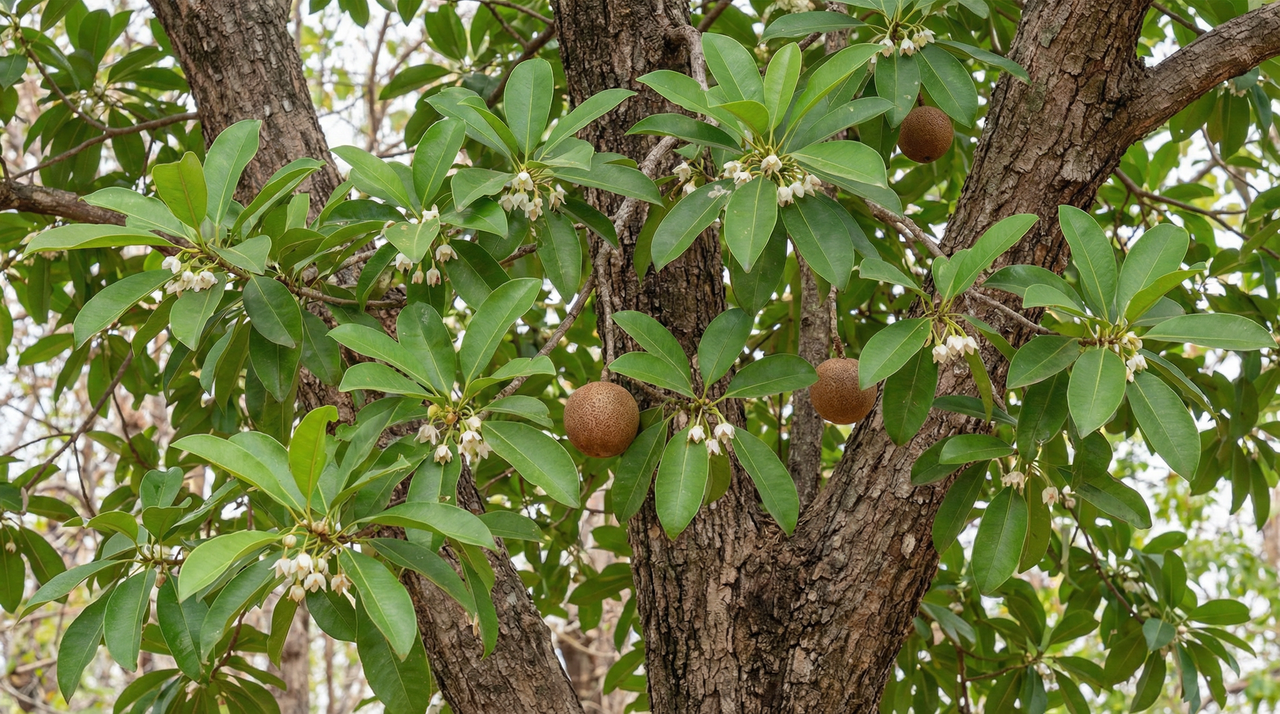
The first time I bit into a sapodilla, I thought someone had somehow baked a pear with brown sugar and vanilla and then chilled it into something that still looked like a dull, russeted potato. Nothing about the outside of this fruit prepares you for what's inside. And that gap between appearance and reality is exactly what's kept sapodilla off most North American radar for decades, even as it quietly fed civilizations. The Maya were cultivating this tree at least 3,000 years ago,[1] eating its fruit, chewing its latex, and carving its timber into some of the most durable structural beams in the ancient world. That latex, called chicle, is the same resin that eventually became the base for every stick of commercial chewing gum sold in the twentieth century. One tree. Millennia of use. Still largely unknown outside the tropics.
What strikes me most, having grown and observed this tree across subtropical climates, is how it refuses to announce itself. It doesn't demand attention in a nursery the way a citrus or mango does. But put it in the right soil, give it warmth and time, and it will outlive almost everything else in your food forest while producing one of the genuinely strangest and most satisfying fruits you'll ever taste.
Sapodilla Origin, History, and Botanical Background
If you've ever chewed a stick of gum, you've had a small, accidental encounter with one of the most quietly influential trees in the Americas. Sapodilla, known scientifically as Manilkara zapota, carries a story that runs far deeper than its unassuming brown fruit suggests. In Spanish it's most commonly called zapote or nispero, and those names hint at how thoroughly this tree wove itself into the cultures that domesticated it.
Botanical Background and Native Range
Sapodilla is native to southern Mexico, Guatemala, Belize, Honduras, El Salvador, Nicaragua, Costa Rica, Panama, parts of the Caribbean, and northern South America, with the Yucatán Peninsula sitting at the cultural and ecological heart of its range.[2][3][4] The Maya had been cultivating it for food, medicine, and ritual for at least 3,000 years before Western science gave it a formal name.[5][6] John Lindley didn't formally describe the species until 1852 in his Vegetable Kingdom,[7] which means millennia of indigenous cultivation preceded the moment taxonomists caught up.
What I find remarkable about sapodilla is its sheer staying power. This is a tree that can live well over 100 years, with some specimens documented beyond 200, and it flowers and fruits repeatedly across its entire lifespan.[8][9] Grafted trees begin fruiting in 5 to 7 years; seedlings ask for 12 to 15 years of patience, sometimes more.[10] In its native lowland forests, it grows as an upper canopy or emergent species below 600 meters, equally at home on coastal flats and the limestone ridges of the Yucatán.[11][12] I've seen this adaptability firsthand in Central Florida landscapes, where a mature sapodilla creates a cool, dense microclimate underneath its canopy that practically invites understory companions to move in.
Visual Characteristics of the Sapodilla Tree
The tree itself is unmistakable once you know it. A mature specimen carries a dense, rounded evergreen crown reaching 30 to 60 feet tall under typical garden conditions, though wild trees can push 100 feet with trunk diameters up to 36 inches and deeply fissured grayish-brown bark.[13][14] The leaves are glossy, dark green, and leathery, arranged spirally along the branch tips, each 2 to 6 inches long with 8 to 12 pairs of prominently raised veins on the underside.[15][16] Flowers are small, creamy white, and fragrant, appearing in clusters along the leaf axils.[17]
The fruit is what throws people the first time they see it. A rough, brown, potato-like berry 2 to 4 inches across, it looks like something you'd dig out of the ground rather than pick from a tree.[16][2] Cut it open when it's ripe and the flesh is juicy, granular, and tastes like a caramel pear crossed with brown sugar. Unripe, it's full of white latex and deeply astringent. I always tell people that the difference between delicious caramel goodness and a mouth-puckering experience comes down to one thing: patience. The fruit should yield to gentle thumb pressure, much like testing an avocado at the market. That milky latex runs through the bark, leaves, and young shoots throughout the tree's life,[15] and it's the source of everything that comes next in this tree's extraordinary cultural story. Drought stress can produce thicker leaves with higher structural tissue content, and soil conditions influence fruit sweetness, so the tree you grow reflects the conditions you give it.[18]
Traditional and Cultural Uses Through the Ages
For the Maya, sapodilla was sacred territory. The fruit was a dietary staple prized for its sweetness and digestibility, the bark and leaves treated gastrointestinal illness, and the latex, called tzictli, was chewed for oral hygiene, breath freshening, and ritual purposes.[19][20] The wood is exceptionally hard and decay-resistant, and traditional communities used it for tool handles, furniture, construction, and boat building.[21][6] Meeting a sapodilla in a subtropical garden today feels like meeting a plant with a 3,000-year résumé.
When 16th-century Spanish chroniclers like Hernán Cortés and Bernardino de Sahagún documented Mesoamerican life, they recorded these uses in detail.[22] The Portuguese carried the tree to India during the same era, where it took hold so thoroughly that India eventually became one of the world's major producers.[23] From India it traveled through tropical Asia and Africa, a quiet global migration fueled by the same qualities the Maya had recognized centuries earlier.
Fun Facts About Sapodilla and Chicle
I love telling clients that the worldwide chewing gum industry owes its existence to Maya ingenuity. The latex was called chicle, harvested by making shallow incisions in the bark during the dry season and boiling the collected sap.[22] In the 19th century, American entrepreneur Thomas Adams watched a Mexican general chewing the stuff, recognized the commercial potential, and began selling chicle-based gum. Wrigley later popularized it before synthetic bases took over.[24] One tropical tree, quietly shaping a global industry.
The productivity of a mature sapodilla is equally impressive. In favorable subtropical conditions like South Florida, established trees can yield 20 to 50 kilograms of fruit per year.[25] Traditional chicle harvesters in Central America still practice sustainable tapping techniques, allowing two-week healing periods between incisions to keep trees healthy across decades of use. Where modern data is thin, traditional knowledge still leads the practice. The tree is not considered invasive in the United States, though bird-dispersed seeds can establish in warm, humid microclimates.[26][27] Only fully ripe fruit belongs in your mouth. Unripe sapodilla is astringent, latex-laden, and genuinely unpleasant.[28] The reward for waiting is extraordinary. The penalty for rushing is memorable in all the wrong ways.
Sapodilla Varieties and Cultivars
Manilkara zapota is one species, but you'd never know it from the range of fruit it produces. Depending on the cultivar, you might be looking at pale, almost white skin and candy-sweet flesh, or a pink-fleshed, aromatic fruit the size of a tennis ball, or something nearly seedless.[10][29] That variability is the good news. The challenge is that most people never get to taste multiple cultivars side by side, so they don't realize how much the choice matters.
Notable Sapodilla Cultivars
I've been lucky enough to taste several Florida cultivars at tropical-fruit events over the years, and I can tell you firsthand that the differences aren't subtle. 'Tasty' really does live up to its name. 'Blanco' has an almost candy-like sweetness that catches first-time tasters completely off guard. These aren't just catalog descriptions.
For most home growers, the decision comes down to a handful of traits: size, flavor, cold tolerance, and how long you're willing to wait for fruit. 'Alano' is a reliable choice with large, sweet fruit and a relatively short ripening window.[10] 'Prolific' earns its name with a compact growth habit, high self-fertility, and yields significantly higher than unpruned standard trees, which matters when you're working with a smaller backyard canopy slot.[30] 'Honey' brings large, yellow-gold fruit with exceptional sweetness. 'Findlay Seedless' is the one to reach for if seeds are a deal-breaker. For fiberless texture, 'Australian Queen' is hard to beat. And if you want something a little unusual, 'Pink Sapodilla' offers distinct pink flesh that surprises people at the table.[10][29]
Tree size is a real planning consideration. In the wild, sapodilla can reach 60 to 100 feet.[31] That's why compact selections like 'Prolific' get so much attention in home-scale permaculture designs. Climate adaptation also varies: 'Tasty' is more cold-sensitive and needs a bit more warmth to break buds reliably, while 'Alano' and 'Prolific' have better tolerance for brief cold snaps. I recommend both against a south-facing wall in marginal zone 9b spots; I've seen them bounce back from a dip to 29°F where 'Tasty' showed real leaf damage.[30] Fruit maturation itself varies widely by cultivar, anywhere from 3 to 11 months after flowering, so ripening season depends heavily on what you plant.[32] Florida breeding programs trace back to early 20th-century USDA introductions from Central America and the Caribbean, which is part of why local performance can still vary so much by site and microclimate.[33]
Sourcing Sapodilla Trees, Seeds, and Fruit
Sapodilla is still a specialty crop in the U.S., with commercial production concentrated in Florida's Homestead area and parts of Hawaii.[10] That means sourcing requires some planning. The single most important decision is grafted versus seedling: grafted trees from reputable nurseries fruit in 3 to 7 years, while seedlings may keep you waiting 8 to 15 years or more.[10] In my design work with clients, that gap is the difference between a tree that becomes part of someone's food forest during their active gardening years and one that fruits for their kids.
Reliable U.S. suppliers include Top Tropicals and Just Fruits and Exotics in Florida, Logee's Greenhouses, and Miami Fruit, with grafted trees typically running $50 to $150 for a 3 to 5 foot specimen.[34][35][36] When evaluating any tree before purchase, I look for healthy glossy leaves, a strong central leader, and a clearly visible graft union. If a nursery can't show you where the graft is, that's a red flag. I've seen beautiful-looking trees collapse in their first wet season because drainage or disease wasn't considered at the source.
On the regulatory side, I always advise clients to secure a USDA APHIS PPQ 587 permit before ordering from out-of-state nurseries; it's not optional, and rules change.[37] Nursery stock can also carry latent Phytophthora or sapodilla ringspot virus, so buying from a specialist who uses sterile practices genuinely matters.[38] The premium for quality sourcing pays for itself fast.
Sapodilla Propagation and Planting Guide
Sapodilla has two propagation personalities, and understanding both shapes every decision you make from the moment you crack open a ripe fruit. The seeds are fascinating and slightly frustrating; the grafting is methodical but worth every bit of effort. I've worked with this tree long enough in Central Florida to have strong opinions about both routes.
Seed Characteristics, Storage, and Germination
Sapodilla seeds are recalcitrant, meaning they cannot be dried and stored like most garden seeds. Viability drops sharply within weeks of extraction from ripe fruit, and even under careful cool, moist storage (10-20°C at 80-95% relative humidity) they're largely nonviable within six to twelve months.[38][39][40] I've started hundreds of sapodilla seedlings from grocery-store fruit in my nursery, and the single most important habit I've built is sowing them the same afternoon I eat the fruit. Wait a month and you're gambling.
Sapodilla seeds are polyembryonic in 80-90% of cases, producing multiple embryos per seed, with over 95% fidelity to the parent plant.[41][38] That's a genuine advantage for home growers who want to preserve a favorite flavor. Sow fresh seeds at 25-30°C in moist, well-drained media like sand or vermiculite, keep humidity high, and expect hypogeal germination in two to six weeks at rates of 60-90%.[38][42][43] The seed coat can be mildly hard, and scarification or a gibberellic acid soak will improve uniformity if germination is uneven, though fresh seeds often don't need any pretreatment at all.[44][45] One practical note I learned the embarrassing way: label every flat immediately, because polyembryonic sapodilla seedlings look completely identical in their first month above ground.
Grafting, Cuttings, and Other Vegetative Methods
For anyone who wants fruit in a reasonable timeframe, grafting is the answer. Commercial propagation uses one-to-two year old Manilkara zapota seedling rootstocks, with Manilkara bidentata occasionally substituted for added disease resistance.[8][40] Cleft grafting gives the best results at 70-80% success, followed by veneer grafting at 60-75% and budding at 50-70%; all are best done in late spring or early in the rainy season when sap is actively moving.[46][47] In my experience, cleft grafts done in May, when Central Florida humidity is climbing and the sap is rising, consistently outperform grafts attempted at any other time of year.
If grafting feels like a stretch, semi-hardwood cuttings treated with 1000-5000 ppm IBA can root at 50-80% success, and air layering during the rainy season with 5000-8000 ppm IBA achieves 60-80%.[48][49] Tissue culture remains experimental and is plagued by phenolic browning and poor acclimatization, so it's not a realistic option for home growers.[50] If you're uncertain about seed quality before any of this, germination trials at 25-30°C, tetrazolium staining, or X-ray radiography can all assess viability before you commit to a propagation batch.[51][52]
Soil, Site Selection, and Planting Technique
Drainage is the single non-negotiable for sapodilla. I've watched young trees bounce back from weeks of drought without complaint. I've never seen one recover from waterlogged roots. Poor drainage invites Phytophthora root rot, and by the time you notice the brown, soft, foul-smelling roots, the tree is often already beyond saving.[38][53] After losing two trees to a poorly drained bed in my early years, I now insist on mounding or raised beds, and I only use a sandy-loam mix that drains visibly within minutes of watering.
Sapodilla performs best in well-drained sandy loam or loam with a pH of 6.0-7.5, ideally 6.5-7.0, and 2-5% organic matter.[38][54] It can tolerate a wider range of 5.5-8.0 and will grow in light sandy or calcareous soils, but heavy clay and compaction are deal-breakers. If a soil test shows pH above 7.5, incorporate elemental sulfur at 5-10 lb per 1,000 square feet, worked in 6-8 inches deep, before planting; skip lime on already-acidic sites.[55][8] I've seen iron chlorosis (interveinal yellowing) stall a tree's growth for an entire season when gardeners skipped this step, and aluminum toxicity stunts roots below pH 5.5. A $15 soil test before planting is cheap insurance. For containers, use a 40-50% loam, 30% coir or peat, 20-30% perlite or sand mix in pots at least 6-8 inches deep.[56][57]
Choose a site with full sun, at minimum 6-8 hours of direct light daily. Partial shade produces leggy, chlorotic growth and weak fruiting, but be aware that very young transplants can sunscorch if moved abruptly from shade to full exposure.[10][58]
Spacing and Transplanting Tips
Sapodilla is a big tree. Mature specimens reach 30-70 feet tall with canopy spreads of 20-40 feet, and giving them room upfront pays dividends in airflow, light penetration, and ease of harvest for decades afterward.[38][59] Commercial orchards typically space at 25 x 25 feet; for home gardens, 20-30 feet between trees is the practical target.[60] Think of it like planting a mango or avocado: the generous spacing you give it today means you won't be fighting a crowded, disease-prone canopy fifteen years from now.
Plant in the warm, wet season or spring, just as the rains begin, so the tree has moisture to establish without constant supplemental irrigation.[38][30] Stake young trees for the first two to three years because their root systems take time to anchor against wind, and mulch the root zone generously to suppress weeds and conserve moisture. Light annual pruning to remove crossing branches and open the canopy is all the shaping this tree really needs in its early years.
Time to First Fruit
Here's the number that usually settles the seed-versus-graft debate: seed-grown sapodilla trees typically take 5-8 years to produce their first fruit, sometimes stretching to ten.[10][61] Grafted trees fruit in 2-5 years, occasionally as early as two years under good conditions.[62] Just as with citrus, a grafted sapodilla will reward you with fruit years before a seedling will; I've always recommended grafted trees to clients who want dessert from their landscape within this decade. Seeds are wonderful for rootstock production, for those who genuinely enjoy the propagation process, and for the polyembryonic bonus of nearly true-to-type offspring. For most home growers, though, the nursery premium for a grafted tree is simply the price of not waiting a decade.
Sapodilla Care Guide: Sunlight, Water, Feeding, and Seasonal Management
Caring for sapodilla is largely about understanding what a tree from seasonal tropical forests actually needs and then providing a reasonable approximation of that in your own landscape. Get the fundamentals right and sapodilla rewards you with decades of reliable fruit. Push it too hard with heavy feeding or aggressive pruning and it punishes you quietly but decisively.
Sunlight Requirements
Full sun is non-negotiable. Six to eight hours of direct sunlight daily is what drives healthy canopy development and, more importantly, fruit quality.[38][28] The tree will tolerate partial shade, but "tolerate" is the operative word. Shade-grown specimens in the Manilkara genus do orient their leaves to capture more light and ramp up chlorophyll production[63], but that's a compensation strategy, not a preference. What I tell clients is simple: put sapodilla in your sunniest spot or don't expect much fruit. For container growers or anyone trialing it in a northern greenhouse, supplemental lighting may be necessary to meet that threshold.
Watering Needs and Drought Tolerance
Sapodilla comes from seasonal tropical forests that receive somewhere between 750 and 2,500 mm of rainfall annually, with an optimal range around 1,000 to 2,000 mm.[10][64] Once a tree is two to three years in the ground and properly established, it becomes genuinely drought tolerant. Getting there, though, requires consistent moisture: young trees need deep watering of about an inch to two inches per week, and established trees in dry periods should be irrigated every seven to ten days when young, stretching to every two to three weeks once they've settled in.[10][65] During flowering I keep the schedule tighter, every five to seven days, because water stress at that stage translates directly to poor fruit set.
The leaves will tell you what's happening. Wilting, brown or yellowing margins, and leaf drop point to underwatering. Persistent wilting despite wet soil, general chlorosis, and stunted growth point to overwatering and possible root rot from Pythium or Phytophthora.[10][66] A two to four inch layer of mulch helps regulate both extremes[8], and I keep it pulled back from the trunk to avoid creating rot habitat at the base.
Frost Tolerance and Cold Protection
Sapodilla is solidly a zone 10a to 11 tree, with zone 9b being marginal territory that requires active management.[8] Brief dips to 28 to 32°F are something an established tree can survive, but prolonged exposure below 30°F causes real damage: leaf burn, stem dieback, bark splitting, and fruit russeting.[56][67] Young trees in their first two winters are the most vulnerable, and I've seen zone 9b clients lose otherwise healthy seedlings to a single hard frost event simply because they weren't prepared.
Protection is layerable. Start with site selection: avoid low spots where cold air pools. Keep three to six inches of mulch around the root zone. For a forecast dip, frost blankets or horticultural fleece can buy four to eight degrees of protection.[68][69] I once saved several young client trees during a 28°F event by running overhead irrigation through the night, which kept the canopy temperature up by five to ten degrees through evaporative heat release. For container-grown trees, moving them to a covered porch below 50°F is straightforward and effective; string lights tucked under a frost blanket can handle the more severe events.
Heat Tolerance and High-Temperature Management
Sapodilla loves warmth. Its sweet spot is 68 to 95°F, and it handles brief spikes to around 100 to 104°F without permanent damage.[70][71] Above that threshold, photosynthesis starts to falter and fruit set drops. I've watched my own established trees wilt dramatically on days above 38°C, leaves drooping by mid-afternoon, then fully recover once evening temperatures fall back below 75°F. That rebound is reassuring, but repeated extreme heat days without irrigation will catch up with any tree.
Mitigation is straightforward: drip irrigation every three to five days during heat waves, five to ten centimeters of organic mulch over the root zone, and if you're in an extremely hot climate, thirty to fifty percent shade cloth during peak summer.[72][73] Nighttime temperatures matter too; chilling injury becomes a risk below 50°F, so the tree needs warm nights as much as it needs warm days. Heat-tolerant cultivars like 'Pineras' are worth seeking out if you're in a climate with prolonged high-heat periods.
Feeding and Nutrient Management
Sapodilla is a moderate feeder, and that distinction matters enormously in practice. Over-fertilizing is one of the most common mistakes I see, especially in sandy Florida soils where excess salts build up quickly, causing tip burn, leaf scorch, and root damage. Worse, heavy nitrogen pushes lush dark vegetative growth at the expense of fruit set.[74][38] After seeing this happen repeatedly, I now insist on a soil test every two to three years before adjusting any fertilizer program.
For young trees, a balanced NPK fertilizer like a 6-6-6 or 10-10-10, applied at about half a pound to two pounds per tree split across three to four applications through spring and summer, is sufficient.[56][8] Mature trees can handle one to five pounds, one to four times yearly, always applied with irrigation and timed away from the rainy season. Potassium is worth emphasizing for fruit quality; deficiency shows up as marginal leaf necrosis and fruit drop.[75] Interveinal chlorosis often signals zinc or manganese deficiency rather than a primary NPK problem, which is exactly why soil tests save money and guesswork. Organic growers can substitute ten to twenty kilograms of compost or aged manure annually as a gentler baseline.
Pruning, Maintenance, and Seasonal Rhythm
The rule I've landed on after pruning one mature sapodilla too aggressively in early summer and watching the following season's fruit set drop dramatically: keep cuts light and time them after harvest in the dry season, late winter or early spring.[33][76] Heavy pruning can reduce yields by more than fifty percent, triggers excessive latex flow, and exposes inner wood to sunburn. Remove dead, diseased, or crossing branches and maintain airflow. That's it. For trees in their first two to three years, structural pruning to establish a central leader or open center shape is worthwhile, but once the framework is set, mature trees need only light annual maintenance.[77][78] Local extension services are always worth consulting for region-specific timing adjustments.
Seasonal Growth Patterns
Sapodilla doesn't enter true dormancy. It slows during prolonged dry periods but stays evergreen, and in the tropics it flowers and fruits nearly year-round with peaks that follow dry-season leaf flushes triggered by reduced rainfall.[38][79][80] In subtropical climates like Florida, that translates to a practical calendar: three to four fertilizer applications from spring through fall, pruning in the post-harvest dry season, and irrigation schedules that tighten around flowering and fruiting windows.[8] Once you internalize those rhythms, the tree's care becomes intuitive. It's always doing something, always responding to seasonal moisture cues, and once established it's genuinely forgiving of the occasional missed irrigation or imperfect timing. The gardener who pays attention to that seasonal pulse, and keeps soil tests current, will have a productive sapodilla for a very long time.
Sapodilla Harvesting: Timing, Technique, and Post-Harvest Handling
Patience is the defining skill for sapodilla harvesting. From flower to ripe fruit takes anywhere from 6 to 8 months under ideal conditions, and some sources put the full development window closer to 10 to 16 months depending on climate and cultivar.[38][54][81] I actually tag my sapodilla flowers with flagging tape and dates because that long a development window means you will absolutely forget which fruit set is close and which is nowhere near ready.
When to Harvest Sapodilla – Maturity Indicators and Seasonal Timing
In Florida and comparable subtropical climates, sapodilla season runs roughly August through December, with peak harvest concentrated September through November.[38][33] I read maturity the same way I'd read an avocado: color shift first, then thumb pressure. Ripe sapodilla transitions from dark green to a yellowish-green, light brown, or yellowish-brown skin; give it a gentle squeeze and the flesh should yield slightly, not feel like a rock or collapse like mush.[38][82] The latex flow also diminishes noticeably at true maturity. If you have a refractometer, look for total soluble solids in the 15 to 18° Brix range as confirmation.[38][83] Getting this right matters more with sapodilla than with almost any other tropical fruit I grow, because the unripe version isn't just disappointing, it's genuinely unpleasant.
How to Harvest Sapodilla Without Damage or Bitter Latex
Pick individually by hand, early in the morning during dry weather, using clippers or secateurs rather than pulling.[31][10] The morning harvest timing isn't arbitrary; cooler temperatures and dry skin reduce latex bleed at the cut stem. Only take fruit that meets all the maturity cues from above. I learned the hard way that "almost ripe" sapodilla still carries enough latex to coat your mouth with bitterness and a slightly gummy, astringent film that no amount of sweetness can salvage. Skip anything that feels firm and bleeds heavily when clipped.
Expected Yields, Flavor at Peak Ripeness, and Storage
Grafted trees typically begin bearing 4 to 7 years after planting, reaching solid production around 5 to 6 years; seedlings take considerably longer, which is exactly why I steer clients toward grafted stock whenever I'm designing a food forest in Central Florida.[31][30] A mature tree will yield 200 to 600 fruits per season, and peak productivity runs from roughly 20 to 30 years of age.[10][84] The reward for all that waiting: at true ripeness, sapodilla hits 15 to 23° Brix with a caramel-honey flavor, subtle pear-strawberry aroma, and that uniquely sandy texture from stone cells in the flesh.[85][86]
Sapodilla is a climacteric fruit, meaning it can finish ripening off the tree once picked at the right stage. Store harvested fruit at 59 to 68°F (15 to 20°C) with humidity around 85 to 90% and it will hold for 7 to 14 days.[87][88] Skip the refrigerator entirely: temperatures below 54°F (12°C) cause chilling injury, which shows up as blackened skin and pitted flesh.[87] A cool shady corner of the kitchen or a ventilated pantry is the practical solution for most home growers.
Sapodilla Preparation, Culinary Uses, and Safety
The Ripe Pulp: Flavor, Texture, Nutrition, and Everyday Uses
Once you've waited out that long ripening arc, the reward is genuinely unlike most fruits you've grown. Ripe sapodilla pulp delivers a flavor that reads as caramel, honey, and brown sugar with distinct undertones of pear and cinnamon, and the aroma adds strawberry, apple, and earthy-floral notes that make the kitchen smell like a spice cabinet and a fruit bowl at once.[89][90] That sweetness comes from a sugar profile tilted heavily toward sucrose at 40-50%, with fructose and glucose making up the rest.[85] There's also a characteristic gritty, almost sandy mouthfeel from small stone cells distributed through the pulp; some people find it off-putting at first, but I've watched clients come around completely once they stop expecting a mango and just let it be itself.[91]
Nutritionally, a 100g serving lands somewhere between 62 and 83 kcal with 15-20g of carbohydrates, 1.3-3.4g of dietary fiber, and modest amounts of vitamin C, potassium, magnesium, calcium, iron, B vitamins, carotenoids, and polyphenols -- with variation depending on cultivar, soil, and how ripe the fruit was at harvest.[92][93] The fruit is eaten fresh, dried, and processed into jams, jellies, milkshakes, ice cream, juices, and desserts across Latin America, India, and Southeast Asia.[21][10] Cultivar choice shapes the experience: 'Pineras' leans into intense pear-like notes while 'Tasty' offers a milder profile with berry undertones.[94] Close relatives in the genus echo this appeal -- Manilkara gaumeri produces smaller fruits eaten raw or in desserts,[95] and Massaranduba (Manilkara striata) brings a juicy, sweet-tart pear-caramel flavor with just a hint of astringency that softens to sweetness as you eat.[96]
Safety Guidelines: What to Avoid and Why
Ripeness isn't just a flavor question here. Unripe sapodilla contains high tannin concentrations that cause sharp astringency and genuine gastrointestinal distress.[97] I learned this the hard way in my first season growing the tree in Central Florida -- one impatient taste of a fruit that hadn't quite softened yet left me with a dry, puckered mouth for an hour. Now I teach clients the same cue I use: wait for the skin to dull and yield slightly under gentle thumb pressure. That's when the tannin bite is gone and the sweetness has fully arrived.
The seeds must always be removed and discarded. They contain toxic saponins and cyanogenic glycosides capable of releasing cyanide upon metabolism.[98][97] The milky latex isn't eaten either, and anyone who reacts to figs, poinsettia, or other latex-producing plants should handle the fruit with the same caution -- cross-reactivity with latex-fruit syndrome (banana, avocado) is documented.[99] Wash fruit thoroughly before eating, and discard the skin.
Look-Alikes and Safe Identification in the Sapotaceae Family
If you're sourcing fruit from a market or an unfamiliar landscape planting, it helps to know the family. Common look-alikes within Sapotaceae include mamey sapote, star apple, canistel, and Khirni; outside the family, Coccoloba diversifolia can resemble it but lacks the diagnostic milky latex.[58][100] When I'm designing edible landscapes that mix native and exotic Sapotaceae species, my field confirmation comes from nicking a small leaf stem and watching for that white latex -- it's a quick, reliable test that separates Manilkara from most confusion species.[101] Fruit size also helps; Manilkara zapota runs larger than most of its close relatives.
Traditional Medicinal Preparations
Across Mesoamerica, India, the Philippines, and the Caribbean, sapodilla's leaves, bark, and seeds have long served purposes well beyond the kitchen. Leaf decoctions and powders (typically 5-10g daily in general use, 3-6g in Ayurvedic practice) address diarrhea, dysentery, and respiratory complaints; bark preparations of 2-5g are used for similar conditions and wound healing, while seed powder appears occasionally at 1-3g doses.[102][103] Leaves are prepared as teas or poultices, not eaten as food; in Caribbean practice, related Manilkara striata bark is decocted by simmering 20-30g in water for 10-15 minutes.[98][96] These traditions draw on the tannins, flavonoids, and triterpenoids covered in the health benefits discussion. That said, traditional use and clinical validation are still two different things, and I'd always recommend consulting a qualified practitioner before using any part of the tree medicinally.
Non-Food Uses: Chicle and Historical Latex
The same latex that poses a sensitivity risk in the fruit has a fascinating cultural history in its own right. Chicle, harvested from mature 15-25-year-old trees via V-shaped trunk incisions, is composed of 92-95% polyisoprenes plus resins and waxes -- the original base for natural chewing gum.[84][99] A related latex from Manilkara bidentata served the same purpose.[31] Most commercial gum today uses synthetic substitutes, and the decline of natural chicle is one of those quiet losses I think about when I'm designing food forests. A tree that fed people, produced medicine, supplied an entire global industry, and anchored rainforest economies for centuries deserves a place in any serious conversation about regenerative planting.
Sapodilla Health Benefits and Medicinal Uses
When I hand someone their first ripe sapodilla, the nutritional conversation usually starts with taste: that dense, caramel-sweet pulp doesn't read like "health food," but the composition tells a different story. The fruit pulls real weight as a dietary contributor, and understanding what's actually in it helps explain why it's been a staple from Maya kitchens to Southeast Asian markets for millennia.
Nutritional Profile of Sapodilla Fruit
A 100g serving of ripe sapodilla pulp delivers around 83 kcal, with nearly 20g of carbohydrates, 5.3g of dietary fiber, 193mg of potassium, 14.7mg of vitamin C, and 21mg of calcium.[104][10] That fiber content is where I always pause in client conversations. Five grams per serving is genuinely meaningful for gut support, comparable to what you'd get from a guava or a decent handful of mango. For a backyard food forest planting in a warm climate, that's a fruit pulling its weight at the table.
The antioxidant picture gets more interesting as the fruit ripens. Sapodilla contains polyphenols in the range of 200–500 mg/100g fresh weight, with flavonoids at 50–150 mg/100g and carotenoids around 1–5 mg/100g, and both phenolic content and antioxidant capacity rise measurably as the fruit matures.[105][106] That ripening-enhanced antioxidant boost is a practical reason, beyond flavor, to wait for full maturity before eating. Related Manilkara species like Massaranduba share a broadly similar nutritional fingerprint, which makes sense given the genus's shared ecology, though sapodilla remains the most studied and documented of the group.[107]
The seeds are a different matter entirely. They contain saponins, lectins, and cyanogenic glycosides that can cause nausea and gastrointestinal distress, and should never be eaten.[108] In my experience handling these fruits with clients and garden groups, I always make seed removal a talking point before anyone takes a bite.
Key Phytochemicals in Sapodilla
Manilkara zapota is a phytochemically rich plant across all its parts, not just the fruit. Research has identified alkaloids, flavonoids (including quercetin, kaempferol, and rutin glycosides), triterpenoids like lupeol, taraxerol, and betulinic acid, phenolic acids such as gallic and ellagic acid, tannins, ellagitannins including punicalagin, carotenoids, saponins, coumarins, and polyisoprenes in the latex.[109][110] The seed oil, separately, yields 20–30% oil with oleic, palmitic, and linoleic acids as the dominant fatty acids.[111]
Growing conditions meaningfully affect these compound levels. Phenolic concentrations rise during dry periods and stress, flavonoids tend to be higher in organic-rich or calcareous soils, and geographic origin shifts the overall profile between Central American and Southeast Asian plants.[112][113] I've seen this play out anecdotally in Florida, where trees in well-drained, slightly acidic soils seem to produce fruit with a more complex, almost tannic edge when young, which may reflect those elevated flavonoid levels. These compounds also serve the tree ecologically, defending against pathogens and herbivores and attracting the bats and birds that disperse its seeds.[114]
Traditional and Preclinical Medicinal Research
Across Latin America, the Caribbean, and Asia, sapodilla has a documented ethnomedicinal history that maps neatly onto its phytochemistry. Ripe fruit pulp has been used as an astringent for diarrhea and dysentery; bark and leaf decoctions as expectorants and antispasmodics for coughs, fever, and respiratory congestion; latex applied to wounds and skin infections; and seeds prepared for diuretic or digestive purposes.[115][116] Related species like Bulletwood share many of these applications, particularly wound healing and anti-inflammatory use.
Preclinical research has validated several of these uses in lab and animal models. Sapodilla extracts show strong DPPH antioxidant scavenging from their phenolic and flavonoid load, anti-inflammatory effects comparable to indomethacin in edema models, antimicrobial activity against Staphylococcus aureus, E. coli, and Candida, analgesic and antispasmodic effects from bark extracts, sedative and anxiolytic properties with GABAergic activity from seed and leaf extracts, blood glucose reduction via alpha-glucosidase inhibition, and latex-mediated wound healing reaching approximately 80% closure in animal models.[117][118][119][120]
That said, there are no robust human clinical trials or randomized controlled studies validating therapeutic claims for sapodilla or its close relatives.[115] The traditional Caribbean and Mayan uses for diarrhea and wound care are time-tested in practice, but I always tell clients who ask about using extracts medicinally to loop in a healthcare provider first. Years of guiding people through plant-based food systems has made me comfortable recommending the fruit enthusiastically and far more cautious about anything involving concentrated preparations of bark or leaves.
Safety Considerations for Sapodilla
Ripe sapodilla pulp is generally safe for most people. Acute toxicity studies on related species show LD50 values above 2000 mg/kg, and there are no documented cases of severe human fatalities from normal fruit consumption.[121][122] Eating a lot of unripe fruit or overconsuming in one sitting can cause digestive discomfort from the high fiber and residual latex content, but that's a matter of moderation rather than toxicity.
The seeds are a clearer hazard. They contain saponins at 2–5% dry weight, lectins including a compound called MzL, and cyanogenic glycosides that cause gastrointestinal irritation, nausea, or worse depending on dose.[123] Whole seeds also pose a mechanical obstruction risk due to their hard, elongated shape.[124] Remove them before eating and keep them away from children.
The latex deserves attention too, particularly for anyone with latex allergies. Chicle can trigger latex-fruit syndrome, causing oral itching, hives, swelling, or in severe cases anaphylaxis.[125][126] I've learned to wear gloves when pruning these trees, and I make a point of asking anyone new to the fruit whether they have latex sensitivities before encouraging them to handle unripe fruit or cuts on the stem. Processed chicle gum is generally considered safe, but raw latex contact is a different matter.
If you're managing blood sugar with medication, the documented hypoglycemic potential from sapodilla extracts is real enough in animal studies to warrant a conversation with your doctor before using any concentrated preparation.[121][127] Ripe fruit in normal amounts is reasonable during pregnancy and nursing, but concentrated leaf or bark extracts are a different category entirely and I'd recommend erring on the side of caution there.[128] One last practical note: wash fruit under running water before peeling, and be aware that sapodilla has sometimes been confused with manchineel, an unrelated toxic tree that causes severe burns on contact.[129] Knowing your source matters.
Sapodilla Pests and Diseases
Sapodilla isn't the highest-maintenance tree in my food forest, and that's no accident. Compared to mango or papaya, which seem to attract every pest in the county, sapodilla holds its own remarkably well. Part of that comes down to chemistry and structure: the tree produces tannins and saponins in its leaves and bark that reduce palatability for browsing insects, and the milky chicle latex acts almost like a physical trap for small insects while also delivering secondary metabolites with insecticidal properties.[130][131][132] I think of it similarly to the milky sap you see in papaya or fig -- those trees aren't immune to pests either, but that latex layer creates real friction for would-be feeders. The smooth, leathery leaves add another layer by making it physically harder for insects to lay eggs or get a feeding foothold.[133] The overall picture is moderate to high pest resistance relative to other tropical fruits,[134][135] though no widely documented pest-resistant cultivars exist yet, so that resilience is more about the species as a whole than any specific variety you can order from a nursery.
Natural Defenses and Overall Resistance
While university trials haven't identified fully resistant varieties yet, I've noticed that trees grown from local seed stock seem to handle our particular combination of South Florida heat, humidity, and occasional wet feet better than imported nursery stock. Some cultivars like Prolific and Brown Sugar show better tolerance to fruit fly infestation, likely due to thicker skin and earlier maturation,[136][33] but that anecdotal quality of the data is worth keeping in mind as you make decisions for your own planting.
Major Diseases of Sapodilla
Anthracnose, caused by Colletotrichum gloeosporioides, is the disease I watch for most closely. It hits leaves, flowers, and developing fruits, and in a bad year can mean significant defoliation and fruit rot before you get a chance to harvest.[66][137] The disease thrives above 80% relative humidity and between 25-30°C,[138] which describes a typical Central Florida summer almost perfectly. In my experience, keeping the canopy open through winter pruning dramatically reduces anthracnose pressure the following fruiting season -- it's the single most effective thing I've done.
Phytophthora root and crown rot is the other disease I take seriously, and the one that keeps me religious about drainage. Once a sapodilla shows wilting from root rot, it's rarely worth trying to save; the damage to the vascular system typically moves faster than any treatment.[139][67] Prevention through raised planting, excellent drainage, and avoiding soil pH below 6.0 has been far more effective than any remediation attempt.[140] Powdery mildew (Oidium spp.) and fruit rot from Rhizopus stolonifer can appear under humid conditions,[66][141] and various leaf spot pathogens including Cercospora manilkarae, Phyllosticta spp., and Xanthomonas campestris show up occasionally, though they're rarely catastrophic in well-maintained trees.[66] Sapodilla shows notably high resistance to viral diseases like leaf curl virus, which is a genuine point in its favor.[141]
Common Insect Pests
Fruit borers (Conopomorpha sapotae and related species) and fruit flies are the primary economic threats, capable of causing 30-50% fruit loss in affected orchards.[142][143][33] In Florida, the Caribbean fruit fly (Anastrepha suspensa) is the one to watch. I've learned to harvest slightly under-ripe fruit on cultivars like Prolific to get ahead of the worst damage -- a small tradeoff in sweetness for a much cleaner yield. Scale insects, mealybugs, and sooty mold form another linked problem in humid conditions,[144] while leaf-eating caterpillars are more of a concern in Asian growing regions than here.[145] Root-lesion nematodes (Pratylenchus spp.) can stunt young trees in sandy soils, though their overall impact is typically lower than the fruit pests.[146]
Integrated Pest and Disease Management
The best sapodilla disease management strategy starts with everything already covered in the care guide: open canopy pruning, deep infrequent irrigation, excellent drainage, and balanced nutrition with adequate potassium and restrained nitrogen.[147][148] A healthy, vigorous tree with good airflow is your primary line of defense. When intervention is needed, copper-based fungicides address anthracnose, sulfur handles powdery mildew, and targeted fungicides manage Phytophthora; biological tools like Bacillus thuringiensis and natural predator conservation round out the toolkit before reaching for anything heavier.[149][68] Cultivar-specific resistance data remains thin and largely anecdotal, and no commercial variety is fully resistant to major sapodilla tree diseases like Fusarium wilt,[150] but in my years growing these trees, the ones that struggled were almost always stressed by drainage problems or neglect. Observant, attentive growers who maintain tree vigor and good sanitation rarely need to reach for serious chemical intervention.
Sapodilla in Permaculture Design
Few trees earn their place in a tropical food forest as thoroughly as sapodilla. It produces food, supports wildlife, builds soil, breaks wind, and somehow manages to look stunning doing all of it. I've been designing with this tree for years, and every time I site one correctly, it just keeps giving.
Forest Layer and Guild Placement
Sapodilla occupies the upper canopy or emergent layer in a food forest system, typically reaching 30 to 60 feet in cultivation with a dense, conical to rounded crown that stays evergreen year-round.[151][152] What makes it particularly useful in layered systems is its deep taproot with moderate lateral spread, meaning it anchors itself firmly without aggressively competing with the plants growing below it.[153][154] In my own food forest, I've watched sweet potato vines and pigeon pea thrive in the root zone of established sapodilla trees on a gentle slope, with almost no surface competition from the tree itself. That kind of guild compatibility is genuinely rare in a large canopy species.
Ecosystem Functions and Services
Start with what's happening underground. The taproot reaches into deeper soil horizons and pulls up minerals, particularly potassium and calcium, making sapodilla a solid dynamic accumulator.[155][156] That same root architecture stabilizes soils on slopes and prevents erosion where shallower-rooted trees would struggle.[157] Above ground, the dense evergreen canopy works as a legitimate windbreak, shading the understory year-round and generating a steady supply of leaf litter that feeds soil microbial communities and builds organic matter over time.[158][156] I've started using pruned branches directly as chop-and-drop mulch around younger guild plants, and the decomposition is noticeably slow, meaning it keeps working for a long time.
The pollination story is one I find genuinely fascinating. The small, creamy-white bell-shaped flowers open in the late afternoon or evening and release a distinctly fermented scent that draws primarily nocturnal beetles and flies, with bees playing a secondary role.[38][159] I've stood near a tree at dusk and watched the whole event unfold; the smell is unmistakable. Because sapodilla is largely self-incompatible, cross-pollination matters for fruit set.[160] In a season when our pollinator populations were low, fruit set was noticeably poor; after introducing stingless bee hives nearby, yields improved considerably. Planning for pollinators isn't optional with this species.
Fruiting trees also attract a wide range of wildlife. Birds, bats, monkeys, and other mammals feed on the fruit and disperse seeds across the landscape, and the tree forms mycorrhizal associations that further enhance its own nutrient uptake.[155][161] For the human side of the guild, traditional uses of bark and leaf preparations for treating gastrointestinal and respiratory ailments have a long history, and the tree's latex was the original base for commercial chewing gum; its dense wood serves construction and tool-making, and the seeds are carved into beads and crafts.[162][163] (The health-benefits section covers the medicinal profile in much more depth.) Sapodilla pairs well with nitrogen-fixing legumes in mixed guilds, and its ornamental structure adds genuine visual weight to a landscape design.[157] In Florida and similar non-native warm climates, bird and mammal seed dispersal can push this species into invasive territory outside cultivated settings.[164][158] I've seen volunteer seedlings pop up well beyond intended planting zones; monitoring matters, and choosing grafted cultivars with known seed production patterns is a sensible precaution.
Climate and Hardiness Zones
Sapodilla is native to southern Mexico, Central America, and the Caribbean, where it evolved in warm, humid tropical climates classified under Köppen Af and Am, with some tolerance for the drier Aw type, from sea level up to about 1,200 meters, though it performs best below 600 meters.[165][166] It thrives between 75 and 85°F and can handle short spikes to around 104°F, but the lower temperature limit is where things get serious: mature trees can survive brief dips to about 28 to 32°F, while young trees are far more vulnerable and can be severely damaged by any frost at all.[38][167] In my experience, a mature, well-sited tree can survive a brief dip to 30°F with south-facing wall protection and heavy mulch, but the difference in cold hardiness between a three-year-old tree and a ten-year-old one is dramatic. I would never leave a young sapling unprotected in anything below 40°F.
Annual precipitation requirements fall between 40 and 100 inches, with high relative humidity preferred; once established after two or three years, these trees develop respectable drought tolerance.[31][62] In the United States, reliable cultivation is largely confined to South Florida and Hawaii, within USDA zones 10a through 11, with marginal success in zone 9b using microclimates, frost blankets, and heavy mulching.[38][168] Frost damage shows up as leaf scorch, fruit drop, and bark cracking, so siting against a thermal mass or in a sheltered south-facing microclimate isn't optional in colder pockets of that range.[169] Related Manilkara species like Massaranduba and Bulletwood show similar frost sensitivity patterns, suggesting this cold vulnerability is a genus-wide characteristic rather than a sapodilla-specific quirk.[170][171]
The Tree That Made Me Rethink What "Patient Gardening" Actually Means
I once watched a client taste her first homegrown sapodilla, eight years after we planted the grafted tree together, and she went completely silent. Not the polite silence of someone being diplomatic. The other kind. There's a version of gardening that's about quick returns and tidy harvests, and then there's sapodilla, which quietly insists you're playing a longer game than you thought you were.
Sources 171
- Sapodilla – Purdue University NewCrop Resource Online Program ↩
- Manilkara zapota (L.) P.Royen ↩
- Sapote, Sapodilla (Manilkara zapota) ↩
- Manilkara zapota - Wikipedia ↩
- Archaeological Evidence of Sapodilla in Maya Sites ↩
- The Sapodilla: Manilkara zapota ↩
- Vegetable Kingdom (1852) by John Lindley ↩
- Sapodilla Production Guide ↩
- Manilkara zapota: Sapodilla ↩
- Sapodilla - Manilkara zapota ↩
- Manilkara zapota - Sapodilla ↩
- Tropical Fruit Trees: Sapodilla Habitat Preferences ↩
- Sapodilla - Manilkara zapota ↩
- Manilkara zapota (Sapodilla) ↩
- Manilkara zapota - Useful Tropical Plants ↩
- Sapodilla - Manilkara zapota ↩
- Missouri Botanical Garden Plant Finder ↩
- University of Florida IFAS Extension (Plant Details for Manilkara zapota) ↩
- Maya Ethnobotany: Trees and Their Uses ↩
- Traditional Uses of Sapodilla (Manilkara zapota) in Mayan Medicine ↩
- Sapodilla: Fruit, Gum, and Cultural Significance ↩
- History of Chicle and Tzictli ↩
- Introduction of Tropical Fruits to India ↩
- Chicle: The Chewing Gum of the Americas, from the Ancient Maya to William Wrigley ↩
- Sapodilla Production in South Florida ↩
- PLANTS Database: Manilkara zapota ↩
- Florida Exotic Pest Plant Council - Long Term Watch List ↩
- Manilkara zapota ↩
- Sapodilla Production in Florida ↩
- Sapodilla in Florida ↩
- Manilkara zapota ↩
- Tropical Fruit Harvest Guide ↩
- Sapodilla Growing in the Florida Home Landscape ↩
- Sapodilla Tree for Sale ↩
- Sapote - Manilkara zapota ↩
- Sapodilla Tree - Manilkara zapota ↩
- Plant Import Permits ↩
- Sapodilla Growing in the Florida Home Landscape ↩
- Seed Storage Behaviour of Tropical Tree Species ↩
- Conservation of Tropical Fruit Germplasm: Sapodilla (Manilkara zapota) ↩
- Polyembryony in Sapodilla (Manilkara zapota): A Review ↩
- Germination of Manilkara zapota Seeds ↩
- Tropical Tree Seed Manual ↩
- Seed germination of Manilkara bidentata (Aubl.) Merr. ↩
- Germination and Storage Behavior of Manilkara zapota and Related Species ↩
- Propagation of Sapodilla (Manilkara zapota) by Grafting Techniques ↩
- Propagation of Tropical Fruit Trees ↩
- Propagation of Sapodilla (Manilkara zapota) by Stem Cuttings ↩
- Propagation of Sapodilla (Manilkara zapota) by Air Layering ↩
- Micropropagation of Sapodilla through Tissue Culture ↩
- Seed Viability Testing Methods for Tropical Fruits ↩
- Tetrazolium Testing for Seed Viability in Tropical Trees ↩
- Manilkara zapota: Sapodilla ↩
- Manilkara zapota (Sapodilla) ↩
- Using Elements of the Soil (LS155): Adjusting Soil Acidity and Alkalinity ↩
- Growing Sapodilla in Florida ↩
- Container Gardening for Tropical Fruits ↩
- Sapodilla (Manilkara zapota) ↩
- Sapodilla Production Guide ↩
- Sapodilla Cultivation ↩
- Manilkara zapota (Sapodilla) ↩
- Growing Sapodilla ↩
- Photosynthetic Acclimation in Tropical Trees: Case of Sapotaceae ↩
- Manilkara zapota (Sapodilla) - Habitat and Ecology ↩
- Sapodilla Care Guide ↩
- Root Rot in Tropical Fruit Trees Including Sapodilla ↩
- Frost Protection for Florida Crops ↩
- Sapodilla Growing in the Florida Home Landscape ↩
- Cold Protection Methods for Citrus and Tropical Fruits ↩
- Sapodilla: Botany, Production and Uses ↩
- Manilkara zapota: Sapodilla ↩
- Sapodilla Cultivation Guide ↩
- Heat Stress Management in Tropical Fruit Trees ↩
- Nutrient Management for Tropical Fruits: Sapodilla ↩
- Nutrient Deficiencies in Tropical Fruit Trees ↩
- Orchard Management for Sapodilla ↩
- Tropical Fruit Trees: Cultivation Guide ↩
- Manilkara zapota Fact Sheet ↩
- Manilkara zapota (L.) P. Royen ↩
- Tropical Tree Flowering Patterns ↩
- Sapodilla Production Guide ↩
- Postharvest Biology and Technology of Tropical and Subtropical Fruits: Sapodilla ↩
- Manilkara zapota (Sapodilla) Production Guide ↩
- Manilkara zapota (Sapote, Sapodilla, Chiku) ↩
- Biochemical Changes During Sapodilla Ripening ↩
- Sapodilla Fruit Quality and Ripening Physiology ↩
- Postharvest Handling of Sapodilla ↩
- Manilkara zapota: Postharvest Biology and Handling ↩
- Plant Detail: Manilkara zapota (Sapodilla) ↩
- Volatile Compounds and Aroma Characteristics of Sapodilla Fruit ↩
- Textural and Sensory Properties of Sapodilla Fruit (Manilkara zapota L.) ↩
- USDA FoodData Central ↩
- Nutritional composition and health benefits of sapodilla [Manilkara zapota(L.)] fruit - Ghosh et al. 2019 ↩
- Cultivar Evaluation of Manilkara zapota in Tropical Regions ↩
- Manilkara gaumeri - Useful Tropical Plants ↩
- Manilkara striata - Useful Tropical Plants Database ↩
- USDA PLANTS Database: Manilkara zapota ↩
- Manilkara zapota - Sapodilla ↩
- Chicle: A Review of Its History, Processing, and Applications ↩
- Sapotaceae Family Overview ↩
- Sapotaceae of Florida ↩
- Ethnopharmacological Survey of Manilkara zapota in Traditional Medicine ↩
- Ayurvedic Formulary of India: Dosage Guidelines for Herbal Preparations ↩
- Sapodilla, raw ↩
- Phytochemical Composition and Antioxidant Activity of Manilkara zapota (L.) P. Royen Fruits ↩
- Changes in Phenolics and Vitamin C During Ripening of Sapodilla ↩
- Nutritional Composition of Tropical Fruits: Sapotaceae Family ↩
- Toxicity of Sapodilla Seeds ↩
- Phytochemical Screening and Antioxidant Activity of Manilkara zapota Leaves ↩
- Secondary Metabolites from Manilkara zapota: A Review ↩
- Fatty Acid Profile of Manilkara zapota Seed Oil ↩
- Phytochemical Screening and Seasonal Variation of Secondary Metabolites in Manilkara zapota ↩
- Geographic and Soil-Related Variations in Flavonoids of Manilkara zapota ↩
- Ecological Role of Sapodilla (Manilkara zapota) in Tropical Dry Forests ↩
- Pharmacological basis of the medicinal use of Manilkara zapota (L.) P. Royen in gut, airways and CVS disorders ↩
- Medicinal Uses and Pharmacological Activities of Manilkara zapota: A Review ↩
- Pharmacological Review of Manilkara zapota ↩
- Antispasmodic and analgesic activities of Manilkara zapota bark ↩
- Ethnopharmacological investigation of Manilkara zapota seeds for sedative-hypnotic activity ↩
- Antidiabetic Activity of Methanolic Bark Extract of Manilkara zapota (L.) P. Royen in Alloxan Induced Diabetic Rats ↩
- Pharmacological Properties and Toxicity of Manilkara zapota ↩
- Sapodilla: Health Benefits, Nutrition, and Risks ↩
- Phytochemical Screening and Toxicity Evaluation of Manilkara zapota Seed Extract ↩
- Intestinal Obstruction Due to Sapodilla Fruit Seeds: A Case Report ↩
- Latex-Fruit Syndrome: Cross-Reactivity with Tropical Fruits Including Sapodilla ↩
- Dermatitis from Sapodilla Latex ↩
- Phytochemical and Toxicity Studies of Manilkara zapota Leaves ↩
- Traditional Uses and Safety of Sapodilla in Pregnancy ↩
- Hippomane mancinella (Manchineel) ↩
- Latex: The Exudate of Plant Defenses ↩
- Phytochemistry of Manilkara Species ↩
- Chemical Defense in Manilkara Species Against Insect Herbivores ↩
- Missouri Botanical Garden Plant Finder ↩
- Comparative Resistance in Tropical Fruits ↩
- Pests and Diseases of Sapodilla ↩
- Cultivars of Manilkara zapota: A Review - Journal of Tropical Agriculture ↩
- Anthracnose on Tropical Fruits: Sapodilla ↩
- Anthracnose of Sapodilla in the Philippines ↩
- Sapodilla Production and Protection ↩
- Environmental Factors Affecting Tropical Fruit Diseases ↩
- Diseases of Sapodilla in India ↩
- Insect Pests of Sapodilla ↩
- Fruit Fly Management in Sapodilla Orchards ↩
- Pests of Sapodilla in Tropical Regions ↩
- Sapodilla Growing in the Florida Home Landscape ↩
- Nematode Problems in Sapodilla Cultivation ↩
- University of Florida IFAS Extension: Manilkara zapota (Sapodilla) Cultivars & Production ↩
- Sapodilla Production Guide ↩
- Integrated Pest Management for Sapodilla ↩
- Breeding for Disease Resistance in Sapodilla ↩
- Manilkara zapota (Sapodilla) ↩
- Sapodilla - Manilkara zapota ↩
- Manilkara zapota (Sapote, Sapodilla, Chiku) ↩
- Sapodilla in Agroforestry Systems ↩
- Ecological Role of Sapodilla in Tropical Forests ↩
- Permaculture Plants: Sapodilla ↩
- Sapodilla (Manilkara zapota) in Agroforestry Systems ↩
- Sapodilla Tree in Landscape Design ↩
- Pollination Biology of Sapodilla (Manilkara zapota) in Tropical Dry Forest ↩
- Pollination Biology of Mediterranean and Tropical Fruit Crops ↩
- Mycorrhizal Associations in Manilkara zapota ↩
- Medicinal and toxicological aspects of Manilkara zapota L. ↩
- Chicle: The Ancient Gum of the Americas ↩
- Invasive Plant Atlas of the United States ↩
- Manilkara zapota (sapodilla) ↩
- Manilkara zapota (L.) P.Royen ↩
- Growing Sapodilla in Florida ↩
- USDA Plant Hardiness Zone Map ↩
- Growing Sapodilla in California ↩
- Manilkara striata - UF/IFAS Assessment ↩
- Missouri Botanical Garden Plant Finder - Manilkara bidentata ↩