Nobody warned me that the flowers taste faintly bitter until you cook them, and then something strange happens: that bitterness softens into a flavor that's somehow floral and savory at the same time, almost like eating a very elegant green bean that forgot what it was. I picked up my first Sesbania grandiflora bloom at a farm stand outside Gainesville, and the vendor looked genuinely pleased that I had no idea what to do with it. That's the thing about Vegetable Sesbania. It's been feeding people across Southeast Asia, India, and the Pacific for thousands of years, documented in Ayurvedic texts going back to 1000 BCE,[1] and yet most American gardeners, even experienced ones, walk right past it.
Here's what makes that gap so strange: this tree practically grows itself. In the right climate it can go from seed to flowers in just a few months, fixing nitrogen the whole way up, feeding pollinators, shading out weeds, and producing edible leaves, flowers, and pods almost simultaneously. It's the kind of overachiever that makes you wonder why it isn't in every subtropical food forest in Florida. The honest answer is that it does have a few quirks worth knowing about before you plant one, and understanding those quirks is exactly what turns a chaotic, self-seeding shrub into one of the most productive edges in your garden.
Origin and History of Vegetable Sesbania (Sesbania grandiflora)
Botanical Background and Native Range
Sesbania grandiflora is a fast-growing, deciduous, short-lived tropical legume tree native to Southeast Asia and northern Australia.[2][3] What I find most remarkable about it is the sheer pace at which it moves from seed to productive tree: germination happens in 7-14 days, first flowers open within 4-6 months, and the plant is setting seed by month 6-8.[4][5] In a permaculture food forest, that kind of timeline matters enormously. I've worked with a lot of fast-growing legumes in Central Florida landscapes, and this one consistently surprises me by reaching 3-4 meters and beginning to bloom before most fruit trees I've planted in the same season have even settled in.
Under optimal tropical conditions it typically climbs 2-3 meters per year, eventually reaching 10-15 meters in cultivation, with exceptional specimens pushing 20 meters.[4][2] That rapid biomass production is backed by a root system that fixes atmospheric nitrogen at up to 200 kg N/ha/year, quietly building soil fertility for every neighboring plant in the guild.[6][7] It thrives in well-drained loamy soils with a pH of 5.5-7.5, and I always test drainage before planting; the trees I've lost to premature die-back were almost always on heavy or poorly drained sites.[8] The cultivated lifespan typically runs 5-10 years, occasionally stretching to 20 under ideal conditions, so it's genuinely short-lived by tree standards, a fact worth building into any long-term design.[6][9] Pollination comes primarily from birds and insects, with some self-pollination possible, though herbivory by insects and goats can cut productivity if left unmanaged.[10]
Traditional and Cultural Uses Through the Ages
The paper trail for this plant stretches back remarkably far. Ancient Indian Ayurvedic texts, the Charaka Samhita and Sushruta Samhita, documented uses for fever, wounds, respiratory ailments, and as food from roughly 1000 BCE onward.[11] Linnaeus formally described it as Robinia grandiflora in 1767, and Persoon reclassified it under its current scientific name in 1807.[12] That Ayurvedic lineage has genuinely shaped how I approach plants like this: thousands of years of documented use across multiple systems of medicine earns respect, and I tend to favor the culinary applications over concentrated medicinal doses unless someone's working directly with a qualified practitioner.
Native to the tropical regions of Southeast Asia and northern Australia, including India, Indonesia, Malaysia, the Philippines, and Papua New Guinea, sesbania grandiflora was carried across trade routes into Africa, the Americas, the Caribbean, and the Pacific Islands.[13][14] In India, where it's known as Agati or Katurai Murungai, it holds sacred status in Hindu ritual for its purifying symbolism, appears in Ayurvedic and Siddha medicine for respiratory complaints, inflammation, night blindness, and as a galactagogue for nursing mothers, and shows up in Santhal tribal curries as a dietary staple.[15][16]
In the Philippines, known as Katuray, the flowers turn up in salads, festivals celebrate it as a symbol of abundance, and groups including the Ifugao and Tagalog have long used it for diarrhea, wounds, and eye conditions.[17] Malay and Orang Asli communities in Malaysia and Indonesia extended the pharmacopoeia further still, employing it for fever, skin conditions, postpartum care, and laxative preparations.[18][19] Across the Pacific Islands it served for wound healing, ritual use, and environmental adaptation; East African pastoralists relied on it as a famine food and malaria treatment; and Caribbean communities documented its bark and root decoctions for dysentery and general tonic use by the mid-20th century.[20][21][22] The IUCN currently lists it as Least Concern given its wide cultivation and adaptability, though its global spread across traditional communities raises genuine questions about traditional knowledge, benefit-sharing, and the Nagoya Protocol obligations that come with ethnobotanical research.[23][24]
Visual Characteristics of the Vegetable Hummingbird Tree
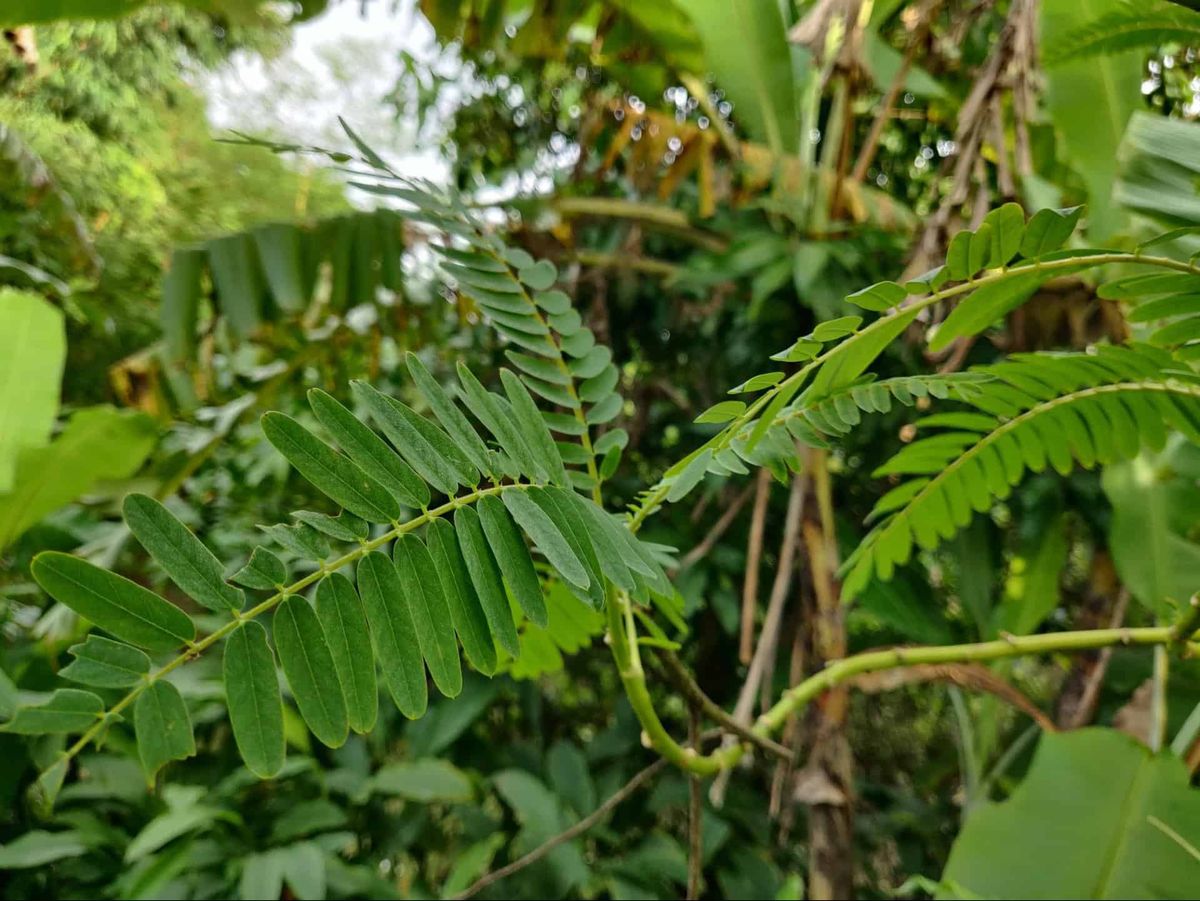
The tree has an upright, broadly rounded form with dense branching; young stems are pubescent and green to reddish before hardening into greyish-brown wood, and the taproot can drive several meters deep, supplemented by lateral fibrous roots.[25][26] The foliage is what gives it that signature lacy look: alternate, bipinnate leaves carrying 10-20 pairs of oblong leaflets, each about 1-2 inches long, bright green and smooth at maturity.[27][28] From a distance, the canopy reads as airy and fine-textured in a way that few fast-growing trees manage.
Then there are the flowers, and honestly they're the reason most people stop and ask what the tree is. At 7-10 cm long, they're among the largest blooms in the legume family, papilionaceous and pendulous, typically white or pale pink, arranged in axillary racemes of 3-20 flowers that can show open and closed blooms simultaneously on the same cluster.[13][29][30] In the tropics the blooming is essentially year-round, with peaks in the rainy season. I've watched large bees work those pendulous racemes with genuine enthusiasm in my own designs, which makes the plant earn its keep as a pollinator resource beyond just its edible and nitrogen-fixing roles. The pods are equally distinctive: linear, dehiscent, 15-30 cm long, silvery-green when young and turning brown at maturity, containing dark brown to nearly black seeds roughly 6 mm across.[31][29] White and red-flowered forms exist, with high phenotypic plasticity across environments and cultivars.[32]
Interesting Facts About Sesbania grandiflora
In the United States, sesbania grandiflora arrived as an ornamental, forage crop, and erosion control plant, with documented presence in Florida, Hawaii, and southern states going back to at least the early 20th century.[2][33] The growth rate alone is staggering: roughly 6-10 inches per month under full sun with adequate water, translating to a productive canopy tree within a single growing season.[2][34] That same vigor, paired with prolific self-seeding and root sprouting, is precisely why it's listed as a Category II invasive species in Florida by the Florida Exotic Pest Plant Council, documented spreading into wetlands, riparian zones, and disturbed areas where it can displace native vegetation.[35][3]
I've seen it naturalize along waterways in Central Florida, and my honest advice is to treat it as a managed guild member rather than a set-and-forget tree. That means monitoring for seedlings at the margins, pruning before pods mature if you're near natural areas, and being deliberate about where you site it from the start. None of that diminishes its value in a well-maintained permaculture system; it just means you need to stay in relationship with it. A plant that grows this fast, feeds the soil, feeds pollinators, and feeds your kitchen deserves that kind of attention.
Vegetable Sesbania Varieties and Where to Buy Them
Notable Varieties of Sesbania grandiflora
The variety question with Sesbania grandiflora is refreshingly simple: you're essentially choosing a flower color, and that choice tells you a lot about how you plan to use the plant. White-flowered trees (var. alba) are the standard for edible use, the ones you'll find in Southeast Asian markets with their petals headed for stir-fries and soups. Red- and pink-flowered forms (var. grandiflora or var. rosea) lean more ornamental, though they're still edible.[36][37][38] I've grown both in my Central Florida garden, and I can tell you the white form consistently produces more tender foliage for kitchen use, while the red draws far more hummingbirds and butterflies to the garden edge. No catalog I've seen captures that tradeoff as cleanly as actually growing them side by side.
Beyond that color split, formal cultivar development is sparse. Named varieties are scarce in mainstream horticultural literature, though regional selections do exist.[37] The most notable example is 'Arunoday,' a high-yielding white-flowered selection developed in India.[39] I've trialed seed labeled as 'Arunoday' sourced through an Indian supplier, and the vigor under humid subtropical conditions was genuinely impressive. That said, getting correctly labeled seed can be hit-or-miss, and I've received mislabeled plants from online nurseries before. These days I start from reputable seed sources and label everything myself from day one.
Sourcing Vegetable Sesbania in the United States
Availability in the U.S. is closely tied to climate. The sesbania tree does best in USDA zones 9 through 11, and it can't survive temperatures below 28°F (-2°C).[40][41] Not surprisingly, the most consistent nursery support and institutional resources for this sesbania plant are concentrated in Florida and Hawaii.[42][43] On the regulatory side, the news is straightforward: S. grandiflora isn't listed as a federal noxious weed, so no APHIS import restrictions apply, though interstate movement may require permits and state rules vary.[44] Florida's Exotic Pest Plant Council doesn't classify it as invasive, though its rapid growth is worth monitoring in tropical settings.[45] I always cross-check UF/IFAS and Missouri Botanical Garden resources before adding any new tropical to my system, and both cover this species well.
Seeds are the practical entry point for most U.S. growers. They're easier to ship than live plants, and the price is right: a packet of roughly 10 seeds typically runs $3 to $10, seedlings go for $15 to $25, and young trees in the 1 to 3-foot range average $25 to $40.[46][47][48] Eden Brothers, Park Seed, Sheffield's Seed Company, Baker Creek (RareSeeds.com), and Florida Seed and Garden are among the more reliable seed suppliers.[49][50][51][52] For live plants, Logee's, Miami Fruit, and Plant Delights Nursery are worth checking, and Amazon, Etsy, and eBay carry listings from U.S. exotic-plant sellers as well.[53][54][55] For anyone wanting to go deeper on taxonomy, distribution, or cultivation details, the USDA Forest Service, Plants of the World Online (Kew), the Royal Horticultural Society, and Missouri Botanical Garden are the references I return to most.[56][57][58][41]
Propagating and Planting Vegetable Sesbania (Sesbania grandiflora)
Sesbania grandiflora is one of those plants that rewards growers who take a few minutes to understand it before they start. Get the basics right and this tree practically grows itself. Skip them and you'll be puzzling over a tray of dead seedlings or a waterlogged root system that never recovers.
Seed Morphology and Orthodox Storage Behavior
The seeds themselves are worth a close look before you plant them. Each one is tiny -- 3-5 mm long and roughly 2-3 mm wide -- with that classic kidney shape and a smooth, leathery brown coat featuring a small hilum at the base where it was attached to the pod.[59][60] They feel a bit like small, dense lentils. Always harvest from fully mature brown pods for the best viability, and once you have them dry, they store beautifully because these are orthodox seeds -- meaning you can dry them down to 5-10% moisture, seal them in an airtight jar, and refrigerate at 5-10°C for 3-5 years or freeze at -18°C for over a decade without meaningful viability loss.[61][62] I keep a small jar in my fridge and run a simple paper-towel germination test each spring. After three years, I'm still seeing 75% or better emergence, which tells me the orthodox storage research translates directly to home practice.
Seed Propagation Methods and Germination
Seed is the go-to method for most growers, and for good reason. Sesbania grandiflora is predominantly self-pollinating, so seedlings generally come true to type, and fresh seed under optimal conditions hits 70-90% germination.[63] There's no significant dormancy to work around, but a quick scarification treatment makes a real difference. My method: pour water that's cooled slightly from boiling (around 80°C) over the seeds and let them soak for one to two minutes, then transfer them immediately to cool water.[60][64] In my Florida nursery trays during humid subtropical summers, this pushes germination from around 60% up to 90% or better. The seedlings look a lot like a large-leafed bean when they emerge, and they come up fast -- radicles typically appear within 7-14 days at 25-30°C.[65] A cooler spring spell will stall them noticeably, which is a good reminder that warmth isn't optional with this species.
Vegetative Propagation Options
If you have a specific plant worth cloning -- say, a white-flowered selection with unusually large pods -- vegetative methods give you that genetic fidelity that open-pollinated seed can't guarantee.[63] Semi-hardwood cuttings of 15-20 cm, treated with IBA rooting hormone at 1000-2000 ppm and stuck into a well-drained sand/soil/compost mix under high humidity, root at 50-80% in three to four weeks at 25-28°C.[66] Air layering on young branches is similarly reliable, succeeding 60-80% of the time in four to eight weeks.[28] Grafting is possible but success rates of 40-60% make it less practical for most home growers.[67] Unless you're running a specialty nursery, cuttings or seed will cover nearly every situation.
Soil, Site Selection, and pH Requirements
Well-drained loamy or sandy loam soil with a pH between 5.5 and 7.5 is the sweet spot.[68][60] The plant tolerates a wider range (4.5-8.5) and will grow in sandy, clayey, saline, or nutrient-poor soils, but it has one absolute dealbreaker: waterlogging. Even brief standing water causes root rot that kills young plants quickly. I always amend with compost before planting and I watch for interveinal yellowing in my alkaline-leaning Florida beds, which signals iron chlorosis; a quick drench of chelated iron solution corrects it fast. At the acidic extreme, below pH 5.0, aluminum toxicity can impair both roots and the nitrogen-fixing nodules that make this tree such a soil-building asset.[69] Because it fixes its own nitrogen, fertilizer needs at planting are modest -- focus on phosphorus and potassium (20-40 kg/ha each) and a generous layer of organic matter rather than nitrogen inputs.[70] For containers, a mix of 50% loam, 30% compost, and 20% perlite in a pot at least 12-18 inches deep gives adequate depth and drainage.[71] Full sun, a minimum of 6-8 hours daily, is non-negotiable for flowering and vigorous growth.[72]
Planting Technique, Spacing, and Initial Establishment
This is a genuinely big tree. Mature plants reach 8-15 m tall with a canopy spread of 10-20 feet, and they put on 2-3 m of growth in their first year under good tropical conditions.[13][73] Spacing for a food forest or agroforestry planting is typically 2-3 m between plants and 3-4 m between rows; tighter spacing (1-1.5 m) works for green manure hedges where you plan to cut frequently.[74] I learned the hard way about planting too close in a guild -- I had a cluster of three at 1.5 m spacing that shaded out the herbs and smaller companions within one season. Now I give each tree a full 3 m radius and plan the understory guild around that footprint from the start. Transplant seedlings once they're 4-6 inches tall and temperatures are consistently above 15°C, well past any frost risk.[40] Stake them that first season; the fast top growth gets ahead of the roots, and even moderate wind can topple an unanchored young plant. Keep soil moist but never saturated during establishment, and consider light shade cloth for the first few weeks in full tropical heat. This species is strictly for USDA zones 9-11 and should not be planted in frost-prone areas without a solid protection plan.[34]
Timeline to First Harvest
What I genuinely love about this tree is how quickly it pays you back. First leaf harvests can begin as early as 60-90 days after planting, with cuts repeating every 30-45 days from there.[75][76] Significant flower and pod production typically arrives 6-18 months from seed, though in optimal tropical conditions you can see flowers in as few as 3-6 months. Grafted plants tend to start flowering 6-12 months after grafting.[77] In Central Florida, where summers are genuinely tropical but winters carry frost risk, the timeline stretches a bit on either end -- but once established in a sheltered spot, this tree races. The nitrogen-fixing root system reduces your fertilizer workload considerably, but that only holds if drainage is right. A waterlogged root system isn't fixing nitrogen; it's rotting. Get the drainage and the sun right, and the timeline largely takes care of itself.
Vegetable Sesbania Care Guide
Caring for sesbania grandiflora is largely an exercise in giving a fast-moving tropical exactly what it evolved for: warmth, bright light, and consistent moisture without ever letting the roots sit in water. Get those fundamentals right, and this tree practically raises itself. Push against them, and it tells you quickly.
Sunlight Requirements
Vegetable Sesbania wants full sun, ideally six or more hours of direct light daily, though it can manage in 50-70% sunlight if it has to.[78][79] What I've noticed with fast-growing tropical legumes generally is that shade doesn't kill them so much as it quietly stalls them: leaves yellow and etiolate, growth slows, and gardeners often blame the soil when it's really the light.[60] On the flip side, intense sun combined with drought or temperatures climbing past 35°C can tip into leaf scorch, so siting matters more than just "full sun or not."[60] A bright, humid lowland spot with good air circulation is the sweet spot.
Watering Needs
Plan on roughly 1-2 inches of water per week, keeping the soil consistently moist but never waterlogged.[4][80] Established trees handle dry spells reasonably well, but seedlings and flowering or fruiting trees need that moisture to be reliable.[30][81] Diagnosis is usually straightforward: if leaves are yellowing from the bottom in soggy soil, you're likely overwatering; if they're wilting midday despite recent rain, it's underwatering.[82][83] Drip irrigation and a generous mulch layer are the most permaculture-friendly tools here, keeping soil moisture in the 50-70% field capacity range without guesswork. The tree also shows moderate salinity tolerance and accepts a wide pH range of 4.5-8.0, with the sweet spot sitting around 6.0-7.0.[84][85]
Feeding and Soil Fertility
Here's the part I love telling people: Vegetable Sesbania essentially fertilizes itself. Through symbiotic nitrogen fixation, its root nodules can supply 100-200 kg of nitrogen per hectare annually, which means heavy nitrogen applications aren't just unnecessary -- they can actually suppress nodule formation and push the plant into excessive leaf growth at the expense of flowers.[86][87] In my propagation work, inoculating seedlings with the right Rhizobium strain before planting consistently produces stronger, faster-growing trees than relying on native soil bacteria to do the job on their own. Where this tree does benefit from targeted support is phosphorus, which is critical for root and nodule development, and potassium for drought resilience and yield; a low-N formulation like 10-40-40 or 20-40-20 applied in split doses (at planting, then at 30-45 days and again at flowering) covers those needs without overloading the system.[86][88] Soil testing before planting has prevented more problems in my experience than any fertilizer schedule ever has. Organic amendments like aged manure are excellent here, and a simple test tells you whether you're even deficient before you spend money on inputs.[89][7]
Heat and Frost Tolerance
Sesbania grandiflora is built for heat. It sustains growth up to 40°C and can handle short peaks near 45°C, with optimal performance in that 25-35°C range and nighttime temperatures staying above 20°C.[90][91][78] The vulnerability shows up at flowering: once temperatures push past 35°C and dry conditions set in simultaneously, flower drop accelerates in a way that reminds me of what happens with heat-stressed okra, and prolonged exposure above 38°C with drought can cut photosynthesis and yield by 20-50%.[92][93] Consistent irrigation, mulch, and temporary shade cloth during peak summer heat are practical mitigations. Cold is a different story entirely. This is not a plant that bounces back from a hard freeze the way some subtropicals will. Hardy in zones 9b-11, it can briefly tolerate 25-30°F but prolonged exposure below 28°F is typically fatal, with trunk damage leaving no path to recovery.[94][95][96][97] After losing young seedlings to a late frost in my zone 9b garden, I now use 4-6 inches of mulch as a standard practice, choose south-facing sheltered spots, and tell anyone in a marginal zone to grow one in a large container so it can move under cover before a freeze. That's the most reliable method I've found.[98]
Pruning and Maintenance
Light pruning once or twice a year after the main flowering flush keeps the canopy open, removes dead or crossing branches, and genuinely improves yields.[99] I've observed that opening up the canopy this way improves light penetration enough to increase the next round of large, edible flowers -- a payoff that only becomes obvious once you're regularly harvesting. Beyond that, maintenance on an established Vegetable Sesbania is refreshingly minimal; the nitrogen fixation handles most of the fertility work, and the primary task is monitoring moisture and avoiding the compounding stress that comes from poor drainage combined with inadequate pruning.[4][7] Good airflow from pruning also reduces disease pressure, which ties directly into keeping this fast grower productive rather than reactive.
Seasonal Growth Rhythm
In its preferred tropical climate of 20-35°C with 1000-2000 mm of annual rainfall, Vegetable Sesbania flowers essentially year-round, with peaks tracking the wet season.[4][5] During dry spells it goes deciduous, shedding leaves as a survival strategy rather than a sign of poor health, then rebounds vigorously once the rains return.[100] I've watched this cycle play out in subtropical gardens and found it genuinely useful once you understand it: the leaf shed signals when to back off irrigation, and the flush of new growth signals when to resume feeding and heavier harvesting. Timing pruning and maintenance tasks around this rhythm means you're working with the plant's own pace rather than against it, which is exactly the kind of low-intervention, high-productivity relationship that makes this species worth planting in a food forest system.
Harvesting Vegetable Sesbania: Timing, Technique, and Flavor
In warm subtropical climates, Sesbania grandiflora produces at a pace that can honestly catch you off guard. In zone 9B conditions, the plant pushes out new shoots and flowers so quickly during the summer months that I find myself picking at least once a week just to stay ahead of it. Peak harvest runs from late spring through early fall in most southern US growing areas, with Florida growers often starting as early as March and stretching into November, and in truly frost-free spots the productive window never fully closes.[101][102] That rhythm of near-continuous harvest is one of the things I genuinely love about this tree in a food forest design.
When to Harvest Leaves, Flowers, and Pods
Each edible part has its own timing cue, and learning to read them makes the difference between a pleasant vegetable and a bitter disappointment. For leaves, I go for shoots between 5 and 15 cm long with bright green color and a clean snap when bent.[75][103] Once a leaf approaches 20 cm it gets fibrous and that snap disappears fast; I've learned to trust that sensory cue completely. Morning harvest gives the best texture before heat sets in.
Flowers are harvested at peak freshness, one to two days after opening when petals are still crisp, vibrant, and measure around 5 to 7 cm.[4][104] Any sign of wilting and you've missed the window. For pods, look for fully developed but still green pods in the 15 to 30 cm range, typically 35 to 45 days after flowering.[105][4] Once pods start yellowing and seeds harden inside, they're past their vegetable prime and headed toward seed-saving territory.[34]
Yield, Flavor Profiles, and Nutritional Value
The nutritional case for harvesting these parts young is real. Dry leaves carry up to 25 to 30 percent protein alongside vitamins A and C, calcium, iron, and antioxidants, which is why I recommend this tree to clients designing vegetarian food systems where calorie-dense protein sources are harder to come by.[106][107] But that nutritional payload only delivers well when you've caught the plant at the right moment.
Flavor-wise, all three edible parts are mild at their core, with leaves and pods carrying a bitterness that's noticeable but not unpleasant when harvested young, and cooking tames it reliably.[13] I've let leaves run too big more than once and the bitterness goes from background note to front-and-center pretty quickly, so timely picking matters. Raw young leaves have a slight mucilaginous quality similar to okra, which softens further with heat.[13][108] The flowers, which I'd compare directly to okra in their crisp, succulent texture, hold up beautifully in a quick stir-fry and soften when boiled, with a gentle sweetness that makes them an easy entry point for anyone new to eating this tree.[109][110]
Preparing and Using Vegetable Sesbania (Sesbania grandiflora)
Culinary Uses, Flavors, and Safety
The flowers and young pods are where most cooks start with Sesbania grandiflora, and for good reason. Freshly opened blooms have a crisp, almost crunchy texture with a flavor that sits somewhere between a snow pea and a mild radish, delicate and faintly sweet.[111][112] In my Central Florida food forest, I've watched the flowers come on in flushes right after rain, which makes it easy to harvest enough for a full pot of curry or a stir-fry without much effort. Young pods eaten raw have that same grassy sweetness with a hint of bitterness, but once you cook them, they shift into something closer to okra territory, developing a mildly mucilaginous quality that works beautifully in coconut-milk dishes.[111][113] If you like the way okra thickens a gumbo, you'll appreciate what these pods do in a spiced curry broth. Both flowers and pods absorb surrounding flavors readily once cooked, which is exactly why they've been staples in Southeast Asian and Indian soups, stir-fries, and curries for generations.[111]
Very young leaves can also be cooked and eaten. They carry real nutritional weight, with roughly 6-8 grams of protein per 100 grams fresh weight alongside vitamins A and C, calcium, and iron, though they benefit from thorough cooking to tame bitterness and reduce anti-nutritional compounds.[114][115] Boiling, blanching, steaming, and stir-frying all work well to improve palatability across leaves, flowers, and pods alike.[113][116]
One thing I tell every workshop student who asks about this plant: leave the seeds alone. Mature seeds contain cyanogenic glycosides, lectins, saponins, and canavanine, a combination that can cause real gastrointestinal distress or worse if eaten raw or in quantity.[117][118] The research is clear enough that it's not worth experimenting. Stick to the flowers, young pods, and cooked leaves and you're in excellent territory. One more identification note worth repeating: Sesbania punicea, the scarlet sesbania, is a toxic ornamental that can turn up in similar landscapes. Its flowers are small and pinkish-red, nothing like the large white or pale pink blooms of Sesbania grandiflora, which can reach 10 cm long, but when in doubt, confirm before you cook.[119][13]
Traditional Medicinal Preparations
Across India, Southeast Asia, and the Philippines, communities have long prepared leaves, flowers, and bark as teas, decoctions, and poultices to address inflammation, wounds, fever, diarrhea, diabetes, and respiratory complaints.[120][107] Modern preclinical research on flavonoids, saponins, and tannins supports several of these uses, though clinical standardization is still limited. Traditional preparations typically involve infusing leaves or flowers for internal teas, decocting tougher bark, or making poultices from crushed fresh material for topical wounds. Ethnobotanical references suggest around 3-6 grams of leaf powder per day or 50-100 ml of decoction twice daily, though these figures aren't clinically validated standards.[121][122] I occasionally brew a mild tea from fresh home-grown leaves as a seasonal tonic, but I treat it as exactly that, something occasional and attentive rather than a daily supplement. Anyone using this plant with a specific therapeutic goal really should loop in a qualified practitioner, especially given what we know about seed toxicity.
Non-Food and Practical Uses
Beyond the kitchen and medicine cabinet, this tree pulls serious weight in a regenerative system. Its fast growth generates 20-30 tons of biomass per hectare per year, and the nitrogen-fixing root system feeds everything nearby while the dropped branches and leaves build soil.[123][124] I chop and drop the fast-growing branches regularly to feed my compost pile and mulch the beds around my slower fruit trees. The wood itself is lightweight with a density of 0.4-0.6 g/cm³, suitable for fuelwood, charcoal, light construction, matchsticks, and simple tools, and it burns with relatively low smoke.[123] The bark yields bast fibers strong enough to compete with jute for ropes and coarse textiles, and both flowers and leaves can produce yellow and green natural dyes.[123] Ornamentally, the showy pendulous blooms make it a genuinely beautiful shade or avenue tree, which means the work it's doing for your soil is largely invisible behind something that simply looks good in the garden. That combination of beauty, food production, soil building, and material utility is what makes Sesbania grandiflora such a satisfying plant to grow when you have the climate for it.
Vegetable Sesbania Health Benefits and Medicinal Uses
There's a plant in my garden that routinely surprises visitors who've never encountered it before. When I tell them the flowers are edible, medicinal, and the subject of serious pharmacological research, they usually want to know more. The health story of Sesbania grandiflora is genuinely layered, running from centuries of traditional use across Asia all the way to preclinical work on liver protection and blood sugar regulation. It's worth understanding the full picture, including where the evidence is solid and where it's still preliminary.
Traditional Medicinal Uses Across Asia
Across India, the Philippines, and Thailand, this tree has been part of the healing toolkit for a very long time.[125][126][127][128] Ayurvedic texts documented it under the name Agastya for treating wounds, ulcers, fever, diarrhea, and respiratory disorders, and as an analgesic.[115][129] What I find compelling about this is how different plant parts were assigned specific roles with a kind of intuitive precision: leaves for inflammation and digestive complaints, flowers for respiratory ailments and night blindness, bark as an astringent for skin conditions and ulcers.[130][131] It parallels what I see with moringa in the same regional traditions: overlapping ethnomedicinal roles for inflammation and nutrition, developed independently across cultures that had no obvious reason to converge unless the plant kept delivering results.
Key Phytochemicals in Vegetable Sesbania
The leaves are the most phytochemically dense part most growers will work with. They're concentrated with flavonoids including rutin, kaempferol, and quercetin, plus phenolic acids like gallic acid, ellagic acid, and p-coumaric acid, along with saponins, tannins, and isoflavones like genistein and daidzein, with total phenolic content measuring around 20 to 30 mg GAE per gram.[132][133] Flowers add anthocyanins and carotenoids to that base of flavonoids and phenolics.[134] Pods push phenolic content even higher, up to 40 mg GAE per gram, while seeds carry sesbanimide and additional isoflavones alongside a seed oil dominated by oleic and linoleic acids.[135][136][137] One thing I've noticed growing sesbania through hot, dry spells in my zone: the leaves seem noticeably more pungent and bitter under heat stress, which aligns with the research showing that phytochemical composition shifts with geography, season, and growing conditions.[132][138] Stressed plants may actually be producing more of the bioactives that drive the health benefits readers care about.
Scientific Research on Health Benefits
Those phytochemicals underpin a solid body of preclinical research. Leaf and flower extracts show antioxidant effects driven by flavonoid and phenolic activity, anti-inflammatory action through inhibition of TNF-α, IL-6, and the NF-κB and COX-2 pathways, antimicrobial activity against a range of bacteria and fungi, and meaningful analgesic effects.[139][140] On the antidiabetic front, alpha-glucosidase inhibition has been demonstrated, and one small human study showed improved glycemic control in type 2 diabetics using sesbania leaf extract, though acute toxicity data places the LD50 above 2000 mg/kg, suggesting low toxicity at therapeutic doses.[115][141] The research also points to hepatoprotective effects via Nrf2 pathway activation, some anticancer potential through caspase-mediated apoptosis, and antihypertensive activity from ACE inhibitory peptides.[142][143][144] Almost all of this is from animal models and in vitro studies, and I'm always straightforward with gardeners asking about using sesbania grandiflora benefits for blood sugar management: the preclinical data is genuinely compelling, but please talk to your healthcare provider before relying on leaf extract preparations alongside any medications.
Nutritional Profile of Edible Parts
In my experience, the tender flower buds are the most rewarding part to harvest, picked just before they open for the best texture. Per 100 grams raw, they deliver around 150 mg calcium (15% DV), 1.9 mg iron (10% DV), 35 mg magnesium, and 340 mg potassium,[145] while young leaves bring meaningful vitamins A and C alongside their mineral content.[146] The nutritional value of sesbania grandiflora leaves is real, but it requires proper preparation to access. Raw seeds and pods carry hemagglutinins, trypsin inhibitors, cyanogenic glycosides, and tannins that will cause digestive trouble if consumed uncooked; thorough boiling, with the water discarded, is non-negotiable for unlocking bioavailability and neutralizing antinutrients.[146][147] Anyone with peanut or soy sensitivities should also approach this plant cautiously, given typical legume cross-reactivity.
Safety Considerations and Contraindications
The dual nature of this plant deserves directness. Properly cooked young leaves and flowers have been a reliable part of tropical diets for generations, and I eat them regularly without issue.[122] Seeds are a different matter entirely. They contain lectins, saponins, cyanogenic glycosides, and sesbanimide, a cytotoxic alkaloid that disrupts mitochondrial function.[148][149] I am meticulous about never using raw seeds in food, full stop. Beyond seeds, the plant is contraindicated during pregnancy due to potential uterine stimulant properties, may amplify antidiabetic medications, and carries mild anticoagulant activity that warrants caution alongside blood thinners.[150][151] Thorough boiling and discarding the cooking water handles most antinutritional concerns with leaves and pods, but toxin levels can vary with plant maturity and growing conditions.[152] There are also toxic look-alikes in the Sesbania and Crotalaria genera; the large pendulous flowers up to 10 cm, compound pinnate leaves with 10 to 25 leaflets, and long slender pods stretching 20 to 60 cm are your clearest confirmation that you've got the right plant.[153]
Vegetable Sesbania Pests and Diseases
For a fast-growing tropical legume, sesbania grandiflora holds up remarkably well against the pest and disease pressure you'd expect in hot, humid climates. Its alkaloids and flavonoids do real biochemical work as internal defenses, and the physical barrier of trichomes and thick leaves keeps some insects from getting comfortable.[154][155] That said, "moderate to high resistance relative to other legumes" is not the same as problem-free, especially once the monsoon season settles in and humidity spikes. I've found that good site design handles more than half the battle before a single problem appears.
Common Diseases of Vegetable Sesbania
Cercospora leaf spot is the one to watch. Caused by Cercospora sesbaniae, it shows up as circular brown spots and spreads quickly in humid, poorly ventilated conditions.[156][157][158] I site my Sesbania on the east-facing edge of my food forest so it gets strong morning sun that dries the foliage before humidity peaks in the afternoon; that one design choice keeps leaf-spot pressure noticeably lower than I've seen in crowded or shaded plantings.
Rust from Uromyces sesbaniae brings orange pustules to leaves and stems, cutting into photosynthetic capacity,[156] while anthracnose (Colletotrichum spp.) and powdery mildew (Oidium spp.) can pile on during wet seasons and further weaken foliage.[156][159][160] On the bacterial side, Xanthomonas leaf spot produces water-soaked lesions that turn necrotic in wet weather, and Ralstonia solanacearum can cause bacterial wilt, leading to yellowing, drooping, and potentially plant death in the humid tropics.[156][161] Viral diseases, reassuringly, are rare.[156]
Root rot from Phytophthora or Fusarium species is the disease I've personally lost plants to, and it's entirely avoidable. Early in my design career I put a young Sesbania in a low spot that held water after heavy rain, and it was gone within weeks.[156][162][163] Now I always mound or raise the planting site. Root-knot nematodes (Meloidogyne spp.) cause similar stunting and poor growth, especially in sandy or compacted soils.[156][164]
Major Insect Pests and Nematodes
Aphids are usually the first insect problem to appear, particularly Aphis craccivora and Aphis gossypii, which can cause 30-80% leaf curling and reduced pod formation if populations go unchecked.[164][165][154] Caterpillars like Spodoptera litura chew foliage, while pod borers (Etiella zinckenella, Maruca variabilis) are the most economically serious, with reports from tropical growing regions showing losses up to 100% of pods in unmanaged plantings.[164][165][154] Spider mites (Tetranychus spp.) tend to show up during drought stress, producing the familiar stippling and fine webbing that signals a plant under pressure.[154] Pest pressure is highest in the humid tropics of Southeast Asia and tropical Africa, so local extension advice is worth seeking for region-specific thresholds.[166][167]
No widely commercialized resistant cultivars exist, though local selections like 'Agati Red' and 'Agati White' show moderate resistance, and breeding programs continue working with wild relatives.[154][168][169] From my own observation, the red-flowered forms I've grown seemed noticeably less troubled by leaf spot than green-leaved seedlings, which tracks with the idea that pigment chemistry and insect resistance often travel together.
Integrated Management and Prevention Strategies
The IPM approach that works in my Central Florida food forest comes down to this: space plants for airflow, keep drainage impeccable, remove infected debris promptly, and let the plant's own defenses do most of the work.[160][170][171] For soil-borne pathogens, I apply Trichoderma-based inoculants at planting and top-dress around the root zone during wet seasons. Natural enemies handle aphids most of the time when you're not disrupting them with broad-spectrum sprays. I rarely reach for anything beyond neem oil, and when I do it's a targeted application on an early-stage aphid colony, not a routine calendar spray.[160][172][154] Copper-based sprays remain an option for persistent bacterial issues, but getting drainage and spacing right from the start usually means they stay on the shelf. Pair this tree with companion plants that draw in beneficial insects, as the permaculture_design section covers in more detail, and you create an environment where Sesbania's own chemistry does the heavy lifting.
Permaculture Design with Vegetable Sesbania (Sesbania grandiflora)
If you're designing a productive food system in the humid tropics or subtropics, few plants reward you as quickly or as generously as Sesbania grandiflora. But getting the most out of it means being honest about where it belongs and where it doesn't. This is not a plant you coax through cold winters or squeeze into a marginal climate. Site it right, and it becomes one of the hardest-working elements in your system.
Climate Requirements and Suitable Zones
In its native range across Southeast Asia, northern Australia, and the Pacific Islands, Sesbania grandiflora colonizes stream banks, disturbed edges, and secondary forest margins from sea level up to about 1,200 meters elevation.[173][174] That origin tells you a lot about what it needs: warmth, consistent moisture during establishment, and good drainage. It's essentially a plant of humid lowlands, and it behaves that way in cultivation.
For U.S. growers, this means USDA zones 9b through 11, where temperatures stay reliably between 77 and 95°F through most of the growing season.[79][175] Frost is a real threat. Leaf damage begins below 25°F, and even in a protected microclimate, survival below 20°F is unlikely.[79] I've learned from working in Central Florida that even a temperature dip forecast in the low 40s warrants covering young plants, because leaf burn sets them back weeks and delays flowering. Recovery is slower than you'd expect from something that otherwise grows so fast.
Rainfall in the 1,000 to 2,500 mm annual range suits it well, with humidity in the 60 to 90 percent range keeping it happiest.[69][176] Once established, deep roots give it decent drought tolerance, but during Florida's dry season I supplement irrigation without question. Waterlogging is the other edge of the knife, soil that drains poorly will stall or kill it regardless of the heat.[60] A well-chosen site does more work than any amendment.
Ecosystem Functions and Pollination Ecology
The reason this plant earns its place in any permaculture design is the nitrogen. Through symbiotic root nodules with Rhizobium bacteria, Sesbania grandiflora fixes somewhere between 100 and 200 kg of nitrogen per hectare per year, with figures climbing toward 300 kg under ideal conditions.[177][178][179] In practice, I've watched the vegetable beds I interplant beneath it respond noticeably, needing far less supplemental feeding than equivalent beds without a legume tree nearby. The research numbers become very real when you see the color difference in your tomato leaves.
Sesbania grandiflora also functions as a dynamic accumulator, drawing phosphorus, potassium, and other nutrients up from the subsoil and cycling them back to the surface through leaf drop and pruning.[180] Its deep roots simultaneously stabilize slopes and riverbanks, making it a smart choice for erosion-prone edges in tropical systems.[181] Pile on habitat value, nectar for wildlife, and some evidence that its saponin content may deter certain pests in mixed plantings (though I'd call that a bonus rather than a strategy),[181] and you have a plant that earns its footprint several times over.
Now, about that common name. The "hummingbird tree" label is about flower shape, not actual hummingbird visitors. In its native Southeast Asian and Australian range, those large 3 to 4 inch tubular blooms are designed for sunbirds and honeyeaters, with pollen placement that favors bird-sized visitors for optimal fruit set.[13][182][183] Hummingbirds simply don't exist where this plant evolved. In Florida, though, bees and butterflies pick up the secondary pollinator role,[184] and I've noticed that when mine starts blooming in early summer, pollinator activity around the whole garden edge increases visibly. Flowering runs from roughly March through November in subtropical zones, peaking with the wet season.[185] Positioning it near fruit trees isn't a bad idea purely for the spillover effect.
Forest Layer and Guild Placement
Growing 3 to 4 meters per year and reaching anywhere from 5 to 15 meters tall at maturity, Sesbania grandiflora occupies the canopy or upper mid-story layer in a forest garden, though its relatively short lifespan positions it as a pioneer rather than a permanent fixture.[186][79] Think of it the way you might think of pigeon pea in a Florida system: fast soil-builder, temporary canopy, managed by regular cutting rather than allowed to sprawl indefinitely. Pruned hard, it stays shrub-sized and becomes a continuous biomass source instead of a shade problem.
It wants full sun, at least 6 to 8 hours daily, and tolerates poor sandy or clay soils across a wide pH range of 5.5 to 7.5, improving conditions for its companions as it grows.[187][174] Classic guild placements include intercropping with rice, maize, and vegetables, which is exactly how it's used in traditional agroforestry across Southeast Asia and the reason the sesbania cover crop model is so well established in the literature.[177] In a home-scale food forest, it works well on the northern edge of a vegetable bed where it delivers nitrogen and light chop-and-drop material without shading out the crops below.
The multipurpose payoff is real. Leaves, flowers, and young pods are all edible and nutritious.[188] Prunings become mulch, sesbania green manure, or fodder for goats and other livestock, with the protein-rich foliage making it especially valuable as sesbania for goats in integrated smallholder systems.[189] One plant pulls nitrogen from the air, mines minerals from the subsoil, feeds pollinators, protects slopes, and puts food on the table. That kind of stacking is what permaculture design is actually about.
One responsible note: Sesbania grandiflora is introduced rather than invasive in the U.S., but it seeds prolifically.[72] In my own designs, I harvest seed heads before they shatter, especially near any natural areas. A little stewardship keeps this generous plant from becoming someone else's problem.
The Tree That Fed My Garden Before It Fed My Kitchen
I grew my first Sesbania grandiflora from a handful of scarified seeds on a humid Central Florida August, and it outpaced everything else in the nursery bed by week three. I kept waiting for it to slow down. It never really did. What stays with me isn't the flowers, as showy as they are; it's how much this plant gave back to the soil beneath it before I ever harvested a single leaf.
Sources
- Sesbania grandiflora: A Review on Its Phytochemical and Pharmacological Profile ↩
- Sesbania grandiflora ↩
- Sesbania grandiflora ↩
- Sesbania grandiflora: A Multipurpose Tree for Tropical Agroforestry ↩
- Sesbania grandiflora ↩
- Sesbania grandiflora: A Multipurpose Tree for Agroforestry ↩
- Agroforestry Species: Sesbania grandiflora ↩
- Soil Requirements for Leguminous Trees in Tropical Regions ↩
- Plants of the World Online: Sesbania grandiflora ↩
- Pollination Biology and Herbivory Impacts on Sesbania grandiflora ↩
- Charaka Samhita ↩
- Mantissa Plantarum ↩
- Sesbania grandiflora ↩
- Sesbania grandiflora (L.) Pers. ↩
- Agati (Sesbania grandiflora) in Indian Traditional Medicine ↩
- Ethnobotanical Survey of Sesbania grandiflora in India ↩
- Traditional Uses of Plants by Indigenous Peoples in the Philippines ↩
- Medicinal Plants of Malaysia: Sesbania grandiflora ↩
- Sesbania grandiflora: A Review on Its Ethnopharmacology, Phytochemistry and Pharmacology ↩
- Pacific Island Medicinal Plants: Sesbania grandiflora ↩
- African Ethnobotany: Uses of Sesbania Species ↩
- Medicinal Plants of the Caribbean: Sesbania grandiflora ↩
- IUCN Red List: Sesbania grandiflora ↩
- Ethical Considerations in Ethnobotany: Traditional Knowledge and Benefit-Sharing ↩
- Sesbania grandiflora Overview ↩
- Root System Architecture of Sesbania grandiflora ↩
- Sesbania grandiflora ↩
- Sesbania grandiflora - Useful Tropical Plants ↩
- University of Florida IFAS Extension: Sesbania grandiflora Fact Sheet ↩
- Sesbania grandiflora ↩
- Missouri Botanical Garden Plant Finder: Sesbania grandiflora ↩
- USDA PLANTS Database: Sesbania grandiflora ↩
- SESGR2 Sesbania grandiflora ↩
- Sesbania grandiflora ↩
- Florida's Invasive Species ↩
- Sesbania grandiflora ↩
- Sesbania grandiflora (PROSEA) ↩
- Sesbania grandiflora: A Multipurpose Tree Species ↩
- Agati (Sesbania grandiflora) Varieties and Cultivation ↩
- Sesbania grandiflora (Agati) ↩
- Sesbania grandiflora ↩
- Sesbania grandiflora ↩
- Growing Sesbania grandiflora in Florida ↩
- Federal Noxious Weeds ↩
- List of Florida's Invasive Species ↩
- Sesbania Grandiflora Seeds ↩
- Magic Gardens Nursery - Tropical Plant Listings ↩
- Sesbania Grandiflora Seeds ↩
- Sesbania Grandiflora Seeds ↩
- Agati Tree Seeds (Sesbania grandiflora) ↩
- Sesbania grandiflora Seeds ↩
- Sesbania grandiflora Seeds ↩
- Tropical Plants - Logee's Greenhouse ↩
- Miami Fruit - Exotic Plants ↩
- Plant Delights Nursery Catalog ↩
- Sesbania grandiflora - Agati ↩
- Sesbania grandiflora L. ↩
- Sesbania grandiflora ↩
- Sesbania grandiflora (Fabaceae): Seed Morphology and Description ↩
- Sesbania grandiflora (Agati): Morphology and Uses ↩
- Seed storage behaviour of Sesbania grandiflora ↩
- Millennium Seed Bank Guidelines for Tropical Seeds ↩
- Propagation of Sesbania grandiflora: Methods and Genetic Considerations ↩
- Propagation of Sesbania grandiflora ↩
- Germination and Storage of Tropical Tree Seeds ↩
- Vegetative Propagation of Multipurpose Trees ↩
- Propagation of Tropical Trees ↩
- Sesbania grandiflora: A Multipurpose Tree ↩
- Sesbania grandiflora: A Multipurpose Tree for the Tropics ↩
- Agroforestry Species: Sesbania grandiflora ↩
- Growing Agati in Pots: Soil and Care Guide ↩
- Sesbania grandiflora ↩
- Sesbania grandiflora (Vegetable Hummingbird Tree) ↩
- Sesbania grandiflora - World Agroforestry Centre ↩
- Sesbania grandiflora: A Multipurpose Tree ↩
- Sesbania grandiflora - UF/IFAS Extension ↩
- Propagation of Sesbania grandiflora: Grafting Techniques and Timeline ↩
- Sesbania grandiflora: A Multipurpose Tree for Agroforestry ↩
- Sesbania grandiflora (agati) ↩
- Water Management for Sesbania Species ↩
- University of Hawaii Extension: Tropical Legume Cultivation Notes ↩
- Sesbania grandiflora: Cultivation and Management ↩
- Water Management for Tropical Trees ↩
- Tolerance of Tropical Legumes to Soil Salinity and Sodicity ↩
- Sesbania grandiflora: Cultivation and Utilization ↩
- Nutrient Management for Sesbania grandiflora ↩
- Sesbania grandiflora: A Multipurpose Tree for Agroforestry ↩
- Fertilization of Leguminous Trees in Tropical Agroforestry ↩
- Nutrient Management for Tropical Legumes ↩
- Sesbania grandiflora Care Guide ↩
- Sesbania grandiflora Environmental Requirements ↩
- Heat Stress Effects on Tropical Legumes ↩
- Combined Drought and Heat Stress in Flowering Plants like Sesbania grandiflora ↩
- Sesbania grandiflora (Agati) Plant Profile ↩
- Sesbania grandiflora ↩
- Frost Tolerance of Tropical Trees ↩
- Cold Injury in Woody Plants ↩
- Growing Sesbania Species in the Home Landscape ↩
- Missouri Botanical Garden Plant Finder ↩
- Nitrogen Fixation and Drought Tolerance in Sesbania grandiflora ↩
- Sesbania grandiflora at Missouri Botanical Garden ↩
- Sesbania grandiflora - USDA PLANTS Database ↩
- Katurai Leaf Production Guide ↩
- Edible Flowers: Harvesting and Uses in Tropical Agriculture ↩
- Agati (Sesbania grandiflora) Production Guide ↩
- Nutritional and Anti-nutritional Composition of Sesbania grandiflora ↩
- Sesbania grandiflora: A Short Review on Phytochemistry and Ethnopharmacology ↩
- Sesbania grandiflora: A Comprehensive Review on Its Phytopharmacology ↩
- Agati (Sesbania grandiflora) - Useful Tropical Plants Database ↩
- Agati Flowers Information and Facts ↩
- University of Florida IFAS Extension - Sesbania grandiflora ↩
- Katuray: The Filipino Superfood Flower ↩
- Sesbania grandiflora - Useful Tropical Plants ↩
- Nutritional Composition of Sesbania grandiflora Leaves ↩
- Sesbania grandiflora (Agati): A Review of its Phytochemistry and Pharmacology ↩
- Sesbania grandiflora: A Comprehensive Review on Its Phytochemical Constituents and Pharmacological Importance ↩
- Nutritional and Anti-nutritional Factors in Seeds of Sesbania grandiflora ↩
- Toxicity of Sesbania grandiflora Seeds in Rats ↩
- Sesbania punicea (Scarlet Wisteria) - CABI Compendium ↩
- Ethnobotanical Uses of Sesbania grandiflora in India ↩
- Sesbania grandiflora: A Review of Traditional Uses, Phytochemistry, Pharmacology ↩
- Pharmacological Activities of Sesbania grandiflora ↩
- Multipurpose Tree Species: Sesbania grandiflora for Food, Fodder, Fuel and Medicine ↩
- Agroforestry Potential of Sesbania grandiflora ↩
- Sesbania grandiflora: Insights into Ethnopharmacology and Phytochemistry ↩
- Traditional Medicinal Uses of Sesbania grandiflora in the Philippines ↩
- Ayurvedic Uses of Agastya (Sesbania grandiflora) in India ↩
- Folk Medicine Practices in Thailand Involving Sesbania grandiflora ↩
- Ethnopharmacological Uses of Sesbania grandiflora in India ↩
- Medicinal Properties of Sesbania grandiflora (Agati): A Review ↩
- Journal of Ethnopharmacology: Ethnobotanical study of Sesbania grandiflora ↩
- Phytochemical Screening and Antioxidant Activity of Sesbania grandiflora Leaves ↩
- Bioactive Compounds from Sesbania grandiflora: A Review ↩
- Flavonoids and Phenolics in Sesbania grandiflora Flowers ↩
- Phenolic Content in Pods of Sesbania grandiflora ↩
- Alkaloids and Isoflavones in Sesbania Species ↩
- Fatty Acid Composition of Sesbania grandiflora Seed Oil ↩
- Ethnopharmacological Uses and Phytochemistry of Sesbania grandiflora ↩
- Anti-inflammatory and Antioxidant Properties of Sesbania grandiflora Extracts ↩
- Anti-inflammatory and analgesic activities of Sesbania grandiflora leaves ↩
- Toxicity Profile of Sesbania grandiflora ↩
- Hepatoprotective Role of Nrf2 Activation ↩
- Apoptosis Induction in Cancer Cells ↩
- ACE Inhibitory Peptides from Sesbania grandiflora ↩
- USDA FoodData Central – Edible flowers, sesbania, raw ↩
- FAO - Sesbania in Tropical Agroforestry Systems ↩
- Journal of Ethnopharmacology review on Food Plants ↩
- Occurrence of Sesbanimide in Seeds of Toxic Sesbania Species - Weed Science ↩
- Sesbanimide, a potent antitumor substance from Sesbania drummondii seed - JACS ↩
- Sesbania grandiflora: A Review on Its Medicinal Uses and Safety ↩
- A Comprehensive Review of Sesbania grandiflora - Vegetos India ↩
- Nutritional and Toxicological Aspects of Sesbania grandiflora ↩
- Distribution, Phytochemical Insights, and Cytotoxic Potential of the Sesbania Genus - PMC ↩
- Research on Sesbania grandiflora pests and management ↩
- Plant defense mechanisms in Sesbania species ↩
- Diseases of Sesbania grandiflora ↩
- Fungal Pathogens of Legumes Including Sesbania ↩
- Fungal Pathogens of Sesbania grandiflora in Tropical Asia ↩
- Diseases of Sesbania grandiflora and Their Management ↩
- Management of Diseases in Multipurpose Trees like Sesbania ↩
- Diseases and Pests of Sesbania grandiflora ↩
- Sesbania grandiflora: Cultivation and Pest Management ↩
- Cultivation of Sesbania grandiflora ↩
- Pests and Diseases of Sesbania Species ↩
- Management of Insect Pests in Vegetable Hummingbird (Sesbania grandiflora) ↩
- Regional pest susceptibility in tropical legumes ↩
- Tropical legume pest pressure review ↩
- Breeding for Disease Resistance in Legumes: Focus on Sesbania ↩
- Sesbania grandiflora: Pathology and Resistance Breeding ↩
- Integrated Disease Management in Tropical Trees ↩
- Pests and Diseases of Multipurpose Trees: Sesbania spp. ↩
- IPM strategies for legume crops ↩
- Sesbania grandiflora (L.) Pers. ↩
- Sesbania grandiflora: A Multipurpose Tree ↩
- Sesbania grandiflora (Agati, Vegetable Hummingbird) ↩
- Sesbania grandiflora (Agati) ↩
- Nitrogen Fixation in Sesbania Species ↩
- Nitrogen Fixation by Sesbania Species ↩
- Nitrogen Fixation by Sesbania grandiflora ↩
- Dynamic Accumulators in Permaculture ↩
- Ecological Benefits of Leguminous Trees in Tropical Riparian Zones ↩
- Pollination Biology of Sesbania grandiflora ↩
- Pollination Ecology of Sesbania grandiflora ↩
- Flower Visitors and Pollination in Sesbania Species ↩
- Growing Tropical Trees in Florida ↩
- Sesbania grandiflora - Agroforestry Species Profile ↩
- Royal Horticultural Society - Agastya (Sesbania grandiflora) ↩
- Agati (Sesbania grandiflora) - ECHO Community ↩
- Sesbania grandiflora in Permaculture - Permaculture Plants ↩
About the Author
Samiksha is a Certified Permaculture Designer and Teacher. Raised on a regenerative farm, she has over 20 years of experience learning and growing with local and indigenous communities.