The first time I peeled a snake fruit, I cut myself. Not badly, but enough to make me stop and actually look at what I was holding: a small, reddish-brown fruit covered in overlapping scales so precise they looked machined, tipped with tiny spines that absolutely mean business. It looked less like something you'd eat and more like something that would eat you. And then I bit into it, and got this bright, almost electric hit of pineapple and cinnamon and something I still can't quite name, wrapped in flesh that snapped like a perfectly ripe Asian pear. I've introduced a lot of people to unusual fruit over the years. Snake fruit is the one that always stops conversation.
What gets me, though, is that most Western growers write it off as a novelty, a curiosity you taste once at an Asian market and file away under "interesting, not practical." That assessment is completely wrong, and I'd argue it comes from never seeing a mature specimen in the ground. This is a clumping understory palm that has been feeding families and anchoring food forest systems across Java and Bali for centuries,[1] with a depth of cultivar diversity, cultural meaning, and ecological function that most "mainstream" fruits can't touch. There's a lot more here than the scales suggest.
Snake Fruit Origin, History, and Botanical Background
Botanical Background and Native Habitat
Snake fruit, known botanically as Salacca zalacca, is native to the tropical lowland rainforests and shaded understories of Java and Sumatra in Indonesia, where it grows naturally along riverbanks and forest margins on volcanic-derived soils up to about 700 meters elevation.[2][3][4] Those volcanic soils are the key detail for any grower trying to understand what this plant wants: rich, consistently moist, well-aerated ground with a gentle slope for drainage. I think of its requirements as sitting somewhere between ginger and cardamom in a food forest understory -- it loves humidity, dappled shade, and organic matter, and it will let you know quickly when its roots are sitting in standing water.
Cultivation records for Salacca zalacca reach back to 14th-century Javanese literature, including the Nagarakretagama, a court poem from the Majapahit Empire that lists salak among prized garden plants.[5] European documentation came later, when botanist Georg Eberhard Rumphius described it in detail in his 17th-century Herbarium Amboinense, one of the most important early records of Southeast Asian flora.[6] From there, Arab, Chinese, and Dutch colonial trade networks carried it across the region, and today it's cultivated commercially across Indonesia, Malaysia, and Thailand, with Indonesian production alone exceeding 100,000 tons annually.[7][8][9] The palm is dioecious, meaning you need both male and female plants for fruit, and it's a long-term investment -- expect fruit in three to five years from suckers, with peak production not arriving until years ten through fifteen, and productive lifespans stretching to thirty years.[4][10] The IUCN currently lists it as Least Concern, though localized overexploitation and habitat loss are real pressures on wild populations.[11]
Visual Characteristics of Salacca zalacca
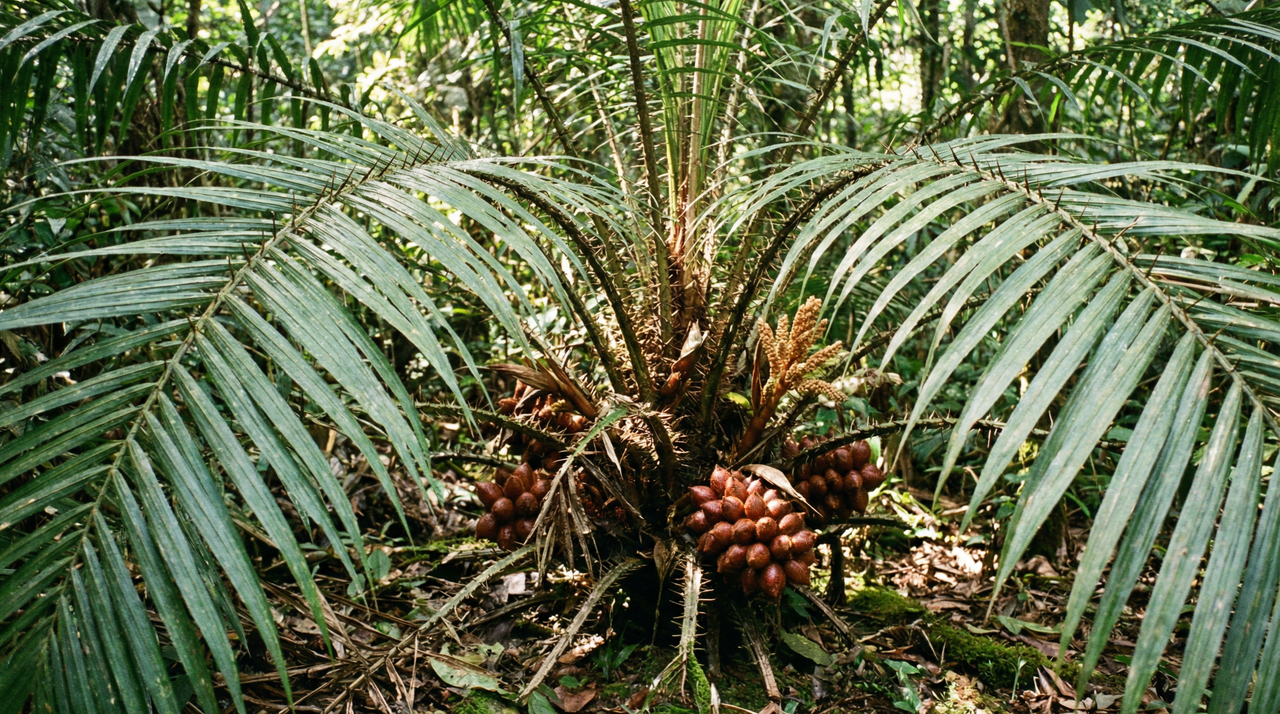
If you've never seen a snake fruit palm in person, the first encounter is memorable for all the wrong reasons. Salacca zalacca forms dense, multi-stemmed clumping thickets two to six meters tall, with short, largely subterranean stems armed with dense black needle-like spines up to ten centimeters long arranged in whorls around the stem.[2][4][12] From those ferociously armored bases arc the fronds: three to six meters long, pinnate, bearing forty to eighty pairs of leathery linear leaflets thirty to sixty centimeters in length, giving the whole plant a lush, plumose silhouette.[13][14] The spines are no joke -- I always wear heavy gloves and long sleeves when working near any Arecaceae with this kind of armature.
The fruits themselves cluster near the base of the plant, borne on pendulous female inflorescences while the male flowers are erect and highly branched.[15] Each fruit is small and ovoid, five to seven centimeters long, with reddish-brown skin covered in uneven conical scales that give it its common name.[7][16] Peel that scaly exterior and you find white to pale yellow flesh, crisp and juicy, divided into three lobes like garlic cloves and surrounding one large hard seed.[17][15] The contrast between the forbidding exterior and that clean, refreshing interior is genuinely startling the first time you experience it.
Traditional and Cultural Significance
Salak has been woven into Javanese cultural life for centuries. The fruit symbolizes prosperity and appears in wedding ceremonies, harvest festivals, and royal gardens, and in Balinese Hindu tradition it shows up in canang sari temple offerings representing gratitude and fertility.[18][19][20] Knowing that context changes how I see this fruit. There's something grounding about a plant that connects 14th-century Majapahit court poetry to a modern temple offering -- that kind of continuity is rare, and it deserves more than a passing mention. Sundanese communities use salted salak in life-cycle ceremonies, and Dayak communities in Borneo incorporate it into foraging and ritual traditions as well.[21][22]
In Indonesian jamu and regional folk medicine, the fruit has been used for digestive complaints, diarrhea, and fever, while leaves, bark, and roots appear in decoctions and poultices addressing wounds, inflammation, hypertension, and respiratory conditions.[23][24] The fruit's astringency and fiber make the digestive reputation easy to believe, even before you look at the research. Beyond food and medicine, leaves and stems feed into basket weaving, roof thatching, and natural dyes, and modern cultivation increasingly emphasizes agroforestry approaches that relieve pressure on wild stands while keeping this culturally significant palm productive.[25][26]
Fun Facts About Snake Fruit
The name "snake fruit" is entirely literal: those reddish-brown conical scales covering the skin look convincingly like reptile scales, and the resemblance is striking enough that people encountering the fruit for the first time often hesitate before picking one up.[16][7] The flavor that waits underneath is equally distinctive: sweet, tangy, and faintly astringent, often described as a cross between apple, pear, and grape, though I think that comparison undersells how unique it actually tastes. What makes the plant ecologically unusual is that it achieves all this while behaving nothing like most people's mental image of a palm. Salacca zalacca stays low, clumps aggressively, and thrives in moist shade under taller canopy species, with its long arching fronds reaching three to six meters in conditions where an open-canopy palm would struggle.[4][27] For permaculture designers, that understory niche is the whole point -- it's a fruit producer that fills a layer most tropical palms simply can't occupy.
Snake Fruit Varieties and Where to Buy Them
Salacca zalacca is a clustering, dioecious understory palm, typically 2-4 meters tall, with pinnate leaves that can stretch 3-6 meters and leaf sheaths armored with serious spines. The fruits are small, oblong, 5-10 cm long, wrapped in that unmistakable reddish-brown scaly skin. Inside: white to pale yellow translucent flesh with a flavor that lands somewhere between pineapple, apple, and pear, sweet and tangy with a faint astringent edge.[28] It strictly requires tropical warmth and consistent moisture to thrive.[29][30] Get those basics right and a mature plant can yield 50-100 kg of fruit annually.[31][32] That's the baseline. Now for the personalities.
Notable Cultivars of Salacca zalacca
Indonesia has done most of the heavy lifting when it comes to breeding and selecting snake fruit cultivars, and the range of flavor and texture that has emerged from that work is genuinely surprising. If Pondoh is your introduction to the fruit, you might think all salak tastes like that: ultra-sweet, low-acid, soft almost to the point of yielding, with a thin skin and a flesh-to-seed ratio that makes it actually pleasant to eat.[33][34] Brix readings of 12-20° put it in serious dessert-fruit territory, and it yields up to 25 tons per hectare with near-continuous fruiting and solid resistance to pests and fungal infections.[35] It's the cultivar that put salak on the export map, originating from the Yogyakarta and Lampung regions of Java.
Then try the Java cultivar and you get a completely different experience: crisp, apple-like bite, noticeably more acidic, moderate yield, and good resistance to scale insects.[33][35] I think of Pondoh the way wine people talk about Pinot Noir and Java like a Grüner Veltliner: same grape family, completely different personality. Bali sits closer to Pondoh on the sweetness spectrum but with more juice and a bolder size, though it comes with a real liability: notable susceptibility to fruit rot.[33][35] I keep one eye on Indonesian breeding programs for exactly that reason -- Phytophthora can move through a humid planting fast, and I want to know when a more resistant release becomes available.[36][37]
Beyond those three, the Indonesian cultivar list keeps going. Sulawesi is sweet with low acidity, firm flesh, and reasonable cold tolerance for a tropical palm, yielding up to 15 tons per hectare.[38] Condet is a small, aromatic, seedless heirloom that has real appeal for urban growers with tight spaces. Gula Pasir delivers a granular, almost crystalline sweetness in 4-5 cm fruits, while Susu has a distinctly creamy flesh texture that sets it apart. Gading runs larger, and Nangka goes elongated.[33][39] Malaysia, for its part, relies primarily on introduced Indonesian clones like Pondoh rather than locally developed named varieties, with a few endemic selections from Perak and Johor that haven't reached wider cultivation.[40]
Sourcing Snake Fruit in the United States
Getting your hands on a snake fruit plant in the U.S. requires some realistic expectations upfront. Commercial production doesn't exist here at any meaningful scale; cultivation is limited to southern Florida (Miami-Dade County being the primary pocket), sheltered microclimates, or greenhouses, and most plants are grown as niche specimens rather than productive orchard crops.[29][7] Importing fresh fruit or live plant material triggers USDA APHIS oversight, and you'll generally need phytosanitary documentation and compliance with inspection requirements to bring plants across borders legally.[41]
The better path for most U.S. growers is sourcing directly from domestic specialty tropical nurseries. Top Tropicals, Logee's Plants, Florida Hill Nursery, and Rare Exotic Seeds all carry salak at various times of year.[42][43][44][45] Seeds run $5-15 each, seedlings $20-60, and mature plants up to $150, with availability shifting seasonally.[46][43] I'd skip seeds unless you're patient and experimental -- germination is slow and erratic, and you'll wait years before knowing what sex you have. Because the species is dioecious, you need at least one male and one female plant for any fruit production at all. One hard-learned tip: label your plants clearly the moment you get them. Those spines make sorting a mature clump for sex identification genuinely unpleasant.
Snake Fruit Propagation and Planting (Salacca zalacca)
Snake fruit's native habitat tells you almost everything you need to know about how to propagate and plant it. In the humid lowland rainforests of Java and Sumatra, this spiny palm grows as a forest understory resident on rich, well-drained volcanic soils, rarely straying above 700-800 m elevation.[47] Those conditions, warm temperatures, persistent humidity, dappled light, and excellent drainage, shape every practical decision you'll make in the nursery and the field.
Propagation Methods: Suckers vs. Seeds vs. Tissue Culture
If you can get your hands on a well-rooted sucker, take it. Sucker division is the workhorse method for snake fruit: when suckers are at least two to three years old and separated during the rainy season, success rates run 80-95%.[48][49] The offspring come true to type, which matters enormously for a dioecious species where you need known-sex plants. The catch is that Salacca zalacca is stingy with suckers, so you're often working with what little the mother clump produces.
Seed propagation is an option, but not an easy one. These are recalcitrant seeds, genuinely unforgiving if they dry out even slightly. They can't tolerate moisture contents below 20-30% and lose viability within weeks if stored improperly or chilled below 10°C.[50][51] I've learned to source and sow snake fruit seeds within days of harvest for exactly this reason. Even a week of improper handling can kill a batch before you've started. Sow immediately, fresh.
Even under optimal conditions, germination rates range from 20-50% on the low end and up to 80-90% with very fresh seed handled perfectly.[52][53] Sprouting is slow and erratic, anywhere from two to six months, sometimes stretching past a year.[4] To give yourself the best shot, keep temperatures between 25-30°C (77-86°F), humidity at 70-90%, and the substrate, ideally a sandy loam or peat-perlite mix, consistently moist but never waterlogged. Soaking fresh seeds in warm water (30-35°C) for 24-48 hours before sowing helps, and light scarification can coax along stubborn seeds.[54][55] Grow seedlings in bright indirect light, not full sun.
Then there's the genetic lottery problem. Because snake fruit is dioecious and outcrossing, seed-grown plants vary considerably, and you have no guarantee of sex ratios until flowering.[53] That's a nerve-wracking gamble after years of waiting.
Tissue culture fills the commercial scaling gap. Using shoot tip explants on Murashige and Skoog medium with auxins and cytokinins, optimized lab protocols achieve 70-90% success, producing disease-free, uniform plants at scale.[56] Non-optimized protocols drop closer to 30%, with phenolic oxidation and contamination being the main headaches.[57] For most home growers, tissue culture plants purchased from specialty nurseries are a more realistic entry point than attempting the technique yourself.
Grafting and stem cuttings aren't practical paths. As a monocot, Salacca zalacca lacks the cambium needed for reliable graft unions, and success rates typically fall below 30-50%.[58] Cuttings with IBA treatment achieve only 20-40%.[59] File those under "interesting experiment" rather than "reliable technique."
One nursery reality worth preparing for: damping-off fungi, particularly Pythium and Fusarium, will find your seedlings if conditions let them.[53] After losing several batches to rot, I now sterilize my germination media and inoculate transplants with mycorrhizal inoculant when moving to unamended growing mix, since beneficial arbuscular mycorrhizal associations are easily disrupted in sterile media and need reintroducing.[60] Keeping media barely moist rather than saturated is the single biggest nursery-stage variable I can control.
Germination and Timeline to First Fruit
Seed-grown snake fruit plants typically take five to seven years from planting to first commercially significant harvest, with flowering possible as early as four to five years under ideal conditions.[61][62] I've grown plants both from seed and from suckers, and the difference in patience required is genuinely night and day. Sucker-propagated plants reach first harvest in two to four years, often flowering within two to three years.[63][64] That gap alone explains why commercial Indonesian orchards lean overwhelmingly on vegetative methods. When you're planning a food forest guild around a plant this slow to mature, starting with suckers wherever possible is simply the more rational choice.
Remember, too, that even when flowering begins, fruit set requires both male and female plants present. Factor the dioecious requirement into your planting plan from the beginning, because discovering you have only males after five years of waiting is a deeply frustrating outcome.
Soil, Site Selection, and Planting Requirements
That volcanic lowland origin shapes every soil preference this plant has. Salacca zalacca thrives in well-drained, fertile loamy or sandy loam soils rich in organic matter, ideally 3-5%, and its best natural performance comes on the andisols and regosols derived from volcanic parent material.[65] A generous amendment of compost or well-rotted manure in the planting hole, 5-10 kg at minimum, goes a long way on less fertile soils.[61]
Soil pH sweet spot is 5.5-6.5, with 6.0-6.5 being ideal.[66] Below 5.5, aluminum toxicity becomes a real risk. Above 7.5, iron and manganese deficiencies show up as interveinal chlorosis, similar to what I see on citrus pushed into alkaline conditions.[67] Regular soil testing is non-negotiable in humid subtropical conditions where pH can drift seasonally. I test every spring before the growing season begins.
Drainage is the other non-negotiable. The root system is shallow and fibrous, typically 30-60 cm deep and spreading laterally up to 3-4 m, so it doesn't reach down to find better-drained subsoil.[68] Poor drainage triggers Phytophthora root rot fast, with yellowing lower leaves, wilting despite wet soil, and eventually dark mushy roots as the diagnostic signs.[69] On marginal sites, mounding the planting area or building a raised bed is a practical fix. Aim for soil depth of at least 1-1.5 m to accommodate lateral spread.
For climate, this plant wants consistent temperatures of 24-30°C, high humidity in the 70-90% range, and 1,500-3,000 mm of annual rainfall without extended dry spells.[70] USDA zones 10a-11 are its territory. Young plants particularly benefit from partial shade during establishment; mature plants fruit better with six to eight hours of sun, but they evolved under a canopy and appreciate some overhead filtering in the hottest months.
The arbuscular mycorrhizal associations that naturally develop on these roots, primarily Glomus species, meaningfully improve phosphorus uptake in lower-fertility soils.[60] Inoculating transplants supports this network from the start, especially when moving plants out of sterile nursery media.
Spacing, Planting Technique, and Establishment
For commercial orchards, the standard spacing is 5-6 m between plants within rows and 6-8 m between rows, working out to roughly 200-300 plants per hectare.[71] Home gardens can push slightly tighter, 3-4 m between plants and 4-5 m between rows, while high-density Indonesian systems go as close as 3.5-5 m overall.[72] The mature canopy spreads 10-15 ft (roughly 3-4.5 m), so those numbers make intuitive sense.[73] Tighter spacing requires vigilant airflow management to keep fungal disease pressure down.
Before you set a single spacing peg, account for the dioecious requirement. Plan for roughly one male plant per eight to ten females in an orchard setting.[61] Distribute males evenly across the block so pollination coverage is reliable, or you'll end up with productive females at the planting edges and frustrated clusters in the middle.
Planting technique matters more than most growers expect. Set transplants, whether sucker divisions or tissue-cultured stock, at soil level, never deeper. I've found that planting too deeply is one of the fastest routes to stem rot, particularly in humid climates where moisture accumulates around the crown. Dig holes amended with compost and work organic matter into the backfill, not concentrated at the bottom where it can create a moisture trap. Time planting to coincide with the rainy season so the soil stays consistently moist while roots establish.[71]
During the first four to six weeks, 50% shade cloth over transplants dramatically improves survival in hot, direct sun. Snake fruit grows slowly in its early years, 30-50 cm of new growth annually, so that initial investment in careful establishment pays dividends for a plant that, once settled in, can produce for decades.[53] Because vegetative propagules are genetically uniform, you can space an entire block confidently at optimal density and expect consistent canopy development across the planting.
Snake Fruit Care Guide
Growing snake fruit well means accepting one foundational truth: this is a plant that evolved in some of the wettest, most consistently warm lowland rainforests on earth, and it has not forgotten that. Native habitat receives 1,500 to 3,000 mm of rainfall annually with relative humidity sitting between 70 and 90 percent year-round.[74][75][4] Everything in this care guide flows from that fact.
Water Requirements
In my experience, water management is where most growers struggle first. The goal is evenly moist soil that never becomes waterlogged, which sounds straightforward until you realize how quickly both extremes cause visible damage. During the growing season, plan on 1 to 2 inches of water every two to three days, or whenever the top inch of soil feels dry.[74][76] Back off significantly in cooler months, stretching to once a week or every ten to fourteen days and letting the top two to three inches dry slightly between drinks.[74][76] Those are guidelines, not rules; your local soil structure and ambient humidity will shift the numbers.
Seedlings need the most attention, requiring consistently moist soil and frequent misting to maintain humidity around their foliage.[12][75] Established clumps develop moderate drought tolerance, but fruit yield drops noticeably without regular irrigation.[12][75] Drip irrigation or deep watering beats overhead spraying here; keep water quality in mind too, targeting low salinity and slightly acidic pH (EC below 1.5 dS/m, pH 5.5 to 6.5), with rainwater being the ideal.[77] Heavy mulching around the base does a lot of work on its own by slowing moisture loss between waterings. Root rot from overwatering is the quiet killer; watch for wilting fronds, yellowing lower leaves, or sudden fruit drop as early warning signs, and in containers check soil moisture before watering rather than going by a fixed schedule.[76][78]
Sunlight and Light Management
The snake fruit plant is an understory species by nature, and it shows. Young plants and seedlings want 70 to 80 percent shade, and I've noticed that seedlings grown under proper shade cloth come out noticeably darker green and more vigorous than those pushed into brighter conditions too early. Mature plants are more flexible, tolerating 30 to 60 percent shade, with the optimal sweet spot sitting around 30 to 50 percent full sun, roughly 12,000 to 20,000 lux.[79][80][61] Six to eight hours of direct sun will push yield higher, but only when moisture is never allowed to lapse.[79]
Seasonal adjustment matters more than most people expect. During wet season or humid summers, you can dial shade back to 30 to 50 percent; in the dry season, push it up to 50 to 60 percent.[80] Once temperatures climb above 35°C, full sun becomes a real problem, and I'd always pair any increased sun exposure in a hot subtropical summer with heavier mulch and a drip line. Too little light shows as chlorosis and stunted growth; too much produces leaf scorch, bleached patches, and wilting.[61][81] Placed correctly under taller canopy species in a food forest, the snake fruit tree largely manages itself on light.
Fertilization and Nutrient Management
Salacca zalacca is a moderate feeder, and that classification matters because it's easy to over-apply and cause leaf tip necrosis, salt buildup, and weakened fruiting.[82][83] Target soil organic matter between 2 and 5 percent, and maintain nutrient levels of roughly 100 to 150 ppm nitrogen, 20 to 50 ppm phosphorus, and 150 to 200 ppm potassium.[84][85] Young plants in their first three years need 100 to 200 g of balanced NPK annually (a 15-15-15 or palm-specific 8-2-12 works well); mature trees scale up to 200 to 600 g, shifting toward nitrogen-heavy formulas during vegetative pushes and phosphorus-potassium-rich mixes like 10-20-20 when flowering and fruiting.[86][83]
Split your applications into three or four doses during the growing season, placing them at the drip line rather than against the trunk, and incorporate 10 to 20 kg of compost or aged manure per tree each year.[87][84] Soil testing every six to twelve months keeps you ahead of problems rather than chasing them. Reading leaves is your best diagnostic tool: uniform yellowing of older leaves signals nitrogen deficiency; purplish margins and stunted roots point to phosphorus.[82] In my experience, the orange-brown necrotic spotting on older fronds is the clearest sign of potassium shortfall, and it responds quickly once you switch to a palm-specific fertilizer with elevated K. Micronutrient deficiencies are worth knowing too: interveinal chlorosis on mature leaves suggests magnesium; yellowing of young leaves with green veins points to iron; and malformed fruit often traces back to boron.[82][83]
Temperature, Frost, and Heat Tolerance
Snake fruit is hardy only in USDA zones 10a through 11, with survival requiring temperatures that stay well above freezing.[13][88] The RHS H1c rating says it all for temperate readers: frost-free conditions or active protection required. Established plants can technically endure brief dips to around 30°F, but growth slows below 18°C and stops entirely below 15°C.[13][88][89] Seedlings are significantly more vulnerable. Frost injury runs from leaf chlorosis and water-soaked lesions all the way to frond dieback and trunk splitting; a hard freeze is simply fatal.[59][90]
I grow mine in containers for exactly this reason, and I move them under cover the moment any forecast shows temperatures approaching 35°F. Protection options include greenhouses, frost blankets, heavy mulching, windbreaks, and container mobility.[59][90] On the other end of the thermometer, this species handles heat well in AHS zones 10 through 12, thriving between 24 and 32°C.[91][69] Above 35°C the stress starts showing: scorched leaf tips, curling fronds, sunscald patches, and fruit drop.[69] It behaves a lot like a true mango or mature avocado in my garden; if those are comfortable, the snake fruit usually is too. The caveat is that heat tolerance collapses fast when humidity drops or irrigation slips.
Pruning, Maintenance, and Seasonal Care
Day-to-day upkeep on a snake fruit plant is mostly about consistency and observation rather than heavy intervention. Remove dead or damaged fronds as they appear, and be careful near the trunk; any wound during routine maintenance is a potential entry point for disease. Maintain humidity at 60 to 90 percent, especially for container or greenhouse specimens, using misting or a humidifier, and keep plants away from heating vents and cold drafts below 59°F.[92] For growers in cooler climates, container mobility and a stable overwintering space above 59°F are the most reliable tools available.[92]
On pest and disease management, I reach for neem oil on scale before considering synthetic options because it preserves the beneficial insects that keep aphid pressure in check across the rest of my garden. General IPM for this plant layers cultural sanitation, biological controls, and targeted applications of neem or mancozeb for fungal issues as a last resort.[93][94] The pests and diseases section covers specific threats in more depth, but the habit to build here is weekly monitoring tied to your watering routine so nothing escalates quietly. Drain freely, feed thoughtfully, and stay warm: that rhythm is the whole game with this species.
Harvesting Snake Fruit (Salacca zalacca)
When to Harvest Snake Fruit: Timing, Ripeness Cues, and Pollination Basics
Expect roughly 120 to 150 days from flowering to a harvestable bunch, though irrigation, variety, and how efficiently pollination occurred all nudge that window in either direction.[95][96] Because Salacca zalacca is dioecious, you need both male and female plants in the planting to get fruit at all, and poor pollination is often why a grower waits four months and gets almost nothing. Get that biology right first; everything about yield and flavor follows from it.
The best ripeness cues are sensory rather than calendar-based. Skin color deepens to a rich reddish-brown, the sweet floral aroma intensifies noticeably, and a fruit that's ready to pick will detach from the bunch with very little resistance.[97][98] I've picked snake fruit at various stages and learned the hard way that pulling even a few days early leaves a puckery, tannic aftertaste that clings to the back of your throat long after you swallow. If you're getting that sensation, wait another week before checking again.
Sustainable Harvesting Techniques for Snake Fruit
Traditional harvesting has always been selective: take what's ripe, leave the rest, and let the clump recover before the next cycle.[25] Commercial pressure has pushed against that ethic in wild populations, which is a pattern I find frustrating every time I see it. In my designs I always leave enough fruit to feed the next generation of palms and the local wildlife; this isn't just tradition, it's how you keep the system productive for decades. Work carefully around the spiny petioles when cutting bunches, use sharp pruners rather than pulling, and handle the clusters gently since the scaly skin damages more easily than it looks.
Snake Fruit Yield, Flavor, and Texture at Harvest
Each mature palm yields a modest 2 to 5 kg of fruit annually.[99][100] Compared to a dwarf banana or papaya sharing the same understory guild, that's a quiet producer, so I plan for multiple clumps when snake fruit is a serious food-forest goal rather than just a novelty.
Peel back the scaly skin and you find white to yellowish flesh divided into three lobes, with a large inedible seed in the center lobe.[7][101] The ripe flavor lands somewhere between pineapple, apple, jackfruit, and banana with creamy, nutty undertones, and the aroma carries sweet floral notes reminiscent of ripe pear with subtle earthy warmth that intensifies as the fruit reaches peak maturity.[102][103][104] The texture is crisp and juicy, similar to a wet apple.[12] The first time I peeled a just-ripe one, that juicy crunch instantly reminded me of an Asian pear, and I knew immediately I'd timed it right.
A mild astringency lingers in the finish even at peak ripeness, the signature of residual tannins that drop as sugars climb.[7][105] Unripe fruit is sharply tart and mouth-puckering; fully ripe fruit shifts toward caramel-sweet with fructose and glucose levels measurably higher and tannins measurably lower, with detachment from the bunch being your most reliable field indicator of that transition.[97][98]
Snake Fruit Preparation and Uses
Culinary Uses and Preparation Methods for Salak
Biting into a perfectly ripe snake fruit is genuinely surprising if you've only seen photos of the scaly skin. The flesh is crisp and aromatic, with a flavor that shifts between pineapple, pear, banana, and a citrusy tang depending on the variety and how long it's been on the plant.[106][107] The difference between unripe and ripe is significant, almost like the leap from a tart, chalky persimmon to a fully soft one. Grab unripe fruits and you'll get something astringent and acidic that's genuinely unpleasant; wait for full ripeness and the sweetness opens right up.
There's one preparation detail I wish someone had emphasized to me before I peeled my first batch: calcium oxalate raphides concentrate in the skin and outer flesh, and if you don't remove them thoroughly, you get an uncomfortable prickling sensation in your mouth and throat.[108][109] Peel carefully and completely. Cooking, drying, and fermentation all denature those crystals too, so preserved or cooked preparations sidestep the issue entirely.
Nutritionally, you're looking at roughly 82 kcal per 100g, about 3.8g of fiber, and 376mg of potassium,[110] plus polyphenol levels in the range of 100-500 mg GAE/100g and significant flavonoid content.[111] That antioxidant profile is part of why this fruit has been a dietary staple rather than just a curiosity.
Fresh and raw is the most common approach, but the culinary range extends surprisingly far: Indonesian rujak salads, smoothies, juices, pickled and candied preparations, preserves, and fermented wines all appear in traditional Southeast Asian kitchens, often paired with coconut, lime, and chili.[112][113] The palm heart is also edible as a vegetable; the hard seeds are not digestible and best discarded.[106] Ripe, properly peeled fruit is generally safe, though rare allergies are possible as with any fruit, and unripe fruit can cause mild digestive upset.[7]
Traditional Medicinal Preparations
The ethnobotanical tradition around salak in Indonesia runs deep, and the preparation methods passed down through jamu practice are specific enough to be genuinely useful as reference points. Traditional decoctions call for boiling 10-20g of dried leaves or fruit in 500ml of water for 15-20 minutes; infusions use 5-10g of leaves steeped for about 10 minutes; tinctures are prepared at a 1:5 ratio in 40% ethanol for 2-4 weeks; and powdered dried fruit is typically dosed at 1-5g daily.[114] I occasionally prepare infusions from aromatic leaves in similar palms for digestive teas, so I have a feel for this kind of preparation, but I always recommend consulting a qualified practitioner before using salak-specific remedies medicinally. The preclinical research is promising, and the traditional practice is real, but clinical validation in humans is still limited.
Non-Food Uses of Leaves, Stems, and Sap
Every part of this palm has found a use. The leaves have long been woven into mats, baskets, hats, and thatching material; fiber from the leaf sheaths works for ropes and traditional crafts.[106][115] I've seen the pinnate leaves used in tropical-inspired garden installations, and their durability makes them genuinely practical for craft work beyond decoration. Stems serve as agricultural tools, fencing material, structural supports, and erosion barriers on slopes, while the sap can be fermented into alcoholic beverages or used in dyeing.[116] In the landscape itself, the spiny, clumping habit makes it an effective barrier plant, and its fibrous root system provides real slope stabilization.[106][14] From a permaculture design standpoint, that combination of edible fruit, craft materials, erosion control, and wildlife habitat in a single understory plant is exactly the kind of stacking functions that makes a food forest worth building.
Snake Fruit Health Benefits and Medicinal Uses
What first struck me about snake fruit, beyond its reptilian skin and that satisfying snap of the flesh, is how much biochemical complexity is packed into something that looks so prehistoric. Salacca zalacca is genuinely rich territory for researchers, and the phytochemical picture emerging from the literature is more layered than you'd expect from a fruit most Westerners have never encountered.
Key Phytochemicals and Antioxidant Capacity in Snake Fruit
The fruit carries an impressive roster of secondary metabolites: flavonoids like quercetin and rutin, phenolic acids including gallic, ferulic, and p-coumaric, plus catechins, procyanidins, tannins, terpenoids, saponins, and alkaloids.[114][117][118] Anthocyanins range from around 5 to 20 mg per 100g in standard varieties, climbing to 180 mg in purple-fleshed cultivars, while yellow-fleshed types are comparatively richer in beta-carotene.[114][117] Interestingly, the distribution of these compounds isn't uniform across the plant: terpenoids and catechins concentrate in the edible pulp, while seeds and peels carry more saponins and tannins, and alkaloids are more substantial in the roots.[119][120]
Ripeness matters enormously here. Total phenolic content roughly doubles from green to fully ripe fruit, moving from around 150 mg GAE per 100g at the unripe stage to over 300 mg at peak maturity, with antioxidant activity tracking that increase.[121][122] I've noticed that fruit grown in well-drained, slightly acidic soils tends to taste noticeably more aromatic and complex, and the science backs that up: soil type and the humid tropical climate of 25 to 30°C both significantly shape metabolite production, and even drought stress can push antioxidant compounds higher.[123][124] These compounds evolved as ecological defenses against herbivores and pathogens, which is precisely why they show up in so many pharmacological contexts.[125][126]
Preclinical Research and Traditional Medicinal Applications
Laboratory and animal studies paint an encouraging picture. Extracts have demonstrated strong DPPH free radical scavenging activity, antimicrobial action against Staphylococcus aureus, E. coli, and Candida albicans, inhibition of pro-inflammatory cytokines TNF-α and IL-6, improved glucose uptake with alpha-glucosidase inhibition consistent with antidiabetic potential, and hepatoprotective effects in paracetamol-induced liver injury models.[127][128][129][130] These are the same phenolics and flavonoids from the phytochemical foundation doing the heavy lifting.
Traditional Southeast Asian uses are deep and regionally varied: the fruit and seeds for digestive complaints and blood sugar support, leaves for skin infections and fever, bark and root for diuretic and dermatological applications, across Indonesian, Thai, Malaysian, and Philippine ethnobotany.[131][114][132] That heritage deserves respect. But I treat salak as a delicious, nutrient-dense food first and any medicinal application second, because virtually all the pharmacological data comes from in-vitro or animal models, human clinical trials are essentially absent, and claims for effects like sedation, stimulation, or expectorant action lack meaningful scientific backing.[133][134] The preclinical results are genuinely exciting; they just aren't the whole story yet.
Nutritional Profile of Snake Fruit
Per 100g of edible flesh, salak delivers around 80 to 82 calories, roughly 21g of carbohydrates, and 2.8 to 3.5g of dietary fiber, both soluble and insoluble.[135][122] That fiber number outpaces bananas at 1.2g and mangoes at 1.6g per 100g, which I always mention to people who assume tropical fruits are all sugar and little else.[135] Mineral content is where it gets particularly interesting: potassium comes in at around 376 mg per 100g, with meaningful amounts of calcium, iron, and magnesium alongside moderate vitamin C and folate, though exact values shift with cultivar, ripeness, and soil.[136][137]
Antioxidant capacity measured by DPPH scavenging runs 80 to 90%, and ORAC values land between 1,200 and 2,500 μmol TE per 100g, putting it in apple territory and ahead of many familiar tropical fruits.[122][117] From my own observations, fruit harvested at full color change consistently delivers that optimal sweetness alongside peak aromatic intensity, and the research confirms antioxidant compounds peak at that same stage.[138] Procyanidins, anthocyanins, and pectin contribute to an estimated glycemic index of 40 to 50, which, combined with alpha-glucosidase inhibition (IC50 around 0.9 mg/mL), supports its low-GI reputation and traditional use in blood sugar management.[117][139] If you're drying the fruit, freeze-drying preserves far more of that phenolic value than oven drying, which reduces vitamin C by 30 to 50% even at low temperatures.[140]
Safety Profile and Considerations for Snake Fruit Consumption
Ripe snake fruit is widely eaten as a staple food across Southeast Asia, and no documented cases of severe toxicity exist.[134][141] Oxalate content in the pulp is low, under 10 mg per 100g, so the concerns you might have with high-oxalate foods simply don't apply here.[142] The main practical caution with eating ripe salak in volume is that its fiber content can surprise an unprepared gut; I always start any new high-fiber tropical fruit in small portions until I know how my system handles it.
The risks worth knowing are plant-part specific. Young stems contain soluble calcium oxalate crystals that cause intense oral irritation if consumed raw, similar to the handling caution you'd extend to other problematic palms or rhubarb leaves; proper identification and using only ripe, peeled fruit sidesteps this entirely.[143][144] Plant sap can cause contact dermatitis in sensitive individuals, and the seeds contain anti-nutritional tannins, phytates, and saponins, though seeds are hard, bitter, and almost universally discarded anyway.[145] No drug interactions have been confirmed clinically, though a theoretical additive effect with antidiabetic medications is plausible given the alpha-glucosidase inhibition data; anyone managing blood sugar with medication should flag it with their provider.[134][146] Allergic reactions are rare but possible, with potential cross-reactivity among those sensitized to palm pollen.[146] The broader safety picture is reassuring, but comprehensive toxicological studies are limited, and much of what we know still rests on traditional consumption patterns rather than formal assessment.[143]
Snake Fruit Pests and Diseases
Common Diseases of Snake Fruit
Fungal pathogens are the dominant disease concern with snake fruit. The main culprits are leaf spots from Pestalotiopsis sp. and Curvularia sp., root and butt rot from Ganoderma boninense, bud rot caused by Phytophthora palmivora, and anthracnose from Colletotrichum sp.[147][148][149] Bacterial and viral diseases are largely a non-issue; bacterial problems from Erwinia or Ralstonia turn up occasionally in waterlogged soils, but viral diseases remain essentially undocumented for this species.[147] What really matters is understanding the trigger: Phytophthora bud rot thrives when humidity stays above 80% and drainage is poor, while anthracnose requires only prolonged leaf wetness and annual rainfall above 2,000 mm to take hold.[150][151] I've learned to scout for spear-leaf collapse after heavy rains as the earliest field cue for Phytophthora; once you see the central frond wilting while everything else looks fine, you're already behind. The plant itself isn't especially weak; the conditions are the problem, and that insight makes most cultural interventions feel obvious rather than arbitrary. Cultivar selection adds another layer of protection: 'Pondoh' shows moderate resistance to Phytophthora and Ganoderma, while the landrace 'Gintung' tolerates leaf spot diseases reasonably well, though no fully resistant cultivar exists yet.[152]
Major Insect Pests
The red palm weevil (Rhynchophorus ferrugineus) is the headline threat. Its larvae bore into the trunk and cause structural damage that's irreversible by the time you notice wilting fronds.[153][154] I've seen the early symptom look deceptively like drought stress in other palms, so if fronds are wilting and you've been watering consistently, weevil should be on your differential immediately. Beyond weevils, the secondary cast includes scale insects (Aspidiotus destructor, Aulacaspis yasumatsui), mealybugs (Phenacoccus solenopsis), fruit borers (Conogethes punctiferalis), stem borers, and fruit flies (Bactrocera spp.), all capable of reducing vigor, triggering sooty mold, or causing direct fruit damage.[155][156] The cultivar 'Golek' offers some tolerance to fruit borers but stays susceptible to scales, so active management remains necessary regardless of variety.[157][158]
Integrated Pest and Disease Management
IPM is the only realistic long-term strategy here. I say that as someone who has watched broad-spectrum sprays eliminate the predatory beetles and birds doing most of the actual pest suppression in a healthy planting. The framework prioritizes:\n
- \n
- prevention through cultural practices first \n
- biological controls second \n
- monitoring throughout \n
- chemical intervention only when other methods fall short \n
Snake Fruit in Permaculture Design
Snake fruit is not a plant you shoehorn into a design. It tells you exactly where it wants to go, and if you listen, it rewards you. Everything about Salacca zalacca points back to its origins in the humid, shaded understories of Southeast Asian rainforests, and that native context is the starting point for every placement decision you'll make.
Climate Requirements and Suitable Zones for Snake Fruit
In the wild, snake fruit grows where the humidity rarely dips below 70-90%, annual rainfall tops 2000 mm, and temperatures hold steady between 24-30°C (75-86°F) year-round.[106][165] That's not a plant that negotiates with cold. In cultivation it's reliably suited to USDA zones 10-11, thriving in daytime temperatures of 25-35°C (77-95°F), and begins showing tissue damage below 10°C (50°F).[166][167] A brief dip to around -2°C (28°F) might not kill it outright, but sustained cold absolutely will.[89]
In the United States, that realistically means southern Florida, Hawaii, and frost-free pockets of southern Texas.[61] I've observed plants doing reasonably well in protected Central Florida landscapes, tucked against south-facing walls or under established canopy, but it's always a negotiation with winter. If you're near the edge of zone 10a, site selection is everything: south-facing exposures, thermal mass from buildings or water features, and heavy organic mulch at the base can mean the difference between a thriving plant and a dead crown in January. Outside these warm pockets, greenhouse cultivation is the only reliable option. This isn't a plant for optimists hoping for a mild winter.
Ecosystem Functions and Pollination Needs of Snake Fruit
In its native habitat, snake fruit functions as a keystone understory species. Macaques, monitor lizards, and birds eat the fruit and disperse seeds across the forest floor, while the plant's dense basal offshoots and fibrous root system hold soil on slopes and reduce erosion in disturbed areas.[168][99] It also forms arbuscular mycorrhizal associations that improve phosphorus uptake and help it tolerate the lower-fertility soils common in food forest understories, and it supports a community of parasitic wasps and predatory beetles that earn their keep in any polyculture.[169]
The pollination biology is where growers need to pay real attention. Snake fruit is dioecious, meaning you need both male and female plants, and it's primarily pollinated by beetles, flies, and bees that visit its creamy, mildly scented flowers.[169][170] The complication is that male inflorescences open and shed pollen 2-3 months before the females are receptive, pollen viability lasts only 12-24 hours, and the female stigma stays receptive for just 1-3 days.[171][172] Without intervention, natural fruit set in cultivation can fall below 20-30%.[171] It took me a couple of seasons to get the timing of pollen collection down, storing it carefully and watching the female flowers for the narrow receptivity window. Once you've done it successfully a few times, it becomes routine rather than stressful.
Commercial plantings use a 1:10 to 1:20 male-to-female ratio with supplemental hand pollination to push fruit set above 80%.[171][172] For smaller home-scale guilds, I plant at roughly 1 male to 12-15 females, which balances productivity with spatial diversity while still giving me clear access for hand pollination when I need it. Treat hand pollination as standard practice rather than a backup; in most small systems the insect community alone won't give you reliable yields. Optimum conditions for natural pollination are temperatures of 25-32°C with relative humidity above 70-80%, so designing for those ambient conditions with appropriate shade and windbreaks helps the whole system.[173] Traditional agroforestry systems in Indonesia commonly pair snake fruit with bananas, coffee, coconut, ginger, turmeric, and cocoa, all of which contribute to improving soil organic matter and suppressing weeds while snake fruit provides structure in the understory.[174][175]
Forest Layer Placement and Guild Design with Snake Fruit
Snake fruit slots naturally into the shrub and subcanopy layers of a tropical food forest. At a mature height of 1.5-3 m (occasionally reaching 6 m), it's sized perfectly to sit under taller canopy trees while still offering meaningful structure above the groundcover level.[176][177] Shade tolerance is genuinely one of its design strengths. A 2021 Tropical Ecology study recorded yields of 10-20 tons per hectare under 20-50% light reduction, often outperforming plants grown in full sun.[176] In my experience, plants positioned under a light canopy of banana or papaya consistently outperform those in deeper shade; it's enough filtration to buffer heat and moisture loss without suppressing photosynthesis too severely.
The root system deserves honest attention before you finalize spacing. Snake fruit develops a shallow, spreading fibrous mat in the top 30-50 cm of soil, and it can be as assertive about lateral space as a clumping ginger or a running bamboo.[178] Guild partners need to be chosen with that in mind: deep-rooted companions like moringa or cassava avoid direct competition, while shallow-rooted groundcovers can get crowded out if you're not watching. The mycorrhizal associations the plant forms are a real asset in low-fertility food forest soils, but they also mean you want to minimize soil disturbance around the root zone once the plant is established.[179] The plant prefers well-drained, humus-rich, acidic to neutral soils in the pH 5.0-6.5 range, which aligns comfortably with most established food forest systems that have been receiving organic mulch for a few years.[178]
The clumping habit itself is a design asset. Unlike a solitary palm that demands its own footprint, snake fruit's clumping form creates dense habitat structure and contributes steadily to soil building through leaf litter decomposition.[180] Removing old fronds regularly is a simple task that improves light penetration down through the layers and keeps the clump productive. One last note on the spiny leaf bases: they need to stay away from paths. The first time I placed a young plant too close to a walking route, the lesson was immediate and memorable. Give it space, let it anchor a guild corner, and design foot traffic well clear of those stems.
The First Time I Peeled One Without Looking It Up
I'd grown this plant for three years before I finally harvested enough to just sit with one, peel it slowly, and eat it without thinking about nutrients or guild placement or dioecious ratios. That first bite still stopped me. There's something almost disorienting about a fruit that tastes like someone layered pineapple, pear, and brown sugar into something that looks like a reptile. It reminded me why I got into this work in the first place, which is not a feeling every plant gives you.
Sources 180
- Salacca zalacca: Ethnobotany and phytochemistry ↩
- Salacca zalacca ↩
- Salacca zalacca ↩
- Salacca zalacca - Useful Tropical Plants Database ↩
- Nagarakretagama: Description of the Territory of the Kings of Majapahit ↩
- The Ambonese Herbarium of Rumphius ↩
- Salak - Wikipedia ↩
- History of Salak Fruit - Tropical Indo ↩
- Snake Fruit Production in Indonesia ↩
- Salak (Salacca zalacca) Plant Profile ↩
- Conservation Status of Salacca zalacca ↩
- Salacca zalacca ↩
- Salacca zalacca ↩
- Salacca zalacca (Snake Fruit) ↩
- Salacca zalacca (Snake Fruit) Description ↩
- Salacca 'Anak' ↩
- Salacca (Snake Fruit): Composition and Nutritional Potential ↩
- Cultural Significance of Tropical Fruits in Javanese Traditions ↩
- Balinese Offerings and the Role of Local Flora ↩
- Ethnobotany of Salacca zalacca in Indonesia ↩
- Ethnobotanical Database - Entry for Salak (Salacca zalacca) in Indonesia ↩
- Traditional Knowledge of Palm Species in Borneo ↩
- Traditional Uses of Salak in Indonesian Folk Medicine ↩
- Ethnobotanical Uses of Salak (Salacca zalacca) in Indonesia ↩
- Sustainable Cultivation of Salak in Indonesia ↩
- Ethnobotany of Salacca Species in Southeast Asia ↩
- Salacca zalacca (snake fruit) ↩
- Salacca zalacca (Salak Palm) ↩
- Salacca zalacca - Snake Fruit ↩
- Salak (Salacca zalacca) Plant Profile ↩
- Salacca zalacca (Gaertn.) Voss ↩
- Horticulture of Salak (Salacca zalacca) ↩
- Fruit Quality Characteristics of Snake Fruit Cultivars ↩
- Salak Pondoh: The Super Sweet Snake Fruit ↩
- Pest and Disease Management in Salacca zalacca ↩
- Breeding and Improvement of Salak (Salacca zalacca) in Indonesia ↩
- Disease Resistance in Salak Cultivars: Breeding Programs in Thailand ↩
- Salak Varieties in Indonesia ↩
- Salak (Salacca zalacca) Fruit Production in Indonesia ↩
- Cultivation of Salak in Malaysia ↩
- Importing Fruits and Vegetables into the United States ↩
- Salacca zalacca - Snake Fruit Palm ↩
- Salacca zalacca - Snake Fruit Palm ↩
- Salacca zalacca Seeds ↩
- Snake Fruit Plant - Salacca zalacca ↩
- Salak Palm Seeds (Salacca zalacca) ↩
- Distribution and Habitat of Salacca zalacca ↩
- Propagation of Salak (Salacca zalacca) by Sucker Division and Tissue Culture ↩
- Propagation of Salak (Salacca zalacca) ↩
- Morphology, germination and storage behavior of Salacca zalacca fruit and seeds ↩
- The Storage Behaviour of Seeds of Palm Species ↩
- Seed Germination and Vegetative Propagation Techniques for Salacca spp. ↩
- Propagation of Salak (Salacca zalacca): Challenges and Opportunities ↩
- Germination Guide for Tropical Palms ↩
- Seed Germination and Dormancy in Palms: Focus on Salacca Species ↩
- Micropropagation of Salacca zalacca Using Tissue Culture Techniques ↩
- Commercial Micropropagation of Snake Fruit (Salacca zalacca) ↩
- Grafting of Palm Trees: Techniques and Prospects ↩
- Rooting Enhancement in Palm Cuttings with Auxins: Case of Salacca Species ↩
- Mycorrhizal Associations in Tropical Palms ↩
- Salacca zalacca (Snake Fruit) - Propagation and Cultivation ↩
- Horticulture of snake fruit (Salacca zalacca Vorst. Mannetje) in Indonesia ↩
- IUP Research Collaboration on Tropical Horticulture - Salacca zalacca Cultivation Guide ↩
- Royal Horticultural Society - Salacca (Salacca zalacca) Cultivation Notes ↩
- Salak Palm (Salacca zalacca) Cultivation Guidelines ↩
- Salak Palm (Salacca zalacca) Production Guide ↩
- Salacca zalacca ↩
- Salak (Salacca zalacca) Production and Research ↩
- Salak Palm Cultivation and Common Problems ↩
- Ecological Requirements of Salacca zalacca in Indonesia ↩
- Salak Cultivation Guide ↩
- Propagation and Planting of Salacca zalacca ↩
- Salacca zalacca Plant Profile ↩
- Salak (Salacca zalacca) - Plant Profile ↩
- Tropical Fruit Cultivation: Salacca zalacca ↩
- Growing Snake Fruit (Salacca zalacca) ↩
- Salak Palm Cultivation Guide ↩
- Salak Palm Care Guide ↩
- Salak (Salacca zalacca) Plant Profile ↩
- Missouri Botanical Garden: Salacca zalacca Cultivation Profile ↩
- Salacca zalacca Cultivation Guide ↩
- Nutrient Deficiencies in Palms ↩
- Fertilization of Palm Trees ↩
- Nutrient Management for Salak (Salacca zalacca) Production ↩
- Soil pH and Organic Matter Effects on Salacca Growth ↩
- Fertilizer Management for Snake Fruit (Salacca zalacca) ↩
- Cultivation of Snake Fruit (Salacca zalacca) ↩
- Salacca zalacca - Royal Horticultural Society ↩
- Growing Salak Palm in Florida ↩
- Protecting Palms from Frost ↩
- Salak (Salacca zalacca) ↩
- Growing Snake Fruit Indoors ↩
- Pests and Diseases of Salak (Salacca zalacca) ↩
- Integrated Pest Management for Snake Fruit ↩
- Salacca zalacca (Snake Fruit) Cultivation and Production ↩
- Phenology of Salacca Species in Southeast Asia ↩
- Characterization of Volatile Compounds in Salak Fruit at Different Ripeness Stages ↩
- Postharvest Quality and Storage of Salak Fruit (Salacca zalacca) ↩
- Salacca zalacca (Salak): Morphology and Ecology ↩
- Permaculture Plants: Salak Palm (Salacca spp.) ↩
- Salacca zalacca (Snake Fruit) ↩
- Salak (Snake Fruit): Nutrition, Benefits, and More ↩
- Salak (Salacca zalacca) Fruit: A Review on Nutritional Value, Phytochemicals and Health Benefits ↩
- Volatile Compounds and Sensory Profile of Salak (Salacca zalacca) Fronds and Fruit ↩
- Salacca zalacca (Salak) Plant Profile ↩
- Royal Botanic Gardens Kew - Salacca zalacca ↩
- Missouri Botanical Garden - Salacca zalacca ↩
- USDA PLANTS Database: Salacca zalacca ↩
- Missouri Botanical Garden Plant Finder: Salacca zalacca ↩
- USDA FoodData Central - Salak, raw ↩
- Nutritional Composition and Antioxidant Activity of Snake Fruit (Salacca zalacca) ↩
- Culinary Applications of Tropical Fruits: Focus on Salak ↩
- Salak (Salacca zalacca): A Review of Its Phytochemicals, Pharmacology and Ethnomedicinal Uses ↩
- Ethnobotanical Survey of Salacca zalacca in Indonesia ↩
- Crafts and Uses of Salak Leaves in Southeast Asia ↩
- Ethnobotany of Indonesia: Plants, People, and Culture ↩
- Phytochemicals and Biological Activities of Salacca zalacca ↩
- Bioactive Compounds in Snake Fruit (Salacca zalacca): A Review ↩
- Terpenoids and saponins in tropical fruits including Salacca zalacca ↩
- Secondary Metabolites in Salacca zalacca Seeds and Leaves ↩
- Maturity Stages and Phenolic Content in Salacca zalacca ↩
- Composition and Antioxidant Capacity of Salacca Zalacca (Salak) Fruits ↩
- Influence of Soil and Climate on Snake Fruit Metabolites ↩
- Phytochemical Composition of Salak Fruit (Salacca zalacca) ↩
- Phytochemical Analysis of Salacca zalacca ↩
- PLOS ONE Study on Palm Metabolite Diversity ↩
- Antioxidant and Antimicrobial Activities of Salacca zalacca Fruit Extracts ↩
- Anti-Inflammatory Properties of Snake Fruit (Salacca zalacca) in LPS-Stimulated Macrophages ↩
- Antidiabetic Effects of Salacca zalacca in Streptozotocin-Induced Diabetic Rats ↩
- Hepatoprotective Activity of Salacca zalacca Against Paracetamol-Induced Liver Injury ↩
- Plant Resources of South-East Asia (PROSEA) No. 3: Vegetables ↩
- Ethnobotanical study of medicinal plants used by the Semai in Temanggol, Perak, Malaysia ↩
- Pharmacological Properties of Salacca zalacca: A Review ↩
- Salak (Salacca zalacca) Fruit: Nutritional, Phytochemical and Health Protective Aspects ↩
- FoodData Central: Salacca zalacca ↩
- Nutritional Composition of Salak Fruit (Salacca zalacca) ↩
- Salak, raw ↩
- Nutritional Composition and Antioxidant Activity of Salak Fruit (Salacca zalacca) at Different Ripening Stages ↩
- Glycemic Index of Tropical Fruits Including Salak ↩
- Effect of Drying Methods on Phenolic Compounds and Antioxidant Capacity of Salak Fruit ↩
- Snake Fruit (Salacca zalacca): A Review of Its Nutritional and Bioactive Compounds ↩
- Oxalate Content in Common Fruits and Vegetables ↩
- Edible Palms Database ↩
- Phytodermatitis from Palm Trees ↩
- Nutritional Composition and Anti-Nutritional Factors in Salak Seeds ↩
- Allergenic Potential of Palm Fruits ↩
- Diseases of Palm Trees: Focus on Tropical Species ↩
- Fungal Pathogens of Snake Fruit in Indonesia ↩
- Diseases of Snake Fruit (Salacca zalacca) in Humid Tropics ↩
- Environmental Factors Influencing Phytophthora in Palms and Fruit Trees ↩
- Anthracnose Management in Southeast Asian Fruits ↩
- Breeding for Disease Resistance in Salak Palm in Indonesia ↩
- Red Palm Weevil: Rhynchophorus ferrugineus ↩
- Red Palm Weevil Management ↩
- Pests and Diseases of Salak Palm ↩
- Insect Pests of Tropical Fruit Trees ↩
- Pest Management in Salak (Salacca zalacca) Cultivation ↩
- Breeding for Resistance in Snake Fruit Against Major Pests ↩
- Integrated Pest Management for Tropical Fruit Palms ↩
- Salak (Salacca zalacca) Production and Management ↩
- Integrated Pest Management for Palm Fruits in Southeast Asia ↩
- Biological Control of Palm Pests Using Entomopathogenic Fungi ↩
- Integrated Pest Management Strategies for Salacca zalacca ↩
- Pests and Diseases of Palm Trees ↩
- Salacca zalacca - The Snake Fruit Palm ↩
- USDA Plants Database - Salacca zalacca ↩
- Missouri Botanical Garden - Salacca zalacca ↩
- Plants of the World Online: Salacca zalacca ↩
- Pollination Ecology of Palms ↩
- Insect Pollinators of Salacca zalacca in Indonesia ↩
- Hand Pollination Techniques for Snake Fruit in Indonesia ↩
- Cultivation and Pollination Management of Salacca spp. ↩
- Environmental Requirements for Snake Fruit Production ↩
- Agroforestry Practices with Salak (Salacca zalacca) in Indonesia ↩
- Sustainable Agroforestry Systems: The Role of Salacca zalacca ↩
- Shade Tolerance and Intercropping Potential of Snake Fruit in Polycultures ↩
- Salacca zalacca ↩
- Plant of the World Online: Salacca zalacca ↩
- Ecology Database - Salacca zalacca ↩
- Salacca zalacca: Agroforestry Plant Description ↩