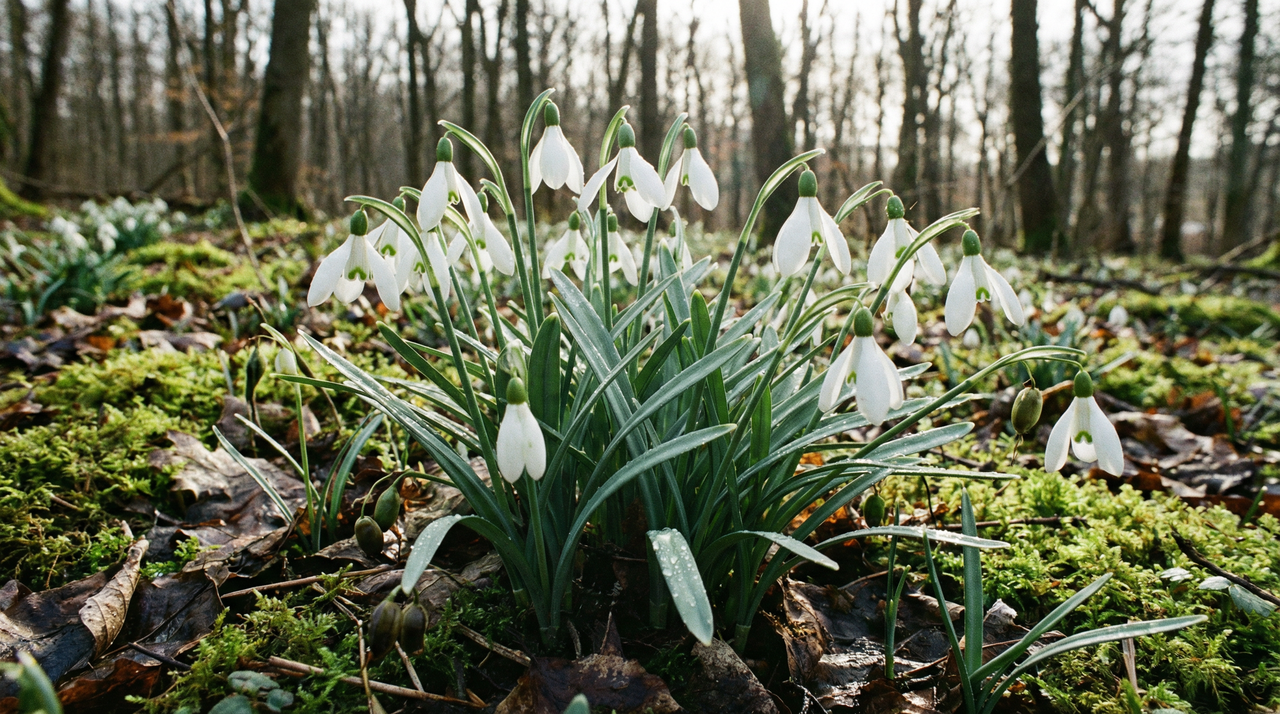
Every February, I watch visitors to my garden do the same thing: they crouch down in the cold mud, peer at the little white snowdrop bells dangling above the frozen ground, and say something like "oh, how delicate." And I have to bite my tongue. Because the snowdrop is one of the toughest plants I've ever grown. It produces a natural antifreeze protein that keeps its cell walls intact while the soil around it is still locked hard, and its emerging shoot tip is literally rigid enough to punch through crusted snow.[1] Delicate is the last word I'd use. Relentless is closer.
What gets me every time is the timing. Not just that it blooms in winter, but that it needs winter, specifically the kind that would kill most ornamentals outright. Get the bulbs too warm during dormancy and they won't flower properly the following year. There's a beautiful stubbornness to that, a plant that demands the cold rather than tolerating it. Once I understood that, everything else about growing snowdrops started to make sense, including why they've been quietly naturalizing in temperate gardens for centuries and why one of their alkaloids ended up in a drug prescribed for Alzheimer's patients. This little plant has a lot going on underneath those nodding white bells.
Snowdrop Origin and History
Few plants carry as much quiet drama as the snowdrop. While the rest of the garden sits dormant and gray, Galanthus nivalis is already at work, threading its way through frozen ground to open those impossibly delicate white bells. That timing isn't accidental. It's the product of millions of years of adaptation to a very specific kind of place.
Botanical Background and Native Range of Galanthus nivalis
Galanthus nivalis is native to broad-leaved woodlands and meadows stretching from the Pyrenees in the west across central and eastern Europe all the way to the Caucasus Mountains, and it has since naturalized in parts of the eastern and central United States.[2][3][4] That's a wide native range, and it tells you something important: this is a plant shaped by cool, moist winters and warm, dry summers. It thrives in exactly the temperate woodland conditions that most kitchen gardeners and permaculture designers are trying to work with, not against.
The lifecycle is beautifully precise. Leaves emerge from October into December, flowers open from January through March (with February as the peak), seed capsules develop and mature through late spring, and by midsummer the whole plant has retreated underground as a bulb to wait out the heat.[5][2] It's a polycarpic perennial, meaning it flowers annually for multiple years rather than dying after setting seed, and it's cold-hardy to around -20°C to -29°C, covering USDA zones 3 through 8.[6][4]
One thing I always tell people when I'm designing woodland-edge plantings is that snowdrop colonies are a long game worth playing. Individual bulbs typically persist for 10 to 30 years before producing offsets, and under good garden conditions lifespans can exceed 50 years.[7][8] I've watched my own colonies slowly thicken in shaded borders over more than a decade, and that gradual spread through vegetative offsets is exactly what makes them so low-maintenance once established.[9] The related Crimean snowdrop, G. plicatus, native to mountain meadows and open woodlands from Crimea through the Caucasus and Turkey at elevations up to 2,000 meters, was introduced to Western European gardens in the late 19th century[10][11] and shares that same long-lived persistence, a useful reminder of just how durable this genus is across a surprising range of highland habitats.
Distinctive Visual Characteristics of Snowdrops
The snowdrop flower is small and architectural. Each plant produces a single, nodding, bell-shaped bloom on a leafless scape that reaches 7.5 to 20 cm tall, with three outer white tepals 10 to 20 mm long and three shorter inner tepals carrying that instantly recognizable green V- or heart-shaped marking at the base.[12][13][2] After years of identifying early-spring bulbs in the field, I've found those inner tepal markings are the single most reliable visual cue for distinguishing G. nivalis from similar white bulbs like Leucojum when the leaves are still just emerging.
The leaves themselves are basal, linear, conduplicate (folded lengthwise), dark green with a glaucous bloom, and often slightly sickle-shaped, emerging before or with the flowers.[12][14] The whole plant grows from a tunicate ovoid bulb with a fibrous root system, and after flowering it sets a small three-lobed pendulous capsule containing black seeds equipped with a white elaiosome that attracts ants for dispersal.[15] I often use G. plicatus alongside G. nivalis in woodland plantings precisely because the contrast is so striking: where G. nivalis has those flat, folded leaves, G. plicatus has broader, pleated gray-green foliage with a more sculptural quality that catches the low early-spring light beautifully.[10][16] And if you want to see how far the genus stretches, G. reginae-olgae flips the whole phenological script: it flowers in autumn, and its narrow, semi-evergreen leaves emerge with or before the blooms rather than after.[17]
Traditional, Cultural, and Historical Uses of Snowdrops
The earliest well-documented cultivation record of G. nivalis dates to around 1100 AD at the Benedictine monastery at Clairvaux, France, and the plant moved from monastery gardens into the broader horticultural literature through John Gerard's Herball (1597), John Parkinson's Theatrum Botanicum (1640), and finally Carl Linnaeus's formal naming in Species Plantarum (1753).[18][19][20] By that point the snowdrop had already been spreading through European gardens for at least a century, and many cultivated plants have since naturalized across temperate regions far outside the native range.[2][3]
Traditional European folk medicine applied G. nivalis bulbs and leaves to headaches, nervous disorders, and pain, while Caucasian uses of the closely related G. plicatus extended to neurological conditions, neuralgia, paralysis, and memory complaints, often as topical poultices or decoctions.[21][22] I find that history genuinely fascinating, but I'm also very direct about it in my work: the plant contains toxic alkaloids, and I treat it as strictly ornamental in every design. No exceptions. The alkaloid story does have a remarkable modern chapter, though. Galantamine was first isolated from the related Galanthus woronowii, bridging centuries of Caucasian folk use for neurological conditions directly to contemporary pharmaceutical treatment for Alzheimer's disease.[23]
Beyond medicine, the meaning of the snowdrop flower runs deep in European culture. As the January birth flower and a symbol of hope, purity, and renewal across Orthodox Christian, poetic, and folk traditions, it has earned its symbolism honestly: it's often the first bloom of the year, pushing through snow to signal that winter is ending.[24][25] Snowdrop symbolism as a motif of resilience and resurrection appears in centuries of art and verse, and it's an association the plant earns every single February.
Snowdrop Physiology and Adaptation
That snow-piercing emergence isn't just poetic. Galanthus nivalis achieves it through a combination of hygroscopic expansion of the outer bulb scales, rapid scape elongation, and specialized cellular adaptations that protect the flower tissue from freezing.[26][27] Seeing the first shoots break through a frosted border in January still stops me in my tracks, even after years of watching it happen. The physiology behind it is genuinely elegant.
Native populations also show regional adaptations in flowering time, with plants in colder climates delaying bloom accordingly, and many cultivars have established naturalized populations well beyond the historic native range.[28][3] That adaptability is worth noting carefully: in parts of North America, G. nivalis can outcompete local flora where it escapes cultivation, so responsible sourcing and thoughtful placement genuinely matter.[29] The same qualities that make snowdrops such reliable garden stalwarts -- cold hardiness, persistence, slow but steady spread -- are precisely why they deserve a considered spot in the design rather than a casual one.
Snowdrop Varieties and Cultivars
Most US gardeners meet the genus through Galanthus nivalis, the common snowdrop, and that's a perfectly fine starting point. But once you start looking at the broader family, you realize there's a lot more seasonal range available than a single February flush. Widely adapted and generally non-invasive across the country,[4] G. nivalis itself comes in two recognized subspecies: the widespread European subsp. nivalis and the morphologically distinct subsp. cilicicus from southern Turkey.[30] That subspecific variation hints at how much quiet diversity exists within what most people think of as a single plant.
Notable Snowdrop Species and Cultivars
If you want to stretch the snowdrop season, Galanthus plicatus is the species I'd point you toward first. It shares the same zones 3-8 hardiness as the common snowdrop[31][32] and carries those characteristically pleated, strap-like leaves that I find more architecturally interesting than the flat foliage of typical G. nivalis. The pleating also seems to help the leaves stand up better to heavy late-winter rain, which I've appreciated in wetter springs. While the species typically blooms from February through March, its named cultivars are where the real seasonal range opens up. 'König Ludwig' pushes into January,[33] while 'Easter Snow' holds on through late March into April. In between you have options like the reflexed-petal 'Aversiflorus', the double-flowered 'Flore Pleno', and the genuinely unusual 'Wendy's Gold', which carries yellow rather than green markings.[31][33] For a permaculture woodland edge, that January-to-April bloom arc from a single species is genuinely useful for early pollinator support.
The real surprise, though, is Galanthus reginae-olgae. I first came across it flowering in a collector's garden in October, well before the first frost had arrived, and I immediately started thinking about how it could anchor a woodland guild's interest calendar from the opposite end of the season. Native to Greece and Turkey, this species blooms in autumn or very early winter in mild climates, and it's reliably hardy in zones 5-8, with the best performance in zones 6-8.[34][35] Two subspecies exist: the broader-leaved subsp. reginae-olgae and the narrower-leaved subsp. odensis. The species has more than 20 named cultivars selected for flower shape, markings, vigor, and timing, including 'Kentford', 'Naomi Goldsmith', 'South Hayes', 'Trym', and 'Westfield Place'.[36] Subsp. reginae-olgae has earned the Royal Horticultural Society Award of Garden Merit, which I pay attention to because it reflects actual performance trials rather than catalog enthusiasm.[36]
Sourcing Snowdrop Bulbs Responsibly in the US
Snowdrop bulbs ship in fall, generally September through November, and reputable US sources include Plant Delights Nursery, White Flower Farm, Brent and Becky's Bulbs, and Old House Gardens.[4] Expect to pay $5 to $25 per bulb for most cultivars, with rarer selections running $50 or more. Popular varieties disappear fast, and after losing out on 'Wendy's Gold' two years in a row, I now pre-order everything I want in July or August. It feels early, but it's the only reliable strategy in this collector market.
The regulatory picture for US gardeners is straightforward. Galanthus nivalis carries no noxious weed designation in any state, isn't federally restricted, and isn't listed under CITES, so no special permits are required for cultivated material.[37][38] Dormant bulbs can be imported with proper phytosanitary certification, though I always verify current APHIS guidelines before placing any international order since regulations can tighten after pest incidents.[39] The conservation issue worth knowing: wild collection of G. plicatus is prohibited in the Crimea and Caucasus, where native populations have been badly pressured by collection pressure.[40][41] Every bulb I plant comes from a nursery that propagates its own stock. That's not just ethics; it's also how you avoid diseased or low-vigor material. Stick with nurseries that can tell you where their stock was grown.
Snowdrop Propagation and Planting Guide
Snowdrops move at their own pace, and the sooner you accept that, the happier you'll both be. There are two real paths into a snowdrop planting: lifting and dividing established clumps, or starting from seed. One delivers flowers in a season or two. The other is a half-decade commitment. I've done both, and I'll tell you upfront which one I recommend for most gardeners.
Propagation Methods: Division, Seed, and Specialized Techniques
Bulb division is the backbone of snowdrop propagation, and for good reason. You lift a congested clump right after flowering while the foliage is still visible and fading, separate the natural offsets, and replant them before the leaves go fully yellow.[42][43] I've found this post-flowering window far safer than waiting until late-summer dormancy: when the foliage is gone, it's genuinely easy to slice through a bulb you never saw coming. The bulbs go back into the ground at 2-4 inches deep in well-drained, humus-rich soil, and smaller offsets may need 1-3 years to reach blooming size, but flowering-size divisions will often perform the very next spring.[42][44]
Seed propagation tells a more interesting biological story, even if it's not the practical choice for most of us. Each snowdrop seed is a small ellipsoid structure, 4-6 mm long with a thin reddish-brown coat and a white fleshy elaiosome attached to one end.[14][45] That elaiosome is an ant magnet; ants carry the seeds, eat the fatty appendage, and drop the seed somewhere new. It's a tidy dispersal system, and it explains how snowdrops colonize slowly and organically in woodland settings. Internally, the tiny and underdeveloped embryo is surrounded by starchy endosperm, securely locked behind double dormancy requiring warm stratification followed by 12-16 weeks of cold moist conditions at 2-5°C before germination can occur.[46][47] Even with fresh seed and correct stratification, germination rates typically fall in the 30-45% range.[48] First flower comes somewhere between 3 and 7 years later, most commonly around year five.[44][47] I label every pot I start from seed because for the first two seasons the seedlings look nearly identical to grass, and I've had visitors offer to weed them for me.
Commercial growers use twin-scaling and tissue culture to multiply rare cultivars quickly, but these are not realistic techniques for the home garden.[49] Grafting and leaf cuttings simply don't work on monocot bulbs like these.[2] If you're chasing a specific named cultivar, the practical answer is to source it from a reputable nursery selling cultivated snowdrop bulbs for sale, then build your stock through patient division over the years.
Soil, Site, and Light Requirements
Get the drainage wrong and nothing else matters. Snowdrops need humus-rich, moist-but-not-waterlogged soil with a pH of 6.0-7.5; neutral to slightly acidic is ideal for G. nivalis, but heavy clay must be amended with generous quantities of grit and leaf mold before planting snowdrop bulbs of any kind.[42][44] I lost an entire tray of new offsets one wet spring before I learned to amend even moderately heavy soil properly; the difference in survival rate is dramatic. A simple soil test kit has also saved me more than one planting, since compacted or acidic spots that look fine to the eye can quietly rot bulbs over winter. For the genus more broadly, G. plicatus and G. woronowii show that snowdrops can adapt to slightly alkaline conditions up to pH 7.5-8.5 when drainage stays excellent, which should reassure gardeners on limestone soils.[16][50]
For light, think woodland edge rather than deep shade or open sun. Partial shade or dappled light under deciduous trees is the sweet spot, with at least 2-4 hours of morning sun and protection from hot afternoon exposure.[51][52] Much like trilliums or hostas, snowdrops are built to take advantage of early spring sun before the canopy closes, then rest through summer in cool shade. A deciduous tree canopy provides exactly that seasonal shift without you having to engineer it.
Planting Depth, Spacing, and Technique
Planting snowdrop bulbs in autumn between September and November gives them time to root before the ground freezes.[44] Set them pointed-end up at 2-4 inches deep, which works out to roughly 2-3 times the bulb's height.[53] Standard spacing for naturalizing drifts is 3-4 inches apart, though tighter 2-inch spacing speeds up colony formation in lawn settings while 6-8 inches suits a more formal arrangement.[54]
I always plant in generous groups rather than singletons. A cluster of 3-5 bulbs creates immediate visual impact, and planting in drifts of 10-20 gives that naturalized woodland look from the very first season.[55][56] Mature clumps top out around 4-8 inches tall and spread gradually through offset production, so spacing them correctly now pays off years down the line when you're lifting and dividing a thriving colony rather than untangling a congested one.
Germination and Flowering Timelines
The practical summary is this: if you want flowers next spring, buy or divide flowering-size bulbs. Dormant snowdrop bulbs planted in autumn establish roots before winter and typically bloom within 3-6 months.[44] Smaller offsets from division need a bit more patience, usually 1-3 years to build enough energy for reliable flowering.[42] Vernalization is non-negotiable for all of them: the bulbs need 10-12 weeks below 45°F (7°C) to break dormancy and initiate growth, mirroring their native Eurasian woodland cycle.[57][53]
The seed route follows a longer arc: stratification, a slow germination the following spring, a year or two forming a tiny bulb underground, and then the long wait to first flower at 3-7 years under good conditions.[47][49] I've committed to that timeline more than once, and the first flower from a seed-raised plant genuinely feels like an event. But once any snowdrop colony is established, the maintenance calculus shifts entirely: the bulbs naturalize, spread slowly on their own, and ask little beyond a lift and divide every few years to keep the clumps productive. That's a long game worth starting.
Snowdrop Care Guide: Growing Galanthus nivalis
The best thing I can tell you about caring for snowdrops is that your instinct to fuss will be your biggest obstacle. These are woodland bulbs that evolved to do most of the work themselves, cycling through cold winters and dry summers without anyone hovering over them. Get the site right, respect the seasonal rhythm, and step back. That's genuinely most of it.
Watering Needs and Soil Moisture for Snowdrops
Drainage is non-negotiable. Snowdrops need humus-rich, well-drained soil year-round, with consistent moisture from autumn through spring (roughly a quarter to one inch per week during active growth) and a significantly drier profile once foliage fades.[58][59] That summer dry-down isn't a drought problem; it mirrors exactly what happens in a deciduous woodland when the canopy closes and rainfall gets intercepted. I collect rainwater for my bulb beds whenever possible, though chlorinated tap water works fine if you let it sit out for 24 hours.[60]
Symptoms of overwatering include soft, mushy bulbs, yellowing or wilting leaves, blackened roots, and visible fungal growth.[61] Underwatering shows up as browning leaf tips and weak or absent flowering. In practice, if your drainage is genuinely good, you're far more likely to have rot problems than drought problems. A 2- to 3-centimeter layer of leaf litter or compost applied in autumn helps buffer both moisture loss and waterlogging without smothering the bulbs.[62]
Sunlight and Light Requirements
Snowdrops are adapted to deciduous woodland, which means they've timed their entire lifecycle around that brief window of brightness before the canopy fills in. They flower and photosynthesize in what is essentially full sun, then retreat into shade as the trees leaf out. In the garden, 2 to 5 hours of direct morning sun with afternoon shade is ideal; hot afternoon exposure causes leaf scorch and reduces flowering in subsequent years.[58][15] In my experience, snowdrops planted under deciduous trees bloom far more reliably than those in open beds, even when both get similar light totals across the year. The tree canopy does double duty: it shades the soil during the summer dormancy period and keeps root temperatures cooler heading into that dry rest.
Feeding and Fertilization
I'll be direct: I almost never feed my snowdrops. They thrive in nutrient-poor soils, and the biggest fertilizer mistake I see is over-application, which pushes excessive leafy growth at the expense of flowers and increases rot risk.[43][42] If you do want to feed, a light application of a low-nitrogen formula like 5-10-10 right after flowering or in early autumn is plenty; phosphorus and potassium serve bulb development better than nitrogen ever will.[63]
I run a simple soil test every three or four years rather than feeding on any routine schedule, and I rarely find anything alarming when drainage and placement are correct.[64] For most gardens, top-dressing with leaf mold every other autumn supplies enough phosphorus for healthy roots while preserving the lean woodland conditions these bulbs actually prefer.[44] Queen Olga's snowdrop, adapted to nutrient-poor limestone slopes in Greece, takes this even further and genuinely performs better with almost no supplemental feeding at all.[65]
Frost and Cold Hardiness
Galanthus nivalis is rated for USDA zones 3 through 8, with dormant bulbs tolerating temperatures down to around -20°F (-29°C) or colder.[42] The pleated snowdrop, G. plicatus, pushes that even further, surviving to -40°F, which puts it in the same league as some of the toughest zone 3 perennials I grow.[66] The interesting paradox is that all this cold-hardiness applies to dormant bulbs. Emerging shoots and open flowers are more vulnerable to hard late-season frosts, which can blacken tips or cause wilting.[67]
Minimal intervention is usually sufficient. In exposed sites, 2 to 3 inches of organic mulch applied after the ground freezes provides useful insulation, and choosing a north- or east-facing spot with good air drainage keeps wet-freeze cycles from damaging roots.[52] These aren't fussy plants; mostly they just need you to stay out of the way and let the cold do its work.
Heat Tolerance and Summer Dormancy
Snowdrops prefer cool growing conditions, ideally between 32 and 50°F (0 to 10°C) during their active phase, and they're rated for AHS heat zones 1 through 6.[58] Temperatures that climb consistently above 77°F (25°C) during the growing season can cause wilting, leaf scorch, and reduced bulb vigor heading into the following year.[68] Mulching with leaf mold in early summer is my most reliable tool for keeping root zones cool through the transition to dormancy; it genuinely makes a difference in how the bulbs come back the following spring.[52]
During summer dormancy, established bulbs can handle more heat, particularly G. plicatus, which tolerates brief spikes into the mid-80s°F if kept dry.[69] Zone 9 and above is genuinely marginal for G. nivalis without intensive shade and moisture management; in those climates, summer snowflake (Leucojum aestivum) is a more practical stand-in.[42]
Pruning, Maintenance, and Division
The main rule here is patience. Once snowdrops finish flowering, let the foliage yellow and die back completely on its own, which takes roughly 6 to 8 weeks.[44] Early on I cut back yellowing leaves thinking I was tidying things up, and I paid for it with weaker, sparser blooms the following season. The leaves are doing critical work, photosynthesizing and replenishing the bulb for next year's flowering. Leave them.
Division is where you actually influence long-term performance. I divide crowded clumps every 3 to 4 years in late summer after foliage dies back, and the payoff is consistently stronger flowering the next season.[44] Replant offsets immediately at 8 to 10 centimeters deep and 5 to 10 centimeters apart, and they'll settle in before winter.[70] A light mulch of 2 to 4 inches of organic material after planting suppresses weeds and buffers freeze-thaw cycles without waterlogging the bulbs.[71] Between divisions, these naturalize reliably by offset, and deer and rodents largely leave them alone, which in a food forest context is quietly wonderful.
Seasonal Rhythm and Lifecycle Care
Once you internalize the yearly cycle, snowdrop care basically runs itself. Plant or divide in autumn, maintain consistent moisture from autumn through the flowering period in late winter or early spring, then allow foliage to die back naturally in late spring and keep bulbs cool and dry through summer.[72][73] Resume light watering in fall if the season is unusually dry, and the cycle starts again. That's the whole calendar.
For anyone interested in forcing blooms indoors, chill bulbs at 40 to 50°F (4 to 10°C) for 12 to 16 weeks before bringing them into a cool room around 50 to 59°F (10 to 15°C).[74] G. reginae-olgae follows broadly the same pattern but tolerates slightly drier summer conditions thanks to its limestone-cliff origins, while G. plicatus has a bit more flexibility at temperature extremes on both ends.[65] Once you've lived with a well-sited colony for a few seasons and watched it thicken and spread without much help from you, snowdrops start to feel less like something you tend and more like something you simply get to enjoy.
Snowdrop Harvesting: Timing, Technique, and Safety
Snowdrops bloom from January through March in temperate climates, with peak flowering typically landing in February and March across most of North America.[75][53] That early emergence is part of what makes snowdrops so beloved, but it also means you need to start thinking about bulb division before most of the garden has even woken up. The good news is that once you understand the seasonal timeline, the whole process becomes almost intuitive.
When to Harvest Snowdrop Bulbs
Bulbs reach maturity roughly 6 to 8 weeks after flowering, once the leaves have yellowed and begun to die back.[76][44] For most temperate gardens, that puts the dormant-harvest window somewhere between June and July. Related species like Galanthus plicatus can take anywhere from 120 to 180 days post-flowering before entering true dormancy, so late spring through early summer is a reliable target across the genus.[77][78] I've learned through years of lifting clumps that patience here is non-negotiable. Move bulbs before the foliage is unmistakably yellow and you risk pulling them before they've stored enough energy to flower the following winter.
If you're growing from seed, patience takes on a whole new meaning. Snowdrops require 3 to 7 years from seed to reach flowering size, whereas divisions from established clumps typically bloom within 1 to 3 years.[44][79] I've sat out that long seed-to-flower timeline more than once, and I'll tell you honestly: I almost always reach for division now. The results are faster, more predictable, and the bulbs hit the ground already knowing what they're doing.
How to Harvest and Divide Snowdrops
The most practical approach, and the one the RHS recommends, is dividing snowdrops "in the green" immediately after flowering in late winter or early spring.[44] At that point the foliage is still upright and visible, making it easy to locate and lift clumps without accidentally stabbing them with a fork. Mature bulbs to look for are 1 to 2 centimeters in diameter or larger, often showing visible offsets clustered at the base; bulbs that have developed 3 to 5 leaves are the ones with the resources to multiply reliably the following season.[44][79] Those visible bulbils are what I look for first when I'm deciding which clumps are ready to split.
One thing I feel obligated to say clearly: there is no culinary harvest here. Every part of Galanthus nivalis and its relatives is toxic.[75][53] The flowers smell lovely, but that fragrance is entirely ornamental. The bitter, acrid taste of the plant material exists precisely because the alkaloids inside are nature's way of saying do not eat this.[75] I tell people to think of it the same way they'd think of a daffodil, same family, same warning. Just as you'd never eat a daffodil bulb, you should never eat a snowdrop. There is zero safe home use for this botany.
Snowdrop Preparation and Uses
Why Snowdrops Are Not Edible: Toxicity and Symptoms
I've handled more snowdrop bulbs than I can count, dividing established clumps in late winter with cold-numbed fingers, and the one thought that has never crossed my mind is putting any part of this plant anywhere near my mouth. Every part of Galanthus nivalis is toxic to humans and animals, loaded with alkaloids including galanthamine and lycorine that make the entire genus poisonous from tip to bulb.[80][42][81][82][83] If you're familiar with daffodils, you already understand the basic idea -- snowdrops share the same Amaryllidaceae family and the same chemical defense strategy, a bitter, acrid taste built specifically to discourage any creature tempted to nibble.[84] Ingesting the bulbs triggers severe gastrointestinal distress, with the potential for serious nervous system effects in larger exposures.[81][3] There are no established culinary uses, and no vague historical folklore translates into anything safe or practical today.[85][81][86]
The bulbs concentrate galanthamine most heavily, reaching up to 0.5 to 1 percent dry weight.[87] This applies equally to Galanthus plicatus and every other species in the genus.[11][82] Wild harvesting is both dangerous and, in many regions, legally restricted on sustainability grounds.[88][89] Anyone who has divided a mature snowdrop colony knows how many seasons it takes to build even a modest display; wild populations simply can't absorb that kind of pressure.
One practical note I give clients when we're interplanting early spring bulbs: label everything. Snowdrops can be confused with spring snowflake (Leucojum vernum) or three-cornered garlic (Allium triquetrum), and a mixed-up label in a food garden is exactly the kind of mistake you don't want to make.[90][91] Keep snowdrops clearly separated from any edible guild planting.
The Galanthamine Paradox: From Toxic Bulb to Alzheimer's Medicine
Here's the fascinating, frustrating paradox: galanthamine, the very compound that makes snowdrops dangerous, is used in purified pharmaceutical form as a treatment for mild-to-moderate Alzheimer's disease.[92][93] Some folk traditions did use decoctions and tinctures from snowdrop bulbs, but those preparations carry serious toxicity risks and have no clinical validation behind them.[94][95] I would never attempt a home extraction, and I say that as someone with professional experience handling these plants regularly. The therapeutic window is too narrow, the raw material too unpredictable, and the interactions too serious: galanthamine can conflict with other cholinesterase inhibitors, potentially triggering bradycardia and other cholinergic effects.[96][94] Modern pharmaceutical galanthamine is produced synthetically and used only under medical supervision. I always tell clients with neurological conditions or complex medication histories to take any conversation about medicinal herbs straight to their doctor.
Cultural Significance, Look-Alikes, and Safety Reminders
What snowdrops genuinely offer, beyond their chemistry, is symbolic. In European folklore they represent hope, purity, and the return of spring[97][95] and honestly, that resonates with how I think about them in a permaculture garden. Seeing the first nodding white bells push through in February has never stopped being a small miracle. In a regenerative system designed to celebrate seasonal rhythms, that emotional and ecological signal of renewal is a genuine contribution. The snowdrop's role is to be admired, to feed early pollinators, and to mark the turn of the year. That's enough. Taste them, it is not.
Snowdrop Health Benefits and Medicinal Uses
Let me say this clearly before anything else: snowdrops have no nutritional value, no safe home remedy use, and every part of the plant is toxic. What they do have is one of the most pharmacologically significant alkaloid profiles in the entire plant kingdom, and understanding that chemistry is worth your time.
Key Phytochemicals: Galanthamine and Amaryllidaceae Alkaloids
Galanthus nivalis produces a dense suite of Amaryllidaceae alkaloids as its primary secondary metabolites, with galanthamine, lycorine, narciclasine, and crinine-type compounds among more than 100 identified across the genus.[98][99] The bulbs carry the highest concentrations, ranging from 0.1 to 0.5% galanthamine by dry weight, peaking during flowering and varying significantly by geography, soil conditions, and cultivation practices.[100][101] Certain wild Turkish and Eastern European populations run toward the higher end of that range; cultivation adjustments can push yields another 20 to 50% in purpose-grown stock.[102] The leaves and flowers carry far lower concentrations, but that doesn't make them safe.
Beyond the alkaloids, snowdrops also contain flavonoids including quercetin, kaempferol glycosides, and rutin, alongside phenolic compounds like gallic acid and catechins that show antioxidant activity in extracts.[103] These compounds exist primarily as ecological defenses: herbivore deterrents and antimicrobial agents protecting the bulb in the wild.[104] I was reminded of this vividly while dividing an old clump a few years back. I accidentally nicked a bulb with my trowel and caught the sharp, intensely bitter smell of the alkaloid chemistry doing exactly what it evolved to do.
Galantamine in Modern Medicine and Traditional Uses
Galanthamine was first isolated in 1952 from the related species Galanthus woronowii, and the pharmaceutical form, galantamine, is now a clinically approved treatment for mild-to-moderate Alzheimer's disease. It works through a dual mechanism: reversible acetylcholinesterase inhibition at nanomolar concentrations and positive allosteric modulation of nicotinic acetylcholine receptors, specifically the α4β2 and α7 subtypes.[105] At therapeutic doses of 8 to 24 mg per day, it delivers modest but measurable cognitive improvements (roughly 2 to 3 points on the ADAS-Cog scale over six months) alongside neuroprotective effects involving amyloid-beta pathways.[106][107] That's pharmaceutical galantamine from controlled synthesis, not anything you could derive from your garden.
Folk traditions in Eastern Europe, the Caucasus, Turkey, and Crimea do record Galanthus nivalis medicinal use for headaches, neurological complaints, rheumatism, and as an emmenagogue, but none of these applications have modern clinical backing.[108] Preclinical research on supporting alkaloids like lycorine and narciclasine shows anti-inflammatory effects (inhibition of TNF-α and IL-6), antimicrobial activity against Gram-positive bacteria, and some antiviral and anticancer signals in cellular and rodent models, but all of it remains preliminary.[109][110] I never recommend harvesting snowdrops for any home remedy. The alkaloid concentrations are too variable, the risks are real, and the evidence simply isn't there.
Safety and Toxicity of Snowdrops
Every part of the snowdrop plant is toxic to humans, dogs, cats, and livestock. Bulbs carry the highest alkaloid load, but leaves and flowers are not safe either.[81][83] Ingestion causes nausea, vomiting, diarrhea, abdominal pain, excessive salivation, and dizziness, with severe cases progressing to convulsions, cardiac arrhythmias, and respiratory depression from cholinergic toxicity. Lycorine contributes additional emetic and potentially hepatotoxic effects.[111] Symptoms typically appear within hours, and children and pets face the highest risk. If you've grown daffodils, the family pattern is familiar; both are Amaryllidaceae, both capable of causing serious harm from relatively small amounts.
Even pharmaceutical galantamine at therapeutic doses carries side effects: nausea, vomiting, dizziness, and bradycardia. It interacts with beta-blockers, NSAIDs, antidepressants, neuromuscular blockers, and cardiovascular drugs, so anyone prescribed it needs medical supervision.[112] Skin contact with sap or bulb tissue can cause contact dermatitis in sensitive individuals, partly from calcium oxalate crystals in addition to the alkaloids themselves, so gloves are non-negotiable when handling.[113] As a designer of gardens and public installations, I label snowdrop plantings clearly and always have a direct conversation with clients who have young children or dogs. The early white flowers are genuinely tempting to small hands. For suspected poisoning, call Poison Control immediately; treatment is supportive and severe outcomes are rare with prompt care, but don't wait to see how symptoms develop.[114][115] Watch for look-alikes too: Leucojum vernum, Colchicum, and wild Crocus can all be mistaken for snowdrops, and all carry their own toxicity risks.
Nutritional Profile
Snowdrops have no nutritional value. They appear in no food composition database, because the plant is poisonous and has no safe edible use whatsoever.[81] The flavonoids and phenolics discussed above are relevant only in purified pharmaceutical research contexts, not as anything you could benefit from by consuming the plant. Beauty in the garden does not imply edibility, and snowdrops make that lesson unusually clear.
Snowdrop Pests and Diseases
Snowdrops are about as trouble-free as any bulb in my garden, and that's not wishful thinking. Part of it comes down to timing: by blooming in late winter, Galanthus nivalis sidesteps most of the insect pressure that hammers later-season plants.[43] But there's also genuine chemistry behind the resilience. Snowdrops contain a suite of alkaloids, including galanthamine, lycorine, and narciclasine, that make the plant genuinely toxic to most insect herbivores.[116][117][118] It is no coincidence that the snowdrops remain untouched when almost everything else in the garden gets nibbled.
Natural Resistance to Pests
Mature snowdrop foliage is noticeably less palatable than the tender new growth, something I've watched play out season after season.[119] The first soft shoots to push through in late winter are the ones that need a watchful eye; once the leaves toughen up, the slugs move on to easier targets. Deer and rabbits avoid the plant almost entirely, which makes snowdrops genuinely useful in gardens with heavy browsing pressure.[120] For the occasional slug problem that does appear, iron phosphate baits are effective and low-impact, while physical barriers work well in particularly wet springs.[121]
Common Pests and Their Management
Slugs and snails are the one pest that actually earns attention. They'll chew irregular holes in emerging foliage and, if populations are high enough, damage bulbs at the surface.[43][44] G. plicatus, G. woronowii, and G. reginae-olgae all face the same pressure in damp conditions. In wet springs, beer traps and iron phosphate pellets are my most reliable tools, and I've found that hand-picking in the evening is surprisingly effective for smaller patches. Aphids appear occasionally on emerging shoots and, more importantly, can transmit viruses to the plant.[49] Snowdrops have an advantage here that I've come to appreciate: because they finish flowering before aphid populations really build in spring, they often escape meaningful virus transmission entirely, the same timing luck that my lilies rarely get.
Less common but worth knowing: bulb mites (Rhizoglyphus echinopus) can infest stored or damaged bulbs and lead to rot,[122] thrips occasionally rasp flower surfaces causing distortion and silvery scarring,[49] and narcissus bulb fly larvae can tunnel into bulbs and cause decay.[123][124] Mice and voles will sometimes take bulbs, though snowdrops are lower on their preference list than tulips or crocuses.[44] For almost all of these, a consistent integrated approach applies. Inspect bulbs before planting, lift and divide clumps every few years to keep them vigorous, and encourage ground beetles and other predators with diverse plantings nearby, and use nematodes if fly larvae become a recurring problem.[49][125] Companion planting with alliums nearby can also deter aphids. Cultivar choice matters too: 'S. Arnott' and 'Magnet' have consistently shown me more vigor and less slug damage than other selections in my conditions,[126] and G. plicatus 'Byzantinus' shows particular tolerance to aphids and slug feeding.[126]
Disease Resistance and Prevention
Snowdrops have high overall disease resistance and are rarely troubled by serious pathogens when grown well.[119][127][2] The single biggest variable is drainage. Poor drainage undermines almost every natural defense the plant has, promoting the fungal and bacterial pathogens that well-sited bulbs simply never encounter.[127][128][129] I learned that the hard way. After losing a small patch to bulb rot in a heavy clay border, I started amending every planting hole with horticultural grit and sharp sand. That single change eliminated the problem entirely, and those bulbs have multiplied reliably ever since. Good airflow from correct spacing, combined with the plant's waxy cuticle and its habit of finishing its above-ground growth before summer pathogens peak, does most of the protective work.
Common Diseases and Cultural Solutions
The diseases that do occur are almost always the same three: Botrytis cinerea (grey mold), viral infection transmitted by aphids, and bulb or root rot from Fusarium or Pythium.[6] Root rot announces itself with yellowing or wilting leaves, soft mushy bulbs, and blackened tissue at the base.[130][131] G. nivalis shows solid resistance to Botrytis[119] and moderate-to-high resistance to bulb rots when drainage is genuinely good,[119][129] but that qualifier matters. G. reginae-olgae, adapted to warmer, drier conditions, sidesteps fungal problems more easily than the other species,[132][124] while G. plicatus can tolerate wetter soils but still needs adequate drainage to stay disease-free.
Preventive culture covers almost everything: start with certified disease-free stock, remove and destroy any rotting foliage or bulbs immediately, space plants at least 3-6 inches apart and plant at 3-4 inch depth for good airflow, and water only when the soil has dried out rather than on a schedule.[133][128] I have never needed to reach for chlorothalonil for Botrytis or thiophanate-methyl for Fusarium on my snowdrops, and I don't expect to: once drainage was corrected, the disease issues I used to see every few years simply stopped.[134] The research and my own garden agree that culture beats chemistry here. A well-sited colony in gritty, well-drained soil under deciduous trees will spend decades asking for almost nothing.
Snowdrop in Permaculture Design
There's a particular kind of satisfaction that comes from watching a snowdrop colony do exactly what it's supposed to do in a well-designed system: push up through a crust of snow in February, feed the first groggy bumblebee queens of the year, and then disappear quietly underground before summer heat even arrives. In my years designing temperate woodland guilds, snowdrops have become one of those plants I reach for not because they're flashy or productive in a conventional sense, but because they fill a genuinely rare ecological role in the early-spring calendar with almost zero fuss.
Climate Adaptation and Hardiness Zones
Snowdrops are built for cold, and they don't apologize for it. Galanthus nivalis is hardy in USDA zones 3 through 8, tolerating minimum temperatures down to -40°F, which makes it one of the more impressively cold-hardy bulbs you can tuck into a temperate food forest.[135][4][57] In the wild, the species tracks oceanic and humid continental climates where cool, wet winters and mild summers prevail, comfortable within a precipitation range of about 500 to 1,200 mm annually and a growing-season temperature band of 41 to 59°F.[2][42] After flowering in late winter it enters full summer dormancy, which means it's not asking anything of the garden during the hottest months. That's a genuinely elegant adaptation.
The tricky end of the range is zone 8. Reliable bloom depends on vernalization, specifically a cold period of six to ten weeks at 32 to 40°F, roughly 400 to 600 chill hours, and in warmer gardens that threshold simply doesn't happen without intervention.[136][137] I've pre-chilled bulbs in the refrigerator for clients on the warm margins of the range and seen dramatically better bloom rates the following spring. It adds a step, but it works. What doesn't work is prolonged heat above 85°F combined with humidity, so south of zone 7 you'll generally be fighting the plant rather than working with it. For humid subtropical gardens, I honestly recommend redirecting that energy toward native spring ephemerals that evolved for the conditions.
Ecosystem Functions and Pollination Ecology
The reason snowdrops earn a place in a permaculture system rather than just a flower bed comes down to timing. They offer nectar and pollen in January through March, when almost nothing else in the temperate landscape is blooming, feeding bumblebee queens emerging from hibernation, solitary mining and mason bees, and hoverflies.[58][15] That honey scent the flowers carry isn't incidental; I've noticed it draws solitary bees more consistently than crocus in the same guild, even on days cold enough that you'd question whether any insects were flying at all.
The flowers are morphologically specific to insect pollination: nodding bells about 1 to 2 cm long with outer petals forming a protective hood, and pollen release triggered by insect vibration rather than passive shedding.[58] The species is self-compatible but protandrous, meaning selfing is inefficient and cross-pollination drives seed set.[138][139] Optimal pollination happens at 35 to 50°F with 60 to 80% humidity, and the flowers close thermonastically when temperatures drop further.[58] In practice, this means avoiding any spray program during the bloom window and planting complementary early natives nearby to support the pollinator community through the full cold-season gap.
Beyond pollination, snowdrops form mycorrhizal associations with Glomus species that aid nutrient uptake, and their quickly decomposing foliage adds modest organic matter to the woodland floor.[140][141] Dense colonies do suppress weeds reasonably well during the brief window they're actively growing, though shallow roots at 15 to 30 cm mean you shouldn't credit them with meaningful erosion control on slopes.[142] These are supporting contributions, not headline functions, and I think it's worth being honest about that rather than overclaiming.
One boundary that must be clear in any design: snowdrops belong strictly in the ornamental layer.[143][144] As a designer I'm unambiguous with clients: snowdrops stay out of the edible layer entirely, and bulbs especially need to be kept away from children and pets. The pharmaceutical chemistry is genuinely fascinating, but that's a story for the health section, not a gardening rationale.
Forest Layer and Guild Placement
In permaculture terms, snowdrops belong firmly in the herbaceous layer of a temperate woodland system. At 4 to 8 inches tall, tolerating 70 to 80% shade, and completing their entire above-ground cycle before the canopy closes overhead, they slot naturally beneath deciduous trees in exactly the niche they occupy in native European woodlands.[145][2] After years of planting them under mature oaks and maples where a layer of intact leaf mulch keeps the soil cool and moist, I've watched colonies return and slowly widen each year with almost no intervention. That slow expansion via bulb offsets is part of what makes them so well-behaved; they naturalize without dominating.
For guild companions, they pair well with daffodils, winter aconites, and cyclamen for a layered succession of early-season bloom, and their foliage yellows and vanishes cleanly by early summer without the lingering mess some bulbs leave behind.[146][147] That clean exit matters practically; hostas and ferns filling the same space later in the season don't have to compete with dying foliage for light or aesthetic space. There's minimal allelopathy, so you're not worrying about chemical interference with neighboring plants. The foliage decomposition is modest but consistent, feeding the soil system year after year in a way that compounds quietly over time. For a plant this small, it pulls its ecological weight in ways that only show up properly across a full season's observation.
The Plant That Taught Me to Stop Waiting for Spring
I used to think of late February as the dead time, the gap between winter and anything worth going outside for. Then I put snowdrops under my old apple tree, and that whole story collapsed. Now I'm out there in a coat and mud boots, crouching down to look at something barely three inches tall, and it's enough. It's actually more than enough.
Sources 147
- Galanthus nivalis - RHS Plant Profile ↩
- Snowdrop (Galanthus nivalis) - Kew Gardens ↩
- Galanthus nivalis - Wikipedia ↩
- Galanthus nivalis ↩
- Galanthus nivalis - Snowdrop ↩
- Galanthus nivalis ↩
- Galanthus nivalis (Common Snowdrop) ↩
- Galanthus nivalis ↩
- Galanthus nivalis - Snowdrop ↩
- Galanthus plicatus and Cultivars ↩
- Galanthus plicatus ↩
- Galanthus nivalis - Royal Horticultural Society ↩
- Galanthus nivalis - Missouri Botanical Garden ↩
- Flora of North America - Galanthus nivalis ↩
- Galanthus nivalis ↩
- Galanthus plicatus ↩
- Galanthus reginae-olgae ↩
- Form and Flower: The History of Plants in the Garden ↩
- Theatrum Botanicum by John Parkinson ↩
- Species Plantarum by Carl Linnaeus ↩
- Ethnopharmacological Uses of Galanthus Species ↩
- Ethnobotany of the Caucasus: Medicinal Plants in Traditional Use ↩
- Galantamine from Snowdrop and Related Species: A Review ↩
- Snowdrop: Cultural Significance ↩
- Snowdrops: A Guide to the World's Special Bulbs ↩
- Galanthus nivalis (Snowdrop) ↩
- Galanthus nivalis ↩
- Environmental drivers of flowering in common snowdrop (Galanthus nivalis L.) ↩
- Snowdrops in European Woodland Biodiversity ↩
- Galanthus nivalis L. ↩
- Snowdrops: A Guide to the World's Species, Hybrids and Cultivars ↩
- Galanthus plicatus Description ↩
- Galanthus plicatus and its Cultivars ↩
- Galanthus reginae-olgae - BBC Gardeners World Magazine ↩
- Galanthus reginae-olgae - Wikipedia ↩
- Snowdrops: A Guide to the Species and Cultivars - Royal Horticultural Society ↩
- Noxious Weed List ↩
- CITES Appendices ↩
- International Trade in Plants ↩
- EU Regulation on Trade in Wild Fauna and Flora ↩
- Galanthus plicatus - Snowdrop ↩
- Galanthus nivalis (Snowdrop) - Propagation Guide ↩
- How to grow snowdrops ↩
- Snowdrops: How to Grow Snowdrops ↩
- Myrmecochory in Galanthus nivalis: Ant-mediated seed dispersal ↩
- Seed Morphology and Anatomy of Galanthus nivalis ↩
- Snowdrops from Seed ↩
- Viability Assessment Methods for Amaryllidaceae Seeds ↩
- Propagation of Snowdrops ↩
- Galanthus woronowii ↩
- Galanthus nivalis - Plant Profile ↩
- Growing Snowdrops ↩
- Galanthus nivalis ↩
- Snowdrop (Galanthus nivalis) ↩
- Galanthus nivalis ↩
- Snowdrop (Galanthus nivalis) ↩
- Snowdrop (Galanthus nivalis) ↩
- Royal Horticultural Society – Growing Snowdrops (Galanthus nivalis) ↩
- Missouri Botanical Garden Plant Finder – Galanthus nivalis ↩
- Snowdrop (Galanthus nivalis) Growing Guide ↩
- Bulb Rot in Snowdrops - University of Minnesota Extension ↩
- Snowdrop Care Guide ↩
- Plant Finder Entry: Galanthus nivalis ↩
- Nutrient Deficiencies in Bulbous Plants ↩
- Kew Gardens: Galanthus reginae-olgae ↩
- Galanthus plicatus ↩
- Plant Ecology & Evolution – Frost tolerance of early spring geophytes (2020) ↩
- Heat Stress Effects on Bulbous Ornamentals: Focus on Galanthus nivalis ↩
- Galanthus plicatus ↩
- Kew Gardens – Galanthus nivalis Fact Sheet ↩
- Royal Horticultural Society – Snowdrop (Galanthus) cultivation ↩
- Galanthus nivalis - Plant Care & Growing Guide ↩
- Snowdrop Care Guide ↩
- Missouri Botanical Garden Plant Finder ↩
- Galanthus nivalis (Snowdrop) ↩
- Snowdrops: A Guide to Galanthus in the Garden ↩
- Phenology of Galanthus plicatus ↩
- Snowdrop Bulb Propagation and Care ↩
- Snowdrops: A Guide to Galanthus ↩
- Snowdrop (Galanthus nivalis) - Toxicity ↩
- Snowdrop Toxicity - Poison Control ↩
- Galanthus - Poisonous Plants - North Carolina State University ↩
- Snowdrop Toxicity - ASPCA ↩
- Galanthine and Hanatonine: Comparative Investigation of the Central Nervous System Activity and Detoxification Process ↩
- Foraging Snowdrops: Edible or Poisonous? ↩
- Royal Horticultural Society Plant Finder: Galanthus nivalis ↩
- Galanthamine in Galanthus species - PubMed ↩
- USDA PLANTS Database: Galanthus nivalis ↩
- Royal Horticultural Society (RHS) - Plant Library: Galanthus nivalis ↩
- Distinguishing Snowdrops from Look-Alikes ↩
- Leucojum vernum vs. Galanthus nivalis ↩
- Galanthamine: From Snowdrop to Drug Discovery ↩
- Galanthus Species: Chemistry, Bioactivity, and Uses ↩
- Galanthamine: An Overview of Production and Applications ↩
- Ethnobotanical Notes on Galantus nivalis ↩
- Galanthamine: Uses, Side Effects, Interactions ↩
- Royal Horticultural Society Plant Guide ↩
- Galanthamine from snowdrop: A natural remedy for Alzheimer's disease ↩
- Secondary Metabolites in the Genus Galanthus: A Review ↩
- Alkaloids from Galanthus nivalis: Content and Distribution ↩
- Environmental Effects on Galanthamine Biosynthesis ↩
- Geographic Variation of Secondary Metabolites in Galanthus Species ↩
- Flavonoids and Phenolics in Snowdrop (Galanthus nivalis) ↩
- Chemical Ecology of Herbivory in Snowdrops (Galanthus nivalis) ↩
- Mechanism of Action of Galanthamine on Acetylcholinesterase and Nicotinic Receptors ↩
- Galanthamine for Alzheimer's disease ↩
- Galanthamine: An Update ↩
- Ethnobotany of Snowdrops (Galanthus spp.) in Eastern Europe ↩
- Alkaloids from Galanthus nivalis with Anti-inflammatory Activity ↩
- Antioxidant and Antimicrobial Activities of Snowdrop Extracts ↩
- Toxicology and Pharmacology of Amaryllidaceae Alkaloids ↩
- Galanthamine Side Effects ↩
- Allergic Contact Dermatitis from Snowdrop Bulbs ↩
- Galanthus nivalis - Toxic Properties ↩
- Toxicity of Bulbous Plants - Royal Horticultural Society ↩
- Chemical Defenses in Snowdrop (Galanthus nivalis) Against Herbivores ↩
- Alkaloids of the Amaryllidaceae: Structures, Biogenesis, and Distribution ↩
- Chemical Ecology of Snowdrop (Galanthus nivalis) Alkaloids ↩
- Royal Horticultural Society (RHS) - Plants for Problems ↩
- Snowdrop (Galanthus nivalis) Growing Guide ↩
- USDA ARS — Common garden insects: Slugs and snails ↩
- Snowdrop Pests - Royal Horticultural Society ↩
- Bulb Pests: Identification and Control ↩
- Snowdrops: Pests and Diseases - Kew Gardens ↩
- Integrated Pest Management for Ornamental Bulbs ↩
- Snowdrops: A Guide to Galanthus ↩
- Missouri Botanical Garden - Plant Finder ↩
- Royal Horticultural Society – Snowdrop (Galanthus nivalis) Cultivation and Care ↩
- University of British Columbia - Integrated Pest Management for Snowdrop Bulb Rot ↩
- Snowdrop (Galanthus nivalis) Profile ↩
- Bulb Rot in Ornamental Plants ↩
- Galanthus reginae-olgae - RHS Gardening ↩
- Royal Horticultural Society — Snowdrop care guidance ↩
- University of Michigan Extension — Spring-flowering bulb disease management ↩
- Koppen Climate Classification Map of Europe ↩
- Snowdrop (Galanthus nivalis) ↩
- USDA Plant Hardiness Zone Map ↩
- Flora Europaea - Galanthus nivalis entry ↩
- Pollination Biology of Snowdrops (Galanthus nivalis and Relatives) ↩
- Mycorrhizal Associations in Woodland Perennials ↩
- Ecological Role of Spring Ephemerals in Temperate Forests ↩
- Missouri Botanical Garden - Plant Finder: Galanthus nivalis ↩
- Galantamine - DrugBank ↩
- Toxicity of Snowdrop Bulbs - Poison Control ↩
- Galanthus nivalis (Snowdrop) ↩
- Permaculture Plants: Snowdrop (Galanthus nivalis) ↩
- Galanthus nivalis ↩