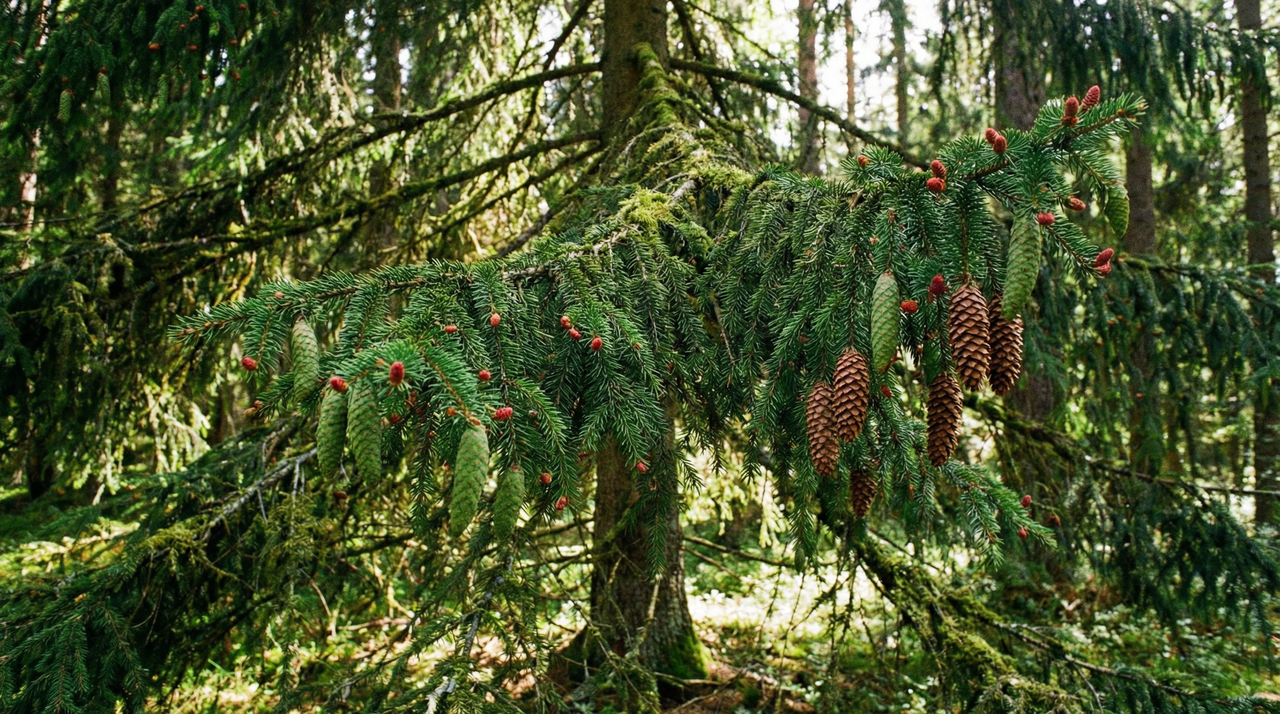
Every spruce I've ever planted has outlived the person who asked me to plant it, and that's not hyperbole. Somewhere in the Fulufjället Mountains of Sweden, there's a Norway spruce with a root system that has been regenerating itself since the last ice age, roughly 9,550 years old.[1] The trunk you'd see standing there today is only a few hundred years old. The tree keeps dying back and regrowing from the same ancient root mass, patient and indifferent to every century that passes. I think about that a lot when someone tells me spruce is "just a Christmas tree."
That reputation bothers me, honestly. Most gardeners see a spruce and think decoration, maybe a windbreak, possibly a headache when it outgrows the front yard. What they're missing is one of the most ecologically loaded trees you can put in a cold-climate landscape: a wind interceptor, a carbon sink, a wildlife apartment complex, and a medicine cabinet that kept people alive through winters before vitamin C came in a bottle. The gap between how casually we treat this genus and what it actually does is, in my experience, enormous. So let's close that gap.
Origin and History of Norway Spruce (Picea abies)
Botanical Background and Native Range
Few conifers command the northern landscape quite like Norway spruce. Known by its scientific name Picea abies, this species is native to the cool temperate forests of Europe, spanning from Scandinavia south through the Carpathians and east to the Ural Mountains.[2][3] It thrives in Köppen-Geiger zones Dfb and Cfb, those cool, humid climates where summers stay mild and winters bite hard. In my landscape work, I've seen these trees flourish on moist, acidic slopes and decline fast in compacted urban soils that can't drain properly. The match between site and species is everything.
Under natural conditions, Norway spruce typically lives 250 to 300 years, though some individuals push well past 500 in optimal habitats, with exceptional recorded specimens reaching 574 to 600 years.[4][5] That longevity isn't guaranteed. Spruce bark beetle, budworm, windthrow, fire, and competition all shape how long a given tree actually survives.[6] The tree does have one advantage over most of its relatives: it reaches sexual maturity in as little as 5 to 15 years, earlier than most other spruces, following a biennial reproductive cycle where pollination happens in May through June and seeds disperse by September or October.[5] Like all spruces, it's monoecious and wind-pollinated, carrying both male and female cones on the same tree. Across the genus, related species including white spruce across northern North America, blue spruce in the Rocky Mountains, and Siberian spruce through boreal Eurasia share these basic reproductive strategies, though white and black spruce can also produce serotinous cones that hold seeds until heat or drought triggers release.[7] For North American readers, it's worth knowing that Norway spruce has naturalized in parts of the Pacific Northwest after being widely introduced for horticulture and forestry, and its allelopathic tendencies and competitive roots make it something to site deliberately rather than casually.[8]
Visual Characteristics and Identification
Norway spruce is a big tree. Typically it reaches 30 to 60 meters tall with a strongly pyramidal form, though champion specimens have topped 67 meters.[9] The whorled branches sweep horizontally and then droop slightly toward their tips, giving the tree that distinctive layered, slightly mournful silhouette I find so recognizable even at a distance. In cultivation, expect a spread of roughly 6 to 10 meters. The root system is shallow and plate-like, spreading widely but staying mostly within the top 15 to 90 centimeters of soil.[9] Those roots form valuable ectomycorrhizal associations, but they also make the tree prone to windthrow. After watching mature specimens topple in storms on more than one client property, I now always site Norway spruce away from exposed ridgelines and recommend genuine windbreak planting rather than isolated specimens.
The needles are four-sided in cross-section, dark green, sharply pointed, and 1.2 to 2.5 cm long.[10] They attach to small woody pegs called pulvini, which stay on the twig after the needle falls, leaving a rough texture that's one of the fastest ways to distinguish spruce from fir in the field. Crush a needle and you get a distinct citrus scent, a sensory cue I've relied on countless times when labeling newly arrived plant stock. The pendulous seed cones are cylindrical, 10 to 15 cm long, ripening from green or purplish to brown with thin, flexible scales that release seeds individually rather than falling intact.[11] Bark starts reddish-brown and thin on young trees, thickening and fissuring to a grayish-brown with age. Other spruces offer useful contrasts: blue spruce carries a silvery-blue cast from epicuticular wax on stiff, sharply pointed needles; black spruce shows remarkable plasticity from pyramidal forest trees to krummholz scrub at treeline; Siberian spruce has notably short needles of just 3 to 6 mm and erect cones that persist on the branch.[12][13] Norway spruce cultivars extend the palette further, with 'Glauca' offering bluish-gray needles, 'Aurea' emerging golden before greening out, 'Columnaris' growing in a tight column, and the beloved dwarf 'Nidiformis' forming a low, bird's-nest mound.[14]
Traditional, Cultural, and Historical Uses
The Norway spruce has been woven into European life for a very long time. Romans used its timber in construction centuries before Carl Linnaeus formally described the species in his 1753 Species Plantarum.[15][16] The tradition of decorating it as a Christmas tree began in Germany around the 16th century and spread across Europe through the 19th century, and it still appears in Scandinavian Midsummer celebrations as a symbol of resilience and protection.[17][18] Practical uses ran just as deep: the timber built Scandinavian homes and fed paper mills; luthiers prized the wood for violin soundboards because of its extraordinary acoustic properties; resin went into folk antiseptic ointments and expectorants; needle tea provided vitamin C against scurvy; and bark was used for tanning and diuretic preparations.[19] Across the Atlantic, white, blue, red, and Siberian spruces carried parallel traditions among Indigenous peoples, who made needle teas, used resin for wound salves and adhesives, ate inner bark as emergency food, and incorporated spruces into ceremonial life.[20][21] I've harvested spruce tips myself for syrup each spring, and the process feels genuinely connected to that long foraging lineage, as long as it's done with restraint and proper ecological awareness. Red spruce, for its part, was heavily exploited for timber through the 19th and 20th centuries to the point where conservation became necessary, a reminder that these traditions carry responsibilities alongside their gifts.[16]
Fun Facts and Ecological Significance
The most humbling fact about Norway spruce is "Old Tjikko," a Swedish individual whose clonal root system is estimated at 9,550 years old.[22] No gardener will ever see a tree like that, but the clonal persistence behind it is exactly why I reach for long-lived conifers when a client asks for a legacy planting. The individual stem may come and go; the organism endures. Champion specimens reach girths of 8.4 meters and volumes over 500 cubic meters, and the species produces substantial oleoresin that was historically processed into turpentine and rosin.[23] Ecologically, Picea abies is a pillar of European boreal forests, supporting biodiversity, contributing to carbon sequestration, and forming mycorrhizal associations that drive nutrient cycling across vast forest stands.[24] Its physiological cold tolerance reaches -40°C through LEA proteins and antioxidant gene expression, adaptations that explain its dominance across boreal Eurasia.[25] Siberian spruce pushes that envelope further still, surviving to -60°C in continental interiors.[26] Blue spruce, meanwhile, earned its place as Colorado's state tree through that striking epicuticular wax that gives it a silvery-blue tone unlike anything else in the genus.[27] The genus as a whole is a study in cold-climate engineering, each species solving the same problems of frost, drought, and thin soils in slightly different ways.
Norway Spruce Varieties and Cultivars
The wild-type Norway Spruce is genuinely impressive on its own terms. Picea abies is native to central and northern Europe from Scandinavia down through the Alps, where it grows to 120-170 feet tall with a 20-30 foot spread, hardy from USDA zone 2a all the way to 7b, tolerating temperatures as low as -50°F.[28][5] Young trees hold that classic conical Christmas-tree shape before gradually opening into a more irregular vase form with age, carrying dark green to faintly glaucous needles that release a mild resinous scent when you crush them between your fingers.[29] It arrived in North America around 1700 and has since become a timber species, a pulpwood crop, a Christmas tree staple, and a widely planted landscape tree across the Northeast and Midwest.[5][30]
Notable Norway Spruce Cultivars
The Royal Horticultural Society recognizes over 100 named cultivars of Picea abies, which means almost any garden situation has a spruce-shaped answer.[31] For small spaces, 'Nidiformis' is the one I keep reaching for. It tops out at 3-4 feet tall and wide, forming a dense bird's-nest hollow at the center that you don't fully appreciate until the plant matures. The first time I grew one in a rock garden I honestly thought something had gone wrong with it, but that flattened, concave center is exactly the point.[32] 'Repanda' offers a similar low-spreading habit, creeping outward to 3-13 feet wide as a ground-hugging mound.[26]
For gardeners who want the full evergreen column without a 150-foot commitment, 'Columnaris' (sometimes sold as 'Cupressina') stays narrow at 40 feet, and 'Glauca' delivers a silvery-blue pyramidal form to around 65 feet. 'Aurea' is the flashy one: golden-yellow needles through spring and summer on a conical tree reaching 33-50 feet.[31] I've grown the golden form and found it appreciates some afternoon shade in brighter climates; push it into full exposure and the needles scorch rather than glow. 'Pendula' rounds out the palette with a weeping habit, and 'Acrocona' earns its keep with ornamental cones that cluster right at the branch tips.[26] U.S. breeding programs have also developed selections like 'Nielsen' and 'Densata' specifically for improved pest resistance and Christmas-tree form, because Norway Spruce adapts beautifully to cool moist conditions but genuinely struggles with heat, drought, and winter burn in marginal climates.[30]
The genus stretches well beyond abies. Colorado Blue Spruce (Picea pungens) offers more than 200 ornamental cultivars built around that iconic silver-blue color; 'Hoopsii' is widely praised for its dense, intensely silver-blue needles and better resistance to Rhizosphaera needle cast, while 'Fat Albert' gives you a compact 10-15 foot pyramid and 'Blue Chip' keeps things under 5 feet.[9][33] White Spruce (Picea glauca) is native across northern North America and hardy in zones 2-6; its cultivar 'Conica' (Dwarf Alberta Spruce) is probably the most common dwarf conifer sold in American garden centers, a slow-growing conical form reaching 3-10 feet that I've seen planted everywhere from container gardens to foundation beds.[34][35] One sensory note worth remembering when you're working with both species: abies needles have that faint, pleasant resinous scent, while crushed White Spruce needles smell distinctly skunky. You'll know immediately which one you're holding.
Sourcing Norway Spruce and Related Species
Norway Spruce is commercially available throughout the U.S. for landscaping, Christmas trees, and reforestation plantings, with supply heaviest in the Northeast and upper Midwest where growing conditions actually suit the tree.[28][36] Availability peaks in spring (March-May) and fall (September-November) for planting stock; containerized trees consistently outperform bare-root, with survival rates around 90% versus 70% for bare-root.[37] I've learned this one the hard way and now insist on containers for any spruce I'm planting, especially in transitional seasons.
For mail-order, Sheffield's Seed Company handles seeds reliably, and Musser Forests carries Norway, White, Red, and Siberian Spruce trees with consistent quality. Nature Hills Nursery and the Arbor Day Foundation are solid options for smaller quantities.[38][39][40] Expect to pay $1-5 for seedlings, $20-60 for trees under 5 feet, $50-150 for 5-6 foot specimens, and $100-500 or more for larger stock.[39] Blue Spruce and Dwarf Alberta Spruce are the easiest to find locally in most regions; Siberian Spruce and Red Spruce usually require specialty mail-order sources.[41]
When you're at the nursery, look for a straight central leader, vigorous roots with at least 80% container fill, and clean green foliage with no discoloration or pest activity.[37][42] Buy from AOSCA-certified or state-inspected nurseries; if you're importing, a USDA APHIS PPQ 526 permit and phytosanitary certificate are required, and any stock should be verified free of regulated pests like Ips typographus.[43] Native North American species like White Spruce and Red Spruce carry no federal planting restrictions and are worth prioritizing if you're working in their natural range.[44] Skip the post-Christmas clearance sales; those trees have been root-bound under lights for weeks and rarely recover to form a healthy specimen. A local extension service or the American Conifer Society can point you toward regional alternatives if Norway Spruce isn't the right fit for your site.[42]
How to Propagate and Plant Spruce (Picea abies)
There are two very different relationships you can have with a spruce tree depending on how it came into your care. Grow one from seed and you're signing up for a long partnership, full of genetic surprises and honest effort. Start with a grafted cultivar and you get predictability, earlier maturity, and the exact traits you selected. I've worked with both in designs ranging from reforestation blocks to ornamental food forests, and the right choice genuinely depends on what you're trying to accomplish.
Seed Propagation, Storage, and Germination for Norway Spruce
Norway spruce seeds are small, winged, and built for wind dispersal. One thing that surprised me early on is that they're polyembryonic, meaning a single fertilized ovule can produce multiple embryos, though typically only one matures into a viable seed.[45][46] Before any of that matters, the seed needs its dormancy broken through cold moist stratification: 30 to 90 days at 1-5°C, followed by germination at 15-25°C.[47] Skip that cold period and you'll get frustratingly low germination rates.
The good news is that spruce seed stores beautifully. Seeds are orthodox, tolerating drying down to 3-5% moisture content, and when sealed in airtight containers with desiccant at -18 to -20°C, they can hold 70-90% viability for 20 years or more.[48][49] I've started testing my home-stored spruce seed every five years using both germination assays after cold stratification and tetrazolium (TZ) biochemical tests, and I can tell you that moisture above 8% during storage is where viability starts collapsing fast.[50] At room temperature without controls, expect viability to drop to nearly nothing in one to three years.[51]
The patience requirement is real. Seed-grown Norway spruce typically won't produce harvestable cones until 15-20 years after germination.[52] I've walked clients through this math and watched their faces fall. Open-pollinated seed also introduces significant genetic variability, which is actually an asset for reforestation and timber production but a liability if you're trying to reproduce a specific ornamental form.[53] For named cultivars, seed simply won't get you there reliably. Other spruce species follow similar stratification logic: white, red, and Siberian spruce all need 30-90 days of cold treatment, with some red and Siberian populations pushing toward 120 days for reliable break of dormancy.[54]
Vegetative Propagation Methods: Cuttings, Grafting, and Tissue Culture
If seed is the patient path, vegetative propagation is the precision path. Grafted Norway spruce begins cone production in 3-5 years post-grafting, with harvestable seed cone crops possible by year 4-7.[52] That difference is enormous when a client wants to establish a seed orchard or just wants to see results in their lifetime.
Cuttings are the most challenging vegetative route, and I learned this the hard way. Early in my practice I was taking cuttings from mature landscape specimens and wondering why rooting rates were so poor. The maturation effect is significant: adventitious root formation drops sharply as the mother tree ages, and cuttings from juvenile trees root far more reliably.[52] I now maintain hedged juvenile stock plants specifically for cutting material, which has made a genuine difference. Even with optimal juvenile material, IBA rooting hormone treatment, consistent mist, and bottom heat, expect variable results; semi-hardwood blue spruce cuttings treated with 3000-8000 ppm IBA typically achieve only 20-50% success.[55]
Grafting is the professional standard for ornamental cultivars. Side-veneer and cleft methods performed during dormancy using compatible Picea rootstocks consistently achieve the best outcomes, with grafting success rates reaching 60-95% for blue spruce using Picea glauca as rootstock.[56] Sanitation throughout is non-negotiable. Micropropagation from shoot tips or embryos can achieve up to 90% success and enables rapid large-scale production of elite clones, but it requires lab facilities and careful acclimatization to avoid transplant shock when young plants transition to greenhouse conditions.[57] For most home growers and small nurseries, grafting hits the sweet spot between success rate and equipment required.
Optimal Soil, Site Selection, and Planting Requirements
Norway spruce has a shallow, wide-spreading root system with most fine roots concentrated in the top 12-24 inches of soil, which makes drainage more critical than almost any other factor.[6] Waterlogged or compacted soils directly restrict root growth and invite the root pathogens that kill trees slowly and puzzlingly.[58] I compare spruce drainage requirements to blueberries or rhododendrons: if the site doesn't drain freely, no amendment regimen will compensate. Root growth becomes significantly inhibited when soil penetration resistance exceeds 1.0-2.0 MPa, so compacted urban soils are genuinely problematic before planting even begins.[59]
Soil pH sits ideally between 5.5 and 6.5, though Norway spruce tolerates a broader range of 4.5-7.5.[60] In its native European forests it grows naturally in acidic soils around pH 4.0-5.5 and relies heavily on mycorrhizal associations to access nutrients.[61] Push the pH above 7.0 and you'll see interveinal chlorosis on new needles as iron, manganese, and zinc become unavailable; go too acidic below 5.0 and aluminum toxicity can cause root tip necrosis and stunted growth.[62] A soil test before planting is the single most useful step a grower can take. I've prevented many client failures this way. To lower pH use elemental sulfur; to raise it use lime sparingly; and a layer of pine needle or bark mulch helps maintain acidity over time.[63]
For light, full sun (6+ hours) is the target, with tolerance for light shade.[64] Too little light and you get chlorotic needles, elongated internodes, and a thin canopy; but light response is strongly mediated by soil moisture, so a tree stressed by drought will scorch even without extreme sun exposure.[6] Other spruce species shift the tolerance window in useful ways: blue spruce handles neutral to slightly alkaline soils and rocky substrates from its Rocky Mountain origins; red spruce wants stricter acidity (pH 4.5-6.0 optimal) with high organic matter; white spruce tolerates pH up to 7.5 and a broader range of soil textures; black spruce is the peatland specialist, thriving in waterlogged organic-rich soils that would rot any other spruce.[54][13]
Spacing, Planting Technique, and Establishment
Spacing decisions for spruce are really long-term trade-off decisions, and they're worth thinking through carefully before you plant anything. Standard plantation spacing runs 1.5-2.5 meters, roughly 1,600-2,700 trees per hectare.[65] Tighter spacing produces early competition, smaller branches, natural pruning, and cleaner wood; wider spacing at 3-4 meters encourages faster diameter growth but delays canopy closure and can increase management costs over time.[66] I once planted a spruce hedge at 5-foot centers in a client's yard, thinking it would fill in quickly. Within eight years we were paying to have every other tree removed. Landscape specimens want at least 20-30 feet between trees. For windbreaks, 10-15 feet works; for Christmas tree production, start at 3-5 feet with planned thinning as the rotation progresses.[67]
Early spring planting (March-May, after the ground thaws but before buds swell) and fall planting (September-October, giving at least 6-8 weeks before hard frost) both work well.[68] Bare-root seedlings should go in when soil temperatures reach 40-50°F. Dig the hole twice as wide as the root ball, plant at the same depth the tree was grown, water deeply, and apply 2-4 inches of organic mulch kept back from the trunk.[69] In windy sites, stake young trees with flexible ties for the first one to three years to prevent root movement while the anchorage system develops. Site-specific factors ultimately dominate long-term outcomes more than any single technique, so matching the tree to the right soil, drainage, and light conditions at the outset prevents problems that no amount of corrective care can fully undo later.
Spruce Care Guide: Growing and Maintaining Picea abies
Most spruce problems I've seen in the field trace back to one of two mistakes: planting in the wrong spot, or intervening too much afterward. Get the soil, drainage, and siting right in years one through three, and a Norway spruce will largely take care of itself for decades. That's the philosophy this section runs on.
Watering Needs and Drought Tolerance
Norway spruce wants well-drained, slightly acidic to neutral soil (pH 5.5-7.0, with 6.0-6.5 being the sweet spot) and clean, low-chlorine water; rainwater or dechlorinated tap water are both fine.[70] That pH preference is more forgiving than red spruce, which really wants 4.5-6.0, and less particular than blue spruce, which tolerates up to 7.5 and handles moderate salinity reasonably well.[26][71] On drainage: Norway spruce roots typically run 12-18 inches deep, and the watering goal is to thoroughly wet the top 6-8 inches while letting the upper 2-3 inches dry out between sessions.[26] Shallow, frequent watering keeps roots near the surface and invites disease. Deep and infrequent is the rule.
Young trees in their first three years need 1-2 deep waterings per week, roughly 10-15 gallons per application for small trees, to stay consistently moist without sitting in water.[9] Established trees need supplemental water only during dry spells, typically 1-2 inches every one to two weeks.[72] Once established, Norway spruce can go 4-8 weeks without supplemental irrigation before showing stress; white and blue spruce are similar, while red and Siberian spruce may flag within 2-4 weeks.[73] After I started mulching my trees with 3-4 inches of pine bark kept clear of the trunk, I went from watering weekly to once every three weeks during dry stretches in year two. That mulch layer made a real difference.
One diagnostic trap worth knowing: overwatering and underwatering can look nearly identical, with yellowing inner needles, premature drop, and stunted growth appearing in both scenarios.[74] Before adjusting your routine, push a finger or a soil probe to 6-8 inches and check actual moisture. Siberian spruce is especially intolerant of wet feet due to its shallow, fibrous root system, so good drainage is non-negotiable there.[75]
Soil, Feeding, and Nutrient Management
Norway spruce is a moderate feeder, nothing like the nutrient appetite of a fruit tree, and it forms ectomycorrhizal associations that handle much of its phosphorus and nitrogen uptake naturally.[68] This matters enormously for fertilization decisions: excess phosphorus can suppress those mycorrhizal partnerships, which undermines the tree's long-term resilience.[76] I no longer apply full-rate fertilizer to any spruce regardless of what the bag says. Soil tests and the research on mycorrhizal inhibition are clear that half-rate in early spring, only when tests indicate a deficiency, keeps trees hardy and pest-resistant.
Run a soil test before you fertilize, and repeat every 3-5 years.[77] For young trees in their first few seasons, a balanced slow-release fertilizer like 10-10-10 at half the labeled rate in early spring is appropriate if the test calls for it; established trees in reasonably fertile soil often need nothing at all.[26] When nitrogen is warranted, apply 0.5-2 lb of actual nitrogen per 1,000 sq ft around the drip line, and never fertilize late in the season; tender growth pushed in fall is precisely what winter injury targets.[78] I learned this the hard way with a late-August feeding that produced a flush of lush growth on a zone-7 tree; it winter-burned badly, and I've stuck to early spring ever since.
Symptom literacy helps: nitrogen deficiency shows as yellowing of older needles from the base upward; phosphorus deficiency produces dull bluish-green or purplish needles; potassium deficiency causes marginal scorch and necrosis; magnesium deficiency appears as interveinal chlorosis.[79] Road salt nearby mimics these symptoms with needle tip burn and branch dieback, so always rule out salt exposure before assuming a nutrient problem.[80] Compost, leaf mold, and pine bark mulch are excellent organic inputs that build the soil organic matter above 3% that spruces prefer without the salt load of some manures.[81]
Sunlight Requirements
Full sun, meaning six or more direct hours daily, is where Norway spruce does its best work.[82] It tolerates light partial shade, but too little light shows quickly as inner-needle chlorosis, sparse branching, and a stretched, leggy silhouette. Too much intense light paired with drought or heat goes the other direction: needle scorch and premature drop.[9] Across the genus, juveniles in hotter zone 5-7 sites can benefit from afternoon shade protection until they're established, after which mature trees want as much sun as they can get, provided soil moisture keeps pace.[83]
Frost Tolerance and Winter Protection
Norway spruce is genuinely cold-hardy, rated for USDA zones 2-7 and RHS H7, tolerating temperatures down to approximately -50°F (-45°C).[9][84] Needles handle -40°C in winter without significant damage. The vulnerable window is late spring after bud break, when new growth loses cold hardiness rapidly, and early fall before the tree has fully hardened off.[85] Frost damage shows as reddish-purple needle discoloration, tip browning, and in severe cases branch dieback; seedlings and young trees bear the brunt while mature specimens shrug off the same events.[86]
After my first unprotected planting showed significant needle desiccation by February, I started paying attention to the early cues: slight inward curling on south-facing needles in January is my signal that drying winds are winning. Wrapping young trees with breathable burlap on the prevailing wind side in November stops that damage before it starts. Combine the burlap with 2-4 inches of organic mulch kept clear of the trunk, deep watering before the ground freezes, and a site chosen for good air drainage rather than a frost pocket, and most winter injury problems simply don't happen.[87][88] The same toolkit applies across white, blue, red, and Siberian spruce.
Heat Tolerance and Summer Stress Management
Norway spruce is fundamentally a cool-climate tree. Optimal growth happens below 68°F (20°C); sustained daytime temperatures above 77-86°F push it into stress, and anything prolonged above 86°F can impair photosynthesis, cause needle discoloration and drop, and weaken defenses against insects.[89] Short spikes to 95°F are survivable if cool nights follow, but seedlings and young trees have less buffer; heat above 77°F during pollination can reduce cone and seed production by up to 50%.[90]
I've watched a mature Norway spruce develop significant needle scorch on its south and west faces during a week of 95°F heat, while a neighboring tree protected by 40% shade cloth came through with deep green color intact. That comparison alone was enough to convince me that mitigation strategies genuinely work in marginal zone 7 sites. For young trees, 30-50% shade cloth, deep watering of 1-2 inches weekly during heat events, and a consistent 2-4 inch mulch layer address the worst of the stress.[91] Compact cultivars like 'Nidiformis' and 'Pumila' show better heat tolerance in marginal zone 7 conditions and are worth considering if you're pushing the southern edge of the range.[92]
Pruning, Maintenance, and Mulching
Mulching is the single easiest thing you can do for spruce health. Apply 2-4 inches of bark, wood chips, or leaf mold around the base, kept 2-3 inches back from the trunk, and replenish it each fall.[68] It conserves moisture, moderates soil temperature, and protects roots from freeze-thaw heaving. Beyond mulching, spruce pruning is mostly about restraint. Late winter to early spring before bud break is the window; remove dead, damaged, or crossing branches, and maintain the single central leader.[93] Never remove more than 20-25% of the live crown in a single year, and avoid cutting into old wood entirely since spruces don't regenerate from it.[94] Mistakes here are permanent. The goal with spruce pruning is really just damage control and structural clarity; the tree wants to grow as a tree.
Seasonal Rhythm and Phenology
Once you learn to read the phenological calendar, the tree starts telling you what it needs. Bud break runs April through May, followed by rapid shoot elongation through summer, bud set in August through October, and full dormancy from November through March.[95] Timing shifts with latitude and elevation, but the sequence is consistent across white, blue, red, and Siberian spruce.[45]
Practically, this means: soil test and apply any needed fertilizer in early spring before bud break, prune in late winter while the tree is still fully dormant, deep-water through dry summer spells, let the tree harden naturally in fall without late nitrogen pushes, and water deeply one final time before the ground freezes.[68][96] Avoid planting or heavy intervention during midsummer heat peaks. After a few seasons, the color shifts in the needles and the swelling of next year's buds in late summer become reliable signals. The tree communicates clearly if you're paying attention.
Harvesting Spruce: Timing, Techniques, and Post-Harvest Care
When to Harvest Spruce Cones, Shoots, and Trees
I've been gathering spruce in one form or another for years, and the first thing I tell people is that this tree doesn't run on a single harvest calendar. Cones, shoots, and Christmas trees each have their own window, and confusing them is how you end up with empty seeds or a tree that drops its needles before New Year's.
For cone collection, watch the color. Norway spruce cones shift from bright green through a reddish-brown or purplish hue, then settle into dry light brown with scales that start to open on their own.[81][97] That scale-opening is your green light. Peak maturity lands between September and October in the native European range, though some cones won't be ready until November.[5][98] What's easy to overlook is that those cones represent roughly 18-24 months of development from the original pollination event, so the seeds you're collecting this autumn were set in motion almost two years ago.[81][68] I think about that cycle a lot. It's a patience that makes blueberry production look instant by comparison, and it's a good reminder that working with spruce means thinking in multi-year arcs.
If your trees are at elevation or you're in the northern end of the range, build in an extra 2-4 weeks.[81] As springs warm, that window may creep earlier by a week or two per degree of average temperature increase,[99] so tracking your own observations year to year matters more than any fixed date on a calendar.
Christmas trees are a different conversation entirely. The commercial target is 6-8 feet, which on Norway spruce typically means 7-10 years of growth.[100][101] I cut after first frost. I've watched the difference closely enough to be opinionated about it: trees harvested after frost hold their needles noticeably better than early cuts. Timber is its own long story, with Norway spruce reaching harvestable size at 40-80 years and 50-100 feet tall.[6] That's a rotation measured in human generations, not growing seasons.
Harvest Techniques and Post-Harvest Handling
Cone collection is straightforward: clip or hand-pick in September and October once the scales begin to separate naturally, before they open fully and release the seed.[81] Lay them somewhere warm and dry and let them finish opening on their own. The seed will fall out when it's ready.
Post-harvest handling for Christmas trees is where most people lose the plot. I immerse the trunk base within an hour of cutting -- skipping this step is the most common reason home-cut trees disappoint. A fresh cut, followed by 1-2 hours submerged in water, rehydrates the xylem and keeps the uptake system functional. After that, cold storage at 33-38°F with high humidity and periodic misting will hold the tree in good condition for 4-6 weeks.[102][103] Miss those steps, and you've got a fire hazard, not a Christmas tree.
Spruce Preparation and Uses
Culinary Uses and Edible Parts of Spruce
The most accessible entry point into eating spruce is also the most rewarding: the bright green tips that emerge each spring, still capped with their papery sheaths, tasting like someone crossed rosemary with a lemon drop and ran it through a pine forest. I've used them interchangeably with rosemary in herbal salt blends for clients who wanted edible landscapes that doubled as kitchen gardens, and the flavor holds up surprisingly well. That character comes from volatile compounds, primarily alpha-pinene, limonene, and bornyl acetate, that give spruce tips their signature citrus-pine lift.[104][105] Beyond flavor, fresh needles carry 100 to 300 mg of vitamin C per 100 grams, which is why spruce needle tea was a literal survival food for Indigenous communities and European settlers facing scurvy through long winters.[106][107]
Timing your harvest matters more than most foraging guides admit. Young spring tips, harvested before the needles harden, are tender and pleasantly aromatic. Wait too long and you get something tough, tannic, and unpleasantly resinous.[108] Preparation method shifts the flavor further: a hot-water steep draws out more bitterness, while a cold infusion or fresh use in syrups and vinegars preserves the delicate citrus notes that make the tips so appealing.[109] I've found that steeping dried tips in cold water overnight before warming the liquid gently gets you the best of both worlds for tea blends. For syrups and cocktails, fresh tips are simply irreplaceable.
The culinary range across the genus is generous. Norway spruce tips work beautifully in teas, syrups, vinegars, and the historically significant spruce beer that North American settlers adapted from Indigenous traditions.[110][111] White spruce tips lend themselves to jellies, desserts, and infused oils; red spruce has a history in jams.[112] Even the inner bark has a role: Dene and Cree peoples dried and ground it into a survival flour or stirred it into porridge, and sap can be boiled into a rough syrup, though the yield is low enough that I'd treat it as a curiosity rather than a pantry staple.[113][107] After years of designing conifer windbreaks, I've learned to limit tip harvest to no more than 10 to 15 percent of a young tree's new growth; watch the leader extension and needle color the following season and the tree will tell you plainly whether you pushed it too far.
Medicinal Preparations and Safety Guidelines
The traditional preparation is simple: steep one to two teaspoons of fresh or dried tips in hot water for five to fifteen minutes and drink up to three cups a day.[114] Indigenous communities across North America and Eurasia used this exact practice for respiratory complaints and scurvy prevention, and settlers eventually formalized it into the spruce beer tradition.[115] Tinctures and resin salves represent the more concentrated end of traditional use, with tinctures typically dosed at one to two milliliters up to three times daily and essential oil diluted to one to two percent in a carrier before any topical application.[116]
On safety, I'll be direct: spruce tea in moderate culinary amounts is generally well tolerated, but the monoterpenes that make it medicinally interesting can cause gastrointestinal upset or skin irritation when used in excess, and essential oils containing those same compounds carry neurotoxicity risk at high doses.[117] If you're pregnant, avoid concentrated preparations entirely; the safety data simply isn't there, and I've seen the pregnancy contraindication repeated consistently across reliable ethnobotanical sources.[118] Anyone with pine-family allergies should approach cautiously regardless of form. The traditional wisdom here is essentially correct: respect moderation, and you'll rarely have trouble.
Non-Food Applications and Sustainable Harvesting
Norway spruce's most economically significant use has nothing to do with the kitchen. The timber is a major commercial softwood, valued for construction framing, flooring, beams, and paper pulp, and managed plantation stands can yield five to ten tons per acre annually for biomass and firewood.[4][119] Needles distilled for essential oil and bark processed for tannins used in leather-making and natural dyes round out the industrial picture.[120] In a permaculture context, a single mature spruce in a designed windbreak can supply Christmas greenery, mulch from needle drop, and eventual biomass fuel while simultaneously sheltering the food-producing layers behind it.
The Indigenous craft traditions go much further than timber. White spruce provided canoe materials, tool handles, lodge poles, and bow staves, while its flexible roots were split for basketry and used to sew birchbark, and branches became roofing and bedding inside sweat lodges.[121] Resin sealed canoes, waterproofed clothing, glued tools, and served as chewing gum. Comparable uses exist across blue, red, and Siberian spruce wherever those species overlapped with human communities.[120]
Sustainable harvest is the piece I feel most strongly about after watching over-foraged urban park trees show girdling scars and dieback. Clip only a small fraction of new tips from well-established branches, use needles from pruned or windfall material whenever possible, and collect bark only from already-felled trees.[120][122] A spruce that's treated with restraint will keep giving for decades.
Spruce Health Benefits
I'll be honest: before I started foraging spruce tips, I thought of spruce mostly as a structural tree, something to anchor a windbreak or frame a food forest edge. Then I started digging into the ethnobotanical record and realized this genus has been quietly feeding medicine chests for centuries. The health story of spruce is anchored in Norway spruce (Picea abies), the European reference species, but it extends broadly across white, red, black, and Siberian spruces with remarkable consistency.
Traditional Medicinal Uses of Spruce
European herbalists have brewed young spruce shoots and needles into teas for respiratory complaints, colds, coughs, and bronchitis for hundreds of years, and resin has been applied in salves for antiseptic wound care or chewed for sore throats.[123][124] Indigenous communities across North America drew on white spruce (Picea glauca) and its relatives for the same purposes, particularly as a source of vitamin C to prevent scurvy through the long boreal winters when no other green food was available.[125][121] What strikes me about this convergence is that European and Indigenous North American traditions arrived at nearly identical uses entirely independently. That kind of cross-cultural agreement usually means something real is going on in the plant.
I harvest young tips from my own Norway spruce plantings each spring, and the timing genuinely matters. Tips taken in early May, when they're still soft and pale green, are noticeably less resinous and more palatable than anything collected a few weeks later. That same seasonal shift also reflects real changes in phytochemical composition, which I'll get into below.
Key Phytochemicals and Their Roles
Norway spruce needles are chemically complex. The essential oil is dominated by monoterpenes, with α-pinene making up 20-40%, bornyl acetate 10-30%, and limonene and β-pinene rounding out a profile that is 70-90% monoterpene by volume.[126][127] The needle phenolics, including catechins, taxifolin, and quercetin glycosides, sit at 10-50 mg/g dry weight, while the bark is rich in diterpene resin acids such as abietic acid at 20-40% of total resin extractives.[128][129] Genus-wide, the pattern holds across stilbenes, lignans, and phenolic acids alongside those core monoterpenes and flavonoids, though exact profiles shift with plant part, altitude, and environmental stress.[130]
Phenolics tend to peak in autumn as the tree prepares for frost and herbivore pressure, while terpenes ramp up in spring and summer.[131] Stress from drought, cold, poor soil, or pest attack generally pushes defensive compound production higher.[132] From a permaculture perspective, I find it useful to remember that the same chemical arsenal the tree uses to fend off bark beetles and pathogens is also what makes it medicinally interesting to us.[133]
Modern Research on Spruce Benefits
Preclinical research provides plausible mechanistic support for the traditional uses. Norway spruce extracts show antimicrobial activity against Staphylococcus aureus and Candida albicans, primarily through membrane disruption and enzyme inhibition.[134][135] Antioxidant activity is strong, with DPPH radical scavenging comparable to synthetic antioxidants and phenolic content up to 150 mg GAE/g.[136] Anti-inflammatory effects have been documented via inhibition of TNF-α, IL-6, COX-2, and NF-κB pathways, largely attributed to taxifolin.[137] Preliminary work also hints at analgesic, anxiolytic, and sedative potential, though these findings are early and less consistent.[138]
The honest caveat is that virtually all of this comes from in vitro and animal studies. Human clinical trials are scarce, and no standardized therapeutic protocols have been established.[139] The science supports the plausibility of what traditional herbalists observed, but it doesn't yet confirm human dosing or efficacy.
Nutritional Profile of Spruce Needles and Tips
The most practically useful nutritional fact about spruce needles is their vitamin C content: 100-250 mg per 100 g fresh weight in Norway spruce, with related species ranging up to 500 mg/100 g in spring tips.[140][141] To put that in everyday terms: a cup of fresh spruce-needle tea can deliver vitamin C on par with or exceeding citrus or rose hips, which is exactly why Indigenous communities across the boreal zone treated needle tea as winter medicine. Beyond vitamin C, needles supply vitamins A and E, calcium, magnesium, potassium, and iron at nutritionally relevant levels, all for roughly 37 kcal per 100 g fresh.[142]
How you process the material matters considerably. Drying at high temperatures can destroy 30-90% of the vitamin C, so low-temperature or freeze-drying is worth the effort if you want to preserve that value.[143] For tea, a typical working dose is 10-20 g of fresh young tips or 2-5 g of dried needles per cup.[144] I prefer fresh spring tips for exactly this reason: highest flavor, lowest resin bitterness, and peak nutrient density all in the same window.
Safety Considerations for Spruce Use
Norway spruce is generally considered non-toxic to humans, pets, and livestock at normal foraging quantities.[145] In my own years harvesting tips, the main issue I've encountered is mild stomach upset from eating too many older, more resinous needles. Large quantities of bark or resin can cause gastrointestinal irritation, and wilted material poses more risk to livestock than fresh needles, though Norway spruce is generally less potent in this regard than some pine species.[146] Start small and build tolerance gradually.
A few specific risks deserve direct attention. Spruce pollen is a recognized aeroallergen, and resin containing oxidized abietic acid can cause contact dermatitis in sensitized people.[147] Concentrated essential oil must always be diluted to 1-2% for topical use and should never be ingested undiluted. I do not use spruce medicinally during pregnancy; the research on potential emmenagogue effects is clear enough that caution is warranted, and no established safety data exists for pregnancy, lactation, or pediatric medicinal use.[148][149] Harvest only from clean sites away from roadsides; conifers are known to accumulate heavy metals from traffic pollution, and that's not something you want concentrated in your tea.[150] Finally, get your identification right. A close look at a mixed planting early in my career reminded me how easy it is to confuse spruce with yew, which is genuinely toxic. The flat, alternate, two-ranked needles with a red aril are yew; spruce needles are four-sided and attached individually all around the twig. Know the difference before you brew anything.[151]
Spruce Pests and Diseases
Norway spruce is neither bulletproof nor particularly fragile. What I've observed over years of working with Picea abies in landscapes is that a well-sited tree on good soil rarely makes me worry. The trouble starts when the site is wrong: compacted roots, standing water, drought stress, or trees packed so tightly they can't breathe. Stress is the master key that unlocks almost every pathogen and pest problem spruce faces, and the resistance profile of any individual tree varies enormously by cultivar, provenance, climate, and management.[152][153][154]
Disease Resistance and Common Pathogens in Norway Spruce
The root diseases are the ones that genuinely scare me, because by the time you see symptoms, the damage is already done. Norway spruce is highly susceptible to Heterobasidion annosum, the fungus responsible for root and butt rot, particularly where stumps or wounds give it a point of entry.[155][156] Armillaria root rot (honey fungus) compounds the problem, especially in stressed or aging trees, and it's widespread across the Northeast and Midwest.[157][158] Layer Phytophthora root rot on top of those two, which takes hold fast in poorly drained or saturated soils and causes wilting, needle drop, and outright mortality, and you have three serious reasons to get your drainage right before you plant a single tree.[159][160] No chemical control exists for Armillaria or Heterobasidion once established; the whole strategy has to be prevention through vigor and sanitation.[161]
Above ground, the needle diseases are more common and more visible. Rhizosphaera needle cast (Rhizosphaera kalkhoffii) is probably the pathogen I see most often on ornamental spruces, and it spreads fastest through dense plantings where humidity stays high and needles stay wet. It needs leaf wetness for 48 hours or more at moderate temperatures to really get going, and it's widespread across the eastern United States.[162][163] Lophodermium needle cast follows a similar pattern, with risk climbing in dense stands and humid conditions, though Norway spruce's susceptibility varies quite a bit by provenance.[164] Cytospora canker rounds out the common disease trio, promoted by heat stress, drought, or summer temperatures above 30°C, and it shows up as progressive branch dieback starting from the lower crown.[165][166]
Early in my career I planted a windbreak of Norway spruce about twelve feet apart because my client wanted a fast privacy screen. Within four years, Rhizosphaera was moving through the interior trees like a slow fire. That experience is why I now hold firm on 25 to 30 feet of spacing even when clients push back. Some cultivars do help at the margins: 'Columnaris' carries moderate resistance to Rhizosphaera, and 'Aurea' and 'Nidiformis' show better tolerance to Diplodia tip blight, though no cultivar is immune.[26][167] Blue and white spruce share most of the same vulnerabilities to Rhizosphaera, Cytospora, Armillaria, and Phytophthora, with blue spruce suffering most visibly when planted outside its native range in humid eastern conditions.[7][168] Red spruce carries compounded risk from needle casts like Stigmina and Lirula when humidity, poor drainage, and pollution stress coincide.[169][170] Siberian spruce stands out as the relative bright spot, with lower infection rates for Lophodermium and better baseline tolerance to Cytospora and Heterobasidion, likely thanks to thicker needle wax and deep adaptation to cold, stable climates.
Major Insect Pests and Resistance Profiles
Norway spruce has genuine built-in defenses. Its resin, rich in monoterpenes, is toxic and physically deterrent to many insects, and its waxy needles add a physical barrier on top of that.[171] I sometimes tell clients that the same resin smell they love on a warm afternoon is essentially the tree telling bugs to go away. Vigorous trees with good resin flow really do seem to shrug off early attacks. But that defense collapses under drought, windthrow, or sustained stress, and that's when Ips typographus, the European spruce bark beetle, becomes a genuine mortality driver.[172][173] Spruce budworm follows as the second major threat, causing defoliation and significant growth loss; Central European provenances tend to show better resistance than others, while red spruce stands can see mortality exceeding 50 percent during outbreak years.[174][175]
Secondary pests tend to be opportunists. Blue spruce is notably susceptible to spruce spider mites and aphids, especially in hot, dry conditions, and the bronzing you see on affected needles looks a lot like heat scorch at first glance. I think of it the way I think of basil wilting on a scorching afternoon: the plant is already under stress, and the pest is just making it obvious.[176] Gall adelgids, sawflies, and aphids round out the common pest picture across the genus, while stressed white spruce faces serious risk from spruce beetle with mortality topping 50 percent in compromised stands.[177] Siberian spruce tends to see fewer defoliator outbreaks in its native range, though it's not exempt from bark beetles, budworm, or mites when densely planted or stressed. I haven't grown Siberian spruce myself, but conversations with growers in colder climates and the provenance trial literature both point to cold-adapted stock carrying a meaningful baseline advantage in pest tolerance compared to Norway spruce.
Management Through Cultural Practices and Integrated Approaches
The honest truth is that I've rarely needed to reach for any spray on well-spaced, properly drained spruces in my designs. The few times I did, it was because the site was wrong from the start. Cultural practices are the real foundation: generous spacing for air circulation, well-drained soil, removal and destruction of infected material, no overhead irrigation, and pruning done in dry or dormant conditions with sterilized tools, removing no more than 25 percent of the canopy per year.[68][178]
When intervention is necessary, the timing matters more than the product. For Rhizosphaera and other needle casts, preventative fungicides like chlorothalonil or copper-based formulations applied in three rounds at 7 to 10 day intervals from bud break can slow spread, but they don't cure existing infections and shouldn't be a first resort.[162] For root rots from Armillaria or Heterobasidion, there's no effective chemical option; focus entirely on tree vigor, sanitation, and avoiding wound-creating practices like stump-leaving after removal. Trichoderma-based biological inoculants show some promise for root rot suppression, and Bt (Bacillus thuringiensis) remains the go-to biological control for budworm outbreaks.[161]
For bark beetles, pheromone traps combined with sanitation logging of infested trees and support from natural predators like Thanasimus formicarius form the backbone of an integrated approach.[179] Spider mites and aphids respond well to horticultural oils, neem, or insecticidal soaps, with natural predator populations doing much of the work on trees that aren't pushed with excess nitrogen.[180] The trees most worth monitoring closely are always the stressed ones: drought-hit, flooded, mechanically damaged, or just planted in the wrong spot. Pair careful site and cultivar selection with consistent monitoring, and most spruce pest and disease problems stay manageable without ever opening a chemical jug.
Spruce in Permaculture Design
If there's one genus I'd call the workhorse of cold-climate permaculture, it's Picea. Not glamorous in the way an apple guild is, not producing abundant edibles from day one, but doing the slow, structural work that makes everything else possible. Getting spruce right in a design means being clear-eyed about where it thrives and where it simply won't.
Climate Suitability and Hardiness Zones for Spruce
Norway spruce is rated for USDA Zones 2-7, with cold tolerance down to -40°F to -50°F,[181][182] but that cold tolerance tells only half the story. The other half is heat sensitivity: once summer temperatures regularly exceed 85°F, performance degrades noticeably.[181][183] In warmer microclimates I've trialed, even marginal Zone 6 trees showed needle scorch once highs topped 88°F for more than a week. This is why I now reserve spruce for true cool-summer regions, period.
Norway spruce also needs consistent moisture: it performs best with 700-800 mm of annual rainfall and relative humidity in the 60-80% range, on moist, well-drained soils with a pH of 4.5-6.5.[184][183] Hot, humid southern summers, or dry continental summers, are equally problematic. If your warm season regularly climbs above 80°F with humidity and poor air circulation, look elsewhere.
The broader genus follows the same pattern. White spruce (Picea glauca), blue spruce (Picea pungens), red spruce (Picea rubens), and Siberian spruce (Picea obovata) all share that core cold hardiness in Zones 2-6 or 7.[34][170] Blue spruce handles dryness somewhat better once established, making it the most forgiving for drier inland sites.[185] Red spruce is the most elevation- and humidity-dependent of the group, really at home only in cool, moist highland conditions.[170] For Zone 7 gardeners, all of these are worth treating as marginal; the hardiness data is frequently extrapolated from native-range studies rather than garden performance at the warm edge.
Ecosystem Functions and Services of Spruce Trees
Spruce is a wind-pollinated, monoecious genus, meaning male and female cones appear on the same tree but depend entirely on air movement to complete fertilization. Norway spruce produces saccate pollen grains with two air bladders that can travel 50-100 km under favorable conditions,[186] which sounds impressive until you realize how quickly that viability drops in rain, high humidity, or temperatures outside the 10-20°C sweet spot.[187] In my own plantings, I've started monitoring wind direction and pollen release timing each spring. Research on advancing phenology and pollution effects is clear: climate stress alone can reduce pollen viability by up to 30%,[188] and I've noticed earlier release dates each year in my warmer microclimates. For anyone managing a seed orchard or small timber stand, targeted thinning and gap creation can boost seed yields 20-80% by improving pollen movement and light access.[189]
Beyond reproduction, the ecosystem services these trees deliver are substantial. Mature spruce supports over 200 insect species along with birds like crossbills, woodpeckers, and siskins, plus mammals from squirrels to deer.[183] Dense fibrous roots stabilize slopes and regulate water movement, and mature spruce forests can sequester 10-20 tons of carbon per hectare annually.[190] Spruce needle litter acidifies soil much like pine does, but I've found it breaks down slower. Pairing it with alder has been my go-to fix to keep the understory productive rather than barren, because alder's nitrogen fixation partially compensates for what the needle mulch locks up.
Forest Layer Placement and Guild Design with Spruce
Norway spruce is a dominant upper-canopy species, capable of reaching 30-50 m in maturity,[184] and its dense pyramidal canopy reduces understory light to less than 5-10% of full sun while its needle drop gradually pushes soil pH toward 4-5.[5] Those aren't flaws exactly, but they're forces you design around rather than ignore.
My rule now is to site spruce at the northern or windward perimeter of a food system. Oriented perpendicular to prevailing winter winds, a row of Norway spruce becomes serious infrastructure: wind protection, wildlife corridor, carbon sink, and eventual timber resource. I learned this lesson the hard way after an early planting placed too close to productive guilds suffered branch breakage and began shading out the berry beds I'd worked hard to establish.
The best guild partners I've found are nitrogen-fixing trees like alder to offset the acidifying needle drop, with acid-tolerant shrubs such as blueberries, ferns, or ericaceous groundcovers filling the understory closest to the tree's edge.[191][192] Early on I underplanted spruce too closely with currants; the combined shade and root competition made them miserable. Give at least 10-15 m between trees and any productive food layer, and choose only genuinely shade-tolerant companions for that transition zone.[191]
Spruce also forms obligate ectomycorrhizal partnerships with a remarkable range of fungi including Amanita, Russula, Suillus, and Boletus,[193] which means it contributes to the fungal web underlying a whole system even when its canopy seems to dominate it. Blue spruce, with its shade-intolerance and allelopathic tendency, belongs firmly at the perimeter rather than mixed into a diverse guild.[185] White spruce is more flexible, tolerating a wider moisture range and fitting into mixed boreal guilds more easily.[34] Across the genus, the design logic is consistent: spruce is supporting infrastructure, a generous edge element that protects and enriches, but it rewards the designs that give it room to do that job without crowding the edible heart of the system.
The Tree That Taught Me to Stop Apologizing for Shade
I used to hedge whenever a client pointed at the spruce on a design plan, bracing for the objection about the darkness underneath. Now I just let them stand next to one in October, needles still holding, everything else gone soft and brown, and I don't say a word. There's a Norway spruce on the north edge of my own food forest that I planted fifteen years ago, and honestly, it's the reason the whole system made it through that brutal winter of 2019. Some plants earn their keep quietly. This one does it every single year.
Sources 193
- A new method to date young Pinus sylvestris and Picea abies -- employed at Fulufjället, Sweden ↩
- Norway spruce - Wikipedia ↩
- Picea abies ↩
- Picea abies - Wikipedia ↩
- Norway Spruce - USDA Forest Service ↩
- Norway Spruce (Picea abies) - Silvics Manual ↩
- White Spruce - USDA Forest Service ↩
- Picea abies (L.) H.Karst. ↩
- Picea abies - Missouri Botanical Garden ↩
- Picea abies - Norway Spruce ↩
- Norway Spruce - Royal Horticultural Society ↩
- Picea pungens ↩
- USDA Forest Service: Black Spruce ↩
- Missouri Botanical Garden Plant Finder ↩
- Roman Timber Use in Central Europe ↩
- Species Plantarum by Carl Linnaeus ↩
- The Cultural History of the Christmas Tree ↩
- Norway Spruce: Symbolism and Traditions ↩
- Norway Spruce (Picea abies) - Traditional and Modern Uses ↩
- Native American Ethnobotany ↩
- Ethnobotany of the Siberian Spruce (Picea obovata) ↩
- Old Tjikko ↩
- List of champion trees in Germany ↩
- Ecological Role of Norway Spruce in Boreal Forests ↩
- Physiological Adaptations of Picea abies to Cold Stress ↩
- Picea obovata Siberian Spruce ↩
- Colorado Blue Spruce ↩
- USDA PLANTS Profile: Picea abies ↩
- Missouri Botanical Garden Plant Finder ↩
- Christmas Trees: Norway Spruce Breeding ↩
- Picea abies cultivars - Royal Horticultural Society ↩
- Picea abies 'Nidiformis' - Dwarf Norway Spruce ↩
- Blue Spruce Cultivars - Colorado State University Extension ↩
- USDA PLANTS Database: Picea glauca ↩
- Picea glauca 'Conica' - Missouri Botanical Garden ↩
- Norway Spruce for the Home Landscape ↩
- Norway Spruce: Production and Marketing ↩
- Norway Spruce Seeds ↩
- Norway Spruce Trees ↩
- Norway Spruce Trees for Sale ↩
- Red Spruce Trees for Sale ↩
- Buying Guide: Conifers for the Home Landscape ↩
- Plants for Planting Manual ↩
- Federal Noxious Weeds ↩
- Flora of North America North of Mexico, Volume 2: Pteridophytes and Gymnosperms ↩
- The Embryology of Picea ↩
- Seeds of Woody Plants of North America ↩
- The Woody Plant Seed Manual (USDA Agriculture Handbook 727) ↩
- Seed Information Database (SID) - Picea abies ↩
- Longevity of Conifer Seeds in Storage: A Review ↩
- Norway Spruce Seed Handling Guidelines - International Plant Propagators' Society ↩
- Propagation of Norway Spruce by Grafting ↩
- Genetic Variation in White Spruce (Picea glauca) Populations ↩
- Silvics of North America: Volume 1. Conifers - Picea rubens ↩
- Propagation of Picea pungens ↩
- Picea pungens (Blue Spruce) ↩
- Micropropagation of Picea pungens ↩
- Root Rot Diseases of Conifers ↩
- Root Growth Response of Norway Spruce to Soil Compaction ↩
- Missouri Botanical Garden - Picea abies ↩
- Mycorrhizae and Norway Spruce in Acidic Soils ↩
- Effects of Soil pH on Conifer Nutrition ↩
- Royal Horticultural Society - Norway Spruce ↩
- Missouri Botanical Garden - Picea abies ↩
- Effect of initial spacing on the growth of Norway spruce ↩
- Wood quality and spacing relationships in Norway spruce ↩
- Forestry Commission guidance on Norway spruce spacing ↩
- Norway Spruce - University of Minnesota Extension ↩
- Planting Trees and Shrubs - USDA Forest Service ↩
- Royal Horticultural Society - Picea abies ↩
- USDA Plants Database - Picea glauca ↩
- University of Minnesota Extension - Watering Trees and Shrubs ↩
- USDA PLANTS Database - Picea abies ↩
- University of Minnesota Extension - Conifer Disorders ↩
- Missouri Botanical Garden Plant Finder ↩
- Journal of Ecology - Mycorrhizal Associations in Picea abies ↩
- University of Minnesota Extension - Fertilizing Evergreens ↩
- North Carolina State University Extension - Fertilizing and Liming Conifers ↩
- University of Maine Extension - Nutrient Deficiencies in Conifers ↩
- University of Minnesota Extension - Salt Tolerance of Landscape Plants ↩
- USDA Forest Service - Norway Spruce Soil Requirements ↩
- Royal Horticultural Society - Picea abies ↩
- University of Minnesota Extension - White Spruce ↩
- USDA Plant Hardiness Zone Map ↩
- University of Minnesota Extension - Frost Damage in Conifers ↩
- Purdue Extension - Identifying Winter Injury on Landscape Plants ↩
- University of Minnesota Extension - Protecting Trees from Winter Injury ↩
- Colorado State University Extension - Winter Injury of Evergreens ↩
- Missouri Botanical Garden - Picea abies ↩
- Forest Ecology and Management - Climate change impacts on Norway spruce reproduction ↩
- Royal Horticultural Society - Norway Spruce: Care and Cultivation ↩
- Conifers.org - Cultivar Selection for Warm Climates ↩
- Royal Horticultural Society - Picea abies ↩
- Conifer Society - Pruning Conifers ↩
- Phenological growth stages of Norway spruce (Picea abies (L.) Karst.) ↩
- University of Minnesota Extension - Winter Care for Evergreens ↩
- Conifer Cone Maturity Indicators ↩
- Seed Production and Cone Collection in White Spruce ↩
- Degree-Day Requirements for Seed Cone Development in Norway Spruce ↩
- Norway Spruce (Picea abies) in Christmas Tree Production ↩
- Christmas Trees: Production and Marketing ↩
- Postharvest Handling of Cut Christmas Trees ↩
- Storage and Handling of Cut Foliage ↩
- Volatile Compounds in Norway Spruce Needles (Picea abies L. Karst.) ↩
- Chemical Composition of the Essential Oil from White Spruce (Picea glauca) Needles ↩
- Vitamin C in Pine Needles and Its Variation ↩
- Ethnobotany of Picea glauca ↩
- Spruce Tips: Foraging and Using Conifer Tips by Wild Food Girl ↩
- Seasonal Variation in Volatile Compounds of Siberian Spruce ↩
- Historical Spruce Beer ↩
- Spruce Tip Syrup Recipe ↩
- Picea rubens (Red Spruce) - Edible Uses ↩
- Traditional Ecological Knowledge of Spruce in Alaska ↩
- Medicinal Benefits of Spruce Needle Tea ↩
- Traditional Ecological Knowledge of Spruce in Eastern Canada ↩
- Picea mariana (Black Spruce) in Traditional Medicine ↩
- Monoterpenes Toxicity Review ↩
- Pregnancy and Herbal Contraindications ↩
- Norway Spruce Uses - USDA Forest Service ↩
- Sustainable Harvesting of Forest Products: Bark and Needles ↩
- Native American Ethnobotany Database - Picea glauca ↩
- White Spruce Management Guidelines ↩
- Traditional Uses of Norway Spruce in European Folk Medicine ↩
- Medicinal Uses of Spruce - Eat the Weeds ↩
- Traditional Medicinal Uses of Picea abies in Europe ↩
- Chemical Composition of the Essential Oil from Needles of Picea abies ↩
- Terpene Composition of Spruce Essential Oils ↩
- Phenolic Compounds in Norway Spruce Needles ↩
- Resin Acids in Picea abies Bark ↩
- Secondary Metabolites in Conifers: Norway Spruce (Picea abies) as a Case Study ↩
- Seasonal Variation in Monoterpene Emission from Norway Spruce ↩
- Environmental Influences on Secondary Metabolites in Picea abies ↩
- Chemical Defense Mechanisms in Picea abies against Pests ↩
- Pharmacological Activities of Picea abies Extracts: A Review ↩
- Antimicrobial Properties of Conifer Essential Oils Including Picea Species ↩
- Antioxidant Activity of Picea abies Extracts ↩
- Anti-Inflammatory Potential of Conifer Extracts Including Picea abies ↩
- Analgesic Effects of Norway Spruce Extracts in Rodent Models ↩
- Pharmacology of Conifer Extracts: Focus on Picea Species ↩
- Vitamin C Content in Picea abies Needles ↩
- Vitamin C Content in Conifer Needles ↩
- Nutritional Composition of Conifer Needles ↩
- Effects of Drying on Bioactive Compounds in Spruce Needles ↩
- Spruce Tips: Nutrition and Uses ↩
- Norway Spruce - ASPCA ↩
- Conifer Needle Toxicity in Livestock ↩
- Pollen Allergens in Picea abies (Norway Spruce) ↩
- Essential Oil Safety: A Guide for Health Care Professionals ↩
- Essential Oils During Pregnancy: Safety Concerns ↩
- Heavy Metal Accumulation in Conifer Needles: Implications for Foraging ↩
- University of Maryland Medical Center: Norway Spruce ↩
- Norway Spruce Diseases - USDA ↩
- Missouri Botanical Garden Plant Finder: Picea abies ↩
- Forest Pathology of Picea abies ↩
- Heterobasidion annosum in Norway Spruce ↩
- Heterobasidion Root Disease ↩
- Armillaria Root Disease ↩
- Armillaria Root Disease of Conifers ↩
- Phytophthora Root Rot in Trees ↩
- Root Rot in Conifers ↩
- Armillaria Root Rot ↩
- Rhizosphaera Needle Cast of Spruce ↩
- Rhizosphaera Needle Cast ↩
- Lophodermium Needle Cast ↩
- Cytospora Canker of Spruce ↩
- Cytospora Canker of Spruce ↩
- Disease Resistance in Conifer Cultivars ↩
- Blue Spruce Diseases ↩
- Needle Cast Diseases of Spruce: Humidity and Susceptibility ↩
- USDA Forest Service - Red Spruce ↩
- Chemical and Physical Defense of Norway Spruce Against Insect Pests ↩
- Ips typographus in Picea abies: A Review ↩
- Resistance of Norway spruce (Picea abies) to the spruce bark beetle (Ips typographus): A review ↩
- Comparative Susceptibility of Spruce Species to Spruce Budworm ↩
- Spruce Budworm - University of Minnesota Extension ↩
- Spruce Spider Mite - Colorado State University Extension ↩
- Spruce Beetle Biology and Management ↩
- Integrated Pest Management for Conifer Plantations ↩
- Integrated Pest Management for Ips typographus ↩
- Spruce Budworm Management ↩
- missouribotanicalgarden.org ↩
- uvm.edu ↩
- kew.org ↩
- plants.usda.gov ↩
- missouribotanicalgarden.org ↩
- researchgate.net ↩
- ncbi.nlm.nih.gov ↩
- nature.com ↩
- sciencedirect.com ↩
- fao.org ↩
- permaculturenews.org ↩
- tcpermaculture.com ↩
- link.springer.com ↩