Every so often a plant arrives in my propagation house with a name tag that's technically correct and practically useless at the same time. Spurflower, Rabdosia nervosa, is one of those plants. Half the suppliers selling it in Western herbal markets list it under "Horny Goat Weed," and that label has done more damage to this plant's reputation than any pest or drought ever could. The real Horny Goat Weed is Epimedium, a completely unrelated genus from an entirely different plant family, famous in traditional Chinese medicine for its kidney-tonifying, libido-supporting properties. Rabdosia nervosa has nothing to do with any of that.[1] What it does have is a genuinely compelling medicinal profile built around potent diterpenoids, a centuries-long history in East Asian ethnobotany, and a role in the forest understory that I think deserves far more attention on its own terms.
I've watched gardeners dismiss this plant twice: once when they realize it's not the aphrodisiac they were hoping for, and again when they can't find reliable sourcing because the name confusion has muddied the supply chain beyond recognition. Both reactions are understandable. Neither is the plant's fault. Once you meet spurflower on its own terms, a rhizomatous, square-stemmed perennial with soft purple flower spikes and leaves that smell faintly resinous when you crush them, it stops being a disappointment and starts being genuinely interesting.
Spurflower Origin and History
Botanical Background and Taxonomy of Rabdosia nervosa (Isodon nervosus)
The first time I encountered spurflower listed under "Horny Goat Weed" at a nursery, I did a double-take. This is a confusion I run into regularly when sourcing medicinal herbs for clients, and getting it wrong matters. Rabdosia nervosa, now correctly accepted as Isodon nervosus, is a perennial member of the Lamiaceae, the mint family. It has absolutely nothing to do with Epimedium, the true source of the "Yin Yang Huo" and "Horny Goat Weed" names, which belongs to an entirely separate family, Berberidaceae.[2][3] The reclassification from Rabdosia to Isodon came out of molecular phylogenetic work that reshuffled a large swath of the Lamiaceae, and you'll still find both names in circulation depending on which database or supplier you're dealing with.[4][5] When I'm specifying this plant for clients, I always cross-check against Flora of China or the Kew POWO database before anything gets ordered, because commercial labels are unreliable.
In the wild, this is a plant of East Asian mountains, native primarily to southern China at elevations between 500 and 3,000 meters, with its range extending into Japan, Korea, Vietnam, and parts of Russia, where it colonizes moist, shaded forest understories and rocky slopes.[6][7] It spreads via creeping rhizomes, flowers repeatedly over a lifespan of three to ten years, and forms the kind of quiet, persistent ground layer that characterizes healthy temperate forest floors.[8] Some wild populations are now declining due to habitat loss and overharvesting for traditional medicine.[9] My strong advice, whenever a client wants to work with plants that face that kind of pressure, is to source only nursery-propagated stock rather than wild-harvested material. It's a small choice that adds up.
Traditional and Cultural Uses
The goat-herder legend, in which a herder observed his flock becoming unusually amorous after grazing on a particular plant, belongs entirely to Epimedium. That story first appears in the Shen Nong Ben Cao Jing, recorded around 200–250 AD, where Epimedium is classified as a superior herb for tonifying kidney yang, strengthening bones and tendons, and treating impotence.[10][11] None of that applies here. Spurflower has its own distinct medicinal history, appearing in Li Shizhen's Ben Cao Gang Mu of 1596 as a heat-clearing, anti-inflammatory herb used for respiratory conditions including cough, sore throat, and tonsillitis, as well as abscesses, tumors, snakebites, and digestive complaints.[12][13] Among the Miao people of Guizhou, it shares some anti-inflammatory and insect-repellent uses with other local herbs, but the functional and chemical distinction from Epimedium is real and significant.[14] I take that seriously: using the wrong herb because of a shared common name isn't just an inconvenience, it means working with entirely different chemistry, and at high doses, spurflower carries its own gastrointestinal and hepatic risks that have nothing to do with Epimedium's profile.[15]
Visual Characteristics
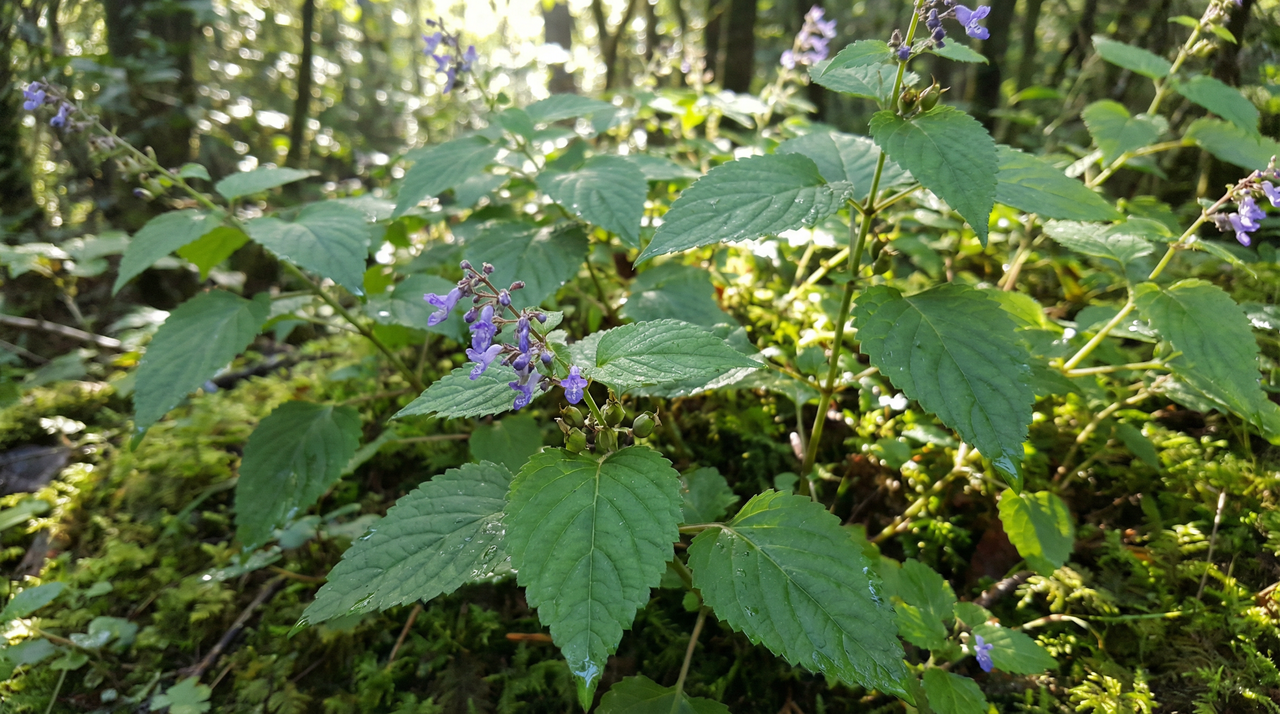
Once you know what you're looking at, spurflower is easy to recognize. It's an upright, clump-forming rhizomatous perennial reaching roughly 0.6 to 1.8 meters tall, with the distinctly square, slightly hairy stems that immediately signal mint family to anyone who's grown enough Lamiaceae to have the pattern in their hands.[16][17] The leaves are opposite, ovate to lanceolate with serrated margins, 5 to 15 centimeters long, and the whole plant carries a subtle herbal scent when brushed. Small tubular purple-blue to white flowers appear in terminal spikes from July through September.[18] Below ground, creeping rhizomes anchor a fibrous root system, and the fruit splits into four tiny nutlets in classic mint-family fashion.[19] A related genus member, Isodon grandifolius (Chinese Giant Hyssop), reaches 1 to 2 meters with dramatically larger peltate leaves up to 30 centimeters across, aromatic when bruised; I've seen those leaves stop visitors cold in a garden setting.[20] The spurflower's own foliage is more restrained, which actually makes it easier to tuck into a layered woodland planting without overwhelming its neighbors. Compare either of these to true Epimedium, with its compound, heart-shaped leaflets and completely different growth habit, and the two plants could not look less alike.
Fun Facts About Spurflower
The reclassification from Rabdosia to Isodon is itself a small window into how much botanical understanding of the Lamiaceae has shifted in recent decades, with molecular work reshaping genera that field botanists had organized by morphology for centuries.[21][4] For gardeners, the practical upshot is that commercial material sold as "Horny Goat Weed" may actually be this species rather than the legendary Epimedium, and the only reliable fix is learning the plants well enough to tell them apart on sight. In its native mountain understories, spurflower earns its place ecologically too: the late-summer flowers feed bees, butterflies, and other pollinators at a season when many competitors have already finished blooming, and the mint-family chemistry that defines it makes it naturally deer-resistant in the garden.[22] That's not a trivial feature in any shade garden I've ever designed.
Spurflower Varieties and Sourcing
Clarifying the Horny Goat Weed Confusion
If you've spent any time searching for Rabdosia nervosa, you've almost certainly run into a wall of Epimedium listings. They couldn't be more different botanically. Epimedium species belong to the Berberidaceae family and are low-growing, shade-loving groundcovers hardy from USDA zones 5 through 9.[23][24][25][26] Rabdosia nervosa is a tall, square-stemmed Lamiaceae perennial from East Asian mountain forests. Same common name, completely separate plant families, distinct chemistry, different growing habits. The confusion is persistent enough that I cross-check every seed shipment I receive against Flora of China entries, because mislabeled Epimedium arrives more often than you'd think.
Rabdosia nervosa itself has no widely recognized commercial cultivars.[27][26] This is a wild medicinal species, collected from its native habitat for its oridonin content rather than selected for garden performance. No named forms, no ornamental releases, no breeders competing for a showier flower. What you're growing is essentially the straight wild type.
Varietal Differences in Related Isodon Species
The closest window into what deliberate selection might look like in this genus comes from a close relative, Isodon grandifolius. It has two recognized botanical varieties: var. grandifolius (the typical form) and var. major, which was selected from wild southern Chinese populations in the 1950s and brought into limited cultivation during the 1970s and 1980s.[28][29] Var. major carries leaves up to 20 cm long, grows taller (to around 1.5 m), and produces higher diterpenoid concentrations preferred for medicinal extraction.[28] I grew var. major out one season and the foliage was noticeably more pungent than the Rabdosia nervosa I had alongside it, which confirmed for me just how much variation exists even within this genus. Even so, neither species has made it into major horticultural databases like Plants of the World Online or the RHS Plant Finder as a named cultivar.[30][31] The breeding work simply hasn't happened yet.
How to Source Authentic Rabdosia nervosa
The good news on the regulatory side is that Rabdosia nervosa isn't listed under any CITES Appendix, so there are no international trade restrictions for endangered species to navigate.[32] The less convenient reality is that importing live plants, seeds, or plant material into the United States still requires a USDA APHIS permit.[33] I learned that lesson firsthand when a single seed packet turned into a paperwork project. What that experience taught me was to build relationships with small international seed banks that already understand U.S. import rules rather than ordering from general overseas suppliers and sorting out compliance afterward.
Authentic Rabdosia nervosa is not something you'll find at a local nursery. It surfaces occasionally through specialty medicinal seed suppliers like Strictly Medicinal Seeds or through niche importers trading in traditional Chinese herbs, typically priced around $5-10 per seed packet or $10-30 for a mature specimen.[34][35] Compare that to Epimedium, where you can click "add to cart" at Plant Delights Nursery and have a plant at your door for $8-25.[36][37] The gap in availability is real, and any listing simply labeled "Horny Goat Weed" is almost certainly Epimedium. When you do find a legitimate source, verify the scientific name against Flora of China, look for vibrant green foliage and firm roots, and confirm there's no sign of pest damage before committing.
Spurflower Propagation and Planting
If your nursery tag or seed packet says "Horny Goat Weed" without a botanical name, verify it before you do anything else. I learned this the hard way when I received stock that turned out to be Epimedium rather than the Isodon I'd ordered. Those two plants are not even in the same family. Rabdosia nervosa (syn. Isodon nervosus) is a Lamiaceae mint-family perennial; Epimedium belongs to Berberidaceae.[38][39] That distinction matters enormously for propagation, because everything that follows applies specifically to spurflower, not to the division-heavy methods you'd use for Epimedium.
Seed Morphology and Viability
Spurflower seeds are tiny: roughly 1.5-2.0 mm long, 0.8-1.2 mm wide, ovoid to oblong, brown to dark brown, with a faintly reticulate surface pattern typical of Lamiaceae.[38][40] You can barely feel them in your palm. Because they're so small, storage conditions matter more than you'd think. The good news is that spurflower has orthodox seed behavior: low initial moisture content (8-10%), good desiccation tolerance, and viability that holds above 70% for five years when stored at -20°C and 6% moisture in airtight containers.[41][42] For most home growers, a sealed glass jar at 3-5°C (your refrigerator crisper drawer works) will preserve them well; room-temperature storage drops viability below 50% within two years, so don't leave them on a shelf.[41][43] This is a completely different situation from Epimedium, whose seeds are intermediate to recalcitrant, lose viability within 6-12 months, and need to be sown fresh.[44][45] If you're ever unsure about your seed lot, tetrazolium staining gives you a rapid biochemical viability read without sacrificing the whole batch to a germination test.[46][47]
Propagation Methods and Germination Timeline
Seed is the primary route for spurflower, but go in with realistic expectations: success rates sit around 30-50% under good conditions.[48][41] The literature reports germination anywhere from 10-30 days without stratification to 2-4 weeks after 4-8 weeks of cold stratification at 4-5°C.[49] My practical read: try surface sowing or covering seeds no deeper than 0.5 cm on a consistently moist substrate at 20-25°C first, with bottom heat, before committing to a cold-stratification cycle.[50] I've started several Lamiaceae woodland perennials in Central Florida's humid summers, and consistent bottom heat at around 22°C with careful surface sowing has given me noticeably better germination rates than cold-treated batches alone. If you do stratify, keep seeds at 4-5°C in a moist paper towel sealed in a bag for four to eight weeks, then move to warmth. One caveat worth mentioning: open-pollinated seed from spurflower is not reliably true to type because the plant outcrosses readily.[51][52] If genetic consistency matters for medicinal use, controlled pollination is necessary.
Stem cuttings are a solid secondary option, particularly for preserving a specific plant. Semi-ripe or softwood cuttings taken in spring or summer root in 3-4 weeks under humid conditions, and a dip in rooting hormone improves the odds.[53][54] Division is generally not recommended given the fibrous root system; unlike Epimedium, where rhizome division achieves 80-90% success and is the standard commercial method, spurflower does not divide cleanly.[44] Worth noting: the species does not appear prominently in the USDA Plants Database under Rabdosia nervosa; look for it under Isodon synonyms if you're checking regional availability.[55]
Soil, Site Selection, and Planting Technique
Spurflower is native to moist, shaded forest understories in East Asia at 500-2500 m elevation, growing in humus-rich, well-drained soils over both limestone and acidic parent materials.[56][57] That ecology tells you exactly what to build at planting time. Target a soil pH of 5.5-7.0 (sweetspot 6.0-6.5); outside that range you'll see chlorosis and stunted growth.[58][59] Drainage is non-negotiable. I once planted a related woodland mint into an unamended heavy clay bed and watched it yellow and collapse within a season; the following year I worked in generous leaf mold and perlite before replanting, and the difference in root health was immediate and obvious. Aim for loose, aerated loam at least 12-18 inches deep with 3-8% organic matter, consistent moisture without waterlogging, and good vertical drainage.[58][60] For containers, a mix of roughly 40% peat or coco coir, 30% perlite or grit, 20% compost or leaf mold, and 10% sand or bark at pH 6.0-7.0 works well, with a light organic fertilizer application in spring.[61][62] Direct pH trials on this specific species are limited, so I'd recommend testing your bed before planting and amending with peat to lower pH or lime to raise it rather than guessing.
Spacing and Establishment
Mature spurflower plants reach 0.5-2 m tall with a spread of 0.8-1.2 m, so give them room from the start.[63][64] Sources suggest a range of 30-90 cm; I've found that 45 cm in dappled shade hits a practical sweet spot, producing robust clumps with enough airflow to reduce the mildew problems I saw when I planted too tightly during a humid summer. Tighter spacing is workable if you want a denser ground-cover effect, but adequate air circulation will matter more once the plants size up. Start seeds indoors 8-10 weeks before your last frost date, then transplant after frost risk passes; spring planting gives the best establishment window.[65] Label your starts carefully. Lamiaceae seedlings look remarkably similar at the cotyledon stage, and a misidentification now creates real confusion at harvest. From successful germination, expect first flowering in 1-2 years under optimal conditions,[60] which is when the plant begins to develop the medicinal profile you're growing it for.
Spurflower Care Guide: Growing Rabdosia nervosa
Rabdosia nervosa (syn. Isodon nervosus) is a Lamiaceae perennial, a member of the mint family, and it requires completely different conditions than Epimedium. That distinction matters in the care context because the two plants have different hardiness, different nutrient responses, and different sensitivities. What you're managing here is a woodland-floor herb from East Asian mountain slopes, and that heritage shapes every care decision you'll make.
Sunlight Requirements for Healthy Spurflower Growth
Rabdosia nervosa comes from moist forest understories in southwestern China, growing at elevations between 500 and 3,000 meters.[66][67] That context alone tells you most of what you need to know about siting it. It wants partial to full shade, around 4 to 6 hours of indirect or dappled light daily, not a south-facing bed in full summer sun.[68][61] In my experience growing shade perennials in Central Florida's punishing summers, I've learned to read the leaves rather than the calendar. Too little light and you get etiolated, floppy stems and sparse flowers; too much and the leaf margins start browning, the tissue bleaches out, and in bad cases you'll see necrotic spots spreading inward from the edges. Both are easy to avoid if you choose the right spot from the start. Under a food-forest canopy or on the north-facing side of a building are my first instincts for placement.
Watering Needs and Soil Moisture Management
Spurflower wants consistently moist, well-drained, humus-rich soil during the active growing season, with a pH tolerance of roughly 6.0 to 7.5.[26][69] The shallow, fibrous root system, typically only 4 to 12 inches deep, means frequent light watering outperforms deep infrequent soaking; I aim for every 5 to 7 days during the growing season, checking that the top inch or two has dried slightly before I water again.[70] In hot or exposed sites, increase frequency to stay ahead of leaf scorch; in cool shaded spots, back off to avoid crown rot, which is a real risk in Florida's wet summers. If your soil drains poorly, raised beds or generous organic matter amendment are worth the effort before you plant. Related Isodon species show that once established the genus tolerates some dryness, but prolonged drought brings wilting and reduced vigor, and overwatering invites root rot and yellowing that's hard to reverse.[71]
Feeding and Fertility for Medicinal Quality
Here's where the Lamiaceae vs. Berberidaceae distinction from fact #8 does real practical work.[72] Nutrient management in spurflower directly affects the diterpenoids, like oridonin, that give the plant its medicinal value. I learned this the embarrassing way early in my career when I fed a batch of medicinal Lamiaceae with a high-nitrogen fertilizer because the plants looked pale. The growth that followed was lush, dark green, and almost completely odorless. Medicinally, it was weak. This plant is not a vegetable crop; push nitrogen and you get leaves, not medicine.
A light application of balanced slow-release organic fertilizer at half strength in early spring, and optionally again in midsummer, is plenty.[64][73] Optimal ranges hover around 150 to 200 ppm nitrogen, 50 to 100 ppm phosphorus, and 200 to 300 ppm potassium.[74] Watch for yellowing older leaves (nitrogen deficit), purplish leaf discoloration (phosphorus), scorched margins (potassium), or interveinal chlorosis in young leaves, which points to iron deficiency and worsens in alkaline soils.[75][76] Compost, well-rotted manure, or diluted seaweed extract are my preferred inputs because they release slowly, mimic the forest-floor nutrient cycle this plant evolved with, and genuinely seem to support secondary metabolite production better than synthetic alternatives.[73] Annual soil testing takes the guesswork out of it.
Frost Tolerance and Winter Protection
Spurflower is generally rated for USDA zones 6 to 9, tolerating minimum temperatures around 10°F (-12°C) for established plants, though young plants are considerably more vulnerable and prolonged freezes cause more damage than brief dips.[69][77] This is a meaningful contrast to the Epimedium species it gets confused with, which are far more cold-hardy and can handle zones 5 through 9 with temperatures down to -20°F.[78][26] The mountain habitat context is genuinely useful here: native to well-drained slopes with good cold-air drainage, this plant needs the same conditions in cultivation.[79] Two to four inches of organic mulch applied after the ground freezes has been my most reliable winter-protection tool. For late-spring frosts when new shoots are emerging, I treat those tender young stems the same way I'd treat new mint growth after a surprise frost: row covers go on the night before and come off the next morning. Frost damage shows as wilting, browning or blackening of stems and foliage, and in severe cases outright necrosis, but if the roots stay healthy the plant typically recovers from mild damage.[80]
Heat Tolerance in Warmer Climates
Spurflower's optimal growth range sits between 15 and 25°C (59 to 77°F), which immediately tells you it's a cool-forest species at heart.[77][81] It can handle brief spikes up to 30 to 35°C if soil moisture stays even, but above 30°C I start seeing the leading edge of heat stress: margins brown first, then the browning progresses toward the midrib, and if I let moisture drop at the same time, the whole leaf wilts within a day or two. Keep moisture consistent and move it into dappled shade and that progression usually stops. In my Central Florida garden, where summer afternoons routinely push past 35°C, dappled shade and attentive watering aren't optional, they're the entire game plan. If you're gardening in a zone 9 or warmer climate, don't even attempt a full-sun position; the plant will tell you it's unhappy before you have a chance to correct it.
Pruning, Maintenance, and Seasonal Rhythm
Spurflower is genuinely low-maintenance, but timing your minimal interventions correctly makes a real difference. In spring, when new shoots reach 6 to 8 inches tall, pinching back the top inch or two encourages bushier, more compact growth rather than the upright stems that can flop in wind.[61] After flowering in late summer or early autumn, I cut spent flower stems back to the base; I actually mark my calendar for this because it's the single maintenance task I've found most reliably keeps plants tidy and sets them up for a clean dormancy.[69][64] Don't prune too late in the season; any new growth that follows will be sitting exposed when the first hard frost arrives. Dead foliage comes off in late winter, just before the rhizomes push up new shoots again.
The full seasonal arc runs like this: new shoots emerge from rhizomes in spring, the plant builds through summer into autumn flowering, then foliage dies back and the plant enters winter dormancy.[82] Seedlings are the most vulnerable phase, preferring daytime temperatures around 20 to 25°C with nights above 15°C and humidity around 60 to 70%.[60] Once you've watched it cycle through a full year, the care rhythm becomes intuitive. It doesn't want constant attention; it wants you to work with its seasons rather than against them.
Harvesting Spurflower (Rabdosia nervosa)
The spurflower you're growing, Rabdosia nervosa (now correctly Isodon nervosus), is a mint-family perennial. It is not Epimedium. They are from entirely different families, they have different harvest targets, different chemical profiles, and different safety considerations. Everything in this section applies to the Lamiaceae spurflower, not to Epimedium's barrenwort leaves.
When to Harvest Rabdosia nervosa for Medicinal Use
This is not a plant you harvest in year one. Medicinally useful aerial parts don't come into their own until the plant has reached 2-3 years from seed, when the root system is established enough to push strong stems and fully expanded leaves consistently.[48][83] The primary harvest window for aerial parts runs July through September in temperate climates, timed to full bloom, when diterpenoid concentration is at its peak.[84][85] If you want to be more precise, aim for 30-60 days after peak flowering, before seed set begins.[86][87] The plant tells you it's ready: stems are sturdy, leaves are vibrant green and fully expanded, and there's no yellowing at the margins.[88] Yellowing or early seed drop means you've waited too long.
Harvesting Techniques for Aerial Parts and Roots
Collect aerial parts on dry sunny mornings after the dew has lifted. I've learned this the hard way with other aromatic Lamiaceae medicinals: wet material rots before it dries properly, and you lose the volatile compounds you're trying to preserve. Use clean cuts and gather only the vibrant green stems and leaves, leaving enough basal growth so the plant recovers.[84][89] Aerial parts are the primary harvest for most medicinal applications, so treat them as the main event.
Roots are a secondary option, harvested in late autumn (September through November) after the aerial parts have died back and the plant has entered dormancy.[87][90] A digging fork works better than a spade here; you want to excavate carefully without snapping the roots, because damaged tissue loses compound integrity quickly.
Yield, Flavor Profile, and Important Safety Notes
Don't come to this plant looking for a culinary experience. Rabdosia nervosa is overwhelmingly medicinal, and its flavor makes that plain: a strong, lingering bitterness from diterpene rabdosin and related diterpenoids, layered with aromatic pine and citrus notes from β-pinene and limonene.[91][92][93] Young shoots are the most tender, though they're also the most intensely bitter, and older growth gets fibrous fast.[94] The bitterness reminds me of the sharper end of other Isodon species I've worked with; it's not something you'd absentmindedly nibble in the garden. This contrasts noticeably with true Epimedium, which carries an acrid-bitter yet slightly sweet, warming quality and honey-musk floral notes from its flowers, with a nearly neutral fresh-leaf scent.[95][96] Two completely different sensory experiences from two completely different plants.
Post-harvest, both shade-drying of leaves and stems is the traditional approach, preserving volatiles for use in decoctions, tinctures, or teas.[97] Be aware that drying tends to concentrate bitterness rather than reduce it; fermentation may moderate it somewhat, but that's not a casual kitchen project.[97] Growing conditions matter too. Plants from high-altitude regions of Yunnan, Sichuan, or Guizhou tend toward stronger compound expression, and what you grow in your garden will reflect your specific soil and climate in ways that are hard to predict precisely.[14]
On safety: I take this seriously, and you should too. Both Rabdosia nervosa and Epimedium species require professional guidance before internal use. The diterpenoids in spurflower carry real toxicity risks at excessive doses, with contraindications for pregnancy, certain TCM heat syndromes, and anyone with liver conditions.[98][99] These are TCM herbs with centuries of use inside a structured system of diagnosis. They are not everyday edibles, and harvesting them without understanding why and how much is where people get into trouble.
Spurflower (Rabdosia nervosa) Preparation and Uses
Taxonomic Clarification: Distinguishing Rabdosia nervosa from True Horny Goat Weed (Epimedium)
Sorting out the Epimedium mislabeling is the first thing I do whenever I'm evaluating a medicinal guild for clients. These are entirely different plants. True Horny Goat Weed is Epimedium, a Berberidaceae genus whose primary bioactive is icariin, whose flavor is acrid and slightly sweet, and whose traditional role centers on tonifying kidney yang, addressing fatigue, and supporting bone density.[100][101] Rabdosia nervosa is a Lamiaceae mint-family perennial driven by ent-kaurane diterpenoids, particularly oridonin, with a bitter, cooling, herbaceous profile that tastes nothing like Epimedium and works through entirely different biochemical pathways. Buying the wrong one isn't just a wasted investment; it's a genuine safety issue.
Flavor Profile, Limited Culinary Applications, and Nutritional Value
The flavor tells you everything you need to know about culinary potential. Rabdosia nervosa is strongly bitter and pungent with a cooling, herbaceous finish that persists stubbornly in any infusion you make from it.[102] When I've tested small batches of young Isodon-type leaves in herbal tea, the bitterness reminds me immediately of over-brewed dandelion or certain Artemisia species; it's the kind of bitter that closes off any casual culinary enthusiasm quickly. Traditional use of the young leaves as an occasional potherb or folk tea exists in parts of Asia, and related species like Isodon adenanthus appear in some Thai salads, but these applications are sparse, unstandardized, and rarely replicated outside their local contexts.[103][104] Rabdosia nervosa is not a dietary staple by any stretch.[105]
The nutritional picture, based on breadth species like Isodon grandifolius, shows moderate vitamins (C, A, B vitamins), minerals including potassium, calcium, and magnesium, and a meaningful load of flavonoids, phenolic acids, and volatile oils with antioxidant activity.[106] The bioactive compounds, especially oridonin alongside flavonoids and essential oils, bring documented anti-inflammatory, antioxidant, antimicrobial, and preliminary anticancer properties.[107] Those qualities make this a plant worth growing for medicinal reasons. They don't make it lunch.
Traditional and Modern Medicinal Preparations
The same bitterness that limits kitchen use is precisely what makes Rabdosia nervosa valuable as a therapeutic herb. Traditional Chinese medicine preparations use the leaves and stems as a decoction: typically 9 to 15 grams of dried material per day, divided across two or three doses.[108] Post-harvest drying should happen in shade or at low temperatures, staying below 40 to 60 degrees Celsius, over three to seven days depending on ambient humidity.[109] I've found that rushing this step in Florida's summer heat degrades both aroma and potency in similar bitter mint-family herbs; the diterpenoids need gentle conditions to survive into the final product. Store the dried herb in airtight containers away from light, between 10 and 25 degrees Celsius with humidity below 60 percent, for a shelf life of one to two years.[110]
Safety Considerations and Expert Guidance
Related Rabdosia species have been associated with hepatotoxicity and acute liver injury at high doses.[111] Rabdosia rubescens tea and related preparations have shown up in case reports precisely because people self-medicate without supervision. In my work with medicinal perennials, I've seen how easy it is to misidentify square-stemmed Lamiaceae members in the field; I always triple-check before any medicinal harvest and I strongly advise readers to do the same or consult a qualified practitioner. Treat spurflower as a therapeutic herb requiring professional guidance, not a kitchen herb you improvise with. Proper botanical identification, responsible dosing, and medical oversight aren't optional extras here.
Spurflower Health Benefits and Medicinal Uses
The mislabeling around this plant is genuinely pervasive and it matters for safety. If you've seen this plant sold or described as "Horny Goat Weed," that label belongs to Epimedium species in the Berberidaceae family, used in traditional Chinese medicine for kidney yang deficiency, aphrodisiac effects, and osteoporosis.[112][113] Spurflower is Isodon nervosus (formerly Rabdosia nervosa), a Lamiaceae perennial with a completely different phytochemical story and a completely different set of applications.[114] When I first encountered this plant labeled as Horny Goat Weed at a herb fair, I immediately double-checked my sources because the described actions didn't match the Epimedium I knew from years of working with TCM-aligned medicinal guilds. The correction to Isodon nervosus clarified everything. These are not interchangeable plants.
Key Phytochemicals in Isodon nervosus
The real story of spurflower's medicinal value sits in its diterpenoids. The leaves and roots accumulate ent-kaurane and related diterpenoid types at roughly 2-5% dry weight, and in certain concentrated extracts these compounds can represent up to 70% of total composition.[115][116] The named compounds include rabdosin A and B, oridonin, lasiodonin, rabdonervin A and B, nervosine, and isodocarpin, with over 100 diterpenoids identified across the broader Isodon genus.[117] These are not the gentle flavonoids you'd find in a cup of lemon balm tea. Oridonin-type compounds function as phytoalexins, part of the plant's own chemical armor against herbivores and pathogens,[118] which tells you something about their biological potency.
Supporting those diterpenoids are flavonoids (apigenin, luteolin, quercetin derivatives), phenolic acids including rosmarinic and chlorogenic acid, triterpenoids, and essential oils with monoterpene and sesquiterpene fractions; the flavonoids and phenolics carry much of the antioxidant capacity.[115][119] If you grow other aromatic Lamiaceae like oregano or lemon balm, you already have a rough picture of that flavonoid-phenolic backbone. What makes Isodon nervosus unusual is the diterpenoid layer on top of it.
Concentration isn't static. Phenolics peak in spring, while diterpenoids and essential oils build toward late summer and autumn.[120] I've noticed this pattern with other potent Lamiaceae I grow in humid subtropical conditions; late-summer harvests of aromatic mint-family plants consistently yield more pungent, resinous material. Geography, altitude, soil pH, and cultivation conditions all shift the profile too, and optimized growing can increase bioactive yields by 20-40%.[121][122]
Traditional Uses and Modern Pharmacological Research
In traditional practice, Isodon nervosus and its close Isodon relatives have been applied to clear heat, reduce inflammation, address respiratory infections, sore throat, cough, dysentery, mastitis, abscesses, and rheumatic pain.[123][124] Preclinical research has started to explain some of those uses mechanistically: in vitro models demonstrate anti-inflammatory activity through NF-κB pathway suppression and COX-2 inhibition, antioxidant effects via Nrf2 activation and free-radical scavenging, antimicrobial action targeting bacterial membranes, and preliminary cytotoxic activity against leukemia and lung cancer cell lines, all driven primarily by the oridonin-type diterpenoids.[125][115] That's a compelling list. The honest caveat is that nearly all of this data comes from in-vitro and animal models.[123] Rigorous human clinical trials are essentially absent. The traditional application record is long; the controlled human evidence is not.
Nutritional Profile of Spurflower
Spurflower is primarily a medicinal herb, not a food plant, and its nutritional profile reflects that. Standardized data in USDA FoodData Central is sparse.[126] Estimates extrapolated from the related Isodon grandifolius suggest modest values around 10-15 g carbohydrates, 2-4 g protein, 3-5 g dietary fiber, 200-300 mg potassium, 100-150 mg calcium, and roughly 10-20 mg vitamin C per 100 g fresh weight,[127] but these figures need more rigorous lab analysis before anyone should draw dietary conclusions from them. Young leaves do turn up occasionally in teas or salads in traditional contexts, but the plant is consumed mainly as a dried decoction at 9-15 g daily.[128] Any nutritional contribution from macronutrients or minerals is genuinely secondary; the value is in those diterpenoids and flavonoids covered above.
Rabdosia rubescens Side Effects and Safety Considerations
At traditional decoction doses of 9-15 g dried herb per day, Isodon nervosus has low acute toxicity and a reasonable safety record from centuries of use.[129] That said, I always tell clients that low acute toxicity at traditional doses is not the same as harmless at any dose. Excessive intake can cause gastrointestinal upset, dizziness, allergic reactions, and potential liver strain linked to oridonin and related diterpenoids.[130][131]
The contraindications are clear: spurflower preparations should not be used without qualified medical supervision during pregnancy or breastfeeding, in children, or by anyone with pre-existing liver conditions or who is taking hepatotoxic medications.[132][133] As a Lamiaceae member, the possibility of mint-family-type allergic reactions also exists for sensitized individuals.[134] Severe adverse events appear rare when the herb is used appropriately, but long-term human safety data simply don't exist yet. I treat that gap with respect, and recommend anyone using this plant medicinally do the same.
Spurflower Pests and Diseases
Grow spurflower well and it will largely fend for itself. That's not a marketing promise; it's the chemical reality of being a Lamiaceae perennial loaded with ent-kaurane diterpenoids. The same oridonin and related compounds that give Rabdosia nervosa its medicinal value also double as insect deterrents and antifungal agents, which means the plant enters your garden already armed.
Natural Resistance from Diterpenoids and Trichomes
The diterpenoids in spurflower's tissues, oridonin prominent among them, exhibit real insecticidal and antifeedant properties against herbivorous insects.[135] That biochemical armor works alongside glandular trichomes on the leaf surface that create both a physical deterrent and a localized chemical barrier to feeding insects.[136] The same bioactive compounds appear to suppress certain fungal pathogens as well.[137][59] Compared to something like sweet basil, which I grow in the same humid Central Florida conditions, spurflower's glandular trichomes give it noticeably better spider-mite resistance. I've watched basil covered in mites while the spurflower a few feet away stayed clean. That said, both collapse under powdery mildew pressure when airflow is poor, so the trichomes are not a get-out-of-jail-free card.
Common Pests and Vulnerabilities
The defenses weaken fast under stress. I've seen aphids colonize Rabdosia nervosa within days of inconsistent watering during Central Florida summers; once the plant is drought-stressed or waterlogged, that chemical edge disappears.[138] Spider mites follow the same pattern, arriving opportunistically on plants that are already struggling. Caterpillar damage shows up occasionally in field settings too, though it's rarely severe.[138]
Slugs deserve specific attention on young growth, a vulnerability shared with related barrenworts (Epimedium), where slug and snail damage to emerging foliage is well documented.[26][139] Spurflower's tougher mature foliage gives it a slight edge over Epimedium, but new spring growth is still vulnerable. Whiteflies and thrips round out the pest list, as both affect Lamiaceae species broadly.[140] No documented cultivars exist with standout pest resistance;[141] after trialing several unnamed Isodon accessions, I've found none that justify relaxing your monitoring routine.
Disease Susceptibility and Prevention
Root rot from Fusarium and Phytophthora, powdery mildew, and leaf spot are the primary fungal threats.[142] In persistently humid conditions, gray mold (Botrytis) and anthracnose can appear as secondary problems. The related Isodon adenanthus shows better tolerance to downy mildew than most Lamiaceae species, which has guided me to trial similar Isodon relatives in damp guild spots where other mints routinely fail,[140] but Rabdosia nervosa itself offers only partial powdery-mildew tolerance through its volatile compounds rather than true resistance. Most of what we know about its disease susceptibility is extrapolated from related Isodon species rather than dedicated crop trials, so treat these as informed expectations rather than confirmed certainties. No disease-resistant cultivars have been documented.
Integrated Pest and Disease Management
Cultural prevention handles the heavy lifting. Avoiding waterlogged soil is non-negotiable for blocking root rot and damping-off.[143] Good spacing and airflow matter just as much; overcrowded plants invite powdery mildew regardless of how chemically defended they are.[50] Skip overhead irrigation when you can, mulch to moderate soil moisture, and you've already eliminated the conditions that trigger most problems.[144]
For insects, insecticidal soap or horticultural oil addresses aphids and mites; iron phosphate bait handles slugs without harm to surrounding soil life.[139][145] I never reach for synthetic fungicides on medicinal plants unless absolutely necessary; neem oil applications combined with the cultural steps above have kept my spurflower clean through multiple humid seasons.[146] The drainage, spacing, and watering practices already covered in the care guide are genuinely your best disease-prevention tools. Regular observation, especially in summer humidity, catches problems early enough that hand-picking or a single neem spray is usually all it takes.
Spurflower (Rabdosia nervosa) in Permaculture Design
This plant is not Epimedium. The shared "Horny Goat Weed" label causes real confusion in nursery catalogs and online forums, but Rabdosia nervosa is a Lamiaceae perennial, square-stemmed and aromatic, not the low-spreading barrenwort from the Berberidaceae family.[147][148] I've learned to distinguish the two by leaf texture alone: spurflower's leaves are rough and faintly scented when crushed, where Epimedium foliage is waxy and odorless. Get that identification right before you design around it.
Climate Suitability and USDA Hardiness Zones
In its native range, spurflower grows in the moist forest understories, valleys, and stream banks of China, Japan, Korea, and Taiwan, typically at elevations between 200 and 2000 meters under humid, partially shaded conditions with 750 to 1500 mm of annual rainfall.[149][7] That origin translates cleanly into USDA zones 6 through 9, with the plant tolerating winter lows down to around -23°C and performing best where summer temperatures stay between 15 and 25°C.[77][16] Pacific Northwest woodlands and Eastern U.S. deciduous forest edges are natural fits. In zone 6, I'd treat it the same way I treat any borderline-hardy woodland perennial: 5 to 8 centimeters of hardwood leaf mulch over the crown before the first hard freeze goes a long way toward reliable overwintering. The soil should be humus-rich, well-drained, and neutral to slightly acidic; consistent moisture is non-negotiable during establishment, especially if you're pushing it into hotter or drier conditions than its native range prefers.[141]
Ecosystem Functions and Pollination Services
Spurflower's most reliable contribution to a guild is summer pollinator support. The tubular purple to violet flowers appear from June through August, arranged in whorled clusters up the stems, and they draw honeybees, bumblebees, hoverflies, and butterflies with consistent enthusiasm.[150][151] In my shaded guild plantings I've watched bumblebees work these flowers on the same mid-morning rounds they make through the salvias and agastaches nearby. The plant is protandrous, meaning pollen is released before the flower's female parts are receptive, which actively promotes cross-pollination and keeps the insect traffic purposeful.[152]
That pollinator benefit holds best in connected plantings. Pollination success drops by up to 50% in fragmented or disturbed habitats, and I've seen the same pattern play out in isolated specimen plantings versus a genuinely biodiverse guild: the insects visit less, the seed set suffers, and the whole system feels less alive.[153][154] That's a design lesson worth internalizing: spurflower wants company, not a solo spotlight.
Beyond pollination, its fibrous root system provides moderate slope stabilization and erosion control, and the clumping foliage creates ground-level insect habitat in shaded understories.[155] It fixes no nitrogen, and it won't bulk up your biomass piles. Set expectations accordingly: this is a medicinal herb that earns its space through pollinator service and understory coverage, not as a productivity workhorse. Related species round out the picture nicely. Isodon grandifolius extends flowering into early autumn and contributes to nutrient cycling through leaf-litter decomposition, while Isodon adenanthus produces aromatic monoterpenes that show some aphid-repelling activity.[82][156] Mixing two or three Isodon species in a moist shaded border stretches the bloom season and diversifies what the guild offers insects.
Forest Layer Placement and Guild Companions
Spurflower occupies the herbaceous understory layer, growing 50 centimeters to about 1.5 meters depending on conditions, and it wants the dappled light that comes through a canopy of fruit trees or native hardwoods rather than full afternoon sun.[157] I place similar woodland Lamiaceae in the east-facing or north-facing sides of food-forest plantings where they catch morning light and get afternoon shade, bedded into accumulated leaf mulch rather than cultivated soil. That positioning mimics the forest edge conditions where Rabdosia nervosa thrives naturally and keeps moisture from flashing off in summer heat.
Good companion choices include ferns, hostas, and shade-tolerant gingers. Epimedium also works well functionally in the same spot, though it's worth keeping the two plants' identities distinct in your records given the naming overlap.[158] What to avoid: aggressive mint-family spreaders like Mentha or Lycopus that will crowd the clump out over a few seasons, and nitrogen-fixing groundcovers that can outcompete in richer soils. Give spurflower a spot where it can establish quietly at the forest floor, do its pollinator work through the summer, and cycle into dormancy without competing with plants that want the same resources more aggressively.
The Plant That Made Me Read the Label Twice
I almost passed on spurflower entirely the first time I saw it mislabeled at a specialty nursery, tucked next to a row of actual Epimedium with a tag that made the whole shelf look interchangeable. Something made me stop and look closer. That pause turned into a rabbit hole of TCM texts and diterpenoid research, and eventually a plant I genuinely treasure under my oak canopy, not for what people think it is, but for exactly what it is.
Sources 158
- Isodon nervosus: Phytochemistry and biological activities ↩
- Flora of China: Lamiaceae ↩
- Yin Yang Huo: Epimedium in Traditional Medicine ↩
- Rabdosia nervosa - Synonyms and Classification ↩
- Isodon nervosa (Rabdosia nervosa) - Plant Profile ↩
- Flora of China: Rabdosia ↩
- Rabdosia nervosa - Distribution and Habitat ↩
- Growth Habit and Lifecycle of Isodon nervosus ↩
- Flora of China - Rabdosia ↩
- Shennong Bencao Jing ↩
- Epimedium: The Horny Goat Weed ↩
- Traditional Uses and Bioactive Compounds of Rabdosia nervosa ↩
- Compendium of Materia Medica ↩
- Ethnobotanical Study of Medicinal Plants Used by the Miao People in Guizhou Province, China ↩
- Pharmacological Activities of Rabdosia Species: A Review ↩
- Isodon nervosus (Rabdosia nervosa) ↩
- Flora of China - Lamiaceae ↩
- Flora of China - Rabdosia ↩
- Flora of China - Isodon nervosus ↩
- Flora of China: Isodon grandifolius ↩
- Isodon nervosus (Blume) H. Hara ↩
- Chemical Constituents and Biological Activities of Plants from the Genus Isodon ↩
- Isodon nervosus (Rabdosia nervosa) ↩
- Epimedium (Barrenwort) Plant Profile ↩
- Yin Yang Huo (Epimedium) Medicinal Uses and Cultivation ↩
- Epimedium Species: Hardiness and Care ↩
- Flora of China: Isodon nervosus ↩
- Botanical Journal: Varietal Differences in Isodon grandifolius ↩
- Flora of China: Isodon grandifolius ↩
- Isodon grandifolius - Plants of the World Online (Kew Science) ↩
- Royal Horticultural Society - Plant Finder ↩
- CITES Species Database ↩
- Importing Plants and Plant Products into the United States ↩
- Rabdosia nervosa Seeds ↩
- Seed Banks for Rare Plants ↩
- Epimedium Species Availability in Nurseries ↩
- Epimedium Plants for Sale ↩
- Flora of China: Isodon nervosa ↩
- Isodon nervosus ↩
- Seed Morphology of Isodon Species ↩
- Germination and Storage Behavior of Isodon Species Seeds ↩
- Seed Storage of Medicinal and Aromatic Plants ↩
- Seed Storage of Orthodox and Recalcitrant Species ↩
- Epimedium: Barrenwort Nursery Production ↩
- Seed Dormancy and Storage in Epimedium spp. ↩
- Seed Testing Handbook ↩
- Seed Viability Testing for Plant Propagation ↩
- Cultivation of Medicinal Plants: Rabdosia nervosa ↩
- Seed Germination of Isodon Species ↩
- Propagation and Cultivation of Medicinal Plants in Lamiaceae ↩
- Lamiaceae Family: Reproductive Biology ↩
- Flora of China: Rabdosia nervosa ↩
- Propagation Techniques for Medicinal Plants: Isodon nervosus ↩
- Propagation of Isodon nervosus ↩
- USDA Plants Database Search ↩
- Flora of China - Isodon nervosus ↩
- Rabdosia Species Habitat and Ecology - Kew Science ↩
- Isodon nervosa Cultivation Guide ↩
- Soil pH Preferences of East Asian Forest Herbs ↩
- Missouri Botanical Garden Plant Finder ↩
- Growing Rabdosia nervosa: Soil and Care Guide ↩
- Container Gardening for Perennials ↩
- Missouri Botanical Garden Plant Finder - Isodon nervosus ↩
- Rabdosia nervosa (Isodon nervosus) Plant Profile ↩
- Growing Rabdosia Species: A Guide ↩
- Missouri Botanical Garden Plant Finder - Isodon nervosus ↩
- Flora of China - Isodon nervosus ↩
- Isodon nervosus (Rabdosia nervosa) - Plant Profile ↩
- Isodon rubescens (Rabdosia nervosa) Cultivation ↩
- Isodon nervosus (Rabdosia nervosa) ↩
- USDA Plants Database - Isodon grandifolius ↩
- Isodon nervosus (Rabdosia nervosa): A Review of Its Phytochemistry and Pharmacology ↩
- Growing Isodon nervosus: Care and Cultivation ↩
- Fertilizer Recommendations for Shade Perennials ↩
- Nutrient Deficiencies in Ornamental Plants ↩
- Iron Chlorosis in Plants - University of Minnesota Extension ↩
- USDA Plant Hardiness Zone Map ↩
- Flora of China - Rabdosia and Epimedium Synonyms ↩
- Missouri Botanical Garden Plant Finder - Isodon nervosus ↩
- Frost Damage in Perennials ↩
- Flora of China - Lamiaceae ↩
- Isodon nervosus (Rabdosia nervosa) - Plant Profile ↩
- Isodon nervosus: Propagation and Harvest ↩
- Harvesting and Processing of Medicinal Plants in Traditional Chinese Medicine ↩
- Medicinal Plants of China ↩
- Cultivation and Propagation of Rabdosia nervosa ↩
- Rabdosia Species in Traditional Medicine ↩
- Phenology and Cultivation of Isodon nervosus ↩
- Traditional Harvesting Practices in Chinese Materia Medica ↩
- Harvesting and Processing of Medicinal Plants: Isodon Species ↩
- Isodon nervosus ↩
- Chemical Composition and Bioactivity of Rabdosia nervosa ↩
- Volatile Constituents of Isodon Species ↩
- Isodon nervosus (Rabdosia nervosa) - Botanical Description ↩
- Epimedium ↩
- Yin Yang Huo (Epimedium) Taste and Properties in TCM ↩
- Traditional Uses and Processing of Rabdosia Herbs ↩
- Chemical constituents and biological activities of the genus Isodon (Labiatae) ↩
- Epimedium (Yin Yang Huo) - Herbal Medicine: Biomolecular and Clinical Aspects ↩
- Epimedium: A Review on Comprehensive Pharmacology and Quality Specifications ↩
- Pharmacological Effects of Epimedium brevicornum Maxim ↩
- Chinese Herbal Medicine: Materia Medica ↩
- Traditional uses and pharmacological properties of Isodon species ↩
- Isodon (Rabdosia) Species: Ethnopharmacology, Phytochemistry, and Pharmacology ↩
- Traditional Uses of Rabdosia Species in Chinese Medicine ↩
- Nutritional Composition of Edible Lamiaceae Plants Including Isodon grandifolius ↩
- Chemical Constituents and Biological Activities of Rabdosia Species ↩
- Isodon grandifolius - Useful Tropical Plants Database ↩
- Medicinal Plants of China: Post-Harvest Handling of Rabdosia Species ↩
- Storage and Preservation of Chinese Materia Medica ↩
- Acute Liver Injury Associated with the Herbal Supplement Rabdosia rubescens ↩
- Epimedium: A Review on Pharmacology and Toxicology ↩
- Yin Yang Huo (Epimedium) - American Botanical Council ↩
- Isodon nervosus (C. Y. Wu) H. Hara ↩
- Chemical Constituents and Biological Activities of Rabdosia Species ↩
- Bioactive Diterpenoids from Rabdosia nervosa ↩
- Chemical Constituents and Biological Activities of Isodon Species ↩
- Ecological Roles of Secondary Metabolites in Lamiaceae Plants ↩
- Phytochemical and pharmacological studies on Isodon species ↩
- Seasonal Variation in Phenolic Compounds of Isodon Species ↩
- Cultivation Effects on Chemical Profile of Rabdosia nervosa ↩
- Environmental Influences on Secondary Metabolites in Lamiaceae Plants ↩
- Pharmacological Activities of Rabdosia nervosus: A Review ↩
- Ethnobotany and Phytochemistry of Isodon Species ↩
- Molecular Targets of Rabdosia Diterpenoids in Inflammation ↩
- USDA FoodData Central Search Results ↩
- Ethnobotany of Isodon grandifolius ↩
- Species of traditional medicinal plant Isodon in South Asia: An ethno-botanical review ↩
- Safety Evaluation of Rabdosia nervosa Extracts ↩
- Pharmacological Activities and Toxicity of Rabdosia nervosa ↩
- Herbal Medicine Safety: Rabdosia Species Review ↩
- Rabdosia nervosa in Traditional Chinese Medicine ↩
- Isodon: A review of phytochemistry and pharmacological activities for drug discovery ↩
- Toxicity Studies on Rabdosia (Isodon) Species ↩
- Chemical Constituents and Biological Activities of Rabdosia Species ↩
- Trichomes and Insect Resistance in Medicinal Plants ↩
- Antifungal Activity of Extracts from Rabdosia Species ↩
- Pests and Diseases of Ornamental Plants ↩
- Epimedium: Barrenwort ↩
- Pests and Diseases of Lamiaceae Family Plants ↩
- Isodon (Rabdosia) Species Overview ↩
- Fungal Pathogens of Isodon Species ↩
- Disease Management in Perennial Herbs ↩
- Integrated Pest Management for Herbs in the Mint Family ↩
- Slugs and Snails in the Garden ↩
- Insect Pests of Medicinal Herbs ↩
- Flora of China - Isodon nervosus ↩
- Plants of the World Online: Isodon nervosus ↩
- Flora of China - Isodon nervosus ↩
- Pollination Ecology of Lamiaceae in Asia ↩
- Flora of China - Isodon nervosus ↩
- Insect Pollination in Lamiaceae Family ↩
- Habitat Fragmentation and Plant-Pollinator Interactions ↩
- Impact of Habitat Disturbance on Plant-Pollinator Interactions in the Himalayas ↩
- Plant Functional Traits and Ecosystem Services ↩
- Isodon species: Phytochemistry and Pharmacology ↩
- Isodon nervosus (Blume) H. Hara ↩
- Plant Profile: Isodon grandifolius in Permaculture ↩