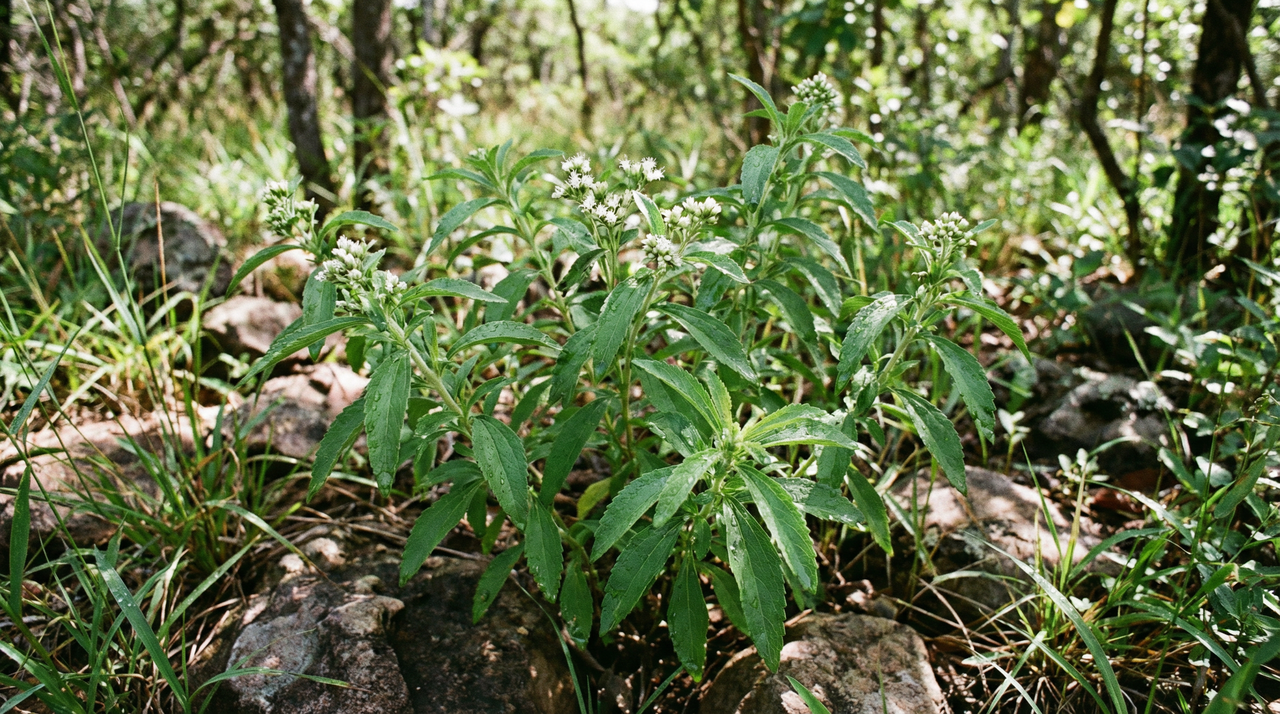
Most people who grow stevia for the first time crush a leaf between their fingers, take a cautious sniff, and think: this smells like absolutely nothing special. Then they touch that finger to their tongue. I watched a first-time gardener at one of my food forest workshops do exactly this, and the look on her face was genuinely startling, somewhere between delight and mild suspicion. The leaf itself had no sweetness aroma, no candy-shop perfume, nothing to advertise what was coming. Just a clean, green, slightly herby smell, and then an almost shocking sweetness that lingered for a full minute.
That gap between expectation and reality is, I think, the whole story of this plant in miniature. Stevia rebaudiana has been used by the Guaraní people of Paraguay for centuries as 'ka'a he'ê,' meaning sweet herb, woven into daily tea and traditional medicine long before any laboratory confirmed what they already knew.[1] Yet somehow it arrived in most of our gardens trailing a reputation built almost entirely on the processed white powder sold in little packets, which tastes nothing like the real thing. The fresh leaf is genuinely better, and growing it yourself changes the whole conversation.
What I want to dig into here is the actual plant: where it comes from, how it behaves in a garden, what it needs to thrive, and why getting any of those details wrong produces something bitter and disappointing rather than sweet.
Stevia Origin, History, and Description
Botanical Background and Native Habitat
Stevia rebaudiana is native to the subtropical grasslands, forest edges, and stream banks of northeastern Paraguay and southern Brazil, with a range extending into northern Argentina and parts of Bolivia.[2][3] In the wild, it occupies semi-arid to moist open woodlands and streamside habitats at 500-1,000 meters elevation, growing under 20-50% partial canopy rather than in dense forest or open blazing sun.[4] I've grown stevia in Central Florida for several seasons now, and once I understood that native habitat, everything clicked: the afternoon shade I give it isn't coddling, it's replicating exactly where this plant evolved to thrive. That dappled-light preference translates directly to better leaf production and plant longevity through the hottest months.
In cultivation, stevia is a polycarpic perennial that typically lives 3-8 years, with peak productivity falling somewhere in years two through five before a gradual decline sets in.[5][6] Wild populations carry moderate genetic diversity, and that variation has served as the raw material for decades of selective breeding programs targeting higher sweetness, disease resistance, and environmental resilience.[7] Knowing it comes from seasonally dry grassland edges also explains the good drainage it demands everywhere in the article: waterlogging is not something this plant evolved to tolerate.
Traditional and Cultural Uses by the Guarani
Long before any European botanist wrote it down, the Guarani people of Paraguay were calling this plant ka'a he'ê, "sweet herb," and building it into daily life.[8] They sweetened yerba mate with it, chewed fresh leaves directly, and prepared dried-leaf infusions as medicine.[9] The medicinal repertoire was broad: treating diabetes, hypertension, digestive complaints, nausea, and colds, with additional use as a diuretic and expectorant.[10][8] The plant also carried ceremonial weight, symbolizing health, prosperity, and sweetness in spiritual and social contexts.[11]
Jesuit missionaries documented this use in the 17th and 18th centuries, and formal Western botanical recognition arrived in 1899 when Swiss botanist Moses Bertoni described and named the species.[12][13] Organized cultivation followed in Paraguay before the 20th century was out, and by the mid-1900s the plant had reached Japan and China, where commercial scaling began in earnest through the 1990s and beyond.[14] What strikes me is how an indigenous South American herb quietly became one of the most commercially significant zero-calorie sweeteners on earth, all while the knowledge that made it valuable remained largely uncompensated. Modern commercial development has brought real ethical concerns: patents on derived compounds filed without benefit-sharing arrangements with Guarani communities, sustainability risks from large-scale monocultures, and erosion of the genetic diversity that those wild populations still hold.[15][16] As someone who sources plants ethically, I always keep that history in mind. The sweetness we enjoy today was first discovered and stewarded by the Guarani, and supporting fair-trade or community-benefit stevia products is one concrete way to honor that.
Visual Characteristics and Identification
In the garden, stevia is a compact, bushy subshrub that typically reaches two to three feet tall with a spread of one to two and a half feet, tidy enough for a container, an herb border, or a guild understory.[17][18] The stems are erect, often branched, and slightly pubescent, ranging from green to reddish-brown. The leaves are what you'll learn to recognize first: opposite, lanceolate to ovate, 2-7 cm long, with distinctly serrated margins and a slightly velvety texture from fine surface hairs.[19][20] They remind me a bit of small basil leaves in their opposite arrangement, which I find helpful when showing new gardeners what a young stevia seedling looks like. The real giveaway, though, is the taste; the striking concentration of sweetness genuinely surprises most first-time growers. It's intense in a way that instantly explains centuries of indigenous use without needing any chemistry lesson.
From late summer into fall, the plant produces small white tubular flowers in loose terminal clusters, each flower only about 5-6 mm across but collectively quite charming.[21][22] These give way to small ribbed achenes topped with white bristles for wind dispersal, a neat reminder of this plant's wild grassland origins.[23] Cultivar and environment both shape how the plant ultimately looks: drought or salinity tends to push it toward more compact growth and smaller leaves, while well-watered, partly shaded plants fill out more generously.[24][25] That plasticity is actually useful: once you've grown a season or two, you start reading the plant's size and leaf shape as a live report on its growing conditions.
Stevia Varieties and Where to Buy Them
Most gardeners think of stevia as a single plant. It isn't. There are over 200 cultivars of Stevia rebaudiana, each selectively bred for specific traits: steviol glycoside content ranging from 4 to 20 percent of dry leaf weight, improved disease resistance, better flavor, or adaptation to particular climates.[5][7] That diversity matters enormously when you're deciding what to slot into a guild or a container on a patio.
Notable Stevia Cultivars for Home Gardens and Commercial Use
The first thing to sort out is size. Compact cultivars like 'KSM-768' and 'H-77' top out around 30 to 40 centimeters, which puts them roughly in Thai basil territory and makes them genuinely useful in small-space polycultures.[26][17] Mid-sized types like 'PolarStar' and 'Candyleaf' reach 60 to 70 centimeters. The robust processing types, 'Coccolita', 'Sugar Leaf', and 'Sweetleaf', push 80 to 100 centimeters and can dominate a small bed if you're not planning for that.[26]
Sweetness varies just as much as height. Depending on cultivar, the leaves can be anywhere from 200 to 450 times sweeter than sugar. 'KSM-768' sits near the top at roughly 400x, while 'PolarStar' and 'Candyleaf' clock in around 300x.[26][27] For fresh tea, I reach for 'Morita' or 'Morita II' type plants almost every time. Their higher rebaudioside A content and naturally lower bitterness mean you get a genuinely clean sweetness off the younger leaves without that lingering aftertaste that puts some people off stevia entirely.
For yield, the numbers are worth knowing. A typical home plant produces 0.5 to 1 kilogram of dry leaves annually. High-performing cultivars like 'Candyleaf' can push to 3 kilograms per plant under optimal conditions, with field-scale production reaching 2,000 to 4,000 kilograms of dry leaf per hectare.[28][29] Most cultivars are happiest in USDA zones 9 to 11; 'Sugar Leaf' and 'Sweetleaf' can stretch into zone 8 with protection, while 'Coccolita' is really best reserved for zones 10 to 11.[30][26] After trialing several types in Central Florida landscapes, I've found Florida-adapted lines like 'UF Sweet' establish noticeably faster and handle summer humidity far better than older imported varieties.[31]
USDA breeding programs are actively pushing cold tolerance, pest resistance, and higher glycoside content to expand where the crop can realistically thrive in the US.[32] The USDA Germplasm Resources Information Network already catalogs over 20 accessions sourced primarily from Paraguay and Brazil, giving breeders raw material to keep working with.[33] Many of the most promising commercial lines are proprietary, so what's available to home growers right now is genuinely just the beginning.
Sourcing Stevia Plants and Seeds in the United States
Live plants and seeds are easy to find domestically. Reliable US suppliers include Plant Delights Nursery, Logee's Plants, Johnny's Selected Seeds, Baker Creek Heirloom Seeds, Richters Herbs, Territorial Seed Company, and Strictly Medicinal Seeds.[34][35][36] A 4-inch potted plant typically runs $6 to $15; seed packets of 50 to 100 seeds go for $3 to $7, and bulk 1,000-seed packs cost around $20 to $30.[37][38][39] I personally look for organic certification whenever I'm buying in bulk, especially when the dried leaf is destined for homemade stevia rebaudiana extract or tea blends.
I almost always buy starts rather than seeds. Stevia rebaudiana germination is notoriously finicky, and named cultivars won't come true from seed anyway, so a rooted plant from a reputable nursery gives you a known quantity. One practical note for anyone tempted to source internationally: importing live stevia rebaudiana plants into the US requires a USDA APHIS permit, a phytosanitary certificate, and possible inspection or quarantine. Domestic suppliers save you all of that hassle.[40]
Stevia Propagation and Planting Guide
Stevia rewards growers who understand its biology before they reach for a seed packet or pruning shears. The propagation path you choose has real consequences for how sweet your plants will be, and that's not something most herb guides tell you upfront.
Understanding Stevia Seeds: Structure, Biology, and Limitations
Stevia seeds are technically achenes, small oblong fruits measuring just 2.5 to 3.5 mm long with a pappus of white bristles designed for wind dispersal.[41][42] They're orthodox seeds, meaning they tolerate desiccation and store reasonably well under cool, dry conditions,[43] but their viability is notoriously short-lived in practice. I only use seed within six months of harvest or pulled from the refrigerator; older seed has consistently given me germination rates below 20%, which matches exactly what the research reports.[44]
The deeper issue is genetic. Stevia is self-incompatible, meaning it requires cross-pollination, and the resulting plants show considerable variability in steviol glycoside content, with heritability of those sweetener traits running between 0.4 and 0.8.[45][46] The plant also exhibits polyembryony, with multiple embryos possible in a single seed, and some populations show apomixis.[47] What this means practically: even when seeds do germinate, you have no guarantee the resulting plants will be sweet. I've started stevia from seed several times and while it's doable, the variability means you won't always get the most rebaudioside-rich individuals in a batch.
Seed Germination Timeline and Techniques
If you're committed to growing stevia from seed, freshness and light are non-negotiable. Sow seeds on the surface without covering them, since germination requires light, at soil temperatures of 70 to 80°F with consistent moisture and ideally a 16-hour photoperiod.[48] Under good conditions expect germination in 7 to 21 days, with seedlings ready to transplant around 6 to 8 weeks after sowing.[48] Flowering typically follows 90 to 120 days after that.[49] Even with ideal conditions, overall germination rates typically land between 10 and 30%; GA3 priming or scarification can push that toward 50 to 70% with very fresh seed.[50][51] One thing I wish someone had told me early on: label your seedling flats carefully. Young stevia looks remarkably similar to other Asteraceae herbs at the cotyledon stage, and an unlabeled tray of mixed cuttings and seedlings on a propagation bench has caused me genuine confusion more than once.
Preferred Method: Stem Cuttings for Uniform Plants
For anyone who wants reliable sweetness, stem cuttings are the answer. Vegetative propagation guarantees that every plant is a genetic copy of a high-performing parent, which is why commercial producers almost universally use it and why store-bought stevia seedlings look so uniform.[52] Success rates run 80 to 95%, a dramatic improvement over seed germination.[53]
The technique itself isn't complicated. Take 3 to 5 inch cuttings with 2 to 3 nodes from healthy, non-flowering stems in late spring or early summer.[54] Dip the cut end in IBA rooting hormone at 1,000 to 3,000 ppm, stick into a 1:1 perlite-vermiculite mix, and maintain 70 to 80% humidity at 70 to 75°F. Roots establish in 2 to 4 weeks.[55] Stevia cuttings root almost as reliably as basil or mint under those same high-humidity dome conditions, which makes the process genuinely approachable if you've had success propagating either of those herbs. Gradually reduce humidity after rooting before transplanting out.
Soil, Site Selection, and Planting Technique
Stevia's native Paraguayan and Brazilian habitat is well-drained, relatively infertile, and never waterlogged. Getting the soil right before transplanting is the single most important thing you can do. The target is a well-drained sandy loam with 2 to 5% organic matter, pH between 6.5 and 7.5, at least 20 to 30 cm of usable soil depth, and a bulk density below 1.3 g/cm³ so roots aren't fighting compaction.[48][56] Waterlogging is genuinely fatal here; Pythium and Fusarium move fast on stressed stevia roots.[57] When I amended a heavy clay bed with compost and built it into a raised mound, the plants in that spot showed noticeably better root establishment and thicker leaves compared with plants I'd tucked into unamended ground nearby. The difference was visible within a month. Plan for about an inch of water per week during the growing season, full sun of at least 6 to 8 hours daily, and amend pH and texture based on a soil test before planting rather than guessing.[58] Transplant after the last frost date when soil has reached at least 60°F; in USDA zones 9 to 11 stevia can overwinter as a perennial shrub, while cooler-climate gardeners should treat it as an annual or bring plants indoors before first frost.[59]
Spacing, Initial Care, and Establishment
Mature stevia plants reach 2 to 3 feet tall with an 18 to 24 inch spread.[17] Space plants 12 to 18 inches apart within rows and keep rows 24 to 36 inches apart to allow airflow.[60] In humid summers like those I deal with in Central Florida, crowding is an invitation to fungal problems; the extra room between plants earns its keep. For containers, a 12-inch pot is the minimum workable size, with 16 to 18 inches being more forgiving for a full-season plant.[61] Pinch the growing tips once plants reach 8 to 10 inches, and remove flower buds as they appear to keep the plant bushy and redirect energy into leaf production rather than seed set.[62] No trellising is needed, though a light stake helps in exposed or windy spots.
Stevia Care Guide: Sunlight, Water, Feeding, and Maintenance
Caring for stevia well means understanding where it comes from. This is a plant that evolved in the warm, humid grasslands and forest edges of subtropical South America, and it brings those preferences with it into your garden. Get the fundamentals right and you'll have leaves sweet enough to sweeten your morning tea. Push the plant too hard in the wrong direction and you'll end up with either leggy, pale growth or bitter, stressed foliage that's barely worth harvesting.
Sunlight Requirements for Optimal Leaf Production and Sweetness
Here's the nuance I wish someone had spelled out for me early on: full sun and maximum sweetness are not quite the same goal. Six to eight hours of direct sun daily drives the most leaf biomass,[17][60] but dialing back to 50-70% partial shade actually concentrates steviol glycosides by balancing photosynthetic efficiency with reduced light-induced stress.[63][64] If your priority is sweeter leaves rather than more leaves, afternoon shade in a hot climate is your friend.
The visual diagnostics are worth memorizing. Too little light produces etiolated stems, wide spacing between leaves, pale or yellowing foliage, and overall weak structure.[65] Too much intense heat (above 35°C) tips the other direction: leaf scorch, wilting, chlorosis, and photoinhibition that shuts down photosynthesis just when you want the plant producing.[66] I'll cover heat mitigation in more detail below. The one other piece worth knowing here: stevia is a short-day plant for flowering,[18] which means long summer days actively favor vegetative leaf growth. That's exactly what you want.
Watering Needs and Drought Tolerance
Stevia wants consistent moisture without ever sitting in soggy soil. About an inch of water per week during the growing season is a reasonable baseline, and the "top inch dry" test is the most reliable guide for timing. Overwatering is the more common mistake; the symptoms are yellowing leaves, wilting despite wet soil, and black roots that signal rot already underway.[67] Underwatering shows up as wilting, curling leaf edges, and browning tips; when you see those signs, water deeply and the plant usually recovers within a day.[68]
Established plants have more resilience than you might expect. The root system can reach one to two meters deep, and waxy leaf cuticles help reduce water loss during dry spells.[69] That said, even brief drought stress can reduce leaf yield and glycoside production by 20-30%, and while plants bounce back quickly once moisture returns,[70] young seedlings don't have that resilience yet. Stage-specific watering matters: seedlings need light, frequent moisture every two to three days; established vegetative plants can go four to seven days between deep waterings.[71][72] Soil pH of 6.5-7.0 and low salinity (EC below 1.5-2.0 dS/m) keep the root zone healthy enough to absorb all that water efficiently.[31]
Feeding and Nutrient Management
Stevia is a light to moderate feeder,[73] and the most important lesson I've learned from years of growing it is this: heavy feeding produces lush plants that taste disappointingly flat. Excessive nitrogen (above 150 kg/ha equivalent) can reduce steviol glycoside content by 20-30% and triggers the kind of leggy, vegetative surge that looks impressive but sweetens your tea poorly.[74] I've tasted the difference directly from plants fed on lean versus rich regimes, and it's noticeable. Feed for flavor, not biomass.
Soil testing before you apply anything is genuinely the only way to get the numbers right for your specific site.[75] A balanced 5-10-10 or 10-10-10 formula at planting, side-dressed lightly every four to six weeks during active growth, keeps most home garden plants in good shape.[76] Reduce nitrogen once flowering approaches. Optimal soil pH sits between 6.5 and 7.5.[48]
The deficiency symptoms are worth learning because they show up before a plant stalls completely. Pale older leaves starting at the tips signal nitrogen shortage. Purple stems or reddish-tinged dark green leaves with poor root development point to phosphorus. Marginal browning on older leaves with weak stems suggests potassium. Interveinal chlorosis means iron or magnesium.[77][78] I watch for those pale older leaves every season as my cue to side-dress before the whole plant slows.
Frost Tolerance and Cold Protection
Whether stevia is a perennial or annual in your garden comes down to one number: your USDA hardiness zone. In zones 9-11 it overwinters reliably as a tender perennial; everywhere else, treat it as an annual or bring it inside.[79][80] It prefers temperatures between 70-85°F and grows best above 50°F;[81] a brief dip to 28-30°F is survivable, but hard freezes around 20°F will kill the plant outright.[82][48]
I've overwintered stevia indoors for three seasons now. The trick is a south-facing window that stays between 60-70°F during the day and never drops below 50°F at night, with bright indirect light to keep the cuttings from going dormant entirely.[83][84] For outdoor plants in marginal zones, frost cloth, row covers, and 4-6 inches of mulch around the base after the first frost can buy you another season.[85]
Heat Tolerance and Mitigation Strategies
Stevia is rated for AHS Heat Zones 7-9, meaning it can handle 60-90 days per year above 86°F,[17] but once temperatures push above 35-40°C (95-104°F), the plant signals stress clearly: leaf scorching, wilting, leaf curl, and a drop in fresh yield and rebaudioside A concentrations that can reach 20-50% under chronic heat.[86]
The mitigation toolkit that has worked best for me in hot summers combines 30% shade cloth with 5-10 cm of organic mulch and early-morning drip irrigation.[87] That combination consistently improves leaf quality when afternoon temperatures push into the danger zone. Proper plant spacing at 30-45 cm also helps by reducing air stagnation around the canopy.[88]
Pruning, Maintenance, and Seasonal Care
Pruning is what turns stevia from a short-lived annual into a productive multi-year plant. Start pinching growing tips when plants hit 8-10 inches tall to encourage branching, then cut established plants back to 6-8 inches above ground in early spring to stimulate vigorous new growth.[48][18] Post-harvest cuts to 30-50 cm height keep the plant compact and push out the fresh vegetative growth where the sweetest leaves form.[18]
Remove flower buds the moment you see them forming. I learned this the hard way: the year I let a few plants bloom out of curiosity, the perceived sweetness in those leaves dropped noticeably compared to the plants I'd kept pinched.[17] I deadhead ruthlessly now. With consistent bud removal and selective harvesting, perennial plants in favorable zones can produce two to four harvests per season without losing vigor.[5] In zones 8 and colder, plan for a hard cutback before the first frost, heavy mulching, or bringing the plant indoors; in zones 9-11, a light trim heading into winter and a harder cutback in late winter sets the plant up for another productive season.[17]
Harvesting Stevia Leaves for Peak Sweetness and Quality
Everything about growing stevia well comes down to this moment: catching the harvest window before the plant decides it's time to flower. Miss it, and you'll have perfectly healthy-looking leaves that taste noticeably more bitter than they should. Nail it, and you'll have dried material that's genuinely sweet and useful in the kitchen.
When to Harvest: Timing, Visual Cues, and Flowering Stage
The target is 60-90 days after transplanting, once plants reach 12-24 inches tall with 10-15 pairs of large, glossy dark-green leaves per stem. The optimum harvest window opens just as flower buds are forming but haven't opened yet.[89][90] That pre-flowering moment is when steviol glycoside concentration peaks; once the blooms open, sweetness starts dropping and bitterness climbs.[90][91] I've harvested mine with the first tiny buds barely visible, and even waiting three or four days past that point made a noticeable difference in the aftertaste. Don't go by the calendar; go by the buds.
Because stevia is a short-day plant, flowering is triggered when days shorten to 12-14 hours, typically 2-3 months after planting.[92] In warmer zones (9-11), where it behaves as a perennial, the main harvest window runs from July through October, with 2-4 cuts possible every 45-60 days once the plant is established.[92][93]
How to Harvest, Dry, and Store Stevia Leaves
Cut stems back to 4-6 inches or hand-pick mature leaves during cool morning hours when the plant is well-hydrated and the weather is dry.[91][94] Think of it like pruning basil: a good cut keeps the plant pushing new growth rather than sending energy into seed production. This is how you get that second and third harvest without stressing the plant.
Drying promptly is non-negotiable. I keep my dehydrator under 105°F (40°C) without exception; the goal is getting moisture down to 10-12% within about 48 hours to preserve the glycosides intact.[55][95] Shade drying on a mesh rack works well in low-humidity climates. Once fully dry, store leaves in airtight containers somewhere cool (50-59°F) and dark, where they'll keep well for 1-2 years.[55][96]
Expected Yields and Flavor at Harvest
Home growers can realistically expect 200-500 grams of dried leaves per plant per season.[94][5] In practice, that's roughly a cup or two of crumbled dried leaf per major harvest from a well-established plant. My three-year-old mother plants produce reliably in that range; commercial operations scale to 2-3 tons of dry leaf per hectare, so backyard expectations should be calibrated accordingly.[5]
The flavor chemistry matters here. Leaves are 200-300 times sweeter than sugar, with rebaudioside A delivering the cleanest sweetness (5-9% of dry weight in improved cultivars versus 1-2% in standard types), while stevioside tends toward bitterness.[97][98] A licorice-like aftertaste lasting 30 seconds to several minutes is common, and home-dried leaf tends to express it more strongly than commercial powders.[99] I've found that pairing homegrown stevia with a bit of citrus or fresh mint smooths that note considerably. Harvest timing, your cultivar choice, and light levels during the growing season all influence what ends up in the jar.
Stevia Preparation, Uses, and Safety
Culinary Uses and Sweetener Applications
Fresh stevia leaves are edible straight off the plant, and the flowers work as a milder garnish tossed into salads. But the real kitchen magic happens once you dry the leaves properly. The steviol glycosides responsible for that clean sweetness are massively concentrated,[22][100][1] which means a little goes a surprisingly long way. After several seasons of drying my own harvest, I've learned to do it on screened trays in the shade rather than in direct sun. Full sun exposure can reduce glycoside levels to about 70% of what you started with, while shade-drying at 30-40°C or freeze-drying retains up to 95%.[1][101] In Florida humidity that also means less bitterness, which is a trade-off worth managing carefully.
One thing I love about growing my own is what comes along for the ride nutritionally. Dried stevia leaf is essentially calorie-free (around 4 kcal per 100g), but it's packed with potassium at 3,847 mg per 100g, calcium at 1,351 mg, and magnesium at 312 mg.[102] Commercial stevia packets stripped down to pure extract don't offer that. The leaves also carry meaningful antioxidant phenolics including chlorogenic and caffeic acid, with total phenolic content around 50-100 mg GAE per gram dry weight.[103] For tea, steep one teaspoon of dried leaves in eight ounces of hot (not boiling) water for five to ten minutes. For syrup, simmer leaves and water at a 1:4 ratio for twenty to thirty minutes, then strain and reduce. The sweetener is heat-stable, so it holds up in baking, glazes, and sauces without breaking down.
On the regulatory side: high-purity steviol glycoside extracts carry FDA GRAS status, but whole-leaf preparations and crude extracts are not approved as food additives in the US.[104][105] I use my home-dried leaf for personal tea and baking; when a recipe calls for something more concentrated, I buy a high-purity extract that carries that approval. Research confirms steviol glycosides don't raise blood glucose and may support glycemic control in diabetic individuals,[106] which makes home-grown stevia genuinely useful beyond flavor.
Medicinal Preparations and Dosages
For daily use as a sweetener, about one to two grams of dried leaf per serving (roughly an eighth to a quarter teaspoon of powder) is a reasonable starting point, staying within one to two grams total per day for whole-leaf preparations. With liquid extracts, two to four drops per serving is typical; powdered extracts standardized to 95% steviol glycosides are far more potent, and the ADI established by EFSA and JECFA caps steviol glycoside intake at 4 mg per kilogram of body weight, which works out to about 280 mg daily for a 70 kg person.[1] My own practice is two cups of leaf tea per day at about two grams per cup, and I find the sweetness varies noticeably depending on when I harvested and how carefully I dried the batch.
Non-Food Uses and Safety Considerations
Stevia foliage can technically produce a natural green dye, though this is uncommon and not commercially significant.[107] Roots, stems, seeds, and pollen have no notable uses as food, fiber, or fuel. On safety: stevia belongs to Asteraceae, a family that includes white snakeroot (Ageratina altissima), which shares similar white flower clusters and serrated leaves and is genuinely toxic. I once confused young stevia seedlings with a similar-looking aster at a plant swap until I tasted a leaf; now I always verify by smell and flavor before trusting any volunteer or wild-harvested plant. If you have ragweed or chrysanthemum sensitivities, I'd suggest starting with a single small cup of tea to test tolerance before making it a daily habit. And for pregnant folks, stick to food-level leaf use rather than concentrated medicinal extracts until more research is available.
Stevia Health Benefits and Medicinal Uses
Long before stevia became a supermarket sweetener, the Guarani people of Paraguay and southern Brazil were chewing its leaves fresh and brewing them into teas as foundational medicine. That's over 1,500 years of observed medicinal use,[108][109] and modern research has done a solid job of explaining the mechanisms behind several of those traditional applications.
Traditional and Modern Medicinal Research on Stevia
The glycemic effects are the best-documented. Stevioside binds to sweet taste receptors T1R2/T1R3, activates AMPK to enhance insulin signaling and glucose uptake in skeletal muscle, inhibits alpha-amylase to blunt postprandial glucose spikes, and acts as a PPARγ agonist to improve insulin sensitivity.[110][111][112] Clinical trials back this up: stevia reduces fasting blood glucose and HbA1c in type 2 diabetes patients without disrupting glucose metabolism in healthy individuals.[113][114] The antihypertensive evidence is meaningful too: stevioside inhibits ACE,[115] and clinical trials show systolic blood pressure reductions of 5-14 mmHg at doses of 750-1500 mg per day.[116]
Beyond blood sugar and blood pressure, stevia scavenges free radicals, inhibits lipid peroxidation, and suppresses pro-inflammatory cytokines TNF-α and IL-6 via NF-κB inhibition.[117][118][119] Animal models also show antimicrobial activity against E. coli and S. aureus, plus analgesic and diuretic effects.[120][121] Honest caveat: many of those studies are small, short-term, or conducted at doses you wouldn't reach from a cup of leaf tea.[122][123] Gut microbiota composition also influences how individuals metabolize steviol glycosides, so results genuinely vary from person to person.[122]
Key Phytochemicals in Stevia rebaudiana
The leaves hold 4-20% steviol glycosides by dry weight, with stevioside (3-11%) and rebaudioside A (1-5%) doing most of the heavy lifting.[124][125] These are ent-kaurane diterpenes concentrated almost entirely in the leaves; stems, roots, flowers, and seeds contain negligible amounts.[126] This concentration is strongly tied to the plant's life cycle, with glycoside content naturally peaking at up to 15-20% dry weight right as the plant prepares to flower. glycoside content peaks at flowering, reaching up to 15-20% dry weight.[127][128] Shade drying at around 40°C also protects those compounds better than direct sun; after experimenting with different methods over the years, low-temperature shade drying is what I now consistently use to preserve both sweetness and the antioxidant phenolics.[129]
The supporting cast matters too. Flavonoids including quercetin, kaempferol, apigenin, and luteolin derivatives come in at roughly 1-5 mg/g, alongside phenolic acids like chlorogenic and caffeic acid at 0.5-2 mg/g.[130][131] These are what drive much of the antioxidant and anti-inflammatory activity mentioned in the clinical literature.[132]
Nutritional Profile of Stevia Leaves
Whole stevia leaves are used fresh or dried, with typical servings of 2-5 g fresh or 0.5-2 g dried powder.[133] At those amounts, you're not eating for macros. Raw leaves run about 85 kcal per 100 g with minimal sugar; dried leaves concentrate the fiber dramatically (63.5 g per 100 g) but still register zero sugars.[133] Where the mineral profile gets genuinely interesting is in the dried leaf: approximately 1,500 mg potassium, 1,000-1,700 mg calcium, 150-250 mg magnesium, and 15-25 mg iron per 100 g.[134][135] That's comparable to what I'd expect from dried nettles or parsley, herbs most people already respect for their mineral density. I add a pinch of dried leaf powder to herbal teas partly for sweetness and partly because, gram for gram, it's delivering more than the sugar it replaces.
Safety Considerations and Regulatory Status
The regulatory picture is actually quite clear once you separate purified extracts from whole-leaf products. High-purity (approximately 95%) steviol glycosides, particularly rebaudioside A, have been FDA GRAS since 2008,[136] with JECFA and EFSA establishing an acceptable daily intake of 4 mg/kg body weight, or roughly 280 mg for a 70 kg adult.[105] Whole leaf and crude extract forms don't have U.S. food additive approval, though they're used as supplements here and are fully approved in countries like Japan.[137] The overall toxicity profile is favorable: steviol glycosides metabolize to steviol and are rapidly excreted, with no demonstrated carcinogenicity or reproductive toxicity at normal doses.[123][138] Rare hypersensitivity occurs in people sensitive to other Asteraceae plants like ragweed, and high doses of crude extracts can cause mild GI upset.[1]
I dry my own leaves for culinary sweetening without concern. But when someone asks me about using stevia medicinally, I always point them toward commercial standardized extracts where the regulatory data is clearest. The interaction profile is specific enough to take seriously: stevia can potentiate antidiabetic medications and increase hypoglycemia risk, add to the effects of antihypertensives and diuretics, decrease lithium renal excretion, and interact with certain antivirals through PXR/AHR receptor pathways.[123][139] If you're on blood sugar or blood pressure medications, or if you're pregnant, skip medicinal doses entirely and talk to your healthcare provider first. The animal data on potential endocrine effects in pregnancy is enough that I wouldn't take the chance.[140] Caution also applies for children using concentrated supplements and anyone with kidney disease.[123]
Stevia Pests and Diseases
Natural Pest Resistance Mechanisms in Stevia
One of the things I genuinely enjoy about growing stevia is watching new gardeners discover how little pest trouble it causes compared to something like basil, which seems to attract every slug and aphid in the county. A lot of that resilience comes down to the plant's own chemistry. The steviol glycosides that make the leaves sweet also act as feeding deterrents for many insects,[141][142] and the fuzzy texture of the leaves comes from trichomes that form a physical barrier against herbivory.[143][144] Run a leaf between your fingers on a dry afternoon and you can actually feel the pubescence. The plant also emits volatile organic compounds that may repel pests or draw in beneficial predators to do the work for it.[145] That said, these defenses only carry so far. Stevia's natural resistance holds up well under good growing conditions but slips quickly once the plant is stressed.[146][147]
Common Insect Pests and Management
When pest problems do show up, the usual suspects are aphids (particularly Aphis gossypii and Melanaphis sacchari), whiteflies (Bemisia tabaci), spider mites (Tetranychus urticae), and occasionally caterpillars in the Spodoptera family. Spider mites leave a characteristic stippling on the leaves that's easy to spot once you know what to look for.[148][149][77] Cultivar choice makes a real difference here. Selections like PPNO show resistance to whiteflies and spider mites, Namikan offers moderate aphid resistance, and Diss tolerates leafhopper pressure better than standard varieties.[150][151] Environmental stress is the bigger wild card: waterlogging, overcrowding, and nutrient imbalances all weaken the plant's defenses and invite problems that a healthy specimen would shrug off.[152][5] My approach follows standard IPM principles: good spacing, crop rotation, and companion planting with marigolds first; neem oil or insecticidal soap when pressure builds; chemical controls only as a genuine last resort.[153][154][155]
Disease Resistance and Common Pathogens
Stevia's resistance to disease is moderate to low across the board, with no documented immunity to any common pathogen. The one bright spot is a high resistance to cucumber mosaic virus, which is genuinely useful.[156][157][158] Beyond that, the disease list is long. Fungal leaf spots caused by Cercospora steviae, Septoria steviae, and Alternaria alternata are common, and powdery mildew (Podosphaera xanthii or Erysiphe cichoracearum) shows up as white dusty patches that gradually tank photosynthesis and yield.[158][159][160] Root rots from Fusarium oxysporum and Rhizoctonia solani can kill plants outright, and the list of additional fungal threats includes Sclerotinia stem rot, Botrytis gray mold, downy mildew, and Verticillium wilt.[161][162] Bacterial wilt from Ralstonia solanacearum causes sudden collapse with characteristic vascular discoloration, and Pseudomonas syringae brings moderate bacterial leaf spot.[163] Nearly all of these thrive in the humid, poorly drained conditions that stevia growers in warm climates can inadvertently create. I've trialed 'Morita II' alongside standard seedling-grown plants and consistently seen less leaf spot on the named selection; disease-resistant cultivars like 'CIM-Sudarshan', 'Madhu Tulsi', and 'Sweet Honey' are worth seeking out if you're in a humid region.[164][165]
Integrated Disease Management for Stevia
The year I lost half a bed of stevia to root rot during a particularly wet Florida summer taught me more than any research paper: waterlogged soil is stevia's worst enemy, and no amount of corrective treatment makes up for bad siting. The fix was straightforward -- raised beds, wider spacing for airflow, and inoculating with Trichoderma at planting, which actively suppresses soil-borne pathogens like Fusarium.[166][167] Drip irrigation or bottom watering instead of overhead watering eliminates much of the leaf wetness that powdery mildew and leaf spot pathogens need to establish. Crop rotation and sanitation matter too -- don't leave diseased material sitting in the bed. If fungicides become necessary, mancozeb, azoxystrobin, and copper-based products are the conventional options, though I reach for them only when cultural practices have already failed.[55][166] Get the siting right, choose a disease-tolerant cultivar, and most of this list stays theoretical.
Stevia in Permaculture Design
Native Habitat, Ecosystem Functions, and Guild Roles
In the wild, Stevia rebaudiana grows at the edges of things. Grasslands, forest margins, stream banks in subtropical Paraguay and southern Brazil, places that get decent light and periodic stress, where a small, fibrous-rooted subshrub can carve out a niche without competing for canopy space.[168][17] Those fibrous roots do modest but real work: stabilizing loose soil and improving organic matter uptake in sandy, low-fertility ground.[168] Nothing dramatic, but useful in an edge planting.
The flowers are what I find most surprising. They're tiny, maybe 5–6 mm, white to pale yellowish, clustered in loose corymbs that remind me of a scaled-down yarrow or chamomile head.[169] Not showy by any standard. But late summer in my warm-climate gardens, those small white flower clusters reliably pull in honeybees, solitary bees, bumblebees, hoverflies, and the occasional butterfly.[170] The nectar runs 20–40% sucrose, which is a respectable draw.[170] Stevia is self-incompatible, so it depends on those visitors to set seed at all, which means it's been quietly co-evolving with pollinators rather than trying to go it alone.[170]
I want to be honest about where the research stops, though. Most studies on stevia focus on its steviol glycosides as a commercial sweetener crop, not on its broader ecological role in South American grasslands.[168] I value it for the pollinators it clearly supports and its drought tolerance once established, but I'm not going to overstate soil-building or carbon benefits that simply haven't been studied well. That's good permaculture practice: observe what you can actually see, hold the rest loosely.
Climate Requirements and USDA Hardiness Zones
Stevia is native to semi-arid to humid subtropical climates (Köppen Aw and Cfa) at elevations mostly under 500 meters, which tells you almost everything about what it needs.[17][2] It wants warm days (ideally 65–85°F), honest rainfall in the 30–50 inch range with sharp drainage, and humidity around 60–80%.[171][172] Growth stalls below 50°F and hard freezes do real damage, though plants can briefly tolerate down to around 20°F.[17][173]
As a perennial it's reliably hardy in USDA zones 9–11.[17] In zone 8, I've had success mulching heavily and siting plants against a south-facing wall where nighttime temperatures stay a few degrees warmer than the open garden; it's a useful trick when you'd rather not drag pots inside. In zones 7 and colder, treat it as a tender annual or start cuttings in late summer to overwinter on a sunny windowsill.[48] The good news for warmer-zone gardeners is that it's not a weed-in-waiting. Stevia can self-seed in favorable conditions, but it isn't classified as invasive in North America or Europe, and in my experience the seedlings are easy enough to manage.[174]
Forest Layer Placement and Companion Planting
In any permaculture system, stevia belongs at the sunny front edge. It's a compact herbaceous subshrub, typically 2–3 feet tall with an upright branching habit, and it genuinely struggles in shade.[17][48] My standard placement is at the drip-line edge of a citrus guild, where it gets full sun and benefits from the slightly warmer microclimate the tree creates overhead. Citrus works well as overstory because it doesn't cast deep shade, and the pairing lets me pack the understory with real function.
A companion plant for stevia that I keep coming back to is basil, partly for the kitchen synergy and partly because their aromatic oils seem to discourage aphids on both plants. Marigolds nearby pull double duty, deterring nematodes in the soil while adding another insectary layer.[175] I'll tuck in a strip of clover or let beans run along the same bed as the nitrogen contribution, with comfrey a short distance away as a dynamic accumulator whose chopped leaves I use as a soil mulch around the stevia roots.[175] The combination keeps fertility cycling through the guild without purchased inputs.
The pubescent, slightly fuzzy leaves aren't just a texture curiosity: they help reduce water loss in drier stretches, and the fibrous root system handles loose, organic soils well.[175] What stevia asks for in return is non-negotiable drainage; boggy feet will kill it before cold does. Get that right, pair it thoughtfully, and you have a plant doing real work in the herbaceous layer: drawing bees at the edge of summer, keeping a low profile, and producing sweetener leaves from a spot that might otherwise just be mulch.
The Plant That Made Me Stop Reaching for the Sugar Bowl
I grow a lot of plants with impressive profiles on paper that quietly underwhelm me in practice. Stevia isn't one of them. There's still something that stops me every time I pinch a leaf on my way through the food forest, rub it between my fingers, and taste it; that clean sweetness from something I started from a cutting in a solo cup feels almost unfair. It's a small thing, but it's the kind of small thing that keeps me gardening.
Sources 175
- Stevia rebaudiana Bertoni: Sources, Health Benefits, and Risks ↩
- Stevia rebaudiana - Wikipedia ↩
- Stevia rebaudiana (Bertoni) Bertoni | Kew Science - Plants of the World Online ↩
- Distribution and Habitat of Stevia rebaudiana in South America - Botanical Journal ↩
- Stevia: Botany, Agronomy and Market Potential ↩
- The Life Cycle of Stevia rebaudiana ↩
- Genetic Diversity in Stevia rebaudiana ↩
- Ethnobotany of the Guarani Indigenous People in Paraguay ↩
- Stevia: Its Medicinal, Nutritive and Therapeutical Applications ↩
- Stevia: A Comprehensive Review of Its Traditional Uses and Health Benefits ↩
- The Use of Stevia rebaudiana Bertoni (Compositae) Leaf as Medicinal Plant in Paraguay ↩
- The History of Stevia Use in Paraguay ↩
- The History of Stevia: From Ancient Herb to Modern Sweetener ↩
- Stevia: Its Medicinal and Other Uses and the History of Its Spread Around the World ↩
- Ethical Issues in Biopiracy: The Case of Stevia rebaudiana ↩
- Indigenous Knowledge of Stevia Among Guarani ↩
- Stevia rebaudiana (Sweetleaf) ↩
- Royal Horticultural Society: How to Grow Stevia ↩
- Botany of Stevia rebaudiana ↩
- Stevia rebaudiana - USDA PLANTS Database ↩
- Missouri Botanical Garden Plant Finder - Stevia rebaudiana ↩
- Stevia rebaudiana - Wikipedia ↩
- Morphological Characterization of Stevia rebaudiana Cultivars ↩
- Environmental Influences on Stevia Plant Morphology ↩
- Drought Tolerance Mechanisms in Stevia rebaudiana ↩
- Stevia Cultivation and Varieties ↩
- Glycoside Profiles in Stevia Cultivars ↩
- Stevia Cultivation Guide ↩
- Stevia rebaudiana: Its Agricultural, Industrial and Nutraceutical Uses ↩
- Stevia rebaudiana ↩
- Stevia Production in Florida ↩
- Breeding and Selection of Stevia rebaudiana for High Steviol Glycosides ↩
- Stevia rebaudiana (Bertoni) Bertoni ↩
- Stevia Plants for Sale ↩
- Stevia Seeds ↩
- Sweet Leaf Stevia Plants ↩
- Stevia Plants for Sale ↩
- Stevia Seeds ↩
- Organic Stevia Seeds ↩
- Importation of Plants and Plant Products ↩
- Seed Morphology of Stevia rebaudiana ↩
- Morphology and anatomy of Stevia rebaudiana seeds ↩
- Seed Storage of Orthodox and Recalcitrant Species ↩
- Germination and Storage of Stevia rebaudiana Seeds ↩
- Genetic Variability and Heritability of Steviol Glycosides in Stevia rebaudiana ↩
- Seed Germination and Apomixis in Stevia rebaudiana ↩
- Embryology of Stevia rebaudiana ↩
- Growing Stevia: From Seed to Harvest ↩
- Stevia rebaudiana - USDA ARS ↩
- Propagation of Stevia rebaudiana Bertoni: A Review ↩
- Seed Germination of Stevia rebaudiana: A Review ↩
- Vegetative Propagation Techniques for Stevia ↩
- Propagation Methods and Genetic Stability in Stevia rebaudiana ↩
- Propagation of Stevia rebaudiana ↩
- Vegetative Propagation of Stevia ↩
- Soil Requirements for Stevia in Paraguay and Brazil - FAO Report ↩
- Stevia Cultivation Guide - Root Health and Water Management ↩
- Stevia Cultivation Guide - University of Georgia Extension ↩
- Stevia: A New Sweetener for Your Garden ↩
- Stevia Production in the United States ↩
- Growing Stevia in the Home Garden ↩
- Herbs: Stevia ↩
- Ochoa-Alderete et al. (2014). Effects of light and water stress on steviol glycoside accumulation in Stevia rebaudiana, Journal of Agricultural and Food Chemistry ↩
- University of Florida IFAS Extension: Stevia Cultivation Guide ↩
- University of Florida IFAS Extension - Stevia Production Guide ↩
- Heat Stress Effects on Stevia rebaudiana ↩
- Signs of Overwatering and Underwatering in Stevia Plants ↩
- Identifying Water Stress in Stevia rebaudiana ↩
- Morphological and Physiological Adaptations of Stevia rebaudiana to Subtropical Climates ↩
- Drought Tolerance in Stevia rebaudiana ↩
- Stevia Production Guide - University of Florida IFAS Extension ↩
- Greenhouse Management for Stevia - Cornell University ↩
- Horticultural Classification of Plants as Feeders ↩
- Impact of Nitrogen Fertilization on Steviol Glycoside Yield in Stevia ↩
- Soil Fertility Recommendations for Stevia ↩
- Growing Stevia: Fertilization Schedule - North Carolina State University Extension ↩
- Stevia Production and Management Guide ↩
- Growing Stevia in the Home Garden ↩
- USDA Plant Hardiness Zone Map ↩
- Stevia rebaudiana - Missouri Botanical Garden ↩
- Native Habitat and Ecology of Stevia rebaudiana - Botanical Journal ↩
- Stevia rebaudiana - RHS Gardening ↩
- Protecting Tender Perennials from Frost ↩
- Indoor Winter Care for Stevia ↩
- Cold Tolerance of Stevia rebaudiana ↩
- Effects of Heat Stress on Stevia rebaudiana Bertoni: A Review ↩
- Mitigation of Heat Stress in Stevia rebaudiana Bertoni: Effects of Shade and Mulching ↩
- Cultivar Evaluation for Heat and Drought Stress in Stevia rebaudiana ↩
- Stevia Production and Marketing ↩
- Stevia Cultivation and Production ↩
- Stevia Production Guide ↩
- Stevia rebaudiana: A Crop for the Future ↩
- Horticulture of Stevia rebaudiana Bertoni ↩
- Stevia Production Guide ↩
- Harvesting and Post-Harvest Handling of Stevia rebaudiana ↩
- Stevia Leaf Processing and Storage ↩
- Steviol Glycosides in Stevia rebaudiana: Influence of Cultivar and Environmental Factors ↩
- Breeding for High Rebaudioside A Content in Stevia rebaudiana ↩
- Sensory Characteristics of Stevia rebaudiana Leaf Extracts ↩
- Stevia rebaudiana - Kew Science ↩
- Effect of Drying Methods on Steviol Glycosides in Stevia Leaves ↩
- USDA FoodData Central - Stevia, sweetner [dried, ground] ↩
- Antioxidant Activity of Stevia rebaudiana Leaf Extracts ↩
- FDA GRAS Status for Steviol Glycosides ↩
- Steviol Glycosides - EFSA ↩
- Stevia and Blood Glucose Regulation: A Meta-Analysis ↩
- White Snakeroot - Ageratina altissima ↩
- Traditional Uses of Stevia by Guarani People ↩
- Guaraní Medicinal Plants ↩
- Stevioside Improves Insulin Sensitivity via AMPK Activation in High-Fat Diet-Induced Obese Mice ↩
- α-Amylase Inhibition by Stevioside from Stevia rebaudiana ↩
- Stevioside Acts as a PPARγ Agonist in 3T3-L1 Cells ↩
- Clinical Trial on Stevia for Blood Glucose Control ↩
- Effects of Stevia on Glucose Homeostasis: A Systematic Review ↩
- Inhibitory Effect of Stevioside on Angiotensin-Converting Enzyme ↩
- Clinical Trial: Stevia and Blood Pressure in Hypertensive Patients ↩
- Pharmacological Activities of Stevia rebaudiana: A Review ↩
- Antioxidant and Anti-inflammatory Properties of Stevia rebaudiana ↩
- Stevioside Suppresses NF-κB Activation and Inflammatory Response in LPS-Stimulated Macrophages ↩
- Systematic Review of Stevia's Antimicrobial and Analgesic Effects ↩
- Diuretic and Antispasmodic Activities of Stevia Extracts ↩
- Peer-Reviewed Review on Stevia's Biological Activities ↩
- NIH: Office of Dietary Supplements - Stevia ↩
- Steviol Glycosides from Stevia rebaudiana Bertoni ↩
- Steviol Glycosides from Stevia rebaudiana: Composition and Applications ↩
- Distribution of Sweet Compounds in Stevia Plant Organs ↩
- Seasonal Variation of Steviol Glycosides in Stevia rebaudiana Bertoni Leaves ↩
- Secondary Metabolites Profile of Stevia rebaudiana: Factors Affecting Composition ↩
- Impact of Drying Methods on Steviol Glycosides in Stevia Leaves ↩
- Secondary Metabolites in Stevia: Flavonoids and Phenolics ↩
- Stevia rebaudiana Bertoni: A Comprehensive Review on the Phytochemical Constituents and Biological Activities ↩
- Phytochemical Composition of Stevia rebaudiana ↩
- USDA FoodData Central ↩
- USDA FoodData Central - Stevia, sweetner [whole leaf] ↩
- Mineral Content in Stevia rebaudiana Bertoni Leaves ↩
- FDA GRAS Notice Inventory: Rebaudioside M and Rebaudioside A in Stevia Leaf Extract ↩
- EFSA: Scientific Opinion on Reproductive and Developmental Toxicity of Steviol Glycosides ↩
- PubMed Review on Stevia Safety ↩
- Steviol interacts with PXR and AHR receptors affecting CYP3A4 and CYP1A2 detoxification genes ↩
- Herbal Medicine: Biomolecular and Clinical Aspects - Stevia Interactions ↩
- Insecticidal Properties of Steviol Glycosides from Stevia rebaudiana ↩
- Secondary Metabolites and Defense in Stevia against Herbivores ↩
- Trichomes and Insect Resistance in Stevia rebaudiana ↩
- Leaf Pubescence and Reduced Herbivory in Stevia ↩
- Volatile Organic Compounds in Stevia rebaudiana for Pest Defense ↩
- FAO/IAEA Crop Production Profile: Stevia rebaudiana ↩
- Missouri Botanical Garden Plant Database ↩
- Crespi et al. (2021) - Journal of Economic Entomology ↩
- University of California Integrated Pest Management (UC IPM) ↩
- Breeding Stevia rebaudiana for Whitefly and Spider Mite Resistance ↩
- Field Trials of PPNO, Namikan, and Diss Cultivars Against Aphids and Leafhoppers ↩
- University of Florida IFAS Extension - Fact Sheet: Stevia ↩
- Integrated Pest Management for Stevia ↩
- Biological Control of Insect Pests in Stevia ↩
- Organic Pest Management for Herbs ↩
- Stevia rebaudiana - USDA PLANTS Database ↩
- Diseases of Stevia rebaudiana: A Review ↩
- Diseases of Stevia rebaudiana ↩
- Management of Fungal Pathogens in Stevia Cultivation ↩
- Powdery Mildew on Stevia: Identification and Control - University Study ↩
- Bacterial and Fungal Diseases Affecting Stevia ↩
- Management of Fusarium Root Rot in Stevia - Extension Service Bulletin ↩
- Bacterial Wilt in Herbaceous Plants Including Stevia ↩
- Breeding for Disease Resistance in Stevia rebaudiana ↩
- CIMAP Releases New Stevia Varieties with Disease Tolerance ↩
- Stevia Production Guide - University of Arizona Extension ↩
- Integrated Pest Management for Herb Crops - Cornell University ↩
- Stevia: Biology and Ecology ↩
- Botanical Description of Stevia rebaudiana ↩
- Pollination Biology of Stevia rebaudiana Bertoni: A Review ↩
- Missouri Botanical Garden Plant Finder ↩
- Stevia rebaudiana Bertoni: A Comprehensive Review ↩
- Stevia rebaudiana - North Carolina Extension Gardener Plant Toolbox ↩
- Stevia rebaudiana ↩
- Cultivation of Stevia rebaudiana ↩