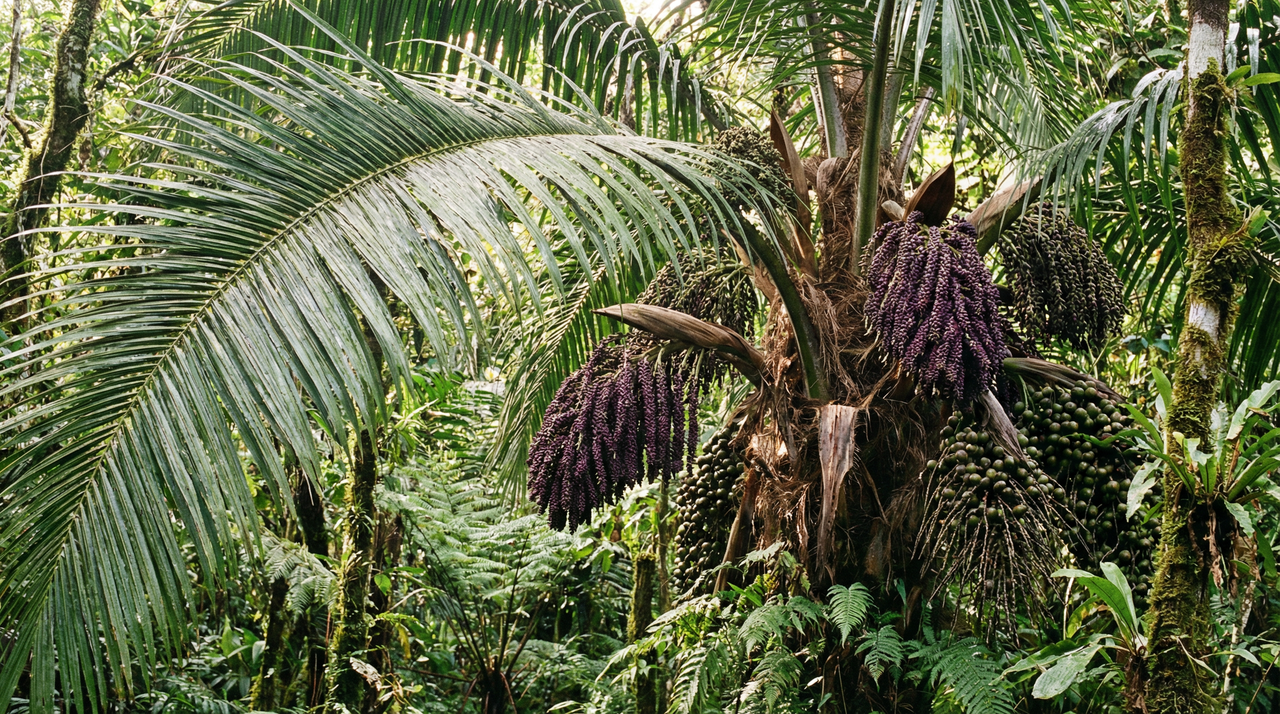
Every part of this palm is useful, and yet most permaculture designers I've met have never grown one, never tasted its sugar, and couldn't pick it out of a lineup. That's a strange gap, because Arenga pinnata has been feeding and clothing people across Southeast Asia for at least four thousand years.[1] The sap alone gets tapped daily, fermented, boiled down into a dark caramel sugar with a depth that makes commercial palm sugar taste flat by comparison. The fiber wraps ropes, thatches roofs, and strings instruments. The starch feeds families when rice fails. This is a plant that entire economies have leaned on, quietly, for millennia, and somehow it barely registers outside its native range.
Here's the part that stopped me when I first really dug into it: the main trunk only fruits once, then dies. The whole stem, gone. Most people hear that and think the plant sounds unreliable, a bad long-term bet. But that reaction misses something important about how this palm actually works, because it doesn't grow as a single trunk. It grows as a clump, producing suckers from the base, cycling through stems across decades while the colony itself just keeps going. Understanding that lifecycle changes everything about how you'd site it, manage it, and harvest from it. That's where this gets genuinely interesting.
Sugar Palm Origin, History, and Botanical Background
Few plants carry the full weight of a civilization's pantry quite like the sugar palm. Arenga pinnata is native to tropical Southeast Asia, with its heartland stretching from eastern India across the Malay Peninsula through Sumatra, Java, Borneo, the Philippines, and into New Guinea, where it grows as an understory to mid-canopy tree in lowland rainforests and secondary forests up to about 1,000 meters elevation.[2][3][4] Humans have been moving it around ever since, and today the arenga pinnata tree is naturalized across Pacific Islands, parts of Australia, Sri Lanka, and even Hawaii.[2][5] A plant that travels with people is usually a plant worth paying attention to.
Botanical Background and Visual Characteristics of Arenga pinnata
The sugar palm tree is a clumping, dioecious palm that can reach 15 to 20 meters with a trunk diameter of 30 to 50 centimeters, wrapped in persistent leaf bases and shaggy black fiber that give it an almost prehistoric silhouette.[6][7] The pinnate leaves run 2 to 5 meters long (occasionally longer), with leaflets that are deep green above and distinctly silvery-white underneath.[2][8] That silver underside is one of the first things I look for when trying to confirm a specimen in a botanical garden or forest planting. It's a great field marker.
What really sets Arenga pinnata apart from most palms is its monocarpic lifecycle at the stem level. Each individual stem flowers just once, after 8 to 20 years of growth, then dies.[6][9] The whole plant persists via basal suckers, which is a critical distinction for anyone planning to grow it. Early on, I made the mistake of being too aggressive removing suckers on a young clump, thinking I was tidying up the planting. What I was actually doing was hollowing out the long-term productivity of the entire colony. You need to maintain multiple stems at different stages of maturity. It's less like managing a tree and more like managing a relay race. The overall lifespan of a well-managed clump runs 25 to 50 years, with some sources reporting up to a century under optimal conditions.[6]
The broader Arenga genus stretches across Southeast Asia in interesting ways. Arenga undulatifolia, endemic to Borneo and Sumatra, has dramatically wavy leaflets and spiny petioles adapted to wind and dappled understory light.[10] Arenga obtusifolia forms compact clumps in Taiwan's subtropical forests, while Arenga tremula and Arenga longipes round out a genus with strong shade-tolerance tendencies across the board, adapted to low-light understory conditions that would stress most palms.[11][12] Several of these species are now under real conservation pressure: Arenga undulatifolia is listed as Critically Endangered on the IUCN Red List, a sobering reminder of what overharvesting and habitat conversion can do to even a resilient, multi-purpose genus.[13]
Traditional and Cultural Uses Across Southeast Asia
Cultivation of Arenga pinnata goes back at least to 2000 BCE in Indonesia and the Philippines, woven into indigenous agroforestry long before the concept had a name.[14][15] The Dayak in Borneo, the Ifugao in the Philippines, the Karen in Thailand, and the Orang Asli in Malaysia all developed distinct but overlapping relationships with this palm, using it simultaneously for food, materials, and ritual.[16] The utility is genuinely staggering: tapped inflorescences yield the sweet sap that becomes gula aren (palm sugar), fermented tuba, or distilled spirits; leaves provide thatch and weaving material; the famous ijuk black fiber from the trunk serves in construction and rope-making; and various parts address wounds, diarrhea, and inflammation in traditional medicine.[17][18]
Across Bali, the Philippines, and Taiwan, the sugar palm plant also carries deep symbolic weight as a representation of fertility, prosperity, and communal sustenance, appearing in ceremonies from Balinese Hindu ritual to the Amis Harvest Festival.[19][20] Traditional practitioners have long practiced selective tapping without felling, rotational harvesting, and community management as ways to keep the resource alive across generations.[21] In my reading of ethnobotanical records and work with regenerative systems, that selective tapping ethic isn't just culturally respectful; it's non-negotiable if we want these palms to persist. The genus-wide pattern holds too: Taiwanese indigenous groups including the Bunun and Atayal tap Arenga obtusifolia for sugar and wine and weave its leaves, while the Dayak and Iban use Arenga undulatifolia medicinally and regard it as a symbol of resilience even as overexploitation has made it increasingly rare.[22][23] Traditional knowledge and sustainable management aren't separate ideas here; they're the same idea.
Fun Facts About the Sugar Palm and Its Relatives
Beyond its sheer utility, the sugar palm is an ecologically active presence in any landscape. Its fibrous roots extend horizontally up to 6 meters or more, stabilizing slopes and building soil structure, while the fruits feed birds, bats, and monkeys, and the complex leaf bases host epiphytes and small invertebrates.[2][24] After working with a number of Southeast Asian-inspired guild designs, I've been consistently surprised by how much wildlife activity concentrates in the leaf litter and fibrous trunk of a mature clump. It becomes its own vertical habitat layer, which is exactly what good food forest design aims for.
Among the genus relatives, the naming stories are worth knowing. Arenga tremula takes its name from the quivering, trembling motion of its leaves in the lightest breeze, while Arenga undulatifolia references those distinctively wavy, undulating leaflets that look almost sculptural up close.[25][26] Arenga obtusifolia tops out around 6 to 15 meters and handles subtropical conditions, while the clustering Arenga longipes features spiny petioles and the same silvery leaflet undersides as its larger cousin.[27][28] There's also genuine taxonomic overlap between tremula and pinnata that has caused confusion in the literature, so always verify your source when sourcing seed or plants. The way the undulating leaflets of undulatifolia flex and redirect in wind reminds me of how some wind-tolerant palms I've worked with in zone 9B handle gusts, that loose, responsive architecture absorbing rather than resisting. It's a trait the whole genus seems to have quietly perfected over millennia of understory life.
Sugar Palm Varieties and Where to Buy Them
If you come to sugar palm expecting a tidy catalog of named cultivars, you'll be quickly disappointed. Arenga pinnata simply doesn't work that way. There are two recognized botanical varieties: var. pinnata, the typical form spread across Southeast Asia, and var. sumatrana, largely restricted to Sumatra with some possible morphological differences.[29] Beyond that, selection has happened the slow, informal way -- farmers in Indonesia, Malaysia, and the Philippines have observed which seedlings produce well or stand up to local conditions and saved seed accordingly, not through breeding programs or registered cultivar names.[30][31] What you're really working with are local ecotypes, not standardized selections.
Notable Varieties and Related Arenga Species
The anchor species itself is substantial: a mature Arenga pinnata will push 15 to 20 meters tall with a canopy spread of 4 to 6 meters and fronds stretching 3 to 5 meters long.[32][33] That's a lot of palm. For most home food forest designs, the related arenga species deserve serious consideration as well. Arenga undulatifolia, the Wavyleaf Sugar Palm, tops out at 4 to 8 meters with fronds that have distinctively wavy-margined leaflets -- genuinely beautiful in a way that stops visitors in their tracks.[34][35] I've seen specimens at botanical gardens in South Florida and the visual contrast between those wavy leaflets and a standard pinnata is immediately obvious from a design standpoint. Arenga tremula, the Dwarf Sugar Palm, is my personal recommendation for growers with tighter spaces: it clusters at 4 to 8 meters with silvery leaf undersides and a manageable 3 to 4.5 meter spread.[36][37] In a Central Florida garden where you're already negotiating space between canopy trees, that difference in scale matters enormously. Arenga obtusifolia rounds out the genus at 6 to 10 meters, with sugar-producing potential though it's less common in cultivation than pinnata.[38]
Sourcing Sugar Palm and Related Species
You won't find sugar palm at a mainstream garden center. Standard U.S. nurseries simply don't stock it, and sourcing requires going through specialty tropical nurseries, exotic importers, or seed suppliers like Rare Palm Seeds, Eat Your Yard, or Logee's Plants.[39][40] Seeds run roughly $5 to $20 each, with small packets in the $10 to $50 range; seedlings and young plants typically fall between $15 and $60 depending on size.[41] I've ordered Arenga pinnata seed more than once and learned the hard way that freshness is everything with this species -- the seeds are recalcitrant, meaning they don't store, and viability drops fast. Supply also fluctuates with seasonal fruiting cycles and import logistics, so prices and availability shift constantly.
On the regulatory side, pinnata itself is not CITES-listed and import requires only standard USDA APHIS phytosanitary compliance.[42][43] The related species are a different story. Arenga undulatifolia carries IUCN conservation concerns and CITES protections, making it genuinely rare in U.S. trade and requiring proper paperwork when it surfaces at all.[44][45] Arenga obtusifolia is similarly rare, with specimen plants reaching $150 to $800 or more from specialists.[46] Arenga tremula is more accessible, with plants typically $50 to $200 and seeds around $2 to $10, and no CITES restrictions.[47][42] When I'm sourcing any of these palms I always start with reputable specialty nurseries and verify current APHIS requirements before placing an order -- it saves real headaches. With patience and the right supplier, pinnata and its compact relatives are genuinely obtainable, and worth every bit of the effort.
How to Propagate and Plant Sugar Palm (Arenga pinnata)
Sugar palm asks one thing of you before anything else: move fast. The seeds are recalcitrant, meaning they don't go dormant and can't be dried for long-term storage. Left at room temperature without careful handling, Arenga pinnata seeds lose viability within 2 to 4 weeks of harvest.[48][49][50] I learned this the hard way early on when I let a batch sit too long before sowing. Now I start the germination process within days of receiving fresh seed, not weeks.
Seed Propagation: Handling Recalcitrant Seeds and Polyembryony
The seeds themselves are roughly 2 to 3 cm across, dark brown to black, with a hard fibrous coat and an oily ruminate endosperm inside.[2][51] Start by soaking them in warm water for 24 to 48 hours to soften that tough outer layer and flush off any clinging fruit pulp; mild scarification or a gibberellic acid soak can help with stubborn batches.[52][15] Sow into a well-draining sand-peat or sand-compost mix, keep temperatures between 25 and 30°C, and maintain humidity around 70 to 90%. Fresh seed sown under those conditions can hit 50 to 80% germination, though you should budget 1 to 6 months for the process since germination is hypogeal and happens slowly below the soil surface.[53]
Here's the rewarding surprise that patience earns you: Arenga pinnata is polyembryonic, often pushing out 2 to 5 seedlings from a single seed.[54][55] Those clusters are genuinely exciting when they emerge, but I've made the mistake of not labeling my flats carefully enough. Young sugar palm seedlings look deceptively similar to several other palm genera in the first weeks, and when a single pot suddenly has four sprouts in it, things get confusing fast. Label everything. Trust me on this one.
For clustering relatives like Arenga undulatifolia and A. obtusifolia, basal sucker division is a reliable vegetative option. Select suckers that are 1 to 2 years old and 30 to 50 cm tall with their own roots, cut cleanly, treat the wound with fungicide, and plant into partially shaded, well-drained soil during warm months.[56][57] Solitary A. pinnata doesn't sucker reliably, so seed is almost always your only path. Tissue culture exists for research and conservation purposes, but it requires sterile lab conditions and isn't something a home grower can replicate; grafting, air-layering, and cuttings all have low success rates and aren't worth attempting.[58][59]
Site Selection, Soil, and Light Requirements
Sugar palm evolved in Southeast Asian rainforest understories, which tells you almost everything you need to know about site selection.[2] Young plants especially want filtered or dappled light, around 4 to 6 hours of indirect sun daily, with protection from intense afternoon exposure.[60] I've watched seedlings scorch badly under full Florida afternoon sun within a few days; I start mine under 50 to 70% shade cloth and transition gradually. Think of the light requirements as similar to what you'd give a large fern or a calathea, minus the delicacy.
Soil should be well-drained, fertile loamy or sandy loam with good organic matter content, and a pH between 5.5 and 7.5, ideally landing in the 6.0 to 7.0 sweet spot.[61][40][15] Heavy clay and waterlogging will cause root rot quickly. I've seen iron chlorosis develop in plants grown in slightly alkaline fill soil, and once it takes hold it's slow to reverse. Regular mulching with organic material keeps the pH in range, holds moisture, and suppresses weeds without trapping water against the crown.[62] For containers, blend in perlite or coarse sand to keep air moving around the roots.
Spacing, Planting Technique, and Establishment
Mature Arenga pinnata reaches 9 to 24 meters tall with a canopy spread of 4.5 to 6 meters.[63] Commercial plantations space trees on an 8 to 10 meter grid, running roughly 100 to 150 trees per hectare.[64] For landscape plantings in Florida zones 10 to 11, 4.5 to 6 meters gives the palm room to grow while still fitting into a home-scale food forest. Smaller clustering species like A. undulatifolia can be tucked in at 3 to 6 meters in garden settings, though production plantings of those still want 8 to 12 meters.[65] I once planted a small trial group too close together and had a messy time thinning after year five when the clumps started competing. Wider spacing from the start keeps airflow up, disease pressure down, and harvest access practical.
Plant after the last frost once soil temperatures exceed 15°C, ideally at the start of the wet season in subtropical climates.[64][66] Set seedlings or suckers at the same depth they were growing in their nursery container, stake in windy sites, and mulch the root zone generously. The first few years feel slow; this is a palm that builds its root system long before it shows much height. Give it the space it needs from day one, and it will fill that space in its own time.
Sugar Palm Care Guide
Growing sugar palm well means thinking like the plant thinks: you're replicating the layered humidity and filtered light of a Southeast Asian rainforest, then gradually adjusting as the palm matures and claims more of the canopy for itself. The care needs shift considerably over a 20-to-30-year productive life, so I'll walk through them in roughly the order they matter to a grower.
Sunlight Requirements for Sugar Palm
Young sugar palms want the dappled shade of a forest understory, not blazing afternoon sun.[8] I learned this the hard way in my Central Florida garden, where I planted a two-year seedling in an open bed and watched the leaf margins crisp up within a week. After that I started siting juveniles under taller palms or 30-percent shade cloth for the first two years. Once a specimen is established and has a few strong fronds fanning out, full sun becomes tolerable and eventually preferred.[67] For anyone trying to grow one indoors, east- or west-facing windows give the bright indirect light the plant needs, with supplemental grow lights filling gaps in darker rooms.[68][40] Related species like Arenga undulatifolia manage lower light partly because high humidity under a closed canopy reduces the photosynthetic demand, a useful reminder that moisture and shade work together.[69]
Watering Needs and Soil Moisture Management
The practical rule is simple: keep the soil consistently moist but never waterlogged, and water when the top two to three inches feel dry.[70][8] Seedlings are the demanding ones here. They need soil held at roughly 60-70 percent field capacity and will show wilting and tip browning within days if that slips.[71] Established plants have moderate drought tolerance and can ride out a short dry spell, but anything beyond two weeks warrants supplemental irrigation.[40] In humid subtropical summers I rarely need to water my mature specimens at all, but container plants are a different story and I check them almost daily.
Knowing the difference between overwatered and underwatered is worth memorizing. Overwatering shows as uniform yellowing of lower fronds, premature frond drop, and mushy dark roots with a foul smell. Underwatering looks like crispy leaf tips, wilting, and stalled frond production.[40][72] The soil itself matters too: a sandy loam or volcanic mix rich in organic matter with a pH between 5.5 and 7.0 drains well enough to prevent the anaerobic root conditions that cause most of those overwatering symptoms.[70][40]
Fertilizing Sugar Palm: Feeding for Sap and Fruit Production
Fertility needs change as the palm ages, and getting this right is what separates a healthy specimen from a chronically deficient one. Young plants in their first three years want a nitrogen emphasis to push vegetative growth; once a palm hits five or more years and approaches reproductive maturity, potassium becomes the priority nutrient for sap quality, flowering, and fruit set.[73][74] I've noticed that palms in my garden kept on adequate potassium produce noticeably sweeter sap when tapped years later, so this isn't just theoretical.
In practice, a 20-10-10 formula suits young plants while mature specimens do well on something like 12-6-18 or 15-15-20; standard slow-release palm granules in the 8-2-6 or 12-4-8 range also work as general maintenance feeds.[75][15] Apply at around 100-300g per mature tree split across two or three growing-season doses, and halve that for young plants.[73] Watch the older fronds for yellowing with green midribs, which signals magnesium deficiency, and young fronds for interveinal chlorosis, which points to iron. Potassium deficiency shows as marginal necrosis and frizzle top; manganese deficiency produces speckling and necrotic streaks on new growth.[76][75] I do a soil test every two to three years and adjust blends based on what the leaves are telling me. Compost, aged manure, or rice husk compost layered over the root zone also helps replicate the organic-rich forest floor this palm evolved in.[73][77]
One comparison worth noting: Arenga obtusifolia is a notably light feeder that relies on mycorrhizal partnerships in low-fertility soils and can be damaged by the same rates that Arenga pinnata handles comfortably.[78] If you're growing multiple Arenga species, don't assume one fertilizer schedule fits all.
Frost Tolerance and Cold Protection
Sugar palm is reliably hardy in USDA zones 9b through 11, with a minimum survival temperature around 28°F (-2°C) and potential for brief dips to 25°F (-4°C) before serious damage sets in.[8][2] Cold damage reads as wilting, browning frond margins, and in severe cases crown die-back, with young plants far more vulnerable than established ones. In my zone 9b garden I've kept mature specimens unscathed through several light freezes using about 8-10 inches of organic mulch over the root zone plus a frost blanket draped over the crown on nights below 30°F.[79] For anyone in a marginal situation, pushing that mulch depth to 12-18 inches and adding wind protection makes a real difference.[80] Container plants can simply be moved somewhere above 50°F.
Arenga obtusifolia, the highland species, shows a bit more cold hardiness once established and may tolerate brief dips to around 20°F (-6°C).[76][81] Arenga engleri cold hardiness is better known among subtropical growers, but for Arenga pinnata, I'd treat 28°F as the real working limit and not push it without protection in place.
Heat Tolerance and Summer Care
Sugar palm thrives in a 68-95°F (20-35°C) range and is rated AHS Heat Zone 12, meaning it can handle more than 210 days a year above 86°F without complaint.[82] That said, prolonged heat above 104°F starts reducing photosynthesis, and I notice the older fronds on my trees scorching first during Central Florida's worst July weeks.[83] Seedlings and palms in active flowering are most vulnerable to heat stress.
The mitigation approach is straightforward: keep soil moisture up, maintain that organic mulch layer at the base, and give young plants 30-50 percent shade cover during the hottest periods.[84] Arenga tremula and Arenga obtusifolia both appreciate a touch more shade than the main species during heat extremes, and are each rated for AHS Heat Zones 9-10 rather than the full zone 12.[85] Wind barriers help too, since hot dry winds compound heat stress faster than the temperature alone would suggest.[86]
Pruning, Maintenance, and Seasonal Rhythm
My pruning philosophy with sugar palms is essentially: less is more, and only cut what's already dead. Remove dead, damaged, or diseased fronds once a year to improve airflow and reduce pest habitat, but never take more than 20-25 percent of the canopy at once, and never cut a healthy green frond thinking you're doing the tree a favor.[76][87] Arenga species have genuinely unpleasant spines, so gloves, long sleeves, and eye protection are non-negotiable. I also sterilize my pruning tools before and after every palm, which is why I've never had a Ganoderma problem despite working in a climate where that fungus is endemic.[88] Dry season is the best time to prune; wet conditions favor fungal entry through fresh cuts.
For general maintenance, keep 5-10 cm of organic mulch around the base, replenish it annually, and stake young plants in exposed or windy spots until they're anchored.[89] Monitor for rhinoceros beetles during active vegetative growth; they're drawn to the soft crown tissue and create entry wounds for secondary infections. Weed control matters most in the first two to three years while the palm is establishing; once the canopy fills in, it handles competition well.[6]
Seasonally, this palm is essentially evergreen with no true dormancy.[2] Rainy season brings noticeably faster growth and larger fronds; drought or extreme heat slows things down without stopping them. Flowering typically begins after 8-12 years, and because sugar palm is monocarpic at the stem level, that stem will eventually die after fruiting. What I find reassuring about the clumping habit is that I've never felt anxious about losing the whole plant to this cycle; the colony just carries on through its suckers, one generation quietly replacing another.[90]
Harvesting Sugar Palm (Arenga pinnata)
Growth Timelines and When to First Harvest
Sugar palm demands a particular kind of grower patience. From seed, Arenga pinnata takes 5-8 years to yield its first tappable sap and 6-10 years to produce fruit, with optimal production arriving somewhere between 10-15 years.[77][91][6] After growing this palm from both seed and suckers, I now recommend suckers without hesitation. Vegetative propagation shortens that first sap harvest window to 4-6 years,[6][92] and that difference of several years feels enormous when you're actually waiting it out. Related species shift the timeline further: Arenga undulatifolia begins sap production around 6-8 years, while Arenga tremula can push 10-20 years from seed for meaningful fruit (though suckers bring it to 5-8 years).[93][94] Plan accordingly. Sap flow and fruiting both peak during the dry season, typically March through July in Indonesia and the Philippines, with tapping initiated on 1-2 m inflorescences during a flowering period that can sustain itself for 6-12 months per stem.[15]
Sap Tapping Techniques and Seasonal Flow
Tapping a mature sugar palm is physical, rhythmic work. Growers climb to the inflorescence stalks using ladders, make V-shaped incisions, and collect sap in bamboo containers early in the morning, typically during dry weather when flow runs strongest. Each stalk yields roughly 1-3 liters per day and continues producing for 2-7 months before the stalk is spent.[15][95][96] Tapping can happen year-round, but dry-season flow is noticeably stronger and sweeter, which matters for sugar quality.[15][97] The first time I worked a young inflorescence, flow was sluggish until I deepened the cut slightly and shifted collection to the coolest part of the morning. Sharp, clean cuts aren't just about efficiency; they're how you protect the stalk enough to sustain weeks of flow without introducing infection. Collected sap needs prompt processing, which I'll leave to the preparation section, but the message at harvest is: don't let it sit.
Fruit Ripeness Indicators and Yields
Female palms produce dense clusters of ovoid, 2-4 cm drupes that move from green through orange-red to a deep reddish-brown or black at full ripeness, with each fruit containing 1-3 seeds.[8][98] I've learned to judge readiness the same way I read a mango or lychee: when 70-80% of a bunch has shifted to that ripe color, the whole cluster is ready.[6][99] Counting individual drupes isn't practical; reading the bunch as a whole is. Fruit from anthesis to harvest takes 4-6 months, and post-harvest storage works best at 10-15°C with 85-90% humidity for a 2-4 week window; dip below 10°C and chilling injury sets in quickly.[99][15] For context, Arenga undulatifolia produces massive inflorescences exceeding 100 kg with glossy black-purple drupes, while Arenga obtusifolia and Arenga tremula offer smaller 1-3 cm orange-red to black fruits.[93][100] One rule I hold firm regardless of species: I never harvest the apical meristem for palm heart. Removing it kills the plant outright.[93] The sap, the fruit, the arenga fiber from the trunk -- those are the sustainable harvests. The heart is the tree's future, and it's not worth the trade.
Sugar Palm Preparation and Uses
Every part of this palm has a job. That's not an exaggeration -- Arenga pinnata is genuinely one of those plants where the more you learn, the longer your list of uses gets. But with that bounty comes real responsibility, because several of those uses require knowing exactly what you're doing before you put anything in your mouth.
Culinary Uses, Nutrition, and Safety of Sugar Palm
The sap is where the story starts. Fresh from the inflorescence, it's a lightly sweet, slightly floral liquid running 10-15% sugar by content and delivering roughly 250-300 kcal per 100 ml along with potassium, calcium, magnesium, and traces of vitamins C and B.[101][102] Boil it down the same day -- and I mean the same day -- and you get gula aren, a palm sugar that registers somewhere between caramel, toffee, butterscotch, and molasses with a faint smoky undercurrent that no refined sugar can replicate.[103] The finished sugar runs 70-80% sucrose and about 380-400 kcal per 100 g while retaining small amounts of magnesium, zinc, and B vitamins.[104] Across Southeast Asia it goes into klepon, es cendol, bibingka, bubur sumsum, sambals, and glazes -- wherever you want sweetness with actual depth.[105]
What happens when you don't process the sap immediately? It ferments. Within hours in humid tropical conditions, yeasts convert those sugars into tuak, a palm wine with yeasty, boozy, fruity aromas from ethanol, ethyl acetate, isoamyl alcohol, and terpenes.[106] I've processed sugar-palm sap in Florida's summer heat and watched unboiled batches go noticeably yeasty in under 24 hours. That guidance about immediate processing isn't conservative caution; it's just chemistry.
Beyond sap, the ripe fruit pulp is sweet, tangy, and fibrous, tasting somewhere between dates, lychee, and figs, with respectable nutrition: around 100-150 kcal per 100 g, meaningful fiber, vitamin A, beta-carotene, vitamin C, potassium, and phosphorus.[107][108] The palm heart offers a mild, nutty, artichoke-like crunch when cooked, and related species like A. undulatifolia and A. obtusifolia yield sago-like trunk pith (80-90% starch) useful as a gluten-free thickener or porridge base.[6][109]
Now the cautions. Raw and unripe parts of Arenga pinnata contain calcium oxalate crystals (raphides), oxalates, and cyanogenic glycosides that cause oral irritation and gastrointestinal distress.[110] I compare the sensation to handling a raw aroid corm or biting into an unripe persimmon -- that immediate scratchy, burning feeling that tells you something needs cooking first. Boiling and roasting neutralize these compounds, and ripe fruit pulp is generally safe after thorough processing. Harvesting the palm heart kills that stem, so I always opt for sap and fruit instead, using young shoots only from multi-stemmed clumps where one stem's loss doesn't cost you the whole tree. Misidentification also matters here: A. obtusifolia looks similar and carries higher oxalate loads, so confirming your species before harvesting anything is non-negotiable.[111]
Traditional Medicinal Preparations from Sugar Palm
Traditional healers across Indonesia, Malaysia, and the Philippines have long used specific parts of this palm for specific complaints: fruit for diarrhea and dysentery, roots for fever and rheumatism, sap as a wound treatment and general tonic.[112] Related species follow similar patterns, with A. obtusifolia leaf and sap extracts used for wounds, inflammation, and digestive issues across the region.[113] Standard preparations include decoctions (10-20 g dried roots or leaves simmered in 500 ml water for 15-20 minutes) or infusions of fresh leaves steeped for around 10 minutes.[112]
The underlying phytochemistry -- flavonoids, phenolics, saponins -- does support antioxidant, anti-inflammatory, and antimicrobial activity in preclinical studies, but clinical human trials establishing dosage and safety interactions simply don't exist yet.[16][114] I've seen leaf decoctions used for mild digestive relief in traditional contexts and I respect that these practices have persisted across generations of careful use. But I always tell people to consult a qualified practitioner, especially since the oxalate concerns from raw parts extend into any preparation where plant material isn't thoroughly processed.
Non-Food and Cultural Uses of Sugar Palm
The black fiber stripped from the leaf sheaths, called ijuk or gomuti, may be the most underappreciated product this palm yields. It's stiff, incredibly durable, and resistant to the kind of rot that claims most natural fibers in tropical humidity -- properties that make it genuinely superior to many commercial cordage materials for outdoor use.[115] I've used it in demonstration gardens as both functional rope and dark decorative thatch, and it holds up beautifully season after season. Across Dayak, Ifugao, and Balinese communities it goes into brooms, mats, hats, ropes, gamelan instrument covers, and construction, carrying ritual significance as a symbol of prosperity in festivals and ceremonies.[105][116]
Leaves thatch roofs and wrap food. The wood handles light construction, tools, and fuel. Fruit kernels, when processed, yield an oil rich in lauric and oleic acids with potential vitamin E content.[117][118] Modern applications have extended into commercial palm sugar markets and bioethanol production. What ties all of this together from a permaculture perspective is that sustainable sap tapping from multiple inflorescences can continue across the palm's productive lifetime without ever killing the tree.[119] You get sugar, fiber, thatch, and medicine from one long-lived clump, year after year, and the ecosystem keeps functioning underneath the whole time.
Sugar Palm Health Benefits and Medicinal Uses
After years of designing tropical food forests, I've come to appreciate that the most valuable plants in a system are often the ones where the line between food and medicine gets genuinely blurry. Sugar palm is one of those plants. Every part of Arenga pinnata has been put to work across generations of traditional Southeast Asian practice, and the emerging phytochemical research is starting to explain why.
Traditional Medicinal Uses Across Southeast Asia
The ethnobotanical record for this palm is remarkably consistent across Indonesia, Malaysia, and the Philippines. Seeds are decocted for digestive complaints and fever, bark is applied topically to wounds and skin infections, flowers are used for cough and asthma, and the sap is valued as an energy tonic and electrolyte replenisher.[120][121] The full scope of recorded uses spans digestive issues, fever, hypertension, urinary problems, rheumatism, malaria, skin infections, and postpartum recovery.[120][122] Related species across Borneo, the Philippines, Taiwan, and peninsular Malaysia show nearly identical patterns, which tells me this isn't coincidental folk practice; it's accumulated observation across ecosystems.[123]
Key Phytochemicals in Sugar Palm
The reason those traditional uses hold up under scrutiny comes down to a rich secondary metabolite profile. Leaves are the most concentrated source, followed by fruit then trunk, with phenolic content reaching up to 150 mg GAE/g, flavonoids around 80 mg QE/g (quercetin, rutin, kaempferol, catechin derivatives), saponins at 5–8%, tannins up to 20% in bark, and trace alkaloids and terpenoids including β-sitosterol.[124][125] These levels aren't static; they peak in the wet season and vary with geography and growing conditions, which is why Indonesian and Malaysian samples sometimes read differently in antioxidant assays.[126] Plants grown in the hot, humid, high-rainfall conditions they evolved in tend to produce the most robust secondary metabolite profiles, which is worth keeping in mind when you're choosing a site.
Scientific Research on Antioxidant, Anti-Inflammatory, Antimicrobial, and Antidiabetic Effects
The preclinical research is genuinely interesting, even if it hasn't yet produced human clinical trials. Antioxidant activity comes in strong, with DPPH IC50 values of 20–50 μg/mL driven by hydrogen atom transfer from the phenolic and flavonoid load.[127] Anti-inflammatory work shows fruit extracts inhibiting COX-2, suppressing TNF-α, IL-6, and NF-κB pathways, and reducing paw edema in rats by roughly 60% at 200 mg/kg.[124][128] Antimicrobial effects against S. aureus (MIC 125 μg/mL) and E. coli are attributed mainly to saponins disrupting bacterial cell walls.[129] The antidiabetic data may be the most clinically relevant: α-glucosidase inhibition with IC50 values of 20–50 μg/mL and α-amylase inhibition around 45 μg/mL in animal models, alongside improved insulin sensitivity.[130] While I find these arenga pinnata benefits compelling, I always encourage readers to treat this as a nourishing food first and consult a qualified practitioner before using it therapeutically.
Nutritional Profile of Edible Parts
Fresh sap runs about 80–85% water with 10–15 g of carbohydrates per 100 g and a meaningful load of phenolics (over 500 mg GAE/L) that contribute real antioxidant value before any processing happens.[131][30] Boiling it into palm sugar concentrates things considerably, around 380 kcal/100 g with some retained B vitamins, potassium, and iron, though heat-sensitive vitamin C takes a hit.[132] Young fruit pulp is more modest at 80–100 kcal with useful fiber (5–10 g), vitamin C (20–30 mg), and beta-carotene.[133] The palm heart is where things get interesting from a low-calorie standpoint: just 20–30 kcal per 100 g with 300–500 mg of potassium, fiber, and vitamins A and C.[134] Having worked with sabal palmetto and peach palm hearts in other designs, I can say the nutritional parallels are real, and Arenga heart holds up well in tropical salads or stir-fries when you have access to a thinned sucker.
Safety and Precautions
The overall safety picture for arenga palm sugar and its related edible parts is reassuring. Acute toxicity studies show LD50 values above 2000 mg/kg, the ASPCA doesn't flag it as toxic to common pets, and centuries of food use across Southeast Asia back up that baseline.[135][136] The caveats cluster around preparation: unripe fruit, raw seeds, or improperly handled sap can contain saponins, oxalates, tannins, or cyanogenic glycosides at levels that cause nausea, vomiting, or contact dermatitis.[137][138] I always tell clients to wear gloves and long sleeves when tapping or pruning; I've seen clients end up with irritated skin from the milky latex after skipping that step. No standardized dosages exist for medicinal preparations, and use during pregnancy hasn't been well studied so it's generally avoided.[135] Because the α-glucosidase inhibition data is solid enough to take seriously, anyone on antidiabetic medications should talk with their doctor before using sugar palm medicinally; this is a real interaction worth respecting, not a boilerplate disclaimer.[139]
Sugar Palm Pests and Diseases
Sugar palm thrives in the warm, humid conditions that also happen to be a paradise for pathogens. I've watched growers in tropical landscapes pour years of care into these palms only to lose a mature specimen in a single wet season because something went wrong underground before any symptom appeared above the soil line. The good news is that most of what threatens Arenga pinnata is preventable. The bad news is there are no resistant cultivars to bail you out, so prevention really is everything.
Major Fungal Diseases of Sugar Palm
The two threats I worry about most are Ganoderma butt rot and Phytophthora bud rot, and both can kill a mature palm in months. Ganoderma zonatum and Ganoderma boninense infect the root system and move upward through the base of the trunk, often showing no outward sign until the tree is already dying from the inside.[140][141][142] Phytophthora palmivora takes a different route, attacking the growing point at the crown, which is especially devastating in waterlogged soils during heavy rainfall.[141][143] In every palm guild I've designed where drainage was properly addressed and trunk wounds were avoided during maintenance, these diseases stayed out. That connection between cultural practice and outcome has held across multiple seasons and multiple sites.
Other Diseases and Susceptibilities
Beyond those silent killers, a complex of leaf spot fungi including Pestalotiopsis, Bipolaris, and Curvularia causes necrotic lesions on the fronds whenever humidity climbs above 80 percent and air circulation is poor.[141][15] Bacterial leaf spot from Xanthomonas species is a moderate risk under the same humid conditions, though viral diseases and lethal yellowing are either extremely rare or simply undocumented in this genus.[140][144] If you're searching for resistant varieties to sidestep all of this, I'll save you the time: none exist commercially across Arenga pinnata or its relatives, though some Indonesian local selections show modest fungal tolerance.[141][142] Waterlogging accelerates root rot fast, and soil pH outside the 5.5-7.5 window combined with temperatures above 25°C under high humidity raises the overall disease load considerably.[15][145] The site and soil prep covered in the care guide section really does the heavy lifting here. For fungal flare-ups, copper-based compounds work on bacterial and some fungal leaf spots, mancozeb targets the leaf spot complex, and phosphonates help against Phytophthora when cultural fixes alone aren't enough.[146][147]
Common Pests of Sugar Palm and Related Arenga Species
Red palm weevil (Rhynchophorus ferrugineus) and rhinoceros beetle (Oryctes rhinoceros) are the most destructive insects this palm faces, tunneling into trunks and crowns of plants at any age and leaving behind entry wounds that Ganoderma and Phytophthora are happy to exploit.[148][149] I check weekly for the fine sawdust-like frass at the trunk base that signals weevil activity; by the time you see unexplained wilting in the crown, the damage is already significant. Scale insects (particularly Aspidiotus destructor), mealybugs, caterpillars like Opisina arenosella, gall midges, leaf beetles, and spider mites round out the secondary pest complex, causing yellowing, defoliation, sooty mold, and general stunting.[150] Related species like Arenga undulatifolia, A. obtusifolia, and A. tremula share the same vulnerabilities, and young suckering plants across the genus are especially exposed.[151][152]
Natural Defenses and Integrated Management Strategies
Sugar palm isn't completely defenseless. Its fibrous trunk, silica phytoliths, and a suite of phenolics, tannins, terpenoids, and saponins provide moderate resistance compared with softer-stemmed palms like young coconut.[153][154] Think of it as buying you time for early intervention rather than immunity. Since no pest-resistant cultivars exist and genetic selection is still at the wild-population stage, integrated management is the only reliable strategy.[155][156] In my experience, consistent sanitation (removing infected fronds promptly), good spacing for airflow, pheromone traps for early weevil detection, and encouraging lady beetles and parasitic wasps have proven far more reliable than hoping for a genetic silver bullet.[155][157] Neem-based products and targeted insecticides belong at the end of the toolkit, used only when monitoring confirms populations have exceeded practical thresholds. Most of what looks complicated on this list collapses into a simple routine: watch closely, drain well, and don't wound the trunk.
Sugar Palm in Permaculture Design
Before you can design with sugar palm, you have to be honest about where it will actually grow. Arenga pinnata is a committed tropical: it wants temperatures in the 20-30 °C range, humidity between 70 and 90 percent, and somewhere between 1,500 and 3,000 mm of rainfall spread fairly evenly across the year.[15][158] It grows from sea level up to about 1,500 m, though it performs best below 1,000 m. That profile rules out a lot of gardens, and the sooner you know that, the better.
Climate Requirements and Suitable Zones
Sugar palm sits in USDA zones 9b through 11, with reliable, unfussy growth only in 10a and warmer.[8][159] Mature plants can survive a brief dip to around 25-28 °F, but leaf damage starts below 30 °F, and young plants have considerably less buffer.[61][160] I learned that lesson the hard way: I lost two young specimens in my zone 9b garden during an unexpected frost, even though the temperatures only dropped into the high 20s for a few hours. Now I plant them exclusively on the south side of taller trees where overhead canopy breaks the radiative heat loss overnight. If you're pushing the cold edge, that kind of microclimate management isn't optional.
For growers on the cooler fringe, the genus offers some modest alternatives. Arenga obtusifolia and Arenga undulatifolia can perform in a protected 9b site, while Arenga tremula remains marginal even with careful siting.[161][162] All of them share the same dislike of prolonged drought or waterlogged soil, so drainage and consistent moisture matter regardless of which species you're working with.[2]
Ecosystem Functions and Biodiversity Support
The ecological resume of this palm is genuinely impressive. The pendulous inflorescences attract a specific guild of beetle pollinators, primarily from the families Nitidulidae and Curculionidae, drawn in by strong floral odors, heat generation in the flowers, and protandrous timing that encourages cross-pollination.[163][164] I noticed this firsthand one evening: standing near a flowering stem at dusk, there was a distinct fruity fermentation smell, and within twenty minutes the inflorescence was buzzing with beetle activity. Flowering aligns with the wet season, and manual pollination can improve fruit set in cultivation if beetles are scarce.[165] The orange-red drupes that follow are eaten by birds, bats, and small mammals, which handle seed dispersal across the landscape.[8]
Below ground and in the litter layer, the palm does solid structural work. The fibrous root mat stabilizes slopes and resists erosion, and the leaf litter cycles nutrients back into the soil, though decomposition is slow because of high lignin content.[166][167] I compare it to coconut fronds in that way: both break down slowly, but over a few years Arenga litter builds a genuinely rich humus layer. You have to be patient. The palm doesn't fix nitrogen on its own, so pairing it with pigeon pea or a species like Inga brings that fertility function into the guild.[166] The complex habitat inside the old leaf sheaths and trunk structure supports invertebrates, reptiles, and epiphytes; I started noticing more frogs and lizards taking up residence in my Arenga plantings once the stems had a few years of accumulated fibrous material. The sap, fiber, thatch, and timber yields are real and valuable,[168] but they're harvests that emerge from a functioning system rather than the reason to build one. And for growers weighing ecological risk: sugar palm has low invasive potential outside its native range and is rated Least Concern by the IUCN.[2]
Forest Layer Placement and Guild Design
In its native forest, sugar palm occupies the understory to mid-canopy, reaching 10-20 m with pinnate fronds stretching 3-6 m.[2][8] That puts it in a bridging role that few palms fill as naturally, knitting the lower canopy to the upper without becoming weedy or aggressively competitive when placed well. The clustering habit means you're managing a clump rather than a single trunk, and the hapaxanthic lifecycle shapes how that clump evolves over time: each stem flowers once, sets fruit, and dies back, but basal suckers replace it so the colony persists.[8] The first time I watched a mature stem senesce after fruiting while three new suckers were already pushing up at the base, I understood why this palm makes such a dependable long-term guild anchor. It handles its own succession.
For guild design, space plants 3-8 m apart depending on expected clump size and how much light you want to pass through to lower layers.[169][170] The dappled shade from mature fronds suits mushrooms, shade-tolerant herbs, or small fruiting shrubs in the layer below. I routinely plant pigeon pea or Inga on the downhill side of sugar palms on slopes: the palm's fibrous roots hold the bank, the legume feeds the system, and the whole combination is more stable than either plant alone. Pair it with deep-rooted nitrogen-fixers or tall fruit trees overhead rather than plants with similarly aggressive surface roots to keep competition manageable. If your site is too tight for a full-sized specimen, Arenga tremula at 5-15 m offers a compact alternative that fits smaller guild configurations,[171] while Arenga obtusifolia and Arenga undulatifolia occupy the same understory niche with slightly greater shade tolerance when young.[172]
The Palm That Taught Me to Think in Decades
I planted my first sugar palm knowing I might never tap it myself, and there's something clarifying about that. It reoriented my whole relationship with the food forest, pulling me out of the seasonal thinking that dominates most garden work and into something longer, slower, more honest about who a landscape is really for. Some plants you grow for dinner. Some you grow because the land needs them, and because the people who come after you will be glad you did.
Sources 172
- Arenga pinnata: A Traditional Food Plant in Southeast Asia ↩
- Arenga pinnata (sugar palm) ↩
- Arenga pinnata ↩
- Palms of the World ↩
- Arenga pinnata (L.) Merr. ↩
- Arenga pinnata - Useful Tropical Plants Database ↩
- Arenga pinnata - Plants of the World Online (Kew Science) ↩
- Arenga pinnata (Wurmb) Merr. ↩
- Arenga pinnata ↩
- Plants of the World Online - Kew Science ↩
- Arenga obtusifolia (Blume) Merr. ↩
- Arenga tremula ↩
- IUCN Red List: Arenga undulatifolia ↩
- Arenga pinnata: A Multi-Purpose Palm in Southeast Asia ↩
- The Sugar Palm: Traditional Uses and Cultivation ↩
- Ethnobotany of the Dayak People: Uses of Arenga pinnata in Borneo ↩
- Arenga pinnata on Plants of the World Online ↩
- Palm Sugar Production in the Philippines ↩
- The Cultural Significance of Arenga Pinnata in Balinese Hinduism ↩
- Ethnobotany of the Sugar Palm (Arenga pinnata) in Indonesia ↩
- Sustainable Harvesting of Palm Species in Southeast Asia ↩
- Ethnobotany of Taiwan's Indigenous Peoples: The Role of Arenga obtusifolia ↩
- Ethnobotany of Palms in Borneo ↩
- Palms of the World ↩
- Arenga undulatifolia: Morphology and Ecology ↩
- Plants of the World Online: Arenga tremula ↩
- Arenga obtusifolia ↩
- Arenga longipes - Palm and Cycad Societies of Australia ↩
- Palms of the World ↩
- Sugar Palm (Arenga pinnata) in Indonesia ↩
- Plants of the World Online ↩
- Arenga pinnata (Sugar Palm) ↩
- Sugar Palm (Arenga pinnata) ↩
- Arenga undulatifolia - The Wavyleaf Sugar Palm ↩
- Arenga undulatifolia ↩
- Arenga tremula Care Guide ↩
- Arenga tremula ↩
- Missouri Botanical Garden Plant Finder ↩
- Arenga pinnata (Sugar Palm) ↩
- Growing Tropical Palms in the United States ↩
- Propagation of Palms ↩
- CITES Appendices ↩
- Arenga pinnata ↩
- Arenga undulatifolia - The IUCN Red List of Threatened Species ↩
- CITES Species Database ↩
- IUCN Red List: Arenga obtusifolia ↩
- Arenga tremula Availability ↩
- Propagation of Rare Palms: Arenga undulatifolia ↩
- Recalcitrant Seeds: Biology and Storage ↩
- Seed Storage Behaviour of Palms ↩
- Morphology of Palm Seeds ↩
- Propagation of Sugar Palm (Arenga pinnata) ↩
- Seed Germination of Palms Including Arenga pinnata ↩
- Polyembryony in Palms: A Review ↩
- Seed Morphology and Embryology of Arenga Species ↩
- Arenga undulatifolia: Cultivation and Propagation ↩
- Propagation of Palms ↩
- Micropropagation of Arenga pinnata through Somatic Embryogenesis ↩
- Vegetative vs. Seed Propagation in Arecaceae ↩
- Light Requirements for Palms ↩
- Arenga pinnata ↩
- Arenga pinnata Cultivation Guide ↩
- Arenga pinnata Cultivation Practices ↩
- Sugar Palm (Arenga pinnata) Growing Guide ↩
- Arenga undulatifolia ↩
- Palms for Florida Landscapes ↩
- Arenga undulatifolia ↩
- Indoor Care for Arenga pinnata ↩
- Arenga undulatifolia ↩
- Arenga pinnata (Sugar Palm) ↩
- Arenga pinnata Care Guide ↩
- Palm Watering and Stress Symptoms ↩
- Arenga pinnata Cultivation and Management ↩
- Palm Nutrient Requirements and Fertilization ↩
- Fertilization of Palm Trees ↩
- Nutrient Deficiencies of Landscape Palms ↩
- Soil Requirements for Sugar Palm ↩
- Missouri Botanical Garden: Palms Collection Care Guide ↩
- Arenga pinnata - Sugar Palm ↩
- Growing Palms in Temperate Climates ↩
- Arenga obtusifolia ↩
- Arenga pinnata (Sugar Palm) ↩
- Physiological Responses of Sugar Palm to Heat and Drought Stress ↩
- Arenga pinnata Cultivation Guide ↩
- Arenga tremula (Little Sugar Palm) ↩
- Heat Stress Management in Tropical Palms ↩
- Arenga pinnata Care Guide ↩
- Arenga undulatifolia - Wavyleaf Palm ↩
- Palm Crop Management: Sugar Palm ↩
- Arenga pinnata ↩
- Palmyra Palm and Sugar Palm Production ↩
- Propagation of Palms ↩
- Arenga undulatifolia: Cultivation and Biology ↩
- Arenga tremula Profile ↩
- Palm Sap Production in Southeast Asia ↩
- Cultivation of Sugar Palm (Arenga pinnata) ↩
- Palm Sap Harvesting Techniques in Indonesia ↩
- Arenga pinnata (Sugar Palm) ↩
- Harvesting and Post-Harvest Handling of Palm Fruits ↩
- Demography of the monotypic palm Arenga obtusifolia ↩
- Nutritional Composition of Sugar Palm (Arenga pinnata) Sap ↩
- Nutritional Composition of Palm Sap from Arenga pinnata ↩
- The Sugar Palm (Arenga pinnata) in Indonesia ↩
- Palm Sugar: Production and Nutritional Profile ↩
- Ethnobotanical Uses of Palms in Borneo ↩
- Volatile Compounds in Palm Wine from Arenga pinnata ↩
- Physicochemical and Nutritional Properties of Arenga pinnata Fruits ↩
- Bioactive Compounds in Palm Fruits Including Arenga pinnata ↩
- Edible Palms and Their Uses ↩
- Arenga pinnata (Sugar Palm) ↩
- Palms of the World: A Guide to Identification ↩
- Arenga pinnata: A Review on Its Traditional Uses and Phytochemical Constituents ↩
- Medicinal Uses of Arenga Species ↩
- Medicinal Plants of Southeast Asia ↩
- The Sugar Palm (Arenga pinnata) in Indonesia: Traditional Uses and Sustainability ↩
- Ethnobotany of Palms in Southeast Asia ↩
- Sugar Palm (Arenga pinnata): A Multipurpose Species ↩
- Fatty Acid Composition of Sugar Palm Kernel Oil ↩
- Sustainable Harvesting of Palm Sap - FAO Document ↩
- Medicinal potential of Arenga pinnata: A review ↩
- Antibacterial activity of Arenga pinnata seed extracts ↩
- Ethnobotanical Survey of Medicinal Plants Used by Indigenous Communities in Indonesia ↩
- Ethnobotany of Palms in Southeast Asia ↩
- Antioxidant and Anti-Inflammatory Activities of Arenga pinnata Fruits ↩
- Pharmacological Review of Arenga pinnata: Bioactive Compounds and Therapeutic Targets ↩
- Variation in Chemical Constituents in Sugar Palm (Arenga Pinnata) from Different Indonesian and Malaysian Regions ↩
- Phytochemical Screening and Antioxidant Activity of Arenga pinnata L. and Its Potential Applications ↩
- Anti-Inflammatory and Antioxidant Activities of Arenga pinnata Fruit Extract ↩
- Antimicrobial Activity of Sugar Palm Extracts ↩
- Phytochemical Screening and α-Glucosidase Inhibitory Activity of Arenga pinnata ↩
- Nutritional Composition of Palm Sap ↩
- Arabian Journal of Chemistry: Processing of Sugar Palm Sap and Nutritional Changes ↩
- Nutritional Composition of Arenga pinnata Fruits ↩
- Sugar Palm (Arenga pinnata): Nutritional and Edible Uses ↩
- Arenga pinnata: Phytochemical Composition and Biological Activities ↩
- ASPCA Toxic and Non-Toxic Plants List ↩
- Toxicity of Palm Fruits: A Review ↩
- Contact Dermatitis from Palm Trees ↩
- Toxicity Evaluation of Arenga pinnata ↩
- PLANTS Database ↩
- Diseases of Sugar Palm (Arenga pinnata) ↩
- Ganoderma in Palms: Susceptibility of Arenga Species ↩
- Phytophthora Bud Rot in Palms ↩
- RHS Plant Lookup ↩
- Diseases of Palm Trees ↩
- Diseases of Palms and Their Management ↩
- Ganoderma Butt Rot of Palms ↩
- Rhynchophorus ferrugineus (Red Palm Weevil) on Arenga pinnata ↩
- Pests and Diseases of Tropical Palms ↩
- Insect Pests of Tropical Palms ↩
- Diseases of Tropical Palms ↩
- Arenga palm pests: A review ↩
- Chemical Defenses in Tropical Palms ↩
- Physical and Chemical Defenses in Tropical Palms ↩
- Integrated Pest Management for Palms ↩
- Pest Management in Sugar Palm (Arenga pinnata) ↩
- Integrated Pest Management of Palm Weevils ↩
- Sugar Palm (Arenga pinnata) Cultivation in Indonesia ↩
- Arenga pinnata - Royal Horticultural Society ↩
- Cold Hardy Palms - University of Florida IFAS Extension ↩
- Arenga obtusifolia - Palm and Cycad Societies of Australia ↩
- Arenga tremula ↩
- Pollination Biology of Arenga pinnata in Indonesia ↩
- Insect Pollinators of Palms: A Focus on Arenga Species ↩
- Manual Pollination Techniques in Oil Palm and Implications for Other Palms ↩
- Arenga pinnata in Agroforestry Systems ↩
- Soil Conservation Using Native Palms ↩
- Ethnobotanical Uses of Arenga pinnata in Southeast Asia ↩
- Ecology of Understory Palms in Borneo Rainforests ↩
- Permaculture Plants: Arenga Species ↩
- Arenga tremula - Useful Tropical Plants ↩
- Arenga undulatifolia - Useful Tropical Plants Database ↩