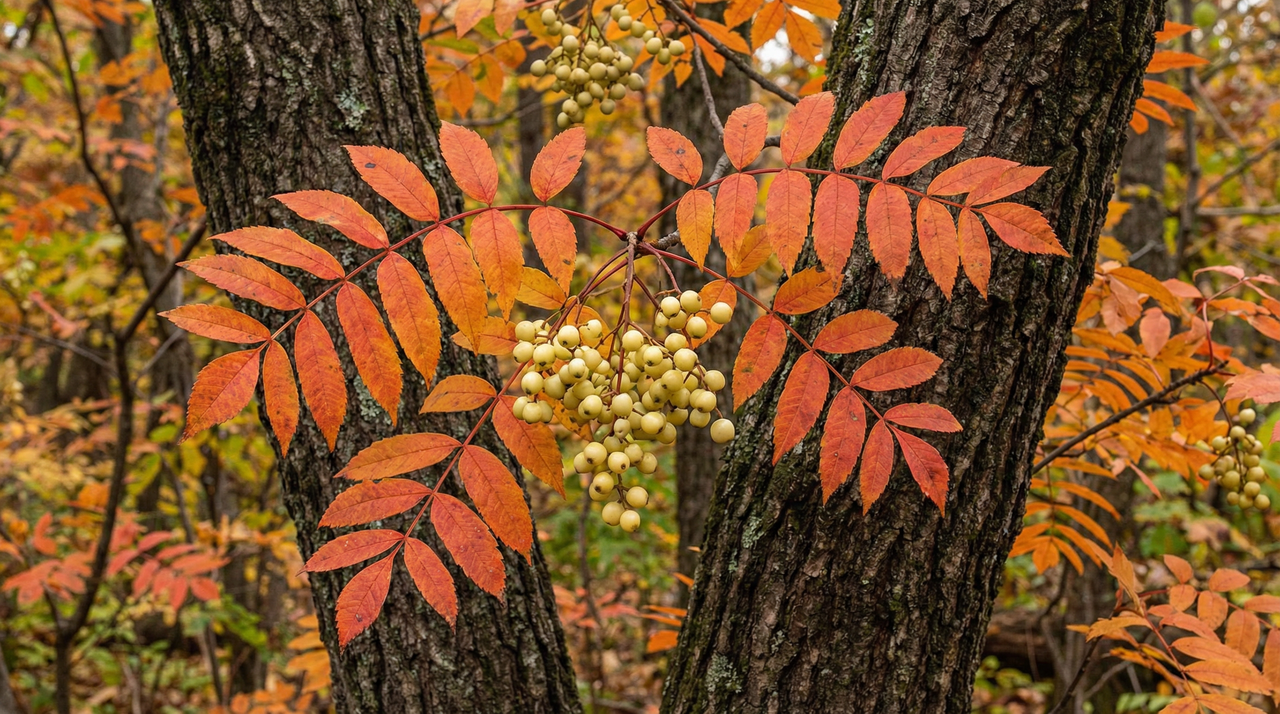
Most people have driven past sumac a thousand times without knowing it. It colonizes highway medians, swallows abandoned lots, flames orange-red along the edges of old pastures every October, and somewhere along the way got lumped in with weeds. What nobody tells you is that those fuzzy red berry clusters you've been ignoring are sour, intensely lemony, and loaded with vitamin C, and that people have been making a cold-brewed drink from them for centuries that tastes better than anything you'd buy at a farmers market. I made my first batch on a whim, rubbing a single cluster between my palms over a jar of cold water, and I remember thinking: how is this not everywhere?
The contradiction at the heart of sumac is that it's simultaneously one of the most dismissed plants in North American landscapes and one of the most useful. It stabilizes eroding banks without complaint, feeds birds through the bleakest part of winter, and resprouts from its roots after fire like nothing happened. It's been a food, a medicine, a dye source, and a tanning agent across dozens of Indigenous cultures. And yet gardeners spend real money removing it. Once you understand what this plant is actually doing out there on the roadside, the whole story flips.
Origin and History of Staghorn Sumac (Rhus typhina)
If you've driven the back roads of the eastern United States in October and noticed those unmistakable torches of crimson foliage blazing along the highway cuts and field edges, you've already met Staghorn Sumac. Most people assume it's a weed. It is one of the most ecologically sophisticated pioneer plants native to this continent.
Botanical Background and Native Range of Staghorn Sumac
Rhus typhina is a deciduous shrub or small tree native to eastern and central North America, stretching from southern Ontario and Quebec down to northern Florida and west toward eastern Kansas and Texas.[1][2] Individual plants typically live 20 to 50 years, but the clonal colonies they anchor through underground root suckers can persist 50 to 100 years or more.[3][2] When I'm doing site assessments in the mid-Atlantic region, I often find colonies that look ancient but started from a handful of pioneers that colonized a clear-cut or road corridor decades ago. Age is genuinely hard to judge from the surface.
The plant's reproductive strategy is part of what makes it so persistent. It's polycarpic, flowering and fruiting year after year without dying back the way monocarpic plants do.[4][5] It's also dioecious, meaning male and female flowers occur on separate plants, which influences how much seed a colony produces depending on the ratio of sexes present.[6] Seed-grown plants take 3 to 5 years to reach reproductive maturity,[7][6] which is why I usually steer clients toward transplanted root suckers when they want berries sooner. Fire and scarification break the seeds' hard coat dormancy, with cold stratification following for best germination. After disturbance, the plant resprouts with remarkable vigor from root crowns and sucker networks.[6][7] This fire-adapted lifecycle, combined with its preference for dry slopes, roadsides, ravines, and disturbed ground from sea level up to around 5,000 feet, explains why it's always first to claim the wreckage.[8][2] For a coastal California contrast, its relative Lemonade Sumac (Rhus integrifolia) occupies a completely different ecological niche in the chaparral,[9][10] which says something about how wide the Rhus genus really reaches.
Visual Characteristics of Staghorn Sumac
Staghorn Sumac typically grows 15 to 30 feet tall, with young stems covered in that distinctive dense, velvety, reddish-brown fuzz.[11] Those stems are the whole reason for the common name: they look almost exactly like antlers in velvet. In winter, when everything else is bare, I use that fuzzy twig texture as my primary field ID key. Smooth stems that look similar? Walk away -- that's a different story. The leaves are pinnately compound, 12 to 20 inches long, with 11 to 31 serrated leaflets that go absolutely incandescent in fall, turning shades of red and orange-red that rival any maple.[1][12] It's honestly one of my favorite signals that autumn has properly arrived.
Flowers are small and greenish-yellow, clustered in upright conical panicles up to 16 inches long that emerge in late spring to early summer.[13][14] Those panicles then mature into the iconic dense, conical clusters of small, fuzzy reddish drupes that persist through winter long after the leaves have dropped.[1][15] Against snow they look like dark red torches, and I'll admit they're one of the reasons I keep recommending this plant to clients who want winter interest. One quick note on confusion: Chinese Sumac (now reclassified as Toxicodendron sinicum) contains urushiol, the same irritating compound found in poison ivy, and it's a different genus entirely despite the shared common name.[16][17] Rhus typhina's velvet stems and those persistent red cones are your safe, reliable ID marks.
Traditional and Cultural Uses of Sumac by Native Americans
Across its native range in eastern North America, Indigenous peoples developed a rich and practical relationship with this plant over thousands of years.[18] The ripe berries were cold-soaked to make a tart, vitamin C-rich beverage that has often been compared to lemonade, used both as a refreshing drink and as a remedy against scurvy.[19][8] I've demonstrated that cold-soak method at workshops many times, and I always emphasize letting the water do the work slowly rather than boiling, which preserves the bright tartness and avoids releasing excessive tannins into the final drink. Young shoots and flower stalks were also consumed as food, though they required careful processing -- repeated boiling with water changes to leach out astringent tannins -- before they were palatable.[20]
Medicinally, tribes used various plant parts to treat gastrointestinal complaints, skin conditions, and respiratory infections.[21][8] The inner bark and berries also yielded red and yellow pigments used to dye textiles and ceremonial items,[22][23] and some tribes incorporated the plant into purification and protection ceremonies.[8] European settlers later adopted sumac tea for its vitamin C content and borrowed the dyeing applications.[24] From there, the plant traveled to Europe through the horticultural trade beginning in the 17th century, naturalizing in the UK, France, Germany, and parts of Asia, where it has occasionally become invasive.[25][26] It currently holds an IUCN status of Least Concern across its range, though sustainable harvesting practices are encouraged to prevent localized depletion.[27]
Fun Facts About Staghorn Sumac
More than 30 bird species rely on those persistent winter fruit clusters for food, including robins, catbirds, and flickers.[8][28] The same cones that look like holiday decorations against January snow are functioning as a critical winter larder. The flowers draw in bees and butterflies during summer, and white-tailed deer browse the foliage and stems as well.[8] On steep slopes and eroded banks, the rhizomatous colony habit that gardeners sometimes find frustrating is doing serious ecological work, holding soil against runoff more effectively than most plantings I could design.[29]
Add to that a genuine fire resistance, deep roots that grant drought tolerance once established, and leaf hairs that reduce water loss and reflect intense sunlight,[30][31] and you have a plant that is structurally engineered for adversity. The "staghorn" name itself comes from those velvety young twigs that mimic antlers so closely you almost do a double take in the field.[32] A roadside weed, people say. I'd call it a deeply adapted native that just happens to be very, very good at surviving whatever we throw at it.
Staghorn Sumac Varieties and Where to Buy
Notable Cultivars of Rhus typhina
Most gardeners encounter staghorn sumac as straight species, but there are named selections worth knowing if you're working within a tighter space or want a specific look. 'Compacta' is the one I reach for most often when I don't want a full thicket situation; it stays smaller and tidier than the species, though after growing it side by side with wild-type plants for several seasons, it still spreads by suckers. More slowly, yes, but it spreads. 'Dissecta' (sometimes listed as 'Laciniata') brings a finely cut, almost ferny leaf that reads beautifully next to bold perennials like Joe Pye weed or cup plant. 'Princeton Sentry' offers a narrow columnar form that works well in more structured plantings, and 'Tigerman' is selected for especially bright red fall color.[33][34] All of them share the species' rugged cold-hardiness, performing reliably in USDA zones 3 through 8.[33][34]
A few European selections like 'Moresnet' and 'Klein Albert' do appear in specialty catalogs, but sourcing them in North America requires patience and some trial-and-error. I wouldn't prioritize tracking them down when the North American cultivars are genuinely excellent and far easier to find from genetically appropriate stock.
Sourcing Staghorn Sumac Plants and Seeds
One thing that makes shopping for sumac genuinely pleasant is that it's a true native, present across 37 states, and carries no invasive classification anywhere in its natural range.[1][11] You're not navigating gray-area legality or ecological risk; you're buying a native shrub with a strong institutional support network behind it.[1][35] The Royal Horticultural Society even awarded it the Award of Garden Merit, which tells you something about how widely its toughness is recognized.[36]
For sourcing, I always prioritize nurseries that can tell me where their stock was grown and propagated. Missouri Botanical Garden runs provenance-focused plant sales offering bare-root and ball-and-burlap plants in Pennsylvania, Missouri, Ohio, and New York, and that's exactly the kind of program I trust for zone-edge plantings where cold-hardiness actually matters.[37][38] Specialty native-plant growers like Prairie Moon Nursery, Native Seeds/SEARCH, and Twin Falls Farm carry seeds, bare-root stock, and container plants in various sizes.[39][40] If you want something larger to establish quickly, Big Picture Orchards offers 20-gallon container specimens.[41] Bare-root stock is the most economical form and peaks in availability March through May.[1][42]
Pricing runs roughly $5 to $15 for small plants in the one- to two-foot range, and $20 to $60 for young to medium-sized specimens, with bare-root always coming in cheaper than potted stock.[43][44] Personally, I rarely spend more than $30 because I buy small and let the plant do what it does best: grow fast. The Lady Bird Johnson Wildflower Center and the USDA Forest Service Native Plant Nurseries Directory are both solid starting points for finding verified, regionally appropriate sources near you.[35][45] Always check current listings before you order; availability, pricing, and stock sizes shift considerably by region and season.[45][46]
Staghorn Sumac Propagation and Planting
Staghorn sumac has two very different reproductive strategies, and understanding both will save you a lot of frustration. It spreads vegetatively through underground rhizomes with almost reckless enthusiasm, and it also produces seeds inside those fuzzy red drupes every autumn. Which path you take matters enormously depending on whether you want a known female that fruits reliably, a diverse colony for wildlife restoration, or just a few plants to anchor an erosion-prone slope.
Propagation Methods: Seeds, Cuttings, Suckers, and More
Starting sumac from seed is genuinely doable, but the plant makes you work for it. Each small drupe contains a single hard seed 2-4 mm long,[8][35] and that seed has double dormancy: a hard outer coat plus a physiologically dormant embryo that won't budge without cold moist stratification at 34-41°F for 60-90 days.[8][47][48] If you skip the cold period or use old seed without scarifying the coat first, you'll be staring at an empty flat well into summer. When you do it right, germination rates can hit 80-90% at 70-75°F under light, with seedlings emerging within 2-8 weeks.[47][49][50] I've had good luck with that protocol. However, I once lost an entire flat to damping-off by being sloppy with airflow and moisture after germination. Now I use a heat mat, keep the medium on the drier side, and run a small fan nearby. Small detail, big difference.
The bigger issue with seed isn't germination; it's what you get afterward. Because staghorn sumac is dioecious, seedlings don't come true to type, and you have no way to know if you've grown a male or a female until the plant is old enough to flower. That can take 3-5 years, sometimes up to 7.[8][51][34] For restoration plantings or wildlife habitat where genetic diversity is a feature rather than a bug, seed is a great low-cost option. But if you want a fruiting colony for spice or lemonade? I almost always go back to a known female clone. I waited years on a seed-grown plant once. Never again.
Vegetative propagation is where staghorn sumac really shines, partly because the plant does most of the work. Root suckers and division are the simplest route, producing clones that bypass the juvenile phase entirely.[8][52][53] Think of those spreading rhizomes the way you'd think of mint: the plant is constantly throwing out new growth points, and all you have to do is sever and relocate them. Softwood cuttings taken in late spring root at 50-80% with 1000-3000 ppm IBA, while semi-hardwood cuttings in July-August under mist and bottom heat achieve 60-80% success.[54][55][56] My personal favorite for reliability is the root cutting: 2-4 inch sections taken in late fall or winter, laid horizontally in moist sand at 40-50°F, rooting at 70-90% within 4-6 weeks.[32][53] It's low-tech and it works. That aggressive rhizomatous spread that makes sumac a management headache in formal gardens is also the reason vegetative propagation feels almost effortless.[32][57] I love the free plants; I've just learned to rogue unwanted suckers every spring before they turn a tidy specimen into something I'm fighting all summer.
Soil, Site Selection, and Planting Technique
Staghorn sumac is a classic pioneer of disturbed ground, naturally colonizing roadsides, rocky slopes, and open glades across eastern North America from sea level to about 1,500 meters elevation.[58][1] That biography tells you almost everything you need to know about site selection. Give it full sun, reasonably well-drained soil with a pH anywhere from 5.5 to 7.5, and don't fuss over fertility.[59][32][60] It'll shrug at sandy, rocky, or compacted urban soil. The one thing it truly won't forgive is a spot that stays waterlogged; roots rot fast in heavy clay or anywhere drainage is sluggish.
The roots are shallow and fibrous, concentrated in the top 12-18 inches of soil and spreading horizontally up to 10-15 feet from the crown,[14][61] which is exactly why this plant colonizes so readily and also why you should think carefully about what's nearby. When planting, aim for at least 18-24 inches of good-draining soil depth, with 3 feet preferred for long-term stability. I test every new planting site with a simple soil test before I put anything in the ground. I watched interveinal yellowing develop on new growth in an alkaline pocket of one of my beds, and tracing it back to pH imbalance rather than nutrient deficiency saved me from over-amending a spot that just needed better drainage.[62][63] Staghorn sumac doesn't want rich, amended soil; it wants honest, well-drained ground.
Spacing, Timeline to Fruit, and Establishment Tips
Staghorn sumac grows 2-3 feet per year once it's settled in, reaching reproductive maturity in 3-5 years from seed, while plants started from cuttings or divisions often fruit in 2-3 years and grafted stock can fruit in 1-2 years.[59][63] That timeline alone is usually enough to convince people to start with nursery stock or a rooted sucker from a known fruiting female rather than seeds.
Spacing depends entirely on your goal. For most landscape situations, 10-15 feet between plants gives each enough room to develop before the colony fills in.[64][34][65][66] If you're establishing a wildlife corridor or a fast windbreak screen, you can tighten that to 6-10 feet within rows; the thicket effect forms quickly, but you'll be managing suckers every single spring and the closer canopy can invite some fungal pressure in humid climates. For a naturalized grove or a specimen planting where you want to actually walk around the plant and appreciate it, 15-20 feet gives you breathing room and reduces future maintenance headaches significantly. The aggressive rhizomatous habit means spacing is never really "set and forget"; whatever gap you leave, the plant will eventually try to fill it and then some. Plan for that honestly, and you'll enjoy this plant tremendously. Underestimate it, and you'll spend a lot of time with a mattock.
Staghorn Sumac Care Guide
Staghorn sumac is, genuinely, one of the easiest plants I work with in difficult sites. It colonizes roadsides and eroded banks for a reason: it evolved to thrive where the soil is poor, the sun is relentless, and no one is coming to water it. Once you understand that ecology, the care guide practically writes itself. Give it what it wants, stay out of its way, and it will reward you for decades.
Sunlight Requirements for Staghorn Sumac
This is a full-sun plant with no ambiguity about it. Rhus typhina needs a minimum of 6 hours of direct sunlight daily to flower well, fruit reliably, and put on that spectacular fall display.[67][48][68] Shade it out and you'll get leggy, sparse growth with pale foliage and almost no fruit.[48][68] It's worth understanding this as an ecological signal: sumac is a pioneer that rushes into open, disturbed ground because that's where it wins. Plant it accordingly. At the upper end, it can handle 10 to 12 hours of direct sun, though in intense heat with low moisture you may see marginal leaf scorch or temporary wilting during peak afternoon hours.[69][70] That's a drought signal more than a sun signal, and water is the fix.
Watering Needs and Drought Tolerance
Once established, staghorn sumac is about as hands-off as a woody plant gets. Mature specimens develop root systems reaching 3 to 6 feet deep,[48] pulling moisture from well below the surface and making monthly deep watering more than sufficient in most climates.[71][72] I tell clients that after year two, they can essentially forget to water it; it handles dry spells better than many viburnums I've grown in the same sites. The first year or two is the only real commitment: about an inch of water per week, watered deeply rather than frequently, to encourage those roots to chase downward.[14][72] Overwatering is actually the bigger risk with established plants: soggy roots lead to yellowing, wilting, and dieback far more reliably than a missed week of rain.[48][71] Stick it in well-drained, sandy or rocky soil (pH 5.5 to 7.5) and you've already done most of the work.[72]
Heat Tolerance and Summer Care
Rhus typhina is rated for USDA zones 3 to 8 and AHS heat zones 3 to 8, managing sustained daytime temperatures below 90°F comfortably, with short spikes to 100°F tolerable when nights cool down.[11][1] Its velvety stem pubescence isn't just decorative; it helps reduce transpiration under heat stress.[57][73] Once the roots are deep, this plant genuinely laughs at summer heat. Where heat stress and drought compound each other, a 2 to 4 inch layer of organic mulch around the base (kept away from the trunk) is the single most useful intervention you can make.[7][74] Seedlings are the most vulnerable to heat stress, so that establishment watering in year one matters more than anything else you'll do.
Frost Tolerance and Winter Protection
Cold hardiness is where staghorn sumac genuinely stands out. It survives minimum temperatures down to -40°F, carries an RHS H7 rating, and shrugs off late spring and early fall frosts once mature.[64][75][76] I rarely worry about established sumac colonies in zone-appropriate climates. Young plants are a different story. I learned to mulch new plantings after losing a few to frost heaving in an early cold snap. The fix is simple: apply 2 to 4 inches of organic mulch after the ground freezes, not before, so you're insulating existing cold rather than trapping warmth that invites late-season root activity.[77][14] Any frost damage shows up as browning or blackening of new growth and tip dieback;[78] prune that out in early spring once you can see where fresh buds are breaking.
Soil, Feeding, and Nutrient Management
In my low-input landscape designs, I almost never fertilize sumac. It evolved in poor, infertile, sandy, and rocky soils and frankly performs better there than in heavily amended beds.[79][32][1] Over-fertilizing pushes excessive vegetative growth at the expense of fruit and makes plants more susceptible to pests and disease.[7] If you genuinely see yellowing leaves or stunted growth, run a soil test first. In alkaline soils above pH 7.5, iron chlorosis (yellowing leaves with green veins) is the most common culprit, and chelated iron or a sulfur amendment usually solves it quickly.[14][80] When feeding is warranted, a top-dressing of compost or well-rotted manure every two to three years is all an established plant needs.[81][82] A balanced slow-release fertilizer applied sparingly in early spring works if you want something more precise,[7] but restraint is the operating principle here.
Seasonal Rhythm and Pruning
Staghorn sumac runs a satisfyingly legible annual calendar. Buds break in April or May, flowers open from late spring into early summer, fruit ripens from July through September, and then the whole colony ignites in crimson and orange before leaf drop in September and October.[1][7][2] After a hot, sunny summer the fall color is genuinely breathtaking; it's one of those moments that makes you glad you gave the plant the full-sun site it wanted. For pruning, early spring is the right window, after you can clearly see which stems took frost damage and where new growth is emerging. Hard rejuvenation cuts are tolerated well, since the plant suckers freely and comes back fast. Outside of removing dead wood and managing spread, though, most established sumacs need very little pruning at all.
Sumac Harvesting
Timing and Ripeness Cues for Staghorn Sumac
Staghorn sumac flowers from late spring through early summer, and from there the fruits need roughly 60 to 90 days to develop fully, putting peak harvest squarely in August and September across most temperate North American zones.[6][7] What you're watching for is a deep, even crimson across the whole cluster, fuzz that feels substantial under your fingers, and drupes that give just slightly when pressed. After years of harvesting these, I can tell you there's a window right after leaf drop in autumn when the phenolic and antioxidant content peaks and the flavor sharpens beautifully.[83][63] The difference between a cluster harvested too early, still carrying that raw astringency, and one pulled at peak redness is genuinely dramatic. I made the mistake of tasting an under-ripe green cluster once. Once was enough.
My technique is simple: clip entire clusters with clean pruners on a dry day.[63] Wet weather dilutes the surface acids and invites mold. Clipping the whole stem rather than stripping berries keeps the harvest clean and leaves the plant healthier for next season's production.
Flavor, Texture, and Yield of Sumac Fruit
Before we talk flavor, identification. Ripe sumac berries are red and densely fuzzy. While the ripe red drupes are completely safe from the urushiol that causes poison ivy's sting, if you have sensitivities to cashews or mangoes, start with a very small amount and see how your body responds.[13][8] I've harvested staghorn sumac for years and always do a quick visual check before anything else. Red and fuzzy means go. White means walk away.
The flavor payoff for waiting is real. Ripe sumac berries carry malic, citric, ascorbic, and tartaric acids, landing at a pH around 2.5 to 3.0, which explains why the taste hits like wild lemonade.[84] Volatile compounds including limonene contribute a genuinely citrusy aroma the moment you clip a ripe cluster.[85] The exterior is velvety and fuzzy; the interior is soft, slightly juicy, and seedy. There's a bright initial tartness that mellows into mild sweetness with a lingering astringency, which disappears as you dry or infuse the berries. Lemonade Sumac (Rhus integrifolia), a California native I haven't grown personally, follows a similar arc but packs even higher citric acid content (5 to 10%) as it ripens from bitter-green to sweet-tart red.[86] The genus pattern makes sense once you taste it.
Yields are modest per plant, often just one or two good clusters from a younger shrub, but in a good season a mature thicket produces more than enough for a winter's supply of spice and tea. The reward is proportional to your patience with the ripening process.
Sumac Preparation and Uses
The sumac you want in your kitchen has deep red, fuzzy berries, not white ones. Staghorn Sumac's upright crimson cones are unmistakable once you've seen them in person. The ripe fruits of Rhus typhina don't contain urushiol,[87][88] so they're safe to eat and process without worry. That said, I always wear gloves when pruning because the sap can irritate sensitive skin just like its poison ivy relatives. The berries themselves have never given me a problem.
Culinary Uses and Flavor Profile of Staghorn Sumac
The flavor of ripe staghorn sumac lands somewhere between lemon juice and sour apple, with a soft astringency from the tannins and a fruity undertone that's genuinely pleasant.[13][89] Early-harvest clusters taste sharp and mouth-puckering; wait for deep crimson and you get something brighter and more balanced. I've noticed the difference clearly in years when I've rushed versus waited, and the fully ripe cold-soak lemonade is in a completely different league. The fruits are also a meaningful source of vitamin C, up to 100-200 mg per 100 grams, with antioxidant capacity comparable to blueberries.[90]
The simplest preparation is a cold infusion: soak dried clusters in cold water for 10 to 60 minutes, strain through cheesecloth, and sweeten if you like.[87][91] Cold water matters; boiling pulls more bitterness from the tannins and degrades the vitamin C. Dried and ground, the fruits become a sumac spice or sumac seasoning you can use anywhere you'd reach for lemon: over grilled fish, stirred into dressings, folded into sumac onions or a sumac slaw, even sprinkled on sorbet. The ground sumac powder keeps well in a sealed jar for months. Young leaves can go into salads raw, though they're quite astringent and not something most people want in quantity.[87] When harvesting, I take no more than 20 to 30 percent of any one thicket,[8] partly out of respect for the wildlife that depends on those persistent winter clusters, and partly because that restraint keeps the colony doing its erosion-control work in the guild.
If you're researching sumac substitutes because you can't find it locally, lemon zest plus a pinch of salt gets you partway there, but what does sumac taste like compared to that substitute? More complex, more layered. There's genuinely no perfect swap.
Traditional Medicinal Preparations
Native American groups including the Cherokee and Iroquois prepared berry teas and bark decoctions for respiratory complaints, digestive upset, sore throats, and skin conditions, with specific preparations varying considerably by tribe and region.[43][92] A simple home preparation follows the same logic as the culinary infusion: steep one to two teaspoons of dried, chopped berries in a cup of boiling water for ten to fifteen minutes, strain, and drink up to three cups per day for digestive or cold symptoms. More than that can cause stomach upset, so I treat those upper limits as real limits, not suggestions. Tinctures and poultices round out the traditional toolkit, though for everyday use the tea is the most accessible starting point.
Non-Food and Practical Uses
The stems and wood have a long history of practical use: tool handles, arrows, pipe stems, and basketry frames, prized for their light weight and durability.[20][8] The Menominee used those distinctive velvety stems specifically for pipe stems. Berries, bark, roots, and leaves all yield natural dyes depending on mordant, producing pink, red, yellow, or dark brown across different fiber types,[20][93] and I've had fun experimenting with sumac alongside blackberries and turmeric in small natural dye batches in my own garden. Related species extended that tradition further; Lemonade Sumac (Rhus integrifolia) bark fibers were woven into mats and nets, and its berries yield a purple-black dye for baskets and textiles.[94][95] Taken together, these uses paint a picture of a plant that indigenous communities understood far more completely than most modern gardeners do: food, medicine, fiber, dye, and tool material growing in the same thicket at the edge of the field.
Staghorn Sumac Health Benefits and Medicinal Uses
The benefits of sumac are, at their core, a polyphenols story. High concentrations of gallic acid, ellagic acid, quercetin, and condensed tannins give the plant its characteristic astringency and also account for the medicinal reputation it built over centuries of indigenous use across North America. The berries, bark, roots, and leaves were all put to work by people who understood this plant intimately, long before anyone had a word for antioxidants.
Traditional Native American Uses of Staghorn Sumac
Cherokee, Iroquois, Ojibwe, and Potawatomi peoples prepared sumac in ways that map strikingly well onto what we now know about its chemistry.[96][97] Berry teas for dysentery and sore throats, root poultices for swelling and skin irritations, bark decoctions as astringent tonics for fever and digestive upset: these aren't random folk remedies.[98] Tannins denature proteins and disrupt microbial membranes; of course a high-tannin berry tea would ease dysentery. The traditional knowledge and the modern mechanism point at the same thing from different directions.
Phytochemical Profile and Bioactive Compounds
The fruits and leaves of Rhus typhina contain 20-30% tannins by dry weight (gallotannins, ellagitannins, and proanthocyanidins), with total phenolics running 50-150 mg GAE per gram depending on the tissue and growing conditions.[99][100] Flavonoids including quercetin, myricetin, kaempferol, and rutin show up alongside phenolic acids like gallic and ellagic acid, with anthocyanins contributing to the deep red color of the drupes.[101]
One thing I've noticed in my own harvests: the berry clusters that develop in full sun on dry, lean sites have a noticeably deeper color and sharper tartness than those growing in richer, moister spots. That tracks with the research, which shows phenolic concentrations peak under high-light, drought, and low-nitrogen conditions.[102] Site selection matters if you're harvesting for medicinal or culinary potency.
Modern Medicinal Research on Antioxidant, Anti-Inflammatory, and Antimicrobial Effects
Preclinical research confirms what traditional use suggested. Rhus typhina extracts show meaningful anti-inflammatory activity through suppression of TNF-α and IL-6, inhibition of the NF-κB pathway, and COX-2 inhibition.[103][104] On the antimicrobial side, extracts disrupt bacterial cell membranes with MIC values of 0.5-2 mg/mL against Staphylococcus aureus and E. coli.[105] Researchers have also observed α-glucosidase inhibition suggesting potential blood-sugar support, and acetylcholinesterase inhibition that hints at neuroprotective applications.[106]
Large-scale human randomized controlled trials don't exist yet. All of this is in vitro and animal model work.[107] But the consistent traditional use across many tribes, combined with a long safety record from generations of food use, gives me real confidence in the berries as a functional wild food. The research is young; the plant is not.
Nutritional Value of Sumac Berries
The ripe red drupes are genuinely nutritious, not just medicinally interesting. Fresh berries deliver an estimated 50-100 mg of vitamin C per 100 grams, along with notable potassium (1,500-3,000 mg per 100 g dried), calcium, magnesium, and a load of polyphenols providing strong antioxidant capacity.[90][108] Those numbers are approximate and often proxied from the closely related Rhus coriaria, so treat them as good-faith estimates rather than guaranteed values.[109]
The traditional sumac lemonade, made by cold-soaking berry clusters in water for 20-30 minutes and straining, is the best way to capture both the vitamin C and the bright, tart flavor without boiling off the heat-sensitive ascorbic acid or pulling excess bitterness from the seeds.[110] I find it comparable to rosehip tea or hibiscus in terms of that pleasing, fruity tartness, though sumac has its own earthy, almost lemony-herbal quality that's distinct once you've tasted it a few times.
Safety, Identification, and Cautions
The single most important thing to know: staghorn sumac is not poisonous. The ripe red berries are safe, edible, and ASPCA-listed as non-toxic to dogs, cats, and horses.[111] It does not contain urushiol, the compound that makes poison ivy and poison sumac (Toxicodendron vernix) so problematic.[112] The confusion persists because the common names overlap, but these are genuinely different plants.
Identification is non-negotiable before you forage. Staghorn sumac has velvety, red-brown young stems that look exactly like deer antlers in velvet, large pinnately compound leaves with 11-31 serrated leaflets, and upright clusters of fuzzy red drupes.[8] Poison sumac grows in wetlands and bogs, has smooth stems, and produces loose clusters of white or pale yellow berries. If the berries are white, walk away.[113] I've walked students through this identification in the field many times. Once they see both plants side by side, the contrast is obvious. The habitat alone does most of the work: staghorn sumac loves sunny roadsides and disturbed ground, not swamps.
Minor cautions are worth noting honestly. The sap or leaves can cause mild contact dermatitis in sensitive individuals, heavy consumption of tannin-rich preparations may cause GI upset, and pollen can trigger respiratory irritation during bloom.[114] If you're pregnant or taking anticoagulants or antidiabetic medications, speak with your healthcare provider before using sumac in medicinal quantities; the evidence on potential additive effects is preliminary, but the biochemical pathways for interaction are plausible.[8] As a culinary ingredient in moderate amounts, it's a safe and genuinely enjoyable wild food with a solid traditional track record backing it up.
Sumac Pests and Diseases
Staghorn Sumac is about as close to a plant that looks after itself as I've found in twenty-plus years of permaculture work. That's not an accident. Its high tannin and phenolic content functions like a built-in chemical defense system, similar to what makes elderberry so resilient in a food forest guild, and it shows in how few problems actually materialize in a well-sited planting.
Natural Resistance and Common Pests
Aphids and scale insects will occasionally show up, but Staghorn Sumac is broadly resistant to both, and even when minor infestations do appear, they rarely cause significant damage and almost never require intervention.[14][34][35] I've watched colonies bounce back from light aphid pressure without so much as a missed leaf flush. Deer give it a wide berth too, which I credit largely to those tannins and phenolics doing their quiet, antimicrobial work from the inside out. It's genuinely deer-resistant in my experience, even in landscapes where pressure is high.
Diseases of Staghorn Sumac
The plant's moderate-to-high disease resistance is a product of its pioneer-species evolution, built for disturbed, exposed sites where pathogens thrive and competition is fierce.[14][115] The biggest exception is Verticillium wilt, a soil-borne fungal disease that causes wilting and dieback and is significantly harder to manage in soils that have already hosted infection.[116][117] I never plant sumac where tomatoes, potatoes, or other Verticillium-susceptible crops grew in the past five years. That single habit, drawn from integrating disease knowledge into site planning, has saved me grief more than once.
Beyond Verticillium, the fungal diseases you're most likely to see are anthracnose (triggered by cool, wet spring conditions in the 50-70°F range)[118], leaf spot diseases that develop after prolonged leaf wetness[8], and powdery mildew in warm humid conditions with poor air movement.[119] Rust can appear in cool, moist summers when free water sits on leaves long enough for spores to germinate.[120] Root rot from Phytophthora or Armillaria is possible in waterlogged or heavy clay soils, particularly at pH above 7.0.[121][122] Canker and bacterial problems do occur but tend to affect stressed or wounded plants and are rarely fatal to established specimens.[117] If you're choosing for disease resistance, Fragrant Sumac (Rhus aromatica) holds up better against both Verticillium and anthracnose than Staghorn does[123], and the 'Gro-low' selection of Fragrant Sumac is a particularly reliable low-growing option in that regard.[123]
Prevention and Management Strategies
For a vigorous native like sumac, chemical treatments aren't recommended and frankly aren't necessary.[124][125] Prevention is the whole game: full sun, good drainage, air circulation, no overhead irrigation, and prompt removal of infected debris.[126][127] Years ago I thinned a crowded sumac thicket that had developed a recurring powdery mildew problem. The following season it was gone completely, no spray required. Gardeners in zones 5-7 in the humid eastern US should calibrate expectations accordingly since disease pressure is simply higher there[8], but in my experience, plants growing in sunny, well-drained microclimates stay clean even through humid summers. Get the site right and problems largely disappear on their own.
Staghorn Sumac in Permaculture Design
Few native shrubs earn their place in a permaculture system as quickly or as completely as Staghorn Sumac. It's a plant that does several jobs at once without asking much in return, and once you understand its ecological personality, you'll start seeing exactly where it belongs in a well-designed landscape.
Climate Adaptability and Hardiness Zones
Staghorn Sumac is one of the most climatically adaptable shrubs in eastern North America. It's hardy through USDA zones 3–8, tolerating winter lows to -40°F and the summer heat of zone 8, with its happiest growth happening somewhere between 60–80°F.[128][1] It prefers 20–40 inches of annual rainfall but will push through on as little as 10–15 inches once established, relying on minimal supplemental water after the first year.[129][130] I've watched established colonies coast through genuinely brutal summers without supplemental irrigation, which tells you the root system is doing serious work underground long before the canopy reflects it. Its native adaptability extends to rocky outcrops, urban pollution, and genuinely poor soils across a wide pH range, so zone-edge placements mostly just need a windbreak buffer in zone 3 or extra mulch and occasional summer water in zone 8.[8][2]
For designers working in warmer, drier coastal climates, Lemonade Sumac (Rhus integrifolia) fills a comparable ecological niche across zones 8–11, thriving in Mediterranean coastal conditions with only 10–20 inches of rainfall, high salt tolerance, and the low humidity typical of coastal California and Baja.[9][10] The genus gives you real range; it's not a one-climate plant.
Ecosystem Functions and Wildlife Benefits
Staghorn Sumac's first job in a permaculture system is pioneer stabilizer. It spreads by rhizomatous suckers to form dense thickets that lock disturbed soil in place, reduce erosion, and function as a living windbreak on exposed edges.[131][130] Thickets form faster than most people expect. I've seen significant colony expansion within two seasons on a disturbed edge, which is exactly what you want when you're trying to cover ground before weedy annuals move in.
The flowers are dioecious and primarily wind-pollinated, with supplementary visits from bees, flies, wasps, and beetles; the small greenish-yellow panicles offer pollen but minimal nectar, blooming May through July.[130] Because the plant is dioecious, fruit set in a designed planting depends on having both sexes present. A ratio of one male to four to six females keeps pollination efficient and maximizes the persistent red drupes that feed robins, waxwings, catbirds, and over 30 other bird species through winter.[132][133] Those drupes staying on the stems well into late winter isn't just a nice visual feature; in my region the clusters are still drawing birds in February when almost nothing else is available.
Beyond birds, sumac hosts Lepidoptera larvae and contributes to nutrient cycling through leaf and fruit litter, though it does not fix nitrogen.[131][134] Mild allelopathic tannins help suppress competing weeds beneath established colonies, which is genuinely useful on edges where you want the sumac to hold ground rather than share it.[135] Lemonade Sumac adds another dimension here, contributing fire and drought resilience within coastal sage-scrub communities where those pressures are constant.[94]
Forest Layer Placement and Guild Design
Staghorn Sumac sits in the shrub layer, typically reaching 6–18 feet, and it belongs at sunny forest edges and early-successional open sites.[136][35] I place it exclusively in full-sun guild positions because I've watched it languish and thin out when faster-growing trees overtop it. It's shade-intolerant in a way that doesn't negotiate; partial shade isn't a compromise, it's a slow decline. For comparison, Chinese Sumac (Rhus sinica) carries moderate shade tolerance that lets it persist in understories, along with stronger allelopathy that can actively shape the plant community around it, which gives designers a different tool when partial-canopy conditions are unavoidable.[137][138]
As a low-grow sumac companion, native wildflowers and grasses that tolerate periodic mowing work well at the colony edge, since sucker management is the design reality you're working with. I've found the key is to mow or cut suckers early in the season before they harden off; once you're ahead of the colonization, it's not a burden. A quick note worth sharing with anyone new to the genus: young sucker growth can look disarmingly similar to poison ivy to an untrained eye, so labeling your plantings and walking visitors through the difference is genuinely worthwhile. The suckering habit that makes it effective for erosion control and wildlife corridors is the same habit that will swallow a companion shrub if you step back for a season, so design with that energy in mind rather than against it.
The Plant I Used to Drive Past Without Stopping
For years I wrote sumac off as roadside noise, something scraggly growing through guardrails and chain-link. Then I tasted a cold infusion made from a cluster I'd clipped on a whim, and I stood in my kitchen genuinely stunned. That tartness, bright and clean and completely free, had been there the whole time. I'd just never slowed down enough to notice it. That's the thing about sumac: it doesn't ask for your attention, but it repays it generously when you finally give it.
Sources 138
- Rhus typhina L. ↩
- Staghorn Sumac (Rhus typhina) ↩
- Staghorn Sumac - Rhus typhina ↩
- USDA PLANTS Database ↩
- Missouri Botanical Garden Plant Finder ↩
- USDA Forest Service - Rhus typhina ↩
- Propagation of Staghorn Sumac (Rhus typhina) ↩
- Staghorn Sumac ↩
- USDA PLANTS Database - Rhus integrifolia ↩
- Calscape - Rhus integrifolia ↩
- Rhus typhina - Missouri Botanical Garden ↩
- Staghorn Sumac - Missouri Botanical Garden ↩
- Rhus typhina - Wikipedia ↩
- Staghorn Sumac - Missouri Botanical Garden ↩
- Missouri Botanical Garden Plant Finder: Rhus typhina ↩
- Field Guide to Chinese Trees - Lacquer Tree Description ↩
- Flora of China - Toxicodendron sinicum ↩
- Rhus typhina L. ↩
- Ethnobotany of the Forest Potawatomi Indians ↩
- Native American Ethnobotany: A Database of Foods, Drugs, Dyes and Fibers of Native American Peoples ↩
- Native American Ethnobotany ↩
- Ethnobotany of the Eastern Woodlands ↩
- Plants Used by Native Americans for Dyeing ↩
- Sumac in American Folk Medicine ↩
- Rhus typhina ↩
- Staghorn Sumac (Rhus typhina) ↩
- Rhus typhina ↩
- Ecological Role of Rhus typhina in Disturbed Habitats ↩
- Native Plants for Erosion Control in the Northeast ↩
- Fire Ecology of Rhus typhina ↩
- Drought Tolerance in Sumac Species ↩
- Rhus typhina ↩
- Missouri Botanical Garden Plant Finder - Rhus typhina ↩
- North Carolina Extension Gardener - Staghorn Sumac ↩
- Staghorn Sumac (Rhus typhina) ↩
- Rhus typhina ↩
- Pointed Shaggy Bark Sumac - Rhus typhina ↩
- Plant Sales ↩
- Rhus typhina (Staghorn Sumac) - Seed ↩
- Staghorn Sumac ↩
- Staghorn Sumac - Rhus typhina ↩
- Staghorn Sumac - Rhus typhina ↩
- Rhus typhina ↩
- Rhus typhina ↩
- Native Plant Nurseries Directory ↩
- Seasonal Availability and Pricing for Native Shrubs ↩
- Germinating Sumac Seeds: A Guide ↩
- Native Plant Propagation Protocols ↩
- PlantFinder - Rhus typhina ↩
- Extension Gardener Handbook ↩
- Staghorn Sumac (Rhus typhina) ↩
- Commercial Propagation of Sumac Species ↩
- Sumac Propagation Techniques ↩
- Staghorn Sumac (Rhus typhina) Propagation ↩
- Propagating Sumac from Cuttings ↩
- How to Grow Rhus typhina ↩
- Rhus typhina: Staghorn Sumac ↩
- Rhus typhina - Flora of North America ↩
- Staghorn Sumac (Rhus typhina) Plant Guide ↩
- Rhus typhina ↩
- Growing Sumacs ↩
- Missouri Botanical Garden Plant Finder - Staghorn Sumac ↩
- Sumac (Rhus spp.) - Diseases and Pests ↩
- Staghorn Sumac (Rhus typhina) ↩
- Staghorn Sumac ↩
- Staghorn Sumac ↩
- USDA PLANTS Database ↩
- The Morton Arboretum - Staghorn Sumac ↩
- Missouri Botanical Garden Plant Finder ↩
- Missouri Botanical Garden Plant Finder ↩
- Missouri Botanical Garden Plant Finder ↩
- USDA Plants Database ↩
- Lady Bird Johnson Wildflower Center - Rhus typhina ↩
- North Carolina Extension: Growing Sumac in the Landscape ↩
- USDA Plant Hardiness Zone Map ↩
- RHS Plant Finder - Staghorn Sumac ↩
- University of Minnesota Extension - Winter Protection for Young Trees and Shrubs ↩
- University of Minnesota Extension - Frost Damage in Deciduous Trees and Shrubs ↩
- The Spruce - Staghorn Sumac Growing Guide ↩
- University of Minnesota Extension - Nutrient Deficiencies in Woody Plants ↩
- Missouri Botanical Garden ↩
- Missouri Botanical Garden ↩
- Phenolic Compounds in Sumac Fruits During Ripening ↩
- Chemical Composition and Antioxidant Properties of Rhus typhina L. Fruits ↩
- Volatile Compounds in Rhus coriaria L. (Sumac) Fruits ↩
- Rhus integrifolia - Lemonade Berry ↩
- Staghorn Sumac: Identification, Look-Alikes, and Uses ↩
- Sumac (Rhus spp.) ↩
- Foraging Texas - Staghorn Sumac ↩
- Nutritional Composition and Antioxidant Properties of Staghorn Sumac (Rhus typhina L.) Fruits ↩
- Forager's Guide to Sumac Safety and Urushiol Content ↩
- Flora of North America - Rhus typhina ↩
- Staghorn Sumac: Uses and Benefits ↩
- Rhus integrifolia - Wikipedia ↩
- Ethnobotany of the Chumash People - Santa Barbara Botanic Garden ↩
- Native American Ethnobotany Database ↩
- Ethnobotany of the Forest Potawatomi Indians ↩
- Staghorn Sumac (Rhus typhina): Traditional Uses, Phytochemistry, and Pharmacology ↩
- Phytochemical and Pharmacological Profile of Staghorn Sumac ↩
- Bioactive Compounds and Antioxidant Activity of Rhus typhina L. Fruits ↩
- Phytochemical Constituents of Rhus typhina L. (Anacardiaceae) ↩
- Environmental Influences on Secondary Metabolites in Staghorn Sumac ↩
- Anti-inflammatory Effects of Rhus typhina Extract in Vitro and In Vivo ↩
- Phytotherapy Research: Antioxidant and anti-inflammatory activities of Rhus typhina ↩
- Antimicrobial Activity of Rhus typhina Extracts ↩
- Phytochemical and Pharmacological Review of Rhus typhina ↩
- Bioactive Compounds and Pharmacological Properties of Staghorn Sumac (Rhus typhina L.) ↩
- USDA FoodData Central: SUMAC SPICE ↩
- Journal of Food Science: Phenolic Composition and Antioxidant Activity of Rhus coriaria ↩
- Antioxidant and Nutritional Properties of Rhus typhina Fruits ↩
- Rhus typhina ↩
- Sumac Toxicity and Identification ↩
- Missouri Botanical Garden Plant Finder ↩
- Phytochemical and Pharmacological Profile of Staghorn Sumac ↩
- Sumac Management Guide ↩
- Verticillium Wilt of Trees and Shrubs ↩
- Diseases of Woody Ornamental Plants ↩
- Anthracnose of Trees: Discula umbrinella ↩
- Powdery Mildew on Woody Ornamentals ↩
- Rust Diseases of Woody Ornamentals ↩
- Root Rot in Trees and Shrubs ↩
- Sumac (Rhus spp.) - Diseases ↩
- Fragrant Sumac (Rhus aromatica) Plant Profile ↩
- Rhus typhina (Staghorn Sumac) - Integrated Pest Management Notes ↩
- Plant Finder - Rhus typhina ↩
- Rhus typhina (Staghorn Sumac) - Maryland Department of Agriculture, Plant Problems Laboratory ↩
- University of Missouri Extension - Woody Ornamental Diseases ↩
- Rhus typhina ↩
- Staghorn Sumac (Rhus typhina) Plant Guide ↩
- Staghorn Sumac (Rhus typhina) ↩
- Staghorn Sumac: A Native Shrub for Wildlife and Erosion Control ↩
- Missouri Botanical Garden Plant Finder - Staghorn Sumac ↩
- Seed Dispersal by Birds in Sumac Species ↩
- Native Plants for Pollinators and Wildlife: Sumac Species ↩
- Ecological Roles of Rhus typhina in North American Ecosystems ↩
- Rhus typhina ↩
- Shade Tolerance and Habitat Preferences of Rhus sinica ↩
- Allelopathic Potential of Toxicodendron sinicum Leaves on Seed Germination ↩