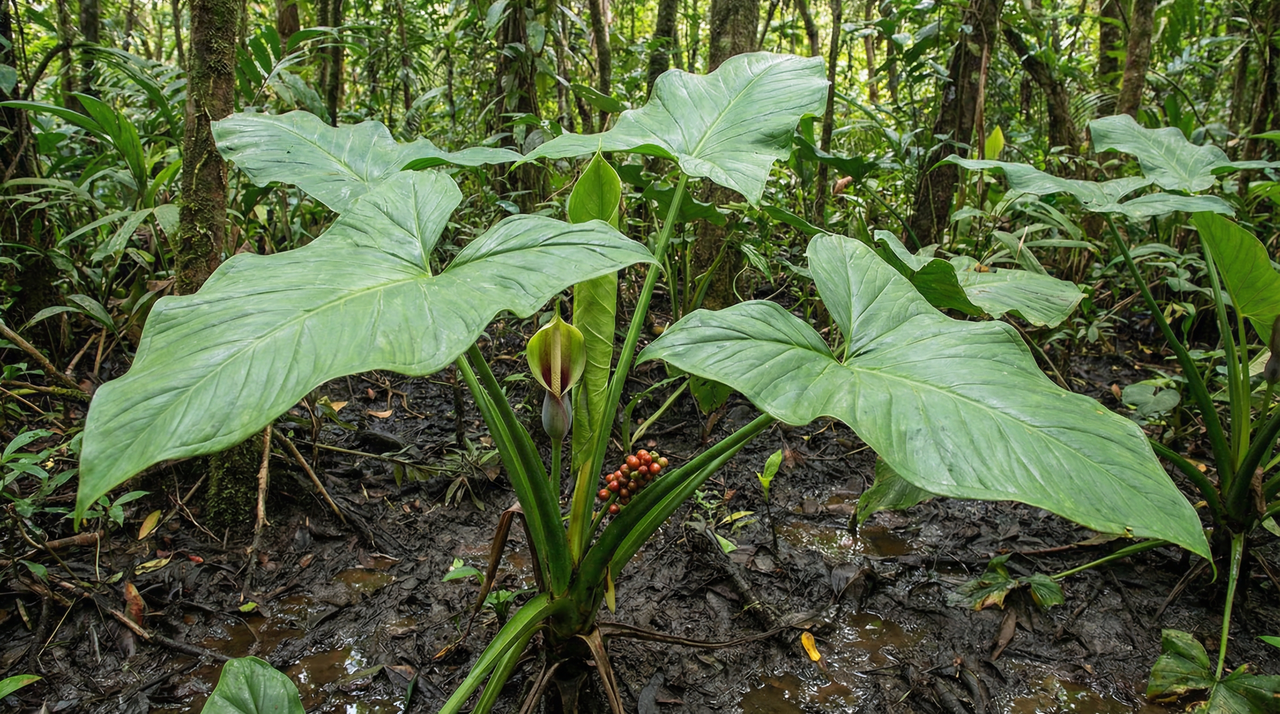
Most edible aroids will punish you mildly for eating them raw, a sharp tingle on the back of the throat that fades in a few minutes. Swamp taro won't let you off that easy. Bite into a raw corm of Cyrtosperma merkusii and you're dealing with calcium oxalate raphides, microscopic crystal needles that drive into soft tissue, causing swelling and burning intense enough that traditional Pacific Island communities developed multi-day soaking and fermentation protocols just to make it safe.[1] And yet this plant has been a famine food, a ritual staple, a nutritional lifeline on low-lying Pacific atolls for centuries. That tension is exactly what makes it fascinating.
What stops most gardeners from ever growing it isn't the oxalates, though. It's the timeline. You're looking at three to five years from planting to harvestable corm, in permanently flooded soil, in a climate that never sees frost. This is not a plant for the impatient, and it's not pretending to be. What it offers instead is something rarer: a massive, long-lived perennial engineered to thrive in the waterlogged spots that defeat almost everything else you'd want to grow.
Swamp Taro Origin, History, and Botanical Background
Most aroids will sulk in standing water, but swamp taro was built for it. Cyrtosperma merkusii, the giant swamp taro, is a long-lived perennial in the Araceae family that doesn't merely tolerate flooded conditions; it actively thrives in them, producing some of the largest edible corms in the plant kingdom in soils where most crops would simply rot. Heinrich Wilhelm Schott formally described it in 1856 from Java specimens,[2] though the plant had been cultivated and depended upon by Pacific and Southeast Asian communities for thousands of years before European botanists took notice. You may encounter it under the synonyms Cyrtosperma chamissonis or the basionym Lasia merkusii, but Cyrtosperma merkusii (Hassk.) Schott is the accepted name.[3][4]
Native Range and Wetland Habitat
Swamp taro is native to the tropical lowlands of Southeast Asia and the western Pacific, from the Moluccas and Borneo through Papua New Guinea, the Solomon Islands, the Philippines, and into coastal northern Australia, spanning the Malesia and Melanesia floristic regions.[5][6] Its home territory is freshwater swamps, riverine floodplains, peat bogs, and lake margins in lowland tropical rainforest, almost always below 200 meters in elevation and frequently at or near sea level.[5][7] In the lowland swamps of Indonesia and Papua New Guinea, plants regularly reach 3 to 4 meters tall, standing water half a meter to a meter and a half deep, in temperatures hovering between 25 and 35°C year-round.[8][9] I've found that when I maintain my beds at consistent flood depth of 30 centimeters or more, the aerial roots emerge with noticeably more vigor than in merely saturated but unponded soil; that visual cue alone tells you the plant is operating in its preferred register.
Botanical Features and Life Cycle
The leaves stop people in their tracks. Sagittate or hastate, they reach 1 to 3 meters in length and nearly as wide, on petioles that bring total plant height to 2 to 4 meters under good conditions.[10] If you know Colocasia or Alocasia, think bigger, more deeply lobed, and with more prominent venation designed to shed heavy tropical downpours rather than catch and hold water. The corm beneath those leaves is the real story: starch-packed, potentially enormous, and anchored in organic-rich, acidic to neutral waterlogged soil by a rhizomatous root system built for long tenure.[8]
What I love about this plant from a permaculture standpoint is its sympodial, polycarpic life cycle. It lives for 5 to 20 years or more, reproduces vegetatively through cormels, suckers, and rhizome division, and rarely bothers with seeds.[11][12] Flowering typically begins 3 to 5 years after planting, with berries taking another 6 to 9 months to ripen, and seed viability is low enough that vegetative propagation is simply the practical path.[13][14] In richer organic muck, I've seen plants reach usable corm size faster than the timeline suggests; poorer peat substrates really do slow everything down, which aligns with what the cultivation literature says about soil quality driving yield more than almost any other factor.[15] As a "plant it and leave it" perennial for a wetland guild, few plants compare.
Traditional and Cultural Significance in the Pacific and Southeast Asia
The human history of swamp taro runs deep. Evidence of its cultivation and domestication in Melanesia and New Guinea stretches back thousands of years, carried outward across Oceania by Austronesian voyagers who brought it as a deliberate food crop to island communities where swampy ground made conventional taro impossible to grow.[16][17] On Pacific atolls vulnerable to cyclones and salt intrusion, a crop that stores well in the ground and tolerates waterlogging became genuinely irreplaceable.
The corms can't simply be dug and eaten; the calcium oxalate crystals require cooking, fermentation, or thorough grating and leaching before the food is safe and palatable.[18][19] Having processed corms following Pacific methods myself, I can confirm that proper grating and leaching completely removes the raw acridity; what you're left with is mild, starchy, and genuinely satisfying. Traditional communities developed pit fermentation techniques that also extended storage life, making swamp taro a true famine reserve in regions where other crops failed seasonally. Among the Motu of Papua New Guinea and communities across the Philippines and Solomon Islands, it carries cultural weight well beyond nutrition; it appears in ceremonies, feasts, and as a marker of status and hospitality,[20][21] with ethnomedicinal uses for skin conditions, wounds, and digestive complaints alongside its food role. Traditional cultivation in irrigated swamp plots using mound and pit methods has kept these systems productive for generations, though wild populations now face pressure from wetland drainage and habitat conversion.[22] In my own work with regenerative landscapes, I've watched how quickly swamp drainage removes Cyrtosperma from local ecosystems entirely, which is why the traditional mound cultivation knowledge is worth preserving alongside the plant itself.
Fascinating Adaptations and Uses of Giant Swamp Taro
Exceptional corms can weigh up to 50 kilograms, which puts this in a category of edible root crops most Western gardeners have simply never encountered.[12][7] The plant earns those dimensions through a pair of elegant physiological tricks: aerenchyma tissue, which opens internal air channels through submerged tissues for gas exchange, and adventitious aerial roots that reach up from flooded stems to pull atmospheric oxygen directly into the root zone.[12] These aren't marginal adaptations; they're the reason this plant can form dense monotypic stands in anoxic peat swamps where almost nothing else edible survives. This evolutionary profile captures a plant that Pacific communities had already been purposefully adapting and depending on for millennia,[2] which is as good a summary as any of what makes swamp taro worth knowing: ancient, purposefully cultivated, and still quietly holding wetland food systems together wherever the conditions are right.
Swamp Taro Varieties and Sourcing
Notable Varieties and Landraces of Swamp Taro
What strikes me every time I dig into the variety landscape for Cyrtosperma merkusii is how the diversity here isn't the product of breeding programs or seed companies. It's centuries of farmers selecting for what worked in their particular flooded plot. Papua New Guinea alone accounts for over 100 documented landraces,[23][24] which tells you something important: this is a crop shaped by subsistence selection, not commercial optimization.
The named cultivars that do show up in the literature tend to be regionally specific. In Malaysia, 'Kasturi' is the name you'll encounter; Micronesia has 'Babai,' the deeply ceremonial corm used for community feasts; Indonesia claims 'Gembili.' Papua New Guinea's 'Biai' and 'Karo' are among the better-documented selections there.[23][25][26][27] From a permaculture standpoint, 'Karo' is the one I'd flag first for anyone dealing with beetle pressure -- it's worth knowing ahead of time rather than discovering after a season's growth is compromised.
The related species Cyrtosperma beccarianum rounds out the picture without muddying it. Its 'Merika' selection is noted for high yield and large corms, 'Karo' (shared name, different species) carries taro beetle resistance, and 'Wakunai' is valued for its flavor in traditional contexts.[26][27] I've noticed that when I source giant swamp taro through the specialty aroid market, the plant often arrives without a cultivar name at all -- just "swamp taro" or "giant taro." That's honest, actually. Most of this diversity still lives in village gardens, not catalogs.
Where to Source Swamp Taro Plants or Tubers
In the US, Logee's Plants and Florida Hill Nursery have carried Cyrtosperma merkusii as young plants or tubers, typically in the $20-50 range.[28][29] My advice: when you call or email, ask specifically for a larger tuber if they have it. In my experience establishing wetland aroids in a new pond or swale, the extra root mass on a bigger division pays off in the first growing season far more than saving fifteen dollars on a seedling-sized start.
Australian and Southeast Asian nurseries sometimes stock it too, but shipping into the United States gets complicated fast. USDA import permits and phytosanitary certificates are typically required,[30] and I've learned to treat that paperwork as a worthwhile step rather than a bureaucratic annoyance. Done right, it's how you ethically introduce a non-invasive wetland species without creating biosecurity risk. Cyrtosperma merkusii is not CITES-listed, so the convention itself doesn't restrict trade,[31] but domestic regulations in both the exporting and importing country still apply.
Skip hunting for seeds. They're genuinely difficult to source and far less reliable than vegetative divisions, which also preserve the traits of whatever selection you're working with. When searching, know that this plant circulates under several common names including Giant Taro, Bandicoot Taro, and Elephant Taro, in addition to giant swamp taro. I've seen it mislabeled as Colocasia at generalist nurseries more than once -- the leaf shape is broadly similar to an unfamiliar eye, but true wetland-adapted Cyrtosperma has a distinct midrib and petiole texture that you'll recognize quickly once you've grown both.
Swamp Taro Propagation and Planting Guide
If you're hoping to grow swamp taro from seed, I'll be honest with you: don't count on it. Seeds are rarely produced in cultivation, and when they are, natural viability sits below 20%.[32][33] The seeds themselves are recalcitrant, holding 40-50% moisture content at maturity, which means they begin losing viability almost immediately after the berry splits.[34][35] I tried germinating fresh berries I collected from a botanical garden display once, sowing them within 48 hours of picking, and still had dismal results. That experience taught me what the literature confirms: even under ideal conditions of 25-30°C and constant moisture, germination can take one to three months and many seeds simply never wake up.[32] A healthy sucker is worth a hundred recalcitrant seeds.
Propagation Methods for Swamp Taro
Vegetative propagation is the practical reality for nearly every grower.[36][37] The simplest home-scale method is corm division: cut a mature corm into sections, each with at least one visible bud or eye, and treat the cut surfaces with fungicide paste before planting to prevent rot. Done right, a single mature corm can yield four to six new plants.[38][39] I select only the largest, most vigorous offsets when dividing, because I've noticed they reach meaningful corm size considerably faster than smaller suckers. Given the 3-5 year timeline to harvest, that head start genuinely matters.
Stem cuttings are another option. Sections 10-15 cm long with at least one node root reliably when aerial roots are present; a dip in IBA rooting hormone speeds things up, with roots typically appearing within four to six weeks.[40][41] Whichever method you use, the environmental requirements are non-negotiable: temperatures consistently above 25°C, high humidity, and saturated or flooded rooting medium from day one.[38][39] Commercial nurseries producing large volumes use tissue culture to generate disease-free planting stock at scale, which is worth knowing if you're sourcing from a specialty supplier.[36][42]
Soil, Site Selection, and Planting Requirements
Swamp taro is native to tropical peat swamp forests and freshwater wetlands across Southeast Asia and the western Pacific, and it evolved in permanently waterlogged, highly organic, acidic soils.[43][44] That native habitat tells you everything you need to know about site selection. Aim for heavy clay, clay-loam, or peat with 5-15% organic matter and a pH between 5.5 and 6.5; it can tolerate standing water 30-60 cm deep and will simply sulk in anything sandy or free-draining.[45][12]
For container or water-garden culture, a mix of 50% peat or coco coir, 30% compost, and 20% perlite works well, planted into 15-30 cm of water over the substrate.[46][47] Swamp taro does have aerenchyma tissue that shuttles oxygen down to submerged roots, giving it better waterlogging tolerance than Colocasia esculenta (which I grow in the same wet corner of my garden), but that adaptation has limits. Completely stagnant, anaerobic conditions can still trigger Pythium or Phytophthora rot.[39] After losing young plants to rot in overly still containers, I now ensure a small amount of water movement or add a thin gravel layer at the pot base to prevent total anaerobic stagnation.
Spacing, Support, and Initial Establishment
These are large plants. Mature specimens reach 1.8-3 m tall with a spread of nearly 2 m, and they clump steadily outward via suckers and rhizomes.[48][49] Space plants 1.5-2 m apart with rows 2-3 m wide; crowding them invites exactly the fungal and bacterial pressure a humid wetland bed is already prone to.[50] In windy sites, bamboo stakes 2-3 m tall are worth setting at planting time, and removing older outer leaves periodically improves airflow significantly.[49] Generous spacing has saved me from toppled plants during tropical-style summer storms and noticeably reduced leaf-blight pressure through humid seasons.
Plant corms or suckers 10-20 cm deep with the crown at or just above the soil or water surface.[51][52] Expect the first one to two years to be primarily about leaf and root establishment, with serious corm bulking only beginning in years three through five. That timeline is precisely why starting with the strongest, most disease-free material you can find is the single most important decision you'll make with this crop.
Swamp Taro Care Guide: Growing Cyrtosperma merkusii
Everything about caring for swamp taro traces back to a single fact: this plant evolved in permanently flooded tropical swamp forests, and it has never forgotten that. Water depth, light levels, feeding strategy, cold protection -- every decision you make as a grower flows from that wetland origin. Get the conditions right and you're rewarded with one of the most productive giant aroids you'll ever grow. Push it outside its comfort zone and it tells you quickly, usually through its leaves.
Sunlight Requirements for Swamp Taro
In the wild, swamp taro grows in the shaded understory of tropical swamp forests, and in cultivation it does best with bright indirect light or around four to six hours of filtered sun daily, somewhere in the 1,000 to 5,000 foot-candle range.[53][54] It can handle full sun if moisture and humidity stay consistently high, but direct exposure often triggers photoinhibition -- you'll see leaf scorch, yellowing, and crispy brown edges before long.[55][43] I use 50 to 70 percent shade cloth in my hotter, sunnier systems -- the same setup I use for cardamom and coffee -- and it keeps the foliage looking clean through summer. Too little light brings its own problems: etiolated, stretched growth and noticeably smaller leaves, though the plant will persist even under a dense canopy.[56] The leaves are genuinely expressive -- they're usually the first indicator that something's off.
Water Needs and Irrigation for Swamp Taro
Swamp taro is not merely "moisture-loving." It's a true wetland obligate that can grow in standing water up to a meter deep, and cultivated plants are typically kept in 30 to 60 centimeters of water in ponds or deep trays.[57][58] Drought tolerance is essentially zero. Humidity should stay above 70 percent, and if you're not running a flooded system, you need to water every one to three days -- or whenever the top inch or two of soil starts to dry -- using rainwater or dechlorinated water.[59][60] I collect rainwater for my systems specifically because of this; I've found even brief exposure to salinity above about 5 ppt slows corm bulking dramatically, and the research on electrical conductivity thresholds confirms that staying below 0.5 mS/cm isn't over-caution.[43] Permanent flooding does suppress most upland weeds, which is a genuine permaculture bonus, but watch for root rot -- Pythium and Fusarium both thrive in anaerobic soils if drainage stagnates completely. Foul odor, mushy roots, and wilting leaves are the warning signs.[43] Aim for loamy, organic-rich soil at pH 5.5 to 7.0 and keep water off the foliage to reduce fungal pressure.
Soil, Nutrients, and Feeding Swamp Taro
This giant aroid has moderate to high nutrient demands, and in waterlogged systems those nutrients leach fast. Potassium deserves particular attention -- it's critical for disease resistance in the humid, low-oxygen conditions these plants live in, with recommended application rates running 150 to 250 kg per hectare alongside nitrogen and phosphorus.[61][62] After two years growing swamp taro in a backyard pond system, I noticed that potassium-rich feeds visibly improved leaf toughness and reduced leaf-spot pressure through humid summers -- it's one of those connections that makes the research feel real. A balanced 10-10-10 or 15-15-15 fertilizer applied every four to six weeks in split doses works well during the growing season.[63] In flooded systems, I lean toward slow-release organics like fish emulsion and bone meal to reduce leaching. Watch for interveinal yellowing on younger leaves -- that chlorosis pattern is usually iron or manganese deficiency rather than nitrogen, which tends to show first on older foliage.[48] A periodic soil test pays for itself here. And resist the urge to push nitrogen for bigger leaves; excess nitrogen produces lush growth but increases pest vulnerability without improving corm yield.[64]
Frost Tolerance and Cold Protection for Swamp Taro
There's no softening this: swamp taro has zero frost tolerance. It's a USDA zones 10b to 12 plant, and temperatures below 10 to 15°C (50 to 59°F) cause leaf blackening, necrosis, and wilting; even a light frost can rot the corm and kill the plant entirely.[65][66] There are no cold-hardy varieties, so zone 9 growers are working with mitigation rather than true adaptation. I've overwintered specimens successfully in a heated greenhouse by maintaining 70 percent or higher humidity and blocking any cold drafts -- the plants held on, but it's not effortless. Optimal growth happens between 25 and 30°C (77 to 86°F).[67] Heavy mulching over the root zone and supplemental heat indoors can bridge short cool spells, but if your climate regularly dips below 50°F, a greenhouse or indoor setup isn't optional.
Heat Tolerance and Temperature Management for Swamp Taro
Swamp taro handles high heat better than cold, tolerating brief spikes up to 40°C, but consistent temperatures above 35°C cause real stress: leaf scorching, curling, slowed growth, and reduced corm yields, especially in younger plants.[68][69] The real buffer against heat stress is water and humidity -- consistent flooding, 70 to 90 percent relative humidity, and daily irrigation to replace evapotranspiration keep the root zone cool where it counts.[36][70] Pair that with 50 to 70 percent shade cloth and mulched, organic-rich acidic soil, and even a hot subtropical summer becomes manageable. The flooded bed itself acts as a thermal moderator -- one of the underappreciated advantages of growing in a true wetland setup rather than trying to replicate it in containers.
Pruning, Maintenance, and Seasonal Rhythm
Pruning is simple but non-negotiable in humid conditions: remove dead or yellowing leaves at the base with clean, sharp shears as soon as you notice them. Good airflow reduces the fungal disease pressure that can build quickly in a warm, wet system. Stake tall, top-heavy plants before they lean, and clear debris from the water surface promptly. I leave healthy older leaves in place as long as they're still photosynthesizing -- stripping them prematurely just slows the plant when it needs to be building corm mass.
Swamp taro has no true dormancy, but it follows a clear seasonal rhythm: slower during dry periods, then surging with new leaf production and occasional flowering when wet season rains arrive.[71] Corms take 18 to 24 months to mature, and under well-managed flooded conditions the plant can produce 20 to 40 tons of biomass per hectare per year.[72] The first year often feels frustratingly slow. By year two, if the water, nutrients, and light are dialed in, the growth becomes genuinely impressive -- the kind of biomass output that reminds you why this plant has fed wetland communities for centuries.
Swamp Taro Harvesting: Timing, Technique, Yield, and Flavor
When to Harvest Giant Swamp Taro: The 3-5 Year Wait for Maturity
There's no shortcutting this one. Cyrtosperma merkusii takes 3 to 5 years from planting before its corm reaches harvestable maturity, with corms tipping the scales at 10 to 20 kilograms or more.[51][73][74][75] In my wetland guild designs, I always tell clients to mark their Cyrtosperma plantings clearly and commit fully. The growers who wait the full timeline walk away with corms large enough to feed a family for weeks. Those who get impatient dig up something closer to a potato. Climate, soil fertility, variety, and management all shift that window significantly, so connecting with your local agricultural extension for site-specific guidance is genuinely worthwhile, not just obligatory advice.
For comparison, the closely related Cyrtosperma beccarianum matures somewhat faster, typically in 2 to 3 years, with fairly readable harvest signals: 70 to 80 percent leaf senescence, reduced vigor across the clump, and a firm corm when probed.[76][77][75] I've learned to watch that specific leaf yellowing pattern as an early prompt to begin harvest planning -- not an excuse to dig early, but a signal to stop adding infrastructure to that bed and start thinking about succession. For C. merkusii specifically, visible cues are subtler. The slow decline in new leaf production and reduced overall vigor after years of steady growth are your best guides.
Harvesting Technique, Yield Potential, and What Swamp Taro Tastes Like
Before anything else: never eat raw swamp taro corm. The defensive raphides concentrated throughout the raw tissue cause intense irritation in the mouth and throat.[78][79][12] Having worked extensively with tropical aroids, I've seen this irritation firsthand with undercooked corms. Cook thoroughly, full stop. If any acrid bite lingers after cooking, keep going. This is not optional.
Once properly cooked, what you get is genuinely rewarding after that multi-year wait: a starchy, mildly earthy corm with soft notes of sweetness and nuttiness, a creamy to mealy texture, and a solid nutritional profile at 70 to 80 percent carbohydrate by dry weight with moderate protein, fiber, potassium, and calcium.[80][81][82] Under-processing is the main culprit when people report a bitter or acrid aftertaste, though cultivar, soil conditions, maturity at harvest, and cooking method all influence the final result.[12] Swamp taro also runs higher in moisture than Colocasia esculenta, the taro most readers already know, which gives the cooked corm a softer, more paste-like quality that suits mashing and fermentation beautifully but requires more attention to post-harvest storage. For wetland systems where few staple crops will even survive, that trade-off is easy to accept.
Swamp Taro Preparation and Uses
Important Safety Notes: Why Swamp Taro Must Never Be Eaten Raw
I'll be direct: raw swamp taro is not a plant you nibble to check for ripeness. The corms, petioles, and leaves all contain these defensive raphides, which cause immediate burning, swelling, and intense irritation in the mouth and throat, along with potential nausea and, in serious cases, respiratory distress.[83][84] Low levels of cyanogenic glycosides may also be present.[17] Having researched multiple ethnobotanical and toxicological sources, I treat this warning as absolute. Raw tasting is simply not an option. The edible part is the starchy corm; petioles become edible after extended cooking, and while leaves are generally too toxic to eat, they do serve well as food wrappers.[17][85]
Traditional Preparation Methods for Safe Consumption
The processing sequence that Pacific communities developed over centuries is meticulous and completely non-negotiable. Peel the corm first, then soak it in running water or frequently changed water for three to seven days; this leaching step alone can reduce oxalate content by up to 90%.[86][87] After soaking, the corm still needs one to two hours of boiling, baking, or steaming; fermentation and earth-oven pit cooking are also traditional options across the Pacific.[88] I once cut the soaking short when preparing a similar aroid and ended up with a distinctly acrid result. With swamp taro, the full multi-day soak is the difference between a meal and a mistake.
Flavor, Texture, and Nutritional Profile of Cooked Swamp Taro
The reward for that patience is real. Properly prepared swamp taro corm is mild and nutty with a hint of earthiness and slight sweetness, soft and creamy in texture, and genuinely comparable to familiar taro or yam.[89][78] Nutritionally, it's a solid if modest staple: roughly 100 to 120 kcal per 100g with about 15g carbohydrates, useful amounts of potassium (up to 500mg), vitamin C, B vitamins, magnesium, and iron.[89][85] It's not a nutritional powerhouse by modern standards, but as a calorie-stable wetland staple where no other crop survives, that profile matters enormously.
Traditional Culinary Applications and Cultural Significance
Across Papua New Guinea, Vanuatu, Fiji, and much of Southeast Asia, swamp taro root has anchored food security in permanently flooded soils for generations, appearing at feasts, in rituals, and as famine insurance when upland crops failed.[90][91] The culinary range is wider than most outsiders expect: porridges, puddings like the Vanuatu and Fijian laplap, stews blended with coconut and fish, and poi-style fermented pastes.[92][93] Regional fermented versions like Papua New Guinea's masi and the Philippines' burong taro go further, developing a tangy sourness that reminds me of fermented cassava or sour yam preparations. Those fermented versions take some getting used to for a Western palate, but the logic is sound: fermentation extends shelf life and further breaks down residual compounds.[90][94] Giant swamp taro flour, made by drying and grinding leached corm, also offers a shelf-stable option for communities that need to store the harvest.
Medicinal Preparations and Cautions
Traditional communities across the Pacific and Southeast Asia have long used swamp taro medicinally, from leaf poultices to rhizome decoctions, knowledge developed carefully over centuries.[95] I have deep respect for that accumulated wisdom. That said, no clinical trials exist to establish safe dosages, and self-dosing is strongly discouraged; the full detoxification process described above applies here too, and any medicinal use should involve professional medical guidance rather than personal experimentation.
Non-Food Uses: Fiber, Crafts, and Ornamental Value
What I find genuinely inspiring about swamp taro is how completely Pacific communities have utilized the whole plant. Petiole and leaf fibers go into woven mats, rope, cordage, and thatch; the large leaves serve as natural food wrappers; and the dramatic architectural foliage earns the plant a place in tropical water gardens and botanical collections at institutions like Kew and the Missouri Botanical Garden.[96][36][97] Those strong petiole fibers are exactly the kind of material I bring into permaculture workshops when teaching traditional cordage. The related Cyrtosperma beccarianum extends the picture further, producing substantial biomass for mulch, compost, or animal fodder while accumulating potassium and nitrogen in waterlogged soils.[98][99] In a well-designed wetland food forest, seeing all of this work together, food, fiber, fertility, and beauty, is one of those moments that reminds me why I love this work.
Swamp Taro Health Benefits and Medicinal Uses
Swamp taro is a plant that demands respect long before it offers anything in return. That's true in the garden, and it's equally true when you start looking at its health story. What you find is a picture shaped by centuries of indigenous knowledge, a handful of genuinely intriguing laboratory findings, and some very real chemical defenses that make proper preparation the foundation of everything else.
Traditional Medicinal Uses Across the Pacific and Southeast Asia
Indigenous communities across the Philippines, Papua New Guinea, and the Pacific Islands have drawn on Cyrtosperma merkusii as medicine for generations, using leaf poultices and sap directly on wounds and skin infections and preparing rhizome decoctions for inflammation, digestive ailments, and heart complaints.[100][101][102][103] These practices weren't random experimentation; they were refined over centuries, embedded in food systems and cultural ritual alike. The scientific record on Cyrtosperma beccarianum, by contrast, is essentially silent -- no documented traditional medicinal use, no peer-reviewed pharmacological data specific to that species.[104][105]
Modern science has begun investigating those traditional applications, and some early results are genuinely interesting: in vitro studies show anti-inflammatory effects via NF-κB pathway inhibition and reduced cytokines like TNF-α and IL-6, antimicrobial activity against common pathogens, antidiabetic potential through enzyme inhibition, and preliminary anticancer activity.[101][106][107][108] All of it is preclinical; no controlled human trials exist.[50][109] While the lab data on NF-κB inhibition is genuinely intriguing, I always remind growers that these plants have been safely stewarded by Pacific Island knowledge systems for generations when prepared correctly, and that track record matters at least as much as any petri dish result.
Key Phytochemicals and Bioactive Compounds
The phytochemical profile of C. merkusii is reasonably rich for a tropical wetland aroid. Flavonoids (including quercetin derivatives), phenolic compounds, saponins, tannins, alkaloids, terpenoids, and a distinctive compound called merkusin have all been identified, with leaves generally showing higher concentrations of phenolics and flavonoids than the corms.[106][101][110] I've noticed that my plants in the poorest, wettest spots tend to push the darkest, most vigorous leaf growth, which tracks with research showing phytochemical levels vary considerably with soil, season, and hydrology.[111][112]
These compounds underpin the antioxidant, antimicrobial, and cytotoxic activities observed in lab studies, with leaf extracts consistently outperforming corm extracts in antioxidant assays.[106] The same plant also contains calcium oxalate raphides, cyanogenic glycosides, and proteases -- concentrated in raw corms and leaves -- which are responsible for the plant's toxicity when unprocessed.[113][114][115] This balance of beneficial secondaries and anti-nutritional factors is actually characteristic of wetland Araceae, and it's the reason the plant's medicinal and culinary use are inseparable from preparation methods.
Nutrition Profile of the Cooked Corm
Once properly processed, the cooked corm delivers a solid starchy staple: roughly 100-112 kcal per 100g, 23-26g of carbohydrates (primarily starch), about 3.5-4.1g of dietary fiber, and a potassium content ranging from 300 to 591mg, which compares favorably to cassava and is closer to what I'd expect from a well-grown sweet potato.[116][117][118] Protein and fat are both modest, and sodium is low. It's not a nutritional superstar in the way leafy greens are, but as a calorie-dense, high-fiber carbohydrate source with meaningful mineral content, it earns its place in tropical diets where other crops simply can't handle waterlogged conditions.
Vitamins are a supporting role here: some vitamin C (reduced significantly by cooking), small amounts of B vitamins and vitamin E, and polyphenols that contribute additional antioxidant value to the cooked corm.[119][120][121] All figures vary with variety, soil, and cooking method, so treat ranges as guidelines rather than absolutes. The typical serving is 100-150g of cooked corm.[122]
Safety Considerations and Proper Preparation
The first time I got careless handling a raw aroid and felt that immediate burning sensation in my mouth, I never made the same mistake again. With swamp taro, the stakes are higher than most. All parts of the plant contain calcium oxalate raphides (microscopic needle-like crystals), cyanogenic glycosides, and proteases that cause immediate mechanical irritation to mucous membranes when consumed raw; symptoms include intense burning in the mouth and throat, excessive salivation, swelling, difficulty swallowing, vomiting, and gastrointestinal distress.[113][123][115] The raw sap can also cause irritant contact dermatitis on skin, and the toxicity profile extends to dogs and cats with similar acute symptoms requiring veterinary care.[124][125] Our dogs have never shown interest in the plants, but I still keep raw material well out of reach -- the reaction can be dramatic even in small amounts.
Proper processing is non-negotiable, not optional. Peeling and slicing followed by soaking for one to two days reduces oxalates by 50-70%; prolonged boiling for two to four hours pushes total oxalate reduction up to 90%; and traditional methods like earth-oven baking for six to twelve hours or multi-day pit fermentation achieve comparable results.[126][127][128] Pacific Island communities developed these methods precisely because they understood the plant's defenses. Anyone with a history of kidney stones should be cautious even with cooked corm given the residual oxalate content, and if you're considering any medicinal application, consult a healthcare provider first -- potential interactions with anticoagulants and mineral-binding effects are real concerns that the current research doesn't yet fully address.
Swamp Taro Pests and Diseases
There's a useful paradox at the heart of swamp taro's relationship with pests and disease. The permanent flooding that defines its habitat repels many soil-dwelling pathogens and crawling insects that wreak havoc on drier aroids, yet that same saturated environment rolls out the welcome mat for water-loving fungi and bacteria. I've learned to hold both truths at once when designing wetland guilds, because the grower who understands this paradox stops chasing problems after the fact and starts designing them out.
Common Diseases of Swamp Taro
Root rot is the disease to lose sleep over. Pythium species, including P. myriotylum, and Phytophthora species, including P. colocasiae, are the primary offenders, and they thrive when soil moisture climbs above 80% saturation without relief.[129][130][131] The telltale sign is a plant that looks like it needs water even though it's sitting in it: wilting petioles, soft spots developing at the corm base, a faint sour smell when you push your hand into the substrate. I've seen this most often in beds where the water is stagnant rather than gently moving. Maintaining some flow, even subtle, drops disease pressure noticeably. Keeping temperatures in the 25-30°C sweet spot and pH between 6.0 and 7.0 also keeps the plant's natural defenses running at full capacity.[132][133]
Fungal leaf spots caused by Rhizoctonia, Cercospora, and Phytophthora species are the next concern, appearing as brown or black lesions on foliage when humidity climbs above 85%.[134][135] Bacterial soft rot from Erwinia species tends to pile on alongside fungal infections rather than arriving alone, which is why what looks like a simple leaf spot can spiral fast.[136] Viral problems, primarily Dasheen mosaic virus and taro bushy top virus, are real but secondary; both are vectored by aphids, so aphid management has outsized importance beyond the insects themselves.[134][137] When I've been able to source cultivars like 'Koriba', 'Orok', or 'Karo' from Papua New Guinea breeding programs, I've noticed meaningfully lower leaf spot incidence even in consistently humid conditions. Those varieties were selected in flooded environments and it shows.[138][139]
Key Insect and Other Pests
The insect pressure on swamp taro is real but more manageable than on Colocasia and other common aroids, largely because the flooded, anaerobic conditions around the root zone deter so many soil-dwelling pests.[140][141] Above ground is a different story. Taro beetles (Papuana spp.), aphids, planthoppers, mealybugs, scale insects, spider mites, and leaf beetles all show up in the literature and in the field, with outbreaks clustering in wet-season peaks.[135][137] Below ground, root-knot nematodes (Meloidogyne spp.) cause galling and yield reduction, and snails or slugs will chew irregular holes in foliage given any opportunity.[142]
One thing I've observed across my wetland guilds is that swamp taro seems to discourage casual feeding in a way that, say, elephant ear (Colocasia) does not. The calcium oxalate raphides throughout the plant's tissues function as a physical deterrent, causing irritation and damage when insects try to feed.[143] It's a family trait across Araceae, but in my experience the effect seems pronounced here. I've seen noticeably less generalist herbivore pressure on this plant compared to other aroids in the same guild, and I suspect the raphide density deserves some credit.
Prevention and Integrated Management
In wetland systems, prevention through design beats reactive spraying every time. The cultural foundation is maintaining drainage nuance even in a deliberately saturated bed: gentle water movement, disease-free planting material, removing infected foliage promptly, and keeping water off the leaves by avoiding overhead irrigation where possible.[144][145] Starting with resistant cultivars, when you can source them, removes a huge chunk of your risk before a single pathogen shows up.
For ongoing management, IPM is the right framework. In my tropical edible landscape work, I've found that holding water depth at 30-50 cm combined with regular releases of beneficial insects like ladybugs keeps aphid populations well below damaging thresholds, far more reliably than broad-spectrum sprays that disrupt the whole system.[146][147] Neem-based sprays and pheromone traps handle insects well when cultural controls aren't enough. Targeted fungicides, metalaxyl for Pythium or copper for leaf spots, have their place but always as a complement to cultural methods, never a substitute.[148] Regular monitoring is what ties it together; catching soft rot or a beetle infestation early is the difference between a setback and a loss.[149]
Swamp Taro in Permaculture Design
Picture the understory of a lowland swamp forest in Melanesia or the Philippines: standing water, dense canopy, humidity so thick you feel it in your lungs. That is the ecological birthplace of Cyrtosperma merkusii, and it tells you almost everything you need to know about placing this plant in a permaculture system. Swamp taro didn't evolve to tolerate wetland conditions; it evolved to require them. If you're designing with this plant, you're not accommodating a preference, you're recreating an entire hydrological niche.
Climate Requirements and Suitable Zones for Swamp Taro
In its native range, swamp taro thrives in Köppen Af and Am climates where annual rainfall runs between 2,000 and 4,000+ mm and there is no meaningful dry season.[150][151] Optimal growth happens between 25 and 30°C, and while it can survive brief dips to around 10°C, anything below 20°C noticeably slows its development.[152][153] Frost is simply not in the picture.[54]
For outdoor cultivation, this restricts the plant strictly to USDA Zones 10b through 12.[54][154] I've grown large aroids in parts of Central Florida that sit right on the 10a/10b boundary, and I've learned the hard way that a single winter night dipping to 8°C will blacken the leaves by morning. I now keep mine in a large aquatic tub that rolls into the greenhouse the moment cold is forecast. If you're in zone 9, I wouldn't call it impossible, but I would call it a greenhouse plant with wetland ambitions rather than a landscape specimen. The plant also demands constant saturation, and I mean constant: it can handle water depths up to a meter or two and requires humidity between 60 and 100 percent.[155][36] Let it dry out even briefly and the plant collapses with startling speed. The warmth, saturation, and humidity all work together; get one wrong and the others can't compensate.
Ecosystem Functions and Habitat Provision
The plant earns its place in a wetland guild through ecological services that go well beyond its edible corm. Start with pollination: like most aroids, it relies on beetles, specifically dynastid and scarab species lured by the strong, often fetid odor of the spadix.[156][157] The inflorescence is protogynous, meaning beetles enter during the female phase and pick up pollen during the male phase, a sequence often aided by thermogenesis that can raise flower temperature 10 to 30°C above ambient air.[158] If you've ever grown a voodoo lily (Sauromatum), you already know the smell; swamp taro's bloom operates on the same aromatic principle, just scaled up considerably. Supporting beetle pollinators in a food forest has cascading benefits well beyond this one plant.
The root system does serious ecological work. Research from wetland aroid studies documents that C. merkusii absorbs excess nitrogen and phosphorus, improves water filtration, and generates biomass in the range of 20 to 30 tons per hectare per year, which decomposes to build soil organic matter over time.[159][160] I've watched the plant's dense root mat hold constructed swale banks that would otherwise slump in heavy rain; the erosion-control value is tangible, not theoretical.[161][162] Add to that the shelter it provides for invertebrates, amphibians, and small mammals, and you have a plant that's building habitat while it's building corms.[163] These are ecosystem-level benefits grounded in general wetland aroid research, so I'd frame them as strong tendencies rather than guaranteed outcomes for every installation.
Forest Layer Placement and Guild Companions
In its native swamp forest, swamp taro occupies the shade-tolerant understory, which translates naturally to the herbaceous or tall ground-cover layer in a permaculture food forest built around a wetland zone.[62] It handles full to partial shade without complaint, which means you can tuck it beneath bananas, breadfruit, or other canopy-layer fruit trees and it will keep producing. Traditional agroforestry systems across the Pacific pair it with yams, legumes, and cassava;[164] the legume companions in particular make sense, since nitrogen inputs from above help offset what the flooded soil can't always deliver.
Where swamp taro really comes into its own is in aquaponic loops and rice-fish systems. I've had real success pairing it with rice and tilapia in a backyard aquatic bed, where fish waste feeds the plants and the root mass filters the water. FAO documentation of traditional Pacific and Indonesian systems confirms this is well-precedented, not experimental wishful thinking.[165][166] The broader value is that swamp taro turns the wetland zones that most gardeners consider problem spots into productive, biodiverse polyculture layers.[167][168] That permanently saturated corner of the property where nothing else will cooperate? Swamp taro is auditioning for exactly that role. Just know going in that this is a specialist for true tropical wetland guilds, not a generalist you can slot into a standard food forest bed that occasionally floods.
The Plant That Taught Me to Think in Decades
I put my first swamp taro in the ground knowing I might not harvest it for five years, and something about that commitment changed how I approach the whole food forest. There's a certain honesty in a plant that refuses to be rushed. It doesn't care about your season. It just grows, slowly and enormously, in the wet corner nobody else wanted, asking almost nothing except that you leave it alone long enough to become something extraordinary.
Sources 168
- Cyrtosperma merkusii: A Review of its Ethnobotany, Phytochemistry and Pharmacology ↩
- Synopsis Aroidum ↩
- Cyrtosperma merkusii (Hassk.) Schott ↩
- Cyrtosperma merkusii ↩
- Cyrtosperma merkusii (Hassk.) Schott ↩
- The genus Cyrtosperma (Araceae): Taxonomy, distribution and economic importance ↩
- Swamp Taro - Kew Science ↩
- Cyrtosperma merkusii (Hassk.) Schott: a rare tropical aroid ↩
- Taro and Swamp Taro Cultivation - FAO ↩
- Cyrtosperma merkusii cultivation notes ↩
- Araceae of the Pacific Islands - Fact Sheet ↩
- Cyrtosperma merkusii - Useful Tropical Plants Database ↩
- Cultivation of Cyrtosperma merkusii (Swamp Taro) ↩
- Reproductive Biology and Systematics of Cyrtosperma (Araceae) ↩
- Cultivation of Swamp Taro in Papua New Guinea - ACIAR Report ↩
- The Prehistory of Taro Cultivation in the Pacific ↩
- Taro Cultivation in the South Pacific ↩
- Swamp Taro: Cyrtosperma spp. ↩
- Swamp Taro (Cyrtosperma merkusii): A Traditional Crop in Pacific Islands ↩
- Traditional Cultivation of Giant Taro in the Philippines ↩
- Ethnobotany of Cyrtosperma Species in Papua New Guinea ↩
- Swamp Taro: A Key Crop for Pacific Food Security ↩
- Swamp Taro: Cyrtosperma merkusii (Hassk.) Schott ↩
- Diversity of Cyrtosperma in the Pacific ↩
- Swamp Taro (Cyrtosperma merkusii) Production Guide ↩
- Swamp Taro (Cyrtosperma spp.) in Papua New Guinea ↩
- Araceae Diversity and Uses in the Pacific ↩
- Cyrtosperma merkusii - Giant Swamp Taro ↩
- Exotic Aroids for Sale - Including Cyrtosperma ↩
- Importing Tropical Plants to the US ↩
- CITES Species+ Checklist ↩
- Reproductive Biology of Cyrtosperma in Pacific Islands ↩
- Seed Morphology and Germination in Araceae ↩
- Seed Storage of Aroid Species ↩
- Recalcitrant Seeds in Tropical Plants ↩
- Cyrtosperma merkusii (Giant Swamp Taro) ↩
- Propagation of Aroid Crops ↩
- Propagation of Edible Aroids ↩
- Cultivation of Wetland Taro in Florida ↩
- Propagation Techniques for Cyrtosperma merkusii ↩
- Horticulture of Swamp Taro (Cyrtosperma merkusii) ↩
- Propagation of Taro and Relatives ↩
- Cyrtosperma merkusii - Missouri Botanical Garden Plant Finder ↩
- Swamp Taro (Cyrtosperma merkusii) - FAO ↩
- Soil and Water Requirements for Swamp Taro ↩
- Cultivation of Cyrtosperma Species ↩
- Swamp Taro Cultivation ↩
- Giant Taro (Cyrtosperma merkusii) - University of Hawaii Extension ↩
- Swamp Taro (Cyrtosperma merkusii) Production Guide - ACIAR ↩
- Cyrtosperma merkusii - Useful Tropical Plants ↩
- Cyrtosperma: A Neglected Crop with Potential ↩
- Cultivation of Swamp Taro (Cyrtosperma merkusii) ↩
- Growing Tropical Aroids: Care Guide ↩
- Cyrtosperma merkusii - Plant Finder ↩
- Aroids: Light Requirements - University of Florida IFAS Extension ↩
- Cyrtosperma merkusii - Missouri Botanical Garden Plant Finder ↩
- Giant Swamp Taro (Cyrtosperma merkusii) ↩
- Cyrtosperma merkusii (Swamp Taro) ↩
- Swamp Taro (Cyrtosperma merkusii): Cultivation and Uses ↩
- Cyrtosperma merkusii ↩
- Swamp Taro: Nutrient Requirements and Fertilization ↩
- Cyrtosperma Cultivation in the Pacific ↩
- Nutrient Management in Taro and Other Aroids ↩
- Nutrient Management for Wetland Aroideae ↩
- Cyrtosperma merkusii (Swamp Taro) ↩
- Frost Damage in Tropical Plants ↩
- Cyrtosperma merkusii (Giant Swamp Taro) ↩
- Swamp Taro: Growing Guide for Hot Climates ↩
- Heat Stress Management in Aroid Crops ↩
- Cultivation of Cyrtosperma merkusii in Tropical Wetlands ↩
- Growth and Reproduction of Cyrtosperma in Pacific Islands - IPGRI Report ↩
- Growth and Yield of Swamp Taro (Cyrtosperma merkusii) ↩
- Cyrtosperma: Biology, Uses and Cultivation ↩
- Taro and Swamp Taro Production Manual ↩
- Giant Swamp Taro: Growth and Harvesting Practices ↩
- Taro and Tannia Production in the Asia-Pacific Region ↩
- Cyrtosperma: Cultivation and Utilization ↩
- Cyrtosperma merkusii - Wikipedia ↩
- Kew Science - Plants of the World Online - Cyrtosperma merkusii ↩
- Swamp Taro (Cyrtosperma merkusii) - Traditional Pacific Foods ↩
- FAO - Underutilized Food Plants: Cyrtosperma ↩
- Plants for a Future: Cyrtosperma merkusii Profile ↩
- Toxic Components in Aroids: Calcium Oxalate in Cyrtosperma ↩
- Toxicity of Aroids: Calcium Oxalate and Cyanogenic Glycosides ↩
- Edible Aroids: Post-Harvest and Processing ↩
- Traditional Preparation of Swamp Taro (Cyrtosperma merkusii) in the Pacific Islands ↩
- Detoxification Methods for Edible Aroids ↩
- Swamp Taro (Cyrtosperma merkusii) - Traditional Preparation and Safety ↩
- Nutritional Composition of Tropical Root Crops ↩
- Ethnobotany of Cyrtosperma merkusii in Vanuatu and Fiji ↩
- Swamp Taro (Cyrtosperma merkusii) in Papua New Guinea ↩
- Traditional Food Processing Techniques for Swamp Taro in Papua New Guinea ↩
- Indigenous Pacific Cuisines: The Role of Araceae Family Plants ↩
- Taro (Colocasia esculenta) and Swamp Taro (Cyrtosperma merkusii) - Traditional Pacific Island Crops ↩
- Ethnobotany of the Genus Cyrtosperma (Araceae) ↩
- Ethnobotanical uses of Cyrtosperma species in Southeast Asia ↩
- Cyrtosperma merkusii (Giant Taro) ↩
- Cyrtosperma beccarianum - Useful Tropical Plants ↩
- Permaculture Plants: Swamp Taro (Cyrtosperma spp.) ↩
- Ethnobotany of Cyrtosperma merkusii in Southeast Asia ↩
- Ethnobotanical study and pharmacological review of Cyrtosperma merkusii (Hett.) ↩
- Ethnobotany of Cyrtosperma in the Pacific ↩
- Traditional uses of swamp taro (Cyrtosperma merkusii) in Papua New Guinea ↩
- Missouri Botanical Garden Plant Finder ↩
- USDA PLANTS Database – Cyrtosperma beccarianum ↩
- Phytochemical Profiling and Anticancer Potential of Giant Swamp Taro (Cyrtosperma merkusii) ↩
- Antimicrobial and Anti-inflammatory Properties of Cyrtosperma merkusii Leaf Extract ↩
- Apoptosis Induction by Cyrtosperma merkusii in Human Cancer Cell Lines: Molecular Mechanisms ↩
- Medicinal Properties of Cyrtosperma Species: Focus on Molecular Pathways and Phytochemistry ↩
- Phytochemical Screening and Antioxidant Activity of Cyrtosperma merkusii ↩
- Environmental Influence on Phytochemical Variation in Swamp Taro (Cyrtosperma merkusii) ↩
- Secondary Metabolites in Tropical Wetland Araceae ↩
- Toxicological Evaluation of Calcium Oxalate in Cyrtosperma Species ↩
- Toxicity and Processing of Taro Species ↩
- Cyrtosperma merkusii (Giant Swamp Taro) ↩
- Pacific Islands Food Composition Tables ↩
- Nutritional Composition of Cyrtosperma spp. ↩
- Nutrient Composition of Selected Aroids in the South Pacific ↩
- Pacific Islands Food Composition Tables ↩
- Nutritional evaluation of aroid crops ↩
- Antioxidant Properties of Cyrtosperma Species Leaves ↩
- Nutritional Composition of Tropical Root Crops ↩
- Toxicity of Araceae Family Plants: Calcium Oxalate ↩
- American Society for the Prevention of Cruelty to Animals (ASPCA) – Toxic & Non-Toxic Plant List – Araceae ↩
- Irritant Contact Dermatitis from Plants in the Araceae Family ↩
- Oxalate Content in Tropical Root Crops - Journal of Food Composition and Analysis ↩
- Processing Techniques for Toxic Aroids in Papua New Guinea ↩
- Traditional Processing Methods for Taro and Swamp Taro ↩
- Pythium Root Rot of Swamp Taro in Papua New Guinea ↩
- Diseases of Taro and Tannia: Cyrtosperma and Xanthosoma ↩
- Phytophthora Diseases of Aroids ↩
- Environmental Factors Affecting Disease in Aroid Crops ↩
- Cultivation Guide for Giant Swamp Taro (Cyrtosperma merkusii) ↩
- Diseases of Taro and Tannia ↩
- Pests and Diseases of Edible Aroids ↩
- Pests and Diseases of Taro and Tannia ↩
- Pests and Diseases of Taro and Other Aroids ↩
- Diseases of Taro and Tannia in the South Pacific ↩
- Giant Swamp Taro (Cyrtosperma merkusii): Cultivation and Pest Management ↩
- Pest Management in Aroid Crops ↩
- Comparative Resistance in Araceae Family to Insects ↩
- Nematode Problems in Taro Production ↩
- Kew Gardens: Plants of the World Online - Cyrtosperma merkusii ↩
- Management of Taro Diseases in the Pacific ↩
- FAO - Taro Cultivation Guide ↩
- Pest Control for Aroid Crops ↩
- Integrated Pest Management for Taro Crops in Southeast Asia ↩
- Cyrtosperma merkusii: Cultivation and Disease Management ↩
- Diseases of Taro and Tannia ↩
- Swamp Taro: Traditional Production in the Pacific ↩
- Cyrtosperma merkusii ↩
- Giant Taro (Cyrtosperma merkusii) ↩
- Cultivation of Tropical Aroids: Temperature Requirements ↩
- USDA Plant Hardiness Zone Map ↩
- Swamp Taro (Cyrtosperma spp.) - Growing Guide ↩
- Pollination Biology of Araceae ↩
- Pollination in Araceae: The Role of Insects and Thermogenesis ↩
- Beetle Pollination in Aroids ↩
- Ecological Roles of Araceae in Wetlands ↩
- Nutrient Cycling in Southeast Asian Swamp Forests ↩
- Ecological Roles of Araceae in Tropical Wetlands ↩
- Taro Species for Erosion Control ↩
- Biodiversity and Habitat Provision by Aroid Plants ↩
- Cyrtosperma Cultivation in Traditional Agroforestry Systems of the Pacific ↩
- FAO - Traditional Rice-Fish Farming in Indonesia ↩
- Agroforestry Practices with Giant Taro ↩
- Swamp Taro (Cyrtosperma merkusii) in Permaculture Systems ↩
- Ecological Interactions of Aroids in Tropical Swamp Forests ↩