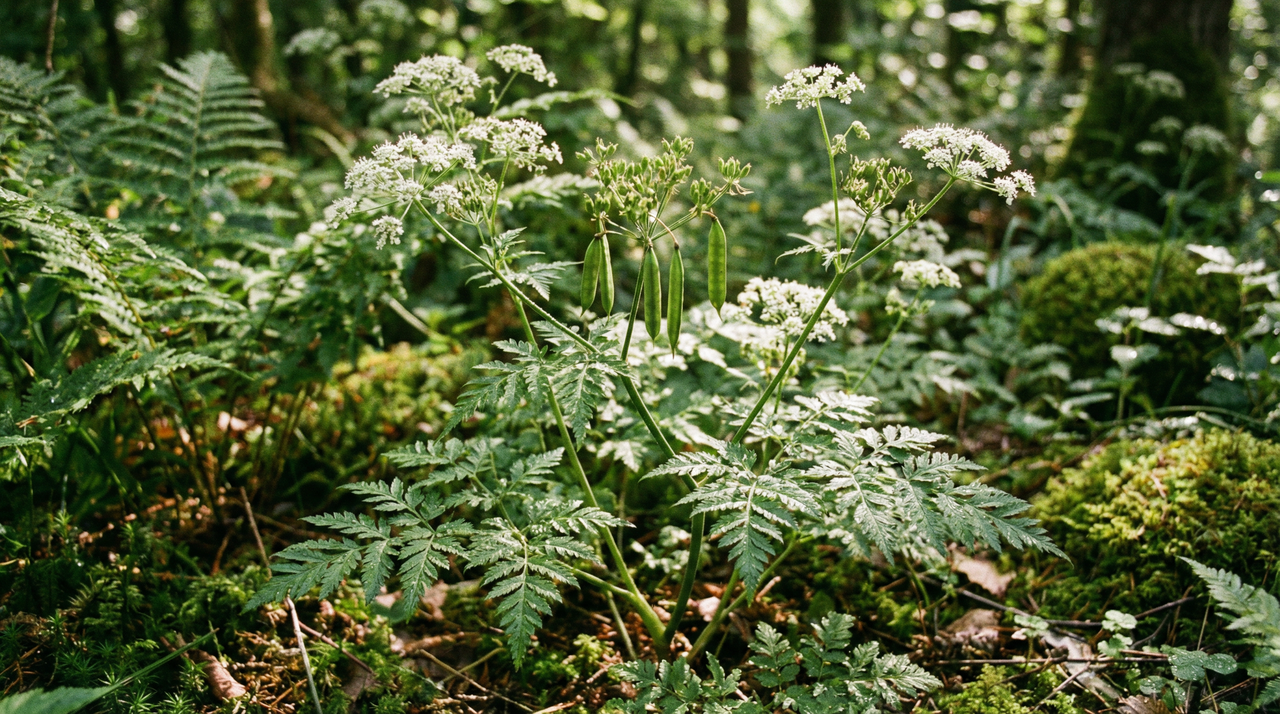
Every spring, before almost anything else has woken up in my shaded border, Sweet Cicely is already there: ferny, bright, smelling faintly of anise and something almost sweeter, like a liqueur left open on a warm afternoon. It's one of those plants I didn't fully appreciate the first season I grew it, partly because nothing dramatic happens. It just... shows up, quietly useful, and then I cut a handful of leaves to throw into a pot of stewing rhubarb and the whole thing clicks. I used half the sugar I normally would. The tartness softened without disappearing. That's the thing about this plant that nobody leads with: it's a functional sweetener growing in your garden, and most people walking past it have no idea.
The misconception I run into constantly is that Sweet Cicely is basically decorative, a cottage-garden filler with a pleasant smell. Understandable, honestly, since it does look the part, all lacy white umbels and soft ferny leaves. But Myrrhis odorata has been earning its place in European herb gardens since at least the Roman period,[1] not because it's pretty, though it is, but because every part of it is edible, medicinally useful, and ecologically generous in ways that take a full season of watching to really understand.
Sweet Cicely Origin, History, and Botanical Background
If you've ever grown sweet cicely and crushed a leaf between your fingers, you already understand why this herb has been cherished for millennia. That immediate, clean rush of anise is the plant's whole story in one breath. Long before it found its way into our shaded borders and food forests, Myrrhis odorata was doing exactly what it does now: perfuming the damp woodland edges and mountain meadows of Europe, quietly making itself indispensable.
Botanical Background and Native Habitat of Myrrhis odorata
Sweet cicely is native to the cool, humid mountain regions of southern, central, and western Europe, where it grows from sea level up to roughly 2,000 meters elevation in habitats that include damp woodlands, stream banks, hedgerows, and shaded rocky slopes receiving 600 to 1,200 mm of rain annually.[2][3][4] Think the Apennines, the Pyrenees, the British uplands: places where the light comes filtered and the soil stays reliably moist and rich with humus. That origin shapes everything about how the plant wants to live in your garden.
A member of the Apiaceae family, Myrrhis odorata behaves as a biennial in the wild, spending its first year as a basal rosette before flowering and setting seed in year two, then completing its cycle.[5][6] In cultivation, though, it softens into a short-lived polycarpic perennial that can persist for three to five years or longer, largely because it self-seeds so reliably.[7] I've watched this play out over several seasons in my own shaded borders: seedlings appear each spring without any help from me, quietly filling gaps where I'd otherwise be wrestling with something more demanding. Flowering comes in the second year, typically May through June.[6] It has naturalized in parts of northeastern North America, Canada, and New Zealand as a garden escape, though it is not native to any of those places.[8]
Visual Characteristics of Sweet Cicely
Sweet cicely identification starts with scale and silhouette. Plants typically reach 60 to 180 cm tall with a spread of 45 to 90 cm, occasionally pushing toward 240 cm in particularly favorable spots.[9][10] The stems are erect, hollow, and finely hairy, and when you brush against them they release that characteristic sweet anise scent immediately.[11][1] The leaves are ternate-tripinnate, meaning they're divided and subdivided into triangular, fern-like fronds up to 60 cm long, with small softly hairy leaflets that carry the same scent. Crushing a leaf reminds me of fennel, but gentler and sweeter, without the sharp edge. That aroma comes primarily from trans-anethole, which makes up 80 to 95 percent of the essential oil and is responsible for the plant's natural sweetening quality in the kitchen.
In late spring through early summer, flat-topped compound umbels of small white five-petaled flowers appear, each umbel around 5 to 8 cm across.[12][8] After flowering come the fruits, technically dry schizocarps (each splitting into two single-seeded mericarps) that are oblong and prominently ribbed, measuring 10 to 18 mm long.[6][13] I used to see 5 mm quoted everywhere until I started saving my own seed and actually measuring them; the accurate 8 to 15 mm range is what you'll find when you hold one in your hand.[14]
Traditional and Cultural Uses Through the Ages
Sweet cicely's credentials go back a long way. Both Pliny the Elder in his Naturalis Historia (77–79 AD) and Dioscorides in De Materia Medica (50–70 AD) recorded it, noting its anise-like flavor and usefulness for digestive and respiratory complaints.[15][16] By the medieval period, it was a fixture in monastic and apothecary gardens across Europe, appearing in the Regimen Sanitatis Salernitanum and herbals by Leonhart Fuchs and Pietro Andrea Mattioli, with Linnaeus formally describing it in Species Plantarum in 1753.[17] Centuries before anyone used the term "food forest," European monasteries were already layering useful herbs like sweet cicely into productive shade gardens where fruit trees grew above and useful understory plants filled in below.
Its dual value as culinary herb and folk remedy drove that cultivation. Leaves, stems, roots, and unripe seeds all made their way into salads, soups, stews, fruit dishes (rhubarb especially), beers, and cheeses, with the sweet anise flavor added toward the end of cooking since heat diminishes it.[18] Medicinally it served as a digestive aid for flatulence and indigestion, a mild expectorant, a diuretic, and a vermifuge.[19] Scandinavian folklore added another layer, associating it with protection while berry picking, safe forest passage, and women's health.[20]
The plant spread globally through cultivation and garden escape, naturalizing across temperate North America, parts of eastern Asia, and Australia.[21] Because I've seen how enthusiastically it self-seeds in cultivation, I always encourage gardeners to grow their own rather than wild harvest; it's considered of least concern conservation-wise, but local populations still deserve care.[22]
Fun Facts and Modern Appeal of Sweet Cicely
The anise aroma that defined sweet cicely's entire cultural history comes down to this volatile oil profile, giving leaves, stems, and seeds a sweetness that genuinely reduces the need for added sugar in acidic fruit dishes. That's not culinary hyperbole; it's chemistry with a centuries-long track record.
In the modern garden it punches well above its weight. The Royal Horticultural Society has given it an Award of Garden Merit, deer tend to leave it alone, and its white umbels draw butterflies and beneficial insects reliably.[23][24] Its self-seeding habit is worth understanding upfront: seed dispersal happens mostly by gravity, with lightweight ribbed umbels providing limited wind assistance, which keeps spread relatively localized and the overall invasive risk low to moderate rather than aggressively weedy.[25] In my shadier borders, I've found that this self-seeding fills in exactly where I want ground-level coverage without the plant ever becoming something I'm trying to contain. A ferny, fragrant, deer-resistant perennial that largely manages itself? That's a good addition to a thoughtfully designed woodland edge.
Sweet Cicely Varieties and Where to Buy It
Why Sweet Cicely Has No Recognized Cultivars
If you've spent any time chasing the "best" cultivar of a popular herb, Sweet Cicely is going to feel almost refreshingly simple. Myrrhis odorata is grown as a single, unified species with no formally recognized cultivars or botanical varieties. The RHS, Missouri Botanical Garden, and USDA all document it the same way: just Myrrhis odorata, full stop.[26][27][28] You may occasionally encounter a seller labeling plants as a "select" strain, but those aren't standardized or stable enough to carry any real cultivar weight. Minor variation in leaf intensity or growth vigor exists in the wild, as it does in any species, but nothing heritable enough to justify a name.
What that means practically is that every plant you grow is delivering the same package: finely divided, fern-like foliage with that signature sweet anise scent when you brush it, and those lovely flat-topped umbels in late spring. I actually appreciate this about the plant. There's no decision fatigue, no wondering if you chose the right form. You learn this plant, its character and its needs, rather than chasing a catalogue of variations. I label every Sweet Cicely planting clearly in my own garden because the seedlings can look disconcertingly like other umbellifers early on, but that's a care skill, not a cultivar problem. The leaves' anise fragrance is most pronounced when harvested young, which tells you something about the plant's real value sitting right there in the botany.
Sourcing Sweet Cicely Plants and Seeds
Because there's only one thing to buy, what matters most is finding a healthy specimen from a grower you can trust. Sweet Cicely has a somewhat limited but consistent presence in the specialty herb mail-order world in the US, and availability does shift by season, so checking current stock and confirming shipping to your location before you fall in love with a listing is genuinely good advice.
My go-to recommendation is Plant Delights Nursery in North Carolina, where I've ordered Myrrhis odorata multiple times and consistently received vigorous, well-rooted plants.[29] For seeds, Strictly Medicinal Seeds ships across the US and has a solid reputation in the herbal growing community.[30] Richters Herbs in Canada also ships Myrrhis odorata stateside, which is worth knowing since they carry a broader range of unusual culinary herbs than most domestic sources.[31] Bluestone Perennials is another option for gardeners in USDA zones 4 through 8, and local herb-focused garden centers occasionally carry it seasonally if you prefer to inspect a plant in person before committing.
As for Etsy and eBay, I've had mixed results with random sellers on those platforms and now stick to the nurseries above. Quality control varies wildly, and with a plant that needs to establish a deep taproot before it truly hits its stride, starting with weak or mislabeled stock is a frustrating setback. The absence of variety confusion actually makes this easier: you know exactly what you're looking for, so hold out for a reputable source that can deliver it.
Sweet Cicely Propagation and Planting Guide
Sweet cicely rewards patience, but it also rewards gardeners who understand what they're actually working with. Before you can grow it well, you need to know what you're holding when you pick up those seeds.
Seed Structure, Viability, and Stratification Requirements
The "seeds" of sweet cicely are technically dry schizocarp fruits, each one splitting into two mericarps at maturity, running 10–20 mm long with five prominent ribs and a dark reddish-brown color.[8][32] They look almost like small, elegantly ridged grains of rice. Each mericarp holds a single embryo, and that detail matters because there's no backup if germination fails on any individual seed. Freshness matters enormously: viability drops sharply after the first year, though seeds stored cool and dry at 3–5 °C with low moisture can remain viable for 2–3 years and up to a decade under controlled seed-bank conditions.[33][34] In practice, I treat sweet cicely seed like fresh pasta: use it now or accept the consequences.
The seeds also carry physiological dormancy, which means cold is non-negotiable. A minimum of 4–6 weeks of cold moist stratification at 1–5 °C breaks that dormancy reliably.[35][36] I think of it the way I think about parsley or carrot germination quirks: the whole Apiaceae family seems to need something a little extra, and sweet cicely just takes that further. The simplest approach is autumn sowing directly in the ground, letting winter do the work. If you're sowing in spring, mix fresh seeds into damp vermiculite, seal them in a bag, and refrigerate for at least a month. Once stratified, sow shallowly at just 6–13 mm deep in soil held around 15–20 °C; they need light to germinate, so don't bury them.[37] Expect germination in 2–4 weeks, though it can stretch to six, and rates of 50–70% from fresh, well-stratified seed are realistic.[38]
One more thing on saved seed: sweet cicely is insect-pollinated and predominantly outcrossing, so seedlings from your garden may not match the parent plant in flavor or form.[39] I save seed mainly to share with neighbors or to naturalize a new patch. If I have a plant with particularly sweet, aromatic leaves and I want more of exactly that, I propagate it by division every time.
Root division in spring or autumn delivers 80–90% success, produces genetically identical plants, and establishes faster than any seedling.[40] Each division needs both roots and shoots, and you should replant it immediately rather than letting it sit. Stem cuttings are possible but not worth the trouble given a 30–50% success rate and a deep taproot that simply doesn't cooperate the way a fibrous-rooted perennial would.[41]
Germination Timeline and Growth Stages
Set realistic expectations early: seed-grown sweet cicely typically takes 1–2 years to reach full maturity, spending its first season as a basal rosette you can harvest from lightly once it's settled in.[42] I always label my rows carefully because first-year seedlings look almost identical to young carrot or parsley plants; they're ferny, modest, and entirely unassuming. Plants from root divisions skip that waiting period and can be harvested within the first season after a 6–12 month establishment window.[43] In my shaded borders, where I want usable leaves sooner rather than later, division wins without question.
Soil, Site, and Planting Technique
Sweet cicely is a woodland-edge plant at heart, native to the damp mountain meadows and hedgerows of Europe, and its soil preferences reflect exactly that origin.[44] It wants moist, humus-rich, well-drained loam with a pH between 6.0 and 7.5, and it needs at least 30 cm of soil depth to develop its taproot properly.[45][46] Waterlogging causes root rot, and compacted soil frustrates establishment almost as badly.[47] In my heavier clay beds I dig the planting hole at least 18 inches deep and work in a generous handful of horticultural grit along with compost before planting; after losing one plant to a poorly draining corner, I stopped trusting the drainage to sort itself out. Partial to full shade suits it best, with 4–6 hours of dappled or morning sun tolerated.[48] It's reliably hardy in USDA zones 4–8, which maps neatly onto the cool, moist climates its native habitat receives.
Spacing, Divisions, and Establishment Tips
Mature sweet cicely grows 90–180 cm tall with a spread of 60–90 cm, and that eventual size should drive your spacing decisions from day one.[5] Space plants 30–45 cm apart within a row and allow 60–90 cm between rows to give the taproot room and keep air moving through the canopy.[49] Crowding leads to stagnant humid pockets, which is the one condition this otherwise tough plant doesn't handle gracefully.
Once established, sweet cicely essentially manages its own population. It self-seeds readily in suitable spots, attracts pollinators with its white umbels, and resists deer browsing.[47] The colony will need thinning or division every 2–3 years to maintain vigor, but that's not a burden; it's a source of free divisions to extend your planting or share. The seed route asks for patience and a refrigerator. Division asks for a sharp spade and about fifteen minutes. Either way, once you've got sweet cicely settled into the right shaded spot, it quietly becomes one of the most self-sufficient plants in the garden.
Sweet Cicely Care Guide: Growing Myrrhis odorata
Sweet cicely is one of those plants that rewards you more for choosing the right spot than for fussing over it once it's in the ground. Get the siting right and you'll have a lush, fragrant perennial that largely looks after itself. Get it wrong, and no amount of supplemental watering or shade cloth will fully compensate.
Sunlight Requirements for Sweet Cicely
Partial shade is where this plant thrives, ideally with four to six hours of morning or dappled light filtered through a tree canopy.[50][51] I've learned the hard way that afternoon sun in warmer gardens browns the foliage fast, much like parsley left in a sunny window. Full shade is tolerable but tends to produce leggy plants that flop over and produce less of the ferny, arching growth that makes the sweet cicely plant so beautiful. The sweet spot, in my experience, is the dappled light under a fruit tree or along a north-facing fence, where the delicate anise scent stays concentrated in the leaves rather than cooking off in the heat.
Watering Needs and Soil Moisture
Think of its native habitat: cool, damp mountain woodland edges in Europe. That context explains everything about its moisture preference. Sweet cicely wants consistently moist, humus-rich, well-drained soil and about an inch of water per week, or watering whenever the top inch dries out.[5][52] It has some drought tolerance once established, but prolonged dry spells push it toward stress quickly. Underwatering shows up as wilting and leaf curl from the margins inward; overwatering is sneakier, producing yellowing leaves, soft mushy roots, and sometimes a foul smell from the soil.[53] A two-to-three inch layer of leaf mold mulch is non-negotiable in any garden that isn't naturally damp. Soil pH should sit between 6.0 and 7.5, and the plant prefers soft water or rainwater over hard tap water with high mineral content.[54] If you're growing the North American native Osmorhiza longistylis instead, nudge the pH slightly more acidic, toward 5.5 to 6.5.[55]
Feeding and Soil Fertility for Myrrhis odorata
Sweet cicely is a light to moderate feeder that evolved in moderately fertile woodland soils, and it needs no regular fertilization once established.[56][57] I stopped using high-nitrogen feeds on mine years ago after noticing that the plants put on lush, almost coarse growth with almost none of the sweetness I was growing them for. A single early-spring application of balanced low-nitrogen organic fertilizer, or just a generous top-dress of compost or well-rotted manure, is plenty.[58][59] Watch for yellowing leaves as a nitrogen signal, purpling as a phosphorus deficiency, and leaf scorch as a potassium problem. Over-fertilization shows up as wilting and a white salt crust on the soil surface, which is your cue to flush and step back.[60][61] The annual compost mulch does double duty here, feeding the soil slowly while retaining moisture. Benign neglect, in this case, is genuinely the best strategy.
Frost Tolerance and Winter Protection
Cold is not the enemy here. Myrrhis odorata is fully hardy in USDA zones 4 through 8, tolerating temperatures as low as -30°F (-34°C), and holds an RHS H7 rating covering all UK climates.[62][63] Established plants die back to the crown in autumn and regrow reliably from the root system each spring; it's really only young leaves, emerging buds, and first-year plants that need any particular attention during a late frost. My autumn routine involves mulching with three or four inches of leaf mold after the first hard frost, which mimics the woodland floor litter the plant evolved under and has eliminated winter losses even in tricky microclimates.[64][5] Container plants and freshly divided crowns are the exception; those benefit from row cover or a sheltered spot during hard freezes.
Heat Tolerance and Summer Care
Heat is the real threat to sweet cicely growing conditions. The plant performs best between 50 and 70°F (10 to 21°C) and starts showing stress above 75 to 80°F: wilting in the afternoon, leaf scorch along the margins, and sometimes early bolting.[5][37] In zone 8 or the hotter edges of zone 7, it may behave more like an annual, going dormant by midsummer. The mitigation toolkit is straightforward: site it in morning sun only, keep moisture consistent, and maintain that two-to-four inch mulch layer to cool the root zone.[5][59] Once the plant bolts or scorches, the leaf flavor deteriorates rapidly, which is why the afternoon-shade rule matters as much to the kitchen as it does to the garden.
Pruning, Maintenance, and Seasonal Rhythm
The sweet cicely plant follows a predictable calendar: new shoots emerge from the crown in March and April, the white compound umbels open in May and June, seeds mature through July and August, and the whole above-ground structure dies back naturally in September and October.[65][6] Once you know this rhythm, maintenance becomes easy to sequence around it.
Deadheading after the sweet cicely flowers open is the most important seasonal task. Cut the spent umbels before the seeds mature and you accomplish two things at once: you curb what can become enthusiastic self-seeding, and you push the plant to produce a flush of fresh, tender foliage with the concentrated anise sweetness that makes the leaves worth harvesting.[49][66] If you want seeds for propagation or the kitchen, leave a few umbels on the strongest stems and collect when they turn dark brown. Divide mature clumps every three or four years in spring to keep the plants vigorous; in my own garden, spring divisions establish noticeably faster than autumn ones and the foliage flavor seems sharper in the season following division.[67][59] Top-dress with compost each spring to replenish organic matter and the plant largely tends to itself from there. Pest and disease pressure is genuinely low; the aromatic foliage deters most insects, though slugs and the occasional aphid colony are worth watching for in spring.[68][69] Once the seasonal rhythm is part of your garden routine, sweet cicely height settles comfortably at three to five feet and the plant rewards you with almost no intervention beyond the annual cut-back and mulch.
Sweet Cicely Harvesting: Timing, Technique, and Flavor
Sweet cicely doesn't hand you all its gifts at once. Each edible part has its own window, and learning to read the plant through the seasons is really the whole skill. Get the timing right and you're rewarded with some of the sweetest, most anise-forward flavors in the herb garden. Wait too long and the leaves turn tough, the seeds shatter before you can collect them, and the roots stay undersized. The plant tells you when it's ready. You just have to know what to look for.
When and How to Harvest Sweet Cicely Leaves, Seeds, and Roots
In temperate climates, sweet cicely follows a reliable phenological arc: emerging in early spring around March or April, flowering through May and June, and setting seed from July into August, with leaf harvest possible from April all the way through September.[42][48][70] That's a long season, but the quality isn't uniform across it. I've found that harvesting leaves just before the plant flowers keeps them noticeably sweeter and more tender than anything picked later in the season. Once flowering kicks in, the foliage coarsens slightly and loses some of that bright anise edge. You can still harvest through summer and into early autumn, and I often do, but those spring and early summer leaves are the ones I reach for in fresh salads.[71][5]
Sweet cicely seed pods are a different harvest altogether, and the cues are sensory rather than calendar-based. Seeds mature from late summer into early autumn, roughly two to three months after flowering, when the umbels brown and curl inward, the seeds turn dark brown to nearly black, and, most usefully, they rattle audibly inside the dried heads.[72][48][73][74] I use the same rattle test I apply to fennel seeds: if you can shake the umbel and hear movement, they're ready. If they're still silent and green-tinged, give them another week. Act decisively at that point, because a mature umbel will drop its seeds quickly.
Roots require the most patience of all. They're best harvested in the second autumn, once the plant has gone dormant in October or November, when two full growing seasons have given them the size and sweetness that first-year roots simply lack.[43] I learned this the slow way. My first-year roots were stringy and barely worth cleaning. The second autumn was a completely different story.
Understanding Sweet Cicely's Flavor Profile and Yield
The sweet anise character that runs through every part of this plant traces back to its high concentration of anethole and estragole.[75][76] That chemistry is why the flavor reads as licorice-adjacent without being sharp, why the plant has such a long history as a sugar substitute, and why each part tastes like a variation on the same theme rather than something completely different.
Young leaves are fern-textured, crisp, and intensely fragrant when crushed. That fragrance is also my quickest field ID cue in a mixed border: one gentle pinch and the anise burst is unmistakable, very useful for distinguishing it from other ferny umbellifers early in the season. Fresh leaves shine in salads and as garnishes; dried, they mellow considerably and work better steeped into teas.[75] The sweet cicely seed pods, once fully mature, shift the experience entirely: hard, crunchy, and warming with a fennel-like sweetness that makes them genuinely useful as a sugar substitute in baking, either whole in a crumble topping or ground into pastry dough.[47][18] Roots, roasted or added to soups, deliver a parsnip-like sweetness and texture that feels substantial in a way the leaves don't.[47][18] A well-established plant is generous with leaves and seeds; the self-seeding habit alone can keep a dedicated patch productive indefinitely without much intervention from you.
Sweet Cicely Culinary Preparation and Uses
Culinary Uses and Flavor Profile of Sweet Cicely
Every part of sweet cicely is edible, which puts it in rare company among kitchen herbs. Leaves, flowers, stems, seeds, and roots all carry that characteristic sweet anise flavor,[6][77] and the practical upshot is that you can pull something useful from the plant at almost any point in its growing season. I use a generous handful of chopped leaves in rhubarb crumble and find it reliably replaces about two tablespoons of sugar; the tartness softens without tasting medicinal or licorice-forward. That same principle applies to gooseberry fool, early-season fruit compotes, anything that usually needs significant sweetening to be pleasant.
The seeds deserve their own moment. They're more intense than the leaves, closer to fennel or caraway, and can be ground into spice blends or folded into shortbread and custards.[78][77] The dried root works beautifully in baking and liqueurs.[79] Historically, European cooks stirred the leaves into curds, cream, fish dishes, sauces, and sorbets,[80][47] and that tradition translates easily to modern kitchens. Nutritionally, the leaves contribute modest amounts of vitamin C, potassium, calcium, and dietary fiber,[81] along with flavonoids and anethole-driven antioxidant activity.[82] Treat those as a quiet bonus rather than a reason to eat it by the bowlful.
One thing I wish someone had told me early on: sweet cicely shares its ferny, white-umbelled look with some genuinely dangerous relatives. Verifying your harvest visually and by smell is strictly necessary because early spring foliage easily fools the eye. The reliable field test is smell. Crush a leaf hard; if it doesn't release a clear, sweet licorice scent, leave the plant alone. Poison hemlock (Conium maculatum) has no such fragrance and typically shows purple blotching on its stems.[83][84] In culinary amounts sweet cicely is considered safe, with only low coumarin levels and no significant toxins,[85][86] though anyone with Apiaceae sensitivities should introduce it carefully, and pregnant women should stick to food-scale amounts and avoid medicinal doses.[87]
Traditional Medicinal Preparations
European herbalists have long reached for sweet cicely as a digestive aid, carminative, and expectorant, and preliminary research hints at anti-inflammatory and antimicrobial properties that might support those traditional applications,[6][18] though robust clinical trials are sparse. I keep a small jar of dried leaves for after-dinner tea; one to two teaspoons per cup, steeped ten minutes, up to three cups daily is the standard herbalist guidance.[88][89] I've never had any digestive upset at that level, though I'm always clear with myself that this is folk tradition with limited clinical backing, not a proven therapy. Tincture preparations typically run one to four milliliters up to three times daily; topical essential oil use should be diluted to 0.5 to 1 percent, and internal use of the concentrated oil isn't recommended without professional guidance.[88]
Non-Food Uses for Sweet Cicely
Beyond the kitchen and the medicine cabinet, sweet cicely earns its place in a permaculture system through sheer biomass. The foliage chops down into excellent mulch or compost material,[90] a practical echo of its dynamic accumulator role covered in the permaculture section. And for a piece of historical curiosity: some Native American communities used it as a tobacco substitute, blending the dried plant with others for ceremonial or social smoking.[90] It's a small detail, but it's a reminder that this graceful woodland herb has been noticed, used, and valued by cultures well beyond the European kitchen garden tradition.
Sweet Cicely Health Benefits and Medicinal Uses
When I pick a leaf of sweet cicely and hand it to someone for the first time, I usually say the same thing: this plant has centuries of use behind it, and the chemistry to back up at least some of that reputation, but don't go treating it like medicine from a bottle. That's the honest framing for everything that follows.
Traditional European Folk Medicine Uses
Across Germany, Russia, and the broader European tradition, sweet cicely earned its place in the apothecary garden as a go-to carminative for flatulence, indigestion, bloating, and stomach cramps.[91][92] Herbalists also reached for it as an expectorant for coughs and bronchitis, a mild diuretic, and a topical poultice for minor skin irritations and wounds.[93][94] These aren't fringe uses; they're consistent across centuries of European ethnobotany. I've had family members sip a mild sweet cicely tea after heavy meals and report noticeably less bloating, which I mention not as evidence but as the kind of modest, anecdotal observation that aligns with what the tradition describes.
Preclinical research does lend some biological plausibility to these folk applications. Extracts and essential oils show antioxidant activity via DPPH and ABTS radical scavenging comparable to ascorbic acid, along with moderate antimicrobial effects against gram-positive bacteria like Staphylococcus aureus and Bacillus subtilis, and anti-inflammatory activity through COX-2 and NF-κB inhibition in vitro and in animal models.[95][96] Antispasmodic effects via calcium channel modulation and mild analgesic activity from root polyacetylenes have been reported in animal models as well, and one small human trial noted reduced inflammation markers from tea consumption.[97][98] That last data point is promising but nowhere near conclusive; no large-scale human clinical trials exist as of 2023.[99][91] This is supportive traditional herbalism, not substitute medicine.
Key Phytochemicals and Bioactive Compounds
The scent tells you everything about where the bioactivity starts. Sweet cicely's essential oil is dominated by (E)-anethole, the same phenylpropanoid that gives star anise and fennel their characteristic sweetness, reaching up to 90% in seeds and typically 50-80% across plant parts, with estragole, p-anisaldehyde, myristicin, and β-caryophyllene rounding out the profile.[100][101] The sweet cicely root tells a different chemical story: it's richest in polyacetylenes such as falcarinol, at up to 0.1% dry weight, compounds with their own distinct pharmacological interest.[102]
The leaves contribute a separate layer of bioactives: flavonoids including rutin, quercetin, kaempferol, hyperoside, and isoquercitrin, along with phenolic acids like chlorogenic, caffeic, and ferulic acid, and coumarins including umbelliferone and herniarin in both aerial parts and roots.[103][104] None of these numbers are fixed. Concentrations shift meaningfully by plant part, season, soil, and geography, with peak essential oil levels during June and July flowering.[105][106] I've noticed this firsthand: leaves harvested in late June from my garden produce a noticeably more pungent tea and a sharper anise aroma than those picked in early spring or autumn. These same phenylpropanoids and root exudates also serve ecological functions, attracting pollinators and potentially modulating the soil microbiome through allelopathic activity.[107][108]
Scientific Research on Antioxidant, Antimicrobial, and Anti-Inflammatory Effects
The antioxidant findings are worth knowing about. IC50 values of 50-100 µg/mL via DPPH and ABTS assays put sweet cicely extracts in genuinely useful territory, comparable to ascorbic acid, and antimicrobial activity against Staphylococcus aureus, Bacillus subtilis, and Candida species has been recorded at MIC values of 0.5-2 mg/mL.[109][110] The anti-inflammatory pathway work, specifically COX-2 and NF-κB inhibition with reduced TNF-α, gives a plausible mechanism for the traditional digestive and wound applications.[96] Still, nearly all of this is in-vitro or animal data, and the gap between a cell-culture result and a clinical outcome is wide.[92] Until larger human trials exist, the honest position is that the science is suggestive, the tradition is long, and the two point in the same direction without yet confirming each other.
Nutritional Profile and Culinary Health Contributions
Sweet cicely isn't a nutritional powerhouse in the way kale gets marketed, but it earns its place in the kitchen garden. Fresh leaves come in at roughly 20-30 kcal per 100g, are 85-90% water, and provide modest amounts of protein, carbohydrates, and fiber, along with approximately 20-50mg of vitamin C and useful levels of vitamins A and E.[111][112] That vitamin C contribution is modest compared to parsley, but in a kitchen garden context where you're adding a teaspoon or two of chopped leaf to a dish, it accumulates across a whole season of use. What I find more compelling is its function as a natural sweetener: cooking acidic fruits like rhubarb with a few sweet cicely leaves genuinely reduces the sugar you need to add, which is a real, everyday health contribution that no supplement delivers.
A serving of 1-2 teaspoons of chopped leaves or seeds keeps the flavor from overpowering a dish and stays well within sensible culinary use. Every plant part is edible, from leaves used raw in salads or cooked like spinach, to seeds applied like anise in baking and pickling, to young roots peeled and prepared like parsnip.[97] I use the leaves in fruit salads instead of added sugar and find it one of the more elegant tricks the kitchen garden offers.
Safety Considerations, Contraindications, and Look-Alike Warnings
For healthy adults using sweet cicely as a culinary herb, the safety profile is reassuring. It carries GRAS status for food use, shows low acute toxicity in studies (LD50 above 5 g/kg), and is listed by the ASPCA as non-toxic to pets.[113][114] Children and livestock tolerate food amounts without issue. That said, a few specific considerations matter.
Anyone with sensitivities to the Apiaceae family (carrot, celery, parsley) should be aware of cross-reactivity risks and potential contact dermatitis.[115] The coumarins present, specifically umbelliferone and herniarin, create a theoretical interaction risk with anticoagulant medications like warfarin, and the plant's mild blood-sugar-lowering activity means diabetics monitoring glucose should be aware when using it medicinally rather than as a seasoning.[116][117] Pregnancy and lactation are a clear caution: the anethole and trace apiol content carry potential emmenagogue effects, and robust safety data simply doesn't exist for those periods, so professional guidance is necessary.[118][119]
The identification warning is the one I take most seriously, and it's why I label every seedling tray in my nursery beds. Young sweet cicely looks deceptively similar to other Apiaceae, and in the wild it shares habitat with poison hemlock (Conium maculatum) and water hemlock (Cicuta spp.), both of which can be fatal.[120][121] The hemlocks have purple-blotched stems, a foul unpleasant odor, and chambered roots, none of which sweet cicely shares, but you must confirm all of those features before foraging.[62] This is non-negotiable. Grow your own from a verified source, and the identification question never arises.
Sweet Cicely Pests and Diseases
Natural Pest Resistance from Aromatic Compounds
Sweet cicely is one of the plants I worry about least in my herb borders. That distinctive anise scent isn't just pleasant to us; it's the plant's defense system in action. The foliage is dense with volatile compounds including anethole, estragole, and myristicin, along with furanocoumarins in the plant tissues, and together they make Myrrhis odorata deeply unappealing to most insects.[122][123][124] Aphids, which routinely colonize my parsley and carrots, largely skip it. Deer and rabbits avoid it too, almost certainly because of the pungency that hits you when you brush past a leaf.[125] In my experience, the strongest deterrent effect comes from plants grown in full sun or bright partial shade with good airflow; crowded, shadier specimens seem to have less aromatic intensity, and you can actually smell the difference when you handle them.
Beyond repelling pests from itself, the plant releases coumarins through its root exudates that can inhibit nearby weed competitors, a secondary allelopathic quality that slots nicely into a companion planting strategy.[126] Tucked near brassicas or salad greens, it can help buffer those more vulnerable crops from aphid pressure.[127] The 'Variegata' cultivar, the only notable selection you're likely to encounter, holds onto all of these same resistance traits.[128] Occasional slugs, snails, leaf beetles, or caterpillars can turn up, especially on stressed plants or in persistently damp corners of the garden, but these are minor nuisances rather than genuine threats. Good siting, meaning fertile and well-drained soil with adequate spacing, prevents most of it before it starts.
Disease Resistance and Prevention Strategies
The disease story is similarly reassuring. Bacterial problems are virtually unreported, and fungal issues are infrequent enough that the research literature on Myrrhis pathology is genuinely sparse, partly because the plant has never attracted enough commercial interest to warrant intensive study.[129][130] While formal studies on Myrrhis pathology are sparse, my experience and the broader Apiaceae literature point to the same conclusions on prevention. The conditions that occasionally produce powdery mildew, rust, leaf spot, root rot, or damping-off in seedlings are almost always a matter of poor siting rather than any inherent fragility in the plant.[131][130]
The prevention toolkit is straightforward: good spacing for airflow, well-drained soil in the pH 6.0–7.5 range, and watering at the base rather than overhead.[132][48][130] The one time I've seen powdery mildew appear on my plants, switching to basal watering and thinning a few crowded stems cleared it up without any chemical intervention. I did lose a few seedlings early on to damping-off in a propagation tray that stayed too wet, but once I improved drainage in my starting mix, the problem disappeared entirely. There are no cultivars bred for enhanced disease resistance,[37] but with a plant this constitutionally robust, you really don't need them. Preventive culture beats any spray program here, every time.
Sweet Cicely in Permaculture Design
Sweet cicely is not a plant you slot into every design. It has preferences, and respecting them is the difference between a thriving woodland understory specimen and a struggling, bolted-out disappointment. Get the climate match right, though, and it repays you with years of stacked function in the shadiest corners of a food forest where most herbs refuse to cooperate.
Climate Suitability and Hardiness Zones
Most sources converge on USDA zones 4-8 as the sweet spot, though reliable cold hardiness extends into zone 3 with snow cover or a good mulch layer, tolerating lows around -30°F.[5][133][134] Cold hardiness is the easy part of the story. The harder constraint is heat. Sweet cicely is genuinely happiest between 50-68°F, and when summer temperatures stay above 75°F for extended stretches, expect bolting or a slow decline.[134][59] It's a cool-climate specialist, full stop.
That temperature reality shapes everything else: light, water, soil, placement. In cooler climates you can grow it in full sun, but in warmer reaches of its range, partial shade is non-negotiable for managing heat and preserving soil moisture.[5] The soil it wants is consistently moist, well-drained, and rich in organic matter, and it performs poorly under drought.[135][5] I've found mulching to be non-negotiable in any planting I do -- a deep wood-chip layer mimics the cool, moisture-retentive duff of its native European mountain woodland and keeps the root zone from spiking in summer. In North America, the Pacific Northwest, the Northeast, and parts of the upper Midwest are the most natural fits, places where the climate already leans cool and damp.[136] If you're outside those regions, sweet cicely is an uphill battle that rarely ends well.
Ecosystem Functions and Guild Roles
The first time I planted sweet cicely under a young apple tree, I wasn't fully prepared for what happened when the umbels opened in late May. Hoverflies descended in waves. Solitary bees worked every floret. The white compound flowers, 4-8 cm across and faintly sweet-smelling, turned out to be one of the more effective insectary moments in my entire garden that season.[137][138][139] Honeybees, butterflies, and various flies join the party, drawn in by accessible nectar and pollen during the May-June bloom window.[140] For a woodland guild trying to support fruit set on nearby trees, this is genuinely useful timing.
Beyond pollinators, sweet cicely contributes to the soil economy. As a dynamic accumulator, its roots mine phosphorus and potassium from deeper layers, returning those nutrients to the surface as the plant decomposes each autumn.[141] I started noticing greener spring growth in the nitrogen-fixing shrubs nearby after a few years of letting the plant die back in place, which is the kind of closed-loop observation that keeps me trusting the system. Its fibrous roots and self-seeding habit also translate into solid ground cover that suppresses weeds and holds soil in shaded spots where bare ground would otherwise be an invitation for erosion.[141] It also serves as a larval host for certain moths, broadening its biodiversity value beyond the adult insect visitors at flowering.[142] The anise-scented foliage is often cited as a mild deterrent for aphids and carrot fly, though I'll be honest that the evidence there is largely anecdotal. I wouldn't design around it as pest control, but I wouldn't dismiss it either.
Forest Layer Placement and Companion Planting
Structurally, sweet cicely belongs in the herbaceous understory layer. It grows 60-90 cm tall with ferny, anise-scented foliage on upright stems[47][143], which makes it a graceful filler beneath fruit trees or tall shrub layers without competing for canopy space. Paired with ferns, wild garlic, or shade-tolerant ground covers, it recreates the feel of a European woodland edge in a way that's genuinely beautiful, not just functional.[143] I've grown it alongside cow parsley and the two together create that lush, light-dappled ground plane that makes a food forest feel like somewhere you actually want to linger.
It forms mycorrhizal associations that support soil microbial life, contributing to the underground network that connects plants in a mature guild.[144] Sweet cicely does not fix nitrogen. It's not playing that role in your guild, so pair it with alders, currants, or other fixers rather than relying on it for that function. And for North American designers specifically, it is an introduced species that has naturalized in parts of the Northeast and Canada.[8][136] I monitor self-seeding in my own designs and pull volunteers that wander beyond the intended guild. It's not an aggressive spreader, but it pays to stay attentive. Site it well, manage it lightly, and it becomes one of the most quietly productive plants in a temperate food forest.
The Plant That Made Me Rethink What "Useful" Looks Like
I still catch myself brushing a leaf just to smell it on my way past, which is something I don't do with most plants after twenty years. There's something about Sweet Cicely that feels genuinely generous: it asks for a shady corner nobody else wants, it shows up early when the garden still looks half-asleep, and it sweetens your rhubarb without asking anything in return. Some plants earn their place through sheer productivity. This one earned mine through quiet, consistent charm.
Sources 144
- Myrrhis odorata | Plants of the World Online | Kew Science ↩
- Myrrhis odorata ↩
- Myrrhis odorata ↩
- Myrrhis odorata (Sweet Cicely) ↩
- Myrrhis odorata (Sweet Cicely) ↩
- Myrrhis odorata ↩
- Sweet Cicely - Myrrhis odorata ↩
- Myrrhis odorata ↩
- Myrrhis odorata ↩
- Myrrhis odorata ↩
- Myrrhis odorata ↩
- Myrrhis odorata - Sweet Cicely ↩
- Flora of Europe: Myrrhis odorata ↩
- Umbelliferae Fruits and Seeds ↩
- Naturalis Historia ↩
- De Materia Medica ↩
- Species Plantarum ↩
- Myrrhis odorata - Sweet Cicely ↩
- Myrrhis odorata in Traditional Medicine ↩
- Scandinavian Folklore: the World of Witchcraft & Healing Plants ↩
- Myrrhis odorata (Sweet Cicely) ↩
- Conservation Status of European Wild Herbs ↩
- Myrrhis odorata ↩
- Myrrhis odorata (Sweet Cicely) ↩
- Invasive Species Compendium: Myrrhis odorata ↩
- Myrrhis odorata ↩
- Myrrhis odorata ↩
- Plants Profile for Myrrhis odorata (sweet cicely) ↩
- Myrrhis odorata - Sweet Cicely ↩
- Sweet Cicely Seeds (Myrrhis odorata) ↩
- Myrrhis odorata ↩
- Plants of the World Online: Myrrhis odorata ↩
- Seed Information Database - Myrrhis odorata ↩
- RHS: Seed Storage and Viability in the Apiaceae Family ↩
- RHS Propagation of Sweet Cicely ↩
- Germination and Dormancy of Sweet Cicely ↩
- RHS Growing Sweet Cicely ↩
- Sweet Cicely: Propagation Techniques ↩
- Breeding Systems in Myrrhis odorata ↩
- Myrrhis odorata - Sweet Cicely ↩
- Perennial Herbs from Cuttings ↩
- Growing Sweet Cicely (Myrrhis odorata) ↩
- Growing Sweet Cicely (Myrrhis odorata) ↩
- Flora Europaea: Myrrhis odorata ↩
- RHS Gardening - Myrrhis odorata ↩
- Sweet Cicely (Myrrhis odorata) - Plants for a Future ↩
- Myrrhis odorata Cultivation Guide ↩
- Myrrhis odorata ↩
- Royal Horticultural Society: Sweet Cicely (Myrrhis odorata) ↩
- Myrrhis odorata ↩
- Myrrhis odorata (Sweet Cicely) ↩
- Myrrhis odorata ↩
- Myrrhis odorata (H533): RHS Plant Profile ↩
- Myrrhis odorata ↩
- Flora of North America - Osmorhiza longistylis ↩
- Sweet Cicely (Myrrhis odorata) Plant Profile ↩
- Myrrhis odorata USDA Plant Profile ↩
- Sweet Cicely (Myrrhis odorata) Growing Guide ↩
- Extension.umn.edu/herbs/sweet-cicely ↩
- University of Michigan Extension: Growing Perennial Herbs ↩
- Fertilizer Burn in Plants: Symptoms and Prevention ↩
- Myrrhis odorata (Sweet Cicely) ↩
- Myrrhis odorata (Sweet Cicely) ↩
- University of Illinois Extension - Overwintering Perennials ↩
- Myrrhis odorata (Sweet Cicely) ↩
- Dividing and Propagating Sweet Cicely ↩
- Growing Sweet Cicely: Myrrhis odorata ↩
- Myrrhis odorata (Sweet Cicely) Growing Guide ↩
- Pests and Diseases of Herbaceous Perennials ↩
- Phenology of Myrrhis odorata in Temperate Regions ↩
- Sweet Cicely: Harvesting and Uses ↩
- Sweet cicely - Myrrhis odorata ↩
- Sweet Cicely (Myrrhis odorata) - Cultivation and Propagation ↩
- Harvesting Herb Seeds: Guidelines for Apiaceae Species ↩
- Myrrhis odorata ↩
- Myrrhis odorata - Sweet Cicely ↩
- Sweet Cicely: Flavor and Culinary Uses ↩
- Sweet cicely (Myrrhis odorata) - Edible Garden Plant ↩
- Herbs: Sweet Cicely ↩
- Royal Horticultural Society: Myrrhis odorata ↩
- Nutritional and Phytochemical Composition of Myrrhis odorata (Sweet Cicely) ↩
- Essential Oil Composition and Biological Activities of Sweet Cicely ↩
- Poison Hemlock Look-Alikes: Sweet Cicely and Others ↩
- Edible Wild Plants: Sweet Cicely ↩
- Coumarin Content in Apiaceae Plants ↩
- Sweet Cicely: Safety and Uses ↩
- Herbs in Pregnancy: Sweet Cicely ↩
- Sweet Cicely (Myrrhis odorata) - Uses and Dosage ↩
- Sweet Cicely: Health Benefits, Side Effects, Uses, Dose & Precautions ↩
- Native American Ethnobotany Database ↩
- Sweet Cicely: A Forgotten Herb with Potential Health Benefits ↩
- Myrrhis odorata in Traditional European Medicine ↩
- Sweet Cicely (Myrrhis odorata) - Traditional Uses and Pharmacology ↩
- European Herbal Monographs: Myrrhis odorata ↩
- Antioxidant and Antimicrobial Activity of Sweet Cicely Essential Oil ↩
- Anti-inflammatory Effects of Myrrhis odorata Extracts in Vitro and In Vivo ↩
- Pharmacological Properties of Myrrhis odorata: A Review ↩
- Enzyme Inhibitory Effects of Sweet Cicely Extracts ↩
- Search Results for Myrrhis odorata on ClinicalTrials.gov ↩
- Chemical Composition and Antioxidant Activity of Essential Oil from Myrrhis odorata ↩
- Chemical composition of the essential oils of Myrrhis odorata (L.) Scop. ↩
- Phytochemical investigation of Myrrhis odorata roots ↩
- Phytochemical Analysis of Myrrhis odorata L. (Apiaceae) ↩
- Flavonoids and coumarins from Myrrhis odorata ↩
- Phytochemical Characterization of Myrrhis odorata Essential Oils ↩
- Environmental Influences on Apiaceae Secondary Metabolites ↩
- Chemical Composition and Biological Activities of Apiaceae Essential Oils ↩
- Allelopathic Potential of Myrrhis odorata Root Exudates ↩
- Chemical Composition and Biological Activities of Myrrhis odorata Essential Oil ↩
- Phytochemical Screening and Antioxidant Potential of Myrrhis odorata ↩
- Nutritional Composition of Selected Wild Edible Plants ↩
- Nutritional Composition of Selected Green Leafy Vegetables ↩
- Toxicological Assessment of Myrrhis odorata Extracts ↩
- Toxic and Non-Toxic Plants ↩
- Allergic Reactions to Apiaceae Plants ↩
- Coumarins in Myrrhis odorata and Potential Anticoagulant Interactions ↩
- Kew Gardens - Plants of the World Online ↩
- Myrrhis odorata (Sweet Cicely) - Drugs and Lactation Database (LactMed) ↩
- Sweet Cicely Overview, Uses, Safety - WebMD ↩
- Poison Hemlock Identification ↩
- Identifying Sweet Cicely ↩
- Volatile Compounds of Myrrhis odorata ↩
- Chemical Defense in Apiaceae: Focus on Furanocoumarins ↩
- Trichomes and Plant Defense Mechanisms ↩
- Insect Deterrence Properties of Apiaceae Plants ↩
- Allelopathy in Sweet Cicely (Myrrhis odorata) ↩
- Companion Planting with Herbs ↩
- Sweet Cicely - Myrrhis odorata ↩
- Sweet Cicely (Myrrhis odorata) - Profile ↩
- Disease Management in Herbs ↩
- University of Minnesota Extension - Powdery Mildew on Ornamentals ↩
- Sweet Cicely Growing Guide ↩
- USDA Plant Hardiness Zone Map ↩
- RHS Plant Finder - Myrrhis odorata ↩
- RHS Plant Finder - Myrrhis odorata ↩
- USDA PLANTS Database - Myrrhis odorata ↩
- Pollination Ecology of Apiaceae in European Woodlands ↩
- Insect Visitors to Umbellifers in Temperate Europe ↩
- RHS - Myrrhis odorata ↩
- Journal of Pollination Ecology - Pollination Biology of Apiaceae ↩
- Forest Garden Wales - Dynamic Accumulators in Permaculture ↩
- Wildlife Prairie Park - Euclid borer larval host plants ↩
- RHS - Myrrhis odorata ↩
- RHS - Myrrhis odorata - Sweet Cicely ↩