The root of this plant is so bitter that traditional healers in Malaysia sometimes called it "the bitter stick," and yet generations of men across Southeast Asia have been drinking decoctions of it before dawn, willingly, for centuries. That kind of commitment doesn't happen without results. What gets me about Tongkat Ali isn't the testosterone headlines or the supplement industry buzz, it's the fact that rural communities in Peninsular Malaysia and Borneo figured out something real about this scraggly understory tree long before any clinical trial existed, and they figured it out the hard way: by boiling the roots, gagging on the taste, and noticing what happened next.
Here's the thing most growers don't realize when they first encounter Tongkat Ali as a plant rather than a pill: it's genuinely difficult to grow well outside its native humid lowland forests, it takes years before the roots are worth anything medicinally, and wild populations are now listed as Vulnerable precisely because demand outpaced anyone's patience to actually cultivate it.[1] That tension between slow biology and fast commerce is what makes it such an interesting plant to bring into a permaculture system, and it's exactly where this article is going.
Tongkat Ali Origin, History, and Botany
Botanical Background and Native Habitat
Tongkat Ali, known botanically as Eurycoma longifolia, is a slow-growing perennial evergreen shrub or small tree native to the humid tropical rainforests of Southeast Asia, with a native range spanning Malaysia, Indonesia, Thailand, Vietnam, the Philippines, Myanmar, Laos, and Cambodia.[2][3][4] A member of the Simaroubaceae family, it's built for life in the understory of lowland and hilly dipterocarp forests: think 2,000+ mm of annual rainfall, temperatures holding steady between 25 and 30°C, and dappled shade running at 50 to 70%.[5] It occupies elevations from sea level up to about 1,200 meters, preferring acidic to neutral, well-drained sandy loam soils with a pH between 5 and 7.[6][7] What I find most striking about this plant, having grown it from seed in containers, is just how much that forest origin shapes every aspect of its care. The seedlings spend their first months developing what feels like nothing at all above ground while that characteristic taproot system quietly establishes itself below.
Patience is the defining trait of anyone who grows tongkat ali seriously. The plant is dioecious, meaning you need both male and female specimens to get seed, and it doesn't reach reproductive maturity or its peak concentration of bioactive root compounds until 4 to 5 years in.[8][9] Wild specimens in optimal conditions may persist for up to 25 years, though most of the long-term data comes from cultivated plants rather than rigorously tracked wild individuals.[10] That taproot, rich in quassinoid compounds, is the whole point, and the forest shaped it to develop slowly and deeply.
Visual Characteristics of Eurycoma longifolia
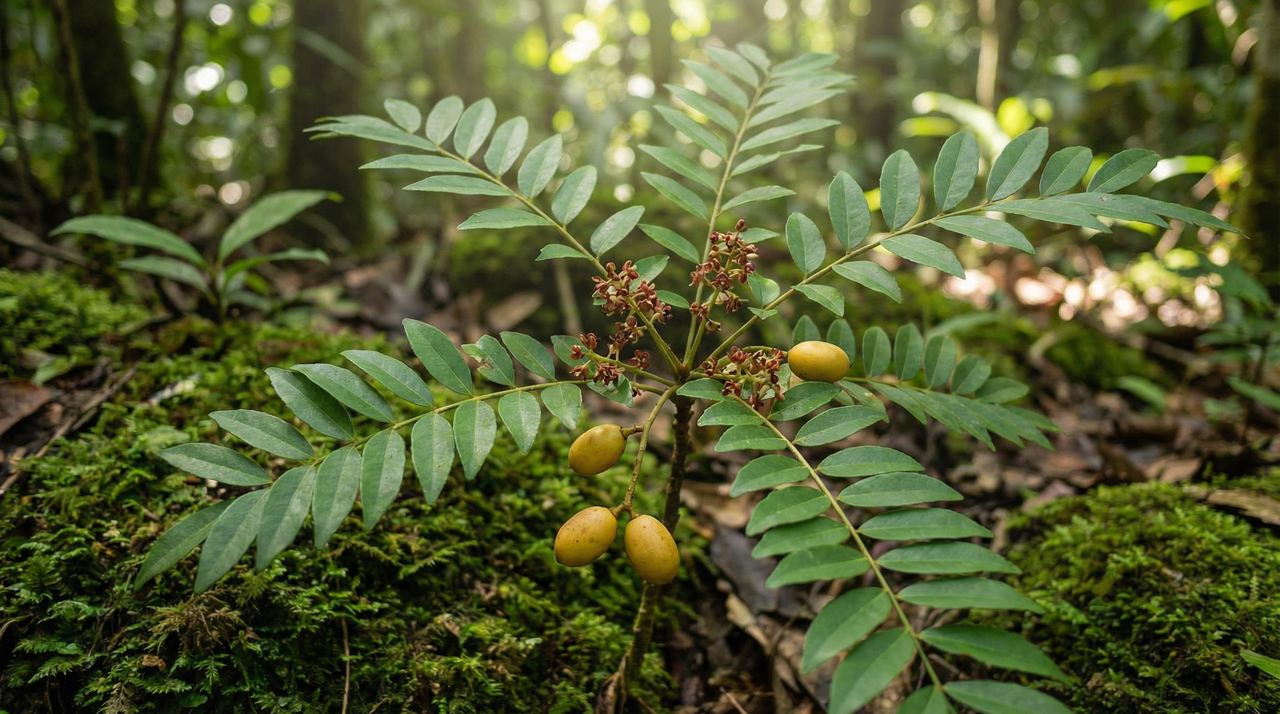
Eurycoma longifolia grows as a slender, erect tree with an essentially unbranched trunk cloaked in rough, pale gray-to-brown fissured bark and a sparse crown that lets a surprising amount of light through to the layers below.[2][5] Heights range from 2 to 15 meters in the wild, though cultivated specimens tend to stay on the shorter end. I usually describe the juvenile form to people as something between a young papaya and a small citrus, that same vertical emphasis with a tuft of large compound leaves at the top. It helps people picture it before they've ever seen one. The leaves themselves are compound pinnate, running 50 to 100 cm long, with anywhere from 7 to 41 opposite lanceolate leaflets that are leathery, dark green above and noticeably lighter below.[11][12] That tough, coriaceous leaf texture is a classic understory adaptation, built to handle low light and high humidity without succumbing to fungal pressure.
The flowers are small, only 2.5 to 5 mm across, clustered on lax compound panicles up to 30 cm long and peaking during the dry season between April and June.[13] Male flowers carry reddish-brown petals with 5 to 10 stamens; female flowers bear a superior ovary. As a landscape designer I always appreciate the ecological elegance here: small generalist pollinators work the flowers, and the small ovoid drupes that follow, green ripening to reddish-brown, are dispersed by birds moving through the forest canopy.[12] The whole reproductive system is quietly woven into the understory food web.
Traditional and Cultural Uses Across Southeast Asia
Long before Western science took note of Eurycoma longifolia in 1881, communities across Malaysia, Indonesia, and the broader region had built a detailed medicinal tradition around its roots.[14] The Malay name "Tongkat Ali" and the Indonesian name "Pasak Bumi" both carry meaning tied to the plant's upright, anchoring character, and its root was prized as a tonic for vitality, a febrifuge for malarial fevers, and an aphrodisiac.[15][16] Among the Orang Asli and other indigenous communities, the roots also appeared in folklore as love charms and virility amulets, a use worth acknowledging with the same respect we'd give any long-standing ethnobotanical record, while also being clear that modern growers should prioritize sustainable cultivation over any romanticized wild-harvest tradition.[14]
What strikes me about this cultural history is how specific it is. The root, not the leaves or fruit, and roots harvested with an understanding that the plant needed time to mature. Modern science has since validated many of these traditional applications, and the shift from wild harvesting to managed cultivation in Malaysia, Indonesia, and Thailand reflects both that growing demand and a growing awareness of what uncontrolled collection has cost.[15][14]
Conservation Status and Modern Cultivation
Eurycoma longifolia is currently classified as Vulnerable (VU A2cd+4cd) on the IUCN Red List, a status driven by overexploitation of roots, habitat loss from logging and agricultural expansion, and the kind of habitat fragmentation that reduces genetic diversity and triggers local extinctions.[17][18] Parts of Malaysia and Indonesia have lost local populations entirely. The cruel irony is that the same 4 to 5 year maturity window that makes the roots medicinally valuable is precisely why unsustainable wild harvesting is so destructive: plants are being pulled before they ever reach their chemical peak or reproduce.[19] Conservation responses now include protected area management, ex-situ cultivation programs, plantation development, and proposals for CITES Appendix II regulation to constrain international trade in wild-harvested material.[9] For anyone growing tongkat ali in a permaculture context, that story matters. Every cultivated plant represents a root that didn't have to come from the wild, and the conservation chapter of this species is genuinely still being written by the growers who choose cultivation over extraction.
Tongkat Ali Varieties and Sourcing
Taxonomy and Regional Variations
If you're searching botanical databases hoping to find a tidy list of named cultivars, you'll come up empty. Eurycoma longifolia is a single species with no formally recognized subspecies or cultivars; neither The Plant List nor World Flora Online acknowledges any official varieties.[20][21] That doesn't mean all plants are identical. Researchers have identified over 20 morphotypes across the species' Southeast Asian range, with informal distinctions sometimes drawn between broader-leaved populations and narrower-leaved ones, and real genetic diversity that influences which bioactive compounds a given root will contain.[21][22]
From a grower's perspective, this is where origin starts to matter more than any label ever could. Malaysian populations, particularly from Pahang and Perak, consistently show quassinoid concentrations of 1.5-2% dry weight, including 0.8-1.3% eurycomanone, compared to Indonesian specimens which typically land at 0.5-1% quassinoids and 0.2-0.6% eurycomanone.[23][22] Genetic diversity studies confirm these regional differences are real, tied to both genetics and local environment.[24][25] I've seen this pattern repeatedly with other medicinal perennials: plants pushed to perform in leaner, well-drained soils often concentrate more secondary metabolites, almost as if scarcity sharpens their chemistry. No formal breeding programs exist yet to stabilize or improve on these regional differences,[24] which honestly feels like both a gap and an opening. As a designer, I'd rather select for documented regional origin than trust a branded name with no provenance behind it.
Sourcing Tongkat Ali Plants, Seeds, and Supplements
Outside Southeast Asia, finding quality planting material takes real effort. Seeds and live plants exist through specialized tropical nurseries and online seed banks, but availability is genuinely niche in the US, and sellers often focus on small potted starters because fresh plant material requires USDA APHIS permits while processed dry root generally moves more freely if it's pest-free.[5][26][27] Expect to pay roughly $10-30 for a packet of 10-20 seeds, or $20-60 for established plants depending on size and shipping. The FDA treats the eurycoma longifolia extract and root as a dietary supplement ingredient under DSHEA, so domestic supplement products face regulatory oversight there rather than at the plant import level.[28] Malaysia imposes no stringent export controls on cultivated material, though wild harvesting may require forestry permits, and while the species doesn't appear on any CITES appendix, international trade is being watched for overexploitation signals.[29][30]
The supply-chain risk that genuinely worries me is adulteration. Industry reports suggest somewhere between 30-50% of market products may contain inferior or misidentified material. When I'm sourcing root stock or extract for any design recommendation, I ask for third-party lab documentation and origin disclosure upfront, the same way I'd verify any medicinal herb I'm recommending to a client. Malaysian-origin material still dominates reputable commercial products for good reason, given the potency data,[22][23] but "Malaysian Tongkat Ali" on a label proves nothing without documentation. Seek out specialty tropical plant nurseries that disclose provenance, prioritize cultivated over wild-harvested material, and treat that transparency as a baseline rather than a bonus.
How to Propagate and Plant Tongkat Ali (Eurycoma longifolia)
Growing tongkat ali from scratch is a lesson in humility. I've worked with recalcitrant seeds from other tropical medicinals -- jackfruit, breadfruit, rambutan -- and the rule I give every student is the same: sow it the day you get it. With Eurycoma longifolia, that urgency is non-negotiable. These seeds cannot tolerate desiccation and lose viability fast once extracted from ripe fruit.[31][21] Delay by even a few days and your germination numbers plummet. Plan your growing setup before the seeds arrive, not after.
Propagation Methods for Tongkat Ali
Even fresh seeds germinate at only 20-50% without intervention.[32] Scarification or a gibberellic acid (GA3) soak pushes that up to 60-80% or better, and you'll want to maintain temperatures of 25-30°C with 80-90% humidity in a partially shaded germination environment.[32][33] A humidity tent or a heated propagation mat inside a shaded poly tunnel gets you there. Even then, you're working against variable dormancy, so expect some stragglers.
There's another wrinkle worth knowing before you go the seed route: tongkat ali is dioecious, meaning you need both male and female plants to produce seeds, and because it outcrosses freely, seedlings show real genetic variation.[34][35] Heritability of quassinoid content sits around 0.3-0.5, which means the medicinal potency of your seedling crop is genuinely unpredictable.[35] That's precisely why clonal methods matter so much here.
Stem cuttings are the most accessible vegetative option for home growers. Take 10-15 cm semi-hardwood cuttings during active growth, treat with IBA at 1000-3000 ppm, and stick them in a 1:1 sand-to-peat mix with bottom heat around 25-28°C and misting to keep humidity above 80%.[36][37] Getting 50-70% rooting success feels genuinely satisfying once you've dialed in the IBA concentration and mist timing.[37] Air layering on mature branches offers similar success rates of 50-75%, while grafting remains more experimental at 40-80% depending on technique.[38] For commercial-scale production, tissue culture using MS medium with cytokinins and auxins achieves 80-95% success and delivers true-to-type plants consistently.[39]
Soil, Site Selection, and Planting Technique
Think about where this plant evolved: the dappled floor of a Southeast Asian lowland rainforest, with years of leaf litter building loose, aerated, slightly acidic topsoil over deep subsoil that drains quickly after rain. Replicating that is the whole job. You want sandy loam or loamy texture with 3-5% organic matter, a pH between 5.5 and 6.5, and enough structure to let a taproot eventually push 2-4 meters down without hitting compaction or sitting in water.[40][41] In humid subtropical conditions, I've found that raising beds or working extra perlite into the mix is non-negotiable. Root rot from poor drainage is the single most common way this plant dies in cultivation, and the research on Phytophthora risk matches exactly what I've seen when water sits around the crown.
For light, aim for 30-50% of full sun, with morning exposure and afternoon shade being the sweet spot.[19][42] Young plants benefit from 50-70% shade cloth while they're establishing. In a food forest context, positioning tongkat ali beneath a light-canopied nitrogen-fixer works well, letting filtered light through without the midday intensity that scorches new growth. Handle transplanting carefully -- that taproot resents disturbance from its earliest stages.
Germination Timeline, Spacing, and Establishment
With treated fresh seeds under warm, moist conditions, expect germination in two to four weeks.[21] Variable dormancy can push that out to two to six months, so don't abandon a tray too soon. Stem cuttings root in four to eight weeks once conditions are right.[43] Seedlings are ready to transplant at three to four months when they've put on four to six true leaves.[44] The young leaves have a look somewhat reminiscent of small neem or young citrus -- pinnate, glossy, arranged alternately -- worth noting so you don't accidentally mislabel a tray in a busy nursery.
Space plants two to three meters apart, following contour lines on any slope to manage erosion and reduce runoff around those developing roots.[45][46] After transplanting, the real timeline begins: two to three years to first flowering, and four to five years under good cultivation conditions before roots approach harvest maturity.[44][47] I've grown enough slow-rooted perennials to know how the first two years can feel like nothing is happening, then suddenly the plant finds its rhythm and growth accelerates. With tongkat ali, the real measure of time isn't weeks or even months. It's years of patient, attentive tending that ultimately determines what you have in the ground.
Tongkat Ali Care Guide: Growing Eurycoma longifolia
Everything about caring for tongkat ali flows from one central fact: this is a rainforest understory plant. It evolved under the canopy of Malaysia and Indonesia's lowland dipterocarp forests, where temperatures are reliably warm, humidity is high, and soil moisture is consistent but never stagnant. Replicate those conditions and the plant rewards you. Deviate significantly from them and you'll find out quickly how unforgiving it can be.
Temperature, Frost, and Heat Tolerance
Tongkat ali has zero frost tolerance. Growth slows noticeably below 18°C, stress symptoms like leaf drop and wilting appear below 15°C, and prolonged exposure under 10°C is lethal.[48][5] Optimal growth sits between 20 and 32°C, which puts it firmly in USDA zones 10-12.[48][49] I treat my potted specimens the way I treat my more tender citrus: as soon as nights start dipping toward 15°C, they're moving inside. No negotiating.
Cold damage shows up as yellowing or blackening leaves, wilting, and stunted growth, often followed by secondary root rot.[5] Catching it early and moving the plant to warmth can save a mild case, but prevention is far easier. For growers outside the tropics, greenhouse overwintering or keeping plants in containers at 18-25°C is non-negotiable, and site selection matters too: avoid frost pockets and exposed positions.[7][50] Remember that every degree of cold stress is also stress to the root system you're waiting 4-5 years to harvest.
Heat, on the other side of the spectrum, can also cause problems. Prolonged temperatures above 35°C trigger leaf wilting, scorching, and reduced photosynthesis, and there's evidence that extreme heat lowers quassinoid content in the roots.[51][21] A 5-10 cm layer of organic mulch, consistent irrigation, and shade netting at 50-70% will carry plants through hot dry spells.[52][53]
Sunlight and Light Requirements
In the wild, Eurycoma longifolia grows under a broken canopy with filtered, shifting light. Its sweet spot is 50-70% shade, roughly 10,000-20,000 lux; full sun scorches the leaf margins while deep shade drives chlorosis and weak, leggy growth.[54][55] Growing it from seed under 50-70% shade cloth versus unfiltered sun, the difference in leaf health is immediate: deeper green, no crispy edges, and a visibly happier plant overall. I think of it the same way I think about young coffee or cacao, plants that technically tolerate more sun as adults but really perform under dappled canopy. Shade cloth or a position under taller food forest trees works well; what you want to avoid is that harsh midday glare.
Watering Needs and Humidity
Tongkat ali lives in that Goldilocks moisture zone: consistently moist but never saturated. Water when the top 1-2 inches of soil feels dry, which in warm conditions typically means every 2-3 days.[56][57] Seedlings need more frequent checks than established plants, which develop moderate drought tolerance once their taproot is well established. Container plants dry out faster than in-ground ones, and I find a simple moisture meter takes the guesswork out of it.
Preferred humidity sits between 70-90%.[58][59] Underwatering signals itself with wilting and leaf drop; overwatering is more dangerous, showing up as yellowing from the base upward with a sour soil smell, which points to root rot before you even see root damage. Rainwater or dechlorinated water is preferable, and whatever you do, don't let pots sit in standing water. The root rot prevention story really starts here, not at the fungicide shelf.
Soil, Feeding, and Fertility Management
Tongkat ali is native to nutrient-poor forest soils, so it doesn't need heavy feeding and actually suffers from it. A balanced NPK such as 15-15-15 applied every 2-3 months during the growing season is plenty; excess nitrogen in particular pushes lush aboveground growth at the expense of root development and quality.[60][61] I learned this one firsthand: heavy nitrogen applications produced beautiful, glossy leaves and disappointingly thin roots with noticeably less bitterness at harvest. The bitterness is the point.
Adjust the ratio by stage: a balanced 10-10-10 suits seedlings, higher nitrogen supports vegetative growth, and a lower-nitrogen formula like 5-10-10 serves plants entering flowering.[62][63] Adding 100-200g of organic compost or aged manure annually to mature plants improves soil structure and mimics the decaying leaf litter of forest conditions. Micronutrients like iron, manganese, and zinc can become deficient in more alkaline soils, so a soil test before you start is worth the effort; precise NPK ratios for medicinal root quality aren't universally standardized, and your local soil is the real variable.[64][65]
Pruning, Maintenance, and Seasonal Care
Keep pruning light: removing no more than 10-20% of foliage to clear dead or diseased branches and open up light to the lower plant is all this species needs.[66][67] Timing matters: after harvest or during the dry season works well; avoid cutting during active flowering. I think of pruning here less as shaping and more as redirecting energy toward the root system, which is ultimately what this plant is for. I also stake young plants for the first couple of years to encourage upright form, a habit I carry across most slow-growing medicinal shrubs in my designs.
In native range conditions, tongkat ali grows nearly continuously, with flowering peaking in the drier months from roughly December through May and fruiting following shortly after.[68][69] Temperate growers will spend a meaningful portion of the year managing overwintering, whether that's a heated greenhouse or a bright indoor space, and that seasonal rhythm becomes the dominant calendar rather than any flowering cue. The roots reach their medicinal peak at 4-5 years, when quassinoid concentration is highest; after harvest, slice the roots to 2-5 mm and dry them below 40°C in the shade to preserve those bioactive compounds, then store in airtight containers at under 10% moisture.[57][70] That patience, four or five full growing seasons before you see the payoff, is the whole game with this plant.
Harvesting Tongkat Ali Roots
Most medicinal herbs are ready to harvest in months. Tongkat Ali asks you to think in years. This is a root that rewards patience in a way that's genuinely rare in the garden, and the science backs up exactly why that patience matters.
When to Harvest: 4-5 Years for Cultivated Plants, 7-10 for Wild
Cultivated roots reach optimal potency at 4 to 5 years of age, when the quassinoids, including eurycomanone, peak in concentration.[71][72][21] Wild specimens are often left 7 to 10 years or longer for even higher potency.[71] I find myself making the same comparison I do with American ginseng: both plants will grow if you're impatient, but neither will deliver what you're actually after. By harvest maturity, cultivated plants typically stand 1 to 2 meters tall, and timing is guided by root development rather than any flowering cue.[73] Dry-season harvest is preferred to minimize sap loss and make digging more manageable.[73]
Harvest Technique and Yield
Because the longjack tongkat ali root is the entire medicinal payload, you want to recover as much of it intact as possible. Careful, deep digging around the full root system is essential; nicking or snapping the taproot wastes years of growth.[74] Sustainable practice means rotating harvest across your planting rather than clearing a bed all at once, preserving both your own supply and, in wild or semi-wild settings, the broader population.[74]
The Bitter Taste and Earthy Aroma of Mature Roots
What you're harvesting is a medicinal root, not a food crop. Leaves and bark see occasional traditional use, but the eurycoma longifolia radix is the primary target, and it has a sensory profile that announces itself immediately.[75][76] The moment you brush soil from a freshly dug root, there's an unmistakable wet-earth, musty-wood smell that concentrates further as the root dries.[2][77]
The bitterness comes straight from the quassinoids, eurycomanone chief among them.[78] Sensory panels consistently rate eurycoma longifolia extract root at 7 to 9 out of 10 for bitterness, with almost no sweetness detectable.[79] In tea form the mouthfeel is astringent and tongue-puckering, and the aftertaste lingers.[80] There's no getting around it; traditional preparations always fold in honey or an aromatic herb for exactly this reason.[81] Drying method, geographic origin, and harvest age all shift the intensity: roots harvested later and dried carefully carry more concentrated quassinoids and stronger flavor.[82][83] I've evaluated commercial powders that taste almost mild, which usually signals early harvest or poor drying rather than a gentler plant. If a tongkat ali extract root powder barely registers on your palate, it's worth asking hard questions about how it was sourced.
How to Prepare and Use Tongkat Ali (Eurycoma longifolia)
Pull the roots from this plant and you're holding something that has been prepared, argued over, and traded across Malaysia, Indonesia, and Vietnam for generations. The root is the thing here. Leaves get occasional use, stems and fruits almost none, but the root carries the full weight of the tradition: aphrodisiac, energy tonic, fever treatment, antimalarial remedy, and more, with each region developing its own specific applications and preparation customs over centuries.[84][85]
Traditional and Modern Preparations of Tongkat Ali
Traditional practice across the region centers on decoctions: dried root slices boiled in water, often with honey, palm sugar, ginger, or lemongrass added to soften the bitterness.[86][87] Traditional doses run 10-30 g of dried root daily, while tinctures typically follow a 1-2 ml dose taken once or twice per day.[88] Modern standardized extracts narrow that down considerably: most clinical work has used 200-400 mg daily, with some studies going up to 600 mg.[88] Powders for capsules or blending generally fall in the 1-2 g range. A 2012 clinical trial found a 37% increase in serum testosterone in stressed adults at 200 mg per day of extract, though the broader research picture is genuinely mixed and more rigorous randomized controlled trials are still needed before strong conclusions can be drawn.[89]
Short-term use up to 12 weeks appears well-tolerated for most healthy adults, with clinical trials showing no serious adverse effects at recommended doses.[90][91] That said, I've seen insomnia show up in a few sensitive individuals at higher doses, which is exactly why I suggest starting at 200 mg of standardized extract and seeing how your body responds before going further. Irritability, restlessness, and elevated body temperature are also documented side effects worth knowing about.[92] Avoid it entirely during pregnancy or breastfeeding given the hormonal activity involved, and if you're on blood thinners, hormone therapy, or managing any hormone-sensitive condition, talk to your healthcare provider before adding this to your routine.[57][93]
Culinary and Flavor Considerations
Calling this a culinary plant would be a stretch. There are no documented traditional food uses,[94] and the flavor explains why. The bitterness from the quassinoids is genuinely intense, earthier and woodier than most herbs you'd encounter in the kitchen. I'd compare it to a strong gentian root or wormwood -- the kind of bitter that makes you understand why every traditional recipe wraps it in something sweet or aromatic. Boiling helps: a 20-30 minute gentle simmer reduces bitterness by roughly 50%,[95][96] and in my experience that window strikes a reasonable balance between palatability and preserving the active compounds. Raw consumption isn't recommended both for the sheer unpleasantness and because the safety profile of unprocessed root hasn't been well characterized.[97] Modern formulations including tongkat ali coffee, tongkat ali tea bags, and extract powders blended into smoothies with pineapple or coconut have made the bitter profile much more approachable for daily use. Ginseng tongkat ali coffee blends are particularly common in Southeast Asian markets and give you a sense of how the flavor gets integrated rather than masked.
Safety, Dosage, and Non-Food Applications
One thing I feel strongly about as someone who has worked with plant identification in nursery settings: source your root material from reputable, cultivated suppliers only. There are toxic look-alikes in the same forest ecosystems, including Simarouba glabra, which contains cardiotoxic and hepatotoxic quassinoids, and Antiaris toxicaria, whose milky sap causes severe irritation and poisoning.[98][99] A similar leaf shape once gave me pause during a nursery identification check, and it underscored how much depends on trusting your supply chain. The roots take 4-8 years to develop meaningful quassinoid concentrations,[100] and wild populations in Southeast Asia are already under serious overharvesting pressure. Seek out cultivated material whenever possible. It's the right call both ethically and practically, since cultivation programs are actively working to take pressure off wild forests. Outside of its medicinal applications, tongkat ali has limited uses: occasional local timber, fuel wood, and display in botanical gardens and tropical greenhouses round out the picture.[101] This is a medicinal plant first, last, and almost entirely.
Tongkat Ali Health Benefits and Medicinal Uses
Traditional Uses in Southeast Asian Medicine
For generations across Malaysia and Indonesia, Tongkat Ali has been the go-to root for male vitality. Traditional healers prescribed it as an aphrodisiac, an energy tonic, a treatment for fevers and malaria, and a remedy for erectile dysfunction long before anyone knew what a quassinoid was.[102][103][104] That ancestral knowledge pointed healers almost exclusively to the roots, and modern chemistry tells us why: eurycomanone and the other quassinoids that drive this plant's pharmacology concentrate in the root bark at 0.8-1.3% dry weight, tapering off sharply in leaves and stems to below 0.1%.[105][106] The roots aren't the medicine by accident.
Key Phytochemicals in Tongkat Ali
The bioactive picture here is dominated by quassinoids, chiefly eurycomanone, eurycomanol, and eurypine, alongside canthin-6-one alkaloids, eurypeptides, glycosaponins, flavonoids, and phenolics.[107][108] Each class contributes something, but quassinoids are doing the heavy lifting across most of the documented pharmacological actions. They're also why the plant tastes unbearably bitter, which is actually an ecological defense mechanism: these compounds act as antifeedants and allelochemicals that deter herbivores and resist fungal infection in the wild.[109]
What I find genuinely fascinating from a grower's perspective is how dramatically the phytochemical profile shifts based on cultivation conditions. Eurycomanone concentration is higher in Malaysian-sourced material than Indonesian, in 4-5 year old roots versus younger ones, in dry-season harvests, and in plants grown in sandy loam at a soil pH of 5.5-6.5.[110][111][112][113] Just as I adjust guild companions and soil amendments to maximize secondary metabolites in other bitter medicinals, growing conditions here directly determine potency. That's why I prioritize 3-4 year old roots from well-drained loamy sites when sourcing, and why the bitterness difference between well-grown and poorly grown material is genuinely noticeable. Processing matters too: conventional solvent extraction yields 2-5% eurycomanone, ultrasound-assisted methods can push that up by 20-50%, and heat above 60°C degrades thermolabile compounds by up to 40%.[114][115]
Clinical Research on Testosterone, Fertility, and Performance
The strongest clinical evidence for eurycoma longifolia sits squarely in male reproductive health. Systematic reviews and meta-analyses show standardized extracts can increase testosterone levels by up to 37% in some trials, improve male fertility parameters, and support erectile function, with doses up to 600 mg/day of standardized extract considered safe across clinical populations.[116][117][118] The mechanisms are genuinely sophisticated: eurycomanone stimulates luteinizing hormone release, inhibits aromatase to slow conversion of testosterone to estrogen, and blocks 5α-reductase to reduce DHT conversion, essentially preserving testosterone from multiple angles simultaneously.[119][120] Erectile function benefits appear to involve eurycomanone-induced nitric oxide production through enhanced iNOS expression, improving smooth muscle vasodilation through a well-characterized pathway.[121] Physical performance gains and improved insulin sensitivity via AMPK activation (attributed to the saponin fraction) round out the metabolic and athletic applications that are showing up increasingly in the sports nutrition literature.[122]
Adaptogenic, Anti-Inflammatory, and Antioxidant Effects
Tongkat Ali's adaptogenic reputation isn't just traditional lore. A randomized controlled trial found it reduced cortisol by 16% and improved psychological mood state in moderately stressed subjects through modulation of the HPA axis.[89] Having worked with a number of vitality herbs in garden designs for clients navigating burnout and high-pressure life seasons, I find this cortisol-blunting quality is often what they notice first, well before any testosterone-related changes. The anti-inflammatory activity operates through inhibition of TNF-α, IL-6, and the NF-κB signaling pathway, while the antioxidant profile involves flavonoids and quassinoids scavenging free radicals, activating Nrf2, and upregulating protective antioxidant enzymes.[123][124][125] The quassinoids also show antimicrobial activity against Staphylococcus aureus and Candida albicans, antiplasmodial action against Plasmodium falciparum through DHFR inhibition, and cytotoxic effects in prostate and breast cancer cell lines via caspase activation and PI3K/Akt inhibition, though most of the antimicrobial and anticancer work remains preclinical.[126][127][128] One note on honesty: claims about expectorant properties have no meaningful clinical support, and diuretic effects remain at the preclinical stage with limited data.
Nutritional Profile and Dosage Guidelines
Tongkat Ali is not a food plant, and the root's nutritional numbers reflect that. Dried root powder runs approximately 350 kcal per 100g with modest protein (around 12g), high fiber (around 25g), minimal vitamins, and a mineral profile that includes meaningful potassium (1200-1600 mg/100g), iron (20-25 mg), and phosphorus (150-200 mg).[129][130][131] Those numbers are all approximate and shift considerably with soil conditions, plant age, and processing, so treat them as orientation rather than precision. The bioactives are the point. In practice, typical use is 1-2g per day of root powder, 200-400 mg per day of standardized extract (the range most clinical trials use), or 2-5g of dried leaf as tea.[132][133]
Safety Profile and Considerations for Use
The overall safety picture is genuinely reassuring for short-term use at standard doses. Rodent LD50 values exceed 2000 mg/kg for extracts, classifying it as practically non-toxic, and human trials at 200-600 mg/day of standardized extract report no severe adverse events or fatalities.[134][135][136] Mild side effects, mostly insomnia, restlessness, or gastrointestinal upset, occur in fewer than 5% of trial participants and appear dose-dependent.[137]
The contraindications are where I take a firm line with clients: avoid during pregnancy, lactation, and in children due to insufficient safety data and hormonal activity.[138][139] Anyone with a hormone-sensitive cancer, prostate or breast, should not use it without direct medical oversight given its testosterone-modulating effects. Potential hepatotoxicity exists at very high animal doses and CYP450 inhibition studies suggest real interaction risks with statins, anticoagulants, immunosuppressants, and antidiabetics.[140][9] The EFSA's 2021 genotoxicity flag from in vitro clastogenic testing is important context I don't gloss over: they assessed 200 mg/day as a novel food ceiling and did not grant unconditional approval. Long-term safety data beyond six months simply doesn't exist yet. My practical guidance: use standardized extracts containing 2-5% eurycomanone at 200-400 mg/day from third-party tested suppliers, because wild-harvested Southeast Asian material carries real heavy metal contamination risk, and product quality in this category is wildly inconsistent.[132][141]
Tongkat Ali Pests and Diseases
Natural Resistance Mechanisms
Tongkat Ali is a genuinely tough plant in its native context, and the reason starts with chemistry. Its tissues are loaded with quassinoids like eurycomanone and brusatol that function as powerful insect antifeedants, essentially making the plant unpalatable to most generalist feeders.[142][143] If you've ever chewed a fresh leaf, you know exactly what I mean. The bitterness is arresting in the same way Quassia chips are, which makes sense given they're in the same family, Simaroubaceae, and that group is well-known for bitter quassinoids with biopesticidal properties.[144] Layered on top of that chemical armor are physical deterrents: trichome-covered leaves and relatively tough leaf tissue that makes casual chewing less rewarding for small insects.[145] These traits work together, which explains why wild populations generally shrug off what would devastate a less defended plant.
Common Insect Pests
Despite that defense, cultivated plants do attract trouble. Leaf beetles from the Chrysomelidae family are among the most visible offenders, chewing holes and skeletonizing foliage in ways that are hard to miss on a morning walk-through. The Bagisara pustulosa caterpillar is arguably the more serious defoliator, with infestation rates in Malaysian forest plantings documented between 10 and 30%.[21][146] In my observation, outbreaks tend to follow periods of new flush growth, particularly after pruning, so I time hard cuts carefully and monitor closely in the weeks after. Then there's the subtler tier: aphids, scale insects (Pulvinaria spp. can hit 40% infestation in cultivated plots), mealybugs, and spider mites.[147][148] These sap-suckers rarely announce themselves dramatically; sticky honeydew on lower leaves or a grey sooty mold coating is usually the first sign. That fungal sooty mold matters beyond aesthetics, because insect feeding stress frequently opens the door to secondary fungal infections.[148]
Fungal Diseases and Environmental Stress
Major diseases are surprisingly under-documented in the peer-reviewed literature, which makes sense given that most plants are still wild-harvested or grown at small scale.[148] That said, growers consistently run into two categories of trouble: Fusarium root rot in poorly drained or overwatered plantings, and leaf spot fungi like Colletotrichum and Cercospora that thrive under high humidity.[149] The root rot pattern I've seen looks like sudden mid-day wilting even when soil seems moist, and cutting into an affected root reveals discoloration that confirms the fungal damage. Improving drainage always helps more than any spray. The plant's native habitat gives you the clearest prevention blueprint: well-drained acidic soils, consistent warmth, and high humidity without waterlogging.[150] Stress from compacted clay or nutritional imbalance reliably increases susceptibility. No disease-resistant cultivars are commercially available yet, though breeding programs in Malaysia and Indonesia are beginning to select from tolerant wild Sabah material.[151]
Prevention and Integrated Management
The most effective approach here is Integrated Pest Management built around prevention rather than rescue chemistry.[152] Good drainage, appropriate spacing for airflow, regular sanitation of fallen leaf debris, and avoiding over-fertilization with nitrogen (which produces the soft flush growth that beetles and caterpillars prefer) will handle most problems before they start. I avoid broad-spectrum insecticides on tongkat ali specifically because they knock out the predatory insects that naturally keep aphid and scale populations in check; neem-based sprays applied early and targeted stay in my toolkit, but a healthy planting with good airflow rarely needs even that. Wild populations show markedly better resilience than cultivated plants, and infestation rates vary from 5 to 45% depending on season, humidity, and management.[21][153] The lesson there is worth internalizing: in my experience, mimicking rainforest edge conditions, roots that never sit wet, canopy overhead but with real air movement at shrub level, does more work than any spray schedule I've tried.
Tongkat Ali in Permaculture Design
If you've grown cacao or ginger, you already have an intuition for what tongkat ali wants: warmth, humidity, dappled shade, and soil that drains freely without drying out. This is a plant shaped entirely by the lowland dipterocarp rainforests of Southeast Asia, and every cultural decision you make should trace back to that origin. Understanding its native habitat isn't background reading, it's the practical instruction manual.
Climate Requirements and Hardiness Zones
Tongkat ali is a true tropical specialist. It performs best at daytime temperatures of 25-30°C (77-86°F) and can tolerate up to 35°C when humidity and soil moisture keep it from stressing.[2][154] Cold is a different story. Below 15°C it starts to struggle visibly, and anything below 10°C will damage or kill it outright.[7][155][5] That puts it squarely in USDA zones 10a through 12, which in the continental US means southern Florida and very little else for reliable outdoor cultivation.[7][156]
Rainfall and humidity are equally non-negotiable at establishment. The plant needs a minimum of 1,500 mm of annual rainfall, with roots really thriving in the 2,000-3,000 mm range.[157][154] Ambient humidity of 70-90% is preferred, and the soil should be well-drained, acidic (pH 5.5-6.5), and rich in organic matter.[158][159] Waterlogging is one of the fastest ways to lose a plant. Young specimens are particularly vulnerable to dry spells and will need supplemental irrigation until they're properly established.[157][160]
For growers outside those narrow tropical bands, large containers are the honest answer. A pot that can be wheeled into a heated greenhouse or bright interior when temperatures drop keeps this plant viable in zone 9 and below.[156][161] I'd also point out that roots won't be ready for harvest for 4-5 years from planting, so commit to the long game before you start. I write the planting date directly on the pot label because slow tropical perennials have a way of becoming anonymous over the years.
Ecosystem Functions and Guild Roles
In its native forests, tongkat ali does real ecological work. Its extensive root networks stabilize slopes, its falling leaves feed the decomposer community, and the fleshy red fruits attract frugivorous birds that disperse seeds through the understory.[21][162][163] What the forest also gives this plant is a web of arbuscular mycorrhizal fungi that dramatically improve phosphorus uptake in the nutrient-poor, acidic soils it calls home.[164][165] In a designed system, that means inoculating transplants and layering in generous organic matter to build the fungal community the plant expects.
The quassinoid compounds in its leaves and roots also give it a practical gift for guild design: natural pest-repellent properties that reduce insect pressure on neighboring plants.[166] That said, tongkat ali doesn't fix nitrogen, so it needs deliberate pairing with leguminous shrubs or trees if you want the guild to build soil fertility over time.
The flowers are small, greenish-yellow to reddish, and produced in large axillary panicles that can reach a meter in length, attracting honeybees, flies, and beetles as generalist pollinators.[167][21] The species is dioecious and protogynous, meaning it has separate male and female individuals and the female flowers become receptive before the plant's own pollen is shed, which promotes cross-pollination.[13] If you're growing from seed, you'll need both sexes present. Most growers I know sidestep the uncertainty entirely by sourcing vegetatively propagated plants of known sex.
Forest Layer and Companion Planting
In the wild, tongkat ali occupies the understory and lower mid-stratum as a slender, typically unbranched small tree reaching 2-12 meters, occasionally taller.[2][168][169] Its sparse, pinnate foliage means it doesn't cast the kind of heavy shade that would suppress medicinal groundcovers or smaller herbs growing beneath it. I've found this open canopy genuinely useful when layering a food forest: tongkat ali intercepts some afternoon sun while still letting enough light through to keep lower companions productive.
In a tropical permaculture guild, it fits naturally as a protected understory companion to taller canopy trees and nitrogen-fixing species like Leucaena or Gliricidia, which supply both the dappled shade and the steady fertility inputs it needs.[104][170] The same mycorrhizal networks that tongkat ali relies on in the forest will colonize more readily when you avoid compaction and maintain a consistent organic mulch layer beneath the canopy.
There's a conservation dimension to growing it in cultivation that I feel strongly about. Wild tongkat ali populations are under serious pressure from medicinal overharvesting, and that pressure is only growing as global demand for supplements increases.[21] Every nursery-grown specimen in a designed system is a small offset against that. I only source propagated plants and encourage people to grow their own rather than rely on imported root powder of uncertain origin.
The slow growth is real: expect 4-5 years before roots reach a harvestable size, though the plant will flower and fruit more or less continuously once it settles into suitable conditions.[171][169] That timeline is the price of working with a plant that has spent millennia calibrated to the long rhythms of a tropical forest. In a layered, multi-decade system, it's exactly the right kind of patience.
The Plant That Taught Me to Stop Rushing the Understory
I still think about a grower I visited in northern Malaysia who walked me past a row of spindly, unremarkable stems and said, quietly, that the roots beneath us were six years old. Nothing about the plant above ground suggested that kind of time had passed. That's what I keep coming back to with Tongkat Ali: the value is invisible until it isn't, and the patience it demands from you is exactly the patience the forest spent building it.
Sources 171
- IUCN Red List: Eurycoma longifolia ↩
- Eurycoma longifolia ↩
- Eurycoma longifolia Jack ↩
- Eurycoma longifolia ↩
- Eurycoma longifolia - Tongkat Ali ↩
- Plants of the World Online - Kew Science ↩
- Tongkat Ali (Eurycoma longifolia) Cultivation - University of Florida IFAS Extension ↩
- Eurycoma longifolia: Propagation and Cultivation ↩
- Eurycoma longifolia: A Comprehensive Review of Its Phytochemistry, Pharmacology, and Conservation Status ↩
- Biology and Ecology of Eurycoma longifolia ↩
- Eurycoma longifolia - Useful Tropical Plants Database ↩
- Eurycoma longifolia ↩
- Flora Malesiana, Series I, Volume 6 ↩
- Tongkat Ali: History and Cultivation in Malaysia ↩
- Eurycoma longifolia: A Comprehensive Review ↩
- Traditional Uses and Pharmacology of Eurycoma longifolia ↩
- Eurycoma longifolia ↩
- Genetic Diversity and Population Structure of Eurycoma longifolia ↩
- Conservation Status and Threats to Eurycoma longifolia in Malaysia ↩
- Eurycoma longifolia: A Comprehensive Review ↩
- Taxonomy and Morphology of Eurycoma longifolia ↩
- Phytochemical and Pharmacological Profile of Eurycoma longifolia ↩
- Variation in Quassinoid Content of Eurycoma longifolia by Origin ↩
- Genetic Diversity in Eurycoma longifolia Populations ↩
- Genetic Diversity and Regional Variations in Tongkat Ali ↩
- Federal Plant Protection and Quarantine Regulations ↩
- Importing Biological Materials into the United States ↩
- Dietary Supplements ↩
- Export of Herbal Products from Malaysia ↩
- CITES Species Database ↩
- Tongkat Ali (Eurycoma longifolia) Cultivation and Harvest ↩
- Seed Morphology and Germination of Eurycoma longifolia ↩
- Propagation and Dormancy Breaking in Eurycoma longifolia Seeds ↩
- Eurycoma longifolia: A Comprehensive Review ↩
- Genetic Diversity and Population Structure of Eurycoma longifolia ↩
- Propagation of Eurycoma longifolia by Stem Cuttings ↩
- Rooting Response of Tongkat Ali (Eurycoma longifolia) Cuttings to IBA and Environmental Factors ↩
- Vegetative Propagation of Eurycoma longifolia in Indonesia ↩
- Micropropagation of Tongkat Ali (Eurycoma longifolia) ↩
- Eurycoma longifolia: A Comprehensive Review ↩
- Cultivation and Soil Requirements of Eurycoma longifolia ↩
- Cultivation and Management of Tongkat Ali (Eurycoma longifolia) ↩
- Vegetative Propagation Techniques for Eurycoma longifolia ↩
- Phenology and Growth Cycle of Eurycoma longifolia Jack ↩
- MARDI Tongkat Ali Cultivation Guidelines ↩
- Cultivation and Propagation of Eurycoma longifolia Jack ↩
- Cultivation Challenges of Medicinal Plants in Southeast Asia ↩
- Eurycoma longifolia Care Guide ↩
- Eurycoma longifolia ↩
- Growing Tongkat Ali in Temperate Climates ↩
- Eurycoma longifolia: Cultivation and Environmental Requirements ↩
- Cultivation of Eurycoma longifolia (Tongkat Ali) ↩
- Shade and Irrigation Management for Tongkat Ali ↩
- Eurycoma longifolia Jack: Ethnopharmacology, Phytochemistry, and Pharmacology ↩
- Cultivation of Tongkat Ali in Malaysia ↩
- Cultivation and Utilization of Tongkat Ali ↩
- Horticultural Practices for Eurycoma longifolia ↩
- Peer-Reviewed Study on Eurycoma longifolia Cultivation ↩
- Cultivation of Tongkat Ali (Eurycoma longifolia) ↩
- Cultivation of Eurycoma longifolia Jack: A Review ↩
- Agronomic Practices for Tongkat Ali Production ↩
- Effect of Different Fertilizer Types on the Yield and Bioactive Compounds of Eurycoma longifolia ↩
- Nutrient Management in Tongkat Ali Plantations ↩
- Soil Nutrient Requirements for Tongkat Ali (Eurycoma longifolia) ↩
- Cultivation Practices of Eurycoma longifolia for Quality Phytochemical Production ↩
- Horticultural Management of Eurycoma longifolia ↩
- Cultivation of Tongkat Ali (Eurycoma longifolia) ↩
- Eurycoma longifolia Cultivation and Management ↩
- Flora of the Philippines: Eurycoma longifolia ↩
- Post-Harvest Processing of Medicinal Plants: Focus on Tongkat Ali ↩
- Phytochemical Variations in Eurycoma longifolia Roots at Different Ages ↩
- Sustainable Cultivation Practices for Tongkat Ali (Eurycoma longifolia) ↩
- Tongkat Ali (Eurycoma longifolia) Cultivation and Harvest ↩
- Cultivation and Harvesting of Eurycoma longifolia ↩
- Eurycoma longifolia: A Comprehensive Review ↩
- Traditional Uses and Pharmacology of Eurycoma longifolia ↩
- Eurycoma longifolia: A Comprehensive Review of Its Phytochemistry and Pharmacology ↩
- Sensory Characteristics of Eurycoma longifolia Jack ↩
- Sensory Analysis of Eurycoma longifolia Extracts ↩
- Sensory and Phytochemical Evaluation of Eurycoma longifolia Roots ↩
- Tongkat Ali (Eurycoma longifolia Jack): a review on its ethnobotany and pharmacological importance ↩
- Effect of Drying Methods on Bioactive Compounds in Tongkat Ali Roots ↩
- Geographical Variation in Quassinoids of Eurycoma longifolia ↩
- Tongkat Ali (Eurycoma longifolia): Traditional Uses and Pharmacology ↩
- Ethnobotanical Survey of Eurycoma longifolia in Malaysia ↩
- Eurycoma longifolia Jack: a potent adaptogen with great potential in the treatment and prevention of various ailments ↩
- Eurycoma longifolia: A Review of Its Phytochemistry, Biological Activities, and Traditional Uses ↩
- Tongkat Ali: A Comprehensive Review ↩
- Effect of Tongkat Ali on stress hormones and psychological mood state in moderately stressed subjects ↩
- Eurycoma longifolia (Jack) Improves Serum Total Testosterone in Men: A Systematic Review and Meta-Analysis of Clinical Trials ↩
- Safety of Eurycoma longifolia Extract in Healthy Volunteers: A Phase I Clinical Trial ↩
- Eurycoma longifolia: A Comprehensive Review of Its Traditional Uses and Pharmacological Activities ↩
- Herbal Medicine: Biomolecular and Clinical Aspects - Eurycoma longifolia ↩
- Non-Timber Forest Products: Uses of Eurycoma longifolia in Malaysia ↩
- Tongkat Ali (Eurycoma longifolia): A Review of Its Ethnobotany, Phytochemistry, and Pharmacology ↩
- Effects of boiling on the phytochemical composition and bitterness of Tongkat Ali (Eurycoma longifolia) root ↩
- APV Monograph: Tongkat Ali (Eurycoma longifolia) ↩
- Simarouba glabra ↩
- Antiaris toxicaria ↩
- Cultivation and Conservation of Eurycoma longifolia for Sustainable Harvesting ↩
- Tongkat Ali (Eurycoma longifolia) ↩
- Traditional Uses and Pharmacological Activities of Eurycoma longifolia ↩
- Ethnobotanical Survey of Eurycoma longifolia in Peninsular Malaysia ↩
- Pasak Bumi: Ethnobotany of Eurycoma longifolia in Indonesia ↩
- Quantitative analysis of eurycomanone in different parts of Eurycoma longifolia ↩
- Quassinoids from Eurycoma longifolia: Isolation and bioactivity ↩
- Eurycoma longifolia: A Comprehensive Review of Its Phytochemistry and Pharmacology ↩
- Bioactive Compounds and Pharmacological Actions of Eurycoma longifolia ↩
- Eurycoma longifolia: A Comprehensive Review of Its Phytochemistry and Pharmacological Activities ↩
- Variation of Bioactive Compounds in Eurycoma longifolia Roots from Different Ages ↩
- Geographic Variation in Phytochemicals of Eurycoma longifolia ↩
- Effect of Soil Types on Quassinoid Production in Eurycoma longifolia ↩
- Harvest Time Influence on Eurycomanone in Tongkat Ali ↩
- Optimization of Ultrasound-Assisted Extraction of Bioactive Compounds from Eurycoma longifolia ↩
- Supercritical Fluid Extraction of Tongkat Ali: Process Optimization and Metabolite Profiling ↩
- Effect of Tongkat Ali on Testosterone Levels: A Systematic Review and Meta-Analysis ↩
- Eurycoma longifolia Jack in managing idiopathic male infertility ↩
- Standardised Water-Soluble Extract of Eurycoma longifolia, Tongkat ali, as Testosterone Booster for Managing Menopausal Symptoms: A Pilot Study on Monkeys and Men ↩
- Quassinoids from Eurycoma longifolia as Potential Inhibitors of 5α-Reductase ↩
- Standardized quassinoid-rich Eurycoma longifolia extract improved spermatogenesis and fertility in male rats via the hypothalamic-pituitary-gonadal axis ↩
- Nitric Oxide Pathway Modulation by Tongkat Ali ↩
- Clinical Trial: Eurycoma longifolia Improves Physical Performance in Athletes ↩
- Antioxidant and Anti-Inflammatory Activities of Eurycoma longifolia ↩
- Bioactive Compounds and Biological Activities of Tongkat Ali ↩
- Anti-Inflammatory Effects of Eurycomanol via NF-κB Inhibition ↩
- Antimicrobial Activity of Quassinoids from Eurycoma longifolia ↩
- Antimalarial quassinoids from Eurycoma longifolia ↩
- Anticancer Effects of Eurycoma longifolia via NF-κB Inhibition ↩
- Nutritional Composition of Eurybility longifolia (Tongkat Ali) ↩
- Nutritional Composition and Phytochemical Analysis of Eurycoma longifolia Roots ↩
- Proximate Composition and Mineral Contents in The Leaves and Roots of Eurycoma longifolia ↩
- Tongkat Ali: A Comprehensive Review ↩
- Eurycoma longifolia Dosage Guidelines ↩
- Toxicity and Safety of Eurycoma longifolia in Humans ↩
- Safety and efficacy of Tongkat Ali in humans: a review ↩
- Acute toxicity study of Eurycoma longifolia root extract ↩
- Eurycoma longifolia (Jack) Improves Serum Total Testosterone in Men: A Systematic Review and Meta-Analysis of Clinical Trials ↩
- Eurycoma longifolia: A Comprehensive Review of its Phytochemistry, Pharmacology, and Toxicology ↩
- Eurycoma longifolia (Tongkat Ali) - LiverTox ↩
- Safety of Eurycoma longifolia (Tongkat Ali) root extract as a novel food - EFSA Journal 2021 ↩
- Phytochemical and Pharmacological Profile of Eurycoma longifolia ↩
- Quassinoids from Eurycoma longifolia as Insect Antifeedants ↩
- Chemical Ecology of Eurycoma longifolia: Defense Against Herbivores ↩
- Simaroubaceae Family Profile ↩
- Morphological Defenses in Tropical Trees: Case of Eurycoma longifolia ↩
- Biology and Management of Bagisara pustulosa on Medicinal Plants ↩
- Scale Insect Infestations in Herbal Crop Production: A Case Study on Tongkat Ali ↩
- Eurycoma longifolia - An Overview of Its Medicinal Uses and Cultivation ↩
- Pest and Disease Assessment of Medicinal Trees in Southeast Asia ↩
- Geographical Distribution and Agronomy of Eurycoma longifolia: A Review ↩
- Genetic Diversity and Disease Tolerance in Tongkat Ali Populations ↩
- Integrated Pest Management for Tongkat Ali Cultivation ↩
- Pathogens Affecting Eurycoma longifolia Jack and Management Strategies ↩
- Missouri Botanical Garden: Eurycoma longifolia Plant Finder ↩
- USDA Plant Hardiness Zone Map ↩
- Growing Tropical Plants in Temperate Climates: Greenhouse Techniques ↩
- Journal of Tropical Forest Science: Cultivation Practices for Eurycoma longifolia ↩
- Royal Horticultural Society: Eurycoma longifolia Cultural Requirements ↩
- Cultivation of Tongkat Ali ↩
- Kew Gardens: World Checklist of Vascular Plants - Eurycoma ↩
- Tongkat Ali (Eurycoma longifolia) ↩
- Ecological Roles of Understory Plants in Tropical Forests ↩
- Seed Dispersal Mechanisms in Southeast Asian Dipterocarp Forests ↩
- Mycorrhizal Symbioses in Tropical Understory Plants: Case of Simaroubaceae ↩
- Mycorrhizal associations of medicinal plants in Malaysian rainforests ↩
- Eurycoma longifolia: A Review of Its Ethnobotanical and Pharmacological Importance ↩
- Floral biology and pollination ecology of Eurycoma longifolia ↩
- Ecological role of Eurycoma longifolia in dipterocarp forests ↩
- Habitat and Ecology of Eurycoma longifolia in Malaysian Rainforests ↩
- Peer-Reviewed Study on Eurycoma longifolia Agroecology ↩
- Eurycoma longifolia Jack: a potent adaptogenic plant of Southeast Asia ↩