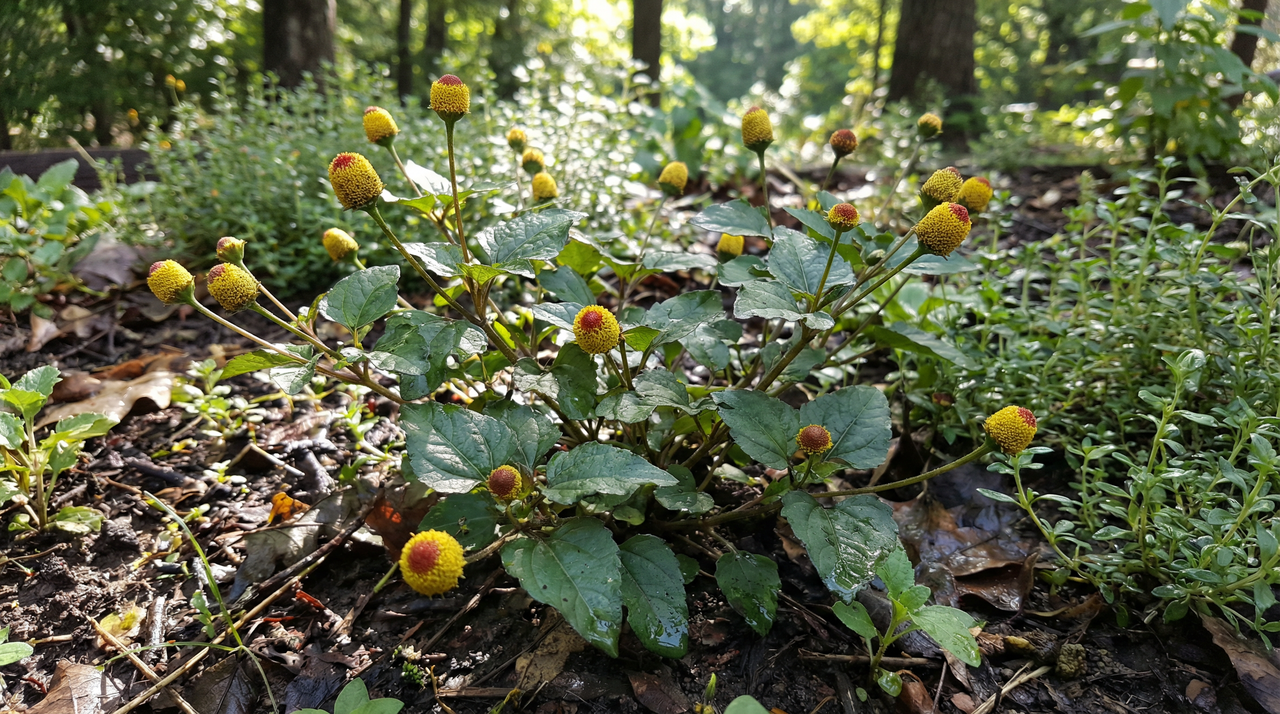
The first time I put a toothache plant flower bud in my mouth, I thought something had gone wrong. There's a brief pause, maybe two seconds, where nothing happens and you start to wonder if you picked the wrong plant entirely. Then it hits: a spreading, electric tingle that starts at the tip of your tongue and rolls outward until your whole mouth feels like it's been lightly connected to a nine-volt battery. Not painful. Not unpleasant. Just genuinely, unmistakably strange. I've handed these little yellow buttons to skeptical gardeners at plant swaps and watched their expressions cycle from polite confusion to wide-eyed alarm to delight, usually within about thirty seconds.
What gets me is that this sensation isn't a curiosity that someone engineered for novelty menus or botanical garden displays. Indigenous communities in the Amazon were chewing these flowers for toothache relief centuries before spilanthol had a name, and cooks in Brazil, Thailand, and India were folding them into soups and chews long before molecular gastronomy decided they were interesting.[1] The plant has been circling the globe and rewriting local food traditions for a very long time. We're just catching up.
Toothache Plant Origin, History, and Botanical Background
The intense oral paresthesia caused by chewing the flowers is a shared botanical experience. That sensation is the thread connecting Amazonian villages, Ayurvedic apothecaries, Thai street food, and your backyard garden. The toothache plant has been earning its name on multiple continents for centuries, and its story starts in the warm, disturbed soils of tropical America.
Taxonomy and Native Range of Spilanthes acmella
The toothache plant scientific name you'll see most often in older literature is Spilanthes acmella, but the currently accepted name is Acmella oleracea, with Spilanthes acmella now treated as a heterotypic synonym.[2][3] That taxonomic shuffle matters practically: if you're searching ethnobotanical records or seed catalogs, you'll find the plant listed under both names, and the genus-level confusion bleeds into related species like S. callimorpha and S. commutata, making older traditional use records harder to interpret.[4] Carl Linnaeus first described it botanically in the 18th century, and it appeared in Western pharmacopeias through the 19th before picking up the nickname "Szechuan buttons" in the mid-20th century.[3]
The plant's native range spans Central and South America, including Brazil, Mexico, Peru, Bolivia, and Colombia, where it grows in exactly the places you'd expect a cheerful opportunist: roadsides, disturbed agricultural fields, forest edges, and wetland margins.[2][5] From there it naturalized across tropical Africa, India, Southeast Asia, and Oceania, hitching along with trade routes wherever the climate was warm and moist enough to suit it.[6][7] In USDA zones 9-11 it's technically a short-lived perennial, polycarpic and capable of flowering repeatedly across a 1-3 year lifespan; everywhere cooler it behaves as an annual.[8][9] It stays compact, reaching 12 to 18 inches with a low branching habit that can turn prostrate in tropical heat.[10] Seeds germinate in 7 to 21 days under warm, moist conditions and the plant reaches first flower in roughly 6 to 8 weeks after that.[11] I compare it to basil or zinnias in my garden planning: once temperatures are reliably warm, it moves fast. That speed is exactly why it colonizes disturbed ground so easily and why it spread so far so quickly.
Visual Characteristics and Identification Features
What stops people in their tracks is the flower. Each bloom is a tight, button-like composite head with bright yellow disc florets surrounding a raised reddish-brown conical center, sitting on long, slender stems above serrated, slightly fleshy bright green leaves.[12][13] That conical red center is the plant's signature, and the source of the name "eyeball plant." The stems are noticeably hairy, and crush a leaf and you'll find milky latex -- both useful identification markers if you're unsure what you're looking at.[14] Those four features together (hairy stems, opposite serrated leaves, conical reddish button heads, milky sap) distinguish it from toxic lookalikes like Ageratum conyzoides, which matters if you're foraging or letting it self-seed through a kitchen garden.[15] The related S. callimorpha broadens the color palette considerably, producing buttons in orange, white, deep rose, and pink on especially slender peduncles, which makes it a showier ornamental but less botanically typical.[16]
Traditional and Cultural Uses Across Continents
The Yanomami and other Amazonian indigenous communities were using this plant for dental pain, dysentery, and topical anesthesia long before European contact, calling it jambu in Brazil where it still seasons tacacá soup today.[17][18] In India, Ayurvedic and Siddha traditions reaching back at least 2,000 years, documented in texts like the Charaka Samhita, used it for toothaches, oral ulcers, cough, asthma, and as an aphrodisiac, often chewed with betel leaves.[19] In Africa, Zulu and Maasai communities incorporated it into ceremonial contexts for sensory stimulation and endurance, and traditional healers used it for malaria, rheumatism, and oral infections.[20] Southeast Asian cooks discovered the same tingling quality that made it medicinal was also thrilling in food, working it into dishes like Thai miang kham.[21]
Ethnobotanical records document over 20 distinct traditional uses ranging from antifungal to aphrodisiac, though those records carry a caveat worth naming: the persistent genus-level taxonomic confusion means it's not always clear whether a historical account refers to Acmella oleracea, S. commutata (used by Maya communities for oral pain), or S. callimorpha, which appears in Ming Dynasty Chinese medicine and West African cooking alike.[22][23] The plant isn't globally endangered, sitting at IUCN Least Concern, but commercial and medicinal demand has put real pressure on wild populations in several native regions.[24] I've made it a personal rule to source only cultivated seed or nursery plants rather than wild-collected material, and I'd encourage anyone building a permaculture planting to do the same.
Fun Facts About the Toothache Plant
The signature numbing and buzzing impact of spilanthol that spreads across the tongue and lips, sometimes triggering a little facial twitch and a flood of saliva.[25] It's why chefs call them "buzz buttons" and why those same flowers have been landing in cocktails and tasting menus. I've also noticed, after growing several successive crops, that plants in full sun and consistently warm soil produce a noticeably stronger tingle than those grown in dappled shade, which suggests the spilanthol concentration responds to growing conditions in ways worth paying attention to.
What I find equally fascinating is the ecological contradiction at its heart: the same chemistry that sends pollinators flocking to those eye-catching button flowers also repels mosquitoes and aphids.[26][27] Bees and butterflies read those yellow discs as an invitation while aphids apparently read the whole plant as a warning. For a small, fast-growing herb that colonizes roadsides, it's quietly doing a lot of ecological work at once.
Toothache Plant Varieties and Where to Buy
Notable Varieties and Selections of Spilanthes acmella
If you're expecting a tidy list of patented cultivars, this plant is going to surprise you. Spilanthes acmella has no formally registered cultivars recognized by Kew's Plants of the World Online, the Missouri Botanical Garden, or the Royal Horticultural Society.[28][29] The name Acmella oleracea still floats around on seed packets and botanical records, but it's now treated as a synonym rather than a separate species or subspecies. What you're working with is wild-type and landrace seed, and I find that genuinely liberating. The "typical" form is a compact annual reaching 20 to 40 cm, with bright green leaves and those unmistakable button flowers in yellow with reddish-brown centers, blooming six to ten weeks from seed.[30][9]
That said, a handful of informal selections circulate under market names. 'Gold Nuggets' emphasizes those bright yellow blooms, 'Emerald Falls' has a cascading habit that works beautifully in hanging baskets (I've used it similarly to dichondra in subtropical container designs), and 'Big Red' leans into reddish bract coloration.[31][32] None of these are registered cultivars; they're practical selections that small nurseries and seed savers have stabilized around specific traits. If you're growing for culinary use or medicinal extracts, some selections are specifically chosen for higher spilanthol content and a more intense tingle. That's the real measure of quality here.
Sourcing Toothache Plant Seeds and Plants
This plant is easy to find and completely legal to grow across the US. Spilanthes acmella doesn't appear on any federal or state noxious weed list, including California's and Florida's notoriously strict inventories.[33][15][34] Standard APHIS rules apply if you're importing seed from abroad, which typically means a phytosanitary certificate and potentially an import permit.[35] I've navigated that process for tropical herb seed many times; it's straightforward, but always verify current requirements before ordering internationally.
For domestic sourcing, the Oregon cluster is where I go first: Strictly Medicinal Seeds and Horizon Herbs (both in Williams, OR) and Mountain Rose Herbs out of Eugene consistently offer high-germination Spilanthes acmella seed.[36][37] Johnny's Selected Seeds, Baker Creek (listed as Szechuan Buttons), Eden Brothers, High Mowing, and Seed Savers Exchange are all reliable broader options.[38][39][40] Expect to pay roughly $3.95 to $6.95 for a packet of 50 to 250 seeds, with Etsy sellers typically in the same range.[41][42][43] I always look for USDA Organic certification and pop a seed or two in my mouth before planting a batch; if you don't get that immediate electric tingle, the spilanthol has likely degraded. Seed viability drops off after one to two years,[44] so fresh seed matters.
Live plants are a seasonal and niche find, mostly through farmers markets and herbal nurseries in warmer states during summer and fall.[44] If you want to explore the genus further, related species like S. commutata and S. callimorpha show up occasionally through Strictly Medicinal, Plant Delights, and specialty Etsy shops, usually priced at $3 to $8 per seed packet or $8 to $15 for a live plant when available.[45][46] They're genuinely rare in trade, but worth the hunt for curious growers who want to compare tingle profiles across the genus.
Toothache Plant Propagation and Planting Guide
The toothache plant is one of those herbs that rewards you no matter which propagation path you choose. You can grow it from seed, take stem cuttings, divide established clumps, or even layer it; but for most home gardeners, seed and cuttings are where the real conversation starts.[47][48] After several seasons working with both approaches, I've landed firmly in the cuttings camp when I need quick results and seed when I want to build a bigger planting or experiment with variation.
Propagation Methods: Seeds, Cuttings, and Beyond
Spilanthes seeds are tiny achenes with a wispy white pappus, and they're what seed savers call orthodox: dry them down to about 5-7% moisture, seal them in an airtight jar with a desiccant, tuck them in the refrigerator at 5-10°C, and they'll stay viable for two to five years.[49][50][51] I keep small jars of dried achenes in the refrigerator door and still see 70% or better germination heading into year three, which makes seed saving genuinely practical rather than just aspirational.
If you're ever unsure whether older seed is still worth sowing, a tetrazolium test gives you an answer in two to four hours; viable embryos stain red where dead tissue stays pale.[52][53] A standard germination test over 7-14 days works too if you'd rather not source the stain.
For sowing, surface the seed or cover it barely (no more than a half-inch) in a sterile, well-draining mix and keep the medium consistently moist at 70-85°F. Germination happens in one to three weeks, and seedlings are ready to transplant after four to six weeks.[44][54] I lost a full flat early on to damping-off because I used heavy garden soil in my seed trays. Now I always use a perlite-heavy sterile mix for the first four weeks, and the problem has never come back.
Cuttings are almost foolproof. Take 4-6 inch tip cuttings from healthy, non-flowering shoots, stick them in moist perlite or coarse sand under a humidity dome, and they'll root in two to four weeks with success rates of 70-90%, even higher with a light application of rooting hormone.[55][56] I take mine in early summer off my most vigorous plants and root them on a shaded propagation bench; they barely miss a beat. Division in spring or fall and tip layering also work well for related Spilanthes species, while tissue culture is worth knowing about if you're producing for consistent medicinal potency, though it's overkill for the home garden.[47][57]
Soil, Site Selection, and Light Requirements
Toothache plant wants loamy or sandy-loam soil, rich in organic matter, with a pH somewhere between 6.0 and 7.0 (it will tolerate a range of 5.5-7.5 in a pinch).[29][58] Heavy clay is the one condition I'd call a genuine deal-breaker without amendment, because waterlogged roots invite Pythium and Phytophthora and you'll lose plants fast. I always work in compost and perlite before planting into native Florida soil, which errs heavily toward sand and compaction depending on the site.
Container growers should aim for a 1:1:1 blend of potting soil, perlite or coarse sand, and compost.[59] The roots are shallow, only going down 8-12 inches at most, so the plant behaves a lot like basil or cilantro in this regard: wide, shallow containers work beautifully, and you don't need deep pots to keep it happy.[54] The same wide terracotta bowls I grow herbs in on my patio work perfectly.
On light, the plant does best with full sun to partial shade and needs at least 4-6 hours of direct sun daily.[44][29] Its native habitat is the forest edge of tropical America, which explains why it handles filtered afternoon shade without complaint. In hotter climates, that afternoon relief can actually prevent leaf scorch and keep plants looking better through the height of summer.
Spacing, Planting Technique, and Early Care
Plants reach 12-18 inches tall and wide with a clumping to mat-forming habit, and that's the number to keep in mind when you're setting transplants.[29][44] I space at 12-18 inches between plants with 18-24 inches between rows in garden beds. Tighter spacing creates faster ground cover, but in humid summers you want airflow through the canopy, so I resist the urge to crowd them.
The single most impactful early-care step is pinching. When transplants or seedlings hit about 4-6 inches tall, pinch the growing tips back.[60] I've done this systematically on one half of a bed and left the other half unpinched, and the pinched plants produce roughly double the flower heads. It delays first bloom by maybe a week, but the payoff in overall yield is worth it every time. For anyone growing this in a permaculture guild as a ground layer companion, that bushier, denser habit also does a better job suppressing weeds and creating habitat for beneficial insects.
Germination and Establishment Timelines
From seed sown under warm conditions (18-30°C), expect your first significant harvest somewhere between 60 and 120 days, with flowering usually kicking in around 65-80 days after sowing.[61][44] That timeline holds reliably in warm subtropical conditions. Gardeners in cooler climates should start seeds indoors 6-8 weeks before last frost and budget a little extra time on the back end.
Cuttings close that gap considerably. Rooted tips reach their first blooms in 8-12 weeks and full maturity in 3-6 months.[55][62] When I'm establishing a new bed mid-season and want coverage fast, cuttings from an existing plant are the obvious move. Seeds are the better choice when you're building numbers from scratch or want to let the plant's natural variation show up across a planting.
Toothache Plant Care Guide
Get the basics right and the toothache plant practically grows itself through a long, humid summer. Get them wrong and you'll end up with either a leggy, barely-tingling disappointment or a crispy, scorched mess that bolts before you've harvested a single button. Its needs are consistent and readable once you know what to look for.
Sunlight Requirements
Full sun is the sweet spot, with at least 4-6 hours of direct light daily to drive both flowering and spilanthol production.[44][63] I've grown it in spots where it only caught dappled afternoon light and the result looked like basil that forgot its purpose: stretched stems, pale leaves, and almost no flowers. The tingle on those few buttons that did form was noticeably weaker. Shade is a potency killer with this plant. That said, there's a real limit on the other end. In intense heat above 90°F, too much unfiltered afternoon sun will scorch the leaf edges and push the plant into stress rather than bloom.[64][65] After losing a whole row to leaf scorch during a July heat dome, I now site my plants where they get morning sun and gentle shade from about 2pm onward on the hottest days. It's a small adjustment that makes an enormous difference.
Watering Needs
Toothache plant wants consistent moisture, not wet feet. The target is evenly moist, well-draining soil with a pH between 6.0 and 7.5, letting the top inch dry out slightly before watering again.[29][44] In practice, that means every 3-5 days during warm humid stretches, weekly in cooler or drier conditions, and more frequently when temperatures climb above 90°F.[29][66] The finger test in the top inch of soil has saved more of my plantings than any gadget.
Root rot is the classic trap, especially in heavy clay or poorly draining containers. If you're seeing wilting leaves on wet soil, that's overwatering, not drought.[67][68] Underwatering reads differently: curling leaves, brown tips, and a general limpness that perks right back up after a drink. A 2-3 cm layer of organic mulch around the base helps regulate both moisture and temperature, and if you're using tap water in a chlorine-heavy municipality, letting it sit overnight makes a difference since this plant has low salinity tolerance.[29][69]
Feeding and Fertility
Toothache plant is a moderate feeder that does best in fertile, well-drained loam with moderate organic matter and a pH of 6.0-7.0.[44][70] I made the classic mistake early on of feeding generously with a high-nitrogen fertilizer and got magnificent, lush foliage with almost no buttons. Excess nitrogen pushes leaf production at the expense of flowering, and in a medicinal plant where the flowers are the whole point, that's a real loss.[44][71] A balanced fertilizer like 10-10-10 or 15-15-15 at half strength every 4-6 weeks from spring through fall keeps things productive without pushing vegetative excess.[44] Incorporate compost or well-rotted manure at planting and you'll need to supplement much less.[44][72]
Reading the leaves is how I catch problems early. Yellowing on the older, lower leaves is classic nitrogen deficiency. Purplish discoloration and stunted growth point to phosphorus. Brown, crispy leaf edges that look like scorching often indicate potassium deficiency, though I once spent a full week convinced I had an over-fertilization problem before a soil test revealed the actual culprit.[73][74] For anyone growing this plant for medicinal use, annual soil testing isn't optional. Micronutrient availability, especially zinc, boron, and manganese, directly affects spilanthol production, and the optimal window for those is a soil pH of 5.5-6.5.[75][76]
Frost Tolerance and Hardiness
Here's where the annual-versus-perennial question gets answered by your climate. Toothache plant is reliably perennial only in USDA zones 9-11.[29][77] Below 50°F, the plant starts to show damage; actual frost turns the leaves black and triggers rapid decline, often killing the plant outright.[78] Everywhere else, you're treating it as a fast annual and that's perfectly fine given how quickly it grows and flowers.
In my garden I don't gamble with outdoor overwintering on plants I want to carry forward. Once nights start dipping toward 50°F, I bring selected container plants inside under grow lights and keep them above 60°F through winter.[79][44] Some gardeners in marginal zones report regrowth from roots after dieback, particularly with Spilanthes commutata, but I wouldn't count on it as a strategy.[80] Row covers, mulch, and cloches can buy a few extra weeks in autumn but won't save a plant through a hard freeze.
Heat Tolerance
Toothache plant is genuinely heat-loving, sitting comfortably in AHS Heat Zones 10-12 with an optimal daytime range of 70-85°F.[29][81] It can push through temperatures up to 90°F without complaint, but sustained heat above 95°F causes wilting, leaf scorch, and a noticeable drop in flower production.[82] Seedlings are the most vulnerable stage, especially when direct-sowing in late spring during a warm spell. The response to extreme heat is the same prescription as for sun scorch: afternoon shade, consistent moisture, and that 2-3 cm mulch layer to keep the root zone from overheating.[83][84] Avoid waterlogging during heat waves; a stressed plant sitting in wet soil is a fast path to root rot.
Pruning, Maintenance, and Seasonal Rhythm
Regular harvesting and deadheading are the same action here, which makes maintenance feel productive rather than like a chore. I harvest flower heads in the morning when spilanthol content is highest, picking buds at full bloom and cutting stems back to 2-3 nodes to stimulate regrowth.[44][60] Done consistently every 2-3 weeks, this approach reliably yields three to four flushes of buttons across a season, and letting spent flowers linger long enough to set seed means the plant directs energy away from the next round of blooms. Leaves can come from 45-60 days in, flowers from 60-90 days.[85][86] If you're drying for later use, do it in shade below 40°C to preserve those active compounds.
The seasonal rhythm in temperate climates is simple: plant after last frost, enjoy the button show from July through October, accept that the first frost ends the season.[65][87] In tropical and subtropical climates the plant can flower nearly year-round, slowing only when temperatures drop or photoperiod shortens below that 12-14 hour threshold that triggers active growth.[88][89] Understanding that rhythm is what separates gardeners who get one lucky flush from those who get a long, productive season of buttons. As a companion planting aside, tucking marigolds or basil nearby offers some passive pest deterrence and fits naturally into the kind of polyculture beds where toothache plant really thrives.[44]
Harvesting Toothache Plant (Spilanthes acmella)
Most of what makes harvesting this plant satisfying is learning to read the buds before they fully open. By around 60-90 days from seed, when plants have reached 20-30 cm tall and the flower buds measure roughly 5-10 mm across with that characteristic bright yellow cone and a reddish-brown center just beginning to show, you're right at peak spilanthol window.[90][91][44] I harvest in the early morning when the volatile aromatic oils are most concentrated and the plant hasn't been stressed by afternoon heat. Once established, the plant will keep producing flushes every 4-6 weeks through the season, and young leaves are worth picking from about week four onward.[90][92] If you want to save seed, leave a few heads to mature fully after flowering -- that takes another 30-45 days.[93]
When and How to Harvest for Maximum Tingling Effect
I treat the flower buds the way I treat the most delicate basil tips: pinched gently, stems snipped just above a leaf node, no rough handling. Bruising the tissue before you're ready to use it lets those volatile compounds disperse into the air instead of onto your tongue. Pre-bloom is the sweet spot; once the flower fully opens and starts declining, spilanthol concentration drops.[90][44] Use fresh whenever you can, and store cut flower heads loosely in the refrigerator for no more than a day or two.
Flavor, Texture, and Yield of Fresh Toothache Plant
The first time the tingling lasted nearly 20 minutes I genuinely wasn't expecting it -- now I always start with a small bud and give it a moment before eating more. That electric, buzzing oral paresthesia is spilanthol doing exactly what it's designed to do, stimulating salivary glands and activating TRPV1 channels in the mouth; the sensation typically runs 5-15 minutes depending on your individual sensitivity.[94][95] The fresh flower head is crisp on first bite, then almost immediately releases a juicy, slightly mucilaginous interior, with an aroma that reads herbal and citrusy, somewhere between lemongrass and basil with a peppery edge.[96]
Spilanthol content peaks at around 8-10 weeks of growth and sits at roughly 0.1-0.5% dry weight in fresh flowers and leaves, with flowers carrying more than leaves.[97][98] If you're drying any portion of your harvest, know that air-drying can reduce spilanthol by 20-50%; I've tested both methods in my own kitchen and the difference in pungency is noticeable enough that freeze-drying is worth the extra effort if you want dried spilanthes with real medicinal potency.[99] If you've grown 'Gold Strike,' expect a noticeably stronger buzz than standard wild-type plants -- it runs roughly 20% higher in spilanthol content.[100]
Toothache Plant Preparation and Uses
Culinary Uses and Sensory Experience of Toothache Plant
When eating it raw, there's a brief moment of citrusy, almost tangy brightness before it delivers its signature rolling electric tingle that spreads across your tongue and cheeks, pumps out saliva, and just keeps going for ten minutes or more. That sensation is spilanthol doing exactly what it evolved to do, and it's the reason the toothache plant has been both a kitchen ingredient and a folk remedy across continents for centuries.[101] I now tell every workshop guest to start with half a bud. That's not timidity; that's how you enjoy it without regretting it.
Leaves and flowers are the culinary parts worth focusing on. Raw in salads or as a garnish they deliver that peppery crunch and full tingle; cooking softens both the texture and the intensity considerably, which is exactly what Brazilian cooks exploit in tacacá soup, where the flowers contribute a signature mouth-numbing warmth without overwhelming the broth.[102][103][104] Thai, Indian, and Amazonian cooks have applied the same logic in curries and spiced salads for generations. The modern restaurant world has landed on a different name for the flower heads: Szechuan buttons or buzz buttons, now showing up in cocktails, on oysters, and in chocolate pairings where the tingle plays against acidity or fat.[105][106] Think of it as a milder, more floral cousin to Szechuan peppercorn: same family of sensation, gentler ceiling. A few buds per serving is the rule, not a suggestion.
For preserving the harvest, you have real options. Shade-dry leaves and flowers and they'll hold for up to a year; pickle chopped parts in brine or vinegar for a shelf-stable condiment; blanch leaves briefly to reduce bitterness before using raw.[29] Sustainable harvesting means taking no more than 20-30% of foliage at a time and favoring young leaves and tight buds where spilanthol concentration peaks.[29]
Safety is straightforward: the leaves, stems, and flowers carry GRAS status in culinary amounts with no significant toxicity on record.[107] Fruits and seeds lack established safety data, so I leave them alone. If you're pregnant or breastfeeding, skip it entirely; the potential uterine stimulant effect is documented clearly enough that it's not worth the risk.[108] And if you're foraging or growing from unlabeled seed, do the taste test before using a plant in quantity. I've avoided mixing up Toothache Plant with Bidens pilosa more than once that way; the electric buzz is unmistakable in a way that no visual ID can match.[9][109]
Medicinal Preparations from Toothache Plant
The plant's common name explains the oldest preparation: chew a fresh flower head directly against an aching tooth.[110] It's blunt, immediate, and it works well enough to have persisted across cultures for centuries. Beyond that direct application, a toothache plant tea made from 1-2 teaspoons of dried leaves or flowers steeped in boiling water for 10 minutes, taken 1-3 cups daily, is the standard infusion approach drawn from ethnobotanical records.[111] For a spilanthes tincture, the general range is 1-2 ml (about 20-40 drops) in water, two to three times daily.[112] I've tinkered with both in my own kitchen, and I'd suggest starting at the lower end of both ranges; the intensity varies with how potently your plants were grown and what part of the season you harvested. These are ethnobotanical guidelines, not standardized dosages, and talking to a healthcare provider before using any spilanthes extract medicinally is the right call, especially given the pregnancy contraindication already noted above.
Non-Food Uses of Toothache Plant
Outside the kitchen and medicine cabinet, toothache plant earns its place through simple garden utility. The bright yellow button flowers make it a genuinely attractive ornamental, and I see it tucked into Florida borders and container gardens constantly, often by people who have no idea it's edible.[29][113] In a permaculture system the biomass pulls double duty as mulch, compost material, or green manure once plants are cut back, a small but real nutrient return that fits naturally into the ground layer role this plant already plays.[114] There's also a historical footnote worth knowing: limited traditional use as a dye source exists in some cultures, though it's never been a primary application.[9] For most gardeners, the ornamental and compost value alone justify a spot in the garden even before you factor in everything it offers at the table and in the medicine cabinet.
Toothache Plant Health Benefits and Medicinal Uses
It is easy to understand why healers across India, Brazil, Africa, and Southeast Asia have reached for the toothache plant for centuries. Traditionally, it's been used for toothache, sore throats, rheumatism, and as a sialagogue to stimulate saliva flow, with roots prepared as decoctions for fever, digestive complaints, and even stammering.[23][115][116][110] The common name didn't come from folklore embellishment. It came from direct, repeatable sensory experience: chew the flower, feel the pain ease. Modern pharmacology has caught up with that observation, and the alignment is satisfying.
Traditional and Modern Medicinal Applications of Spilanthes acmella
The primary driver behind essentially all of the toothache plant's medicinal action is spilanthol, an N-alkylamide that produces the characteristic tingling and numbing sensation the moment it contacts mucous membranes.[117][118] The analgesia isn't just a folk impression. Spilanthol modulates TRPV1 and TRPA1 pain channels and inhibits voltage-gated sodium channels, the same class of ion channels targeted by lidocaine.[119][120] That's a mechanistically credible explanation for an effect traditional practitioners have described for generations.
Anti-inflammatory activity is equally well-documented preclinically. Spilanthol suppresses NF-κB signaling, inhibits COX-2, and reduces pro-inflammatory cytokines including TNF-α and IL-6, with demonstrated effects in animal models of paw edema.[121][122] For those familiar with Echinacea (another Asteraceae family member commonly used for immune support), this NF-κB pathway suppression will sound familiar; it's a recurring theme in the family's medicinal heavyweights. The antimicrobial data is particularly relevant for oral health: spilanthol disrupts microbial cell membranes and shows activity against Streptococcus mutans and Candida albicans at MIC values of 50 to 200 μg/mL.[123][124] There's also solid preclinical evidence for wound-healing effects via enhanced collagen synthesis and epithelialization in rat models.[125]
Emerging preclinical research points toward anti-diabetic activity through α-glucosidase inhibition, cytotoxicity against cancer cell lines including HeLa and breast cancer, and moderate antiplasmodial effects against Plasmodium falciparum, with one small human trial showing mild hypoglycemic effects.[126][127][128] These are genuinely interesting directions, but the evidence base is thin. The strongest human clinical data we have covers oral mucositis, recurrent aphthous stomatitis, and dental pain, including a randomized double-blind placebo-controlled trial for S. oleracea extract.[129][130] My read on the research: this is a plant where traditional use and lab findings genuinely reinforce each other around oral applications, but the broader therapeutic claims need more rigorous human trials before anyone should treat them as settled.
Spilanthol and Other Key Phytochemicals in Toothache Plant
Spilanthol, also known as affinin, is the headline compound: an N-alkylamide responsible for both the unmistakable electric sensation and the analgesic, anti-inflammatory, and antimicrobial activities described above.[131][132] It concentrates most heavily in the flower heads, at 0.2 to 0.5% dry weight, with leaves running 0.1 to 0.3%, and peaks during active flowering.[133] After several seasons of growing and tasting these plants, I can tell you that the intensity does vary noticeably. Flowers harvested during peak bloom in hot, humid midsummer deliver a significantly stronger buzz than those cut in early spring or as the season winds down. That gradient is real, and it tracks with what the phytochemical data would predict.
Beyond spilanthol, the plant contains flavonoids including quercetin and kaempferol derivatives, phenolic acids like caffeic and chlorogenic acid, sesquiterpene lactones, and aromatic essential oils dominated by β-caryophyllene and germacrene D.[134][135] These companions support the antioxidant activity measured in DPPH scavenging assays, where extracts have compared favorably to ascorbic acid in some in vitro work.[136][137] The whole phytochemical picture explains why the mouth-feel when you eat a fresh flower isn't just tingle; there's a layered warmth and aromatic quality underneath that makes the experience genuinely complex.
Nutritional Profile of Toothache Plant
You are not growing this plant for its macronutrients. Fresh leaves run roughly 3.5 g protein, 0.6 g fat, and 6.2 g carbohydrates per 100 g at about 85% water content, with modest contributions of vitamin C (estimated 20 to 50 mg per 100 g), beta-carotene, B vitamins, calcium, iron, and potassium.[138][139][140] Those numbers aren't meaningless, but in practice, you're using one or two flowers in a salad or a drink, not eating a bowlful like spinach. The serving size is self-limiting in the most literal way: the sensation tells you when you've had enough. I learned that early on during my first round of culinary experiments, when I used about three times more than I should have and spent the next twenty minutes with a very buzzy tongue.
Where the plant does deliver real value in the diet is through its phytochemical density: the flavonoids, phenolics, and alkaloids that support antioxidant activity are present in meaningful concentrations even in small amounts.[141] Processing matters too. Boiling degrades water-soluble vitamins like C, while drying preserves minerals more reliably, though it can also reduce spilanthol concentration.[142] For bioactive compounds, fresh and raw is generally the better choice.
Safety Considerations and Potential Side Effects
The toothache plant has a low acute toxicity profile. Animal studies show an LD50 above 2000 mg/kg, and traditional culinary use in cultures across multiple continents without documented widespread harm supports its general safety at reasonable amounts.[143][144] Mild mouth or throat irritation, excessive salivation, and occasional gastrointestinal upset are the most commonly reported effects, and anyone with sensitivities to the Asteraceae family (ragweed, chrysanthemums, chamomile) should approach it cautiously given the cross-reactivity risk.
The contraindication I take most seriously in my own practice is pregnancy. The research on spilanthes acmella's potential to stimulate uterine contractions through emmenagogue activity is consistent enough across sources that I avoid recommending medicinal use to any pregnant clients in my landscape designs, full stop.[145][146] Safety data during lactation is also insufficient to make a confident recommendation either way. If you're on anticoagulants, antiplatelet medications, or blood pressure drugs, the mild antiplatelet and potential hypotensive activity documented in pharmacological reviews makes a conversation with your healthcare provider genuinely necessary before using this plant beyond culinary amounts.[19][147] None of this makes the plant dangerous in normal garden use. It means you should treat the tingling button flowers as the potent medicinal-culinary ingredient they actually are, not just a novelty garnish.
Toothache Plant Pests and Diseases
Natural Resistance from Spilanthol
The toothache plant has a built-in defense system that most garden herbs would envy. Spilanthol and related alkylamides give it genuine insecticidal, antifeedant, and repellent properties, and the Royal Horticultural Society describes it as largely pest-free, attributing that directly to its chemical makeup.[148][149] I think of spilanthol the way I think of neem oil: both work by disrupting insect nervous systems and inhibiting feeding rather than killing on contact.[150][151] Even mosquitoes, aphids, and caterpillars tend to steer clear when the plant is healthy and unstressed.[152] That said, "largely pest-free" isn't the same as bulletproof, and stress or crowding can compromise those defenses fast.
Common Diseases and Environmental Triggers
Where the plant does struggle is with fungi. Root rot (Fusarium or Pythium), leaf spots (Alternaria or Cercospora), powdery mildew, bacterial leaf spot (Xanthomonas), and downy mildew in humid conditions are all documented risks when drainage or airflow is poor.[152][153][154] Young seedlings are especially vulnerable to damping-off, and I learned that lesson the hard way before I switched to bottom watering my trays entirely.[152] In my humid subtropical climate, any lapse in drainage or a week of still, wet weather is usually all it takes for leaf spot to appear.
Pest Challenges and Management
Aphids, spider mites, whiteflies, and armyworm caterpillars can still show up, particularly in still air or under cultivation stress.[155][156] I've noticed spider mite pressure climbs noticeably when plants are crowded together, which is tempting to do when you're trying to maximize flower production in a small bed. Spilanthol deters them in theory, but a dense, poorly ventilated planting gives soft-bodied insects exactly the microclimate they need to get established before the plant can push back.
Prevention and Integrated Control Strategies
Prevention really is the whole game here. Well-drained loamy soil, good spacing, consistent moisture without waterlogging, and avoiding overhead irrigation eliminate most of the conditions that invite problems in the first place.[157][29] When intervention is needed: 1) neem oil handles both pest and fungal pressure, 2) Bacillus subtilis products work well against fungal disease, 3) insecticidal soap addresses soft-bodied insects, and copper-based sprays can be used preventively for bacterial leaf spot.[158][159] I've also found that companion planting with marigolds reduces pest pressure noticeably in my beds, which fits neatly into an IPM approach that combines cultural, biological, and chemical tools in that order of preference.[160] Because this plant is grown specifically for its medicinal alkylamides, I avoid synthetic fungicides unless absolutely necessary. Products like chlorothalonil or tebuconazole are a last resort, and the potential to alter those bioactive compounds simply isn't worth a shortcut.[161]
Toothache Plant in Permaculture Design
There's a particular kind of satisfaction that comes from a plant that quietly does several jobs at once without ever demanding your attention. Toothache plant is exactly that. It doesn't tower over a guild or fix nitrogen like some permaculture heroes, but in the warm, humid systems where it belongs, it earns its space through sheer ecological busyness — drawing in beneficial insects, deterring pests, smothering weeds, and looking cheerful while doing all of it.
Climate and Growing Zones for Toothache Plant
Getting the climate picture right matters most with this plant, because its whole personality changes depending on where you garden. As a perennial, it's reliable in USDA Zones 9–11 where winter temperatures stay above freezing.[29][77] In Zones 3–8 you're growing an annual or overwintering plants indoors, and frost-tender means frost-tender — one hard freeze and it's done.[162] Its true sweet spot, rooted in its origins as a tropical South American native from Brazil and Paraguay, is Zones 10–12 under Köppen Af, Am, and Aw classifications — the humid tropical climates where it has also naturalized across Africa, Asia, and the Pacific.[163][164]
Temperature-wise, it's happiest between 70 and 85°F with nights staying above 59°F.[165][166] In the subtropical US — southern Florida, coastal Texas, Hawaii, parts of coastal Southern California — it settles right into the 40–80 inches of annual rainfall and the moderate to high humidity it evolved with.[111] For Zone 9 gardeners like me who push the boundary, I keep several plants in large pots that roll under the eave or into a garage on the handful of nights temperatures flirt with freezing. A sheltered south-facing microclimate and a layer of mulch help, but I won't pretend Zone 9 is anything other than marginal — the plant wants heat, humidity, and no frost.[29][167]
Ecosystem Functions and Benefits
The first thing I noticed when I started tucking toothache plant into my Central Florida food forest was the hoverflies. Within a couple of weeks of the first flowers opening, they were everywhere — hovering over the button blooms, then drifting over to work the tomatoes and peppers growing nearby. That's not coincidence. The flowers bloom continuously through summer and fall (year-round in frost-free climates), and because they're protandrous, they support both pollen- and nectar-seeking visitors across a long season.[168][169] Bees, butterflies, and ladybugs show up too, and those predatory insects stick around to hunt the aphids on neighboring crops.[170]
The repellent side of the equation is just as interesting. Spilanthol and related compounds in the foliage deter aphids, whiteflies, mosquitoes, and nematodes, which makes toothache plant a genuinely useful companion for tomatoes, peppers, and beans.[171][172][173] I've noticed my pepper plants interplanted with Spilanthes seem to attract fewer aphid colonies, and I'll admit I avoid spraying anything on or near it — the spilanthol effect is real, and I'd rather let the plant do its work than interfere with whatever equilibrium it's maintaining around itself. Deer leave it alone too, which in my neighborhood is practically a permaculture design criterion on its own.
As a ground layer plant, the spreading stems knit into a low mat that smothers weed seedlings and stabilizes bare soil between taller guild members.[174] Roots improve aeration and soil structure as the plant cycles biomass through the system.[170] It may accumulate potassium, calcium, zinc, and iron in its tissues — though I'll be honest that the data on exact mineral profiles is still thin.[175] I treat it the way I treat other Asteraceae in my chop-and-drop routines: cut it back, lay the stems in place, and trust that the organic matter is doing something useful for the soil food web even if I can't quantify exactly what. One thing it won't do is fix nitrogen — there's no symbiotic bacterial relationship here, so pair it with a legume if nitrogen cycling is what you need.[114]
Forest Layer and Guild Placement
At 8 to 16 inches tall with prostrate branches spreading up to 50 cm wide, toothache plant belongs firmly in the ground layer.[116][176] In food forests and structured guilds, it fills the space between shrubs and perennial herbs the same way it would in a tropical forest edge or disturbed understory in the wild: low, spreading, opportunistic, and ecologically productive.[177][178] I've used it to carpet the open gaps between comfrey clumps and dwarf citrus, and it fills those awkward in-between spaces beautifully while still being easy to step around or harvest from.
Within a guild, it pulls multiple roles simultaneously: living mulch, dynamic accumulator, medicinal harvest, and pollinator magnet.[179] If you're working in a denser food forest canopy where light is more limited, it's worth knowing that Spilanthes commutata tolerates 20–50% canopy shade better than acmella, making it the stronger choice for shadier understory positions.[180] For the bright, humid subtropical conditions where most gardeners growing this species are working, though, acmella fits naturally into any guild design that has warm, moist soil and a season long enough to let those cheerful button flowers do their work from summer right through fall.
The Plant That Made My Whole Mouth Laugh
The first time I handed a fresh flower head to a skeptical neighbor, she chewed it, went quiet for a moment, and then burst out laughing at the sensation spreading across her tongue. That laugh is what I keep coming back to. In a food forest full of plants I love for serious, practical reasons, this one earns its spot just as much for the joy it sparks in people who've never met anything quite like it.
Sources 180
- Spilanthes acmella: Ethnobotany and pharmacology ↩
- Plants of the World Online - Kew Science ↩
- Acmella oleracea ↩
- Taxonomy of Spilanthes (Compositae) ↩
- Spilanthes acmella Distribution - GBIF ↩
- Spilanthes acmella ↩
- Global Biodiversity Information Facility (GBIF) ↩
- Spilanthes acmella - Plants of the World Online (POWO) ↩
- Spilanthes acmella - Useful Tropical Plants ↩
- Spilanthes acmella - Flora of North America ↩
- RHS - Seed Germination and Flowering Times for Acmella oleracea (syn. Spilanthes) ↩
- Spilanthes acmella — Missouri Botanical Garden Plant Finder ↩
- Spilanthes acmella — Plants of the World Online, Kew Science ↩
- Foraging Safety: Misidentification of Buzz Buttons — American Botanical Council ↩
- Spilanthes acmella — USDA PLANTS Database ↩
- Spilanthes calva Roem. var. callimorpha ↩
- Spilanthes acmella: A Review on Traditional Medicinal Uses, Phytochemistry, and Pharmacological Activities ↩
- Traditional Uses of Jambu in Brazilian Amazonian Cuisine ↩
- Ethnobotany of Spilanthes acmella: A Review ↩
- Traditional Uses of Spilanthes acmella in African Ceremonies ↩
- Culinary and Medicinal Uses in Thai Folklore ↩
- Sustainability Challenges in Harvesting Medicinal Plants: Case of Spilanthes acmella ↩
- Ethnobotany of Spilanthes in Mexico ↩
- Conservation Status and Indigenous Knowledge of Spilanthes acmella ↩
- Spilanthes callimorpha Plant Profile ↩
- Spilanthes acmella: A Comprehensive Review on Its Phytochemistry and Pharmacological Activities ↩
- Insect Repellent Properties of Spilanthol from Spilanthes acmella ↩
- Plants of the World Online — Spilanthes acmella — Kew Royal Botanic Gardens ↩
- Spilanthes acmella — Missouri Botanical Garden Plant Finder ↩
- Growing Spilanthes: The Toothache Plant — Old Farmer's Almanac ↩
- Acmella oleracea (Spilanthes acmella) — NC State Extension Gardener Plant Toolbox ↩
- Growing Szechuan Buttons (Spilanthes acmella) — Fine Gardening ↩
- Federal Noxious Weed List ↩
- California Invasive Plant Council Inventory ↩
- Plant Importation Regulations ↩
- Organic Toothache Plant (Spilanthes acmella) Seeds ↩
- Spilanthes acmella - Toothache Plant Seeds ↩
- Toothache Plant (Acmella) Seeds ↩
- Szechuan Buttons ↩
- Spilanthes: Toothache Plant ↩
- Spilanthes Acmella - Toothache Plant Seeds ↩
- Spilanthes Acmella Seeds ↩
- Spilanthes acmella ↩
- Growing Spilanthes (Toothache Plant) ↩
- Spilanthes commutata - Useful Tropical Plants Database ↩
- Acmella (Spilanthes) Species Availability ↩
- Propagation of Spilanthes Species ↩
- Vegetative Propagation Techniques for Tropical Herbs ↩
- Viability and Longevity of Seeds ↩
- Seed Storage of Horticultural Crops ↩
- Longevity and Viability of Spilanthes acmella Seeds Under Different Storage Conditions ↩
- Seed Viability Testing: Tetrazolium Test Handbook ↩
- X-ray Analysis of Seed Viability in Plants ↩
- How to Grow Spilanthes (Toothache Plant) ↩
- Propagation of Medicinal Plants: Spilanthes acmella ↩
- Vegetative Propagation Techniques for Herbaceous Plants ↩
- Micropropagation of Spilanthes callimorpha Through Nodal Explants ↩
- Spilanthes acmella (Toothache Plant) ↩
- Creating perfect growing conditions in containers ↩
- Growing Szechuan Buttons: Pruning and Care ↩
- Spilanthes acmella - Missouri Botanical Garden ↩
- Horticulture of Spilanthes acmella: Cultivation Guide ↩
- Light Requirements for Medicinal Herbs like Spilanthes ↩
- Managing Leaf Scorch in Tropical Plants ↩
- Missouri Botanical Garden - Acmella oleracea ↩
- Growing Guide for Spilanthes acmella ↩
- Spilanthes acmella - Plant Care Guide ↩
- Spilanthes oleracea Care Guide ↩
- Spilanthes acmella ↩
- Paracress (Spilanthes acmella) Production Guide ↩
- Influence of Nitrogen on Spilanthol Content in Spilanthes ↩
- Nutrient Management for Medicinal Plants: Spilanthes spp. ↩
- Nutrient Management for Medicinal Plants: Focus on Spilanthes acmella ↩
- Identification and Correction of Nutrient Deficiencies in Herbaceous Plants ↩
- Nutrient Management in Medicinal Plants: Spilanthes Species ↩
- Micronutrient Management for Agricultural Plants ↩
- USDA Plant Hardiness Zone Map ↩
- Spilanthes acmella ↩
- Overwintering Tender Perennials ↩
- Spilanthes commutata (Paracress) ↩
- AHS Plant Heat Zones ↩
- Heat Stress in Ornamental Plants ↩
- Response of Spilanthes Species to Abiotic Stresses ↩
- Growing Spilanthes in the Home Garden ↩
- Cultivation and Utilization of Spilanthes acmella ↩
- Medicinal Plants of the World: Spilanthes spp. ↩
- Spilanthes acmella - RHS Gardening ↩
- Phenology of Tropical Asteraceae Species ↩
- Spilanthes commutata ↩
- Spilanthes acmella ↩
- Cultivation and Harvesting of Medicinal Plants: Spilanthes acmella ↩
- Cultivation and Harvesting of Spilanthes Plants ↩
- Cultivation of Spilanthes acmella: Growth and Development Stages ↩
- Spilanthes acmella Murr. (Acmella oleracea L.): A Comprehensive Review on Its Traditional Medicinal Uses, Phytochemistry, Pharmacology and Toxicology ↩
- Sensory Properties of Spilanthol from Acmella oleracea - Journal of Agricultural and Food Chemistry ↩
- Volatile Constituents of Spilanthes acmella and their Sensory Properties ↩
- Spilanthol Content and Bioactivity of Spilanthes acmella Murr. at Various Harvest Stages ↩
- Influence of Growth Conditions on Spilanthol Yield in Spilanthes acmella ↩
- Effect of Drying Methods on Spilanthol Content in Spilanthes acmella ↩
- Flavor Profiles and Varietal Differences in Spilanthes acmella ↩
- Journal of Ethnopharmacology: Alkylamides in Spilanthes species responsible for paresthesia (1995) ↩
- Wikipedia - Acmella oleracea ↩
- Eat The Weeds - Paracress: The Buzzing Herb ↩
- Culinary Uses of Spilanthes in Traditional and Modern Contexts ↩
- Sensory Evaluation of Spilanthes acmella in Culinary Applications ↩
- Szechuan Buttons: The Electric Flowers - Eater ↩
- USDA PLANTS Database - Spilanthes acmella ↩
- Spilanthes callimorpha - Useful Tropical Plants ↩
- Identification and Toxicity of Look-Alike Plants to Spilanthes Species ↩
- Spilanthes acmella Murr. An Understanding of Its Traditional Uses, Phytochemistry, Pharmacology and Future Prospectives ↩
- Spilanthes acmella: A Comprehensive Review on Phytochemistry and Pharmacological Aspects ↩
- Spilanthes acmella: A review on traditional uses, phytochemistry, pharmacology and health benefits ↩
- Spilanthes acmella ↩
- Spilanthes: A Medicinal and Ecological Plant ↩
- Traditional Uses of Spilanthes acmella in India and Africa ↩
- Spilanthes acmella in Brazilian Folk Medicine ↩
- Pharmacological Review of Spilanthes acmella: A Potential Medicinal Plant ↩
- Pharmacological Activities of Spilanthes acmella: A Review ↩
- Analgesic and Local Anesthetic Effects of Spilanthol ↩
- Spilanthol from Acmella oleracea Inhibits Voltage-Gated Sodium Channels ↩
- Spilanthol from Spilanthes acmella Suppresses Inflammatory Cytokine Expression ↩
- Spilanthol from Acmella oleracea Suppresses Inflammatory Activity via Inhibition of NF-κB and COX-2 ↩
- Antimicrobial Properties of Spilanthes acmella Extracts In Vitro ↩
- Antimicrobial Activity of Spilanthol from Spilanthes acmella ↩
- Wound Healing Potential of Spilanthes acmella in Animal Models ↩
- Anti-Diabetic Effects of Spilanthes acmella in Experimental Models ↩
- Antioxidant and Anticancer Potential of Spilanthes acmella ↩
- Antiplasmodial Activity of Spilanthes acmella ↩
- Efficacy of Spilanthes acmella Extract in Treatment of Recurrent Aphthous Stomatitis: A Randomized Double-Blind Placebo-Controlled Clinical Trial ↩
- Spilanthes acmella (Jambu) — Memorial Sloan Kettering Cancer Center ↩
- Pharmacological Potential of Spilanthol from Spilanthes Species — Frontiers in Pharmacology ↩
- Phytochemical and Pharmacological Review of Spilanthes spp. — Pharmaceutical Biology ↩
- Alkylamides from Spilanthes Species: Isolation and Bioactivity — Phytochemistry Reviews ↩
- Spilanthes: Phytochemistry and Pharmacology — Journal of Ethnopharmacology ↩
- Chemical Composition and Biological Activities of Essential Oils from Spilanthes — Journal of Essential Oil Research ↩
- Antioxidant and Antimicrobial Activities of Spilanthes acmella Extracts ↩
- Antioxidant and Anti-inflammatory Activities of Spilanthes oleracea Extracts ↩
- Proximate Composition, Mineral Content and Functional Properties of Spilanthes acmella Murr. Leaf Flour ↩
- Nutritional and Phytochemical Analysis of Spilanthes oleracea ↩
- Nutritional and Phytochemical Evaluation of Spilanthes acmella Murr. - A Popular Folklore Medicinal Plant of Indo-Burma Biodiversity Hotspot ↩
- Nutritional Composition and Antioxidant Properties of Acmella oleracea ↩
- Effect of Processing on the Nutritional Quality of Leafy Vegetables ↩
- Toxicity Assessment of Spilanthes acmella Extracts ↩
- Spilanthes acmella: A Comprehensive Review on Phytochemistry, Pharmacology and Health Applications ↩
- Spilanthes acmella: A Comprehensive Review on Phytochemistry, Pharmacology and Ethnopharmacology — Molecules Journal ↩
- Uterotonic Activity of Spilanthes acmella ↩
- Spilanthes acmella Murr. – An Ethnopharmacological and Phytochemical Review ↩
- Antifeedant, insecticidal, and repellent properties of Spilanthes extracts ↩
- Spilanthes — Royal Horticultural Society Plant Finder ↩
- Mosquito Repellent Activity of Spilanthol-Rich Extracts ↩
- Spilanthes: Chemical Composition, Bioactivity, and Pharmacological Properties ↩
- Diseases and Pests of Spilanthes acmella: A Review ↩
- Fungal Pathogens Affecting Acmella Species in Tropical Agriculture ↩
- Missouri Botanical Garden Plant Finder - Spilanthes commutata ↩
- Cultivation Guide for Buzz Buttons ↩
- Diseases and Pests of Spilanthes acmella ↩
- Spilanthes acmella: Cultivation and Uses ↩
- Spilanthes acmella Pest Management ↩
- Management of Fungal Diseases in Herbaceous Plants ↩
- Integrated Pest Management for Herbal Crops Including Spilanthes ↩
- Plant Finder - Spilanthes acmella ↩
- Spilanthes acmella — Royal Horticultural Society ↩
- Spilanthes acmella — USDA PLANTS Database ↩
- Spilanthes acmella — Plants of the World Online, Kew Science ↩
- Spilanthes acmella - RHS Gardening ↩
- Spilanthes commutata - North Carolina Extension Gardener Plant Toolbox ↩
- Toothache Plant (Spilanthes acmella) — University of Florida IFAS Extension ↩
- Floral Biology and Pollination Ecology of Spilanthes acmella — Journal of Plant Biology ↩
- Companion Planting for Pollinators — Royal Horticultural Society ↩
- Ecological Role of Spilanthes acmella in Tropical Ecosystems ↩
- Insect Repellent Plants - Royal Horticultural Society ↩
- Spilanthes acmella: A Comprehensive Review on Its Traditional Uses ↩
- Companion Planting Guide: Herbs for Pest Control ↩
- Ground Covers for Erosion Control - USDA Natural Resources Conservation Service ↩
- Phytoremediation Potential of Spilanthes spp. ↩
- Spilanthes acmella - RHS Plants ↩
- Agroforestry Species Profiles ↩
- Spilanthes acmella: Habitat and Cultivation ↩
- Tropical Forage Plants: Ecology and Use ↩
- Tropical Plant Ecology Database ↩