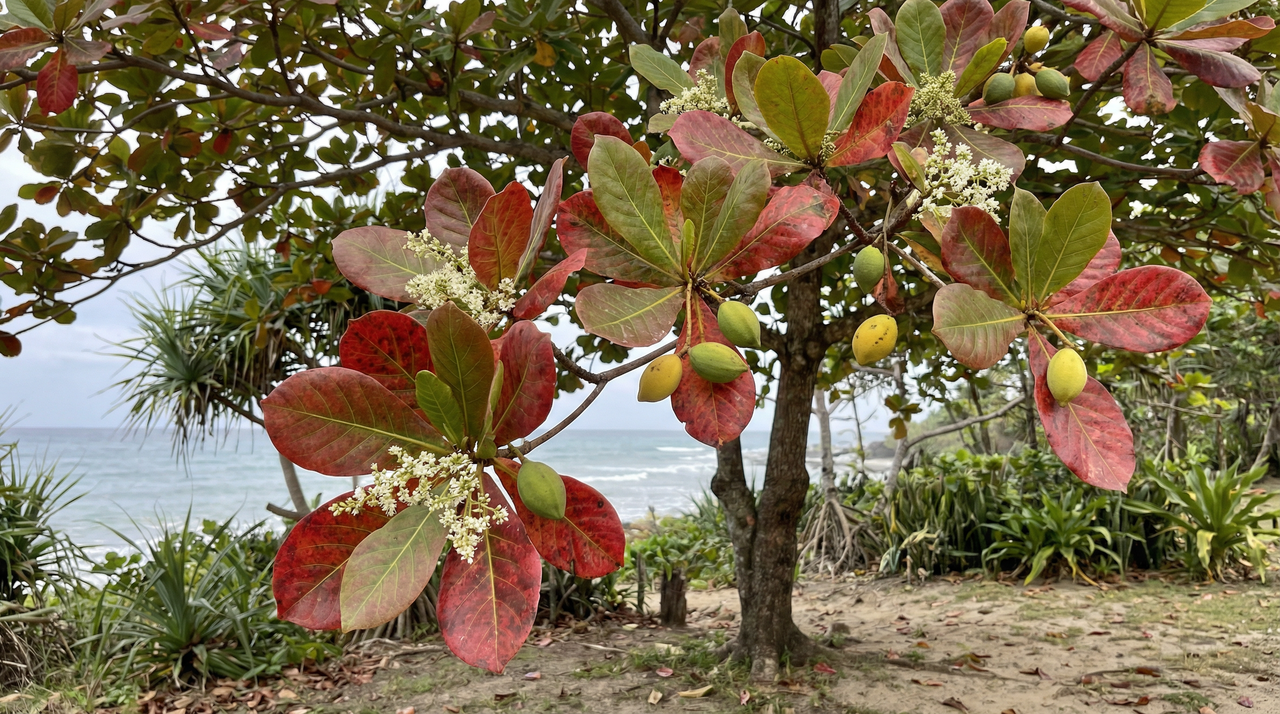
Nobody warned me about the leaves. I'd planted a Tropical Almond in a Central Florida coastal garden and spent the next six months assuming it was dying. Every few weeks, a flush of foliage would turn the most spectacular scarlet-orange and drop, right there in the humid, frost-free subtropics where nothing is supposed to do that. Except it wasn't dying. It was doing exactly what Terminalia catappa does: cycling through a partial leaf drop that mimics autumn in a climate that doesn't have one, then flushing glossy new growth within weeks as if nothing happened.
That confusion is almost universal among first-time growers, and it points to something genuinely strange about this tree. It looks like a shade tree, behaves like a seasonal one, produces a nut that most people in the West have never eaten, and has been used in Ayurvedic medicine since at least 1000 BCE[1] while simultaneously becoming one of the more controversial ornamentals in Florida and Hawaii. It's a tree full of contradictions, and that's precisely why it's worth understanding before you plant one.
Tropical Almond Origin, History, and Botanical Background
Visual Characteristics and Growth Habit
Terminalia catappa stops people in their tracks, and honestly that's one reason I keep specifying it for coastal clients who need immediate presence in a new landscape. The tree grows in a striking pagoda-like form, with horizontal branches radiating outward in tiered whorls from a straight cylindrical trunk, creating an umbrella canopy that typically spreads 30-50 feet wide.[2][3] In cultivation it generally reaches 25-40 feet tall, though under optimal tropical conditions it can surge to nearly 100 feet.[2][4] The bark starts smooth and gray-brown when young, eventually roughening into fissured, scaly plates with prominent lenticels on younger stems.[3][5]
The leaves are where things get truly theatrical. Large, glossy, obovate blades up to 25 cm long cluster at the branch tips and emerge reddish-bronze, mature to deep green, then turn vivid red, orange, or yellow before dropping in response to seasonal drought.[6][7] I've seen those red-orange tones against a green tropical backdrop and it genuinely reads like autumn in the subtropics -- striking enough that visitors to my clients' gardens ask what's happening to the tree. Nothing is wrong. It's just drought-triggered leaf drop, a coastal adaptation rather than cold-season dormancy. Below ground, the root system mirrors that coastal pragmatism: fibrous and shallow, spreading laterally rather than sinking a taproot, which is exactly what you want holding sandy dunes together.[8][9] The flowers are small and cream-white, arranged in slender spikes, and the fruit that follows is a smooth drupe 3-7 cm long that ripens from green to yellow, red, or crimson, enclosing a seed kernel that does, genuinely, resemble a small almond.[10][8][7]
Native Range and Botanical Background
Tropical almond is native to coastal and lowland tropical zones spanning Southeast Asia, northern Australia, the Pacific Islands, parts of Africa, and Madagascar, thriving wherever temperatures hold between 68-95°F and annual rainfall lands in the 1000-2500 mm range.[11][7] It's a genuinely long-lived tree; some specimens in Sri Lanka and India are estimated at 200-300 years old, though longevity varies considerably with site conditions.[12] The IUCN classifies it as Least Concern given its wide distribution, which I read as a green light for planting it where it's ecologically appropriate -- not as an excuse to ignore localized pressures where it has naturalized aggressively.[13] From a design standpoint, its proven tolerance of salt spray, waterlogged soils, and coastal winds makes it one of the more reliable canopy anchors I reach for in shoreline or wind-exposed sites.
Traditional and Cultural Uses
The human relationship with Terminalia catappa runs deep. Its earliest documented uses appear in Ayurvedic texts dating to around 1500-1000 BCE, including the Charaka Samhita and Sushruta Samhita, where various plant parts were recorded for treating wounds, diarrhea, skin infections, and respiratory complaints.[14][15] Across Hindu traditions, leaves appear in rituals honoring Lord Shiva and nuts are offered in ceremonies symbolizing prosperity and fertility.[16] In Hawaiian culture, where it's known as 'ala'a or false kamani, leaves have been woven into hula skirts and lei.[17] Pacific Island communities historically used the dense, durable wood for canoe building, a use that speaks to how thoroughly this tree was integrated into daily survival rather than just ceremony.[18]
Carl Linnaeus formally described the species in 1753, but the tree had already been traveling the world long before European taxonomy caught up with it.[19] Its buoyant fruits disperse readily on ocean currents, and human hands carried it further still into Florida, the Caribbean, and coastal Africa through ornamental planting and erosion control programs.[20][21] That spread is worth taking seriously. The tree isn't federally listed as invasive in the United States, but it has naturalized in subtropical Florida and Hawaii in ways that warrant thought before planting.[22] I always weigh that when specifying it for clients, and I advocate for sourcing leaves and seeds from community-managed stands rather than wild populations, especially given ongoing harvesting pressure from both medicinal and aquarium trades.
Fun Facts and Modern Applications
A few of tropical almond's traits still catch me off guard even after years of working with it. The salt tolerance is real and documented -- specialized leaf glands actively manage saline conditions -- and the roots develop aerenchyma tissue that lets them function in waterlogged soils where most canopy trees would struggle.[23][24] That shallow fibrous root mat binds coastal dunes with real effectiveness, and the leaf litter that falls after each drought-triggered drop enriches the soil beneath.[25] Fruits are dispersed by water and eaten by birds and bats, and the cream-white flower spikes draw insect pollinators, so the tree is genuinely embedded in coastal food webs.[26]
The aquarium hobby has developed a whole subculture around dried tropical almond leaves, which release tannins that tint water tea-brown, lower pH, and provide antimicrobial conditions that benefit fish like bettas.[27] Leaves have also been used historically for natural dyes producing yellow to brown hues, and the wood appears in traditional tools and furniture across its range.[28] The seeds, while almond-flavored, do contain cyanogenic glycosides and are toxic in quantity without proper preparation -- something covered in depth later in this profile.[29]
For context on where tropical almond sits within its own genus, it's worth briefly comparing it to Kakadu plum (Terminalia ferdinandiana), a deciduous Australian relative that grows 5-10 m tall and produces fruits with extraordinary vitamin C concentrations -- up to 100 times that of oranges -- alongside high levels of ellagic and gallic acid.[30] Both trees share the genus's characteristic deciduous or semi-deciduous habit and deep ethnobotanical roots among Indigenous communities, but the Kakadu plum's bush-tucker profile and commercial vitamin C story are distinctly its own. The Terminalia genus, it turns out, has a lot to say.
Tropical Almond Varieties and Sourcing
Notable Varieties and Forms of Terminalia catappa
If you're hunting for a named cultivar list the way you'd find with, say, citrus or mango, tropical almond is going to disappoint you. Terminalia catappa has no serious breeding program behind it and almost no formally recognized cultivars in commercial circulation.[31][32] What exists instead are botanical varieties and selected ornamental forms, mostly minor morphological differences rather than distinct horticultural clones.
The three botanical varieties you'll occasionally see in taxonomic references are var. sinensis (slender-leaved), var. robusta (stouter growth habit), and var. australasiae from Australia.[31][33] On the ornamental side, f. rubra produces striking reddish new growth, and the form sometimes sold as 'Rosea' has pink-red flowers, but neither departs dramatically from the species in structure or productivity.[31][34] I've installed f. rubra as a specimen shade tree in several coastal Florida projects, and the reddish flush of new foliage against the existing green canopy is genuinely dramatic. It reads as ornamental design without any compromise on function.
What actually matters more for home growers is regional origin. Southeast Asian seed sources tend to produce larger fruits, while Pacific island types lean more compact, and in humid tropical conditions a productive tree can yield 50 to 100 kilograms of fruit per season.[33] After growing several seed batches I've noticed noticeable variation in leaf size and fruit shape even within the same packet, so I now tag the most vigorous seedlings early and grow them on as selections rather than expecting consistency across the batch. The edible kernel inside rewards that patience, though it needs roasting or boiling before eating to move past the bitter tannin aftertaste of raw fruit.[35]
How to Source Tropical Almond Trees
Specialty tropical nurseries and online retailers are your most reliable starting points in the US, with Missouri Botanical Garden and Fairchild Tropical Botanic Garden both maintaining specimens worth visiting before you buy.[36][37] Seed packets typically run $5 to $15, rooted seedlings $10 to $25, and young trees in the 1 to 3 foot range around $30 to $60; mature specimens at 5 feet or more can reach $100 to $300 depending on the source. Seeds peak in availability from May through August when fruit is ripening.[38][37] I prefer starting from fresh seed when I can get it; germination is straightforward and lets me grow on multiple seedlings and select the best performers for the site.
If you're importing seeds or plant material from overseas, USDA APHIS requires permits and phytosanitary certification, so plan ahead.[39] And because this Terminalia catappa Indian almond tree naturalizes readily in disturbed coastal habitats, it's listed as potentially invasive in Hawaii and capable of spreading in Florida.[40][41] Check your local guidelines before planting, and never discard seeds or seedlings in natural areas. That's not a disclaimer, it's something I feel strongly about after watching how quickly this species moves into disturbed shoreline habitat once it gets established outside a managed garden. It's a magnificent tree for the right spacious tropical site, and a responsibility wherever the coast is nearby.
How to Propagate and Plant Tropical Almond (Terminalia catappa)
Tropical almond is one of those trees that rewards the patient gardener with multiple paths to propagation, but most of us start with seeds, and for good reason. They're accessible, they germinate reasonably well under warm conditions, and there's something satisfying about coaxing a tree from the fruit you gathered off the ground. I've started Terminalia catappa from seed more times than I can count, and while vegetative methods have their place, seed remains the most practical entry point for the home grower.
Propagation Methods: Seeds, Cuttings, Air Layering, Grafting, and Tissue Culture
Seed propagation is the most reliable and widely used method for Terminalia catappa, provided you're working with genuinely fresh material.[42][43] The sequence matters: soak seeds in warm water around 30°C for 24 to 48 hours, then nick or lightly file the hard endocarp before sowing 1 to 2 cm deep in well-drained sandy loam.[42][44] Keep temperatures between 25 and 30°C and germination rates can run anywhere from 50 to 95 percent with fresh, treated seeds.[42][43] Skip the scarification and you'll drop toward that lower end of the range, sometimes well below it.
If you want guaranteed genetic uniformity or faster fruiting, vegetative methods are worth the extra effort. Semi-hardwood cuttings of 10 to 15 cm treated with IBA at 1000 to 3000 ppm, stuck into a sand-perlite mix under 80 to 90 percent humidity with bottom heat around 25 to 27°C, root in four to eight weeks with success rates of 30 to 70 percent.[42][45] That variability is real. I've seen cuttings do beautifully under well-managed humidity domes and struggle in less controlled environments. Air layering is somewhat more forgiving, producing roots in six to eight weeks at 50 to 70 percent success, and grafting onto compatible Terminalia rootstock succeeds at 30 to 70 percent while delivering fruiting trees meaningfully faster.[42][46] Tissue culture from nodal explants is technically possible but requires lab equipment most of us don't have access to.[47] For anyone outside a research setting, seed is simpler. Beginners especially.
Seed Characteristics, Viability, and Germination Timeline
Here's the part I wish someone had explained to me clearly the first time: Terminalia catappa seeds are recalcitrant, which means they cannot be dried without dying.[48][49] Fresh seeds carry 35 to 50 percent moisture content and viability crashes if they drop below 20 to 25 percent.[48][50] I learned this the hard way after leaving a batch on a paper towel for two days in a warm room. I thought I was doing prep work. I was actually killing them. Short-term storage at 15 to 20°C in moist sand, peat, or vermiculite at 80 to 90 percent relative humidity can hold viability for six to eighteen months under ideal conditions, but realistic shelf life is considerably shorter.[51][52] Source locally and use fresh whenever possible.
The seed itself sits inside a fibromuscular drupe, 3 to 5 cm across, with a hard woody endocarp that splits into two valves.[7] Dormancy is physical rather than embryonic, caused by that tough pericarp, which is exactly why scarification works so reliably.[53] Once the barrier is breached and conditions are warm and moist, the radicle emerges first and germination proceeds readily. Seed-grown trees typically take three to five years to first fruit, sometimes longer in suboptimal conditions, reaching full production around five to seven years.[54] Grafted trees can fruit in two to four years. I've seen that difference play out in client landscapes and it genuinely matters if you're planting for near-term food production. For a food forest with a long timeline, seed-grown trees perform fine.
Two other realities are worth sitting with. First, the species is self-incompatible and protogynously dichogamous, meaning you'll need multiple trees for reliable fruit set.[55] Second, because outcrossing rates run above 80 to 90 percent, seed-grown plants are not true to type.[56] I label my seedling rows carefully because leaf shape, growth rate, and fruit characteristics can vary noticeably between plants from the same parent. It's not a deal-breaker for most uses, but if you're selecting for specific fruit traits, vegetative propagation from a known parent is worth the added complexity.
Soil, Site Selection, and Light Requirements
Tropical almond is a coastal native, and its site preferences reflect exactly that origin. It thrives in full sun, needing six to eight or more hours of direct light daily.[33][2] Young plants can tolerate partial shade during their first season, but push them into too much shade and you'll see etiolation and chlorosis pretty quickly.[2] In coastal Florida I think of it alongside sea grape as a tree that simply wants to be in the open, facing the light, with wind moving around it.
Well-drained sandy or loamy soil with moderate fertility and low organic matter is the ideal starting point.[57] The workable pH range is wide, from 5.5 to 7.5 with tolerance stretching to 4.5 and 8.5, so pH is rarely the problem.[57][58] Drainage is. In my coastal plantings, I've never compromised on that point. Even one extended wet period in heavy clay or compacted soil can trigger root rot that's genuinely hard to reverse once it takes hold. Raised planting areas, sandy amendments, and generous mulch help enormously. Once the tree is established it handles drought well and needs at least 1000 mm of annual rainfall to sustain vigorous growth, but it won't tolerate sitting wet.[2] Site high, drain well, and this tree will largely take care of itself. This is a USDA zones 10 to 11 plant with genuine salt and wind tolerance, which makes it one of the better choices for coastal gardens where other species struggle.[57]
Spacing, Planting Technique, and Establishment
The size this tree reaches should drive every spacing decision you make. Mature specimens can hit 30 to 100 feet tall with canopy spreads of 30 to 50 feet, growing at two to three feet per year under good conditions, with roots spreading 20 to 40 feet or more beyond the drip line.[59] I've watched fast-growing tropical trees become expensive management problems when planted too close to structures or smaller guild members, and Terminalia catappa is one of the faster ones.
For landscape and urban settings, 30 to 50 feet between trees is the practical minimum.[4] Orchard plantings can go tighter at 26 to 33 feet, while windbreak rows can be closer still at 20 to 26 feet where canopy overlap is acceptable.[4][60] In zone 10, plant in spring after any cool weather risk has passed to give roots the warmest possible establishment window.[61]
During the first one to two years, deep watering once or twice a week encourages roots to push down to 12 to 18 inches rather than staying shallow.[8] Formative pruning in the first two to three years to develop a strong central leader pays dividends later when you're not fighting a multi-stemmed mess.[62] Get the structure right early and the tree essentially runs itself from there.
Tropical Almond Care Guide
The single thing I tell every client before I plant a tropical almond in their landscape is this: if the site gets anything less than six hours of direct sun, choose a different tree. Full sun isn't a preference for Terminalia catappa; it's the condition the entire plant is built around. In shade, you get etiolated, weak structure, slow growth, and foliage that never achieves that rich, glossy depth the tree is known for. In full sun on a well-drained site, you get exactly what the tree promises.
Sunlight Requirements for Tropical Almond
Tropical almond requires at least six hours of direct sunlight daily for optimal growth.[11][63] The tree is frost-sensitive as well, and even brief exposure to freezing temperatures can damage leaves and buds,[64] which means placing it in a sheltered, sun-drenched microclimate does double duty. I've planted these trees on the open south and southwest exposures of coastal properties where unfiltered light comes off both the sky and the water, and that's where they perform best. Dappled light is acceptable during the first season while a young tree is getting established, but plan for full exposure as a long-term requirement, not a long-term option.
Watering Needs and Drought Tolerance
I lost two young transplants early in my design career to overwatering in dense clay-amended beds, and it was a useful lesson. Young trees need consistent moisture but the soil absolutely cannot sit wet. For seedlings and first-year trees, deep watering every two to three days is appropriate, scaling back to once or twice per week as vegetative growth matures.[65][66] Aim for roughly one to two inches per week during the growing season, letting the soil dry slightly between waterings.[66][62]
Once the deep, extensive root system is established, the picture changes considerably. Mature trees need supplemental irrigation only during extended dry periods, roughly once a month or less.[66][67] Those roots are actively seeking moisture from deep in the soil profile,[67][62] and overwatering at this stage is more dangerous than underwatering. The tree has medium drought tolerance and can typically handle one to three months without significant rainfall before experiencing irreversible damage.[68] Watch for wilting, browning leaf tips and edges, or crisp drooping foliage as the signal to intervene.[69] On the flooding side, established trees tolerate periodic waterlogging through lenticels, but permanent submergence will kill them.[70]
I confidently specify this tree for coastal buffers because moderate salinity doesn't faze established specimens. It tolerates salt spray and low-to-moderate soil salinity up to roughly 5-10 ppt, though high salinity or saline groundwater will cause real stress.[71][64] I still flush the root zone after heavy fertilizer applications as a precaution. One thing I changed early on was switching clients with city water supplies to collected rainwater for young trees; chlorinated water is hard on the roots and invites the rot problems I was seeing before I made that connection.[72][64]
Feeding and Nutrient Management
Tropical almond is a moderate feeder that does best in well-drained sandy or loamy soils with a pH between 5.5 and 7.5, and it responds well to a balanced NPK program without needing heavy fertilization.[73][74] For young trees, apply one to two pounds of a balanced fertilizer like 10-10-10 every three to four months through the growing season; mature trees can be fed three to five pounds annually, split into two or three applications.[75] During active vegetative growth, leaning toward a higher-nitrogen ratio (something like 16-4-8) builds canopy faster; shifting toward higher phosphorus when flowering or fruiting supports better yields.[74][76]
In alkaline Florida soils particularly, I've learned to test before I plant rather than troubleshoot after. The tree is sensitive to micronutrient deficiencies when pH climbs too high; iron deficiency shows as interveinal chlorosis on young leaves, zinc deficiency produces stunted rosetting, and magnesium deficiency appears as interveinal yellowing on older foliage.[77] When I see these symptoms, I use targeted foliar sprays based on what the soil test tells me rather than guessing. Compost worked into the soil before planting improves nutrient availability and structure in a way that synthetic fertilizers alone can't replicate.[75] Always water thoroughly after any fertilizer application to prevent salt buildup in the root zone.[76]
Frost Tolerance and Cold Protection
Tropical almond is hardy in USDA zones 10-11, with minimum temperatures around 28-30°F before serious damage occurs.[78][11] The first sign of trouble I watch for is blackened leaf margins after a surprise dip below 30°F; that's the canary in the coal mine for more significant damage to come. Below that threshold you can expect wilting, yellowing, tissue necrosis, and branch dieback.[79] Prolonged freezes below 20°F are generally fatal.
For marginal zone clients, my standard toolkit includes south-facing placement near a structure for reflected warmth, horticultural fleece secured without touching the foliage (it can buy four to eight degrees of protection), and thick mulch around the base to protect the root zone.[59][80] Container growing is also worth considering if you're pushing zone 9b; bringing a potted specimen indoors through a Central Florida cold snap has saved trees I would otherwise have lost. The tree may also behave deciduously in cooler parts of its range, dropping leaves rather than succumbing,[81][11] and coastal dune microclimates can provide a few extra degrees of buffering that make the difference.
Heat Tolerance and Stress Management
At the opposite end of the temperature spectrum, tropical almond handles heat remarkably well. Optimal growth happens between 25-30°C daytime temperatures with the tree tolerating a range from roughly 10°C up to 45°C before stress becomes a real factor.[62] In my experience it holds leaf color and structure through 95°F+ stretches with high humidity far better than many other tropicals I've worked with. Where I've seen problems is when high temperatures combine with drought: above 40°C without adequate soil moisture, photosynthesis declines, leaves scorch and curl, and in severe cases defoliation follows.[82]
Mulching five to ten centimeters deep with organic matter, combined with deep but infrequent irrigation every three to five days during peak heat, keeps the root zone cool enough to prevent the worst outcomes.[83] The tree's native coastal habitat of sandy, low-elevation sites with excellent drainage and constant humidity is essentially a model for what you're trying to replicate in cultivation. Work with that template and the tree rewards you; fight against it and you'll be managing heat stress all summer.
Pruning, Maintenance, and Seasonal Rhythm
This is where tropical almond earns its low-effort reputation. Year-round, the only real pruning obligation is removing dead, damaged, or diseased wood as you see it, cutting just outside the branch collar with clean, sharp tools to encourage rapid healing.[84] I learned the hard way that dull cuts on these trees lead to excessive sap bleeding; sharp tools and clean angles make a real difference. Any structural shaping belongs in late spring to early summer during active growth; heavy cuts outside that window cause more stress than they solve, and major structural training should really happen while the tree is still young.[85][86] Mature specimens have limited tolerance for significant pruning.
In its preferred climate the tree stays evergreen, growing rapidly through warm months then slowing as temperatures drop, at which point water demand decreases and you should reduce irrigation accordingly.[81][11] The whole rhythm of this tree, fast establishment, dramatic seasonal foliage shifts, then years of near-autonomous canopy growth, is exactly what a permaculture food forest canopy layer should deliver once you've put in the work up front.
Harvesting Tropical Almond (Terminalia catappa)
The tree will tell you when it's ready. After several seasons of growing tropical almond in Central Florida, I've learned to trust the color shift over any calendar date. Fruit development runs 90-120 days from flowering to maturity, with the full reproductive cycle stretching to four to six months depending on conditions.[55][87] Flowering peaks during the wet season, with the main fruiting window typically running May through September in places like India, though local rainfall patterns and temperatures shift that window considerably.[55][88] The honest answer is: your location determines your timing, which is exactly why learning to read the tree matters more than memorizing a month.
When to Harvest: Timing, Color Cues, and Maturity Indicators
What I watch for is the moment those large, leathery fruits shift from flat green to vivid orange, red, or brown -- it's a striking visual against the canopy, not unlike waiting for a mango to blush. Ripe fruits also detach with minimal effort, and when you split one open, the inner seed should be hard, dry, and uniformly dark.[89][90] Green fruit is genuinely astringent -- don't rush it. Here in Florida, that readiness window lands in late summer, typically August through October, when the shells begin to dehisce and expose the beige seed inside.[91] Equatorial growers may catch a second flush in a single year, but for most of us, there's one generous main harvest to look forward to.[60][92]
How to Harvest and Process the Nuts
Once the color tells you the fruit is ready, the harvest itself is straightforward. Low-hanging fruit comes off by hand. For anything higher up, I use a long pole fitted with a soft mesh basket to dislodge fruits gently without bruising the flesh. Processing happens right outside, because stripping the fleshy pericarp is satisfying in a slightly messy way -- it stains your hands and it's better done with a hose nearby. After peeling, wash the seeds thoroughly, then crack the hard endocarp to access the terminalia catappa nut inside.
Sun-drying is the step most people underestimate. In theory, two to three days is sufficient, but in humid subtropical conditions I go a full week or more before I trust the moisture content enough to store them. Properly dried nuts keep reliably for six to twelve months in a cool, dry spot. Florida-grown seeds tend to be smaller than Southeast Asian sources, around 20-30 grams each, which simply means slightly less yield per fruit -- nothing wrong with the flavor or viability. I've found the home-grown tropical almond nuts to be genuinely delicious, and there's something rewarding about processing a tree that you planted yourself.
Tropical Almond Preparation and Uses
Culinary Uses and Flavor Profile of Tropical Almond
The kernel is the real reason to grow this tree. Packed with protein, healthy fats, vitamins, and antioxidants, tropical almond seeds can be eaten raw, roasted, boiled, or pressed into oil.[93][94] Raw, the flavor is mild, nutty, and faintly sweet, a bit like a softer almond with a slightly fibrous bite.[94][35] Roasting is where things get interesting: a low oven around 300°F for 15 to 20 minutes deepens those buttery, nutty notes considerably. I've found that going too hot scorches the thin kernel quickly, so patience pays off. Because raw seeds contain cyanogenic glycosides and tannins, I always recommend roasting them thoroughly; the few minutes of extra care removes any risk and dramatically improves the flavor.[95][96][35] Boiling is the other reliable option, especially when you want to mellow astringency for use in savory dishes.
Across Pacific Island, Southeast Asian, and Indian food traditions, roasted kernels appear in snacks, curries, desserts, and stir-fries, valued much the way almonds are in temperate cuisines.[97][60] They pair naturally with coconut milk and warm spices. The outer fruit is worth knowing about too: ripe, it has a juicy, sweet-tart pulp reminiscent of apple or apricot, though it can lean astringent depending on the individual tree.[35][94] Young leaves, harvested before they fully expand (when their astringency is noticeably milder), turn up in traditional Southeast Asian salads and vegetable preparations in small quantities.[98] If you have tree nut allergies or sensitivity to the Combretaceae family, proceed cautiously; potential cross-reactivity isn't well-documented but is worth factoring in.[96]
Traditional Medicinal Preparations
In traditional practice across Southeast Asia and the Pacific, leaf decoctions are the most common preparation: roughly 10 to 20 grams of fresh leaves simmered in 250 to 500 mL of water, taken in 50 to 100 mL doses two to three times daily.[35][99] Dried leaf powder, at about 2 to 3 grams two to three times daily, is the shelf-stable alternative where fresh material isn't available. These figures represent ethnobotanical guidelines, not clinically validated prescriptions; the research on anti-inflammatory and antidiabetic effects lives in the health benefits section, and I'd always encourage anyone using Terminalia catappa therapeutically to consult a qualified practitioner before leaning on these dosages for any medical purpose.
Non-Food Uses of Tropical Almond
The wood is genuinely impressive. Durable and termite-resistant, it's used for construction, furniture, tool handles, and high-quality charcoal throughout the tropics.[100][60] I've seen the same tree that drops edible kernels supply excellent handles for garden tools; that closed-loop dynamic is exactly what makes tropical almond worth the space in a well-planned permaculture system. The bark fibers yield rope, nets, and cordage, while young leaves produce a yellow dye and bark tannins have long served leather tanning and textile coloring across the Pacific.[100][101] I've tested the leaf dye on natural fiber in small batches and found it holds surprisingly well even without mordant in humid subtropical conditions. Pacific Island communities also historically used the broad leaves for thatching and as natural hair and cloth dyes, knowledge that reflects generations of close observation of this tree's full seasonal offering.[102][101]
Tropical Almond Health Benefits
Across the tropical world, Terminalia catappa has been quietly doing what good medicinal plants do: solving problems. Healers in Ayurvedic, Chinese, Southeast Asian, African, and Pacific Island traditions have reached for its leaves and bark to treat diarrhea, skin infections, fever, wounds, and inflammation for centuries.[103][104] Modern phytochemistry is now filling in the why.
Key Phytochemicals in Terminalia catappa
The chemistry of this tree is genuinely rich. Leaves, bark, seeds, and fruit each carry their own profile of bioactive compounds, including flavonoids like quercetin, kaempferol, and rutin; phenolics such as gallic acid and ellagic acid; hydrolyzable tannins including punicalagin and corilagin; saponins; terpenoids like ursolic and betulinic acid; and trace alkaloids.[105][106] The leaves in particular are dense with hydrolyzable tannins and terpenoids, while the kernels contribute fatty acids and phenolic compounds, and the bark is especially high in ellagitannins and ellagic acid.[107][108]
Leaf extract antioxidant activity is measurably strong, with DPPH radical scavenging IC50 values of 20-50 μg/mL and total phenolic content ranging from 100-300 mg gallic acid equivalents per gram.[109][110] What I find interesting as a grower is that those numbers aren't fixed. Young leaves harvested during the rainy season contain two to three times more phenolics than mature leaves, and populations in Malaysia have been found to be richer in flavonoids than Indian ones.[111][112] I've noticed the same kind of timing effect with other tropical medicinals I grow: the difference in pungency and apparent potency between a young-leaf tea and one made from older, darker leaves can be striking. If you're preparing extracts or teas for any purpose, harvest timing genuinely matters.
Medicinal Research and Pharmacological Actions
The most consistently supported actions are antioxidant and anti-inflammatory. Punicalagin, ellagic acid, and the flavonoid fraction collectively scavenge free radicals, activate the Nrf2 pathway, and show measurable antioxidant capacity in multiple studies.[113][114] On the inflammatory side, extracts inhibit the NF-κB pathway, suppress pro-inflammatory cytokines like TNF-α and IL-6, and have shown up to 60% inhibition of inflammation markers at 200 mg/kg in animal models, with COX-2 suppression playing a likely role.[115][116] These two properties together help explain why leaf and bark decoctions have been the go-to remedy across so many cultures for conditions rooted in infection or tissue damage.
Antimicrobial activity against Staphylococcus aureus, E. coli, and Candida albicans has been documented, with MIC values of 0.5-2 mg/mL for leaf extracts.[117][109] The antidiabetic picture is promising but still early: alpha-glucosidase inhibition with IC50 values around 50-100 μg/mL, a 20-30% reduction in fasting blood glucose in diabetic rat models, and one small human pilot study (n=15) showing reduced fasting glucose after 30 days of leaf extract use.[118][119] A pilot study of 15 people is not the basis for a treatment decision. If someone I knew was interested in using this plant to help manage blood sugar, my first conversation would be about monitoring with a healthcare provider, not sourcing leaf extracts. Additional pharmacological activity has been noted, including hepatoprotective effects (reduced liver enzyme markers in toxin-challenged animals), accelerated wound healing via collagen synthesis and angiogenesis, and in vitro cytotoxicity against several cancer cell lines.[120][121] Preliminary anti-obesity findings in high-fat diet animal models round out an impressive-looking list, but the honest caveat is that large-scale human trials are almost entirely absent for all of these indications.[122][123] The preclinical data aligns beautifully with centuries of traditional use; it's the human trial data we're still waiting on.
Nutritional Profile of Tropical Almond
The edible kernel is energy-dense and genuinely nutritious. Per 100 g dried kernel, you're looking at roughly 604 kcal, 21 g of protein, 55 g of fat (predominantly oleic acid at 65-75% and linoleic acid at 10-20%), meaningful amounts of vitamin E (15-25 mg), magnesium, potassium, calcium, and iron, plus bioactive phenolics running 10-50 mg per gram of extract.[124][125] Think of it as being in the same general neighborhood as other tropical nuts, not a daily handful snack but a worthwhile addition in moderation (10-50 g per day for adults is the range cited in the literature).
The critical caveat is processing. Raw kernels carry tannins (5-10%), saponins (up to 2%), and minor cyanogenic glycosides that can cause real gastrointestinal trouble if you skip this step.[126] Roasting at 150-180°C for 10-20 minutes reduces tannins by 40-70%; boiling for 30-60 minutes leaches saponins by up to 80%. Either method retains 70-90% of the lipid and protein content while meaningfully improving both safety and digestibility.[127] I label any kernels I process at home and make a point of never snacking on them raw, which is the kind of kitchen discipline that sounds fussy until you understand why it matters.
Safety Considerations and Potential Side Effects
The good news first: ripe fruit and properly processed kernels have low acute toxicity, with LD50 values above 2000 mg/kg in rodent studies for leaf extracts, and the fruit has a long record of safe consumption across many cultures.[128][129] The cautions come in with the other plant parts and with specific populations. Leaves, bark, and raw seeds contain high concentrations of tannins, saponins, and cyanogenic glycosides that can cause nausea, vomiting, diarrhea, or cyanide-like toxicity if consumed raw or in large amounts.[130]
I don't recommend medicinal use of tropical almond during pregnancy. The research on uterotonic and antifertility effects is clear enough to take seriously, and the risk isn't worth it.[131] Extracts have also been shown to inhibit CYP450 enzymes including CYP3A4, CYP2D6, and CYP1A2, which creates real interaction potential with statins, anticoagulants, and antidiabetic medications.[132] Contact dermatitis and respiratory allergies from pollen have been documented as well.[133] For households with pets, be aware the plant can cause GI upset and lethargy, and high tannin intake from leaves is problematic for ruminant livestock.[134][135] Finally, if you're foraging in coastal tropical areas, positive identification is non-negotiable. Manchineel, one of the most toxic trees in the Americas, shares some of the same beachside habitat and is not something you want to confuse with your tropical almond harvest.[136] In my experience working with tropical plants, that kind of careful identification isn't paranoia; it's just good practice.
Pests and Diseases of Tropical Almond (Terminalia catappa)
Tropical almond sits in a useful middle ground for a large canopy tree: it's not bulletproof, but it's not fragile either. In my experience growing and designing with these trees in humid subtropical settings, they perform reliably when the cultural basics are right, and they fall apart when those basics are ignored. The same phytochemistry that makes this species medicinally interesting is also what keeps pests and pathogens from treating it as easy prey, so the management philosophy I've settled on is to support what the tree already does rather than reaching for sprays as a first move.
Natural Disease Resistance and Common Fungal Pathogens
Terminalia catappa shows moderate overall disease resistance, holding up better than some of its relatives (Terminalia ivorensis, notably) especially in coastal and saline conditions.[137] Part of that comes down to leaf chemistry: the tannins concentrated in the foliage carry genuine antifungal properties, and trees with good canopy airflow show noticeably fewer fungal lesions.[137][138] The caveat is that "moderate resistance" doesn't mean "immune," and the fungal pathogen list is genuinely long: Pestalotiopsis leaf spots, Colletotrichum anthracnose, Botryosphaeria cankers, Phytophthora root rot, Fusarium wilt, powdery mildew from Oidium species, and Septoria leaf spot are all documented.[139][140][141] In practice, the ones I see most often are leaf spots, anthracnose, and Phytophthora. Bacterial and viral issues are possible but relatively rare compared to the fungal load.[139]
Humidity is what tips the balance. Phytophthora in particular is a soil-borne problem that thrives in waterlogged or poorly drained ground, and I'll admit I lost a young tree to it early in my career by overwatering through an exceptionally wet rainy season before I understood how little intervention this species actually needs once planted.[139][142] There are no commercially bred disease-resistant cultivars to fall back on, though some locally adapted seedlings do show better performance, likely tied to tannin concentration.[138][60] That means management is the only lever you have. Proper spacing, clean drainage, pruning for airflow, skipping overhead irrigation, and removing fallen leaf litter consistently are what separate clean foliage from chronic drop.[143][144] Copper-based fungicides or chlorothalonil can address active infections, but they're last resort, not routine.[143]
Insect Pests and Integrated Management Strategies
The same phenolic compounds, tannins, flavonoids, and terpenoids that show up in the health-benefits research also function as the tree's first line of pest defense. Tannins act as antifeedants that reduce digestibility for chewing insects; flavonoids limit secondary fungal infections when feeding wounds do occur.[145][146] I've observed this directly: trees growing in full sun with open canopies consistently show less caterpillar feeding damage than specimens crowded into shade, where the chemistry seems less concentrated and pest pressure visibly climbs.
That said, the insect pest list is substantial. Leaf beetles (Chrysomelidae) skeletonize and defoliate; scale insects (Aspidiotus destructor and relatives) drain sap and trigger sooty mold; fruit borers cause premature drop; leaf miners, aphids, webworms, spider mites, and termites round out the cast.[147][2][148] Unmanaged infestations can strip 30 to 50 percent of a canopy, and insect feeding wounds are also the entry points that invite fungal disease in, so the two problems genuinely compound each other.[147][149] Pressure is always higher on humid, high-rainfall sites or wherever drainage is poor.[147] No pest-resistant cultivars exist commercially, though genetic variability means higher-tannin individuals do show partial resistance.[150]
My IPM approach follows the same hierarchy the research supports: cultural practices first, biological allies second, targeted products only when necessary.[151][152] Wide spacing, weekly leaf-litter cleanup, and pruning for airflow have kept scale and leaf-miner damage below damaging thresholds on every Terminalia specimen I've maintained long-term. When biological reinforcement is needed, lady beetles, parasitic wasps, and lacewings handle scale and aphid populations well.[153] Horticultural oils, insecticidal soaps, or neem-based products cover most flare-ups before systemic insecticides ever need consideration.[154] The sanitation steps that reduce fungal load do double duty on insect pressure too, which is the kind of layered efficiency that makes this species genuinely manageable when you respect its chemistry and give it room to breathe.
Tropical Almond in Permaculture Design
Before you fall in love with that gorgeous umbrella canopy and decide you need one of these trees, there's a hard geographic line you need to respect. Tropical almond rewards you generously inside its climate envelope and punishes you quickly outside it.
Climate Requirements and Hardiness Zones
Terminalia catappa is genuinely tropical, at home in Köppen Af, Am, and Aw climates where rainfall runs 40 to 80 inches annually and humidity stays reliably high.[155][156][33] USDA hardiness zones 10b through 11 are where it belongs, and it can survive a brief dip to 28 or 30°F, but chilling injury starts showing up below 50°F and prolonged cold will kill it outright.[157][158][8] Heat tolerance extends to around 104°F once established, and it handles moderate drought reasonably well as a mature tree, though it performs best with consistent moisture.[159]
What it thrives on is coastal exposure: salt spray, sandy or loamy well-drained soils (pH 6.0 to 7.5), occasional flooding, and persistent wind that would knock most fruit trees sideways.[158][4] I've watched these trees growing within 50 feet of the Atlantic in Central Florida, shrugging off salt and wind that left adjacent plants looking genuinely miserable. But drive those same trees ten miles inland where winter cold pools, and they look completely different by February: scorched leaves, die-back, the works. If you're in zone 9b hoping a warm microclimate will get you by, I'd honestly steer you toward something with more cold forgiveness.
Ecosystem Functions and Guild Roles
Within the right climate, tropical almond is a legitimate ecological workhorse. The spreading canopy, reaching up to 35 meters tall and 15 wide, provides nesting and foraging habitat for birds, bats, and insects, while the drupes feed frugivores who then disperse seeds downstream or down the beach.[160][161] The flowers are small and easy to overlook, white to pale yellow and only 5 to 8 mm across, but they produce nectar and a mild fragrance that pulls in honeybees, stingless bees, butterflies, flies, and beetles.[162][163] I've noticed that during dry-season flowering peaks, the bee activity around these trees is noticeably higher than around nearby plantings, which makes them genuinely useful in a guild designed to support local pollinator populations.
The leaf litter is where the real soil-building happens. Those large, glossy leaves turn vivid red, orange, and yellow before dropping, and the first time I saw it in a Central Florida coastal planting I genuinely stopped and stared because nothing prepares you for that kind of color in a subtropical landscape. The drop adds organic matter, potassium, nitrogen, and phosphorus back to the soil, while the root system, extending 10 to 15 meters, holds dunes and shorelines together and improves water retention in sandy ground.[164][165][166] The biomass is also excellent chop-and-drop material and the leaves carry natural insect-repellent compounds as a bonus.[100][167]
There's a responsible caveat that has to come before any guild planning conversation, though. Tropical almond is listed as invasive in Florida and Hawaii, where it self-seeds readily via water and birds and can form dense stands that outcompete native vegetation while altering local soil chemistry.[168][169] Having seen how enthusiastically these trees colonize coastal margins here in Florida, I now weigh their benefits deliberately against the risk of displacing native species before planting one anywhere near natural areas. It's a calculated choice, not a default large tree selection.
Forest Layer and Agroforestry Applications
In permaculture design, tropical almond belongs firmly in the canopy layer. It's fast-growing and large-statured, and it becomes competitively dominant as it matures, so it needs to be positioned as the top of the system from the start rather than fit in around existing plantings later.[160][170] Its canopy reduces light by 70 to 80 percent underneath, which is more shade than most fruit trees cast and roughly comparable to what you'd get under a mature live oak.[168] That level of shade suits taro and ginger well, and those are the understory companions I'd reach for first in a coastal guild.
The allelopathic angle took me a few years to fully appreciate. The tannins in the leaf litter can inhibit seed germination for nearby plants, and I noticed this in an early guild attempt where some understory seedlings were consistently struggling in ways I couldn't explain until I started thinking more carefully about where the mulch was accumulating.[170] The mulch is genuinely valuable, but I now use it strategically, spreading it in pathways and around established plants rather than broadcasting it indiscriminately near propagation areas. As a windbreak, dune stabilizer, and pollinator support tree on a coastal property with enough space, this is an impressive species.[79][171] Just give it room to be what it actually is: a dominant, wide-spreading canopy tree that will reorganize the ecology around it whether you plan for that or not.
The Tree That Taught Me to Slow Down and Watch
I planted my first Tropical Almond on a coastal lot in Brevard County thinking mostly about shade and erosion, and then one November morning I walked out to find the canopy had turned fire-red overnight. No frost, no autumn, just the tree deciding it was time. After years of designing systems that perform, that moment reminded me why I got into this work: some plants don't just function in a landscape. They surprise you.
Sources 171
- Terminalia catappa Linn: A Review of Its Phytochemistry and Pharmacological Properties ↩
- Terminalia catappa - Indian Almond ↩
- Terminalia catappa L. ↩
- Terminalia catappa L. ↩
- Terminalia catappa ↩
- Terminalia catappa ↩
- Plant Description - Terminalia catappa ↩
- Terminalia catappa ↩
- Terminalia catappa L. ↩
- Terminalia catappa L. ↩
- Terminalia catappa ↩
- World Agroforestry - Terminalia catappa ↩
- IUCN Red List: Terminalia catappa ↩
- Terminalia catappa in Traditional Medicine ↩
- Medicinal Plants in the Charaka Samhita ↩
- Symbolic Trees in Hindu Folklore ↩
- Hawaiian Plants and Their Uses ↩
- Ethnobotany of Terminalia catappa in the Pacific Islands ↩
- Terminalia catappa ↩
- Atlas of Florida Vascular Plants - Terminalia catappa ↩
- Dispersal of Terminalia catappa by Ocean Currents ↩
- Invasive Plant Atlas of the United States ↩
- Physiological Adaptations of Terminalia catappa to Saline Environments ↩
- Aerenchyma Formation and Waterlogging Tolerance in Tropical Trees ↩
- Coastal Dune Stabilization Using Native Trees: The Case of Terminalia catappa ↩
- Ecological Role of Terminalia catappa in Mangroves ↩
- Terminalia catappa ↩
- Terminalia catappa ↩
- Toxicity of Terminalia catappa ↩
- Terminalia mantaly - Useful Tropical Plants Database ↩
- Flora of China - Terminalia catappa ↩
- The Plant List - Terminalia catappa varieties ↩
- Terminalia catappa (Country Almond) - CABI Compendium ↩
- Plants of the World Online ↩
- Horticultural Aspects of Terminalia catappa - Useful Tropical Plants ↩
- Terminalia catappa ↩
- Terminalia catappa ↩
- Terminalia catappa ↩
- Importation of Plants and Plant Products ↩
- Invasive Species in Florida ↩
- Hawaiian Plants and Tropical Flowers List ↩
- Propagation of Terminalia catappa L. by Seeds and Cuttings ↩
- Propagation of Tropical Trees: Terminalia catappa ↩
- Propagation of Terminalia catappa ↩
- Propagation of Tropical Almond (Terminalia catappa L.) by Stem Cuttings ↩
- Vegetative Propagation Techniques for Tropical Trees ↩
- Micropropagation of Tropical Almond (Terminalia catappa L.) ↩
- Seed Storage of Tropical Tree Species ↩
- Storage Behaviour of Tropical Tree Seeds ↩
- Recalcitrant Seeds: Biology and Storage ↩
- Seed Storage of Tropical Tree Species ↩
- Viability and Storage of Terminalia catappa Seeds ↩
- Seed Development and Germination in Terminalia catappa ↩
- Terminalia catappa (Tropical Almond) ↩
- Reproductive Biology of Terminalia catappa ↩
- Genetic Diversity and Population Structure of Terminalia catappa in Tropical Regions ↩
- Terminalia catappa - Indian Almond ↩
- Terminalia catappa L. ↩
- Terminalia catappa: Indian Almond Tree Care and Planting Guide ↩
- Terminalia catappa Cultivation and Propagation ↩
- Terminalia catappa ↩
- Indian Almond Tree (Terminalia catappa) ↩
- Royal Horticultural Society - Terminalia catappa ↩
- Fact Sheet - Terminalia catappa L. ↩
- Terminalia catappa Care Guide ↩
- Plant Finder - Missouri Botanical Garden ↩
- Florida Plant Atlas ↩
- Plant Finder - Missouri Botanical Garden ↩
- Plant Finder - Missouri Botanical Garden ↩
- Flora of Australia Vol. 55A - Terminalia catappa ↩
- Effects of salt stress on Terminalia catappa L. (Indian Almond): Biomass production, physiological attributes and antioxidant enzyme activities ↩
- Soil and Water Requirements for Tropical Fruit Trees ↩
- University of Florida IFAS Extension - Tropical Almond (Terminalia catappa) ↩
- Missouri Botanical Garden - Terminalia catappa ↩
- Tropical Almond (Terminalia catappa) Fact Sheet ↩
- Terminalia catappa - Tropical Fruit Trees ↩
- Nutrient Management for Tropical Trees ↩
- Terminalia catappa - Indian Almond Tree ↩
- Terminalia catappa - Indian Almond Tree ↩
- Protecting Tropical Plants from Frost ↩
- Country Almond - Terminalia catappa ↩
- Heat Stress Effects on Tropical Trees ↩
- Heat Stress Management in Tropical Fruit Trees ↩
- Missouri Botanical Garden - Plants of Southeast Asia ↩
- Royal Horticultural Society - Plant Portfolio ↩
- University of Hawaii At Manoa - Cooperative Extension Service ↩
- Fruit Development in Indian Almond Trees ↩
- Phenology of Terminalia catappa in Tropical India ↩
- Terminalia catappa - USDA Plants Database ↩
- Terminalia catappa - Plants of the World Online ↩
- Florida Department of Agriculture & Consumer Services ↩
- The Tropical Almond Tree (Terminalia catappa): A Review ↩
- Nutritional Composition of Indian Almond (Terminalia catappa L.) Kernels ↩
- Chemical Composition and Nutritional Value of Tropical Almond (Terminalia catappa L.) ↩
- Edible and Poisonous Plants of the Caribbean ↩
- Ethnobotanical and Nutritional Properties of Terminalia catappa ↩
- Edible Uses of Terminalia catappa in Tropical Diets ↩
- Ethnobotanical Uses of Terminalia catappa in Southeast Asia ↩
- Baskaran K et al. Antihyperglycemic and hypolipidemic effects of Terminalia catappa L. on experimental diabetes ↩
- Terminalia catappa: Uses and Benefits ↩
- Pacific Island Ethnopharmacology ↩
- Ethnobotanical Uses of Terminalia catappa ↩
- Ethnomedicinal Uses and Phytochemistry of Terminalia catappa ↩
- Traditional Uses and Phytochemistry of Terminalia catappa ↩
- Phytochemical Analysis of Terminalia catappa Leaves ↩
- Phytochemical and pharmacological review of Terminalia catappa ↩
- Phytochemical and Pharmacological Review of Terminalia catappa ↩
- Secondary Metabolites from Seeds of Terminalia catappa ↩
- Antioxidant and antimicrobial activities of Terminalia catappa leaf extracts ↩
- Phytochemical screening and antioxidant activity of Terminalia catappa in Malaysia ↩
- Seasonal variation of secondary metabolites in Terminalia catappa leaves from India ↩
- Geographical variation in flavonoids of Terminalia catappa across Asia ↩
- Phytochemical and pharmacological review of Terminalia catappa L. ↩
- Antioxidant properties of Terminalia catappa: Free radical scavenging mechanisms ↩
- Anti-inflammatory and analgesic activities of Terminalia catappa leaf extracts ↩
- Anti-Inflammatory Effects of Punicalagin from Terminalia catappa ↩
- Antimicrobial properties of Terminalia catappa extracts ↩
- Antidiabetic and Hepatoprotective Effects of Terminalia catappa ↩
- Antidiabetic Activity of Terminalia catappa Leaf Extract in Type 2 Diabetics: A Pilot Study ↩
- Wound Healing Effects of Terminalia catappa in Animal Studies ↩
- In Vitro Anticancer Activity of Terminalia catappa Leaf Extract ↩
- Clinical Trials on Terminalia catappa: Review and Future Directions ↩
- Health Benefits of Terminalia catappa: A Review ↩
- Nutritional Composition and Phytochemical Analysis of Terminalia catappa Seed Kernel ↩
- Nutritional Composition of Terminalia catappa Kernel ↩
- Nutritional Composition and Anti-Nutritional Factors of Terminalia catappa Seeds ↩
- Processing Effects on the Nutritional Value of Tropical Almond (Terminalia catappa) Kernels ↩
- Toxicity and Safety of Terminalia catappa Extracts ↩
- Safety evaluation of Terminalia catappa Linn. fruits in experimental models ↩
- Cyanogenic glycosides in almond-like seeds of Terminalia catappa ↩
- Antifertility activity of the methanolic leaf extract of Terminalia catappa in male rats ↩
- In vitro inhibition of human CYP450 enzymes by Terminalia catappa leaf extracts ↩
- Contact Dermatitis Caused by Leaves of the Indian Almond Tree (Terminalia catappa) ↩
- Plant Poisoning in Pets: Tropical Almond ↩
- Toxicity of Terminalia catappa Leaves in Ruminants ↩
- Manchineel Tree (Hippomane mancinella) - Identification and Toxicity ↩
- Terminalia catappa: An Underutilized Coastal Species ↩
- Diseases and Pests of Tropical Almond ↩
- Diseases of Tropical Trees: Terminalia catappa ↩
- Fungal Diseases of Terminalia Species ↩
- Diseases of Tropical Fruit Trees ↩
- Phytophthora Root Rot in Ornamental Trees ↩
- Tropical Fruit Diseases in Florida ↩
- Horticultural Management of Beach Almond Trees ↩
- Chemical Composition and Biological Activities of Terminalia catappa ↩
- Antifeedant Activity of Tannins from Terminalia spp. against Insects ↩
- Insect Pests of Tropical Trees: Terminalia catappa ↩
- Pests and Diseases of Trees in Hawaii ↩
- Pests and Diseases of Terminalia catappa in Tropical Regions ↩
- Genetic Variation and Pest Resistance in Indian Almond (Terminalia catappa) ↩
- Integrated Pest Management for Tropical Trees ↩
- Integrated Pest Management for Terminalia Plantations ↩
- Biological Control of Pests in Indian Almond ↩
- Pest Management in Terminalia Species ↩
- Köppen Climate Classification for Tropical Asia ↩
- Distribution and Ecology of Terminalia catappa in India ↩
- Terminalia catappa L. ↩
- Beach Almond - Terminalia catappa ↩
- Growing Tropical Almond Trees ↩
- Terminalia catappa ↩
- Terminalia catappa L. ↩
- Pollination Ecology of Terminalia catappa ↩
- Bee Pollination in Tropical Trees: Case Study of Terminalia catappa ↩
- Terminalia catappa ↩
- Soil Nutrient Cycling under Indian Almond Trees ↩
- Agroforestry Trees for the Pacific Islands ↩
- Ecological Roles of Tropical Almond (Terminalia catappa) ↩
- Indian Almond ↩
- Hawaii's Most Invasive Plants ↩
- Agroforestry Uses and Management of Terminalia catappa ↩
- Terminalia catappa L. ↩