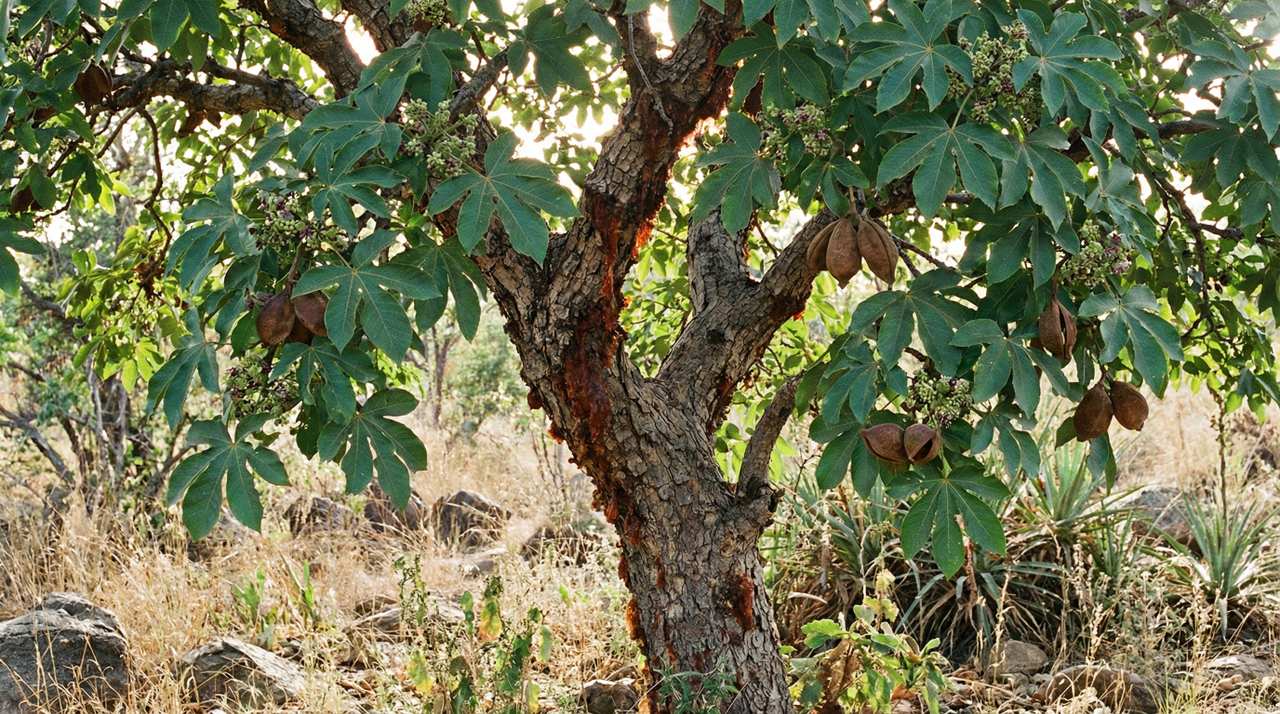
Most people who've heard of karaya gum have encountered it as an ingredient buried in the fine print of a laxative box or a denture adhesive, never once connecting it to a living tree. What they don't know is that Sterculia setigera has been feeding, healing, and supporting communities across the African savannas for centuries long before any pharmaceutical company figured out how to bottle it. I came to this tree the way I come to most of my favorites: sideways, through a rabbit hole about dryland food forests in the Sahel, where I kept finding references to a spreading, fire-resistant canopy tree that communities tapped for gum, cooked for seeds, and folded into medicine without ever having to irrigate, fertilize, or fuss over it the way we fuss over almost everything in Western horticulture.
The contradiction that hooked me is this: a tree that thrives on neglect, in some of the harshest dryland conditions on the planet, also produces a mucilaginous gum with real, documented pharmacological properties comparable to psyllium.[1] That's not a coincidence. That's a plant that has spent millennia getting very good at surviving, and the same chemistry that lets it seal its own wounds turns out to be genuinely useful to the people living alongside it. If you've been sleeping on this one, you're not alone. But I think that's about to change.
Tropical Chestnut Origin, History, and Botanical Background
Tropical Chestnut (Sterculia setigera) is a tree rooted in the African savanna in every sense. Native to a broad sweep of sub-Saharan Africa stretching from Senegal in the west through Sudan, Ethiopia, and Somalia in the east, and south through Tanzania, Zambia, Mozambique, Angola, and into parts of South Africa, it has also made its way into drier regions of India, particularly Rajasthan, Gujarat, Madhya Pradesh, and Andhra Pradesh, where it was introduced and cultivated primarily for gum production.[2][3] This is a plant that knows hardship and has spent millennia adapting to it.
Botanical Background and Native Range of Sterculia setigera
Across its native range, the tropical chestnut tree settles into dry deciduous woodlands, Sudanian savannas, Somali-Masai Acacia-Commiphora bushlands, Zambezian mopane woodlands, and riverine fringes, often turning up near termite mounds where soil conditions concentrate nutrients.[3][4] It grows from sea level up to about 1,500 meters, occasionally higher, and asks for little more than well-drained sandy or loamy soil and a pH somewhere between 6 and 8.[3]
Taxonomically, it sits in the Malvaceae family (formerly its own Sterculiaceae), a deciduous, long-lived perennial that takes 5 to 7 years to reach sexual maturity and can persist for 50 to 100 years under good conditions.[5][6] For anyone planning a food forest or dryland agroforestry system, that lifespan matters. I've worked with long-lived pioneer trees in restoration contexts, and the ones with deep taproots and fire-resistant bark like this one tend to be the anchors that make a guild stable over decades rather than just a season or two. You plant Sterculia setigera for your future self, or honestly, for whoever comes after you. Globally, the IUCN lists it as Least Concern, but that's a big-picture number; locally in the Sahel, overharvesting for gum, charcoal pressure, habitat loss, and climate shifts are real stressors on populations that still carry meaningful genetic diversity worth protecting.[7][8]
The related Peanut tree (Sterculia quadrifida) gives useful genus context here: it's native to northern Australia, parts of Southeast Asia, and Papua New Guinea, growing in monsoon forests and savannas from sea level to about 800 meters.[9][10] Same genus, very different geography and gum profile. The two are worth keeping distinct in your mind from the start.
Visual Characteristics of the Karaya Gum Tree
The first time you see a mature tropical chestnut tree, the spreading, flat-topped silhouette gives it away as a savanna tree immediately. It typically reaches 6 to 15 meters tall with an 8 to 10 meter spread, growing at a moderate clip of about half a meter to a meter per year, though in especially arid zones it tends toward a shrubby multi-stemmed form rather than a clean single trunk.[11][3] The bark is dark brown to silvery-gray, rough, and flakes in patches, marked with horizontal scars where leaves have dropped over the seasons; that same bark provides the fire insulation that lets the tree survive the dry-season burns that define its native landscape.[3][12]
The leaves are palmately compound with 5 to 7 leathery, elliptic to obovate leaflets, each 5 to 12 cm long, glabrous on top and softly pubescent along the veins beneath, turning yellowish as the dry season takes hold before the tree drops them entirely.[13] Flowers are small, only 8 to 10 mm across, apetalous, with yellowish-green to reddish sepals fused at the base and an unmistakably musky odor that carries surprisingly well in dry air. They appear in axillary or terminal panicles 5 to 15 cm long, and the species is dioecious, flowering in the dry season.[14][12] I've worked with a few Sterculia relatives in botanical garden settings and that particular musky quality is a consistent genus trait, not something you forget.
The fruit is where this tree really announces itself: 3 to 5 boat-shaped woody follicles, 10 to 20 cm long, that split open when ripe to reveal seeds nestled in a vivid red aril against shiny black seed coats. Monkeys, birds, and elephants disperse them across the landscape.[3][15] One clarification worth making early: S. setigera is distinguished from its relative S. urens by its bristly (setose) indumentum, and despite the common association with karaya gum, S. urens is the primary commercial karaya source.[16][17] Knowing the difference matters when you're selecting species for a multi-use design rather than relying on common names that can blur across the genus.
Traditional and Cultural Uses Across Africa and India
Communities across the Sahel and beyond have worked with this tree for centuries. Fulani, Hausa, and Tuareg people have traditionally used bark infusions to treat diarrhea, stomach ailments, wounds, and skin conditions, while the oil-rich seeds are edible, the wood goes into furniture and fuel, and bark and leaves serve as fodder or dye.[18][19] In India, particularly among Gond and Baiga tribal communities, the bark and gum have been used similarly, with a focus on dysentery treatment and poultices for boils.[20]
The gum is where the trade history gets interesting. Tapped by making incisions in the bark, the exudate dries into brittle flakes with value as a food stabilizer, emulsifier, and pharmaceutical binder, as well as a local laxative.[21][12] Colonial trade networks picked up on this early, folding the tree's gum into broader African gum-and-resin commerce alongside acacia and other species. Sustainable tapping is everything here, a point the FAO has made clearly and one I take seriously when evaluating any gum-yielding species for a regenerative system. Overtap and you weaken the tree; harvest thoughtfully and you have a livelihood crop for decades.[8] In African folklore, the sticky mucilaginous quality of the gum connected the tree to themes of fertility, protection, and community bonds, with the wood appearing in ritual objects across multiple cultures.[22][23]
Fun Facts and Ecological Adaptations
What makes Sterculia setigera genuinely fascinating from an ecological standpoint is how precisely its whole annual rhythm is calibrated to the wet-dry cycle of the African savanna. It leafs out and grows during the wet season, flowers at the dry-wet transition, and fruits through the wet period, then drops its leaves and goes dormant again.[3][24] Deep taproots pull water from well below the surface during drought, and that fire-resistant bark means a grass fire that would kill younger plants just rolls past. In my experience designing dryland guilds, trees with this combination of characteristics, deep roots, fire tolerance, and a pioneer role in the canopy layer, are the ones that let you establish a guild in a challenging site and actually have it survive long enough to become self-sustaining.
The seeds, once roasted, develop a pleasant nutty flavor, and in arid zones where the tree takes a shrubby multi-stemmed form, it associates naturally with Acacia species in semi-arid savanna mixes.[19][25] Then there's the fruit: watching those woody follicles split open and reveal black seeds against a bright red aril is one of those moments that makes you understand immediately why birds and monkeys have been doing the dispersal work here for so long. It's not subtle. The tree is, at its core, a patient, multi-generational investment in a landscape, which is exactly the kind of thinking that belongs in permaculture design.
Tropical Chestnut Varieties and Sourcing
Notable Varieties and Ecotypes of Sterculia setigera
If you're coming to tropical chestnut hoping to browse a catalog of named cultivars the way you might with, say, chestnuts or hazelnuts, you're in for a reality check. Sterculia setigera is a monotypic species with no formally recognized subspecies, varieties, or distinct cultivated forms.[16][11] The same goes for the related peanut tree, Sterculia quadrifida: no named horticultural selections exist for either species.[26][27] You're working with wild-type material, full stop.
The practical substitute for cultivar selection here is provenance. Regional ecotypes vary meaningfully in height, leaf morphology, drought tolerance, and especially karaya gum yield, with Senegalese and Indian populations both documented as higher producers.[28][19] In my experience with related Sterculia species, plants grown from Indian-sourced seed tend to show noticeably better drought performance in hot, humid conditions compared to some African lines. It's subtle, but it matters when you're designing for a dryland guild. That's the kind of selection decision that belongs in your design notes, not on a nursery tag.
The peanut tree offers a useful contrast to keep this from feeling discouraging. Under managed conditions with pruning and pest control, Sterculia quadrifida yields 20 to 30 kilograms of nuts per mature tree annually, often double what unmanaged wild trees produce, though it responds best when irrigation and fertilization are applied.[29] That gap between wild and managed performance tells you what thoughtful stewardship can unlock in this genus, even without formal breeding programs.
Sourcing Tropical Chestnut Seeds and Plants
Sterculia setigera simply isn't in the mainstream U.S. horticulture trade. When it appears at all, it's as an ornamental curiosity through specialty exotic nurseries, not as a production tree.[14] Living plants are rarely available from international vendors shipping to the U.S., and that's not an accident.[30] APHIS regulations require permits and quarantine compliance for plant material, and I've imported tropical tree seeds myself: the paperwork is non-negotiable, and skipping it risks your entire shipment being destroyed at the border.[31]
Seeds are your realistic path. Retailers like Rare Exotic Seeds and Trade Winds Fruit occasionally carry them, and eBay or Etsy listings pop up from time to time.[32][33] After trying several sources over the years, I've found that freshness makes all the difference: a recent lot from a dedicated retailer consistently outperforms old eBay stock. Don't expect standardized pricing either; costs vary widely and usually require direct inquiry with the seller.[34] Always verify current USDA regulations before placing any order from an international supplier.
How to Propagate and Plant Tropical Chestnut (Sterculia setigera)
Tropical chestnut is one of those plants that teaches you something the moment you hold its seeds. They're small, shiny, and almost lacquered-looking, and that hard black coat isn't just an aesthetic quirk. It's the whole story of how this tree reproduces.
Seed Morphology, Dormancy, and Polyembryony
Each ovoid seed averages 10-15 mm long with a woody endocarp and a fleshy aril that lures ants into dispersing it across the savanna floor.[35][36] What you can't see from the outside is equally interesting: these sterculia seeds are polyembryonic, meaning a single seed can contain 2-5 embryos derived from both zygotic and nucellar tissue.[37][38] In practice, this means you'll sometimes see two or three seedlings pushing up from one sowing position. I've found it useful to pot all of them up individually rather than thinning right away; they often show subtle morphological differences in the first few weeks, and that variation is exactly what plant breeders mine when selecting for gum yield or drought hardiness.[39]
Scarification, Germination, and Seed Storage
That beautiful hard coat enforces physical dormancy so effectively that untreated seeds germinate below 20% of the time.[25] Scarify properly and you're looking at 70-90% germination rates instead.[25][40] Your options are mechanical nicking, concentrated sulfuric acid (30-60 minutes, effective but not something I recommend without a proper lab setup), or hot water.[41][42] After trying all three on related Sterculia species, I keep coming back to the hot-water soak at around 80°C left to cool overnight. It consistently outperforms nicking for home-scale batches and sidesteps the acid hazards entirely.
After scarification, sow seeds 1-2 cm deep in a moist, well-drained medium and keep temperatures between 25-30°C.[23] Germination typically starts within 10-20 days and wraps up within 2-4 weeks, with success rates of 50-80% under good conditions.[25][23] One thing I wish someone had told me upfront: these seeds are recalcitrant. Like mango or avocado, they can't handle drying out, lose viability rapidly below 20-30% moisture content, and don't tolerate cold storage well.[43][44] If you must store them, keep humidity at 70-90% and temperatures between 5-15°C; even then, viability rarely holds past 6-12 months.[45] Fresh seed sown immediately after harvest is always the better choice.
Vegetative Propagation: Cuttings and Grafting
Seed propagation will serve most growers perfectly well, but clonal material matters when you're running a gum plantation and need predictable output. Semi-hardwood cuttings of 10-15 cm treated with IBA at 1000-3000 ppm under high humidity (80-90%) and 25-30°C can root, though success rates are variable at 20-60%.[46][47] Grafting onto compatible Sterculia rootstocks is the more reliable route to uniform clones in commercial orchards,[48][49] though for a permaculture food forest, the seedling variability is often an asset rather than a liability, especially if you're scouting for drought-tolerant individuals over time.[39]
Soil, Site Selection, and Planting Technique
Before I plant any tree with a substantial taproot, I dig a 1-meter test pit. With tropical chestnut, that habit is non-negotiable. The taproot can reach 2-4 meters deep, which demands at minimum 1.5-2 meters of workable, well-drained soil.[50][51] Sandy or loamy textures at pH 6.5-7.5 are ideal (it tolerates 6.0-8.5), and the tree handles nutrient-poor lateritic soils better than most.[52][11] What it absolutely will not forgive is waterlogging. If your test pit fills and drains slowly, amend heavily, use raised beds, or find a different site. Full sun (6-8 hours minimum) is equally firm as a requirement for good growth and gum yield, though young seedlings appreciate some temporary shade while they harden off.[53][54]
Spacing, Timeline, and Establishment
Nursery seedlings are ready to transplant after 6-12 months, once they've reached around 15-20 cm, and the early rainy season is your window.[55][23] Spacing depends on your goal: intensive gum plantations can run as tight as 4-6 meters (up to 400 trees per hectare), while orchard or permaculture guild plantings need 8-15 meters to accommodate a mature canopy spread of the same dimension.[23][56] Set expectations accordingly: in tropical savanna conditions, the tree reaches around 5-7 meters by year eight, with gum tapping viable from years five through seven.[52][21] The first two to three years require consistent supplemental irrigation, but once the taproot is established and reaching down to deeper soil moisture, this tree becomes remarkably self-sufficient. Getting those early years right is what makes the long wait worthwhile.
Tropical Chestnut Care Guide
Growing Sterculia setigera well means understanding where it comes from. This is a tree shaped by African savannas, by soils that drain fast and seasons that alternate between downpour and months of almost nothing. Once you internalize that rhythm, the care decisions start to make intuitive sense.
Sunlight Requirements for Tropical Chestnut
Tropical chestnut needs full sun, at least 6 to 8 hours of direct light daily.[3][15] It evolved in the upper canopy of open woodlands, not under a closed forest, so low light produces weak, etiolated growth and sets up chlorosis down the line.[57] I grew my first seedlings in a greenhouse bay that got morning shade, and by week four they were leggy and pale. Moving them to a south-facing spot with unobstructed sun made an immediate difference. That said, if you've had a young plant in partial shade and you relocate it, acclimate it over a week or two; sudden full-sun exposure on shade-adapted foliage causes leaf scorch with brown necrotic patches that I've seen in other subtropical species when growers rush the transition.[58]
Watering Needs and Drought Tolerance
The mature tree's drought credentials are genuinely impressive. Native to semi-arid savannas receiving as little as 300 mm of annual rainfall, it can survive 6 to 8 months of dry season thanks to a taproot that may reach 10 to 15 meters, thick bark, and the simple strategy of dropping its leaves to cut water loss.[59][60] It reminds me of certain acacias I've worked with: once that taproot is down, the tree largely manages itself. Getting to that point, though, requires patience and attentive watering in years one and two.
Young trees need water one to two times per week, roughly an inch to two inches, keeping the soil consistently moist without waterlogging.[52][15] Established trees want deep, infrequent irrigation every two to four weeks during prolonged dry spells, and often nothing beyond natural rainfall.[52] Let the top two to three inches of soil dry completely between waterings.[61][53] I check that before I reach for the hose, and it's often the first thing I check before fertilizer too, because lower-leaf yellowing from overwatering looks a lot like a nutrient problem at a glance. Root rot from consistently wet soil is a real risk, and I've seen it sink young trees fast in subtropical conditions where humidity is already high. Underwatering shows differently: leaf edges brown, leaves drop early, and growth stalls.
It prefers well-drained sandy or loamy soils with a pH of 5.5 to 8.5, and it has moderate salinity tolerance.[3][23] A thick organic mulch layer helps retain moisture during establishment and insulates the root zone. Seasonally, increase watering during hot summers, ease off in fall, and reduce to monthly or rainfall-dependent in winter to mirror the natural dry-season rhythm.[62] This tree fits comfortably in xeriscaping schemes once it's past the establishment phase.
Fertilizing Tropical Chestnut Trees
Tropical chestnut is a moderate feeder that performs surprisingly well in low-fertility soils, which is partly why it thrives in arid-zone agroforestry where other trees struggle.[56] For individual trees, a balanced slow-release fertilizer like 10-10-10 or 14-14-14, around 200 to 500 grams applied twice yearly at the start of the rainy season and again post-monsoon, supports healthy growth.[63][64] For first-year trees I stay at the lower end, 50 to 100 grams per application, supplemented with 5 to 10 kilograms of organic manure. I've seen heavier early applications produce soft, lush growth that establishes poorly compared to the stockier, more resilient seedlings that get lighter doses.[65][66]
Watch for deficiency symptoms, which vary usefully: interveinal chlorosis points to iron, stunting suggests zinc, yellowing older leaves indicate nitrogen shortage, purplish discoloration signals low phosphorus, and marginal necrosis is typically potassium.[67] These micronutrient problems show up more often in alkaline soils, so a soil test every two to three years targeting pH, phosphorus, and potassium is worth the effort.[65] One clear lesson from related species: excess nitrogen pushes lush vegetative growth at the cost of gum yield and can spike aphid pressure.[68][69] If gum production matters to you, lean on potassium rather than nitrogen, and don't fertilize heavily without testing first.
Frost Tolerance and Cold Protection
This is not a tree for cold climates, and I don't want to soften that. Minimum survivable temperature is around 10°C (50°F), and anything prolonged below 5°C (41°F) causes leaf drop, branch dieback, or outright death, especially in young plants.[3][15][61] I treat it like certain tender citrus I overwinter: when nights start approaching 10°C, my containerized specimens come inside. USDA zones 10a through 12 are the reliable range; zone 9b may work for brief, light frosts but I wouldn't recommend banking on it for anything you expect to live long-term.[70][14] In marginal areas, heavy mulch over the root zone and frost cloth can offer a few degrees of protection, and keeping young plants in containers you can move gives you the most flexibility during establishment.
Heat Tolerance and High-Temperature Care
On the other end of the spectrum, tropical chestnut is genuinely heat-adapted. It grows comfortably between 20 and 40°C and tolerates peaks up to 45°C, using its deep taproot, thick bark, small leaves, and stomatal regulation to minimize water loss when temperatures climb.[25][71][72] Compared to more tender tropicals in my garden, I've had to worry about it far less during heat waves. The caveat is water availability: above 40°C without adequate moisture, even this tree shows leaf scorch, wilting, and reduced photosynthesis, and gum yields drop.[73][23]
Seedlings and flowering plants are the most vulnerable stages. For seedlings, 30 to 50% shade cloth during the hottest months buys them time while their roots develop.[74] For established trees in hot exposed sites, deep mulching and occasional deep irrigation during extreme heat keep stress symptoms at bay. Its value as a windbreak in dryland agroforestry systems comes partly from this resilience, providing shelter for more sensitive species while asking very little itself.
Pruning, Maintenance, and Integrated Pest Management
Prune during the dry season, after leaf fall and before the monsoon breaks.[75][76] I time mine the same way I do with other latex or gum-producing trees: sap flow is lowest then, which means cleaner cuts, less sticky mess, and fewer open wounds sitting in humid conditions where fungal entry is easy. Remove dead, diseased, or crossing branches, thin the canopy for airflow, and with young trees, train to a central leader to build a strong scaffold.[77]
Light pruning can actually stimulate gum exudation, but keep it controlled. Heavy pruning reduces overall yield, so the principle here is minimal intervention with clear purpose.[78][79] For pest and disease management, an integrated approach works best: good drainage, sanitation, biological controls, and neem oil or insecticidal soap for soft-bodied insects, with fungicides reserved for when cultural fixes aren't enough. The pests_and_diseases section covers specific threats in more detail.
Seasonal Growth Rhythm of Tropical Chestnut
Once I understood this tree's phenological calendar, all my care decisions got easier. Leaf flush and peak vegetative growth happen in the wet season, roughly October through December. Flowering follows in the dry season, November through February, with those vivid yellow-orange panicles appearing before new leaves.[14][80][81] Fruiting follows in the early to mid-wet season, March through July. In the peak dry months the tree goes semi-deciduous to fully deciduous, pulling back to conserve water, a strategy that tightens or loosens depending on how harsh the dry season is.[82][24]
I use leaf drop as my cue to prune, reduce watering, and hold off on fertilizer until the rains return. That moment when the canopy thins is the tree telling you exactly where it is in its cycle. Follow that lead, and once establishment is behind you, this tree does most of the work itself.
Harvesting Tropical Chestnut (Sterculia setigera)
Planting a tropical chestnut is a commitment that rewards patience more than most trees I've worked with. This is not a plant you add to a food forest expecting returns in a few seasons.
When to Harvest Tropical Chestnut: Maturity Timelines and Seasonal Cues
First gum harvest typically comes 8 to 10 years after planting from seedling, with anything resembling commercial viability arriving closer to 10 to 12 years and genuine peak production not until 20 years or beyond.[3][83][23] From a design perspective, I'd always place this tree as a long-term overstory anchor in a dryland food forest guild rather than a quick-yield specimen. Think of it alongside your canopy legumes and slow-producing fruit trees; it earns its space over decades, not years.
The annual harvest rhythm follows a reliable phenological cue. Flowering happens in the dry season, typically October through December, and the woody follicles then spend 120 to 180 days developing before ripening in the following wet season, usually March through May or June.[84] Gum tapping runs on a similar calendar, with the primary harvest window sitting in that same March to June dry season period.[85][84]
If you're also growing the related Australian Peanut Tree (Sterculia quadrifida) nearby, keep in mind that its seed harvest follows entirely different cues. Pods ripen August through November, turning from green to brown before splitting naturally, and you must wait for that split.[27][86] Unripe green pods are toxic and not an item to taste-test your way through. The genus does not offer uniform harvest rules, and that distinction matters.
How to Harvest Karaya Gum from Sterculia setigera
Gum tapping is the primary economic and medicinal harvest this tree offers, and the technique is straightforward but requires discipline to do sustainably. Vertical incisions 5 to 10 cm deep are made into the bark, allowing the gum to exude and air-dry before being scraped off.[87] Tapping sites are rotated around the trunk, and bark guards of 20 to 30 cm are left between incision points to protect the tree's vascular integrity.[87][88] Respecting those guards is non-negotiable if you want this tree producing for decades. For casual foragers who aren't managing a gum-production system, collecting seeds from naturally split pods is a simpler entry point, and the preparation details for those seeds are worth reading carefully before you go further.
Yield, Flavor, and Quality Factors
Raw karaya gum has a bland, slightly acidic flavor with a musty, almost mouse-like odor in fresh exudate form.[89][90][91] In my experience processing the raw gum, that odor is most noticeable right after collection and fades considerably once the material is properly dried and cleaned. The gum's polysaccharide structure, including acetyl groups, proteins, and trace minerals, contributes to its remarkable ability to absorb up to 100 times its own weight in water, which is exactly what makes it valuable as a thickener and stabilizer.[92] Timing your tapping for early dry season tends to reward you with lower moisture content, higher viscosity, and a cleaner overall profile.[79] I've found that waiting out the last of the rains before making incisions consistently delivers better quality dried gum sterculia than rushing the window. Regional variation matters here too; the data on composition differences is richer for African populations than Indian ones, so treat specific yield figures as rough guides rather than guarantees.
Tropical Chestnut Preparation and Uses
Culinary Uses of Tropical Chestnut
The safest and most versatile part of this tree to work with in the kitchen is the karaya gum tapped from its trunk. FDA-approved as a safe food additive, it's rich in polysaccharides like mannose and galactose that swell in water to form a viscous, gel-like solution, making it a reliable thickener, stabilizer, and emulsifier as well as a vegetarian substitute for gelatin.[14][91][93] I've learned through working with mucilaginous plant gums that adding it gradually to warm (not boiling) liquid prevents clumping and gives you the smoothest result. Indian cooks have known this for generations, using the gum to make gond ke laddu, halwa, payasam, falooda, and sheer khurma, where its neutral, slightly earthy character thickens milk-based desserts and syrups without overwhelming other flavors.[94]
Moving beyond the gum, the fruit offers its own reward. Each woody sterculia pod splits open to reveal black seeds cradled in a white or yellowish aril with a sweet, mango-like flavor that's eaten fresh in parts of Africa.[14][3] Young leaves, shoots, and flowers also find their way into the pot, typically boiled and stirred into soups or stews in African households.[3][95]
The seeds require more respect. Once you shell them, they need roasting, boiling, or grinding before eating; raw kernels carry mild toxins that heat neutralizes, and I can tell you from personal experience that those raw kernels have a distinctly musty smell that roasting largely clears away.[3][95] Processed seeds go into porridge, baked goods, and thickened stews, and soaking releases mucilage that creates the same gel-like quality as the gum itself. The kernels yield an edible cooking oil, and the seeds have served as a famine food in Sudan and Ethiopia, though specific nutritional data for this species remains thin.[96] The entire Malvaceae family sits comfortably in the low-toxicity range; in all my reading of ethnobotanical records, I've never come across a credible report of serious poisoning when seeds are properly prepared.[97]
Traditional Medicinal Preparations
Leaf preparations are the most accessible entry point into tropical chestnut's medicinal tradition. Infusions are taken internally for malaria and respiratory complaints, while poultices applied externally address eye infections, wounds, and skin infections.[98][99] Bark decoctions go deeper into the pharmacopeia: the traditional preparation simmers 10 to 30 grams of bark in 500 to 1000 ml of water for 15 to 20 minutes, with adults typically taking one to two cups daily in divided doses for diarrhea, dysentery, and stomach complaints.[100][99]
The gum itself has a long history as a demulcent and bulk-forming laxative at 3 to 10 grams daily for adults, with 20 grams per day as a firm upper limit to avoid gastrointestinal discomfort.[101] Sustainable tapping means making selective incisions in mature trees no more than once every two to three years; harvest it more aggressively than that and you'll weaken or kill the tree.[8] These are time-honored preparations with real utility, but the clinical evidence base is still thin, so I always recommend consulting a qualified practitioner before using bark or gum internally on an ongoing basis.
Non-Food and Industrial Applications
Beyond the kitchen and medicine chest, tropical chestnut earns its place in a landscape through sheer economic and ecological range. The gum harvested from trunk incisions functions as a suspending agent in pharmaceuticals, a stabilizer in foods and cosmetics, and a vital source of income for communities across Sahelian Africa.[102][103] Commercial karaya is primarily sourced from the Indian species Sterculia urens, but S. setigera produces a gum with comparable adhesive, thickening, and water-absorption properties that supports local African production.[18]
Like moringa in tropical systems, this tree gives you food, medicine, fodder, and a marketable non-timber product, but it asks for respectful harvest intervals in return. The timber supplies fuel and construction material, leaves and pods go to livestock, and the bark yields dye for fabric.[104][105] It doesn't fix nitrogen, so pairing it with leguminous guild companions is a design priority, but its deep roots stabilize slopes and its leaf litter slowly feeds the soil beneath it. For a dryland agroforestry system, that combination of structure, fodder, gum, and seasonal food from the same canopy is genuinely hard to replicate.
Tropical Chestnut Health Benefits and Medicinal Uses
If you ask me what the most important thing to understand about tropical chestnut's health profile is, it's this: the gum is the star. Not because the seeds, leaves, and bark are without value, but because the gum is where the strongest evidence lives, where traditional African healers have historically focused their practice, and where modern pharmacology has done its most serious work. Everything else is supporting cast.
Traditional Medicinal Applications and Pharmacological Research
Across Sudan, Ethiopia, West Africa, and the Sahel, Sterculia setigera has a long track record in traditional medicine. Bark decoctions have been used for diarrhea, dysentery, and respiratory complaints; leaf poultices applied to wounds and inflamed tissue; and the gum used as a demulcent to coat and soothe irritated mucous membranes throughout the gastrointestinal tract.[106][107][100] That demulcent action is something I've come to genuinely appreciate after working with gum-producing trees: there's a reason mucilaginous plant medicines have survived in traditional pharmacopoeias for so long. When a properly prepared karaya-type gum hits water and swells into that thick, protective gel, you can almost feel why it would soothe an inflamed gut lining rather than irritate it.
The laxative application is where clinical data gets most interesting. Karaya gum functions as a bulk-forming laxative comparable to psyllium, with human trials showing efficacy in constipation management and a mild side-effect profile.[108][109] The gum absorbs water, expands in the colon, and forms a mucoadhesive gel layer that both softens stool and moves things along without the cramping some harsher laxatives cause. Preclinical models add breadth to the picture: anti-inflammatory studies show inhibition of TNF-α, IL-6, and COX-2 pathways via NF-κB suppression, with up to 60% reduction in rat paw edema.[110][111] Antioxidant activity has been measured by DPPH assay, antimicrobial inhibition against Staphylococcus aureus and certain fungi clocks in at MIC values of 50 to 200 µg/mL, and analgesic effects in animal models have been described as comparable to aspirin.[112][113] There's also potential antidiabetic activity through α-glucosidase inhibition and slowed carbohydrate absorption driven by the gum's high viscosity.[114]
I want to be honest about where this evidence sits, though. Most clinical research on karaya gum uses Sterculia urens, the primary commercial source, not S. setigera specifically, and the two are frequently conflated in the literature.[115][116] The preclinical data for tropical chestnut is genuinely promising, and the ethnobotanical record is robust. But large-scale human trials specific to this species don't yet exist, and I'd rather give you that limitation upfront than let enthusiasm outpace the science.
Key Phytochemicals in Tropical Chestnut
The gum's chemistry explains a lot. It's built from acidic polysaccharides with molecular weights of 10 to 20 million Da, carrying galacturonic acid at roughly 40 to 50% of the structure, rhamnose at 20 to 30%, plus galactose, glucuronic acid, and uronic acids making up 70 to 80% of the total mass, with about 8 to 13% acetyl content contributing to its characteristic viscosity.[117][118] That polysaccharide architecture is what produces the mucoadhesive, gel-forming behavior and underpins both the laxative action and the prebiotic potential for gut microbiota.
The leaves and bark bring a different set of compounds: flavonoids including quercetin, kaempferol, and rutin derivatives, alongside phenolics like gallic and ellagic acid, tannins, saponins, alkaloids, and terpenoids.[119][120] If you grow hibiscus in your landscape, you already have a frame of reference for what quercetin and kaempferol can do as antioxidants and anti-inflammatory agents; tropical chestnut's leaf chemistry sits in similar territory, though it's been studied far less. Seed chemistry is where things get more complicated: cyclopropenoid fatty acids, particularly sterculic and malvalic acids, are present in meaningful concentrations and inhibit stearoyl-CoA desaturase, an enzyme involved in fatty acid metabolism.[121] Metabolite concentrations across all plant parts also shift with season, peaking in dry periods, and vary with soil type and origin, which means chemistry from one region's trees won't necessarily match another's.[122]
Nutritional Profile of Seeds and Gum
Properly processed tropical chestnut seeds are a respectable food source for arid climates. Roasted or boiled seeds contain 22 to 28% protein, 10 to 15% fat (primarily oleic and linoleic acids), and 45 to 55% carbohydrates with 5 to 8% fiber.[123][124] Mineral content is solid for a famine food: roughly 150 to 200 mg calcium, 120 to 150 mg magnesium, 400 to 500 mg potassium, and 5 to 8 mg iron per 100 grams. From my experience roasting similarly anti-nutritional seeds in food-forest contexts, thorough heat processing doesn't just neutralize problematic compounds, it genuinely improves flavor, pulling out a nuttiness that makes the effort worthwhile as a supplementary protein source.
The gum itself contributes differently: it's primarily soluble dietary fiber with low caloric value, useful as a thickener and stabilizer but not a significant source of macronutrients.[125] The leaf flavonoids and phenolics add an antioxidant dimension. Worth noting for genus context: the Australian relative Sterculia quadrifida offers a sweeter fruit aril with higher vitamin C at 20 to 30 mg per 100 grams, compared to the modest 5 to 10 mg found in tropical chestnut seeds.[126] Treat all these figures as informed ranges rather than hard targets; nutritional analyses for this species are still relatively sparse, vary by region and soil, and vitamin data in particular carries meaningful uncertainty.[127]
Safety Considerations and Potential Side Effects
The purified gum is the safest part of this plant, and the regulatory record backs that up. The FDA classifies karaya gum as GRAS, the EU lists it as food additive E 416, and toxicological studies show a high LD50 exceeding 5 g/kg with no evidence of carcinogenicity or mutagenicity.[128][129] That's a genuinely reassuring profile for something used medicinally. Even so, excessive consumption can cause bloating, flatulence, and diarrhea, and there is documented allergenic potential including contact dermatitis and occupational asthma.[130][131] The gum can also reduce absorption of certain oral medications, including antibiotics and lithium, so spacing doses separately from any pharmaceuticals matters.[132] Because clinical data specific to S. setigera gum during pregnancy is limited, I recommend avoiding medicinal doses and sticking to occasional food use unless you're working with a qualified practitioner.
Raw seeds are a different matter entirely, and this distinction is worth taking seriously. The cyclopropenoid fatty acids, sterculic and malvalic acid, interfere with fatty acid desaturation in ways that can cause real physiological problems.[133] Add saponins and lectins to the picture, and you have multiple reasons not to eat raw seeds.[134] Thorough roasting or boiling is not optional; it's the step that turns a potentially risky food into a reliable one. I always tell people new to this tree: the traditional processing knowledge that comes with these seeds exists for a reason. The leaves and bark carry tannins that may cause mild GI irritation at high doses, but the acute toxicity across the plant family remains low overall. Respect the processing requirements, keep raw seeds away from children and animals, and the rest of this tree's chemistry becomes something worth working with rather than worrying about.
Pests and Diseases of Tropical Chestnut (Sterculia setigera)
I'll be upfront: species-specific research on Sterculia setigera pests and diseases is thinner than I'd like. Most of what we can reliably draw on comes from work on related karaya gum trees across Africa and India, and from broader Sterculia family studies. That said, the patterns are consistent enough to be genuinely useful, especially if you've spent time with savanna-adapted trees and understand what conditions push them toward trouble.
Common Diseases and Environmental Vulnerabilities
Tropical Chestnut carries moderate resistance to many common pathogens, but that resistance erodes fast when humidity climbs or drainage fails.[135][136] The heaviest disease pressure hits during wet seasons, when Fusarium wilt and root rot, Colletotrichum anthracnose, powdery mildew, and Cercospora leaf spot all become realistic threats; severe outbreaks can cut gum yields by up to 30%.[137][138] On the bacterial side, Xanthomonas leaf spot and Ralstonia solanacearum wilt can cause vascular blockage and rapid decline in affected trees.[139] Viral infections are rarely documented and aren't a meaningful management concern here.[23]
The tree's drought tolerance is a genuine asset: once established through dry conditions, stress-related disease incidence drops noticeably.[56] Waterlogged soils are the real weak point, where Phytophthora root rot can take hold fast.[138][52] Working with other savanna-adapted species has taught me that good drainage solves more disease problems than any spray program ever will, and this tree is no exception.
Major Insect Pests and Natural Defenses
The pest complex you're most likely to encounter includes termites (Macrotermes spp.), aphids, scale insects, mealybugs, noctuid caterpillars, and cerambycid stem borers, all capable of causing defoliation, trunk weakening, and secondary fungal infections at wound sites.[140][141] Mature trees hold up reasonably well because of the karaya gum exudate, physical defenses like pubescent leaves, and chemical compounds including tannins, flavonoids, and triterpenoids.[142][143] I've watched that sticky gum well up around borer entry points like a natural bandage, which is one of those defense mechanisms that makes you appreciate how a tree can manage its own wounds. Young plants don't have that resilience yet, so early monitoring matters.
Pest pressure is higher in humid East African sites and during rainy seasons than in drier Indian savannas, and drought stress can paradoxically increase borer susceptibility.[144] No cultivars with documented pest resistance exist; this species is managed as wild or semi-domesticated stock, and selecting vigorous seedlings from healthy parent trees has been more reliable in my experience than waiting for formal breeding programs to catch up.[145]
Integrated Management and Prevention Strategies
In practice, I rarely reach for fungicides in a diverse food forest. The cultural steps that prevent problems here also benefit the whole guild: well-drained sandy-loam soil, appropriate spacing for airflow, prompt removal of infected material, and seasonal pruning of damaged wood keep most issues from escalating.[146][147] When something more is needed, copper-based sprays address bacterial and some fungal infections, sulfur handles powdery mildew, and neem or Bacillus thuringiensis are reasonable biopesticide options before anything harder.[139][148] Given that fungal and borer damage can reduce gum yields by up to 30%, those cultural practices aren't just philosophically satisfying; they protect the tree's most economically significant output.[149] Once established in a well-sited system, tropical chestnut is genuinely low-maintenance on the pest and disease front.
Tropical Chestnut in Permaculture Design
If you're designing a food forest in a hot, seasonally dry climate, Sterculia setigera deserves a serious look as your upper canopy anchor. This is a tree built for places that bake in summer and dry out hard, and its ecological functions run deeper than the obvious ones. Let me walk through how I think about placing it, what it gives back to a system, and where it fits in a layered guild.
Climate Suitability and Hardiness Zones
Tropical Chestnut is native to the tropical savannas and hot semi-arid zones of Africa, those Köppen Aw and BSh climates with a punishing dry season and modest annual rainfall.[3][15] It thrives with 500 to 1500 mm of rain annually and prefers low to moderate humidity with daytime temperatures in that 20 to 35°C sweet spot.[3][53] That rainfall range is broader than you might expect, which means it can handle both the drier parts of South Florida and the wetter subtropical fringe of Central Florida without complaint once it's settled in.
Frost, though, is a real conversation to have. It handles brief dips down to about -4°C (25°F) but not prolonged cold, and it's rated for USDA zones 9 to 11 with the best performance in zones 10 and 11.[150][53][151] I've learned from working in zone 9B that young specimens of similar subtropical canopy trees need winter protection more than mature ones do, and this tree is no different. Tuck young plants into a south-facing microclimate near a heat-radiating wall, or keep them in containers their first winter if you're on the edge. In zone 9 I'd treat them like a marginal avocado: confident once they're large enough, anxious before that.
If your site leans wetter and more humid, look instead at the Peanut Tree (Sterculia quadrifida), which tolerates 600 to 2000 mm of rainfall, higher humidity, and a slightly more forgiving cold threshold of 0 to 5°C, though it still wants zones 10a to 11.[152][153] The two trees are genuinely different climate fits, so matching species to site isn't just a precaution here, it's the whole game.
Ecosystem Functions and Benefits
What I find compelling about this tree from a systems perspective is how much it gives back to the soil and the local fauna without ever fixing a single gram of nitrogen. That last part matters, and I'll come back to it. Start with the roots: a deep taproot that anchors into subsoil, stabilizes loose or sandy ground, and helps hold structure in landscapes prone to dry-season erosion.[154][155] In my Central Florida designs, I've found that deep-rooted canopy trees do a lot of the unsung work of keeping sandy soils from deflating under summer stress. Sterculia setigera belongs to that same functional guild.
Above ground, its deciduous leaf litter decomposes slowly (the leaves are tough) but builds organic matter and feeds microbial life in the thin savanna soils it evolved with.[156] Think of it like a slow-release amendment you don't have to buy. The colorful woody follicles attract frugivores, birds, and primates in its native range, and that seed-dispersal relationship translates to strong wildlife habitat value in a designed system.[157][156]
The pollination picture is genuinely useful for food forest timing. Flowers bloom during the dry season, offering nectar and pollen through bell-shaped, musky-scented panicles that attract bees, butterflies, flies, and beetles when not much else is flowering.[158][60] I always try to plan understory companions that stagger their bloom around a tree like this, extending the forage window and keeping pollinators cycling through the whole system. The tree's protandrous breeding (male phase first, female phase after) favors cross-pollination, but habitat fragmentation can reduce pollinator efficiency and drag down fruit set, so planting more than one tree where space allows is a practical call.[158][159]
Now, back to the nitrogen question. Sterculia setigera doesn't fix nitrogen.[105] In a savanna-inspired guild, this is the gap you need to fill intentionally. Pigeon pea works beautifully as a sub-canopy companion in warm-climate systems. I've used it in multiple projects specifically to underplant tall non-fixing canopy trees, and the combination handles nitrogen budget without drawing down the system over time.
Forest Layer and Guild Design
Sterculia setigera belongs in the upper canopy or emergent layer. It reaches 20 to 30 meters at maturity with a broad, spreading crown, and its deep taproot means it's not aggressively competing with the understory for moisture or nutrients at the same soil horizon.[160][56] Young trees tolerate some shade, but mature specimens want full sun, so position them where they won't be shaded out by neighboring canopy and where their own spreading crown will cast dappled rather than dense shade below, giving room for productive mid-layer plants.
In its native African range, it grows alongside Khaya senegalensis and Irvingia gabonensis in naturally layered woodland systems.[161] I'd mirror that structure in a subtropical food forest by pairing Tropical Chestnut with nitrogen-fixing sub-canopy companions like pigeon pea or Leucaena, with fruiting shrubs in the mid-layer and shade-tolerant herbs or groundcovers at the base. A design I've sketched for clients in warmer zones puts this tree at the northwest corner of a guild to provide afternoon shade without blocking morning sun from the productive layers below. The taproot handles drought years, the leaf litter slowly conditions the soil, and the dry-season blooms keep bees working when the rest of the garden goes quiet. That's the kind of multi-function stacking that makes a canopy tree worth its footprint.
The Tree That Taught Me to Think in Decades
I keep a photo on my phone of a gnarled Sterculia trunk in Mali, bark scored with old tapping lines, the tree still standing and still giving. Nobody planted it with a plan. It just outlasted everything around it. That image has quietly shaped how I think about patience in food forest design, and why I keep making room for plants that won't pay off until I'm old.
Sources 161
- Sterculia gum: A review of its properties and applications ↩
- IUCN Red List: Sterculia setigera ↩
- Sterculia setigera - Useful Tropical Plants ↩
- Sterculia setigera Delile | Species ↩
- Plants of the World Online ↩
- Gum Karaya (Sterculia spp.) ↩
- IUCN Red List: Sterculia setigera ↩
- Sustainable Harvesting of Karaya Gum in the Sahel ↩
- Sterculia quadrifida - Wikipedia ↩
- Kew Science - Plants of the World Online: Sterculia quadrifida ↩
- Sterculia setigera - Kew Science ↩
- Sterculia setigera (PROTA) ↩
- Kew Science Plants of the World Online - Sterculia setigera ↩
- Sterculia setigera - Wikipedia ↩
- Sterculia setigera Del. - PlantZAfrica ↩
- Sterculia setigera Delile ↩
- FAO - Non-Wood Forest Products: Sterculia spp. ↩
- Sterculia setigera Del.: A Review of Its Phytochemistry, Ethnopharmacology and Toxicology ↩
- Karaya Gum from Sterculia Species ↩
- Ethnobotanical Uses of Sterculia setigera in Indian Tribes ↩
- Karaya Gum (Sterculia spp.) ↩
- Ethnobotany of Sterculia Species in Sub-Saharan Africa ↩
- Gums and Resins from Africa: Traditional Uses and Potential for Industrial Applications ↩
- The Biology and Ecology of Sterculia setigera in African Dry Forests ↩
- Growth and Ecology of Sterculia setigera in African Savannas ↩
- Sterculia setigera Delile ↩
- Sterculia quadrifida - Wikipedia ↩
- Karaya Gum Production from Sterculia urens and setigera ↩
- Research Article: Cultivation Potential of Sterculia quadrifida in Northern Australia ↩
- Plants of the World Online ↩
- Plant Import Regulations ↩
- Sterculia setigera - Karaya Gum Tree Seeds ↩
- Exotic Tropical Tree Seeds Including Sterculia spp. ↩
- Kew Science - Plants of the World Online ↩
- Seed Morphology of Sterculia setigera Del. ↩
- Plants of the World Online: Sterculia setigera ↩
- Polyembryony in Tropical Trees: A Case Study of Sterculia setigera ↩
- Seed Biology of Sterculiaceae: Polyembryony and Breeding Systems ↩
- Genetic Variation in Seedling Populations of Sterculia setigera ↩
- Germination of Sterculia setigera Del. Seeds ↩
- Propagation of Sterculia setigera: Overcoming Seed Dormancy ↩
- Seed Germination Guidelines for African Karaya Gum Trees ↩
- Seed Information Database - Sterculia setigera ↩
- Recalcitrant Seeds of Tropical Tree Species ↩
- Seed Storage Behaviour of Tropical Tree Seeds ↩
- Propagation Techniques for Sterculia setigera ↩
- Propagation of Tropical Trees: Sterculia setigera ↩
- Propagation of Sterculia setigera by Grafting ↩
- Horticultural Techniques for Karaya Gum Trees ↩
- Karaya Gum Tree Cultivation - FAO Guidelines ↩
- Root Systems of Savanna Trees - Journal of Ecology ↩
- Sterculia setigera - Useful Tropical Plants Database ↩
- Sterculia setigera: The Karaya Gum Tree ↩
- Cultivation of Gum-Producing Trees in Tropical Regions ↩
- Cultivation Guide for Karaya Gum Tree (Sterculia setigera) ↩
- Agroforestry Species: Sterculia setigera ↩
- Sterculia setigera Profile ↩
- Drought and Heat Stress in Tropical Trees: Case of Sterculia spp. ↩
- Sterculia setigera Del.: a review of traditional uses, phytochemistry and pharmacology ↩
- Drought Tolerance in African Savanna Trees ↩
- Tropical Trees: Overwatering Symptoms in Sterculia Species ↩
- Sterculia setigera ↩
- Sterculia setigera: Agronomy and Fertilizer Requirements ↩
- Karaya Gum Production Handbook (ICAR-Fruit Science Institute) ↩
- Cultivation Practices for Karaya Gum (Sterculia setigera) ↩
- Gum Karaya Production and Management Guide ↩
- Nutrient Deficiencies in Tropical Trees ↩
- Nutrient Management in Tropical Trees: Focus on Sterculia spp. ↩
- Cultivation of Sterculia setigera for Gum Karaya Production ↩
- Sterculia setigera - Plant Profile ↩
- Drought Tolerance Mechanisms in African Savanna Trees ↩
- FAO - Non-Wood Forest Products: Sterculia setigera ↩
- Heat Stress Effects on Tropical Trees ↩
- Karaya Gum (Sterculia spp.) Production and Uses ↩
- Cultivation of Karaya Gum (Sterculia spp.) ↩
- Pruning Techniques for Tropical Trees ↩
- Australian Native Plants Society - Sterculia quadrifida Care ↩
- Sterculia setigera: Cultivation and Pests ↩
- Gum Production in Sterculia Trees ↩
- Flora of Tropical East Africa ↩
- Sterculia setigera Del.: A Review of Its Botanic Profile, Phytochemical and Pharmacological Properties ↩
- Sterculia setigera - Missouri Botanical Garden Plant Finder ↩
- Karaya Gum Production - FAO ↩
- Phenology of Sterculia setigera in the Sudanian Zone ↩
- Karaya Gum: Production and Marketing ↩
- Bush Tucker Guide: Sterculia quadrifida ↩
- Karaya gum production, properties and applications ↩
- Journal of Ethnopharmacology - Karaya Gum properties ↩
- Gum Karaya: Properties and Uses ↩
- Sterculia setigera Del. gum, composition and some of its applications ↩
- Karaya gum - Wikipedia ↩
- Chemical Composition of Sterculia setigera Gum ↩
- Karaya Gum - ScienceDirect ↩
- Use of Gums in Indian Confectionery ↩
- Edible Plants in Africa: Sterculia setigera ↩
- Edible Seeds of Sterculia setigera in Traditional Diets ↩
- Toxicity of Malvaceae Family - PubMed Review ↩
- Traditional Uses of Sterculia setigera in African Herbal Medicine ↩
- Ethnobotanical Survey of Medicinal Plants Used by People in Zalingei, Sudan ↩
- Medicinal Plants of Sudan: Ethnobotanical Survey ↩
- Pharmacology of Sterculia urens (Karaya gum) ↩
- Gum Production and Socio-Economic Importance of Sterculia setigera in the Sahel ↩
- Karaya Gum (Sterculia spp.) - FAO Agroforestry Species Profiles ↩
- Indigenous Knowledge of Non-Timber Forest Products in Sudanian Africa ↩
- Sterculia setigera Del.: A Tree with Multiple Uses ↩
- Traditional Uses and Phytochemistry of Sterculia setigera ↩
- Traditional Uses and Phytochemistry of Sterculia Species ↩
- Clinical Evaluation of Karaya Gum in Constipation Management ↩
- Karaya gum: chemistry, functionality and biomedical applications ↩
- Antioxidant and Anti-inflammatory Properties of Sterculia setigera ↩
- Anti-inflammatory Effects of Karaya Gum ↩
- Antioxidant Activity of Sterculia setigera Leaf Extracts ↩
- Pharmacological Evaluation of Sterculia setigera Del. (Sterculiaceae) in Albino Rats ↩
- Karaya Gum: Therapeutic Applications and Mechanisms ↩
- Pharmacological Review of Sterculia setigera ↩
- Karaya Gum: Botanical and Pharmaceutical Review ↩
- Composition and Bioactivity of Karaya Gum Polysaccharides ↩
- Chemical Composition of Karaya Gum (Sterculia urens and Sterculia setigera) ↩
- Phytochemical Investigation of Sterculia setigera Del. ↩
- Secondary Metabolites from Sterculia setigera: Flavonoids and Phenolics ↩
- Sterculic Acid: A Natural Inhibitor of Delta-9 Desaturase from Sterculia Species ↩
- Seasonal Variation in Gum Yield and Composition of Sterculia setigera ↩
- Nutritional Composition of Sterculia setigera Seeds ↩
- Nutritional Potential of Sterculia setigera Delile Seeds from Senegal ↩
- Karaya Gum: Uses and Applications in Food Industry ↩
- Bush Foods of Australia: Nutritional Composition of Native Fruits ↩
- Nutritional Composition of Australian Indigenous Foods - CSIRO Report ↩
- Karaya Gum - Safety and Uses ↩
- Re-evaluation of karaya gum (E 416) as a food additive - EFSA 2016 ↩
- Karaya Gum Uses, Benefits & Dosage ↩
- Hypersensitivity to karaya gum ↩
- Karaya Gum - WebMD Vitamins Overview ↩
- Cyclopropenoid Fatty Acids: Biological Effects in Animals ↩
- Effects of Sterculia setigera Stem Bark Extract on Hematological Parameters of Wistar Rats ↩
- Sterculia setigera Profile ↩
- Fungal Pathogens of Tropical Trees in Africa ↩
- Fungal Infections in Sterculia Species ↩
- Diseases and Pests of Karaya Gum (Sterculia setigera) ↩
- Diseases and Management of Tropical Trees ↩
- Integrated Pest Management for Sterculia Species ↩
- Pests and Diseases of Tropical Trees: Sterculia Species ↩
- Integrated Pest Management for Gum-Yielding Trees ↩
- Phytochemical Investigation of Sterculia setigera Del. ↩
- Environmental Influences on Tree Pests in African Savannas ↩
- Agroforestry Species: Sterculia setigera ↩
- Sterculiaceae: Integrated Pest & Disease Management ↩
- Integrated Pest Management for Gum-Yielding Trees ↩
- Integrated Pest Management for Sterculia Species ↩
- Diseases and Pests of Sterculia setigera in Tropical Africa ↩
- Sterculia setigera - Missouri Botanical Garden Plant Finder ↩
- USDA Hardiness Zone Map - Sterculia setigera ↩
- Sterculia quadrifida Cultivation Guide - Royal Botanic Gardens Kew ↩
- Royal Horticultural Society - Plant Finder ↩
- Sterculia setigera Delile ↩
- Sterculia setigera Del. - World Agroforestry Centre ↩
- Ecological Roles of Sterculia setigera in African Savannas ↩
- Sterculia setigera ↩
- Pollination Ecology of Sterculia setigera in Sudano-Sahelian Zone of Cameroon ↩
- Floral Ecology and Pollination in the Sterculiaceae Family ↩
- Missouri Botanical Garden: Sterculia setigera ↩
- Sterculia quadrifida - Australian Tropical Rainforest Plants ↩