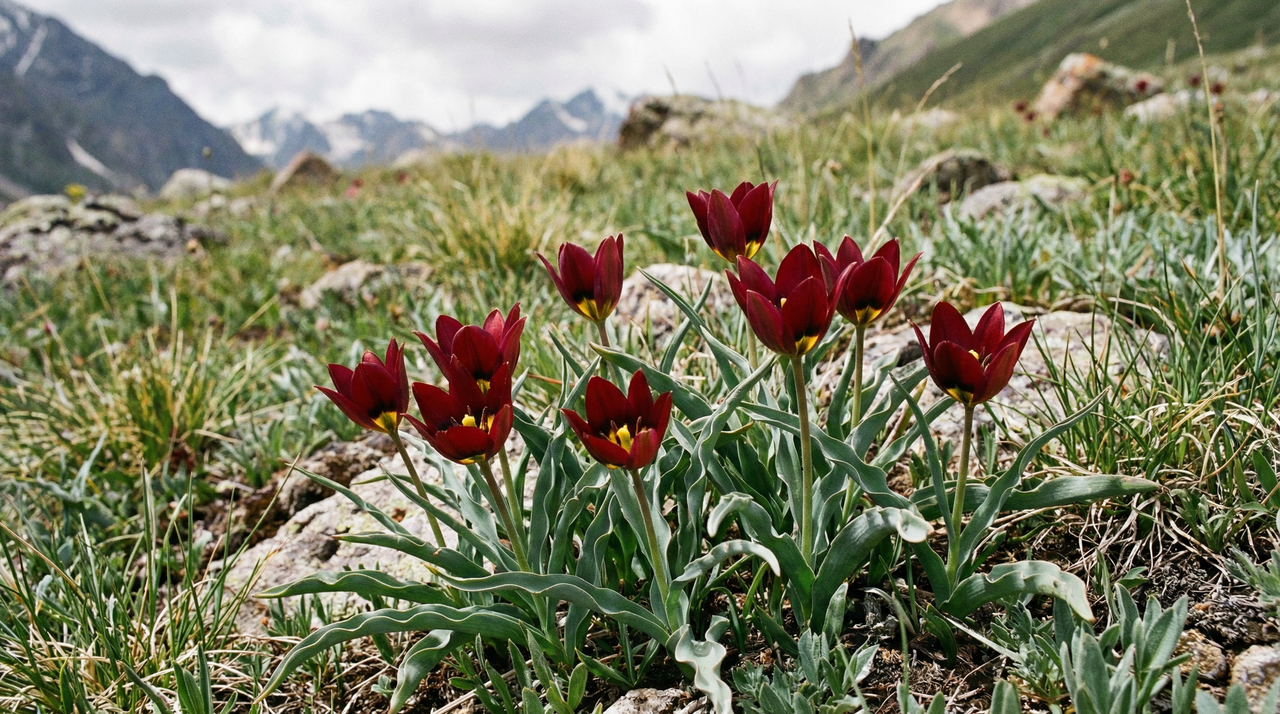
While history obsesses over the 1630s Dutch tulip frenzy where a single bulb bought a house, the real value of Greig's tulip (Tulipa greigii) is its rugged, perennial resilience. What gets left out is the quieter part: the tulips at the center of that frenzy were almost nothing like the ones we actually grow today. Most of what you'll find in a modern garden or roadside planter is Tulipa gesneriana, a hybrid so far removed from its wild ancestors that it barely knows how to survive a second season without help. Greig's tulip, Tulipa greigii, is something else entirely. It comes from the rocky high slopes of the Tian Shan and Pamir-Alai ranges in Central Asia, and it carries that origin in its bones, or more accurately, in its leaves.[1]
Those leaves. Mottled with maroon streaks and blotches that look almost painted on, they're the first thing that stops people in my garden every spring. Most visitors assume something is wrong with the plant. Nothing is wrong. That pigmentation is the species tulip doing exactly what it evolved to do in a high-altitude steppe, and understanding that one detail changes how you think about where this plant belongs, what it needs, and whether it's actually the right choice for your landscape.
Origin and History of Greig's Tulip (Tulipa greigii)
Botanical Background and Native Habitat
Picture the Pamir-Alai and western Tian Shan mountain ranges: rocky scree slopes, thin soils draining faster than they can collect moisture, winters that drop to -20°C and summers that bake to 30°C with barely 250-500 mm of annual rainfall, most of it arriving as snowmelt in spring.[2][3] That's the birthplace of Tulipa greigii, growing from roughly 800 to 3,000 meters elevation across Uzbekistan, Tajikistan, Kyrgyzstan, southern Kazakhstan, and parts of Afghanistan and Turkmenistan.[4][5] That's not a gentle origin story. It's a crucible, and the plant carries those credentials into your garden.
This history immediately explains why Greig's tulip behaves differently from the hybrid tulips that dominate most garden centers. This is a polycarpic perennial species, meaning it reliably returns and flowers year after year, spreading slowly into clumps through bulb offsets, with bulbs that can persist a decade or more under decent conditions.[6][7] After growing species tulips for several seasons, I've learned that one well-chosen planting can deliver decades of spring color with almost no intervention, which is simply not something you can say about most modern hybrid tulips that need replacing every few years. Unfortunately, wild populations aren't faring as well: the IUCN currently lists T. greigii as Vulnerable, with documented declines of 30-50% over the past three decades due to habitat loss, overcollection, and climate pressure.[5] I've made it a point to source only nursery-propagated bulbs for this reason; that IUCN status is a real reminder that beautiful plants carry a responsibility.
Visual Characteristics
Most tulips top 18-24 inches and disappear into the border. Greig's tulip stays compact, typically 6-15 inches tall, with most cultivars sitting under a foot.[8] What makes it genuinely distinctive before a single flower opens is the foliage: broad, leathery leaves marked with longitudinal maroon streaks, blotches, or stripes caused by anthocyanin pigmentation, most vivid early in the season.[9] I sometimes compare this patterning to heuchera foliage when I'm helping clients visualize the plant before they've seen it in person; it reads as ornamental long before bloom. The leaf margins are gently undulate, and the undersides carry fine trichomes, giving them a subtly tough texture that suits their mountain origins.[10] Flowers on the true species are typically scarlet red with yellow margins and a black basal blotch, though cultivars extend the palette into orange, yellow, and richly marked bicolors.[11]
Traditional and Cultural Uses
Eduard Regel formally named the species in 1874, honoring Samuel Greig, a Scottish-born admiral who served in the Russian Imperial Navy, after bulbs collected during Russian botanical expeditions reached the Imperial Botanical Garden in St. Petersburg around 1872.[12] From there the path to Western horticulture was quick: Dutch nurseries had it by 1875, and Victorian gardeners embraced its mottled leaves and vivid blooms during a broader 19th-century revival of tulip interest and hybridization.[13] There's something I love about that arc, a plant forged on alpine scree finding its way into formal Victorian borders within a few years of Western discovery.
Long before Regel's expedition, though, the tulip was woven into the cultural fabric of the people living alongside it. In Central Asian folklore, particularly within Kazakh ethnobotany, the appearance of wild tulips on mountain slopes signals the return of spring, carrying associations with fertility and seasonal renewal that predate any botanical classification.[14] The tulip flower symbolism in this context is less about romance and more about the land waking up, which feels fitting for a species that emerges from frozen ground every year without any coaxing.
Fun Facts and Discovery
Carl Maximowicz first described the species scientifically in 1871, but it was Regel who formally named it Tulipa greigii in 1874.[12] Those maroon leaf markings that caught Victorian gardeners' eyes likely served a genuinely functional role on the mountainside: anthocyanins in alpine plants often provide UV protection, aid heat absorption in cold environments, and may deter herbivores, though the exact selective pressure in T. greigii is still somewhat speculative.[9] It's a reminder that what looks like decoration in a garden border may be hard-won mountain armor.
The Royal Horticultural Society has since granted its Award of Garden Merit to several cultivars, including 'Red Hunter', 'Toronto', and 'Oratorio', recognizing their consistent garden performance and reliability.[15] For anyone building a spring-interest guild around perennial bulbs, those AGM designations are worth paying attention to; they represent decades of garden observation, not just one good season.
Tulipa greigii Varieties and Cultivars
Most gardeners first encounter tulips through the big hybrid divisions: the towering Darwin hybrid tulip, the ruffled tulipa parrot types, the dense tulipa double late, or the classic tulipa triumph. Greig's tulip sits apart from all of them. Classified in Division 15 as a true species tulip,[16] it carries the same wild DNA it developed on the rocky Central Asian slopes covered in the origin section, and that shows in everything from its leaf markings to its compact stature. I think of it as the species you grow when you want a tulip that actually behaves like a plant rather than a theatrical one-season production.
Notable Greigii Tulip Cultivars
The cultivar list for Tulipa greigii is surprisingly deep given how niche the Division 15 world can feel. 'Red Riding Hood' is the one I recommend to almost everyone starting out: bright red bowls held above the boldest mottled foliage in the group, and it naturalizes more reliably in well-drained beds than most of the larger-flowered hybrids I've trialed. 'Toronto' gives you orange-red with striking black centers, 'Cape Cod' layers yellow with red streaks, and 'Queen of the Tulips' takes the species into deeper crimson territory with fringed petal margins. For something quieter, 'Purissima' offers clean white blooms that let the maroon-streaked leaves do most of the talking. 'Zevenkerk,' 'Pinocchio,' 'Kashmir Red,' and 'Purple Dot' round out the color range without losing the compact, early-flowering habit that makes the greigii group useful in the border.[16][17][18]
The species has also had a long hand in tulip breeding more broadly. Breeders drew on Tulipa greigii from the early twentieth century onward, and it contributed to double-flowered forms developed in the 1950s.[19] That history is part of why you see its signature mottled foliage showing up as a ghost trait in some tulipa fosteriana and tulipa darwin hybrids, which is also part of the mislabeling problem I'll get to in a moment.
Sourcing Greigii Tulip Bulbs
Greigii bulbs are widely available from US horticultural suppliers and online retailers, with fall the clear window for ordering and planting.[20][21] I order in bulk in early September when prices are lowest and the popular cultivars haven't sold out yet. For smaller quantities expect to pay roughly $0.50 to $2.00 per bulb; bulk orders of 100 or more can drop that to $0.20 to $0.80.[22][23] Named cultivars like 'Queen of the Tulips' are more widely stocked but command a premium,[24] which I consider worth paying when it means getting correctly identified material from a reputable source.
That last point matters more than it might seem. The true species, Tulipa greigii, tops out around 15 to 20 cm, has broad leaves with distinctive red margins, and produces fiery orange-red flowers with a black basal blotch. The greigii-group hybrids are taller, with larger and more varied blooms. Nursery trade mislabeling between the two is genuinely common.[25][26] I've received a box labeled 'Greigii' that produced plants eight inches taller than expected with none of that maroon mottling on the emerging shoots. Now I use those first emerging leaves as my field check: if the mottling isn't visible in the first week of growth, something is off. Stick to specialists with detailed species descriptions rather than mass-market garden centers for the true species.
If you order from European specialists, be prepared for the regulatory layer. Importing bulbs requires compliance with USDA APHIS rules under 7 CFR Part 319, a phytosanitary certificate, and in states like California, Florida, and Hawaii, additional permits to prevent introduction of bulb nematodes.[27][28][29] I always secure the phytosanitary certificate in advance when ordering internationally; skipping that step has cost other growers I know weeks of customs delays at exactly the wrong point in the planting calendar.
Greig's Tulip Propagation and Planting
There are two paths to more Greig's tulips in your garden, and they tell very different stories. One is quick, reliable, and the method I reach for first. The other is slow, humbling, and genuinely exciting if you have the patience for it.
Propagation Methods: Bulb Division, Seed, and Specialized Techniques
Bulb division is the gold standard for home growers, and for good reason. Each mature bulb typically yields two to five offsets when you lift it in late summer or early fall after the foliage has died back completely. These offsets produce flowering plants in just one to three years, with high-quality larger bulbs sometimes blooming the very next season.[25][30][31] When planted in well-drained soil, success rates run between 80 and 95 percent.[25] It's low-tech, nearly foolproof, and it keeps the clump true to type, meaning those fiery blooms and the species' signature mottled foliage come back exactly as you remember them.
Seed is a different proposition entirely. Tulipa greigii seeds are small (three to five millimeters), dark, oblong, and enclosed in dehiscent capsules that you collect in late summer as they split open.[32][33] Cold moist stratification is non-negotiable to break physiological dormancy; I'd recommend starting with a full 8 to 12 weeks at around 4 to 5°C and adjusting from there based on your results, since shorter periods tend to produce patchy germination.[34][35] After stratification, germination takes another four to eight weeks at 15 to 20°C, with success rates ranging from 50 to 90 percent depending heavily on seed freshness.[34][36] Then the wait begins: four to seven years from sowing to first bloom, possibly three under optimal conditions.[37][26] One thing I wish someone had told me before my first attempt: those first-year seedlings look exactly like fine grass. Label your rows obsessively, or you will weed them out. I've done it. It stings.
That long wait does come with a genuine payoff. Seed-grown populations carry genetic diversity, meaning you'll get variation in flower color and the intensity of that beautiful leaf mottling. I watch my seedling batches carefully and select for the most strongly patterned individuals, because those tend to hold up better in lower-light spots at the woodland edge of my plantings. For most gardeners, though, seed propagation is a project for plant enthusiasts and breeders rather than a practical means of garden expansion.
Two other techniques occasionally come up in conversation. Bulb scale propagation under sterile conditions achieves 40 to 60 percent success, while tissue culture micropropagation reaches 85 to 95 percent but requires lab equipment, meristem or scale explants, and hormones like BAP.[38][39] These are commercial production methods, not backyard options. Grafting and stem or leaf cuttings aren't viable for this genus at all.[40][41]
Seed Storage, Viability, and Germination
The good news for seed collectors is that Tulipa greigii has orthodox seed behavior, meaning the seeds tolerate desiccation and store well under the right conditions.[42] For home growers, keeping seeds at 5 to 7 percent moisture content in a sealed container in the refrigerator at 3 to 10°C will maintain viability for two to five years.[43][44] Professional seed banks using temperatures of minus 18°C or lower can maintain viability for 10 to 20 years or more.[42] I've kept small batches viable for three years in my refrigerator with no issues, though I've noticed germination rates drop noticeably with older seed even when storage conditions look right.
Before storage, clean seeds thoroughly to remove any debris, dry them in a cool shaded spot, and consider running a simple cut test or germination trial to assess viability before committing to a full stratification cycle.[45][46] Fresh seed is always your best starting material. Viability declines over time even under optimal conditions, so if you're trading seed with other collectors, get it sown or into cold storage quickly.
Soil, Site Selection, and Planting Technique
Understanding where Greig's tulip comes from explains almost every site requirement it has. Native to rocky slopes and scree in the Pamir-Alai and Tien Shan ranges at 1,000 to 3,000 meters elevation, it evolved on calcareous, limestone-rich, fast-draining soils where summer rains are rare and bulbs bake dry during dormancy.[47][32] Replicate those conditions and it thrives. Ignore them and you'll lose bulbs to rot.
I learned that lesson the hard way. Early on I planted a batch of Greig's tulip bulbs in a heavy border that held moisture longer than I realized, and by the following summer most of them were mush. After switching to raised rock-garden beds amended with coarse grit, I haven't lost a bulb to rot since. In cultivation, aim for sandy loam or gritty soil with a pH between 6.0 and 7.5, enriched with around 3 to 5 percent organic matter like compost.[8][25] Heavy clay soils need substantial amendment with sand, grit, or perlite; raised beds make the whole thing easier and give you precise control over drainage.[48]
Full sun is non-negotiable for strong stems, vibrant color development, and bulb replenishment after flowering; the minimum is six hours of direct light daily.[49][25] The species shows some tolerance for dappled shade (that distinctive mottled foliage helps optimize photosynthesis in variable light), but performance drops noticeably without a full sun position.[25]
Plant bulbs pointed end up, 8 to 10 inches deep, in fall between September and November before the ground freezes.[25][8] Deeper planting isn't just about frost protection; it also improves anchorage and reduces disease pressure, particularly in heavier soils. Planting too shallow is a common mistake that leads to frost heaving and weaker stems, especially in zones 3 and 4.
Spacing, Timing, and Timeline to Bloom
Space bulbs four to six inches apart at planting, with twelve to eighteen inches between rows if you're working in formal drifts.[25][30] Greig's tulip is a vigorous offset producer, and clumps expand steadily, so I tend toward the wider end of that range (six to eight inches) to give each colony room to develop without immediately crowding its neighbors.[25] Good airflow from proper spacing also helps keep disease pressure low as the canopy closes in spring.
Mature plants reach six to twelve inches tall with a foliage spread of four to six inches and a clump spread of six to eight inches.[8][50] Divide clumps every three to five years when you notice crowding or a decline in flower size and count.[8] In my garden, waiting past four years reliably results in smaller blooms and increased disease pressure in the clump's center, so I've settled into a fourth-year division rhythm. It keeps the colony vigorous and gives me a steady supply of offsets to move elsewhere or share.
The timeline contrast between propagation methods is worth keeping in mind when you're planning. Offsets from a healthy clump flower in one to three years, and large division bulbs can perform the very next season.[25][51] Seed-grown plants ask for four to seven years of patience before a single bloom.[37] Both routes lead to the same reward: a naturalizing colony of distinctive, early-spring color anchored by foliage unlike anything else in the spring garden. Which path you take just depends on how long you're willing to wait for it.
Tulipa greigii Care Guide: Growing Greig's Tulip
Everything about caring for Greig's tulip makes more sense once you accept that it evolved on rocky Central Asian slopes where winters are brutal, springs are brief and wet, and summers are bone dry. Work with that rhythm and this tulip rewards you generously. Fight it, especially during summer dormancy, and you'll be wondering why your bulbs vanished.
Light Requirements for Greig's Tulip
Greig's tulip needs full sun, at least 6 hours of direct light daily during its spring growing and flowering period.[52][53] Open rock gardens and unshaded borders suit it perfectly, which maps directly onto its open, high-altitude homeland. One thing I've noticed after growing it for several seasons is that the mottled maroon foliage genuinely pops in full sun; it looks almost painted. Plants grown in lower light stretch toward brightness, producing elongated weak stems, pale yellowing leaves, and noticeably fewer flowers.[54][55] Too much intensity can also cause problems: scorched brown leaf margins, bleached foliage, and premature die-back, particularly from intense afternoon sun in warmer regions.[56][57] I'll revisit afternoon shade as a heat management tool further down, since it's worth understanding as part of a broader summer strategy rather than a contradiction of the full-sun rule.
Watering Needs and Drought Tolerance
Native to arid Central Asian steppes with only 200 to 400 mm of annual rainfall, this tulip is genuinely drought tolerant once established in well-drained sandy or loamy soil.[58][59] During active spring growth, aim for about an inch of water per week as a deep soak when the top inch of soil has dried out.[60][25] In zones 3 to 8, spring rainfall often covers this without supplemental irrigation; I check soil moisture more frequently with container plantings since pots dry faster and give less margin for error.[61][60] Rainwater is preferable; if you're using tap water, low-salinity sources under 500 ppm TDS are best.[62]
Once the leaves start yellowing after bloom, cut back irrigation significantly and let the soil go fully dry by midsummer. In my experience the fastest way to lose Greig's tulip bulbs is to keep them moist once dormancy sets in; I let beds go completely dry by midsummer and the bulbs return stronger every spring. Under-watering during active growth shows up as wilting, brittle foliage, and brown leaf tips; over-watering at any stage, but especially during dormancy, causes yellowing lower leaves, mushy bulbs, and opens the door to Fusarium and Botrytis.[61][63] Drainage is the non-negotiable here, not irrigation frequency.
Fertilizing Greig's Tulip: Nutrient Needs and Deficiencies
Greig's tulip is a moderate feeder. A balanced low-nitrogen fertilizer such as 5-10-10 or 10-20-10 at planting, a slow-release application in early spring, and a high-potash feed after flowering covers the seasonal schedule well; apply roughly 2 to 4 tablespoons per square foot and avoid high-nitrogen products entirely.[25][55][64] I once pushed nitrogen thinking I'd get bigger blooms and watched the stems go lax and floppy instead; it's a lesson I only needed once. Soil testing every two to three years keeps guesswork out of the equation, and in naturally nutrient-rich soils you may need very little supplementation at all.[48][25]
Deficiency symptoms worth knowing: nitrogen shortage shows as yellowing, thinning lower leaves with stunted growth; phosphorus deficiency produces purplish leaves and poor bulb development; potassium deficiency causes scorched brown margins similar to what I see in underfed daffodils; magnesium causes interveinal chlorosis on older leaves; and iron deficiency yellows young leaves, especially in high-pH soils.[65][66][67] Over-fertilizing, particularly when it tips soil conductivity above 1.0 mS/cm, produces lush weak foliage, fewer blooms, and leaf-tip burn.[25][68] Stop feeding entirely after flowering and during summer dormancy; the bulbs need to harden off, not keep growing. Soil pH between 6.0 and 7.5 supports the best nutrient uptake across the board.[69][25]
Frost Tolerance and Winter Protection
Cold hardiness is where Greig's tulip genuinely earns its reputation. It's rated USDA zones 3 to 8 and RHS H6, tolerating winter lows down to -40°F thanks to its mountain steppe origins where snow cover naturally insulates dormant bulbs.[70][71][72] That said, once young shoots emerge in spring they become vulnerable below -5°C; a late freeze will turn them water-soaked and black, and if drainage is poor the cold injury can travel down to the bulb.[25][73] I now routinely put 2 to 3 inches of shredded leaves over new plantings in fall, then pull the mulch back slightly once shoots push through in spring to prevent rot from accumulating around the tender stems.
For reliable protection, 2 to 4 inches of organic mulch (straw, leaves, or evergreen boughs), planting at a 6-inch depth, and scrupulously well-drained soil do most of the work.[25][8][32] For particularly late or severe cold snaps, horticultural fleece over emerging shoots buys meaningful protection on short notice.
Heat Tolerance and Summer Management
Greig's tulip carries an AHS Heat Zone rating of 8-1 and performs best with daytime temperatures between 60 and 70°F and cool nights; prolonged heat above 30°C causes leaf scorch, wilting, and reduced bulb vigor.[55][74][25] In practice those thresholds are microclimate dependent, and warmer exposures can push stress symptoms well within the rated zone. I've seen leaf scorch disappear from south-facing plantings simply by letting taller perennials cast dappled shade during the hottest part of the afternoon, which is exactly the kind of guild thinking that fits well in a layered garden.
Where heat is a real concern, afternoon shade, consistent spring moisture without waterlogging, and a mulch layer to buffer soil temperature all work together as a coherent system rather than separate fixes.[25][8][75] The same mulch you applied for frost protection in fall does double duty cooling roots when temperatures climb in late spring.
Pruning, Maintenance, and Naturalizing
Unlike many hybrid tulips that decline after a season or two, Greig's tulip naturalizes reliably, producing offsets that expand clumps over several years.[8][32] Dividing every three to five years keeps clumps vigorous and prevents overcrowding from reducing flower size. The mottled foliage actually makes it easy to spot where clumps have densified; I find it one of the simpler bulbs to monitor at a glance. Deadhead spent flowers promptly to redirect energy into the bulb rather than seed production, but let the foliage die back completely on its own before removing it. That yellowing, wilting greenery is doing critical work replenishing the bulb for next season.
Seasonal Rhythm and Lifecycle Care
The entire care framework for this tulip connects back to one biological reality: vernalization. Greig's tulip requires 2 to 3 months of temperatures below 5°C to trigger spring flowering, cycling through winter dormancy, spring emergence and peak bloom from April through June, summer foliage senescence, and fall dormancy before starting again.[76][77][25] Every care point in this guide feeds into that cycle. After growing this plant for several seasons I've learned to watch the first 2 to 3 inches of mottled foliage in early spring closely; when it pushes up strong and upright, it almost always means the previous summer's dry dormancy was managed well. Weak, pale emergence usually traces back to too much summer moisture or a drainage problem. Respect the cycle, and Greig's tulip becomes one of the most perennial and low-effort species bulbs you can grow.
Harvesting Tulipa greigii (Greig's Tulip)
Harvesting Greig's tulip isn't really a kitchen story. It's a bulb story. The rhythm here is entirely horticultural: grow, bloom, replenish, divide. Once you understand that, the timing makes perfect sense.
Timing and Signs That Greig's Tulip Bulbs Are Ready
Tulipa greigii blooms in April, a good two to three weeks ahead of most Darwin hybrids,[25][55] which means your harvest window also arrives earlier than you might expect. After flowering, the foliage stays green and actively photosynthesizes for six to eight weeks, quietly pumping energy back into the bulb for next year's display.[78][79] This is not the time to tidy up. That yellowing, collapsing foliage you're tempted to cut back is doing critical work.
Full bulb maturation takes sixty to ninety days post-flowering, putting most US gardeners at a July to August lift window.[80][81] The signal to dig is twofold: foliage fully yellowed and beginning to die back, and the bulb firm to the touch. I learned this the hard way early in my gardening life, lifting bulbs while the leaves were still half-green because I was impatient. The offsets that came back the following season were noticeably smaller and fewer. Waiting for complete senescence before digging has made a measurable difference in bulb size and vigor every single time. Climate and soil temperature shift the exact dates, so treat July-August as a guideline and let the plant tell you when it's ready.
Expected Yields, Flavor Profiles, and Important Safety Notes
Before anything else: the bulbs are not food. Tulipa greigii bulbs contain toxic alkaloids and saponins that cause a pronounced bitter taste, and cooking does nothing to eliminate either the bitterness or the toxicity.[82][83] The health benefits section covers the toxicology in detail, but I want to be direct here: in all my years growing and dividing tulips, I've never considered the bulbs as anything other than ornamental. They belong in the flowerbed, not the pantry. Historical instances of people eating tulip bulbs were acts of desperate survival, not culinary tradition.[82][84]
The petals are a different, if still cautious, conversation. Organically grown tulip petals carry mild floral notes with herbaceous undertones, sometimes described as hyacinth-adjacent, and a crisp texture that works as a delicate garnish in very small quantities.[85][86] Compared to nasturtiums or borage from my own garden, tulip petals are considerably more subtle and far less versatile. Use sparingly, only if unsprayed, and approach with caution. These descriptions apply to tulips broadly, and Greigii hasn't been studied in enough culinary depth to make confident species-specific flavor claims.
If you're looking for a tulip with genuine culinary history, Tulipa edulis is the genus exception with documented food use in Asia.[82][84] Greig's tulip is not that plant. The real yield here is the harvest of bulb offsets that let you expand a planting over years, watching a handful of bulbs naturalize into a reliable spring display. That's what I dig for in late summer, and it's a genuinely satisfying kind of abundance.
Tulipa greigii Preparation and Uses
Culinary Considerations and Toxicity Warnings
Greig's tulip is not food. The bulbs contain tulipalin A and tulipalin B, concentrated most heavily in the bulb scales, and these compounds cause immediate allergic contact dermatitis and genuine gastrointestinal distress including nausea, vomiting, and abdominal pain if ingested.[87][88][89][90][91] I wear gloves every single time now.
The Dutch Hunger Winter of 1944-45 is sometimes cited as evidence that tulip bulbs can be eaten. Understanding that history only deepens my conviction to never recommend it. People boiled, peeled, leached, and ground those bulbs into flour out of desperate necessity, and they still got sick.[92][93] Repeated boiling reduces tulipalins but doesn't eliminate them, and no reliable method renders the bulbs safe.[94] The nutritional profile, roughly 70-80% starch and some protein, never justified the risk then, and it certainly doesn't now.[95]
The one narrow exception is the petals, which can serve as delicate garnishes in very small quantities if grown organically and harvested with anthers removed.[94][96] I'd compare it to using a single viola or a nasturtium petal: visually lovely, mildly floral, and best treated as occasional decoration rather than an ingredient. Unlike Tulipa edulis, the Asian species with genuine culinary history, ornamental tulips like Greig's are a different equation entirely.[97][98]
Traditional Medicinal Applications
In Kazakh and Uzbek communities, T. greigii bulbs have been applied externally as poultices for wounds, skin inflammations, abscesses, and rheumatic pain, with sparse records of internal decoctions for urinary and digestive complaints.[99][100] I appreciate ethnobotanical knowledge for what it tells us about a plant's cultural history, but these uses are anecdotal, clinically unvalidated, and not something I'd encourage anyone to replicate given what we know about tulipalin toxicity. External poultice applications carry their own dermatitis risk. The health_benefits section covers the phytochemical research in more depth; the short version here is that laboratory curiosity has not translated into any safe therapeutic application.
Ornamental and Non-Food Uses
This is where Greig's tulip genuinely excels, and as a landscape designer I specify it often. That compact form, rarely exceeding 30 cm, combined with the vivid red-orange blooms, bold black basal blotches, and those unmistakable wavy purple-mottled leaves makes it one of the most visually distinctive spring bulbs I work with.[8][101] It fits beautifully in rock gardens, perennial borders, and containers, and in well-drained sites it will naturalize into self-sustaining colonies over time.[32] I always advise clients to treat every part except the petals as strictly ornamental and to keep it away from pets. That guidance rarely dampens enthusiasm once they see it in bloom.
Greig's Tulip Health Benefits and Medicinal Uses
I'll be direct with anyone who lands here hoping to find a medicinal or nutritional case for Greig's tulip: there isn't one. What Tulipa greigii does have is a genuinely fascinating chemical defense system, some preliminary laboratory findings that researchers find worth studying, and a toxicity profile that every gardener needs to understand before they put a single bulb in the ground.
Phytochemical Profile of Tulipa greigii
The chemistry that makes this plant so resilient in the wild is impressively complex. Bulb extracts contain flavonoids including quercetin, kaempferol, rutin, and their glycosides; phenolic acids such as chlorogenic, ferulic, p-coumaric, and caffeic; phenanthridine alkaloids; terpenoids; saponins; tannins; and anthocyanins that contribute to those vivid flower pigments.[102][103] Phenolic content can reach up to 45 mg/g and flavonoids up to 20 mg/g in bulb extracts, with in-vitro antioxidant activity comparable to synthetic standards.[104] Those numbers are higher in bulbs from high-altitude, drought-stressed plants, which tracks with something I've noticed firsthand: tissues from wild-origin or stress-grown stock tend to smell sharper and more pungent when cut, a sensory hint at denser phenolic loading.
The most consequential compounds, though, are tuliposides A and B, present at 0.5 to 2% dry weight in the bulbs.[102] When bulb tissue is damaged, enzymatic hydrolysis converts these tuliposides into tulipalin A, a potent contact allergen formally known as α-methylene-γ-butyrolactone.[105][106] It's an elegant defense mechanism for a plant growing in rocky mountain meadows where herbivore pressure is real. For gardeners, it's the reason gloves are non-negotiable.
Limited Medicinal Research and Pharmacological Findings
Lab studies on T. greigii extracts have documented antioxidant activity via DPPH radical scavenging, anti-inflammatory effects through COX-2 inhibition and NF-κB modulation in cell models, antimicrobial activity against Gram-positive bacteria, and cytotoxicity against cancer cell lines including HeLa with an IC50 around 20 µg/mL.[104][107][108] These are genuinely interesting results. They are also, without exception, in-vitro findings. No clinical trials exist. No human studies exist. There are no approved medicinal applications for this species or the genus at large.[109]
Historical ethnobotanical records from Central Asia mention tulip bulbs occasionally as emetics or diuretics, or in external poultices, but these uses are sparse, poorly documented, and carry real toxicity risks that outweigh any speculative benefit.[110][111] After reviewing the available literature and growing this species for years, I keep T. greigii strictly in the beauty-and-ecosystem layer of my designs. The risk simply outweighs any speculative benefit.
Nutritional Information
There is no nutritional analysis for Tulipa greigii in any scientific database or food-composition resource, because it isn't food.[20][112] I grow daylilies and alliums alongside tulips in my edible landscapes, and the contrast is stark: those plants have centuries of culinary tradition and well-characterized chemistry. Greig's tulip has tulipalin A. The presence of toxic tuliposides in every part of the plant, concentrated most heavily in the outer bulb scales, closes the door on edibility entirely. Any question about what you can do with the bulbs in the kitchen belongs in the preparation section, and the answer there is similarly short.
Safety Considerations and Toxicity
If you have cats or dogs, this is the part that matters most. Tulips are toxic to both species; the ASPCA and Pet Poison Helpline list them clearly.[113][114] Ingestion by dogs or cats typically causes vomiting, diarrhea, hypersalivation, and oral irritation; larger ingestions can produce cardiac arrhythmias or convulsions. If you're wondering whether tulip plants are poisonous to cats, the answer is an unambiguous yes, with the bulbs being the most hazardous part by a significant margin. I don't let my dogs anywhere near freshly planted bulb beds until the foliage is up and visible. It's a simple habit that eliminates a real risk.
Humans aren't immune. Ingesting tulip bulb material causes gastrointestinal irritation, nausea, vomiting, diarrhea, and abdominal pain, usually within a few hours of exposure.[115][116] Small quantities are typically self-limiting, but larger ingestions warrant medical attention. Livestock, including cattle and horses, are also susceptible, showing salivation, depression, and potentially convulsions.[117]
The most common human health issue, though, isn't ingestion. It's skin contact. Repeated handling of damaged bulbs causes "tulip fingers": allergic contact dermatitis with itching, redness, swelling, blisters, and fissuring, typically appearing 12 to 48 hours after exposure.[118][119] Tulipalin A is a strong sensitizer, meaning repeated exposure can increase sensitivity over time. Early in my career I spent an afternoon sorting and planting bulbs without gloves, and the skin on my fingers paid for it. Now gloves go on before I open the bag, and I wash my hands thoroughly after handling any part of the plant. That's the practical upshot of all this chemistry: treat this tulip as an ornamental, wear your gloves, and keep children, pets, and grazing animals away from the bulbs.
Tulip Pests and Diseases: Managing Challenges for Tulipa greigii
One of the quiet pleasures of working with species tulips is that they tend to take care of themselves far better than the big hybrid cultivars most gardeners picture when they hear the word tulip. Tulipa greigii is no exception. Its origins in the rocky, seasonally dry slopes of Central Asia gave it a naturally tougher constitution, and that translates into real advantages once it's in the ground. But it's not bulletproof, and knowing where its defenses are solid versus where they need backup is what separates a perennializing colony from a bag of mushy disappointments.
Common Diseases of Tulipa greigii and Prevention Strategies
Compared to hybrid tulips, Greig's tulip shows good resistance to the two most common fungal troublemakers: Botrytis tulipae (the culprit behind tulip fire) and Fusarium bulb rot.[120][121] It also outperforms Tulipa kaufmanniana in overall fungal resistance, though it falls short of T. fosteriana's viral tolerance.[122] Cultivars like 'Red Riding Hood' and 'Toronto' carry enhanced fungal resistance, and in my experience placing these in well-drained micro-sites, they'll perennialize for years with almost no disease pressure once they're established.[123]
The Achilles heel is moisture. Poor drainage, cold wet springs, and humid conditions open the door to Rhizoctonia, Pythium, and other rot fungi that Greig's natural defenses don't reliably block.[124][125] I've learned the hard way that a quick pre-plant dust with a fungicide like captan or thiophanate-methyl saves far more headaches than trying to nurse rotting bulbs come spring.[126][127] Good air circulation and full sun exposure matter just as much; I treat these like bearded iris once they finish blooming, wanting dry air and no overhead watering.[128] For growers who prefer a biological route, Trichoderma harzianum and Bacillus subtilis can suppress bulb rot fungi as part of an integrated approach.[129]
Viral disease is the one area where I never try to be clever. Tulipa greigii has variable susceptibility to Tulip Breaking Virus, and partial resistance can collapse under heavy aphid pressure.[40][130] I always start with certified virus-free stock. There's no chemical fix once a bulb is infected, so prevention is the only real strategy.
Key Pests Affecting Greig's Tulip and Integrated Management
The pest roster is familiar: aphids, slugs, thrips, bulb mites in humid storage, nematodes, voles, deer, and rabbits can all cause problems.[131][132] The reassuring difference is that Greig's tulip draws noticeably less pressure than hybrid tulips across nearly every category. Tougher foliage, fibrous bulb tunics, and the chemical compounds tuliposides and tulipalin A make this species less palatable to browsers and burrowers alike.[133][134] I tell clients to think of these more like daffodils in deer country than like the hybrid tulips that can vanish overnight. Cultivars like 'Toronto' and 'Red Hunter' lean even further in that direction.[133]
My approach follows IPM principles: monitor first, intervene thoughtfully, and lean on biological allies. Each spring I watch for the first aphid colonies and rely on the lacewings I've encouraged through guild plantings of fennel and sweet alyssum rather than reaching for sprays. For slugs, iron phosphate bait is my go-to since it's safe around other garden life. Predatory mites and beneficial nematodes like Steinernema species handle soil-dwelling pests without disrupting the broader ecosystem.[135][136] The cultural foundation of drainage, sun, and good airflow (covered in the planting and care sections) does more heavy lifting than any spray program I've tried. Get the site right, start with clean stock, and Greig's tulip will largely look after itself.
Tulipa greigii in Permaculture Design
Greig's tulip occupies a specific ecological niche that most ornamental bulbs don't even attempt to fill: the cold-hardened, early-spring ephemeral that wakes up when almost nothing else does. Understanding that niche starts with climate, because this plant's native steppe rhythms will either align with your site or they won't, and there's not much middle ground.
Climate Adaptations and Hardiness Zones
Tulipa greigii is hardy across USDA Zones 3-8, tolerating winter lows down to around -40°F and summer highs up to 95°F, with the sweet spot firmly in Zones 5-7.[8][137][138] What makes those zone numbers meaningful is the vernalization requirement underneath them: the bulbs need 12-16 weeks of temperatures below 45°F to bloom properly.[2][139] Skip that cold period and you get leaves but no flowers, sometimes no emergence at all. That's not a preference; it's a hard biological requirement shaped by thousands of years in the Pamir-Alai and Tian Shan mountains, where cold dry winters and hot dry summers are the norm.[53][140]
In my experience working with temperate food forests and meadow plantings, clients in Zones 5-7 see these bulbs return reliably for years without any intervention. Zone 8 is a different story. Those clients often lose bulbs within a season or two unless we build raised beds with sharp drainage or pre-chill the bulbs in the refrigerator before fall planting. The humid deep South is genuinely where I draw the line; excessive winter moisture rots bulbs faster than any pest will, and no amount of grit in the planting mix fully compensates for a climate the plant simply didn't evolve for.
Ecosystem Functions and Pollinator Support
The permaculture value of Greig's tulip as a pollinator resource is easy to underestimate from a catalog photo. Those cup-shaped flowers, 5-8 cm across, in vivid red-orange with reflexed petals and dark basal blotches, carry moderate nectar and almost no scent.[141][142][32] What matters isn't fragrance, though; it's timing and visibility. These flowers open in March and April when the foraging landscape is nearly bare, and that color signal draws a wider range of visitors than you might expect: bumblebees, solitary bees, Andrena mining bees, hoverflies, butterflies, and even the weevil Tropinota tristis.[143][144] After planting hundreds of these bulbs in meadow-edge designs, I've consistently watched Andrena mining bees outnumber honeybees two-to-one in the first hours a flower opens, often while temperatures are still in the low 50s.
The plant is partially self-compatible, but cross-pollination is where it performs best, producing two to three times the viable seed when insects shuttle pollen between flowers.[145][146] That's worth thinking about in design terms. In small plantings, I've improved seed set by including borage or lavender nearby as companion plants that draw more pollinators into the vicinity and keep insects working the area longer.[147][148] For breeding work or seed saving, hand pollination with a fine brush makes a measurable difference. Optimal conditions for pollination run between 50-70°F with 50-60% relative humidity and 12-14 hours of daylight, which in most temperate zones lands squarely on the April window.[145]
Below ground, Greig's tulip forms partnerships with arbuscular mycorrhizal fungi that improve phosphorus uptake and bolster drought tolerance in lean soils, an adaptation straight from its native nutrient-poor steppe substrate.[149][150] In garden situations, this means the plant can hold its own in gravel gardens and sunny slopes where other ornamentals sulk. One practical note: avoid broad-spectrum pesticide applications in spring, since they eliminate the very visitors that make the plant ecologically useful.[151]
Forest Layer Placement and Guild Considerations
Greig's tulip sits in the herbaceous layer, and a low one at that. At 6-10 inches tall with broad basal leaves that die back completely by summer, it functions as a classic spring ephemeral, active from March through May, then gone until the following year.[32][152] I think about it the way I think about crocus or early alliums in a guild: a brief, bright burst of function followed by a long dormancy. Its natural companions are other early bulbs, Allium, Crocus, Fritillaria, and Iris, plus low grasses on open slopes where it contributes to both biodiversity and soil microbial activity as a pioneer stabilizer.[140][153] What it needs above everything else is sun and open sky; dense food-forest understories simply aren't its habitat.
I never include tulips in client food forests, and the reasons stack up quickly. The bulbs contain tulipalin A, a potent allergen that causes dermatitis on contact and gastrointestinal distress if ingested by humans, pets, or livestock.[154][20] Beyond toxicity, the summer dormancy leaves bare patches right when edible perennials want to fill in and close the canopy, and the shallow roots can't compete with established food plants anyway. The closed-loop goals of a productive edible guild and the ecological personality of this tulip just don't align.
For those working with taller tulip cultivars, Darwin hybrids like 'Julia' can reach 18-24 inches,[155] which changes layering calculations considerably. I choose Greig's tulip specifically because that compact 6-10 inch stature fits under the radar of taller spring perennials without competing for light, letting it do its pollinator work and disappear cleanly. Place it at meadow edges, on well-drained sunny slopes, or at the outer margins of ornamental woodland edges, and it will earn its spot every spring.
The Tulip That Finally Stayed
I planted hybrid tulips for years before I understood why they kept disappearing on me. Then I put in a dozen Red Riding Hood bulbs along a sunny berm, half-forgot about them, and found them again the following April, and the April after that. There's something quietly humbling about a plant that asks almost nothing and just keeps showing up, fiery and low to the ground, while everything else is still deciding whether spring is real.
Sources 155
- Tulipa greigii - RHS ↩
- Tulipa greigii - Wikipedia ↩
- Climate of Tian Shan - Köppen-Geiger Classification ↩
- Tulipa greigii - Plants of the World Online | Kew Science ↩
- Tulipa greigii ↩
- Species Tulips: Planting and Care ↩
- Tulipa greigii ↩
- Tulipa greigii - Missouri Botanical Garden ↩
- Tulipa greigii ↩
- Anatomy of Tulip Leaves and Bulbs ↩
- Tulipa greigii: Morphology and Ecology ↩
- Eduard Regel and Russian Botanical Exploration ↩
- Tulips ↩
- Traditional Knowledge of Plants in Kazakhstan: Focus on Liliaceae Family ↩
- Tulipa greigii 'Red Hunter' ↩
- Tulipa greigii - Royal Horticultural Society ↩
- Royal Horticultural Society - Tulipa greigii ↩
- Tulipa greigii Cultivars - Pacific Bulb Society ↩
- Breeding History of Double Tulips Including Greigii ↩
- Tulipa greigii ↩
- When to Plant Tulip Bulbs ↩
- Tulipa Greigii Bulbs - Greig's Red Tulip ↩
- Greig's Tulip Bulbs Pricing Guide ↩
- Missouri Botanical Garden - Plant Finder: Tulipa greigii 'Queen of the Tulips' ↩
- Tulips: Species and Hybrids ↩
- Tulipa - Species Tulips ↩
- Importation of Bulbs Regulations ↩
- 7 CFR Part 319 - Foreign Quarantine Notices ↩
- USDA APHIS Tulip Bulb Import Requirements ↩
- Tulip Offset Development Timeline ↩
- Vegetative Propagation of Ornamental Bulbs ↩
- Tulipa greigii: Morphology and Taxonomy ↩
- Seed Morphology of Central Asian Tulips ↩
- Germination of Tulipa greigii Seeds ↩
- Germination of Tulipa Seeds ↩
- Seed Propagation of Bulbous Plants ↩
- Tulips: Growing from Seed ↩
- Bulb Scale Propagation of Tulipa for Production of Bulbs and Bulbils ↩
- Micropropagation of Tulipa Species ↩
- Grafting Techniques for Bulbous Ornamentals ↩
- Royal Horticultural Society: Tulipa greigii Greig's Tulip ↩
- Seed Information Database - Tulipa greigii ↩
- Seed Storage of Horticultural Crops ↩
- Longevity of Tulip Seeds Under Different Storage Conditions ↩
- Seed Viability Testing in Ornamental Bulbs ↩
- Seed Storage Techniques for Bulbous Plants ↩
- Tulipa greigii ↩
- Soil Requirements for Bulbous Plants - University of Minnesota Extension ↩
- Tulipa greigii ↩
- Tulipa greigii ↩
- Greigii Tulip Care and Propagation ↩
- Royal Horticultural Society ↩
- Plants of the World Online (Kew Science) ↩
- Tulipa greigii ↩
- Tulipa greigii ↩
- Tulipa greigii ↩
- Sun Exposure for Bulbs: Protecting Tulips from Heat ↩
- Tulipa greigii - Royal Horticultural Society ↩
- Plants of the World Online: Tulipa greigii ↩
- Tulipa greigii Plant Profile ↩
- Greig's Tulip Care Guide ↩
- Tulip Water and Soil Requirements - University of Minnesota Extension ↩
- Bulb Rot in Tulips: Causes and Prevention ↩
- Bulb Fertilization Guidelines ↩
- Tulip Nutrient Management - University of California, Davis ↩
- Plant Nutrition for Tulips - Missouri Botanical Garden ↩
- Nutrient Deficiencies in Bulb Crops - Royal Horticultural Society ↩
- University of Minnesota Extension - Nutrient Deficiencies in Bulbs ↩
- Royal Horticultural Society - Tulip Care ↩
- Tulipa greigii - Missouri Botanical Garden ↩
- Tulipa greigii - RHS Gardening ↩
- Greig's Tulip - Kew Royal Botanic Gardens ↩
- Frost Injury in Bulbous Plants ↩
- AHS Heat Zone Map and Plant Ratings ↩
- Shading Effects on Tulip Bulb Production ↩
- Tulipa greigii Species Information ↩
- Greig's Tulip Cultivation Guide ↩
- RHS Cultivation Guide for Tulipa greigii ↩
- Bulb Forcing and Storage for Tulips ↩
- Tulip Bulb Production in the Pacific Northwest ↩
- Acta Horticulturae: Phenology of Bulbous Plants: Tulips ↩
- Tulip Bulbs as Food: History and Toxicity ↩
- Missouri Botanical Garden Plant Finder: Tulipa greigii ↩
- Ethnobotany of Tulips in Central Asia ↩
- Edible Flowers: Tulips ↩
- Chemical composition of edible tulip petals and leaves of Turkistan ↩
- Ethnobotany of Tulipa Species in Central Asia ↩
- Tulips and Toxicity ↩
- Tulipalins: The Allergenic Principles of Tulips ↩
- Allergic Contact Dermatitis from Tulips ↩
- Allergic Contact Dermatitis from Tulips - Kew Gardens Information ↩
- Tulip Bulbs in the Dutch Famine ↩
- Hunger Winter: The Tulip Bulb Diet - Smithsonian Magazine ↩
- Toxicity of Tulip Bulbs ↩
- Nutritional Composition of Ornamental Bulbs ↩
- Tulips and Poisoning ↩
- Tulipa greigii ↩
- Cornell University Cooperative Extension, Toxic Garden Plants ↩
- Ethnobotany of Wild Tulips in Central Asia ↩
- Medicinal Plants of Uzbekistan ↩
- Tulipa greigii ↩
- Phytochemical Composition of Tulipa Species: A Review ↩
- Phenolic compounds and bioactivity in bulbs of Tulipa species including T. greigii ↩
- Antioxidant and Antimicrobial Activities of Tulipa greigii Extracts ↩
- Tulipalin A: The Major Allergen in Tulip Bulbs ↩
- Tulip Bulb Phytochemistry and Allergens ↩
- Anti-inflammatory Effects of Tulipa Species Extracts on COX-2 and NF-κB ↩
- Cytotoxic Potential of Tulipa Species Against Tumor Cells ↩
- Alkaloids from Tulipa Species: Phenanthridines and Their Biological Activity ↩
- Ethnobotany of Tulips in Central Asia ↩
- Ethnobotany of Central Asian Liliaceae ↩
- Kew Science: Tulipa greigii ↩
- Tulip | ASPCA ↩
- Plant Poisoning in Pets: Tulips ↩
- Tulip Bulb Toxicity in Humans and Pets | Poison Control ↩
- Toxicity of Tulip Bulbs in Humans and Animals ↩
- Toxic Plants: Tulips ↩
- Tulipalin A and Occurrence of Allergic Contact Dermatitis in Tulip Fingers ↩
- Tulip Bulb Dermatitis ↩
- Tulipa greigii: Disease Resistance and Cultivation ↩
- Fungal Diseases of Bulb Crops: Focus on Tulips ↩
- Disease Resistance in Tulipa Species ↩
- Cultivar Evaluation for Tulipa greigii ↩
- Tulip Diseases and Pests ↩
- Diseases of Bulb Crops: Tulips ↩
- Tulip Diseases and Disorders ↩
- Tulip Fire (Botrytis tulipae) ↩
- Tulipa greigii - RHS Gardening ↩
- Tulipa greigii ↩
- Tulip Virus Diseases ↩
- Control of Pests on Garden Tulips ↩
- Tulip Pest Problems ↩
- Deer-Resistant Bulbs: Tulips and Beyond ↩
- Tulipa greigii: Pest and Disease Management ↩
- Integrated Pest Management for Bulb Crops ↩
- Tulips - Pests and Diseases ↩
- Tulipa greigii - RHS Gardening ↩
- USDA Plant Hardiness Zone Map ↩
- Tulipa greigii Growing Guide - Royal Horticultural Society ↩
- Greig's Tulip: Habitat and Ecology - Royal Horticultural Society ↩
- Missouri Botanical Garden: Plant Finder ↩
- Flora of China: Tulipa greigii ↩
- Pollination Biology of Tulipa Species in Central Asia ↩
- Insect Pollinators of Tulipa - Kew Gardens ↩
- Self-Compatibility and Seed Set in Tulipa Species ↩
- Tulip pollination ecology ↩
- Hand Pollination Techniques for Bulbous Plants ↩
- Companion Planting for Tulips ↩
- Mycorrhizal Associations in Steppe Flora ↩
- Mycorrhizal Associations in Tulipa Species - Journal of Plant Ecology ↩
- Habitat Fragmentation Effects on Tulipa greigii Populations ↩
- Missouri Botanical Garden Plant Finder ↩
- Central Asian Flora: Bulbous Plants in Steppe Ecosystems - Kew Royal Botanic Gardens ↩
- Poison Control - Tulip Toxicity ↩
- Royal Horticultural Society - Tulipa 'Julia' ↩