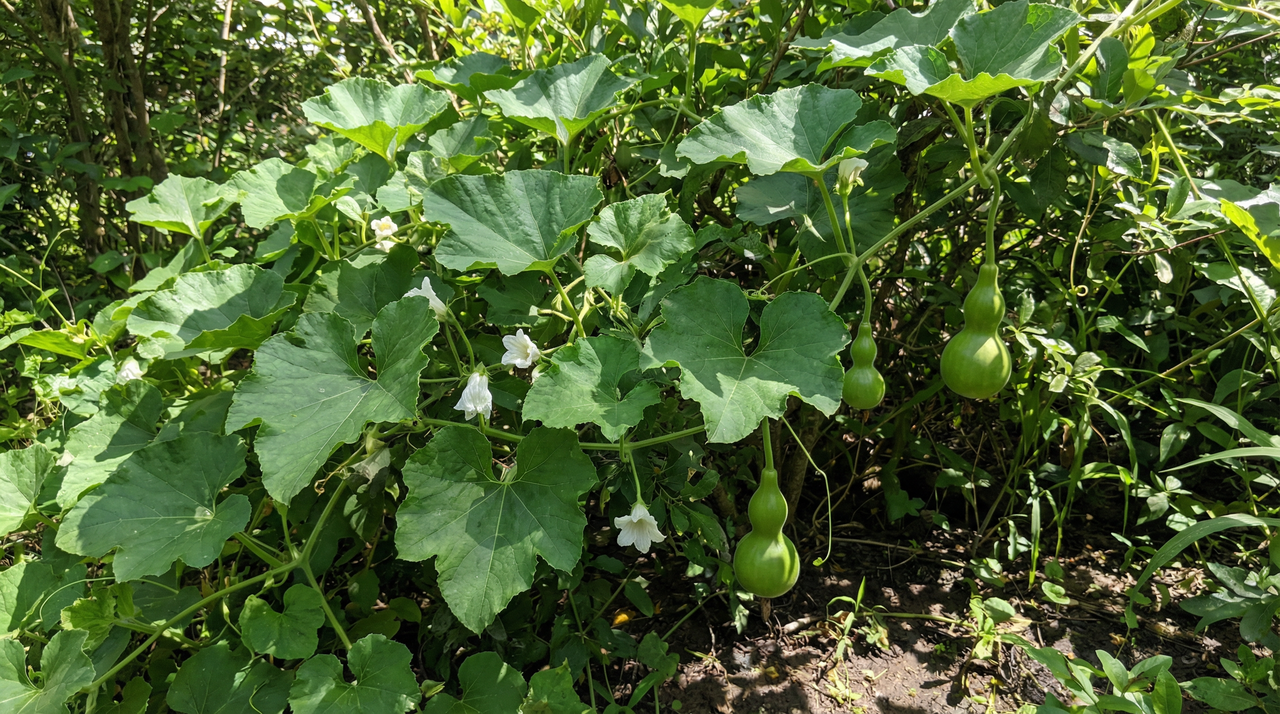
The vining gourd has been traveling with us longer than wheat has been farmed. Archaeobotanists have traced Lagenaria siceraria back 10,000 to 14,000 years in the human record,[1] which means our ancestors were cultivating this vine before they'd figured out pottery. That detail stopped me cold the first time I really sat with it, crouched in my Florida food forest with a gourd the size of my forearm in my hands. Not because the plant is impressive, exactly, but because the reason people kept it around had nothing to do with eating it. It was the container. The shell. A lightweight, durable vessel that could carry water, seed, medicine, or sound across migration routes that predate recorded history.
Most gardeners today grow this vine almost as an afterthought, tucked onto a trellis as a novelty or a conversation piece. They're missing the whole story. This vine has circled the globe, embedded itself in Hindu mythology, West African ceremony, Egyptian medicine, and Native American ritual, and it did all of that before Europeans started drawing maps. The plant you're about to read about isn't a curiosity. It's one of the oldest co-evolutionary relationships between people and a plant that we know of, and it's still, quietly, worth growing.
Origin and History of the Vining Gourd (Lagenaria siceraria)
Many older references and seed catalogs list this plant as Pilogyne lagenaria or seed catalogs, that's an outdated synonym for the accepted scientific name Lagenaria siceraria, commonly known as bottle gourd or calabash.[2][3][4] It sits in the Cucurbitaceae family alongside cucumbers, squash, and melons, so for those wondering about the difference between gourd and squash, or gourd vs squash vs pumpkin: all three share this family, but calabash belongs to a separate genus entirely from the Cucurbita species we call squash and pumpkin. Knowing the correct name matters when you're searching for research, sourcing seed, or just trying to understand what you're growing.
Botanical Background and Taxonomy
The vining gourd is a vigorous annual herbaceous climber that completes its entire life cycle in a single season.[2][5] It's monoecious, carrying separate male and female flowers on the same plant, with large white blooms that open at night. Male flowers typically appear first, around 40 to 50 days after germination.[2] I'll be honest, those night-blooming flowers are a quiet delight in the garden, the kind of thing you notice walking past at dusk when everything else has closed up. The vine itself is vigorous, reaching 10 to 15 meters in a single warm season, hauling itself up trellises and fences with tendrils and large hairy leaves.[6][7] The fruits that follow are strikingly variable: bottle-shaped, dumbbell, spherical, or elongated, typically 6 to 24 inches long, starting dark green and maturing to pale green, yellow, or cream, with a hard waterproof shell once dried.[8]
Native to tropical and subtropical Africa, particularly southern and eastern regions including savannas and riverine areas, Lagenaria siceraria has wild populations still present on the continent today.[2][9] Archaeological and genetic evidence places its domestication in Africa at over 10,000 years ago, making it one of the earliest cultivated plants on record.[9][10]
Traditional and Cultural Uses Across Civilizations
The domestication story is genuinely remarkable. Genetic studies confirm parallel domestication events in Africa and Asia, with carbon-dated seeds from Neolithic sites placing cultivation in India around 10,000 BCE and in China's Yangshao culture around 7,000 BCE.[11] By around 5,000 BCE the calabash had reached the Americas, with remains turning up in Peru, Brazil, and Mexico's Guilá Naquitz cave.[12][13] That's a pre-Columbian global spread driven almost entirely by utility.
Ancient Egyptians documented the bottle gourd as early as 2,500 BCE, using it as containers, buoyancy aids for fishing nets, and funerary objects, with records appearing in the Ebers papyrus around 1,550 BCE.[14][15] Across Asian and African cuisines, young fruits and seeds were eaten in soups, curries, and roasted preparations, while the mature hard-shelled fruits were reserved for craft and container use rather than eating.[16] Traditional medicine systems from Ayurveda to African folk practices to TCM drew on the plant's leaves, fruit pulp, seeds, and root ash to address conditions ranging from digestive disorders and fever to edema and jaundice, though I'd note that these are historical ethnobotanical references, not modern prescriptions.[17][18] My role as a grower is to understand and appreciate that lineage, not to prescribe it.
The dried shell's contribution to human material culture is hard to overstate. West African griots shaped it into talking drums; communities across Africa, Asia, and the Americas used it for bottles, ladles, and ceremonial vessels.[19][20] In Hindu tradition it carries association with Lord Vishnu, representing fertility, purity, and protection; Native American cultures used it as a ceremonial container by around 1,000 BCE.[21] Few plants have embedded themselves so deeply in ritual and daily life across so many unconnected civilizations simultaneously.
Fun Facts and Global Journey
What I find most compelling about this plant's history is how its spread mirrors the behavior of any useful, lightweight, portable thing: people carried it. The calabash traveled Saharan routes into the Americas and rode with Austronesian seafarers into Oceania, driven by the simple fact that a dried gourd is a durable, weightless container that doesn't break.[12] I think about seeds I've passed to neighbors tucked into jacket pockets, and it's not hard to imagine ancient migrations working the same way, just at a continental scale.
This profound evolutionary timeline is directly visible in the striking diversity of modern seed cultivars.[11] Millennia of human selection for specific shapes, sizes, and wall thicknesses means that today's cultivars often look quite different from ancient landraces. That gap between what our ancestors grew and what arrives in a modern seed packet is a good reminder that every time we choose a seed, we're participating in a selection process that's been running for roughly 140 centuries.
Vining Gourd Varieties and Sourcing
Notable Varieties of Bottle Gourd (Lagenaria siceraria)
Knowing the correct botanical name matters when you're hunting down specific cultivars or seed catalogs.[22][2] The first decision every grower should make isn't which cultivar to pick, it's which end use they're after. Culinary varieties are harvested young, around 10 to 15 centimeters (4 to 6 inches), when the flesh is mild, slightly sweet, and genuinely comparable in texture to zucchini or cucumber. I've picked them at that stage straight off the trellis and they have a crisp, watery bite that surprises people who expect something more exotic. Ornamental and craft types are left to mature fully, developing hard, papery shells with an earthy, desiccated scent that signals they're ready for carving, drying, or use as birdhouses and containers.[8]
The bitterness warning deserves a direct statement here: over-mature fruit and ornamental varieties can develop intense cucurbitacin compounds that are unpalatable and potentially toxic raw.[8] I mark my calendar the moment a young culinary gourd appears on the vine because leaving it too long is how that pleasant sweetness turns into something you'd immediately spit out.
Growth habit shapes everything else. Vigorous climbing types like 'Thai Long' and 'H.Y. Giant' can push 10 to 15 meters and are built for high-yield tropical production where vertical space is generous.[23][24] I learned early that 'H.Y. Giant' will swallow a trellis in a single season if you're not watching, so label your vines and give them a structure that's actually up to the task. For smaller spaces or cooler-edge gardens, dwarf types like 'Cornell Bush' stay compact at 1 to 2 meters and are far more manageable. The rich genetic diversity behind all of these traces back to African landrace origins, with regional adaptations developed across Asia for monsoon climates and across the Americas for dry seasons.[25] Choosing heirlooms that carry those adaptations supports the genetic breadth this 10,000-year-old crop has accumulated across cultures and continents.
Sourcing Vining Gourd Seeds and Plants
In the US market, bottle gourd seeds are reliably available from Baker Creek Heirloom Seeds (rareseeds.com), Johnny's Selected Seeds, and Southern Exposure Seed Exchange (southernexposure.com).[26][27][28] Logee's occasionally carries young plants, though stock shifts seasonally, so seeds are the more dependable starting point. I always look for organic certification and detailed germination instructions on the packet; suppliers like these emphasize heirloom seeds specifically to preserve the genetic diversity and reliable germination rates that matter most when you're sourcing an ancient African native.[28]
If you're considering importing seeds from overseas, know the rules before anything arrives at customs. USDA APHIS regulates seed imports to prevent introducing new pests and diseases; small quantities for personal planting can generally come in if they're clean, free of soil, insects, and plant debris. Commercial quantities require an import permit and a phytosanitary certificate.[29][30] Honestly, for most home growers and permaculture designers, the domestic heirloom vendors cover the cultivar range you'll realistically need, and starting with quality seeds from a trusted source is the simplest way to set a vigorous, multifunctional vine up for success.
How to Propagate and Plant Vining Gourd (Bottle Gourd)
When sourcing seeds, ensure you use the accepted botanical name; the accepted scientific name is Lagenaria siceraria, the bottle gourd or calabash.[31][32][33] Knowing the right name matters when you're sourcing seeds, looking up extension resources, or reading research on germination and disease. Everything here applies to that one species, regardless of what the seed packet says.
Taxonomy Note: Pilogyne lagenaria and Lagenaria siceraria
The gourd seeds themselves are worth knowing by sight: flat, oval to elliptical, roughly 10-18 mm long and 6-12 mm wide, pale white to light brown, with a smooth to slightly ridged surface and often a faint marginal wing.[34] Each seed carries a single zygotic embryo, and because L. siceraria is primarily an outcrossing species, seedlings from open-pollinated stock show real genetic variability.[35][36] That variability is mostly fine for kitchen growers, but if you're saving seed to preserve a specific heirloom line, you'll want isolation distances of 400-800 meters or hand pollination to keep things true to type.[35]
Seed Propagation Methods and Germination Timeline
Seed is how most people grow this plant, and for good reason. Under optimal conditions you can expect 80-95% germination success, it's straightforward for any level of grower, and it preserves the genetic diversity that makes each season's crop slightly different and interesting.[37] The catch is that hard seed coat. Scarification (a light nick with a file or sandpaper) or a 24-hour warm water soak softens things up enough for water to penetrate and germination to begin.[37] In my hot Florida summers, I've found the soak alone usually does the job on fresh seed; it's the older gourd seeds I make a point of scarifying too, because the coat toughens with age and skipping that step costs you a week or more of sitting and waiting with nothing to show for it.
Soil temperature is the other non-negotiable. Germination needs consistent warmth above 21°C (70°F), with the sweet spot between 25-29°C (77-85°F); at those temperatures, sprouts typically emerge in 7-10 days.[38][39] Cold soil doesn't just slow germination, it often kills it outright. I've lost early sowings to impatience more than once, putting seeds in the ground while nights were still cool because the calendar said spring. Now I use a soil thermometer and wait. For gardeners in shorter seasons, starting seeds indoors 3-4 weeks before the last frost buys useful time, just be deliberate about hardening off before transplanting.[40] From sowing to harvest, plan for 75-100 days with standard varieties, or as little as 55-70 days with faster-maturing cultivars.[40]
On storage: gourd seeds are orthodox storers, meaning you can dry them to 5-7% moisture, seal them in an airtight container, and keep them in a cool spot for years.[41][42] Lab figures put viability at 5-10 years, up to 15 under ideal cold storage.[43] I've had good results germinating seeds stored cool and dry for four years, so don't toss that leftover packet, just scarify a bit more carefully and test a few before committing to a full bed.
Vegetative Propagation Options
Most home growers never need to go beyond seed, but there are situations where vegetative propagation makes sense. Stem cuttings (4-6 inches from semi-woody stems, treated with IBA rooting hormone) root at 50-70% success in 2-3 weeks under high humidity; air layering pushes that to 60-80% in roughly the same window.[44] The option I find most compelling for serious growers is grafting onto squash rootstocks, which can hit 70-90% success and significantly improves Fusarium resistance in problem soils.[45] Tissue culture also exists for multiplying specific clones, producing 4-6 shoots per explant on MS medium, but that's lab territory rather than backyard practice.[46] For most permaculture gardens, seed is simpler, cheaper, and plenty reliable.
Soil and Site Requirements
In my work with clients, the single most common killer of young bottle gourds I've seen is planting into heavy, poorly drained soil. Fix the drainage first, before you do anything else. Lagenaria siceraria wants well-drained, fertile sandy loam or loamy soil with 2-5% organic matter, a pH of 6.0-7.5 (ideally 6.0-7.0), and at least 12-18 inches of depth for roots to run.[47][48][33] Waterlogged conditions bring wilting, yellowing, stunted growth, and eventually dark, mushy roots and plant collapse.[49] Working in 2-4 inches of compost before planting helps on both drainage and fertility; for containers, a mix of roughly 40% loam, 30% compost, 20% perlite or coarse sand, and 10% coir gives you the right structure.[50]
Site choice comes down to sun. This plant originates from tropical African savannas and riverbanks, and it expects full sun, 6-8 hours minimum.[51] Put it in partial shade and you'll get leggy vines, reduced flowering, and frustratingly low yields.[52] The riverbank origin also explains why it becomes reasonably drought-tolerant once established but cannot tolerate sitting in wet soil early on, a classic fast-draining riparian plant that wants moisture available but never stagnant.
Spacing, Planting Technique, and Initial Care
The vine's reach is the thing most first-time growers underestimate. These plants run 10-30 feet in length, sometimes more in a long tropical season, and they do it fast.[48] If you're letting them trail on the ground, space plants 24-36 inches apart in rows at least 6-8 feet apart.[48][53] Going vertical changes the math: on a trellis, you can pull plants closer together at 18-24 inches, which saves ground space and, critically, improves airflow around the foliage.[6] I think about trellising this vine the way I think about staking indeterminate tomatoes, it's not optional if you care about fruit quality and disease pressure. In humid climates especially, getting fruits off the ground keeps them straighter and cleaner.
Direct sow seeds 1 inch deep once soil temperature is reliably above 21°C after the last frost date.[54][55] Tighter spacing can nudge total yield up, but individual fruits tend to be smaller; wider spacing with good airflow is the better trade-off for both fruit size and fungal disease prevention.[54] Get your trellis or support structure in place at planting time, not two weeks later when the vine is already flopped across the path, and keep soil consistently moist but never soggy from day one.[37][56]
Vining Gourd Care Guide
Lagenaria siceraria is fundamentally a tropical vine, and every care decision follows from that fact. It wants heat, full sun, consistent moisture, and rich soil. Deny any one of those and the plant tells you immediately, usually through symptoms that are easy to read once you know the vocabulary. I find this actually makes it a satisfying plant to manage: the feedback loop is fast and honest.
Sunlight Requirements for Vining Gourd
Vining gourd needs at least 6 to 8 hours of direct sun each day to drive the vine growth, flowering, and fruit set that make it worthwhile.[57][5] Shade it and you get the classic signs of a plant reaching desperately for light: leggy elongated stems, yellowing leaves, and flowers that either don't appear or don't set fruit.[5][58] Too much sun during the first week after transplant is its own problem. I always keep a piece of shade cloth handy for newly set-out seedlings because leaf scorch is a real risk before the roots are established enough to support transpiration at full sun intensity.[59][60] A week of morning sun with afternoon shade, then full exposure, and you've avoided a setback that can cost two weeks of growth.
Water Needs and Irrigation for Vining Gourd
The gourds vine needs consistent moisture, roughly 1 to 2 inches per week, but it punishes waterlogged soil swiftly.[48][61] In my experience, overwatering is the more common beginner mistake, especially in humid climates where rain adds to whatever you're applying manually. Yellowing older leaves and wilting despite wet soil are the giveaways, and they point straight toward Pythium or Fusarium root rot if you don't correct course fast.[61][62] Underwatering shows up differently: wilting during the heat of the day followed by browning leaf margins, then misshapen or aborted fruits at the worst possible moment.[61]
Needs scale with lifecycle stage. Seedlings want frequent, lighter water to keep the surface moist; once vines are running, you shift to deeper, less frequent applications aimed at the 6 to 12 inch root zone to encourage a strong taproot.[23][48] Drip irrigation is worth setting up if you're growing more than a few plants: it delivers water at the root zone, keeps foliage dry, and reduces disease pressure considerably.[48] A 5 cm layer of organic mulch over the root zone ties the whole system together by holding moisture between waterings and moderating soil temperature.
Feeding and Nutrient Management for Vining Gourd
This is a heavy feeder. I run a soil test every season before I plant cucurbits, and with vining gourd especially, that test saves me from guessing at rates that can tip from productive into toxic. Typical nitrogen needs run 80 to 150 kg/ha, split so that roughly half goes in at planting and the rest is side-dressed once vines begin their rapid push; phosphorus around 50 to 80 kg/ha and potassium 60 to 120 kg/ha round out the macronutrient picture.[63][64] Rich compost worked into beds before planting goes a long way toward meeting that demand organically.[48][65]
Iron chlorosis can appear rapidly on young leaves in projects where pH creeps above 7.0 or where soil is naturally high in alkalinity. The leaves yellow between the veins while the veins stay green; it's distinctive once you've seen it once. A foliar iron spray paired with a soil sulfur amendment brought them back within about two weeks in one particularly stubborn situation.[66][64] Keep pH in the 6.0 to 7.5 range to prevent that cascade. Calcium deficiency shows up as blossom-end rot, magnesium as interveinal chlorosis on older leaves, and boron deficiency hurts pollination and fruit set.[66] Over-fertilization is just as readable: tip burn on leaf margins, excessive leafy growth with almost no flowers, and leaves that curl or thicken.[66][48] I've made that nitrogen mistake; a vine so lush and leafy it looked glorious right up until flowering barely happened.
Frost Tolerance and Cold Protection
There is no cold tolerance here. Chilling injury starts at 5 to 10 °C, and anything below 10 °C stops growth outright.[23][67] Actual frost turns tissues water-soaked and then brown or black within hours, hitting young leaves, stems, buds, and any developing fruits first.[68] Wait until two weeks after your last expected frost date before transplanting outdoors. In shoulder seasons, I've used double-layer row covers and cloches to push the window by about three weeks on either end, which can make a real difference in short-summer zones. For most of the US, this plant is treated as a warm-season annual in USDA zones 3 through 11, with no hope of overwintering below zone 9 without protection.[69][70]
Heat Tolerance and Management Strategies
Optimal daytime temperatures sit between 25 and 30 °C, with nights ideally staying 18 to 24 °C.[48][71] Brief spikes to 38 or even 42 °C are survivable with adequate moisture, but sustained heat above 32 to 35 °C causes real damage: flower drop, pollen sterility, and fruit that either aborts or sunscalds.[48][72] Flowering is the most vulnerable stage, which is something I compare to summer squash, where I see the same pollen viability crash during July heat domes in Central Florida. Watching a vine covered in buds drop them all during a heat event is genuinely demoralizing.
The practical response is layered. A 30 to 50 percent shade cloth can bring canopy temperature down 3 to 5 °C.[73][74] Morning and evening drip irrigation aimed at maintaining soil field capacity around 60 to 70 percent, combined with deep organic mulch, keeps root zone temperatures stable.[75] Good airflow through trellising helps too, which connects directly to why training and pruning matter beyond just managing vine size.
Pruning, Training, and Seasonal Maintenance
I once let a vining gourd run almost completely untrained through a late summer garden bed, and by August it was a tangled mass of overlapping stems with barely any light penetrating to the interior. Powdery mildew moved in fast. The lesson I've stuck with since is the 2 to 3 main vine rule: select your strongest shoots early and remove excessive side growth before it becomes a management problem.[48] After fruit sets, prune side shoots back to 2 to 3 leaves beyond the fruit, and thin developing fruits to 2 to 3 per vine if you want size over quantity.[48] Morning is the best time for this work when vines are turgid and cuts heal cleanly.
A sturdy trellis of 6 to 8 feet is non-negotiable for plants that can reach 15 feet of vine length.[48][52] Getting heavy fruits off the ground prevents rot and pest pressure, and if a fruit swells too large for the stem to support, fabric slings made from old netting work perfectly. In zones 10 to 12 where the plant can behave as a short-lived perennial, I cut vines back hard in late summer to encourage a second fruiting flush before nights cool and growth slows.[76]
Seasonal Rhythm and Lifecycle
Expect germination in 7 to 10 days in warm soil, first flowers around 40 to 50 days after sowing, and fruit ready for most uses at 55 to 70 days, with a full cycle from seed to mature hard-shelled gourd running 75 to 100 days.[77][48] In USDA zones 3 through 9, that calendar is dictated entirely by frost dates: start indoors 3 to 4 weeks before last frost, transplant after the soil has warmed, and plan to finish before the first fall frost ends the season.[78] In truly frost-free zones 10 to 12, the plant can persist through multiple fruiting cycles as a short-lived perennial given optimal gourd care, though most growers still treat it as a warm-season crop and replant fresh for the most vigorous production.[77] Your climate makes the decision: if you have frost, work backward from your dates; if you don't, manage for continuous production and watch for the natural slowdown as vines age past their first heavy flush.
When and How to Harvest Vining Gourd
The vining gourd might be one of the few plants in my garden where the harvest goal completely changes the timeline. Are you feeding your family tonight, or are you building a birdhouse for next spring? Those two outcomes require picking the same fruit at opposite ends of its development, and confusing them is the most common mistake I see with this crop.
Timing and Maturity Cues
For the kitchen, you want young fruits at 12 to 18 inches long, harvested roughly 50 to 70 days after planting and just 15 to 25 days after pollination.[79][48] The University of Florida IFAS guidance on bottle gourd harvest time holds up well in my Central Florida garden, though I've learned to trust the thumbnail test over the calendar. Press your nail gently into the skin; it should give without much resistance. Hot summer weeks can push fruit size faster than expected, so a gourd that looks undersized might already be right at the sweet spot.
For crafts, containers, or seed saving, the calculus flips entirely. Leave the fruit on the vine until 100 to 120 days in. You're looking for a stem that's dried and brown, a rind that won't dent no matter how hard you press, and a fruit that feels surprisingly light for its size because the interior has dried down.[79][48] Pull those before any hard frost hits, even in warmer zones where frost is rare.
Harvest Technique and Post-Harvest Care
Cut with a sharp knife or pruners and leave a few inches of stem attached; that stem stub helps the fruit hold together and slows moisture loss.[79][48] Young culinary fruits go straight to the kitchen. Mature ones headed for craft use need 2 to 4 weeks of curing in a warm, dry spot to finish hardening before you do anything with them. The soft young gourds nick easily if you're careless, so I handle them gently; the mature ones are practically wooden and can take more abuse.
Flavor, Yield, and Quality Factors
Pick young and you get mild, watery flesh with a faint cucumber-like sweetness, closer to zucchini than anything assertive.[80][81] Wait too long and the texture turns bland and fibrous; wait even longer and cucurbitacins can make the fruit outright bitter and unsuitable for eating.[80] I learned that lesson the hard way one summer when I left a few fruits on the vine to see what happened. The answer was compost. The fresh aroma on a properly timed harvest is delicate and green, with roasting able to pull out earthy, slightly nutty notes.[82][83] Cultivar matters too; Asian varieties like Dudhi and Pusa Summer Prolific Long tend toward sweeter, less bitter flesh, and fruits from humid, tropical conditions are generally more tender than those grown under water stress.[84][85]
A healthy, well-tended vine can yield 10 to 20 fruits per season, and vertical trellising can push yields up 20 to 30 percent over ground trailing.[48] In my humid Central Florida summers, getting the gourds off the ground on gourd racks or trellises also prevents the soft-skinned young fruits from sitting in moisture and rotting before you ever get to harvest them, so the yield benefit and the practical benefit arrive together.
Vining Gourd Preparation and Uses
Confirming you have the correct botanical species is the first step in unlocking this vine's culinary potential.[2] Every preparation method below applies to the same plant, whatever name it's wearing on your seed packet.
Culinary Uses and Preparation of Young Vining Gourd
The immature fruit is the real culinary prize here, and the safety rule is simple: taste a small raw sliver before you commit the whole gourd to your pot. If there's any bitterness, compost it. I learned this the uncomfortable way years ago with a fruit I thought was just "a little past peak." It wasn't fine. Bitter cucurbitacin content is the reason mature fruits are never eaten as food, and thorough cooking is non-negotiable for everything else.[2][86]
Once you've confirmed a mild, non-bitter fruit, the cooking is genuinely easy. Peel if the skin feels tough, scoop out the seeds, and cook by whatever method suits your dish: boiling, steaming, stir-frying, or simmering directly in a curry.[86][80] The flavor is mild and watery, somewhere between zucchini and cucumber, which means it soaks up whatever you cook it in. In my Central Florida kitchen it goes straight into coconut milk curries with mustard seed and curry leaf, and it's excellent with lentils, ginger, and garlic the way you'd see it in Indian lauki sabzi.[87]
The rest of the plant is edible too, and that's part of what I love about growing it. Young leaves and tender shoots cook down like spinach; they're slightly mucilaginous and carry around 3-4 g of protein per 100 g, though older leaves turn bitter, so harvest young.[86] Male flowers are mild and delicate, excellent battered for tempura or tossed raw into salads; I harvest mine early morning before the bees get there.[86] Mature seeds, once the fruit is fully dried, can be roasted, boiled, or ground into flour and contain up to 30% protein along with zinc and iron, though eat them in modest amounts since the fiber content is real.[86][88]
Traditional Medicinal Preparations
The same plant parts that feed you have a long ethnobotanical record as medicine. Fruits have traditionally been used for digestive and diuretic support, leaves for jaundice and skin conditions, and seeds for anti-inflammatory applications.[89] The dosage ranges that appear consistently in the Ayurvedic literature I've consulted are 50-100 ml of fresh fruit juice daily for diuretic use, 20-30 ml of leaf decoction, and 1-3 g of seed powder for anti-inflammatory purposes.[90][91] That cooling, diuretic reputation tracks with what I observe growing it: the fruit is mostly water, which probably explains quite a bit. That said, any fruit used medicinally still needs to pass the bitterness test, and these preparations should complement professional medical care, not replace it.
Non-Food and Craft Uses of Mature Vining Gourd
Let a few fruits go fully mature and you're holding something humans have found useful for at least ten thousand years. The dried shell is hard, waterproof, lightweight, and slightly porous, which is why it became containers, bowls, ladles, fishing floats, birdhouses, lanterns, and musical instruments across cultures on nearly every continent.[92][2] Every year I cure a handful for use as garden scoops and seed-starting pots, and there is something deeply satisfying about a tool you grew yourself.
To get there: cure freshly harvested mature gourds at 68-77°F (20-25°C) with good humidity for about a week, then move them somewhere cool, dry, and well-ventilated, around 50-59°F (10-15°C), to finish drying.[93] The process takes patience. Beyond the shells, the vine itself pulls its weight in a permaculture system: the vigorous growth suppresses weeds, the cut biomass makes excellent mulch or green manure, and stems have been used for fiber, dried material for fuel, and plant extracts as dye.[94] Few plants earn their space quite so thoroughly from root to rind.
Vining Gourd Health Benefits
When tracking down the nutritional and medicinal data for this plant, ensure you are searching its accepted scientific name. The accepted name is Lagenaria siceraria, the bottle gourd or calabash, and that distinction matters when you're searching the research literature. Once you're looking at the right species, the nutritional and pharmacological picture becomes genuinely interesting, though it comes with a safety caveat I'll insist on before we're done.
Nutritional Profile of Bottle Gourd
Bottle gourd is 96% water with only 14 calories per 100g raw.[95][96] That extraordinary hydration is its headline trait, and it's why I reach for it constantly in my Central Florida garden during August, when the humidity is brutal and you want food that cools you down rather than weighing you down. At 3.39g carbohydrates, 0.62g protein, 0.5g fiber, and 150mg potassium per 100g, it's not a nutritional powerhouse in the way moringa or sweet potatoes are, but it contributes 10mg of vitamin C (about 11% of your daily value) along with meaningful amounts of calcium (26mg) and magnesium (13mg).[95][96] Modest numbers, yes, but in a low-calorie vegetable that practically grows itself on a trellis, they add up over a season of regular eating.
How you cook it changes what you actually absorb. Boiling can strip 30 to 50% of that vitamin C through leaching, while steaming holds onto it much better.[97] I usually add young cubed gourd to soups and stir-fries near the end of cooking rather than simmering it from the start. Beyond the basic vitamin and mineral profile, the fruit also contains flavonoids, phenolic acids, β-carotene, and cucurbitacins, compounds that carry antioxidant and anti-inflammatory activity well beyond what the basic nutrition label captures.[98]
Key Phytochemicals in Lagenaria siceraria
The bioactive compounds in Lagenaria siceraria read like a who's who of plant chemistry. Key bioactive groups include: cucurbitacins (specifically types B, D, E, and I); flavonoids like quercetin, kaempferol, apigenin, and luteolin; phenolic acids such as chlorogenic and ferulic acid; and oleanane-type saponins—these and are responsible for most of the pharmacological effects reported in the literature.[99][100][101] Cucurbitacins are the bitter-tasting tetracyclic triterpenoids that give the plant its traditional medicinal reputation and, simultaneously, its most serious safety concern.
The specific plant tissue where these active compounds concentrate matters enormously for anyone growing or eating this gourd. Seeds and immature fruit rinds carry the highest cucurbitacin and triterpene loads, and concentrations climb with maturity and stress.[102][103][104] I think of it the way I think about bolted lettuce or drought-stressed basil: push a plant beyond its comfort zone and it produces more intense secondary metabolites, sometimes in ways you don't want. On the positive side, flavonoid and phenolic levels peak during summer rainy seasons in nutrient-rich soil, which means a well-tended plant in good conditions delivers more antioxidant activity than a stressed one.[105][106] Traditionally, healers across Asia and Africa have used the fruits, leaves, and seeds to address diabetes, hypertension, and digestive complaints, drawing on exactly these compounds for their ecological role in herbivore defense and pathogen resistance.[107][108]
Medicinal Research and Traditional Uses
The preclinical research on bottle gourd is genuinely wide-ranging. Lab and animal studies have demonstrated anti-inflammatory activity (inhibition of TNF-α, IL-6, and COX enzymes), antioxidant effects measured by DPPH and FRAP assays, antimicrobial action against E. coli and S. aureus, antidiabetic potential via α-glucosidase and α-amylase inhibition, hepatoprotective and cardioprotective properties, analgesic effects roughly comparable to aspirin, and even apoptosis induction in cancer cells attributed to cucurbitacins.[109][110][111][112][113] Traditional systems in Ayurveda and across African medicine have long used this plant for digestive relief, skin conditions, urinary disorders, fever, and respiratory support.[15][114]
Robust human clinical trials are largely absent, with limited clinical evidence existing only for glycemic and gastrointestinal applications. I keep bottle gourd in the kitchen vegetable rotation rather than the medicine cabinet until human studies catch up. The traditional reputation is real and the preclinical data is promising, but that's a different thing from demonstrated efficacy in people. Enjoy it as food first.
Safety Considerations and Toxicity Risks
This is where I get firm with everyone who grows or eats this plant: if a bottle gourd tastes bitter, stop eating it immediately and throw the whole fruit away. Cucurbitacins are the toxic culprit, and ingesting them can cause nausea, vomiting, severe abdominal pain, diarrhea, gastrointestinal bleeding, hypotension, and in documented cases, shock, multi-organ failure, or death, with symptoms appearing within hours of consumption.[115][116][117] Livestock suffer the same acute gastroenteritis.[118] Early in my gardening I made the mistake of using a slightly bitter fruit, assuming cooking would mellow it. The resulting stomach upset was a lesson I haven't repeated.
The good news is that cucurbitacin accumulation is largely driven by environmental stress rather than being an inherent trait of all fruits. Drought, heat, poor soil, and irregular watering push levels up.[119][120][121] Grow in well-drained loamy soil (pH 6.0 to 7.5), keep moisture consistent, and harvest young fruits in the 4 to 6 inch range. I instruct every helper in my garden to taste a raw sliver from every single fruit before it goes into the harvest basket. No exceptions. That habit takes five seconds and it's the most important safety practice for this plant.
Foragers should know that wild look-alikes including mock cucumber (Echinocystis lobata) and bur cucumber (Sicyos angulatus) also contain cucurbitacins and should be avoided entirely.[122][123] Some people also experience contact dermatitis or urticaria from raw fruit, and those with latex-fruit syndrome may face cross-reactivity.[122] For pregnant clients, I recommend enjoying moderate amounts of young, sweet bottle gourd as a vegetable while skipping concentrated juices or supplements unless a doctor specifically approves, given potential emmenagogue effects and the diuretic properties that can interact with blood pressure medications.[124][125] Properly grown, harvested young, and tasted before use, this is a safe and genuinely useful vegetable. The bitterness signal is your protection; trust it every time.
Vining Gourd Pests and Diseases
Understanding the correct scientific name ensures you can access accurate agricultural extension data on pests and resistance for the vining gourd discussed here.[126][127] Same plant, same problems, same solutions.
Natural Defenses of Vining Gourd
Before cataloging what can go wrong, I think it's worth appreciating how much this vine does to protect itself. Vining gourd produces cucurbitacins that deter many chewing insects, carries glandular trichomes on its leaves and stems that trap small invaders or release sticky exudates, and emits herbivore-triggered volatile organic compounds that recruit predatory insects and parasitoids to do the dirty work.[128][129][130] The vine is calling in allies. That's a good starting posture.
Common Pests and Management
Squash bugs (Anasa tristis) are the pest I respect most in a Central Florida garden. They feed on plant sap and can take down a young vine through wilting and yellowing before you realize what's happening.[131][132] I've learned to patrol at dusk, when they congregate on the undersides of young leaves and their distinctive odor when disturbed makes them easy to locate. Hand-picking eggs and adults early is genuinely effective.
Cucumber beetles (both spotted and striped species) concern me even more because of their role as disease vectors; bacterial wilt arrives on their mouthparts.[132][133] Because these beetles transmit bacterial wilt so efficiently, I treat even a few sightings as a signal to deploy row covers immediately rather than waiting for visible damage. Aphids, spider mites, root-knot nematodes, and melon fruit fly are moderate threats; the thick rind and cucurbitacin content actually limit fruit fly damage somewhat, though aphids and mites can still transmit viruses under hot, dry stress.[134][135][136]
Disease Susceptibility and Resistance
Vining gourd shows low to moderate resistance to most major diseases, and how much trouble you get depends heavily on which cultivar you're growing.[137][138] The primary disease roster includes powdery mildew, downy mildew, Fusarium wilt (to which most cultivars are highly susceptible), bacterial wilt spread by those cucumber beetles, anthracnose in humid post-harvest conditions, and mosaic viruses including ZYMV and CMV.[139][140] The good news is that breeding programs have made real progress. I've grown several Pusa-series cultivars side by side through Central Florida summers and noticed noticeably less powdery mildew on Pusa Naveen than on unimproved lines. Pusa Summer Prolific Long, Arka Bahar, and Pusa Sandesh all show improved resistance profiles worth seeking out.[141][142]
Integrated Pest and Disease Management
The same layered approach I use for cucumbers and melons works well here. Cultural practices come first: two to three year crop rotation, proper spacing for airflow, drip irrigation instead of overhead watering, and prompt removal of infected debris keep most problems from escalating.[143][144] Temperatures between 70 and 95°F with humidity below 60% and consistent drainage favor the plant over most pathogens.[145] From there I layer in biological controls, planting flowers that attract predatory insects before pest pressure builds. Mechanical options like reflective mulch and row covers handle cucumber beetles reliably. Insecticidal soap, neem, or spinosad only come out when all of that has failed.[146][147] A well-sited, well-spaced vine with a resistant cultivar underneath it rarely needs more than that.
Vining Gourd in Permaculture Design
Before placing any plant in a design, I want to know what it actually does in an ecosystem versus what growers assume it does. Vining gourd sits in an interesting middle ground: it's genuinely useful, but some of the permaculture hype around cucurbits doesn't quite land on this species. Let me sort through what's real.
Climate Zones and Growing Conditions
Understanding the precise taxonomy of the vining gourd is critical for establishing reliable climate baselines.[2][77] That taxonomic clarity matters in permaculture design because it points you toward the right climate literature. This is an African-origin tropical vine with a clear comfort zone: Aw, BSh, and Cwa climate classifications, meaning tropical savannas, hot semi-arid regions, and humid subtropicals with dry winters.[148][149] In the United States, it's reliably cultivated in Florida, Texas, California, and Georgia, all places with the long frost-free windows it demands.[150]
The numbers behind those regions tell the design story. Optimal temperatures run 24 to 30°C (75 to 86°F), with growth slowing above 35°C and frost damage beginning below 10°C (50°F).[151][152][153] In native habitats and USDA zones 10 through 12, it can behave as a short-lived perennial through mild winters; everywhere else, treat it as a frost-sensitive annual.[154][155] I'm in Central Florida (zone 9b), and my vining gourds thrive as warm-season annuals through our long humid summers, though I stay alert during July and August heat spikes above 38°C and watch for the occasional rare freeze that would wipe out an unprotected planting.[48]
Rainfall requirements fall in the 600 to 1,000 mm range, with the plant tolerating a minimum of around 500 mm once established; it's susceptible to waterlogging, so drainage matters as much as volume.[156][157] Relative humidity between 60 and 80 percent supports vigorous growth and fruit set, though it manages around 50 percent with some attention.[158] Full sun is non-negotiable; shade leads to poor pollination and weak fruit set on a vine that otherwise matures in 60 to 90 days.[58][159] That sun requirement is the first placement constraint: in a food forest, this vine belongs where the canopy doesn't close in on it.
Ecosystem Functions and Guild Roles
In its native habitats, wild Lagenaria siceraria contributes to habitat complexity by climbing, attracting pollinators, adding organic matter, and providing erosion control on slopes.[160][10] A 2015 Journal of Arid Environments study supports the erosion-control function, and the dense canopy of sprawling vine growth serves as highly productive living mulch on banks and slopes. But the real standout, the thing that makes me keep reaching for this plant in guild design, is the pollinator relationship.
The flowers are large, white, trumpet-shaped, and they open at night or very early morning with a mild scent that specifically summons specialist squash bees in the genera Peponapis and Xenoglossa, which are more efficient cucurbit pollinators than honey bees.[161][162][163] I've stood in my Central Florida plantings at dawn watching squash bees work these blossoms with an intensity that makes honey bees look casual by comparison. Bumble bees, sweat bees, and moths round out the secondary pollinator list, which means even in gardens without an established squash bee population, you're still supporting pollinator diversity.[163] Pollination peaks at 25 to 30°C and 60 to 80 percent humidity; heavy rain, extreme heat, pesticide use, and monoculture all reduce success, which is another reason polyculture planting matters here.[164][73] When summer rains keep the bees away for days at a time, I hand-pollinate with a small brush in the early morning; it takes five minutes per plant and guarantees the fruits I'm growing for both kitchen use and craft projects.
One thing I want to be honest about: vining gourd is monoecious, with separate male and female flowers on the same plant, and it is not a nitrogen fixer.[165] Early on I made the mistake of expecting it to enrich my soil the way legumes do. It doesn't. It's a moderate to heavy feeder, typical of cucurbits, and any guild design that relies on it to build fertility will fall short. Knowing that upfront changes how you plan the companion planting around it.
Forest Layer Placement and Companion Strategies
Vining gourd belongs in the climber or vertical layer of a food forest, full stop.[166][167] Its root system is extensive but shallow and genuinely sensitive to disturbance, so it can't compete with established trees at ground level.[168] I think of it the way I think about passionfruit: a vigorous tropical climber that needs strong vertical support and a full-sun position, but is far more frost-tender, so I site it on the south-facing side of a fence, trellis, or arbor where it won't get swallowed by a closing canopy. Growing over a sturdy structure also keeps the large fruits off the ground, which reduces rot and pest pressure.
For gourd companion plants, beans are the obvious first choice. Pairing with pole beans creates a vertical guild where the legume fixes nitrogen that feeds the heavy-feeding gourd, and both share the same trellis infrastructure.[169][170] It's a subtropical spin on the three-sisters logic, and it works well because the bean's nitrogen contribution partially offsets what the gourd pulls from the soil. Once the season winds down, the accumulated vine biomass becomes useful mulch, and the dense canopy during the growing season suppresses weeds effectively without any additional effort from me.
The traditional utility of mature dried shells as containers, instruments, and utensils gives this plant a second-harvest dimension that few climbers can match.[171][24] I'd hedge any claims about it functioning as green manure; the evidence for that specific role in Lagenaria siceraria is thin. What I can say with confidence from my own designs is that it earns its place through vertical biomass production, genuine pollinator support, and a harvest that yields both food and lasting craft material from the same vigorous vine.
The Vine That Reminded Me Why I Started All This
I still have the first gourd I ever dried on a trellis in my back garden; it's sitting on a shelf in my potting shed right now, light as paper, smooth where I've handled it a hundred times. Something about holding an object that people ten thousand years ago also held, grown from the same kind of seed, stops me cold every time. That's what this plant does. It feeds you, shelters creatures, and then, if you let it, hands you something that outlasts the season.
Sources 171
- Erickson et al. 2005 – An Asian origin for a 10,000-year-old domesticated plant in the Americas, PNAS ↩
- Lagenaria siceraria - Wikipedia ↩
- Bottle Gourd - Kew Science Plants of the World Online ↩
- Synonyms of Lagenaria siceraria - World Flora Online ↩
- Bottle Gourd - Missouri Botanical Garden ↩
- Lagenaria siceraria - Missouri Botanical Garden ↩
- Bottle Gourd - Lagenaria siceraria - North Carolina Extension Gardener Plant Toolbox ↩
- University of Florida IFAS Extension - Lagenaria siceraria (Bottle Gourd) ↩
- Bottle Gourd: Origin, Distribution, and Domestication - ScienceDirect ↩
- Ecological Role of Wild Cucurbits in African Ecosystems - Kew Royal Botanic Gardens ↩
- Historical and economic botany of Lagenaria siceraria ↩
- The bottle gourd: Naturalized African history and global migration ↩
- The Domestication of Lagenaria siceraria: Evidence from Africa, Asia, and the Americas ↩
- Royal Botanic Gardens, Kew: Plants of the World Online ↩
- Lagenaria siceraria - Traditional Uses and Pharmacological Profile ↩
- Ethnobotany of Lagenaria siceraria: Cultural and Medicinal Perspectives ↩
- Traditional Uses and Pharmacological Potential of Lagenaria siceraria ↩
- Ethnobotanical uses of Lagenaria siceraria in India ↩
- Symbolic Uses of Bottle Gourd in Hindu Rituals ↩
- Calabash and Gourd in African Traditions ↩
- Cultural Significance of Gourds in Folklore ↩
- Synonymy of Cucurbitaceae Names ↩
- Varieties and Growth Habits of Bottle Gourd ↩
- Bottle Gourd (Lagenaria siceraria) - Horticulture Overview ↩
- Genetic Diversity and Landraces of Lagenaria siceraria ↩
- Bottle Gourd Seeds ↩
- Calabash Gourd Seeds ↩
- Bottle Gourd ↩
- Importation of Fruits and Vegetables ↩
- Bringing Agricultural Products Into the United States ↩
- Lagenaria siceraria ↩
- Bottle Gourd: Lagenaria siceraria Fact Sheet ↩
- Lagenaria siceraria (Bottle Gourd) ↩
- Seed Morphology of Lagenaria siceraria ↩
- Breeding and Seed Production in Bottle Gourd (Lagenaria siceraria) ↩
- Genetic Variability and Heritability in Bottle Gourd Seedlings ↩
- Bottle Gourd (Lagenaria siceraria) - Propagation and Care ↩
- Bottle Gourd Growing Guide ↩
- Propagation Techniques for Cucurbitaceae Family ↩
- Starting Gourds Indoors ↩
- Seed Storage Guidelines - Royal Horticultural Society ↩
- Seed Storage of Horticultural Crops ↩
- FAO Seed Storage Guidelines ↩
- Vegetative Propagation in Gourds: A Review ↩
- Grafting Techniques for Cucurbitaceous Vegetables ↩
- Micropropagation of Lagenaria siceraria ↩
- Bottle Gourd Cultivation Guide ↩
- Bottle Gourd Production Guide ↩
- Root Rot in Bottle Gourd: Symptoms and Management ↩
- Soil Management for Vegetables: Cucurbits ↩
- Bottle Gourd - Kew Royal Botanic Gardens ↩
- How to grow bottle gourd ↩
- Growing Bottle Gourd - Penn State Extension ↩
- Bottle Gourd Production ↩
- University of Florida IFAS Extension: Bottle Gourd Production ↩
- Bottle Gourd: Cultivation and Uses ↩
- Bottle Gourd Cultivation Guide ↩
- Bottle Gourd (Calabash) - Cultural Guide ↩
- Bottle Gourd Care: Sunlight Requirements ↩
- Lagenaria siceraria: Cultivation Tips ↩
- Missouri Botanical Garden Plant Finder - Bottle Gourd ↩
- Cucurbit Diseases Associated with Wet Soil Conditions ↩
- Cucurbit Crop Production - University of Florida IFAS Extension ↩
- Nutrient Management in Bottle Gourd ↩
- Nutrient Management for Gourds - Cornell University Gardening Resources ↩
- Nutrient Disorders of Vegetable Crops: Cucurbits ↩
- Cold Hardiness of Cucurbits - USDA Plant Hardiness Zone Map ↩
- Frost Injury on Plants - University of Minnesota Extension ↩
- Cucurbit Crop Production - Frost Management - Cornell University ↩
- Bottle Gourd Growing Guide ↩
- Heat Stress Effects on Cucurbit Crops ↩
- Response of Bottle Gourd to High Temperature Stress During Flowering ↩
- Heat Stress Management in Vegetable Crops ↩
- Shade Net Effects on Cucurbit Yield Under Heat Stress ↩
- Management Strategies for Heat and Drought Stress in Cucurbits ↩
- Trellising and Pruning Vining Vegetables ↩
- USDA PLANTS Database ↩
- Growing Cucurbits ↩
- Bottle Gourd Production ↩
- Edible Parts of Bottle Gourd - Purdue University Horticulture ↩
- Lagenaria siceraria (Bottle Gourd) - Missouri Botanical Garden ↩
- Royal Horticultural Society (RHS) Plants ↩
- Kew Gardens Plant Science: Lagenaria siceraria Fact Sheet ↩
- Bottle Gourd Production and Varieties ↩
- Culinary Uses of Bottle Gourd in Asia ↩
- Edible Parts of Bottle Gourd - Useful Tropical Plants Database ↩
- Culinary Uses of Bottle Gourd - BBC Good Food ↩
- Nutritional Composition of Bottle Gourd Seeds - Research Article ↩
- Phytochemical and Pharmacological Profile of Lagenaria siceraria: A Review ↩
- Medicinal Potential of Lagenaria siceraria ↩
- Ayurvedic Uses and Dosage of Bottle Gourd ↩
- The Bottle Gourd: An Ancient Crop with a World of Uses ↩
- Postharvest Handling of Bottle Gourd ↩
- Bottle Gourd Uses in Traditional Medicine - NCBI ↩
- USDA FoodData Central - Bottle gourd, raw ↩
- USDA FoodData Central - Gourd, white-flowered (calabash), raw ↩
- Effects of Cooking on Vitamin C in Vegetables - FAO Report ↩
- Phytochemical and Pharmacological Importance of Lagenaria siceraria (Roxb.) Standl. ↩
- Phytochemical Review of Lagenaria siceraria - PubMed ↩
- Cucurbitacins from Lagenaria siceraria Seeds: Isolation and Bioactivity ↩
- Flavonoids in Bottle Gourd Seeds: Quercetin and Kaempferol Content ↩
- Phytochemical Investigation of Lagenaria siceraria Fruits ↩
- Cucurbitacins in Bottle Gourd: Biosynthesis and Localization ↩
- Phytochemical Profiling of Lagenaria siceraria Fruits: Influence of Growth Stages ↩
- Seasonal Variation in Phenolics of Bottle Gourd (Lagenaria siceraria) ↩
- Environmental Factors Affecting Secondary Metabolites in Cucurbitaceae ↩
- Ethnopharmacological Survey of Lagenaria siceraria in Traditional Medicine ↩
- Secondary Metabolites in Lagenaria siceraria: Phytochemical and Pharmacological Perspectives ↩
- Anti-inflammatory and Antioxidant Properties of Bottle Gourd ↩
- Pharmacological Activities of Lagenaria siceraria: A Review ↩
- Antidiabetic Potential of Lagenaria siceraria Fruits ↩
- Analgesic and Diuretic Effects of Lagenaria siceraria ↩
- Cucurbitacin B from Lagenaria siceraria Induces Apoptosis in Cancer Cells ↩
- Medicinal Properties of Bottle Gourd (Lagenaria siceraria) ↩
- Bottle Gourd Poisoning: A Case Report ↩
- Bottle Gourd (Lagenaria siceraria) Juice Poisoning ↩
- Food Safety Alert: Bitter Bottle Gourd ↩
- Toxicity of Bottle Gourd to Animals ↩
- Safe Handling of Bottle Gourd - University of Florida IFAS Extension ↩
- Toxicity of Lagenaria siceraria - Journal of Ethnopharmacology ↩
- Environmental Stress and Cucurbitacin Accumulation in Cucurbits ↩
- Allergic Reactions to Bottle Gourd (Lagenaria siceraria) ↩
- Wild Cucumber - Echinocystis lobata ↩
- Lagenaria siceraria: Nutritional and Medicinal Uses ↩
- Safety and Contraindications of Herbal Remedies: Focus on Lagenaria siceraria ↩
- Lagenaria siceraria - Kew Science Plants of the World Online ↩
- Synonyms of Lagenaria siceraria - The Plant List ↩
- Cucurbitacin Content and Insect Resistance in Bottle Gourd ↩
- Trichomes and Chemical Defenses in Cucurbitaceae ↩
- Volatile Organic Compounds in Plant-Insect Interactions ↩
- Anasa tristis (Squash Bug) | Michigan State University Extension ↩
- Bottle Gourd - Planting Guide | UF/IFAS ↩
- Cucumber Beetle Management | Texas A&M AgriLife Extension ↩
- Aphis gossypii (Cotton Aphid) | UC IPM ↩
- Spider Mites | UC IPM ↩
- Pest Management in Bottle Gourd - ICAR ↩
- Cucurbit Breeding Program - University of Delaware ↩
- PlantVillage ↩
- Bottle Gourd Diseases and Management ↩
- UC Integrated Pest Management ↩
- ICAR - Indian Agricultural Research Institute: Bottle Gourd Varieties ↩
- Journal of Horticultural Science: Resistant Cultivars of Lagenaria siceraria ↩
- UC IPM - Cucurbits ↩
- Cucurbit Disease Management - Cornell University Extension ↩
- Bottle Gourd Production Guide - Purdue University Extension ↩
- UF IFAS Extension: Cucurbit Insect Management ↩
- NC State University Extension: Cucurbit Pest Management Resources ↩
- Climate zone classification and elevation range ↩
- Natural habitat descriptions ↩
- US cultivation regions and climatic requirements ↩
- Temperature requirements for growth and germination ↩
- Frost sensitivity and high-temperature tolerance ↩
- Bottle Gourd Growing Guide - University of Florida IFAS Extension ↩
- Missouri Botanical Garden - Lagenaria siceraria ↩
- Growing Bottle Gourds ↩
- Precipitation requirements and tolerance ranges ↩
- Water needs during establishment and mature phases ↩
- Humidity preferences and tolerance ↩
- Lagenaria siceraria - Missouri Botanical Garden ↩
- Native Habitats and Biodiversity Contributions of Lagenaria siceraria - Journal of Arid Environments ↩
- Missouri Botanical Garden Plant Finder ↩
- Squash Bees and Cucurbit Pollination ↩
- Floral Biology of Lagenaria siceraria - ResearchGate ↩
- Environmental Factors Affecting Fruit Set in Lagenaria siceraria ↩
- Floral Biology of Cucurbitaceae ↩
- Cultivation Guide for Tropical Vines ↩
- Vertical Gardening Techniques ↩
- Root Architecture of Climbing Plants ↩
- Companion Planting Strategies ↩
- Role of Vines in Agroecosystems ↩
- Ethnobotanical Uses of Gourds ↩