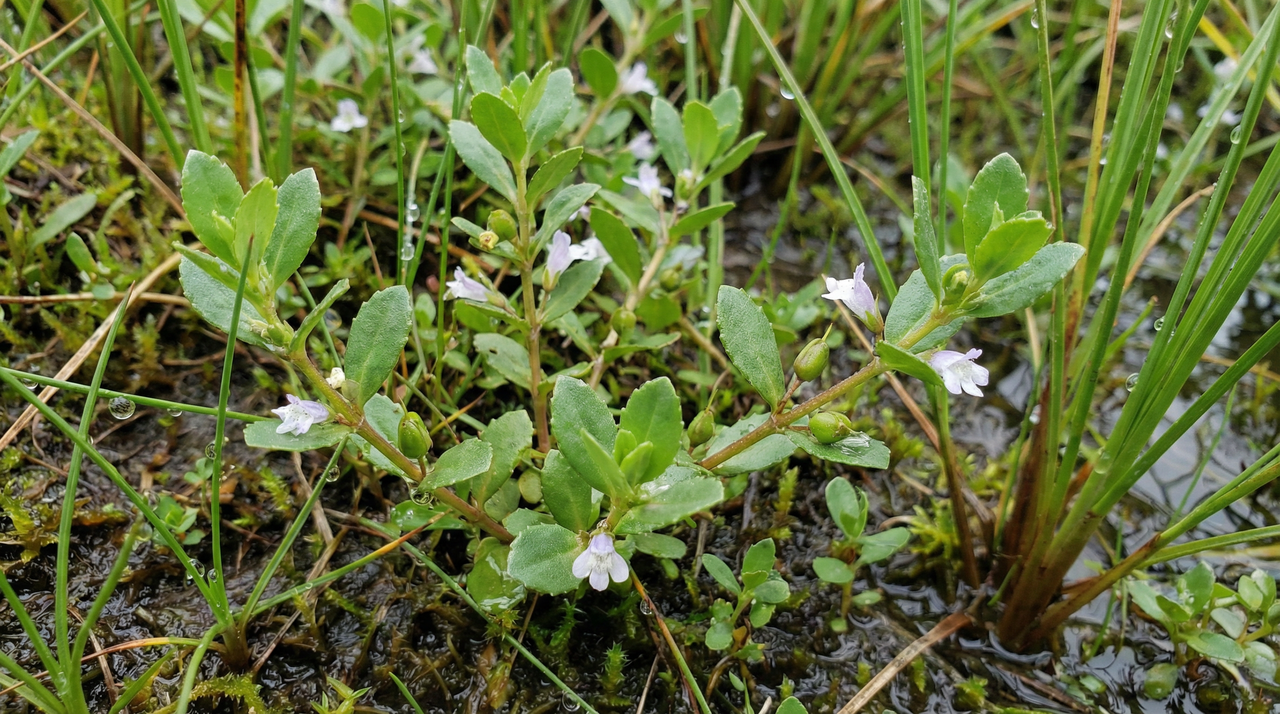
Nobody told me it was a brain tonic. The first time I encountered waterhyssop, I was crouched at the edge of a rain garden in Central Florida, puzzling over a low, succulent-looking creeper that had colonized the wet margin almost overnight. Tiny white flowers, bright green leaves, stems threading through the mud like it owned the place. I pulled a leaf and chewed it. Bitter, herby, a little strange. I filed it away as "interesting wetland volunteer" and moved on. It took me an embarrassingly long time to realize I'd been casually snacking on one of Ayurveda's most revered cognitive tonics, a plant that Sanskrit scholars had been prescribing for memory and concentration for over 3,000 years.[1]
Here's where it gets confusing, and I want to get this out of the way early: you'll find this plant listed as Monnieria semiserrata in older references, but that name is now recognized as a synonym for Bacopa monnieri, the same plant widely sold as Brahmi. Same species, different label depending on which century your source was printed. Once I sorted that out, a whole body of research suddenly clicked into place, and what looked like a humble mud-crawler started looking a lot more remarkable.
Origin and History of Waterhyssop (Monnieria semiserrata)
Botanical Background and Taxonomy
If you've ever ordered this plant from an older catalog under the name Monnieria semiserrata and received something labeled Bacopa monnieri, you weren't cheated. They're the same plant. Monnieria semiserrata is now recognized as an accepted synonym of Bacopa monnieri (L.) Wettst., a semi-aquatic perennial herb in the family Plantaginaceae native to wetlands across tropical and subtropical Asia, Africa, and the Americas.[2][3] Early on, this caused me real confusion at nurseries where tags still bore the older name. I've learned to cross-check with POWO and the USDA database before assuming I'm looking at something new.
Its native range is remarkably broad: southeastern North America from Texas east to Florida and north to North Carolina, plus tropical regions across Asia, Australia, and parts of Africa and South America.[4][3] What threads all those places together is water. This is a plant that belongs at the edge of things, where soil and stream meet. It creeps low, rarely exceeding 20 cm in height and spreading up to 50 cm across,[5] and it reproduces both by stolons and seed, returning year after year in warm climates without any fuss from the gardener. That perennial persistence in wetland zones is exactly why it has colonized so much of the planet quietly and completely.
Visual Characteristics and Aquatic Adaptations
The stems of water hyssop are succulent, glabrous, and procumbent, typically 5 to 15 cm long and 1 to 3 mm in diameter, ranging from greenish to brownish and rooting freely at the lower nodes.[6] The leaves are small, rounded to ovate with partially serrated margins and a noticeably reduced cuticle that facilitates gas exchange.[6] Flowers appear singly in leaf axils, white to pale violet or pale blue, tubular to bell-shaped, and only 5 to 8 mm long, blooming from summer into early autumn.[7] They're tiny, but bees find them reliably.
What I find genuinely fascinating about this plant is how dramatically it shifts its own form depending on conditions. Leaf area can expand two to three times when submerged compared to terrestrial growth, and leaves grown in deeper water during wet seasons tend to be broader and fleshier.[8] I've watched this firsthand in my wetland-style beds: stems kept in 10 to 15 cm of water produce noticeably larger, more succulent leaves than the same plant trailing across moist soil nearby. That phenotypic plasticity is a survival strategy, not inconsistency. Underneath it all, the root system is fibrous with adventitious roots at the stem nodes, and the stems contain aerenchyma, spongy air-space tissue that provides buoyancy and ferries oxygen down to submerged roots.[9] It's a beautifully engineered wetland plant.
Traditional and Cultural Significance
While I grow waterhyssop primarily for its ecological services, I always harvest a few stems with real respect for the tradition behind this plant. Records of its medicinal use trace back to ancient Indian texts from 1500 to 1000 BCE, including the Atharvaveda and the Charaka Samhita, where it was prescribed as a Medhya Rasayana, a brain tonic for cognitive enhancement, memory, anxiety, and longevity.[10][1] That's over 3,000 years of intentional cultivation and use by people who understood something important about this unassuming creeper.
In Ayurveda, the plant carries the name Brahmi, linking it to Lord Brahma and to rituals intended to sharpen memory and invite spiritual clarity.[1] Traditional Chinese medicine adopted it too, under the name Huang Jin She, for neurological support.[11] Across South and Southeast Asia, healers prepared it as juice, powder, decoction, and ghrita (a clarified butter infusion) to treat asthma, fever, skin diseases, and wounds.[12] Modern research has since validated its neuroprotective and anti-inflammatory properties,[13] a rare continuity between ancient observation and laboratory confirmation.
Fun Facts About Waterhyssop
Water hyssop forms dense mats across freshwater marshes, pond edges, slow streams, and riverbanks, and those mats do real ecological work. The plant absorbs excess nitrogen and phosphorus from the water column, reducing eutrophication and improving water quality in ways that benefit amphibians, aquatic insects, and small fish sheltering beneath its cover.[14] I include it in guild plantings around small ponds and bioswales in humid subtropical settings, and the reduction in algae is noticeable. It's essentially a living biofilter that also happens to be beautiful.
Reproduction is equally clever. Beyond spreading by stolon and vegetative fragmentation, water hyssop also reproduces sexually via insect pollination, and its seeds carry specialized appendages that may help them travel by water current or hitch rides on aquatic animals.[15] That dispersal strategy, combined with its IUCN Least Concern status and tolerance for elevations from sea level up to roughly 1,000 meters,[16] explains how a plant that looks this delicate has quietly spread across the wetlands of the world. Close observation rewards you: no two patches look quite the same, and that's the whole point.
Waterhyssop Varieties and Where to Buy
Physical Characteristics and Notable Forms of Waterhyssop
If you've spent any time searching for this plant online, you've probably encountered both Bacopa monnieri and Monnieria semiserrata on nursery tags and supplier listings. They're the same plant.[17][18][19] Be aware of both names when sourcing your plant. What you're looking for in either case is a low mat-former with trailing stems that can reach about two feet long and plants that top out somewhere between four and twelve inches tall.[17][20] The foliage is the giveaway: thick, bright green, and genuinely succulent-feeling, with small white to pale blue flowers that carry faint purple veining.[17][20] Once you've handled the leaves, you'll recognize that fleshiness immediately. It's noticeably different from the thinner, more paper-like leaves on ornamental relatives.
There are no named medicinal cultivars of water hyssop itself.[21] What you find in the trade is essentially the straight species, which suits me fine since consistency of chemistry matters more than flower color when you're growing this for harvest. The closely related Bacopa caroliniana does have ornamental selections like 'Coloratus' and 'Double Pink,'[21] but those are a different plant. In warm climates, the medicinal species can be harvested year-round,[20][21] and it holds up remarkably well to heat and humidity. I've found the leaves stay tender and flavorful even through Central Florida midsummers, which says a lot about how well-adapted it is to the conditions it prefers. Pest pressure tends to be minimal when the plant is happy in wet soil with good light.[20][18]
Sourcing Waterhyssop Plants and Seeds
Finding true Bacopa monnieri takes a bit of homework. Availability is limited mostly to specialty nurseries, aquatic plant suppliers, and medicinal herb vendors[22][23] rather than big-box garden centers, so plan accordingly. Buce Plant, Aquario Gardens, Strictly Medicinal Seeds, Mountain Valley Growers, and Prairie Moon Nursery are all reputable starting points, and Etsy has dependable sellers too if you vet them carefully.[24][25][26] Small bundles and potted plants typically run $5 to $15, with larger specimens closer to $18 and seed packets in the $3 to $7 range.
The mislabeling issue is real. I've received shipments labeled as Bacopa monnieri that turned out to be the more upright Bacopa caroliniana, which is a perfectly nice blue bacopa water plant but not what I ordered. Now I ask suppliers for photos of the actual stock before purchasing from any marketplace. Look for that trailing, mat-forming habit and the unmistakably fleshy, bright-green leaves. Organic certification is worth seeking out, especially for medicinal use, since it signals cultivated rather than wild-collected stock and reduces pesticide risk. I consistently prefer medicinal and native-plant nurseries for exactly that reason; their stock comes from propagated plants, which takes wild-collection pressure off native wetland populations entirely.
Waterhyssop Propagation and Planting
Taxonomy and Plant Overview
When looking for propagation guidance on waterhyssop, you will find the most robust information under its accepted botanical name, Bacopa monnieri, the widely studied water hyssop.[27][3] Every practical growing guide, every university extension resource, every aquatic nursery is going to use the Bacopa name, and all of it applies here. The plant itself is a creeping perennial that forms dense mats across shallow water, marshes, ditches, and pond edges throughout tropical and subtropical regions, with obligate wetland status that tells you everything about what it needs underfoot: consistently wet, poorly drained soil, always.[3][28] That wetland identity shapes every decision from propagation method to spacing, so keep it in mind as we go.
Propagation Methods for Waterhyssop
Stem cuttings are the method I reach for every time. Take 4- to 6-inch tips from healthy, actively growing stems in spring or summer, strip the lower leaves, and push them into a moist perlite-sand or peat-perlite mix. Roots form in two to four weeks at 70 to 75°F with humidity around 70 to 80% and bright indirect light.[29][30] A simple humidity dome over the tray brings success rates close to 100% in my experience. I've found that cuttings taken in late spring from the newest growth root more uniformly than older, woodier stems, and plants started this way show more consistent leaf thickness and aroma than seedling-grown plants, which matters if medicinal quality is your goal.
If you have an established clump, division is even simpler. Pull apart rooted sections during repotting and replant them directly; no special treatment needed, and the genetics are identical to the parent.[30] Grafting isn't worth attempting; success rates run below 20% on this herbaceous aquatic, and there's simply no practical reason to try when cuttings work so reliably.[31]
Seed propagation is biologically fascinating but slower and less predictable. The seeds are tiny (0.3 to 1 mm), polyembryonic, and exhibit physiological dormancy that can require scarification or gibberellic acid to overcome. Fresh seeds germinate at 50 to 80% under optimal conditions, but that rate drops significantly after the first year.[32][8][33] I use waterhyssop seeds mainly for experimentation or when I need to fill a large restoration area; for a kitchen garden or medicinal bed, cuttings are faster and give you true-to-type plants with no guesswork.
Germination Timeline and Seed Handling
Sow seeds after the last frost once soil temperatures reach at least 60°F, pressing them onto the surface of a moist mix without covering them since they need light to germinate.[34][29] At 70 to 85°F with consistent moisture, germination typically happens in 14 to 21 days; a thin film of water (1 to 5 cm) over the surface mimics the natural seedbed and works well.[29][35] Seedlings are ready to transplant four to six weeks later, once they have two to three true leaves. I always label my flats clearly because those early seedlings are easy to confuse with other wetland volunteers. One helpful identification clue: the first true leaves look like miniature versions of the mature succulent foliage, slightly fleshy and bright green, which is reassuring once you know what to look for. If you're storing seed between seasons, keep it cool (4 to 10°C), dry (below 30% humidity), and sealed with a desiccant; viability can hold for one to five years under those conditions.[36]
Soil, Site Selection, and Planting Technique
This plant wants wet feet, but it doesn't want suffocating, compacted muck with no air movement. The sweet spot is a clay-loam, loam, or organically rich mucky soil with 2 to 5% organic matter, a pH between 6.0 and 7.0, and enough structure that roots can breathe despite constant saturation.[37] Push pH above 7.5 and you'll see chlorosis from iron and phosphorus lockout fairly quickly.[38] For containers, I use a 50/30/20 blend of peat, perlite, and loam with drainage holes; in my early attempts with straight garden soil the roots rotted even though the plant was sitting in a tray of water, which taught me that aeration and saturation aren't opposites here, they both have to coexist.[34] The plant can also root directly into 2 to 6 inches of water at a pond margin if the substrate holds it in place.
For light, aim for four to six hours of direct sun. That's enough for robust growth and flower production without the leaf scorch that shows up in hot climates with full afternoon exposure.[39][40] In my Central Florida experience, afternoon shade in July and August is a genuine kindness to the plant.
Spacing and Establishment
Mature plants spread 12 to 24 inches wide and stay 6 to 12 inches tall, forming solid ground-covering mats.[41] For garden beds or medicinal production, space plants 12 to 18 inches apart; if you're planting in rows, 6 to 12 inches within the row and 12 to 18 inches between rows gives good airflow while still allowing stolons to knit together over a season.[42] I tend toward the wider end of that range in humid summers because the foliage stays drier and fungal pressure drops noticeably. The mat-forming habit means any gaps close quickly without your help, so there's no need to crowd plants at establishment just to get coverage fast. Good airflow from the start is the practical insurance policy against the fungal issues that come with growing a moisture-loving plant in a warm, humid climate.
Waterhyssop Care Guide: Growing Monnieria semiserrata
Every care decision you make with water hyssop circles back to one non-negotiable fact: this is a classified wetland plant, native to marshes, swamps, and shallow freshwater edges across the tropics and subtropics.[43][44] Treat it like a typical garden perennial and it will tell you, quickly and dramatically, that you're wrong.
Water Requirements for Waterhyssop
Waterhyssop wants consistently moist to saturated soil, or shallow standing water up to six inches deep.[45][46] Drought tolerance is genuinely low; it can survive about two weeks of dryness by going dormant, but prolonged stress means wilting and stunted growth.[47] After growing this plant in both bog gardens and aquarium setups, I've found that checking that top inch of soil is the single most reliable way to stay ahead of the sudden summer wilts that catch new growers off guard. In warm climates, water every two to three days; in hot, dry stretches, daily is not overkill.[48] In aquatic settings, aim for two to four inches of standing water. Yellow leaves and mushy stems mean you've overwatered the container or blocked drainage; browning tips and drooping signal the opposite.[47] The plant prefers loamy or sandy soils rich in organic matter, with a pH between 6.0 and 7.5.[45]
Sunlight Needs and Light Management
Full sun drives the most vigorous growth and the best flowering, but in warm climates that same full sun can scorch leaves and collapse the plant without relief.[45] I learned this the hard way one summer when I positioned a new planting in an unshaded south-facing bed and watched it go pale and leggy within three weeks. Afternoon shade or a part-shade position is usually the smarter call in zones 9 and above. Too little light creates its own problems: yellowing leaves, stretched stems, smaller foliage, and almost no flowers.[49] For indoor or aquarium-grown plants, full-spectrum grow lights at 2,000 to 3,000 lux will keep the mats compact and healthy.[50]
Feeding and Nutrient Requirements
The bacopa garden plant is a moderate feeder. Nitrogen drives leafy stem growth, phosphorus supports roots and flowering, and potassium helps with water balance and disease resistance.[29] In aquatic setups, iron becomes especially important; without it, high-pH water causes interveinal chlorosis fast.[51] For soil-grown plants, a slow-release balanced fertilizer (10-10-10) applied at half strength every four to six weeks through the growing season works well; in water features, use liquid fertilizer or root tabs diluted to 200 to 300 ppm and resist the urge to push more.[29][52] Excess nutrients feed algae, not the plant. In the humid summers I garden through, I've had far better results with fish emulsion or compost tea than with granular fertilizers; less tip burn, and my water features stay cleaner.[3] This plant is sensitive to salt buildup, so if you're seeing crispy leaf margins, salinity is often the culprit before disease.[53]
Heat and Frost Tolerance
The bacopa plant zone sweet spot is 68 to 86°F (20 to 30°C).[41] Above 95°F you'll see wilting, scorching, and yellowing, and unlike tougher terrestrial herbs, waterhyssop recovers poorly from heat stress unless the substrate stays continuously wet.[54] Seedlings are most vulnerable. Partial shade and unwavering soil moisture are the combination that gets it through hot spells. On the cold end, frost damage begins at 32°F and the plant is not reliably hardy below 20°F (-6°C).[55] It's a perennial in USDA zones 8 through 11 and behaves as an annual anywhere colder.[56][57] In my zone 9B garden, most winters are mild enough that I don't worry, but I keep frost cloth handy for the occasional dip into the low 20s. If a hard freeze is forecast, bring containers indoors or apply heavy mulch and row cover over in-ground plantings.[58]
Pruning, Maintenance, and Seasonal Rhythm
Waterhyssop experiences active growth from spring through summer, with flowering peaking in summer and potentially continuing year-round in tropical climates.[59] Below 50°F growth stalls noticeably, so maintenance rhythms shift with the season.[57] During the growing season, trim leggy stems back by one-third every four to six weeks; this keeps the mat dense rather than sprawling and promotes fresh flowering growth.[60] I pinch mine back hard in early spring and the result, within a few weeks, is the tightest, most productive mat of the whole year. Remove spent flowers and dead material as you go. Every other spring I divide the clumps, and I've found the fresh divisions root almost instantly when dropped into shallow water, turning one mat into several within weeks. Dividing every two to three years keeps older clumps from getting woody and waterlogged at the center.[61] Going into winter, avoid heavy pruning before a cold snap; leave a bit of vegetative buffer to protect the crown until the worst has passed.
Waterhyssop Harvesting Guide
Patience is the real skill with water hyssop. The plant rewards growers who wait for the right developmental window rather than pulling leaves because it looks ready. In my Central Florida garden, I start spring-planted bacopa in late February or March, which puts the first harvest right at the edge of summer's humidity surge. That timing isn't accidental.
When to Harvest Waterhyssop: Timing and Growth Cues
Expect to wait 90 to 120 days from sowing before taking your first cut, with full maturity arriving somewhere in that 12 to 16 week window under warm, consistently moist conditions.[29][29] In U.S. gardens, that generally lands harvest season somewhere between July and October.[3] The two cues I trust most are plant height (15 to 20 cm is the target) and the presence of flower buds forming but not yet open. When the stems are carrying those fat little buds and the leaves have reached about 1.5 to 2.5 inches long, that's your window.[55]
Clip stems 1 to 2 inches above soil level with clean scissors, and do it early morning, between 4 and 8 AM on a dry day.[55] I've noticed the leaves taste noticeably less sharp before the day's heat builds, which matters given how bitter this herb can get at maturity. Preserving the crown ensures the perennial mat rebounds for additional harvests through the season.
Waterhyssop Flavor Profile, Aroma, and Yield
Go in with honest expectations: this is a predominantly bitter, astringent herb with earthy, slightly pungent qualities.[12][62] The milder, slightly sweet notes that occasionally show up in research reflect a narrow window in young fresh leaves. In my experience, plants harvested right at that 15 to 20 cm mark consistently show more of that herbaceous, almost minty side before bitterness takes over with age. Miss that window and the astringency climbs fast.
Fresh leaves carry subtle linalool-driven aromatics with faint lemon and mint, but drying concentrates everything into something more pungent and medicinal.[63][64][65] Texturally, the raw leaves are tender and succulent,[12][66] but I treat this as a medicinal herb first. I've found it works best blended with milder greens in salads or dried for tea rather than eaten on its own. Coastal-grown plants can carry a noticeably saltier edge, so flavor does vary with site conditions. Don't expect a salad green; expect a serious, functional herb.
Waterhyssop Preparation and Uses
When researching waterhyssop preparation, you will mostly find it documented under its accepted botanical name, Bacopa monnieri,[17][3][32] and nearly everything written about its culinary and medicinal applications uses that more familiar name. Once you sort that out, a genuinely useful plant emerges from your pond edge.
Culinary Uses and Flavor Profile
The edible parts are the leaves and tender young stems; flowers are occasionally eaten but it's the shoots that matter most in the kitchen. Young leaves and tender shoots can go into salads raw, get cooked down into soups, or find their way into stir-fries and curries.[12] I've found that harvesting in early morning, before the heat builds, gives leaves that are noticeably less sharp on the palate when eaten raw; balanced against peppery arugula or mild watercress, that bitterness becomes interesting rather than off-putting.
The raw flavor is bitter and slightly pungent, but cooking mellows it considerably and brings out a warmer, herbal aroma.[65][12] Traditional culinary use is concentrated in Ayurvedic and Southeast Asian contexts, where the plant appears as a potherb, a salad green, or a curry ingredient in small quantities rather than a dietary staple.[12][67] On the Ryukyu Islands of Okinawa, where it's called gachi raa, the succulent leaves are eaten as a leafy vegetable.[67] The texture reminds me of a milder purslane; if you've foraged wetland greens before, you'll orient quickly.
Medicinal Preparations and Traditional Forms
The same leaves and aerial parts that go into the soup pot have a much longer history in the apothecary. Traditional forms include decoctions, infusions, tinctures, powders, and standardized extract capsules, and Ayurvedic and Siddha practice often incorporates the plant with ghee or water to aid absorption.[68][69] Standardized extracts for adults typically run 300-450 mg twice daily, delivering 150-300 mg of bacosides per day; traditional dried-plant infusions and decoctions generally use 2-5 grams of material.[69][70] I find that 300 mg standardized extracts twice daily maps reasonably onto those traditional dried-plant doses I prepare for tea at home; just make sure you're sourcing correctly identified material, because several toxic look-alikes favor the same wetland edges.
Post-harvest handling matters more than people expect. Harvest gently, rinse immediately in clean water, and air-dry in shade at temperatures below 40°C; I monitor mine with a simple thermometer in the drying shed, and the difference in color and aroma compared to higher-heat drying is obvious.[71] Once dry, airtight containers in a cool, dark spot below 25°C with humidity control will protect potency and prevent mold. Commercial 'Brahmi' cultivars bred for higher bacoside content are worth seeking out if medicinal use is your primary goal.
Non-Food and Ornamental Applications
For many gardeners, water hyssop earns its place long before it ever reaches the kitchen or the drying rack. It's cultivated globally as an ornamental aquatic in water gardens and aquariums,[72][73] where its bright-green mat and tiny white flowers offer genuine aesthetic value alongside the ecological work it does stabilizing edges and filtering water. If you're designing around a pond and you're not ready to commit to regular harvesting, this plant still pulls its weight. That's the kind of low-maintenance multifunctionality that makes it worth growing even for gardeners who never brew a single cup of tea from it.
Waterhyssop Health Benefits
Modern clinical research on waterhyssop's health benefits focuses almost entirely on the accepted botanical name Bacopa monnieri, the Brahmi of Ayurvedic tradition.[74][75] That matters because virtually every clinical trial, pharmacological study, and safety review you'll encounter was published under the Bacopa monnieri name. When I talk about water hyssop's health benefits, I'm drawing on that research body directly.
Medicinal Research and Traditional Uses
Ayurvedic practitioners have used this plant for over 3,000 years as a cognitive tonic, memory enhancer, and nervine, with additional traditional roles as a diuretic, expectorant, and anxiolytic.[76][77] Modern pharmacology has validated the cognitive and adaptogenic core of that tradition pretty convincingly. The primary active compounds, bacosides A and B, modulate acetylcholine, serotonin, dopamine, and GABA pathways; inhibit acetylcholinesterase; and reduce cortisol under stress conditions.[78][79][80] That combination of neurotransmitter support and cortisol modulation is what earns it the "adaptogen" label, and it's not an exaggeration.
The antioxidant and anti-inflammatory mechanisms are equally well-documented. Water hyssop scavenges free radicals, upregulates endogenous enzymes like SOD and catalase via the Nrf2 pathway, and suppresses inflammatory mediators including TNF-α, IL-6, NF-κB, and COX-2.[81][82] Growing and harvesting my own plants for tea, I've found the calming, clarifying effect genuinely repeatable -- nothing dramatic, but consistent enough that it matches what the adaptogenic studies describe. Preliminary in vitro evidence also suggests antimicrobial and antispasmodic activity, though these aren't strongly backed by clinical data yet, so I don't lead with them.[77][83] Related species like Bacopa caroliniana share a similar antioxidant and anti-inflammatory phytochemical profile, but the clinical evidence there is far thinner.[84]
Key Phytochemicals in Waterhyssop
Bacosides A and B are triterpenoid saponins concentrated at up to 12% in the leaves, and they're responsible for most of what makes this plant medicinally interesting.[78][85] Supporting cast includes alkaloids like brahmine and herpestine, plus flavonoids (apigenin, luteolin, quercetin) and additional phenolics.[86] Those flavonoids and phenolics aren't just passengers; they contribute antioxidant capacity and serve as chemical defenses in the plant's wetland environment, where bacterial and fungal pressure is constant.[87] Leaves consistently carry higher concentrations of these secondary metabolites than stems or roots do,[86] which is why harvest technique matters if you're using this medicinally. Most studies were conducted under the Bacopa monnieri name, but the phytochemical profile converges regardless of which label appears on the specimen.
Nutritional Profile
As a food, water hyssop is more comparable to watercress than to a calorie-dense vegetable. Fresh leaves run approximately 20-30 kcal per 100g with 85-90% water content, modest carbohydrates mostly from fiber, around 2-3g protein, and trace fat.[12] Mineral content is genuinely respectable, with fresh leaves providing roughly 300-400mg potassium, 100-200mg calcium, and up to 5mg iron per 100g, alongside vitamin C, trace beta-carotene, and folate, though boiling reduces vitamin C by 20-40%.[88][89] I'd treat all these figures as approximations drawn from aquatic plant studies rather than standardized food data, since waterhyssop is absent from USDA FoodData Central entirely.[90] Think of it as a nutrient-dense supplement to a meal, not a dietary staple.
Safety Considerations and Dosage
If you're foraging rather than growing your own, get your identification right first. Water hyssop has convincing look-alikes including Hydrocotyle umbellata and Ludwigia hexapetala, which have different safety profiles entirely.[91] In my experience designing Florida pond margins, the surest tells are the small, paired, sessile leaves with subtle venation and the plant's distinctly succulent, mat-forming habit at the water's edge.
The safety record on waterhyssop is solid within reasonable therapeutic doses. Centuries of Ayurvedic use are backed by a rat LD50 above 2000 mg/kg, and the most common side effects -- nausea, cramps, dry mouth, mild sedation -- are dose-dependent and usually resolve when you start lower.[92][93] Standard dosing for standardized extract (50-55% bacosides) is 300-450mg daily in two or three divided doses, though I always recommend starting at the lower end.[94]
The contraindications deserve direct attention. If you're pregnant, breastfeeding, or under 18, skip medicinal doses. If you take thyroid medication or blood thinners, talk with your doctor before using this plant therapeutically -- the research on thyroid hormone suppression and potential anticoagulant interactions is clear enough that I don't treat it casually.[93][95] It can also add to sedation from CNS depressants. One more thing: this plant bioaccumulates heavy metals from contaminated water.[96] I always source my harvest from clean, well-managed beds rather than roadside ditches or urban waterways, and that's not just about flavor -- leaves from clean sites taste noticeably less bitter and carry far lower contamination risk than wild-collected material.
Waterhyssop Pests and Diseases
Before anything else, a caution: the common name "waterhyssop" floats across at least two distinct botanical lineages. Sources variously treat the plant as Bacopa monnieri (Plantaginaceae), its older synonym Monnieria semiserrata, or Brachyscome multifida (Asteraceae), and some list them as interchangeable.[97][98][99] That matters here because Asteraceae and Plantaginaceae plants have genuinely different disease vulnerabilities. Read everything below with that caveat in mind.
Disease Challenges and Management
Water hyssop lands in the moderate-susceptibility category rather than the high-risk one, but that status shifts fast under poor drainage, overwatering, or stagnant humid air.[100][1] I learned this the hard way early in my pond-margin work, losing several plantings to root rot before I accepted that "water-loving" does not mean "tolerates waterlogged, airless roots." Now I amend even aquatic edge plantings with coarse grit or perlite, and I've stopped losing plants to Pythium, Phytophthora, and Fusarium, which are the dominant fungal killers in this genus.[1][101]
Fungal leaf spot from Alternaria and Cercospora is the second threat worth watching, especially when leaves stay wet overnight.[101][102] If your plant turns out to be the Asteraceae form (Brachyscome), add rust (Puccinia spp.) and powdery mildew to that list, along with crown rot in heavy soils.[103][104] Bacterial and viral problems are rare and barely worth tracking in home settings.[100][1] The bacosides in Bacopa-type plants appear to confer some antimicrobial activity, and cultivars like Aphrodite, Snowflake, and Olympia show noticeably better disease tolerance than wild-type material.[1][105] In humid Florida summers I always start with Aphrodite or Snowflake; the extra vigor means fewer flare-ups when the air sits heavy. Prevention is straightforward: sharp drainage, good airflow, and avoiding overhead irrigation will handle most of it.[106][107]
Pest Pressures and Natural Defenses
Aphids, whiteflies, spider mites, and thrips are the main insect pressures, and aphids specifically can reduce growth by up to 30 percent in warm greenhouse conditions where populations build fast.[108][109] The plant fights back harder than its delicate appearance suggests. Run your fingers gently across healthy foliage and you'll notice a slight tackiness; that's the glandular trichomes doing their job, physically trapping small insects while the bacosides in the tissue deliver insecticidal and repellent chemistry at the same time.[12][110][111] Its semi-aquatic habitat also limits access by many terrestrial pests, and plant extracts show moderate repellent effects against thrips specifically.[112][12] Compared to the mints and basils I grow alongside it in wet-edge guilds, the Bacopa usually rebounds from an aphid wave more quickly once I open up the canopy above it.
For management, cultivars like Snowtopia and Aphrodite carry improved vigor and relative pest resistance.[108][113] In my pond plantings I never use systemic insecticides; instead I release ladybugs early in the season and rely on the predatory wasps that seem drawn to the plant's chemistry. Neem oil and insecticidal soap work as targeted spot treatments when pressure gets heavy.[114][115] Broad-spectrum sprays near any water feature are simply off the table; the fish matter too, and the plant's own defenses are usually enough to bridge the gap.
Waterhyssop in Permaculture Design
Before placing any plant in a design, I want to know exactly what I'm working with, and waterhyssop is well-documented in restoration contexts under its accepted name, Bacopa monnieri,[116][117][118] so if you see either name on a plant tag or in a restoration plant list, you're looking at the same species. Once that's settled, you can start seeing it for what it really is: one of the most quietly productive ground-layer plants I've put into a wet-zone design.
Ecosystem Services and Wetland Functions
I've installed this plant around pond margins and rain-garden edges at multiple sites across Central Florida, and the transformation it drives is visible within a single growing season. The dense creeping mats anchor bare mud almost immediately,[119][120] and within a few months clients start asking me why their water looks clearer. The answer is phytoaccumulation: water hyssop actively pulls excess nitrogen and phosphorus from the water column and accumulates heavy metals, functioning as a living biofilter in constructed wetlands and nutrient-loaded sites.[121][119] When clients have lawn-runoff problems draining toward a water feature, I pair it with pickerelweed knowing the two together pull measurable nitrogen and phosphorus; I first saw the numbers in the literature, and now I watch it happen in my own installations.
The pollinator piece surprises a lot of people because the flowers are small, just 1 to 1.5 cm wide, pale white to soft purple. But bees, butterflies, and hoverflies work them consistently.[17] I think of it the way I think about native frogfruit (Phyla nodiflora), another plant I grow: tiny flowers, enormous insect traffic. Both belong together at the wet edge of a food forest guild for exactly that reason. The plant also provides structural habitat for aquatic insects, amphibians, and birds within its mats,[119][120] which makes every square foot of coverage a small ecosystem rather than just a ground treatment.
In disturbed south Florida wetlands I have personally seen water hyssop outcompete smaller natives, spreading aggressively where the ecology is already stressed.[3][122] That's why in any restoration or naturalized planting I use submerged planters to contain root spread, and I edge it against deeper water where it can't easily creep into adjacent native zones. Removing flowering stems before seed set is a simple habit that prevents most spread problems.[122][123] Treat it as a managed asset and it's enormously useful; ignore it in the wrong site and you'll spend years pulling it back.
Forest Layer Placement and Guild Roles
In a food forest with a wet edge, an aquatic plant like bacopa belongs at the ground layer, full stop. Mature plants reach only 10 to 30 cm tall,[124][125] creeping outward rather than upward, knitting the saturated margin into a continuous living mulch. Think of it as the subtropical analog of creeping charlie or native frogfruit in a moist-edge guild: it stabilizes soil, suppresses weed pressure in the mud zone, and feeds the insects that pollinate everything around it.
Its shade tolerance is moderate, surviving under 50 to 70 percent canopy cover,[125] which means it can function under the dappled light of a willow or elderberry canopy. That said, I've noticed a real difference in mat density and vigor when the plants get at least four to six hours of direct sun daily. If I'm designing a pond guild and the canopy is heavy on the south side, I place water hyssop on the north-facing open edge where it gets the light it wants. The moderate shade tolerance makes it useful; full sun makes it excellent.
Climate and Hardiness Zones
This is a subtropical wetland native with a clear preference for warm, humid conditions: think 40 to 60-plus inches of annual rainfall, temperatures between 20 and 30°C (68 to 86°F) for peak growth, and the kind of year-round warmth found across southeastern North America, South Asia, and tropical Australia.[3][42][17] As a perennial, it's best suited to USDA zones 9 through 11; in zone 8 it can survive with protection, but prolonged exposure below 10°C (50°F) can kill it outright, and any frost will brown the mats fast.[108][42]
I learned the frost lesson the hard way. Even a short overnight dip below freezing in Central Florida, the kind of event we dismiss as a minor cold snap, can turn a lush mat brown by morning. Now I keep a few plants potted up to overwinter on a sunny windowsill. They're not pretty through February, but they're alive, and come March I have strong cuttings ready to go back into the rain gardens. In zone 8 or colder, treat it as an annual or commit to that indoor overwintering routine. It's worth it in the right design context. On the question of invasiveness: it's not federally listed as invasive in the United States,[3][122] but local regulations vary, and any aquatic planting warrants a check with your county extension office before you put it in the ground near open water.
The Plant That Made Me Stop Rushing Past My Pond Edge
I used to walk right past the waterhyssop without really seeing it, just a low green mat doing its quiet work at the water's edge. Then one afternoon I crouched down to check a cutting and noticed how the leaves had shifted shape entirely since I'd planted them, same plant, different light, different water depth, just quietly adapting. That stopped me. Something that unassuming, that old, and still full of surprises.
Sources 125
- Bacopa monnieri, a Neuroprotective Lead in Alzheimer Disease: A Review on its Properties, Mechanisms of Action, and Preclinical and Clinical Studies ↩
- Bacopa monnieri (Monnieria semiserrata) - Plants of the World Online ↩
- USDA Plants Database: Bacopa monnieri ↩
- Bacopa monnieri (Water Hyssop) ↩
- Bacopa monnieri ↩
- Flora of Pakistan - Bacopa monnieri ↩
- Bacopa monnieri (Water Hyssop) ↩
- Phenotypic Plasticity in Bacopa monnieri Under Different Environmental Conditions ↩
- Morphological Characteristics of Bacopa monnieri (L.) Wettst. ↩
- Charaka Samhita: A Treatise on Ayurveda ↩
- Traditional Uses in Ayurveda and TCM ↩
- Ethnopharmacology of Bacopa monnieri ↩
- Ethnobotany of Bacopa monnieri (L.) Wettst. - a review ↩
- Plants of the World Online ↩
- Monnieria semiserrata (Lindl.) Ruhsam ↩
- Bacopa monnieri ↩
- Bacopa monnieri - Wikipedia ↩
- USDA Plants Database - Bacopa monnieri ↩
- Kew Science - Plants of the World Online - Bacopa monnieri ↩
- Bacopa monnieri Plant Profile - Missouri Botanical Garden ↩
- Bacopa Species in Horticulture ↩
- Bacopa semiserrata - Useful Tropical Plants ↩
- Monniera cuneifolia (syn. Bacopa monnieri) Germplasm ↩
- Buce Plant - Monnieria Semiserrata ↩
- Buy Bacopa Monnieri Seeds ↩
- Water Hyssop Plants for Sale ↩
- Plants of the World Online: Bacopa monnieri ↩
- Wetland Flora: Bacopa monnieri ↩
- Growing Water Hyssop (Bacopa monnieri) from Seed ↩
- Bacopa monnieri - Propagation Guide ↩
- Grafting Techniques for Herbaceous Plants ↩
- Flora of North America: Bacopa monnieri ↩
- Dormancy and Germination in Aquatic Plants: Bacopa monnieri ↩
- Bacopa Monnieri Planting Guide ↩
- Germination Protocols for Bacopa monnieri Seeds ↩
- Seed Storage Behaviour of Bacopa monnieri ↩
- Bacopa monnieri: Soil and Water Requirements ↩
- Nutrient Uptake in Bacopa monnieri at Different pH Levels ↩
- Water Hyssop (Bacopa monnieri) ↩
- Bacopa ↩
- Bacopa monnieri Cultivation Guide ↩
- Bacopa monnieri (Water Hyssop) ↩
- USDA PLANTS Database - Monnieria semiserrata ↩
- Kew Science - Monnieria semiserrata ↩
- Bacopa monnieri (Water Hyssop) Plant Profile - RHS ↩
- Useful Tropical Plants - Bacopa monnieri ↩
- Missouri Botanical Garden Plant Finder - Bacopa ↩
- How to Grow and Care for Bacopa - The Spruce ↩
- Horticultural Guide to Bacopa Species ↩
- Bacopa (Waterhyssop) Care Guide ↩
- Micronutrient Deficiencies in Aquatic Plants ↩
- Nutrient Management for Semi-Aquatic Herbs ↩
- Symptoms of Nutrient Deficiencies in Aquatic Plants ↩
- Heat Stress in Aquatic Plants ↩
- Bacopa monnieri Plant Profile ↩
- USDA Plant Hardiness Zone Map ↩
- Growing Water Hyssop (Bacopa monnieri) ↩
- Frost Damage in Tropical Perennials ↩
- Phenology of Aquatic Plants in Florida ↩
- Bacopa monnieri (Water Hyssop) - Cultivation Guide ↩
- Growing and Caring for Water Hyssop ↩
- Organoleptic Properties of Bacopa monnieri ↩
- Essential Oil Composition of Bacopa monnieri ↩
- Herbal Medicine: Biomolecular and Clinical Aspects - Bacopa monnieri ↩
- Bacopa monnieri: A Review on Phytochemical and Pharmacological Profile ↩
- Bacopa monnieri (Water Hyssop): Benefits and Side Effects ↩
- Use of native plants on the Yaeyama Islands and their sustainable utilization ↩
- Traditional Uses and Bioactive Compounds of Bacopa spp. ↩
- European Medicines Agency (EMA) Assessment Report on Phytovigant (Bacopa monnieri) ↩
- Herbal Medicines Compendium Article on Bacopa monnieri ↩
- Bacopa monnieri (Water Hyssop) - Post-Harvest Management ↩
- Water Hyssop (Monnieria semiserrata) ↩
- Water Hyssop, Monnieria semiserrata ↩
- World Flora Online: Bacopa monnieri Synonyms ↩
- Bacopa monnieri: A Review on its Phytochemistry and Pharmacological Activities ↩
- Bacopa monnieri: A review of pharmacological actions and clinical research ↩
- Pharmacological attributes of Bacopa monnieri extract: Current updates and clinical manifestation ↩
- Bacopa monnieri - A Review on Phytochemistry and Pharmacological Properties ↩
- Neuroprotective Effects of Bacopa monnieri ↩
- Bacopa monnieri - StatPearls - NCBI Bookshelf ↩
- Antioxidant and Anti-inflammatory Effects of Bacopa monnieri ↩
- Nrf2 Pathway in Bacopa monnieri Neuroprotection ↩
- Bacopa monniera, a reputed nootropic plant: an overview ↩
- Pharmacological Studies on Bacopa caroliniana ↩
- Bacosides from Bacopa monnieri: Chemistry, Pharmacology and Neuroprotective Potential ↩
- Phytochemistry and Pharmacology of Bacopa monnieri ↩
- Phytochemical composition and antioxidant activity of Bacopa semiserrata (D.Don) T.Anderson ↩
- Nutritional Composition of Some Underutilized Aquatic Plants ↩
- Antioxidant Activity of Bacopa monnieri Leaves ↩
- Edible Uses of Water Hyssop ↩
- Plant Identification: Bacopa monnieri and Look-Alikes ↩
- Toxicity and safety evaluation of Bacopa monnieri extracts ↩
- Bacopa monnieri ↩
- Bacopa monnieri, a Neuroprotective Lead in Alzheimer Disease: A Review on Its Properties, Mechanisms of Action, and Preclinical and Clinical Studies ↩
- Interactions between Bacopa monnieri and Conventional Drugs: A Review ↩
- Heavy Metal Accumulation in Bacopa monnieri Grown in Contaminated Sites ↩
- Tropicos ↩
- Synonymy of Bacopa monnieri ↩
- USDA PLANTS Profile: Brachyscome multifida ↩
- Missouri Botanical Garden Plant Finder ↩
- Fungal Pathogens of Aquatic Plants ↩
- Cultivation and Diseases of Bacopa monnieri ↩
- Royal Horticultural Society (RHS) Plant Fact Sheet: Brachyscome multifida ↩
- Parks Victoria - Plant Information: Brachyscome multifida ↩
- Cultivar Evaluation for Disease Resistance in Water Hyssop ↩
- Horticultural Practices for Water Hyssop ↩
- Bacopa monnieri Cultivation and Disease Management ↩
- Bacopa monnieri Cultivars and Care ↩
- Greenhouse Insect Pests on Water Hyssop ↩
- Insect Resistance in Bacopa Species ↩
- Trichomes and Plant Defense in Wetland Plants ↩
- Plant Defense Mechanisms Against Herbivores in Aquatic Environments ↩
- Ornamental Bacopa Varieties ↩
- Bacopa monnieri Pest Management - University of Florida IFAS Extension ↩
- Integrated Pest Management for Ornamental Plants - Missouri Botanical Garden ↩
- World Flora Online: Bacopa monnieri ↩
- Tropicos Synonymy of Monnieria semiserrata ↩
- Missouri Botanical Garden - Plant Finder ↩
- Florida Native Plant Database: Bacopa monnieri ↩
- Wetland Plants: Biology and Ecology ↩
- Bacopa monnieri: A Review on Its Phytochemistry and Pharmacological Activities ↩
- Invasive Plant Atlas of the United States ↩
- Florida Fish & Wildlife Conservation Commission: Waterhyssop (Bacopa monnieri) ↩
- USDA PLANTS Database, Monnieria semiserrata ↩
- Ecological Profile of Bacopa monnieri ↩