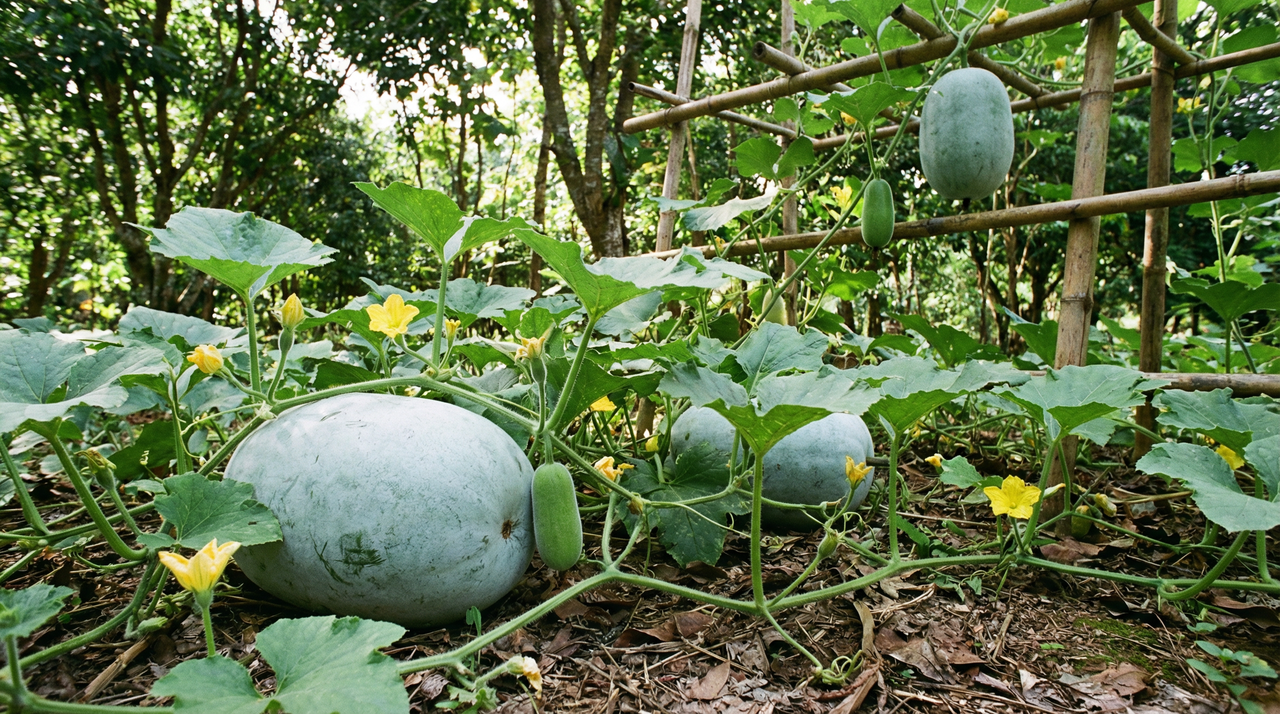
A wax gourd can sit on a shelf for six months without refrigeration, without canning, without any intervention whatsoever, and still be perfectly edible.[1] I've grown a lot of vegetables over the years, and that fact still stops me cold every time I say it out loud. We're conditioned to think of fresh produce as this fragile, perishable thing that needs to be rushed from garden to kitchen before it turns. Wax gourd just ignores that entire assumption. The thick epicuticular wax coating that matures on the skin isn't decorative; it's essentially a biological shrink-wrap the fruit grows itself, sealing moisture in and pathogens out with a kind of quiet engineering that no modern storage technology has meaningfully improved on.
What gets me is how thoroughly this plant has flown under the radar in Western gardens, despite being a staple across China, India, and Southeast Asia for somewhere around three thousand years. It fed empires. It traveled the Silk Road. It shows up in Ayurvedic texts and classical Chinese medicine as a cooling, restorative food with genuine therapeutic depth. And here, most people walk right past it at the Asian grocery store without a second glance, if they notice it at all. That's the contradiction I keep coming back to: a plant this useful, this productive, this genuinely low-maintenance once it gets going, should not be this obscure to growers in warm climates.
Origin and History of Wax Gourd (Benincasa hispida)
Botanical Background and Native Range
The wax gourd plant has been quietly feeding and healing people for millennia, long before most of us ever encountered one at an Asian grocery store. Benincasa hispida is native to tropical and subtropical Southeast Asia, with its center of origin spanning southern China and northeastern India, where it thrives at low to medium elevations up to about 1000 m with the kind of generous, well-distributed rainfall (1000-2500 mm annually) that makes a cucurbit truly happy.[2][3][4] As an annual herbaceous climbing vine in the Cucurbitaceae family, it completes its entire lifecycle in one season, sending out vines that can reach 5-10 m in length with tendrils that grab onto anything you give them.[5][6] I say this from experience: these vines behave exactly like oversized cucumbers that have decided the trellis you built is merely a suggestion. Early in my career I watched a bed of them collapse a lightweight wooden structure around week six. Cattle-panel trellises, installed before the vines reach a meter tall, are the only thing I trust now.
The scientific name itself carries some history. The genus honors Giorgio Benincasa, a 16th-century Italian botanist, while "hispida" refers to the fine hairs covering the young fruit. The common name wax gourd comes from something far more practical: mature fruits develop a thick epicuticular waxy coating that minimizes moisture loss, deters pests, and inhibits microbial growth, enabling storage without refrigeration.[7] Seeds from saved fruits remain viable for 3-5 years when kept cool and dry, and while the plant can become weedy in tropical regions, it carries no listing as a high-risk global invasive.[8][9] In my work with tropical vines across several projects, I've found it stays reliably well-behaved when managed, which is why I recommend it confidently for designed systems.
Visual Characteristics
The vines themselves are stout, hairy, and angular, reaching 5-10 m (20-30 ft) with horizontal spread of 10-20 ft when trellised.[10][11] Leaves are broadly ovate to kidney-shaped, palmately lobed into 5-7 segments, 10-25 cm across, with a rough scabrous texture and soft white hairs particularly dense on the underside.[12] They're not subtle leaves. The rough texture tells you immediately this plant is built for durability.
Wax gourd is monoecious, meaning male and female flowers appear separately on the same plant. Both are yellow and funnel-shaped, about 7.5-10 cm across, but the female flower sits on a short pedicel with a swollen base (that's your future fruit) while the male hangs on a longer, slender pedicel.[13][14] Once you know the difference, you can spot a setting fruit at a glance, which matters when you're deciding where to position support slings for what will become a very heavy gourd. Fruits are large fleshy pepos, oblong to cylindrical or spherical, 10-40 cm long, typically weighing 5-20 kg, covered at maturity with that signature white waxy bloom over pale green skin, with crisp white flesh and numerous flat, pale seeds inside.[15][11] Below ground, a deep taproot extends 1-2 m, supplemented by lateral fibrous roots that give the plant surprising drought resilience once established.[16] The waxy bloom I see forming on mature fruits under intense humidity is noticeably thicker than on fruits grown in drier conditions, and I've learned to harvest only once that coating is complete and even across the entire rind.
Traditional and Cultural Uses
Domestication of Benincasa hispida goes back roughly 4000-5000 years, with the earliest written records appearing in the Chinese Shennong Bencao Jing (circa 200-250 AD) and Ayurvedic texts including the Charaka Samhita (circa 300 BCE-200 CE); Chinese cultivation is documented as far back as the Han Dynasty (206 BCE-220 AD).[17][18][19] From those ancient agricultural centers it spread along the Silk Road and maritime trade routes, reaching Japan, Korea, and broader Southeast Asia within the first millennium BCE, and arriving in the Americas in the 16th century via Portuguese traders. Today it's cultivated in over 50 countries, with global production of roughly 1.5-2 million tons annually and China accounting for more than 80% of that output.[20]
In Traditional Chinese Medicine, wax gourd earned classification as a superior, non-toxic herb: it was used to clear heat, promote urination, quench thirst, treat edema, and address summer-heat ailments, typically decocted or eaten fresh.[21][22] Ayurvedic traditions valued the same cooling nature from a different framework, prizing it for balancing Pitta dosha, aiding digestion, reducing fever, and treating urinary stones and asthma, often prepared as a soup for heat-related conditions.[23][24] Two independent ancient medical traditions landing on the same conclusion about a plant's cooling, diuretic character is the kind of convergent evidence that earns my respect as a grower. I think about that when I see this vine providing literal, physical shade and cooling to the plants below it in a food forest guild.
Culturally, the wax gourd carries significant weight in Chinese tradition: its round shape, white flesh, and associations with endurance symbolize prosperity, longevity, and good fortune. It appears in Chinese New Year soups as an invocation of health and family harmony and features in Mid-Autumn Festival observances as well as certain Hindu rituals.[25] That longevity symbolism resonates differently when you're growing something with a permaculture lens; a plant that stores for months, shares its abundance across generations of seed saving, and has nourished communities across 50 centuries is exactly the kind of deep-rooted ally a food system should include. Which makes it all the more urgent that more than 100 existing landraces now face genetic erosion from modern hybrid pressure, driving active conservation through seed banks to preserve that diversity.[26]
Fun Facts About Wax Gourd
The numbers on wax gourd fruits are genuinely hard to believe until you've wrestled one into a wheelbarrow. Typical cultivated specimens run 5-20 kg, but documented record fruits include a 40.8 kg (90 lb) specimen recognized by the RHS in 2017 and a 100 kg (220 lb) fruit recorded in China in 2010, with larger fruits most common under tropical growing conditions.[27][28] Even the more modest 5-15 kg fruits I typically see in home systems demonstrate the genetic range that makes landrace selection genuinely worthwhile; different cultivars produce dramatically different sizes, shapes, and habits from the same species.
The storage story is what really makes this plant remarkable as a food security crop. This robust natural outer barrier is exactly what enables traditional storage without any refrigeration for 3-6 months, and up to a full year under cool, dry conditions.[29][30] When I see that white bloom fully developed and even across a fruit's surface at harvest, I know I'm holding something that doesn't need to be eaten for months. That's exactly why this plant traveled ancient trade routes: it's a self-preserved, calorie-dense cargo that outlasted nearly any other vegetable available to traders crossing Central Asia or sailing maritime routes. A plant that stores its own harvest for a year has a competitive advantage that needs no further explanation.
Wax Gourd Varieties and Where to Source Them
Notable Cultivars of Benincasa hispida
Wax gourd is a monotypic species with no recognized wild subspecies,[5] which means the diversity you see across Asian markets comes entirely from centuries of purposeful human selection. Breeders have concentrated on fruit shape, size, weight, skin texture, and flesh quality,[31][32] giving growers a practical range to choose from rather than an overwhelming one. Long cylindrical types can run 10-50 cm and top 40 kg; round types generally measure 15-30 cm across and carry their weight more compactly.[33][34]
India's Pusa series from the Indian Agricultural Research Institute covers a lot of ground in that selection: 'Pusa Uday' is early maturing, 'Pusa Summer' is built for hot conditions, 'Pusa Rashmi' stays round, and 'Pusa Utsav' leans slightly sweeter.[35] Chinese types like 'Tientsin White', 'Fukien Long White', and the large-fruited 'Dong Gua' are selected for sheer size and culinary utility, with some fruits reaching 40 cm long.[5][36] Japan's 'Togan' sits apart from both, carrying a noticeably sweeter flavor that lends itself to fresh preparations and tempura.[5] Western-facing suppliers have also named a few cultivars like 'Tasty Green', 'White Winter', and 'Fuzzy Morning Glory', which tend to run 5-40 lbs and vary mainly in skin texture and market appearance.[37][38]
For most home growers in warm climates, the more useful distinction is shape. Round cultivars handle heat better, staying productive up to around 95°F, while long types tend to struggle above 90°F.[38] I trialed both in my Central Florida garden and the round types set fruit reliably through the worst of our humid summers, while the long ones got fussy. If you're in a subtropical or tropical climate, that difference matters more than any flavor nuance between cultivars.
Sourcing Wax Gourd Seeds and Plants in the US
The U.S. imports 5,000-7,000 metric tons of fresh wax gourd annually, arriving primarily from China, India, and Vietnam, with China dominating global production and export.[39][40] That volume keeps it on shelves year-round in markets serving Asian communities, which is why many gardeners encounter the fruit long before they think to grow it. The good news is that the same genetics feeding those markets are available to home growers from accessible domestic seed companies.
Baker Creek Rare Seeds, Southern Exposure Seed Exchange, and Johnny's Selected Seeds all carry Benincasa hispida.[41][42][43] I've ordered from Baker Creek and Southern Exposure across multiple seasons and their germination rates have been consistently strong. Packets of 10-50 seeds typically run $3-10, with shipping adding a few dollars; starter plants are occasionally available from specialty nurseries for $5-15, though seeds are far easier to find.[44][45] For most permaculture growers, seed is the practical entry point, and at those prices it's easy to trial a round type alongside a long type and let your own climate decide the winner.
Wax Gourd Propagation and Planting
Before you ever stick a wax gourd seed in the ground, there's one biological quirk worth knowing: a single seed can sprout two, three, sometimes five seedlings at once. That's polyembryony, and it's genuinely unusual territory for a home vegetable gardener. One zygotic embryo develops normally from fertilization, while several adventitious embryos form alongside it from maternal tissue.[46][47][48] I learned this the hard way in my first season growing wax gourd in Central Florida -- I planted a flat and got what looked like overcrowded cucumbers everywhere. Now I label every cell and expect to separate multiple seedlings gently at the first true leaf stage.
Seed Characteristics and Polyembryony
The seeds themselves are flat, oval to elliptical, pale white to tan, with a smooth hard coat and a profile of roughly 10-15 mm long by 5-8 mm wide.[49][50] They look a lot like small pumpkin seeds, and they behave like them in storage too. Wax gourd seeds are orthodox, meaning they store reliably when kept at 5-10°C with moisture content around 5-7% and relative humidity below 50%. Sealed in an airtight container with a silica gel packet, fresh seeds hold above 70% viability for three to five years.[51][52][53] Skip the cool storage and leave them in a warm humid drawer, and expect germination rates to crater within two to three seasons.[54] I buy fresh seed whenever I can and store the surplus in a small jar in the back of my refrigerator.
Germination Requirements and Timeline
Soil temperature is the make-or-break factor for germination. Wax gourd seeds want soil at 25-30°C (77-86°F), and they won't cooperate reliably below 70°F. Hit that window with fresh seed and you'll see emergence in 7-14 days with germination rates of 80-95%.[55][32] A 24-hour soak in warm water before planting, or a light scarification of the seed coat, speeds that up noticeably. One botanical aside worth knowing: germination is hypogeal, meaning the cotyledons stay below the soil surface rather than pushing up as seed leaves.[55] Your first above-ground sign of life will be the true seedling stem, which can fool you into thinking germination is slow when it isn't.
The other timing pressure is the season itself. Wax gourd needs 100-150 frost-free days to reach maturity, so the calendar is always working against you in cooler climates.[6][56] In my zone 9B garden I start seeds indoors under lights in early March so transplants are ready to go out once nights consistently stay above 70°F. For colder zones, count back 4-6 weeks from your last frost date and start indoors accordingly. Those polyembryonic seedlings will look nearly identical to young cucumbers or squash for the first couple of weeks, so label your flats clearly from the start.
Vegetative Propagation and Grafting
Seed is by far the most common starting method for home growers, but wax gourd can also be propagated from semi-hardwood or softwood stem cuttings of 10-15 cm, treated with IBA at 1000-2000 ppm and rooted in a sand-perlite-peat mix under high humidity and warm temperatures.[57][58] It's not a method most backyard gardeners will reach for, but it's useful if you have a vigorous specimen you want to clone. More practically interesting is grafting: Benincasa hispida is actually prized commercially as a rootstock for cucumbers, watermelon, melon, and squash, because its roots offer disease resistance that scions lack. The whip-and-tongue technique on 10-14 day old seedlings achieves 70-95% success when post-graft conditions hold at 85-95% humidity and 25-30°C.[59][60] I've grown grafted tomatoes for fusarium resistance for years, and the same logic applies here; if you're in a field with a history of soilborne cucurbit disease, those university trial numbers are worth taking seriously.
Soil, Site Selection, and Planting Technique
Wax gourd wants well-drained, fertile loamy or sandy loam soil with 2-5% organic matter. The pH window is 6.0-7.5, with the sweet spot sitting at 6.5-7.0. Drift below 6.0 and you risk manganese toxicity; climb above 7.5 and iron chlorosis sets in. Either way, yields drop 20-30% outside the 6.0-7.0 range.[6][61][62][63] I test my soil every spring, and when I see the classic interveinal yellowing of iron chlorosis on young leaves I know the pH has crept up and it's time for elemental sulfur. For low pH, incorporated lime several weeks before planting does the job. Amend heavy clay with coarse sand, perlite, or compost, and work in aged manure before transplanting. Go easy on straight nitrogen amendments; excess nitrogen pushes vine growth at the expense of fruit set.[64][6]
My first attempt at growing wax gourd here in Central Florida was in a flat bed with heavy clay subsoil, right through a wet summer. Root rot took plants that looked perfectly healthy above ground. Now I build raised beds 8-12 inches high and amend generously with compost before anything goes in the ground. The plant's taproot wants at least 60 cm of depth to run properly,[6][65] and in a waterlogged bed it simply won't get there. Full sun is non-negotiable; plan for a minimum of 6-8 hours of direct light daily.[66][67] Shade causes etiolation, reduced vigor, and frankly disappointing fruit, and the drainage problem only multiplies on a north-facing or tree-shaded site.
Spacing, Support, and Initial Care
Give these vines room. For trellis culture, space plants 2-5 feet apart within rows; for ground culture, rows should sit 6-8 feet apart to allow the vines to spread 10-15 feet or more without crowding.[68][69] Trellising isn't optional if you want clean, rot-free fruit; vertical training increases yields by 20-30% by improving airflow and keeping developing gourds off damp soil.[68][70] The structure has to be genuinely sturdy; mature fruits can weigh up to 20 kg, and a flimsy cattle panel will not hold them. I use 4x4 posts with heavy-gauge wire, and I still sling large fruits in mesh bags tied to the frame once they size up. In humid climates, wider plant spacing also reduces fungal disease pressure significantly, which is worth more than squeezing in an extra plant per row.
Wax Gourd Care Guide
Growing wax gourd well means understanding that you're working with a plant that has spent millennia adapting to intense tropical sun, and it shows in some genuinely clever biology. Before any discussion of watering schedules or fertilizer ratios, the most important thing to know is that this vine rewards attentive, responsive care far more than rigid routines.
Sunlight Requirements and Light Adaptations
Wax gourd wants full sun, and it's built for it. The leaves practice diaheliotropism, constantly repositioning themselves perpendicular to direct light to reduce photoinhibition and heat stress.[71] It's a subtle but continuous movement, a bit like a slow-motion tracking system, and I find myself noticing it the same way I do with sunflowers. In high-light conditions, leaves thicken and develop denser stomata, while the plant builds up the same epicuticular wax on its leaves that eventually coats the mature fruit, reflecting excess radiation and slowing moisture loss.[71][72] That said, during the hottest weeks of a Florida summer, even a sun-adapted vine appreciates afternoon shade. Six to eight hours of direct sun is the sweet spot; twelve hours of blazing midsummer heat is when you start seeing stress regardless of how well the plant copes.
Watering Needs and Irrigation Management
Deep, consistent irrigation is non-negotiable. The goal is to reach the 12 to 18 inch taproot zone every two to four days, delivering one to two inches of water per week, with heavier applications during flowering and fruit set and a slight pullback as fruits mature.[6][73] Sandy soils need more frequent attention; clay or loam holds moisture longer and forgives a missed day. Target around 60 to 70 percent field capacity, and keep irrigation water pH between 6.0 and 7.5 with salinity well below an EC of 2.0 dS/m, since higher salt levels quietly reduce both yield and fruit quality.[74][75]
In my experience, the first sign of overwatering is older leaves yellowing from the base, even when the top inch of soil feels dry. Catching that early has saved more than one planting before soft roots or stem rot set in.[76][77] Underwatering shows differently: wilting that doesn't recover in the evening, scorched leaf edges, and noticeably smaller fruits.[78] Trust the plant's signals more than the calendar.
Feeding and Nutrient Management
This is a heavy feeder, and the numbers reflect that. Before planting, incorporate generous amounts of compost or well-rotted manure (around 20 to 25 tons per hectare at field scale, proportionally less in home gardens), then follow with balanced NPK split across basal application, flowering, and fruit set, targeting roughly 100 to 150 ppm nitrogen, 50 to 100 ppm phosphorus, and 150 to 250 ppm potassium in the soil.[79][80][81] I always start with a soil test rather than a blanket recipe; it's the only way to know whether you're addressing a real deficiency or creating a new imbalance.
The deficiency spectrum is worth knowing. Nitrogen shortage shows as uniform pale yellowing of older leaves; phosphorus as a purplish tint with poor fruit set; potassium as marginal leaf scorch; magnesium as interveinal chlorosis on older leaves; and iron or zinc deficiencies target young growth first.[82][83][84] Overfeeding carries its own risks: too much nitrogen produces lush, sappy growth that I've watched attract aphids noticeably faster than balanced plants, while diverting the vine's energy from fruit development into endless foliage.[85][86] More compost first, synthetic inputs second, and always test before you add.
Heat and Frost Tolerance
Wax gourd thrives between 70 and 95°F, with the sweet spot sitting around 77 to 86°F.[87] Above 104°F the consequences are real: pollen viability drops, flowers abort, fruits sunscald, and what does set tends to be smaller and lower in sugar.[88][89] During extreme heat, 30 to 50 percent shade cloth, deep mulch, and consistent drip irrigation are your primary tools, alongside proper spacing of three to four feet between plants to maintain airflow.[90] The large leaves make wilting very obvious, which is actually useful; wax gourd telegraphs heat stress faster than a cucumber but also recovers well with afternoon shade and a good mulch layer. Heat-tolerant cultivars like 'Pusa Utsav' and 'Arka Bahar' are worth sourcing if you're gardening through consistently brutal summers.[91]
On the cold end, this plant has no tolerance for frost. Growth slows or stops below 50°F, and anything below 32°F kills it outright.[92] Chilling injury can happen even above freezing, showing up as leaf curl, fruit pitting, and bronzing.[93][94] Perennial behavior only happens reliably in zones 10 and 11; in zone 9B where I garden, it's marginal, and I've lost an early planting to a surprise cold snap. Now I don't transplant until my soil thermometer reads a consistent 65°F and the forecast is clear for at least two weeks.[92][95] Row covers are cheap insurance on forecast nights below 50°F.
Pruning, Training, and Maintenance
Start training the main stem onto a sturdy trellis once the plant reaches one to two feet tall, and prune side shoots back to the first two or three leaves to keep energy moving toward the main vine and fruit development rather than sprawling lateral growth.[96][34] I cannot overstate how important the trellis strength is; mature fruits on this vine can push 20 to 40 pounds, and an undersized support will fail at the worst possible moment. I've used cattle panel arches with good results. Regular walkthroughs also let you spot early pest pressure before it escalates, which connects naturally to monitoring as a maintenance habit rather than a separate task.
Seasonal Growth Rhythm
Outside of zones 10 and 11, wax gourd runs on an annual clock: sow after last frost, and count on 100 to 150 days from sowing to mature fruit.[97][6] The first six to eight weeks are all vine, which can feel slow, but that root and stem infrastructure is what drives the explosive fruit set that follows. In my garden, around week six or seven I start watching for the shift from vegetative push to flowering, which signals that it's time to back off nitrogen slightly and keep soil moisture rock-steady. Waterlogging at any stage invites fungal problems, and poor pollination from temperature extremes at the wrong moment can collapse a whole season's investment.[95] Think of the season in three phases: establishment, flowering and fruit set, and maturation, each with its own watering and feeding adjustments, and you'll avoid most of the common mistakes before they happen.
Wax Gourd Harvesting Guide: Timing, Technique, and Yield
One of the first things I tell people who are growing wax gourd for the first time is that this isn't a one-size-fits-all harvest. You're essentially choosing between two completely different vegetables from the same vine. Pick it young and small, and you've got something closer to a tender summer squash. Leave it to fully mature, and you've got a storage crop that can outlast most of what's in your root cellar. Getting clear on that decision before you head to the garden makes everything else much simpler.
When to Harvest Wax Gourd: Maturity Indicators and Timelines
From seed to first harvest, wax gourd typically takes 90-120 days, though in ideal tropical conditions that can compress to 80 days, and in cooler climates it may stretch to 150.[32][98] Female flowers usually appear around 60-70 days after planting, and then the fruit itself needs another 45-60 days to reach full maturity.[32][99] For most U.S. home gardeners, that puts the harvest window squarely in late summer through early fall, August through October, extending into November if you're in Florida or Southern California.[6][100]
Calendar days give you a rough frame, but the fruit itself tells you when it's ready. At full maturity, the skin shifts from deep green to pale green or greenish-white, and a thick chalky wax bloom develops across the surface.[101][102] The tendrils closest to the fruit dry out and yellow. The fruit feels noticeably heavy for its size and gives a hollow thud when tapped. And the skin resists a thumbnail pressed firmly into it.[34][98] I use the thumbnail test in combination with the heavy-for-size feel because color alone has burned me in overcast stretches of Florida summer, when fruits that looked pale enough were still too immature to store well. For growers who want a more precise read, commercial maturity benchmarks land around 4-6 °Brix soluble solids and peel firmness above 10 N; over-mature fruits soften and their seeds harden, which reduces culinary quality noticeably.[86]
How to Harvest and Handle Winter Melon Fruits
If you want tender, zucchini-style eating, pull the fruit at 4-6 inches long before the waxy bloom develops.[102][37] If you're after a long-keeping storage gourd, wait for the full waxy coating, because that bloom is the plant's built-in preservative.[103] Either way, use a sharp knife or clean pruning shears and leave 2-3 cm of stem attached to the fruit.[101][34] That stub of stem is the single most effective thing I've found for preventing rot at the stem end during storage, especially in humid conditions.
These fruits get heavy, so handle them with both hands and set them down gently. Skip washing unless there's visible soil, and sort them immediately after cutting. For long-term storage, mature fruits do best at 10-15 °C (50-60 °F) with 85-90% relative humidity.[101][104] I keep mine in a cool garage rather than the refrigerator; temperatures below 10 °C cause chilling injury, which shows up as surface pitting and accelerated decay.[104][34] Stored correctly, these fruits hold for 2-3 months without issue, and additional waxing or curing can push that even further.[105]
Expected Yields, Flavor, and Post-Harvest Storage
The scale of a mature wax gourd fruit is genuinely satisfying after a long season of vine management. Individual fruits run 20-50 cm long, 15-25 cm in diameter, and commonly weigh between 5 and 20 kg (roughly 10-44 lb), with a healthy vine producing several of those across the season.[102][103] That's not a modest payoff for a single planting.
The flesh is crisp, firm, and very juicy when raw, with a mild, slightly sweet flavor and a faint cucumber-grassy aroma.[106][107] Cooked, it softens and absorbs surrounding flavors readily, which is exactly what makes it such a workhorse in Asian soups and braises.[108] The preparation-and-uses section covers all of that in depth, along with how the seeds, leaves, and flowers are used across different food traditions. What matters at the harvest stage is that the waxy bloom you've been watching develop isn't just a maturity signal; it's what keeps that mild, clean flesh worth eating months after you've cut the fruit from the vine.
Wax Gourd Preparation and Uses
Culinary Applications and Flavor Profile
Nearly every part of Benincasa hispida is edible. The mature fruit gets the most kitchen attention, but leaves and flowers are also fair game, and the seeds are worth treating like pumpkin seeds rather than tossing.[5][109] In Chinese, Indian, and Southeast Asian cuisines, the standard prep is straightforward: peel the rind, scoop out the seeds, and cut the flesh into cubes or slices for soups, stir-fries, and curries where its neutral character lets it absorb whatever aromatics surround it.[110]
Raw, the flesh is mild and faintly sweet with a subtle cucumber-like scent. Cooked, something genuinely interesting happens. After 20 to 45 minutes of simmering, the pectin in the flesh breaks down and the cubes go from crisp and watery to soft, almost creamy, while naturally thickening the broth around them without any added starch.[111][107] I've watched this happen dozens of times in my own kitchen, and it still surprises people. Think of a zucchini cooked all the way down, but silkier and without the fiber. Natural glutamates in the flesh also develop a faint umami quality that makes a simple broth feel more substantial.[112][113]
Cooking also mellows the raw green notes by reducing volatile compounds, leaving a cleaner, more neutral profile that explains why a classic wax gourd soup recipe lets the stock and aromatics carry the flavor.[114][106] Drying or candying the flesh introduces nutty or caramelized notes and a chewy texture that feels nothing like the fresh fruit. The seeds are worth harvesting young. I've learned through trial and error here in Florida that waiting until full seed maturity introduces a faint bitterness you won't get if you pull them a little early and roast or boil them while they're still tender.[109]
Traditional Medicinal Preparations
The same fruit you cook for dinner is the foundation for traditional preparations in both TCM and Ayurveda. In Traditional Chinese Medicine, the standard adult approach is a decoction made from 9 to 30 g of dried fruit per day, or 3 to 10 g daily in powder form, typically used for fever, thirst, edema, and urinary difficulties.[115][116] Ayurvedic practice tends toward juice or decoction for digestive and skin support, with typical dosages around 50 to 100 ml of juice or 10 to 20 g of powder daily.[117] When I've experimented with simple dried winter melon teas from garden surplus, I stay at the conservative end of those ranges and always tell people to check with a qualified practitioner before using it therapeutically. The tradition behind these preparations is centuries old; the modern clinical evidence is still catching up.
Non-Food Uses
For those of us running integrated systems, the leaves are worth paying attention to even if you're not eating them yourself. They're high in protein (up to 20% dry weight) and rich in calcium and potassium, making them a solid forage option for goats, cattle, or poultry.[118] I've seen animals go straight for the leaves when given access to the vine, which is a useful reminder that what doesn't end up in your kitchen can still feed something else on the property. The fruit itself can be prepared fresh, dried, or pickled, and in many parts of Asia it functions as a year-round pantry staple in exactly that preserved form.
Wax Gourd Health Benefits and Medicinal Uses
Wax gourd has never been a plant that needed a marketing campaign. Across Asia, its medicinal reputation built itself over two millennia of practical use, and when you look at what modern pharmacology is finding, it's hard to argue with the track record.
Traditional Uses in Chinese Medicine, Ayurveda, and Folk Systems
In Traditional Chinese Medicine, Benincasa hispida is a cooling, clearing herb first and a food second. It's prescribed to clear heat, reduce edema, promote urination, and address respiratory issues like cough and phlegm accumulation.[119][120] Ayurveda reaches similar conclusions from a different framework: classified as Sheeta Virya (cooling in potency), wax gourd is used to balance Pitta dosha, support digestion, manage blood sugar, treat urinary complaints, and address skin conditions.[121][122] Folk practitioners across South and Southeast Asia have added their own layers, using it as a remedy for asthma, constipation, and general debility.[123]
The whole plant has a role to play, not just the flesh. The fruit gets most of the attention for its cooling and anti-diabetic applications, but seeds have traditionally been used as anthelmintics and laxatives, and leaves applied topically for wounds and skin disorders.[124] I find that useful framing because it tells you the plant has always been treated as a complete pharmacopoeia, not a single-use remedy. Knowing where the different actions are concentrated matters both for the kitchen and for anyone interested in its broader Benincasa hispida medicinal uses.
Key Phytochemicals and Bioactive Compounds
The chemistry here is genuinely diverse. Wax gourd contains flavonoids, phenolic compounds, alkaloids, terpenoids, glycosides, saponins, tannins, steroids, and coumarins across its various plant parts.[125][126] The signature compounds are the cucurbitacins, particularly cucurbitacin B, which drive anti-inflammatory, antioxidant, and cytotoxic effects and can induce apoptosis in cancer cells through caspase activation.[127][128][129]
The flavonoid fraction includes quercetin and kaempferol, while phenolic acids run to caffeic, ferulic, gallic, and chlorogenic acids, with total phenolic content measured between 50 and 200 mg GAE per 100 grams depending on the part and extraction method.[130][131][132] Fruit polysaccharides add another anti-inflammatory layer by suppressing pro-inflammatory cytokines like TNF-α,[131] and the seed oil is rich in oleic and linoleic acids.[133]
Distribution across plant parts matters practically. The peel concentrates the highest phenolic and flavonoid levels, seeds contain phytosterols like β-sitosterol along with alkaloids and saponins, and the edible fruit flesh of domesticated varieties sits well below 0.1% cucurbitacin content, low enough that it's not a concern in normal culinary use.[134][135][128]
Pharmacological Research and Potential Health Benefits
The strongest pharmacological evidence supports anti-inflammatory and antioxidant actions. Wax gourd extracts inhibit NF-κB translocation and reduce TNF-α and IL-6, with reduced paw edema demonstrated in animal models.[136][129] Antioxidant activity operates through Nrf2-mediated pathways, upregulating SOD, catalase, and glutathione, and is confirmed by DPPH radical scavenging assays.[137][138] From there, the evidence fans out: anti-diabetic potential via α-glucosidase inhibition and enhanced insulin sensitivity in streptozotocin-induced diabetic rats,[139][140] hepatoprotective effects with reduced ALT/AST levels against chemically induced liver damage,[141] anti-obesity effects in high-fat-diet models,[142] and diuretic activity comparable to furosemide in rat studies.[143] Emerging work on cancer cell lines, including MCF-7 breast and HCT-116 colon cells, shows apoptosis induction via PI3K/Akt suppression and Bax/Bcl-2 modulation.[144]
Most of this evidence is preclinical. Human trials are limited, with the most notable being a small study of 30 type 2 diabetes patients showing modest blood glucose reductions over 12 weeks.[145][146] That gap between centuries of traditional wax gourd benefits and robust clinical validation is real. But I've been using this plant in my own kitchen for years precisely because that traditional pedigree is long and the safety record in food amounts is excellent. I still advise clients who take diuretics or blood sugar medications to talk to their doctor before using concentrated extracts, which is a different conversation than eating a bowl of winter melon soup.
Nutritional Profile of Wax Gourd
The primary edible part is the immature fruit pulp, typically consumed in 200 to 300 gram servings,[147] and the numbers tell a clear story: 13 kilocalories per 100 grams, 96% water, with minimal fat and protein and about 3.3 grams of carbohydrates.[148] I lean on wax gourd heavily in summer soups and stir-fries specifically because those big chunks fill a bowl without adding meaningful calories. For clients designing food gardens with weight management in mind, it's one of my reliable recommendations: high volume, high satisfaction, low caloric density.
Vitamin C comes in at 13 mg per 100 grams alongside a decent spread of B vitamins and minerals including calcium, iron, zinc, and potassium.[149] The phytochemical richness from the flavonoids, phenolic acids, cucurbitacins, and carotenoids like β-carotene and lutein is what bridges nutrition into medicine, with total phenolics ranging from 50 to 200 mg GAE per 100 grams across plant parts.[150][114] One practical note on cooking: boiling can reduce vitamin C content by 25 to 50% through leaching, though minerals like potassium hold up relatively well.[151] Worth keeping in mind if you're reaching for wax gourd juice benefits rather than cooked preparations.
Safety Considerations and Contraindications
Ripe wax gourd fruit consumed in normal food amounts is considered non-toxic and safe, backed by both traditional use across Asia and the absence of significant toxicity reports for the edible flesh.[5][152] The primary caution is cucurbitacin content. Cultivated varieties keep cucurbitacin levels well below 0.1 mg/g in the fruit flesh, far under the threshold for toxicity, but leaves, stems, seeds, and unripe fruit carry higher concentrations that can cause nausea, vomiting, abdominal pain, and diarrhea.[153][154]
I learned this firsthand early in my growing days, harvesting a young fruit that tasted unmistakably bitter. I used a tiny piece, cooked it anyway, and had an uncomfortable afternoon. Bitterness is a reliable signal that cucurbitacin levels are elevated, and you should trust it completely.[155][156] Cooking significantly reduces cucurbitacin concentrations and is standard practice for good reason, so always cook the fruit and avoid anything that tastes off.[157] On the cultivar selection front, knowing your source matters too: wax gourd can be confused with bitter relatives like bottle gourd or wild cucumbers in the Marah genus, both of which carry significantly higher cucurbitacin loads.[70][158]
Beyond cucurbitacins, the practical cautions are manageable. Allergy risk is low but possible, with some cross-reactivity in people sensitive to cucumbers, melons, or ragweed pollen.[159] The diuretic and blood-sugar-lowering effects documented preclinically mean that anyone taking diuretics or antihyperglycemic medications should exercise caution with concentrated extracts or supplements, even if the cooked vegetable is fine.[160][161] TCM tradition also advises against use during pregnancy without medical guidance, and cautions that its cooling nature may not suit people with constitutionally cold conditions.[162] For pets, the ripe cooked flesh is not listed as significantly toxic, but leaves, stems, and seeds with higher cucurbitacin content are best kept out of reach.[159]
Wax Gourd Pests and Diseases
Wax gourd sits in a middle ground within the cucurbit family: tougher than cucumbers or watermelons, but nowhere near bulletproof. Its thick waxy rind, leaf trichomes, and cucurbitacin chemical compounds create a genuine feeding deterrent that reduces pressure from some insects.[163][164] I've noticed the faint bitterness in young leaves and consistently seen fewer caterpillar problems on my wax gourds compared to the cucumbers growing right beside them. That's the cucurbitacins doing their job. Still, this plant faces the full suite of cucurbit threats, and in humid subtropical conditions things can escalate fast.
Common Pests of Wax Gourd
The pest list reads like a who's who of cucurbit trouble: aphids, spider mites, cucumber beetles, squash bugs, fruit flies, leaf miners, whiteflies, and squash vine borers.[165][166] Melon fruit fly is the one I worry most about during rainy season, when larvae tunnel into developing fruits and cause losses that can gut a planting before you've had a chance to harvest.[167] Squash vine borers are my other nemesis in Florida heat. They target vines right at the base, and by the time you see the wilting the plant is usually gone.[168] After losing early plantings to them, I now use row covers until flowering and do a quick check at the base of every vine during my weekly walk-through.
Aphids cause leaf curling and yellowing through direct feeding and spread mosaic viruses in the process.[169] Cucumber beetles vector bacterial wilt while squash bugs inject toxins that cause rapid wilting.[170][171] Spider mites flare up in hot, dry spells; whiteflies bring sooty mold and more virus risk.[172] Cultivars like 'Pusa Utsav' and 'Arka Bahar' show documented tolerance to aphids and fruit flies, which is worth factoring in if you're in a high-pressure region.[173]
Diseases Affecting Wax Gourd
Compared to cucumber or watermelon, wax gourd has a modest edge on disease resistance, including some tolerance to Fusarium wilt and certain viral strains.[174] That advantage evaporates quickly in humid, crowded conditions. Powdery mildew and downy mildew are the most consistent problems, joined by gummy stem blight and anthracnose.[175][176] On the bacterial side, this plant is highly susceptible to bacterial wilt and moderately susceptible to bacterial fruit blotch and angular leaf spot.[177] Viral pressure from Zucchini Yellow Mosaic Virus and Cucumber Mosaic Virus causes mosaic patterns, fruit distortion, and stunting; Watermelon Mosaic Virus 2 is a moderate concern.[177]
One genuine bright spot: wax gourd is relatively resistant to root-knot nematodes compared to other cucurbits, though in intensive production soils nematodes remain worth monitoring.[174] The thick rind physically limits pathogen entry and its high calcium content may reinforce that barrier, though the same rind can trap surface moisture in a way that encourages fungal growth if airflow is poor.[178] Cultivars 'Longdeng', 'Minshuyu', 'Rongchun', and 'Zhonglu' carry documented powdery mildew resistance; 'Qiyu' and 'Nosu' fare better against gummy stem blight.[179] I've grown similar resistant cucurbit varieties in humid Florida summers and consistently seen 20-30% less mildew pressure -- cultivar selection genuinely moves the needle.
Integrated Pest and Disease Management
My approach follows a strict hierarchy: cultural practices first, then biological controls, then targeted treatments only when scouting justifies it. Crop rotation with non-cucurbits for at least two years, good plant spacing for airflow, sanitation, and prompt removal of infected material handle the majority of disease pressure before it starts.[180][181] Ladybugs, lacewings, parasitic wasps, and beneficial nematodes can carry a real load on pest suppression without reaching for a sprayer. When monitoring shows 5-10% infestation thresholds, neem oil, kaolin clay, or Bt are my first targeted options; copper-based fungicides or chlorothalonil come in preventively if disease pressure has been high.[182]
Bacterial wilt deserves special attention: once it's established, the plant is finished. There's no saving it. I focus entirely on controlling cucumber beetle populations before they ever reach the vines, because they're the primary vector and prevention is the only strategy that works.[183] Pair resistant varieties like 'Pusa Utsav' or 'Arka Bahar' with consistent scouting, and serious losses are genuinely avoidable even in the humid subtropical gardens where wax gourd grows best.[184]
Wax Gourd in Permaculture Design
Before you can design with wax gourd, you have to be honest about where it will actually thrive. This is a true tropical, and it will not negotiate with frost. Get the climate wrong and nothing else matters.
Climate and Hardiness Zones for Benincasa hispida
Wax gourd is reliably suited to USDA zones 9-11, where it behaves as a tender annual or occasionally a short-lived perennial in frost-free microclimates.[95][6] Its sweet spot is 25-30°C (77-86°F); growth stalls below 15°C (59°F), and soil needs to be at least 18-21°C (65-70°F) before seeds will germinate reliably.[185][186] The vine also demands a long run: 100-150 frost-free days and 2000-2500 growing degree days (base 10°C), supported by 1000-1500 mm of annual rainfall and 70-90% relative humidity.[187][6] That profile describes humid subtropical Florida, coastal Southern California, and Hawaii almost perfectly.[188][189]
One nuance worth building into your site design: prolonged temperatures above 35°C reduce photosynthesis and hurt fruit quality even with adequate water,[190] so in monsoon climates where afternoon heat spikes hard, a position with morning sun and afternoon dappled shade is a genuine advantage rather than a compromise.[191] For those of us in zone 9b like my Central Florida garden, I start seeds indoors 4-6 weeks before last frost and use cloches to buy those extra weeks of warm soil. It's a bit of theater, but it's the difference between a full harvest and a vine that just sits there sulking until summer finally arrives.
Ecosystem Functions and Soil Health Benefits
Once climate is sorted, the ecological functions of wax gourd in a warm, humid system are genuinely impressive. The vine's vigorous sprawl acts as living mulch: dense leaf cover suppresses weeds, reduces surface erosion, and stabilizes soil against heavy tropical rain.[192] Root exudates and leaf litter continuously feed soil microbiology, and in alley-cropping systems, researchers have measured a 10-20% increase in soil organic carbon attributed to cucurbit cover-vine integration.[193] I've noticed this firsthand: the thick mat of spent vines and fallen leaves at the end of each season visibly improves soil structure the following spring, even before I've added any external compost. The beds where wax gourd grew are softer, darker, and better-draining than adjacent beds.
Broader ecosystem services include improved water infiltration, carbon sequestration, and some early-stage evidence of phytoremediation capacity in degraded soils, though that last one is worth treating cautiously until more field data accumulates.[192][193] The plant's nectar and floral structure also support pollinator and beneficial insect diversity within the guild.[194] In agroforestry and alley-cropping arrangements, it pairs particularly well with nitrogen-fixing legumes like beans, which feed the soil while the wax gourd's ground-hugging canopy keeps moisture in and weeds out.[193]
Pollination Ecology and Support in Guilds
The plant's separate male and female flowers are substantial, sweetly scented, and evening-opening, with male flowers reaching 5-8 cm and female flowers 4-6 cm.[195] The primary pollinators are honeybees (especially Apis cerana in Asian systems), squash bees (Peponapis spp.), and other native bees attracted by that nectar.[196][197] Pollination works best at 20-30°C and 60-80% humidity, and the plant can set fruit through self- or cross-pollination when conditions are right.[198]
In a guild setting, this means including flowering companions that draw bees throughout the day so pollinators are already active in the area when the wax gourd flowers open in the evening. Squash bees have been reliably consistent in my garden once flowering begins, but I still hand-pollinate the first female flowers of each season. It takes thirty seconds with a small brush or a pulled male flower, and it guarantees early fruit set before the bee population fully catches on. If insect activity is low for any reason, this same technique works throughout the season.[199]
Forest Garden Layer and Companion Planting Guilds
In permaculture food forest design, wax gourd belongs in the vine layer. At 5-10 m (16-33 ft), its tendril-climbing habit can move through the canopy edge, scramble over shrubs, or run a trellis with the kind of commitment you'd expect from a plant that produces fruits weighing up to 35 kg.[200][195] Every part of that vine is edible too, from young leaves to seeds to both immature and mature fruits, so it earns multiple harvests from a single planting in a well-designed guild.
The practical design challenge is directing that vigor without letting it smother companions. In my experience, sturdy cattle-panel trellises are the best solution: they hold heavy fruit, lift the canopy off shorter plants, and create predictable shade patterns underneath that I can plan around. The space beneath a trellised wax gourd is ideal for shade-tolerant ground covers or low nitrogen-fixing herbs. Left to trail on the ground without management, the same vine becomes a weed-smothering blanket that can overwhelm shorter companions rather than supporting them. That living-mulch effect is a feature when the ground layer is intentionally kept clear, but it needs to be designed in consciously rather than discovered after the fact.
The Gourd That Spent Three Months on My Shelf and Earned My Respect
I grew wax gourd mostly out of curiosity the first time, convinced something that large and that bland couldn't justify the trellis space. Then I harvested one in October, set it on a shelf in my garage, forgot about it through the holidays, and cut into it in January to find perfectly usable flesh. No refrigeration. No preserving. Just that waxy skin doing exactly what it's been doing for thousands of years. That's when I stopped being skeptical and started making room.
Sources 200
- Postharvest Biology and Technology: Wax Gourd Storage ↩
- Benincasa hispida Distribution and Habitat ↩
- Benincasa hispida (Wax Gourd) - CABI Compendium ↩
- Benincasa hispida (Wax Gourd) - Origin and Distribution ↩
- Benincasa hispida - Wikipedia ↩
- Benincasa hispida - University of Florida IFAS Extension ↩
- Culinary History of Wax Gourd in Asia ↩
- Benincasa hispida (ash gourd) ↩
- Benincasa hispida (winter melon) ↩
- Benincasa hispida - Royal Horticultural Society ↩
- Ash Gourd (Benincasa hispida) Production Guide ↩
- Flora of China - Benincasa hispida ↩
- Missouri Botanical Garden Plant Profile - Benincasa hispida ↩
- Flora of North America - Benincasa hispida Description ↩
- Royal Horticultural Society - Wax Gourd ↩
- Root System Architecture in Cucurbitaceae ↩
- Domestication History of Cucurbitaceae in Asia ↩
- Shennong Bencao Jing ↩
- Ash Gourd in Ayurveda ↩
- FAO STAT: Production of gourds and squash ↩
- Shennong's Herbal Classic (Shennong Bencao Jing) ↩
- Winter Melon: A Review of Nutritional and Medicinal Properties - PubMed ↩
- The Encyclopedia of Ayurvedic Medicinal Plants ↩
- Benincasa hispida (Thunb.) Cogn.: Ethnopharmacology, Phytochemistry, and Pharmacology of an Ayurvedic Plant ↩
- Cultural Significance of Benincasa hispida in Asian Traditions ↩
- Genetic Diversity and Erosion in Benincasa hispida ↩
- Award of Garden Merit for Benincasa hispida - Royal Horticultural Society ↩
- Benincasa hispida - Missouri Botanical Garden ↩
- Wax Gourd (Benincasa hispida): Storage and Preservation ↩
- Postharvest Biology and Technology of Horticultural Crops: Principles and Practices ↩
- Benincasa hispida - Wax Gourd ↩
- Wax Gourd (Benincasa hispida) Production Guide ↩
- Cultivar Variation in Winter Melon (Benincasa hispida) ↩
- Winter Melon (Benincasa hispida): Cultivation and Varieties ↩
- Wax Gourd Cultivars ↩
- Winter Melon (Benincasa hispida) Production Guide ↩
- Growing Ash Gourd (Benincasa hispida) - Cornell University Extension ↩
- Winter Melon Production Guide ↩
- U.S. Import Statistics for Vegetables ↩
- Global Trade in Benincasa hispida ↩
- Benincasa hispida - Chinese Winter Melon ↩
- Wax Gourd ↩
- Winter Melon Seeds ↩
- Winter Melon Seeds ↩
- Winter Melon Plants ↩
- Polyembryony in Cucurbitaceae ↩
- Seed Development in Benincasa hispida ↩
- Embryology of Wax Gourd (Benincasa hispida) ↩
- Flora of China - Benincasa hispida ↩
- Cucurbitaceae Seed Morphology ↩
- Seed Storage Behaviour of Selected Plant Species ↩
- Seed Storage of Horticultural Crops ↩
- Genebank Standards for Acquisition, Management and Characterization of Plant Genetic Resources ↩
- Longevity of Vegetable Seeds Under Different Storage Conditions ↩
- Seed Germination of Ash Gourd (Benincasa hispida) ↩
- Cultivation of Winter Melon ↩
- Vegetative Propagation of Cucurbits ↩
- Rooting of Stem Cuttings in Wax Gourd ↩
- Grafting Techniques for Cucurbit Crops ↩
- Vegetable Grafting: A Tool for Enhancing Crop Productivity ↩
- Winter Melon (Benincasa hispida) Production Guide ↩
- Soil pH for Vegetable Crops - USDA ↩
- Winter Melon Production Guide ↩
- University of Florida IFAS Extension: 'Winter Melon (Benincasa hispida): A New Addition to the Florida Vegetable Market' ↩
- Winter Melon (Benincasa hispida) Production Guide ↩
- Missouri Botanical Garden Plant Finder - Benincasa hispida ↩
- Light Requirements for Cucurbits ↩
- Winter Melon for Florida Home Gardens ↩
- Wax Gourd Cultivation Practices ↩
- Winter Melon (Benincasa hispida) Plant Profile ↩
- Leaf Movement in Cucurbitaceae: Benincasa hispida as a Model ↩
- Epicuticular Wax and Light Adaptation in Tropical Gourds ↩
- Cultivation of Ash Gourd (Benincasa hispida) ↩
- Water Quality for Agriculture ↩
- Salinity Tolerance of Crops ↩
- Missouri Botanical Garden Plant Finder ↩
- Royal Horticultural Society Plant Profile for Winter Melon ↩
- Irrigation Stress Responses in Benincasa hispida ↩
- Winter Melon (Benincasa hispida) Production Guide ↩
- Fertilizer Management for Wax Gourd ↩
- Cucurbit Production in Florida ↩
- Nutrient Deficiencies in Cucurbits ↩
- Ash Gourd Cultivation Guide ↩
- Micronutrient Deficiencies in Vegetable Crops ↩
- Nutrient Management for Wax Gourd (Benincasa hispida) ↩
- Fertilizer Toxicity in Cucurbits ↩
- Winter Melon Cultivation Guide ↩
- Heat Stress Effects on Cucurbit Crops: A Review ↩
- Physiological Responses of Benincasa hispida to High Temperature Stress ↩
- Heat Stress Management in Cucurbitaceous Vegetables ↩
- Cultivar Evaluation for Heat Tolerance in Winter Melon ↩
- Winter Melon (Benincasa hispida) Growing Guide ↩
- Frost and Freeze Damage to Plants ↩
- Chilling Injury in Tropical and Subtropical Fruits and Vegetables ↩
- Wax Gourd: Planting and Care ↩
- Winter Melon Production Guide ↩
- USDA PLANTS Database ↩
- Ash Gourd Cultivation ↩
- Cultivation of Ash Gourd (Benincasa hispida) ↩
- Growing Ash Gourd in Home Gardens ↩
- Winter Melon Production Guide ↩
- Winter Melon Production Guide ↩
- Harvesting Wax Gourd (Benincasa hispida) ↩
- Postharvest Handling of Winter Melon - UC Davis ↩
- Post-Harvest Management of Ash Gourd ↩
- Volatile Composition of Winter Melon (Benincasa hispida) ↩
- Winter Melon (Benincasa hispida): Nutritional Value and Culinary Uses ↩
- Flavor Profiles of Underutilized Cucurbits ↩
- Edible Parts of Wax Gourd ↩
- Culinary Uses of Ash Gourd Leaves and Seeds ↩
- Flavor and Chemical Composition of Winter Melon ↩
- ASH GOURD: A REVIEW - Botany, Horticulture, and Indian Folklore ↩
- Winter Melon (Ash Gourd) Production Guide ↩
- Aroma Changes in Cucurbitaceae During Processing ↩
- Chinese Herbal Medicine: Materia Medica ↩
- Benincasa hispida in Traditional Chinese Medicine ↩
- Ayurvedic Pharmacopoeia of India ↩
- Benincasa hispida Leaves as Livestock Feed ↩
- Traditional Uses of Wax Gourd in Chinese Medicine ↩
- Benincasa hispida in Traditional Chinese Medicine ↩
- Ash Gourd in Ayurveda: Therapeutic Applications ↩
- Medicinal Uses of Ash Gourd (Benincasa hispida) ↩
- Folk Medicinal Uses of Benincasa hispida in India ↩
- Benincasa hispida: A Phytochemical and Pharmacological Review ↩
- Phytochemical Screening and Antioxidant Activity of Benincasa hispida ↩
- Secondary Metabolites in Cucurbitaceae Family: Focus on Benincasa hispida ↩
- Cucurbitacin B from Benincasa hispida: Isolation and Bioactivity ↩
- Cucurbitacins in Cucurbitaceae: Distribution and biosynthesis in Benincasa hispida ↩
- Cucurbitacins from Benincasa hispida Induce Apoptosis in Cancer Cells ↩
- Phytochemical Constituents and Pharmacological Activities of Benincasa hispida ↩
- Antioxidant and Anti-inflammatory Properties of Benincasa hispida Extracts ↩
- Phenolic profile of Benincasa hispida leaves by LC-MS analysis ↩
- Fatty Acid Composition of Benincasa hispida Seed Oil ↩
- Phytochemical analysis of Benincasa hispida ↩
- Secondary metabolites from different parts of Benincasa hispida ↩
- Pharmacological Activities of Benincasa hispida: A Review ↩
- Antioxidant and Anti-inflammatory Properties of Benincasa hispida Fruit Extract ↩
- Antioxidant and hepatoprotective activities of Benincasa hispida ↩
- Anti-diabetic Potential of Benincasa hispida: An Overview ↩
- α-Glucosidase Inhibitory Activity of Benincasa hispida Extracts ↩
- Hepatoprotective activity of Benincasa hispida against CCl4-induced toxicity ↩
- Clinical Evaluation of Wax Gourd (Benincasa hispida) in Obesity Management ↩
- Diuretic Activity of Benincasa hispida in Experimental Animals ↩
- Anticancer activity of Benincasa hispida against breast cancer cell lines ↩
- Antidiabetic Activity of Benincasa hispida in Type 2 Diabetes Mellitus Patients ↩
- Clinical Trial on Benincasa hispida for Glycemic Control in Type 2 Diabetes ↩
- Missouri Botanical Garden Plant Finder ↩
- USDA FoodData Central - Waxgourd, Chinese, raw ↩
- USDA FoodData Central - Waxgourd, Chinese, raw ↩
- Phytochemical and pharmacological review of Benincasa hispida ↩
- Effect of Cooking on Vegetables Nutrients ↩
- Benincasa hispida - USDA PLANTS Database ↩
- Cucurbitacin Toxicity in Cucurbitaceae ↩
- Toxicity of Cucurbitacins: A Review ↩
- Cucurbitacins in Cucurbitaceae: Biosynthesis, Pharmacology and Biochemistry ↩
- Toxicity of Cucurbitacins from Cucurbitaceae Fruits ↩
- Toxicity of Cucurbitacin in Humans and Animals - PubMed ↩
- University of Florida IFAS Extension: Wild Cucumber (Echinocystis lobata, Marah species) Toxicity ↩
- Toxic and Non-Toxic Plants: Cucurbita (Pumpkin, Squash) ↩
- Planta Medica (2021) - Diuretic and Antihyperglycemic Activities of Benincasa hispida (Wax Gourd) Extracts ↩
- Benincasa hispida diuretic activity - JCDR ↩
- A Review on Pharmacological Activity of Benincasa hispida ↩
- Benincasa hispida: Cultivation and Pest Control ↩
- Insect Resistance in Cucurbitaceae: Role of Trichomes and Metabolites ↩
- Insect Management for Cucurbits ↩
- Pests of Winter Melon (Benincasa hispida) ↩
- Management of Fruit Flies in Cucurbits ↩
- Squash Vine Borer Management - USDA ARS ↩
- Aphids and Other Pests of Melon Crops ↩
- Common Insect Pests of Cucurbit Vegetables ↩
- Bacterial Wilt of Cucurbits - Penn State Extension ↩
- Insect Pests of Cucurbit Vegetables ↩
- Breeding for Resistance in Cucurbits: Focus on Winter Melon ↩
- Comparative Disease Resistance in Cucurbitaceae ↩
- Disease Dynamics in Benincasa hispida Cultivars Across China ↩
- Winter Melon (Benincasa hispida) - Pests and Diseases ↩
- Wax Gourd Production Challenges in Florida ↩
- RHS Grow Guide: Benincasa hispida ↩
- Powdery Mildew Resistance in Benincasa hispida Cultivars ↩
- Integrated Pest Management for Cucurbits ↩
- Crop Rotation for Disease Management in Vegetables ↩
- Downy Mildew on Cucurbits ↩
- Bacterial Wilt of Cucurbits ↩
- Improving Production and Postharvest Management of Winter Melon in Florida ↩
- Agronomic Characteristics of Winter Melon (Benincasa hispida) ↩
- Wax Gourd Production Guide ↩
- Winter Melon (Benincasa hispida) Production Guide ↩
- Tropical Vegetables: Winter Melon Production Guide ↩
- Growing Winter Melon in California ↩
- Temperature Stress in Cucurbit Crops: Focus on Wax Gourd ↩
- Monsoon Agriculture: Adaptations of Benincasa hispida ↩
- Ecological Roles of Cucurbit Crops in Tropical Agriculture ↩
- Soil Health Benefits of Vine Crops in Agroforestry Systems ↩
- Biodiversity Conservation through Traditional Cropping Systems in Asia ↩
- Benincasa hispida (Wax Gourd) - Flower Characteristics ↩
- Insect Pollinators of Winter Melon (Benincasa hispida) ↩
- Squash Bees: Specialists of the Cucurbitaceae ↩
- Pollination Biology of Benincasa hispida ↩
- Hand Pollination Techniques for Cucurbits ↩
- Benincasa hispida - Missouri Botanical Garden Plant Finder ↩