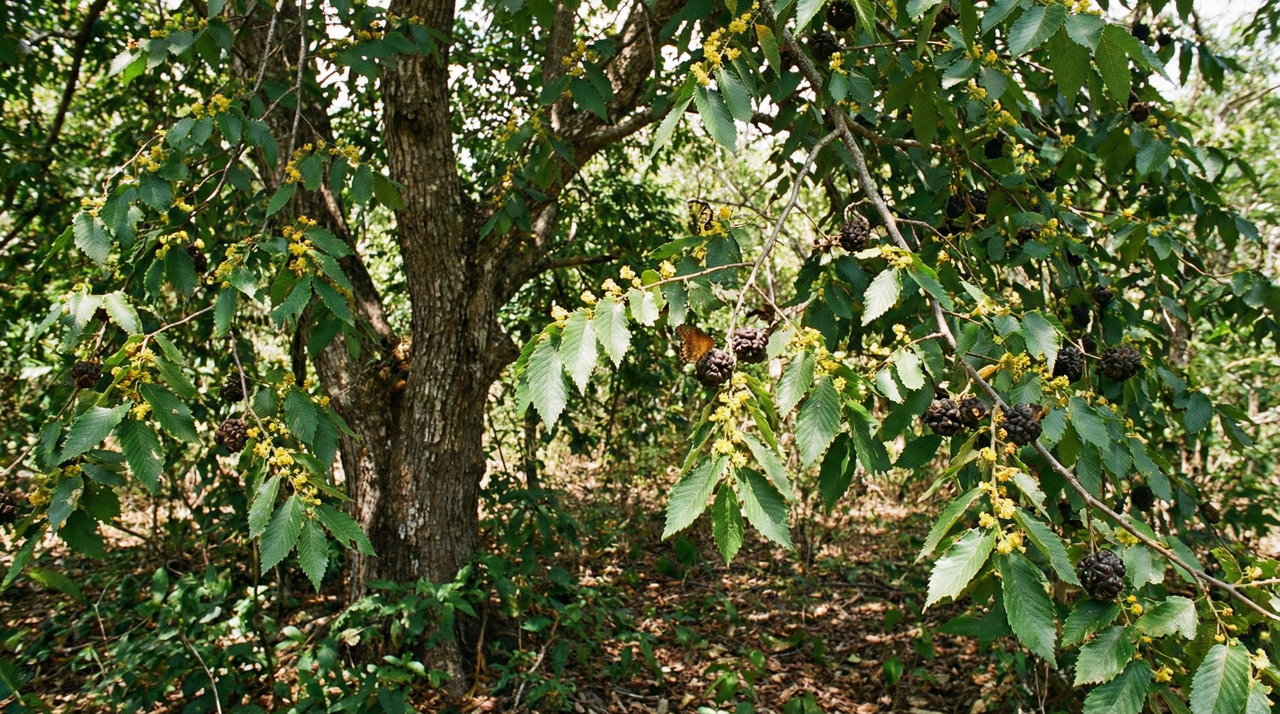
The fruit of West Indian elm sounds, when you shake it, like a tiny maraca. I'm not joking. Those small, warty, woody pods rattle with loose seeds inside, and the first time I heard one in a botanical garden in South Florida I genuinely looked around for whoever was making the noise. Nobody tells you that. Nobody leads with it. Instead, this tree gets filed under "fodder species" or "agroforestry pioneer" and people move on, missing the fact that inside that ridiculous little maraca is a pulp that tastes somewhere between apple, pineapple, and cotton candy, and that Maya and Taíno communities figured this out centuries before any botanist gave the tree a Latin name.
What keeps pulling me back to Guazuma ulmifolia is the gap between how it looks on paper and what it actually does in a system. On paper it's a weedy, fast-growing tropical tree with sandpaper leaves and no named cultivars. In practice it's a tree that charges into degraded land, holds soil together, flowers like it's trying to set a record, and feeds everything from bees to bats to the humans willing to crack open one of those chattering pods. That contradiction, between how easy it is to dismiss and how much it delivers, is exactly what this profile is about.
Origin and History of West Indian Elm (Guazuma ulmifolia)
Botanical Background and Native Range
Jean-Baptiste Lamarck first described this tree in 1785,[1][2] and the name he gave it, Guazuma ulmifolia, has stuck ever since. Common names pile up around this tree like debris in a floodplain: West Indian elm, guácimo, bay cedar, and monkey comb tree are the ones you'll encounter most often.[1] It belongs to the Malvaceae family (you may see older texts placing it in Sterculiaceae, which has since been folded into Malvaceae), and its native range sweeps from southern Mexico and Central America through the Caribbean and into South America as far south as Brazil and Bolivia.[3][4][5] That's an enormous geographic footprint, and the tree has earned every kilometer of it.
What I love most about West Indian elm, ecologically speaking, is that it's a genuine pioneer. It thrives in secondary forests, savannas, roadsides, riparian zones, and degraded pastures — essentially anywhere disturbance has cracked open the canopy and given it a foothold.[6][7] Its phenotypic plasticity is remarkable — smaller leaves in dry habitats, faster stem elongation near water — which is part of why it shows up across such wildly varied conditions. The tree reaches flowering and fruiting age in just two to four years, and while its lifespan typically runs somewhere between 15 and 50 years, it doesn't really need to live long to make a significant ecological impression.[7] Prolonged drought, soil salinity, and land conversion are the main threats to established populations, though healthy trees handle moderate versions of all three.[8]
For growers in the United States, the important caveat is Florida. West Indian elm has naturalized in Miami-Dade County and surrounding disturbed areas, where it's listed as a Category II invasive species by the Florida Exotic Pest Plant Council.[3][9] It's suited to USDA zones 10a through 11,[10] and I treat it with the same respect I give other vigorous pioneers in that climate — useful when deliberately placed in a productive system, risky when left unsupervised near natural areas. Beyond Florida, the tree has been intentionally introduced across tropical Africa, Asia, and the Pacific for reforestation, agroforestry, and soil improvement, though it can get weedy in some of those introduced contexts too.[5]
Visual Characteristics
Mature West Indian elm trees are substantial: typically 10 to 30 meters tall with trunk diameters reaching 50 to 100 centimeters and a broad, rounded canopy that can spread 10 to 20 meters wide.[11][12] Young bark is light gray to brown and relatively smooth, but with age it becomes rough, fissured, and corky with prominent lenticels that give older trunks a distinctly weathered character.[11]
The leaves are what I use to identify seedlings in the field. They're alternate, simple, ovate to elliptic, generally 6 to 15 centimeters long, with serrate margins and a sandpaper-rough upper surface that you can't mistake once you've rubbed one between your fingers.[13][14] The underside is softly pubescent. In drier habitats the leaves run noticeably smaller, one of the clearest expressions of that phenotypic flexibility. Flowers are small, barely a centimeter across, yellowish-green to cream-colored and inconspicuous — but fragrant, borne in axillary panicles and blooming nearly year-round in the tropics with a spring-to-summer peak.[15]
The fruit is what gives the tree its most evocative common name. Each small capsule, roughly 1 to 3 centimeters, is covered in short stiff tuberculate hairs that look uncannily like a comb, which is exactly where "monkey comb tree" comes from.[3][16] Inside, flat dark-brown seeds are surrounded by sweet, mucilaginous pulp that birds and bats find irresistible. I've watched fruiting trees become genuine wildlife magnets — between the pollinators working the flowers and the fruit-eaters working the pods, there's almost always something living in the canopy. The wood itself is lightweight and soft, with a density around 0.35 to 0.45 g/cm³, pale yellowish-brown, and useful for light construction and fuel.[17]
Traditional and Cultural Uses
This tree carries centuries of accumulated human knowledge. Herbarium specimens at Kew date to the 1840s, and its presence in healing ceremonies and folk medicine traditions across the Neotropics suggests people were working with it long before European botanists arrived to catalog it.[18] Among Taíno and broader Mesoamerican communities it carries cultural symbolism tied to resilience — fitting, really, for a tree that comes back after fire and colonizes land that everything else has abandoned.
Maya and Nahua peoples in Mexico and the Yucatán have long prepared bark and leaf decoctions as astringent treatments for diarrhea, dysentery, and parasitic infections.[19][20] In the Caribbean, Puerto Rican communities and those with Taíno heritage use bark infusions for similar gastrointestinal complaints while turning to leaf decoctions for coughs, colds, and respiratory ailments, and leaf poultices for wounds and inflammation.[21][22] The leaves also appear in postpartum care, a use that implies deep, specific knowledge of the plant's properties built across generations. Brazilian indigenous communities in the Amazon and Atlantic Forest regions extend these applications further into veterinary medicine, while also eating the fruit fresh or fermenting it into beverages and using the wood for construction and tools.[23][24]
Interesting Facts About West Indian Elm
Under favorable conditions West Indian elm can put on one to two meters of height per year and reach reproductive maturity within two to four years of germination.[13][25] I've seen it recolonize cleared pasture edges in just a few seasons — a living demonstration of tropical succession that no textbook quite captures the way watching it unfold in real time does. Part of what drives that persistence is its seed bank: seeds remain viable in the soil across seasons, and stumps resprout vigorously after fire or cutting.[26] The pubescent leaves aren't just a tactile curiosity; that fine hair layer reduces transpiration, giving the tree genuine moderate drought tolerance once its roots are established.
Its ecological web is broad. Birds, bats, and terrestrial mammals disperse the seeds while feeding on that sweet pulp; pollinators work the fragrant flowers; livestock browse the foliage as quality fodder.[6] The IUCN rates it as Least Concern globally, thanks to its enormous native distribution, though habitat loss can chip away at local populations.[27] Outside its native range the weed potential is real but context-dependent; in the right permaculture guild, channeled rather than left to its own devices, this is a tree whose pioneer vigor becomes an asset rather than a liability.
West Indian Elm Varieties and Sourcing
Absence of Named Cultivars and Use of Superior Provenances
If you go looking for a named cultivar of Guazuma ulmifolia, you won't find one. There is no 'Improved West Indian Elm' at the nursery, no dwarf selection, no high-yield variety tag to reach for on the shelf. The species simply hasn't been domesticated in that way. Propagation happens almost entirely from seed, with growers and forestry programs selecting for performance based on regional origin rather than any formalized breeding program.[28][29][5] I've watched gardeners spend weeks hunting for a specific variety of a tropical multipurpose tree, only to realize the wild-type seed was the right answer all along.
What the forestry world has given us instead is the concept of provenance selection. Certain seed sources, particularly those collected from Costa Rica and Mexico, have shown measurably faster growth rates and better wood quality in trials.[30] In my experience sourcing multipurpose tropical trees for Central Florida food forests, I've learned to stop asking "which variety?" and start asking "where did this seed come from?" That shift in framing changes everything. Seedlings from well-documented Central American provenances tend to reach useful shade and fodder size noticeably sooner than those grown from untracked, mixed-origin seed. The difference isn't subtle once you're watching trees side by side in the same guild.
The practical implication for permaculture designers is this: with no cultivar selection available, provenance choice and site matching become your real variety decision. I keep records on every seed source I plant, labeling batches by origin so I can propagate forward from the strongest performers. Over time, that's how you build a locally adapted population suited to your specific conditions. For a species as range-wide and phenotypically variable as guazuma ulmifolia, that kind of long-term observation is the closest thing to cultivar development that most of us will ever do.
West Indian Elm Propagation and Planting
West Indian elm is one of those plants that practically wants to reproduce. In the wild, it colonizes disturbed ground with remarkable speed, and once you understand how its seeds work, that enthusiasm becomes easy to channel in your own nursery or food forest. Seed is almost always where I start, and for good reason: it's cheap, accessible, and for restoration or living fence work, the genetic diversity you get from seed-grown stock is actually an asset rather than a liability.
Seed Characteristics and Germination
Guazuma ulmifolia seeds are small, flat, and brown, typically 2-5 mm long and 2-3 mm wide.[7] Don't let their size fool you. They're orthodox seeds, meaning they tolerate being dried down to 5-10% moisture content and stored cool without losing viability.[7][31] Kept in an airtight container at 5-15°C and below 50% relative humidity, they'll stay viable for up to a decade.[32] That's genuinely useful if you're collecting from a good provenance and want to bank seed for future plantings.
The catch is physical dormancy. The seed coat is hard and essentially impermeable, which is why fresh, untreated seeds often sit in the soil seed bank for a year or two before germinating naturally.[7] In the nursery, you don't want to wait that long. Scarification is the fix, and I've had consistently good results with a 24-48 hour warm water soak at 40-50°C, which bumps germination from around 50% up to 70-90%.[7][33] The visual cue I look for after soaking is a slight swelling of the seed, a subtle softening that tells you the coat has been breached without over-nicking and risking the embryo. Mechanical scarification with sandpaper or acid treatment both work too, but warm water is the most beginner-friendly option.
After scarification, sow seeds 0.5-1 cm deep in a well-drained sandy loam or sand-compost mix.[34] Keep the media consistently moist but not waterlogged, and maintain soil temperature around 25-30°C. I've found that consistent bottom heat at 77-80°F dramatically shortens the germination window and reduces fungal pressure compared to cooler conditions. With good pretreatment, you can expect germination in 10-21 days.[34][35] Because West Indian elm is largely insect-pollinated and self-incompatible, seedlings show 20-30% variability in growth rate and leaf morphology.[36] For restoration plantings, that diversity is exactly what you want. For a tight fruiting guild, it's a reason to consider vegetative propagation instead.
Vegetative Propagation Methods
If you need uniform, predictable trees that fruit sooner, there are three vegetative routes worth knowing. Semi-hardwood cuttings taken in the growing season (10-15 cm, treated with IBA at 1000-5000 ppm) root at 40-70% success under 80-90% humidity and 25-30°C bottom heat, with roots developing in 4-8 weeks.[37][38] The downside is that cuttings are genuinely prone to damping-off fungi, so I consider them the least reliable of the three options.
Grafting on related Malvaceae rootstocks achieves 60-80% success in warm humid conditions and yields fruiting trees in 1-2 years rather than the 2-4 years typical of seedlings.[39][40] I use grafted stock for small fruiting guilds where I want early, predictable production and consistent canopy form. For living fence lines or agroforestry corridors, I go back to seed; the variability in those populations actually improves resilience over time. Air layering is often more reliable than cuttings, hitting 70-90% success with IBA and moist sphagnum in 4-8 weeks.[41] Tissue culture exists for this species and can produce 80-90% rooting from nodal explants, but it requires sterile facilities and is really only practical for disease-free stock production rather than typical backyard or small farm use.[42] Regardless of method, start seedlings and cuttings under partial shade, harden them off gradually, and consider mycorrhizal inoculants in the nursery mix. This species performs best in USDA zones 10-11, though zone 9b is feasible with frost protection.[43][3]
Soil, Site Selection, and Planting Technique
Drainage is non-negotiable. West Indian elm tolerates sandy, rocky, limestone, and even compacted soils, but it fails in heavy clay or anywhere water sits after rain.[7][44] There are riparian provenances that have evolved metabolic flood adaptations, but don't count on that unless you know your seed source.[45] Before I commit a tree to a new site, I do a simple percolation test: dig a 12-inch hole, fill it with water, and see how fast it drains. If it takes more than four hours to empty, I find a different spot or build a raised planting mound. Phytophthora root rot in waterlogged conditions shows up as yellowing leaves, wilting, and dark mushy roots, and by the time you see those symptoms, the damage is usually done.[46]
The preferred soil pH range is 5.5-7.5, with 6.0-7.0 being optimal.[7] On borderline sandy Florida soils, I routinely amend with compost to hold pH near 6.5 while improving aeration and fertility; it's a simple intervention that makes a real difference in early establishment. The tree develops a deep taproot reaching 60-120 cm or more, so you need at least 45-60 cm of workable soil depth.[47] That taproot is also why this species handles compaction and drought so well once established, making it genuinely valuable for restoring degraded or marginal tropical land.[48] Site it in full sun, minimum six to eight hours of direct light daily; juveniles tolerate some shade, but reduced light means slower growth and poor structure long-term.[7] For containers, use a mix of roughly 50% loam, 30% compost, and 20% perlite or sand, and resist the urge to overwater.[46]
Spacing, Training, and Time to First Fruit
This tree grows fast, 1-2 meters of height gain per year, and ultimately reaches 10-30 meters tall with a canopy spread of 5-12 meters.[49][50] That growth rate is a feature, not a problem, as long as you plan spacing accordingly. For ornamental or landscape use, 6-9 meters between trees gives canopies room to develop without crowding. In agroforestry rows or for timber production, 4-8 meters within and between rows is typical, sometimes starting as tight as 3x3 meters with planned thinning later.[49] For living fences, you can plant considerably tighter.
Train young trees to a single leader from the start, staking if necessary, and select three to four balanced scaffold branches for the permanent framework. Prune during the dry season to shape structure and encourage fruiting, keeping cuts minimal to avoid unnecessary stress.[51][52] I've seen neglected specimens turn into sprawling, multi-stemmed giants that are difficult to manage and produce erratically; a little dry-season attention in years one through three makes everything easier afterward. Seedlings typically begin fruiting at two to four years from germination, with year three being common under good conditions.[7] Grafted or air-layered trees can fruit within one to two years of planting, which is why I reach for vegetative stock when I want production in a specific fruiting guild quickly, and seed when I'm thinking in terms of landscape scale and long-term resilience.[39]
West Indian Elm Care Guide
West Indian elm is a tree of two distinct phases, and understanding that split is the most useful thing I can tell you before you plant one. Young specimens need real attention; established ones practically take care of themselves. Get through that first year or two thoughtfully and you'll have a tree that rewards minimal intervention for decades.
Sunlight Requirements for West Indian Elm
As a pioneer species, Guazuma ulmifolia evolved to colonize disturbed, open ground, which tells you everything about its light preferences. It wants a minimum of 6-8 hours of direct sun daily. That full exposure is what drives the rapid growth, dense canopy, and reliable flowering and fruiting that make this tree worth growing.[13][53] It will tolerate partial shade when young, but expect reduced vigor, pale or sparse foliage, and that telltale stretched, reaching growth that says the plant is hunting for light.[54]
The one nuance worth flagging for growers in hotter climates: very young seedlings can actually scorch in relentless afternoon sun, showing bleached or wilted leaves that look alarming.[55] I've seen the same thing happen with young citrus and hibiscus pushing into a full Florida exposure in June. A little afternoon shade for the first season in the hottest sites is a reasonable compromise; just don't let it become a permanent crutch.
Watering Needs and Drought Tolerance
During establishment, typically the first 6-12 months, consistent moisture is non-negotiable. Aim for roughly an inch per week, watering every 2-3 days initially, keeping the soil moist but never waterlogged.[56][5] The tree prefers well-drained sandy or loamy soils with a pH of 6.0-7.5, though it tolerates a range from 5.0 to 8.0 and even moderate salinity.[57][56] In sandy Florida soils especially, deep infrequent watering via drip or basin irrigation is the approach I rely on. It pushes roots down rather than keeping them shallow and lazy, and shallow-rooted specimens in sandy ground are exactly what develops root rot when drainage is imperfect.[58][56]
Once established after 1-2 years, the transformation is dramatic. Mature trees can go 4-8 weeks without supplemental irrigation, drawing on deep roots and relying on whatever natural rainfall the climate provides.[59][60][5] I've watched mature specimens sail through extended dry spells with only minor leaf curl, while ornamentals nearby were collapsing. That deep-root physiology is the whole story.
Soil, Fertilization, and Nutrient Management
This tree grows fast, often 1-2 meters per year under good conditions, and fertilization can push that to 2-3 meters.[13][61][62] My preference is to start with organic amendments, compost or aged manure worked into the planting hole, because they improve soil structure while feeding slowly and predictably.[63][59] If synthetic feeding is needed for young or fruiting trees, UF/IFAS research points to slow-release balanced formulas like 8-3-9 or 16-4-8 applied at 0.5-1 lb actual nitrogen per 100 square feet of canopy, split across applications from February through October.[64][65]
Always start with a soil test. I've noticed that over-fertilized specimens, the ones getting generous NPK without a test to justify it, produce that soft, lush, fast growth that aphids seem to find irresistible well before unfertilized neighbors show a single insect. Lean toward less.[64] Watch for micronutrient deficiency symptoms too: interveinal yellowing points to iron, small distorted leaves suggest zinc, and brittle shoots with poor fruit set often indicate boron.[66][61]
Heat and Frost Tolerance for Guazuma ulmifolia
In its native range, this tree thrives at 20-35°C and handles sustained heat up to 40-45°C without serious damage in well-drained, full-sun conditions.[53][59][55] It manages this through physiological adaptations including proline accumulation, antioxidant upregulation, and partial stomatal closure, but seedlings still benefit from 30-50% shade and consistent moisture during their first season while those deep roots develop.[67][61] Once those roots are down, the same system that buffers drought buffers heat. Sustained temperatures above 38-42°C will eventually cause leaf scorch and chlorosis, though flowering and fruiting stages handle heat relatively well.[68][69]
Cold is the hard limit. West Indian elm is rated for USDA zones 10-11, with some sources extending to zone 9b under favorable microclimates.[59][70][12] Brief dips to around 28°F (-2°C) are about the limit of tolerance; below 32°F expect wilting, blackened foliage, defoliation, and branch dieback, especially on young plants.[71][49] I lost a young specimen to a cold snap once because I trusted an optimistic microclimate assessment. Now I frost-cloth anything under two meters the moment temperatures look iffy, and I map microclimates carefully before siting new plants anywhere near the zone boundary. A mature tree in a protected subtropical spot can recover from a light frost; a two-foot seedling usually cannot.
Pruning, Maintenance, and Seasonal Rhythm
In seasonal tropical climates, west Indian elm is semi-deciduous, dropping 80-90% of its leaves during the dry season to conserve water before flushing vigorously again when the rains return.[72][73] That natural leaf drop is your pruning window. Timing cuts to coincide with it reduces stress significantly, and in my maintenance routines I've found that dry-season pruning consistently produces stronger wet-season flushes and better fruit set than pruning at random times through the year.
Keep pruning light, removing dead, crossing, or diseased branches and staying under 25% of the canopy at a single session.[52][51] The goal is improved structure, airflow, and light penetration to fruiting wood, not dramatic shaping. In consistently humid tropical zones (zones 10-11), where seasonality is less pronounced, the guazuma ulmifolia tree may flower and fruit more or less continuously,[4] so maintenance there becomes more observational: prune when you see deadwood, not because the calendar says so. Either way, this tree asks remarkably little of you once established.
Harvesting West Indian Elm Fruits and Wood
When and How to Harvest Guazuma ulmifolia
One thing the literature can't quite agree on is how long west Indian elm takes to ripen after flowering. Some studies cite 60-90 days; others report 5-6 months under typical conditions.[74][75][76] Climate, rainfall patterns, and individual tree variation all push that window around. I've learned with tropical trees in zone 9b that trusting a calendar date is a fool's errand. Watch the pods instead. The small, warty, lenticel-covered fruits start green, firm, and astringent, then gradually shift to brown as the interior dries and becomes brittle.[77][78] The tell is the rattle. Give a branch a shake and if you hear seeds knocking around inside like dried okra pods or Chinese lanterns, you're in the harvest window. Aim for roughly 80% of capsules showing splits before collecting in volume for seed.[77][7]
The tree flowers and fruits year-round in true tropical climates, with production peaking through the wet season, roughly May to October.[7][3] In Central Florida that wet-season fruiting peak maps almost perfectly onto our rainy summers, which means multiple harvests annually if you're paying attention. For anyone managing this tree with timber or fuelwood in mind, the optimal cutting window falls between 15 and 20 years, when trees reach 10-15 meters and wood density peaks at 0.55-0.65 g/cm³.[7][79] In a permaculture design I'm weighing that against the biomass and fodder this tree throws off in the meantime; the wait is rarely idle.
Flavor, Texture, and Yield of West Indian Elm Fruit
The woody pod itself isn't the prize. What you're after is the sweet mucilaginous pulp clinging to those small angular seeds, the part traditionally eaten fresh across Latin America and the Caribbean.[80][5] Flavor-wise, fully ripe fruits are mildly sweet with notes that rotate between apple, pineapple, fig, and something almost cotton-candy-like; astringency drops off noticeably as the pods brown and dry.[5][80] I made the mistake early on of grabbing pods that were still half-green, and the difference in palatability was significant. The texture is mealy and slightly sticky, somewhere between kapok fiber and fresh cheese.[80] Unconventional, but pleasant once you know what to expect.
The seeds themselves are bitter and hard, so most people spit them out or discard them after sucking the pulp.[81][80] Roasting them unlocks a secondary use as a chocolate substitute with nutty, vanilla undertones, which I think is worth experimenting with if you have a harvest surplus on your hands.
West Indian Elm Preparation and Uses
Culinary Uses and Edible Parts of West Indian Elm
The ripe fruits are where most people start with west Indian elm, and for good reason. That sweet-sour, faintly mucilaginous pulp surprises people expecting something more austere from a pioneer tree. I've blended fresh ripe fruits into agua fresca and the flavor holds beautifully, but they also dry well, cook down into jams, and show up in regional atoles across Latin America and the Caribbean.[5][82] The nutritional case is solid without being spectacular: roughly 10-15% sugars, substantial dietary fiber at 20-30% dry weight, a reasonable hit of vitamin C, and meaningful amounts of calcium, potassium, and iron.[83] Stick to ripe fruits; unripe ones can cause digestive upset.[84]
Young leaves are a secondary edible, and preparation matters. After two or three changes of boiling water the bitterness drops dramatically, and what you're left with is a mild, slightly mucilaginous green that works well in soups and tropical stir-fries. They carry 10-15% protein by dry weight and useful amounts of vitamin A precursors, which makes them worth the extra effort in food-forest systems where you're working with what's available.[85][5] The seeds are edible too, but only after roasting or grinding; raw, they're bitter and carry anti-nutritional factors that processing reduces. Roasted, they develop a pleasant nutty note I've found works surprisingly well stirred into trail mixes as a chocolate-adjacent ingredient.[84] Mature leaves, by contrast, shift from food territory into medicine: their tannins, quercetin, saponins, and alkaloids make them too astringent to eat in any quantity but genuinely useful as remedies.[86] Overall toxicity from traditional culinary use is low, with animal model LD50 values above 2000 mg/kg, though I take the pregnancy caution seriously: the potential emmenagogue effects and thin human data aren't a combination I'd want to navigate during pregnancy.[87][88]
Traditional Medicinal Preparations
Across Mayan, Caribbean, and broader Latin American traditions, virtually every part of this tree has a medicinal role: bark, leaves, flowers, and fruits appear in decoctions, infusions, poultices, and tinctures for gastrointestinal complaints, respiratory infections, wounds, skin conditions, fever, and general inflammation.[89] The same phytochemicals that limit the culinary value of mature leaves are precisely what makes them effective medicinally. Traditional dosages are relatively consistent across the ethnobotanical literature: 5-20 g of dried leaves per infusion or decoction, taken as one to two cups daily for short-term use; 2-10 g of dried bark simmered in water two to three times daily for digestive issues; and about 3-5 g of flowers steeped ten minutes for respiratory infections.[90][89] Fresh leaf poultices applied directly to wounds or skin infections remain a practical topical option. Regional variation is real, so starting at the lower end of any dosage range is prudent.
Non-Food Uses in Permaculture and Traditional Crafts
West Indian elm pulls its weight well beyond the kitchen. The wood is lightweight but genuinely strong, used traditionally for construction, furniture, tool handles, and boxes, and it burns well as fuelwood too.[91] The inner bark has long been twisted into rope and cordage across its native range, a use that pairs naturally with coppicing: cut the tree back on a rotation and it regenerates fast, giving you both fresh bark fiber and a continuous supply of biomass for mulch or green manure without sacrificing the tree.[92][93] In a food forest context, that rapid regrowth is one of the most useful traits the tree offers. I've seen it managed this way in agroforestry systems where it supplies shade, wildlife forage, and chipped wood in the same annual cycle. Harvesting sustainably means paying attention to that cycle rather than treating the tree as a one-time resource, which is really the whole permaculture point: design the system so every yield reinforces the next.
West Indian Elm Health Benefits and Medicinal Uses
What strikes me every time I dig into the research on Guazuma ulmifolia is how much is happening inside one tree. The sweet fruit is widely consumed fresh, the bark has been boiled into medicines for centuries, and the leaves, depending on when and where you pick them, can be among the more phytochemically potent things growing in a subtropical food forest. West Indian elm benefits don't come from a single active compound; they come from a layered chemistry that varies by plant part, season, and soil.
Phytochemical Profile of West Indian Elm
The secondary metabolite profile here is genuinely diverse. Leaves are richest in flavonoids like quercetin, rutin, and kaempferol, plus phenolics including chlorogenic acid and gallic acid. Bark leans toward tannins and alkaloids, while fruits and seeds concentrate lipids and organic acids. Triterpenes, lupeol and betulinic acid among them, show up across multiple parts, along with saponins, steroids like beta-sitosterol, and coumarins.[94][95][96] In laboratory assays, leaf extracts show total phenolic content ranging from 20 to 150 mg GAE/g and flavonoid content of 10 to 50 mg QE/g, with DPPH radical scavenging activity up to 80 to 90 percent and IC50 values between 20 and 50 μg/mL.[97][98]
Those numbers shift depending on growing conditions. Phenolic and flavonoid levels peak during dry seasons and in warmer, drier climates, while wetter soils tend to push production toward alkaloids over phenolics.[83][99] I've noticed this directly in my own harvests: leaf tea made from dry-season cuttings has a noticeably more pungent, astringent quality than tea brewed from the same trees after weeks of summer rain. If you're growing this tree for medicinal purposes, that variability is worth tracking. Labeling your harvests with season and conditions isn't fussiness; it's the difference between a consistent product and a guess.
Traditional Uses Across Latin America and the Caribbean
Maya, Taino, and other indigenous communities across Central America, the Caribbean, and Latin America have used Guazuma ulmifolia for generations, primarily as bark and leaf decoctions for diarrhea, dysentery, stomach upset, fever, respiratory complaints, wounds, and hypertension.[100][101][102] That's a long track record. I always start with that context, not because traditional use is proof enough on its own, but because it's a very good signal about where to look.
Key Pharmacological Properties Backed by Research
Preclinical research has done a reasonable job of explaining why those traditional applications work. Anti-inflammatory activity comes through inhibition of TNF-alpha, IL-6, NF-kB signaling, COX-2, and iNOS, driven largely by the flavonoid and triterpene fractions.[103][104] Antioxidant activity goes beyond simple radical scavenging; some extracts upregulate SOD and catalase and chelate metals, with performance comparable to ascorbic acid in certain assays.[105] Tannins and saponins provide broad-spectrum antimicrobial effects against Staphylococcus aureus and E. coli, including biofilm inhibition, with MIC values typically between 0.5 and 2 mg/mL for ethanolic extracts.[106]
The antidiabetic data are probably the most cited aspect of guazuma ulmifolia medicinal uses right now. Animal studies show 30 to 50 percent blood glucose reduction in streptozotocin-induced diabetic rats, with alpha-glucosidase and alpha-amylase inhibition and improved insulin sensitivity, sometimes performing comparably to glibenclamide.[107][108] Additional preclinical work points to hepatoprotection, wound healing, cytotoxicity against HeLa and MCF-7 cancer cell lines, and possible hypotensive effects via ACE inhibition or nitric oxide pathways.[109][110] All of that is compelling, but every one of these findings comes from in-vitro or rodent research. Human clinical trials are still sparse, and that gap matters.
Nutritional Value of Fruit and Leaves
The sweet, spongy fruit aril is the most approachable entry point for most home growers, eaten fresh or pressed into juices, jams, and fermented drinks.[5] Per 100 grams fresh fruit, you're looking at roughly 50 to 100 calories, 20 to 25 grams of carbohydrates, modest protein and fat, dietary fiber, vitamins A and C, and meaningful calcium, iron, and potassium.[111] Nothing extraordinary as fruits go, but solid. That cotton-candy flavor makes it genuinely child-friendly in an edible landscape, which I think matters; a food-forest plant that kids will actually eat and pick themselves is worth designing around.
The leaves outperform the fruit on minerals, carrying 1.2 to 2.5 grams of calcium per 100 grams dry weight, along with significant magnesium and potassium, plus concentrated chlorogenic acid and rutin.[112][113] A mildly astringent leaf tea is the most direct way to access those phenolics at home, and the astringency itself lines up neatly with the tree's traditional use for digestive complaints.
Safety Profile and Cautions
The overall safety picture is genuinely reassuring. Acute oral toxicity studies put the LD50 above 2000 mg/kg in rodent models, and centuries of traditional use across livestock, humans, and children haven't raised red flags in standard toxicology references.[114][115] That said, high doses of leaves, bark, or seeds can cause nausea, loose stools, or a laxative effect from the combined load of tannins, fiber, and saponins.[116] It reminds me of over-steeped black tea or excess pomegranate peel; the same principle of moderation applies, and the remedy is simply backing off the dose.
The interaction I'm most direct about with clients is the blood sugar issue. If you're taking medications to lower blood glucose, start with very small amounts of leaf tea and monitor your levels closely; the hypoglycemic effect documented in animal studies is real, and combining it with antidiabetic drugs without awareness risks an additive effect.[117] In-vitro data also suggest possible inhibition of CYP3A4 and CYP2D6 enzymes, which could affect how other medications are metabolized.[118] Rare contact dermatitis and pollen sensitivities have been reported, and pregnant women should avoid medicinal-strength preparations given traditional emmenagogue use.[119][120] The ethnobotanical and animal data are strong, but human clinical research on guazuma ulmifolia side effects and drug interactions remains limited; consulting a healthcare provider before using this plant therapeutically is the right call, not a formality.
West Indian Elm Pests and Diseases
West Indian elm doesn't have a Dutch elm disease equivalent lurking in the wings. [121][122] That's genuinely good news for growers in humid subtropical and tropical climates. What you're dealing with instead is a moderately resistant tree that can still pick up a handful of fungal issues and insect visitors when conditions favor them, most of which respond well to sensible cultural management rather than chemical intervention.
Fungal Diseases and Environmental Factors
The fungi are the real story here. Cercospora leaf spot, anthracnose from Colletotrichum species, and powdery mildew are the trio most likely to show up, primarily during rainy seasons and on plants under stress. [123][124] I've learned to recognize early Cercospora infection as small circular lesions on young foliage, almost like freckles at first, and once I started designing guilds with deliberate canopy spacing I stopped seeing it progress to anything alarming. Bacterial and viral issues do occur occasionally, but they're genuinely rare; fungi dominate the disease picture almost entirely. [123][122] Root rot from Phytophthora or Fusarium is the one issue that goes beyond cosmetic damage; it emerges in poorly drained soils and can genuinely set a young tree back. [121][125] I've learned the hard way that even drought-tolerant species like Guazuma ulmifolia will sulk in waterlogged soil, so good drainage is non-negotiable from the moment you choose the site.
Common Insect Pests and Natural Defenses
The pest list is longer than the disease list, though in practice most of these show up situationally rather than reliably. Shoot borers, leaf miners, defoliating caterpillars, aphids, scale insects, leafhoppers, wood-boring beetles, leaf-cutting ants, leaf beetles, and spider mites have all been documented on this species. [122][91][126] That's a formidable list on paper. In practice, the tree pushes back through the same phytochemicals that make it medicinally interesting: flavonoids, tannins, phenolics, and saponins in the leaves and bark all exhibit insecticidal and repellent activity against a broad range of pests, including termites, ants, and mosquitoes. [127][128] Think of it as the neem principle applied to a food-forest canopy tree. Physical structure contributes too: the leathery leaf texture, thick corky bark, and dense canopy all limit how easily insects can colonize and spread. [129] Most damage, when it occurs, is cosmetic and recoverable.
Integrated Management for Healthy Trees
The good news is that everything effective against pests and diseases on west Indian elm maps cleanly onto permaculture practice anyway. Spacing trees 4 to 6 meters apart maintains the airflow that keeps fungal pressure low; annual removal of infected leaf litter breaks disease cycles; and organic soil amendments support the microbial activity that builds genuine resilience from the roots up. [125][130] Targeted biological controls come before any chemical intervention, and in my experience that threshold rarely gets reached on a well-sited tree. There are no commercially available resistant cultivars to seek out, though some Central American provenances do show better tolerance to shoot borers and leaf spot. [61][5] I source seed from reputable tropical tree nurseries and select for local adaptation rather than hoping for a miracle variety. When stress or defoliation does occur, the tree's fast growth and drought tolerance help it bounce back; just expect some temporary reduction in vigor until conditions normalize. [125][131]
West Indian Elm in Permaculture Design
Every food forest needs at least one plant that does the heavy lifting before the system matures. West Indian elm is exactly that kind of tree: a fast-moving pioneer that colonizes disturbed ground, steadies the soil, feeds pollinators, and begins building the canopy under which more sensitive species can eventually thrive. Getting it into the right climate is the first decision, and it's non-negotiable.
Climate Preferences and Suitable Growing Zones
Guazuma ulmifolia is built for warmth. It performs best where annual rainfall sits between 1000 and 2500 mm and mean temperatures stay in the 20 to 30°C range, though established trees show real grit in drier conditions down to around 600 mm once their roots are in.[3][5] That rainfall profile maps surprisingly well onto Central Florida's wet summers, and the dry-season resilience is genuinely useful during our periodic droughts.
On paper this tree is rated for USDA zones 9b through 11, but that zone 9b rating comes with a serious asterisk.[3][34] Mature trees can survive a brief dip to around 25°F (-4°C), but young plants are genuinely vulnerable, and prolonged exposure below 10°C causes real damage.[13] I cover new saplings with frost cloth for the first two winters in any borderline site; skipping that step is how you lose a tree you've been nursing along for eight months. Zone 10 and above is where it truly stops asking for help.
In South Florida it's already well established. Fairchild Tropical Botanic Garden grows it, and it has naturalized into subtropical hammocks around Miami.[132][133] Seeing it thriving at sea level in those hammocks, alongside native canopy trees, tells you something about its ecological adaptability. It does prefer inland or non-saline sites; salt tolerance is low to moderate, so beware of coastal exposures with salt spray.[13]
Ecosystem Functions and Services
Once you've confirmed the climate fit, the ecological resume is genuinely impressive. As a pioneer species, west Indian elm moves fast into disturbed sites and gets to work: stabilizing soil with an extensive root system, controlling erosion in riparian zones, and accelerating secondary succession by creating conditions that slower, more sensitive species can follow into.[134][135] After Hurricane Irma I watched trees like this establish themselves on freshly disturbed edges within a single growing season. That speed is the whole point.
The flowers are small and greenish-yellow, and easy to overlook from a distance, but stand close to a blooming tree during a dry-season lull and the bee traffic is remarkable. Honeybees, stingless bees, butterflies, flies, and beetles all work the blooms, which appear year-round in the tropics with peaks during the dry season.[136][137] For a permaculture system trying to support pollinators through seasonal gaps, that reliability matters.
The fruit draws birds, bats, rodents, and other mammals, which disperse seeds widely after digestive scarification.[6] Leaves and young shoots double as high-protein livestock fodder, and the wood has traditional value in light construction and tool handles.[5] Soil fertility improves through rapid leaf-litter breakdown and mycorrhizal associations, though I want to be clear: this tree does not fix nitrogen.[138] Plan your nitrogen budget around companions, not this tree.
The one caution I give every Florida client is invasiveness. Outside its native Neotropical range it can spread aggressively by seed and root suckers and crowd out native vegetation.[139] I don't plant it near sensitive native plantings, and I monitor for suckering in any design where it's included. That's not a reason to avoid it; it's a reason to site it thoughtfully.
Forest Layer and Guild Companions
In successional terms, west Indian elm occupies the subcanopy to full canopy in regenerating forest, growing up to 2 meters per year in its early phase and eventually reaching 10 to 30 meters at maturity.[13][7] That puts it firmly in the upper-story canopy layer of a tropical food forest, with a light, somewhat open crown that allows dappled light through rather than creating the dense shade of a mango or breadfruit.
That light canopy is exactly why it works well as an overstory companion for coffee and cacao.[24][140] I use a similar design logic with Inga species in client food forests, and west Indian elm fills a comparable structural niche where nitrogen fixation is less critical than canopy moderation and litter accumulation. The leaf drop builds organic matter steadily, moderating soil temperature and feeding the understory system. On slopes, it earns its keep on edges and riparian margins where its roots can anchor the bank while the crown provides wind buffer.[24]
For restoration or food-forest establishment on degraded or rocky ground, few trees are as forgiving. It germinates readily from seed, tolerates poor soils, and once established handles dry spells with minimal complaint.[141][142] Give its roots space from shallow feeders, keep it out of the salt zone, protect it through its first two winters if you're pushing the climate envelope, and it will do the rest.
The Tree That Taught Me to Stop Waiting for Perfect Conditions
I planted my first West Indian elm into a patch of compacted, sun-baked fill dirt that I'd written off as hopeless, mostly just to see what would happen. It didn't just survive; it filled out, fruited, and pulled in more pollinators that first summer than anything else on the property. Some plants remind you that the land doesn't need you to fix it first. This one does that quietly, every season.
Sources 142
- Encyclopédie Méthodique. Botanique ↩
- Guazuma ulmifolia ↩
- USDA PLANTS Database - Guazuma ulmifolia ↩
- Flora of North America - Guazuma ulmifolia ↩
- Guazuma ulmifolia - Useful Tropical Plants Database ↩
- Guazuma ulmifolia Lam.: Its Role in Tropical Ecosystems ↩
- Silvics of North America: Guazuma ulmifolia ↩
- Ecology and Distribution of Guazuma ulmifolia in Tropical Forests ↩
- Guazuma ulmifolia - Florida Exotic Pest Plant Council's Global Compendium ↩
- West Indian Elm - Guazuma ulmifolia ↩
- Guazuma ulmifolia - Missouri Botanical Garden ↩
- West Indian Elm (Guazuma ulmifolia) - University of Florida IFAS Extension ↩
- Guazuma ulmifolia - Missouri Botanical Garden Plant Finder ↩
- Guazuma ulmifolia - Plants of the World Online, Kew Science ↩
- University of Florida IFAS Extension ↩
- Guazuma ulmifolia - Plants of the World Online (Kew Science) ↩
- Guazuma ulmifolia Wood Properties - Wood Database ↩
- Indigenous Plants and Taíno Culture: Healing and Symbolism ↩
- Ethnobotany of the Yucatan Maya ↩
- Ethnobotany of Guazuma ulmifolia in Mexican Indigenous Communities ↩
- Ethnobotany of the Caribbean: Guazuma ulmifolia Uses in Puerto Rico ↩
- Traditional Uses of Medicinal Plants in the Caribbean: Focus on Guácima ↩
- Folk Medicine in Brazilian Indigenous Groups: Guazuma ulmifolia Applications ↩
- Guazuma ulmifolia: A Multipurpose Tree for Tropical Agroforestry ↩
- Guazuma ulmifolia - Tropical Forages ↩
- Ecological Attributes of Guazuma ulmifolia in Tropical Dry Forests ↩
- Guazuma ulmifolia - IUCN Red List ↩
- Guazuma ulmifolia - Tropical Timbers of the World ↩
- FAO - Species Profiles: Guazuma ulmifolia ↩
- Provenance Variation in Guazuma ulmifolia ↩
- Seed Storage of Tropical Tree Species ↩
- Seed Storage of Tropical Tree Species ↩
- Seed Germination of Neotropical Trees ↩
- Guazuma ulmifolia - University of Florida IFAS Extension ↩
- Propagation Techniques for Tropical Trees: Guazuma ulmifolia ↩
- Ecological Role of Guazuma ulmifolia in Neotropical Forests ↩
- Vegetative Propagation of Guazuma ulmifolia by Cuttings and Grafting ↩
- Vegetative Propagation Techniques for Woody Plants ↩
- Propagation and Cultivation of Guazuma ulmifolia ↩
- Grafting Techniques for Fruit Trees in the Tropics ↩
- Air Layering in Tropical Fruit Trees ↩
- Micropropagation of Guazuma ulmifolia Lam. ↩
- Nursery Manual for Tropical Trees ↩
- Guazuma ulmifolia: West Indian Elm ↩
- Differences in metabolic and functional mechanisms used to tolerate flooding in Guazuma ulmifolia from flood-prone Amazonian and dry Cerrado savanna populations ↩
- Guazuma ulmifolia (West Indian Elm) ↩
- Guazuma ulmifolia: A Multipurpose Tree for the Tropics ↩
- West Indian Elm (Guazuma ulmifolia) Fact Sheet ↩
- Guazuma ulmifolia - West Indian Elm ↩
- Guazuma ulmifolia: A Multipurpose Tree for the Tropics ↩
- Pruning Techniques for Tropical Trees ↩
- Guazuma ulmifolia: Cultivation and Management ↩
- Guazuma ulmifolia ↩
- Guazuma ulmifolia Care Guide ↩
- Guazuma ulmifolia - USDA Forest Service ↩
- West Indian Elm - University of Florida IFAS Extension ↩
- Guazuma ulmifolia: A Multipurpose Tree for Agroforestry ↩
- Missouri Botanical Garden Plant Finder ↩
- West Indian-Elm – Guazuma ulmifolia ↩
- Guazuma ulmifolia ↩
- Guazuma ulmifolia: A Multipurpose Tree for Agroforestry ↩
- Guazuma ulmifolia (West Indian Elm) ↩
- Cultivation of Tropical Trees: Guazuma ulmifolia ↩
- Fertilizing Landscape and Fruit Trees ↩
- General Recommendations for Fertilization of Ornamental Plants ↩
- Nutrient Management in Tropical Trees: Case Study on Guazuma ulmifolia ↩
- Physiological Responses of Guazuma ulmifolia to Heat Stress in Tropical Environments ↩
- Physiological Responses of Tropical Trees to Drought and Heat Stress ↩
- Guazuma ulmifolia: A Multipurpose Tree for Tropical Agroforestry ↩
- Guazuma ulmifolia ↩
- Frost Damage in Tropical Plants - Missouri Botanical Garden ↩
- Phenology and reproductive biology of Guazuma ulmifolia in a Puerto Rican dry forest ↩
- Seasonal patterns of leaf fall and flowering in tropical dry forests of the Caribbean ↩
- Phenology and reproductive biology of Guazuma ulmifolia ↩
- Fruit development in tropical trees: A case study of Guazuma ulmifolia ↩
- Guazuma ulmifolia Lam. ↩
- Guazuma ulmifolia ↩
- Fruits of Tropical Trees ↩
- Silviculture of Guazuma ulmifolia ↩
- Guazuma ulmifolia - Wikipedia ↩
- USDA PLANTS Database ↩
- Ethnobotanical Uses of Guazuma ulmifolia in Latin America ↩
- Nutritional Composition of Tropical Fruits: Focus on Guazuma ulmifolia ↩
- Nutritional and Toxicological Aspects of Mutamba (Guazuma ulmifolia) ↩
- Fruits of Warm Climates by Julia F. Morton ↩
- Phytochemical and Nutritional Evaluation of Guazuma ulmifolia Leaves ↩
- Toxicological Evaluation of Guazuma ulmifolia Lam. Leaf Extract in Rats ↩
- Safety Assessment of Herbal Remedies: Focus on Guazuma Species ↩
- Guazuma ulmifolia Lam.: A Review of its Ethnobotany, Botany, Biological Activities and Phytochemistry ↩
- Pharmacological Properties and Dosage Guidelines for Guazuma ulmifolia ↩
- Timber Uses of Guazuma ulmifolia ↩
- Ethnobotany of Guazuma ulmifolia in the Caribbean ↩
- Sustainable Harvesting of Guazuma ulmifolia - FAO Guidelines (general ethnobotany) ↩
- Phytochemical Investigation of Guazuma ulmifolia Lam. (Sterculiaceae) ↩
- Medicinal Properties and Phytochemical Constituents of Guazuma ulmifolia Fruits ↩
- Chemical composition and pharmacological activities of Guazuma ulmifolia Lam. (Sterculiaceae) ↩
- Phytochemical Screening and Antioxidant Activity of Guazuma ulmifolia Leaves ↩
- Phytochemical Composition of Guazuma ulmifolia Leaves ↩
- Geographic variation of secondary metabolites in Guazuma ulmifolia from Latin America ↩
- Ethnobotanical Uses of Guazuma ulmifolia in Mayan Communities ↩
- Taino Medicinal Plants: Historical and Contemporary Perspectives ↩
- Guazuma ulmifolia: A Review of Its Traditional Uses, Phytochemistry, and Pharmacology ↩
- Pharmacological Activities of Guazuma ulmifolia ↩
- Anti-inflammatory activity and flavonoids from Guazuma ulmifolia ↩
- Antioxidant and Anti-inflammatory Properties of Guazuma ulmifolia ↩
- Antimicrobial Effects of Guazuma ulmifolia Extracts ↩
- Antidiabetic Potential of Guazuma ulmifolia ↩
- Hypoglycemic and Hypolipidemic Effects of Guazuma ulmifolia in Diabetic Rats ↩
- Anticancer Activity Review ↩
- Pharmacological Activities of Guazuma ulmifolia Lam. ↩
- Nutritional Composition of Guazuma ulmifolia Fruits ↩
- Mineral Content in Tropical Forage Plants Including West Indian Elm ↩
- Phytochemical Analysis and Antioxidant Activity of Guazuma ulmifolia Lam. ↩
- Toxicological Evaluation of Guazuma ulmifolia in Rodents ↩
- Plant Toxicity in Pets - ASPCA ↩
- Nutritional and Antinutritional Factors in Guazuma ulmifolia Leaves ↩
- Antidiabetic Activity and Toxicity of Guazuma ulmifolia ↩
- In Vitro Inhibition of Cytochrome P450 Enzymes by Guazuma ulmifolia Extracts ↩
- Contact Dermatitis from Tropical Plants ↩
- Ethnobotanical Uses and Toxicity of Guazuma ulmifolia ↩
- USDA PLANTS Profile for Guazuma ulmifolia (GUAU) ↩
- Pests and Diseases of Multipurpose Trees in Central America ↩
- Diseases of Guazuma ulmifolia in Tropical Regions ↩
- Fungal Pathogens of Neotropical Trees: Focus on Malvaceae ↩
- Guazuma ulmifolia: A Multipurpose Tree for Agroforestry ↩
- Insect Pests of Tropical Trees: Guazuma ulmifolia ↩
- Insecticidal Activity of Guazuma ulmifolia Lam. (Sterculiaceae) Against Stored Grain Pests ↩
- Phytochemical Screening and Insect Repellent Properties of West Indian Elm ↩
- Missouri Botanical Garden Plant Finder ↩
- University of Florida IFAS Extension - Insect Management for Landscape Plants ↩
- Pathogens of Neotropical Trees ↩
- Fairchild Tropical Botanic Garden - Guazuma ulmifolia ↩
- Naturalized Exotic Plants of Florida ↩
- Guazuma ulmifolia in Caribbean Forests ↩
- Ecological Role of Pioneer Trees in Tropical Forests ↩
- Pollination Biology of Guazuma ulmifolia in Tropical Dry Forests ↩
- Floral Visitors and Pollinators of Neotropical Trees ↩
- Soil Nutrient Cycling Under Guazuma ulmifolia in Florida Agroecosystems ↩
- Invasive Species Compendium - Guazuma ulmifolia ↩
- Shade Trees in Coffee and Cacao Agroforestry: Benefits and Management ↩
- Ecological Notes on Guazuma ulmifolia ↩
- Agroforestry Species: Guazuma ulmifolia ↩