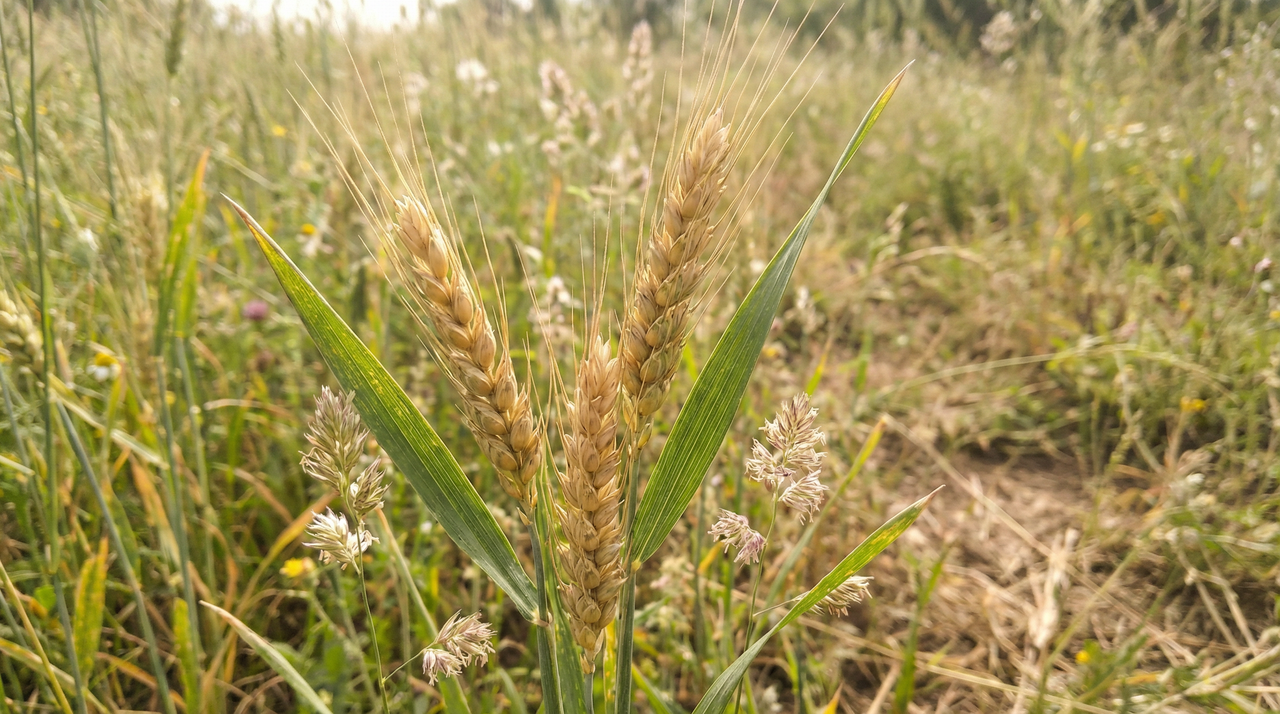
Wheat is the crop that supposedly domesticated us, not the other way around. There's a serious argument, made by anthropologists and more than a few contrarian ecologists, that Triticum aestivum effectively recruited human civilization to spread it across six continents, building entire cultures around its care and feeding.[1] I think about that every time I'm standing in a small grain plot in late spring, watching the awns catch the light and the whole stand shiver in a breeze, and I realize I've organized my entire autumn planting calendar around the vernalization needs of a grass. The plant won. And I'm fine with it.
What gets me, though, is how little most gardeners and even farmers actually know about the plant itself, separate from the flour it becomes. Bread wheat is a genetic chimera, a naturally occurring polyploid carrying the fused genomes of three different wild grasses, a biological accident so unlikely that it's happened only a handful of times in all of evolutionary history.[2] That strangeness is baked into every loaf, every bowl of pasta, every flat of wheatgrass on a juice bar counter. Once you see wheat that way, growing it feels less like farming and more like tending something genuinely ancient and strange.
The Origin and History of Wheat
Every loaf of bread you've ever eaten is, in a very real sense, the product of two wild grasses colliding in the hills of the ancient Near East. Triticum aestivum, the botanical name of the wheat plant we rely on today, didn't exist until roughly 8,000 BCE, when a natural hybridization event between Triticum turgidum and the wild goat grass Aegilops tauschii produced a hexaploid genome that had never existed before.[3] That collision created something with enormous agricultural potential: a grain that was robust, high-yielding, and genetically versatile in ways its tetraploid emmer ancestor simply wasn't. The wild progenitor species, including Triticum dicoccoides and Aegilops tauschii, were native to a crescent of land spanning southeastern Turkey, Syria, Lebanon, northern Iraq, Israel, Jordan, and western Iran.[4][5][6] That region is still one of the most important genetic reservoirs on earth.
One thing that made wheat so useful to early farmers was its lifecycle. As an annual monocarpic plant, it completes its entire arc from germination to seed production in a single growing season and then dies.[7][8][9] Predictable. Harvestable. Storable. For Neolithic farmers learning to plan ahead, that rhythm was everything. Emmer wheat was already domesticated around 10,000 years ago, selected over generations for non-shattering rachises (so the grain stayed on the stalk rather than dropping before harvest), larger seeds, and free-threshing traits that reduced processing labor.[10] Durum came later, an allotetraploid refined from cultivated emmer through selection for those same free-threshing qualities.[11] Spelt took its own evolutionary detour, a hexaploid like bread wheat but with hulled grains that remain locked inside their glumes, a trait that slows processing but offers remarkable field resilience.[12][13] Anyone who's dehulled spelt by hand quickly appreciates why free-threshing bread wheat spread so rapidly, yet that extra step is worth it for the resilience and flavor many growers and bakers now seek.
Botanical Background and Visual Characteristics of Wheat
Triticum aestivum is an upright annual grass in the Poaceae family with a fibrous root system that can reach 24 to 72 inches into the soil, hollow culms for strength without weight, and linear leaves 10 to 30 cm long that catch light efficiently in dense plantings.[14][15][16] The terminal spike runs 10 to 20 cm and holds 15 to 25 spikelets; the grain itself, technically a caryopsis, measures 5.5 to 7.5 mm. Modern semi-dwarf bread wheat cultivars typically stay between 60 and 120 cm tall, bred short to reduce lodging under heavy fertilization.[14][17]
The contrast between modern bread wheat and its ancient relatives is immediately visible in the field. Spelt can tower 100 to 180 cm, with broad bluish-green leaves, vigorous tillering, and notably deeper root architecture that gives it genuine drought resilience on marginal soils.[18][19] Durum sits at 70 to 120 cm, with dense, awned spikes and the hard amber kernels prized for semolina.[20][21] When I'm designing edible landscapes and considering where to site a small heritage grain planting, those rooting depth differences matter as much as the above-ground aesthetics. Spelt's deeper profile stabilizes soil in ways a short modern variety simply doesn't replicate, and in nutrient-variable soils I've seen tillering shift dramatically based on what's available at depth.
Traditional, Cultural, and Symbolic Uses of Wheat
Wheat's domestication anchors firmly around 9,000 to 10,000 BCE, at sites including Karacadağ in southeastern Turkey, the Levant, Çatalhöyük, and Jericho, where archaeobotanical evidence shows early farmers selecting for the traits that would define agriculture itself.[22][23] From there, the crop moved with remarkable speed. Neolithic farmers carried it into Europe beginning around 7,000 BCE via Mediterranean and Danube corridors, reaching Britain by 4,000 BCE; Spanish colonizers brought it to the Americas in 1519, and English settlers followed.[24][25] Ten thousand years of co-evolution in every bite isn't just a nice phrase; it's the actual timeline.
What's striking, looking across cultures, is how consistently wheat was understood as sacred. The Greek Demeter myth and the Eleusinian Mysteries placed wheat at the center of death and renewal. In Egypt, Osiris was bound to wheat as a symbol of resurrection, with emmer appearing in funerary rites alongside the living. Rome honored Ceres with festivals of the grain; Christianity built the Eucharist around it; Chinese and Hindu traditions wove wheat into symbols of longevity and prosperity.[26][27] It's no accident that cultures worldwide saw wheat as a symbol of resurrection. The plant's capacity to feed, to return from cold dormancy, to anchor soil and civilization simultaneously, is literally written into its biology.
Each species carried its own cultural identity. Emmer was the principal bread and beer grain of ancient Egypt from roughly 3,000 to 1,500 BCE. Durum became inseparable from Italian pasta and North African couscous. Spelt defined alpine and German-speaking European foodways from the Bronze Age through the Middle Ages.[27][28][29] That cultural specificity is now at risk. Modern monoculture has driven approximately 75% loss of wheat's genetic diversity since the Green Revolution.[30][31] In my work designing diverse food systems, I see the consequences of that narrowing constantly, and it's why I advocate for integrating mixtures of ancient and modern wheats rather than committing entirely to any single high-yield monoculture.
Wheat Production, Yields, and Modern Context
The scale of global wheat production is genuinely difficult to hold in your head. In 2022, farmers worldwide harvested 775 million metric tons, with China contributing 131 million, India 109 million, and the EU another 60 million.[32] The crop provides 20 to 50 percent of daily calories in 56 countries. Under optimized industrial conditions, bread wheat can yield 100 to 120 bushels per acre; durum tops 10 metric tons per hectare in favorable climates.[33][32] Spelt, by contrast, sits at a modest 20 to 40 bushels per acre, and global spelt production remains a niche 200,000 to 300,000 metric tons annually, mostly in Europe.[34][35] Canada leads global durum production. Modern industrial milling now extracts 30% more flour per ton than 1950s methods, and durum's hard vitreous endosperm (12 to 15 percent protein) makes it uniquely suited to semolina and pasta.[36][37]
Those yield numbers are impressive, but they don't tell the whole story. Practices like crop rotation, reduced tillage, intercropping, and cover cropping consistently improve soil microbial diversity, nitrogen efficiency, and erosion control in wheat systems, and ancient grains like spelt and emmer bring greater built-in resilience alongside nutritional depth.[38][39][40] Growing heritage wheats in small mixed plots has shown me how much more flavor and soil health they can deliver compared to modern high-yield varieties tuned for maximum output under high inputs. The genetic diversity that built civilization over ten millennia is still there, still functional, still worth tending.
Wheat Varieties and Sourcing
USDA Wheat Classes and Notable Cultivars
The USDA recognizes six market classes of wheat, and understanding them saves a lot of confusion at the seed catalog stage. Hard Red Winter, Hard Red Spring, Soft Red Winter, Soft White, Hard White, and Durum are separated by hardness, color, and growing season, but what really matters to a grower or home baker is protein.[41][42] Hard Red Winter and Hard Red Spring both run 11-16% protein with strong gluten networks -- the kind that trap gas and give you a proper open crumb.[41] I've milled both and can tell you the difference in dough feel is immediate: Hard Red Spring flour is noticeably more elastic and resistant, almost springy under your hands, while Soft White produces something closer to cake flour. Soft Red Winter and Soft White drop to 8-11% protein, which makes them ideal for pastries, cookies, and noodles but frustrating if you're after a chewy sandwich loaf.[41]
If you're in the Midwest and want a reliable hard winter variety, Jagger and Bobcat are two public-domain cultivars worth knowing. Jagger comes from USDA-ARS breeding with solid yield and good disease resistance; Bobcat was selected for milling quality and stripe rust resistance out of Kansas.[43][44] Both average 40-60 bushels per acre with fall planting and June-July harvest.[45] In the Pacific Northwest, Hard White varieties like Eltan from Washington State University fill a niche for white noodle and specialty bread markets.[43] For the Eastern U.S., Soft Red Winter names like Pioneer 26R10 and Ernie dominate because their high yield potential suits the heavier, wetter soils there.[46] Public breeding programs at USDA-ARS, Kansas State, Washington State, and North Dakota State continue releasing improved lines using genomic selection, CRISPR, and speed breeding that compresses development cycles from 12 years down to about 5, targeting drought tolerance, earlier maturity, and resistance to Fusarium and the rust complex.[47][48] I lean toward those public-domain releases for my own small plots specifically because I can save and share the seed without licensing complications.
Ancient Wheats: Spelt, Durum, and Emmer
Durum (Triticum durum) is technically a close relative of common wheat rather than a direct ancestor, but it dominates a very specific market: pasta and semolina. Over 90% of U.S. durum is spring-sown, concentrated on 500,000-plus acres in North Dakota, running 12-15% protein with the strong, extensible gluten that makes good pasta hold together through a boil.[49][50] USDA-ARS and North Dakota State have released a solid roster of named varieties -- Divide (with Fusarium head blight resistance, released 2015), Joppa, Briggs, Carpio, and Kronos among them -- yielding 30-50 bushels per acre under good conditions.[49][51]
Spelt and emmer are where things get genuinely interesting for the permaculture-minded grower, though you need to go in with clear eyes about the trade-offs. Both are hulled wheats, meaning the grain stays tightly wrapped in its hull after threshing. That hull is fantastic for field storage and disease protection, but on a small scale, dehulling by hand is genuinely tedious. I learned this lesson the first time I grew spelt and found myself running grain through a thresher twice just to get clean kernels. Spelt averages 20-40 bushels per acre[52] -- well below modern free-threshing wheats -- but European cultivars like Oberkulmer Rotkorn and Zollernspelz show decent disease resistance including to Fusarium, leaf rust, and some Hessian fly populations, and the whole-grain protein runs around 14.5%.[53][54] The lower gluten elasticity means denser, nuttier bread -- which many people prefer once they taste it.
Emmer (Triticum dicoccon, also sold as farro) is the one I keep coming back to on poorer soils. Its deep roots give it real drought tolerance and weed competitiveness that free-threshing modern wheats simply can't match at low-input fertility levels.[55] Protein ranges from 12-18% depending on the accession[56], and yields sit in that same 20-40 bushel range as spelt.[57] Globally it's still a niche crop, grown on perhaps 10,000-20,000 hectares for specialty organic and heritage markets, with notable landraces preserved at CIMMYT and ICARDA genebanks.[56] In a salad or pilaf, the nutty chew of emmer is unmistakable -- it tastes like grain, not flour, in the best possible way.
Sourcing Wheat Seeds: Suppliers, Regulations, and Quality Standards
To put the scale in context: U.S. wheat covered roughly 37.5 million acres in 2024, producing an estimated 1,820 million bushels. Common bread wheat dominates that acreage, durum accounts for 500,000-plus acres in the Northern Great Plains, and spelt sits at somewhere between 5,000 and 10,000 acres total -- less than 0.1% of the national wheat crop.[58] For a home grower, those numbers are mostly useful as a reminder that the infrastructure for seed sourcing is well established for common types and thinner but still workable for the ancient relatives.
For actual purchasing, Johnny's Selected Seeds, Seed Savers Exchange, Baker Creek Heirloom Seeds, Fedco, Territorial Seed Company, Osborne Seed, Albert Lea Seed, and Eden Brothers all carry wheat in various forms -- bread wheat, durum, spelt, and emmer included, with organic and heirloom options widely available.[59][60][61] One hard-won lesson: don't try to plant grain from the bulk food bin. Whole grain sold for cooking is often heat-treated or too old to germinate reliably. I always buy seed certified for propagation from a reputable supplier, with documented germination above 85% and purity above 98-99% -- because starting with weak seed guarantees a disappointing stand regardless of how well you manage everything else.[62] Many newer cultivars carry Plant Variety Protection status, which matters if saving seed commercially, though public-domain varieties sidestep that entirely.[62]
Prices vary considerably. Hard red spring wheat runs roughly $0.40-0.80 per pound; organic spelt in 50-pound bags lands around $80-150; emmer packets run $3-5 with per-pound prices reaching $20-40; durum packets typically fall between $3.95 and $9.95, with bulk pricing from $12-28 per pound.[63][64] Heritage and certified organic stock often carries a 20-100% premium over commodity seed.[65] Anyone importing seed from abroad should know that USDA APHIS requires a phytosanitary certificate from the exporting country plus an import permit, and seed must be demonstrably free of quarantine pathogens like Karnal bunt under the Plant Protection Act.[66] It's a real requirement, not bureaucratic noise -- Karnal bunt can follow contaminated seed for years.
Wheat Propagation and Planting Guide
Wheat is, almost without exception, a seed crop. There's no division, no cuttings, no layering to worry about. That simplicity is a genuine asset, and it runs deeper than convenience. Because Triticum aestivum is self-pollinating more than 95% of the time, each generation stays genetically stable and true-to-type.[67][68] Save seed from a good stand, and what you grow next season will look and perform almost identically. That's the biological reward of a predominantly selfing annual, and it's why home seed-saving with wheat is so much more straightforward than with a cross-pollinated crop like corn.
Wheat Seed Characteristics and Propagation Methods
Wheat seeds are orthodox, meaning they tolerate desiccation well and can remain viable for an extraordinary length of time under the right conditions. Genebanks store them at 0 to 10°C with seed moisture content held at 5 to 6%, where viability can theoretically extend 50 to 100 years or more.[69][70] For the rest of us, practical storage targets are more modest but still impressive: keep moisture content below 12%, store at 5 to 10°C in hermetic containers, and relative humidity around 10 to 20%.[71][72] I've found that hermetically sealing home-saved wheat in my garage at those temperatures keeps germination rates above 85% for two to three years without much fuss. Useful data point for anyone nervous about saving grain from a good harvest year.
Before sowing, a germination test is worth the ten minutes it takes. Standard protocols from ISTA and AOSA give you a reliable viability number; the tetrazolium assay works if you need a fast answer.[73][74] Watch out for granary weevils and confused flour beetles in stored grain, and if you're working with saved seed from a disease-prone area, a pre-storage hot-water treatment addresses seed-borne issues like bunt or Fusarium before they carry over into the next crop.[73]
Sowing depth should be 1 to 2 inches, with soil temperature in the 50 to 65°F range for reliable germination, optimally around 59°F.[75][76] The timing choice that matters most is whether you're planting a winter type or a spring type. Winter varieties go in September through November and need four to eight weeks of cold vernalization at 0 to 10°C before they'll flower; spring types follow in March through May without that cold requirement.[77][78] I've grown both, and properly vernalized winter wheat consistently outyields spring wheat when sown in that autumn window. The longer growing season and slower tiller development simply give the plant more time to build yield potential. Hulled ancient types like spelt and emmer sometimes show slightly different dormancy behavior and may benefit from after-ripening before planting, a minor but worth-knowing distinction from free-threshing modern bread wheat.[79]
One misconception worth clearing up: grafting wheat onto barley or related grasses exists as a research technique, but success rates vary wildly (20 to 80%) and it has no commercial or garden-scale application.[80] Wheat is a monocot, and clonal propagation the way you'd handle a fruit tree simply isn't how this plant works. Seeds are the whole story.
Optimal Soil, Site, and Sun Requirements for Wheat
Wheat prefers well-drained loamy soils, with silt loam or clay loam being the sweet spots, though it adapts reasonably well to sandy or silty textures as long as drainage is adequate.[81] What it genuinely cannot tolerate is waterlogging. Yield losses of 20 to 50% occur from root damage when soils stay saturated too long.[82] Root depth matters here, too: common bread wheat roots typically reach 1 to 1.5 meters, while spelt roots can penetrate 2 to 3 meters, which is part of why spelt performs better on compacted or drought-stressed ground.[83] I've dug up both side by side in garden trials, and the difference in penetration depth is genuinely striking.
Soil pH should sit between 6.0 and 7.5, with 6.5 being the practical ideal.[84] Drop below 5.5 and aluminum toxicity kicks in while phosphorus becomes unavailable, showing up as purplish leaves and stunted roots.[85] I learned this the uncomfortable way on a slightly acidic plot at pH 5.8 where the young wheat developed that classic purplish tint within a few weeks. A lime application the following season corrected it entirely, but that experience is why I now always run a soil test before planting. At the alkaline end, above 7.5 or so, iron, zinc, and manganese deficiencies cause interveinal chlorosis.[84] Durum tolerates up to pH 8.0 to 8.5 and handles saline semi-arid conditions better than common wheat; spelt reaches slightly further into acidic territory, down to about 5.5.[86]
Soil organic matter in the 1 to 3% range is the functional target, with benefits continuing up to 5 to 6%.[87] Compost or aged manure at 5 to 20 tons per acre improves structure significantly, though exact amendment rates should always come from a soil test rather than a formula.[88] For container growing, a mix of 40 to 50% potting soil or compost with 30 to 40% perlite or coarse sand in containers deeper than 30 cm gives adequate drainage; just know that nitrogen fertility will need regular attention in a container scenario.[89]
Sun exposure is non-negotiable. Wheat needs at least six to eight hours of direct sunlight daily, and it's a long-day plant that requires 14 to 16 hours of daylight to trigger flowering.[90] Shade causes etiolation, reduced tillering, and yield losses of 20 to 50%.[91] Planting wheat under or near trees in a forest garden context is genuinely asking for trouble. Site it in full sun, full stop.
Wheat Spacing, Seeding Rates, and Planting Technique
For most bread wheat, drilled rows at 6 to 8 inches apart with seeds placed 1 to 2 inches apart within the row is the practical starting point.[77][78] That geometry targets roughly 15 to 25 plants per square foot and corresponds to drilled seeding rates of 40 to 60 pounds per acre.[92] Spelt requires considerably more seed, typically 80 to 120 pounds per acre drilled, partly because the hull adds bulk and slightly reduces emergence efficiency.[93] If you're broadcasting rather than drilling, bump rates up by 10 to 20% to account for uneven distribution.
The logic behind these numbers connects directly to outcomes you can observe in the field. Narrower rows on fertile soils improve light interception as the canopy closes, suppress weeds more effectively, and make better use of available moisture and nutrients.[94] In a drier year, I've shifted from 6-inch to 10-inch rows and seen noticeably reduced early drought stress alongside lower fungal pressure, without a dramatic yield penalty. Wider spacing reduces plant-to-plant competition for water and also improves air circulation through the canopy, which matters more in humid climates where foliar disease pressure is high. Organic systems often push rows wider still, to 10 to 12 inches, specifically to allow mechanical weeding without damaging the crop.[95]
Mature wheat stands 24 to 48 inches tall, with spelt reaching 3 to 5 feet, so factor canopy height into any companion planting decisions.[94] For small-scale or backyard growing, where harvesting machinery isn't a constraint, you have more flexibility on spacing than commercial guides suggest. That said, local university extension recommendations will always be more accurate for your specific region and variety than any general rule, including this one.
Wheat Care Guide: Growing, Maintenance, and Seasonal Management
Every decision you make growing wheat flows from one fundamental choice: spring or winter type. Spring wheat sprints from seed to harvest in 90 to 120 days, planted as soon as soils are workable and out before summer heat peaks.[96] Winter wheat takes the long road, eight to ten months from fall planting through a full overwintering and into early summer harvest, with vernalization (four to eight weeks below roughly 45°F) as the biological requirement that makes it tick.[97] I've grown both, and I'll tell you the first thing I learned: label your rows obsessively in early spring, because wheat seedlings look exactly like grass, and it's embarrassingly easy to mistake a young winter wheat plot for a weed until tillering begins.
Water Requirements and Irrigation Scheduling
Wheat needs 15 to 25 inches of seasonal water, with peak demand hitting 1 to 1.5 inches per week from jointing through grain fill, the window that accounts for 50 to 60 percent of total uptake.[98] Roots go deep, sometimes 3 to 6 feet, but most active uptake happens in the top 2 to 3 feet, so surface dryness is a real signal.[99] When I see leaves rolling during jointing, I irrigate that day. Checking moisture at 6 inches depth takes 30 seconds and has saved me more than one crop at a critical window. Yield losses from stress at jointing, booting, anthesis, or grain fill can hit 50 percent, so those stages are non-negotiable.[98]
Overwatering causes its own problems. Waterlogging drives out soil oxygen, triggering lower-leaf yellowing, poor tillering, and root rots from Fusarium and Pythium.[100] If you're irrigating, keep water pH between 6.5 and 8.4 and electrical conductivity below 0.75 dS/m ideally, though wheat tolerates up to 3 dS/m.[101] Spelt, emmer, and durum all show meaningfully better drought tolerance through deeper root systems, sometimes needing 20 to 30 percent less water in dryland situations.[86]
Fertility and Nutrient Management
Wheat is a heavy nitrogen feeder, but the timing matters more than the total. Uptake is low early, then peaks sharply during tillering and stem elongation, capturing 40 to 60 percent of total N during that window. Another 20 to 30 percent of grain nitrogen comes later from translocation out of vegetative tissues during grain fill.[102][47] Total demand runs 1.2 to 2.0 kg N per 100 kg of grain yield depending on yield goal.[103]
Splitting applications has consistently given me higher-protein grain and less lodging than single pre-plant doses. A typical split puts 20 to 50 percent down pre-plant, 30 to 50 percent top-dressed at tillering, and a final 20 to 30 percent at booting if the crop needs it, with total N rates ranging 80 to 150 lbs per acre guided by soil tests.[103][104] Phosphorus and potassium go in at planting based on soil test results. Deficiency symptoms are readable: nitrogen shortage shows as yellowing from older leaf tips inward; phosphorus deficiency produces purplish lower leaves and stunted roots; potassium deficiency gives you marginal leaf necrosis, weak stems, and shriveled grain.[105] Zinc is the most common micronutrient problem, especially in high-pH alkaline soils, showing as stunted growth and white leaf streaks.[106] Excess nitrogen is equally problematic: too much promotes lodging, delays maturity, and increases disease pressure.[105] Growers on marginal or organic ground often turn to spelt for good reason: it typically needs 20 to 50 percent less nitrogen than modern bread wheat and has the root system to find what it needs.[107]
Sunlight and Temperature Needs
Wheat is a full-sun crop, period. Consistent daylight exposure during the vegetative phase guarantees adequate photosynthesis, proper tillering, and acceptable yield.[108] In my home garden plots I've seen the difference between a south-facing bed with clean sun exposure and one partially shaded by a fruit tree: the shaded rows tiller weakly and yield losses can hit 20 to 50 percent in severe situations.[109] Wheat's optimal daytime temperature range is 20 to 25°C through the vegetative stages, with heat stress beginning around 32 to 35°C.[110]
Frost and Heat Tolerance
Winter wheat survives cold through genuine physiological adaptation. Triggered by non-freezing low temperatures, the plant accumulates proline and soluble sugars, adjusts membrane lipid composition, and activates the CBF pathway to upregulate cold-response genes.[111][112] A well-acclimated vegetative plant handles -8°C to -15°C without serious damage. The dangerous moment is late spring, after de-acclimation has already begun: reproductive tissues are damaged below -2°C to -5°C, and a single frost event at that stage can be more costly than any winter cold snap.[113] Snow-trapping stubble, 2 to 4 inches of straw mulch, and smart site selection with good air drainage are your practical options.[114] Spelt is impressively hardy, tolerating -20°C to -25°C under snow cover; emmer manages -15°C to -20°C.[115]
Heat at anthesis is the other critical threat. Above 30°C, pollen sterility increases sharply, and yield losses of up to 50 percent are documented.[116] I think of it the way I think about tomatoes under summer heat: the window when pollen is viable is narrow and unforgiving, and once it's gone, fruit set (or grain set) simply doesn't happen. Supplemental irrigation at anthesis and through grain fill can recover 25 to 50 percent of heat-related yield losses.[117] Adjusting planting dates to push anthesis into cooler windows, selecting tolerant varieties, and mulching to drop canopy temperature 2 to 5°C are your primary tools.[118]
Seasonal Growth Rhythm and Lifecycle
Spring wheat grows fast, completing its full lifecycle in 90 to 120 days.[119] Winter wheat moves through germination, tillering (roughly 10 to 30 days post-emergence), jointing, booting, heading, anthesis, grain fill, and maturity over 240 to 300 days total.[97] Tillering is where the crop builds its yield potential: each tiller that survives to head becomes a yield unit, and this is the stage where nitrogen supply, temperature, and moisture interact most powerfully. I've come to think of tillering as the stage that decides everything that follows. Get nutrition and moisture right here and the rest of the season has a foundation to build on.
Optimal vegetative growth happens between 15 and 25°C with consistent moisture and pH held between 6.0 and 7.5.[96] Anthesis typically falls between May and July depending on type and region, with grain fill and maturity following in June through August.[97] Humid weather during grain fill raises Fusarium head blight risk significantly, which is why regional scouting and fungicide timing at flowering is so important in wet years.
Maintenance, Pruning Alternatives, and Common Pitfalls
Wheat doesn't get pruned. Management instead focuses on tillering optimization through seeding rate (60 to 120 lbs per acre for winter types, 90 to 120 for spring), balanced nitrogen to avoid excessive vegetative mass, and short-stemmed varieties or growth regulators to prevent lodging.[120] Drill seeding at 1 to 2 inches depth in 6 to 12 inch rows is preferable to broadcast for uniform emergence and disease management.[121] Rotating with legumes breaks disease cycles and rebuilds nitrogen, a pairing that fits naturally into any regenerative system.
The pitfalls I see most often are planting winter wheat too late (insufficient fall growth before dormancy, meaning thin root systems going into winter), pushing nitrogen too hard in spring (the plants look lush but lodge badly at grain fill), and harvesting too early or too wet.[122] Target 13 to 15 percent grain moisture at harvest. Post-harvest, dry grain down to 12 to 14 percent and store below 15°C with relative humidity under 60 percent.[123] Keeping moisture at or below 13 percent has prevented mold in my stored grain across multiple seasons. Those few percentage points matter more than most growers expect. Spelt and emmer are notably more forgiving on fertility than modern bread wheats, which makes them worth serious consideration for anyone farming organically or on thinner soils.[107]
When and How to Harvest Wheat
Of all the decisions in a wheat-growing season, harvest timing is the one that keeps me most alert. You can do everything right from seeding to tillering and still shortchange yourself at the end if you're not watching the crop closely as it approaches maturity. The window is genuinely narrow, and the signals the plant gives you are worth learning to read fluently.
Timing and Maturity Cues for Optimal Wheat Harvest
Wheat reaches harvest readiness when grain moisture drops to 13-15%, kernels turn golden-amber and harden to the point of resisting thumbnail pressure, the straw goes fully golden, and lower leaves have senesced.[124][125] Physiologically, this corresponds to Zadoks stage 92, roughly 35-60 days after anthesis under moderate conditions, with grain-filling temperatures ideally sitting between 68-77°F; if you're growing into a heat wave above 86°F, that window compresses by 5-10 days and can sneak up on you.[126][127][128] I learned to test kernel vitreousness early in my small-plot trials by biting into a few grains from across the plot, not just the center. Soft, floury texture means wait. That satisfying crack of a truly hard kernel is what you want before you commit to cutting.
Total time from planting varies considerably: spring wheat typically matures in 90-130 days, while winter wheat (and especially spelt) runs 240-300 days when you account for vernalization.[129][130] In U.S. production, winter wheat is typically harvested May through early July, spring wheat and durum from July into September.[131] Whatever the variety, the practical harvest window is about 7-10 days before shattering, sprouting, or quality degradation starts cutting into your efforts.[132] I had a season where a forecasted rain system pushed me to cut two days earlier than I wanted, and while the yield was fine, the moisture was borderline and drying took more energy than usual. That experience made me a serious GDD tracker.
Spelt is the forgiving outlier here. Its hull shields the grain so effectively that it can stand in the field and dry down naturally without the same sprouting risk common wheat faces.[133][134] I've grown both side-by-side and spelt consistently gave me more scheduling flexibility. Durum and emmer share the same 13-15% moisture target at maturity, with durum sometimes described as ready when roughly half the peduncle has gone straw-colored at the 12-18% range.[135][136]
Harvest and Post-Harvest Techniques
At small-plot scale, I harvest by hand or with a small-plot combine, ideally in the early morning when slightly higher humidity reduces grain shatter at the head.[137] Post-harvest, the sequence is threshing (targeting over 95% efficiency with less than 1% grain damage), cleaning via sieves and air aspiration to reach at least 98% purity, then rapid drying to 12-14% moisture within 24-48 hours of harvest using temperatures kept below 43°C to protect milling and baking quality.[138][139] I don't let grain sit at above 15% moisture even overnight if I can help it; research and my own experience both confirm that delays invite mold and dull the clean, nutty flavor I want for bread. Durum gets dried further, typically to 8-9%, before long-term storage.[140] Spelt is the exception again, since its hull allows extended field drying that can reduce or even bypass artificial drying entirely.[133]
Wheat Yield and Flavor Profile at Harvest
What you do at harvest directly determines what ends up in your bread. Wheat grain carries a baseline profile of mild sweetness from natural sugars, nutty notes from Maillard precursors and lipid oxidation, subtle bitterness from bran phenolics like ferulic acid, and a quiet umami depth from free glutamates.[141][142] The raw grain aroma is earthy and grain-like with hay and malt hints from volatiles including hexanal and related ketones; milling softens that intensity toward starchy notes, while baking develops the toasty, yeasty, and caramel tones most of us associate with a good loaf.[143] Variety, terroir, and processing all shift the intensity: hard red wheats read as more robust and cereal-forward, soft whites are milder and floury, durum leans roasted-nut, and spelt brings a persistent malty, roasty character with higher chewiness in whole-grain form.[144][145] My plots in warm, humid conditions tend to produce grain that skews earthy and nutty with less of the delicate sweetness I'd expect from the same variety grown in a cooler, drier region, which tracks with the terroir research showing that arid conditions intensify earthy metabolite expression.[146] Timely harvest at physiological maturity locks all of that in; wait too long and sprouting enzymes start degrading the starches and proteins that carry those nutty, sweet notes, sometimes introducing off-flavors that no amount of sourdough fermentation fully rescues.[124][147]
Wheat Culinary Uses and Preparation Methods
Culinary Uses and Flavor Profiles of Wheat and Ancient Grains
Every wheat kernel is a three-part system: starchy endosperm (about 80% of the grain's mass), nutrient-dense germ, and fibrous outer bran.[148][149] Refined flour extracts mostly the endosperm; whole grain keeps everything. Hard wheats, with 11-15% protein, build the strong gluten network bread and pasta need, while soft wheats at 8-11% protein give you the fine, tender crumb pastries require.[150][151] Durum sits at the hard extreme, producing the firm semolina that holds pasta al dente.[152]
Raw grain has a pleasant nutty, earthy sweetness with faint malt undertones, but baking transforms it entirely through Maillard reactions that build the toasty, yeasty complexity we actually crave in a good loaf.[153] I mill my own spelt and wheat berries at home, and the difference in aroma between freshly milled flour and a bag that's been sitting in a store is genuinely striking. Spelt adds a slightly maltier, richer character to sourdough; emmer goes earthier and nuttier, fantastic in farro risotto or soups the way you'd use barley.[154][153] Wheat has been central to bread, porridge, and beer from Mesopotamia to Rome,[22] and it still delivers roughly 20% of global calories today.[155] That continuity means something.
On storage and digestibility: whole kernels keep up to a year unrefrigerated, while flour lasts about six months refrigerated in an airtight container, and both require moisture below 13-14% to stay free of mold and rancidity.[156][157] I always soak or sprout berries before cooking or grinding them. These traditional preparation methods neutralize antinutrients to meaningfully improve mineral absorption and overall digestibility.[158][159] A long sourdough ferment for whole wheat bread honey recipes or a slow overnight soak for berry-based grain bowls isn't fussy tradition; it's practical food science with a long track record.
Medicinal and Traditional Preparations from Wheat
Wheat bran used as a bulk-forming preparation (roughly 15-30g daily with adequate water) has a long history as a straightforward remedy for constipation, and it's one of the more well-supported traditional uses.[160] Wheatgrass is a different story entirely. Young shoots harvested before the jointing stage are low in gluten and consumed as 30-60ml of fresh juice or 3-5g of powder for nutritional support and detoxification.[161] In my experience, the sweetest, most vibrant juice comes from shoots at the one-to-two-inch stage. Go past that, and you get more fiber than flavor.
Traditional systems used wheat preparations more broadly: wheat sprouts appear in Traditional Chinese Medicine for digestive and detoxifying support, while Balkan and Mediterranean folk medicine employed wheat bran as a laxative, emmer and spelt in poultices for skin ailments, and decoctions for digestive complaints.[162][163] Ancient roasting, sprouting, and fermenting weren't just culinary choices; they were also practical ways to improve both bioavailability and digestibility. Common starting doses for wheat-based herbal preparations run 1-2 teaspoons of powder, 100-200ml of sprout juice, or 5-10g dried material steeped as an infusion, and it's wise to start low.[164] The clinical evidence here is thinner than the tradition, so I treat these preparations as accessible home remedies rather than prescriptions.
Non-Food Uses of Wheat Straw and Byproducts
Once the grain is harvested, the straw still has work to do. Traditionally it became baskets, mats, brooms, and thatch across Europe, Asia, and East Africa.[165] In my garden, spent wheat straw from small grain patches goes straight down as the base layer in no-till beds each fall. It retains moisture, suppresses winter weeds, and breaks down over winter to feed soil biology in a way wood chips simply won't do for annual vegetable beds.[165] Spelt straw, with its tougher fiber, also suits weaving and thatching particularly well, and it serves as animal bedding and biofuel stock.[166] Nothing about wheat needs to leave the system. From flour to wheatgrass to straw mulch, the whole plant cycles back through the garden in some form, and that closed loop is exactly what makes it worth growing beyond the grain itself.
Wheat Health Benefits and Medicinal Uses
Wheat isn't an herb you tincture or a root you decoct. Its health story is quieter than that, built on the steady, compounding effect of whole-grain consumption over a lifetime. But quiet doesn't mean unimpressive. The research behind wheat's bran and germ is genuinely robust, and when I recommend whole wheat or spelt to clients designing edible systems, I'm drawing on clinical data that holds up, not marketing copy.
Phytochemical Profile of Wheat: Ferulic Acid, Flavonoids, and More
The phytochemical richness of wheat is concentrated almost entirely in the layers that industrial milling discards first: the bran and the germ. The grain carries phenolic acids, flavonoids (including apigenin and luteolin glycosides), lignans, alkylresorcinols, phytosterols, tocopherols, and a range of secondary metabolites including saponins, tannins, and terpenoids.[167][168] Ferulic acid dominates, often accounting for up to 90% of total phenolics and exceeding 500 mg per 100g dry weight in bran, mostly bound to cell walls in the bran and aleurone layers where it's least accessible in refined products.[169]
In my work with clients who want nutrient-dense edibles without chasing exotic superfoods, I often point them toward spelt or emmer for exactly this reason. Those ancient relatives carry 20-50% higher levels of phenolic compounds and lignans, with 15-30% greater antioxidant activity than modern common wheat.[170] That gap isn't accidental. Domestication progressively reduced secondary metabolite diversity in modern cultivars, and growing conditions still matter: organic systems and drought stress can push plants toward higher phytochemical accumulation, which is why I always note that how you grow grain is part of the nutritional story.[171][172]
Evidence-Based Health Benefits from Traditional Use to Modern Research
Cultures from ancient Egypt and Mesopotamia to traditional Chinese and Ayurvedic medicine used wheat to address digestive complaints, skin conditions, inflammation, insomnia, and general vitality. In TCM, wheat (xiao mai) specifically nourishes the heart and calms the spirit.[173][174] What's striking is how well those traditional applications map onto what modern research has actually found, even if the mechanisms weren't understood at the time.
The strongest clinical territory is cardiovascular. Wheat bran fiber and arabinoxylans bind bile acids in the gut, producing modest but consistent LDL reductions of around 5-10 mg/dL in human trials, while phytosterols and tocopherols from the germ reduce cholesterol absorption further.[175][176] Those aren't dramatic numbers, but they represent a real dietary swap with real outcomes. When I suggest whole wheat bread over white to a client focused on heart health, I'm pointing at exactly that fiber-driven mechanism, not a miracle. Glycemic control benefits follow a similar pattern: arabinoxylans slow enzyme activity, modulate gut microbiota, and support a lower glycemic index response overall.[177]
Ferulic acid, luteolin, and alkylresorcinols show antioxidant activity through free-radical scavenging, inhibition of lipid peroxidation, and activation of the Nrf2-ARE pathway.[178][179] Wheatgrass and germ extracts show anti-inflammatory effects in preclinical models, with inhibition of TNF-α, IL-6, and NF-κB signaling, and wheat germ agglutinin has been studied for potential anti-cancer properties in vitro.[180][181] Those findings are promising, but most remain preclinical or from small pilot trials. Systematic reviews are clear that whole wheat delivers benefits consistent with other whole grains, without strong evidence that ancient varieties dramatically outperform modern ones at the clinical level.[182][183] Reliable fiber and phenolics, consistently consumed, is the honest story here.
Nutritional Composition of Wheat and Its Relatives
Per 100g of raw whole-grain hard red winter wheat, you're looking at 13.2g protein, 71.2g carbohydrate, 12.2g fiber, and 1.9g fat, alongside meaningful amounts of thiamin (0.42mg), niacin (5.46mg), vitamin B6 (0.32mg), folate (44µg), and vitamin E (1.49mg).[184] Paired with legumes, whole wheat rounds out the amino acid profile nicely, which is why traditional food cultures rarely served bread alone.
Milling to white flour strips away 70-90% of B vitamins, 50-80% of fiber, and most of the phenolics and minerals.[185] I've experimented with sprouting wheat berries at home and noticed not just the textbook improvements in digestibility but a genuinely milder, slightly sweeter flavor. Sprouting reduces phytic acid by up to 50% and boosts certain B vitamins and mineral bioavailability, a real upgrade for anyone eating wheat daily.[185] Cooking improves starch digestibility but can cost 20-40% of thiamin in pasta through leaching.[186]
Spelt and emmer push protein to 14-16g per 100g, fiber to 10-12g, and carry higher iron, magnesium, and zinc, with elevated antioxidant capacity across the board. Durum stands out for lutein, at 2-6mg per 100g, which puts it in a different conversation for eye health.[187][188] Refine any of these species and the advantage largely disappears, which is the point clients often miss when they assume spelt flour automatically beats whole wheat flour.
Safety Considerations, Gluten, Allergies, and Antinutrients
Wheat itself is not inherently toxic. It has fed billions of people for ten millennia and does so safely when properly grown, stored, and processed.[189] The significant exceptions are well-documented and non-negotiable. Gluten, specifically the gliadin and glutenin proteins, triggers autoimmune intestinal damage in celiac disease and causes symptoms in non-celiac gluten sensitivity. Wheat allergy affects 0.2-1% of the population, with higher prevalence in children, and can produce hives, gastrointestinal distress, respiratory issues, or anaphylaxis.[190][191] I've guided enough clients through this conversation to be unequivocal: if celiac disease is in your family, no amount of ancient-grain marketing changes the fact that spelt and emmer still contain immunogenic gluten. The distinction between gluten intolerance and wheat allergy matters clinically, and both require avoiding all Triticum species.
Contaminant risks are real but manageable. Mycotoxins like deoxynivalenol (DON) from Fusarium and ergot alkaloids are regulated by FDA and EU limits, and keeping grain stored below 14% moisture is the single most important prevention step any home grower can take.[192] Raw flour also carries E. coli risk, something I remind anyone who's tempted to taste dough straight from the bowl.[193]
Phytic acid in bran, at 0.9-2% dry weight, can inhibit mineral absorption, and trypsin inhibitors impair protein digestion to a degree. Sourdough fermentation reduces phytate by 70-90%, soaking and sprouting offer substantial reductions as well, which is why traditional preparation methods weren't arbitrary.[194] High-fiber wheat can also bind certain medications including some antibiotics and thyroid drugs, reducing their absorption, and patients on warfarin should maintain consistent vitamin K intake from wheat-containing foods rather than swinging between whole-grain and refined choices.[195][196] For livestock, young stressed wheat plants can accumulate nitrates, and sudden large grain intake risks bloat or acidosis, both worth knowing if you're integrating wheat into a mixed polyculture system.[15]
Pests and Diseases of Wheat
Wheat holds its own reasonably well against pests compared to maize, requiring lower pesticide inputs overall,[197] but "reasonably well" can still mean losing a third of your crop on a bad year. I found that out the hard way in an early trial plot when Hessian fly quietly devastated about 30% of my stand before I even noticed the stunted tillers. That kind of loss is a fast teacher.
Major Insect Pests and Yield Impacts
The headline threats to bread wheat are Hessian fly, Russian wheat aphid, greenbug, wheat stem sawfly, and cereal leaf beetle, with spider mites and armyworms rounding out the list depending on region.[198][199] Hessian fly can take up to 50% of yield in susceptible varieties; Russian wheat aphid in untreated durum lines can hit 50-80% losses; sawfly-induced lodging runs up to 40% in unprotected fields; and cereal leaf beetle defoliation typically falls in the 20-30% range.[200][201][202][203] Those aren't fringe scenarios; they're what happens when pest pressure peaks and management is absent.
Spelt carries many of the same vulnerabilities but tends to fare better in organic systems, largely because hull protection and elevated phenolics make it less appealing to aphids.[204] Think of the hull the way you'd think of a thick tomato skin: it's not impenetrable, but it raises the cost of entry for insects enough to matter. Durum adds another layer of defense through solid stems and deep root architecture, which is why it holds up better against sawfly in the Northern Plains.
Wheat's biochemical toolkit is genuinely impressive. Seedlings produce benzoxazinoids like DIMBOA at 200-500 μg/g, phenolics ranging 0.5-2.5 mg/g dry weight, flavonoids, and cuticular waxes, while physical traits like dense leaf trichomes, thick glumes, and silica deposits slow insect movement and feeding.[205][206][207] For breeders and home growers alike, these are the traits that make resistant variety selection genuinely powerful rather than wishful thinking.
Fungal and Viral Diseases
Stem rust, leaf rust, Fusarium head blight (FHB), powdery mildew, and Septoria tritici blotch are the primary fungal threats, with barley yellow dwarf virus and wheat streak mosaic virus adding viral pressure on top.[198][208] Spelt shows lower susceptibility to rusts and powdery mildew than modern bread wheat, which is a real advantage in organic rotations, but it's more vulnerable to FHB and Septoria.[209][210] I've seen that FHB vulnerability show up hard in humid Pacific Northwest conditions, and it's the main reason I check local extension scouting alerts before deciding whether to grow spelt in a given season.
Defense Mechanisms and Genetic Resistance
Modern breeding has delivered named resistance genes that genuinely perform. Cultivars carrying Dn genes resist Russian wheat aphid; H genes confer Hessian fly resistance; Sr genes protect against stem rust; and Sm1 guards against orange wheat blossom midge.[198][211] In my own trials, varieties carrying Sm1 and Dn genes have held up reliably where unprotected lines struggled. Solid-stem varieties cut sawfly damage by more than 50%, and durum lines like Kronos, Desert King, and Cutter have shown strong field performance in high-pressure areas.[212] Spelt cultivars Oberkulmer and Frankenkorn carry leaf-rust QTLs on chromosomes 2A, 5B, and 7D and demonstrate higher inherent resistance to Hessian fly and aphids through both antibiosis and antixenosis mechanisms.[213] None of this is a guarantee; resistance shifts with biotype, environment, and region, so variety choice is the starting point, not the whole answer.
Integrated Pest Management (IPM) Strategies
Good IPM for wheat combines the genetics with cultural timing and biological allies. Delaying fall planting until soil temperatures drop to 45-50°F reduces Hessian fly establishment significantly, and rotating with non-cereal crops for two to three seasons disrupts both insect cycles and Fusarium carryover in the soil.[214][215] Ladybugs, parasitoid wasps, and predatory beetles do real work in the canopy when you give them a reason to stay, which means keeping some diversity in the surrounding landscape rather than treating every edge as waste space.
For chemical decisions, I scout weekly once tillering starts and lean on the established thresholds: 300-500 aphids per tiller and 1-2 cereal leaf beetle larvae per stem before intervening.[214][215] Applying that 1-2 larvae rule has saved me unnecessary sprays more than once. Climate is shifting the calculus too; warmer winters are expanding pest ranges and creating pressure in zones that previously had natural cold-season breaks.[216] Staying current with local extension guidelines isn't bureaucratic box-checking; it's how you find out which biotypes are active in your county this year.
Wheat in Permaculture Design
Most people who grow wheat are thinking about bread. In a permaculture context, I'd encourage you to flip that framing entirely and think about wheat as a soil-builder first, with grain as a welcome bonus. That shift changes every decision that follows.
Ecosystem Functions and Soil Benefits
Wheat's fibrous root system does serious work. As a cover crop, it scavenges residual nitrogen, potentially recovering 50-100 lbs per acre that might otherwise leach past the root zone, and cycles those nutrients back into the system for subsequent crops.[217][218] Those numbers vary widely by soil type, crop history, and application rate, so treat them as a range rather than a guarantee. The dense root mass also binds topsoil against erosion and produces somewhere between 4 and 8 tonnes of biomass per hectare that can be cut and composted, left as surface mulch, or incorporated to feed soil microorganisms.[217][219] The tight canopy it forms also suppresses weeds aggressively enough to matter.
Where wheat really earns its keep in a designed system is in rotation with legumes. Pairing it with peas, beans, chickpeas, or clover can improve nitrogen availability by 20-50%, push yield increases of 10-30%, and cut weed biomass by up to 40%.[220][221][222] One small caveat: some Triticum turgidum subspecies show mild allelopathic tendencies that could affect sensitive companion plants, so watch your intercrop choices with durum types.[222]
I've grown both common bread wheat and spelt side by side, and the difference in root penetration is genuinely striking. Spelt sends roots 3-6 feet down versus the shallower fibrous mat of modern wheat, which translates to noticeably better drought resilience and soil aggregation in the subsoil.[223][224] For drier or lower-input sites, that's a meaningful upgrade worth choosing deliberately rather than defaulting to whatever seed is cheapest at the co-op.
Wheat also offers quieter biodiversity benefits worth acknowledging. It improves soil structure, supports soil microorganisms, and the heading grain stands attract beneficial insects and small birds in ways you only notice when you're actually out there watching. I've stood in a ripening wheat block and seen more activity from predatory wasps and finches than I expected from what's essentially a monoculture annual.[224][225] That's not a reason to grow wheat on its own, but it's a reason not to dismiss it as ecologically inert. One honest caveat: wheat is non-native to North America, introduced from Eurasia, and I keep it entirely out of my native meadow and prairie guilds.[224] Use it where it serves a function; don't force it where it doesn't belong.
Climate Adaptability and Hardiness Zones
The first practical decision you'll make with wheat is winter versus spring type, and that choice is really a zone and vernalization question. Winter varieties perform best in USDA zones 5-7 (they'll survive zones 3-8 with reliable snow cover) and require a cold induction period of 0-10°C for 4-8 weeks to trigger flowering.[226][227] Spring types skip that requirement and suit zones 4-7, generally delivering higher disease resistance and reliable yields without the overwintering gamble.[226][228]
Within those zones, wheat's comfortable operating temperature runs from roughly 15-25°C (59-77°F) for active growth, and hardened winter types can tolerate brief dips to -7°C or lower when snow cover insulates the crown.[229][230] The upper threshold matters more than most growers expect: above 30°C during flowering and grain fill, you get measurable kernel abortion.[231] I've watched this happen firsthand when a late-spring heat wave rolled through my test plots. The plants looked fine going into it and came out with clearly shriveled grain sets. Early-maturing varieties are one response; thoughtful placement with taller companions that provide afternoon shade is another.
Rainfall requirements fall in the 400-600 mm annual range for bread wheat, dropping to 250-400 mm for spelt and durum in semi-arid conditions.[232] Optimal humidity sits around 40-70%, and the crop handles moderate salinity better than many annuals, up to 6-10 dS/m in tolerant varieties.[232] The genus as a whole spans zones 3-9 and occasionally into zone 10, with durum and emmer relatives covering the drier, hotter edges of that range.[233]
Climate change is shifting what's reliable here, particularly for heat stress and precipitation timing, so local extension data and microclimate observation matter more than zone maps alone.[234][235] If you're in a colder zone banking on winter wheat, 10-20 cm of snow cover can make the difference between a successful stand and winter kill.[235] Don't assume it; check what your winters actually deliver.
Integration into Forest Gardens and Guilds
Wheat is an annual grass that completes its lifecycle in 90-150 days and tops out at 2-5 feet with an upright, bunch-forming habit.[15][236] That one-season cycle is its defining design parameter. It belongs in the herbaceous layer during transitional phases, not as a permanent resident of a food forest canopy system.
The placements where I've seen it work well are edges, sun-exposed alleys between young fruit trees or nitrogen-fixing shrubs, and dedicated rotation beds where you're cycling it against legumes to progressively improve soil before perennials close in.[237][238] I tried using wheat as a living mulch beneath young citrus in my zone 9b beds once, thinking the ground cover would suppress weeds and cycle nutrients. What actually happened was aggressive moisture competition through summer that the young trees didn't appreciate. I pulled it back to dedicated rotation beds where I can terminate it cleanly before peak tree demand, and it's worked much better in that role.[239]
Spelt's deeper roots (3-5+ feet) give it a slight edge for soil stabilization in alley-crop or guild contexts, and its larger biomass adds more organic matter per season.[240] Durum and emmer bring drought adaptation and pest resistance to drier guild edges, reaching 2.5-5 feet with similar upright form.[5] All of them share the same hard limit: they need full sun. Once a perennial canopy starts closing overhead, wheat in any form stops earning its space. And because wheat is susceptible to rusts and Fusarium head blight, diversifying plantings and rotating locations season to season isn't optional precaution; it's what keeps your beds clean and productive.[241] The annual nature of wheat isn't a limitation to work around; it's the feature that makes it useful precisely because you can move it.
The Bread I Keep Coming Back To
I grew emmer for the first time mostly out of curiosity, and the morning I cracked open a jar of flour I'd milled from my own harvested grain, I stood in the kitchen and just smelled it for a while. Nothing profound happened. But something settled. Ten thousand years of someone deciding this grass was worth saving, and here I was, still deciding the same thing. That's enough for me.
Sources 241
- Did Wheat Domesticate Humans? SAPIENS ↩
- The genetic basis of wheat domestication - Nature ↩
- The Origins of Wheat ↩
- Triticum turgidum L. ↩
- Emmer Wheat ↩
- Conservation of Wild Relatives of Wheat ↩
- Triticum aestivum - Wikipedia ↩
- Wheat Life Cycle - Britannica ↩
- The Life Cycle of Wheat ↩
- Origin and Domestication of Wild Emmer, Triticum dicoccoides ↩
- Durum wheat genome highlights past domestication signatures and future improvement targets - Nature Genetics ↩
- Genomic insights into the origin and evolution of spelt as a valuable gene pool for modern wheat breeding ↩
- Origin of Spelt and Free-Threshing Hexaploid Wheat - Journal of Heredity ↩
- Triticum aestivum - Missouri Botanical Garden Plant Finder ↩
- Triticum aestivum - USDA PLANTS Database ↩
- Morphology of Wheat Plant ↩
- Royal Horticultural Society Plant Finder: Triticum aestivum ↩
- Triticum spelta ↩
- Root Architecture of Ancient Wheats: Spelt vs. Modern Varieties ↩
- Durum Wheat - Wikipedia ↩
- USDA PLANTS Database - Triticum durum ↩
- The Domestication of Wheat: An Archaeobotanical Perspective ↩
- Radiocarbon Dates and Early Wheat from Çatalhöyük ↩
- Wheat: The Oldest Global Food ↩
- History of Wheat in the Americas ↩
- Wheat in Mythology and Religion ↩
- Emmer Wheat in Ancient Egypt ↩
- The Domestication History of Spelt Wheat ↩
- Historical Uses of Emmer in Ancient Civilizations ↩
- Genetic Erosion in Wheat: Implications for Food Security ↩
- Biodiversity and Sustainability in Monoculture Systems ↩
- FAOStat - Cereals: Production, 2022 data ↩
- University of Nebraska-Lincoln Extension - Wheat productivity research ↩
- FAOStat Crop Production Data ↩
- FAOSTAT: Production of Cereals ↩
- Wheat Quality Classification ↩
- Durum Wheat ↩
- Biodiversity Impacts of Wheat Farming ↩
- Ecological Contributions of Durum Wheat in Crop Rotations ↩
- Revival of Ancient Grains: Spelt and Sustainability ↩
- Wheat Classes and Grades ↩
- Wheat Production Handbook ↩
- USDA National Small Grains Germplasm Research Facility ↩
- USDA-ARS Wheat Genetics Program - Jagger Cultivar ↩
- Hard Red Winter Wheat Production - USDA ARS ↩
- University of Illinois Wheat Varieties ↩
- History of Wheat Improvement in the United States ↩
- Wheat Breeding for Climate Change Adaptation ↩
- Durum Wheat Varieties in the US ↩
- Durum Wheat Production in North Dakota ↩
- USDA ARS Durum Breeding Program ↩
- Agronomic Performance of Spelt in North America ↩
- German Spelt Varieties: Oberkulmer and Zollernspelz Traits ↩
- Gluten in Ancient Wheats: Spelt Characteristics ↩
- Drought Tolerance in Triticum dicoccum ↩
- Nutritional Composition of Emmer Wheat ↩
- Emmer Wheat Production Guide - Montana State University Extension ↩
- 2024 Wheat Acreage Report ↩
- Wheat Seeds ↩
- Heirloom Wheat Seeds ↩
- Emmer Farro Wheat Seeds ↩
- Seed Certification Standards ↩
- USDA AMS Grain Market News ↩
- Emmer Farro Wheat Seeds ↩
- Hard Red Spring Wheat: Production and Prices ↩
- Seeds for Planting ↩
- Outcrossing Rates in Wheat: Implications for Gene Flow ↩
- Wheat Breeding: Principles and Practices ↩
- FAO Seed Storage Guidelines ↩
- USDA ARS National Plant Germplasm System - Seed Longevity ↩
- FAO Seed Storage Guidelines ↩
- USDA ARS Seed Storage Handbook ↩
- International Rules for Seed Testing 2023 ↩
- USDA Agricultural Marketing Service - Grades and Standards for Wheat Seeds ↩
- Wheat Growth and Physiology ↩
- Seed Germination and Emergence ↩
- Wheat Planting Guide ↩
- Small Grains Production Handbook ↩
- Growing Spelt ↩
- Grafting in Annual Crop Plants: A Review ↩
- Wheat Production Handbook - Kansas State University ↩
- Soil Salinity Tolerance of Wheat - FAO ↩
- Rooting Depth and Architecture of Ancient Wheat Varieties ↩
- Soil Acidity and Liming for Wheat Production ↩
- Soil pH and Nutrient Availability for Wheat ↩
- Durum Wheat Production Guide ↩
- Soil Organic Matter and Crop Production ↩
- Nutrient Requirements for Wheat ↩
- Penn State Extension: Growing Wheat at Home ↩
- Missouri Botanical Garden Plant Finder - Triticum aestivum ↩
- Shade Effects on Wheat Yield ↩
- Kansas State University - Wheat Seeding Rates and Row Spacing ↩
- Spelt Production Guide ↩
- Wheat Production Handbook - Kansas State University ↩
- Growing Ancient Grains: Spelt ↩
- Phenology of Winter Wheat ↩
- Wheat Growth Stages and Associated Management ↩
- Wheat Water Use and Irrigation - USDA NRCS ↩
- Drought Tolerance in Wheat: A Review ↩
- Waterlogging Tolerance in Wheat ↩
- FAO Irrigation and Drainage Paper 29: Crop Water Requirements ↩
- Heavy Feeder Crops: Nitrogen Demands in Wheat ↩
- Understanding Fertility Needs of Small Grain Wheat ↩
- Nitrogen Management for Winter Wheat ↩
- Nutrient Deficiency Symptoms in Wheat ↩
- Micronutrient Deficiencies in Wheat ↩
- Fertilization of Spelt (Triticum spelta L.) in Organic Farming ↩
- Heat Stress in Wheat: Symptoms and Management ↩
- Adaptations of Leaf Structure and Function to Water Stress and High Light Intensity in Wheat ↩
- Heat Stress in Wheat: Effects on Crop Physiology and Yield ↩
- Metabolic adaptations associated with cold hardening in wheat ↩
- The CBF pathway in wheat: a key regulator of cold tolerance ↩
- Impact of late spring frost on wheat yield and protective agronomic practices ↩
- Genetic loci associated with frost tolerance in wheat: a review ↩
- Cold Hardiness of Ancient Wheat Varieties Including Spelt (Triticum spelta L.) ↩
- Temperature Thresholds for Wheat Yield Loss Due to Heat Stress ↩
- Heat Stress in Wheat: Impacts, Adaptation and Mitigation Strategies ↩
- QTL Mapping for Heat Tolerance in Wheat ↩
- Winter vs Spring Wheat - Kansas State University Extension ↩
- Managing Lodging in Wheat ↩
- University of Minnesota Extension: Wheat Production Guide ↩
- Wheat Production Handbook - Kansas State University ↩
- Storing Grain in Bins ↩
- Wheat Harvest Management ↩
- Harvesting Wheat: Timing and Methods ↩
- Wheat Growth and Physiology ↩
- Effect of Temperature on Wheat Grain Filling Duration ↩
- Zadoks Growth Scale for Cereals ↩
- Wheat Harvesting ↩
- Environmental Factors Affecting Wheat Maturity ↩
- Small Grains 2023 Summary ↩
- Winter Wheat Harvest Management ↩
- Harvesting Spelt Wheat: Timing and Techniques ↩
- Spelt Production Guide ↩
- Durum Wheat Production and Management ↩
- Emmer and Spelt Wheat Production Guide ↩
- Wheat Harvest and Post-Harvest Processing ↩
- Post-Harvest Management of Wheat ↩
- Wheat Drying and Storage Handbook ↩
- Durum Wheat Production Guide ↩
- Sensory Evaluation of Wheat Flour: Taste Attributes ↩
- Flavor Compounds in Wheat and Bread: Umami and Bitterness ↩
- Sensory and Instrumental Evaluation of Aromatic Profiles in Common Wheat (Triticum aestivum L.) ↩
- Aroma Characterization of Different Wheat Varieties ↩
- Sensory Evaluation of Ancient Wheats: Spelt vs. Common Wheat ↩
- Terroir Effects on Wheat Quality and Flavor ↩
- Sensory and Chemical Characteristics of Emmer and Durum Wheat ↩
- Wheat Anatomy Overview ↩
- USDA National Nutrient Database - Wheat Grain Composition ↩
- USDA Wheat Classes and Grades ↩
- FAO Wheat Production and Quality ↩
- Durum Wheat - FAO ↩
- Flavor Chemistry of Wheat and Bread ↩
- Emmer Wheat - Kew Science ↩
- Global Wheat Production and Uses - FAO ↩
- FoodKeeper App - Store Wheat & Wheat Products ↩
- FAO Storage of Cereal Grains and Their Products ↩
- Phytic Acid in Cereal Grains: Structure, Healthy or Unhealthy, and Diet Recommendations ↩
- Reducing Phytic Acid in Grains ↩
- Wheat Bran for Constipation ↩
- Wheatgrass: Green Blood can Help to Fight Many Health Conditions ↩
- Emmer Wheat: History and Uses ↩
- Ethnobotany of Cereals in the Mediterranean ↩
- Triticum aestivum in Herbal Medicine ↩
- Rodale Institute: Wheat in Sustainable Systems ↩
- Uses of Spelt Straw ↩
- Phenolic Acids in Wheat: Review ↩
- Antioxidants in Wheat Grain: A Comprehensive Review ↩
- Ferulic Acid Content in Wheat Bran and Its Antioxidant Properties ↩
- Phenolic Compounds in Ancient and Modern Wheats: A Review ↩
- Phenolic Compounds in Wheat Grain: Distribution and Bioavailability ↩
- Secondary Metabolites in Wheat: Defense Mechanisms and Biosynthesis ↩
- Traditional Uses of Triticum aestivum in Ethnomedicine ↩
- Traditional Chinese Medicine Applications of Wheat ↩
- Wheat Bran and Cholesterol: A Systematic Review ↩
- Phytosterols in Wheat: Cholesterol-Lowering Effects in Humans ↩
- Arabinoxylans from Wheat: Anti-Diabetic Potential ↩
- Antioxidant Activity of Wheat Phenolics ↩
- Alkylresorcinols Activate the Keap1/Nrf2 Antioxidant Pathway ↩
- Anti-inflammatory effects of Triticum spelta phenolic extracts on NF-κB pathway ↩
- Wheat Germ Agglutinin and Cancer Research ↩
- Health Effects of Ancient Grains: A Systematic Review ↩
- Meta-Analysis of Whole Grains and Health Outcomes Including Ancient Varieties ↩
- USDA FoodData Central - Wheat, hard red winter ↩
- Effect of Sprouting on Nutrient Bioavailability in Ancient Grains ↩
- Impact of Cooking on the Nutritional Quality of Cereal Grains ↩
- Nutritional Composition and Phytochemical Properties of Emmer Wheat (Triticum dicoccum): A Review ↩
- Phytochemicals in Durum Wheat: A Review ↩
- Celiac Disease Foundation - Wheat and Gluten ↩
- Food Allergy Prevalence in the United States ↩
- NIAID - Wheat Allergy ↩
- FAO: Mycotoxins in Wheat and Health Risks ↩
- CDC: Multistate Outbreak of E. coli Infections Linked to Gold Medal Flour ↩
- Phytic Acid in Cereal Grains: Structure, Healthy or Unhealthy, and Regulation ↩
- Dietary Fiber and Drug Interactions ↩
- Vitamin K Content of Foods ↩
- FAO Pesticide Use in Agriculture ↩
- USDA ARS: Wheat Pest Management ↩
- Kansas State University Wheat Insect Management Guide ↩
- Hessian Fly Management in Wheat ↩
- Russian Wheat Aphid on Durum Wheat ↩
- Wheat Stem Sawfly - Montana State University Extension ↩
- Cereal Leaf Beetle in Wheat and Barley ↩
- Spelt Production for Farmers and Home Gardeners ↩
- Benzoxazinoids in Wheat: Defense Against Pests and Diseases ↩
- Phenolic Compounds in Spelt Wheat: Implications for Health and Defense ↩
- Stem Solidness as a Defense Mechanism in Wheat Against Stem Borers ↩
- Kansas State University: Fusarium Head Blight in Wheat ↩
- Disease Resistance in Spelt Wheat: A Review ↩
- Disease Susceptibility and Yield Loss in Spelt Wheat ↩
- Hessian Fly Resistance in Wheat: What Have We Learned? ↩
- Wheat Stem Sawfly Management in Durum Wheat ↩
- Leaf Rust Resistance in Triticum spelta: Identification of QTLs ↩
- Integrated Pest Management for Wheat ↩
- Extension Bulletin: IPM Strategies for Small Grains ↩
- Climate Change Impacts on US Wheat - USDA Climate Hubs ↩
- FAO: Wheat in Agricultural Ecosystems ↩
- Cover Crops: Spelt (Triticum spelta) ↩
- USDA Plants Profile for Triticum turgidum ↩
- Permaculture Research Institute: Crop Rotation Guide ↩
- Intercropping Wheat with Legumes in Sustainable Agriculture ↩
- Permaculture Research Institute: Grain Guilds ↩
- Agronomic Requirements for Ancient Grains: Spelt ↩
- Triticum aestivum (Common Wheat) - North Carolina Extension Gardener Plant Toolbox ↩
- Triticum spelta: Spelt Wheat as an Ornamental ↩
- University of Maryland Extension - Wheat Production ↩
- USDA Plant Hardiness Zone Map ↩
- USDA PLANTS Database - Triticum aestivum ↩
- Wheat Production Handbook - USDA ↩
- Temperature Requirements for Wheat Growth ↩
- Heat Stress in Wheat: Effects on Physiology and Yield ↩
- Wheat Growth and Physiology ↩
- Triticum turgidum L. (Durum Wheat): Its Origin, Distribution, and Breeding ↩
- FAO Wheat Production and Constraints ↩
- Wheat Hardiness Information - University of Minnesota Extension ↩
- Bread Wheat Growth and Development - FAO ↩
- University of Minnesota Extension: Wheat and Soil Health ↩
- Permaculture Research Institute: Integrating Annual Crops in Food Forests ↩
- Agroforestry Systems: Interactions between Trees and Crops ↩
- Triticum spelta L. ↩
- USDA PLANTS Database - Triticum aestivum ↩