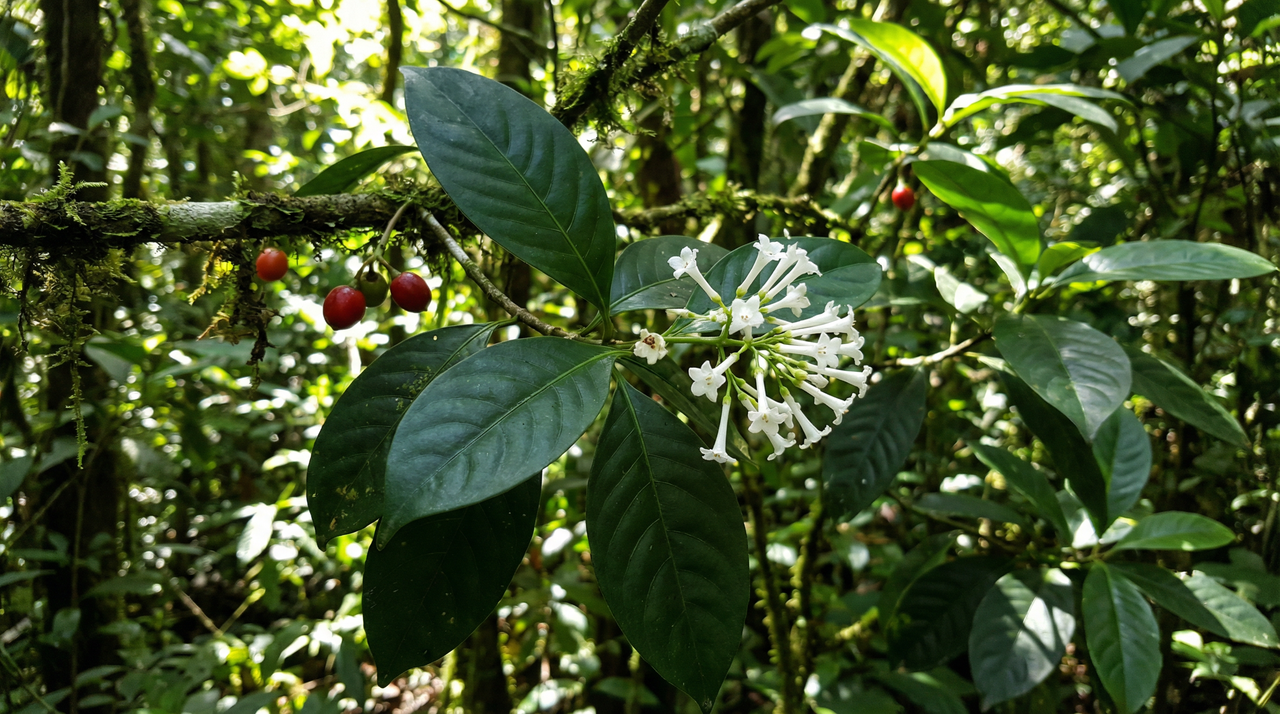
Nobody grows wild coffee (Psychotria viridis) for the fruit. The small, bright-red drupes are technically edible, and birds will strip them clean given half a chance, but that's not why this plant has shaped human consciousness for thousands of years across the Amazon basin. What I find genuinely strange about chacruna is the gap between what it looks like and what it does. You'd walk right past it. Glossy, deep-green leaves, a tidy understory shrub that disappears into the shade, nothing about it announcing that its tissue carries one of the most pharmacologically potent compounds a plant has ever evolved.[1] If you dropped it into a subtropical food forest without telling anyone, most visitors would assume it was an ornamental Rubiaceae and move on.
That invisibility is kind of the point. Chacruna is a forest-floor specialist, shaped by millions of years of deep shade and wet heat, and understanding that ecology is where I always start with a new plant. Get the habitat wrong and nothing else matters. Get it right and you're suddenly growing something that sits at the intersection of Amazonian ethnobotany, cutting-edge psychiatric research, and some genuinely thorny questions about legality and cultural responsibility that every prospective grower needs to think through before they ever stick a cutting in a pot.
Origin and History of Wild Coffee (Psychotria viridis)
Botanical Background and Native Habitat
Before it became famous for anything else, Psychotria viridis was simply a forest shrub doing what understory plants do: growing patiently in the shade of larger trees, fruiting quietly for birds, and cycling nutrients back into the soil. Its native range spans the humid lowland rainforests of the Amazon basin, from Brazil, Peru, and Colombia south through Ecuador and Bolivia and into Venezuela, Guyana, and parts of Central America as far north as Costa Rica.[2][3][4] It occupies the ground and mid-layers of humid evergreen forest from sea level to around 1,000 meters, occasionally higher.[5]
In those forests it grows as a perennial evergreen shrub or small tree, typically two to five meters tall with a multi-stemmed, spreading form and a lifespan of roughly five to ten years, reaching maturity in two to four years.[6][7] It blooms year-round, producing small white tubular flowers that set fleshy drupes ripening to purplish-black, carried off by birds who disperse the seeds across the forest floor.[8] That dispersal ecology tells you something important about where the plant wants to live: it evolved to germinate under established canopy, in moist, organically rich, acidic soil (pH 4.5 to 6.5) kept consistently moist but never saturated, in a climate where temperatures average 25 to 30°C and annual rainfall exceeds 2,000 mm.[6] I've found that plants kept under 30 to 40 percent canopy light produce the largest, darkest leaves and establish fastest, which lines up exactly with what these forest conditions would provide.
European science didn't catch up to this plant until 1794, when the Spanish botanists Hipólito Ruiz López and José Antonio Pavón formally described it from Peruvian specimens.[9][10] Later treatments by Kunth and Bentham added synonyms including Jacquotia viridis and Psychotria psychotriaefolia, but indigenous peoples had been working with this plant for centuries before any of that.[11]
Visual Characteristics and Identification
Psychotria viridis is a dense, multi-stemmed evergreen with smooth bark and a fibrous, laterally spreading root system that helps stabilize soil and scavenge nutrients in the thin organic layers of the forest floor.[12][13] The feature you'll use most for identification is the leaf. They're opposite, elliptic to ovate-lanceolate, seven to eighteen centimeters long, and distinctly coriaceous with a glossy dark green upper surface and a paler underside carrying five to nine pairs of secondary veins with a prominent midrib.[2][6] Having grown several Psychotria species side by side, I can tell you the texture of these leaves is distinctive in hand: thicker and more substantial than the thinner foliage of close relatives, with a waxy quality that you notice the moment you brush one.
The flowers are small, white to yellowish, four-lobed and tubular, carried in axillary paniculate cymes two to nine centimeters long; they're modest things, easily overlooked.[14] The fruits are more eye-catching: small fleshy drupes, five to seven millimeters long, ripening from green to a deep purplish-black and each containing two to four flattened brown seeds.[15][16] Triangular fimbriate stipules at the internodes are another reliable marker once you know to look for them.[17]
There's meaningful variation across the plant's range. Peruvian and Brazilian populations tend toward larger leaves than Ecuadorian ones, and cultivated specimens often push leaves to twenty centimeters or beyond.[18][19] Seedlings I've raised from Peruvian-origin seed have consistently outpaced Ecuadorian lines in leaf size and overall vigor under warm, humid conditions, which matches what the literature suggests about regional differences in growth expression.
Traditional and Cultural Significance
Psychotria viridis is best known as the primary DMT-containing admixture plant in ayahuasca, the visionary brew of Amazonian indigenous peoples, where its leaves are combined with the stem bark of Banisteriopsis caapi to render dimethyltryptamine orally active.[20][21] Groups including the Shipibo-Conibo, Asháninka, and Quechua peoples have used the brew for centuries in ceremonies led by experienced curanderos, for spiritual healing, divination, diagnosing illness, and connecting with the spirit world.[13] This knowledge is ancient and sophisticated, developed through generations of careful practice long before any laboratory identified a single compound in the leaf. Outside the ceremonial context, traditional preparations have also been used to treat infections and rheumatism, and as emetics.[22]
Having studied the traditional preparation methods through reputable ethnobotanical sources and grown the plant responsibly, I believe it's essential to approach this species with genuine respect for the Amazonian peoples who have stewarded this knowledge for centuries. The contemporary picture is complicated: commercialized retreat culture raises real concerns about cultural appropriation, while Amazonian deforestation and overharvesting put wild populations under pressure the IUCN currently classifies as Least Concern but that researchers consider inadequately monitored for long-term sustainability.[23] For anyone growing this plant, those pressures are part of the context. Cultivation from ethical sources eases demand on wild populations; that's a meaningful contribution.
Wild Coffee Varieties and Sourcing
Notable Varieties and Chemotypes of Psychotria viridis
If you're coming to wild coffee from a background in, say, tomatoes or peppers, the variety situation here will feel almost disorienting. Psychotria viridis has no formally recognized cultivars, varieties, or subspecies in standard botanical taxonomy.[7][24] None. What you'll encounter instead are informal regional labels based on geographic origin, Peru, Brazil, Ecuador, reflecting distinct wild populations rather than anything fixed in breeding records.[7] The scientific literature treats these as regional variants, and no named chemotypes have been established.[25][26]
That said, selection work does happen, and it functions as de facto cultivar development even without official naming. Growers focused on alkaloid content select promising material via leaf assays, with some lines reportedly reaching up to 1.8% DMT, and desirable traits like disease resistance and vigorous canopy coverage get prioritized alongside chemistry.[27][28] I've grown multiple accessions side by side and noticed real differences in leaf thickness and branching habit between material labeled Peruvian versus Brazilian origin. Whether those differences are genetically stable or just the plant expressing itself under different conditions is genuinely hard to say, because alkaloid levels shift with soil, shade intensity, and season as much as with genetics. I'd be skeptical of any vendor claiming their line is reliably high-potency on genetic grounds alone.
When I'm sourcing any specialty shrub for a guild planting, I always ask for provenance information. For this species specifically, I've found that material with Brazilian origin labels tends to show more vigorous growth under Florida's humid summers, which matters more to me as a regenerative designer than alkaloid percentages. The ecological role, canopy behavior, and long-term resilience in my climate are what I'm evaluating first.
Where to Buy Wild Coffee Plants, Seeds, and Cuttings
The legal picture here requires clarity before anything else. Psychotria viridis itself is not federally scheduled in the United States, but it contains DMT, which is a Schedule I controlled substance, so cultivation for extraction purposes crosses a legal line.[29] Growing the plant for ornamental, ecological, or research purposes is generally permitted at the federal level, but state laws vary, and you're responsible for knowing yours. In my consultations I always advise clients to document their intent clearly as ornamental or ecological and to steer completely clear of any extraction activities. That's not paranoia; it's just responsible stewardship of a legally sensitive plant.
You won't find this at a mainstream nursery. Live plants, cuttings, and seeds move primarily through online ethnobotanical vendors and specialty plant traders, similar to sourcing certain rare gingers or tropical fruit species that simply haven't entered the conventional horticultural trade. Pricing is fairly consistent: live plants typically run $20 to $60, cuttings $15 to $35, and seeds $5 to $20, though these fluctuate with supply and vendor.[30] Seeds are the lowest-cost entry point, though propagation from seed carries its own complications covered in the next section.
If you're sourcing internationally, be aware that importing Psychotria viridis into the US may require USDA/APHIS phytosanitary permits, and customs can seize unpermitted plant shipments even when no controlled-substance issue is involved.[30] Domestically sourced material from reputable vendors sidesteps most of that friction and usually arrives with better documented provenance anyway.
Wild Coffee Propagation and Planting (Psychotria viridis)
Growing psychotria viridis from scratch is genuinely rewarding, but it asks you to choose your method carefully before you start. I've propagated this plant multiple times in a shade house, and my honest recommendation to any home grower is to begin with cuttings. Seeds are ecologically interesting, but they'll test your patience in ways that cuttings simply won't.
Propagation Methods: Cuttings, Seeds, and Tissue Culture
Semi-hardwood stem cuttings taken in spring or summer give the most reliable results. Take 10 to 15 cm sections from healthy, mature growth, strip the lower leaves, and treat the cut end with IBA rooting hormone at 1000 to 3000 ppm before sticking them into a sterile perlite-peat or sand-peat mix.[31][32] Maintain 80 to 100% humidity and bottom heat around 21 to 24°C (70 to 75°F), keep them in bright indirect light, and you can expect rooting in four to eight weeks with success rates between 50 and 90% depending on how well you hold those conditions.[33] In my experience, the single biggest variable is humidity in that first three to four weeks. Cuttings that dry out even briefly drop their leaves and rarely recover. A simple humidity tent or a misting bench changes everything.
Cuttings also preserve chemotype fidelity in a way seeds can't. Because wild coffee uses an outcrossing mating system, seedlings are zygotic and show low to medium true-to-type rates, meaning the offspring's alkaloid profile can drift considerably from the parent.[34] If you're propagating from a known cutting with documented chemistry, vegetative propagation keeps that intact.
That said, seed propagation has its place, particularly for growers interested in genetic diversity or building out a larger population. The catch is recalcitrance. Chacruna seeds lose viability fast, dropping sharply within 30 days of harvest and becoming essentially nonviable somewhere between one and six months out.[35][36] I've tried storing them in moist sphagnum and in the refrigerator; neither worked well. Sow them the same week they're harvested if you want decent germination. If you must store short-term, keep seeds at 15 to 20°C in moist vermiculite at 80 to 90% relative humidity, but treat that as a stopgap, not a strategy.[37][38] Sow into a sterilized 1:1 peat-perlite mix at 24 to 28°C and 70 to 80% humidity; germination ranges from 10 to 65% over two to eight weeks, with the upper end of that range achieved under controlled greenhouse conditions.[35][39] Young seedlings look a bit like small coffee or gardenia seedlings in their first month, which makes sense given the Rubiaceae family connection; just don't confuse them with something else in your nursery trays.
Tissue culture works well at commercial or conservation scale using nodal explants on Murashige-Skoog medium, achieving 80 to 90% rooting and three to five shoots per explant, but that's lab territory for most of us.[40][41] Grafting isn't recommended at all; vascular incompatibility and the plant's sensitivity to wounding create more problems than they solve. One more thing worth saying plainly: because this plant contains DMT, check your local laws before you source or grow it. I only propagate from verified legal sources and focus on its ornamental and ecological value; that framing matters both legally and ethically.[42]
Soil and Site Requirements
Wild coffee is an Amazonian understory plant native to the humid lowland rainforests of Peru, Brazil, and Colombia, growing at altitudes from sea level to about 1000 m under a canopy that filters most direct light.[43] That origin tells you almost everything you need to know about site selection. Replicate the forest floor and the plant thrives; ignore it and you'll be fighting root rot and leaf scorch from the start.
The soil recipe is non-negotiable: well-drained, humus-rich, and acidic, with a pH between 5.5 and 6.5 and organic matter content of 15 to 30% from compost, leaf mold, peat, or pine bark.[44][45] Above pH 7.5, you'll see chlorosis and nutrient lockout. Heavy clay is a problem because waterlogging invites Phytophthora and related pathogens quickly in warm, humid conditions.[46] Loamy or sandy-loam textures work best. The root system is shallow and fibrous, rarely exceeding 30 to 38 cm deep, which makes it genuinely well-suited to container culture in 12 to 24 inch pots using a mix of roughly 30 to 40% peat or coco coir, 30% perlite or coarse sand, and 30% compost.[14] I always inoculate with mycorrhizal fungi at potting time; the associations improve both nutrient uptake and root resilience, and I've seen a real difference in how quickly young plants establish.
For light, aim for 10 to 20% of full sun, achievable with 50 to 70% shade cloth outdoors or a bright window well away from direct afternoon sun indoors.[47] Growing psychotria viridis indoors is absolutely feasible as long as you can maintain 60 to 80% humidity and keep temperatures between 21 and 32°C consistently; frost is fatal, full stop.[43] The plant wants conditions similar to how you'd grow a large-leafed coffee relative, which is a useful mental model if you've worked with other Rubiaceae before.
Spacing, Planting Technique, and Timeline
Mature wild coffee plants reach 1 to 3 m tall in typical cultivation, with a bushy rounded canopy spread of 2 to 3 m, though specimens can push to 5 m in ideal conditions.[2] Give individual specimens at least 1 to 2 m of space; in row plantings, space 1.5 to 2 m within rows and 2 to 3 m between rows to allow canopy development and adequate airflow, which matters for disease prevention in humid climates.[48] Plant slightly elevated in raised beds or mounded soil to keep the root zone from sitting in water during heavy rain.
From a rooted cutting, expect first harvestable leaves in eight to twelve weeks, with sustainable production building over twelve to eighteen months as the canopy fills out.[35][49] Seed-grown plants follow a similar arc but with slower early establishment. Growth averages around half a meter per year under cultivated conditions, so patience is genuinely part of this plant's character. I now pot seedlings into larger nursery cells with mycorrhizal inoculant as soon as they show two true leaves; post-rooting survival jumps noticeably compared to leaving them in small plug trays. Label everything carefully too, because young chacruna seedlings can look deceptively similar to other tropical shrubs in your nursery, and losing track of what's what becomes easy when you're managing a mixed planting.
Wild Coffee Care Guide: Growing Psychotria viridis
Every care decision you make with wild coffee traces back to one question: does this feel like the Amazon understory? The plant's entire physiology is calibrated to that environment, and deviations from it show up fast. In my experience growing Psychotria viridis, the growers who struggle most are the ones trying to treat it like a forgiving tropical ornamental. It isn't. But once you understand what it actually needs, the logic of its care becomes remarkably coherent.
Watering Needs and Soil Moisture Management
Psychotria viridis needs consistently moist, well-draining acidic soil rich in organic matter, and its shallow fibrous root system has almost no drought buffer.[43][50] A general rhythm is deep watering every 3-5 days when the top inch or two of soil feels dry, pulling back to every 7-10 days through fall and winter.[51][52] I say "general" because your microclimate, pot size, and season will shift that rhythm considerably. One thing I've learned the hard way: container plants dry out at the root zone much faster than the soil surface suggests. I've had plants in pots look fine on top while the lower roots were bone dry. Check deeper than you think you need to. Aim to keep relative humidity between 60-90%, and use rainwater or dechlorinated water when you can. Symptoms of overwatering are yellowing leaves, soft stems, and brown edges; underwatering shows as wilting, leaf curl, and dry crispy tips. Catching either early is the difference between a stressed plant and a dead one.
Sunlight and Light Requirements
This is a shrub that evolved beneath a forest canopy, and it has no interest in direct sun. Bright indirect light or dappled shade is the target, roughly 10-30% of full sun or 1000-2000 foot-candles filtered.[14][53] Direct exposure scorches the leaves in a pattern I've seen before with basil and certain gingers: bleached patches that brown out within days. In Central Florida's blazing summers, I rely on shade cloth or north-side placement and only push toward brighter exposure during warm, humid spells when the plant can handle it. With time and patience it can be acclimated to conditions approaching 40-50% full sun, but that process takes 4-8 weeks of gradual introduction and only when temperatures and humidity are solidly high.[54] Drop either of those factors and light tolerance drops with them.
Temperature, Frost, and Heat Tolerance
There are no hardy cultivars of this plant, no cold-acclimated forms, no workarounds. Psychotria viridis is USDA zones 10-12 only, with its comfort zone between 20-30°C (68-86°F).[43][14][55] Stress begins below 15°C, damage sets in below 10°C, and a single frost is lethal. I've overwintered mine in a bright indoor sunroom in zone 9B, and even there, one night where temperatures dipped unexpectedly close to 10°C left no immediate sign of damage. The necrosis showed up three weeks later. That delayed response is genuinely deceptive and worth knowing about. In cooler climates, containers are your best friend because they come inside. On heat, the plant can survive short spikes to 43°C (110°F), but only with the full support system in place: 70-90% humidity, 2-4 inches of organic mulch at the roots, partial shade or 50-70% shade cloth, and enough spacing for airflow.[56][52] Heat stress and drought stress look almost identical (wilting, scorch, curling), so when symptoms appear, shade and humidity adjustments should come before any change to watering.[57]
Fertilizing and Nutrient Management
Wild coffee is a moderate feeder. During active growth from spring through fall, a balanced fertilizer (10-10-10 or 20-10-20) at half-strength every 4-6 weeks is enough.[58][59] Nitrogen matters most for leaf development and the alkaloid pathways, with research suggesting optimal leaf nitrogen around 2-3%, but pushing too hard with high-nitrogen synthetics actually works against you.[60] In my experience, plants fed with balanced organic inputs, compost, worm castings, fish emulsion, produce noticeably more vibrant foliage than those pushed with synthetic nitrogen. Excess feeding encourages vegetative bulk at the expense of leaf chemistry, and salt buildup from synthetic overfeeding shows up as marginal scorch that looks a lot like potassium deficiency. Speaking of deficiencies: yellowing older leaves signal nitrogen shortage, purplish tones suggest phosphorus, and interveinal chlorosis points to magnesium or iron.[58][61] Encouraging arbuscular mycorrhizal fungi through minimal soil disturbance helps uptake significantly, especially in leaner soils.[62] Soil should run pH 5.5-6.5 with high organic matter content, and a periodic flush with plain water prevents salt accumulation between feedings.[61][63]
Pruning, Maintenance, and Seasonal Care
Pruning older stems back encourages the bushy, compact shape that makes a wild coffee shrub productive and manageable.[64] Selective leaf picking from mature growth also promotes fuller branching, something I've observed with similar tropicals where regular harvesting functions almost like soft pinching. Psychotria viridis doesn't go dormant in any meaningful sense; it flowers and fruits asynchronously year-round, peaking in the wet season.[65] During the drier, cooler months, pull back fertilizer significantly and focus on keeping moisture consistent without tipping into waterlogging.[66] Cultivation of this species is heavily regulated or prohibited in many jurisdictions.[67][28] I always advise checking your local laws carefully before ordering seeds or plants. Responsible cultivation starts there.
Harvesting Wild Coffee (Psychotria viridis)
Patience is the first skill this plant teaches. Psychotria viridis is a slow grower, putting on roughly 6-12 inches per year in its early years and taking 3-5 years to reach full maturity.[31] I've grown it from both cuttings and seed, and the seedling route in particular requires a particular kind of commitment. Those early plants can sit on the bench looking almost unchanged for months. Many first-time cultivators assume something is wrong. Nothing is wrong; the plant is just on its own schedule.
When and How to Harvest Psychotria viridis Leaves
The earliest you can expect a sustainable first harvest is 6-12 months after rooting cuttings, or 1-2 years from seed, once the plant is at least 30-50 cm tall with several established pairs of leaves.[31] I label my young plants carefully because first-year chacruna leaves can look deceptively similar to other Psychotria species growing nearby in a mixed guild. A misidentified harvest helps nobody.
When those leaves do appear ready, the indicators matter. You want young, pale-green leaves that are 5-10 cm long, 2-4 mm thick, and approximately 2-4 months old. Alkaloid concentration is highest at this stage. Mature, dark-green leaves thicker than 5 mm have already seen their chemistry decline and aren't worth taking.[68][69] Sustainable protocol limits removal to no more than 20-30% of foliage at any single harvest, with at least 4-6 weeks between sessions to allow full recovery.[68][69] I personally never exceed 25% even when a plant looks lush; the long-term vitality of the shrub is worth more than any single yield.
Timing harvests to active growth periods also matters for phytochemical quality. Leaf production and alkaloid concentration both peak during the wet season, roughly December through May in the Amazon basin.[70][71] For indoor or greenhouse growers, I simulate wet-season humidity cycles to trigger those flush periods. You'll notice the plant responds quickly when conditions are right. The shrub also flowers and fruits year-round with rainy-season peaks, and fruits take 90-120 days to mature, so there's nearly always some reproductive activity happening alongside your leaf harvests.[72][71] That asynchronous fruiting rhythm is simply something to observe and appreciate rather than manage.
Yield, Flavor Profile, and Sustainable Practices
Fresh wild coffee leaves carry a mildly herbaceous quality underneath a distinctly bitter, astringent base. Drying intensifies the bitterness considerably, a shift I noticed clearly while preparing leaves and something that stays with you.[2][73] That bitterness isn't a flaw; it's a direct sensory signal of DMT, tannins, and related compounds at work. For psychotria viridis dried leaves especially, the sharpness of the flavor serves as a practical gauge of chemical integrity. A plant harvested responsibly, from the right growth stage and at the right moment in its seasonal cycle, will tell you through its taste that the chemistry is intact. That's the feedback loop worth learning to read.
Wild Coffee (Psychotria viridis) Preparation and Uses
Culinary Uses and Edibility of Wild Coffee
Wild coffee is not a food plant. The leaves of Psychotria viridis contain N,N-Dimethyltryptamine (DMT) along with other alkaloids that make them both unsafe and genuinely unpalatable for eating.[2][74] The flavor is intensely bitter, astringent, and earthy, with a leathery texture that makes chewing a leaf feel like a warning from the plant itself.[2] I've grown bitter medicinal herbs like certain ixoras and apocynaceous plants that telegraph "stay away" through taste alone; this one is in that category, only more so.
The DMT content ranges from 0.1% to 1.8% of dry leaf weight depending on plant age, season, and growing conditions, and it's orally inactive without monoamine oxidase inhibitors anyway.[2][75] The small red fruits are similarly not on the menu; they're considered mildly toxic or at best unpalatable, and no culinary tradition uses them.[2] Nutritional data is essentially nonexistent: there's no USDA entry for this plant, and unlike the leafy greens I'd actually recommend growing for food, chacruna's value lies entirely in its phytochemical profile rather than any dietary contribution.[2]
If you're foraging in tropical zones, identification precision matters enormously here. Palicourea marcgraavii and Psychotria ipecacuanha are look-alikes carrying pyrrolizidine alkaloids and emetine respectively, both capable of serious harm.[2][76] DMT is also a controlled substance in many countries, and unsupervised consumption carries real legal consequences alongside risks of nausea and psychological distress.[2][74]
Traditional Medicinal and Ceremonial Preparation
The only established preparation for these leaves is ayahuasca, a brew with deep roots among Shipibo, Asháninka, and other Amazonian peoples who have used it for spiritual and medicinal purposes across generations.[77] The preparation itself is labor-intensive: the tough, leathery leaves are chopped, pounded or ground, then subjected to prolonged boiling alongside Banisteriopsis caapi vine to extract the alkaloids.[78][2] The caapi vine supplies the MAOIs necessary to activate the otherwise orally inert DMT. This is not a casual home remedy, and I want to be clear about that.
Safe ceremonial use requires medical screening, experienced facilitation, and dietary restrictions for 24 to 48 hours beforehand to avoid tyramine interactions from the MAOI activity.[77][79] Having read the case reports on serotonin syndrome, I don't experiment with this plant outside approved ceremonial contexts. If you take SSRIs, the interaction risk is genuinely serious; the required washout period of two to six weeks must be managed under medical supervision, full stop.[80]
Non-Food Uses and Ornamental Value
Where I find myself enthusiastic about Psychotria viridis is in the garden itself. I've grown it as an understory ornamental in humid, shaded settings, and the glossy deep-green foliage holds up beautifully to tropical humidity while responding well to pruning that keeps it compact and tidy.[43] It earns its place in a shaded tropical border purely on aesthetics. Botanical gardens worldwide, including Missouri Botanical Garden, Kew, and Fairchild Tropical Botanic Garden, cultivate it for research, conservation, and education.[43][81] That's actually where I think most of us outside its indigenous cultural context should situate this plant: as a living specimen worth studying, conserving, and appreciating, rather than consuming.
Wild Coffee Health Benefits and Medicinal Uses
Every conversation about wild coffee's medicinal value starts in the same place: DMT. N,N-dimethyltryptamine is the compound that defines this plant's pharmacological identity, and understanding it means understanding why Psychotria viridis occupies such an unusual position in both traditional medicine and contemporary psychedelic research. I've grown this shrub as a shaded understory specimen in my humid subtropical food forest, and one thing that struck me early on was how much the literature emphasizes that leaf DMT content isn't fixed -- it shifts with the plant's conditions. That variability is real and worth taking seriously before anything else.
Key Phytochemicals in Wild Coffee
DMT concentrations in dried Psychotria viridis leaves typically fall between 0.1% and 1.8% (roughly 1-18 mg/g), with averages most commonly cited around 0.2-0.6%.[82][83][84] Plant age, genetics, light exposure, soil moisture, and harvest timing all push that number around considerably. The alkaloid is concentrated almost entirely in the leaves, which account for more than 90% of total alkaloid content; stems carry only trace amounts (0.1-0.5 mg/g), and roots, flowers, fruit, and seeds contribute almost nothing measurable.[85][86]
The supporting cast of compounds is worth knowing about. N-methyltryptamine (NMT), a related tryptamine, appears primarily in leaves at 0.2-0.5 mg/g, alongside trace beta-carbolines, the alkaloid psychotridine, terpenoids like beta-amyrin and lupeol, and phenolic compounds including chlorogenic acid and quercetin derivatives.[87][88] These flavonoids and phenolics show antioxidant, anti-inflammatory, antimicrobial, and analgesic activity in preclinical studies -- all promising, all early-stage, none yet translated into clinical protocols.[89][90] One practical detail that connects the kitchen to the chemistry: DMT retains more than 80% of its potency through traditional boiling at 100°C for four to eight hours when prepared in mildly acidic conditions, so the long decoction process that characterizes Amazonian preparation doesn't degrade the primary compound.[91][18]
Traditional Medicinal and Therapeutic Uses
Amazonian peoples including the Shipibo-Conibo and Asháninka have worked with Psychotria viridis for generations as the leaf component of ayahuasca, using the brew for spiritual healing, divination, initiation, and treatment of physical ailments ranging from rheumatism and wounds to psychological distress.[92][93][94] The plant is rarely, if ever, used alone -- and the pharmacology explains why. DMT is orally inactive by itself because the gut rapidly metabolizes it; the beta-carboline alkaloids (primarily harmine, harmaline, and tetrahydroharmine) from Banisteriopsis caapi inhibit the monoamine oxidase enzymes that would otherwise break DMT down before it reaches the bloodstream.[82][95] I think of this the way a permaculture designer thinks about guilds: neither plant does the job alone, and the synergy between them is the whole point.
At the receptor level, DMT acts as a potent agonist at serotonin 5-HT2A receptors, which drives its hallucinogenic and visionary effects -- similar in mechanism to psilocybin -- while also binding sigma-1 receptors, a pathway linked in preclinical work to neuroprotection, antidepressant-like effects, and cellular stress responses.[96][1] The sigma-1 findings are intriguing, but the evidence is primarily from animal and in vitro models -- not human trials -- so the word "preliminary" belongs firmly attached.
Modern Research and Clinical Evidence
Small-scale randomized controlled trials and systematic reviews of ayahuasca brews show genuine promise for treatment-resistant depression, anxiety, and substance addiction, with some participants experiencing rapid antidepressant effects after a single session.[97][98] That's genuinely exciting -- but it's also where I'd encourage careful reading. These studies examine the complete brew, not isolated Psychotria viridis, and the Banisteriopsis caapi component contributes its own pharmacologically active alkaloids. Attributing the therapeutic outcome to this one plant alone would be like crediting the garlic in a stew for the entire flavor. Large-scale meta-analyses are still lacking, and researchers are actively calling for more study on which components drive which effects.
Nutritional Profile of Wild Coffee Leaves
The leaves contain roughly 10-15% protein alongside dietary fiber, vitamins, and minerals.[99] That is not the reason anyone is growing this plant. The alkaloid profile is what defines its value in traditional preparations, and the nutritional content is contextually irrelevant when the primary use involves a carefully prepared aqueous decoction rather than dietary consumption. The heat stability of DMT through long boiling[91] means the leaf's "active" contribution to traditional medicine survives the cooking process largely intact -- but this is very much a ceremonial or research plant, not a food crop.
Safety Considerations and Contraindications
Wild coffee does not appear in standard toxic plant databases as a highly toxic species, and animal studies show a high LD50 (above 100 mg/kg); the plant's risks come primarily from DMT's psychological effects and from the MAOI context of ayahuasca preparations, not from direct physical toxicity of the plant itself.[77][100] So is wild coffee toxic? In isolation and at normal exposures, the acute physical risk is low. In a brew with MAOI-containing plants, the risk profile changes substantially.
Common adverse effects in ayahuasca use include nausea, vomiting, and diarrhea in 70-90% of participants, along with transient elevations in heart rate and blood pressure, and psychological responses ranging from euphoria and vivid visions to acute anxiety or, rarely, psychosis.[101][102] These effects are typically self-limiting in traditional ceremonial settings, but "self-limiting" is not the same as "safe for everyone."
Having studied both the pharmacology and the traditional protocols, I feel it's my responsibility to be direct about the clearest contraindications. Pregnancy and breastfeeding represent an absolute no -- fetal risks are documented in animal studies and the unknowns in humans are not ones worth testing.[77][103] Cardiovascular conditions including hypertension are a serious concern given the blood pressure spikes the brew can produce, and anyone with schizophrenia or bipolar disorder faces real risk of symptom exacerbation.[77] The serotonin syndrome risk from combining DMT-containing preparations with SSRIs or other serotonergic medications is pharmacologically real, even if confirmed clinical cases remain rare in the literature; the beta-carbolines in ayahuasca are reversible, selective MAO-A inhibitors, but that selective inhibition is still enough to create meaningful interaction risk.[104][77] If you're on SSRIs, this is not a gray area.
No standardized safe dose exists for isolated Psychotria viridis given how much DMT content varies; traditional preparations typically use 15-30 grams of dried leaves yielding roughly 30-100 mg DMT, always under supervised shamanic guidance.[105] Misidentification is a serious additional hazard. As a horticulturist, I'm alert to how easily a novice might confuse Psychotria viridis with toxic look-alikes in warm-climate landscapes; Brugmansia and oleander are both plausible misidentifications for someone unfamiliar with Rubiaceae, and neither one is forgiving.[106] Finally, DMT is a Schedule I controlled substance in the United States and faces legal restrictions in most jurisdictions outside of authorized religious or research contexts.[107][82] This is not a casual tea plant, and treating it as one carries legal and physiological consequences that the emerging therapeutic research doesn't change.
Wild Coffee Pests and Diseases
Natural Defenses of Psychotria viridis Against Pests
Wild Coffee comes remarkably well-armed. The same DMT and tryptamine alkaloids concentrated in its leaves that give this plant its cultural significance also serve as potent feeding deterrents against insect herbivores.[108][109][110] I often tell people to think of it the way I think about neem seedlings or bitter-leafed herbs I propagate: once a plant is past the tender seedling stage and its chemistry is fully expressed, caterpillar damage becomes genuinely uncommon. These alkaloids aren't working alone, either. Supporting compounds including flavonoids, terpenoids, and beta-carbolines contribute additional layers of insect deterrence and antimicrobial activity,[111] while trichomes on the leaf undersides and a relatively thick cuticle create physical barriers that deter herbivores before they even begin to feed.[112][113] When I'm doing early pest scouting on my Psychotria plants, I actually run my fingers lightly across the leaf undersides — that slight roughness from the trichomes is something you can feel, and any smoothing or pitting in that texture is often my first clue that spider mites or scale are establishing. The plant also recruits allies at the ecosystem level: documented mutualistic relationships with Azteca ants provide active protection against herbivores in exchange for nectar, shelter, or food bodies,[114] and endophytic fungi like Colletotrichum spp. living within the plant tissue may trigger induced systemic resistance through jasmonic acid and salicylic acid pathways.[115][116]
None of that makes it invincible. In humid or indoor cultivation settings, aphids, spider mites, scale insects, mealybugs, leaf miners, root-knot nematodes, and Lepidopteran caterpillars can all find their way in.[117][118][119] The honest truth is that most infestations I've seen on containerized Wild Coffee trace back to environmental stress or introducing unquarantined material, not to any failure of the plant's own defenses.[120] Weekly monitoring, quarantining new plants before they go near an established collection, and keeping plants vigorous through good culture will head off most problems. When intervention is needed, neem oil or insecticidal soap handles aphids and soft-bodied pests reliably; predatory mites (Phytoseiulus persimilis) are my preference for spider mite pressure; lacewings provide broader generalist control; and Bacillus thuringiensis works well against caterpillars when they do appear.[121][122]
Common Diseases and Their Management
Specific pathology research on Psychotria viridis is genuinely sparse. Most of what we know comes from general Rubiaceae family patterns, grower experience, and extrapolation from related tropical plants, and there are no commercially bred resistant cultivars to reach for.[123][124] That's not a reason for alarm; it just means that cultural prevention matters more here than for a thoroughly researched crop.
The diseases I watch for most closely are fungal leaf spots caused by Cercospora or Colletotrichum, which show up as dark circular lesions or brown-to-black spots and tend to appear when humidity is high, ventilation is poor, or overhead watering keeps foliage wet for extended periods.[125][126] Root rot from Fusarium, Phytophthora, or Pythium is the other big one, and it's the mistake I made myself early in my container work with this genus: I overwatered, the drainage wasn't sharp enough, and the first sign I had was yellowing leaves followed by wilted stems and, when I finally unpotted the plant, mushy roots.[125][127] Now I always let the top inch of soil dry out between waterings and I treat every container like it needs to drain fast. Powdery mildew, damping-off in seedlings under wet conditions, and possible viral mottling (though specific viruses are poorly documented for this species) round out the disease picture.[128][129]
Prevention is where to put your energy. Well-drained soil, adequate spacing for air movement, watering at the base rather than overhead, good sanitation, and maintaining that 24-30°C sweet spot with appropriate shade reduces disease incidence more reliably than any spray schedule.[130][129] In my experience with humid-climate shrubs, gentle constant air movement has prevented more leaf spot outbreaks than any fungicide. When disease does appear, remove infected material promptly, propagate only from visibly healthy stock, and apply copper-based fungicides for fungal issues while keeping chemical inputs minimal overall.[122][117] Mature, well-established plants tend to handle stress and pathogen pressure with noticeably more resilience than younger ones, so the attentive early care really does compound over time.
Wild Coffee in Permaculture Design
Psychotria viridis is, at its core, a creature of the Amazonian understory: shaded, humid, warm, and never touched by frost. Native to the moist forest interior of tropical South America, it has since been introduced to Florida, Hawaii, and Thailand, and cultivated in greenhouses across the world.[131][2] Those introductions are possible because the plant is adaptable enough to survive outside the Amazon, but only within a tight envelope of conditions that a permaculture designer needs to understand before drawing any guild lines on paper.
Climate Requirements and Hardiness Zones
Wild coffee is firmly a zones 10-12 plant, with zero tolerance for frost and real vulnerability whenever temperatures dip below 15°C (59°F) for more than a brief period.[131][132] It thrives with daytime temperatures in the 21-30°C (70-86°F) range, and at the other extreme, heat above 35°C starts causing stress, which means shade isn't just a preference but an active protection strategy in hot climates.[131][133] Humidity is equally non-negotiable: 70-95% is the comfortable range, and anything below that regularly causes leaf drop.[134][14] I grow several humidity-demanding plants in my Central Florida designs, including certain ferns and shell gingers, and I watch them shed leaves every dry spring when the humidity tanks. Wild coffee behaves the same way, except it's less forgiving about recovery. On top of that, it needs consistently moist, well-drained, slightly acidic soil and prefers partial shade or bright indirect light to replicate the canopy-filtered conditions it evolved under.[14]
At zone 9B, I can only grow this in a protected microclimate or under glass. For most permaculture designers in the continental US, a greenhouse or a sheltered courtyard with supplemental misting is the realistic path. That's not a failure of the plant; it's just an honest constraint that shapes where and how it fits into a system.
Ecological Functions and Guild Roles
Where the climate does cooperate, wild coffee earns its place. As an understory species, it contributes meaningfully to nutrient cycling: its leaf litter decomposes and returns nitrogen and phosphorus to the soil, and it forms mycorrhizal associations that pull phosphorus from nutrient-poor substrates, which is a genuine asset in the thin, often depleted soils beneath a young food forest canopy.[135][136][137] I value it in early-succession food forests precisely because it establishes quickly and starts building litter before slower shrubs have hit their stride. That's the kind of quiet ecological work that makes a system cohere over time.
Its biodiversity contributions are equally practical. The red berries attract tanagers, thrushes, and other birds that act as seed dispersers, the small tubular flowers provide nectar for stingless bees, Euglossine bees, and flies, and the foliage serves as larval host material for certain Lepidoptera.[138][139] Those flowers open in the early morning, so a well-designed polyculture that includes other early bloomers will support the same pollinator community across the season.
One thing worth understanding before you plant is that wild coffee has a distylous breeding system: individual plants come in pin and thrum morphs, and the species is strongly self-incompatible, meaning cross-pollination between morphs is required for fruit set and seed viability.[140] In fragmented habitats, pollinator visitation can drop by up to 50%, with real consequences for berry production.[141] In my designs I always plant at least two individuals of different morphs; in a greenhouse setting where pollinators are scarce, a soft brush run gently between flowers at opening time does the job.[142] The goal in a permaculture system is to build enough floral diversity and habitat connectivity that bees and flies are cycling through on their own, but it's good to know hand pollination is a reliable fallback.
Forest Layer Placement and Companion Strategies
In terms of physical presence, wild coffee is a perennial shrub typically reaching 1-2 meters, occasionally pushing to 3 meters under good cultivation conditions, with opposite elliptic leaves and small white flower clusters that give it a tidy, layered texture.[143] That size puts it squarely in the shrub layer of a multi-strata system, beneath bananas or papayas and above the ground cover. Its photosynthetic adaptations to diffuse light mean it genuinely prefers the conditions that exist under a canopy, rather than just tolerating them.[144]
Guild placement works best when nitrogen-fixing trees like Inga species form the canopy overhead, with heliconias, ferns, or gingers filling adjacent niches at similar or lower heights.[145] The contrast of wild coffee's glossy, broad leaves against heliconia bracts is genuinely beautiful, which matters when you're designing a space people will actually spend time in. I grow it strictly for its ecological contributions in protected garden settings, not for its traditional ceremonial chemistry, and I find that framing makes it much easier to evaluate it clearly as a design element: a shade-adapted, pollinator-supporting, litter-building shrub that rewards a warm, humid polyculture and asks only that you give it the understory conditions it already knows how to thrive in.
The Plant That Taught Me to Slow Down
I've grown a lot of plants with complicated reputations, but Psychotria viridis is the only one that made me sit quietly for a while before I even reached for my propagation tools. There's something about learning a plant this thoroughly, its ecology, its chemistry, its role in living ceremony, that changes the way you handle it. I still grow it in a shaded corner of my screenhouse, mostly just to keep learning. It hasn't asked for much except patience, and honestly, neither have I.
Sources 145
- Pharmacology of Ayahuasca: A Review of Human Studies | Frontiers in Psychiatry ↩
- Psychotria viridis - Wikipedia ↩
- Psychotria viridis in the Global Biodiversity Information Facility ↩
- Kew Plants of the World Online - Psychotria viridis ↩
- Missouri Botanical Garden Tropicos - Psychotria viridis ↩
- Psychotria viridis - Useful Tropical Plants Database ↩
- Psychotria viridis - Missouri Botanical Garden Plant Finder ↩
- Reproductive Biology of Amazonian Psychotria Species ↩
- International Plant Names Index (IPNI) - Psychotria viridis ↩
- Florae Peruvianae, et Chilensis Prodromus ↩
- World Flora Online - Psychotria viridis ↩
- Plants Database, NRCS, USDA ↩
- Psychotria viridis Ruiz & Pav. (Rubiaceae) in Amazonian Peru: Distribution, Morphology and Uses ↩
- Psychotria viridis - Chacruna ↩
- Psychotria viridis - Plant Profile ↩
- Psychotria viridis ↩
- Psychotria viridis - Missouri Botanical Garden Plant Finder ↩
- Psychotria viridis: A Survey of its Morphology and Distribution ↩
- Cultivation and Morphology of Psychotria viridis ↩
- Traditional Uses of Ayahuasca Among Indigenous Amazonian Groups ↩
- Ayahuasca: Psychological and Physiologic Effects - NCBI ↩
- Psychotria viridis: The Plant Source of the Drug Used in Religious Ayahuasca ↩
- Psychotria viridis Research Review ↩
- Plants of the World Online ↩
- Survey of the Alkaloid Content of Psychotria viridis ↩
- A new method for determining DMT in natural products ↩
- Breeding for Alkaloid Content in Psychotria Species ↩
- Cultivation of Psychotria viridis for Ornamental and Medicinal Purposes ↩
- Dimethyltryptamine (DMT) - Drug Fact Sheet ↩
- Importation of Plants and Plant Products ↩
- Growth and Development of Psychotria viridis ↩
- Rooting Hormone Use in Plant Propagation: IBA for Rubiaceae Family ↩
- Greenhouse Production of Tropical Shrubs: Chacruna Case Study ↩
- Plants of the World Online ↩
- Ex situ propagation of Psychotria viridis ↩
- Psychotria viridis: Botanical Description and Cultivation ↩
- Seed Storage Behaviour of Rubiaceae Species ↩
- Recalcitrant Seeds: Their Biology and Conservation ↩
- Plants of the World Online ↩
- In Vitro Propagation and Conservation of Psychotria Species ↩
- Micropropagation of Psychotria viridis: A Plant with Potential for Ayahuasca Production ↩
- Seed Dispersal in Psychotria species ↩
- Psychotria viridis (Chacruna) Plant Profile ↩
- Psychotria viridis - Plant Profile ↩
- Soil Requirements for Tropical Plants: Psychotria Species ↩
- Root Rot Prevention in Tropical Shrubs ↩
- Ecophysiological Responses of Psychotria viridis (Vell.) K. Schum. to Different Light Levels under Controlled Cultivation ↩
- Psychotria viridis Propagation and Spacing ↩
- Psychotria spp. - UF/IFAS Assessment & Ranking System ↩
- Species Profile for Psychotria viridis ↩
- Psychotria viridis Cultivation Guide ↩
- Psychotria viridis: Cultivation and Propagation ↩
- Psychotria viridis Profile ↩
- Plants of the World Online: Psychotria viridis ↩
- Cold Tolerance in Tropical Ornamentals ↩
- Cultivation of Amazonian Plants: Psychotria Species ↩
- Stress Responses in Tropical Ornamental Plants ↩
- Nutrient Deficiencies in Tropical Ornamentals ↩
- Cultivation and Nutrient Management of Psychotria viridis ↩
- Fertilizer Effects on Alkaloid Biosynthesis in Psychotria viridis ↩
- Psychotria viridis (Chacruna) ↩
- Mycorrhizal Associations in Psychotria Species ↩
- Soil Requirements for Tropical Shrubs like Psychotria ↩
- Psychotria viridis: Cultivation and Harvesting Guide ↩
- Reproductive Phenology of Psychotria in Amazonia ↩
- Fertilizer Guidelines for Rubiaceae Family Plants ↩
- Ethnobotany of Psychotria viridis ↩
- Alkaloid Content in Psychotria viridis Leaves at Different Developmental Stages ↩
- Cultivation and Harvesting Guidelines for Psychotria viridis ↩
- Seasonal Variation in Alkaloid Content of Psychotria viridis ↩
- Phenology of Psychotria viridis in the Amazon Rainforest ↩
- Phenology and Reproduction of Psychotria viridis (Rubiaceae) in the Peruvian Amazon ↩
- Chacruna (Psychotria viridis) - Erowid ↩
- Ayahuasca: Psychological and Physiologic Effects, Pharmacology and Potential Uses in Addiction and Mental Illness - PMC ↩
- DMT in Psychotria viridis: A Preliminary Analysis ↩
- Palicourea marcgraavii Toxicity - PubMed ↩
- Ayahuasca: Psychological and Physiologic Effects, Pharmacology and Potential Uses in Addiction and Mental Illness ↩
- Ayahuasca: The Visionary and Curative Plant - Erowid ↩
- The pharmacological interactions of the ayahuasca plant constituents ↩
- Serotonin Syndrome Associated with the Use of Ayahuasca: A Case Report ↩
- Growing Psychotria viridis in Florida ↩
- Psychotria viridis: A Comprehensive Review of Its Phytochemistry and Pharmacology ↩
- Alkaloids of Psychotria viridis ↩
- Psychotria viridis: A Review of its Ethnobotany and Chemistry ↩
- Alkaloid Content of the Leaves of Psychotria viridis ↩
- Tryptamine Alkaloids in Amazonian Psychotria Species ↩
- Chemical Constituents of Psychotria viridis ↩
- Alkaloids and ethnopharmacology of the Psychotria genus ↩
- Anti-Inflammatory Effects of Psychotria viridis Extracts via NF-κB Inhibition ↩
- Antioxidant and Anti-inflammatory Activities of Psychotria viridis ↩
- Thermal Stability of Tryptamines in Aqueous Extracts from Psychotria viridis ↩
- Ethnobotanical Use of Psychotria viridis in Amazonian Cultures ↩
- Ethnobotany of Psychotria viridis in Peru - Journal of Ethnopharmacology ↩
- The Ethnobotany of Ayahuasca in Amazonia ↩
- DMT Pharmacology and Ayahuasca: A Review ↩
- DMT and Sigma-1 Receptor Interactions in Neuroprotection ↩
- Ayahuasca for the treatment of depression: a systematic review ↩
- Randomized, double-blind, placebo-controlled trial of ayahuasca for depression ↩
- Nutritional and Chemical Composition of Psychotria viridis Leaves ↩
- Toxicity and safety of N,N-dimethyltryptamine (DMT) ↩
- Ayahuasca: Psychological and Physiologic Effects, Pharmacology and Potential for Abuse ↩
- Ayahuasca: A comprehensive review of a hallucinogenic brew ↩
- Ayahuasca and Pregnancy: A Review of the Evidence ↩
- Serotonin syndrome associated with the use of ayahuasca: A systematic review ↩
- Psychotria viridis: A Plant Used in Amazonian Shamanism ↩
- International Journal of Drug Policy, Ethnobotanical Use of Substitutes in Ayahuasca ↩
- DEA - Drug Scheduling ↩
- Alkaloids of Psychotria viridis and Their Biological Activities ↩
- Chemical Defense in Tropical Plants: Role of Tryptamines Against Herbivores ↩
- Chemical Ecology of Psychotria viridis: Alkaloids as Plant Defenses ↩
- Defensive Compounds in Rubiaceae Family Plants ↩
- Trichomes and Insect Resistance in Psychotria ↩
- Leaf Defense Mechanisms in Tropical Plants ↩
- Ant-Plant Mutualisms in the Amazon: Psychotria viridis Interactions ↩
- Endophytic Fungi in Tropical Plants: Role in Defense Mechanisms ↩
- Induced Systemic Resistance in Psychotria Species ↩
- Pests and Diseases of Tropical Ornamentals ↩
- Pests and Diseases of Tropical Crops ↩
- Nematode Problems in Tropical Agriculture ↩
- Psychotria viridis ↩
- HortScience - Pest Management in Tropical Ornamentals ↩
- Pest Management for Chacruna Cultivation ↩
- Psychotria viridis: A Review of its Cultivation and Pharmacology ↩
- Genetic Diversity in Amazonian Psychotria viridis ↩
- Fungal Pathogens of Tropical Plants - Review ↩
- Diseases of Psychotria Species in Tropical Cultivation ↩
- Fungal Diseases of Tropical Plants ↩
- Diseases of Rubiaceae Plants ↩
- Greenhouse Pest and Disease Management ↩
- Psychotria viridis - Cultivation and Care ↩
- Psychotria viridis - Missouri Botanical Garden Plant Finder ↩
- Environmental Stress in Psychotria Species ↩
- Psychotria viridis - Plants of the World Online, Kew Science ↩
- Psychotria viridis - Missouri Botanical Garden ↩
- Ecology of Psychotria viridis in Amazonian Forests ↩
- Nutrient Cycling and Leaf Litter Decomposition in Amazonian Forests ↩
- Mycorrhizal Associations in Tropical Understory Plants ↩
- Ecological Interactions of Psychotria Species in the Amazon ↩
- Insect Pollinators of Neotropical Rubiaceae ↩
- Reproductive Biology of Psychotria (Rubiaceae): Distyly and Self-Incompatibility ↩
- Pollination Ecology of Psychotria in Fragmented Amazonian Forests ↩
- Cultivation and Propagation of Chacruna (Psychotria viridis) ↩
- Psychotria viridis - Missouri Botanical Garden ↩
- Understory Dynamics and Shade Tolerance in Rainforest Shrubs ↩
- Permaculture Design with Amazonian Plants ↩