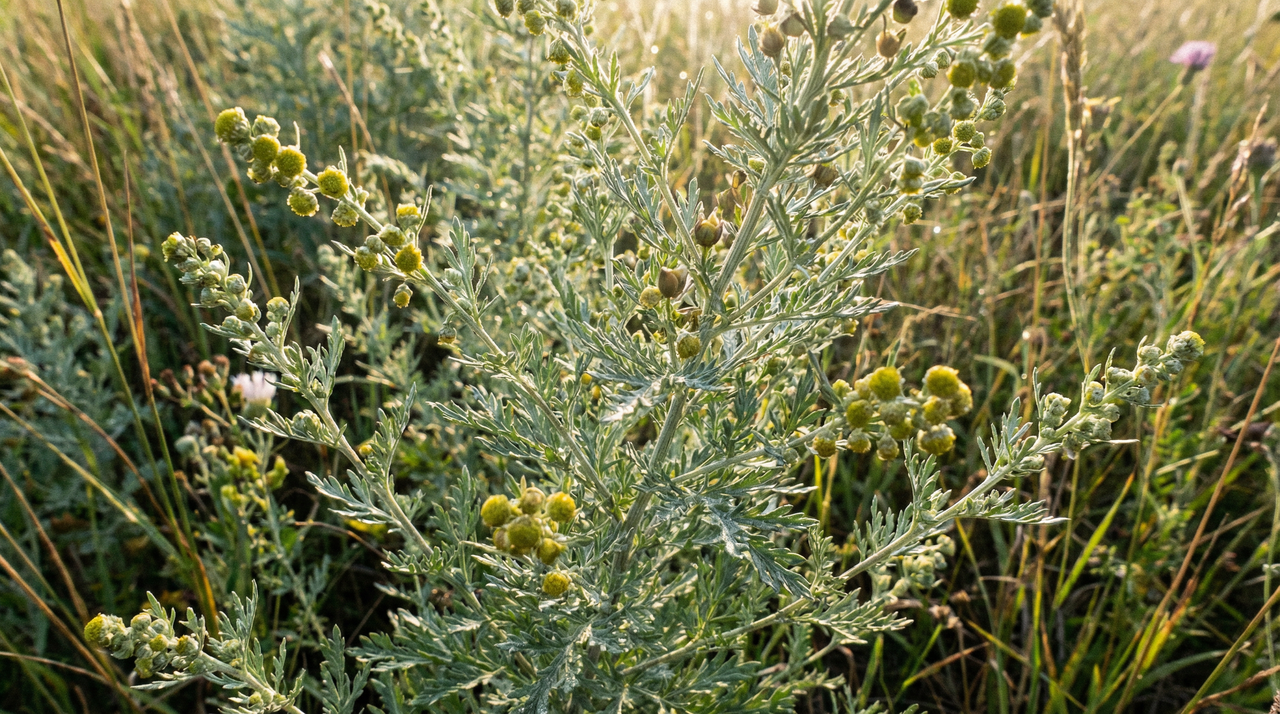
Wormwood presents a fascinating landscape paradox: a profoundly useful medicinal and pest-deterrent plant that demands strict boundaries. I'd planted it as a companion, a pest deterrent, a silvery textural accent for the dry edge of my medicinal guild. What I hadn't accounted for was the plant's complete indifference to my intentions. It spread where it wanted, suppressed what it wanted, and perfumed everything within arm's reach with a smell I can only describe as camphor arguing with anise. And then I read that this same plant, Artemisia absinthium, was once so culturally ubiquitous that its bitterness became a biblical metaphor for catastrophe, a shorthand for the absolute worst thing a person could taste.[1] That felt about right.
What strikes me now is how much of wormwood's reputation rests on a single compound, thujone, which is responsible for both the plant's legendary bitterness and its genuine neurotoxicity risks. People either wave those risks away entirely or treat the whole plant like a controlled substance. Neither camp is being straight with you. The real story is messier and more interesting: a plant with serious chemistry, a long and complicated human history, and enough ecological muscle to reshape a garden bed if you let it. Worth understanding before you put it in the ground.
Wormwood Origin, History, and Botanical Background
Botanical Background and Native Range
Artemisia absinthium is native to the dry grasslands, rocky slopes, steppes, and disturbed open habitats of temperate Europe, western and northern Asia, and North Africa.[2][3] That native range tells you a lot about what the plant expects: full sun, lean soil, and not much water. Since being introduced to North America, Australia, and New Zealand, it has naturalized aggressively in many regions, and in parts of California and Colorado it carries noxious weed status.[4][5] I've watched it spread in garden beds with a persistence that earns respect, even from a horticulturist. It's a polycarpic perennial that can live five to ten years or more as an individual plant. Clonal colonies formed from its rhizomatous root system can persist for decades in undisturbed ground.[6]
The Artemisia genus is wide and wonderfully varied. Sweet wormwood (A. annua) completes its entire lifecycle in a single season, a sharp contrast to A. absinthium's multi-decade staying power.[7] At the other extreme, the compact alpine genepi (A. genipi) can live twenty to fifty years on a cold mountainside with minimal intervention, while mugworts like A. vulgaris and A. princeps settle into the middle range of five to fifteen years.[8] Understanding this spectrum matters for design: you're not dealing with one plant type but a genus with annual, short-lived, and long-lived members that behave very differently in a landscape.
Visual Characteristics of Wormwood
If you've ever mistaken wormwood for dusty miller from across a garden bed, you're not alone. The silvery-gray, feathery foliage is the plant's most arresting feature, and it's not just ornamental. Those dense silvery-white hairs coating the undersides of the pinnately divided leaves and running down the stems actively reduce water loss, a direct adaptation to the arid habitats where this plant evolved.[6][9] Mature plants reach two to four feet tall, occasionally five in a good season, forming upright bushy clumps from a woody base.[6] In my Central Florida landscape, I notice the color intensity shifting through the seasons: the new spring growth comes in softer and a touch greener, and by midsummer, under the full force of the sun, it's almost metallic silver. The silver is most pronounced in nutrient-poor soils and strong sun, which tracks perfectly with the plant's ecology.[10]
Crush a leaf and you'll understand why this plant has captivated herbalists for millennia. The gland-dotted leaves and stems release a sharp camphor-like aroma with notes of sage and anise, an essential oil that is both the plant's defense mechanism and its primary cultural currency.[10] The flowers, by comparison, are almost deliberately unimpressive: tiny pale yellow to greenish-yellow disc florets arranged in loose, nodding panicles, blooming July through September, followed by small ribbed achenes barely a millimeter long.[6] Compare that to tarragon's smooth, narrow, entire leaves with a clean anise scent, or genepi's compact woolly four-to-twelve-inch alpine form, and you start to appreciate just how much visual and aromatic personality separates the Artemisia species from one another.[11][12]
Traditional and Cultural Uses Across Continents
Wormwood's medicinal record is one of the longest in botanical history. Its first documented use dates to around 1600 BCE in the ancient Egyptian Ebers Papyrus, and by the first century CE, Greco-Roman physicians were cultivating and recommending it as a digestive aid, bitter tonic, and anthelmintic.[13][14] Avicenna incorporated it into Islamic medicine in the eleventh century for digestive ailments, fevers, and menstrual issues, and across European folk tradition it gained a parallel life as a protective charm: hung in homes, burned as incense, and invoked against evil spirits and misfortune.[15][16] Biblically, wormwood became a symbol of bitterness and divine judgment, and some Native American tribes have since adopted it for purification smudging ceremonies.[17][18]
Parallel traditions developed independently across the genus. Sweet wormwood had been used in Traditional Chinese Medicine for over two thousand years before its antimalarial compound artemisinin was isolated in 1972 by Tu Youyou, work that earned the 2015 Nobel Prize in Physiology or Medicine.[19][20] In East Asia, Artemisia princeps has been woven into culture since at least the eighth century, used in moxibustion, cuisine, and festival rites.[21] Across southern and eastern Africa, A. afra is a cornerstone of traditional medicine for respiratory, digestive, febrile, and parasitic conditions.[22] The cross-cultural consistency is striking: digestive support, fever management, and antiparasitic action appear across continents, in distinct cultural lineages, from plants that share chemistry but not geography. Given all that convergent use, I always prefer sourcing plants from reputable nurseries rather than contributing any pressure to wild populations, particularly for slow-growing alpine relatives like genepi that can't sustain heavy harvesting.[23]
Wormwood in Absinthe and Folklore: The Green Fairy and Beyond
No plant history generates quite as much romantic mythology as wormwood's role in absinthe. The spirit originated as a medicinal elixir in late eighteenth-century Switzerland before becoming the defining drink of French bohemian culture in the nineteenth century, associated with Baudelaire, Van Gogh, and the seductive mythology of "la fée verte," the green fairy.[24][25] The United States banned it in 1912 over thujone toxicity fears and considerable moral panic; the ban wasn't lifted until 2007, when modern analysis confirmed that contemporary absinthe contains only trace amounts of thujone.[24] I find the story genuinely fascinating, and I say that as someone who grows the plant and knows exactly how powerfully bitter and aromatic it is fresh from the garden. The mystique was real; the chemistry, as it turns out, was somewhat overstated. That said, concentrated use still warrants genuine caution, and the cultural romance doesn't change the pharmacology.
A quieter parallel story belongs to genepi, the compact alpine Artemisia that gives the traditional Alpine digestif génépi liqueur its distinctive bitter warmth, a tradition rooted in at least the eighteenth century and wrapped in its own Alpine folklore as a protective charm.[26] Whether it's the green fairy or the mountain shepherd's digestif, the same pattern holds across the genus: bitterness, aromatic complexity, and powerful chemistry that people have been finding uses for as long as they've been growing things.
Wormwood Varieties and Sourcing
Notable Varieties of Wormwood and Related Artemisia Species
If you're shopping for wormwood expecting a catalog of named cultivars, you'll find the selection surprisingly thin. Artemisia absinthium is grown overwhelmingly as the straight species, valued for that signature silver-gray foliage and intense aromatic bite rather than any breeding breakthrough.[27][28] A handful of selections do appear occasionally in specialty catalogs: 'Lambston' offers a more compact, mounded habit useful where space is tight, and 'Dracunculus' takes the foliage in a dramatically different direction with deeply divided, fern-like leaves that shade toward near-black.[27][28]
The 'Aurea' selection adds golden-yellow foliage to the mix, though I've learned the hard way that it scorches badly without afternoon shade in hot climates.[29] Beyond the foliage differences, cultivar choice can actually affect performance in the garden: 'Green' grows vigorously to 3-4 feet with better drought resistance, 'Purple' stays more compact at 2-3 feet and tolerates poorer soils, and 'Aurea' is the slow grower of the group, topping out around 2 feet.[30][31] For anyone growing the absinthium wormwood herb with medicinal intensity in mind, 'Green' registers higher thujone levels (up to 1.5 percent) compared to 'Purple' (0.8-1.0 percent) or 'Aurea' (0.5-1.0 percent), so the cultivar you choose has real practical weight.[32][31]
Zoom out to the broader genus and the cultivar picture changes completely. Sweet wormwood (Artemisia annua), the annual wormwood grown for artemisinin, has seen intensive medicinal breeding work; selections like 'Artemis', 'Hybrid 1', and 'Anamed' can hit 1.7 percent artemisinin content, which is a long way from the wild-type baseline.[10][33][34] Common mugwort (A. vulgaris) went in an ornamental direction, with foliage selections including silvery 'Silver Queen', cream-variegated 'Variegata', golden 'Aurea', lime-green 'Oriental Limelight', and purple-tinged 'Purpurea' showing up in perennial borders.[35][36] Japanese mugwort (A. princeps) follows a similar pattern with ornamental foliage forms plus 'Myoga', selected specifically for elongated pale flowering shoots used as a culinary garnish.[37][38] Genepi (A. genipi), the alpine specialist, sits at the opposite end of the cultivation spectrum with no commercial cultivars at all; growers work with wild strains or recognized subspecies like subsp. genipi and subsp. hispidula.[39]
Where to Buy Wormwood Plants and Seeds
Artemisia absinthium l. is hardy in USDA zones 4-9 and legal to cultivate across most of the United States; the FDA restricts thujone to 10 parts per million in food products but doesn't prohibit growing or selling the plant itself, though a few states layer on additional requirements.[40][41][42] For sourcing plants, specialized perennial nurseries are your best bet: Bluestone Perennials, High Country Gardens, and Plant Delights Nursery all carry it, with live plants typically running $8-15. Seeds from Johnny's Selected Seeds or Burpee land in the $3.99-$7.99 range, and you'll also find both formats through Etsy and organic herb suppliers like Mountain Rose Herbs.[40][43][44][45][46]
On seed quality: viability from reputable suppliers runs 80-90% with proper storage, and in my experience packets from Johnny's have delivered consistently strong germination.[45] Cheaper unlabeled sources are more of a gamble; I've gotten batches with noticeably off-aromas and lower germination that I wouldn't trust for any serious medicinal purpose. Wild-harvested material can carry superior volatile oil profiles but introduces risks of pesticide residues, heavy metal contamination, and inconsistent thujone content that can vary by up to 50 percent in poor-quality oil.[47][48] Stick with cultivated, certified sources unless you know your wildcrafted supplier well.
Annual wormwood (Artemisia annua) is the easiest of the genus to source. Strictly Medicinal Seeds, Horizon Herbs, and High Mowing Organic Seeds all carry it, seeds run $5-15 and plants $10-25, and it faces no federal noxious weed restrictions.[49] Japanese mugwort is the opposite situation: I've seen A. princeps listed as noxious or invasive in Washington, Oregon, New York, New Jersey, Pennsylvania, Massachusetts, and Virginia, and I treat any mugwort purchase as a research project before I even look at a catalog.[50][51] Check your state rules before ordering. Genepi sits in its own niche entirely: rarely stocked in mainstream US nurseries, it's best sourced through alpine and rock garden societies like the North American Rock Garden Society, with seeds at $5-15 and plants potentially $50 or more given the specialized growing conditions required.[52][53] Conservation pressure from overharvesting in its native range makes responsible sourcing more than just a legal question.[54]
Wormwood Propagation and Planting
Wormwood is one of those plants that will propagate itself enthusiastically if you let it, but getting it started deliberately takes a bit more finesse than people expect. The good news is you have options, and once you understand why each method works the way it does, choosing the right approach for your situation becomes straightforward.
Understanding Wormwood Seeds: Morphology, Dormancy, and Germination Requirements
The seeds themselves are worth understanding before you try to grow from them. Each one is a tiny achene, only 1.0-1.5 mm long and 0.4-0.6 mm wide, pale brown and faintly ribbed, topped with a pappus of white scale-like bristles that lets it drift considerable distances on the wind.[55][56][57] That pappus is also your first clue about sowing technique: do not bury these seeds. They're photoblastic, meaning they need light to break dormancy, so surface sowing on a moist, well-drained mix is non-negotiable.[58][59]
Beyond the light requirement, the seeds carry physiological dormancy that 4-6 weeks of cold moist stratification at 4°C will break.[58][60] Skip that chilling period and you're looking at germination rates as low as 10-30%; do it correctly with fresh seed at 15-20°C, and you can expect 50-70%.[61][62] Fortunately, wormwood seeds are orthodox, meaning they store well under cool, dry conditions, holding viability for 3-5 years at 3-5°C with 10-20% relative humidity; at proper seed-bank temperatures of -18°C, that window extends past ten years.[63][64] For seeds stored at room temperature, I've learned to run a viability test every spring, because germination rates drop noticeably after two years. A pre-chill of 2-4 weeks followed by incubation at 15-20°C under light for 7-21 days will tell you quickly what you're working with; tetrazolium staining is more precise if you have access to it.[65][66]
There's also the variability problem. Because A. absinthium cross-pollinates freely, seedlings often don't come true to the parent plant.[67] Once you've grown a few batches from seed and watched them differ from each other in scent, leaf texture, and habit, the appeal of vegetative propagation starts to make a lot of sense.
Vegetative Propagation Methods: Cuttings, Division, and Beyond
Division is the method I reach for first, and honestly, once you've divided a mature clump you'll probably never go back to waiting two years for seed-grown plants to reach harvest size. Splitting established plants in early spring or fall, with each section retaining a good set of roots and emerging shoots, gives you close to 100% success and plants that are true to type from day one.[68][69] It also keeps the parent plant vigorous; a clump left to its own devices for four or five years gets woody and sparse at the center.
Semi-ripe cuttings are a close second. Take 10-15 cm stems in summer, strip the lower leaves, dip the base in rooting hormone, and stick them in a sand-perlite mix under high humidity. Rooting happens in 2-6 weeks, with success rates of 80-90%.[68][70] This is a good option if you want multiples from a single named plant, or if you're working with a selection whose traits you want to preserve. Layering is possible at 70-85% success but slower, and tissue culture using Murashige-Skoog medium with BAP achieves 90-95% in lab settings; that last one stays firmly in the lab category for most of us.[71][72]
A couple of genus-wide notes worth keeping in mind: French tarragon (A. dracunculus 'sativa') is sterile, so vegetative propagation isn't just preferred, it's mandatory to preserve culinary quality.[73] Japanese mugwort (A. princeps) spreads so aggressively via rhizomes that division every 2-3 years is less a propagation choice and more a containment strategy.[72] All species in this genus share the same non-negotiable site requirements, which is where we need to go next.[74][75]
Soil, Site Selection, and Planting Techniques for Success
Drainage is the single most important word in wormwood cultivation. This plant has a deep taproot and a Mediterranean constitution; it shrugs off drought once established, thrives in poor sandy, gravelly, loamy, or rocky soils, and fails reliably in heavy clay or anything that holds water.[29][3] Root rot isn't a slow decline here; it's a fairly quick death, and the symptoms appear before most gardeners realize what's happening.
Soil pH should sit in the neutral-to-alkaline range, 6.0-7.5. Alkaline, calcareous soils actively enhance the production of secondary metabolites including absinthin, which is the compound responsible for wormwood's characteristic bitterness and much of its medicinal value; growth starts to decline outside the 5.5-8.0 tolerance window.[76][3] I always work a little agricultural lime into acidic garden beds before planting wormwood, and the difference in foliage scent and potency compared to plants growing in unamended soil has been consistently noticeable.
Sun is the other non-negotiable. Wormwood needs at least six hours of direct light daily; anything less and you get the same etiolated, floppy stems I've seen on shade-stressed rosemary and lavender, with pale, less aromatic foliage that simply doesn't perform.[29] The plant's native haunts are dry open slopes, roadsides, and rocky disturbed ground, all of which offer brutal sun and rapid drainage;[77] mimicking those conditions is the entire goal. In heavy or clay-prone gardens, raised beds amended with coarse grit work well. Genepi's requirements for rocky calcareous substrates and cool summers taught me the value of a dedicated raised gravel bed even in warmer, more humid climates where drainage is otherwise compromised.[75]
Spacing, Timeline, and Aftercare for Healthy Establishment
Mature wormwood reaches 60-120 cm tall and spreads 45-90 cm wide, so spacing plants 45-60 cm apart in beds gives each one the air circulation it needs and keeps humidity-related problems from taking hold.[78][79] For field or hedgerow plantings, open up to 90-120 cm between rows.[80] Container growing works well in 30-40 cm diameter pots, but only if you've mixed in generous grit or perlite to keep drainage aggressive enough for the plant's roots.[81] I'd also encourage labeling when growing multiple artemisias together; the seedlings look deceptively similar in their first weeks, and I've mixed up rows more than once before the foliage scent became distinctive enough to sort them.
Germination and Maturity Timelines Across the Artemisia Genus
For A. absinthium started from seed, expect germination in 7-21 days at 15-20°C following the cold stratification period already described.[74][29] Transplant seedlings outdoors after the last frost. First flowering typically takes 1-2 years from seed, with full maturity and peak harvest potential arriving in years 2-3; plants started from divisions or cuttings can flower in their first season.[82][6]
The genus spans an almost absurd range of growth speeds. Sweet wormwood (A. annua) completes its entire annual cycle in 4-6 months, germinating readily in 7-14 days at 20-25°C without stratification, which makes it the sprinter of the family.[83] Genepi, at the opposite extreme, needs 3-5 years from seed to develop properly under alpine conditions; cuttings shorten that to 2-3 years, which is why they're preferred by anyone who wants to actually harvest the plant before getting nostalgic about when they sowed it.[84] If your goal is a productive medicinal or culinary plant within a reasonable season or two, division remains the most direct path for wormwood, and the most honest choice for impatient gardeners.
Wormwood Care Guide
I grow wormwood primarily as a guild plant and pest deterrent, tucked at the edges of beds where its volatile chemistry can do the most work. What I've come to appreciate after years of growing aromatic perennials is how much a plant's needs tell you about its character. Wormwood is native to dry, rocky habitats from sea level up to about 2,000 meters,[3] and every care decision flows directly from that origin story. Get the site right, and the plant practically runs itself.
Sunlight Requirements
Wormwood needs full sun, at least six to eight hours of direct light daily, and it genuinely means it.[3][6] I've seen seedlings planted in partially shaded beds turn lanky and pale within a single season, losing exactly the compact, silver mound habit that makes the plant so useful. Those silvery, light-reflective leaves are an adaptation to high-irradiance, low-humidity conditions,[85] and they only stay bright and tight when the plant is getting the light it evolved under. Think of it like lavender or rosemary: shade produces the same disappointing sprawl, and no amount of pruning fully compensates. The plant is suited to AHS heat zones 1 through 8,[86] though you'll want to monitor it when temperatures climb above 90°F, where foliage can yellow and wilt without supplemental water.[87]
Water Needs
Once established, wormwood is remarkably drought-tolerant, thanks to a root system that can reach two to three feet deep.[88][6] I let soil dry completely between waterings on established plants, and in a normal temperate summer that might mean watering twice a month at most. One sensory cue I rely on: when the leaves lose a little of their silver luster, the plant is thirsty. After a deep watering they recover overnight, which is satisfying to watch.
The non-negotiable is drainage. Waterlogged soil causes root rot fast, and the symptoms are unambiguous: yellowing leaves, soft mushy roots, and powdery mildew on that beautiful foliage.[89][90] Sandy or gravelly soil is genuinely preferred, and soil pH should stay in the neutral-to-slightly-alkaline range of 6.0 to 7.5.[91] I also use collected rainwater when I can; high chlorine in tap water can cause leaf yellowing, and this plant is sensitive to it.[92] Young seedlings are a different story: they need the top inch kept consistently moist every two to three days until they're established, then you can back off sharply.[93] Container-grown plants dry out faster and need more frequent checks throughout.
Feeding and Soil Fertility
The single most useful piece of advice I can give you about feeding wormwood is: don't. Early in my herb-growing years I made the mistake of top-dressing a young plant with compost the way I'd treat most perennials. By midsummer I had a tall, floppy mess with muted aroma and none of the compact silver habit I expected. The plant genuinely prefers lean, low-fertility ground,[6] and excess nitrogen produces exactly that: leggy, weak growth with reduced aromatic-oil concentration.[89][94] Switching to lean conditions dramatically improved both the habit and the scent within a season.
If a soil test genuinely indicates a deficiency, a half-strength application of a balanced low-nitrogen formula like 5-10-10 in early spring is the ceiling of intervention.[95] A light top-dressing of coarse bark mulch gives you weed suppression and slow nutrient release without the fertility spike that encourages lush, oil-poor growth.[29]
Frost Tolerance and Winter Protection
Wormwood is reliably hardy in USDA zones 4 through 9, and established plants can survive temperatures down to approximately -30°F.[6][96] The leaves and young shoots are the vulnerable parts, showing blackened tips or mushy stems below about 23°F, but the crown and root system are well insulated by bark and soil and will push fresh growth in spring.[87] The plant simply retreats underground like a well-behaved prairie perennial, and I stopped worrying about it once I understood that. It behaves almost identically to lavender in this respect: both die back to the crown and return vigorously, provided drainage is right.
My one real winter task is applying two to four inches of organic mulch after the ground freezes in late fall to insulate the root crown and prevent frost heaving.[97][98] Young plants in their first winter need that mulch blanket more than established ones. Sweet wormwood (A. annua), by contrast, is frost-tender and typically killed by sustained temperatures below 28°F,[10] which is why it's often grown as an annual in cold climates. On the opposite extreme, alpine genepi (A. genipi) handles -30°C in zones 3 through 8 with almost no intervention, its dense, woolly leaves providing their own insulation in rocky scree.[99]
Heat Tolerance
Wormwood's heat tolerance mirrors its drought tolerance: moderate stress is fine, even productive, but prolonged extremes cause real damage. Above 90°F, foliage can scorch, wilt, or yellow,[100] and the symptoms overlap enough with drought stress that the two are easy to confuse. Moderate heat actually increases essential-oil production, which I find genuinely interesting as a grower of aromatic herbs, but poor air circulation undermines that benefit quickly.[101] Rosemary behaves similarly: a hot, breezy spot sharpens the fragrance; a hot, stuffy corner turns the same plant sullen.
The practical mitigations are straightforward. Water in the morning to minimize fungal pressure on the foliage, maintain three to four feet of spacing for airflow, and apply two to four inches of mulch early in summer to moderate soil temperature.[102] In regions where heat regularly exceeds 95°F, a little afternoon shade during the worst weeks is worth offering. Sweet wormwood is more heat-sensitive than the perennial species; artemisinin concentration drops measurably above 86°F,[103] which matters if you're growing it for medicinal reasons.
Pruning, Maintenance, and Seasonal Rhythm
Wormwood follows a satisfying and predictable annual rhythm. Silver rosettes emerge in March through May, the plant grows through summer, yellow blooms appear July through September, seed sets in fall, and then the whole aboveground structure dies neatly back to the crown for winter dormancy.[104][105] I genuinely enjoy watching those first silver mounds reappear each spring alongside my other Mediterranean herbs. It's one of those reliable phenological signals that a new growing season has actually arrived.
Late winter or early spring, before new growth starts, cut woody stems back by one-third to one-half, targeting six to twelve inches above the ground.[95][106] Pruning releases that intensely bitter-aromatic scent; use clean, sharp tools to avoid spreading disease between plants. Through late spring and early summer, pinch back young shoots to encourage bushy, compact growth and prevent the legginess that insufficient sun or excess fertility can start. Deadhead the flowers before they go to seed if you want to limit self-seeding and the spread that follows.[107]
I treat wormwood as a utility plant rather than a culinary herb given its thujone content, so I always wear gloves when pruning and keep it away from paths where pets or children play. On the containment side: this plant can spread aggressively, especially rhizomatous relatives like Japanese mugwort, so a two to three inch gravel or bark mulch layer helps suppress both weeds and unwanted seedlings while keeping the crown conditions dry.[29] Pest pressure tends to rise under stress, particularly overwatering or high humidity, so the best pest management is simply keeping the site conditions right.[95] Once the drainage, sun, and lean soil are dialed in, wormwood is largely content to look after itself from one season to the next.
Wormwood Harvesting for Peak Potency and Flavor
Wormwood is a plant where timing is everything. Get it wrong and you end up with diminished material that smells faintly herbal but delivers none of the intense, sharp bitterness that makes this plant worth growing. Get it right and you have something genuinely potent.
Optimal Timing and Visual Cues
For flowering tops, wait for the second year and aim for the early flowering window, when roughly 50-70% of buds are just beginning to open.[108][109] That's when thujone concentrations and essential oil yield peak, and when absinthin, the signature sesquiterpene lactone behind wormwood's extraordinary bitterness, runs highest at 0.5-1.0% dry weight compared to just 0.1-0.2% in the purely vegetative stage.[110] Let the plant go past full bloom and the volatile profile degrades noticeably.[108] I've smelled the difference in my own dried batches and it's not subtle. Young leaves, meanwhile, are fair game from the first growing season if you need material sooner.[74]
In temperate climates, flowering typically runs July through September, with southern gardens often ready in June-July and northern ones waiting until August-September.[111] I've noticed my Silver Frost plants tend to hit the bud stage a week or so ahead of standard A. absinthium, so I check them earlier rather than assuming everything ripens at once.[6] Sweet wormwood (A. annua) compresses the whole cycle into 90-120 days from sowing, harvested at early flowering when 10-50% of plants are blooming.[112][113] Japanese mugwort is more forgiving, offering young leaf harvests once plants reach 20-30 cm in late spring, well before flowering.[95] Genepi sits at the other extreme: harvest flowering tops just 10-20 days after initial bloom, and exercise real restraint since overharvesting is a genuine conservation concern with this slow-growing alpine species.[114]
Harvest Technique and Post-Harvest Handling
Cut in the morning after the dew has cleared, taking stems 10-15 cm above ground with sharp, clean shears.[108][115] Morning harvesting preserves volatile oils before midday heat starts driving them off, and the lower moisture load means cleaner drying. I hold myself to removing no more than one-third of the foliage at any single cut.[116] It feels conservative in the moment, but the plants that get that treatment stay vigorous and productive for years.
My most reliable readiness cue isn't the calendar; it's my fingers. Gently brush the upper leaves and feel for that slightly rough, textured surface caused by the glandular trichomes.[108] In humid subtropical summers the flowering dates can shift by weeks, but those trichomes don't lie. Once cut, move material immediately to shaded drying racks with good airflow. Keep temperatures below 35-40°C and plan on 1-2 weeks until the stems are fully brittle.[108][117] I learned this the hard way trying to speed things up with a dehydrator set too high. The result smelled cooked and flat, not unlike what happens to oregano when you overheat it, but with wormwood the volatile loss is even more obvious because so much of its value lives in that aromatic profile.
Yield, Drying, and Storage for Maximum Quality
Once dried, store in airtight containers somewhere cool, dark, and low-humidity, keeping relative humidity under 60% to hold the essential oils and bitterness compounds stable over time.[115][118] Well-dried wormwood from my own harvests carries a clean, lingering bitterness with a bright aromatic top note that balances beautifully against citrus or anise in small doses. Poorly stored material goes musty and loses that edge entirely, which matters enormously if you're working with bitters or medicinal preparations where potency is the whole point. For sweet wormwood grown primarily for leaf yield, a single plant can produce 0.5-1 kg of dried material under good conditions. Perennial A. absinthium yields less bulk but what you're preserving is quality over quantity, and a clump that's been harvested thoughtfully for five or six seasons delivers every time.
Wormwood Preparation and Uses
Culinary Uses and Safe Preparation of Wormwood
Before anything else: only the leaves and flowering tops of Artemisia absinthium belong anywhere near your kitchen. The seeds and roots are toxic and not used for human consumption.[119][10] Even then, thujone is a genuine neurotoxin with a threshold above 6 mg/kg body weight.[120] The good news is that processing makes a real difference: drying reduces thujone content by 50-70%, and infusing in alcohol or distilling cuts it further by another 20-50%.[121][122] Reduction, not elimination. I treat this plant with the same respect I give foxglove: a pinch in a bitters blend, clearly labeled jars, and no casual snacking.
The flavor driving all of this is absinthin, which accounts for its long history as a digestive aid for fatty meals.[119] The full profile layers herbaceous, earthy, and faintly anise-like notes over a camphorous undertone that needs fat, citrus, or strong alcohol to balance it.[123] Practically, that means wormwood belongs in absinthe, vermouth, and digestive bitters, or in tiny quantities in sausage spice blends and stuffings.[124] The FDA caps thujone at under 10 ppm in food products like absinthe, and the EFSA sets an acute reference dose of just 0.5 mg/kg for α-thujone.[125][126] A daily limit of 1-2 g dried herb is the commonly cited safe range for adults.[125]
If you want something you can actually cook with freely, Japanese mugwort (Artemisia princeps) is where the genus really opens up. Blanching or fermenting knocks the bitterness back considerably, and it shows up across East Asian kitchens in kusa mochi, yomogi tempura, and ssukguk soup.[127] Per 100 g of fresh leaves, it delivers 2-4 g protein, meaningful fiber, vitamins A, C, and K, plus potassium, calcium, and iron.[128][129] Think of it as a more mineral-dense spinach after blanching. Common wormwood, by contrast, contributes essentially no nutritional value; you grow it for bioactives, not calories.[128]
One thing I always emphasize to foragers: positive identification is non-negotiable. Tansy, ragwort, and other Artemisia relatives can look deceptively similar to young wormwood plants.[130][131] I once caught a friend about to harvest what she thought was wormwood from a hedgerow; the leaf underside pubescence and the very specific camphor-forward scent were the tells that set it apart. Crush a leaf, smell it carefully, and check that the undersides are densely silver-hairy before you take anything home. And if you have epilepsy, a seizure disorder, or are pregnant, this entire plant family is off the table.[132][133]
Medicinal Preparations and Dosages
Standard preparations use dried leaves and flowering tops exclusively. A tincture runs 1:5 in 40-60% alcohol, with adult doses of 1-2 mL three times daily; an infusion uses 1-2 g dried herb per cup of water.[132] Both approaches should be short-term and guided by a qualified practitioner. Japanese mugwort infusions are gentler: 3-9 g dried leaves steeped 10-15 minutes, reflecting that species' lower thujone burden.[134] African wormwood decoctions simmer 5-10 g per liter for a different regional preparation tradition.[135]
On drying: I air-dry wormwood slowly in my shade house rather than using any heat source. Low-temperature drying preserves more of the volatile aromatic oils than oven drying does, and those oils are part of what you're preparing the herb for in the first place. Whatever method you choose, store the dried material in sealed glass away from light, and don't keep it past one season.
Non-Food Uses of Wormwood and Relatives
Wormwood's cultural history stretches well beyond the medicine chest. It became the defining flavor of 18th-century absinthe and vermouth, shifting from bitter digestive tonic into an iconic and eventually heavily regulated beverage ingredient.[136] Beyond beverages, the stems have historically provided coarse fiber for textiles and paper, and the plant yields a yellow-green dye for wool; Japanese mugwort shares similar fiber and dye traditions.[137][21]
In my own garden, I've grown wormwood along border edges specifically because its volatile compounds reliably deter deer and a range of pest insects. That pest-repellent function is a genuine permaculture asset, though as I've noted elsewhere, its allelopathic reach means thoughtful placement matters. The same chemistry that keeps pests away doesn't distinguish between a caterpillar and a neighboring nitrogen-fixer. Respectful handling applies here just as it does in the kitchen.
Wormwood Health Benefits and Medicinal Uses
Every conversation about wormwood's benefits has to start with thujone, because thujone is both the reason the plant works and the reason it can hurt you. That's not a warning to tuck at the end of an article. It's the organizing principle of the whole plant.
Key Compounds in Wormwood: Thujone, Flavonoids, and Sesquiterpene Lactones
Artemisia absinthium is chemically complex in ways that still impress me after years of working with aromatic herbs. The plant produces a dense web of secondary metabolites: terpenoids including the monoterpenes α- and β-thujone, sesquiterpene lactones like absinthin and anabsinthin, flavonoids such as apigenin, luteolin, and artemetin, phenolic acids including chlorogenic and caffeic acid, coumarins, tannins, saponins, and trace alkaloids.[138][139][140] That's not one active compound. That's a whole ecosystem of chemistry doing different things simultaneously.
Thujone dominates the essential oil, sometimes accounting for up to 70% of it, and gives the plant its signature fierce bitterness. The essential oil itself is present at 0.2 to 1.5% depending on where the plant grows, what season you harvest in, and what chemotype you're working with.[141][142] I've noticed this myself: plants I grow through hot, humid summers smell markedly more intense than those from cooler periods, which lines up with research showing that European chemotypes tend to be thujone-rich while Asian populations often favor cineole.[143][144] It's a useful rough gauge of potency for gardeners who don't have access to a lab.
The leaves and flowering tops concentrate thujone most heavily, at 0.3 to 1.8 mg/g of dry weight, while roots carry different compounds entirely: absinthic acid, herniarin, higher flavonoid and coumarin fractions, and very little volatile oil.[145][146] The flavonoids and phenolics aren't just background noise, either. They inhibit pro-inflammatory cytokines and the NF-κB pathway, and the phenolic acids show strong antioxidant activity in DPPH radical scavenging assays.[147][148][139] All of this volatile, allelopathic chemistry also explains why I keep wormwood well away from young seedlings in the garden; those same compounds that deter herbivores and pathogens in the wild can suppress germination of neighboring plants.[149]
Traditional and Modern Medicinal Research on Wormwood
People have been using this plant medicinally for a very long time. European and Asian traditional medicine both documented wormwood for digestive complaints, febrile illness, intestinal parasites, gynecological conditions, and as a general bitter tonic.[150][151] Modern pharmacology has since validated several of those uses, at least in part. Anti-inflammatory activity through NF-κB and COX-2 inhibition, antimicrobial effects via membrane disruption by thujone and sesquiterpene lactones, antiparasitic activity, and spasmolytic properties are all documented.[150][152][153] The honest caveat is that most of this evidence is in vitro or from animal models. Robust human clinical trials are scarce.
The strongest clinical territory for A. absinthium specifically is digestive health. A randomized controlled trial involving 120 participants suggested meaningful benefit for functional dyspepsia and appetite stimulation, and there's some evidence for antiparasitic effects against intestinal worms, though systematic reviews note inconsistent methodology across studies.[154][155] These are the uses I'd consider most credibly supported, and they align directly with what folk herbalists have reached for this plant to do for centuries.
The genus-wide story becomes dramatically more impressive when sweet wormwood enters the picture. Artemisia annua produces artemisinin, a sesquiterpene lactone that works by reacting with heme iron to generate reactive oxygen species that damage parasite proteins. Artemisinin-based combination therapies are now WHO-recommended first-line treatment for uncomplicated Plasmodium falciparum malaria, with cure rates exceeding 90%.[156][157] That's Nobel-recognized clinical success, and it reframes how seriously we should take the Artemisia genus while keeping our expectations for A. absinthium appropriately measured. Related species including Japanese mugwort and African wormwood show anti-inflammatory, antioxidant, and preliminary anticancer effects in preclinical research, but evidence for absinthium itself outside digestive and antiparasitic uses remains largely preclinical.[158][159][160]
Thujone's mechanism matters here. At low doses it acts as a positive allosteric modulator of GABA-A receptors; at higher concentrations it flips to antagonist behavior, producing neuroexcitatory effects.[161][162] That dose-dependency is the entire argument for moderation in a single pharmacological fact.
Nutritional Profile of Wormwood and Related Artemisia Species
Dried wormwood leaves do carry real nutrients on paper: around 282 kcal, 18.9g protein, and 24.6g fiber per 100g dry weight, with calcium in the 1,200 to 1,500 mg range and modest iron and vitamins A and C.[163][164] Those numbers exist almost entirely in a theoretical space, because nobody is eating 100g of dried wormwood. The thujone content of the dried herb runs 1 to 5 mg/g in the aerial parts, and while tea extracts relatively little (roughly 0.1 to 0.5 mg/L), tinctures pull considerably more, and traditional use limits are set at under 6 mg thujone per day.[165][125] Nutrition is genuinely secondary to safety here.
If I want to use Artemisia species for their nutritional contribution, I reach for something other than absinthium. Japanese mugwort and common mugwort offer meaningful vitamin K, vitamin A, calcium, iron, and potassium in amounts that make sense at culinary serving sizes.[166] French tarragon is genuinely mineral-dense in small servings. Sweet wormwood and genepi are primarily medicinal, with nutrition a distant second consideration.[167][168] I'll add a pinch of dried mugwort or tarragon to a grain dish without a second thought; wormwood stays in the medicinal or ornamental role in my garden, not the kitchen.
Safety Considerations and Contraindications for Wormwood
Thujone is a neurotoxic GABA antagonist at elevated doses, and the symptoms of overexposure progress quickly: GI distress and dizziness first, then restlessness, tremors, and hallucinations, with seizures possible at acute intakes of 10 to 20g of dried leaves.[169][170] I don't say that to scare people away from a fascinating medicinal plant. I say it because the dose-dependency is real and the margin between therapeutic and harmful is narrower than it appears.
If you're pregnant, breastfeeding, managing epilepsy, or dealing with kidney or liver disorders, medicinal wormwood is off the table. The EMA assessment is specific about uterine stimulant and abortifacient effects in animal studies, and that's not data I'd dismiss.[171][172] Drug interactions are also worth naming: wormwood can reduce anticonvulsant efficacy, add to CNS depression, potentiate anticoagulants, and interact with antidiabetic medications. I never recommend wormwood tinctures for long-term use or during pregnancy; this isn't generic herbal-medicine caution, it's grounded in specific pharmacological data.
Regulatory agencies have set concrete limits. EFSA permits up to 35 mg/kg thujone in bitter liqueurs and less in food products; the EMA recommends staying under 6 mg thujone per day and under 30 mg/kg in supplements, with traditional dried herb doses running 1 to 3g per day with monitoring.[125][173] Sweet wormwood behaves quite differently: artemisinin therapies at approved doses carry only mild GI side effects and are WHO-endorsed even in later pregnancy, though they're avoided in the first trimester.[174] For culinary Artemisia relatives used in small amounts, thujone isn't the primary concern, but all share the genus-wide risks of Asteraceae allergy reactions, potential contact dermatitis, and toxicity to pets.[175] Proper identification matters enormously here. The silvery aromatic Artemisias can look similar, and getting it wrong has real consequences.
Wormwood Pests and Diseases
Wormwood sits in a rare category among garden herbs: it largely protects itself. That's not an accident of circumstance but a product of a remarkably sophisticated chemical defense system, and understanding how it works explains both why the plant thrives with minimal intervention and where its real vulnerabilities actually hide.
Natural Pest Resistance in Wormwood
The glandular trichomes covering wormwood's silvery foliage aren't just decorative. They're essentially tiny chemical factories, secreting the same thujone and camphor that give the plant its signature scent directly onto the leaf surface as a first line of defense against insects and herbivores.[176][144] I grow lavender and rosemary in the same beds, and while those earn their keep as pest deterrents too, wormwood operates at a different intensity. The bitterness here isn't just aromatic; it's a metabolic cost that most insects find genuinely uninviting. The essential oils collectively repel aphids, flea beetles, spider mites, thrips, leaf miners, soft scales, and even nematodes.[177][178] Across the broader genus, this pattern holds: Japanese mugwort backs up its chemical armory with dense pubescence that creates a physical barrier against pest contact,[179] African wormwood deploys a comparable oil profile of 1,8-cineole, borneol, and alpha-thujone,[180] and sweet wormwood goes further still, with artemisinin-powered antifeedant compounds that in field trials provided up to 90% repellent activity against mosquitoes.[181] In healthy soil, mycorrhizal associations may amplify this natural defense by improving nutrient uptake and potentially boosting volatile production overall.[182]
Common Pests and Management
None of that immunity is total. Aphids still find their way onto tender new growth with moderate regularity, and leaf miners can appear at low to moderate levels, particularly during humid stretches.[183] In a well-grown plant sited in full sun with good airflow, neither is typically devastating. I've found that releasing ladybugs early, when aphid pressure first appears on the soft spring growth, keeps populations in check without ever needing stronger interventions, which matters a lot if you're growing this plant for medicinal or culinary purposes and want to keep the foliage clean. For leaf miners and any caterpillar pressure, Bacillus thuringiensis is a sensible organic option; greenhouse trials using spinosad-based insecticides reduced leaf miner infestations by 70 to 80%.[184] Neem oil handles mites and soft scales without compromising the plant's integrity. Avoiding overhead irrigation and giving plants room to breathe are non-negotiable steps that make the difference between a plant that manages itself and one you're constantly fussing over.
Disease Resistance and Vulnerabilities
Wormwood's aromatic oils provide solid baseline disease resistance, and in a dry, sunny site the plant rarely encounters serious pathogen pressure.[6] Viral diseases are almost never reported.[185] The picture changes completely in wet, poorly drained conditions, where root rot from Phytophthora and Pythium species becomes the single most serious threat, leading to rapid wilting and yellowing that can take a plant down fast.[186][187] After losing a planting to poor drainage early in my career, I've since made raised beds or generous grit amendments the first design decision for wormwood in heavier soils. That single practice has eliminated root rot issues in every garden I've designed since. No commercially available cultivars of Artemisia absinthium offer meaningful disease resistance; the ornamental selections that occasionally appear in catalogs were chosen for foliage habit, not pathogen tolerance, so disease management is entirely a matter of cultural practices.[185]
Common Diseases and Prevention
In humid conditions, powdery mildew (Erysiphe cichoracearum or Podosphaera aphanis) and leaf spot (Alternaria alternata, Cercospora spp.) are the most frequent fungal problems, showing up as white powder or brown lesions on the foliage.[185][188] Rust (Puccinia absinthii) can appear under wet conditions, though wormwood generally shows good rust tolerance; the more unusual Gymnosporangium sabinae infection, which requires junipers as alternate hosts, produces orange gelatinous galls on stems and is mainly a concern in regions with winter rainfall.[183][189] Downy mildew and white rust (Albugo candida) occur but are less common.[190] Spacing plants 18 to 36 inches apart, skipping overhead watering, removing dead foliage in fall, and ensuring fast-draining soil address most of these issues before they start.[191] When something does appear, potassium bicarbonate or neem oil handles powdery mildew; copper-based fungicides applied at first sign manage leaf spot and rust effectively.[186]
Integrated Pest and Disease Management
Wormwood's natural chemistry does the heavy lifting on most pest and disease fronts when the plant is grown in conditions it actually prefers: full sun, lean well-drained soil, good air circulation, and low to moderate humidity.[6] I've used it as a border plant in guild designs specifically to extend that repellent chemistry to more vulnerable neighbors, and I always site it at the edge where airflow prevents the mildew pressure I've seen develop in crowded, humid spots. Biological controls first, targeted neem or spinosad only when needed, and cultural prevention above all: that approach keeps Artemisia absinthium genuinely low-maintenance rather than just marketed as such.[192]
Wormwood in Permaculture Design
Wormwood is one of those plants that earns real respect in a permaculture system, not because it's easy to work with, but because it does so many things powerfully well. The catch is that "powerfully" cuts both ways. Understanding what it's actually offering, and what it's quietly doing to everything around it, makes the difference between a useful specialist and a garden problem you spend years correcting.
Climate Adaptability and Hardiness Zones
Artemisia absinthium is a genuinely cold-hardy plant, surviving temperatures down to -30°F and growing reliably across USDA zones 4 through 9.[104][193][194] That said, it really performs in zones 4 through 7. Push it into zones 8 or 9 and the high humidity becomes a genuine obstacle, promoting fungal issues that the plant simply didn't evolve to handle.[104] I've noticed that the silvery, feathery leaves become noticeably more aromatic and pungent in hot, dry summers, which always reads to me as the plant doing exactly what it was designed to do. In a wet season, by contrast, you'll often see that same foliage yellowing and the whole plant looking stressed and sullen. It's telling you something.
What this plant wants is what its native range gave it: dry, rocky slopes, open sun, and lean, well-drained ground across temperate and Mediterranean Europe, western Asia, and North Africa.[3][195] It tolerates drought in the 250 to 600 mm annual precipitation range, handles heat up to 100°F, and functions well at elevations from sea level up to 2000 meters, preferring neutral to slightly alkaline soils with a pH of 6.0 to 8.0.[196][197] If you're working in a different part of the genus, zone compatibility shifts considerably. Mugwort (A. vulgaris) tolerates more moisture but is aggressively invasive across North America.[198] Genepi (A. genipi) is hardy down to zone 3 but needs strict alpine drainage that most gardens simply can't replicate.[199] Site selection has to match the specific Artemisia you're actually growing.
Ecosystem Functions and Ecological Role
The ecological services wormwood offers are genuinely useful in a well-placed design. Its deep taproot pulls potassium, iron, and other minerals up from lower soil layers, making them available as mulch when you chop and drop the stems.[200][201] I chop and drop the stems in autumn so those accumulated nutrients become available to nearby perennials the following spring, turning what could be a competitor into a genuine nutrient contributor. It also stabilizes soil on slopes and in disturbed areas, which fits its role as a pioneer species, naturally colonizing bare, rocky ground before more complex plant communities establish.[202] Note that like all Artemisia species, it doesn't fix nitrogen, so don't expect it to support legumes the way an alder or clover would.[200]
The aromatic compounds, primarily absinthin and thujone, that define its medicinal reputation also drive real pest-repellent activity in the garden, deterring aphids, cabbage worms, moths, and carrot fly while attracting predatory wasps and other beneficials.[202][203] Crushing a leaf near other plants gives you an immediate sense of how concentrated that chemistry is. The flowers themselves are worth understanding correctly: wormwood is primarily wind-pollinated, producing small yellowish-green florets from July through October that are less about bees than about broadcasting lightweight pollen on open, sunny, breezy sites.[204][205] Think of it less like a daisy and more like a grass in terms of pollination strategy. Some insect visits happen, but studies show less than 20% insect pollination in most Artemisia species, with Genepi being a notable exception that actually attracts flies and bees.[206]
The harder truth is that wormwood's allelopathic chemistry, expressed through both root exudates and leaf volatiles, actively suppresses competing plants, inhibits weed germination, and alters soil microbial communities including nitrifying bacteria.[31][207] Over time, a poorly placed wormwood can reduce local plant diversity around it. Combine that with rhizomatous spread reaching up to 1 to 2 meters per year and high seed output, and you have a plant that can shift from asset to problem within a couple of seasons if you're not paying attention.[208][209]
Forest Layer and Guild Placement
My strong recommendation, based on watching what happens when people don't follow it, is to treat wormwood as a managed specialist rather than a core food forest member. It belongs in the herbaceous to low-shrub layer at sunny edges, in dedicated medicinal spirals, or in isolated dry-guild beds, not integrated among your nitrogen-fixers or sensitive culinary herbs.[104][210] I made the mistake early on of planting it too close to a vegetable guild, and within two seasons the neighboring plants were visibly struggling. The allelopathy is not theoretical; it's real and cumulative. In my designs now, I always isolate Artemisia species with root barriers, or give them their own dedicated beds entirely.
Used correctly, though, wormwood as a wormwood companion plant delivers measurable benefits. Positioned near carrots, cabbage, beans, onions, or peas, it repels a meaningful list of common pests while attracting predatory beneficials.[211][212] Intercropping research with related species like Sweet Wormwood shows pest reductions and weed suppression with potential yield increases of 20 to 30%, which is substantial if you're managing it carefully.[213] Sweet Wormwood itself, grown as an annual in the herbaceous layer at open edges, sidesteps the rhizome problem entirely.[6] Japanese mugwort offers ground-cover potential but demands firm containment planning given its spreading habits.[214] The watchword across the whole genus is containment: these plants do their best work when you've decided exactly where they start and end.
The Plant I Keep at the Edge, and Keep Respecting
I planted my first wormwood along the dry southern fence line thinking it would behave. It didn't. But watching it hold that hot, compacted strip of ground through two brutal summers, silver and unbothered while everything nearby struggled, I stopped trying to manage it and started learning from it. There's something clarifying about a plant this honest about what it is, how much it wants, and exactly how far it'll go if you let it.
Sources 214
- Hebrew Lexicon: La'anah (Wormwood) - Bible Study Tools ↩
- Artemisia absinthium ↩
- Artemisia absinthium L. ↩
- Absinth Wormwood ↩
- Artemisia absinthium L. ↩
- Artemisia absinthium ↩
- Artemisia annua L. ↩
- Artemisia genipi L.: The Eternal Plant of the Alps ↩
- Artemisia absinthium ↩
- Artemisia absinthium - Missouri Botanical Garden Plant Finder ↩
- Artemisia annua ↩
- Mugwort (Artemisia vulgaris) - Missouri Botanical Garden ↩
- The Ebers Papyrus: History, Contents, and Significance ↩
- De Materia Medica ↩
- Wormwood: Artemisia absinthium L. – Historical and Modern Perspectives ↩
- Folklore and Uses of Artemisia absinthium in Europe ↩
- Biblical Symbolism of Wormwood ↩
- Ethnobotany of Artemisia absinthium: A Review ↩
- The Discovery of Artemisinin and the Rocky Road to Have a New Antimalarial Drug ↩
- The Discovery of Artemisinin and Nobel Assembly Lecture ↩
- Artemisia princeps: Traditional Uses in Japanese Culture ↩
- Traditional uses and pharmacological properties of Artemisia afra: A review ↩
- Artemisia absinthium L. - GRIN-Global Database ↩
- Absinthe ↩
- The History of Absinthe: Murderous Myths and Menacing Medicine ↩
- Génépi: The Alpine Herb and Its Liqueur Tradition ↩
- Artemisia absinthium - Plant Search - Missouri Botanical Garden ↩
- Artemisia absinthium - RHS Plant Finder ↩
- Artemisia absinthium ↩
- Cultivar Evaluation of Wormwood (Artemisia absinthium) for Ornamental and Medicinal Use ↩
- Thujone Content and Agronomic Performance of Artemisia absinthium Genotypes ↩
- Variation in Essential Oil Composition of Artemisia absinthium Cultivars ↩
- Cultivars of Artemisia annua for Artemisinin Production ↩
- Breeding for artemisinin content in Artemisia annua ↩
- Artemisia vulgaris - Wikipedia ↩
- Royal Horticultural Society: Artemisia vulgaris cultivars ↩
- Artemisia princeps ↩
- Artemisia princeps Varieties ↩
- Artemisia genipi - Wikipedia ↩
- Artemisia absinthium - Wormwood ↩
- Artemisia absinthium - USDA PLANTS Database ↩
- Thujone and Absinthe - FDA ↩
- Wormwood (Artemisia absinthium) ↩
- Artemisia absinthium ↩
- Johnny's Selected Seeds Product Page for Artemisia absinthium ↩
- Burpee Seeds Product Page for Artemisia absinthium ↩
- Essential Oils of Artemisia: Quality and Safety ↩
- Wormwood Monograph ↩
- Federal Noxious Weeds List ↩
- Invasive Plant Atlas: Artemisia princeps ↩
- New York State Invasive Species Council - Noxious Weed List ↩
- Alpine Plants for American Gardens ↩
- Importing Plants and Plant Products into the United States ↩
- Artemisia genipi Conservation Status ↩
- USDA Plants Profile for Artemisia absinthium ↩
- Flora of North America: Artemisia absinthium ↩
- Comparative study of seed morphology and germination characteristics of five Artemisia L. species ↩
- Storage Physiology of Orthodox Seeds in the Genus Artemisia ↩
- Germination of Artemisia absinthium L. seeds: Implications for restoration ↩
- Seed Information Database - Kew ↩
- Germination Ecology of Artemisia Species ↩
- Propagation of Artemisia absinthium ↩
- Seed Storage of Horticultural Crops ↩
- Seed Longevity and Storage of Artemisia Species ↩
- USDA Seed Storage Handbook ↩
- Germination and Storage Behavior of Artemisia Seeds ↩
- Genetic Diversity and Outcrossing Rates in Artemisia annua Populations ↩
- Propagation of Artemisia Species ↩
- Herb Propagation Techniques ↩
- Rooting Success in Artemisia spp. Cuttings ↩
- Micropropagation of Medicinal Plants: Artemisia absinthium ↩
- Propagation of Artemisia princeps ↩
- How to grow French tarragon ↩
- Artemisia absinthium Plant Profile ↩
- Soil and Climate Preferences for Genepi ↩
- Ecological and phytochemical diversity of Artemisia absinthium in Turkey ↩
- Flora of North America – Artemisia absinthium ↩
- Artemisia absinthium ↩
- Royal Horticultural Society – Artemisia absinthium ↩
- Herbs in the Garden, Virginia Cooperative Extension ↩
- Cultivation of Artemisia Species in Containers ↩
- Artemisia absinthium - Missouri Botanical Garden ↩
- Phenology of Artemisia annua L. ↩
- Artemisia genipi Cultivation Guide ↩
- Royal Horticultural Society - Artemisia absinthium ↩
- Missouri Botanical Garden Plant Finder ↩
- North Carolina Extension - Artemisia absinthium ↩
- The Spruce - Growing Wormwood ↩
- Gardening Know How - Wormwood Care ↩
- The Spruce - Wormwood Plant Care ↩
- Royal Horticultural Society - Artemisia absinthium Profile ↩
- UC ANR - Salinity Tolerance in Herbs ↩
- Missouri Botanical Garden Plant Finder ↩
- University of Minnesota Extension - Wormwood ↩
- Royal Horticultural Society - Growing Artemisia ↩
- Royal Horticultural Society - Wormwood Hardiness ↩
- University of Minnesota Extension - Artemisia ↩
- Royal Horticultural Society - Artemisia absinthium ↩
- Royal Horticultural Society - Artemisia genipi ↩
- Frontiers in Plant Science - Heat Stress Responses in Artemisia ↩
- RHS - Artemisia absinthium Cultivation ↩
- Missouri Botanical Garden - Artemisia absinthium Care ↩
- Journal of Agricultural Science - Temperature Effects on Artemisia annua ↩
- Missouri Botanical Garden Plant Finder ↩
- Royal Horticultural Society - Artemisia absinthium ↩
- Missouri Botanical Garden - Artemisia absinthium Care ↩
- The Spruce - Growing Artemisia ↩
- Artemisia absinthium L.: Ethnopharmacology, Cultivation, Phytochemistry, and Essential Oil Analysis ↩
- Essential Oil Yield and Composition of Wormwood (Artemisia absinthium L.) at Different Growth Stages ↩
- Influence of Growth Stage on Bitterness Compounds in Wormwood Leaves ↩
- Essential Oil Content and Composition of Artemisia absinthium during Different Growth Stages ↩
- Cultivation of Artemisia annua ↩
- Growing Artemisia annua for Artemisinin Production ↩
- Sustainability of Wild-Harvested Artemisia Species ↩
- Harvesting and Drying Medicinal Herbs ↩
- Cultivation and Harvest of Medicinal Plants: Artemisia ↩
- Drying Temperature Effects on Artemisinin Content in Artemisia annua ↩
- Storage Conditions for Dried Artemisia annua Leaves ↩
- Wormwood ↩
- Toxicity of Artemisia absinthium ↩
- Thujone Content in Wormwood ↩
- Wormwood: Usefulness and Safety ↩
- The Essential Oil of Artemisia princeps ↩
- Culinary Uses of Wormwood ↩
- Scientific Opinion on the Use of Thujone in Food and Beverages ↩
- Code of Federal Regulations Title 21 - Thujone in Foods ↩
- Artemisia princeps in Japanese Traditional Medicine and Cuisine ↩
- Nutritional Composition of Artemisia princeps ↩
- USDA FoodData Central - Mugwort ↩
- Artemisia absinthium Plant Profile ↩
- Foraging Safety Guide: Asteraceae Family Safety ↩
- Wormwood - Monograph ↩
- Mugwort (Artemisia spp.) Allergy: An Update ↩
- Artemisia princeps in Traditional East Asian Medicine ↩
- Artemisia afra: A comprehensive review of an enigmatic African medicinal plant ↩
- Absinthe: History and Mythology ↩
- Historical Uses of Wormwood ↩
- Phytochemical and Pharmacological Aspects of Artemisia absinthium Linnaeus ↩
- Secondary Metabolites from Artemisia absinthium L. as Potential Source of Antioxidant Compounds ↩
- Secondary Metabolites of Artemisia Genus: Pharmacology and Application ↩
- Chemical Composition and Bioactivities of the Essential Oils of Artemisia absinthium from Different Regions ↩
- Artemisia absinthium L. – Chemistry, Quality, and Pharmacological Aspects ↩
- Seasonal Variation in the Essential Oil and Volatile Oil Contents of Artemisia absinthium L. ↩
- Geographic Variation of Secondary Metabolites in Artemisia absinthium from Different Regions ↩
- Secondary Metabolites of Wormwood (Artemisia absinthium): Distribution and Bioactivity ↩
- Thujone Content in Different Parts of Artemisia absinthium ↩
- Flavonoids from Artemisia absinthium with Anti-Inflammatory Potential ↩
- Antioxidant and Antimicrobial Activities of Artemisia absinthium Extracts ↩
- Secondary Metabolites of Artemisia absinthium L. and Their Biological Activity ↩
- Ethnopharmacology of Artemisia absinthium L. ↩
- Artemisia absinthium: A Review of its Traditional Uses, Phytochemistry, and Pharmacological Activities ↩
- Artemisia absinthium: A Review of Its Phytochemistry and Pharmacological Activities ↩
- Pharmacological Activities of Artemisia absinthium L. ↩
- Efficacy of Artemisia absinthium in Functional Dyspepsia: A Randomized Controlled Trial ↩
- Antiparasitic Activity of Artemisia absinthium Against Human Intestinal Worms ↩
- WHO Guidelines for Malaria Treatment ↩
- Mechanisms of action of the anti-malarial drug artemisinin ↩
- Anti-inflammatory properties of Artemisia annua: A systematic review ↩
- Pharmacological Properties of Artemisia Species: A Review ↩
- Apoptosis induction by Artemisia absinthium in cancer cells ↩
- Thujone's interaction with GABA_A receptors ↩
- Wormwood (Artemisia absinthium L.)-A Curious Plant with Both Neurotoxic and Neuroprotective Properties ↩
- USDA FoodData Central - Search for Wormwood ↩
- Nutritional Composition of Artemisia absinthium L. (Wormwood) ↩
- Chemical Composition and Bioactivities of Artemisia absinthium Essential Oil ↩
- Mugwort, raw | USDA FoodData Central ↩
- Nutritional and Phytochemical Analysis of Artemisia annua L. ↩
- USDA FoodData Central - Tarragon, fresh ↩
- Wormwood (Artemisia absinthium L.)-A curious plant with both neurotoxic and neuroprotective properties ↩
- Absinthe and Thujone: Neurotoxicity Review ↩
- Assessment Report on Artemisia absinthium L., Folium and Herba ↩
- Artemisia absinthium: A Review of its Traditional Uses, Phytochemistry, Pharmacology, and Safety ↩
- Artemisia absinthium L. - Wormwood ↩
- Safety of artemisinins in first and second trimesters of prospectively reported pregnancies ↩
- Artemisia afra: A comprehensive review ↩
- Chemical and Physical Plant Defences in Wormwood (Artemisia absinthium L.) ↩
- Insecticidal Properties of Artemisia absinthium Essential Oil ↩
- Nematicidal Effects of Artemisia Species ↩
- Insecticidal Activity of Artemisia princeps Essential Oil Against Aphids ↩
- Insecticidal and Repellent Activities of Artemisia afra Jacq. Essential Oil ↩
- Repellent Activity of Artemisia annua Essential Oil Against Mosquitoes ↩
- Mycorrhizal Symbiosis and Insect Defense in Artemisia Species ↩
- Artemisia absinthium: Pest and Disease Management ↩
- Integrated Pest Management Strategies for Medicinal Plants ↩
- Diseases of Artemisia Species ↩
- Artemisia absinthium: Diseases and Pests ↩
- Susceptibility of Artemisia to Root Rots ↩
- Fungal Pathogens of Wormwood ↩
- Fungal Diseases of Artemisia Species ↩
- RHS Plant Care: Artemisia absinthium ↩
- Missouri Botanical Garden Plant Finder ↩
- Pests and Diseases of Artemisia - University of California IPM ↩
- Artemisia absinthium ↩
- USDA PLANTS Database ↩
- Artemisia absinthium ↩
- Artemisia absinthium ↩
- Wormwood, Artemisia absinthium ↩
- USDA PLANTS Database - Artemisia vulgaris ↩
- Artemisia afra - PlantZAfrica ↩
- Permaculture Plants: Wormwood ↩
- Dynamic Accumulators - Permaculture Plants ↩
- Kew Science - Artemisia absinthium Ecology ↩
- Companion Planting with Wormwood ↩
- Pollination in the Genus Artemisia ↩
- Floral Biology and Pollination in Artemisia Species ↩
- Pollination Biology of Alpine Artemisia genipi ↩
- Allelopathy in Artemisia Species ↩
- USDA PLANTS Profile for Artemisia absinthium ↩
- Invasive Plant Atlas: Artemisia vulgaris ↩
- Allelopathic Potential of Artemisia annua L. Essential Oils ↩
- Companion Plants: Wormwood as a Natural Pest Deterrent ↩
- Wormwood: Planting and Companion Benefits ↩
- Weed Suppression by Artemisia annua in Intercropping Systems ↩
- Artemisia princeps ↩