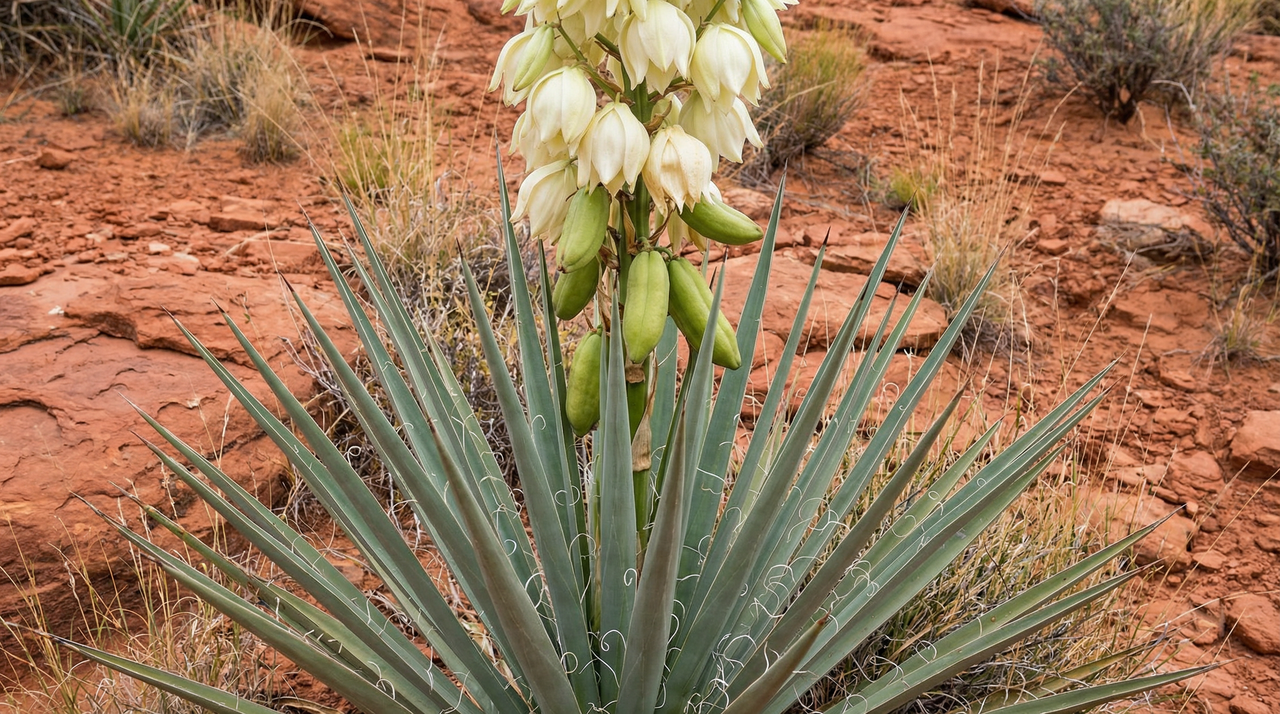
Nobody expects a desert plant to feed you, wash your hair, and weave your sandals. But that's exactly what Banana Yucca (Yucca baccata) has been doing for the Indigenous peoples of the Southwest for thousands of years, and most gardeners who grow it have absolutely no idea. They plant it for the drama of those blue-green sword rosettes, maybe for the tall cream-colored flower spikes in spring, and then they leave it alone and call it low-maintenance. Which, to be fair, it is. But they're missing most of the story.
What got me was the fruit. The first time I split open a ripe banana yucca pod and caught that scent, somewhere between sweet potato and caramel with a faint floral edge, I genuinely couldn't believe it came from something that looks this architectural and severe. These plants have been feeding people since long before European contact,[1] and yet somehow "edible desert succulent with 5,000 years of culinary history" isn't the headline they ever get. I want to fix that.
Origin and History of Banana Yucca (Yucca baccata)
Botanical Background and Native Range
Banana Yucca is a plant that earns its place in the desert, not just survives it. Native to the arid Southwest, Yucca baccata spans Arizona, California, Colorado, Nevada, New Mexico, Texas, Utah, and into northern Mexico, threading through the Mojave, Sonoran, and Chihuahuan Deserts at elevations typically between 2,000 and 5,000 feet.[2][3] That range matters when you're designing with it. Related species like Mound Lily Yucca (Yucca gloriosa) hug the southeastern coastal plains, and Spanish bayonet (Yucca aloifolia) extends through the Caribbean and into South America, which tells you right away that the genus is adaptable even if Banana Yucca itself is very much a creature of the arid interior.[4][5]
The plant itself is a polycarpic evergreen shrub forming clumps of rosettes, typically reaching one to three meters tall with a spread of up to three meters, built from rigid blue-green sword-shaped leaves up to a meter long.[6][3] You might also hear it called Datil Yucca or Broadleaf Yucca depending on who you ask. What separates it from its monocarpic cousins like agave is that it flowers repeatedly over a lifespan that can stretch 100 to 200 years in the wild.[6][7] It won't reach reproductive maturity for 5 to 15 years from seed, and in harsh arid conditions that timeline skews toward the longer end.[8] I watched one specimen in a client's Central Florida xeriscape garden take nearly a decade to push its first flower spike. Genuinely thrilling when it finally did, but you have to plant these with a multi-generational mindset, not a seasonal one. I now site them as permanent anchors, the way I'd place a tree, not as accent plants I expect to swap out.
Those deep roots and CAM photosynthesis allow it to shrug off temperature swings from -20°F to over 100°F, a range most plants would find absurd.[2] Understanding that physiology changed how I approach soil prep: this plant is built for hardship, and trying to make it comfortable with rich, moist soil is the surest way to lose it.
Visual Characteristics and Adaptations
The name "Banana Yucca" is no marketing invention. The fruits, ripening from green to brownish-purple or yellow, are genuinely banana-shaped, two to five inches long, fleshy and plump in a way that looks almost absurdly lush coming off a desert plant.[2][9] I've held fully ripe ones in both hands, and the weight is satisfying in a way that confirms every ethnobotanical description I'd ever read. The leaves are 12 to 40 inches long, rigid and lance-shaped, edged with white thread-like filaments that catch low morning light beautifully. The flowers hang in tall creamy panicles, bell-shaped and pendulous, about one and a half to two inches long, pale yellow to white.[10][3]
Below ground, there's a stout taproot driving several meters deep to access whatever water exists, supplemented by fibrous laterals that stabilize rocky slopes and desert scrub, pinyon-juniper woodlands, and chaparral up to 2,500 meters elevation.[7][10] When I've amended heavy clay soils in Florida to accommodate yuccas, I build a raised, gravelly mound specifically to mimic that rocky, fast-draining native habitat. The roots want to go deep; they don't want to sit.
Navajo yucca (Yucca baileyi), which shares part of this range at higher elevations, shows you how geography shapes form: its leaves run somewhat shorter and narrower, it can develop a short stout trunk, and its fruits are dry woody capsules rather than fleshy ones.[11][12] That fruit difference is actually the fastest field ID cue between the two species and a meaningful one if you're after the edible harvest.
Traditional and Cultural Uses by Indigenous Peoples
Western botany formally described Yucca baccata in 1803, based on a holotype collected along the Red River two years earlier.[13] Indigenous peoples had already been working with this plant for millennia. Tribes including the Tohono O'odham, Navajo, Hopi, Zuni, Apache, Pima, Pueblo communities, and Southern Paiute built whole material cultures around it.[14][15] Archaeological evidence of yucca fiber use at Ancestral Puebloan sites goes back over 2,000 years.[16]
The fruit, called "datil," was a genuine staple: eaten raw when ripe, roasted, baked, dried, or ground into flour.[9][17] Flowers and young stalks were eaten fresh or cooked. The tough leaves gave fiber for baskets, mats, sandals, ropes, and cordage. Saponin-rich roots were processed into soap and shampoo, and used medicinally for skin ailments, wounds, arthritis, and digestive complaints.[14][18] Learning this from ethnobotanical sources completely rewired how I think about "waste" in a designed garden: with Banana Yucca, there isn't any. Every part has a use that someone worked out over centuries of close observation.
The plant carried deep ceremonial weight too, appearing in purification rites, rain-making ceremonies, and as a symbol of resilience across multiple tribal traditions.[19][20] That context matters when we talk about using this plant today. Overharvesting for fruits, fiber, and the ornamental trade raises real sustainability concerns, and responsible guidelines suggest taking no more than 10 to 20 percent of fruits from any site while rotating harvesting locations.[21] In my design practice, I always source from native plant nurseries that propagate ethically rather than wild-collect, and I make a point of acknowledging the indigenous stewards of this knowledge when I'm teaching clients about the plant's uses. That's not a disclaimer; it's the accurate story of where this knowledge comes from.
Pollination, Ecology, and Fun Facts
The relationship between Banana Yucca and yucca moths (Tegeticula spp.) is one of the more elegant examples of coevolution you'll find anywhere in North American ecology. The female moth collects pollen into a ball, actively deposits it on the stigma while laying her eggs in the ovary, and her larvae consume roughly 20 to 25 percent of the developing seeds. The plant produces extras to compensate, so both parties come out ahead. Without the moth, the plant produces no viable seed. Without the yucca, the moth can't reproduce at all.[22][23] I've watched moths working flowers in my garden at dusk and it stops you in your tracks. It's also a practical reminder for anyone designing with yuccas in regions where these moth populations are absent or sparse: fruit set may be unreliable, and hand pollination becomes relevant.
The fruit itself tastes nothing like you'd expect from a spiky desert plant. Ripe datil has a sweet tropical flavor somewhere between banana, fig, and apricot, high in carbohydrates, fiber, vitamin C, and minerals, and around 70 to 80 percent water when fresh.[9] The ripeness cue I've found most reliable is whether the fruit detaches with a gentle twist rather than a tug. Harvest at that moment and the flavor is genuinely lovely. The roots tell a different story: saponins make them bitter raw, but once leached they become a starchy food as well as an effective natural soap and topical wash.[24]
Ecologically, the plant punches above its weight. It's fire-resistant through basal crown regeneration, functions as a keystone species providing nectar, browse, seeds, and shelter, and is currently listed as Least Concern by the IUCN despite localized habitat pressure.[25] Xeriscapers and permaculture designers increasingly specify it precisely because a plant that has survived 200 years on minimal water in rocky desert soil tends to be very forgiving of neglect once it's established.
Yucca baccata Varieties and Where to Buy Them
Notable Varieties of Banana Yucca and Related Species
Banana Yucca isn't a single monolithic plant, and understanding its botanical variation makes a real difference in landscape design. The species carries two recognized varieties: var. baccata, the more widespread form with narrower leaves, and var. thornberi, found mainly in Arizona, with broader, distinctly bluer foliage.[2][26] That blue-gray coloration in thornberi is genuinely striking in a xeriscape planting, and I've specified it specifically to echo the color palette of blue grama and desert willow in a few southwestern-inspired designs.
On the horticultural side, cultivars like Color Guard (variegated leaves), Bright Edge (yellow margins), Ivory (cream flowers), and Compacta (a tidy dwarf form) give designers real choices.[27] I'll say from experience: the variegated selections look stunning but appreciate some afternoon shade relief on hot western exposures. The straight species handles full desert blast without complaint; Color Guard can scorch at the leaf margins if you're not thoughtful about placement.
Navajo yucca (Yucca baileyi) deserves mention as a close relative that expands your options considerably. It has its own variegated forms, including Variegata (cream or yellow stripes) and Silver (silvery foliage), plus three botanical varieties -- var. baileyi, var. mexicana, and var. rockii -- that differ in leaf width and geographic range.[28][29][30] I've grown the Silver selection from seed, and fair warning: that beautiful metallic tone doesn't really emerge until the second year. The cold-hardiness payoff is significant though -- Navajo yucca tolerates down to -20°F and performs in USDA zones 5a through 10b (with excellent drainage in the colder zones), giving it a meaningfully wider cold range than Banana Yucca.[2][26]
Sourcing Yucca baccata Plants and Seeds
Banana Yucca is reliably available through southwestern U.S. nurseries and online native-plant retailers like High Country Gardens and Plant Delights Nursery, with wholesale suppliers such as Mountain States Wholesale Nursery serving landscapers who need volume. Navajo yucca is harder to track down because of its relative rarity; you're generally looking at specialty xeriscape nurseries that emphasize cultivated stock over wild-collected material. One-gallon Yucca baccata plants typically run $15-30, while seeds come in small packets of 10-25 for $4-12 or bulk quantities over 100 seeds for $20-50; Navajo yucca plants tend to fall in the $20-50 range. Availability peaks in spring and fall, with bare-root plants sometimes offered in winter.
For seeds specifically, Yucca baccata ripens from late summer into early fall (June through September depending on your location), and native-seed companies like Native American Seed, Native Seeds/SEARCH, and botanical garden shops at the Desert Botanical Garden and Lady Bird Johnson Wildflower Center are reliable sources.[31] I always call ahead or check with local extension offices before ordering online -- I once received mislabeled stock that turned out to be a less cold-hardy relative, and verifying the source before purchase has saved me that headache since.
There are no federal restrictions or CITES listings on Yucca baccata, but collection permits are required on public lands in Arizona and New Mexico, and for good reason.[2][32][33] I never use wild-collected yucca in my designs. The sustainability pressures on wild populations in the Southwest are real, and reputable nurseries propagating from cultivated stock are the only sources I trust. The USDA National Plant Germplasm System and the Center for Plant Conservation maintain over 30 accessions of Yucca baccata for research, breeding, and preservation[34][35] -- a reminder that this plant's value extends well beyond any individual garden.
Propagating and Planting Banana Yucca (Yucca baccata)
I'll be honest: the first time I grew yucca from seed, I nearly composted the whole tray because I thought nothing was happening. What I didn't fully appreciate yet was just how strange and wonderful the reproductive biology of this plant is, and how that biology demands a very specific kind of gardener patience.
Understanding Banana Yucca Seeds: Morphology, Dormancy, and Genetic Strategies
Those small black seeds are more complex than they look. Banana Yucca produces shiny, ovoid seeds just 3-5 mm long with a hard seed coat, a linear embryo, and oil-rich endosperm.[36] What makes them genuinely fascinating is that a single seed can contain multiple embryos, both from fertilization and from the maternal tissue itself through a process called nucellar embryony.[37][38] In practice, this means you might get a genetically true clone of the mother plant alongside seedlings that reflect genuine outcrossing from moth pollination.[39] For a permaculture planting that values resilience and variability, that's quietly brilliant. Navajo yucca (Yucca baileyi), for comparison, is typically monoembryonic with none of this complexity.[12]
The moth side of the story matters here too. Banana Yucca is an obligate mutualist with yucca moths (Tegeticula spp.); the females pollinate while laying eggs, and the larvae consume roughly 20-25% of developing seeds as their fee.[40] In gardens outside the plant's native range, those moths simply aren't present. I hand-pollinate mine in the landscape for this reason, transferring pollen with a small brush between open flowers during spring bloom. It takes about ten minutes and reliably improves fruit set in a way that waiting for nature never did.
Dormancy is the other challenge. The hard seed coat creates combined physical and physiological dormancy, and seeds are orthodox, meaning they tolerate drying down to 3-8% moisture content and long-term cold storage with viability lasting 5-10 years under proper conditions.[41][42] For freshly collected seed, use it within one to two years for best results.[43] Breaking that dormancy requires scarification first (mechanical abrasion or a sulfuric acid soak of 30-60 minutes), followed by 30-90 days of cold moist stratification at 35-40°F.[44][45] After stratification, sow shallowly (about 1/8 inch) in a gritty, well-draining mix at 70-80°F with some light exposure. Germination can happen in two to eight weeks, but can also take close to a year depending on the seed lot and pretreatment quality.[46] With proper preparation, germination rates can improve from under 20% to somewhere in the 50-80% range. Label everything; the first flush of leaves looks remarkably grass-like, and I've lost count of how many trays I've almost dumped before the rosette character emerged.
Proven Propagation Methods: Seeds, Offsets, Cuttings, and Beyond
If you want fruit in this decade rather than the next, offsets are your fastest route. Pups from mature plants divide cleanly in spring, root readily without hormone treatment, and can flower in three to five years.[47] I learned this the slightly expensive way after a client expected fruit within a few years of a seed-sown plant; now I always set that conversation around offsets for anyone who wants a realistic timeline. Stem cuttings (6-12 inches) taken in spring or early summer should be callused for one to two weeks before planting in a well-draining mix at 70-80°F; roots typically develop in four to eight weeks.[48] Root cuttings of 4-6 inches planted horizontally in sandy soil under mist also work well. With all vegetative methods, the cardinal rule is the same: don't overwater while roots establish, provide indirect light initially, and expect things to move slowly.
Tissue culture and grafting exist as commercial and advanced options. Meristem explants on Murashige-Skoog medium and cleft grafting onto compatible rootstocks like Yucca filamentosa can achieve 60-80% success rates, and grafting mature scions can accelerate fruiting to two to four years.[49][50] For most home gardeners, though, these aren't necessary. Offsets and well-prepped seeds cover everything you need.
Soil, Site Selection, and Planting Technique for Long-Term Success
Banana Yucca is native to rocky slopes and desert scrub from 1,000 to 7,500 feet elevation, with annual rainfall typically under 300 mm.[51] That origin tells you almost everything about what it needs: sharp drainage, lean soils with minimal organic matter, and a neutral to slightly alkaline pH between 6.5 and 7.5 (it tolerates a range of 6.0-8.5, but extremes cause problems).[27] pH above 7.5 tips toward iron chlorosis; below 6.0 and you may see magnesium deficiency.[52] I test soil before planting now because I once dealt with chlorosis in an over-limed xeriscape bed and it was entirely avoidable.
The root architecture is what really drives the drainage requirement. That taproot can push 10-15 feet deep over time, with laterals extending 3-6 feet outward.[53] You need at least 2-3 feet of workable soil depth for successful establishment, ideally more.[54] When I've moved mature specimens, the taproot system is always deeper and more substantial than clients expect. In heavy clay, amend aggressively with coarse sand, gravel, or perlite (up to 50% by volume), or build a raised bed. After losing my first batch of transplants to overwatering in a poorly amended bed, I now treat excellent drainage as genuinely non-negotiable. If your soil stays wet for more than a day after rain, this plant will decline. Amend it, raise it, or choose a different spot.
Spacing, Timeline, and What to Expect from Your New Plants
Banana Yucca grows slowly, adding roughly 6-12 inches per year under good conditions and maturing to 3-6 feet tall and 4-8 feet wide, with flower stalks adding temporary height above that.[55][56] Seed-grown plants typically need 5-10 years before they flower and fruit; most of that early energy goes underground into taproot development rather than above-ground growth.[57] Offsets bring that timeline down to three to five years, which is why I lean toward nursery-sourced pups in nearly every client design.
Plant in full sun in spring after last frost or in fall.[58] In arid climates, 4-6 feet between plants works fine; in more humid regions, stretch that to 5-6 feet or more to allow air circulation around the rosettes.[59] Navajo yucca, with its more compact 1-2 foot rosette, fits comfortably at 3-6 foot spacing.[60] For containers, a minimum 18-24 inch pot with drainage holes and a cactus mix is essential. Banana Yucca is hardy in zones 7-10, while Navajo yucca extends to zone 5.[61]
New transplants need watering every two to four weeks through their first summer, then very little after that.[9] That first season is about taproot establishment, and the biggest threat is overenthusiastic irrigation. Get the drainage right, give it full sun, back off the water once it's settled in, and this is one of those plants that will genuinely outlast you in the landscape.
Yucca baccata Care Guide
If there's one theme running through every aspect of caring for Banana Yucca, it's this: resist the urge to help. In my landscape design work, the plants I've watched fail have almost always been killed by kindness. Too much water, too much fertilizer, too much fussing. The ones that thrive? They get planted in the right spot and largely left alone. That's not neglect. That's replicating a desert.
Sunlight Requirements for Banana Yucca
Full sun is non-negotiable. Banana Yucca needs 6 to 8 hours or more of direct, unfiltered sunlight daily to develop its characteristic compact rosette, produce flowers, and maintain the thick, leathery leaves that define it.[51][3] Shade it, even partially, and you'll see the difference quickly: stems reach and stretch toward light, foliage yellows, and flowering drops off significantly.[59] I've seen homeowners try to tuck yuccas under the dappled canopy of a palo verde and wonder why the plants look so defeated. Give it open sky.
Scorch is possible during establishment, especially in intense reflected heat, but the plant's waxy cuticle and deep taproot make it far more tolerant of baking sun than most garden plants.[62][55] If you're planting in a particularly brutal southwestern exposure, gradual acclimation and consistent water during the first season go a long way. After that, it handles whatever the sun throws at it.
Watering Needs and Drought Tolerance
CAM photosynthesis, a deep taproot, and leaves sealed with a waxy cuticle make Banana Yucca genuinely extraordinary in drought conditions. Mature plants can go six to twelve months or longer without supplemental irrigation in arid climates.[63][64] I've walked established specimens in xeriscapes that hadn't been touched by a hose all summer and found them perfectly content.
Getting to that point takes a little patience. In the first year or two, water deeply every one to two weeks during active growth in spring and summer, encouraging roots to chase moisture downward rather than stay shallow.[65] Once established, stretch that to every two to four weeks in the growing season, then back off to once every month or two in winter dormancy, or stop supplemental watering altogether if you're getting meaningful rainfall. Always water deeply rather than frequently, mimicking the sporadic but soaking desert rains this plant evolved with.
Overwatering is the single most common way people lose yucca. I've had clients call me about plants that looked "sick" and found soft, discolored bases and dark, foul-smelling roots. That's root rot, and it almost always traces back to soggy soil or overhead irrigation hitting the crown.[66] Sandy or gravelly, well-drained soil is essential; clay-heavy sites almost always cause problems.[67] Shriveled leaves and dry brown tips signal underwatering, but that's far easier to correct than rot.
Feeding and Fertility Management
Banana Yucca evolved in soils with less than 1% organic matter, high sand content, and pH ranging from 6.0 to 8.0. It forms beneficial mycorrhizal associations that handle much of its phosphorus and water uptake without any help from a fertilizer bag.[59][68] In native soils, mature plants genuinely need nothing added. My default recommendation is: don't fertilize unless the plant is telling you something's wrong.
When a deficiency does appear, the approach matters. In alkaline desert soils, iron chlorosis (interveinal yellowing) and zinc deficiency (stunted growth, tight rosetting) are the most common culprits.[69] I've corrected iron chlorosis in yuccas with a targeted chelated iron application rather than a general fertilizer dump, and the response is usually clean and quick. If you do need to feed, a balanced low-nitrogen formula like a cactus or succulent mix applied once in early spring is plenty.[70][71] Excess nitrogen is genuinely counterproductive: it pushes weak, floppy growth, reduces drought resistance and flowering, and makes plants more attractive to pests.[71] Soil test first, feed only if warranted, and never fertilize a dormant plant.
Heat and Cold Tolerance
Banana Yucca is a genuine desert specialist, native to arid and semi-arid habitats at 900 to 2,500 meters elevation across the southwestern U.S. and northern Mexico.[10] It handles sustained temperatures up to 110°F (43°C) and brief spikes past 120°F (49°C) through a combination of CAM photosynthesis, deep roots, heat shock proteins, and antioxidant chemistry.[64][72]
Prolonged extreme heat combined with drought can still stress even mature plants, showing up as tip browning, chlorosis, or reduced fruit development.[73] Seedlings are notably more vulnerable than established plants and appreciate some afternoon shade and consistent moisture during their first summer.[74] For new plantings in general, two to four inches of organic mulch around the base helps retain moisture and buffer soil temperature.[75]
Frost Protection and Winter Care
Banana Yucca is hardy in USDA zones 7 through 11, tolerating lows of -10°F to -20°F (-23°C to -26°C) in well-drained conditions, and can sometimes push into zone 5 in protected, sunny, very well-drained sites.[76][77] Frost damage typically shows first on young emerging foliage and flower stalks, with tip browning or blackening, wilting, and mushy tissue; the crown and woody base usually survive and push new growth in spring.[78]
In my experience, the listed cold hardiness numbers only hold when drainage is excellent and the site gets full sun. Wet roots in winter are far more damaging than low temperatures. Apply four to six inches of bark or straw mulch around the base in fall, avoid any overhead watering once cold sets in, and use frost blankets only in truly exceptional cold below -10°F.[79][47] For zone-edge comparison, Navajo yucca (Yucca baileyi) is reliably harder, surviving to zone 5 and -20°F, while Yucca gloriosa is somewhat less tolerant, reflecting its southeastern coastal origins.[80]
Pruning, Maintenance, and Seasonal Rhythm
Caring for a yucca plant outdoors really comes down to one pruning task: remove dead or damaged leaves at the base using clean, sharp shears, either in spring or fall.[59][81] That's genuinely it for most established specimens. Avoid cutting into the living rosette or removing healthy leaves for tidiness. In my design work, the plants that look best in the landscape are the ones that were simply allowed to develop naturally without anyone deciding to "shape" them.
Seasonal Care Cycle
Banana Yucca follows a clear rhythm. Active vegetative growth runs from spring through fall; winter brings a natural dormancy, particularly in cooler and drier conditions from roughly November through March.[2] Stop supplemental watering after the first hard frost and don't resume until you see signs of spring growth. Flowering typically peaks in May in Arizona, with cream-colored bell flowers on tall stalks appearing from April through June, followed by fruit development through summer.[82][2] Timing shifts with elevation, rainfall, and microclimate, so watch the plant rather than the calendar. That seasonal attentiveness, knowing when to water and when to walk away, is really the whole secret to caring for a yucca plant outdoors.
How and When to Harvest Yucca (Yucca baccata)
If there's one thing yucca teaches a gardener, it's patience. Banana Yucca takes 5-10 years from seed to produce its first significant fruit crop under ideal conditions.[83][51] That's not a typo. For comparison, Navajo yucca (Yucca baileyi) stretches even longer, often 8-12 years.[84] But when that first harvest finally arrives, you'll understand what all the waiting was about.
Timing and Ripeness Cues for Banana Yucca Fruit
Spring flowering kicks off the clock. After pollination, fruits need 3-6 months to fully develop, putting the harvest window for Banana Yucca somewhere between late summer and early fall, with peak ripeness typically landing in September and October.[9][82] Regional elevation and microclimate shift that window considerably, and Navajo yucca often ripens earlier, sometimes May through July depending on conditions.[85]
Fruit set also depends entirely on whether the yucca moth (Tegeticula yuccasella) has been present.[57] In gardens where the moth is absent, I've hand-pollinated flowers with a small brush to ensure a crop, which works surprisingly well once you get comfortable reaching into those dense flower spikes. Without pollination, mature and healthy plants can still produce nothing, which confuses a lot of growers expecting automatic abundance.
The ripeness cues are unmistakable once you know them. Watch for the skin shifting from green to yellow, orange, purple, or tan, combined with a noticeable softening and splitting along the fruit's seams.[85][9] The aroma is the real giveaway: a sweet, tropical scent with notes of banana, pineapple, and honey that hits you before you've even reached for the fruit.[86] I learned the hard way early on that harvesting before those cues appear means bitter, saponin-heavy flesh that needs significant cooking to become palatable at all.
Yield, Edible Parts, and Flavor Profiles
The fruit itself is the main event. Ripe Banana Yucca fruits are fleshy and banana-like, sweet with caramel, date, or fig notes that cook down into a gelatinous, pleasantly mucilaginous texture perfect for jams, drying, or fermentation.[51][85] Raw young fruits are crisp, almost like green apple or corn, but the real magic happens with heat. The seeds inside are notably sweet and edible once mature.[9] Unripe fruits carry bitter saponins that require boiling or roasting to break down, so don't skip that step.[87]
Flowers and young flower stalks are also worth harvesting in spring. The blooms have a mild, yeasty floral flavor with asparagus-like qualities, and the young stalks can be prepared similarly.[9] Navajo yucca flowers taste closer to straight asparagus, and its young pods offer a mildly tangy, apple-cucumber flavor when properly prepared, though the species produces dry capsular fruits that require more processing overall compared to Banana Yucca's fleshy, ready-to-cook pods.[88][2] Annual yield varies considerably from plant to plant and year to year, so when a good harvest comes, treat it like the seasonal gift it is. If you let ripe fruit dry on the plant, it becomes hard and woody quickly.[86] Catch it at peak softness and fragrance and you'll have something genuinely worth the years of waiting.
Yucca Preparation and Uses
Edible Parts and Culinary Uses of Banana Yucca
The first time I bit into a properly ripe Yucca baccata fruit, I genuinely didn't expect it. Sweet, almost banana-like, with a soft gelatinous texture that reminds me of cooked plantain.[6][9] The harvest window stretches across most of the growing season: flowers and budding stalks in spring (April through June), then the fruits themselves from July into September.[2][18] Young flowers can be eaten raw or lightly cooked; they have a mild, slightly vegetal sweetness that works well sautéed with garlic or folded into eggs.
The non-negotiable part of working with any edible yucca is saponin management. Raw fruits, flowers, and stalks contain saponins that cause real gastrointestinal distress if you skip preparation, and roots and leaves have even higher concentrations.[2][89] My personal rule is simple: if you still taste soapiness, the batch isn't ready. Boiling, roasting, or leaching in water until that bitter aftertaste disappears isn't optional. Southwestern tribes have been pit-baking, sun-drying, and fermenting these fruits for generations, sometimes pressing them into cakes or flour for winter storage.[9][90] Fermented fruit becomes a mildly alcoholic yucca wine; roasted fruit in a cast-iron pan over a patio grill develops caramel notes that remind me of cooked sweet potato.
Nutritionally, the fruit earns its place: roughly 75 kcal per 100g, 18g of carbohydrates, 5g fiber, and 25mg vitamin C, while the flowers contribute vitamin A alongside about 3g of fiber.[91] Potassium and calcium round out the profile.[92] Related Navajo yucca (Yucca baileyi) offers similar possibilities: roasted or boiled immature fruits, boiled flower stalks, and seeds ground into meal or roasted into something nutty and satisfying.[11][88] Its flowers tend toward a milder, slightly asparagus-like flavor compared to Y. baccata. Proper identification matters enormously before harvesting any species; yuccas can be confused with certain Agave species and the genuinely dangerous death camas (Zigadenus), so take the time to get identification right before the first harvest.[88][93] It took me several seasons of careful observation in desert scrub before I felt fully confident.
Medicinal Preparations
Traditional medicinal use centers on the root, typically prepared as a simple decoction: 1 to 2 teaspoons of dried root powder steeped in hot water, taken two to three times daily.[94][95] Related species like Yucca filamentosa follow similar guidelines in the herbalist literature. The phytochemistry and clinical context behind these preparations are covered thoroughly in the health benefits section of this profile; I won't retread that ground here. What I will say is that the preparation approach carries the same saponin awareness as culinary use: concentration, duration, and sourcing all matter.
Non-Food and Practical Uses
The same saponins that require removal before eating become a genuine asset once you stop trying to eat them. Yucca roots and leaves lather in water, and Southwestern tribes have used that property for centuries to wash hair, clothing, and skin.[9][90] Navajo yucca roots lean even further in this direction, valued more for soap than for food given their particularly high saponin content.[96] I've used bundled yucca leaves as a natural scrub brush in the garden and found them surprisingly durable. It's one of those moments where ethnobotanical knowledge stops being academic and becomes genuinely practical.
Beyond cleaning, the leaf fibers are strong enough for cordage, baskets, and sandals.[9][97] Leaf and stalk biomass can be harvested for mulch or animal feed without killing the perennial clump, keeping the system renewable over the plant's extraordinarily long life.[90] The dense rosette growth also functions as a living windbreak, sheltering more tender companions in xeriscape plantings.[97] Food, medicine, fiber, soap, habitat, and microclimate protection from one long-lived perennial with minimal inputs: that's the permaculture case for this plant in a single sentence, rooted in knowledge that Indigenous communities developed over thousands of years.
Health Benefits of Banana Yucca (Yucca baccata)
Banana Yucca is one of those plants where the traditional record is so rich and so consistent across multiple cultures that it genuinely compels attention, even when the clinical science hasn't caught up yet. Tribes across the Southwest, including Apache, Navajo, Pueblo, Havasupai, and Paiute peoples, documented uses spanning arthritis, joint pain, wounds, skin conditions, fever, respiratory ailments, and digestive complaints, with roots and leaves prepared as poultices and decoctions depending on the application.[98][9] That breadth of application across geographically distinct tribes isn't coincidence. It's signal.
Traditional Medicinal Uses and Ethnobotany
Root decoctions were the workhorse preparation: simmered as teas for fever, colds, and respiratory complaints, or used as a general tonic, while leaf and root poultices went directly onto wounds, bruises, sprains, and inflamed skin.[99][100] The plant also held ceremonial significance, used in purification and protection rituals across several traditions.[99] In my experience working with indigenous foodways and restoration planting in the Southwest, the strongest guidance on dosage and appropriate use still comes from honoring those documented traditions rather than waiting on pharmaceutical-grade trials that may never arrive for a wild desert species this understudied.
The honest picture on clinical validation is that there isn't much yet. No large-scale randomized controlled trials exist for Yucca baccata specifically, and most pharmacological data is either preclinical, from in vitro studies, or extrapolated from the better-researched Yucca schidigera.[101][102] That gap doesn't invalidate centuries of documented use across multiple tribes; it just means we hold the medicinal claims carefully. Sustainable harvesting matters here too. Taking only mature fruits and roots from abundant populations and rotating sites protects the plant populations and the yucca-moth mutualism that keeps the species viable in the first place.[103]
Key Phytochemicals in Banana Yucca
The chemistry behind these traditional uses centers on two compound classes. Steroidal saponins, primarily yuccagenin-based glycosides and derivatives of sarsasapogenin and diosgenin, are concentrated in roots and leaves at roughly 2-5% by dry weight in leaf tissue and potentially higher in roots.[104][105] Supporting them are phenolic compounds including resveratrol derivatives, kaempferol and quercetin glycosides, chlorogenic acid, and tannins, running roughly 1-3% by dry weight and accumulating more heavily under the drought stress that defines this plant's native habitat.[106][107]
Saponin production actually ramps up under arid conditions and nutrient deficiency, functioning as an osmoprotectant and a deterrent against herbivores by disrupting gut membranes and causing hemolysis in feeding insects.[108][109] The plant's chemistry manages to deter generalist insects while still permitting the specialized yucca moth, keeping that obligate pollination relationship intact.[110] I find this genuinely elegant: the same chemistry that irritates tissues at high doses and served as a traditional soap also explains the anti-inflammatory and antimicrobial properties the healers were working with all along.
Pharmacological Research and Potential Benefits
Preclinical studies on Banana Yucca and related species show the saponins inhibiting pro-inflammatory cytokines including TNF-α and IL-6, modulating NF-κB pathways, and suppressing COX-2 enzyme activity, which maps reasonably well onto the traditional arthritis and inflammation applications.[111][112] Antimicrobial activity against Staphylococcus aureus, E. coli, and Candida albicans appears to work through membrane disruption, consistent with how saponins behave as natural surfactants.[113] Related species research also suggests wound healing via saponin-induced epithelialization and collagen synthesis in animal models, aligning with the poultice tradition.[114]
Preliminary work on metabolic effects is intriguing but genuinely early. Phytosterols like β-sitosterol may inhibit intestinal cholesterol absorption, animal model studies hint at hypoglycemic effects through alpha-glucosidase inhibition, and there's early in vitro data on ACE inhibitory activity suggesting possible blood pressure effects.[115][116][117] None of this translates to clinical recommendations yet. The evidence base remains preclinical and extrapolated across the genus rather than confirmed for Yucca baccata specifically.[118]
Nutritional Profile of Banana Yucca Fruit
The ripe fruit is where Banana Yucca shifts from medicinal curiosity to actual food. Fully ripe, it delivers roughly 70-100 calories per 100g, 15-20g carbohydrates, modest protein around 1-2g, and high water content at 76-80%.[119] Vitamin C sits at 18-25mg per 100g, covering about 20-28% of the daily recommended intake for adults, with modest vitamin A from beta-carotene and a useful mineral profile: 250-350mg potassium, 40-60mg calcium, 20-30mg magnesium, and small amounts of iron and zinc.[120][121] Antioxidant capacity measures around 50-100 mg GAE per 100g, contributed by those resveratrol and quercetin derivatives in the pulp.[121]
I've roasted ripe Banana Yucca fruits at around 350°F, and the difference between raw and cooked is dramatic: the soapy, mildly acrid edge disappears and you're left with a genuinely sweet, banana-caramel flavor that I understand completely why Navajo and Apache peoples valued as a staple. Traditional preparation included roasting, sun-drying into cakes, or using the pulp as a natural sweetener, with cooking retaining most nutrients though vitamin C does drop with prolonged heat.[9][119] USDA database coverage for this wild fruit is limited, so these figures are best understood as reasonable estimates from available research rather than precise values.[122] Yucca flowers from related species like Adam's needle and Spanish bayonet are also edible raw or lightly cooked, contributing modest vitamin C and fiber in the 15-50 kcal range, though the same saponin cautions apply to unripe or raw plant material across the genus.[123]
Safety Considerations and Toxicity
The plant's dual nature deserves a direct conversation. Raw or unprocessed Banana Yucca, particularly roots, seeds, leaves, and unripe fruit, is toxic to humans and pets due to steroidal saponins (0.5-3% dry weight, highest in roots) and calcium oxalate crystals that act as surfactants, disrupting cell membranes and irritating GI tissues throughout.[124][125] I learned this the firm way years ago eating fruit I thought was ripe enough: significant nausea within hours confirmed it was not. Now I label harvest dates and cook everything thoroughly, no exceptions.
Human symptoms from problematic ingestion include nausea, vomiting, diarrhea, and abdominal pain, typically appearing within hours and self-limiting with supportive care.[124] Skin contact with sap or leaf edges can cause irritation, redness, and dermatitis from both the mechanical abrasion and irritant saponins.[126] Gloves are non-negotiable when handling this plant; I notice similar saponin intensity in leaf sap across Yucca species, from Spanish bayonet to Navajo yucca, so that rule applies genus-wide. Pets experience drooling, vomiting, and GI upset though serious harm is rare; ruminant livestock face more severe risks including photosensitization and neurological effects, particularly from spring growth or drought-stressed plants with elevated saponin levels.[127][128]
Safe use centers on harvesting only fully mature, purple-colored fruit and cooking it thoroughly; roasting or boiling for 10-20 minutes neutralizes most saponins and eliminates the bitter bite.[9] Yucca preparations are contraindicated during pregnancy and lactation due to potential saponin effects on uterine tissue, and should be avoided by anyone with GI disorders, liver or kidney impairment, or bleeding disorders.[101][129] Potential interactions with digoxin, diuretics, and medications processed through the CYP450 system also warrant conversation with a healthcare provider before any medicinal use.[130] On a reassuring note, the moth-pollinated pollen is not a significant airborne allergen, and acute toxicity in rodent models shows LD50 exceeding 2000 mg/kg for Banana Yucca specifically, though high-dose saponin exposure can cause hemolytic effects in vitro.[125][131]
Banana Yucca Pests and Diseases
Natural Resistance and Common Disease Vulnerabilities
One thing I've noticed holding a Banana Yucca leaf next to almost any other perennial in a xeric planting is how different it feels. That fibrous, almost plastic-like toughness isn't just structural; it's the plant's first line of chemical and physical defense. Yucca baccata arrives pre-armed with saponins, phenolic compounds, and a thick cuticle that make it genuinely unpalatable to most generalist pests and resistant to most pathogens in the arid conditions it evolved for.[54][70] Viral diseases are essentially a non-issue; no major viral pathogens have been documented in this species.[132][133]
The single biggest threat is Phytophthora root rot, and I've diagnosed it more times than I care to count simply by pushing a finger into the soil at planting depth and finding it still wet days after the last rain. That's the tell. Phytophthora, along with Pythium and Fusarium in related species, is nearly always triggered by overwatering or poorly drained soil, and it can take a plant from "slightly off" to dead faster than almost any other problem.[134][135] Secondary fungal issues, including leaf spots from Cercospora, Coniothyrium, and Botryosphaeria, along with powdery mildew, rust, and Botrytis blight, tend to show up when humidity or overhead watering disrupts the plant's dry-air preference, producing brown or black lesions that are unsightly but rarely fatal.[134][136] Bacterial soft rot from Erwinia can enter through wounds but is far less common than fungal problems.[132]
Pest Pressures and Mutualistic Relationships
The saponin and phenolic chemistry that deters fungal pathogens does similar work against insects, which is why Banana Yucca shows noticeably stronger resistance to generalist pests than softer-leafed relatives like Yucca filamentosa or Yucca aloifolia.[137][73] The primary specialist threat is the yucca weevil (Scyphophorus yuccae), which bores into the crown or base. I learned early in my career to look for fine sawdust-like frass at the base of the plant before any wilting appears; by the time leaves droop, the damage is already significant.[47] Scale, spider mites, aphids, and mealybugs are opportunistic, appearing mainly on stressed or overwatered plants rather than healthy ones.[138][54] Extreme heat can spike spider mite pressure even on otherwise well-sited plants, a pattern I've seen with agaves nearby too.[139]
Worth understanding separately are yucca moths (Tegeticula spp.), which are not pests at all in the conventional sense. Their larvae consume some seeds while the adults pollinate the flowers, a mutualism so finely balanced that the plant accepts a portion of seed loss as the price of reliable pollination.[140][75] Leave them alone.
Prevention and Integrated Management
In twenty-plus years of specifying yuccas for low-maintenance plantings, I've found that once drainage is genuinely right, I almost never need to treat for pests or disease. The entire prevention strategy comes down to mimicking desert conditions: sharply draining sandy or gravelly soil, infrequent deep watering, full sun, and good air circulation.[133][141] Keep mulch away from stems, remove and destroy any infected tissue promptly, and avoid overhead irrigation.[142][143] For soft-bodied insects that do appear, horticultural oil or insecticidal soap handles them quickly; systemic insecticides are only warranted for severe weevil infestations where cultural correction isn't enough.[144][145] There are no cultivars of Yucca baccata bred for enhanced resistance; the defense is simply what the species is.[146] Healthy plants in the right site rarely ask for anything more than a watchful eye.
Banana Yucca in Permaculture Design
Few plants in a dryland designer's toolkit pull as much ecological weight as Banana Yucca. It's not just a tough survivor; it's an anchor species that actively builds habitat, stabilizes soil, and participates in one of the most beautifully choreographed pollination partnerships in the plant world. Understanding what it does ecologically is what separates a well-placed yucca from one that just sits there looking sculptural.
Climate Adaptations and Growing Zones
Banana Yucca is rated for USDA zones 5 through 10, with the sweet spot sitting somewhere in zones 7 to 9, and it can handle temperature extremes that would kill most food-producing plants, from -20°F in a hard winter to 115°F on a blistering summer afternoon once it's properly established.[75][9] Its native range runs through the arid and semi-arid Southwest, from around 1,000 feet in elevation up past 8,000 feet, in hot and cold desert and semi-arid climates where annual rainfall sits between 8 and 12 inches under normal conditions.[2][9]
The drainage piece is the one I wish every designer took more seriously. Banana Yucca uses CAM photosynthesis, waxy leaves, and deep roots to survive on as little as 5 to 10 inches of annual precipitation, but tip that equation past about 20 inches per year and you're courting root rot.[2][3] I learned this firsthand growing Banana Yucca in raised beds: even one heavy, poorly-draining summer downpour can begin rotting roots before you'd notice anything above ground. It also prefers low humidity, ideally below 30 to 40 percent, and performs poorly in consistently humid or coastal-spray conditions where fungal problems quickly follow.[59] Full sun and sharply drained sandy or rocky soil aren't preferences; they're requirements.
For designers working at the edges of its range, the broader genus offers useful options. Navajo yucca (Yucca baileyi) matches Banana Yucca's cold hardiness down to -20°F but occupies higher-elevation pinyon-juniper and sagebrush zones with slightly more precipitation tolerance.[2] On the coastal end, Spanish bayonet (Yucca aloifolia) and Mound Lily Yucca (Yucca gloriosa) tolerate salt spray and higher humidity in zones 7 through 11, though they sacrifice some cold hardiness, dropping out around 10°F.[4][5] The genus is adaptable enough that there's almost certainly a yucca for your site; the key is matching the right species to your actual conditions rather than forcing Banana Yucca somewhere its climate profile doesn't fit.
Ecosystem Functions and Guild Roles
The yucca-moth mutualism is the ecological story I return to whenever I'm explaining co-evolution to someone new to permaculture design. Female yucca moths (Tegeticula spp.) actively collect pollen using specialized maxillary tentacles, carry it to another flower, and deliberately pack it onto the stigma while simultaneously laying eggs inside the ovary. The larvae that hatch will consume 20 to 30 percent of the developing seeds, which is the moth's price of admission for the pollination service it provides.[147][148] The flowers are nectarless, night-fragrant, and bloom April through June, timing their activity windows to match moth emergence under the right temperature and humidity conditions.[149]
Fruit set in undisturbed sites reaches 50 to 80 percent, but herbivory, habitat disturbance, and climate variability disrupting moth synchrony can all undercut that significantly.[149][150] I hand-pollinate my yuccas each spring with a soft brush when local moth populations seem low, and consistently see over 90 percent fruit set that way.[151] It takes about five minutes per plant during bloom time and makes a real difference in a garden setting. Keeping pesticide use to zero within the foraging range of these moths isn't just ethical; it's practical if you want fruit.
Below the soil line, Banana Yucca earns its keep through a deep taproot and fibrous root system that stabilizes slopes and dunes, acts as a dynamic accumulator drawing up potassium and calcium from subsoil layers, and likely benefits from mycorrhizal associations that improve phosphorus uptake in nutrient-poor arid soils.[9][152] Above ground, the dense rosette creates a shaded microhabitat that nurses seedlings and shelters reptiles, small mammals, and invertebrates, while the fleshy banana-shaped fruits support birds and mammals as a food source.[153] I've watched lizard activity increase noticeably under established specimens in my designs: the base of a mature yucca rosette becomes a genuinely busy microhabitat once the plant fills in. It's also fire-resistant and can resprout from the root crown after disturbance, which matters in fire-prone arid systems.[97] The saponins in the leaves do deterrent work against many browsing herbivores, which I've noticed in practice: deer tend to leave established rosettes alone once they've made contact with those stiff leaf tips.
One honest caveat on placement: Banana Yucca can compete with neighboring plants for water in dense arrangements, and outside its native range it may spread beyond its intended space.[154] These are solvable problems with thoughtful design, but they're worth flagging before you site the plant.
Forest Layer Placement and Companion Guilds
In a xerophytic planting, Banana Yucca sits in the shrub layer, growing as a basal rosette that typically reaches 1.5 to 6 feet tall, occasionally pushing taller in ideal conditions and developing a short trunk with age.[2][155] Its natural associates give you a ready-made guild template: creosote bush, mesquite, agaves, cacti, and junipers are the plants it grows alongside in desert scrub and pinyon-juniper woodland.[9] That community is telling you something about spacing, water competition, and root stratification that makes good design sense to replicate. I leave at least six to eight feet between individual plants and their nearest water-hungry neighbors to avoid the root competition issue mentioned earlier.
One practical note I always share with clients: young Banana Yucca rosettes look remarkably similar to small agaves at first glance, so label your plants while they're establishing. The leaf texture is a giveaway if you handle them; Banana Yucca leaves are noticeably stiffer and more fibrous than Agave leaves, and those terminal spines are serious enough to puncture skin. I keep it well away from high-traffic pathways for exactly that reason.
Navajo yucca expands the genus upward in elevation, functioning as a co-dominant shrub in higher pinyon-juniper woodlands, desert grasslands, and sagebrush steppe on the Colorado Plateau where Banana Yucca may not fit as neatly.[12] Spanish bayonet illustrates the other extreme of the genus, a much taller, tree-like form reaching up to 25 feet that integrates into coastal scrub alongside live oaks and saw palmettos, sharing the same moth mutualism that ties the whole genus together ecologically.[156] Whatever your site conditions in the arid-to-semi-arid range, the genus gives you a yucca that fits the layer you're designing for.
The Plant That Taught Me to Stop Helping
I killed my first Banana Yucca with kindness. Too much water, too much attention, too much of everything it never asked for. The one I planted three seasons later, in the worst corner of my yard, in sandy soil I didn't amend, got almost nothing from me and rewarded that neglect with its first flower spike last spring. Some plants just need you to get out of the way, and yucca will teach you that lesson one way or another.
Sources 156
- Yucca baccata - USDA Fire Effects Information System ↩
- Yucca baccata ↩
- Yucca baccata - Banana Yucca ↩
- Yucca aloifolia - Wikipedia ↩
- USDA PLANTS Database - Yucca gloriosa ↩
- Yucca baccata ↩
- Reproductive Biology of Yucca Species ↩
- Yucca baccata (Banana Yucca) Plant Profile ↩
- Yucca baccata ↩
- Yucca baccata ↩
- Yucca baileyi ↩
- Flora of North America - Yucca baileyi ↩
- Tropicos - Yucca baccata ↩
- Yucca: Uses by Native Americans ↩
- Ethnobotany of the Southern Paiute ↩
- Archaeological Evidence for Yucca Utilization in the Southwest ↩
- Ethnobotany of Yucca Species in the Sonoran Desert ↩
- Native American Ethnobotany Database: Yucca baccata ↩
- Ethnobotany of the Tohono O'odham ↩
- Uses of Yucca by Southwestern Indians ↩
- Sustainable Harvesting of Desert Plants ↩
- The Yucca and Its Moth ↩
- The Yucca Moth-Yucca Mutualism: A Historical Review ↩
- Native American Ethnobotany: A Database of Foods, Drugs, Dyes and Fibers of Native American Peoples ↩
- Yucca baccata ↩
- Yucca baccata - Missouri Botanical Garden Plant Finder ↩
- Yucca baccata - Missouri Botanical Garden ↩
- Yucca baileyi ↩
- Cultivars of Yucca Species ↩
- Yucca baileyi ↩
- Yucca baccata ↩
- CITES Appendices ↩
- State Protections for Yucca Species ↩
- National Plant Germplasm System (NPGS) - Yucca baccata Accessions ↩
- Center for Plant Conservation - National Collection ↩
- Seed Morphology and Embryology of Yucca baccata ↩
- Seed Development and Polyembryony in Yucca baccata ↩
- Apomixis in Yucca Species: Nucellar Embryony in Y. baccata ↩
- Genetic Variability in Yucca baccata ↩
- Pollination Biology of Yuccas and Yucca Moths ↩
- Kew Seed Information Database - Yucca baccata ↩
- Seed Storage Behaviour of Yucca Species ↩
- Seed Storage of Desert Plants ↩
- Seed Germination Database - Yucca baccata ↩
- Germination of Yucca baccata: Dormancy and Temperature Effects ↩
- Propagation of Yucca Species from Seed ↩
- Propagating Yucca Plants from Cuttings ↩
- Horticultural Propagation Techniques for Yucca ↩
- Tissue Culture Techniques for Yuccas ↩
- Propagation of Yucca Species ↩
- USDA PLANTS Database - Yucca baccata ↩
- Iron Chlorosis in Woody Ornamentals ↩
- Root Systems of Desert Yuccas ↩
- Cultivating Yucca baccata in Home Landscapes ↩
- Banana Yucca Cultivation in the Southwest ↩
- Yucca baccata (Banana Yucca) Plant Profile ↩
- Ecology and Evolution of the Yucca-Tegeticula Mutualism ↩
- Banana Yucca for Landscaping ↩
- Yucca baccata ↩
- Yucca baileyi - Planting and Care ↩
- Growing Yuccas in the Desert ↩
- Yucca baccata Care Guide ↩
- Yucca baccata (Banana Yucca) Profile ↩
- Physiological Responses of Yucca baccata to Drought and Heat Stress ↩
- Plant Finder - Yucca baccata (S.Watson) S.Watson ↩
- Yucca baccata Care Sheet ↩
- Yucca baccata (Banana Yucca) ↩
- Mycobiont diversity and functionality in desert yucca species ↩
- Nutrient Management for Desert Plants - University of Arizona Extension ↩
- Fertilizing Yuccas ↩
- Fertilizing Yuccas in Desert Landscapes ↩
- Thermotolerance in Desert Yuccas: Mechanisms and Adaptations ↩
- Heat Stress in Desert Plants: Yuccas and Agaves ↩
- Seedling Establishment in Desert Yuccas Under Climate Stress ↩
- Yucca baccata (Banana Yucca) ↩
- Yucca baccata - Plant Finder ↩
- Yucca baccata ↩
- Frost Damage on Desert Plants ↩
- Yucca baccata ↩
- Missouri Botanical Garden - Yucca gloriosa ↩
- Growing Yuccas: Pruning and Care ↩
- Banana Yucca (Yucca baccata) ↩
- Yucca baccata - Species Details ↩
- Bailey's Yucca: Propagation and Care ↩
- Banana Yucca (Yucca baccata) ↩
- Yucca baccata: Edible Uses and Flavor Profile ↩
- Yucca baccata (Nettles, Edible Fruit, Spanish Bayonet) ↩
- Yucca baileyi McKelvey ↩
- Traditional Uses of Desert Yuccas by Southwestern Tribes - Journal of Ethnobiology ↩
- Traditional Uses of Yucca by the Tohono O'odham ↩
- Nutritional Composition of Banana Yucca Fruit - Journal of Food Science ↩
- Nutritional Composition of Yucca Fruits ↩
- Identifying Desert Succulents: Yucca vs. Agave ↩
- Yucca: A Traditional Southwestern Food ↩
- Yucca - Health Professional Fact Sheet ↩
- Edible and Useful Plants of the Southwest ↩
- Permaculture Plants: Yucca ↩
- Ethnobotany of Yucca baccata in the American Southwest ↩
- Ethnobotany of the Southern California Native Tribes ↩
- Medicinal Plants of the Desert and Canyon West ↩
- Yucca ↩
- Search for Yucca baccata Clinical Trials ↩
- Ethnobotany of the Southern California Desert ↩
- Bioactive Compounds from Yucca Species: Pharmacology and Potential Applications ↩
- Phytochemical Investigation of Yucca Species ↩
- Ethnobotany and Bioactive Compounds of Yucca baccata Fruits ↩
- Phenolic Compounds in Desert Yuccas: Adaptation to Abiotic Stress ↩
- Saponins in Yucca Species: Composition and Environmental Factors ↩
- Secondary Metabolites in Yucca Species: Saponins and Their Ecological Roles ↩
- Coevolution of Yucca baccata and Yucca Moths: Balancing Defense and Mutualism ↩
- Anti-Inflammatory Saponins from Yucca baccata ↩
- Anti-Inflammatory Saponins from Yucca Species ↩
- Antimicrobial Activity of Yucca Extracts ↩
- Medicinal Properties of Yucca Saponins: Anti-Inflammatory and Wound Healing Effects ↩
- Phytosterols and Polyphenols in Yucca: Health Benefits ↩
- Anti-diabetic Potential of Yucca schidigera and Related Species ↩
- ACE inhibitory activity of saponins from Yucca baccata ↩
- Pharmacological Activities of Yucca Species: A Review ↩
- Nutritional Composition of Edible Wild Fruits in the Southwest ↩
- Yucca baccata: A Review of Its Ethnobotany and Nutritional Value ↩
- Phytochemical Composition and Antioxidant Activity of Yucca baccata Fruit ↩
- USDA FoodData Central - Yucca (related entries) ↩
- Phytochemical and Pharmacological Importance of Yucca Species ↩
- Yucca - ASPCA ↩
- Saponins Toxicity in Yucca Plants ↩
- Irritant Contact Dermatitis from Yucca Species ↩
- Yucca Poisoning of Livestock ↩
- Toxicology of Yucca Species in Livestock ↩
- Yucca baccata (Banana Yucca) ↩
- Yucca: Health Benefits, Side Effects, Uses, Dose & Precautions ↩
- Allergic Reactions to Desert Plants Including Yucca ↩
- Diseases of Yucca ↩
- Yucca Production Guide ↩
- Yucca Diseases and Pests ↩
- Diseases of Yucca - University of California IPM ↩
- Fungal Leaf Spots on Yuccas ↩
- Saponins in Yucca baccata: Role in Herbivore Defense ↩
- Pests and Diseases of Yucca ↩
- Spider Mites on Ornamentals ↩
- Chemical Ecology of Yucca and Its Pollinators ↩
- Root Rot in Desert Plants ↩
- Managing Diseases of Yucca ↩
- Yucca Care and Common Problems ↩
- Integrated Pest Management for Landscape Plants in Arizona ↩
- Pests of Yucca and Agave in the Landscape ↩
- Missouri Botanical Garden Plant Finder: Yucca baccata ↩
- Yucca Moth Pollination ↩
- Mutualism Between Yuccas and Yucca Moths ↩
- Pollination Ecology of Yucca baccata ↩
- Herbivory and Habitat Disturbance in Yucca baccata ↩
- Effects of Climate Variability on Yucca Reproduction ↩
- Yuccas in the Landscape ↩
- Nurse Plant Effects of Yucca in Arid Ecosystems ↩
- Conservation of Yucca Moths and Their Mutualism ↩
- Yucca baccata in Desert Ecosystems - NatureServe ↩
- Yucca aloifolia - Flora of North America ↩