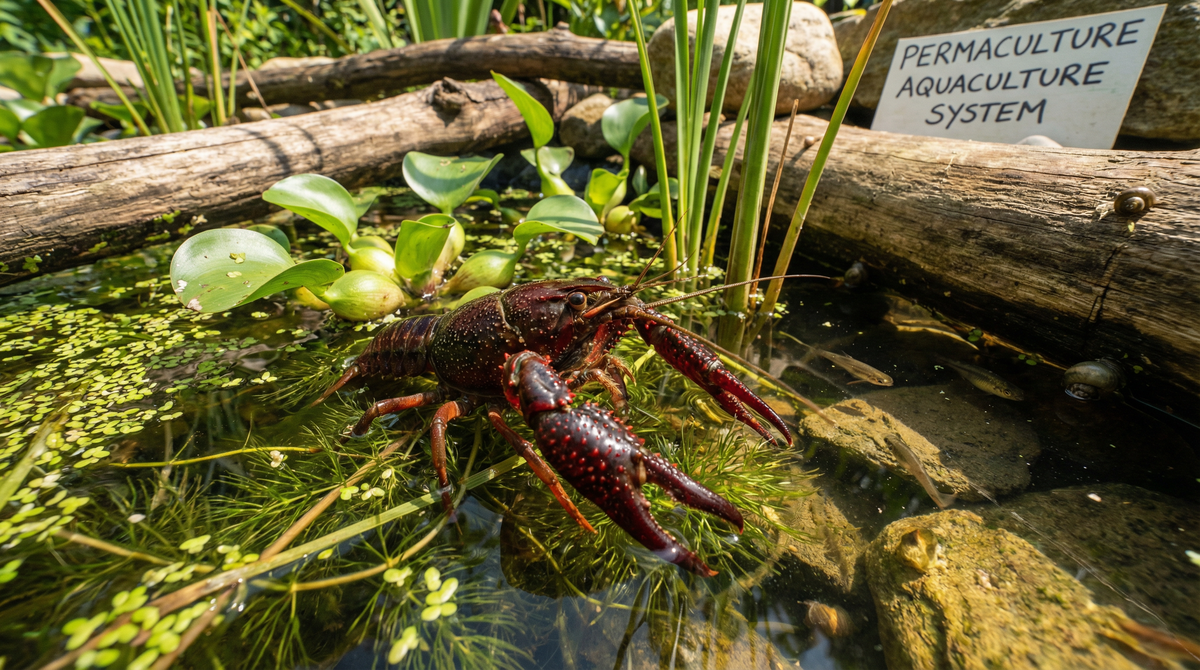
Overview
The red swamp crayfish (Procambarus clarkii) is a freshwater crustacean native to the Gulf coast of the United States and northeastern Mexico, with the heart of its native range in the Mississippi River drainage, including Louisiana, eastern Texas, and parts of the Florida panhandle. It is the foundation of the Louisiana crawfish boil tradition, the basis of a roughly 100 to 150 million pound annual US commercial harvest, and the most widely farmed crustacean species in the world.
The same hardiness and adaptability that make this species a successful aquaculture crop have made it one of the most damaging aquatic invaders in the world outside its native range. The European Union and several US states north of the native range list P. clarkii as a regulated invasive. On my central Florida site (USDA zone 9b), where this species is native to the watershed, I treat the annual late-spring crayfish run in the 1/4-acre pond as a wild-harvest food source rather than a managed crop, and the management plan is built around making sure the population stays in the pond and does not breach the swale system during heavy rain events.
Permaculture Role
Where the species is native, crayfish offer four useful functions: high-value protein production, pond detritus and nutrient cycling, integration with rice culture, and limited insect and snail predation. Outside the native range these benefits are typically outweighed by ecological risk.
Protein production
Stocked at 50 to 100 lb of broodstock per acre, a managed pond produces 500 to 1,500 lb of harvest-size crayfish per acre per year. Louisiana State University AgCenter and Texas A&M AgriLife Extension both publish detailed stocking and harvest schedules for the Gulf-coast climate.
Nutrient cycling
Crayfish are benthic omnivores that consume detritus, plant matter, insect larvae, snails, dead fish, and each other. In a polyculture pond they convert organic mud and decomposing plant matter into harvestable biomass.
Rice-crawfish rotation
The Louisiana rice-crawfish-rice and rice-crawfish-fallow rotations are the standard polyculture models. Rice (rice) is grown in summer, the field is flooded after harvest, and crayfish that emerge from burrows feed on rice stubble and decomposing biomass through the cool months. Harvest runs from December through May. The system produces two crops from one field, with crayfish contributing roughly half the gross income on most operations.
Mosquito and snail control
Crayfish consume mosquito larvae and aquatic snails, reducing both nuisance and disease-vector populations in a managed pond. The effect is real but limited; mosquitofish (Gambusia) or purple martins are more reliable mosquito-control tools.
Pond Design & Containment
A crayfish pond is a shallow, flat-bottomed earthen pond with vegetated edges and reliable water supply. Crayfish are hardy in a wide range of conditions, but escape prevention is the limiting design factor.
Pond size and depth
Commercial Louisiana ponds run 5 to 40 acres at 18 to 24 inches average depth. Backyard operations work at 1/10 to 1/2 acre, same depth, with a sloped bottom that drains to a single harvest point.
Soils and levees
Clay-rich soil is required for water retention without lining. Levees are built 3 to 4 ft high around the perimeter, 8 to 12 ft wide at the base. Sandy Florida sites need an internal clay liner or a synthetic pond liner.
Containment
Crayfish are excellent burrowers and can travel overland for short distances in wet weather. Pond perimeters need a low (12 in) overhang barrier of slick plastic sheeting or aluminum flashing during the late-spring breeding migration, particularly on small ponds adjacent to creeks or drainage ditches. The barrier prevents adults from walking out of the pond and either escaping into the local watershed or being lost to terrestrial predators.
Vegetation
A pond with 30 to 50 percent surface coverage of native emergent vegetation (pickerelweed, duck potato, arrowhead) and submerged structure (untreated wood, masonry rubble) supports a stable crayfish population. Avoid Florida-prohibited aquatic species (water hyacinth, water lettuce, hydrilla); these are illegal to stock and ecologically damaging.
Feeding
A well-managed pond feeds crayfish almost entirely from its own ecology. Supplemental feeding is uncommon in Gulf-coast crayfish aquaculture because pond-grown plants and detritus carry most of the production calories.
Forage base
Rice stubble (where rice rotation is used), aquatic vegetation, fallen leaves, and decomposing plant matter are the foundation. Crayfish are opportunistic and will eat dead fish, snails, insect larvae, and dropped fruit.
Supplemental feed
Where natural forage is limited (sandy Florida ponds without rich detritus), pelleted catfish feed at 1 to 5 lb per acre per day stimulates growth. Overfeeding is wasteful and degrades water quality.
Water quality
Crayfish tolerate dissolved oxygen down to about 3 mg per L for short periods but grow best above 5 mg per L. Hardwater (calcium-rich) ponds support faster shell hardening after molts. Most central Florida well water and limestone-derived surface water is naturally hard enough.
Aquatic plants
Native aquatic plants and duckweed can be tolerated as forage. Water hyacinth is a Florida Prohibited Aquatic Plant and must not be introduced to any pond regardless of crayfish presence.
Health & Population Management
Crayfish populations in well-designed ponds are typically robust. Most production losses come from oxygen crashes, drought-driven die-off, or predation by raccoons, otters, and large fish.
Dissolved oxygen
Hot still summer afternoons can drop oxygen below the survival threshold, especially in shallow ponds with heavy plant biomass. A surface paddle aerator on a timer (early morning hours, the lowest oxygen point of the day) prevents kills.
Drought
Crayfish survive shallow droughts by burrowing into the pond floor and entering torpor for several months. Multi-year droughts can wipe out a population. Maintaining a small refuge of 4 to 6 ft depth in one corner extends survival.
Predation
Raccoons work the edges, otters can clear a small pond if they take up residence, and large predatory fish (largemouth bass, gar) prey on small crayfish. Stocking the right balance of polyculture fish (catfish, tilapia where legal) helps; stocking bass typically does not.
White-spot syndrome and other diseases
White-spot syndrome virus has been reported in farmed crayfish populations and is a regulatory concern. Buy broodstock only from licensed and tested suppliers.
Invasive risk
Outside the native range, P. clarkii is one of the most damaging invertebrate invaders in the world. The European Union, the UK, and several US states list it as an invasive species with transport and stocking restrictions. Even in the native Gulf-coast range, escape into ditches and watersheds outside the property is a real management concern.
Field notes, central Florida. The 1/4-acre pond on my place is a natural low-spot impoundment with clay subsoil and crayfish that arrived on their own from the upstream watershed years before I owned the property. The annual late-April to early-June run produces enough for a half dozen family-and-friends crawfish boils each year. The pond is fenced separately from the rest of the property and the spillway dumps to a wooded swale that drains into a wetland that is also within the native range of this species, so escape is not a regional invasive concern. I do not feed the pond. The annual harvest is what the pond ecology produces on its own.
Integration
Crayfish integrate well with rice culture, certain polyculture fish stockings, and natural-pond permaculture systems within the species’ native range. They integrate poorly outside the native range, where their introduction is often illegal and ecologically destructive.
Rice-crawfish rotation
The classic Louisiana model is the gold standard. Rice in summer, drain and harvest, re-flood for crayfish from November through May. This works in suitable southeastern climates with the right soils.
Polyculture pond
Crayfish co-existence with catfish or tilapia in the same pond is workable at lower stocking densities. Bass-and-bluegill ponds typically eat small crayfish faster than recruitment, suppressing the population.
Aquaponics
Recirculating aquaponic systems can support small-scale crayfish production at hobby scale, but the species is more aggressive and harder to handle than tilapia in this context.
Regulatory check
Before any stocking decision, consult the state wildlife agency. Florida FWC, Georgia DNR, and the relevant USFWS regional office all maintain current lists of regulated aquatic species. Stocking crayfish outside the species native range is often illegal and is always ecologically risky.
Frequently Asked Questions
Are red swamp crayfish legal everywhere?
No. They are legal in their native Gulf-coast range and in most southeastern states with permits. They are prohibited in many northern US states, the UK, and the EU because of invasive risk. Check before stocking.
How long does it take to grow harvest-size crayfish?
From hatching, 3 to 5 months under good conditions. Commercial harvest size is typically 15 to 30 g (about 8 to 15 crayfish per pound).
Can I farm crayfish in a backyard pond?
Yes, on suitable soil, within the native range, and with proper containment. A 1/10 to 1/4 acre pond at the right depth can produce 50 to 200 lb of crayfish per year.
Do crayfish bite or sting?
They pinch with claws and the pinch is painful but not dangerous. They are not venomous.
What do crayfish need to overwinter?
Adults overwinter in the mud or in burrows along the pond bank. Maintaining at least 18 in of water depth and clay-rich soil for burrowing is sufficient through Gulf-coast winters.
References
- Louisiana State University AgCenter. Louisiana Crawfish Production Manual. lsuagcenter.com/crawfish
- Texas A&M AgriLife Extension. Crawfish Aquaculture. agrilifeextension.tamu.edu
- Florida Fish and Wildlife Conservation Commission. Aquaculture Best Management Practices. myfwc.com
- USDA Natural Resources Conservation Service. Pond Construction and Management. nrcs.usda.gov
- USGS Nonindigenous Aquatic Species Database. Procambarus clarkii. nas.er.usgs.gov — P. clarkii
Field notes and central-Florida observations in this article are from Lucas Summer’s permaculture site in USDA zone 9b. The natural-impoundment pond, annual late-spring harvest pattern, and zero-supplemental-feed approach reflect on-site practice; aquaculture stocking rates, pond design details, and invasive-risk regulatory context are drawn from the LSU AgCenter, USGS, and FWC sources cited above.
Foraging Behavior
As a benthic omnivore, the Red Swamp Crayfish forages at the bottom of its aquatic habitat. Its diet is varied and includes insects, larvae, and detritus, with a notable preference for animal matter, which is essential for its optimal growth and health. While it can survive on plant matter, its diet is supplemented by scavenging and predation.
Fencing Requirements
Containment is typically achieved through the construction of levees or berms for pond-based systems. Ponds should be located in flat, open areas with clay-heavy soils to ensure water retention. No special fencing is required beyond what is needed to create the aquatic environment.
Shelter Requirements
The Red Swamp Crayfish is a benthic species that requires shelter to protect itself from predators and cannibalism. Natural shelters such as aquatic vegetation, leaf litter, and submerged structures are beneficial. The crayfish's natural burrowing behavior provides it with refuge during periods of drought or cold.
Permaculture Notes
In permaculture systems, Procambarus clarkii is a valuable component of integrated aquaculture and aquaponics. Its ability to thrive in polyculture systems, such as with tilapia or in rice paddies, makes it an excellent candidate for diversifying aquatic production. The rice-crawfish rotation is a well-established practice that enhances the productivity of both crops. Crayfish contribute to nutrient cycling by consuming detritus and other organic matter, converting it into valuable biomass and manure that can fertilize the water and surrounding land. One of the key benefits of integrating crayfish is their role in pest control, as they consume insect larvae and other small invertebrates. Their burrowing activity, while potentially problematic in terms of water retention in unlined ponds, can also contribute to soil aeration and tillage in paddy systems. However, their aggressive and territorial nature, along with a tendency towards cannibalism, requires careful management of stocking densities and the provision of adequate shelter to minimize losses. When introducing crayfish into a system, it is crucial to consider their potential for antagonism with other species. While polyculture is possible, the species chosen must be compatible to avoid predation and competition. The environmental tolerance of P. clarkii to a wide range of temperatures and water conditions makes it a resilient choice for many permaculture designs, but its invasive potential necessitates secure containment to prevent escape into local waterways.