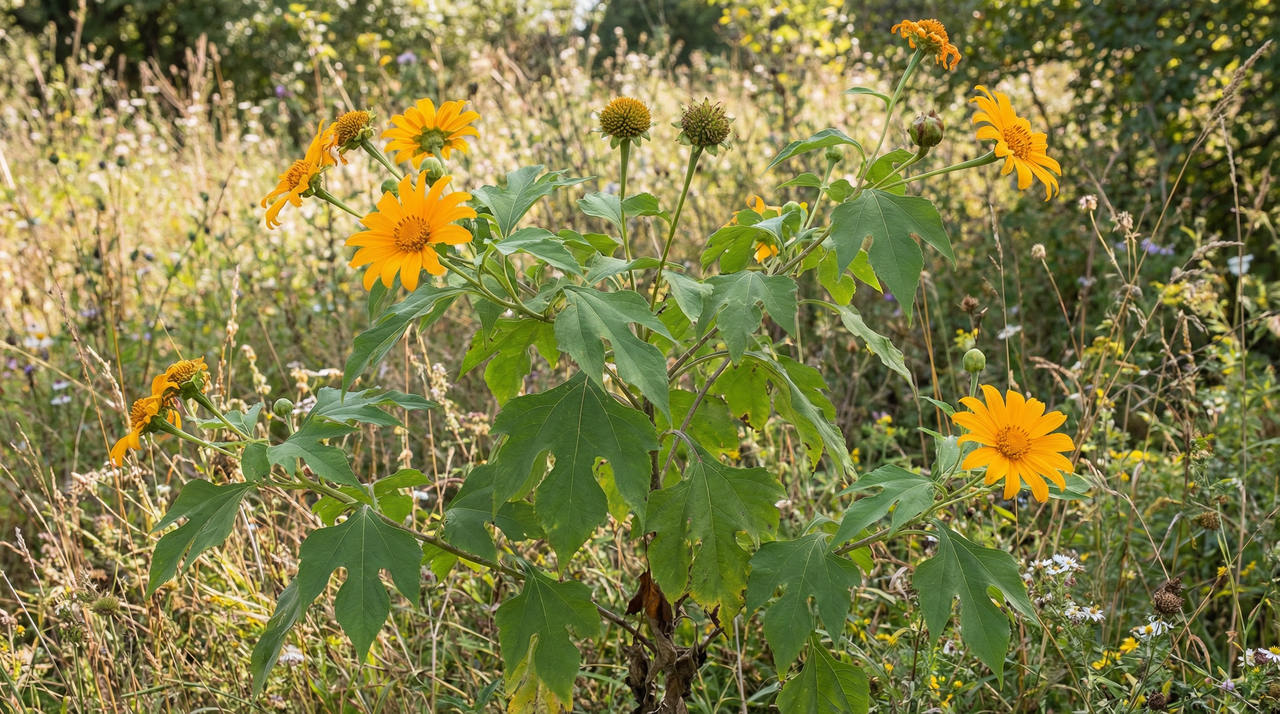
Most plants earn their place in a food forest by doing one thing really well. Mexican sunflower does about seven things well, and it does them so aggressively that it's been declared invasive on three continents. I grew it for two full seasons before I fully understood what I'd brought onto my property, and I'm still not sure whether to call that a mistake or a gift. Here's the thing that caught me off guard: those enormous, lobed leaves aren't just beautiful backdrop for the blazing orange flowers. They're some of the most nitrogen-dense green mulch material I've ever run through a chop-and-drop system, comparable to comfrey in terms of what they return to the soil, which is remarkable for something that looks, honestly, like a tropical ornamental you'd find in a hotel courtyard.[1]
The contradiction at the heart of this plant is that its greatest strengths and its biggest risks come from exactly the same place: its sheer biological momentum. It grows fast, blooms hard, feeds everything from bees to soil fungi, and then seeds itself into your neighbor's fence line if you're not paying attention. Respecting that momentum rather than fighting it is the whole game with Tithonia diversifolia, and once you understand that, you start to see it completely differently.
Mexican Sunflower Origin and History
Botanical Background and Native Range
Mexican sunflower (Tithonia diversifolia (Hemsl.) A. Gray) is native to Mexico and Central America and belongs to the Asteraceae, the enormous daisy family.[2] Its taxonomy has been remarkably stable; major botanical databases including Kew's Plants of the World Online and the USDA PLANTS Database all list the same accepted name with no recent reclassifications.[3][4] That stability is almost ironic given how unstable this plant is in the landscape. From its Central American homeland it has naturalized across the tropics and is now considered invasive in East Africa, India, Southeast Asia, Australia, and the Pacific.[5] It's a plant that carries real ornamental beauty and genuine ecological utility, but it does not stay where you put it if the climate suits it.
Physical Characteristics and Growth Habits
The plant grows fast and big. In optimal conditions it reaches 1.8 to 4 meters (6 to 13 feet) as an upright, bushy shrub or small tree, perennial in warm climates and treated as an annual where frost arrives.[6][7] Stems start out green and erect, then age into reddish-brown, woody canes anchored by a taproot with wide-reaching lateral roots below.[8] The flowers are what stop people in their tracks: large, showy, daisy-like heads, 5 to 8 centimeters across, in a clear burnt orange to reddish-orange with a raised central disk, blooming from midsummer through fall.[6][9]
The leaves tell a more complicated story. They're opposite, bright green on top and slightly fuzzy underneath, anywhere from 5 to 25 centimeters long, and their shape shifts considerably depending on conditions -- sometimes entire and broadly ovate, sometimes with 3 to 7 distinct lobes.[6][10] This phenotypic plasticity is reflected right in the species name: diversifolia literally means "diverse-leaved."[6] I've watched my own plants in zone 9B produce large, barely-lobed leaves during wet summer months and smaller, more deeply cut leaves when things dry out. It's the kind of morphological flexibility you'd expect from a plant built for disturbed edges and variable conditions, much like the more aggressive Asteraceae I pull out of my beds every spring. Seed heads produce tiny dark achenes, 2 to 4 millimeters long, which explain how readily it naturalizes.[2]
Cultural Names and Traditional Uses
A plant this widespread accumulates names the way it accumulates territory. In its Mexican homeland it goes by girasol mexicano, árnica mexicana, and indigenous terms including chimalacate, palo amarillo, and arnica del monte.[11] In North American and European horticulture it's most commonly called Mexican sunflower or tree marigold, the names preferred by Missouri Botanical Garden, Kew, the RHS, and the USDA.[6][12][4] Travel further and the names keep shifting: tournesol mexicain in French, "wild sunflower" or "Aztec marigold" in casual English usage, and "Tree denda" across Kenya and Tanzania, where farmers prize it as green manure and fodder.[5][13] I always label my beds carefully with this one, because first-year seedlings can look surprisingly similar to certain wild sunflowers and even some marigolds, and that mix of common names does not help with identification.
Etymology and Mythological Connections
The genus name Tithonia, established by Adrien-Henri de Jussieu in 1837, honors Tithonus from Greek mythology -- the mortal granted immortality by Zeus but denied eternal youth, left to age endlessly while never quite dying.[14] It's a reference I genuinely love, because in a Central Florida summer this plant really does feel immortal. You cut it back, it surges again. Drought hits, it keeps flowering. The long blooming season stretching from July through October, those relentless orange heads opening one after another, makes the mythological nod feel less like a botanist's fancy and more like someone had actually grown the thing.
Mexican Sunflower Varieties and Cultivars
Botanical Varieties of Tithonia diversifolia
Most gardeners treat Tithonia diversifolia as a single entity, but there are actually two recognized botanical varieties beneath that species name. Var. diversifolia carries narrower, more lanceolate leaves, while var. rotundifolia (sometimes listed as var. grandiflora) has broader, more rounded foliage.[15] That leaf-shape difference might sound like a botanical footnote, but in practice it translates directly to biomass. From my own growing trials, the broader-leaved rotundifolia types produce noticeably more chop-and-drop material in a single season, which matters enormously if you're using this plant as a fertility engine in a food forest guild rather than just as a back-border ornamental.
Popular Horticultural Cultivars and Selections
The horticultural world has produced a handful of named selections worth knowing, though availability is patchy depending on where you are. I've seen 'German Giant', 'Sunset', 'Tiger Eye', 'Washington', 'Red Maja', 'Gold', 'Hawaii', and several others listed across seed catalogs and specialty nurseries. Of those, two stand out in my client plantings. 'German Giant' is a true architectural plant, pushing 8 to 10 feet and commanding real presence in a mixed pollinator hedge. 'Sunset', at a more manageable 4 to 6 feet with warm-toned flowers, is the one I reach for when a client needs something that plays nicely beside shorter perennials or doesn't want to overwhelm a narrow bed. Neither is hard to find if you seek out specialty seed suppliers, but don't expect your local big-box garden center to stock them.
Regional Ecotypes and Performance Selection
Here's where it gets genuinely exciting for anyone using Mexican sunflower as a green manure crop. Research on East African ecotypes, particularly those selected in Kenya, shows biomass yields of 20 to 30 tons per hectare per year with higher nutrient content than lines tracing back to Central American origins.[16] That's not a marginal improvement; it's the difference between a pretty shrub and a serious fertility tool. When I recommend tithonia diversifolia seeds to clients who want real fertility output, I tell them to hunt down cuttings or seed stock with a known provenance rather than grabbing whatever's generic. Not all Tithonia diversifolia is performing equally, and matching the right ecotype to your goal is worth the extra effort.
How to Propagate and Plant Mexican Sunflower
Getting Mexican sunflower going is genuinely one of the more satisfying propagation experiences in a permaculture toolkit. The plant is not fussy about much, but it does have opinions about a couple of things, and knowing them upfront saves a lot of frustration.
Propagation Methods for Mexican Sunflower
Seed is the everyday starting point. Tithonia diversifolia germinates in 7-14 days when you sow seeds about a quarter to half an inch deep in well-drained growing medium at temperatures between 20-30°C (68-86°F). No cold stratification, no scarification, no soaking overnight. The seeds show minimal dormancy, so all they need is warmth and consistent moisture to get going. Fresh seed I've tested at around 25°C almost always hits the upper end of the reported 70-90% viability range, which tracks with what the germination assays show.[17][18] That ease of germination is part of why the plant has become invasive in parts of the tropics; the seeds can persist in the soil seed bank for 2-5 years, meaning even one season's dropped seeds can produce volunteers long after you thought you had things tidied up.[19]
For seed banking, this species has orthodox storage behavior, meaning it tolerates drying down to 3-7% moisture content without losing viability. Stored in airtight containers with desiccant at refrigerator temperatures, seeds can remain viable for years. I keep leftover seed in glass jars with silica gel packets in the back of my refrigerator and still see strong germination after three seasons. For longer-term conservation, freezing at -20°C extends potential viability to 5-20 years under optimal conditions.[20][21][22] If you're ever unsure about a batch, a germination test on moist filter paper at 20-30°C will tell you what you need to know within a week or two.[17]
When I want clonal uniformity, especially when I'm replicating a particularly vigorous selection across a guild, I reach for stem cuttings. Semi-hardwood cuttings from middle-to-upper nodes, cut to 10-15 cm, treated with IBA rooting hormone at 1000-2000 ppm, and stuck into a 1:1 sand-to-soil mix will root in 2-4 weeks at 25-30°C with high humidity. Success rates run between 70-100%. After losing my first batch to soggy media, I now insist on that gritty mix and a clear plastic dome for humidity rather than overhead misting, and I haven't had a failure since. Tissue culture on Murashige and Skoog medium is technically possible for mass production of disease-free stock, but it requires lab facilities most of us will never have access to, so treat it as a footnote rather than a realistic option.
Soil, Site Selection, and Container Growing
The single fastest way to kill a new Mexican sunflower planting is to put it in poorly drained ground. The plant is remarkably adaptable to sandy, clay-heavy, or rocky soils, but only if the water moves through. Ideally you want fertile, loamy soil with 2-5% organic matter and a pH sitting between 5.5 and 7.5.[6][23][24] Waterlogged, compacted, or highly alkaline soils invite root rot and limit nutrient uptake, so if you're planting into heavy clay, amend generously or raise the bed before you start.
Fertility requirements are low, which is one of the most useful things about growing this plant on marginal land. I use it as a chop-and-drop green manure in my guilds, and the difference in soil texture and vigor of neighboring crops the following season is genuinely noticeable. The biomass can accumulate 100-200 kg of nitrogen per hectare, which is not a number to wave off lightly.[25][26] During establishment, keep moisture moderate and consistent, then step back. Once the taproot is down, the plant bounces back from dry spells with a speed that still catches me off guard.
For containers or indoor starts, use a mix of 50% standard potting soil, 30% perlite or coarse sand, and 20% compost.[27] That ratio prioritizes drainage while giving young roots enough organic matter to establish quickly. It's a simple recipe, but it works every time.
Mexican Sunflower Care Guide
Every care decision you make for this plant flows from one central fact: it's a tropical. Tithonia diversifolia is hardy in USDA zones 9-11, where it can grow outdoors year-round without a second thought.[28][6] Outside those zones, it's typically grown as an annual or coaxed through winter indoors. Understanding that distinction saves a lot of heartbreak.
Frost Tolerance and Temperature Requirements for Mexican Sunflower
Native to Mexico and Central America across a range from sea level up to about 1,800 meters elevation, this is a plant that evolved without meaningful frost pressure.[7][29] It wants temperatures above 50°F for healthy growth, and it prefers winter lows that stay well above freezing. The Royal Horticultural Society gives it an H1c hardiness rating, meaning it needs frost-free conditions or winter protection, with minimum temperatures in the 41-50°F range.[30] Technically it can survive a brief dip to around 20°F, but damage typically starts at 28-32°F, and that tolerance shifts considerably depending on plant maturity and site exposure.[6]
I garden in zone 9B in Central Florida, and Mexican sunflower sails through most of our winters without any fuss. But when a hard freeze comes through, those big, thin leaves make the damage impossible to miss. The foliage turns dramatically black almost overnight, sometimes before the flowers even have a chance to react.[6] Leaves, buds, and open flowers go first because of their thin cuticles and high water content; the stems and roots are noticeably tougher and often survive what kills the top growth entirely. If you see that blackening, don't panic. Prune the damaged material and watch the base. In marginal zones, this plant behaves a bit like Brugmansia or Canna, coming back from the roots once warmth returns, which makes it feel almost like a short-lived woody perennial if you manage the cold period well.
For practical protection, a deep mulch around the root zone goes a long way. Siting plants against a south-facing wall or tucked behind taller guild members that break winter wind creates the kind of microclimate where Mexican sunflower can push its hardiness limits. Frost cloth or cloches are worth keeping on hand for those sudden cold snaps. If you're growing it in a container, that mobility is your biggest asset; bring it indoors before temperatures drop, and keep it on the dry side through winter.[30][6] I learned that second part the hard way: a potted specimen I kept too wet one January rotted from the crown down before I even noticed. Root rot in cool, damp conditions is a faster killer than frost itself.
Where summers are long and hot, this plant rewards you generously. Give it the heat and moisture it craves, give it room to reach its full 4-6 foot stature, and it becomes one of the most productive biomass and pollinator plants in the garden from midsummer right up until the cold shuts it down.
Harvesting Mexican Sunflower: Biomass, Leaves, and Flowers
Most plants in my food forests get harvested for what they produce. Mexican sunflower gets harvested for what it is: a fast-growing, large-leafed biomass engine that I'm constantly managing anyway. The harvest is almost incidental to the pruning, which is probably the most useful thing I can say about Tithonia diversifolia as a permaculture plant. You're not waiting for a crop; you're capturing the output of a plant that would otherwise shade out everything around it.
When and How to Harvest for Different Uses
For biomass, I harvest when the stems are lush and green, well before flowering peaks. That's when the leaves have the highest moisture and nitrogen content, making them the most useful for chop-and-drop mulch or green manure. In zone 9b conditions like I work in, the rapid flush that follows a good rain event creates predictable harvest windows every four to six weeks through the warm season. Those are the moments I schedule guild maintenance around.
For medicinal tea, I've learned to harvest leaves before the flowers fully open. Once pollen is flying, the flavor intensifies in ways that aren't pleasant, and the pollen itself can be irritating if you're sensitive to the Asteraceae family. Morning harvests on dry days have also served me well; wet foliage tends to mold quickly in our humid summers.
For flowers specifically, cut at full bloom for infusions or decorative use. Sharp, sanitized pruners make cleaner cuts and encourage faster regrowth. I cut stems anywhere from six to twelve inches above the ground when I'm taking biomass, leaving the root system and lower nodes intact so the plant regenerates quickly and continues its soil-building work.
Expected Yields, Flavor, and Post-Harvest Handling
Specific university data on Tithonia diversifolia biomass yields is thin, so I'll give you what I've actually observed: a well-established plant in rich soil and full sun reliably produces somewhere between 20 and 40 pounds of green chop-and-drop material per year in a subtropical setting. That's comparable to comfrey, though Mexican sunflower regrows even faster after cutting; the tradeoff is that it needs more consistent moisture to maintain leaf quality. The hollow stems make it surprisingly lightweight for its volume, which anyone who's hauled armloads of it across a garden will appreciate.
Leaves used for fodder or tea have a mild, slightly bitter flavor that livestock seem to accept readily once accustomed to it. As a tea, young leaves produce a more subtle brew; mature leaves are noticeably stronger. Flowers contribute a light, faintly resinous quality to infusions. Neither is what I'd call delicious on its own, but both have their traditional uses, and the preparation section covers those in detail. Wear gloves when harvesting in volume; some people develop mild skin irritation from handling the foliage repeatedly, a precaution worth building into your routine from the start.
Mexican Sunflower Preparation and Uses
After growing this plant for several seasons in my Central Florida food forest, I'll be honest: I think of it as a garden workhorse first and a kitchen or medicine-cabinet plant a distant second. That framing matters, because Mexican sunflower carries genuine promise on paper but real caution in practice.
Culinary Uses and Safety Considerations
Let me lead with the honest position here. Tithonia diversifolia is not generally recommended as a regular food source, and that's not overcaution for its own sake. The plant contains sesquiterpene lactones and related compounds that can cause skin irritation, gastrointestinal upset, and allergic reactions.[31][32] Established dietary use simply doesn't exist in the way it does for plants we'd casually toss into a stir-fry.[33][34]
That said, there is a real, if regional, tradition. Young leaves and flower buds are consumed as a cooked leafy vegetable in parts of Mexico and Africa, though this is not universal practice.[35][36] Raw, the leaves are strongly bitter with a slightly mucilaginous texture that isn't particularly inviting.[37] I tried a small, thoroughly boiled piece of young leaf once, purely out of curiosity, and the bitterness was mostly gone. Still, I wouldn't go back for more. Thorough cooking, boiling or steaming, is non-negotiable; it reduces oxalates, tannins, and other anti-nutritional factors by up to 50% and brings the texture closer to cooked spinach.[38][39] The nutritional profile is genuinely impressive on paper, with protein running 18-25% of dry weight alongside meaningful calcium, potassium, iron, and vitamins A and C,[40] but those numbers only mean something after safe, proper preparation.
Two more hard rules before anyone heads to the garden with a basket. Seeds are not edible and may be toxic; any seed oil extraction is strictly an industrial application, not a kitchen one.[33] And please get the ID right. I've helped a gardener sort out young Tithonia seedlings from common sunflowers, and the differences in leaf texture and scent are real once you know them, but they're easy to miss when plants are young.[41] Confusing it with Calendula officinalis is another realistic mistake.[42] Correct identification, young material only, and thorough cooking: those three conditions are the floor, not a suggestion.
Medicinal Preparations
The stronger, more documented use case for this plant sits in traditional medicine. Decoctions are the most common preparation: roughly 10-20 grams of dried leaves per liter of water, simmered and taken two to three times daily. Infusions, poultices of crushed leaves applied topically, and tinctures all appear in ethnobotanical records across the tropics. The anti-inflammatory, antimalarial, and antidiabetic activity detailed earlier in the health benefits section is what underlies these traditions. I'd point anyone serious about medicinal use back to that research context, and I'd strongly recommend consulting a qualified practitioner before experimenting. The clinical human data is thin, and the same sesquiterpene chemistry that makes the plant medicinally interesting is exactly what demands respect around dosage.
Non-Food and Agricultural Uses
This is where I feel completely at ease recommending Mexican sunflower without reservation. As a green manure and biomass crop, it's extraordinary.[43] I've watched my soil structure transform in guild beds where I chop-and-drop this plant regularly: better tilth, better water retention, visibly more earthworm activity. The same nutrient-dense leaves that require such careful handling in the kitchen become pure fertility when they break down in the soil. The antioxidant flavonoids and phenolics concentrated in the flowers and foliage[44] simply cycle back into the system. For animal fodder, it's similarly valued across agroforestry contexts.[43] My practical advice: get comfortable with this plant in the compost heap and fertility patches first. Let it do what it genuinely excels at before any kitchen or medicine experiments enter the picture.
Mexican Sunflower Health Benefits
Traditional Medicinal Uses Across Cultures
What I find fascinating about Tithonia diversifolia is how its medicinal reputation has traveled almost as aggressively as the plant itself. In its native Mexico and Central America, the Nahua people have long used it for wound care, inflammation, and digestive complaints, typically as leaf teas, decoctions, or poultices.[45] That's a traditional pharmacopoeia built from close, long observation of a plant growing right outside the door. As a permaculture designer, I appreciate how that kind of knowledge develops.
What happened next is a genuinely remarkable piece of ethnobotanical history. When the plant spread into Africa, communities there adopted it for an entirely different disease burden, applying it to malaria, diabetes, hypertension, and wound infections.[46][47][48][49] These African uses weren't carried over from Mexico; they appear to have developed independently after the plant arrived. Different continent, different diseases, similar instinct toward the same vigorous leafy shrub.
Key Phytochemicals and Bioactive Compounds
The chemistry gives you a working explanation for why traditional healers kept reaching for this plant. Researchers have identified over 50 bioactive compounds in Tithonia diversifolia, including sesquiterpene lactones like tagitinin C, flavonoids such as quercetin and kaempferol, and phenolic acids including chlorogenic and caffeic acid.[20][50][35][51][48] Flavonoids alone may make up as much as 5% of leaf dry weight. Growing this plant in Florida, I'm struck by how abundantly it produces leaf biomass; that's a lot of active chemistry accumulating every time it pushes out new growth after a hard cut.
Pharmacological Research and Health Effects
The anti-inflammatory evidence is the most compelling thread running through the preclinical literature. Extracts work by inhibiting NF-κB signaling, suppressing COX-2 expression, and downregulating pro-inflammatory cytokines like TNF-α and IL-6, with ethanol extracts performing comparably to indomethacin in animal paw edema models. Beta-caryophyllene contributes additional anti-inflammatory activity through CB2 receptor activation. Paired with Nrf2-pathway antioxidant activity and direct free-radical scavenging from its quercetin, kaempferol, and phenolic compounds, you've got a plant whose traditional reputation for reducing swelling and supporting wound healing maps reasonably well onto its molecular behavior.
The antidiabetic research is compelling enough that it's easy to understand why African traditional practitioners reached for it. Leaf extracts inhibit alpha-glucosidase, the enzyme that breaks down carbohydrates into absorbable sugars, working similarly to the pharmaceutical acarbose; blood glucose reductions have been documented in streptozotocin-induced diabetic rat models.[52] On the analgesic side, activity comparable to aspirin has been reported in animal models, along with antispasmodic effects that support traditional uses for digestive cramps and diarrhea. For malaria, tagitinin C and related sesquiterpenes show moderate in vitro efficacy against Plasmodium falciparum, with IC50 values below 10 μg/mL for some isolates.[53][20] Antimicrobial assays have shown meaningful zones of inhibition against Staphylococcus aureus, E. coli, and Candida albicans.[54] Wound-healing potential in topical applications appears to draw on all three of these actions together.[55]
The honest caveat here, and one I always raise with clients who get excited about preclinical data, is that almost all of this comes from in vitro studies and animal models. Human clinical trials are essentially absent. The preclinical picture is genuinely interesting for a multifunctional plant, but interesting and proven are not the same thing.
Safety Profile and Considerations
Acute toxicity studies put the LD50 above 2000 mg/kg, which signals a relatively low acute risk at typical use levels. That said, high-dose use has raised hepatotoxicity concerns, which is reason enough not to treat this as a casual daily supplement. The interactions that concern me most practically are the hypoglycemic effects; anyone taking antidiabetic medication should treat this plant as pharmacologically active and flag it with their healthcare provider, not treat it as food.[56]
In my work with clients who have allergies, I always flag Asteraceae family plants like Mexican sunflower alongside ragweed, daisies, and marigolds, because cross-reactivity is a real possibility for sensitive individuals. The most absolute contraindication is pregnancy: the plant has documented uterine-stimulant and emmenagogue properties, and that's a hard stop, not a caution.[56] I grow this plant enthusiastically for its biomass and ecological contributions, and I've experimented with a leaf tea or two out of curiosity, but I'd never recommend therapeutic use to anyone without clinical guidance to back it up.
Mexican Sunflower Pests and Diseases
Natural Pest Resistance and Common Susceptibilities
What I love about growing Tithonia diversifolia in Florida's humid, bug-rich summers is watching it hold its own in conditions that would turn many ornamentals into chewed-up sticks. The reason isn't luck; it's chemistry. The plant produces sesquiterpene lactones, particularly tagitinin C, that function as insecticides, antifeedants, and repellents at the cellular level, while allelopathic compounds in both leaf and root exudates suppress Meloidogyne root-knot nematodes in the surrounding soil. A secondary layer of physical trichomes on the leaves adds friction for soft-bodied insects trying to get a foothold. In my experience, this is one plant that rarely needs a spray bottle pointed at it.
That said, it's not bulletproof. Caterpillars from Helicoverpa and Spodoptera species are the real troublemakers, capable of heavy defoliation during warm, humid growth surges. Aphids (Aphis craccivora and Aphis gossypii) show up at moderate levels, though I've watched ladybug colonies dismantle an aphid infestation on a mature plant within a few days without any intervention from me. Leaf miners and thrips are present but tend to stay at low-to-moderate pressure. The plant's rapid regrowth habit is quietly forgiving here; what looks like damage one week has often been outpaced by new growth the next, much the way zinnias recover from caterpillar chewing mid-summer. Deer and rabbits leave it alone in field settings, which, in a Florida food forest, is genuinely useful.
Integrated Pest Management for Mexican Sunflower
When intervention is necessary, I lean hard on cultural and biological controls before reaching for anything stronger. Good spacing keeps air circulating and reduces the fungal pressure that humidity invites; cleaning up leaf litter removes overwintering sites for thrips and miners. Neem oil and insecticidal soap handle most soft-bodied pest flare-ups without disrupting the beneficial insects that are already doing a lot of the work. Pyrethrin-based sprays are a last resort, used sparingly and rotated against other modes of action to avoid resistance, because the predatory insect community around mature Tithonia is genuinely worth protecting.
The bigger permaculture story here is that Mexican sunflower isn't just tolerating pests; it's actively protecting its neighbors. I've interplanted it alongside corn and beans and observed noticeably lighter pest pressure on both, consistent with research documenting its companion-plant role suppressing insect and nematode activity in adjacent crops. Diseases are rarely a conversation worth having when cultural basics are followed, and I haven't encountered serious pathogen issues in my own plantings as long as drainage is adequate. The plant wants to thrive, and in most gardens, it does.
Mexican Sunflower in Permaculture Design
If you garden in a warm climate and you haven't worked with Mexican sunflower yet, you're leaving a significant fertility resource on the table. I think of it as comfrey's tropical cousin -- both are dynamic accumulators that reward the chop-and-drop approach, but Tithonia diversifolia adds something comfrey can't quite match: a towering canopy, substantial shade, and a pollinator draw so strong that in midsummer my plants are almost audible with bee activity. For designers working in subtropical and tropical food forests, this is a plant that earns its space fast.
Climate Adaptability and Growing Zones
Mexican sunflower is frost-sensitive, reliably perennial in USDA zones 9 through 11, and genuinely happiest in full sun with well-drained soil. In my zone 9B garden in Central Florida, it behaves like a vigorous woody perennial that gets cut back by a cold snap every few years and returns from the base with almost comical enthusiasm the following spring. Give it what it wants -- heat, light, and good drainage -- and it rewards you with rapid canopy and continuous bloom. That combination of climate tolerance and fast establishment is exactly why it's become a staple in warm-climate permaculture systems from East Africa to Southeast Asia.
Ecosystem Functions and Pollination Services
The pollination story alone justifies a spot in any subtropical guild. Bees are the primary workers here -- Apis mellifera and native solitary bees predominate, with butterflies and hoverflies filling in as secondary visitors, and the occasional hummingbird stops by for the nectar as well. What makes the flowers so effective is a structural trick called protandry: the disc florets release pollen before the female-phase styles emerge, which promotes outcrossing and keeps the genetic diversity of the population healthy. This means your plant isn't just feeding pollinators; it's doing it in a way that forces those pollinators to move between plants and carry diverse pollen.
The flower heads themselves are up to 15 centimeters across, with 12 to 15 ray florets and a dense cluster of disc florets offering nectar in the range of 0.5 to 1.5 microlitres per flower at a sucrose concentration around 20 to 30%. Anthesis happens in the early morning, typically between 6 and 9 AM, so the blooms are fully open and rewarding when pollinators are most active. The pollen is yellow, spherical, spiny, and highly viable. I've watched mornings in July where the plant is covered in native bees within minutes of sunrise -- that kind of reliable, early-morning resource matters enormously in a food forest where you want fruit set on neighboring plants.
Forest Layer Placement and Guild Roles
Native to Mexico and Central America, Tithonia diversifolia is a member of the Asteraceae family that evolved in exactly the kind of disturbed, edge-y habitat that pioneer plants favor -- roadsides, secondary forests, open tropical margins.[57][4][58] That background tells you a lot about where it fits in a designed system. Growing 3 to 7 meters tall as an upright woody shrub or small tree,[6][59] it slots naturally into the tall shrub or subcanopy layer, where it can provide screening, wind protection, and dappled shade for understory crops. Seeds germinate readily without cold stratification in warm, moist conditions, and in my experience the seedlings emerge so fast in Florida soils that I stopped starting them in pots years ago. I direct-seed exactly where I want a temporary biomass screen or fertility row, and within a season I have what I need.
Its value as a green manure is well documented and genuinely impressive. Leaves run 3 to 5% nitrogen by dry weight, alongside meaningful phosphorus and potassium, and the plant can produce 20 to 40 tons of biomass per hectare annually.[60][61] That nutrient-dense leaf litter decomposes quickly, which means fertility reaches your soil fast rather than sitting in a slow pile. I work it into citrus and avocado guilds as a dedicated chop-and-drop species, cutting it back hard twice a year and hauling the material to mulch around fruit trees. The first time I used it in an agroforestry row I let it get too tall before I cut it, which created unnecessary shade competition -- now I cut at around 1.5 meters and get lush regrowth within weeks plus wheelbarrows of mulch every time.
Weed suppression is another genuine contribution. Allelopathic compounds in the residues suppress competing weed germination and growth by up to 50% in agroforestry systems,[62] which means it's doing double duty as a fertility source and a living mulch substitute. It also works with arbuscular mycorrhizal fungi to extend shared hyphal networks through the soil, improving phosphorus and nitrogen availability for neighboring plants.[63] In practical guild design terms, this means planting it near coffee, citrus, or other crops that are themselves mycorrhizal-dependent can amplify the soil networking effect across the whole system. Combined with its ability to moderate microclimate and reduce weed pressure when used as shade in coffee agroforestry,[64] and its value as a habitat plant for beneficial wasps and hoverflies that hunt aphids and caterpillars, you're looking at a plant that earns multiple stacking functions simultaneously.
That said, I wouldn't be giving you the full picture without acknowledging the invasiveness concern. In parts of Florida it can spread aggressively and has been flagged as a problematic species.[65] My approach is to harvest before it sets abundant seed -- a simple management habit that keeps it well-behaved while preserving every benefit. Know your regional context before planting, and in borderline regions, treat it as a managed biomass species rather than one you let run its own program.
The Plant That Made Me Rethink What "Useful" Looks Like
I'll be honest: I almost pulled mine out the first year. It got enormous fast, flopped over the path, and I wasn't sure it was earning its space. Then I watched a patch of compacted clay transform under three seasons of chop-and-drop, and the monarchs found it, and I stopped second-guessing. Some plants don't reveal themselves right away. Mexican sunflower is one of those, and patience with it has never once disappointed me.
Sources 65
- Tithonia diversifolia as a source of plant nutrients in sub-Saharan Africa ↩
- Flora of China - Tithonia diversifolia ↩
- Plants of the World Online - Tithonia diversifolia ↩
- USDA PLANTS Database - Tithonia diversifolia ↩
- CABI Invasive Species Compendium ↩
- Tithonia diversifolia - Missouri Botanical Garden ↩
- Kew Science - Plants of the World Online: Tithonia diversifolia ↩
- Tithonia diversifolia - Missouri Botanical Garden Plant Finder ↩
- Tithonia diversifolia - Royal Botanic Gardens Kew ↩
- Tithonia diversifolia - University of Florida IFAS Extension ↩
- Plants of the World Online - Kew Science - Tithonia diversifolia ↩
- Royal Horticultural Society - Tithonia diversifolia ↩
- PlantZAfrica: Tithonia diversifolia ↩
- Missouri Botanical Garden Plant Finder - Tithonia diversifolia ↩
- Taxonomic notes on Tithonia diversifolia varieties ↩
- Evaluation of Tithonia diversifolia ecotypes for green manure production in western Kenya ↩
- ISTA Rules 2020 ↩
- Tetrazolium Testing in Seeds ↩
- Soil Seed Bank Dynamics of Tithonia diversifolia in Tropical Regions ↩
- Seed Storage of Tithonia diversifolia: Orthodox Behavior Confirmed ↩
- IPGRI Technical Bulletin on Seed Storage ↩
- Genebank Standards for Acquisition, Processing, Storage and Recovery of Seeds ↩
- Tithonia diversifolia (Mexican sunflower) - CABI Compendium ↩
- Tithonia diversifolia - Kew Science Plants of the World Online ↩
- Tithonia diversifolia as a Green Manure Crop ↩
- Soil Fertility Management with Tithonia ↩
- Container Gardening for Tropical Shrubs ↩
- USDA Plant Hardiness Zone Map - Tithonia diversifolia ↩
- Flora of North America - Tithonia diversifolia ↩
- Mexican Sunflower - RHS Gardening ↩
- Toxicity of Tithonia diversifolia - ScienceDirect ↩
- Toxicity of Sesquiterpene Lactones in Tithonia diversifolia ↩
- Tithonia diversifolia - Useful Tropical Plants Database ↩
- Ethnopharmacological Uses of Tithonia diversifolia - NCBI ↩
- Traditional Uses of Tithonia diversifolia as a Leafy Vegetable ↩
- Ethnobotanical Uses of Tithonia diversifolia in Mexico and Africa ↩
- Kew Gardens - Plants of the World Online - Tithonia diversifolia ↩
- Nutritional and Anti-Nutritional Composition of Tithonia diversifolia Leaves ↩
- Traditional Vegetable Use in West Africa ↩
- Nutritional Composition and Phytochemical Screening of Tithonia diversifolia ↩
- Missouri Botanical Garden Plant Finder ↩
- Royal Horticultural Society - Pot Marigold ↩
- Traditional Uses and Pharmacological Properties of Tithonia diversifolia ↩
- Tithonia diversifolia: A Review on Traditional Uses, Phytochemistry, and Pharmacology ↩
- Traditional Uses of Tithonia diversifolia in Indonesia ↩
- Ethnobotanical Survey of Medicinal Plants Used in the Treatment of Malaria in Kisoro District, Uganda ↩
- Medicinal Plants Used in the Treatment of Diabetes in Rwanda ↩
- Tithonia diversifolia: A Review on Its Chemistry and Pharmacology ↩
- Ethnobotanical Survey of Medicinal Plants Used by the People in Southern Parts of Nigeria ↩
- Flavonoids in Flowers of Tithonia diversifolia ↩
- Phytochemical Profiling of Tithonia diversifolia ↩
- Hypoglycemic Effects of Tithonia diversifolia Leaf Extract ↩
- Antimalarial Sesquiterpenes from Tithonia diversifolia ↩
- Antimicrobial Properties of Tithonia diversifolia Extracts ↩
- Wound Healing Potential of Tithonia diversifolia Leaf Extract ↩
- Pharmacological Review of Tithonia diversifolia ↩
- Tithonia diversifolia (Hemz.) A.Gray ↩
- Tithonia diversifolia - Missouri Botanical Garden Plant Finder ↩
- Tithonia diversifolia - Plants of the World Online | Kew Science ↩
- Tithonia diversifolia as a green manure for soil fertility improvement in western Kenya ↩
- Use of Tithonia diversifolia for Soil Fertility Improvement ↩
- Allelopathic effects of Tithonia diversifolia on weed suppression in maize fields ↩
- Interactions between Tithonia diversifolia and arbuscular mycorrhizal fungi ↩
- Agroforestry systems with Tithonia diversifolia in coffee plantations ↩
- Invasive Species in Florida - UF/IFAS ↩
About the Author
Timothee is a 28-year-old Naturalist, Agricultural Specialist, and Author. He believes that environmental writing provides the information necessary for the cultural transformation needed to stabilize the climate.