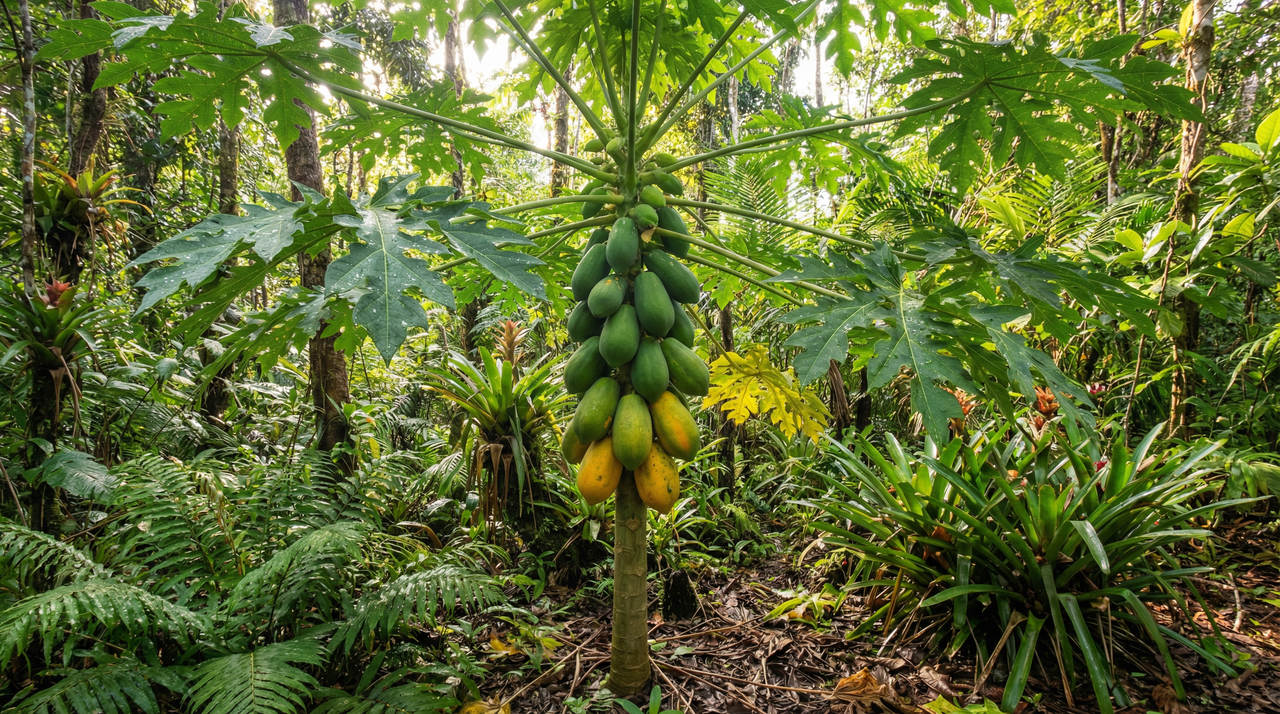
Nobody believes me when I tell them papaya isn't actually a tree. I've watched seasoned gardeners argue with me about this while standing directly in front of one, pointing at that thick, palm-like trunk as evidence. But that woody-looking stem is technically herbaceous tissue, and what you're growing when you plant papaya is essentially a giant, fruit-bearing weed with ambitions. It shoots from seed to bearing fruit in under a year, lives hard for three to five years, then fades out to make room for whatever comes next.[1] That's not a tree's lifecycle. That's a pioneer species doing exactly what it evolved to do on the disturbed forest edges of southern Mexico and Central America.
Once that clicks, everything about this plant starts to make more sense: why it fruits so young, why it declines so fast, why it throws so much energy into that milky latex defense system, why it can completely transform a young food forest guild in a single season and then gracefully exit. I've grown papaya in three different climates and I've come to think of it less like a fruit tree and more like a very productive temporary resident that pays excellent rent while it's here.
Papaya Origin, History, and Botanical Background
Native Range and Botanical Background of Carica papaya
Carica papaya is native to the tropical lowlands of southern Mexico, Central America, and northern South America,[2][3] and that native habitat context dictates its behavior under cultivation. It is a pioneer species, the kind of plant that rushes into disturbed clearings and forest edges where light floods in, grows at a pace that feels almost reckless, fruits quickly, and then makes way for the next successional layer.[4][5] I've started treating it exactly this way in my food forest designs: not as a long-lived anchor tree, but as a rapid-response tropical that fills canopy gaps fast while slower species get established.
In cultivation, you're typically looking at a productive window of 3 to 5 years, though plants can persist up to 10 years under ideal conditions or struggle through just 1 to 2 years in suboptimal ones.[6][7] Commercial growers routinely pull and replace plants after 3 to 4 years because vigor and fruit quality decline noticeably once that window closes.[7][8] That's a short life by orchard standards, but it's the right expectation to have going in. Papaya thrives in USDA zones 9b through 11,[6][8] and in cooler climates it's grown as an annual, which honestly fits the pioneer metaphor even better.
Visual Characteristics of the Papaya Plant
The first time most people see a mature papaya, they're not sure what they're looking at. It reads like a palm, but isn't one. The single upright trunk reaches 10 to 30 feet tall,[6][9] hollow and scarred from every leaf and fruit that ever grew along it, soft enough that it barely qualifies as woody. The massive leaves, each with 5 to 9 deep lobes arranged like an outstretched hand and measuring up to 70 cm across,[10][11] cluster at the very top in a crown that makes the whole plant look permanently windswept. Slice into the trunk and you find milky latex rather than the dense heartwood you'd expect from something that tall. It is, botanically speaking, a giant herb.
Flowers appear year-round in tropical climates,[12] white or pale yellow, tucked in the leaf axils just below that leafy crown. The fruit that follows is technically a berry, oblong or pear-shaped, ranging from roughly 15 to 45 cm long and weighing anywhere from 1 kg up to over 9 kg depending on cultivar.[11][13] The skin transitions from green to yellow-orange as it ripens, and the interior flesh runs from pale yellow to deep coral-pink, surrounding a central cavity packed with small black seeds that smell faintly peppery. Below ground, the root system stays surprisingly shallow, rarely exceeding a meter in depth,[8] which has real implications for drainage and drought tolerance that any grower needs to keep in mind.
Traditional and Cultural Uses of Papaya
The Maya and Aztec were cultivating papaya long before European contact,[14][15] and the ethnobotanical record across Mesoamerica documents over 50 distinct medicinal applications spanning digestive complaints, wound care, fever reduction, and more.[16][17] One of the most fascinating traditional uses involves the milky latex from the unripe fruit and leaves, which contains papain, a proteolytic enzyme used historically for wound debridement and as a meat tenderizer.[15][5] Indigenous cooks wrapping tough cuts in papaya leaves to soften them were, without any laboratory framing, doing exactly what modern food science explains: enzymatic protein breakdown at room temperature.
The Columbian Exchange carried papaya outward from its Mesoamerican homeland in the 16th century, and it took hold across West Africa, South and Southeast Asia, the Caribbean, and the Pacific Islands with remarkable speed.[18] A pioneer species finding new disturbed ground, essentially. Understanding this native tropical context, where it colonized the bright, resource-rich edges of biodiverse forest systems, helps explain why it fits so naturally at the sunny margins of a permaculture food forest rather than deep within a shaded canopy.
Fun Facts About Papaya
Few food plants match papaya for sheer speed. Under warm, protected conditions it can grow 3 to 4 feet per month during its active phase and produce its first fruit in as little as 6 to 9 months from seed.[19] I've had seedlings in my own yard push out harvestable fruit before their first birthday, which never stops feeling a little absurd. For a design that needs early canopy and quick yields while slower guilds mature, there's nothing quite like it.
The reproductive biology is genuinely unusual. Plants can be male, female, or hermaphroditic, and most cultivated varieties are self-compatible hermaphrodites, though they benefit from cross-pollination by bees, flies, butterflies, and wind.[20][21] The latex running through the plant's tissues isn't just a processing curiosity; it's an active chemical defense against herbivores, the papain essentially digesting insects that try to chew through green tissue.[2][5] The first time I pruned a branch and got that sticky white sap all over my hands, I understood immediately why this plant has been a part of wound-care traditions for centuries. Papaya is comfortable between 50°F and 95°F and dies back fast below freezing,[8] so know your limits before you plant. And if you share your harvest with pets, ripe fruit is generally safe for dogs and cats in small amounts, but keep the leaves and seeds out of reach, as both contain compounds that are harmful in quantity.[22][23]
Papaya Varieties and Cultivars
Popular Papaya Cultivars for Home and Commercial Growers
There are reportedly over 100 named Carica papaya cultivars worldwide, but only around 20 to 30 see serious commercial use.[24][25] For most home growers in the US, the choice comes down to a few well-tested types. Solo types, including the beloved Sunrise Solo with its sweet, orange-red flesh, were developed in Hawaii and remain the gold standard for backyard growing: compact fruit, excellent flavor, and manageable size.[26][27] I've grown Sunrise Solo alongside Red Lady in my Central Florida work, and the difference is telling: the Solo wins on sweetness every time, while the hybrid Red Lady, an F1 developed in Brazil, produces fruit up to 2 kg faster and with impressive disease resistance.[27] For commercial scale or serious production, the Mexican red-fleshed Maradol delivers large fruit better suited to market volume than to a kitchen windowsill.[26]
The Tainung series, bred in Taiwan specifically to resist papaya ringspot virus, deserves a mention alongside Rainbow, another PRSV-resistant cultivar that offers slightly better cold tolerance than most.[28][26] Even so, "cold tolerant" is relative here. All papaya varieties thrive in USDA zones 9 to 11 and remain frost-sensitive; once temperatures dip below 60°F for any sustained period, you're in damage territory regardless of cultivar.[29][6]
Sexual Types in Papaya and Their Garden Implications
Papaya's sexual system trips up more new growers than almost anything else about the plant. Trees can be male, female, hermaphroditic, or part of a gynodioecious population mixing females and hermaphrodites.[30][31] Commercial operations favor hermaphrodites overwhelmingly because they self-pollinate and produce that classic elongated fruit shape prized for export.[30] Early in my practice I planted a batch of unlabeled seedlings and ended up with a row of non-fruiting males. It's a frustrating lesson I don't repeat: I now source only labeled hermaphrodite or gynodioecious stock. Tainung series varieties carry gynodioecious genetics by design, giving you a reliable mix of fruit-producing plants without guessing.[31] If you're managing a small orchard rather than a garden planting, a ratio of roughly 70 to 80 percent hermaphrodites and females covers pollination well, with males included sparingly for additional pollen.[32]
Sourcing Papaya Plants and Seeds in the United States
Papaya is commercially cultivated in Florida, Hawaii, and California, and both seeds and seedlings are widely available through US nurseries, with popular options like Red Lady and Tainung #1 easy to find from reputable suppliers.[33] Seed packets generally run $3 to $10, and seedlings typically fall between $5 and $25 depending on size and shipping; availability shifts seasonally, so always verify current stock before ordering. That said, the US still imports over 98 million kilograms of papaya annually, which tells you something honest about how challenging consistent domestic production actually is given virus pressure, hurricane seasons, and soil constraints in our growing regions.[34][35]
Importing fruit and live plants is tightly regulated by USDA APHIS, requiring phytosanitary certificates, approved production sites, and treatments like irradiation at a minimum of 400 Gy or vapor heat to manage fruit fly risk.[36][37] Interstate movement of live plants from infested areas is also restricted, so if you're ordering seedlings across state lines, confirm the seller meets federal and state agricultural requirements before your box arrives with a quarantine notice.[36] I keep it simple: I buy from Florida or Hawaiian nurseries with transparent compliance records, because introducing diseased planting stock is a costly mistake that I'd rather not learn the hard way a second time.
Papaya Propagation and Planting Guide
Papaya is one of those plants that tempts you with its ease and then hands you a biology lesson. Seeds germinate readily, fruit arrives fast, and every home grower I know has started at least one tree from a grocery store papaya on a whim. But there's a real gap between getting a plant to sprout and getting the plant you actually wanted, and understanding that gap before you start saves a lot of frustration.
Understanding Papaya Seeds: Morphology, Types, and Viability
Papaya seeds are small, dark brown to black, oblong to ovoid, and about 4-6 mm long, sometimes smooth and sometimes slightly wrinkled depending on the variety.[38][39] What looks like a simple seed is actually carrying a significant variable: some papaya populations are monoembryonic, producing genetically mixed offspring, while others are polyembryonic, meaning nucellar embryos develop alongside the sexual embryo and can give you true-to-type clonal plants.[40][41] The catch is that even in polyembryonic lines, typical seed lots from commercial papayas are overwhelmingly monoembryonic in practice, and only 10-20% of seedlings from a standard batch will actually resemble the parent plant.[42] I always start at least five to ten seeds for every plant I actually want, and I still end up roguing out the stragglers.
The other thing seed-grown papaya won't forgive is poor handling. Unlike tomato or pepper seeds that you can dry on a paper towel, bag up, and pull out six months later, papaya seeds are recalcitrant: drop them below 15-20% moisture or chill them in the fridge and you've killed them.[43][44][45] I learned this the hard way after carefully drying and refrigerating seeds from a particularly delicious fruit, only to find they'd turned to mush weeks later. If you need to store them short-term, keep moisture content at 20-30% in a breathable container with moist vermiculite or sand, held at 15-20°C; that buys you perhaps 6-12 months of viable seed.[45][46][47] Fresh is always better.
Germination Timeline and Conditions
Given fresh, cleaned seed and warm conditions, papaya germinates reliably and quickly. Sow about half an inch deep in sterile, well-draining media at 75-85°F (24-29°C) with 70-80% humidity, and you can expect sprouts in 2-3 weeks; without consistent heat, it can drag out to 4-6 weeks.[48][49][50] A 24-48 hour pre-soak and bottom heat can push germination rates up to 70-90%. In my experience, a seedling heat mat is the single biggest difference between fast, confident germination and a pot of waiting dirt in cooler spring weather. Remove the gelatinous sarcotesta (the seed coat covering) before sowing and use sterile media; damping-off will take seedlings fast if you skip that step. From germination to first fruit runs roughly 9-12 months, so every week you save at the start matters.
Vegetative Propagation: Cuttings, Grafting, Air Layering, and Tissue Culture
Seed propagation is the default for home growers, and the genetic variability is honestly part of the fun when you're experimenting in a backyard food forest.[51][49][2] But after losing several trees to Papaya Ringspot Virus, I started taking grafting seriously, and I haven't looked back. Grafting onto PRSV-resistant rootstocks like 'Sunset', 'Tainung 2', or 'Red Lady' using side-veneer or cleft techniques achieves 70-95% success in warm, humid spring and summer conditions, and in my experience a well-executed graft can still deliver fruit in the same season it takes.[19][52][47] Grafting a known productive female scion onto a resistant rootstock removes both the genetic lottery and the disease vulnerability in one step.
Cuttings and air layering exist as options but come with real tradeoffs. Semi-hardwood cuttings of 10-15 cm treated with 1000-3000 ppm IBA can root in 4-8 weeks at 75-85°F under high humidity, with success rates between 50-80%, but the resulting plants tend to be weaker than seed- or graft-grown trees; air layering sits at a similar 40-80% range.[47][53][54] Tissue culture using shoot tips on MS medium with cytokinins achieves 70-95% success for clonal, disease-free elite material, but that's a laboratory conversation, not a home garden one.[55][56]
Soil, Site Selection, and Sunlight Requirements
Two things will kill a papaya faster than anything else: wet feet and shade. The ideal situation is a well-drained sandy loam or loam with 2-5% organic matter, pH 6.0-7.0, and at least 6-8 hours of direct sun daily.[50][57][48][58] Papaya's roots are shallow and fibrous, concentrated in the top 30-60 cm of soil, which means they have almost no tolerance for compaction, heavy clay, or standing water. Waterlogging brings yellowing, wilting, stunted growth, and root rot fast. In Central Florida's summer rainy season, I've seen more papayas lost to wet feet than to any pest or pathogen.[59][60][61] In any marginal drainage situation, raised beds or planting mounds are not optional. On the light side, insufficient sun causes etiolation, chlorosis, and 30-50% reductions in growth and flowering, so a partially shaded spot that looks reasonable in winter will struggle by midsummer.[59][60] Young seedlings do appreciate 50-70% shade cloth for their first few weeks after transplanting, both to ease the transition and to protect tender leaves, but that protection should come off as the plant establishes.[50][49][62]
Spacing, Planting Technique, and Establishment
A mature papaya commonly reaches 15-25 feet tall with a canopy spread of 6-12 feet, and that size means spacing deserves real thought upfront.[50][48][63][49] For most home gardens, 6-8 feet between plants in rows 8-10 feet apart is the standard recommendation; dwarf types like 'Solo' can be tightened to 5-6 feet. Good spacing keeps airflow moving through the canopy, which matters more than it sounds in humid climates where fungal pressure builds fast. Plant after last frost, into full sun on a prepared mound or raised bed, and time your transplant for spring so the growing season is fully ahead of the plant. Papaya rewards a confident start: get the drainage right, give it the sun it needs, and this fast-growing pioneer will do the rest on its own terms.
Papaya Care Guide: Water, Sunlight, Feeding, Temperature, and Maintenance
Papaya rewards attentive growers generously, but it punishes neglect fast. Because it grows so quickly, any deficiency in water, nutrients, or temperature shows up within days rather than weeks. Get the basics right consistently and you'll have fruit almost year-round. Let any one of them slip and the plant tells you immediately.
Water Requirements and Irrigation for Papaya
Papaya evolved in tropical lowlands receiving 40 to 80 inches of rainfall annually, and that context matters when you're managing irrigation.[26] In cultivation, it needs roughly 40 to 60 inches of water per year, typically delivered every 7 to 14 days during dry stretches at 1 to 2 inches per event.[64][49] The amount shifts with growth stage: seedlings want about half an inch per week, vegetative plants need 1 to 2 inches, and fruiting trees need up to 3 inches per week to prevent fruit cracking.[47][65]
Deep, infrequent watering is the single biggest mistake I see home growers make in reverse: they water lightly every day instead of soaking deeply every week or so. Papaya has a shallow root system rarely exceeding 24 inches, and it transpires heavily, so it wilts dramatically on hot afternoons until the roots establish. My instinct the first time was to water more. The right answer was to water deeper and skip the overhead sprinkler entirely, since wet foliage invites disease.[47] Let the top 6 to 8 inches dry between waterings. Overwatering is arguably the faster killer: yellowing on older leaves, a soft stem at the base, and sudden collapse all signal root rot from waterlogged soil.[47][66] If the top inch or two of soil is dry and leaves are wilting by mid-morning rather than mid-afternoon, it's time to irrigate.[67]
Sunlight Needs for Healthy Papaya Growth
As a tropical pioneer species, papaya wants 6 to 8 hours of direct sun daily, no exceptions for mature plants.[26][68] Full sun drives everything: vegetative vigor, flower set, fruit development, and flavor. I do use a 30 to 50% shade cloth on new transplants during the first few weeks of a Central Florida summer, because unestablished roots can't keep up with transpiration when soil temperatures spike.[19] That shade cloth comes off once the plant starts pushing new leaves vigorously. After that, full sun is the goal.
Feeding and Nutrient Management for Papaya
Papaya is a heavy feeder and it grows fast enough that you feel that demand in real time. Annual macronutrient needs run roughly 150 to 200 kg/ha of nitrogen, 50 to 100 of phosphorus, and 200 to 300 of potassium.[47][69] The NPK ratio should shift with the plant's stage: higher nitrogen formulas like 16-8-16 during rapid vegetative growth, then potassium-forward blends like 8-8-16 or 10-10-20 once flowering begins.[8][47] For young plants I apply around half a pound per month, scaling up to 1 to 2 pounds monthly for mature fruiting trees during the growing season.[8][60]
Soil testing matters here more than with most garden plants. I soil-test every new planting site, because micronutrient gaps are common and papaya doesn't hide them. Zinc deficiency shows up as rosetting and small brittle leaves; I've corrected it with a foliar spray after a soil test confirmed low zinc. Boron deficiency causes fruit cracking and thickened leaves; iron deficiency appears as interveinal chlorosis on young growth.[70][71] Keeping soil pH between 6.0 and 7.0 is the first defense against most of those deficiencies; outside that range, uptake of both macro and micronutrients becomes erratic.[47] Organic options like compost, well-rotted manure, fish emulsion, and seaweed extract work well as supplements and reduce the risk of salt buildup from over-application of synthetics. Stop fertilizing or reduce sharply when temperatures drop below 60°F, because the plant isn't growing and excess nitrogen just sits in the soil.[8][47]
Frost Tolerance and Cold Protection for Papaya
Papaya comes from a climate where winter lows rarely dip below 60°F, and that origin shapes everything about its cold tolerance.[47][72] Growth slows or stops below 60°F. Brief exposure to 32°F won't necessarily kill a mature plant, but anything sustained below 28°F will, with water-soaked stem lesions, flower abortion, and fruit pitting appearing quickly.[73][74] Young plants are far more vulnerable than established ones. USDA zones 9b to 11 represent its practical outdoor range.[47][75]
Protection layering works: site on south-facing slopes to avoid cold-air pooling, maintain 4 to 6 inches of organic mulch around the base, and drape frost blankets during predicted freezes for 4 to 8 degrees of additional protection. Two winters ago in Central Florida I used overhead sprinkling during a light freeze and saved several young trees that neighbors lost. The ice layer that forms actually insulates the tissue underneath. It feels counterintuitive until you see it work.
Heat Tolerance and Heat Stress Management
Papaya's optimal temperature range runs from 70 to 91°F, and it can handle short spikes up to 95 to 104°F without lasting damage.[8][76] Prolonged temperatures above 95°F are another matter. Flowers abort, pollen viability drops, and young fruit develops sunscald: yellowing, blistering, and necrotic patches on sun-exposed surfaces.[77][78] What papaya really needs during those extreme stretches is nighttime recovery below 77°F, similar to the nighttime cooling that makes subtropical citrus reliable. When nights stay hot, the plant accumulates stress faster than it can recover.
The practical toolkit: 30 to 50% shade cloth during peak summer heat, 2 to 4 inches of mulch to buffer soil temperature, deep morning irrigation (never evening overhead watering), and good airflow through the canopy. Cultivars like 'Red Lady' and 'Tainung No. 1' handle heat somewhat better than older varieties if you're in a consistently hot region.
Pruning, Maintenance, and IPM Practices
Caring for a papaya tree through its growth stages means making a handful of well-timed interventions rather than constant cutting. Train to a single central leader from the start. Remove basal suckers as they appear; they pull energy from the main stem and create entry points for disease.[79][8] Once the plant has 8 to 10 leaves and stands roughly 5 to 6 feet tall, topping the main stem encourages lateral branching and keeps fruit within reach. When fruit clusters set heavily, thin to 2 to 3 per bunch to promote size and prevent branch breakage.
Mulch at 3 to 6 inches, stake taller varieties in any site with regular wind, and consider hand pollination if you're working with female-only plants or in areas with low pollinator activity.[47][80] Papaya heals slowly from cuts, so every pruning wound should be clean and minimal. Do all pruning and sanitation during active growth periods, not in cool months when the plant's recovery capacity is lowest.[12][62] For Papaya Ringspot Virus, which will be covered in depth in the pests section, IPM comes down to resistant varieties, removing infected plants promptly, and controlling aphid vectors.
Seasonal Rhythm and Lifespan Considerations
In a frost-free climate with temperatures staying between 70 and 90°F, papaya flowers continuously and fruits nearly year-round.[6][8] It doesn't enter true dormancy; growth simply slows when temperatures fall below 60°F, which is the cue to reduce irrigation and stop fertilizing until conditions improve. The typical productive lifespan runs 3 to 7 years, though trees under consistent stress often decline after just 1 to 2 years, and those in ideal conditions can stretch toward 10.[47][8]
In my garden I replace most papaya plants every 4 to 5 years. Fruit size and flavor drop noticeably after that point regardless of how well I've maintained them. The plants that consistently reach the upper end of the lifespan window are the ones that have never experienced a chill below 50°F, have been fed on a regular monthly schedule, and haven't suffered through a drought or a flood. Every variable from water management to frost protection adds or subtracts years from that productive arc.
Harvesting Papaya: Timing, Technique, and Flavor
When to Harvest Papaya: From Seed to First Fruit and Color-Break Cues
Papaya grown from seed typically takes 9-12 months to produce its first fruits under good conditions, with the flower-to-ripe-fruit window running anywhere from 150-200 days for most commercial varieties.[47][19][81] Those numbers are only a starting point, though. Temperature swings the whole timeline hard. The plant does its best work between 77-86°F; push it consistently above 90°F and development accelerates but fruit quality drops, while water stress delays maturity further.[82][81] In subtropical situations outside the ideal tropics, the whole arc can stretch to 18 months.[83]
After harvesting hundreds of papayas in Central Florida, I've learned to stop relying on the calendar and start reading the fruit. The most reliable signal is color-break: that moment when 10-25% of the skin shifts from green to yellow or orange, the fruit yields slightly to gentle pressure without collapsing, and a faint sweet fragrance starts coming off the skin.[8][84][83] Before I strip a whole tree, I'll sacrifice one fruit and check the seeds inside. Dark brown or black seeds sitting in that gel-like coating tell me the batch is genuinely mature, not just stressed into premature color change.[85] That 10-15% color-break in my garden reliably predicts peak eating quality about five days later on the counter. No calendar can tell you that.
How to Harvest and Store Papaya
I pick before 8 AM whenever I can. Early morning harvest reduces heat stress on the fruit and slows moisture loss from the moment it leaves the plant, and the quality difference is real.[86] The detachment is gentle: a slight twist and lift, and a mature fruit at color-break releases without much resistance. If you're yanking, it's either not ready or you need to check the stem junction more carefully.
Storage is where a lot of home growers go wrong, and I was no exception early on. I ruined several batches by storing fresh-picked papaya in the coldest part of my refrigerator and ended up with pitted, off-flavored flesh. The research backs up what I learned the hard way: the safe window is 50-55°F (10-13°C) at 85-90% relative humidity, and chilling injury sets in below 46-50°F.[87][84][88] I now keep a dedicated produce drawer set to 55°F, and fruit holds well for up to two to three weeks from that point. Fruit picked closer to fully ripe wants the warmer end of that range; green-mature fruit can handle the cooler end to slow ripening for a few extra days.
Papaya Flavor, Texture, and Yield at Harvest
Get the timing right and the reward is unmistakable. The flesh is juicy and soft, with a sweetness that carries notes of ripe melon, strawberry, and sometimes a hint of banana, all undercut by that distinctive musky depth.[11][89] That muskiness is more pronounced in home-grown fruit than anything from a grocery store, and I've come to love it. The papain enzyme in the flesh contributes a mild bitterness in the aftertaste that disappears almost entirely when you pick at color-break rather than pulling fruit green.[5]
Cultivar and origin shape the profile considerably. Solo-type fruit from Hawaii carries a higher sugar-to-acid ratio (around 15-20:1) and the most aromatic volatiles, while subtropical and Formosa-type fruit tends toward earthier, slightly tarter notes.[90][91] The fruity-floral aroma you actually smell comes from compounds like ethyl butanoate and linalool, plus benzyl isothiocyanate, which gives that slightly pungent edge some people love and others find surprising.[89] Most common cultivars yield fruits 6-10 inches long in the 1-3 pound range, so a single productive tree keeps a household well supplied.[47] The contrast between a perfectly ripe homegrown papaya and a flat, odorless one shipped from far away is significant enough that once you've tasted your own, you understand exactly what you're growing toward.
Papaya Preparation, Culinary Uses, and Traditional Applications
Edible Parts and Safe Preparation Methods
Ripe papaya is one of the most forgiving fruits in the kitchen: slice it, scoop out the seeds, and eat it as-is.[92][93] Leaves are edible too, though they need cooking first -- a quick steep for tea or a longer simmer for stir-fries tames their bitterness.[94][95] Flowers turn up in Southeast Asian salads and stir-fries,[95] and the seeds, with their sharp peppery bite, can be eaten raw, dried, or ground as a spice.[94][96] The roots are toxic and off the menu entirely,[94] and while young shoots appear in limited traditional preparations, the stem isn't something most cooks bother with.[94]
The critical rule with everything that isn't ripe fruit: cook it. Unripe papaya is high in latex and concentrated papain, and consuming it raw can trigger allergic reactions or serious digestive distress.[97][98] Boiling or steaming green papaya neutralizes the latex and breaks down the antinutrients, which is exactly why every authentic papaya salad recipe built around green fruit starts with shredding a very firm, unripe papaya rather than anything soft or transitioning. The latex itself has a culinary application as a meat tenderizer in small, controlled amounts,[94][99] but anyone with a latex allergy should treat every part of the plant with caution. I'm also direct with anyone who asks me about green papaya during pregnancy: it is strictly off-limits because the biochemical interaction with uterine tissue is too unpredictable.[100] Seeds should be used sparingly too -- carpaine, a compound they contain, can cause toxicity in excess -- and if you're on blood thinners, papain's interaction with anticoagulants is worth discussing with your doctor.[101][100]
One forager's note: in North America, Carica papaya is sometimes confused with Asimina triloba, the native pawpaw, because both share that common name and have similarly bold leaves.[102] They're completely different plants with very different fruit, but if you're harvesting from an unfamiliar tree, confirm your ID before eating anything.
Flavor Profiles and Nutritional Highlights
Ripe papaya is buttery and sweet, with that soft, yielding orange flesh that reads like a cross between cantaloupe and mango.[93][5] Home-grown fruit picked at the exact moment the skin begins blushing yellow and gives slightly under pressure is a completely different experience from what arrives at the grocery store. The aroma is almost floral. Green papaya is the flavor opposite: firm, crisp, tangy, and slightly bitter, closer to a firm cucumber or daikon than anything sweet.[93][5] That crunch is exactly what makes a proper som tam papaya salad work -- the dressing, fish sauce, lime, and chili need a firm base to cling to, not a soft one.
A single cup of raw ripe fruit (145g) delivers around 88mg of vitamin C (97% of the daily value), 264mg of potassium, and 2.5g of fiber.[92] The enzyme papain, concentrated primarily in unripe fruit and seeds, doesn't show up in standard nutritional databases but is the reason papaya has been used as a meat tenderizer across cultures for centuries.[92][103] Beyond fresh eating, ripe papaya moves easily into smoothies, juices, and desserts, while green papaya underpins savory dishes from Thai som tam to Filipino tinola.[104][105] I've also tried grinding lightly toasted dried seeds as a pepper substitute -- they lose some of their sharper bitterness with heat, but a little still goes a long way.
Traditional Medicinal Preparations
Across cultures, almost every part of the papaya plant has found its way into traditional medicine in some form: decoctions, infusions, tinctures, poultices, salves, powders, and fresh juices all appear in the ethnobotanical record.[106][107] Leaf extract prepared as a concentrated juice or tea is probably the most discussed contemporary application, with clinical research supporting its use in increasing platelet counts during dengue fever recovery.[108] I grow papaya primarily for fruit, but I do dry leaves occasionally for tea, and I think it's worth respecting what traditional practitioners have worked with for generations -- while also being clear that none of this replaces medical care.
Non-Food Uses in Permaculture and Beyond
Papaya seeds' traditional role as a natural dewormer reflects the same anti-helminthic properties that make carpaine biologically active,[108] and papain's wound-healing applications have moved from traditional poultices into commercial pharmaceutical preparations. In the permaculture garden, though, the most immediate value beyond fruit is the sheer biomass. Leaves and stems break down fast, faster than most woody material, and I've seen papaya leaves visibly improve soil texture in my food forest guilds within a single season of chop-and-drop cycling.[109] Mature trunks can serve as fuelwood, and the stem fiber has documented industrial uses in textile and rope production,[109] though in a home garden context, the compost pile is usually where mine end up. When you're working with a plant that lives three to seven years and then hands off to its successors, nothing should go to waste.
Papaya Health Benefits and Medicinal Uses
Few plants pack as much medicinal history into a single species as papaya does. Across Ayurveda, Traditional Chinese Medicine, Maya healing traditions, Latin American and Caribbean folk medicine, and numerous African systems, virtually every part of this plant has been put to work: leaves for fever and parasites, latex for wounds and digestion, seeds as anthelmintics, fruit as a tonic and anti-inflammatory.[110][111][112] That breadth of traditional application is exactly what draws me to it as a permaculture plant. When so many unconnected cultures independently land on the same remedies, the chemistry is usually doing something real.
Traditional Medicinal Uses Across Cultures
Each part of the papaya carries a distinct chemical signature that explains why traditional healers treated it as multiple medicines in one package. Leaves, concentrated in flavonoids and alkaloids, have historically been used for fevers, malaria, and blood-related conditions. Seeds, rich in alkaloids and benzyl isothiocyanate, appear across traditions as treatments for intestinal parasites. The latex, loaded with proteolytic enzymes, has long served as a wound dressing and digestive remedy. And the ripe fruit, with its carotenoids and flavonoids, was used broadly as a nutritive tonic and anti-inflammatory food.[113][114][115][116]
Key Research on Dengue, Digestion, Inflammation, and More
The most clinically compelling evidence involves papaya leaf extract and dengue fever. Multiple clinical trials now support its ability to raise platelet counts in dengue patients, a finding that has moved this remedy from folk wisdom into serious pharmacological conversation.[117][118] I share this data with real enthusiasm, but I'm always clear with people: leaf tea alongside professional medical care, not instead of it.
Papain, the proteolytic enzyme from the latex, has well-documented applications as a digestive aid, helping break down proteins in ways that support digestion particularly when the stomach is stressed.[119] Papaya extracts also show anti-inflammatory activity by suppressing NF-κB activation and cytokine production,[120][121] and human studies confirm measurable antioxidant activity from consuming the fruit.[122] Seeds exhibit antimicrobial activity in laboratory settings,[123] and broader pharmacological studies point to antidiabetic and anticancer potential through mechanisms including Nrf2 signaling, TRPV1 receptor interaction, and mitochondrial apoptosis pathways in cancer cells.[124][125] The WHO notes, reasonably, that many traditional uses still await fuller clinical validation.[126][127] I'd call the current state of the research genuinely promising rather than conclusive for most applications outside of dengue and digestion.
Phytochemical Profile: Alkaloids, Flavonoids, Carotenoids, and Enzymes
What makes papaya's chemistry so interesting is how unevenly its compounds are distributed across the plant. Leaves run high in phenolics and tannins (roughly 20-35 mg/g), seeds concentrate alkaloids and saponins (around 15-25 mg/g phenolics), the fruit pulp delivers carotenoids (2-5 mg/g) and flavonoids (4-8 mg/g), and fresh latex is where you find papain at its most potent, around 100-200 mg/g.[128][129][130] I've noticed this myself when harvesting: the latex that seeps from an unripe fruit in hot, humid conditions is dramatically more copious and more irritating than what you encounter from a fully ripe one. I wear gloves now without thinking about it.
Those concentrations aren't fixed, either. Cultivar, soil mineral composition, seasonal fluctuations, water stress, and even pest pressure all shift the balance.[131][132] The plant produces many of these compounds defensively: alkaloids and glucosinolates deter herbivores, and phenolics buffer against UV stress and drought.[82] That's the plant protecting itself, but those same mechanisms translate into the antioxidant, anti-inflammatory, and antimicrobial effects the research keeps confirming.
Nutritional Value of Papaya Fruit and Other Edible Parts
Ripe papaya fruit is the most accessible entry point nutritionally, but it's genuinely not the only edible part. Unripe fruit is cooked as a vegetable, leaves go into teas and curries across Southeast Asia, and seeds add a peppery kick to dressings when dried or blended.[133] The ripe fruit itself is low in calories at 43 kcal per 100g, with the standout nutrients being vitamin C (about 102% of the daily value), folate, potassium, and a genuinely impressive carotenoid payload: roughly 950 µg beta-carotene and 1,828 µg lycopene per 100g.[92][134]
Ripeness timing matters more with papaya than with most fruits I grow. Green fruit has higher papain activity and vitamin C, but the carotenoids haven't peaked yet. Once it's fully orange and slightly yielding, beta-carotene and lycopene are at their richest. It's a similar decision to what I make with tomatoes: pick early for preserving vitamin C, wait for full color if you want the carotenoid benefit. Lycopene from papaya absorbs at rates comparable to tomatoes, around 20-30%, and cooking unripe fruit actually enhances lycopene availability even though it drops vitamin C by up to half.[135][136][137] Overall allergenicity is low, though latex-fruit syndrome can cause cross-reactions in people sensitive to latex, banana, or avocado due to shared chitinase enzymes.[138]
Safety Considerations, Contraindications, and Look-Alikes
Ripe papaya fruit, eaten in normal amounts (roughly 150-300g daily), is safe for most adults.[139] The risks climb sharply when you move away from ripe flesh. Unripe fruit and raw seeds contain carpaine (an alkaloid that causes GI distress in quantity), cyanogenic glycosides at low but real concentrations, and high levels of papain and chymopapain that can trigger contact dermatitis or allergic reactions.[140][141]
Pregnancy is the clearest contraindication. Unripe papaya contains high concentrations of papain that can stimulate uterine contractions; it has been used as an abortifacient across traditional cultures for exactly this reason, so it should be avoided entirely during pregnancy.[142][143] People on warfarin or other anticoagulants should be cautious: papaya leaf extract and seeds can alter INR, and there's documented interaction risk.[144][145] Antidiabetic medication users face hypoglycemia risk, and heavy leaf consumption may elevate liver enzymes over time. If someone in your household reacts to avocado or kiwi, introduce ripe papaya flesh carefully and in small amounts first; latex-fruit syndrome affects 30-50% of latex-allergic individuals, with papaya among the most common triggers alongside banana and kiwi.[146][147] The green fruit and latex carry far more of the problematic enzymes than ripe flesh does, so ripeness is genuinely the safety variable there.
One identification note I'd add for anyone planting papaya in a mixed subtropical landscape: the young plants can superficially resemble castor bean (Ricinus communis) at a distance, both sporting large, palmately lobed leaves. Castor bean seeds contain ricin and are highly toxic. Up close the leaf margins are very different and castor bean has a shrubby, woody growth habit that papaya never develops, but it's worth knowing the difference before you hand a leaf to anyone or let children near a plant you haven't positively identified.[148][149] I've flagged this in more than one Florida garden design consultation and it's not a hypothetical concern.
Papaya Pests and Diseases
Papaya is not a tough plant. It's a fast-burning pioneer that trades longevity for speed, and that metabolic bargain comes with real susceptibility to a long list of pathogens and insects.[150][151] What saves it, in the garden and in agriculture, isn't innate toughness. It's smart cultivar selection, good drainage, clean hygiene, and knowing which battles you can actually win.
Major Diseases and Disease Resistance in Papaya
Papaya Ringspot Virus is the headliner, and for good reason. PRSV causes the kind of systemic devastation that ends plantings: mosaic mottling on leaves, severe distortion, stunted growth, and fruit covered in the oily ringspots that give the virus its name.[152][153] If you've seen cucumber mosaic on squash, you'll recognize the general horror of it immediately, except PRSV is faster and there's no recovery once a plant is infected. Aphids spread it plant to plant with devastating efficiency, which is why rogueing infected trees immediately matters so much.
The good news is one of horticulture's genuine success stories. Transgenic cultivars 'SunUp' and 'Rainbow' carry the virus coat protein gene and essentially short-circuit PRSV infection, saving Hawaii's commercial papaya industry from near-collapse in the 1990s.[152][154] I've grown 'Rainbow' alongside open-pollinated varieties in the same bed and watched the difference firsthand: the open-pollinated trees showed mosaic symptoms within a season while the resistant line stayed clean. For growers in regions where GE varieties aren't available or aren't preferred, 'Tainung 1' from Taiwan provides meaningful field tolerance through conventional breeding and is widely used across Asia.[155]
Beyond the virus, two soil-borne pathogens cause the most papaya tree diseases I see in home gardens. Phytophthora palmivora causes crown, root, and fruit rot, and virtually every papaya cultivar is highly susceptible.[156][157] Raised beds genuinely changed my results with this one. Once I stopped planting into flat ground in my humid subtropical garden and started mounding, I stopped losing plants to that particular crown-rot pattern that looked like a dying papaya tree overnight. Fusarium wilt compounds root damage further, especially in acidic soils, and responds best to solarization before planting and careful crop rotation.[158] Anthracnose and powdery mildew round out the fungal threats; humidity above 60% and temperatures between 21 and 32°C are the conditions that push all of these pathogens into outbreak territory.[155][159] Spacing for airflow, removing infected debris immediately, and starting with certified virus-free planting material aren't optional steps here; they're the foundation of keeping a planting alive.[160][161]
Common Pests and Pest Resistance in Papaya
On the pest side, papaya carries low to moderate resistance across the board.[162] Aphids, whiteflies, papaya mealybug, oriental fruit flies, thrips, and root-knot nematodes all treat it as a preferred host.[163][164] Cultivar choice helps more than people realize: 'Red Lady,' 'Honey,' and 'Formosana' show improved tolerance to mealybug and reduced fruit fly damage, and the PRSV-resistant 'Rainbow' and 'SunUp' gain indirect pest benefits simply because vigorous, virus-free trees are harder for opportunistic insects to establish on.[165][166]
Root-knot nematodes deserve special attention because by the time the papaya tree leaves are turning yellow and growth has stalled, the root galling is already severe and options are limited.[164] Solarizing beds before planting made a visible difference in my own experience; I used to see stunted seedlings that I couldn't explain until I started checking roots, and after incorporating solarization as a pre-plant step, that problem nearly disappeared. For mealybugs, consistent monitoring and pulling affected leaves or fruit early has kept outbreaks from ever getting established in my plantings, which aligns with what integrated pest management research consistently shows: the parasitoid wasp Acerophagus papayae is an effective biological control, bait traps intercept fruit flies before they oviposit, and neem serves as a low-impact first-response tool when populations start climbing.[167][168][169] None of these are silver bullets, but layered together, they make papaya's pest susceptibility something you can manage rather than something that manages you.
Papaya in Permaculture Design
Papaya is one of those plants that rewards you quickly and demands you plan ahead. It colonizes disturbed ground fast, feeds wildlife generously, builds soil while it's alive, and then exits the stage rapidly, leaving room for whatever you've planted to come up beneath it. That pioneer lifecycle is exactly what makes it so useful in a food forest, but only if your climate cooperates. Get that part wrong and none of the rest matters.
Climate Requirements and Suitable Zones
Papaya is native to the tropical lowlands of southern Mexico, Central America, and northern South America, where humid, frost-free conditions are the baseline expectation, not a lucky season.[170][47] In cultivation, it performs reliably in USDA zones 10-11 and can survive in zone 9 with careful siting, but fruiting quality drops off sharply outside that core range.[47][6] It wants temperatures between 70 and 90°F for vegetative growth and needs consistent warmth above 68°F for fruit set; it can handle spikes up to 104°F but only with steady moisture, and it needs somewhere between 40 and 80 inches of annual rainfall and high humidity to match.[8][47]
In my years growing papaya in Central Florida, I learned that the 50°F threshold isn't theoretical. Any dip below that mark for more than a few hours will visibly damage young fruit and pucker the leaf edges in ways that don't fully recover. I started positioning plants on the south side of windbreaks partly for frost buffer, which also happened to catch the warmest microclimate on the property. In zone 8b and marginal spots, you can grow papaya as an annual or in containers, but be honest with yourself about the effort-to-harvest ratio before committing space.[2][171] In the continental U.S., Florida and Hawaii remain the two regions where outdoor production is genuinely practical, and even there, cold snaps, hurricanes, and disease pressure are constant design variables.
Ecological Functions and Guild Integration
In its native habitat, papaya is a true ecological opportunist. It rushes into disturbed ground, closes canopy gaps, cycles nutrients, and feeds an impressive list of frugivores including birds, bats, monkeys, coatis, peccaries, and tapirs before longer-lived species shade it out.[172][173] That same energy translates directly into food forest design: you get fast vertical structure, immediate wildlife value, and a nutrient return system built into the plant's natural decline.
The flowers open in the early morning and attract bees, flies, and beetles with nectar and a faint fermenting-fruit scent.[174] Pollination success can be a real bottleneck, especially in gardens without much insect diversity. I've found that placing one male plant for every 10 to 15 females upwind of the cluster, combined with flowering companions like basil and marigolds nearby to draw generalist pollinators, does more for fruit set than hand-pollination ever did for me in a home garden context.[8][175]
On the soil biology side, papaya forms associations with arbuscular mycorrhizal fungi that improve phosphorus uptake, and there's early evidence of associations with nitrogen-fixing bacteria, though that relationship isn't yet confirmed in natural settings.[176] What's more established is its role as a dynamic accumulator, pulling up potassium, calcium, and other minerals and releasing them through leaf litter. Its latex compounds, including papain, also offer some natural pest deterrence at the canopy level.[177] The plant has naturalized in parts of Hawaii and southern Florida but isn't considered aggressively invasive in most continental habitats, which makes it a relatively low-risk pioneer to introduce.[178]
Forest Layer Placement and Companion Planting
Despite being botanically an herbaceous perennial, papaya grows rapidly to 16-33 feet and functions as a subcanopy or pioneer canopy species in a tropical food forest.[179][180] Those enormous palmate leaves create surprising amounts of instant shade; in my own designs, I've used newly planted papayas to shelter young gingers, turmeric, and low-growing herbs that would otherwise fry in direct sun while the system is establishing. The root system stays relatively shallow, extending roughly 2-3 meters wide and 1-2 meters deep, which means it competes in the upper soil layers but pairs well with deeper-rooted species like cassava or moringa below it.[181] It needs 6-8 hours of full sun for serious fruit production, so don't let it get crowded out as the forest layer matures.[182]
Papaya does show allelopathic effects that can suppress weeds and some neighboring plants.[183] I noticed reduced germination when I direct-seeded delicate herbs directly underneath established plants, so I now give anything sensitive a few feet of buffer. For chop-and-drop, the big leaves break down relatively quickly and feed the soil with a notable potassium boost, which I've seen reflected in the vigor of surrounding plants the following season.[184]
The best companion plants for papaya in a guild context include (1) nitrogen-fixing legumes for soil fertility, (2) basil and marigolds for aphid and nematode deterrence, and (3) pollinator-attracting herbs in the understory.[185] Avoid placing cucurbits and nightshades nearby; they share enough common pests and diseases with papaya to create cumulative pressure you don't want concentrated in one guild. A healthy papaya can produce 30-75 fruits per year, which informs spacing decisions too: give each plant room to be managed independently and plan succession plantings every two to three years so you're never caught without productive specimens when the oldest ones begin to decline.[47] That 3-5 year productive window isn't a flaw. It's the pioneer lifecycle working exactly as designed, buying time for the slower, longer-lived layers around it to find their footing.
The Plant That Taught Me to Stop Planning So Far Ahead
Most of what I grow, I'm designing for decades out. Papaya humbled me into thinking in seasons instead. I planted my first one expecting something exotic and demanding; what I got was fruit in under a year, a trunk full of character, and a quiet reminder that some of the most generous things in a food forest don't stick around long enough to take for granted. Pick it at the right moment. That's really the whole lesson.
Sources 185
- Papaya, Carica papaya L. — Purdue University NewCrop ↩
- Missouri Botanical Garden Carica papaya plant finder ↩
- Carica papaya L. - Plants of the World Online (Kew Science) ↩
- Plants of the World Online ↩
- Kew Royal Botanic Gardens - Carica papaya ↩
- USDA PLANTS Database - Carica papaya ↩
- Florida Cooperative Extension Service - Papaya Production ↩
- Papaya Production in Florida ↩
- Carica papaya - Missouri Botanical Garden ↩
- Papaya - Carica papaya L. ↩
- Morphology of Papaya Plant ↩
- Carica papaya - Missouri Botanical Garden ↩
- Carica papaya - University of Florida IFAS Extension ↩
- Carica papaya - Missouri Botanical Garden ↩
- Carica papaya L. - Kew Plants of the World Online ↩
- Ethnobotany of Papaya in Traditional Medicine - Journal of Ethnopharmacology ↩
- Traditional uses and phytochemicals of Papaya ↩
- PLANTS Profile for Carica papaya ↩
- Papaya Cultivation Guide ↩
- Biology of Carica papaya Pollination ↩
- Insect Pollinators of Papaya Flowers ↩
- Papaya (Carica papaya) Is Papaya Toxic to Dogs and Cats? ↩
- Toxicity of Papaya to Pets ↩
- Florida Fruit Growers Association - Papaya Cultivars ↩
- Missouri Botanical Garden - Carica papaya Entry ↩
- Papaya Varieties and Horticulture - University of Florida IFAS ↩
- Papaya Cultivars and Breeding ↩
- Papaya Ringspot Virus Resistant Cultivars ↩
- Papaya Growing in the Florida Home Landscape - University of Florida IFAS Extension ↩
- Papaya: Botany, Cultivation, Production and Uses ↩
- Gynodioecy in Papaya: A Review ↩
- Horticultural Management of Papaya Sexual Types ↩
- USDA PLANTS Database, Carica papaya ↩
- USDA - Economic Research Service, Papaya Trade Data ↩
- Papaya Production in Florida: Challenges and Opportunities ↩
- Importation of Papaya from Certain Countries ↩
- Fruits and Vegetables Import Requirements (FAVIR) ↩
- Missouri Botanical Garden Plant Finder ↩
- Plants of the World Online - Carica papaya ↩
- Polyembryony in Papaya ↩
- Clonal Propagation of papaya through seeds ↩
- Propagation of Papaya (Carica papaya L.) ↩
- Seed Storage Behaviour: Orthodoxy or Recalcitrance ↩
- Desiccation Sensitivity in Papaya Seeds ↩
- Kew - Recalcitrant Seeds ↩
- FAO Guidelines on Seed Storage for Tropical Fruits ↩
- University of Florida IFAS Extension - Papaya Seed Handling and Storage ↩
- Missouri Botanical Garden - Papaya ↩
- Papaya Production in Hawaii ↩
- Papaya Growing in the Florida Home Landscape ↩
- Propagation of Papaya ↩
- Commercial Papaya Production in Florida ↩
- Papaya Propagation Techniques ↩
- Vegetative Propagation of Papaya ↩
- Micropropagation of Carica papaya L. ↩
- Micropropagation of Papaya (Carica papaya L.) ↩
- Papaya Cultivation Guide - University of Hawaii ↩
- FAO - Papaya: Botany, Cultivation, and Uses ↩
- Papaya Cultivation Guide - Waterlogging and Root Rot Management ↩
- Papaya Production Guidelines ↩
- Missouri Botanical Garden Plant Finder ↩
- Royal Horticultural Society - How to Grow Papaya ↩
- USDA PLANTS Database - Carica papaya ↩
- Papaya Growing in the Florida Home Landscape ↩
- Papaya Cultivation Practices ↩
- Papaya Diseases and Pests ↩
- Missouri Botanical Garden Plant Finder - Carica papaya ↩
- Growing Papaya in Subtropical Climates ↩
- Papaya Production Guidelines ↩
- Nutrient Deficiencies in Papaya ↩
- Nutrient Deficiencies in Papaya ↩
- Cold Tolerance of Papaya ↩
- Papaya Production in Florida - Cold Protection ↩
- Cold Injury to Tropical Fruits ↩
- Papaya - Carica papaya ↩
- Heat Stress in Tropical and Subtropical Crops ↩
- Papaya Production in Florida ↩
- Abiotic Stresses in Papaya: Focus on Heat and Drought ↩
- Pruning and Training Papaya ↩
- Integrated Pest Management for Papaya ↩
- Fruit Development in Papaya (Carica papaya L.) ↩
- Carica papaya Profile ↩
- Papaya Crop Information ↩
- Papaya: Postharvest Quality Maintenance Guidelines ↩
- Harvesting and Postharvest Handling of Papaya ↩
- Papaya Growing in the Florida Home Landscape ↩
- Postharvest Handling of Papaya ↩
- Harvesting and Postharvest Handling of Papaya - FAO ↩
- Volatile Compounds and Sensory Characteristics of Papaya ↩
- Flavor Chemistry of Papaya Cultivars ↩
- Volatile Compounds in Papaya Fruit: A Review ↩
- USDA FoodData Central - Papaya, raw ↩
- Carica papaya - Missouri Botanical Garden Plant Finder ↩
- Papaya - The Nutrition Source ↩
- Medicinal and Culinary Uses of Papaya ↩
- Peer-reviewed study on papaya seed toxicity and processing ↩
- UC Cooperative Extension Food Safety Guide for Papaya ↩
- Flora of North America online - Carica papaya ↩
- Latex Allergy and Papaya ↩
- Contraindications and Adverse Effects of Papaya ↩
- Ethnobotany of Carica papaya ↩
- Papaya Look-Alikes and Toxicity - USDA Plants Database ↩
- Papain Content in Papaya - General Reference ↩
- Papaya - The Missouri Botanical Garden ↩
- Culinary Uses of Papaya - Journal of Ethnic Foods ↩
- Papaya in Traditional and Modern Medicine ↩
- Ethnobotanical Uses of Papaya in Traditional Medicine ↩
- Medicinal Uses of Papaya Leaf Extract ↩
- Industrial Uses of Papaya Fiber ↩
- Carica papaya: An Overview on Medicinal Uses ↩
- Traditional Uses of Papaya in Ayurveda and TCM ↩
- Folk Medicine Uses in Latin America ↩
- Phytochemical Screening and Antioxidant Activity of Carica papaya Leaf Extract ↩
- Medicinal properties of papaya (Carica papaya L.) seeds: A review ↩
- Papain: A Plant Protease with Therapeutic Potential ↩
- Bioactive Compounds in Papaya Fruit and Their Health Benefits ↩
- Journal of Ethnopharmacology - Carica papaya leaf extract in dengue fever ↩
- Therapeutic potential of Carica papaya leaf extract in dengue: A review ↩
- Enzyme Research - Pharmacological properties of papain ↩
- Pharmaceutical Biology - Anti-inflammatory effects of papaya leaf extract ↩
- Molecular mechanisms of papaya extracts in inflammation and cancer ↩
- Nutrition Journal - Antioxidant effects of papaya fruit in humans ↩
- Journal of Agricultural and Food Chemistry - Antimicrobial activity of papaya seeds ↩
- Phytochemical and Pharmacological Properties of Carica papaya: A Review ↩
- Enzymatic and Receptor-Mediated Activities of Carica papaya Extracts ↩
- Pharmacological Activities of Carica papaya: A Review ↩
- WHO Monographs on Selected Medicinal Plants ↩
- Phytochemical Composition and Pharmacology of the Genus Carica (Caricaceae): A Review ↩
- Phytochemical Analysis of Carica papaya Leaves and Fruits: A Review ↩
- Papain Extraction and Activity from Papaya Latex ↩
- Seasonal variation in papain content of papaya (Carica papaya) fruit at different ripening stages ↩
- Influence of cultivar and season on phenolic compounds, antioxidant activity, and papain content in Carica papaya latex ↩
- Papaya - Wikipedia ↩
- Lycopene and Beta-Carotene in Tropical Fruits including Papaya ↩
- Bioavailability of Carotenoids from Papaya ↩
- Nutritional Composition of Papaya as Affected by Maturity and Ripeness ↩
- Effects of Processing on the Nutritional Quality of Papaya ↩
- Papaya Allergens and Cross-Reactivity ↩
- NCBI - Toxicity of Carica papaya ↩
- Papaya Toxicity - StatPearls - NCBI Bookshelf ↩
- Cyanogenic glycosides in papaya - ScienceDirect ↩
- Papaya During Pregnancy ↩
- National Center for Complementary and Integrative Health (NCCIH) - Papaya Fact Sheet ↩
- Papaya and Warfarin Interactions - Drugs.com ↩
- Interactions between Natural Health Products and Oral Anticoagulants - PMC ↩
- Revisiting Latex-Fruit Syndrome after 30 Years of Research ↩
- Latex-Fruit Syndrome Cross-reactivity ↩
- University of Florida IFAS Extension - Castor Bean Plant ↩
- North Carolina State University Extension - Ricinus communis ↩
- USDA Papaya Production Guide ↩
- Carica papaya - RHS Gardening ↩
- Development of Virus-Resistant Papaya: From Hope to Reality ↩
- Genetically Engineered Papaya for PRSV Resistance ↩
- Resistance to Papaya Ringspot Virus in Carica papaya ↩
- Disease Resistance in Papaya Cultivars ↩
- Phytophthora Management in Papaya ↩
- Phytophthora Root Rot of Papaya ↩
- Fusarium Wilt of Papaya ↩
- USDA Papaya Production Guidelines ↩
- Papaya Diseases and Pests: Description, Uses, Propagation ↩
- Management of Papaya Ringspot Virus ↩
- RHS Papaya Growing Guide ↩
- Papaya Fruit Fly Management - University of Florida IFAS Extension ↩
- Nematodes of Papaya ↩
- UF/IFAS EDIS: Papaya Production in the United States ↩
- University of Hawaii Tropical Plant Agriculture: Papaya Cultivars ↩
- Papaya Diseases and Pests: A Guide for Florida Growers ↩
- Biological Control of Papaya Mealybug ↩
- Papaya in Home Gardens - UC IPM ↩
- Carica papaya - Missouri Botanical Garden ↩
- Papaya Cultivation Challenges in Florida, USA ↩
- Ecological Role of Carica papaya - PMC Research Article ↩
- Papaya (Carica papaya) - Kew Science ↩
- Pollination Biology of Papaya (Carica papaya) ↩
- Missouri Botanical Garden Plant Finder: Carica papaya ↩
- Arbuscular Mycorrhizal Fungi in Carica papaya - Research Article ↩
- Papaya in Permaculture - Permaculture News ↩
- Hawaii eRAD InfoGuide - Papaya ↩
- Carica papaya: Botany and Horticulture ↩
- Ecological Role of Carica papaya in Tropical Agroforestry Systems ↩
- Root Architecture and Competition in Tropical Fruit Trees Including Papaya ↩
- Shade Tolerance and Growth Responses of Papaya (Carica papaya L.) ↩
- Allelopathic Effects of Carica papaya on Weed Suppression ↩
- Dynamic Accumulators Chart - Deep Green Permaculture ↩
- Companion Plants for Papaya ↩