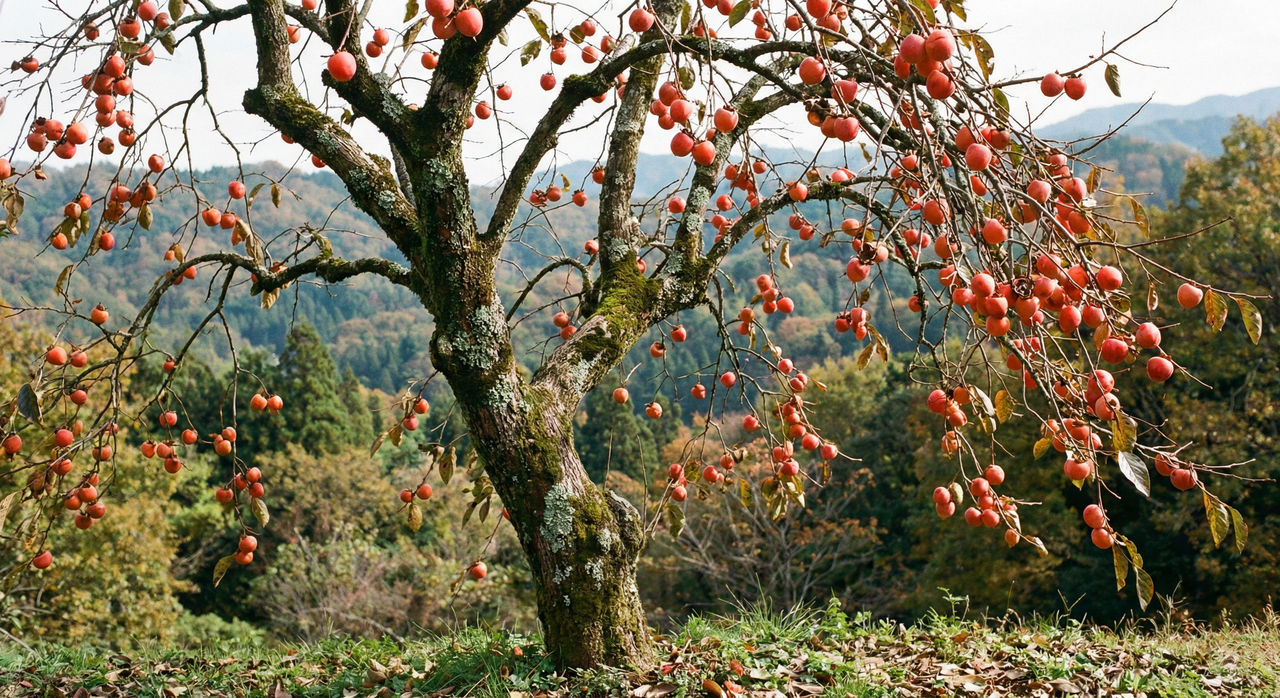
Most fruit rewards patience. Persimmon punishes the impatient. Bite into a Hachiya before it's ready and your mouth will pucker into something between dry chalk and raw horror, your tongue coated in tannins so aggressive they feel almost medicinal. I watched a first-time visitor to my food forest make that mistake on a cool October afternoon, and the look on her face told the whole story of why this tree gets a reputation for being "difficult." It isn't difficult. It's just unforgiving of assumptions, and there's a difference.
What I find genuinely strange is how that same fruit, left on the tree another two or three weeks, becomes something closer to spiced honey custard than anything you'd call a vegetable. The chemistry is doing something remarkable inside the skin while the fruit hangs there looking ready long before it is.[1] Two thousand years of cultivation across China, Korea, and Japan, poetry written about it, festivals built around it, and yet most American gardeners still walk past the nursery tag without a second glance. That, more than anything, is what I want to change your mind about.
Persimmon Origin, History, and Cultural Significance
If you've ever stood under a bare persimmon tree in November, watching those jewel-bright orange fruits hang against a gray sky like ornaments someone forgot to take down, you already understand why this tree has been cherished for millennia. What you might not know is just how deep that story goes.
Botanical Background of Diospyros kaki
Diospyros kaki, the Oriental persimmon, is native to southern and central China, with natural distributions extending through Korea and into Japan.[2][3] In its native habitat it occupies the mid-to-upper canopy of temperate mixed deciduous forests, tolerating moderate shade as a forest understory member before reaching for the canopy.[4][5] Cultivation there stretches back over 2,000 years, with archaeological seeds and references in the Shijing already anchoring it to daily life.[6]
The fruit traveled west considerably later. Thomas Jefferson reportedly planted seeds at Monticello in 1807, and Commodore Matthew Perry brought plant material from Japan to the United States in the 1850s.[7][8] In my experience designing orchards, one fact stops new growers cold: seed-grown trees take 7 to 10 years to produce fruit, while grafted trees bear in 3 to 5 years.[9][10] My own grafted trees in Central Florida started fruiting reliably in year four, which tracks perfectly with that data. I always recommend grafted stock to anyone who wants fruit in a realistic timeframe. The mature tree itself is a long-term commitment: typically 15 to 30 feet tall, occasionally reaching 40 feet, with cultivated lifespans running 50 to 75 years and some specimens exceeding a century.[11][12] Plant one now and you may be planting for your grandchildren. Diospyros as a genus spans continents: the tropical Philippine Mabolo (Diospyros blancoi), for instance, is an evergreen reaching 15 to 30 meters with a notably faster maturation timeline of just 2 to 3 years for grafted trees,[13] a useful reminder that the genus wears many forms.
Visual Characteristics of Persimmon Trees and Fruit
I once had a student in one of my food forest workshops ask me how to identify a persimmon from a distance. The bark, I told her, is unmistakable: dark brown to nearly black, broken into a tight geometric pattern that genuinely looks like alligator skin. Up close, the alternate elliptic leaves are glossy dark green above and paler beneath, often flushing a coppery red when they first emerge in spring, running 7 to 15 centimeters long on a canopy that starts pyramidal and rounds out with age.[14][15] The flowers are easy to miss: small, bell-shaped, greenish-yellow, appearing in late spring and barely a centimeter across.[16] The fruit is the payoff: a 5 to 8 centimeter globose to oblate berry, vibrantly orange at ripeness, wearing a persistent papery calyx like a little crown.[14][17] The critical distinction for growers is astringency: Hachiya types are mouth-puckeringly tannic until fully soft (the unpolymerized tannins create an intensely drying sensation), while Fuyu types deliver a crisp, apple-like sweetness straight off the tree. That single characteristic shapes every harvest and kitchen decision you'll make. The root system beneath it all is shallow and fibrous, spreading laterally two to three times the canopy width but rarely deeper than 60 to 120 centimeters.[18] I mulch my trees heavily for exactly this reason; that shallow surface zone needs moisture retention more than most people realize. By contrast, the African Jackalberry (Diospyros mespiliformis) anchors itself with a deep taproot suited to savanna soils,[19] and Mabolo produces velvety rusty-brown fruit covered in dense hair that looks nothing like the smooth orange globes most Western growers picture.[13]
Traditional and Cultural Uses Across East Asia and Beyond
The cultivation story begins with Neolithic seeds and references in the Shijing, China's Book of Songs compiled during the Zhou Dynasty around 1046 to 256 BCE, where persimmon already appears as part of everyday life and medicine.[20][21] From China it moved to Japan around the 8th century via Korea, where horticulturists of the Edo period (1603 to 1868) refined distinct cultivars and wove the fruit into autumn festivals, haiku poetry, and household symbolism around longevity.[22][23] I'm not an ethnobotanist, but I've read widely on these traditions and visited Japanese autumn markets where dried hoshigaki hang in doorways the way wreaths do in North America. The cultural weight is real and predates any Western orchard catalog by about two thousand years.
Traditional Chinese Medicine draws on the fruit, leaves, and bark for conditions ranging from diarrhea and hypertension to coughs and fever, with leaf tea used for digestion and blood pressure support.[24][25] Korea's gotgam and Japan's hoshigaki traditions mirror these uses for digestive and respiratory health.[26] The genus carries parallel traditions elsewhere: in the Philippines, Mabolo bark decoctions treat diarrhea and dysentery, leaves serve as wound poultices, and the tree itself holds deep symbolic meaning in indigenous culture, though it's now listed as Vulnerable due to overharvesting for its dense, ebony-like timber.[27][28] When I teach classes on Asian fruit crops, I try to be explicit about this: persimmon's story belongs to China, Korea, Japan, and the Philippines first. Western commercialization has sometimes adopted these plants without acknowledging the cultures that selected and stewarded them for centuries, and that's worth naming directly.[29]
Fun Facts and Notable Records
The oldest known cultivated persimmon tree still standing in Japan is estimated to be over 1,200 years old.[30] That number stops me every time. A tree planted during Japan's Heian period, still fruiting. The record for largest fruit belongs to a specimen from Shizuoka Prefecture weighed in 2019 at 378 grams (about 13.34 ounces),[31] which puts some of my own 'Giant Fuyu' harvests in humbling perspective. As an introduced species in the United States, persimmon has a relatively benign ecological footprint, sometimes competing with native vegetation but generally not considered highly invasive.[32] For a tree this ancient and this widely planted, that's a modest ecological bill.
Persimmon Varieties and Where to Buy Them
Astringent vs Non-Astringent Persimmons and Key Cultivars
Before you pick a persimmon cultivar, you need to understand the single most important decision the fruit is going to make for you: astringency. Persimmon cultivars split into astringent and non-astringent types, with a more technical four-way classification behind that: PCA (pollination constant astringent), PVA (pollination variant astringent), PCNA (pollination constant non-astringent), and PVS (pollination variant sweet).[33][34] What this boils down to in practice: astringent types are loaded with soluble tannins early in development and have to be fully bletted to a jelly-like softness before they're edible without that face-clenching pucker, while non-astringent types have low tannins from the start and you can bite into them crisp, like an apple.[35][36][15] I've grown both in Central Florida gardens, and the eating experience really is that different. A Fuyu pulled firm off the branch tastes clean and sweet with a satisfying crunch. A Hachiya picked at the same stage is genuinely inedible. Given a few weeks to soften into pure custard, though, it becomes one of the most seductive fruits I've ever spooned out of its skin.
Hachiya is the astringent archetype: large acorn-shaped fruit, orange-red skin, up to around 200 grams.[37][33] Fuyu is the non-astringent standard: round, orange, reliably hardy in zones 7 to 10, and the one I recommend most often to new growers.[37][33] Jiro is a squat, flattened non-astringent type, 150 to 200 grams with a diameter of about 6 to 8 centimeters, while Saijo is an elongated astringent with reddish-orange skin and a loyal following among dried persimmon enthusiasts.[37][33] Izu comes in early, ripening in September with smaller flattened-round fruit around 100 grams; Katsura offers subtle floral notes; Triumph ripens late, stretching from September through November.[37][38]
For Florida and the broader subtropical Southeast, Fuyu, Hachiya, and Tamopan are the most recommended options, with Fuyu and Hachiya also performing well across the Southeast and into Central and South Texas.[15][39][40] In my own design work, I lean toward Fuyu for clients who want low-maintenance and predictable fruiting in humid subtropical conditions. Pollination behavior also divides them: many astringent cultivars are parthenocarpic, meaning they'll set fruit without any pollination, while non-astringent types are often pollination-variant, where pollination affects seed set and sometimes fruit quality.[41] That distinction shapes guild planning; I often place astringent types where a second tree isn't feasible and reserve the non-astringent varieties for spots where I can guarantee pollinator traffic. University of Florida and USDA breeding programs are actively working to push cultivar development further, with emphasis on reducing astringency, improving fruit size and color, and building disease resistance.[15][7]
Two Diospyros relatives are worth a brief mention for context. Mabolo produces velvety ovoid fruit with a sweet cinnamon-caramel flavor when ripe, though it has only a handful of named cultivars like Palakdan and Latteratura.[42][43] Jackalberry (Diospyros mespiliformis) produces small, sweet, wildlife-beloved fruit across African savannas and has no named cultivars at all.[44][45] They're fascinating genus relatives, but neither has the cultivar depth or practical availability of Diospyros kaki for most home growers.
Sourcing Persimmon Trees and Related Species
Fortunately, Japanese persimmon trees are widely available across the United States. Stark Bro's, Nature Hills Nursery, FastGrowingTrees.com, Burnt Ridge Nursery, Ty Ty Nursery, and One Green World all carry a solid selection of Diospyros kaki cultivars.[46][47][48][49][50] A grafted tree in a 3-foot pot typically runs $35 to $55 depending on the cultivar and nursery, and grafted is always the way to go.[50][51][15] Early in my landscape work I planted a few seedling-grown trees to save money. The difference in vigor and fruiting timeline compared to grafted trees I planted later was significant enough that I don't recommend seed-grown stock to clients anymore except for rootstock purposes. Bare-root trees become available during dormancy, roughly November through March, which is also the optimal window for planting; grafting onto rootstocks like D. lotus is typically done in late winter through early spring.[51]
When you're buying, look for certified disease-free stock from nurseries participating in recognized certification programs rather than just grabbing whatever's cheapest online.[52][53] USDA APHIS regulates importation of live persimmon plants strictly, requiring phytosanitary certificates and permits, and prohibiting imports from regions with known pest risks unless propagated under APHIS oversight.[54][55] These regulations exist for good reason, and working within them protects your long-term investment.
Mabolo is a different story entirely. It's primarily a collector's fruit in the U.S., and while I've grown a couple in large containers and sheltered spots in Florida, their frost sensitivity and very limited nursery availability make them impractical for most readers. If you're determined to track one down, specialty tropical nurseries like Top Tropicals or Logee's Greenhouses occasionally carry plants or seeds, but expect to search.[56][57][58] For the vast majority of growers, a grafted Fuyu or Hachiya from a reputable domestic nursery is the straightforward, reliable path to a productive tree.
Persimmon Propagation and Planting Guide
If you want to grow persimmon fruit reliably, the propagation decision you make at the start shapes everything that follows. I've started persimmons from seed for rootstock, grafted cultivars onto one-year-old seedlings, rooted cuttings under mist, and watched all of them in the ground side by side. The takeaway is pretty unambiguous: for fruiting trees, grafting wins. Seed propagation has its place, but that place is almost exclusively rootstock production.
Understanding Persimmon Seed Characteristics and Why Grafting Is Preferred
Diospyros kaki seeds are oval to obovate, roughly 1.3–1.5 cm long, with a hard, shiny, dark brown testa and ruminated horny endosperm surrounding a small straight embryo.[59][60] That hard coat is a classic Ebenaceae trait, and it contributes directly to the dormancy challenges covered in the next section. What matters here is what's inside: most D. kaki is monoembryonic, meaning seedlings are genetically distinct from the parent. Key commercial cultivars including 'Hachiya' and 'Fuyu' do exhibit polyembryony, occasionally producing nucellar clones identical to the mother,[61][62] but you can't count on it. Cross-pollination, gametophytic self-incompatibility, and genetic variability across a seedling batch mean that seed-grown fruiting trees are a gamble on flavor, ripening time, and astringency level.[63][64] My first season growing seedlings for rootstock, I learned to label every row obsessively because even experienced eyes can't distinguish a future 'Fuyu' from a future disappointment at the seedling stage.
Seed Storage, Viability, Dormancy, and Germination Requirements
Persimmon seeds are recalcitrant, meaning they behave nothing like the packets of vegetable seed sitting in a cool drawer. They're desiccation-sensitive, can't be dried for orthodox long-term storage, and lose viability rapidly if moisture content drops below roughly 20–40%.[65][66] The practical ceiling for viability under optimal moist storage (80–90% relative humidity in damp sand or vermiculite at 5–15°C) is 6–12 months, and germination rates drop sharply after just one to two months of any delay.[67][68] Sow fresh whenever you can.
Beyond storage, D. kaki seeds carry physiological dormancy that requires 2–3 months of cold stratification at 2–5°C before germination will occur.[69][70] After stratification, germination in well-drained media at 20–25°C with 70–90% humidity runs 50–70%.[69] I've lost batches of seedlings to damping-off by rushing them into outdoor beds before they had two true leaves; waiting for that second leaf pair before transplanting genuinely improves survival. Mabolo (Diospyros blancoi) follows a different script entirely: its seeds display physical dormancy from a hard coat and need scarification rather than cold stratification, germinate best at 25–30°C, and should be sown fresh from ripe fruit.[70][71] Same genus, completely different protocol.
Grafting, Cuttings, Air Layering, and Tissue Culture Techniques
For anyone serious about growing a persimmon fruit tree with predictable results, grafting is the answer. The commercial standard is grafting or budding desirable cultivars onto Diospyros lotus seedling rootstock, which brings vigor, nematode resistance, and Phytophthora tolerance to the equation.[72][73] Diospyros virginiana is compatible but tends to show lower success rates in my experience, and I've moved almost entirely to D. lotus seedlings for my own grafting work. Whip-and-tongue, chip budding, cleft, and side-veneer grafting on one- to two-year-old rootstocks all achieve 70–95% success under controlled conditions.[15][74] I prefer late-winter grafting on one-year-old D. lotus when the rootstock is just breaking dormancy; that timing gives the highest take in my nursery beds.
Cuttings and air layering are viable home-scale options, though they take more patience. Softwood and semi-hardwood cuttings taken in late spring or early summer root at 20–40% with 1,000–3,000 ppm IBA; hardwood cuttings improve to 30–50% with up to 8,000 ppm IBA, bottom heat at 21–27°C, and 80–90% humidity in a perlite-vermiculite medium. Air layering sits in the middle at 50–70%.[75][76] Tissue culture micropropagation is possible but stays in the research domain for now.[77]
Soil, Site Selection, and Planting Requirements
Persimmons will tell you quickly whether you got the soil wrong. Diospyros kaki wants well-drained loamy or sandy-loam soil with 3–8% organic matter and a pH of 6.0–7.0, tolerating 5.5–7.5 in a pinch.[78][79] Drop below pH 5.5 and you risk aluminum toxicity and manganese excess; push above 7.5 and iron, manganese, and zinc become unavailable, showing up as interveinal chlorosis on the new leaves.[78] I planted into a bed once that I thought was fine, skipped the soil test, and watched the new flush turn yellow-green within a season. A sulfur application to drop the pH corrected it the following year, but that delay cost me a growing season I didn't need to lose. Test before you plant.
Good drainage and aeration through the top 60–90 cm of soil are non-negotiable; the root system is shallow to moderate and will not tolerate waterlogging or compaction.[78][80] Mabolo shares this intolerance despite its tropical context and prefers well-drained fertile loamy or volcanic soils with a slightly broader pH window of 5.5–7.0.[13] For amendments, compost or well-rotted manure brings organic matter to target levels; agricultural lime raises pH in acidic soils at roughly 1–3 lb per 100 square feet, and elemental sulfur handles alkaline correction. Gypsum helps in sodic or heavy clay situations. Container mixes should run 40–50% potting soil, 30–40% perlite or coarse sand, and 20% compost or peat.[81] Full sun, at least 6–8 hours of direct light daily, is the other non-negotiable for productive fruiting.[82]
Spacing, Timing, and Planting Technique
Grafted persimmon trees on seedling rootstock reach a mature canopy spread of 15–25 feet, and that spread should drive your spacing decision. Standard commercial plantings run 15–20 feet between trees and 20–25 feet between rows, supporting 100–200 trees per acre.[83][84] For home orchards, open-center training systems need more room than central-leader forms. I space my grafted Asian persimmons at 18 feet in Central Florida's sandy loam and have regretted going tighter; once those canopies fill in after year four or five, close spacing becomes a pruning and airflow problem. Mabolo, with its mature height of 20–25 meters and canopy spread of 10–15 meters, is spaced 8–10 meters apart in Philippine orchards using a 10×10 meter grid.[85]
In USDA zones 7–10, plant in early spring after the last frost, or in fall in milder climates where roots have time to establish before summer heat.[86] Dig a hole twice as wide as the root ball but no deeper than it, backfill with native soil amended with compost, water deeply, and lay a ring of mulch to hold moisture while keeping it pulled a few inches from the trunk.[84] The wider hole matters more than most people think; it gives those lateral roots an easy path into loosened soil without the compaction wall that stops establishment cold.
Time to First Fruit: What to Expect from Seeds Versus Grafts
Seed-grown D. kaki trees typically take 4–10 years to produce a meaningful first harvest, and that's before accounting for genetic variability that may deliver fruit nothing like what you hoped for.[72][64] Grafted trees on good rootstock begin bearing in 2–4 years, with some early-maturing cultivars fruiting in as little as one to two years and others requiring up to five.[15][63] Mabolo from seed takes 5–8 years; grafted mabolo drops that to 2–4 years, the same genus-wide pattern.[87][88] I tell every new client to budget three years of patience from a young graft before expecting reliable harvests, and to use those years to get the soil, sun, and drainage dialed in so the tree is ready to perform when its time comes.
Persimmon Care and Growing Guide
Persimmon trees have a reputation for being easygoing, and in some ways that's deserved. But "low-maintenance" doesn't mean "no maintenance," and the home growers I see struggling most are the ones who planted a tree, ignored it for two years, and then wondered why the fruit cracked or the canopy looked like a thicket. Getting the fundamentals right early -- sun, water, fertility, and a little seasonal awareness -- makes everything else follow naturally.
Sunlight Requirements for Persimmons
Full sun is non-negotiable if you want reliably sized, well-flavored fruit. That means a minimum of six to eight hours of direct light daily; anything less and you're looking at fruit that's 30 to 50 percent smaller, with poor set and leaves that yellow from inadequate photosynthesis.[89][90] In my Central Florida garden, I've learned that two hours of late-afternoon shade actually prevents the marginal scorch I used to see on young trees during peak summer, so I don't position them in totally open western exposures.[91] That afternoon protection is a mitigation tool for heat-stressed climates, not a growing strategy. Mabolo (Diospyros blancoi) shares the same six-to-eight-hour baseline but needs gradual acclimation for young plants when temperatures push above 35°C.[13]
Watering Needs and Irrigation for Persimmon Trees
Once a persimmon tree is established, it wants deep, infrequent watering: roughly one inch per week during the growing season, reaching down to 18 to 24 inches.[80][92] Young trees need more attention: every seven to ten days with ten to twenty gallons per session to keep that root zone consistently moist through establishment.[93] The critical windows are spring flowering and summer fruit development, when irregular moisture directly causes flower drop and the fruit cracking I saw constantly in my first planting before I switched to drip lines and mulch.[75]
Overwatering is just as damaging as drought. Too much and you get Phytophthora root rot, chlorotic leaves, and soft stems; too little produces wilting, tip burn, and cracked fruit.[94][10] Shallow, frequent watering builds weak surface roots; mulch around the drip line (but away from the trunk) and a proper drip system solve both problems at once. Persimmons tolerate soil pH from 5.5 to 7.5 and modest salinity up to around 1,000 to 2,000 ppm, though quality declines above 500 ppm.[95]
Feeding and Fertilization for Optimal Persimmon Health
Persimmons are moderate feeders, and the biggest fertilizer mistake I see is treating them like citrus. Excess nitrogen produces exactly what you don't want: vigorous leafy growth, reduced fruit set, alternate bearing, and cracked fruit.[10][96] I found this out the hard way when a heavy late-summer nitrogen application one year gave me whippy growth and a fraction of my usual crop. Now I run soil tests every three years and annual leaf tissue analysis, targeting roughly 50 to 100 ppm N, 20 to 50 ppm P, and 100 to 200 ppm K.[97]
Beyond NPK, the micronutrients matter a lot. Calcium keeps fruit firm; low levels produce mealy texture. Boron deficiency causes cracking. Iron, magnesium, and manganese shortfalls show up as interveinal chlorosis, and zinc deficiency produces the characteristic small, distorted leaves called little-leaf.[98] For young trees, apply 0.2 to 1 lb of actual nitrogen per year of tree age; mature trees need 1 to 2 lb annually, split into an early spring application before bud break and a light follow-up in June if the tree shows signs of deficiency.[96][99] Stop all fertilizer after July; late applications push soft growth straight into frost season. A balanced 10-10-10 or 8-8-8 works well, or go organic with two to four inches of compost or aged manure plus blood and bone meal.[100] Always water thoroughly after feeding to prevent root burn from salt buildup.[101]
Frost Tolerance and Winter Protection
Mature Diospyros kaki trees are hardy in USDA zones 7 to 10, tolerating temperatures down to around 0°F to 10°F (-18°C to -12°C), with some cold-hardy cultivars surviving brief dips to -5°F (-20°C).[102][34] Astringent varieties tend to handle cold better than non-astringent types, so if you're in a zone 7 or 7b garden, that's worth factoring into your selection. Young trees need protection below 10°F.
The toughest bark is not what's at risk. Flower buds die below 28°F (-2°C), and new spring growth blackens or distorts with even a light late frost. The tree also requires its baseline 100 to 300 chill hours below 45°F (7°C) to break dormancy cleanly; without adequate chilling, bud break is erratic and yields suffer.[36][103] I compare this to my citrus, where the new flush is similarly vulnerable, except persimmon wood itself is far tougher once it matures. For young trees, burlap wraps, three to six inches of mulch pulled away from the trunk, and row covers during spring bloom are all practical protections.[15] Mabolo and Jackalberry, by contrast, are zone 10 to 12 plants that require container culture or heavy protection below 28 to 30°F; they represent the tropical end of a genus with remarkable range.[43]
Heat Tolerance and Summer Stress Management
Persimmon is rated for AHS Heat Zones 5 to 9, tolerating 60 to 150 days above 86°F, and the tree has real physiological adaptations to cope: stomatal regulation, thicker cuticles, and upregulated antioxidant activity.[104][105] Photosynthesis peaks at 25 to 30°C and fruit set performs best between 25 and 32°C, but the tree needs nighttime temperatures to drop below 25°C for recovery.[106] Push past that without relief and you get scorched, curling leaves, wilting despite adequate soil moisture, and fruit that cracks or ripens prematurely.
In my humid Central Florida summers, 30% shade cloth on first-year trees is non-negotiable. Without it, leaves are scorching by mid-June, but shaded young trees sail through and set fruit reliably once they've established. Two to four inches of mulch, early-morning deep irrigation, and a windbreak on the hot western exposure round out the summer toolkit.[107][108] For cultivar selection in hot climates, 'Fuyu', 'Hachiya', and 'Izu' have proven the most reliable heat performers.[108]
Pruning, Maintenance, and Seasonal Care
Prune during dormancy, in late winter before bud break. The goal is an open-center system with four to six well-spaced scaffold branches that let light and air reach the whole canopy; remove dead, crossing, or strongly vertical shoots and keep annual canopy removal to 10 to 20%.[109][75] I once removed close to a third of a tree in one session and got nothing but vigorous, fruitless whips the following year. Since I scaled back to about 15% and focused on opening the center, the yields have been heavier and better colored, and anthracnose pressure dropped noticeably.
This is also where the fertilizer story comes full circle: excess nitrogen produces the vegetative flush that heavy pruning only encourages further. Keep fertility balanced, prune lightly, and the tree finds its rhythm. Astringent varieties may benefit from light summer pruning to reduce vigor; non-astringent types respond best to pure dormant training.[110] Mulch two to four inches deep under the canopy (away from the trunk), consider 30 to 50% shade cloth for the first one to two years in intense sun, hand-pollinate if your cultivar has a poor fruit set, and run that soil test every three years.[111]
Seasonal Rhythm of Persimmon Trees
Once you understand the annual cycle, every care task falls into place. Chill hours accumulate through winter, driving clean bud break in spring. Flowers open in April through May, fruit swells through summer, and harvest arrives in October through November, closing with a fall color display that rivals any ornamental tree.[2][103] That 200 to 600 chill-hour requirement explains why spring flowering is so clean when winters are properly cold, and why late frost during bloom is such a setback. Every intervention from pruning timing to fertilizer cutoffs to irrigation increases through flowering maps directly onto this cycle. Mabolo, as a tropical evergreen, runs a completely different calendar without any chill requirement, flowering in the dry season and fruiting into late summer, which underscores just how wide the Diospyros genus actually is.[42] For the temperate persimmon grower, though, it's the elegance of that deciduous rhythm, dormancy giving way to bloom giving way to heavy, orange-globed branches, that makes the patience worthwhile.
Harvesting Persimmons: Timing, Technique, and Flavor
When to Harvest Persimmons by Region, Cultivar, and Type
After watching a persimmon tree carry fruit through an entire summer, the harvest window can feel almost anticlimactic in how quickly it arrives and how unforgiving it is if you miss it. Bloom happens in May and June, and from there the fruit needs roughly 180 to 210 days to reach maturity[112][113], which puts most U.S. growers squarely in October and November. California growers tend to pick from late October into early December; in the Southeast, harvest often wraps up before Thanksgiving; and Texas trees generally land somewhere in between.[83][114][64]
Cultivar type shifts that window further. Early types come off in September to October, Fuyu hits its stride in October and November, and a late astringent like Hachiya can hang on the tree into December.[115][116] I've learned not to trust the calendar alone. What I watch for is full orange-red skin color, a Brix reading in the 15 to 20° range, and for astringent types, firmness around 10 to 15 psi before I reach for the clippers.[117][118] A slight give at the stem end of a Fuyu is usually my final confirmation. My Fuyu trees also tend to drop a few fruit naturally at peak ripeness, which I've come to read as the tree's own signal that everything still on the branch is ready.
Harvest Technique, Thinning, and Post-Harvest Handling
The harvest itself actually starts in June. Persimmon branches are surprisingly brittle once loaded with fruit, and I learned that lesson the hard way watching a well-fruited limb split clean off a young tree. Now I thin every year, three to four weeks after petal fall, keeping one fruit per cluster and spacing them roughly 15 to 20 cm apart, targeting 20 to 30 fruits on young trees.[80] The fruit that stays is larger and better quality. The branches survive. It's not optional.
How you pick depends entirely on which type you're growing. Non-astringent varieties like Fuyu come off the tree at color break while still firm and go straight to the table.[119] Astringent types like Hachiya are harvested firm and orange-red, then ripened off the tree until the soluble tannins polymerize and astringency drops away.[120][121] For storage, keeping fruit at 0 to 5°C with 85 to 90% relative humidity can extend shelf life two to four months.[122][123] I keep a small dedicated cooler at 38°F specifically for this purpose, because even a few days at kitchen temperatures noticeably shortens that window.
Yield Expectations and Flavor at Peak Ripeness
A mature, well-managed persimmon tree can yield around 100 to 150 kg of fruit.[124] Consistent thinning is what pushes a tree toward that upper range. The flavor waiting at the end of that long season is remarkable. Ripe persimmon fruit carries 12 to 18% sugars (mostly fructose, glucose, and sucrose) balanced against very low organic acids[125], and it's the dramatic drop in soluble tannins that makes the difference between something that puckers your entire mouth and something that doesn't.[126]
The textural contrast between types is almost hard to believe they're the same species. A fully ripe Hachiya turns nearly translucent, almost spoonable, with a custard texture and honey sweetness that reminds me of eating a crème brûlée without the crust. Fuyu stays crisp and apple-firm, sweet but structurally satisfying even at peak ripeness. The aroma adds its own dimension: esters, alcohols, aldehydes, and the distinctive compound mesifurane give ripe persimmon fruit a fruity, faintly camphorous quality that's genuinely unlike anything else in the fall garden.[127][128] For context on genus diversity: Black Sapote ripens to a chocolate-pudding sweetness around 20 to 25° Brix[129], and Mabolo delivers pear-like flavors with a notoriously pungent skin that you either find charming or alarming.[130] Ripeness is everything across the genus, but it's most dramatic in Diospyros kaki, where the gap between unripe and ripe is the difference between a terrible experience and a transcendent one.
Persimmon Preparation, Uses, and Safety
Culinary Uses and Flavor Profiles of Ripe Persimmons
Ripe persimmon fruit is where this genus really delivers. Diospyros kaki is eaten fresh, dried, and baked into everything from puddings to breads.[131] Black sapote (Diospyros nigra) offers something almost surreal: pulp that genuinely tastes and looks like chocolate pudding, mild and aromatic.[129] Mabolo (Diospyros blancoi) is a different story entirely. I've tasted it at a fruit swap with fellow gardeners and the reaction is always split down the middle -- the flavor hits notes of apple, mango, and caramel, but the cheesy, pungent aroma from its lactone compounds stops half the room cold.[42] It's not unpleasant once you expect it, but fair warning.
The critical thing to understand before you eat any of these fruits is ripeness. Non-astringent types like Fuyu can be eaten crisp and firm straight from the branch, with flavors of brown sugar and pear.[132] Astringent types like Hachiya need to go soft -- deeply, completely soft. I tell people to wait until the fruit feels like a heavy water balloon with an almost translucent glow to the skin. That's when the tannins have broken down and the flesh turns into that honeyed, custard-like texture you're after.[132][133] The same rule applies across the genus: black sapote is ready when the skin turns fully black and soft, and mabolo needs a complete color change before you touch it.[134][13]
Once you've got ripe fruit, the culinary options open wide. Drying concentrates the sugars and neutralizes tannins, which is exactly why the Japanese hoshigaki tradition produces something closer to candy than dried fruit.[135] Cooking breaks tannins down further through Maillard reactions, yielding the deep caramelized sweetness that makes persimmon pudding and persimmon bread so compelling.[80] On the savory side, that honeyed flavor pairs beautifully with salty cheeses, pork, game meats, and spiced breads. Persimmons also hold significant cultural weight in East Asia, offered at New Year celebrations as symbols of good luck, and used across generations in jams, wines, and juices.[136]
Traditional Medicinal Preparations and Non-Food Uses
Persimmon leaves have a quiet but real history in the kitchen and the medicine cabinet. In East Asian tradition they're brewed as kaki no ha cha, a leaf tea with documented antioxidant properties.[137][138] I harvest young leaves in early summer, dry them in a single layer out of direct sun, and steep them like any herbal tea. It's a gentle, pleasant drink and one of the more practical ways to use parts of the tree that would otherwise just fall to the ground. In Traditional Chinese Medicine, the fruit addresses respiratory and digestive ailments, while the leaves and bark carry astringent and anti-inflammatory properties.[139] Iranian folk medicine has used persimmon leaves for diabetes and hypertension.[140]
For mabolo, traditional Philippine practice uses bark decoctions for fever, dysentery, and wound care, though dosages aren't standardized and typical folk use runs to 1-2 fruits daily or bark preparations taken two to three times a day.[141][142] I'd consult a healthcare provider before going beyond food-use quantities with any species here. Beyond the kitchen and medicine cabinet, tannins from unripe fruit and leaves yield yellow-to-brown natural dyes for fabric.[143] The wood of Diospyros kaki is dense, fine-grained, and hits around 1,500 lbf on the Janka scale, making it highly useful for tool handles and turned objects.[144] Mabolo's timber, known in the Philippines as kamagong, is even more prized for furniture and musical instruments, valued for its termite resistance and exceptional finish.[145] I save thick pruned branches from my trees specifically for small carvings. That density takes a beautiful polish.
Safety Considerations When Using Persimmons
I never serve persimmons until they've reached full ripeness, and the research on why is too clear to ignore. Unripe astringent fruit contains high levels of soluble tannins that can form phytobezoars, hard masses in the digestive tract that may require medical intervention.[146] Unripe black sapote and mabolo carry similar risks for digestive upset.[134][42] On seeds: kaki seeds are technically edible in small amounts when roasted, but mabolo seeds are toxic raw, containing saponins and tannins that cause severe gastrointestinal distress.[147] Always peel mabolo and remove its seeds before eating.[42]
People with latex sensitivity should know persimmons are implicated in latex-fruit syndrome and can trigger oral allergy symptoms.[148] The plant sap of black sapote and mabolo can also cause dermatitis on contact, so gloves are worth wearing when harvesting mabolo with its latex-containing skin.[149] On identification: in North America, unripe persimmons can be confused with bittersweet nightshade or Jerusalem cherry, both toxic.[150] The easiest field check I use is the distinctive four-lobed calyx that persists on the fruit and the furrowed gray-brown bark -- no nightshade has either. When properly ripened and correctly identified, persimmon is a safe, delicious, and deeply culturally significant food for most people. The genus just asks that you earn it with a little patience.
Persimmon Health Benefits and Nutritional Value
What strikes me every autumn, standing in front of my Fuyu loaded with glowing orange globes, is that the persimmon is as nutritious as it is beautiful. People underestimate it because it's not kale or blueberries, but the research tells a genuinely interesting story.
Nutritional Profile of Persimmon
A medium raw Japanese persimmon runs about 168 grams and delivers roughly 70 kcal per 100 g, with 18.6 g of carbohydrate, 3.6 g of dietary fiber, and a modest 0.19 g of fat.[151] That fiber-to-calorie ratio is genuinely good for a sweet fruit. On the micronutrient side, you're getting vitamin A (81 μg RAE), vitamin E (0.73 mg), vitamin C (7.5 mg), potassium (161 mg), and manganese (0.335 mg) per 100 g, among others.[152] Nothing off-the-charts in isolation, but together they add up to a fruit worth eating regularly. The vivid orange color of a tree-ripened Fuyu is also a visible signal of its carotenoid load, including beta-carotene, lutein, and zeaxanthin, alongside flavonoids like quercetin, catechin, and anthocyanins.[153][25] One quick note on dried persimmons: concentrating the fruit bumps calories to 200-250 kcal per 100 g and sugars to 50-60 g while cutting vitamin C by half or more.[152][154] Great for snacking in moderation, but worth knowing if you're eating them by the handful. For comparison, Mabolo (Diospyros blancoi) comes in at a similar calorie range but with notably higher vitamin C (12-60 mg) and potassium (200-300 mg), showing how much nutritional variation the genus holds.[155][156]
Key Phytochemicals in Persimmon
The polyphenol suite in Diospyros kaki is substantial: flavonoids (quercetin, kaempferol, myricetin glycosides), phenolic acids (gallic, protocatechuic, chlorogenic), and tannins including proanthocyanidins and ellagitannins.[157][158] Ripeness fundamentally changes this picture. Astringent varieties like Hachiya can carry 1-2% soluble tannins when unripe, which polymerize into insoluble forms as the fruit softens, eliminating the pucker; non-astringent types like Fuyu stay below 0.2% throughout.[25] Think of it like unripe banana or a very strong black tea, that gripping dryness across your palate. I've grown both cultivars for years, and I notice that fruit allowed to color up fully on the tree in warm, humid weather comes in softer and markedly less astringent than fruit pulled early. This lines up with documented findings that warmer climates and mild stress can elevate polyphenol levels by 20-30% before peak ripeness.[159][160][161] Those secondary metabolites exist because the tree evolved them as anti-herbivore defenses and allelochemicals, which is part of why well-drained loamy soil and a bit of environmental stress tend to produce more flavorful, bioactive fruit.[162][163] Across the Diospyros genus, relatives like Jackalberry share this same flavonoid-tannin-carotenoid profile, with heartwood additionally rich in cytotoxic naphthoquinones like diospyrin and isodiospyrin that show antifungal and antimicrobial properties in lab settings.[164][165]
Medicinal Research and Traditional Uses
Clinical research on persimmon centers on a few explicitly documented areas. Persimmon extracts and leaf preparations show antioxidant activity through Nrf2 activation and NF-κB inhibition, anti-inflammatory effects via reduced pro-inflammatory cytokines, modest blood-pressure reduction in small trials, constipation relief in elderly subjects, and some acetylcholinesterase inhibition suggesting neuroprotective potential.[146][166][167] Every autumn I air-dry surplus leaves from my trees for winter infusions, partly because the blood-pressure and antioxidant findings genuinely interest me, and partly because several Asian and African friends whose families have used persimmon leaf tea for generations describe the same gut-comforting qualities those pilot studies document. Traditional Diospyros kaki leaf tea for blood-sugar regulation has limited human data behind it, while Philippine folk medicine has long relied on Mabolo bark and leaves for diarrhea, dysentery, diabetes, hypertension, and wound care, all effects attributed to the same tannin-flavonoid-phenolic acid chemistry.[168][169][170] Naphthoquinones from multiple Diospyros species show in-vitro anticancer, antimicrobial activity against Staphylococcus aureus, and tyrosinase inhibition, but nearly all of that work is preclinical.[171][172][173] The genus is pharmacologically consistent, but Diospyros kaki is the only species with even a modest clinical dataset behind it.
Safety Considerations for Persimmon Consumption
Fully ripe persimmon fruit is non-toxic and safe for humans and pets.[174][175] The word "ripe" is doing real work in that sentence. Eating large amounts of unripe astringent fruit, especially on an empty stomach, can form phytobezoars, hard masses of polymerized tannin that can cause intestinal obstruction severe enough to require surgery.[176][177] I always wait for full color and a yielding softness in astringent types, and I don't let guests or children eat fruit I'm not certain is properly ripe. Seeds pose a choking risk if swallowed whole, and leaves high in tannins can be toxic to livestock.[176] Beyond ripeness, persimmon contains vitamin K (2.6 μg per 100 g), tannins that can bind minerals or medications, and modest hypoglycemic effects.[178][179] If you take warfarin or other blood thinners, or if you manage blood sugar with medication, talk with your doctor before consuming large amounts or using persimmon medicinally. Those interactions are real and well-documented. People sensitized to birch or grass pollen may experience oral allergy syndrome from persimmon due to cross-reactive lipid-transfer proteins, and handling leaves or sap can cause mild contact dermatitis in sensitive individuals.[180] Pregnant individuals should avoid unripe fruit entirely and steer clear of Jackalberry medicinally, since that species has documented uterotonic properties historically used to facilitate childbirth.[181] Across the genus, ripe Mabolo and Jackalberry fruit are safe when properly identified, but seeds, bark, and unripe tissues contain higher tannins, saponins, or naphthoquinones that require boiling or fermentation to reduce irritant or cytotoxic effects.[138][146] Handle correctly, and persimmon is as safe as it is rewarding to grow and eat.
Persimmon Pests and Diseases
Natural Defenses and Overall Resistance in Persimmon
Persimmon has a few tricks up its sleeve before you ever reach for a spray bottle. The tree produces high concentrations of tannins and phenolic compounds in its leaves and fruit skins, maintains leaf trichomes that physically deter feeding insects, and even sports extrafloral nectaries that recruit predatory beneficial insects to do some of the pest management work for you.[78][182][183][184][185] I've noticed this myself: young persimmon seedlings look almost fragile in early spring when dry weather brings the first spider mites around, but once a tree is established and pushing mature leaves, you can feel that leathery toughness and smell something almost medicinal when you rub them. That's the tannin chemistry at work, and a lot of insects simply move on to easier targets.
That said, no cultivar is fully pest-proof, and smart selection still matters.[78] 'Fuyu' shows moderate resistance to scale and psylla, 'Hachiya' holds off persimmon psylla through its leaf chemistry, and 'Jiro' was bred specifically with reduced susceptibility to fruit flies in mind.[186][162][187] Choosing the right cultivar for your climate is genuinely one of the most effective pest management decisions you can make. Mabolo (Diospyros blancoi) relies on similar tannin, phenolic, and latex chemistry as a feeding deterrent,[188][189] but the cultivar toolkit simply isn't there yet, so growers rely on general practices rather than targeted selection.[190]
Common Insect Pests and Their Management
The pest roster for persimmon is longer than most people expect: fruit flies (primarily Bactrocera spp.), scale insects, aphids, mealybugs, spider mites, codling moth, thrips, leafrollers, persimmon psylla, and the persimmon shot-hole borer all appear in the literature.[78][191][75] Fruit flies are the most economically damaging: females lay eggs directly into developing fruit, larvae feed internally, and the resulting rot can make fruit drop long before it's ripe. If you're wondering why your persimmon tree is dropping fruit early, Bactrocera infestation is high on the list of culprits. Scale insects and mealybugs compound the problem by secreting honeydew that feeds sooty mold, layering fungal stress on top of sap depletion.[192]
Spider mites tend to flare during dry periods, and codling moth, while not a primary host preference, will exploit persimmon during fruit set.[193][194] Severe infestations across this pest complex can cause 30 to 50 percent yield losses through premature drop and fruit damage alone,[195] which is reason enough to take monitoring seriously rather than treating pest pressure as someone else's problem. Mabolo faces a nearly identical cast of insect threats, with fruit flies causing significant crop losses in ripening fruit,[196] so in warm climates both species need vigilant trapping programs during fruiting season regardless of their chemical defenses.
Major Diseases and Cultivar Resistance
Disease performance in persimmon varies enough by cultivar, soil, and climate that broad resistance ratings can mislead.[75] Anthracnose (Colletotrichum spp.) is the disease that matters most in humid regions: it hits leaves, twigs, and fruit, causes defoliation and fruit rot, and can gut a season's yield.[197][198] I've watched this play out directly in humid growing seasons: 'Fuyu' holds its foliage noticeably better than 'Hachiya' once the wet summer weather sets in, a concrete difference that no resistance rating quite captures until you see both trees side by side.[199][200]
Soil-borne root rots from Phytophthora and Fusarium are the other category that keeps me careful. Yellowing, wilting, and sudden tree decline in otherwise healthy-looking trees almost always trace back to poor drainage or overwatering, and resistance depends heavily on rootstock -- D. virginiana offers notably better tolerance here.[201][202][203] I always plant persimmons on a slight mound or well-amended bed because I've learned the hard way that even a few days of standing water during Central Florida's summer rains is enough to trigger Phytophthora decline. Beyond anthracnose and root rots, growers may encounter Cercospora leaf spot (non-astringent types like 'Fuyu' show better resistance), cankers managed through pruning, Botryosphaeria and Alternaria fruit rots in low-vigor trees, and the occasional phytoplasma problem like witches' broom; powdery mildew shows up but the tree's resistance is generally high.[204][205] Bacterial leaf scorch (Xylella fastidiosa) has no cure and warrants watching in warmer regions.[206] Mabolo shares the genus vulnerability to anthracnose and root rots in waterlogged soils, with some suggestion it tolerates humidity slightly better than kaki, though the research base is thin and much of what we know comes from inference rather than direct study.[207][208]
Integrated Pest and Disease Management for Healthy Trees
My default approach is to walk the orchard after rain rather than spray on a calendar schedule. Removing fallen fruit, cleaning up infected leaf debris, and pruning for airflow have cut my anthracnose pressure more consistently than any fungicide timing I've tried.[206][209] A complete IPM program layers that sanitation foundation with well-drained soils, appropriate spacing, dormant-season oil sprays for overwintering scale and mite eggs, and targeted biological or chemical interventions timed to actual pest thresholds rather than anxiety.[205] Breeding programs continue to push cultivar resistance forward, including kaki x D. virginiana hybrids with improved disease tolerance,[210] but the most reliable protection still comes from proactive cultural choices that any home gardener can implement this season without waiting for the next release.
Persimmon in Permaculture Design
Persimmon earns its place in a food forest the way the best guild members always do: quietly, reliably, across many functions at once. It doesn't fix nitrogen, it won't tower over your canopy trees, and it won't demand constant attention. What it does instead is slot cleanly into the low-tree layer of a temperate system, deliver fruit in late autumn when almost everything else is winding down, and build soil year after year with potassium-rich leaf litter that actually decomposes quickly enough to matter. I keep coming back to it in my designs because it occupies a niche that surprisingly few trees fill this gracefully.
Climate Adaptation and Suitable Zones for Diospyros kaki
Diospyros kaki is reliably hardy in USDA zones 7-10, with zone 7 representing minimum winter temperatures in the 0°F to 10°F range.[211][212] Fruit production peaks in zones 7-9, with optimal performance across zones 8-10.[16] Most standard cultivars can handle brief temperature dips to 0°F but start showing real damage at -5°F to -10°F.[213] That's an important distinction for anyone gardening right at the zone 7 edge: marginal is marginal, and a bad winter can set a young tree back hard.
One pattern I've noticed in my zone 8-9 work is that non-astringent cultivars like 'Fuyu' consistently outperform astringent types like 'Hachiya' after the occasional surprise cold snap.[213] I've made it a habit to default toward non-astringent selections in those designs precisely because the cold tolerance buffer is a real advantage, not just a catalog footnote. Chill hour requirements are also refreshingly low at 100-300 hours below 45°F, which opens persimmon up to a lot of mild-winter gardens where other deciduous fruit trees struggle to set fruit.[214][15]
On the heat end, persimmon tolerates temperatures at or above 100°F but can show leaf scorch under prolonged heat in zone 10 without support.[80][215] Mulching heavily around the base genuinely helps here; I've watched unmulched trees in my designs scorch noticeably more during 95°F+ stretches compared to neighbors with a thick mulch ring. Annual rainfall needs of 30-50 inches support optimal growth, though established trees show decent drought tolerance.[80][15] Low salt tolerance rules it out for high-salinity coastal spots, and the tree prefers moderate humidity in the 40-60% range.[216][80]
The broader Diospyros genus spans well beyond these temperate parameters. Mabolo (Diospyros blancoi), native to the Philippines, is a strictly tropical species hardy only in zones 10a-11 with minimum temperatures around 28-30°F before frost damage sets in.[13][217] Same genus, completely different climate envelope, and as we'll see, a completely different place in the system's vertical structure.
Ecosystem Functions and Ecological Contributions
Mature Diospyros kaki trees reach 15-30 feet tall with a canopy spread of 15-25 feet, tolerating partial shade while preferring full sun.[80] The size is one of its real strengths in a designed system: big enough to provide genuine summer shade and dappled light for understory companions, small enough to stay manageable without dominating the space. Because persimmon cannot fix nitrogen, I design around this limitation the same way I do with other non-fixing fruit trees like apples or pears: I lean on legume companions to do that work and let the persimmon contribute in other ways.
And it does contribute in other ways. Deep roots anchor slopes and control erosion, while the leaf litter that falls each autumn is genuinely valuable, decomposing quickly and releasing potassium and calcium back into the soil.[218][219] That potassium cycling isn't abstract; I've observed noticeably sweeter fall fruit from trees where I've been composting the previous year's leaf drop back into the guild. The wildlife dimension is equally real: thrushes, robins, deer, and squirrels all feed on the fruit, and dispersal through wildlife droppings is a legitimate consideration in regions where the tree can naturalize.[218][220]
The flowers are small, inconspicuous, and primarily wind-pollinated, though insects do visit them.[218][133] Most commercial cultivars are self-fertile and parthenocarpic, meaning they set fruit without requiring a pollinator nearby, though cross-pollination can improve yields in some cases. A mature tree at 10 or more years can yield 100-300 fruits, or roughly 50-150 pounds annually.[80] That late-season production window matters ecologically as much as it matters gastronomically; the fruit hangs on well into autumn, feeding birds after most other food sources are gone.
One honest caveat: in non-native regions, D. kaki has shown invasive potential in some areas of the United States and Europe, where it can outcompete native plants and alter soil chemistry when wildlife-dispersed seedlings establish.[221][218] In my own designs, I monitor for volunteers beyond the guild perimeter, particularly in riparian corridors or forest edges where birds carry seeds. It's easy to manage with an annual walk-around, and it doesn't change my enthusiasm for the plant; it just means being a responsible designer.
Forest Layer Placement and Companion Guilds
In its native East Asian mixed deciduous woodlands, Diospyros kaki naturally occupies the mid-canopy or sub-canopy layer.[222][223] In most temperate food forests, it slots comfortably into the low-tree layer beneath larger canopy trees, though in smaller-scale home systems it frequently serves as the canopy anchor itself. This structural flexibility is part of what makes it so easy to place. Compare that to Mabolo, which in its native Philippine forests occupies the upper canopy at elevations up to 800 meters,[224][225] and you can see immediately how genus membership doesn't determine layer placement; climate and mature size do.
There's a visual benefit to the deciduous habit that I find myself mentioning to clients more and more: persimmon's bare winter silhouette lets significantly more light reach the ground than an evergreen like Mabolo ever would. Spring bulbs and early-season annuals planted beneath a persimmon get a full sun window before the canopy leafs out, which is exactly the kind of temporal stacking that makes a food forest more than the sum of its parts.
For guild companions, persimmon pairs well with nitrogen-fixing legumes, dynamic accumulators like comfrey, and pest-deterring plants such as alliums and marigolds at the drip line.[226][219] I've planted comfrey at the drip line in several of my designs and I'm convinced it's contributing to fruit quality; the potassium those deep comfrey roots mine and release, combined with the tree's own potassium-rich leaf litter cycling back into the guild,[227] shows up in sweeter autumn harvests in ways you notice at the table. For understory planting beneath the canopy, shade-tolerant companions like strawberries, ferns, or hostas work well in the dappled light persimmon provides; avoid aggressive water competitors that will stress the root zone.[226][219]
The tree prefers well-drained, slightly acidic to neutral soil in the pH 6.0-7.0 range and needs a minimum of 6-8 hours of direct sun for reliable fruiting.[222][228] Space trees 15-20 feet apart with rows 20-25 feet apart to keep air moving through the canopy and accommodate the full 15-25 foot mature spread.[229][223] The ectomycorrhizal associations the root system forms improve phosphorus and nitrogen acquisition,[230] so inoculating at planting in soils with low fungal diversity is a small investment that pays dividends for the life of the tree. One thing I always remind people who are planting young persimmons into a polyculture: label your trees clearly in the first two years. The young growth can look surprisingly similar to certain understory shrubs before the characteristic bark texture and leaf shape fully develop, and I've definitely had to rescue a few from an overzealous weeding session in client gardens.
The Tree That Taught Me to Wait
I planted my first Hachiya the same year I started this site, and for two autumns it gave me nothing but leaves and a lesson in humility. The third year, I pulled a fruit off the branch too early, bit into it, and spent the next ten minutes trying to scrape tannins off my tongue with a paper towel. But I waited a few more weeks, picked one that had gone almost translucent, and ate it over the sink like a peach. That's the whole thing, right there. Persimmon doesn't reward impatience, and somehow that makes it feel more honest than almost anything else I grow.
Sources 230
- Tannin content and astringency in persimmon fruit – Food Chemistry ↩
- Persimmon - Wikipedia ↩
- Diospyros kaki - Kew Science Plants of the World Online ↩
- Flora of China - Diospyros kaki ↩
- Ecological Role of Persimmon in East Asian Forests - USDA Forest Service ↩
- USDA PLANTS Database - Diospyros kaki ↩
- Peer-reviewed article: Breeding History of Persimmon (Diospyros kaki) in the US ↩
- Thomas Jefferson and Asian Persimmons ↩
- Growing Persimmons ↩
- Asian Persimmon Production ↩
- Missouri Botanical Garden Plant Finder ↩
- USDA Plants Database ↩
- Diospyros blancoi - Useful Tropical Plants Database ↩
- Missouri Botanical Garden Plant Finder ↩
- Persimmon - University of Florida IFAS Extension ↩
- Diospyros kaki - Missouri Botanical Garden ↩
- Persimmon Varieties - UC ANR ↩
- Persimmon Root System Characteristics ↩
- Diospyros mespiliformis - Wikipedia ↩
- Archaeological Evidence for the Origins of Persimmon (Diospyros kaki) in China ↩
- The Book of Songs (Shijing): Ancient Chinese Poetry ↩
- History of Persimmon Cultivation in East Asia ↩
- Cultural Significance of Kaki in Japanese Folklore ↩
- Traditional Uses of Diospyros kaki in Chinese Medicine ↩
- Persimmon (Diospyros kaki L.) in Chinese Traditional Medicine ↩
- Traditional Uses of Persimmon in Korean Medicine ↩
- Ethnobotany of Diospyros blancoi in the Philippines ↩
- Diospyros blancoi ↩
- Traditional Uses and Sustainability of Diospyros Species ↩
- Ancient Persimmon Trees in Japan ↩
- Heaviest persimmon ↩
- Ecological Impacts of Introduced Fruit Trees ↩
- Persimmon Cultivars - University of California Agriculture ↩
- Japanese Persimmon - Diospyros kaki ↩
- Astringent vs. Non-Astringent Persimmons ↩
- Astringent vs Non-Astringent Persimmons ↩
- USDA GRIN - Diospyros kaki Cultivars ↩
- Persimmon Varieties - Purdue University Extension ↩
- Persimmons for the Home Garden ↩
- Growing Persimmons in Texas ↩
- Pollination in Diospyros kaki ↩
- Diospyros blancoi - Wikipedia ↩
- Velvet Apple, Mabolo - Diospyros blancoi, University of Florida IFAS Extension ↩
- Diospyros mespiliformis - Useful Tropical Plants ↩
- Jackalberry Tree - PlantZAfrica ↩
- Persimmon Trees for Sale ↩
- Buy Persimmon Trees Online ↩
- Asian Persimmon Trees ↩
- Persimmon Trees for Sale ↩
- Japanese Persimmon Trees ↩
- Nursery Production of Fruit Trees ↩
- Persimmon (Diospyros kaki) in the Home Landscape ↩
- Tree Fruit Certification Program ↩
- Importation of Plants and Plant Products ↩
- Plant Quarantine Regulations - 7 CFR Part 319 ↩
- Diospyros blancoi (Velvet Apple) ↩
- Diospyros blancoi - Mabolo, Velvet Persimmon ↩
- Mabolo Tree (Diospyros blancoi) - Rare Fruits ↩
- Flora of China, Diospyros kaki Thunb. ↩
- Morphology and Anatomy of Persimmon Seeds (Diospyros kaki L.) ↩
- Nucellar Embryony in Persimmon ↩
- Plant Resources of Southeast Asia: Diospyros kaki ↩
- Plantfinder - Diospyros kaki ↩
- Growing Persimmons in the Home Garden ↩
- Seed Storage of Horticultural Crops ↩
- Storage Behavior of Diospyros kaki Seeds ↩
- Recalcitrant Seeds: Diospyros Species Storage Guidelines ↩
- Seed Storage of Recalcitrant Species from Tropical Tree Flora ↩
- Persimmon Seed Germination and Dormancy ↩
- Germination and Dormancy in Persimmon Seeds ↩
- Germination and Storage of Jackalberry Seeds ↩
- Persimmon Production Guide ↩
- Rootstocks for Persimmon ↩
- Propagation of Persimmon ↩
- Persimmon Propagation ↩
- Propagation of Persimmon by Cuttings ↩
- Micropropagation of Persimmon ↩
- Persimmon Cultivation - University of California IPM ↩
- Diospyros kaki: Soil Requirements and Stress Management ↩
- Persimmon Soil Requirements - Missouri Botanical Garden ↩
- Persimmon Production in California ↩
- Persimmon Growing Guide - University of California Agriculture and Natural Resources ↩
- Persimmon Production in California ↩
- Persimmon Trees - NC State Extension ↩
- Mabolo (Diospyros blancoi) Production Guide ↩
- Persimmon Production - UC ANR ↩
- Cultivation of Velvet Apple (Diospyros blancoi) ↩
- Propagation and Management of Mabolo (Diospyros blancoi) ↩
- Royal Horticultural Society (RHS) Plant Encyclopedia ↩
- UC ANR Citrus & Avocado Growing Manual (Persimmon section) ↩
- Missouri Botanical Garden Plant Finder - Diospyros kaki ↩
- UC Master Gardener Program - Persimmon Trees ↩
- University of California Agriculture and Natural Resources - Persimmon Production ↩
- Missouri Botanical Garden - Diospyros kaki ↩
- Journal of the American Society for Horticultural Science - Salt Stress in D. kaki (2011) ↩
- Persimmon Production in California ↩
- Nutrient Management for Persimmons ↩
- Diospyros kaki: Nutrient Disorders ↩
- Persimmon Production Guide ↩
- Fertilization of Persimmon Trees ↩
- Fertilizer Toxicity in Fruit Crops ↩
- Japanese Persimmon - Diospyros kaki ↩
- Persimmon Cultivation and Varieties ↩
- Persimmon Production in Florida ↩
- Physiological Responses of Persimmon (Diospyros kaki Thunb.) to Heat Stress ↩
- Photosynthetic Temperature Response and Acclimation in Japanese Persimmon ↩
- Heat Stress Effects on Persimmon Trees ↩
- Managing Heat Stress in Fruit Orchards ↩
- Persimmon Production in California ↩
- UC ANR: Persimmon Production ↩
- Growing Persimmons in the Home Garden ↩
- Persimmon Production in California ↩
- Diospyros kaki Thunb. ↩
- Persimmon Harvest Timing in the Southeast ↩
- Persimmon Production and Harvesting ↩
- Japanese Persimmon Cultivation ↩
- Persimmon Production and Harvesting Guidelines ↩
- Fruit Maturity Indices for Persimmons ↩
- Persimmon Harvest and Storage ↩
- Postharvest Biology and Technology of Persimmon ↩
- Persimmon Production in California ↩
- Persimmon Postharvest Handling ↩
- Postharvest Technology of Perishables: Persimmons ↩
- Persimmon Cultivation Guide ↩
- Persimmon Fruit Composition and Quality ↩
- Tannins and Astringency in Persimmon ↩
- Volatile Compounds in the Fruit of Chinese Persimmon ↩
- Aroma-Active Compounds in Persimmon ↩
- Diospyros nigra - Wikipedia ↩
- Physicochemical and Antioxidant Properties of Mabolo (Diospyros blancoi) Fruit ↩
- USDA Plants Database - Diospyros kaki ↩
- Missouri Botanical Garden - Diospyros kaki ↩
- Persimmon Production Guide ↩
- Black Sapote - Diospyros nigra ↩
- Diospyros kaki (Persimmon) - Kew Science Plants of the World Online ↩
- Missouri Botanical Garden - Plant Finder (Diospyros kaki) ↩
- Persimmon Leaf Tea Benefits - Traditional Uses ↩
- Medicinal Uses of Persimmon Leaves - Journal of Ethnopharmacology ↩
- Kew Science - Plants of the World Online (Diospyros kaki) ↩
- EthnoMedicine Study on Diospyros kaki uses in Iran (Ferdowsi University of Mashhad) ↩
- Mabolo (Diospyros blancoi) - StuartXchange ↩
- Traditional Uses of Mabolo (Diospyros blancoi) in Philippine Folk Medicine ↩
- Persimmon - Diospyros kaki L. - USDA Plants Database ↩
- Wood Properties of Diospyros kaki - The Wood Database ↩
- Kamagong: The Philippine Ebony ↩
- Phytobezoars Caused by Persimmon Ingestion: A Case Report ↩
- Mabolo Fruit (Diospyros blancoi) - Uses and Toxicity ↩
- Latex-Fruit Syndrome - American College of Allergy, Asthma & Immunology ↩
- Diospyros blancoi - Missouri Botanical Garden ↩
- Toxic Plants to Avoid: Nightshades and Look-Alikes ↩
- USDA FoodData Central - Persimmons, Japanese, raw ↩
- USDA FoodData Central - Persimmons, raw ↩
- Carotenoids in Persimmon (Diospyros kaki) Fruit ↩
- Nutrient Changes in Dried Persimmons: Vitamins and Bioavailability ↩
- Philippine Food Composition Table (PFTC) ↩
- Phytochemical and Antioxidant Properties of Diospyros blancoi A. DC. Fruit ↩
- Persimmon (Diospyros kaki L.) fruits: A comprehensive review ↩
- Bioactive Compounds and Antioxidant Activity of Persimmon (Diospyros kaki L.) Fruit ↩
- Tannin Changes During Ripening of Astringent and Non-Astringent Persimmon Cultivars ↩
- Seasonal Variation in Bioactive Compounds of Diospyros kaki ↩
- Climate Effects on Phenolic Content in Diospyros kaki Fruits ↩
- Influence of Soil Type on Secondary Metabolites in Persimmon (Diospyros kaki) ↩
- Environmental Factors Affecting Flavonoid Biosynthesis in Persimmon ↩
- Review of the medicinal uses and phytochemistry of Diospyros species ↩
- Bioactive naphthoquinones from Diospyros mespiliformis ↩
- Effects of Persimmon Leaf Extract on Blood Pressure in Hypertensive Patients: A Randomized Controlled Trial ↩
- Persimmon Polyphenols for Constipation Relief in Elderly: Pilot Study ↩
- Persimmon Fruit and Glycemic Control in Type 2 Diabetes: Human Intervention Study ↩
- Traditional Uses and Enzyme Inhibition by D. blancoi ↩
- Ethnobotany of Diospyros blancoi in the Philippines ↩
- Anticancer Potential of Diospyrin from Diospyros kaki ↩
- Antimicrobial Activity of Diospyros kaki Leaf Extracts ↩
- Tyrosinase inhibition by bioactive compounds from persimmon ↩
- ASPCA Toxic and Non-Toxic Plants - Persimmon ↩
- University of California Cooperative Extension - Persimmon Production Guide ↩
- Persimmon Phytobezoar: A Rare Cause of Small Bowel Obstruction ↩
- Persimmon Phytobezoars: A Systematic Review ↩
- Vitamin K Content in Fruits and Warfarin Interaction ↩
- Potential Drug-Food Interactions with Persimmon Fruit ↩
- Persimmon Allergens and Pollen Cross-Reactivity ↩
- Traditional Uses, Pharmacological Activities, and Phytochemical Analysis of Diospyros mespiliformis: A Review ↩
- Tannins in Persimmon (Diospyros kaki) and Their Role in Insect Resistance ↩
- Phenolic Compounds in Japanese Persimmon as Defenses Against Herbivores ↩
- Extrafloral Nectaries in Diospyros kaki: Attraction of Predators ↩
- Leaf Trichomes and Physical Defenses in Persimmon Against Insects ↩
- Persimmon Pest Management Guidelines ↩
- Japanese Persimmon Varieties and Disease Resistance ↩
- Chemical Constituents and Biological Activities of Diospyros Species ↩
- Tannins in Plant Defense Against Insects ↩
- Pest and Diseases of Diospyros blancoi in the Philippines ↩
- Insect Pests of Persimmon ↩
- UC IPM: Persimmon Mealybugs ↩
- Insect Pests of Persimmon Trees ↩
- Royal Horticultural Society - Growing Persimmon Tree Guide ↩
- North Carolina State University Extension Persimmon Insect Pests ↩
- Pests and Diseases of Mabolo (Diospyros blancoi) ↩
- Persimmon Disease Management - UC IPM ↩
- Anthracnose Resistance in Persimmon - Journal of Plant Pathology ↩
- University of California IPM: Persimmon Diseases ↩
- Fungal Pathogens of Persimmon: Resistance Screening ↩
- Phytophthora Root Rot in Fruit Trees - Extension.org ↩
- Persimmon Production in California ↩
- Diseases and Disorders of Persimmon ↩
- Fungal Diseases of Persimmon ↩
- Persimmon Production Guide - USDA ↩
- Managing Plant Diseases in Persimmons ↩
- Diseases and Pests of Mabolo (Diospyros blancoi) ↩
- Disease Resistance in Persimmon Species ↩
- Integrated Pest Management for Persimmons ↩
- Breeding for Disease Resistance in Persimmon ↩
- Missouri Botanical Garden Plant Finder ↩
- University of Arkansas Cooperative Extension System ↩
- Cold Hardiness of Persimmon Cultivars - Research Paper (Acta Horticulturae) ↩
- California Rare Fruit Growers - Persimmon ↩
- Heat Tolerance of Fruit Trees ↩
- Persimmon Cultivation Guide - UC ANR ↩
- Frost Tolerance of Tropical Fruit Trees ↩
- Diospyros kaki in Agroforestry Systems ↩
- Diospyros kaki in Permaculture ↩
- Wildlife Benefits of Fruit Trees ↩
- Invasive Potential of Diospyros kaki in North America ↩
- Flora of China - Diospyros kaki ↩
- Persimmon Tree Care and Design in Permaculture ↩
- Diospyros blancoi (Mabolo) ↩
- Ecology of Philippine Trees: Canopy Species ↩
- Companion Plants for Fruit Trees in Permaculture ↩
- Allelopathic Effects of Persimmon Leaf Litter on Soil Microflora ↩
- Persimmon Trees: Planting and Care ↩
- Persimmon Propagation - University of Florida IFAS Extension ↩
- Mycorrhizal Associations in Persimmon (Diospyros kaki L.) ↩